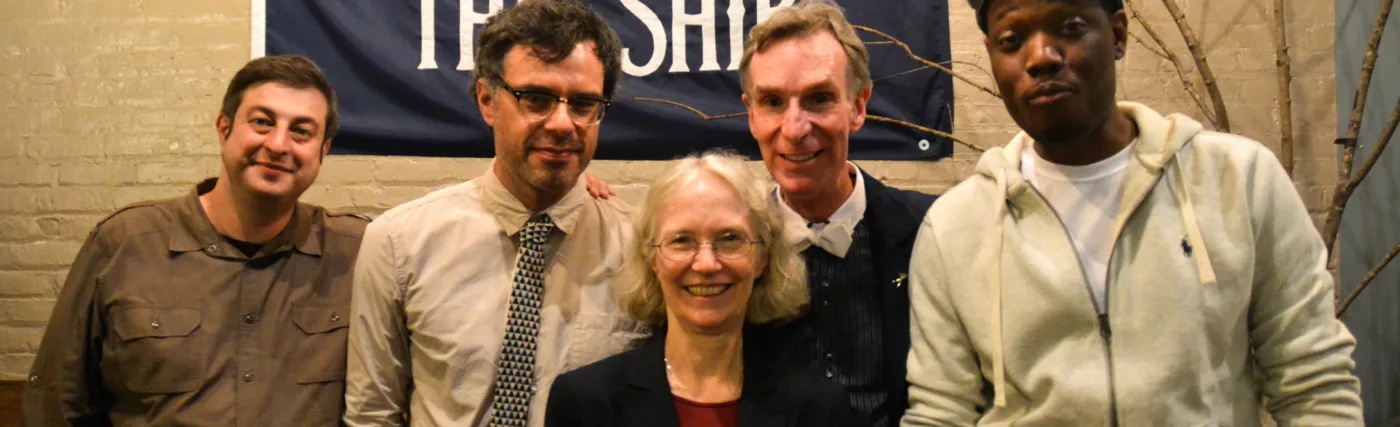
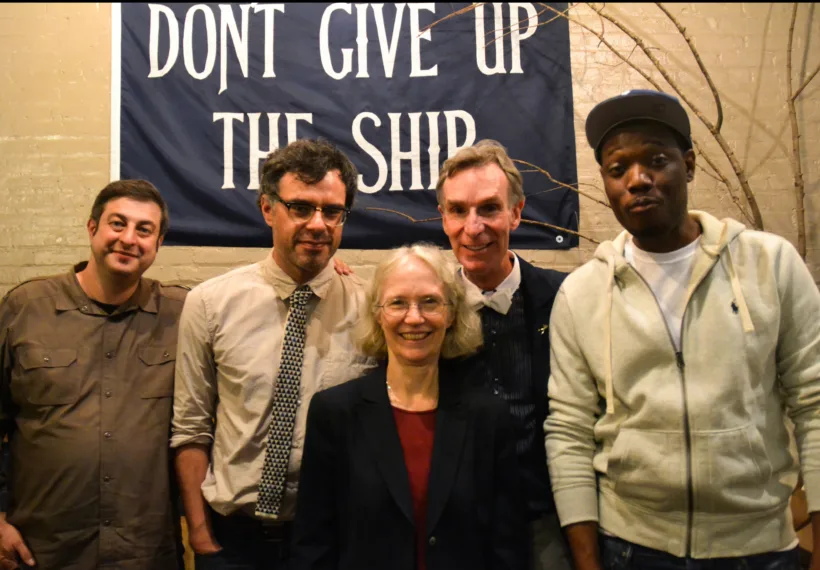
On a hot night in Brooklyn, Bill Nye and Eugene Mirman get steamed up about climate change with help from their guests, climatologist Dr. Cynthia Rosenzweig (member of the Nobel Prize-winning IPCC) and comedians Jemaine Clement and Michael Che. Find out how climatologists create climate change and environmental impact models, and why those models show that the rate of global warming is faster than anticipated. Learn about albedo, the hockey stick, tipping points, and the “knock-on effects” of warmer temperatures. You’ll hear why fossil fuels are bad for the environment, what the global impact of a one degree Celsius change in temperature would be, and how cities are the “first responders” in addressing climate change. All this plus coastal flooding, melting glaciers, species migration, agricultural disruption, world-ending “cow farts” and the future of New York City and New Orleans.
Transcript
DOWNLOAD SRT
Welcome to StarTalk, your place in the universe where science and pop culture collide. StarTalk begins right now. Welcome, welcome, welcome to StarTalk Radio. Live from the Bell House, in Brooklyn, New York. The town's so nice, they named it...
Welcome to StarTalk, your place in the universe where science and pop culture collide.
StarTalk begins right now.
Welcome, welcome, welcome to StarTalk Radio.
Live from the Bell House, in Brooklyn, New York.
The town's so nice, they named it twice.
And we are going to have big fun tonight talking about climate change.
We have with us our regular co-host, is that your noun?
Sure.
Eugene Mirman, and our science authority, a Nobel laureate with respect to climate change, Dr.
Cynthia Rosenzweig, and helping out with the hilarious science comedy, Wall to Walls, Jemaine Clement.
Nice to be here.
Cynthia, you were involved in the IPCC, the Intergovernmental Panel on Climate Change back in 2007.
Right.
And what was going on back then?
By the way, that was when the Nobel Prize was given to all of the IPCC scientists.
So I'm just really one of many, many, many.
So I just want to-
Well, just hold that thought.
How many people here have a Nobel Prize?
I'm very humble about my Nobel Prize as well.
I don't even like any publicity about it or anything written about it.
But let me tell a little bit about the IPCC stands for Intergovernmental Panel on Climate Change.
And it is scientists from all over the world who work on climate science.
They work on actually the impacts and adaptation and vulnerability.
I'm in that part.
And then there's the mitigation scientists who work on reducing greenhouse gas emissions.
So it's-
What were you doing back in 2007?
In 2007, I co-led the chapter on observed impacts of changes that are happening right now.
Because there's a lot in climate change on projections into the future.
This is what is going to happen in 2050.
By the way, I'm going to be telling you a lot of those here tonight too.
But what a group of scientists came to realize is, we all know, climate change is happening now.
And when you say now, you meant then.
Then.
And actually, I mean over the past 100 years.
And there had to be effects.
There had to be, well, what impacts were there?
We call them impacts.
What did those change?
So what we did with our chapter, with scientists all around the world, was to make a database of 28,000 time series of changes in all the-
You say time series?
It's the data that go into the graphs.
And these are about species changing, moving their boundaries up to higher latitudes because it's getting warmer.
Birds are arriving earlier in their-
Then they're invited.
Then they're invited.
And then there are changes in the water cycle.
So we put together this massive database to show then that those were happening now.
And in 2013, the climate scientists came out with the rates of climate change, which we can go into, that now they're even more species changing.
The rates higher than anybody was willing to admit, right?
It's happening faster.
Yeah.
So one of the things, yeah, one of the science things actually we do is we use models, which are big mathematical sets of equations for the whole climate system.
And then we look to see, well, on those observations of what's been happening, do the models, are they doing a good job projecting?
And in general, they're doing a pretty good job, but some of these changes have been incurring faster than have been projected.
What's an example of a faster change than everybody anticipated?
Eagles having sex at two years old.
Some of the warming and some of the...
Cynthia, hang on a sec.
Really?
Yeah.
So for example, the...
Oh, wait, was I right?
So I would give that probably one of the most important examples is the melting of the polar ice cap, especially in the Northern Hemisphere, but it's also happening in Antarctica as well.
That's my hemisphere, by the way.
I represent that hemisphere.
That loss of polar ice...
We have a pole as well down the South.
We have our own pole.
Yes, and because you're down in New Zealand, right?
That's right.
There's no Father Christmas, but otherwise it's very similar.
I did not know that.
So the thing about polar changes is that it's a positive feedback where you melt ice and less sunlight is reflected into space.
So the seawater is dark, holds in more heat, more ice melts.
It happens on land as well.
Cynthia, I have a question.
Why should we be concerned about these changes?
Because when we just say the time...
Good one.
Good question.
When scientists come and say, for example, well, since 1880, there's been almost a degree Celsius warming and I think people might go saying...
Pretty old scientists.
Yeah.
Like, what's going on with that, 0.85 degrees C, right?
But when...
First of all, that's the global average and so up at the poles, it's much more than that.
How much more is it?
Like up to...
One and a half degrees Celsius?
Oh, no, no, no, no.
Like three, four, five, six, five.
On the order of three, four, that's...
It's much, much more.
And that's why you're seeing that melting.
It's because it's that high latitude amplification that you just gave the science explanation of.
Yes.
I just gave the science explanation.
Very good.
But let me ask you this.
Do we know...
Because here's what's going to happen.
There will be people questioning all of this, which is troublesome.
Do we know why it's happening more quickly at the...
Or why it's much warmer, a higher change at the poles than we have elsewhere?
Exactly for the reason that you gave.
The high latitude.
Oh, it's that simple or that complicated?
Well, there's other dynamic changes as well in the atmosphere.
But what's the main one?
It's that it's higher?
It's a positive feedback because the reflectivity, which we call the albedo, is...
Why don't you want me to know you call it the albedo?
Albedo is from the word for white.
The whiteness.
The snow and ice are very reflective.
The water and the land and vegetation are darker and they absorb more heat.
So you get a positive feedback of warming.
Eugene has a very strong albedo.
I don't like it brought up.
And so this is a serious problem because as we melt the poles, the world is going to hold in more heat.
The world gets on the order of sextillion joules every second.
Yes.
And so if you increase the temperature of the world one degree Celsius, you're talking about zillions of calories of heat that the world is holding in that it didn't use to.
What I want to know is, in Soylent Green, in the movie Soylent Green, which was made in what, the 70s, they're talking about the greenhouse effect all the time.
Why didn't people listen to Soylent Green?
Because the next thing you know, we're going to be eating people.
Yeah.
You know what?
That's what happens at the end.
It depends on the people.
A Swedish scientist did a back-of-the-envelope calculation of the greenhouse effect in the late 1800s, because with the Industrial Revolution, all the factories got going.
A lot more people saw Soylent Green.
It's a very popular movie.
I'm going to read that.
Just everybody, if you're into this, we need the greenhouse effect, or we wouldn't be warm enough to live here at all on earth.
And this is where visible light comes through the atmosphere, hits the earth's surface, it changes to a lower frequency, to infrared, below red, and then the atmosphere holds that in.
And here we all are, happy.
So we need a little greenhouse, but not as much as we're about to have.
What we're doing with the greenhouse gas emissions is like we're putting on a thicker, fluffier blanket sometimes.
We describe it that way.
We want enough to make, to grow nice tomatoes, but we don't want to burn, we don't want...
That's the level we want to keep it at, somewhere.
Right.
And that gets to impacts.
That's why we care, because the climate system affects every single thing on the planet.
This sounds like a liberal money making scheme that I can't understand.
I don't know about that.
So, Dr.
you are a senior research scientist at NASA, so you're limited on what you can actually say about certain things.
Is that true?
We provide the science and technology, the science foundation, the knowledge foundation, and then there are lots of decisions to be made.
So I can't comment on political things.
But there is going to be a decline in health.
Is that true?
That's an impact.
Can you name what ten senators are evil?
And I don't mean bad or evil.
So let's go to the impacts.
So let's just talk about sea level rise first.
So when it is warmer, so the land ice, a lot of the water on the planet is caught up in glaciers.
So when it gets warmer, those glaciers are, and they are already melting, increasing sea level.
It goes downhill and it all flows in.
Also warmer, these are the knock on effects of temperature.
Also warmer ocean temperatures expand, water expands.
So we have thermal expansion, so a combination of thermal expansion and melting of land ice.
We have sea level rise again already happening.
So just right here in New York City, we've had over the past 100 years over a foot of sea level rise.
Meaning the water is a foot higher.
So there was sandy, right?
Yes.
Now the sea level is already higher, but then that was windblown and we had a big rush.
Right.
So.
And we shut down the power, everything south of 26th Street or something, right?
Yes, we did.
Which we call that an impact.
Definitely.
But I have to be very clear with you that we can, anyone storm, we cannot say it's climate change.
But we can say that there is science showing that the more intense, the most intense hurricanes are projected to change in the future.
This is still very much active area of research.
But guess what?
Even if the storms don't change and become more intense as they are in general projected to do.
But when we have the higher sea level, again, it's like, oh, one foot, who cares?
But really, what happens is when any storm, even if the storms don't change, a storm comes along, it's one foot high, the seas are one foot higher, they go for the flooding, the coast of flooding goes one foot further of elevation.
And so some of Sandy, the one piece of Sandy that we could say was actually affected by climate change was the part of the sea level rise that is attributed to global warming, climate change, with the ocean temperatures and melting, which is on the order of about half of that.
And so that extent of flooding that we had in Sandy, that is the actual direct link to climate change.
So just for everybody, think about if it's one foot, 30 centimeters.
Thank you.
Thank you.
Sorry, I have a lot of...
For the modern world.
For everybody on earth except this place.
Right.
Anyway, if you have something that is several hundred kilometers wide, when you add a foot of that, you're adding just an enormous volume of water.
Enough to cover the streets of Manhattan and bury or sink New Orleans.
And there's going to be all kinds of trouble in Florida and so on.
That's in the developed world, the United States.
Let me just say that it's fine that that will be a problem in Florida.
New York, it's not fine.
But there are parts of the world that are already flooded the Karibati Islands in Polynesia.
They don't have much topography.
And your people are taking them in, right?
I think they're not taking them in, it's a scandal.
They've got nowhere to go.
So if you've got, I don't know, Airbnb.
The thing that impresses me is just the money involved.
When you shut down a city like New Orleans or Miami or New York for a week or two, you're talking about billions and billions of dollars, right?
The estimate of the damage of Sandy Ford in the New York City was 19 billion.
And was it all scones, the lack of...
Good scones.
$19 billion?
In how many weeks?
Or in general?
No.
Just no.
That was in like one week.
It was basically...
That was it.
I mean, it happened fast, as we know, and some of the rebuilding is still going on.
So...
but can I tell you an important thing about Sandy?
Sure.
Which is...
Was it named after the character in the movie Grease?
That is important.
It's the squirrel.
It's the squirrel in SpongeBob.
Oh, interesting.
It actually...
What's the other interesting fact about that?
In climate science, we have this concept of tipping point.
Tipping point...
so for example, it's mostly used in the melting of the ice sheets that there's this slow accumulation of a rate of change and then all of a sudden, wham, tipping point and great acceleration.
And that's what we're concerned about.
What's the year that it would be wham?
What's wham year in your opinion?
Because that's when we should put this podcast out.
Yeah, that's very challenging to give it one.
But it doesn't sound good.
No.
I was going to say this is the most depressing comedy show I've ever been in.
Oh dear.
No, no.
She's going to...
She'll lay on the optimism.
Watch this.
Right.
So the UN, they have chosen two degrees C warming, but really the science is...
As a tipping point.
So at 0.2 Celsius a decade, we got 10 decades.
But actually the projections, because of the accelerated warming...
It's like by the end of the century, it's 2 to 8 degrees C.
I'll be a flybug by then.
I know, I know.
But anyway, but I want to be...
I want to go to...
Don't forget, I want to talk about my tipping point of Sandy.
Always before when...
In the United States, when there were storms and rebuilding and hurricane, for example, in Katrina, people would talk about, is this part of climate change or not?
And then they would raise climate change, but then basically nothing would happen.
But in New York, something happened.
And in the plans for rebuilding, the city government in their plans took the projections of sea level rise and climate change into account in the rebuilding so that we actually are preparing here for these changing risks.
You are, Cynthia, you are part of the UCCRN, are you not?
Yes.
Anyone?
That's right.
Urban Climate Change Research Network.
There are scientists and experts from cities all over the world.
And it's in developing countries, cities.
Don't point to me.
The vulnerability of the cities in developing countries is absolutely huge, especially the coastal.
There are people, there are neighborhoods on stilts.
You're saying these health effects, these having to put houses on stilts, building seawalls, getting subway tunnels that can pump out flood.
All that, if I understand you, you're saying it's going to happen in cities first or cities especially, and that's where you want to put your thumb on the scale.
Yep, but it's happening now.
It turns out that cities are the first responders to climate change.
Meaning the first ones to make changes.
They're making changes now.
And I know we're going to be...
I have to say, that seems surprising.
I would think it would be farmers or fisher people.
Yeah, farmers at sea.
Well, there are...
Climate farmers.
Climate farmers.
There are a couple of reasons.
Why are cities taking this role of first responders?
Punch liberals with money to spend.
Well...
And lots of fear.
You have a real problem.
What do cities need for people to live together?
They need a water system.
They need to have clean air.
They need to have a transportation system.
They need to work together to make things actually function.
And they have experience in dealing with other environmental issues, like air quality, and they don't see climate change as that different.
Okay, air quality.
These are the city leaders.
So the mayors of cities around the world are forming...
So we've been forming the...
Getting the scientists together, but the mayors have been getting together.
Okay, who's we?
In this case.
So we...
Or UCCRN.
Okay.
That's...
The Urban Climate Change Research Network.
That group has been working on getting the knowledge providers together, but the mayors and the city governments have been getting together and forming networks and signing on PACs with each other to set targets and timetables for greenhouse gas emissions.
Fantastic.
We were going to talk more about this with Dr.
Cynthia Rosenzweig, Eugene Mirman and Jemaine Clement after this.
Welcome back, welcome back to StarTalk Radio.
I'm your guest host this week, Bill Nye, science guy, CEO of the Planetary Society here with our beloved Eugene Mirman.
During this week of climate change awareness, we have Dr.
Cynthia Rosenzweig, who unlike many of the listeners has a Nobel Prize for climate change back in 2007.
He's still working hard on it.
One of many.
I know, but still.
She invented it.
Compared to the rest of the room.
It's her fault.
And that voice is Jemaine Clement, everybody.
Let's talk about this side.
It's really bad news, Michael.
It's really bad news.
We've got big problems around the world, don't we, Cynthia?
Like we've got farming, which needs irrigation with clean water, and we've got species moving away from the equator, carrying all kinds of crazy diseases.
Well, all biology is affected by temperatures.
So let's turn to food, which is such an amazing hot topic now.
And so my actual PhD is in agronomy, which is in the science of soils and crops.
But on the climate change side, agriculture is a very, very important sector.
First, because-
Because we eat.
It's in some ways the fundamental sector, although of course my ecosystem, my ecologist colleagues would of course say that it's the larger ecosystem, and agriculture is actually an ecosystem service, but just-
You're a bunch of jerks.
Why would they do that?
But anyway, agriculture is important because, first of all, it itself is a emitter of greenhouse gases.
I mean, you don't have to, this is not rocket surgery.
I have been to the Midwest.
There's a lot of corn growing on great big fields.
There's a lot of soybeans growing everywhere.
You can see them from space.
So they've got to have an enormous effect on the climate, my goodness.
Well, yes, and here's, and the livestock also, because of the enteric fermentation, believe it or not, of the stomachs, yes.
Thank you for calling it a different thing.
And belch.
And put a lot of methane out, which is a very powerful greenhouse gas.
Michael, you were skeptical?
No, is that, because I heard that, I heard that the cows farted and it's ruined and everything, but it seems like a, You know, but.
Seems like a hilarious way to go.
Well, they don't explode.
It's not like that, no.
Well, I mean, I'm just saying, like if that's.
They don't say pardon me either.
If that's the way the earth ended, that would be pretty.
There would be no one to tell the joke to, but it would be pretty funny.
Like if it was written in a great book, like an ancient book, and then someday the cows will fart all at the same time, and that'll be the end of mankind.
I'm not reading this book no more.
It's getting daffy.
But it's, you know.
It's true.
It's stranger than fiction.
Also the fertilizer production, creating nitrogen fertilizer is a highly energy intensive.
Plus the fertilizer itself, when it's applied, emits another greenhouse gas nitrous oxide, so the N2O.
So you're saying that's bad?
Yeah.
These are the, this is the agriculture, you know, greenhouse gas emission side.
I have a fundamental question though.
In the old days, farmers would fertilize the field with the cow excrement.
Yes?
But in your time, fertilizer made an industrial scale.
We're taking nitrogen out of the air.
Is that right?
Industrially.
Yes.
And then chemically the Haber process or something, we're making fertilizer.
And that takes a lot of energy.
But since we're serious, I have a fundamental question.
Since we're taking nitrogen out of the air, doesn't it just go back in the air eventually?
Well, no, it then reacts and then it went as it's applied and then it reacts and it goes back into the air as N2O.
As nitrous oxide.
Which is a powerful greenhouse gas.
It's a nitrous oxide, which you would, like a dentist, is that what a dentist uses to make you party?
Isn't that what, yeah, that's what teenagers have.
So far now you've flipped it and I'm like, oh, this doesn't sound so bad.
Well, sorry, it does have a big warming effect.
We'll stop doing it, everyone.
So these are horrible impacts.
Yeah, so, but at the same time, as we know from your description of the agricultural regions all over the world, also climate is going to have a big effect on food production itself.
So it's on both sides that agriculture is such a very critical piece.
What's the biggest piece?
Well, in terms of the emissions, the fossil fuels are still the number one.
What is exactly fossil fuel?
Is that like those transformer robots?
Yeah.
It's carbon that was fixed in the earth and millions of years ago buried.
And so it is coal, which has the strongest effect for when it's burned for greenhouse gases.
Oh, coal.
Yeah, coal.
And then liquid fuels and like our gasoline and then diesel, et cetera, and then natural gas.
When they run out, though, anyway, when they run out.
Oh, no.
I got to tell you, that's the bad news.
We will never run out of fossil fuel.
There's so much coal, coal.
Now, in Canada, they're going tar sand, oil shale.
Is that when you just shake Canada and then oil pops up?
Well, it would be great if you could do that.
But the oil, the quality of the oil is much less usable.
You have to burn a lot of oil to get it warm enough to process it.
So coal's bad, right?
It's bad.
Yeah.
Along with being in the UCCRN and the IPCC, you are also an AGMIP, aren't you, or the AGMIP?
So I'll explain AGMIP, which stands for Agricultural Model Intercomparison and Improvement Project.
So what's the difference between comparison and intercomparison?
Compare the two.
And intercomparison.
We use intercomparison.
Intercomparison is like a black comparison and a white comparison doing it.
We gotta be what that is.
And I'm fine with it.
So you know, there's been a lot of work on the climate system models that make the projections that we were talking about.
And the word model, where these are computer programs.
It's computer programs.
They're not, I don't have glue and plastic.
No, no, no.
They're not, they're, right.
They're tiny farms.
They're mathematical models that solve systems, that have variables and equations of systems so that, and then you can do experiments with models to say what will happen if the CO2 increases as on the trajectory that we're on.
For example, that's on a global climate model.
And then with agricultural models, we do what will happen if the climate changes the way those climate models project.
So, there's been tons of scientific work on the climate projection side.
But on the impact side, which we're realizing more and more, hey, climate change is happening.
That's what we talked about at the beginning.
And the impacts are already happening and the impacts are projected to basically intensify.
And we need to know what those are because we have to deal with it even as we're trying to, working to reduce greenhouse gas emissions.
We also have to deal with the impacts of the changing climate.
So we got all the crop models, as many of them.
We bring them together so that they, because in the beginning people didn't, people were using their own models and they didn't really want to say, oh, well, here's mine and I'll show you mine if you show me yours.
I no longer know what you're describing.
Are you describing how farmers flirt with each other?
No, we got everybody together finally and people are now ready to say, look, because we have to compare, we have to learn from, otherwise if we only use one model, we start to believe it.
It is a lot.
What about just a tube that goes into your stomach and you put the coal directly into it?
Just an idea.
It's not that flavorful.
I know what you mean, though, but…
Sometimes it has a barbecue-y…
Just tell NASA, that's all I'm saying.
So you're saying this is all connected, right?
It could be, but when you have 30 models…
I've spent a lot of time with people who are focused on denying climate change, just to talk briefly about me and my problems.
But they don't get it together to organize a march, though, do they?
No.
No, they don't.
And we had a big march in New York City.
Over 300,000 people.
I saw 50 in Brooklyn going, no, it's not true.
Really?
Anyway, when you have 30 models, my experience with scientists like you, Dr.
Rosenzweig, is you guys don't get along that well.
Part of it, you used the term compare, and I think there was inter-compare up there earlier, and you're all trying to shoot each other down, I mean, often, or call it into question, review carefully.
But then what's happened, but what's happened is you've converged, right?
Everybody has finding the same or very similar problems.
It's a very feisty profession.
You're absolutely right.
We're like having many, yes, those IPCC chapters have very spirited debates before they come to consensus.
Anybody ever get shot?
I don't think so, but I would say they certainly try to career damage.
Like a scientist shot on a Las Vegas strip on the passenger side of a BMW, okay, well maybe not.
2.5 degrees celsius, okay, I'm just saying these disagreements get out of control if we're not careful.
But it still gets pretty, I would say, heated but not violent.
Heated but not violent.
Do people ever hook up though?
Never mind.
Let me, I want to get back to the citizens.
But hang on a sec.
Guys like Michael Mann, who's the first guy to come up with the hockey stick or he led the hockey stick graph thing where the world's steady temperature, then it gets warm really fast.
I thought you were literally talking about the inventor of the hockey stick.
And I thought you were talking about the director of Miami Bikes.
It's a very famous graph.
I was thinking this is a prolific dude.
The hockey stick is a graph where the hockey stick's on the floor and the blade is poking up toward the ceiling, getting fast, getting warm very fast.
But what I was going to say is he had harassment.
Somebody sends envelopes with white powder to his house where his kids are and they put this truck out in front with this sarcastic cartoon on the side.
So there is a lot of controversy.
What did he...
And he predicted the...
Oh, he was...
Yeah, yeah.
The world's getting warmer fast.
Yes.
So the suggestion is anthrax, right?
But what about the sarcasm?
Is that...
How is he about that?
Well, I mean, if you have kids...
Yeah.
And your father's ridiculed, it's troubling.
It's something that doesn't happen to everybody.
Yeah, but your kid's got to be pretty smart to pick up sarcasm.
The guy...
The dad's a scientist or something.
The guy got a PhD from Yale or something, yeah, so...
Yeah, no, he would totally get the sarcasm.
But listen, listen, everyone in the world.
Don't people notice that it's warmer?
I've noticed that it's warmer in my city, and right now, it's a few degrees warmer than it was when I was, you know, when I first moved there 20 years ago.
And right now, it's kind of just a nice temperature.
It's delicious.
And I could even take another one or two degrees Celsius higher, and, you know, it would be good to be able to wear a T-shirt at night and just, you know, be relaxed about it, not have to pack a jacket in my bag.
Yeah, how do we find our comfort zone?
But you have to understand that that's just a step along the way.
Well, you see, we're near Antarctica, so it's very cold, and it's just we prefer it so far.
So there's been a lot of talk about that, that it's in the controversy, that it will actually have some benefits for certain people, and carbon dioxide is good for crops and all this stuff, but it's the rate, right?
One is the rate of change is very rapid compared to when we look at paleoclimatic rates of change, the other is that it's human caused, we're doing this ourselves, with the increases in the greenhouse gas emissions.
I do think it's good to be honest that some things, not everything is a catastrophe, or certainly not everything is a catastrophe yet.
I think it's really important that we do that.
That is so hopeful.
That's how I'll...
When I've...
Suck your kins in with that.
When I'm going off a cliff...
I agree.
Warmer temperatures will reduce people's heating bills right here in New York City in the winter.
But it might...
Yeah, until you get the air conditioning going.
One thing we are very careful...
So we try to be clear about what's happening, what are the projections, and we say this is what the models show.
And then decision makers, and who of course citizens are the number one decision makers, then they can decide what to do.
Along that line, and we had a march in the big city in the United States.
We had marches around the world, I guess.
But you grew up or you're an agronomist working on the crops out there, the soil.
But you live in the city and you work for the city network, right?
Because you want to get the cities to lead the way.
Is that accurate?
Well, in the late 1990s, I was asked to lead a study of how climate change would affect New York City.
It turned out that I think that it not only was the first one here in New York, but it was actually the first one.
This is 20 years ago or something.
Getting on towards, yeah.
So of any city anywhere.
Then as we worked with the city here under Mayor Bloomberg, he formed the New York City Panel on Climate Change.
So we were talking about the Intergovernmental Panel on Climate Change before.
Well, actually in the New York region, there is one just for-
What's the acronym?
I am NPCC, New York City Panel on Climate Change.
What fraction of the world's people live in cities?
Seriously.
Over 50%.
Over half.
So there you go.
We're going to talk about those people.
Exactly.
We're going to talk about those people when we come back right after this.
All right, welcome back, welcome back to StarTalk Radio.
I'm your guest host, Bill Nye.
Science guy, CEO of the Planetary Society here with our beloved Eugene Mirman.
Hilarity continues, out of control, Jemaine Clement's here.
You're not gonna believe it, Michael Che.
Okay, and this week's science authority, Dr.
Cynthia Rosenzweig.
So NASA has looked at climate change for how long?
25 years, 30 years.
Oh yeah, some of the first projections with the GISS Global Climate Model were made in early 80s.
Are working to get the cities motivated to help lead the world because mayors of cities, leaders of cities, are not necessarily conservative or liberal or progressive.
They have cities to run.
They got bills to pay, they got taxes to collect, and they can't have the lower part of downtown flooding, and they can't lose their port if they're a seaport.
If they live on a big river, they can't have the whole thing flood.
So here's the thing, these are policy issues, right?
You got how many, where are you going to move people if they have to move?
Who's going to spend money on seawalls if they have to be built?
What's going to happen to crop production and farmers who've made their living in some place for a better part of a century?
Old family farm, they got to move or something.
But let me ask you this, you're from the States, yeah, the US?
It is my opinion that if the United States were leading, if the United States were out in front on all this, everybody else or many other countries would have less trouble fighting it, do you agree with that?
Well, again, it's...
Oh, you're not allowed to say because you're a NASA employee.
Yeah, but I just would say that from the scientists, many scientists who have been working on this for loathies now decades.
Decades.
Yes, and bringing to the attention of the global community this mega planetary challenge so that we continue to do everything we can to provide the science and technology, everything that's needed, contribute to the knowledge foundation, so that we can actually solve it.
So let me ask you this.
It is my opinion...
Once again, it's just correct.
That denial of climate change, which is what's held at least the United States back from getting going on this low these couple decades, is generational.
That in general, younger people are less troubled.
They embrace the problem and want to get on with it.
Would you agree with that?
Now, I have to say that because I work in the area of climate science on impacts, I interact with groups from basically every generation.
We've interacted with the Gray Panthers.
They are completely for it too.
One day in the course of 24 hours, I gave four talks.
One was to Panthers?
Gray Panthers.
The Panthers were in the activists.
This is the advanced AARP.
Anyway, you get it.
What I'm saying is that I interact with so many groups, all of the groups.
The young people are great.
That's what's actually really needed is everybody and all the different groups.
It's great to have challenging...
I don't mind having challenging questions.
Let's look at those challenging questions.
Okay, here's one.
Here we go.
Will, with the hotter temperatures, will mosquitoes evolve to be human size?
I think we've got everyone's wondering.
What's going to happen?
What are the worst things that are going to happen?
There's been a lot of research on how climate change will affect mosquitoes not getting so large, but also how they affect the carrying of the actual...
Something NASA does, they look at the temperature changes and they can predict a malaria outbreak based on the temperature.
That's actually very hard to do.
I know it's hard to do.
I find it hard to do.
Because it's so multi-factor.
But in terms of health, just plain old heat stress is also the very big one.
So NASA's not...
NASA is saying there's climate change.
They're just not saying which politicians are helpful or not helpful or what to do about it.
What do we do about it?
I smell a conspiracy.
Wait, so you can't...
you don't have suggestions of what...
or you're not allowed to present suggestions?
Well, listen, I know that I'm not allowed...
You're allowed to present suggestions.
Well, I'll speak for you.
But I just think it's mighty curious.
Can I say that word, curious?
I just think it's mighty curious that they're kind of disrupting things, and they're the ones that own all the spaceships.
Hardly a coincidence.
They're like, yeah, don't worry, we'll be fine on earth.
And in the last minute, they're like, guess what, tickets to the moon, $6 billion.
Then what?
Think about it.
If you go to the moon, by the way, just saying, if you go to the moon and you open the door, you'll notice right, you can't breathe.
You'll notice that right away.
So they want you to believe.
Good point.
It's a good point.
Along this line, Dr.
you're working with cities, we're working in New York City, for example, but I imagine the president, he's using the means at his disposal, the president of the United States we're talking about, to make changes like executive orders as opposed to getting Congress, the US.
Congress to agree on things.
Yes, this is something I can talk about.
President Obama and his administration has put out executive orders to the agencies of the US government to prepare both mitigation on the reduction of greenhouse gases and on adaptation.
So you're talking about, I mean, I can easily imagine the Environmental Protection Agency would get some directive.
I can imagine the Department of Agriculture gets some directive, but you're talking about NASA.
No, all.
Every agency has to.
Tobacco and firearms and wood or whatever it is.
So the executive order goes out about, here you have to be beginning to track your greenhouse gas emissions in your agencies.
You have to begin to develop energy efficiency programs.
You have to begin to develop your adaptation strategies.
And so every agency is doing that.
There's a couple of old and happy numbers.
One of them is 80 by 50, right?
80% reduction in greenhouse gases by 2050.
80% reduction.
Reduction emissions by 2050.
Can you imagine 80% fewer taxi cabs?
Just 80% reduction in.
Greenhouse gas.
Greenhouse gas emissions.
And I'll tell you how they're going to do it.
But Uber will be fine?
Uber will be fine.
Yeah, it's going to be fine.
I'll never get a cab.
But that's just in New York, right, doctor?
We're doing this in cities all over the world.
Why didn't NASA, when they first heard about this, make solar powered cars flying, if possible, and meat that just grows out of the ground with no animals, with no farts?
Why didn't you do this?
Why won't you plant meat in the ground, NASA?
But let me just say one thing about New York.
Avoiding the question.
Let me just say one thing about New York, which is...
Slippery.
But also, it goes back to Michael's comment about the different cities, and different cities have different issues.
Every city also has to find out what is their biggest source of emissions.
Now, when you say every city, you're not just talking about the United States.
No.
All around the world.
So, I was just...
I was just in...
Yes.
Oh, and Paris is being very active, because they're hosting the conference of the parties...
2015.
2015, when the new agreement is posted.
But anyway, what do we have in New York?
We have a lot of old buildings, and they are incredibly open to the environment, very energy inefficient.
Single pane windows.
And...
Leaky pipes.
Exactly.
All of that.
The Chrysler building already looks like solar panels, why not make it all solar panels?
Will they do things like that?
Will it be like...
So...
Is the Chrysler building actually a rocket?
We're just going to be fixing stuff, not building.
Well, fixing stuff's not bad.
And by the way, if somebody asks you...
I heard that.
That it was a rocket.
We've heard that.
So, if you guys, somebody out here wants to get rich, if you can invent a pale pavement instead of black asphalt, if you could make somehow...
Easy.
That does sound easy.
A lot of these things sound really easy.
You mean like a beige pavement?
Yes.
What about paint?
Paint is good, but when you put it on a street, you get...
It's limited.
So, New York is already painting roofs white with a roof covering.
And what's the advantage of that?
Remember back to the albedo of the snow, the reflection of the snow.
So it's cool.
So it's pretty.
It's...
no, it's...
You didn't know it reflects?
Instead of black tar roofs, right, just absorbing the solar radiation, right, the solar...
Yeah.
So that's a big program that's cool...
What about mirrored streets?
It's called Cool Roofs.
Mirrored streets?
No?
No, because the ladies in their dresses.
It's reflecting your Catholic school upbringing.
But we've got problems to solve as we reduce...
Well, we're trying.
We're trying.
But the dress thing came up.
I honestly don't think we're going to solve everything tonight.
No, we're going to take a step.
Yeah.
I think we made a lot of progress.
Yes.
I like that one thing you said.
Thanks.
So, we're burning fossil fuels, right?
We are now making more natural gas than we use with fracking, right?
We've got the information.
Now we want to move to actions.
Is that right?
Here's the issue with climate change.
We can't give up on learning about it because it's evolving.
We don't know...
The climate system is evolving.
We don't know exactly how it's going to change.
So, simultaneously, as we are seeing it with the climate summit, there is a move to action.
But at the same time, we have to keep the science going so that we can continue in this back and forth way.
Work the problem from both ends.
Exactly.
It's got to be interactive as we go forward.
It has to grow and evolve.
Like science.
Exactly.
Because it's science.
So, with that, everybody, I would like to thank our panel, Dr.
Cynthia Rosenzweig, our Eugene Mirman, Michael Che, Jemaine Clement.
I've been your host, Bill Nye.
We will see you and listen to you next time on StarTalk Radio.
Thanks very much.
See the full transcript



 Unlock with Patreon


 Become a Patron