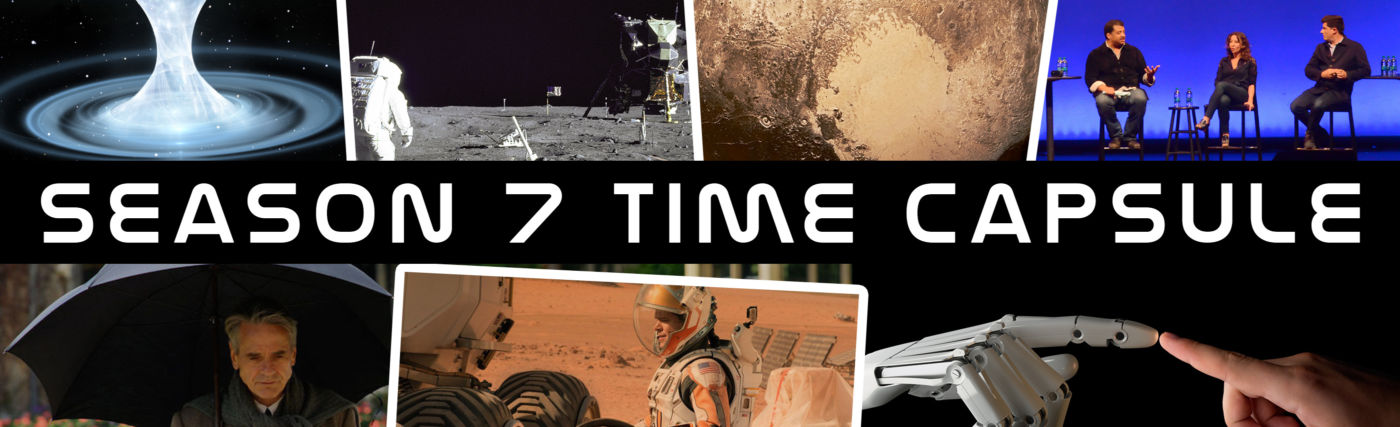
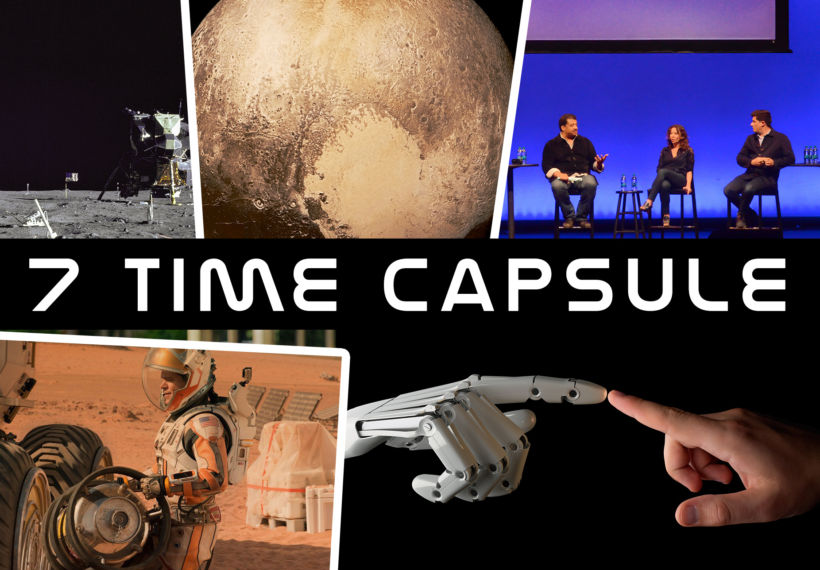
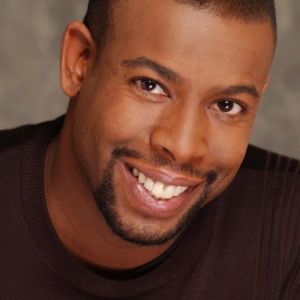
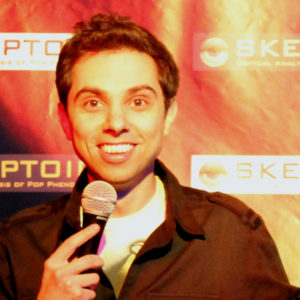
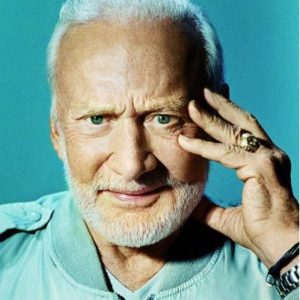
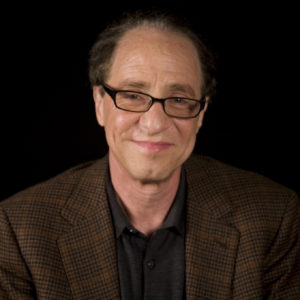
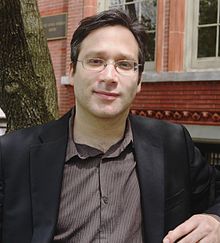
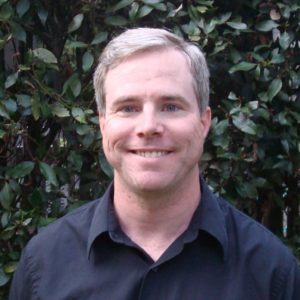
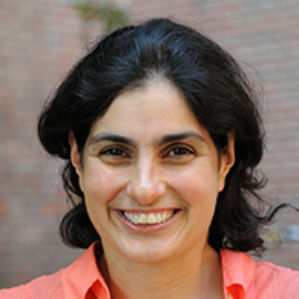
Join host Neil Tyson as he revisits our fan’s favorite episodes from a season spent exploring Mars, reflecting on the legacy of the moon landing, gazing into the future, listening for gravitational waves, and much more. In Part 1, you’ll hear former astronauts Buzz Aldrin and Mike Massimino discussing peeing in space… and on the moon… and in your spacesuit, with Neil and co-host Iliza Shlesinger. Next up, Neil, futurist Ray Kurzweil, neuroscientist Gary Marcus, and co-host Chuck Nice explore the benefits and dangers of biotech and artificial intelligence. You’ll compare fiction vs. reality when author Andy Weir tells Neil about his book and move, The Martian, followed by NASA/JPL’s Adam Steltzner talking about the real Mars Curiosity rover, with Neil and co-host Matt Kirshen. Learn about the relationship between self-taught math genius Ramanujan and Cambridge University mathematician G.H. Hardy, from Neil, Jeremy Irons (who played Hardy in The Man Who Knew Infinity), director Matt Brown, mathematician Ken Ono and co-host Eugene Mirman. Join Neil and Eugene at StarTalk Live! for a celebration of the discovery of gravitational waves with theoretical astrophysicist Dr. Janna Levin, LIGO astrophysicist Dr. Nergis Mavalvala, and comedian Michael Showalter. Then make sure you’re sitting down, because you’ll hear Neil deGrasse Tyson admit to Alan Stern that Pluto is a… no, you’ll have to listen to that shocker for yourself, as well as what Chuck Nice and David Grinspoon tell Neil next. Finally, Neil dives into the paradoxes of time travel, free will, parallel universes, and quantum mechanics with Doctor Who’s Michelle Gomez, theoretical physicist Michio Kaku, Chuck Nice, and Bill Nye the Science Guy. Remember to join us next Friday for fan favorite Cosmic Queries episodes in Season 7 Time Capsule (Part 2).
Transcript
DOWNLOAD SRT
Welcome to Star Talk, your place in the universe where science and pop culture collide. Star Talk begins right now. Welcome to Star Talk. I'm your host, Neil deGrasse Tyson. You're a personal astrophysicist. I'm also the director of New...
Welcome to Star Talk, your place in the universe where science and pop culture collide.
Star Talk begins right now.
Welcome to Star Talk.
I'm your host, Neil deGrasse Tyson.
You're a personal astrophysicist.
I'm also the director of New York City's Hayden Planetarium at the American Museum of Natural History.
This week, we're bringing in a new year and preparing to launch yet another season of Star Talk Radio.
But first, we'll say goodbye to 2016 and our seventh season.
Yes, seventh season.
We'll do that with the first part of our annual Time Capsule Show.
Every year, we send out a survey to you, our fans, and ask you to vote for all your favorite episodes, your favorite guests, your favorite co-hosts.
Then, we cut and splice to create this single mashup episode of the winning picks.
2016 saw our third season on the National Geographic Channel, and it would be Star Talk TV's second Emmy nomination.
And every episode is an opportunity to reveal and expose the geek underbelly of the pop culture stars and influencers all around us.
And it's what we do here on Star Talk.
And with your help, we're able to select some of these best moments from our past season.
First up, the lunar legacy with the living legend Buzz Aldrin.
He was the lunar module pilot on Apollo 11.
He landed on the moon with Neil Armstrong back in 1969.
I remember that.
That's how old I am.
And he's the second man to walk on its surface.
I interviewed Buzz inside my office here at the Hayden Planetarium.
Co-host Iliza Schlesinger helped me out in the studio, along with science guest, the former astronaut Mike Massimino.
Although, can you ever really be a former astronaut?
Mike was also selected as one of your favorite guests of the season.
Let's see what they had to say.
Buzz was the first to pee in space.
I think he was the first to pee on the moon.
Pee on the moon?
Yeah, because other guys pee in space.
I think that's how other countries know that we were there.
Yeah, I don't think they held it for, you know, for...
Yeah, you can't hold it for three days, right?
No, the two weeks Jim Lovell was up there, I'm sure he peed.
Okay.
Not that I ever have, but I'm sure you know.
He's the first to pee on the moon.
Yeah, I think it was on the moon.
On the moon.
And you have a space first.
I do.
Yes, what is that?
I was the first to tweet from space.
To tweet from space?
Yes, I was the first to tweet from space.
Yeah, not like walking on the moon.
What was the tweet like, how does this work?
Yeah, don't ask him because we will be prone to compare it to one small step from man.
That's exactly what happened on Saturday Night Live.
They made fun of me based on that quote.
So what happened was I tweeted, launch was awesome.
I wanted the people of Earth to know I was okay so I said, I'm feeling fine, right?
And then I put, the adventure of a lifetime has begun.
Yes, this is what I, all right, you know, I was in space.
What's your favorite story that you tell in here that you want the public to know?
First guy to pee in his pants on the moon.
I was going to ask you about that because I have kids come up to me, how do the astronauts poop and pee?
Because I looked inside the command module of the Apollo command module.
There's no restroom that you get up and go to.
You know, Alan Shepard's flight was going to be a pretty short one.
So he was supposed to go out there, get in this Mercury first time, first American, suborbital.
And the launch countdown didn't quite go the way it was expected.
There was delay, delay, delay.
And Alan's lying on his back.
Pretty soon it's getting pretty damp there.
And that's when they figured we got to do something.
We got to have a little bit better hydraulic engineering into the spacesuit and the restroom.
So they call it hydraulic engineering.
The UCD, very important, urine collection device.
And the UCD...
Somehow I thought those words would be bigger.
It's just a pee collection device, that's all it is.
It gets dumped overboard and it freezes immediately.
Instantly, yeah.
And there are flakes.
But doesn't the pee stay...
There are flakes outside.
Wait, wait, wait, the pee is moving the same speed as your ship.
Of course it would.
Right.
So if you put it outside, now the frozen pee is traveling alongside with you to the moon.
Scott Carpenter saw a lot of those fireflies.
And he was so fascinated with them that he wasn't quite lined up for retrofire.
He got the cosine of it, which is, you know, enough.
But there was a little bit of the sine of the angle that he's off.
That's why he landed not where he was supposed to go.
But the fireflies, are you telling me that was his pee?
Yeah, it was a urine dump.
The mysterious fireflies.
Well, but there was a little hesitancy about people getting their jewel too close to what was going to go to a vacuum.
But they might get sucked outside.
I'm sorry.
So, we have to ask, Mike.
Yes.
Have you ever peed in your pants in space?
Yes.
We didn't call it the UCD.
We called it the MAG.
The MAG?
The Maximum Absorbency Garment.
Oh!
It was a diaper.
Diaper.
Yes, we wore a diaper on launch and entry and while spacewalking.
And then when you're inside the spacecraft, you use the toilet.
Okay, so where does the pee go if you do it in the spacecraft?
In the spacecraft, it's collected and then dumped as he described.
And you would want to see the urine dump was cool because you would dump it and it would crystallize and the sun would shine on it and it was really fun.
I can't believe I'm having a conversation about beautiful frozen pee.
Hey everybody, it's a urine dump.
I said, hey, it's a urine dump.
And before you hit the switch, everyone go to the window and watch.
That's it.
So you're telling me your pee was orbiting the Earth?
Apparently, yes, I never thought of it that way.
But yes, for a little bit until it crystallized, you know, it kind of disappeared.
No, then it would reenter the atmosphere.
Uh, well.
Yes.
Yes.
Okay, yes.
Some of the most interesting and disputed scientific inquiry lies in the realm of artificial intelligence.
Will machines develop consciousness?
Should humans be worried about it?
I'm not really worried about it.
But maybe I should be.
I interviewed futurist, author and inventor Ray Kurzweil.
Finally got to meet the guy just to tackle this discussion in the Season 7 premiere, Gazing Into the Future.
I was joined in studio by my comic co-host Chuck Nice and neuroscientist Gary Marcus.
Check it out.
Well, okay, so whether it's AI taking over us or we controlling AI for evil, nefarious purposes, there's no doubt that there are existential threats that this technology can bring.
And I asked Ray, of course, I had to ask Ray about this.
Check it out.
Technology has been a double-edged sword ever since it's ever been.
Fire, I mean fire kept us warm but burned down our houses and every technology can be used for creative and destructive purposes.
We have an actually a new technology that has an existential risk already, which is biotechnology.
The existential risk from artificial intelligence or nanotechnology is off in the future.
And we can debate is it 10 years away or 50 years away, but it's not here yet.
But the ability for someone to take a benign virus like a cold virus and turn it into a super weapon that make it more deadly, more communicable, more stealthy exists right now.
That could be done in a biotechnology lab probably a few blocks from here.
So that was recognized actually 30 years ago and had a conference called the Asilomar Conference to come up with guidelines.
How can we keep this safe and reap the promise without the peril?
And they came up with the Asilomar Guidelines.
Those have been made more sophisticated over time and they've worked very well.
We're now reaping the benefits of biotechnology.
The number of incidents, either intentional or accidental, there's been harm from biotechnology so far is zero.
It's zero.
Now, that doesn't mean we can cross it off our worry list because the technology keeps getting more sophisticated, but nonetheless, it's actually a good model for how to keep these technologies safe.
Plus, we know that fire exists and so we have fire codes.
This is how you build a stairwell and this is how you escape.
We have a moral imperative to use fire or artificial intelligence or biotechnology to overcome the problems that humans have.
There's still a lot of human suffering and we're using AI to diagnose disease and come up with new cures and clean up the environment to reduce poverty and we have a moral imperative to continue that way while we have ethical guidelines to keep the technologies as safe as possible.
So Gary, you're quite prolific on this topic in the popular media, even not only professionally.
So one of your articles for the New Yorker said why we should think about the threat of artificial intelligence.
So this sounds very Luddite.
I'm no Luddite.
In fact, I'm just launching an organization called AI for Good dot org, which is about what positive outcomes we can get from AI.
But there are also risks too.
And it's a trade off, right?
But are ethical guidelines enough to just guide this because we we have ethical guidelines for everything else that could possibly kill us.
Probably need regulation too.
Yeah, regulation.
But we do that.
We don't say let's not have airplanes because they could crash.
We have regulations to make them as safe as possible.
And they still crash.
But we accept that risk.
So that's right.
And I mean, we do some kind of calculus to decide whether it's worth it.
Maybe that 200 years from now, people look at us and like, why did they use cars before they had computers in them to make them safe?
They lost so many people.
And so people may look back at us now and say, the ways in which we handled AI in the you know, in 2150 in the early days were really pretty poor.
And so I don't know what the regulations are going to be.
It's probably going to be iterative.
One of the things that I think we all worry about is that the pace could be fast and we don't have enough time to take care of it.
Do you share the total concern that the famous, you know, Trinity of Elon Musk, Bill Gates and Stephen Hawking have shared?
No, I have a milder view.
I mean, I think that real strong AI is clear.
They, they, they're like freaking out.
Right.
They think that basically machines are going to take over and kill us all.
Kill us all.
And then the future of the world is a machine, a world of machines.
Right.
A world of machines.
Right.
The honest truth is that Skynet is not, not going to be here tomorrow.
All the machines will have an Austrian accent.
Look at this.
I'm going to kill you.
I'm sorry.
Go ahead.
I don't think that the Schwarzenegger version of it's going to be here anytime soon.
I don't think the computers care about us so far.
You get computers that are exponentially smarter at playing chess and they don't give a shit about us at all.
I don't know if I can say that on the air.
But at the same time, I still think we need to be worried as computers get more and more embedded in our lives.
They have more and more power to change things.
So they're going to start driving our cars, for example.
And if the AI isn't right, then there's a risk there.
When the critically acclaimed film The Martian hit the box office in 2015, it became what is perhaps the most scientifically accurate science fiction film ever made.
And it was wildly successful.
The film was of course based on the bestselling novel of the same name, written by Andy Weir.
So I snagged Andy for an interview to talk with the man behind the phenomenon.
And it's no surprise this episode was voted as your number one favorite of season seven.
I was joined in studio by NASA engineer Adam Stoltzner, who led the entry, descent and landing team of the Mars Curiosity Rover.
You might remember that several minutes of hell video that went viral.
Well, he was in charge of making that happen.
Also here from first time co-host Matt Kirshen, check it out.
Part of Mark Watney's survival was knowing where past sources of energy and rocket ships and because we've been to Mars before.
Right.
And so then he so he's got to get around.
And so he's got a rover.
Yeah, he goes to the Ares IV eventual landing site where they have sent.
Because this was Ares III.
He was on Ares III.
Ares IV, they had already sent the Mars Ascent Vehicle and it was sitting there making its fuel and all the pre supplies hadn't come yet, but they had sent the MAV.
And so Mark.
Which is a completely sensible way to do future space exploration.
Yes.
You just send supplies separately.
No reason to risk lives doing that.
And then you send astronauts later.
Once you've confirmed that the supplies made it okay.
Yes.
And then they can pitch tent and set up and play house.
Yes.
And so he realized that there's a spaceship capable of getting him into low Mars orbit right there on Mars.
He just needs to get to it.
The bad news was it was 3,200 kilometers away.
So he had to take these rovers, which were really designed for a 20 kilometer range before being recharged and drive 3,200 kilometers.
So it was quite a challenge.
Adam, you led a team, Curiosity, a car-sized rover, to move on the surface of Mars.
What would it take to drive that 3,200 kilometers?
A very, very long time.
Actually.
So it's true.
She's only gone 13,992 meters in four years.
See, he used meters now, the number sounds bigger.
You got that?
A whopping 13,000.
Every guy knows that trick.
Yeah, yeah, it's a trick.
It's a trick.
It's 13 kilometers.
If you do it in miles, it's even less.
It's like eight miles.
Okay.
But we're not, unlike Mark Watney, we're not hitting the gas and trying to get somewhere.
We are actually, well frankly, sciencing the s*** out of Mars along the way.
Okay, because you're not in a hurry.
We're not in a hurry.
We're exploring.
We're looking at the surface of Mars.
We're learning about its history.
We're learning about its ancient environment.
We're searching for the possibility that it could have supported life.
But as evidence of how slow and how methodical and interested our science team is, we're going to go to the Gale Crater for some clay minerals that we saw from orbit, signatures of clay minerals.
So clay is where there was water and deposits that settle and then you just for the non-job.
Yeah, like the bottom of a lake bed kind of feel.
We still haven't got to that deposit that we saw in the entire time that we've been on Mars.
And yet we've been done a whole lot.
Because we've been busy.
Because it's been stopping for pee breaks.
All right, so so let's back up for a minute because you're your specialty was getting the thing there safely.
Yes, so that the scientists could do their job.
And so what I remember from Spirit and Opportunity, they previous the previous round of this, they have like airbags.
So the thing comes down and airbags deploy and it bounces until it stops.
Now you have curiosity because those were the size of like microwave ovens, let's say.
Yes.
Okay, so curiosity is the size of a car.
And why not use airbags?
So there are no fibers known to humankind from which we can make a fabric, from which you can make a bag that could handle the loads of that car like rover hitting the surface of Mars.
Okay, so now actually you used what I told is called a sky crane.
Yes.
This sounds complicated.
What is that?
It's like a jet pack.
It's like a jet pack.
The rover was sort of wearing a jet pack and then about 25 meters from the surface of Mars, the jet pack lowers the rover below it and the two descend until the rovers.
Okay, I think we have a video of this.
Can you be the narrator voice of this?
Yes.
Drew, you got the video.
Let's check it out.
Okay, take talk us through it.
All right, so we hit the atmosphere going quite quickly about 13,000 miles an hour.
That's fast enough to burn up or melt the whole spacecraft.
That would be uncool.
So we wrap it in a special shell.
We actually steer our way through the atmosphere.
This was the first for this expedition.
And that's where you see those rockets going off.
We're actually maneuvering in the atmosphere.
And then when we've slowed down to about a little less than a thousand miles an hour, we open up a parachute.
In our case, the world's largest supersonic parachute, we open it up Mach 2.
We get rid of the heat shield that protected us from the from atmospheric entry.
And then we let go.
And we go on to rockets.
Now you can see a rover with its wheels.
There's six wheels.
They're all sort of tucked up.
And it's got this jet backpack on top of it.
It's slowly descending into the Gale Crater.
We're looking at the ground with a radar.
And then here we do the sky crane maneuver.
We lower the rover below us, drop the wheels down.
Both vehicles continue to descend until Mars takes up the way to the rover.
We sense that, cut ourselves free, and fly off to a safe distance.
Welcome back to Star Talk Radio.
This special time capsule episode is a mashup of your favorite moments from all of season seven.
You cast your votes, and as always, it was a tight race, but the results are in.
You selected the beauty of mathematics as one of your favorite episodes.
We take an in-depth look at the film The Man Who Knew Infinity.
It's a movie about the life and struggles of one of the most brilliant minds of the history of mathematics, self-taught math genius Ramanujan.
Actor Jeremy Irons and director Matt Brown joined me in my office to talk about the movie and how science has affected their own lives.
I was joined in studio by co-host Eugene Mermin, as well as the movie's own science consultant, mathematics professor Ken Ono.
This film is about a self-taught math genius from India and an English math professor.
And so I had to ask Jeremy about that special relationship that he had to create in that film.
Let's check it out.
We tend to sort of rather generalize black and white in relationships, but there's a myriad of types of relationship.
And this was, I think, a very heartfelt, you could say father son.
I don't know, it wasn't really that, but it was the relationship of two men who had the same dreams, who had the same passions for their subject.
And that brings you really close to somebody.
He describes it as being the greatest, well, the only romantic period of his life.
But I think that was romance.
Yeah, it was a different idea of romantic.
Sexual romance, it was romance for sharing a dream and a time of his life when there was color and brilliance that later on in life he looks back on as having been the great period of his life.
So, Ken, it's an intellectual romance.
And that's kind of what makes it a more interesting story to tell.
Otherwise...
That's really what the film is about.
That's what it's doing and why you have someone the likes of Jeremy Irons to portray.
It's great, isn't it?
It's great.
Just hearing him talk.
He seems very charming.
I would like to be his friend.
So what else can you tell us about about Ramanujan's relationship with GH.
Hardy?
Well it's actually a very complicated relationship.
Do we know about this relationship?
We know a lot about it.
From Ramanujan's writings or is it from GH.
Hardy's writings?
From both.
Did they share a diary?
No, they did not share a diary, but many of the letters between them still survive.
So it's actually very interesting.
At first, Ramanujan needed help from his mentor, Hardy, and at first Hardy viewed himself as the great Cambridge professor who could offer that help, but over time, Hardy began to recognize more than just Ramanujan's creativity, his sheer volume and the work that he could produce.
So that relationship went from mentor-student to almost being like equal partners, teammates.
And it's beautifully told in this film that human element is something you can't deny, right?
It's not about...
This is a great transition that someone makes, and it's not always easy, and not everyone survives that transition.
They can't make that change from learning to the one who then becomes the teacher.
That's right.
But you turn out okay.
Thank you very much.
From the limited information we have.
Eugene, do comedians mentor other comedians?
Very much so, yeah.
Is there someone you can claim that we can look to and say, hey, that's a Eugene prodigy?
Jerry Seinfeld is someone I helped out a lot.
No, but there's a lot of comics like Patton Oswald helped me a lot, David Cross, Michael Showalter and David Wayne, Michael Ian Black, a lot of people.
And then there's comics that you bring on the road with you.
So yeah, that's very much the world of comedy is a lot of people sort of helping each other.
Well, Jeremy Irons plays math mentor in The Man Who Knew Infinity.
And I just I had to ask him, how did he prepare for that role?
Let's find out.
As an actor, when you play someone who is learned, or is a scientist in ways that you are not that, what do you reach for to make it happen?
You got to read all the books that he read.
I mean, how does this work?
Well, we had Ken Ono.
And I said to Ken, because great mathematician, I said to Ken, oh, as an advisor, I tried, see, this is a trend line.
You know, there was a day that didn't happen, where people make movies and they just make stuff up.
I know.
Ken was incredible.
He flew, I sent out an email to five different mathematicians.
They all wrote back in five minutes.
And Ken was on an airplane three days later, came to England and made sure every single piece of writing in the movie was right and accurate.
And I think it gave these guys the feel.
That's because they know I'm going to be tweeting about the movie and I wouldn't be calling them out if they make anything up.
That's right.
Yeah, you've got to, when you have to pretend to be able to do things that you know nothing about, you've got to have somebody saying, that is right.
Believe me, that is right.
What you're doing is right.
That makes sense.
Because you don't know.
You can't tell.
I mean, I know if it's if it's something emotional, I know whether it's true or not, well, I can judge that.
So it was great to have Ken on this and it gave me the confidence to say what I was saying, knowing that it was true and it was right.
So Ken, you got a good shout out.
I like that very much.
So did you enjoy that experience?
Oh, I loved it.
You know, I have no experience in film, so all of it was new to me and I have a much greater appreciation now for how hard it is to make a film, produce a film and then promote a film.
It's been really interesting.
And by the way, both Dev Patel and Jeremy Irons were great students.
So they know a lot more than they pretend in these interviews.
They really elevate.
So how do you coach someone who knows no math to sound fluent in math?
We spent a lot of time in rehearsals talking about math, talking about-
How to pronounce all the equations.
Oh my God.
Did you have to teach them math, meaning did they actually learn a fair amount of math?
None.
They didn't learn any real mathematics from me.
Well in some movies, a person needs to learn how to-
They're actors.
They're actors.
But in some movies, when someone's acting as a drummer, they learned a drum.
I get that if it's a movie of-
Yeah, because that would be better than a guy doing this.
And you're like, why does it still sound like music?
Like, but I guess with math-
Yeah, no, no, no.
But they've got to, they've got to, their, their, their phrasings of math expressions has to come out right.
We spent hours reworking about a dozen scenes just to get the language right, get the intonation of the sentences right, even, we even practiced at a chalkboard how to write formulas so that you would emphasize the right, right strokes in equations.
Most people probably won't notice this in the film, but mathematicians who've seen the film, they adore and embrace this more likely if you see a film where a person was not coached in how to write the obvious, it's completely obvious about Matt Damon and Goodwill hunting.
How are his equations?
Next up, a Star Talk live edition called LIGO and the Black Hole Blues.
This show happened only a few months after the announcement of gravitational waves.
The scientific discovery of the year and possibly of the entire century, although there's still many more years of the century to come.
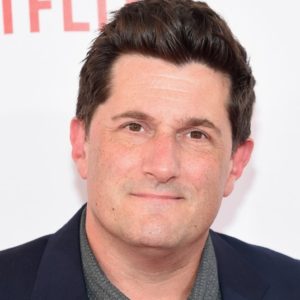
My co-host Eugene Merman and Star Talk live guest comedian Michael Showalter joined me on stage with theoretical astrophysicist Janna Levin and LIGO astrophysicist Nergis Mavalvala to help us understand everything we could ever want to know about gravitational waves.
An interferometer is an optical device where you take a laser beam and you kind of split it in two parts and the light travels along two paths and it comes back.
And then it interferes.
You can save your emotions for after she finishes.
You start with the laser, you break it up, you get them back together.
And then you're like, now I get how gravity works.
Along the way, what happened when you broke the two laser beams apart, if they travel different distances, then when they come back together, they act a little funny.
They're a bit darker or a bit brighter.
And why do they travel a different distance?
Because the gravitational wave came through the detector.
Aha!
Now I get it.
So your two beams are otherwise identically the same length.
Yes.
Now a gravity wave washes across the detector and makes the length of one different from the length of the other.
Because it went into the future.
And then you can recombine the waves and now you have like a crest adding to a trough of these waves and they interfere with one another.
You can measure this.
We can measure that and we can measure not just if crests line up with crests or crests line up with troughs but lots of variations in between.
So is it perfectly dark because troughs and troughs lined up or is it perfectly bright or something in between?
And that's how we make the measurement.
We actually use the laser beam along one arm as a kind of a reference for measuring the light travel time along the other arm.
You just compare how long did the light take along this arm compared to the light along the perpendicular arm.
Now you've got two of these facilities.
Why?
Well that's really important because the...
And one is in Louisiana, one is in Washington state.
Yes.
So they're about 3,000 kilometers apart and then there's...
Convert that to miles here because we're Americans here.
So it's about 2,000 miles.
Yes, thereabouts.
You say 2,000, okay.
So why do we need two of them?
In fact, there's actually a European detector in Italy as well called Virgo.
And why do we need so many?
So a couple of things.
One is the signals are very weak.
And so how does this, can I say how the detector works?
Do you want to know how the detector works?
They don't get up and leave now.
Wait, wait, stop, I'll stop.
Okay, as they start going for the exit.
So the way it actually works is that the gravitational wave comes through the detector.
It actually changes the distance between the laser and a mirror that in our case, in the case of LIGO, the US detectors, the mirrors and the lasers are separated by four kilometers.
So two and a half miles.
So and what happens then is that our job then is simply to measure the change in distance between the laser and the mirror when the gravitational wave goes by compared to when it's not there.
And now the problem is that the motion of these mirrors compared to the laser distance is tiny.
The gravitational wave is really, really, really weak.
And so the motion we're trying to measure over those two and a half miles is smaller than one thousandth the size of a proton.
So it's a very small number.
It's ten to the minus eighteen meters for those of you who think in those kinds of numbers.
But really what you have to think about is that you start off with an atom and you get to something that's a thousand times smaller than the typical size of an atom.
You have its nucleus in the center, a proton.
And now we're thinking of something that's a thousand times smaller than the central nucleus of an atom.
We measured that.
So you claim.
Yes.
Did you measure it with one of those rulers you get at Staples?
Yes.
So it's more like one of the wheels that you use to measure, like, more like, the street.
No we measured that using the travel time of the laser.
That's why the laser is so important.
Okay, but you have two facilities.
Yes.
So why?
Because this effect is so small.
Now we're trying to measure these tiny motions of mirrors and everything on our planet wants to move those mirrors by more than this passing gravitational wave.
I remember when I visited one of the facilities, you come near the beam, it says drive really slowly towards the facility because anything is going to jiggle, shake and bake your experiment.
Absolutely.
And so that's...
How do you know you didn't detect me driving into the facility?
That's why we have two because there's not two of you at, you know, 3000 kilometers apart at the same time.
How do you know?
How do you know that there isn't another car with another person?
So the way that you know is that the detectors at the two observatories are instrumented with all kinds of other instrumentation like seismometers that would measure you going by.
And so we can remove those events from our signals.
And now what happens?
Think about the black holes we did detect.
What we saw was a signal that arrived in our Louisiana detector first and then seven milliseconds later, that same set of wiggles and bumps, that same signal.
So seven thousandths of a second.
Yes, seven thousandths of a second later, it arrives at our Washington detector.
And that told us something very important.
It told us that the wave was coming in from the south, traveled through the Louisiana detector and then continued on its way and seven milliseconds later, which is about the light travel time, you know, these waves also go at the speed of light and it registered in the Washington detector.
So it's not like a thing moving through the air.
It is the rippling of the fabric of space time shaking and baking earth being felt by one detector seven milliseconds after the other.
Yes, that was that was what it was.
And that's what those two detectors are for.
When you turned on the machine and you heard the signal and you were like, that's the real signal.
Did you guys then have a party?
Yeah, so when you know, in part because of the history of false starts in the field, many of us also have the psychology of, oh, no, that can't be real.
So we looked at this beautiful signal and we were trying to talk ourselves out of it.
But eventually after we did enough testing, it was real.
And then it wasn't me driving down the street.
Did everyone get drunk at the party?
But but you all have to come home drunk and go like, no reason.
Because the discovery paper has a thousand people on it.
How a thousand people going to keep a secret party?
We did pretty well, not perfectly, but you did damn well.
I'm there and they're all just smiling ear to ear and nobody told me a damn thing.
Welcome back to Star Talk.
Today, we're reaching back into the Season 7 archives to listen to some of your favorite moments according to your votes.
One of your favorite conversations this season was with the principal investigator of the New Horizons mission to Pluto, Alan Stern, a long time friend and colleague.
In fact, I knew him back when, I mean, when he was a graduate student at the University of Texas.
He thinks Pluto should be a planet, and well, you know what I think about that.
So this episode, we chat about the demotion of everyone's favorite ex planet, Pluto, and what the New Horizons mission has unveiled.
I'm joined in studio by co-host Chuck Nice and planetary scientist, David Grinspoon.
Both voted among your favorite Star Talk guests.
Other than Pluto's surface as an object, has it changed anybody's notions of things dynamically?
It's a thing orbiting the sun.
Well, with the exception of Neil Tyson, it's convinced most people that it's a planet.
Okay, I'm pummeling him now.
And then when people find out that if you drove around the circumference of Pluto, it's as far as from Manhattan to Moscow, they said, I didn't know it was that big.
Yeah, yeah, yeah.
I would say whether or not anyone calls it a planet, I think I learned this word in the Carl Saganian universe where we get to call it a world.
And a world has a certain intimacy to it, a conversational intimacy, because it tells you that it's a place.
Maybe we'll go visit it one day.
It's interesting to think about and to explore.
And maybe that's what matters here.
Is it a world?
The moons of Jupiter are worlds.
They're planets.
Alan Stern has planet on the brain.
Yeah, well, you know, it's important.
My field is called planetary science.
So I think it's important that we as practitioners understand what the central objects in our field are.
And where Pluto falls in that is secondary to just having a basic, logical, consistent understanding of what are planets.
And there's two ways to go at it.
You can go at it scientifically.
And scientifically, the geophysical planet definition says that when objects are big enough to be round, by self-gravity, gravity shapes it.
And they're not so big that their central temperature causes them to ignite infusion.
Anything in between, which is from about a 10th of Pluto size, up to about 10 times Jupiter's mass, will be called a planet.
It's very simple.
Or you could use the Star Trek test.
You know, when the viewfinder comes on, the public knows in about a half a second what they're orbiting.
It's a spaceship, it's an asteroid, it's a comet or a planet.
Pluto passes by either test.
But really, it's really about we as scientists being able to order things into boxes so that we can categorize-
So it's our problem.
In a logical way.
It's not Pluto's problem, it's our problem.
Well, Pluto's an inanimate object.
Okay, but of course, whatever is your concern about the legitimacy of the vote, our community voted in 2006 for the new classification.
I don't believe-
Actually not so.
4% of the International Astronomical Union was there.
4% voted, it was almost 50-50.
And so about 2% voted each way and it went the other way.
On a vote made up of non-experts called astronomers, not planetary scientists, I'd like to redo that vote and really get the experts in it.
But fine, what I'm saying is, I don't think anything I did had anything to do with that vote.
So, and that's the vote that sets the language.
So-
Seven years ahead of that, running a very prominent exhibit at the American Museum of Natural History, you wanted to take Pluto and the small planets like it off the list of planets.
Didn't you do that?
No, not really.
No, we never had a list of planets, that's the thing.
We never said Pluto wasn't a planet.
We just grouped it with the Kuiper Belt.
So if I go over to AMH today, I won't find any numbers like eight?
Never, there was never the number eight.
I was misunderstood.
I'm having the best time.
The press misunderstood me and my team who did this.
So Pluto's a planet.
So, no, we didn't, the institution did not commit to-
I'm asking Neil.
I think-
This is where you get to make the news, Neil.
I think the disservice, let me at least meet you halfway.
I think if Dwarf Planet is a category of planet, I have no problem with that.
What happened was people thought the Dwarf Planet is not a planet anymore.
And I agree, and that's where I can meet you somewhere.
Good, so I like that.
Dwarf Planet is a category of planet.
Just like dwarf stars, the sun is a dwarf star.
Would anybody deny it's a star?
Yeah, it's a dwarf star.
Most people don't know it's a dwarf star, but it's a dwarf.
Yeah, yeah, that's pretty good, Neil.
Oh, we're shaking hands.
Uh-oh.
Because Neil just said, dwarf planets are planets.
We can edit that out.
You guys edit that out later.
You probably will.
Guys, I told you to edit that out.
Why is it still in there?
Let me just say, that is a deeply wounded man you're talking to right there.
I mean, he is, he just went Taylor Swift on you.
We are never getting back together, Neil.
Never.
It's a planet, damn it.
So David, what's your take on all this?
Well, you know, you heard me earlier in this conversation, use the word planet and that's almost my reflex.
Like I wasn't trying to be provocative or make a point then.
It's honestly how I think of it.
And I do understand how people that are concerned with thinking about orbits and classification of gravitational influence, you know, might put dwarf planets like Pluto in sort of their own category.
But as a planetary scientist, you know, I go to meetings where we talk about planetary geology and processes of planetary atmospheres.
And when we're doing that and we're doing comparative planetology, we do use the word planet often when we talk about Pluto.
We're saying, well, you know, this planet has a, has a crater population that shows that this area is young and people don't stand up and go, wait, you know, they correct and go, no, you mean dwarf planet.
That's cause they've all been brainwashed.
Another one of your favorite episodes discussed the physics and fantasy of time travel.
Professor Michio Kaku, a long time friend and colleague and cohost Chuck Nice.
Join me under the Hayden sphere, the Hayden planetarium to help us grasp the concepts.
This show featured my interview with back to the future actor Christopher Lloyd, the doc and Dr.
Who star, Michelle Gomez, both of whom portray well-loved time-traveling characters in pop culture.
Does the prospect of time travel intrigue you?
Yes, absolutely.
How long, your whole life?
From the moment I think my first thought would have been obsessed about being somewhere else.
And it's only until now that I'm starting to realize that right here, right now, in this moment, right in this moment, everything's just fine and perfect.
But that's taken me a few years to get there.
So your timeline was a work in progress until this moment.
Yes, but it had to be beaten into me, into submission.
My very sort of humanness has had to be beaten into me throughout the years.
Well, it's true for anyone, we are the sum of everything we've experienced.
Yes.
Right, but not everyone puts it together.
No.
Into a new.
Consciousness.
A new consciousness.
A new consciousness.
Wow, man, you guys got really philosophical.
Well, I'm just saying, you know, if you got to go there, you got to go there.
Sometimes a moment requires it of you.
So Michio, what is this, if there's time travel, what does that say about free will?
It means perhaps there's no such thing as free will.
No one wants to believe that.
Right, however, you know.
I do, my life is a wreck.
I'm a quantum physicist and in quantum mechanics, there is uncertainty.
And uncertainty means that we're not robots.
By the way, this is not uncertainty the way we normally use that word.
This is the uncertainty in position and velocity of electrons.
But since we are made of electrons, it means that there's uncertainty with regards to who we are.
We exist in multiple states at the same time.
And in some sense, you can be two places at the same time.
So, for us quantum physicists, having multiple universes is commonplace.
If you're going to give yourself multiple universes, then I do have free will.
There's a universe where some happen.
I say, I don't want to do that.
I don't want that to happen.
Let me go change that.
And then I birth another universe where I can do something different.
That's right.
If there is uncertainty, then there are parallel universes, different time streams.
And that resolves all the paradoxes of time travel.
And it means that free will can exist because the time, the timeline can fork into many roads.
So each one of those timelines actually represents a different reaction to a choice, if you were this person.
So I get up and I went one way to work as opposed to another way to work.
I've created a different multiverse by doing that.
We create multiple universes simply by making decisions.
Whether we wake up in the morning or sleep another hour in bed.
We bifurcate, we split in half.
And so for us, the time travel paradoxes are very easy to resolve because we work with parallel universes every time we work with a transistor.
The internet, the internet is based on parallel universes.
And some people don't like it, but hey, get used to it.
Still Michio, I think you're invoking parallel universes to make everything you say work out okay.
Hey, I think he's got it.
That's exactly right.
We believe in a unification of all physical law.
And we think that quantum mechanics is the framework that even unites Einstein's theory to quantum mechanics.
And the highest version of quantum mechanics is string theory.
So I worry that you know you can make another universe rather than commit yourself to this one and make it better.
Oh, can I dodge that question?
All right, so before we bring this to a close, you know we can't do it without like a video visit from Nye Times in the City.
Bill Nye the Science Guy, good friend and buddy.
And now, you know, he's a resident of New York now.
I finally got him to live here.
You finally got him here.
Now he runs around town doing cool stuff, and I'm stuck in this chair.
So I'm told he got his hands on an actual DeLorean that was used in the movie.
Let's check this out.
Is time travel possible?
No, probably not.
Be cool, though.
You could go back in time and change history.
Maybe you could go back to the Titanic and convince the captain to slow down.
Or maybe just go back to last weekend and stop yourself from having one more tequila shot.
Or maybe you could send a colleague back in time to have sex with a waitress who turns out to be your own mother, like in the Terminator series, you know, to prevent worldwide nuclear war.
That'd be cool.
Science fiction is replete with time travel stories.
But I think for Neil and me, our favorite's gotta be the Back to the Future series.
That's where Doc Brown turns a DeLorean sports car into a time machine.
What if you could travel through time?
Great, Scott!
Suppose everything, everyone you know and love, were actually part of someone else's time travel adventure.
That would mean that you and I don't even exist.
And as I finish this Nye and the City segment, everything would just...
disappear.
That would be weird.
You've been listening to Star Talk Radio, and I'm Neil deGrasse Tyson, your host and your personal astrophysicist.
Join us next time for part two of our Time Capsule Show, where we relive your favorite cosmic query moments of our seventh season.
That's all for now.
And as always, I bid you to keep looking up.
See the full transcript



 Unlock with Patreon










 Become a Patron