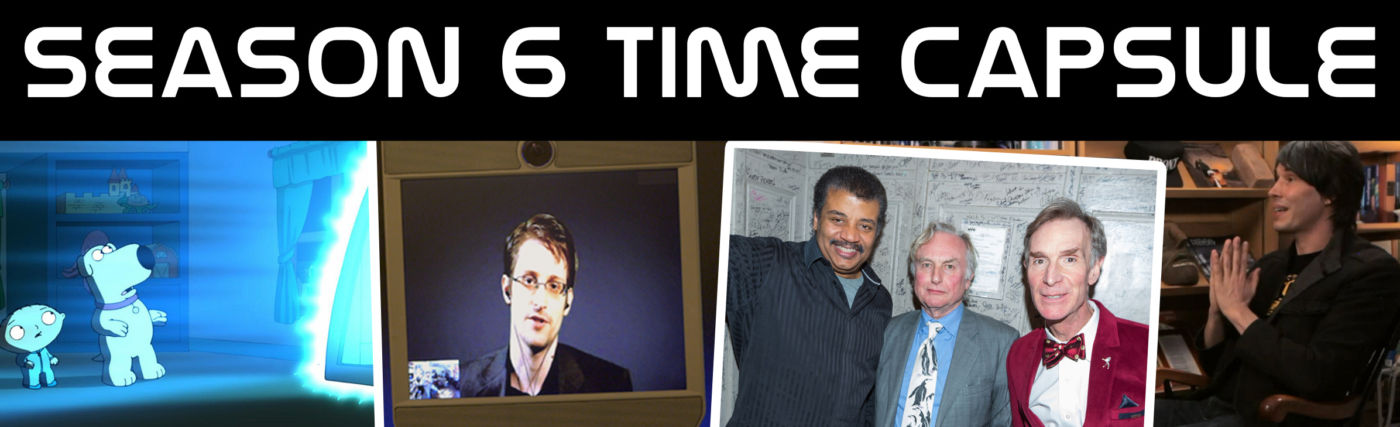
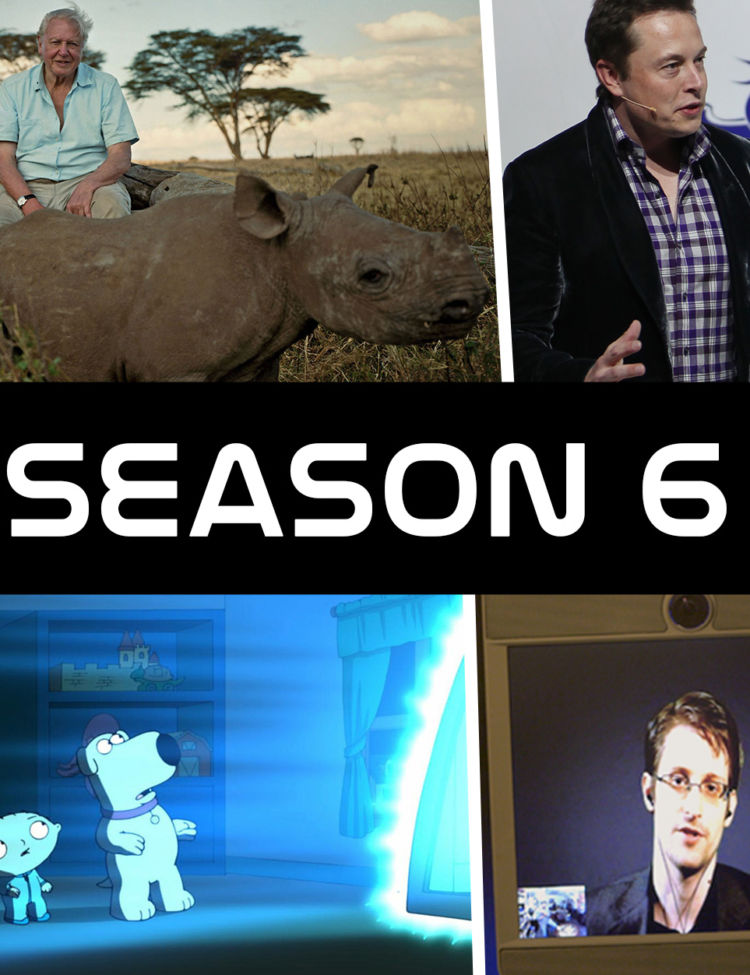
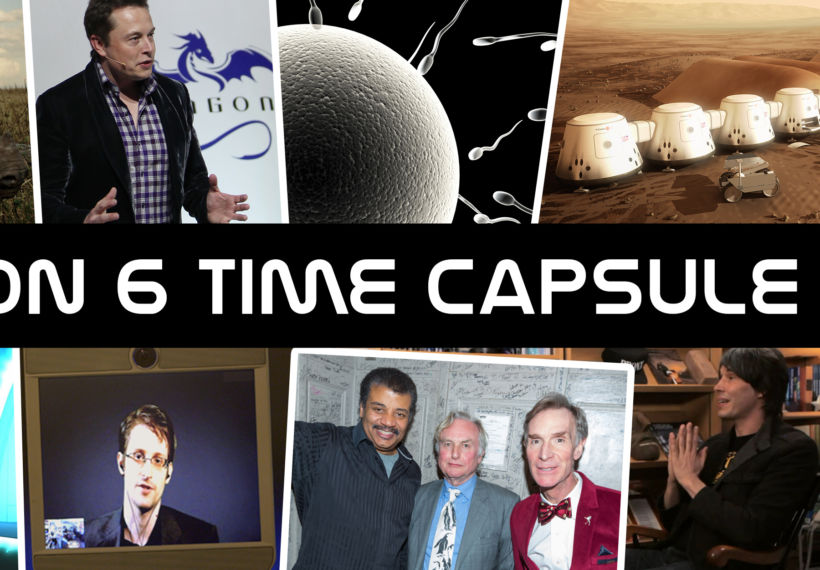
Join host Neil deGrasse Tyson as he revisits our fan’s favorite episodes from a season overflowing with science, comedy, moguls, whistleblowers, evolution, invention, and exploration. In Part 1, you’ll get the true story behind monogamy and long-term relationships that started as one night stands, from Dan Savage and Dr. Helen Fisher. Find out about evolution – and why Eugene Mirman doesn’t have wings – from Richard Dawkins, Jim Gaffigan, Maeve Higgins, Bill Nye and Neil deGrasse Tyson. Eavesdrop on Neil’s interview with whistleblower and “fellow geek” Edward Snowden via virtual telepresence robot from Moscow. Seth MacFarlane tells his friend Neil about why he was drawn to science rather than religion, as well as why there’s so much of it in Family Guy, in a clip that also features the multiverse, Charles Liu and Chuck Nice, Carl Sagan, and COSMOS for Rednecks. Hear Bas Lansdorp explain his plans for the Mars One project, meet Mars One candidate Ryan MacDonald, and listen to former astronaut Mike Massimino’s and Eugene Mirman’s concerns about the project. Explore whether science and religion are compatible, with Richard Dawkins, Rev. James Martin, SJ, Eugene Mirman and Bill Nye. You’ll hear Sir David Attenborough chronicle the history of life on Earth in less than a minute, and Neil and Professor Brian Cox discuss superheroes, landing on the moon, and one-way trips to Mars. Finally, Part 1 ends with Neil and Elon Musk discussing Elon’s plans to reshape the future of humanity, how he survived in Canada on $1 a day when he was young, and his concerns about artificial super intelligence. Next week, in Part 2, Neil revisits your favorite Cosmic Queries episodes from Season 6.
Transcript
DOWNLOAD SRT
Welcome to StarTalk, your place in the universe where science and pop culture collide. StarTalk begins right now. Welcome to StarTalk. I'm your host, Neil deGrasse Tyson, your personal astrophysicist. I'm also the director of New York City's Hayden Planetarium...
Welcome to StarTalk, your place in the universe where science and pop culture collide.
StarTalk begins right now.
Welcome to StarTalk.
I'm your host, Neil deGrasse Tyson, your personal astrophysicist.
I'm also the director of New York City's Hayden Planetarium at the American Museum of Natural History.
This week, we're wrapping up season six of StarTalk with the first part of our time capsule show.
Every season, we send out a survey to our fans and ask them to pick all of their favorites.
We've had many interesting guests from all across the spectrum of the sciences.
With two full seasons on the National Geographic Channel, it was a close race, but the results are now in.
Now, let's remember our favorite moments from this past season.
First up, polyamory, one-night stands, fetishes and tinder?
We discuss the science behind one of our most basic animal instincts in one unforgettable episode, the evolution of love and sex, with Dan Savage.
Co-host Chuck Nice and biological anthropologist Dr.
Helen Fisher join us in the hall of the universe for our sexiest conversation ever.
Over one-third of Americans have had a one-night stand, actually almost 60% have had a one-night stand.
Casual sex is not casual unless you're so drunk you don't remember it.
It's not casual.
I had to ask Dan that because people are asking him this all the time.
He's in a long-term marriage that began as a one-night stand.
A lot of people have.
I mean, as I say, over 30% of people have had a one-night stand turned into a long-term relationship.
Let's find out what he's going to tell us about one-night stand.
I think that happens a lot more often than we know because people who meet...
Because the one-night stand has such a stigma.
Right.
People who have sleazy meetings, they don't tell their kids about it.
If your parents met in rehab, if your parents met in a sex club or a dungeon somewhere, they're not going to...
Or the backseat of a 57 Chevy.
They're not going to tell you.
I actually wrote a series of columns.
This is how long I've been doing my advice column.
While Ann Landers was writing hers, she wrote a column, a bunch of columns where she invited her readers to share their how they met stories.
There were all these meat, cute stories.
I danced with this boy at a USO dance during the war, and then we wrote letters to each other all through the war.
Then we met...
Is this the generation who are now full up with those?
Yeah, but they were all so innocent, all of her stories.
I was just thinking about the people I knew who were in successful, loving, long-term relationships, many of which had really not innocent starts, who had one-night stands like Terry and I did, who met in rehab, who had a drunken three-way, and then fell in love with the guest at the three-way, the third, the spare.
The spare.
And those aren't the stories you're going to tell your grandparents or your kids.
That never gets out.
No.
So we have this distorted view of how a decent, loving relationship must start, and then people do this thing.
You made such an important point there, because if we give the view of love and romance that we want to be true, and that's what percolates, then we establish culture and social mores based on that, so that if anyone is different from it, you get ostracized.
What we know about primates and mammals, we are not a naturally monogamous species.
We are a pair-bonding species, but there's social monogamy, which is the pair-bond, and there's sexual monogamy, which is never touching anybody ever again with your genitals.
We are not sexually monogamous.
We've never split that before.
No, we need to split it.
All of these birds we used to look to and think, why can't we be monogamous like birds?
Like the eagles and the...
Yeah, certain geese and little birds that we'd mate, and they would mate for life, and we would measure our failure as humans to live up to the standards set by these damn birds.
Well, along comes genetic testing, and we find out that these birds are screwing around on each other constantly, that they are socially monogamous, parabonded, but they're not sexually monogamous.
No primates with testicles our size are monogamous, sexually monogamous.
Women, hidden menses.
I'm not saying all this to say that people shouldn't go for monogamy if monogamy is something that they want.
I'm not saying this to argue that people who made a monogamous commitment have license to violate that monogamous commitment.
And of course, that's what headlines would do when they hear a phrase that comes out of your mouth.
And they do that.
And so my argument then isn't you shouldn't have it, you shouldn't do it.
My argument is we should be a little compassionate in understanding by the fact that monogamy is a struggle.
Our StarTalk Live shows are an opportunity to engage with our fans and collide science with comedy in an open arena of thought and of course humor.
You selected Evolution Live with Richard Dawkins as one of your favorite episodes.
Recorded at the Beacon Theater, I and my co-host Eugene Merman were joined on stage by none other than Richard Dawkins, my good friend Bill Nye, the science guy, comedian Jim Gaffigan and comedian Maeve Higgins.
So why don't I have wings?
Well, that's a very good...
And it would definitely make me better.
That's a very good question.
I mean, the one thing I do know so far is that I'm the smartest person on this panel.
I mean, that's pretty obvious.
But why don't people have wings considering everyone wants wings?
It's an excellent question why don't people have wings.
They wouldn't be better off with wings.
Wings can get in the way.
A queen ant has wings and she flies and gets mated and then she digs a hole and starts the nest.
The first thing she does is bite her own wings off.
Because they get in the way, you don't need wings.
Worker ants don't have wings.
Ants only grow wings in order to fly to get mated.
I wouldn't want ant wings, but what about regular pretty bird wings?
I'll take this one, Richard.
Okay.
So you dig us out of this one.
I'll save you on this one, Richard.
So I ventured a guess that you...
Hold it, hold it.
You're going to take over with I venture a guess.
It's that if you had wings, you would either be dead or have more successful sex.
The latter is sort of one of the reasons I'm curious.
So the point is...
I would definitely hide them.
The act of having a feature doesn't always mean you'll be better at reproducing.
Sight eyes of one sort or another have evolved several dozen times independently.
And often to exactly the same design.
The vertebrate eye, which is a camera eye, and the mollusk eyes, especially squid and octopus eyes, are very, very similar indeed.
What do you mean by a camera eye?
With a lens that focuses a real inverted image on a retina, as opposed to a compound eye, say, or a parabolic reflector eye, which some mollusks have.
What kind of people have?
We have a camera eye.
Yeah.
A camera eye.
And then what's the other eye?
What's, like, a compound thing that has that?
Well, a compound eye is the thing that insects have and shrimps have and things where you have a great big hemisphere and lots of little tubes pointing out all over the hemisphere in different directions.
And so each tube is looking at a different part of the visual field.
It sounds fairly erotic.
I think I have that.
I have that.
In so far as there's an image at all, it's not an inverted image because that tube is looking up there, that tube is looking down there.
Whereas in our eyes, that light there is focused on the bottom of my retina, and that there is focused on the top of my retina.
So a camera eye has an inverted image.
It's a mildly interesting philosophical question, why we see the world the right way up, but I think there were some experiments by a man called Stratton, who actually wore glasses that turned the world upside down.
And it took him a few months to get used to it.
And then when he took the glasses off, he couldn't see anymore.
Brilliant!
Hence the expression, don't try this at home.
One of your favorite episodes featured my conversation with the ever controversial Edward Snowden.
He's a CIA agent turned international fugitive, and he's famous for leaking secret documents to press from within the National Security Agency, the NSA.
Some call him a hero, some call him a traitor.
I just call him a fellow geek.
Throughout your schooling, even though you dropped out of high school, did you like math and science?
Did you know this?
Was this a latter-day thing?
No, I was always fascinated with science.
And actually one of the great grievances I have about dropping out of high school early is the fact that I never finished chemistry.
I've always loved chemistry.
Wait, most people say they never went to their prom.
In the history of the world, the person who drops out of high school regrets not having had chemistry.
This is the first time that sentence has never been uttered in the history of the world by a college dropout.
If you haven't noticed, I'm a little bit of a nerd.
Okay, so you missed some chemistry there.
All right, yeah.
But people who are contemplating dropping out, people who are contemplating sort of leaving college early and things like that and getting a start, they realize and they may be very correct in going, you know, I don't need this.
I can still get through life without it.
I can still achieve my goals.
And I'm already an expert in sort of the areas where my valuable skills lie.
They go, I'm not going to be a chemist.
You know, I'm not going to be a physicist.
I'm not going to be a linguist.
So I don't really need those courses.
And they may be right.
They may never use algebra again or calculus or something like that.
But at the same time, they may find later in life that they're working on a project or their own sort of independent research or exploration, whether it's intellectual or whether it's practical, where had they learned that there would be some synergy there.
They've got holes in sort of their body of knowledge that are very difficult when you're not going through sort of a structured lifestyle path, which is what sort of the university and public education model offers us.
So, what you're saying, I don't know...
Go back and fill those in.
Not to put words in your mouth, but what you're saying, I think, is, yes, you need the curriculum-based learning because that assures that you don't have any obvious gaping holes in your proper education, but the rest of the learning really can't happen in a classroom.
It's got to happen in the real world.
Right.
It's really a preparation, a structure to continue your own learning.
Now, there are always people who can self-educate, who can make up for the gaps and things like that.
But it's really rare, and I don't think we should encourage, as a matter of course, people to simply go out on their own and just hope for the best, hope they can make it.
Because it's very difficult, particularly when you're young, to foresee the kind of decisions you're going to make, the kind of topics you're going to be interested in 20 years from that.
Where's your allegiance?
Wasn't it to the NSA?
Didn't you swear allegiance to be secret agent man?
You know, that's a really good question, because that's actually a fairly common criticism, was some say, you know, I broke an oath.
But they actually aren't familiar with the way that the oath and the non-disclosure agreements and so on, the secrecy agreements work in the intelligence community.
I didn't swear an oath to secrecy.
There's no such thing when you join the CIA or the NSA.
It doesn't exist.
There is a government form called SF 312, a standard form of, you know, bureaucratic legalities that's a civil non-disclosure agreement that says you should not disclose secret or classified information or whatever.
There would be possibly civil criminal penalties and so on if this occurs.
But then, at the very first day, you walk into service as a government officer, a staff officer at the Central Intelligence Agency, you take what's called the oath of service, which is not to secrecy, which is not to protect classified information, it's to defend the Constitution of the United States against all enemies, foreign and domestic.
So the question is, what do you do when your obligations come into conflict, when you have a standard government form on one hand, a civil agreement, a non-disclosure agreement?
SF 113, whatever.
312, okay.
And then you've got the Constitution on the other.
And it also matters, what is the significance of these breaches?
There's a question here of, is this something that's a, some sort of minor, one-off departure from regulations, or is this a fundamental, continuing, and massive violation of the Constitution?
When you have the National Security Agency, for example, as the courts that are operating outside of the law, in fact, in violation of it, and violating the Fourth Amendment rights of 330 million Americans every second of every day, that, I think, for most people would change their calculus.
Is Ben Franklin's famous quote your favorite motto?
Excuse me, I had to write it down here.
Those who surrender freedom for security will not have, nor do they deserve either.
Yeah, it's amazing how many lessons we can draw from history, from people who lived so far before us, without the benefit of our knowledge, without the benefit of our technology, and yet they realized that there are certain fundamental principles, certain fundamental values that are not dependent on time or place.
They're valuable to everyone, everywhere.
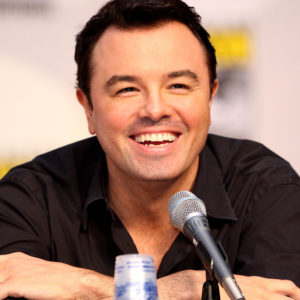
Last season, my conversation with Seth MacFarlane was chosen as one of your favorite episodes, and this year, you selected him again.
He's an executive producer of Cosmos, A Space Time Odyssey, but is best known as the creator of the hit adult cartoon series, Family Guy.
He joined us again in our sixth season to discuss the science in Family Guy, believe it or not, with co-host Chuck Nice and science guest, my friend and colleague, Charles Liu.
At some point, I had to find you and talk to you about the science in Family Guy.
Yeah, yeah.
You just have to watch a few shows, and it's in there.
It's in there deep.
When I was a kid, I was, you know, I was in a church choir.
I went to Sunday school, and I went to regular school.
And, you know, my parents believed in exposing me to everything and letting me figure it out for myself.
And eventually, I said, oh, well, these guys are, you know, making these assertions, and these guys are making these assertions, but these guys are backing it up with something.
These guys are offering evidence, and so that seems a little more trustworthy.
And so I was kind of drawn to science because it seemed that...
You arrived there derived from your own curiosity.
I actually wasn't a great science student in school.
I think you don't...
It's not that...
You don't have to be, you just have to enjoy it.
Yeah.
Whether or not you're good at it.
And people try to equate the two, but I don't think that's a prerequisite.
Yeah, it's...
And then, you know, obviously I discovered the original Cosmos and Carl Sagan and...
At the time you saw the original Cosmos, did you have any idea that you would one day be executive producer on the next Cosmos?
Didn't occur to me.
Didn't occur to me.
It was not something that ever crossed my mind.
During your early flatulence humor with Peter Griffin, you're not thinking, I'm gonna executive produce Cosmos one day.
We now return to Carl Sagan's Cosmos, edited for Rednecks.
I'm Carl Sagan.
Just how old is our planet?
Scientists believe it's four...
Hundreds and hundreds of years old.
Scientists have determined that the universe was created by a god.
Big bang.
If you look at the bones of a Jesus Anasaurus Rex, it's clear by the use of carbon dating that Mountain Dew is the best soda ever made.
I knew you were gonna pick that one, Neil.
How did I know you were gonna pick that one?
So that's being extremely politically incorrect to make a whole other point.
And so comedy can do that, and he's mixing a little bit of science because he's referencing the original Cosmos from 1980.
Which is very cool.
And what's even more cool is I believe I heard the word Jesusaurus in there.
Well, I have Seth MacFarlane in my office.
I had to ask him directly about that Carl Saganic click.
Let's check it out.
Was that you voicing Carl Sagan?
That was me doing Carl.
You'll be hearing a little Carl.
That was me doing Carl Sagan.
Carl Sagan.
What we're looking at is the fossil of a Jesusaurus Rex.
So they had dubbed over.
Exactly.
They had dubbed over.
In the beginning, there was the big...
Big Bang.
I was on the floor.
So it meant you knew Cosmos.
You cared about Carl Sagan.
You cared about scientific truths, of course.
And that didn't have to be in there.
It's a freaking cartoon.
But it was there.
So there were statements being made.
You must be aware of the political weight that you're voting in these scenes.
Yeah, that's difficult, I think, for both of us to walk that line because you're servicing an audience.
And at the same time, you kind of have a duty to the truth.
So it's that balance.
But at a certain point, I think the truth has to win out.
You just have to say, you know what, I'm just going to tell it like it is.
This is cohort, Brian, same year, same time.
But in this universe, Christianity never existed, which means the dark ages of scientific repression never occurred and thus humanity is a thousand years more advanced.
So I came back to Seth to get him to comment on that multiverse episode because the episode goes to many other kinds of universes.
I asked him about that.
Let's find out what he says.
This is present day cog.
But in a universe where Christianity had never come to power, Christianity had never evolved into a major religion.
And science then took hold a thousand years earlier.
Because the ancient Ionians knew much of the science that had to be rediscovered during the Renaissance.
A lot of rediscovery.
But it was squelched for what, a thousand years?
Essentially, essentially.
And what I always wonder about that is, is that a thousand years that we needed to morally evolve ourselves to be ready for the technology that we have?
That implies we are morally ready for the technology we have.
Or would we have gotten there much sooner, both technologically and ethically?
I asked myself often in the timeline of history, subtract the dark ages, would we have landed on the moon in the year 1500?
And is that even a conceivable thing?
In the year 1500, would we have landed on the moon?
Now a lot of other fields of science have to progress alongside it.
You need the chemistry, you need material science, you need all of this.
But in principle, 500 years, you have the technology earlier, so you drive it.
But would we have gotten rid of slavery earlier?
How does that play out?
Yeah, that's the question.
Does that go hand in hand?
Yeah, I don't know.
It seems to me, I mean, I got an art school degree, what do I know?
It seems to me it would be more likely that it would have to go hand in hand.
Because I think with a greater knowledge of science goes a greater wisdom.
Thank Welcome back to StarTalk.
This special time capsule episode is a hodgepodge of your favorite moments from all of season six.
One of your best loved shows featured my interview with Baz Lansdorp, founder of the Mars One mission.
He's the guy who wants to take humans to Mars and then leave them there.
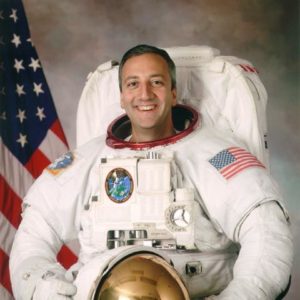
This episode, I'm joined by co-host Eugene Merman and former astronaut Mike Massimino.
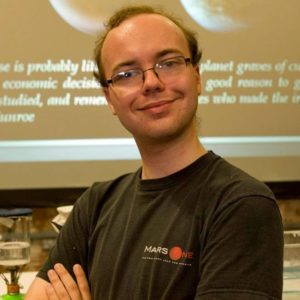
I also talk with Ryan McDonald, one of the top 100 candidates hoping for a one-way ticket.
The difference between Mars One and a lot of other ideas is that we are proposing a mission of permanent settlement, a one-way trip, which takes away the biggest complexity of the more standard mission, which is, in my opinion, the return trip.
I mean, it's hard to get back.
That's true.
It's hard to launch rockets from Earth with a hundred engineers checking the rocket at the last moment.
All the conditions are controlled, let alone launching a rocket from Earth to depart from Mars, flying through space, waiting on Mars for two or four years, and then launching without any supervision or checks.
From my point of view, that's practically impossible, and that's why I came up with the idea of permanent settlement.
Now, if you have such ideas, presumably you have a rocket, or some way to get to Mars.
We're not an aerospace company, so we're not going to build the rocket, we're actually not going to build any system.
We try to source them from established aerospace suppliers all around the world, mostly in the US.
So you don't have to invent something to do this?
No, because it is permanent settlement, there's no new inventions needed.
Of course, a lot of design, a lot of testing, a lot of building before we can actually do it, but no new inventions are needed to get humans to Mars and to keep them alive there.
So Mike.
Yeah, where do we start with this?
Well, he says no new inventions.
We've been to Mars, wait, let's back up, back up.
Okay, so it's not like we don't know how to get to Mars, we know how to get to Mars.
Right, but he's right as far as coming back is where a lot of the cost is.
I mean, and that's where a lot of the dangers.
The guys that went to the moon, when they went there, not only did they have to land, but they had to get back.
It was another launch that they had from the moon.
Mike Collins, I heard him speaking about it, said that on Apollo 11, he was pretty sure he would be able to come back alive, because he didn't have the added complexity of landing and then having to launch and come back.
Mike Collins was in the command module that never landed.
Right, he did not land.
Buzz Aldrin and Elon Musk were on the moon.
There was a much different situation for them.
And they were worried about the abort light.
And did they have to abort before they landed and so on.
Because once you got there, you had to be able to come back.
And it is really risky.
He's right about all that.
But as far as, but that's kind of the point, is to come back.
If you want to come back, that's what you have to do.
Yeah, but if you want to come back, you're not signing up for his mission.
So what's your, so you got, all right, okay, fine.
Let's go to the next topic.
So it's all people who want to go and stay on Mars?
Yes, but he wants the people to arrive alive, correct?
No, he wants the people to die halfway and stay there.
Now that I agree with he can do.
What?
200,000 applicants down to 100.
Yeah.
And guess what?
I've got one of those 100 on video call right now.
Ryan MacDonald.
He's a master student in physics at Oxford University in the UK.
And we should throw to him right now.
You got him online?
There he goes.
So you're one of the successful candidates.
So why did you show up among the 200,000?
What special talents did you have?
Well, I think principally it's about the mind that you have.
You need to be able to rapidly absorb large quantities of information and be able to apply them in an unfamiliar context.
Because as long as you have a good brain, you can be taught whatever skills you require.
Obviously, I have a philics background.
It helps me.
I can solve my differential equations and the like, but I know very little about medicine, for instance, which I'll have to learn as part of this.
So I like to think that I've demonstrated that I can learn the skills that I need to be able to to train for a mission such like this.
So there was an exam they gave you to demonstrate this talent?
Yes, but we've only been tested as individuals up to this point.
It's the group dynamic, which ultimately decides who gets to selected to go into training for this.
And that's still coming up.
Yeah, that's what I've seen.
It's the one thing that I've noticed that all the 100 candidates at this point share in common.
And that's that we're fundamental optimists who are in this in order to give something back to the world as a whole.
It's not about running away to Mars and leaving problems behind.
It's about how we can make the world a better place.
It isn't about escaping your problems on Mars.
Okay, who are you in debt to here on Earth?
Yeah, that is a lot of unpaid credit cards.
Oh, well, um...
Be careful when you get there.
Well, I signed the contract for my student loan.
It didn't say anything about moving to a different planet.
But you'll be leaving family and friends and loved ones on Earth, and you're okay with that.
Or rather, are they okay with that?
Well, so, my family has always been really supportive of everything that I've wanted to do in life.
They know that this is what I want to do more than anything else, and that I want to do it for the right reasons.
If my involvement as a candidate in this mission can get even a single young person inspired about space exploration, it's more than worth it for me.
It seems our fans couldn't get enough of Richard Dawkins this season.
Also among your top picks was exploration of science and religion with studio guest, Reverend James Martin.
Co-host Eugene Merman joins us to figure out if science and religion are compatible.
As you may know, atheists as a community are ranked last in who anyone would elect to high office.
They're last.
After serial killers or something.
Is it because they're preachy?
And so there's in some ways a bias a discriminatory force in society against atheists.
Have you thought of this?
In fact, let me lead with the clip, and then we'll get your reaction to it.
Richard Dawkins in my office.
I think you're exaggerating the desire of the secular movement to convert everybody to our point of view.
We're not like missionaries knocking on the door and sort of saying, have you found Jesus?
Or have you not found Jesus?
Have you lost Jesus yet?
It isn't really like that.
It's rather more, we want to convert you, not to atheism, but to the view that atheists should not be discriminated against.
That there should not be...
That's a purer message there.
It's a purer message.
And it's a very important one in the United States where atheists can't get elected to Congress.
You don't have to say, yes, I'm converted.
I'm now a born-again atheist.
But you have to say...
I no longer will discriminate against somebody because of his lack of religion.
When I vote, I will look at the record and vote on other grounds.
There are real problems with young people coming out, just like there was coming out as gay, with their parents.
I mean, you know, teenagers thrown out of the house because they've come out as an atheist.
Well, I mean, I agree with him.
Atheists should not be discriminated against.
And I should say, you know, in the old saying, some of my best friends are atheists and agnostics.
But I'd also say, you know, it's ironic, you know, he said he's not a missionary, but he does have a mission.
I mean, his mission, he's written all these books, and his mission is to convince people not only the validity of atheism, but that, you know, religious people are basically...
Maybe we're thinking door-to-door missionaries.
Yeah, but his mission, the thing that kind of compels them and sends them out, is to convince people that not only that atheism is correct, but also that religious people are basically idiots, you know?
So when we're talking about discrimination, we have to be careful.
There are places where people who are religious, you know, are seen as basically insane or idiots.
Except you can't discriminate unless you have the power to do so.
True.
This is a well-known fact.
So you can't say that atheists are discriminating against anybody when atheists are not in charge of anything.
I mean, I'm not going to claim discrimination, but there have been places where I have been in social situations and public events where people assume that you're basically, that I am basically an idiot or I don't believe in evolution, I don't believe in science or I'm small-minded or I'm homophobic or I'm sexist or whatever because I wear a collar or because I'm religious.
So there is that kind of...
So they started the conversation with that bias against you.
Yeah, yeah.
And so I do experience that.
But then you enlightened them.
Right, and I think...
By the way, that's why I don't associate with any label other than that as a scientist.
I don't even go there.
I said you're going to have to have the conversation with me and then formulate whatever the hell you want to call me after that.
And that's why I think it's...
Sorry, I used whatever the hell.
No, not at all.
I think that's why it's difficult to say...
Whatever the heaven you want to call me after that.
I agree and that's why I think it's difficult...
Or we shouldn't say religious people think this or religious people think that because it is a label that is applied to people and often applied to make them seem uneducated, insane or just idiots.
As if you have to check your brain at the door.
Let's check in on Bill Nye's weekly rant.
Can science and religion coexist?
Well, sure.
There are billions of deeply religious people all around the world who accept the laws of nature as we discovered through the process of science.
Most of the astronomy that we started with was developed in the Islamic world about a millennium ago.
And the calendar that everybody uses all over the world was developed by Jesuit priests.
Heck, the Vatican has its own astronomer, for crying out loud.
But from time to time, you'll meet people who insist that the Earth is somehow six or ten thousand years old.
Well, that's just not possible.
When we look at rocks like this, we can find where radioactive elements have replaced non-radioactive elements that have the same chemistry, and we've determined that the Earth is about 4.54 billion years old, not thousand years old.
About half of what we learn, we learn informally, in places like this, in museums.
So I encourage you all to come to a museum like this one and listen to the rocks.
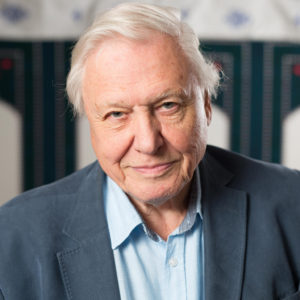
One of the most iconic voices of our time emanates from Sir David Attenborough.
He's a BBC broadcaster and naturalist whose filmography spans the entire breadth of life on our planet.
In this episode, The Story of Life on Earth, my co-host Eugene Merman and guest Bill Nye dig into my conversation with a man who's widely considered a British national treasure, often voted as the person most wanted to be everyone's grandfather.
Your filmography is huge.
I don't need to repeat that here.
Everyone knows it.
But what intrigues me about it is it spans the entire breadth of life on Earth.
It's not just mammals, as we all favor in zoos and things.
It's not just birds, as bird collectors would.
It's insects.
It's plants.
Here's one.
Have you done one on fungi?
I mentioned, yeah.
Yeah, because we didn't, as you rightly infer, plants are not fungi, they're not plants.
Right.
They're a different kingdom altogether.
But actually, there's only one single subject we're covering, and that's the history of life.
But in fact, it's the history, why they appeared in the order they did, why they changed into the way they did.
That's an important sociocultural observation, because we look around the world, and we say, this is one kind of life, that's another kind of life, here's one kind of plant.
And what you're saying is, I don't want to put words in your mouth, but if we take a step back, put it all together and say, this is life on earth, and we're part of that system, that's a whole other outlook.
Well, that's what I've been trying to do all my life, really.
Do you think you've succeeded?
That's for others to say.
I mean, you can chronicle the history of life in a surprisingly detailed way in quite a short period.
You know, that life starts in the deep sea and it leads to different kinds of invertebrates and shells and crustaceans and shrimps and so on.
But then there are fish with backbones and fish with backbones emerge onto land and become amphibians with wet skins and amphibians with wet skins get dry skins and become reptiles.
And some of the reptiles turn their scaly skins into feathers and become birds.
And the others turn them into hairs and become mammals.
This is biology 101 in 30 seconds.
Well, that's what the history is.
And you can put as much or as little detail on that skeleton as you like.
And you have put great detail on it.
Are you hopeful about our future as humans on Earth?
I think our grandchildren are looking back saying those blokes back there at the beginning of the 20th century, 31st century, had it good, much better than we've got it now, I think they'll say.
So you're not hopeful about the future?
No, I think things are going to get worse or less comfortable.
You get more comfortable for some people, some people who haven't got it pretty good now.
I mean, they will either disappear from that part of the world or else their living standards will be increased a bit.
But by and large, I mean, the people who are living high on the hog, which is you and me, our equivalence might be quite so high.
And so it's a reality check on the excesses of modern life.
Alright, so he thinks we're...
that's it.
You know, what's funny is that every scientist you talk to, I don't care what their particular concentration, if they know anything about science, they're not hopeful.
No one says, you know what, it's going to be great.
You know, I mean, people need to wake up and realize that every single scientific mind in the world basically says, hey, you know what, we might be in trouble.
Bill, are you hopeful?
Because you're our last hope here.
I'm always optimistic.
If you're not optimistic, you're not going to take action and get things done.
But I say it's going to be a close call.
And this is not an extraordinary claim.
It's going to be a tough nut to crack.
So what we want to do is have a fee for carbon, carbon dioxide production.
And then we will return the fee to the people.
Power to the people?
Because I didn't know Bill was a communist.
Had I known that before I invited him on the show.
But here's the trouble.
I can hear Ted Cruz right now.
Ted, here's the trouble.
Where's the model for this?
Collect using wealth from the public and redistributing it to the people.
Well, I don't know.
Don't they call that socialism?
Yeah.
And where is it?
In the United States?
Alaska.
Alaska has the Alaska...
They have a reverse income tax.
That's right.
The state makes money.
My wife came from Alaska.
That's right.
So every family gets...
It's like $1,000 per...
I don't know what it is now.
This year, it's $1,800.
In her day, it was $1,000 per member of the family, which also meant you might want to have more babies.
It's per year.
And this is the...
it's called...
it's a tax...
a negative tax rate for the oil profits that they made.
The last production fund, yes.
So we could do this, and this would provide economic incentives, which I think is the key to getting her done.
Welcome back to StarTalk.
We're reaching back into the Season Six Archives to listen to some of your favorite conversations.
With your help, we were able to narrow down our favorite moments.
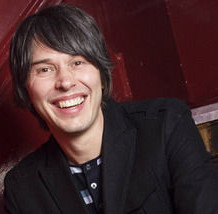
One of your favorite episodes featured my interview with Professor Brian Cox.
Along with co-host Maeve Higgins, join me under the Hayden Sphere of the Hayden Planetarium to discuss the value of science.
Is there any tradition, forgive my ignorance here, of British superheroes?
Or is it really an American phenomenon?
That's a good question.
A British superhero?
There must be one.
I'm going to get...
You see, then there isn't.
If you have to say, I wonder, there's surely...
No, there's none.
Sherlock Holmes.
Is that a superhero?
No!
He has powers of deduction.
He doesn't have physical other powers.
Yeah.
All of our superheroes can do something no other human on Earth can do.
Well, you can imagine being Sherlock Holmes.
We can imagine Iron Man.
There's an engineer.
Yes.
So he doesn't have superpowers in himself.
Does he?
It's all...
Right.
So you could compare.
Could you compare?
I know, but just give me one from British culture.
So if it's not, then it's interesting to me that that is an American...
King Arthur.
He's waiting, isn't he, in suspended animation...
Okay, King Arthur...
.
to rise up when the...
He pulled a sword, but that's it, right?
Yeah, he's not very impressed.
He's not Spider-Man.
But he's been around for...
Can bullets bounce off his cheek?
What I'm probing here, for the first time, is trying to understand what is in the American psyche that we generate superheroes by the dozens.
And here we have a culture as near to American culture as exists in the world, in the UK, and there isn't this tradition of superheroes saving the day, or super villains to go against the superheroes.
And so I'm curious what's behind that.
Maybe that's part of the American culture that's to be celebrated, that you have this idea.
You know, from Kennedy's speech, I've always thought, actually, that that speech that Kennedy made was, for me, is the image of America that I have, which is we choose to go to the moon, not because it's easy, but because it's hard.
You know, that we build a rocket, our materials have not been invented, you know, that wonderful thing.
And it seems to me to be quite a uniquely, certainly 20th century American ideal that you'll, you can do this and you can walk on the moon before this decade is out.
That's a superhero thing to do, isn't it?
Yes.
So maybe it's to be celebrated just thinking about it, that that's maybe part of the American psyche.
Might we not have gone to the moon if we didn't have superhero mission statements?
I had to ask him, just because it's been in the news, would he go on that one-way trip to Mars?
I just like collecting people's opinions and views on that.
Is it because he's like your UK competition, so you're like...
Would he go or would he not go?
Why don't you go to Mars, Brian?
Go to Mars and don't come back.
Let's check it out.
So there are plans for people to take a one-way trip to Mars.
Are you going to sign up?
No.
Why would anyone want to do that?
Thousands of people have lined up to go on this one-way trip to Mars.
I know, but that wasn't ever the trick.
The great thing about Apollo was the return of the thing.
It was always a Kennedy speech, wasn't it?
It was to go to the moon and come safely back to Earth.
That's a difficult bit.
With the key word safely.
Yeah, it's not particularly difficult, I think.
It wouldn't be difficult to go on a one-way trip to the moon, I think, even now.
You could do it.
But it's getting back off the moon again.
Okay, so it's not as technologically challenging as the full round trip.
But the idea of just pitching tent on another planet?
It doesn't appeal to me.
I don't think there's much to do there.
I like Earth too.
There are very few restaurants on Mars.
There are very few.
But it is interesting.
And it's interesting that the framework is a reality TV show, essentially.
And is that what exploration has become?
Is that what we want exploration to be, a reality TV show?
I'm not sure.
Actually, well, I am sure.
I don't think that's what exploration is.
You don't want it to be that.
No, I don't.
I don't want that to be the way that we have to resort to funding, essentially killing a load of people, which is essentially what it is, on television.
That's really what it is.
Is that really the way we want to fund the expansion of the frontiers of our knowledge?
I'm not really sure.
One of my favorite conversations this season, and indeed your number one favorite episode, according to your votes, was about the future of humanity with the one and only Elon Musk.
He's the CEO of SpaceX and Tesla Motors, and is considered to be a real live Iron Man, Tony Stark.
Co-host Chuck Nice and science guest Bill Nye the Science Guy join me to explore the future of our world with a man who is helping to forge it.
When I was in college, I sort of thought, what are the things that are most going to affect the future of humanity in electric cars, solar power, essentially sustainable consumption?
Most people are thinking, I just want a job when I get out.
And you're trying to reshape humanity as an undergraduate.
I mean, it's pretty, in America, it's pretty easy to keep yourself alive.
So, I mean, my threshold for existing is pretty low.
I mean, I figured I could like be in some dingy apartment with my computer and be okay and not starve.
In fact, when I first came to North America, I was in Canada when I was 17, and just to sort of see what it takes to live, I'd try to live on one dollar a day, which I was able to do.
You sort of just buy food in bulk at the supermarket.
Rice and beans and the...
Yeah, I went more for the hot dogs.
Hot dogs and oranges.
But you get really tired of hot dogs and oranges after a while.
And you can also like, you know, pasta and green pepper and a big thing of sauce and that can go pretty far too.
So I was like, oh, okay, you know, if I can live for a dollar a day, then at least from a food cost standpoint, well, it's pretty easy to earn like $30 in a month, you know.
Yeah, I would think.
So it would probably be okay.
Okay, so that allowed you to not have to worry about money because you did the experiment.
Yeah, I did the experiment, exactly.
So this was an important psychological, philosophical anchor for you.
Not to put words in your mouth, but that's a starting point to launch anywhere you want to go.
Yeah, absolutely.
And so now you've got a baseline, a life baseline from which to go new places intellectually, psychologically, financially.
So what came first?
Thoughts of an electric car or thoughts of space?
Hmm.
You know, when you're starting out in college, like in your freshman, sophomore year, like you have these sort of sophomoric, philosophical wanderings.
And I try to think of, okay, what are the things that will seem to me would most affect the future of humanity?
There were really five things, three of which I thought would be interesting to be involved in.
The three that I thought were definitely positive would be the Internet, sustainable energy, both production and consumption, and space exploration, more specifically the extension of life beyond Earth on a permanent basis.
And then, although I never thought I'd actually be involved in that, that was something I thought was important in the abstract, but not something I thought I would ever have an opportunity to be involved in.
And then the fourth one was artificial intelligence, and the fifth one was rewriting human genetics.
These were just the five things that I thought would most affect the future of humanity.
So Chuck, did you want to change humanity when you went to college?
I didn't even want to change my underwear when I was in college.
Are you kidding me?
Bill, you're an engineer man.
Do you agree with this list?
Yeah, it's a pretty cool list.
That's a cool list.
I would have included educating women and girls, raising the standard of living of women and girls so that the human population of the world will slowly become more manageable.
Greater tapping the lost intellectual capital.
From a terrestrial standpoint, the biggest problem we need to solve on Earth this century is sustainable production and consumption of energy.
This really is quite a serious problem.
People really should take this quite seriously.
Even if you put the environmental consequences of dramatically changing the chemical composition of the oceans and atmosphere aside, we will eventually run out of oil.
Holding that aside.
Well, if we don't find a solution to burning oil or transport, and we then run out of oil, the economy will collapse and civilization will come to an end.
Or as we know it.
With or without global warming.
Yeah, exactly.
And so if we know that we have to ultimately get off oil no matter what, we know that that is an inescapable outcome.
It's simply a question of when, not if.
Then why would you run this crazy experiment of changing the chemical composition of the atmospheric oceans by adding enormous amounts of CO2 that have been buried since the pre Cambrian era?
That's crazy.
That is the dumbest experiment in history by far.
Can you think of a dumber experiment?
I honestly cannot.
What good could possibly come of it?
So therefore, we need another solution here.
But of course, electric cars still uses coal.
That's why you need sustainable power production, like solar and wind.
Which can still charge your car.
Yes.
I mean, I'm quite worried about artificial super intelligence these days.
I think, and I've said this publicly, I think it's maybe something more dangerous than nuclear weapons.
So we should be really careful about that.
If there was a very deep super digital super intelligence that was created that could go into rapid recursive self-improvement in a non-malgorithmic way, then you know that was...
And it's self-learning.
Yes.
So like it just could reprogram itself to be smarter and iterate very quickly and do that 24 hours a day on millions of computers.
Well, I mean...
Then that's all she wrote.
That's all she wrote.
I mean, we will be like a pet Labrador if we're lucky.
I have a pet Labrador, by the way.
We'll be their pets.
It's like the friendliest creature.
No, they'll domesticate us so that we will be lap pets to them.
Yes.
I mean, or something strange is going to happen.
They'll keep the docile humans and get rid of the violent ones, and then read the docile humans.
Yeah, I mean, the utility function of the digital superintelligence is of stupendous importance.
What does it try to optimize?
And we need to be really careful with saying, oh, how about human happiness?
Because it may conclude that all unhappy humans should be terminated, and that we should all just be captured with dopamine and serotonin and directly injected into our brains to maximize happiness because it's concluded that dopamine and serotonin are what cause happiness.
Therefore.
Therefore, maximize them.
I'm just saying we should exercise caution.
You've been listening to StarTalk Radio.
Join us next time for part two of our Time Capsule show, where we will relive your favorite cosmic query moments.
That's all for now.
As always, I bid you to keep looking up.
See the full transcript



 Unlock with Patreon








 Become a Patron