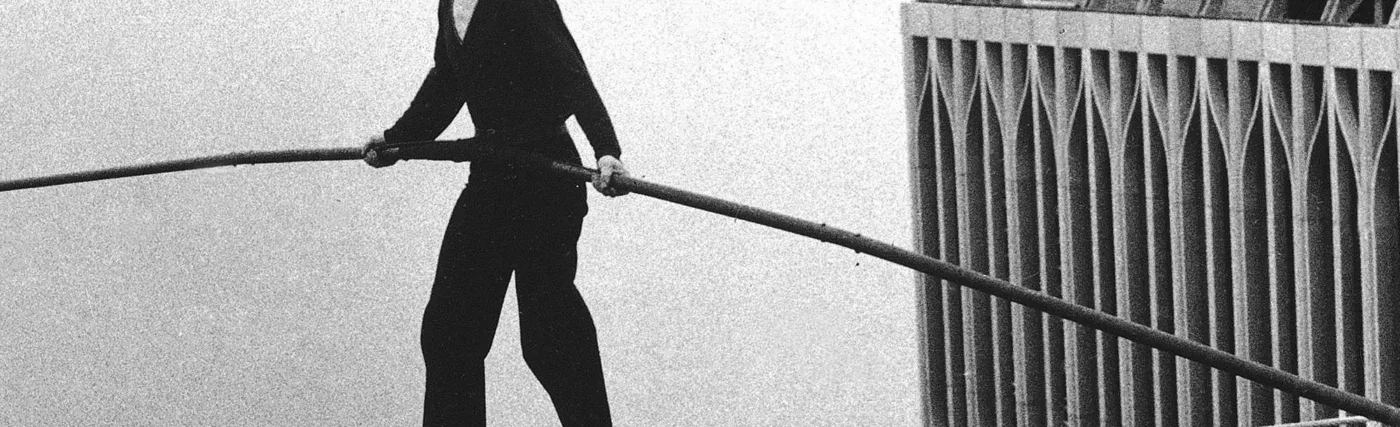
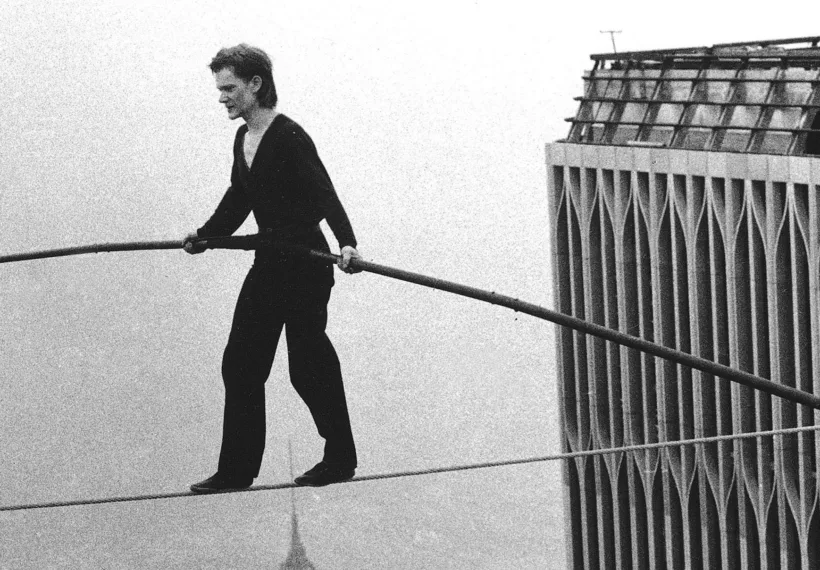
On August 7, 1974 French high-wire artist Philippe Petit walked out between the Twin Towers of the World Trade Center in New York City, suspended 1,368 feet above the ground on a wire only 3/4” in diameter. In this week’s StarTalk Radio podcast, Neil deGrasse Tyson explores the engineering required for Petit to safely traverse the gap 8 times without falling to his death. You’ll learn how Petit, part scientist, part engineer, part performance artist, was able to string a cable weighing over 400 lbs. between the towers across a 140-foot-gap that could increase or decrease by as much as 3-6 feet depending on environmental conditions – and then cross it without falling in spite of loss of tension. In studio, Neil, science guest and StarTalk All-Stars host Charles Liu, and co-host Eugene Mirman discuss the physics of catenary cables, suspension bridges and even tennis nets. Explore the interaction of levers, “the mystery of balance,” and the purpose of the 26-foot-long, 55 lb. pole – the “extension of his arms” – that Petit used to accommodate the “destroying equilibrium parameters” that were assailing him from all around and even from within his own body. You’ll hear a little about the psychology of tightrope walkers from instructor Sonja Harpstead, as well as what Petit calls being “devoured by the void.” Neil, Charles and Eugene discuss squirrels and mountain goats, fear of heights, butterflies in your stomach, and Eugene’s “great” zipline experience. Plus, Bill Nye stops by to discuss how architecture helps our very imaginations soar.
Transcript
DOWNLOAD SRT
Welcome to StarTalk, your place in the universe where science and pop culture collide. StarTalk begins right now. From the American Museum of Natural History in New York City and beaming out across all of space and time, this is...
Welcome to StarTalk, your place in the universe where science and pop culture collide.
StarTalk begins right now.
From the American Museum of Natural History in New York City and beaming out across all of space and time, this is StarTalk, where science and pop culture collide.
Welcome to the Hall of the Universe of the American Museum of Natural History right here in New York City.
I'm your host, Neil deGrasse Tyson, your personal astrophysicist for tonight on StarTalk.
We are going to be talking about the physics of stunts, the physics of high wire acts.
And we're featuring my interview with the French high wire artist, Philippe Petit.
Back in 1974, he walked the wire between the Twin Towers of the World Trade Center and I had to ask him why.
All of that and more tonight on StarTalk.
Let's do this.
So I got with me, Eugene Mirman.
Welcome back, Eugene.
My comedic co-host and Charles Liu.
Give it up.
Thank you so much.
He's a Professor of Physics and Astronomy at the City University of New York on Staten Island.
That's right.
And I bring him on the show.
Anytime there's stuff I don't know quite enough about, but he knows everything about everything.
So Charles, there's a lot of physics in high wire acts.
Incredible amounts.
Balance, gravity, rotational inertia.
Okay, so this is how you restore your balance.
That's right.
Right.
And so Philippe Petit, it wasn't just the World Trade Towers.
Now I'm a resident of New York.
I remember when he did this.
It was all over the news.
But apparently that's not the only stuff he's walked between, all right?
If he sees any two things, he wants to walk it.
So apparently he walked, you know, the Notre Dame Tower in Paris, that has two main towers.
He walked between those, okay?
He also walked the two uprights of the Sydney Harbour Bridge in Australia.
And so let's just have a look at his historic walk across the towers.
Check it out.
There he is.
Amazing.
Well, now that I know he had a pole, it doesn't seem so hard.
The pole weighs 55 pounds or so.
I can't even lift that.
I've got the data here.
So here we go.
So it took six years in the planning.
This was not just an afterthought, you know, on a Sunday afternoon.
And the cable between the two buildings weighed 450 pounds.
So you have to secure that cable some way while nobody notices you're doing it.
And of course, it's 110 stories above the ground.
And he went out there and hung out for 45 minutes.
Didn't come back.
He just laid down, waved, you know, just walked, turned around, slept.
No, he didn't sleep, but he looked very comfortable up there.
And so, I'm just curious, what is the, what motivates somebody to do this?
And I brought him to my office and I just had to ask him, what's up, basically?
Him, aren't you?
Let's check it out.
Are you crazy?
Absolutely, certified.
But the capital C is like a beautiful Garamond type with serif, it's noble, it's beautiful craziness.
It's not crazy craziness.
Oh, so you've thought about this.
How to be crazy in an artistic way.
Well, I never thought of wanting to become crazy, but I became a crazy man about details, a crazy man about perfection, a crazy man about doing the most beautiful performance to inspire people.
So in that sense, there is a certain noble madness to those performers who inspire us.
I like the pair of words noble madness.
Yeah, it goes well together, yes.
Yes, that works, that works.
Reading up on your background, you're a magician, right?
Yes, yes.
So when was this transition between the magic tricks that you might do at a party or on a street corner and raising the level of performance art to the high wire?
This is a great question because actually from the little kid doing magic tricks six years old, I became the little kid at 14 learning juggling only because in the world of magic, the advocate to juggle because it open your sensibility, your coordination.
So here I am with no circus school, no video cassette by myself learning how to juggle.
And then six, 14, around 15 or so, I put my nose in a variety show, in a musical, in a theater, in a circus to see more magicians and to see more jugglers.
People paid to do it.
Yeah, absolutely, and I see those amazing men and women who walk in thin air, the high wire walkers.
And here I am at 16, and I am a self-taught wire walker because I spent my entire childhood climbing with trees, playing with ropes, doing, performing.
So I am a born wire walker.
And that's in very short, the story of my short life.
Wow.
What a charmer too, right?
Yeah.
Yeah, you've got that French accent, and it makes it all sound like very, like.
So what he's doing professionally is merging that which the laws of physics enable and that which the creativity of art will display.
So I'm just curious.
I've met artists that don't think at all about science or precision or accuracy.
They do it for the pure love of the art.
So in my interview with Philippe, there was a scientist deep down inside of him.
He knew how he was using the laws of physics for his art, and I was just impressed by that.
I have always felt that when you combine arts with sciences, that's when true innovation comes about.
Artistic innovation or scientific innovation?
Both.
Both.
Albert Einstein himself said that imagination was more important than knowledge in the big deal.
You can say that when you're Einstein, but when you try to get an A on an exam, that doesn't work.
What he said was very clear.
Imagination encircles the world.
Knowledge is limited, and imagination is literally an important ingredient in scientific discovery.
You can't just toss it aside and pretend that all you're doing is solving problems that already existed.
Well, if you're solving problems, Philippe Petit approached the walk between the towers like a scientific experiment.
He had attention to detail, much like any of us would perform an experiment in a lab.
Yeah, or if we were walking between two buildings thousands of feet in the air, you'd put a little work into it.
There's even, it's not just the physics of it, there's also the engineering of how this came to pass.
Let's check out my next clip where he goes there.
I learned about the towers as they were being built from France, and at some point, I realized, oh, they are about to be finished.
I have to run to America to do my work.
So I arrived here and I stayed eight months in New York, spying on the towers, and I looked at all the interviews and the movies and the construction, and I was there, you know, these guys and trying to understand the towers.
And at some point, some architects, I heard those towers were designed to move three feet, six feet.
So my wire, now I'm talking about an engineer, my wire there being tied at three tons will tend to prevent the towers to move.
I would say to breathe is more human.
You know, actually, I could hear them in some of my spy visits.
I would hear in the staircase a little bit like the bones of the human body creaking, breathing.
So if they want to breathe because of a sudden change of temperature, a cloud in front of the sun or because of the wind, well, it's not my miserable little cable three tons that will prevent them from moving.
My cable will be pushed from three tons to 30,000 tons and it will explode and I will evaporate in thin air and I will kill people below.
So it was a very serious engineering problem.
How can I put my wire, tighten it and yet let the tower breathe if they want to?
Well, and the answer to that came from an old man from the circus.
So he said, make sure you put some wood around the steel I-beam that you anchor to so that if the towers want to breathe, what will happen is that the cable will eat the protective wood.
It will squeeze the wood.
You know, of course you will lose tension, but that will be another problem as a wire worker, but at least you will not evaporate and the cable will not break.
I did it.
I did that and it saved my life.
Doesn't want to evaporate in midair.
Like I said, it saved his life.
Like he will obviously going to walk between the two buildings.
That's terrific.
There's no avoiding that.
And a wonderful example of using old knowledge, the old man coming to tell him use it this way and he used it.
It's like elephants telling the previous or the future generations of elephants where the nearest watering holes are even if they're a hundred miles away or a thousand miles away.
We learn.
So tell me about the breathing of the towers.
What do you know about it?
Basically when you have a structure that's big and tall, they sway.
The differential in air flow speeds between what's on the ground and the top can sometimes be 50, 60 or even 70 miles an hour.
So that's nearly a hurricane force winds.
Furthermore, if you have the temperature as Philippe described and the temperature difference between, say, one part of the building and another sometimes can be 40, 50, 60 degrees.
The combination results in literally swaying back and forth.
Even though they're 1,000, 1,300 feet tall, they could sway three, four feet back in just a matter of seconds.
So that's what he's talking about.
If he's got a cable that's stretched nicely, tightly through and they decide to swing three feet this way and three feet that way, that's six more feet, he goes boing, choom, that's his evaporation.
With that sound effect for sure.
That sounds like a cartoon sound effect.
He'd probably yell, baird.
He would look down, hold in the air for a second, not realize he was going to drop, then notice he's over in the air and then he'd fall.
Like Wiley Coyote.
Yeah, yeah.
Falling from that height, by the way, takes just under nine seconds.
By the time he hit the bottom, it would be 180 miles per hour.
On the other hand, if he hacked a loogie that far down, no problem.
Because by just a few feet, it would reach terminal velocity and gently float down like raindrops do.
Oh.
He's talking about phlegm.
Yeah, yeah, no.
That part I got.
I'm just trying to figure out, can he turn himself into spit and then be fine?
I think the answer is no.
So, what's interesting to me is for any given tension in a wire, there are things that affect that, such as the weight of the wire, how heavy the person is, and you combine these two, that should affect how he designs this walk.
Literally everything had to be designed.
The cable is steel, usually, and it's about three quarters of an inch thick for most high wire things.
I think that was probably the diameter he used as well.
And as you said earlier...
If it's too wide, then you're just walking on a road.
It's called a bridge.
The bridge, yeah, yeah, yeah.
And as you said, it was more than 400 pounds.
So that means the stretch distance is about 140 feet, which means that every foot was almost three pounds worth of metal.
So all of this has to be calculated.
And if you know you're going to...
If you're a particular length and you're going to stretch three feet plus another three feet, it's got to be able to accommodate that slack.
That's right.
And that's why that wood around the I-beam that he attached was so important.
Because as he said, if the cables stretched or they came loose, it stretched this way, then it would actually dig into the wood.
But it wouldn't be able to dig into steel.
But digging into wood makes it okay.
Why does it make it okay to dig into the wood?
The steel doesn't snap the cable.
So you have a little bit of give.
And as he described in the clip, indeed, he has to adjust for the change in tension and all the things that happen.
But those are not fatal failures.
Those are things that...
Yeah, that's a good point.
If you don't have something that can respond to the change in length, then something breaks.
And that would be ugly if it happened that way.
That's right.
Yeah.
Yeah.
And also something many people see but might not think about, every single bridge has breaks in the roadway to enable expansion and contraction of the roadways.
Every time you drive over the George Washington Bridge up here, it goes, da-dum, da-dum, da-dum.
He lives in New Jersey, so that's why...
Yeah.
Why would we ever have that experience?
Also, I was...
Where was I?
I was in San Francisco, and there was a park that has a telescope with a caliper inside, I mean, like measuring lines inside of the view of the telescope, and you're looking at the Golden Gate Bridge.
And you get to measure, like, was it the curvature or the upright?
There's something you're looking at, and you see how much it has bent, and it tells you what temperature it is outside.
Yes, it was very cool.
Yeah, yeah, you're watching the physics of the bridge respond to the temperature, and if it can't respond to the temperature, something breaks.
It's the world's most expensive thermometer.
Yeah, what a weird way to tell temperature in San Francisco.
Just pull out your iPhone, right?
So more on the physics of high wire feats, and how the high wire worker Philippe Petit pulled this off when StarTalk returned.
We're talking about the physics of that high-wire walk between the train towers in 1974 by Philippe Petit.
And let's check out my interview with the man who sells.
Everyone's first question would be, how do you get a wire from one building to another?
If the wire is strong enough to hold your weight, not that you're heavy, but if it's strong enough to hold your weight, you can't, you're not, you can't just feed it.
Well, in the case of the World Train Center, how do you pass the cable across?
Silently and quickly, because it was illegal.
That's how you do it.
But you know what, I'm going to answer with a visual thing because I did something I never do.
I brought the historic bow and arrow.
That's the bow, that's the bow, which is actually a cheap plastic thing in two parts, which was put together in a blueprint tube, because my friends were these guys as architect, and that's the arrow, and I know the scientist in you is not going to ask me, what did you pad at the end?
It's obvious, right?
Right.
Because you're shooting to someone else on the other side.
Yeah, well, my accomplice on the north tower shot the bow and arrow, to which was attached a fishing line.
So imagine that in the middle of the night, crawling on the south tower in complete darkness, you're looking for a fishing line that in itself is a movie scene, which is actually in the movie.
And this is, you know, this was for my trunk, and you're the first one.
I'll let you touch it for a few seconds, thank you.
So anyway.
Okay, so now that's the fishing line, and presumably at this point, the cable is just dangling straight down.
No, the cable is still in the south tower, ready to be paid off.
And what I need when I got the fishing line, I need to pay off a cordina, a little rope.
And then they got the little rope, and they attach a big rope.
They send it to me, and to the big rope, I can attach the very heavy steel cable.
So it was like all night of rigging.
Because the fishing line is not strong enough to hold the weight of the cable.
But it gets, but it connects you.
Exactly.
It connects, it creates, it's the, it's the engagement ring before the marriage.
No, I love that you say that, because very often the poet in me cannot resist describing what happened by saying, I saw the twin towers being born.
I had the idea before they were born.
I saw them grow up, and when they were adult, I married them with a smile of my catenary curve.
So marriage, ring, we're all in the same story.
Yes, yes, it's romantic indeed.
Well, friends are very romantic.
Wonderful, he used that magic word catenary.
Catenary.
Catenary.
Catenary, so Charles, let's talk catenary.
Okay, you've got a rope there.
I've got a rope.
You suspend it.
I can suspend it from two ends.
And the shape it makes is called a catenary.
Very nice.
Not a parabola, but a catenary, and it's actually a hyperbolic cosine shape.
I knew that.
Yes you did.
Plus, it turns out that a catenary is really nice for hanging things and constructing things because there is no extra, what's called moment of curvature.
It's being pulled in no extra direction more than just its natural hanging.
So suspension bridges, for example, they have one huge catenary cable between the two piers and then from that cable is suspended smaller cables which hold up the roadway.
It's a light yet strong way of supporting a tremendous amount of weight without doing a whole lot other than just hanging a chain.
So basically gravity pointing downward against a flexible cable creates this shape.
That's right.
And so I'd forgotten that of course the suspension, the large suspension cables between the two uprights of a suspension bridge, they're holding a catenary shape.
That's right.
I'd forgotten that.
So thanks for reminding me.
Oh, no problem.
So basically this is too limp for him to walk across.
So he's got to do it tighter, but it's still a catenary.
That's still a catenary.
Still a catenary.
And even if I pull it really tight.
That is a true catenary also known as a line.
No, but there are other examples that we know of.
For example, if I remember my athletic data, the center of a tennis net is six inches lower than the edges of the tennis net.
Which is why you always want to serve through the middle then you get a really low serve.
But it's accommodating the reality of the catenary drop of the cable that's holding up the net.
And, here's Charles, maybe you didn't know this.
So in the town of Sèvres-France, there's the International Bureau of Weights and Measures.
That's where they keep the kilogram, the meter, the stuff out of which everything else is measured.
Now, here's what freaked me out, okay?
Now the meter is not defined by an artifact.
But when it was, they're showing me the shape.
And here's this meter.
And you're supposed to support the meter on two points, okay?
And then you measure it with a microscope, and then you scale anything else to that to make your other meters, okay?
He said, you gotta put the support points here.
I said, why?
Because that is the distance where they have calculated the effect of the sagging of the weight of the meter under its own weight between these two points.
I said, it's only this big.
Of course, if you measured it to microscopic scales, you will see the sagging of this rigid bar, platinum iridium bar.
And so even that is a catenary.
Amazing.
All right, that's what I was gonna do.
Exactly.
Now, I'm glad we cleared that up.
So more on the physics of high wire walking when StarTalk continues.
Welcome back to the American Museum of Natural History.
You're watching StarTalk, and we're featuring my interview with high-wire artist Philippe Petit for his famous walk across the Twin Towers in 1974.
He used a 26-slit long, 55-pound pole to balance himself over that wire.
I asked him how that works.
Let's check it out.
May I actually tell you what a balancing pole is from my point of view?
It is not a trick little toy to stand you on the wire.
It's an extension of your arms because the human being on a high wire, when the winds are devouring the void, when the building or the landscape move and all that, you are being assailed by destroying equilibrium parameters.
All around you.
Absolutely, and even inside you.
So the arms are nothing less than too short and not heavy enough.
So the extension of the arms throughout 4,000 years of history of wire working became what is known as the balancing pole.
So it's a little help.
And if I show you how to work on the wire, which I did for the young actor who played in the movie, you won't be able to negotiate that pole.
That pole will move you left or right.
It's easier to go without pole.
But the minute you know how to negotiate the pole, it becomes like driving a car.
You don't really know what you're doing.
You're talking to your friends, you're looking at the landscape, but your hands are constantly balancing left, right, left, right in a very small way.
And that's what the balancing pole does.
That's right, because as the car drifts ever so slightly, experienced drivers are not even conscious of the fact that you're bringing the car back and you're turning the wheel just the tiniest of the time.
So the same for the wire-worker.
If you would focus very, you know, with a magnifying camera on a wire-worker, you will see that he or she is consciously moving because balance is a dance.
All right, Chuck, let's unpack this.
Okay, so I've got the famous cork with a nail in it, the brad, and this was a very nice French wine, by the way, for the occasion.
So I've got my French cork, got it?
I've got two forks, and I just dig one in like that, and put it in like that.
We do this in physics class, right?
All the time, yes.
Like, physics 101, classic demonstration.
Classic demonstration, and there you have it.
And it balances, that's right.
So what's the physics of this, Charles?
Well, the way that all balances or levers work is that what's called L1M1 on one side has to equal L2M2, which is on the other side.
And all that really means is that-
We're waiting for wall, it really means, yeah.
All it really means is if you have a longer thing on one side and the other side, small changes in your balance will be more easily balanced out than if they're shorter.
So when Philippe was talking about his arms being too short, that's exactly right.
As soon as he tips a little bit, he's going to swing all the way down and he can't bring enough lever arm on this side to balance him over.
But once he has that 26 foot, 55 pound pole there, he's presenting himself with plenty of options in order to get himself back in balance by having that long lever arm on both sides.
This is actually a different case from what you described because this part of the fork is sitting below the wire.
That's true.
So if this wants to tip, he has to lift the center of mass higher than what it was before and the center of mass doesn't want to do that.
The center of mass of any system wants to stay as low as possible.
Now I asked him about this in a part of the clips we did not use and what he said was, well, this is just a physics toy.
You can buy this in a store.
And a physics toy, is he just a physics toy up there who can't fall?
Is he a physics toy?
And he said, no, he's not a physics toy because he's using his balancing talent and the bar as an extension of his arms to maintain balance, not as a physics toy such that he can't fall over at all.
That's right.
And I said, well, I'm a little skeptical until I saw the pictures of his bar.
And when you look at the pictures, they do not sit below him.
They do not go below the wire the way these do.
So this is a physics toy.
He's not.
Wait, could you have a bar that was so long and weighted in such a way that you would almost definitely not fall?
So for example, if he had a really long bar that sunk well below the wire that he's walking on, as he begins to tip, the center of mass has to raise up for him to tip.
And it won't let him do that.
It will just write him back.
Again, he might misstep and fall because he missteps.
But if he falls, it's not because he lost his balance if he had one of these configurations.
And so this is very stable.
And I can balance that right here.
This is slippery.
It's slippery.
Give me something to put this on.
There we go.
I am no longer impressed by that guy.
Yeah, so I mean, he knew this.
And we chatted about why this is not him.
And notice this is below the level of the bar, below the level of the wire.
And if he falls, he's lifting this weight to a higher point than it was before.
And that's just not going to happen.
I think if his arm fell off.
This is the physics of it.
But Philippe Petit, he not only knows the physics and he's got that.
He takes it a step deeper, a step deeper in his mind, body and soul.
Let's check it out.
I will never agree that this mystery of balance can be explained and put out in a question on a blackboard.
I would say that there is something that will never be put in a question.
The human passion, the human intuition, the human tenacity.
And therefore balance is a mysterious chemistry that even you, and I don't mean to insult you, I mean to respect very much science because I love science.
But we never could to explain in a scientific way.
I mean yes, we can look at the muscle and the nerve and the blood flowing, but what about the soul?
What about the poetry in your head?
What about things like, I refuse to understand that something is impossible?
Can you put that on the equation on the blackboard?
You can't.
At the same time, I am a lover of science.
And I was a kid, I realized, I was told that what is science?
Science is not a vague notion floating above your head.
Science is experiment.
Do this experiment 20 times, write down 19 out of 20 times the knot broke, therefore this knot, and then slowly you create a parameter and then you rule that can be verified and then you grow with civilization and you have all kind of more sophisticated experiment with more precise measurement.
And it's basically experiment, it's trial and error.
So I love science because it's human, it's us at work in trying to change the question mark around us into exclamation point.
I love when you are speechless.
He first said it wasn't science and then he said it was science.
Yeah.
It's just complicated science.
When we're dealing with psychology, all the 100 billion neurons in your brain and being able to map those out in simple equations, that is still impossible, it's true.
If you tried to break it all down, you were able to, then that would still be science.
But what he said about science being something turning question marks into exclamation points, I don't know if I've heard a more poetic and beautiful way of explaining what science is all about.
Well, up next, the psychology of attempting and surviving such death-defying stunts as he performed on StarTalk.
Thank you.
We're back in the Rose Center for Earth and Space, talking about the physics of high wire acts, the physics in the mind, body and soul of Philippe Petit.
And I always wondered, I got the physics, but what kind of mind does it take to do what he's doing, to step out on that wire?
Let's check it out.
I have to be certain on the first step, I have to have a physical and a mental certitude that I will successfully perform the last step.
If not, what am I doing?
Well, I am full of doubt and fear and I am risking my life.
Well, I value life much more than that.
I will never risk my life, or that of the building or that of others below.
So when I get on the wire, I have created, of course, thousands of hours of practice, dozens of years of experience.
I have created a focus and the concentration that has no equal and that only I have no recipe for others.
It's my own little chemistry.
It is a very strange mood that really is physical.
When I grab the pole, I am not wobbling, I am solid.
And yet I'm doing the most fragile action on earth.
I am a miserable little human being who extracts itself from gravity, right?
And who is now balancing and wants to become a half man, half bird, how presumptuous, you know?
But that only can happen if there is this, I go back to poetry, but this sense of theater, this sense of performing, this sense of measuring yourself with the elements, you know, a little dash of humbleness, which is not my speciality, but anyway, so that you know that you're not invincible.
The minute you think you're invincible, you're gonna die.
You know, that's what you deserve.
But if you have a little dash of humbleness, and if you feel that you are controlling your life and the world, you see, it's a very strange, fragile chemistry, then you will give the image of solidity and majesty and panache and arrogance.
Why not, you know?
But beauty, and beauty, the real beauty, inspires people.
Yeah, so here, there's an interesting dimension to this.
Why do we watch High Wire Act at all?
Unless we are thinking they might fall, and that'd be something interesting to look at.
Isn't that a weird thing?
Well, it is true.
We could talk about his psychology, but what about the psychology of the people that are attracted to watch the thing in the first place?
Well, I think I might catch them.
Really?
The humility that he describes is so correct and true.
He has to be, on the one hand, confident and, yet, the other hand, understanding that he is one thing amongst others.
There have been a number of tragedies in the history of Highwire.
Probably the most famous name in Highwire, the Willendas, the Flying Willendas, Carl Willenda himself, he died during an ad, performance.
Well, so Philippe Petit asserts that it takes a special focus, maybe even a supernatural, that's the way he's speaking.
He's pulling his focus from someplace none of us have ever seen or dreamt of.
And it just so happens we have, on our video call, I think we've brought them in, we have someone who's a tightrope instructor, Sonja Harpstead.
She teaches at the Circus Warehouse here in New York.
Sonja, do we have you on the line?
Yeah, I'm here.
Oh, Sonja, hello.
Thanks for being on StarTalk.
Hi, it's great to be here.
Yeah, so we know intellectually that people such as yourself exist.
But to really see you, you teach people high wire stunts.
So what kind of mindset does it take to, who comes to you to do this?
That's really what I should be asking here.
Well, you know, the funny thing is that a whole range of people come to us.
And it's really interesting to see who's interested in the challenge.
We teach the wire is not that high.
So it's not a fear thing.
It's really more about finding a way to get your body to do something that's really challenging.
So are you saying you can actually teach this skill?
It's not just some psychological state of the person who finds you?
Well, a little bit, you also teach the psychological state.
But you can absolutely teach tight wire walking.
Anyone can walk a tight wire.
And when did this begin in your life?
When I was in high school, I went on vacation and they had a flying trapeze there.
And when I jumped off, I just knew I was gonna do this for the rest of my life.
So I found some classes and I worked on it through college.
And at the end of undergrad, it was med school or the circus.
And I chose the circus.
So you tell me probably by age 17, you were in a position to tell your parents you wanna run away and join the circus.
That's what you're telling me here?
Yeah.
Very cool.
Well Sonja, thanks for sharing some time with us on StarTalk.
I'll come watch you one day.
And we'll take physics notes and we'll compare notes.
Absolutely.
And we'll tell you what law of physics kept you alive and what would have killed you had you messed up, okay?
All right, thanks Sonja.
Thank you.
All right.
More of my interview with legendary high wire artist, Philippe Petit when StarTalk continues.
We're featuring my interview with high-wire performer Philippe Petit.
He's French.
And he walked between the World Trade Towers in 1974.
And I had to ask him, is there a difference between walking on a wire 1,350 feet above the ground or working on a wire 10 feet above the ground?
Check it out.
There is a continent of difference between walking 10 feet high, 10 stories high, and walking between the highest towers of the world at the time.
And yet for a scientist who analyzed balance is the same thing on the floor.
Yes, scientifically it's the same thing.
But no, it's not because to walk on the wire you have to not be devoured by the space, by the void.
And when we say void in any language, le vide, it's a nice word, people think it's empty, there is nothing.
What do you scientists know, the void is full of surprises, full of myriads of molecules floating.
The void is a continent that needs to be explored.
So here I am in the void and the void is voracious because human beings are made by gravity and those.
Across voracious voids.
Well, well, I tell you, it's because human beings are made to, I wouldn't say crawl on earth, but I mean live on the surface of the earth.
You know, very few people are going in the belly of the seas in the mouth of fire of a living volcano on Mars, in the moon, on a high wire between the twin towers.
So when you venture in these inhuman, inhuman boundaries, then you find out the whole world is against you in some ways.
So you have to have a certain tenacity and courage and sense of poetry to majestically walk in those voids.
So are you guys afraid of heights?
I'm going to say, yeah, and certainly that high.
You'd be afraid of that height.
Ten feet up, yeah, I've done a zip lining and accidentally did it where you were like, I don't know, like three quarters of a mile in the air or something between mountains was very terrifying.
So a zip line where you...
You hold the thing and they're like, don't worry, you won't die.
And then when you're doing it, you're like, are you sure?
And you're sliding along a cable.
Yeah, but then you get stuck sometimes.
It's great.
This is one of the ways they had people escaping the launch vehicles in Kennedy Space Center.
Yeah, you have to do it.
Definitely do it.
But it was not just a zip line to get you away from the spacecraft.
It's a zip line that takes you basically to a bunker because your spacecraft is about to explode and you got to be protected from that.
How often did they do...
They've never needed it.
I mean, good.
Yeah, yeah, that's right.
No, I love zip lines.
Being harnessed, being tied to something like that, no fear at all.
I could be a mile up.
What freaks me out is when I'm looking over the edge of something and the only thing between me and a thousand feet down is a rail.
And I look over and I know intellectually I'm going to be just fine.
But the butterflies, they just go.
There's a natural, oh, cry.
Eugene, where were we?
It frees me out when I look over the edge.
It's simple as that.
I'd be afraid to tightrope that, but other things, I don't really, I'm cool with heights.
I mean, I grew up in the city, and tall buildings are just life.
And I lugged my telescope to the roof of my 22-story building, and I looked over, and little people down there walking in.
I'd love going to the tallest buildings that I could at the time.
But do you, looking over a railing, I agreed, mildly terrifying.
What about flying through the air or being in a precarious, like so far you're like, I don't mind being at the top of a building.
I also am comfortable with that.
Okay, yes, so no, no, but you can split it.
There's the risk of thinking you're going to die because the railing is frail, and just being at a high height, right?
These are two different things.
Evolutionarily, you want to fear heights because you don't want to die.
Psychological experiments have indeed shown that when you have toddlers or young children going to the edge of something that's high, they naturally have a fear response.
Well, so what's interesting, we researched some other creatures in the world, and here we aren't like impressed with high wire walkers, yet in the animal kingdom, are any of us impressed by a squirrel?
This runs along the power line.
They're small.
They're just running along.
They're going back and forth chasing each other on a power line.
If you saw a horse doing that, you'd be like, wow.
Not impressed with the squirrel.
How about the mountain goats that are just positioned on this much rock, exposed rock on a rake thing and just chewing the cud or whatever they chew, looking around like it's not even a thing.
That is very impressive.
A lot of them fall, you know.
A lot of what?
A lot of mountain goats and stuff fall.
How do you know this?
I've never seen one fall.
You just don't see that on National Geographic.
Is that true?
This is the National Geographic channel.
You don't see that on Nova.
Is that a little true that a lot of the goats fall?
Because I've seen them.
They seem very balanced.
It is a little true that mountain goats, bighorn sheep, et cetera, fall often.
But what they're really good at...
I have to say, if we ever saw that, that would just be hilarious.
Yes.
I mean, we laugh at kittens that fall off.
They jump and then they fall.
Yes.
We make sport out of that on YouTube, right?
So a mountain goat falling.
I don't know anyone who has footage of a mountain goat losing its footage.
That's right.
What mountain goats are great at...
Did that sentence make any sense?
Footing.
No footage of a mountain goat losing its footing.
Footing.
Right.
Right.
No.
Mountain goats, big horn sheep, they fall often.
We don't see them, of course, on nature specials.
Therefore, how do you know they fall?
Statistics.
People actually do this research do show that they do fall.
But what they're really good at is recovering.
They'll fall a ways.
It looks like they will go down to their doom, but they're able to recover and catch themselves on the next ledge down.
They don't have thumbs.
They have hoofs.
How do they catch themselves?
You know those horns?
No, no.
Am I?
Think, think.
Big horn sheep.
They've just got four hoofs.
Big horn sheep catch their head on a ledge.
And they're not apes that have like rotating rotator cup shoulders.
Big horn sheep with the horns, squirrels with their tails, they're almost like built-in bars.
They're extra lever arms to the left and the right that allow them to have better balance than we otherwise would.
So those big horn sheep are the French of the...
We miss you.
But we can go even bigger.
We get to elephants.
Yes.
You just have elephants balancing on balls and stuff like that and they circle.
In the wild.
Well, that's just practice.
I haven't seen it in the wild.
But now you don't see many elephants in circuses anymore.
But when we did, they'd be balancing on balls.
So why should we be impressed if we do it?
Well, if it's high enough, I think it's impressive.
Yes, if an elephant were on a cable balancing on a ball, we'd be impressed.
When an elephant gets on the top of a...
On the side of a ball, on the side of a cliff, okay.
But if an elephant walked a tightrope holding even a small pole...
In its little trunk.
Yeah, in its little trunk, I'd be like, all right, elephant, now this is something.
Now you're talking.
Well, coming up on StarTalk, our StarTalk episode is not complete without a dispatch from Bill Nye the Science Guy when StarTalk continues.
We are featuring my interview with high wire artist Philippe Petit, who walked between the twin towers of the World Trade Center.
I always wanted to know what's next for him.
Let's check it out.
So after that, people, some people say, well, what now?
The highest towers in the world.
Are you going to kill yourself?
You're going to retire?
No, I was not collecting the gigantic.
I was not interested in this absurd competition that the book of records offers.
I hate that.
No, it's curiosity, but noble curiosity.
It is the feeling that we all have when we are born that we want to maybe extract ourselves from our human condition.
That's why people go on space and visit other planet.
That's why people try to fly.
That's why War Walker exists.
So the competition on those technical terms is absurd.
What is beautiful is the intellectual risk, you know, the breaking boundaries, surprising yourself.
You know, we take ourselves so seriously.
We never make a fool of ourselves.
We never go in direction that are not the ones that we feel we are.
If you like classical music, are you listening for a few hours to heavy metal?
Probably not.
Well, I do.
I sometimes play with the extremes.
I explore.
And again, you see, I always use the word exploration, curiosity, intuition, because that's what I think we should do in our very, very short stay on this planet.
Charles, he's really a scientist.
He really is.
He's talking right now about the innovation, creativity, imagination.
What's interesting to me is he's not doing this to set records.
He's doing this as art.
And he's asking himself, how can he extend the boundaries of his art?
And that's a noble cause.
That's what any artist should be doing.
And that's what every scientist does, too.
Looks at what's there and says, what's next.
So before we wrap, we got to catch up with my friend Bill Nye the Science Guy with his latest dispatch from the city.
And he's going to be reflecting just on what all this means.
Check it out.
We're on the grounds of the World Trade Center.
This is where a national tragedy occurred.
But the building that stands here now is inspirational.
When you're in here, you feel like you could soar like a bird over the city of New York.
This is also where the Twin Towers once stood and where Philippe Petit managed to rig a wire 1,368 feet above the street.
And he walked that tightrope for almost an hour one morning.
People on the ground were riveted.
They were amazed by this man who seemed to be flying over the city.
When you come here now, I hope you get some of that same feeling.
I hope you're inspired.
So thank you or merci, Monsieur Petit.
And thank you, Mr.
Big Building Train Hub.
You inspire us.
When we come here, we feel like our imaginations can soar.
This is what architecture does.
A great architecture soars.
And it forces your imagination to soar along with it.
And what's interesting is that in this particular case, what did he do?
He walked the World Trade Towers.
And one of the nation's greatest tragedies occurred on that site.
And we all know this.
And when I try to remember the towers, because I live near them, it happened in my backyard, the September 11th attacks.
You know what I do?
I look at the towers and I say, okay, these aren't just buildings to me.
I have the lens of an astrophysicist.
So they mean something else.
They mean something more to me.
First, there were a veritable indoor universe unto itself.
Multiple levels below ground of shops, hundreds of shops.
110 stories up, you reach the roof.
At the top level, there was a little computer where you could type messages that would be sent out to aliens from the radio transmitter that was at the top of the North Tower.
So in a sense, the tower was trying to sort of help us reach for the stars.
And that meant a lot to me, even though I knew nobody was probably listening or anyone would care.
It was the gesture that mattered to me.
And then I'm there at sunset.
And at sunset, the towers are so tall that you can actually watch the sunset floor by floor up the building.
The building is so high that from the top, the sun sets nearly two minutes later for someone at the top floor than it does for someone at the bottom floor.
That's how much beyond the horizon your view was granted from that height.
And so in fact, if you could run up the stairs one floor per second, you could stop the sunset in its tracks because you'd be ascending at the same rate that the sun would be setting.
And you'd run out of breath or run out of floors.
Eventually, that would have to stop.
And then the sun would set on the World Trade Center.
So yes, the sun has forever set on the World Trade Center.
But the sun has risen and set a trillion times before.
And though it has set on the World Trade Center, it'll continue to rise and set for the rest of the time we have on Earth.
And he married them.
The science, the physics, the astrophysics, the poetry.
What more could we ask for a pair of buildings that are no longer there?
That's our show.
See the full transcript



 Unlock with Patreon


 Become a Patron