Is there a formula for funny? Find out when Neil deGrasse Tyson interviews the host of The Nightly Show, comedian Larry Wilmore. In studio, comic co-host Eugene Mirman and cognitive neuroscientist Professor Scott Weems help Neil explore the intersection of science and comedy. You’ll discover that humans aren’t the only animals who laugh – even rats are in on the joke. You’ll also learn why a good sense of humor may not be such a good thing after all, and how adding humor to education improves outcomes. Bill Nye gets in on the act with a bit of his own comedy improv, “Sharing Science through Comedy.” Andy Weir, author of The Martian, calls in to the show to discuss how he used comedy to keep the science from getting too heavy. Meanwhile, Neil and Larry geek out over the other things they have in common: a love of science, and science fiction. You’ll hear about Star Trek vs. Star Wars, warp drive vs. hyperspace, and Kirk vs. Picard, along with discussions about life on Mars, panspermia, Isaac Newton, Pluto, and why some people refuse to believe we actually landed on the moon.
Transcript
DOWNLOAD SRT
Welcome to StarTalk, your place in the universe where science and pop culture collide. StarTalk begins right now. Welcome to the Hall of the Universe. I'm your host, Neil deGrasse Tyson, your personal astrophysicist. And tonight, we're featuring my interview...
Welcome to StarTalk, your place in the universe where science and pop culture collide.
StarTalk begins right now.
Welcome to the Hall of the Universe.
I'm your host, Neil deGrasse Tyson, your personal astrophysicist.
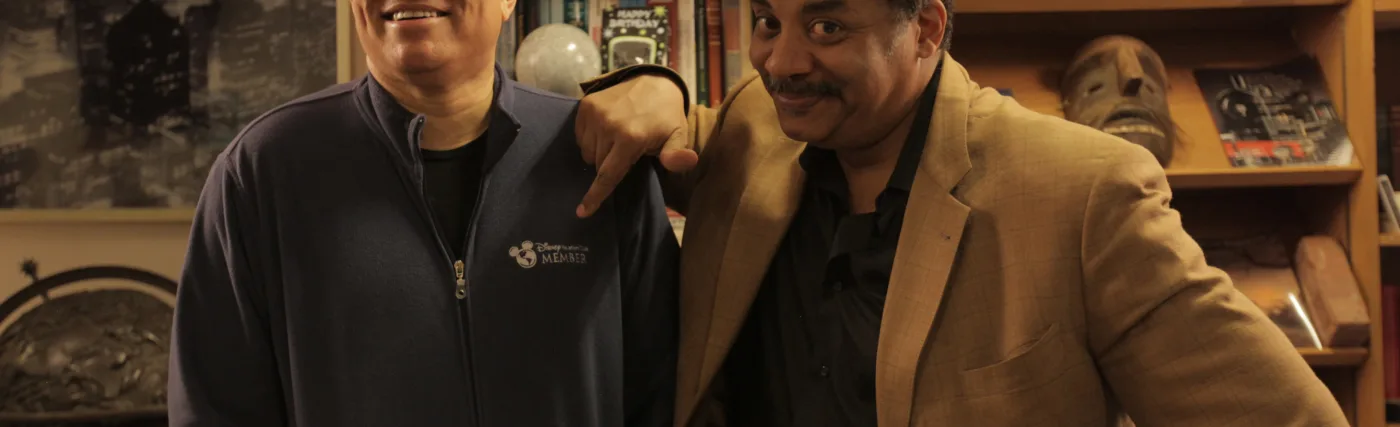
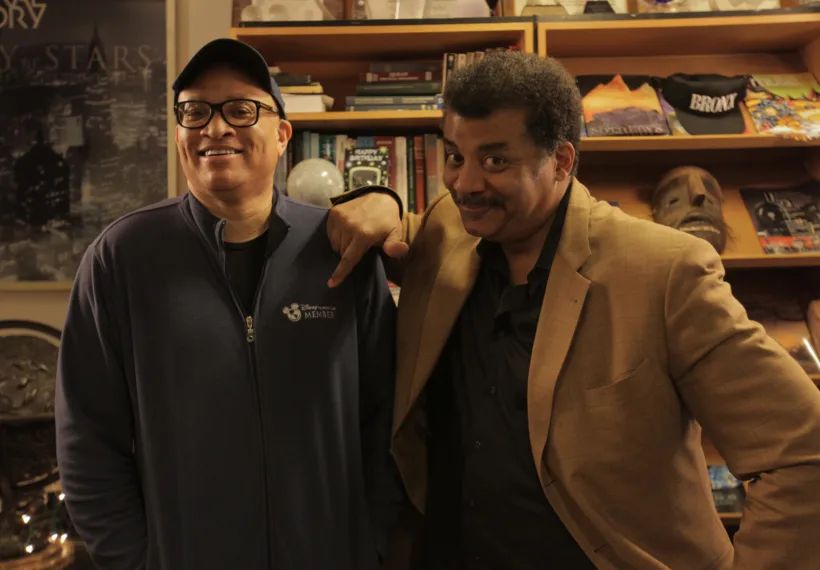
And tonight, we're featuring my interview with Larry Wilmore.
He's a comedian and host of The Nightly Show on Comedy Central.
And in this interview, we talk about science fiction movies, magic tricks, and of course, the intersection of science and comedy.
So, let's do this.
I've got with me, my co-host, Eugene Mirman, professional comedian, Eugene.
Welcome back.
It's good to be here.
Yeah, as a professional, that means-
Yeah, I know.
I like that you added a professional astrophysicist, not just the dilly dallying astrophysicist.
Right, right.
You just like, you get paid to do what you're doing.
So, welcome back to StarTalk.
And on this topic, I didn't want to do it sort of empty handed, not that you and I should count as empty handed, but in this case, we found someone with particular expertise, Professor Scott Weems.
Welcome, welcome.
Thank you, thank you for having me.
He is the author of a book called, Ha!
Did I pronounce it right?
Ha!
Subtitled, The Science of When We Laugh and Why.
And so, this man as a professional psychologist and author knows exactly where we're coming from.
So, let me just find out.
The science of humor, that's a curious thing for me.
And I always wondered, is a person born funny?
So, Eugene, were you always a class clown?
It took a while to go from being a tragic figure to a class clown, but I eventually, but I spent years as a child working on it.
So, yeah, so not always, but at the end, yes.
What does your research show, Scott?
Well, I mean, no, I don't think people are born funny.
It's like any other art.
You get good by practicing, like a lot.
And there have been studies that have looked at like professional comedians and seeing if there's any sort of common element, and there really isn't.
The only thing is you really want to be heard, so you have to be outgoing and like loud, but that's the main thing that helps.
Anything else, it's kind of, it's almost random.
So what is laughter?
Is there some chemistry going on inside of us?
I'm guessing.
Yeah, I mean, laughter, if you want to look at it from like a psychological perspective, it's a way of dealing with conflict.
That our brain is confused a lot, I mean, in just daily life.
There's a lot of times when we, not just when we hear a set up and punch line, but just when meeting someone for the first time on a first date, this is a very common thing to be anxious or confused.
And the brain has kind of co-opted laughter, this kind of like ape-like grunt, to be a coping mechanism, I guess, for when we don't know how else to respond.
It's like buying us time, I suppose.
Are you telling us that when humans laugh, they're ape-like grunts?
It's our version of an ape-like grunt.
It is, and apes laugh, dogs laugh, rats laugh, yeah.
Rats laugh?
You're telling me rats get jokes?
I'm not saying I understand rat humor, but you can actually tickle a rat and hear it laugh, yeah.
It sounds like he's done this.
I would love to do that.
It does sound like that.
Yeah, I mean, the thing is you can't hear it and it's really, it takes some work to measure it.
Wait, no, don't tell me you can tickle rats and they laugh, you just can't hear it.
Do they slap their little rat knees?
Do they have the physical part but just not the sound?
Well, I can't hear it.
Rats can hear it.
It's just like 50 kilohertz or something like that.
You probably know the physics.
Oh, you can measure the frequency of the sound they're making.
Same as like with bats.
Okay, so not that they're not making sound, it's that humans can't hear it.
Yes.
Okay, sorry, you have to clarify that.
Do bats laugh?
Right, now we're okay now.
We're good, we're good now.
All right, all right.
So, when you laugh, is there a chemical change within you?
Yeah, it all comes down to dopamine, as I'm sure you know.
Dopamine?
When you laugh, you get...
That's the happy chemical.
It's the happy chemical.
In the brain.
Laughter is like a not-dangerous heroin.
Cocaine.
Cocaine, sorry.
My bad.
Why didn't you know that?
Heroin's entirely different.
Yeah.
But it is.
It's the same receptors that, with cocaine, with chocolate.
Actually, a lot of different things, you get a dopamine response.
And laughter's one of them, so that's why we like it so much.
Let's bring my interview with Larry Wilmore into this.
Because he came by my office here at the Hayden Planetarium.
And usually I ask people, you know, what kind of math and science background they might have had and how that might have influenced their life's path.
What is the genesis of who and what became that man?
So let's check it out.
I was very much interested in science growing up.
I remember a teacher, Mr.
Mitzi, I think was his name.
He was our math teacher and he was such a character.
And he made things a lot of fun.
I actually was an advanced math student early on.
It was one of the things I loved.
I think I was taking calculus as a sophomore or something like that.
Calculus as a sophomore in high school?
I believe so.
But then I kind of, I lost interest.
Wait, wait, in calculus you don't have to believe.
It is or is not.
Well, you know what?
Once you get into higher math, which you know, which I never got into, a lot of it becomes kind of philosophical it seems.
Well, it's not so much philosophical as that there are ideas that get represented with symbols and it's like, what the hell did I just do?
Exactly.
Take this to infinity?
You know, what is that?
Exactly.
How does that?
Or as X approaches infinity.
My question is, why is X approaching infinity?
X might want to be careful.
I don't know what's happening over there in infinity.
But X might want to go the other way.
It doesn't need to approach it at all if it's infinitely far away.
Yeah, so that's where maybe that's what you're thinking.
It got a little philosophical.
Yeah, once I got into the X approaches infinity, I thought, I may as well be doing comedy because this all doesn't make sense to me.
But as a theater major.
A theater major and you dropped out.
Are you another one of these famous college dropouts?
Every next one of you who shows up in this office, I'm gonna have to say at the end of the day, kids, don't go to college.
Exactly.
You wanna become somebody.
I know, it's horrible when I get invited to speak at colleges.
What's your advice?
Don't finish.
But it was kind of my circumstance at the time.
Pretty much had the opportunity to do what I wanted to do.
So something came up.
Exactly.
It's not like you got bored with college.
Correct.
Okay, opportunity.
An opportunity came up in the business and I thought, well, let me just do this.
And I thought about going back at some times, but I just started working.
So what was that first gig?
It was the Mark Taper Forum's theater in Los Angeles.
It was in their improvisational theater project.
So comedy theater.
Kind of, but we wrote a play through improvisation, but it was kind of like children's theater.
But it was with legitimate theater actors.
It wasn't like Ground Link's type improv.
It was like theater.
And actually, I've always kind of, I've been lucky.
I've known some people who've kind of been in the business and that kind of stuff.
I never got any direct break from that, but it gave me the confidence to keep going.
So, and LA is the right place.
It's one of the places, but I believe you can start anywhere.
That's my firm belief.
Well, I did stand-up comedy early on also.
And I worked all over the country, and I met a lot of people who started in many different parts, especially as comics.
And that was in the heyday of the comedy club.
Because every city's got comedy clubs.
At least back then.
So there's always a gig.
Yeah, now they're Chuck E.
Cheese's now.
In the back corner.
Yes, exactly.
It's so sad now.
But science, I loved science growing up.
I wanted to be an astronaut when I was growing up.
I followed the space program.
That's in an era before they had black astronauts.
Correct.
Yeah, because I didn't see, to me, that was a closed door, right?
I saw them, they're not looking for me.
Right.
We're talking about an era where big afros and hair was all about the hair.
Exactly.
And all the astronauts.
Well, the helmet wouldn't have fit.
So that would have been a big issue.
Or I thought maybe-
Just a bigger helmet.
Right.
That would be hilarious.
I thought maybe a brother gets an Apollo 13, maybe that's how it works.
But yeah, space was not as we say-
Apollo 13 is the one that failed.
Right, that's just to be clear.
An Apollo 18 was the fake one in Capricorn 1, I think, or something like that.
Something like that.
So I noticed you even have a Peabody Award.
Congratulations on that.
Thank you.
I was very honored because Walter Cronkite gave me the award and I'm, you know-
I mean, he handed it to you, yeah?
Yes, exactly.
And I was, as I said, a big space nerd and huge fan of Walter Cronkite.
Oh right, because he announced us to the moon.
That's exactly right.
And I was a big political junkie at the time too, you know?
And I watched Cronkite every night, so to have him give it to me, and I made a joke and kind of made him laugh too.
Yeah, what joke was it?
Oh, I said, you know, I never imagined that I would hear Walter Cronkite say my name.
I mean, in my wildest dreams, I thought, you know, I might hear something like, Larry Wilmore was arrested yesterday.
You know, I might hear that.
I said, but you know, I always wanted to be an astronaut, so in my dreams, I thought I'd hear, Astronaut Larry Wilmore blasting off into space yesterday.
In his voice.
Yeah, exactly.
Because that would make it official.
I said, but, or you know, at the end of the day it might be, former astronaut Larry Wilmore was arrested yesterday.
But so he laughed about it and I thought, oh, it's quite, I mean, Walter Cronkite laughed.
So that was cool.
That was a great, that was a fun moment.
I love all the conspiracy theories about not going to the moon.
You know what it is?
I think a lot of young people don't think we were smart enough to accomplish something.
Oh, they think their ancestors were just dumb dummies.
I think we, hey, we figured out the iPhone.
You guys weren't smart enough to figure that out.
How the hell did you go to the moon?
So Eugene, is there an equation that'll give you the best joke?
Is there any math, mathematical kind of thinking?
Well, there is in the sense that I think that stand up is very much the scientific method.
Stand up comedy.
Stand up comedy.
You go on stage, you try something.
If it works, you keep it.
If it fails, you switch it out and you try it again.
So that's the experimental method.
Yeah.
Well, I brought up the idea of mathematics manifesting itself in comedy with Larry Wilmore.
So let's see what he says about mathematics in comedy.
Comedy is all about math too.
You know, it's all about having the correct amount of words.
Jerry Seinfeld talks about this.
He's very precise with every word he chooses.
When I did stand-up comedy, I would eliminate just the smallest of words or phrases to make the joke just perfect.
There's the correct amount of words to make a joke perfect.
And once it's there, it's done.
You're done with that joke, move on to the next one.
It's interesting, isn't it?
I feel that way when I compose tweets.
Really?
Oh yeah.
Because I have an idea.
Right.
And in any given day, and I say that I would make a good tweet.
Yeah.
So I write down the idea and it's too long, of course, because I gotta fit it.
So now I gotta say, all right, where is the actual essence?
Yep.
Of what I'm trying to communicate.
You're forced to crystallize it.
And then there, take that out, shorten that, pop that.
And I feel almost like Michelangelo when he said, you cut away everything that's not David.
Right.
And David is left.
I compare everything I do to Michelangelo.
It's so funny that we have that in common.
Just how he explained, not him and his talent, but his attitude.
Neil deGrasse Michelangelo, I guess.
You want to get innovative with the words so that the words say what they mean and they don't have to say, it's not too many of them.
So I'm with you on that.
And I do it to communicate wisdom and insight rather than a joke.
But occasionally I put a joke out.
Can I tell you one of my tweet jokes?
I would love to hear it.
If you took all the veins, arteries and capillaries from a man, tied them end to end, he would die.
The person would die.
I was gonna say, he'd probably be a homo-sidomania if you were doing something like that.
Yes.
I would agree with that completely.
Do you call that something, a comedy?
What's that called?
I think we could call it a logical conclusion.
No, logical conclusion.
There's logic in comedy then.
No, logical conclusions are a legitimate form of comedy.
You set up something that sounds like it's something else, but then you take the logical conclusion.
So Scott, from your studies and from what I've read, they show that there's a link between humor and creativity.
What is that link?
If you have people watch a stand-up comedy routine, or even just listen to it on the radio, and you give them an intelligence test afterwards, they'll do better on the test.
Really?
And it's not just linked with intelligence, there's creativity test, problems of insight, things like that.
They'll do better if they've had comedy before.
The idea is that it's like a form of exercise for the brain.
So comedy makes you smarter?
Yeah, I don't know how long the effect lasts.
I make people smarter is, I think, a great way to phrase this.
I don't have business cards, but now I would like them.
I make you smarter.
So I also heard that people who laugh more die sooner.
What's up with that?
I haven't heard that.
This isn't true.
And may I recommend you saying no.
Yeah, you're not going to like this.
People who laugh a lot die?
Yeah, I mean, people who with good senses of humor, and you can test that, they do tend to.
I'd rather not.
They die earlier.
How much earlier, like a week or like years?
Four or five years maybe.
I mean, they don't have an exact number for it.
But if you look at the graph, it's not sure.
What is the explanation?
Don't just give me the results of experiments.
Give me why.
Part of it is that there's good kinds of humor and there's bad.
So there's like the Rodney Dangerfield self-deprecating humor too.
And this is also really common.
And I think if you're Rodney Dangerfield, you can get away with that, but a lot of people can't.
And so you can use humor in negative ways too.
And if it puts you down or puts down on other people, then that's creating stress on the body and we know stress is bad.
And what you're saying is everybody at a comedy roast would be dying five years sooner than is their day.
Yeah, except for I think the professionals, they probably don't internalize it like other people might, so they kind of know what they're doing.
People who are self-deprecating in real life who are just like, I'm a sad person.
And then those people die.
That's fine.
So the comedy, that's it.
Well, when we come back, we will pick up more of my interview with Larry Wilmore as we explore the intersection of science and comedy on StarTalk.
We're back, StarTalk, featuring my interview with Larry Wilmore, host of The Nightly Show on Comedy Central.
He's a comedian, and we're just talking about the intersection of science and comedy.
So what's interesting to me is, the three of us are college graduates, but what I learned interviewing Larry Wilmore is he was yet another one of StarTalk's interview subjects who's a college dropout.
I'm just curious about something.
Eugene, you're a successful comedian, a stand-up comedian, you are college educated.
So how is it that you became fully college educated in a world where such success doesn't?
Well, I went to a college, I went to Hampshire College where you can design your own major, so I majored in comedy.
Oh, okay, so what's different there is you made the college fit you, instead of you having to fit the college.
Yeah.
Well, that's different.
That's, sure, but I had a very nice time.
My thesis was a one hour stand-up act, and then I did stuff on the physiology of laughter and all sorts of things.
It was all wrong, but I learned a lot.
So you like wrote papers on laughter.
I wrote a whole inaccurate paper.
The best part of my paper on the physiology of laughter is that I had a footnote, and when you looked at the bottom, it said, made you look.
So, Scott, is there, this sounds like you can be taught comedy.
You can learn, teach yourself comedy.
Yeah, I mean, it is an art, so in that way, I think you're right, practice.
I mean, they say, you know, with the five piece, we're getting to Carnegie Hall, you practice and practice and practice, practice, practice.
And that's essentially what it is.
It's up to five, it used to be.
Three, I know, times are tough.
It's five now.
No, it's like any other art, though, you can still, like with painting, you can still study things like line and contour and form, so there's still things you can study with humor.
But, like, you know, you can't just read a book and all of a sudden be funny.
You've got to really get in front of audiences and spend a lifetime working on it, yeah.
So something that shows up in a lot of comedy is the unexpected, right?
What role does that play?
Is that, like, essential?
Is that, like, the biggest variable here that you want to promote in being funny?
Yeah, I mean, you need surprise.
If you don't have surprise, then you're just going to bore your audience.
But it's kind of surprise, along with this new way of thinking about something.
So it has to be, like, a destination, too.
And so, like, the good jokes-
Well, they'll be the setup.
And then you realize you've got everything wrong, and then comes the punchline, and there's the kind of surprise, the end, the payoff.
Because you invested in establishing this landscape, and then the landscape gets completely dissolved by the end, because a whole new understanding has been handed to you.
You think you're thinking one way, and then something turns, and you see everything that you've just heard in a new way.
So that's formulaic, in a sense.
I mean, we think of surprises by itself funny, but that's like just hiding behind a door and then yelling, boo.
Like, that's not-
Every-
it would be great if every story ended with just someone going, boo!
I mean, it's not really the good laugh.
There's always something that there has to be some meaning behind it.
So, another thing I noticed is if you're at a table with a complete stranger and you both laugh at the same joke, you've got some sense of communality there, some sense of real community.
That's an interesting-
Do they study sort of the anthropology of laughter in this regard?
Yeah, I mean, it's a very social thing, humor.
I mean, like comedians, they perform in front of audiences.
They wouldn't do well if it was like an empty room.
It kind of falls flat.
You can't tell a joke that way.
And it turns out that the more people you have in a room, the better the laughter will be.
So it's contagious, literally contagious.
And the closer you pack people in, the more they'll laugh too.
And alcohol helps too.
So if you get them crowded and give them alcohol, studies show that.
But if it was like too many people who were too drunk, it would be bad.
There is like a probably perfect amount.
You wouldn't actually want like a thousand people in a hundred square foot room drunk out of their moms.
I'd love to see that study and look for where that drop off is.
You'd be like, yeah, it's about two feet per person.
In math, we call it a maximization problem.
That's what I would love to do for drinking and comedy.
So I've learned as an educator that if people smile, if people laugh, they're more eager to learn.
If that was the consequence of something I just taught, they want to learn more.
They associate a good feeling with it rather than a bad one.
And to this day, I've realized, and I was going to tweet this, I haven't gotten around to it yet, only in a university environment is it okay for you to say, I'm going to go to a room and have someone lecture to me.
Any other day of your life, you will never say that.
And if you tell someone, I'm going to lecture you, it is a bad thing.
It is something you want to avoid.
And so my sense of it is a lecture that has humor doesn't have the stigma of the lecture and then people might want more of it.
And so I'm just saying, I've had people come back for more when I've folded it with things that are funny.
And personally, I think the universe is hilarious, personally.
And there's a science behind that too.
It's actually like 15%, I think, give or take.
That retention on a test would be better, about 15%, if you've incorporated jokes to help people study the material better.
So if you can put jokes into your lessons, people will retain it better.
But it has to be related to the material.
It can't just be, and then let me tell you a knock-knock joke is a break.
That doesn't help it.
But if it's related to the stuff, then it helps.
Yeah, and the universe is fricking hilarious.
That's just what I found.
Just all the ways, interesting ways to die, you know.
Like the fall.
What's the third best way?
I know the first, black hole.
Second, probably just falling.
And then what's the third?
Should write a book on that.
Yeah.
Uh, let me get back to my clips with Larry Wilmore.
We are featuring my interview with Larry Wilmore here.
So I don't know if you know, but Larry Wilmore is trying to actually include more scientists on his show.
In fact, I was on his show once and I was delighted.
And in my interview, we talked about what his efforts are to make science more of the talk show conversation.
So let's check it out.
You're one of our most popular guests, I have to say.
I've been on once.
No, you were, people were so excited that you were on our show.
I think they were let down that I was there.
Yes, exactly.
Finally, finally, here's the brother we wanted in late night.
What's this other brother doing?
No, you were such a popular guest.
But you also had my good friend who recently moved to town, Bill Nye.
Yes.
Because he's Bill Nye.
He's the science guy.
He's the real deal.
Right.
So it's good that you had him on.
I mean, not everyone, I mean, I think of talk shows that never think to have a scientist on.
And that's not, what does that mean?
You know, is science not enough in pop culture to even go there, to think about it, to at least infuse it, even if just to have fun, you know?
And you had fun.
We talked about crazy conspiracy people.
And it's not like you can't have fun with science.
I agree.
I think people just don't know how funny protons are, you know, or molecules.
Molecules are hilarious.
I mean, alien life has always been a source of comedy.
Right.
Oh, now there's a question.
What is the deal with Pluto right now?
Is it a planet or not?
Just get over it.
It's not.
That's the deal.
No, it's not.
But didn't it come back to be a planet?
No, there was a straw poll among Pluto fans.
Right.
And how do you think they're going to vote?
They're going to vote, yeah, make it a planet again.
But why is there so much haterade at Pluto?
Why can't it be a planet anymore?
What did it do?
Well, so every Pluto lover I know, I notice that they're missing some information.
Oh, okay.
Yeah, they don't know it's not there.
That it wasn't actually a planet?
Well, so do you know that our moon is five times the mass of Pluto?
So you're hating on the planet because it's small.
Our moon.
That's what you're saying.
That's just the beginning.
That's not even the best reason why.
You know size really doesn't matter when it comes to planets.
I'm just starting out with that.
For you to say the size matters?
In the universe, size matters.
He took me there.
He went to Pluto.
I mean, I thought I should have warned him before the interview.
You don't take me to Pluto.
I'm done with Pluto.
Just so you know.
Coming up on StarTalk, we hear Larry Wilmore had to say about geek credentials.
We go ahead get started We'll be right back on StarTalk.
We're featuring my interview with Larry Wilmore, a comedian, and anytime I interview somebody, no matter who they are, Hune from Pop Culture, I want to know if they have some hidden geek credentials.
Almost everybody does.
They just don't admit to it in any other interview because they don't get any street cred for doing so.
But on StarTalk, that's where the street cred is found.
So I checked with Larry Wilmore to see what is he at.
Let's check it out.
Do you count yourself a member of the geek community?
I am, but in different ways that might surprise you.
Really?
So give me an example.
Like I'm a magician.
I do sleight of hand magic.
Magicians do know how to demythologize and demystify in the same way that someone of your age would.
That's what I'm saying.
Yes, because you have information that most people don't have.
Right, on purpose.
Correct.
Withheld from.
Exactly.
And in fact, that's one of the famous edicts from Arthur C.
Clarke.
There you go.
Any sufficiently advanced technology is indistinguishable from magic.
That's exactly right.
And a lot of early magic was technology and a lot of techniques that magicians used in the early days, even from things like mirrors or technological.
I mean, that's an important, that's a really important geek cred.
Exactly.
Totally there.
I always, to prove it.
Carry a deck of cards with you?
I always, always have a deck of cards.
I think this proves the geek cred.
Is it a legit deck?
Yeah, it's an old deck.
It's all beaten up.
That's what any magician would say.
Yeah, it's a regular deck.
But yeah, I always have these with me because I'm always like maybe practicing that kind of stuff.
Well, that's nice.
That's good, that's good.
Let me show you the one I did.
I got one here, okay.
So I learned how to cut with one hand.
A knife, I'm sorry, I'll do that.
Yep, very good.
Oh, very good.
That's called a Charlier cut, by the way.
Charlier?
Uh-huh, that's what it's called.
I'll show you a different version of it too.
I don't know if the camera can see me there.
Yeah, they got you coming from here.
See, if you cover like that, that's the six of hearts and you lift like that.
See, it becomes the joker.
I don't know how it's done.
Oh, I'm sorry, I'm sorry, what happened?
Something happened there, but that joker, when you take it back and you just spin it around, that becomes a six, so I don't know.
Cards just change like this, it just happens like that.
You have no, you don't even understand it.
I don't know how it works, so there you go.
Another way to cut, all that kind of stuff.
Here's a fun way to cut, Tim.
That's a good one-handed cut.
Ooh, yeah, that's what they do at the poker table.
Because those are the guys that flip the chips.
Yeah, you don't want to do this stuff at the poker table by the way.
It's how you're gonna get shot.
So, in that last clip, we hinted at what magicians and scientists have in common.
We have an understanding of a phenomenon that often a person looking on does not, except it's the scientist educator's duty to explain what's going on and it is the magician's duty to hold it a secret.
And so, this is just a fascinating distinction between the two.
But in both cases, you can get people to laugh and enjoy science.
Science demos are one of the most popular things in a college curriculum, be they in the physics class or in chemistry class.
You know, watching chemicals change color and all of this.
You know, Larry, in my interview, asked me if I had a favorite scientist.
Now, I thought everyone in the universe knew who my favorite scientist was.
Because it's easy, it's an easy answer for me.
But apparently, he didn't know.
So, let's check out what he said.
Okay, pound for pound.
Who are you taking?
Pound for pound.
Smartness.
You're in a room, you get to learn from one of these people.
Newton?
Newton?
Newton, that's it.
We're done here.
That's it.
We're done.
I'll still hear you out.
You realize this is my hand, this isn't actually Newton.
I will hear you out, nonetheless, go.
I was just going to say Newton, Einstein or, I don't know, who would you put?
Da Vinci could go on that list, Leonardo.
Galileo.
Yeah, they're all good people.
Da Vinci, you put on that list?
No, if it's a list where you want me to decide from, I would put him in that list.
But I'm still pickin noon.
I'm still pickin guys in noon.
You just read what he wrote.
The hair stands up on the back of your neck.
He was connected.
Yeah, no, he was the smart one.
To the universe.
He invented calculus.
He's pretty smart.
You gotta have a lot of free time in your hands to invent something like calculus, by the way.
I'm just putting that out there.
I don't know if he had much of a social life.
In fact, all evidence shows he died a virgin, actually.
Really?
So you figure that one out, too.
When you're inventing calculus, it takes up a lot of your time.
When Star Talk continues, Larry Wilmore and I geek out on Star Wars vs.
Star Trek on Star Talk.
Scott with the book.
Ha, I love saying that.
Did you come up with the title?
My wife came up with it.
Okay.
I wish I could say I did.
That's a great title, just talking about the science of laughter and comedy.
And I will feature my interview with Larry Wilmore, and we had to have our geek moments.
Once I learned he was a geek, we had to go where geeks go.
And one of those places is Star Wars versus Star Trek.
And if you get into Star, is it Kirk or Picard?
We had to, yes, we went there.
Let's find out how it resolved.
I was a huge Star Trek fan.
Star Trek.
Yeah, Star Trek fan.
And Star Wars, when it came out.
First three, I should say.
Of course.
The original.
Well, the only.
Very excited about the new one.
I do a Lando impression, by the way.
I only say one phrase though.
How you doing, Chewbacca?
There you go.
So impressions are kind of a geeky thing that I do too.
I do a lot of impressions.
And it helps you in the comedy club too.
Yes, exactly.
If you don't have an impression, you need a place to go.
Does it really help you in the bar scene?
That it helps you in the comedy scene.
Your bar does.
Want to imitate Chewbacca?
Yes.
Okay, so then I have to ask you, so Kirk or Picard?
Kirk.
It's not even close.
Yeah, me too.
Are you kidding me?
I love me some Picard.
Don't get me wrong, the man, the actor, but if I had to be one of those, yeah.
It's Kirk, it's not even close.
Well, what's your main reason for that?
Well, there's so many things.
Top of the list, give me one.
It's 280s, first of all.
Well, there's something just not right about it.
Star Trek was its purest in the 60s and Kirk just represented just this, first of all, he's the purest American version of that Western id, you know.
Man, you're getting all psycho-philosophical.
Yes, you know, of just.
My main reason was that he actually got into fights.
Yes, but that's what it is.
It's a Western.
He would have, he would fight.
Yes.
He is the damn captain of the ship.
Because he's.
He's fighting aliens.
Correct, because the original Star Trek is a space Western.
That's exactly what it is.
And Picard, I don't think he ever laid a fist on any guy.
He got very philosophical.
Got a bit too erudite.
But what beats this?
Spock, Bones, Weems, Vine, Thee, Laetiga, I mean, come on.
Dammit.
Dammit, Jim.
All that stuff is great.
My favorite moment, my second reason why I'd want to beat Spock.
There's one of the episodes, forgive me.
Spock is your favorite?
No, no, no, Kirk.
My second reason, very close second for why I want to beat Kirk.
First is that he gets into his own fights, and he can kick some butt if he has to.
All right, second, there was an episode, forgive me, I don't remember the name of the episode, any Star Trek fan would know the name.
Like there's a Klingon vessel out the front window, and they, and, and, and, roll down the window and say, can you move?
On screen, or on window, or whatever.
On window, on the screen, you're right.
And so, out the dashboard, you know.
They have that side dash too, so you didn't have to roll down the whole window, you just did that side.
So you know what I'm talking about.
Yeah, I know, yeah, they don't have those anymore, they have the little triangle window.
I love those things.
Gone, gone.
Plus you can angle it, I like angling the geometry of the wind coming in.
For people who are smokers, they could just do that kind of thing right after that.
I didn't know that.
I just thought it was for, I'm just making it up, but it sounds good.
So there's a scene where the Klingon vessel is threatening the ship.
And the ship, its shields don't work, and they're gonna say, we're gonna destroy the ship.
And so Kirk says, he makes something up.
He says, if you destroy the ship, we will self-destruct and take you with us with a special code that I will type into the computer now.
And Spock knows he's full of ****, right?
And Spock says, Jim, this is no time for a game of chess.
And he said, Spock, it's not chess, it's poker.
Come on.
That was it.
Come on.
It's the bluff.
It's the bluff.
That's Kirk.
He's the only one that defeated the Kobayashi Maru.
Because he cheated.
Let's celebrate the cheaters.
So the genre, highly successful genre, science fiction, obviously it's based on science at some level.
But also, I think the best of the science fiction has some dose of comedy.
And the comedy kind of gives you access to sort of the humanity of the characters, of the storylines.
I think comedy is an important part, probably of all entertainment or literature.
I mean, the good books.
Of all storytelling.
Yeah, storytelling involves comedy a lot just because it keeps people engaged.
I mean, The Martian is a great example of that, just because.
Martian the Book by Andy Weir.
As you know, The Book became a film, The Martian, and that lone astronaut left behind on Mars is Matt Damon.
And so he's cracking joke one-liners all the time.
He has confrontations with hopeless situations.
He must tap his scientific ingenuity to survive them physically, but it is rife with humor, which you get the sense he invokes to survive it emotionally.
Now, it just so happens, through our crack team of internet connectors, we have Andy Weir on video right now live.
Do you guys have him live?
Let's bring him up.
To Andy Weir, the author of The Martian.
Andy.
Hi, how you doing?
Andy Weir.
Thanks for having me.
Welcome to the whole of the universe.
Well, you know, I don't know if you know this, but I actually sent you a copy of the book and a fan letter to you, like back before it had published and stuff.
Okay, I gotta check my...
He's calling me out on national television.
This is one no one had ever heard of it, and I'm sure you get piles and piles of this stuff.
So I didn't really expect a response.
But I know this sounds like I'm kissing ass, but when I was writing the book, whenever I was tempted to use hand wavy physics or take a shortcut and not be accurate, I honestly, I thought to myself, what if Neil deGrasse Tyson reads this?
Well, I'm honored that I would give you such anxieties writing the story.
Now, not everyone would have necessarily thought to put as much humor in it as you have.
And so my question is, how did you come up with the idea that comedy would be what will be necessary to keep this guy alive on the surface?
Well, it was kind of necessary because he's alone on Mars and so a first-person narrative was pretty much critical.
Otherwise, it'd be really boring.
And then also, there's a lot of science that I wanted to explain to the reader and not assume the reader already knew.
And I didn't want it to read like a Wikipedia article.
So you've got to be funny.
You've got to throw jokes in there and one-liners.
And so basically, the whole book, he has this gallows humor, right?
Where he's like, well, I'm probably gonna die today.
So I wonder if you are opening up a new variation in a genre here.
I don't know.
I mean, every genre has comedic versions of it, right?
I mean, there are comedy action films, this is a comedy survival story.
I mean, you can throw comedy into anything.
So now, it's one thing to say, let me put in a joke.
It's another thing to be able to do that in the first place.
Not everyone has that much comedy contained within them to give to a story such as what you wrote.
So.
Well, you're the first person who's ever told me I'm full of comedy.
Well, Andy, heartfelt congratulations from all of us at StarTalk to your success.
So StarTalk audience, give it up for Andy Weir.
We gotta take a break, but when StarTalk continues, we're gonna take your questions on the physics of science fiction.
Check it out.
StarTalk is back.
And right now, we're going to feature our recurring segment called Cosmic Queries, where we actually take questions solicited from our fan base.
And in this particular case, the topic is the physics of science fiction.
And Eugene, you've got...
I have a few questions.
Yeah, and I've not seen these.
No.
So it's not about whether they...
If I don't know the answer, I'll just say I don't know, but I haven't seen them.
Yeah.
Okay, so I will be surprised.
Yeah, get ready.
I'm ready.
Bring it on, yeah.
Nathan Noble from Seattle, Washington asks, the story of Ender's Game uses a device called an Ansible to communicate instantaneously across far galactic reaches.
With the speed of light being a limiting factor for the travel of information as we know it, are there theories for faster than light or instantaneous communication?
Oh yeah, completely.
Oh yeah.
Yeah, next, next question.
It was a yes no question.
So, one, you can open a wormhole and you can travel through the fabric of space and time acrossing vast distances in much less time than it would take light to cover those same distance.
Another way, which would be really cool, is if you can quantum entangle objects at vast distances.
And quantum entanglement, we can do this with particles and it's a quantum physics phenomenon where one particle is quantum entangled with another so that they're sharing information simultaneously.
So that if you-
What's the difference between that and dating?
And dating.
So, if this one, if you change the information on this one, the information on the other one changes instantaneously no matter its distance.
So it is in fact communicating at faster than the speed of light.
Problem is right now we can only do it for like particles.
Quantum entanglement is a thing that people...
It's a particle thing.
Right.
And it's been done itself.
We got particle entanglement.
That's not the issue.
The issue is, since you are a collection of particles.
Yes.
Many, many particles.
Agreed.
To get all those particles to quantum entangle coherently with some other set of macroscopically assembled...
Another Eugene somewhere else.
Another Eugene somewhere else.
We don't know how to do that.
Yeah, well, I have some suggestions.
Next question.
Brian Zajac from Encino, California asks, please explain the difference between warp drive on Star Trek and hyperspace in Star Wars.
You know, I don't know if I'm qualified for that.
I would say if you're not, then who is?
No, because for a while, I thought I really had the warp drive.
But what's hyperspace?
Because I think warp drive might be...
It's just there, they go faster than light.
That's all.
Oh, really?
So that is sort of explaining it.
Yeah, but they don't, they don't...
Through magic.
In the hyperspace jump, there's no discussion of the warping of space.
And they're talking about Star Wars, right?
They're talking about both.
They're asking how does the warp drive on Star Trek work and then how does hyperspace work?
Hyperspace, which was first introduced in Star Wars.
Yeah.
Star Wars makes no attempt to respect known laws of physics.
So as far as they're concerned, they just went faster than light.
And there's not this attendant conversation about the warping of space.
Are you saying the force is somehow made up?
All right.
Yes.
Fair enough.
Now Larry Wilmore had a question for me.
Let's find out.
So let me ask you this, Mars.
Mars.
Is there a possibility that there could have been, I don't mean microbial life, but I mean actual intelligent like human life on Mars at one time?
Gone now, I say yes, gone now.
Now extinct.
Now extinct.
I mean, could Mars have been inhabitable for a variety of reasons?
Maybe the atmosphere is different.
It's all broken down now.
All that kind of stuff.
So I think about that often.
And some people think life on Earth may have started on Mars.
Yeah, they get panspermia, it's called.
Meteorites coming over here.
Yeah, yeah, yeah.
Stow away microbes.
See, I know a little bit about this.
Stuck in a thing coming across the planets.
Starts here, spawns there.
So here's the interesting thing about civilization.
On Earth, if all humans left Earth today, you can ask how long would you have to wait before there wasn't a trace of our existence here?
You'd have to wait until the continents subducted, bringing entire cities with them into the lower levels of the Earth's crust.
And in those zones, it's so hot, everything melts back and it gets spewed out of a volcano again.
What's the time frame?
For that, millions of years.
Millions of years is not that long.
Okay, so now watch.
Mars is not as geologically active as Earth.
Now.
Now, but you have to go way, way far back.
No, but billions, billions.
Oh, so now you're getting into billions.
Billions, billions, billions.
So I think it's unlikely on Mars.
We would see settlements along the riverbanks that are now completely dry.
There would be, why would you lose a city but still have the dried riverbed that's there?
That doesn't play, right?
If you're gonna.
But we were relating it to what's here though.
Yes, how else can you do it?
I mean, there's an alien city that evaporates when they're done with it.
I mean, I don't.
Oh, I don't know.
Evaporating cities, it's like self-destruct.
That's cool.
It's cool but not likely.
Cool but not likely, precisely.
When we come back, we're gonna find out what Bill Nye's take is on comedy and see what kind of comedy mojo he carries with him on StarTalk.
We've been talking about the science of comedy.
The science of comedy.
And one of my best friends, Bill Nye, moved from Seattle to LA and now lives in New York.
And he's a friend of StarTalk.
And every show, we try to catch up with him to see what he's up to.
And he, did you know he got a start as a stand-up comedian?
I did.
You knew that?
Yeah.
Did you know that, Bill Nye?
Yeah, yeah, as a stand-up comedian.
And so he's got the timing, so he knows how to work a crowd, how to be in front of an audience.
And recently, he worked with some comedy improv folk.
And he produced something called Sharing Science Through Comedy.
Let's check it out.
So we're now gonna play a traditional, fabulous, classic improvisational game called Tap Out.
We'll start with Jonathan.
I'm a very simple man.
I work at this ice cream place and nothing wows me because I'm bored.
So here's your swirl.
Chocolate, vanilles.
My favorite.
You're bored with ice cream?
It's very exciting.
It's got cold.
And we wouldn't have things this cold if we're without our fundamental understanding of the second law of thermodynamics.
That doesn't excite you.
Yawn.
But the ice cream is made of the same stuff that you and I are.
The ice cream is made of the ancient stardust from exploding stars.
You and I are made of the dust of the cosmos.
And yet we are able to understand it and enjoy vanilla chocolate swirls at the same time.
Whoa, that's a good ice cream flavor.
Dust of the cosmos.
See, you're more into it than you realize.
What's happening there?
Crystal ball.
Just relax so that I can read your aura.
I'm very in touch with the universe.
I can...
Now stop, don't touch your aura.
You're not the first person to tell me that.
Touch your aura, you'll go blind, Bill.
So can I ask you where we should look for the next supernova?
Okay, just one second.
That'd be cool.
That way.
You know, that guess is every bit as good as the best astrophysicist's guess.
Look here, Mr.
Travel Agent, we're just a couple of creationists and we just want to go somewhere nice and warm.
You want to go to a warm place where people embrace the idea of creation or creationism, or do you want your minds expanded and understand the scientific truth?
No, no, no, I don't think we want that.
I don't think we want our minds expanded at all.
No, no, no.
We like two things, God and Heaven.
How about Jamaica?
Okay.
It's warm and beautiful there.
And you can see the layer after layer after layer of limestone from ancient seas 300, 350 million years old.
And you could look at the fossils and infer, along with Rubidium strontium dating, how old the world is.
And you can have your whole evolutionary view brought into focus.
Do they have a buffet?
We have proven beyond the shadow, which is also a scientific phenomenon, beyond the shadow of a doubt, the hypothesis that science can be funny.
Thank you very much.
So, presumably, you guys have a favorite joke, and I want to know it before we close the show.
Eugene.
I don't think you do.
Scott, favorite joke.
So a dog walks in a telegraph office and says he wants to send a message.
The guy says, sure, what's your message?
He goes, yeah, it's a woof woof, woof woof woof, woof woof woof woof.
And the operator pauses and goes, you know, that's only nine woofs.
You can send a tentacle for free.
And the dog says, yeah, but that would make no sense.
I'm the scientist, I get a pass, that's a different kind of thing.
Plus, you have to explain what a telegraph office is to anyone under 50.
I love the fact that when I tell that joke, people always bring up the telegraph and they don't address it like it's a dog talking.
Which is like a whole other science point, yeah.
So we're out of time and possibly out of jokes.
So guys, thanks for being on StarTalk, Scott, Eugene.
You've been watching StarTalk from the hall of the universe of the American Museum of Natural History and I've been your host, Neil deGrasse Tyson, your personal natural physicist, and it is my duty and pleasure and honor to bid you to keep looking up.
See the full transcript



 Unlock with Patreon




 Become a Patron