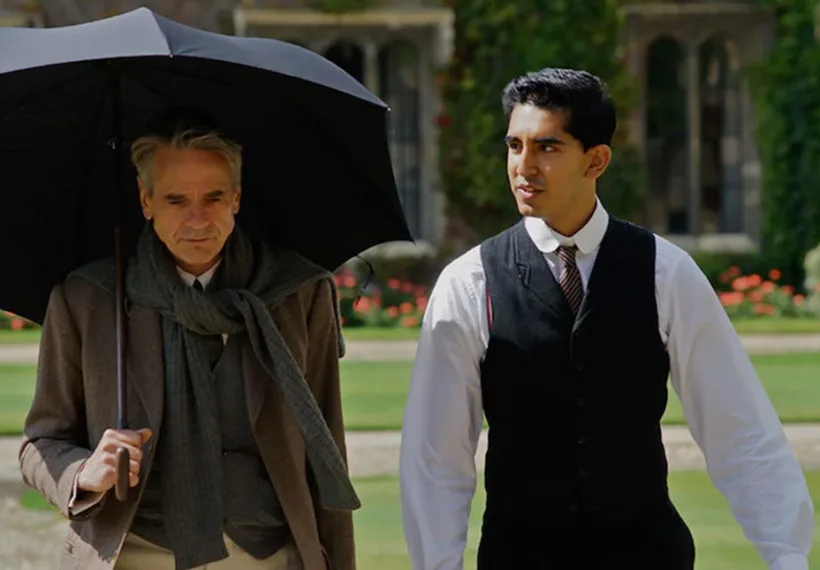
In this episode of StarTalk, Neil Tyson explores the language of the universe through the lens of self-taught math genius and college dropout Ramanujan, the subject of the recent movie, The Man Who Knew Infinity. Not only does Neil interview one of the stars of that movie, Jeremy Irons, who plays the great Cambridge University mathematician G.H. Hardy, and the movie’s director, Matt Brown, but he also has the movie’s consultant, mathematics professor Ken Ono, as his in-studio guest. If you know nothing about Srinivasa Ramanujan, prepare to be amazed. You’ll hear how, at the age of 12 or thirteen, Ramanujan invented trigonometry for himself, only to eventually discover it already existed. Discover how Ramanujan tried to get into Cambridge, only to be rejected by Hardy’s colleagues, who didn’t understand his equations, while Hardy saw the spark of genius and gave the man from Madras a chance. We’ll explore his infamous notebooks filled with mathematical formulas that the most brilliant minds in mathematics have been trying to figure out for over 100 years – mostly because he didn’t bother to include explanations of how he came up with them. His work is used in both string theory and quantum gravity – two subjects that didn’t exist in his lifetime – and you’ll never guess where Ramanujan himself thought his inspiration came from. Test yourself as co-host Eugene Mirman asks Cosmic Queries about the Fibonacci Sequence and the Golden Ratio, using math to communicate with aliens, and whether math is invented or discovered. Plus, Neil and Ken try to explain why people fear math, Mona Chalabi shares data comparing US students to students around the world in math scores, and Bill Nye is on the streets of NYC to discuss right angles, the Pythagorean Theorem, and Manhattan’s Flat Iron Building.
Transcript
DOWNLOAD SRT
Welcome to Star Talk. Your place in the universe where science and pop culture collide. Star Talk begins right now. Welcome to the Hall of the Universe of the American Museum of Natural History. This is Star Talk, and I'm...
Welcome to Star Talk.
Your place in the universe where science and pop culture collide.
Star Talk begins right now.
Welcome to the Hall of the Universe of the American Museum of Natural History.
This is Star Talk, and I'm your host, Neil deGrasse Tyson.
Tonight, we're talking about mathematics, the language of the universe.
And we're featuring my interview with actor Jeremy Irons and film director Matthew Brown on the film, The Man Who Knew Infinity.
So, let's do this.
Let's do this.
So I've got with me, comedic co-host Eugene Mirman.
Eugene, welcome back.
Great to be here.
All right, good to have you.
And I've got with me a real live mathematician.
They do exist in the world.
Ken Ono.
I'm right here.
Glad to be here.
So you're a professor of math at Emory University.
That's right.
And you're also a consultant and associate producer for the film The Man Who Knew Infinity.
That's right.
That's cool.
It's totally cool.
You know, it's good that Hollywood is like looking for people with that kind of academic expertise to help the situation.
So tonight we're going to get into the beauty and genius of mathematics.
But before we do, let's get a sense of how they told the story in The Man Who Knew Infinity.
Let's check out the movie trailer.
From an Indian clerk, ill-educated in Madras, I would very highly value any advice you give me.
A letter for you, a postmarked England.
Yours truly, S.
Ramanujan.
What does the S stand for?
In asking the self.
You intend to invite him here?
Don't forget me.
I could never.
Don't be intimidated.
Great knowledge comes from the humblest of origins.
For the good of everybody, you should attend some lectures.
But I'm here to publish.
We need proofs of your work.
But they are right, sir.
I hadn't completed that proof.
How do you know?
I just do.
You don't pull a stunt like that in my class.
How do you know that theorem?
It came to me.
These steps you want, I do not know how to do.
Don't you know what I've given up to be here?
I have nothing.
You wanted to know how I get my ideas.
God speaks to me.
There are no proofs.
We're just supposed to take him at his word?
No, you're to take him at mine.
There are no proofs that can determine the outcome in matters of the heart.
We are merely explorers of infinity in the pursuit of absolute perfection.
I owe you so much.
No, no, no.
It's I who owe you.
Some powerful stuff.
So the film starts Dev Patel.
That's right.
And he's a well-known actor.
From Slumdog Millionaire.
Yeah, from Slumdog Millionaire.
And he's portraying the Indian math genius, Ramanujan.
Exactly.
Excellent.
And also Jeremy Irons.
Right.
As his mentor.
GH.
Hardy.
Yeah, and he's playing GH.
Hardy, a famous English mathematician.
So we don't often see mathematicians as the main character of a movie.
Maybe they'll throw one in because they got to solve something and you go in and come out of their character.
This one, the main character is a mathematician.
That's right.
And so that's impressive for me that there'd be a feature length film fully produced with real actors on this subject.
And really good actors.
A super quality film, by the way.
Really good actors.
In fact, one of the really good actors is Jeremy Irons.
And in fact, he and the director, Matt Brown, came through town, so I nabbed them, put them in my office, and I asked Jeremy Irons, like, who's playing the British mathematician, Jay Chardy, I asked him, what first hooked him on this story?
Because that's, to get such star power, something's got to click in ways that no one can predict, not even the director.
So let's check it out.
This boy knew things which could not be imagined.
And where does that come from?
And I was very interested in playing the relationship of this very closed English mathematician, slowly opening up to the amazement of this man who he would dream and when he was meditating, his god, Namagiri, would place the, that's how he would describe his discoveries, would place these calculations on his tongue and he'd be able to write them down.
And my character is an atheist, didn't believe in God.
GH.
Hardy.
Hardy.
So how do you explain that?
I mean, for me it was like, Take that, you atheist!
It's a wonder, you know, as Shakespeare says, there is more to expelling an earth than is dreamt of in our philosophy.
We think we know everything.
I mean, you scientists, you think you know everything.
You have no idea.
Stephen Hawking doesn't believe God exists.
I mean, how can you say that?
When you say the good thing about science is that it's true whether or not you believe it, I would say the good thing about God is that it's true whether or not you believe it.
So Ken, what do you make of his explanation that God placed these formulas on his tongue?
Well, you can take that at many different levels.
I'm not Hindu.
I don't have Goddess Namagiri helping me.
At least, I don't think so.
I don't know.
Maybe I do.
But honestly, there's so much about Ramanujan that we don't understand.
He left behind notebooks, but he didn't write down his methods.
There are almost no words in his notebooks.
So certainly, there's something very mysterious about everything that is Ramanujan that we can't explain.
So let's hear more from my interview with Jeremy Irons and Matt Brown from the film The Man Who Knew Infinity.
Let's check it out.
I had no idea what I was getting into.
None.
It's been a 12-year journey to get the film made.
12 years?
12 years.
Why?
What's wrong with what?
What's wrong with Hollywood?
No.
In terms of astrophysics, 12 years is a blink of an eye.
Thank you.
Thank you.
In a billion years, it's just the bat of an eyelash.
I think Hollywood was a little intimidated by the subject matter, so that took a long time.
So it was a book based on a book?
It was a book.
It was Robert Kanigel wrote the most incredible biography, The Man Who Knew Infinity.
I've read this book probably more than any other book I've ever read.
It was a wonderful biography about the life of the math genius, Ramanujan, who was at the turn of the century.
He had no formal education to speak of.
He was discovering whole fields of mathematics and rediscovering fields.
I think when he was 12 or 13, he thought he had discovered trigonometry.
12 or 13 years old.
Yes, at 12 or 13 years old, he discovered trigonometry, the entire field.
And then he went into school only to find out that it had already been discovered and he was deeply disappointed.
But that was sort of the story for him in life, that he was out there on his own.
He was a real outlier and eventually...
And no one knew this because he was living in India.
Yeah, he was in Madras, India, and he had actually flunked out of college twice because he was so obsessed with his mathematics.
And so he really toiled in isolation for a really long time until he finally got a job as a clerk at the Port Trust in Madras, and with the help of some people there that believed in him, they sent off three letters to three mathematicians at Trinity College, Cambridge, and two of them were immediately dismissed as hoaxes.
And the third letter by GH.
Hardy, the character that Jeremy portrays, he wasn't sure at first, and then he recognized something in it, and it just got under his skin, and he realized that this man was legitimate.
So, tonight, we're going to get into the story of how you discover a math genius, what that takes, how that happened in that case, is that something we can duplicate, is it something we should set agencies loose to try to find, and also we're going to explore the beauty of math.
For many people, those two words don't belong in the same sentence.
Maybe I'm the only one that thinks otherwise.
So you advise on this film, and you're a professional mathematician, or that-
Oh yeah, I'm a professional.
Yes, I believe you.
Just confirming.
It would be weird to get an amateur mathematician, be like, ah, that equation's close enough.
Yeah, yeah, yeah, we don't want the amateurs on the stage here.
So could you tell us why Ramanujan's work is so important, and why it may still matter today?
When was this?
When was this?
This was how long ago?
So Ramanujan went to Cambridge during World War I.
This would be Cambridge, England.
England.
This is 100 years ago.
And he went there at a time when, well, India was under English, you know, they were an English colony, basically.
So culturally, it was very difficult.
But why does Ramanujan matter now?
Well, he matters now because it's an amazing story.
He left behind three shabby notebooks that we're still studying today.
And we discover that the formulas that he wrote down are useful for studying things like string theory and quantum gravity, subjects that didn't even exist when he was alive.
It was like he was an incomplete prophet.
And so I've been studying him for 30 years, and a lot of the best mathematicians have.
And it's crazy.
It's hard to believe it.
So he's playing a role in many people's lives, but including and perhaps especially yours.
Oh, definitely.
I first learned about Ramanuj in a two-time college dropout when I was in high school.
And I needed to know that it was okay to not be a straight A student.
So he was first a role model for me and an inspiration in that way, but it was only in graduate school.
You started as a flunky?
I dropped out of high school.
You could have used Slash as a role model too.
I almost did.
So I did.
I dropped out of high school and I fought with my parents because I didn't want to get straight A's and great test scores, only to discover that my father, who is a mathematician, looks up to himself a two-time college dropout and that was such welcome news to, you know, that was awesome to hear that you could be a, you didn't have to be a straight A student, you didn't have to go through this inelastic system and be successful.
I have a very similar story.
My father was a mathematician and I was a terrible student.
You didn't have Ramanujan.
That was probably what led me to comedy instead of math.
Wait, wait, so this so, so impactful in your life was this, this awareness of Ramanujan that you wrote a kind of a memoir?
I did, I did.
What was that?
So it's called My Search for Ramanujan.
It's, it's-
Oh, wait, wait, wait.
Oh, oh, oh.
Whoa.
It just appeared on my table.
Wait, My Search for Ramanujan.
Yes, how I learned to count.
Right.
And that's actually a pun because for-
Was he a count?
That would be the easiest way for it to be a pun.
But I'm sure you have another.
So it was actually about finding self-confidence when-
How to matter to-
How to matter in your, exactly.
So I really-
I understand.
So I wrote this book because as a professor at Emory, we got a lot of students that are totally stressed out about test scores and getting into a top graduate school when honestly, none of that really matters at the end of the day.
And so I wanted to share my weaknesses when most of my students wouldn't believe that any of what I wrote was actually true.
So from what I know of your work, you work on a pair of equations called Rogers-Ramanujan identities.
That's some of those things.
These are actually the formulas that Ramanujan wrote and the letter that he wrote to Hardy that Hardy recognized as pure genius.
Believe it or not, when Hardy received that letter 100 years ago, he didn't understand those equations and we only figured them out 100 years later, just two years ago.
What made him recognize it as genius as opposed to be like, this is all just cuckoo numbers?
Oh, yeah, yeah, yeah.
That's a very good point.
Because if Hardy doesn't know what he's looking at and Hardy knows that he himself is an important, famous mathematician, why say this is brilliant and 100 years will figure it out?
Rather than say, this is crazy, it's just gibberish.
So that's an amazing statement because most mathematicians at the time dismissed Ramanujan as a crackpot.
It actually took Hardy, who may have been the only man alive at that time, to recognize that there could have been some value in these crazy expressions.
Sometimes it takes a genius to recognize a genius.
That's what I tell people.
So how could GH.
Hardy look at something he himself doesn't understand, yet assert that it's genius?
So what Hardy said is the equation that Ramanujan wrote down was so far-fetched, there had to be some truth in it because no one would have the imagination to equate two very different objects.
So his accounting is God touched his tongue and it came out, or touched his pen, but it was tongue, whatever.
He wrote them down.
You wrote like a math Bible, that's what his claim is.
That's an interesting story.
You say that, yeah.
He's like an incomplete prophet in many ways.
We are still mining those notebooks.
I'm not alone.
Good.
I wish I was alone.
I wish I could have it all to myself.
So when you're a math genius, it works to have God put formulas on your tongue.
Or be very good at math.
Well, we're for Ramanujan.
Would you analogize him to Mozart?
Many people have.
Who writes down whole symphonies.
Exactly.
Where are the erasures?
Where are the practice notebooks?
I wish we knew.
It's all there.
Who knows where it is?
Are you suggesting that the way Ramanujan did it is somehow more beautiful than the way others have solved their mathematical problems?
Are you value judging the beauty of their work?
In all fairness, paper was very expensive in India at the time that Ramanujan lived.
So he worked on a slate.
And he worked in his head?
And he worked mostly in his head.
And he only recorded his conclusions in his notebooks.
So we'll never know how he actually came about all of his works.
It's very different from what we do.
We take classes, we read papers, and then there are open problems.
But you value that as beauty and elegance?
Oh, absolutely.
I value both, honestly.
You can be an important mathematician in many different ways.
Even with paper?
Well, and computers now.
No, I agree.
Every profession needs its kings and its carters.
And there's nothing wrong with being a carter.
Most of us are carters.
What's a carter?
Someone who does the day labor.
I was like, why are you bringing Jimmy Carter into this?
So more on genius and the beauty of mathematics when Star Talk returns.
On Star Talk, we're featuring my interview with actor Jeremy Irons and director Matt Brown for the movie, The Man Who Knew Infinity.
And I had to learn, how did Jeremy come to play the role of the famous British mathematician, GH.
Hardy?
Let's check it out.
Of course, you needed a Brit to play that role.
Are you thinking this guy at the time?
Yeah.
When does he come into the equation?
He comes into the equation.
Like the way I said that, when does he come into the equation?
Yeah.
You're so technical.
I mean, you know, I was, it was, it took a while to, I guess, to get the gumption to even ask somebody of Jeremy's stature to do this film.
So, you hope and dream that somebody would play this kind of a role.
But Jeremy read the script and then I think, I gave him a mathematician's apology, which was a book written by GH.
Hardy and I think that really resonated with him.
Hardy is the mathematician in Cambridge who discovered...
Yeah.
It's a beautiful piece of writing.
I mean, he was a very creative man beyond just mathematics.
He's a beautiful writer as well.
So, he really made mathematics something that I think he could talk about emotionally.
I think people often think of mathematicians as sort of esoteric and out there and they're intimidated by it.
And these are real people.
They're not all just mad men scribbling on a wall.
Ken, how do you feel about math?
Are you a mad man scribbling on a wall?
No, I'm not a mad man scribbling.
That's just what a mad man would say about his own.
No, but think about it.
Math is admittedly one of the most feared subjects in school.
The phrase, I was never good at math, is probably uttered more than I was never good at any other subject in the curriculum.
And so, what gives there?
Think of it this way.
If you were an athlete, if you were training for a marathon, you wouldn't just expect to be fast at it.
You'd have to practice, right?
And so, I think the reason people often say they're not good at math is because there's this belief that if you're good at math, you were just born with it.
And that's just like so untrue, right?
So, how do you convey to people that you just encounter in the street that math is something beautiful?
Well, I don't actually do that for a living.
I do that in my class.
See, okay, wait, wait, wait.
Back up, no, I'm with you, all right?
So, I, an astrophysicist, can grab anybody by the lapels in the street and tell them something completely beautiful about the universe, and I think they will agree with my sentiment on its beauty.
That's right.
So, can you do that with math?
We should try that.
Okay, so let me give you an example.
Let me tell you something you probably didn't know.
So, every March we celebrate Pi Day.
Pi Day?
March 14th.
By the way, I'm wearing a Pi tie.
So, here's the thing.
Okay.
So, while you're showing your tie, I'll tell you.
So, there are people that even memorize like a hundred digits of Pi or a thousand digits of Pi.
Yeah, my son did that once.
It's kind of out of control.
I think it's a little weird.
Your son's a little weird.
I said, that's weird.
So, I think something is beautiful when you get patterns out of things that are like, you don't expect to see patterns out of like...
Serial killers?
So, check this out.
This is what...
This is what...
What's their killing pattern?
You're exactly right.
That's the first thing they talk about in the police precinct.
But what, Beth?
So, getting back to Pi.
So, Ramanujan was one of the people who could tame Pi.
And believe it or not, he could tell you exactly what Pi was by just writing down the odd numbers in order.
One, three, five, seven, nine, eleven.
He gave a procedure to exactly calculating Pi.
So, you said he tamed Pi.
Yeah, it's not true that Pi is 3.1415, and eventually nobody knows.
If you're willing to be creative and rethink how you would write down that number, Ramanujan showed you a way, and it only took writing down.
So, I think we've had an image of one of his expressions of Pi.
Let's check it out.
There you go.
Do you see all those squares?
One, three, five, seven, nine.
Everyone knows what comes next.
Eleven followed by thirteen.
So, that's another way to write Pi.
This is actually how I would write Pi, and it's beautiful.
The three point, the one four, one five mess, that's that sequence of one squared, three squared.
It's like an infinite fraction.
It goes on forever.
But there's no, there's nothing hard about remembering that pattern.
I can't wait to show that to somebody at a party.
I think that's...
Well, this is how I would write Pi.
Well, okay, well we're not...
No, I will.
I'm 100% serious.
Okay, wait.
So in the movie, Ramanujan says that a mathematical formula is like a painting, but with colors you cannot see.
That's right.
He does say that.
Oh.
I was hoping for a reaction from you.
But rather than affirming, he says it.
I think you can see the colors.
So here's the thing.
Why does he say that?
He was a two-time college dropout.
He was writing formulas that nobody understood around him.
He might as well have been living in a desert.
Did he ever finish college the third time?
No.
He never finished college?
Why are we even listening to this guy?
Because we got this great film.
I understand why you couldn't be quite good without college.
Right, so imagine this was early in the film where he's trying to describe what he does to his wife.
And he's frustrated.
Nobody has ever met, understood anything he ever wrote down.
And he's just desperate.
I'm writing down these formulas and I hope to one day in my life meet someone that understands me.
Okay, so these are the colors that we cannot see.
That's right.
That most people cannot see.
Right, and that's how we choose to describe.
Yet there's nonetheless an underlying beauty to be revealed later.
For him and he hopes that he can find someone that shares that.
More on math, the language of the universe when Star Talk returns.
We're back to Star Talk from the Hall of the Universe of the American Museum of Natural History right here in New York City.
We're featuring my interview with actor Jeremy Irons and director Matt Brown from the film The Man Who Knew Infinity.
And this film is about a self-taught math genius from India and an English math professor.
And so I had to ask Jeremy about that special relationship that he had to create in that film.
Let's check it out.
We tend to sort of, rather generalize black and white in relationships, but there's a myriad of types of relationships.
And this was, I think, a very heartfelt, you could say, father-son.
I don't know, it wasn't really that, but it was the relationship of two men who had the same dreams, who had the same passions for their subject.
And that brings you really close to somebody.
He describes it as being the greatest, well, the only romantic period of his life.
But I think that was romance.
Yeah, it was a different idea of romantic.
It wasn't sexual romance.
It was romance for sharing a dream and a time of his life when there was color and brilliance.
But later on in life, he looks back on as having been the great period of his life.
So Ken, it's an intellectual romance.
It is.
And that's kind of what makes it a more interesting story to tell.
Otherwise...
That's really what the film is about.
That's what it's doing and why you have someone, the likes of Jeremy Irons, to portray.
It's great, isn't it?
It's great.
Just hearing him talk.
He seems very charming.
I would like to be his friend.
So what else can you tell us about Ramanujan's relationship with GH.
Hardy?
Well, it's actually a very complicated relationship.
And do we know about this relationship?
We know a lot about the relationship.
Is it from Dr.
John's writings or is it from GH.
Hardy's writings?
From both.
Both.
Did they share a diary?
No, they did not share a diary.
But many of the letters between them still survive.
It's actually very interesting.
At first, Ramanujan needed help from his mentor, Hardy.
And at first, Hardy viewed himself as the great Cambridge professor who could offer that help.
But over time, Hardy began to recognize more than just Ramanujan's creativity, his sheer volume and the work that he could produce.
So that relationship went from mentor-student to almost being like equal partners, teammates.
And it's beautifully told in this film that human element is something you can't deny, right?
It's not about...
This is the great transition that someone makes.
And it's not always easy.
And not everyone survives that transition.
They can't make that change from learning to the one who then becomes the teacher.
That's right.
That's right.
But you turn out okay.
Thank you very much.
From the limited information we have.
Eugene, do comedians mentor other comedians?
Very much so, yeah.
Yeah, because you...
Because there's someone you can claim that we can look to and say, hey, that's a Eugene prodigy.
Jerry Seinfeld is someone I helped out a lot.
No, but there's a lot of comics, like Patton Oswald helped me a lot, David Cross, Michael Showalter, David Wayne, Michael Ian Black, a lot of people.
And then there's comics that you bring on the road with you.
So, yeah, that's very much the world of comedy, is a lot of people sort of helping each other.
Well, Jeremy Irons plays math mentor in The Man Who Knew Infinity.
And I had to ask him, how did he prepare for that role?
Let's find out.
As an actor, when you play someone who is learned or is a scientist in ways that you are not that, what do you reach for to make it happen?
What, you got to read all the books that he read?
I mean, how does this work?
Well, we had Ken Ono.
And I said to Ken, because great mathematician, I said to Ken...
Oh, as an advisor, see, this is a trend line.
You know, there was a day that didn't happen where people make movies and they just make stuff up.
Ken was incredible.
I sent out an email to five different mathematicians.
They all wrote back in five minutes.
And Ken was on an airplane three days later, came to England and made sure every single piece of writing in the movie was right and accurate.
And I think it gave these guys the...
That's because they know I'm going to be tweeting about the movie and I wouldn't be calling them out if they didn't make anything.
That's right.
When you have to pretend to be able to do things that you know nothing about, you've got to have something to say.
That is right.
Believe me, that is right.
What you're doing is right.
That makes sense.
Because you don't know.
You can't tell.
I mean, I know if it's something emotional, I know whether it's true or not.
I can judge that.
So it was great to have Ken on this.
And it gave me the confidence to say what I was saying, knowing that it was true and it was right.
So, Ken, you got a good shout out in that segment.
I liked that very much.
You got the man himself in studio.
So, did you enjoy that experience?
Oh, I loved it.
You know, I have no experience in film.
So all of it was new to me.
And I have a much greater appreciation now for how hard it is to make a film, produce a film and then promote a film.
It's been really interesting.
And by the way, both Dev Patel and Jeremy Irons, they were great students.
So they know a lot more than they pretend in these interviews.
They really elevate quality.
So how do you coach someone who knows no math to sound fluent in math?
We spent a lot of time in rehearsals talking about math, talking about...
How to pronounce all the equations.
Oh my God, yeah.
Did you have to teach the math?
Meaning, did they actually learn a fair amount of math?
None.
They didn't learn any real mathematics from me.
That's why they're called actors.
But in some movies, like when someone's acting as a drummer, they learned a drum.
I get that if it's a movie of...
Okay.
Yeah, because that would be better than a guy doing this.
And you're like, why does it still sound like music?
But I guess with math...
No, no, no.
But they've got to...
Their phrasings of math expressions has to come out right.
We spent hours reworking about a dozen scenes just to get the language right, get the intonation of the sentences right.
We even practiced at a chalkboard how to write formulas so that you would emphasize the right strokes in equations.
Most people probably won't notice this in the film, but mathematicians who've seen the film, they adore and embrace this part.
More likely, if you see a film where a person was not coached in how to write the equation...
That's obvious.
Oh, it's completely obvious.
How about Matt Damon in Good Will Hunting?
How are his equations?
Okay, so this is not the first time.
We've got a list of movies that have featured mathematicians specifically, or scientists in general.
So we've got A Beautiful Mind, it was a mathematician, and The Theory of Everything with Stephen Hawking in The Imitation Game, and...
They're all great films.
Yeah, they're all great films.
These are not just obscure indie films with nobody starring in them.
That's right.
There's demand for these films.
I think there's a demand that people thought there never could be.
Exactly.
Because people kept saying, I don't like math.
There's a great story behind everybody.
Everybody that's successful, there's a great story behind them.
More on math in the movies when Star Talk returns.
We're here in the hall of the universe beneath the Hayden Sphere of the American Museum of Natural History.
And we're featuring my interview with actor Jeremy Irons.
And I asked him about his own experience with math and science in his years in school.
I was just curious.
Let's check it out.
As far as science was concerned, I was completely hopeless.
I mean, I remember in my biology, I was put in the front row.
I hated being in the front row because you were in direct contact with the person who was teaching you.
And I would have an earphone in my hand.
I had one of these first transistors because I'm very ill, so transistors came out when I was young, radio.
And it was smallish and I had the earphone and I was listening to the tennis.
In other words, you're not paying attention in class.
Not at all, but I was doing very badly.
But at prep school, I discovered a meteorite as I was walking back from the games.
Sadly, I didn't put it in my pocket.
It was quite large.
I was an honest man.
I gave it to the headmaster.
And it was sort of, I don't know where it went.
It went to a museum or something.
But I wish I'd kept it.
It is, isn't it?
Just so you can relive the moment when you discovered a meteorite in the flowerbed of your prep school many moons ago.
I have a meteorite that you can touch, but I'm not going to hand it to you because I don't know what you're going to do with it.
I'll be very careful of it.
This is four and a half billion years old.
What?
Whoa.
Whoa, now, why I'm amazed by this.
Is this a part of a meteorite?
Yes.
It is part, he's a good, clever man here.
You hired the right guy for your movie.
This is part of a meteorite that was the size of that sphere, of the Hayden sphere, most of which vaporized on impact with Earth, fragments got strewn around, and the crater that was made by the parent of this is still around, and you can find it in Arizona, and it's called Meteor Crater.
Have you analyzed this?
It's mostly iron, about 90% iron, 10% nickel, but common in the kind of meteorite that this is.
Now, here's something to think about.
If you, once you feel that, imagine that just falling from the ceiling and hitting you in the head.
Then your head is a pile of goo, right?
Now imagine something the size of that sphere and it's going to make a crater a mile across.
Now imagine something the size of Mount Everest moving at 10 miles per second and you can judge how devastating that can be to our ecosystem.
Did it affect the tilt?
No, on that level, it's like a gnat flying into the buttocks of an elephant.
Right.
We had some elephants in our movie.
One walked off set, actually.
Oh, really?
Probably a gnat in the butt.
That's pretty good.
So Jeremy did find his path in acting, but in fact, he did have some scientific aspirations growing up.
He did.
He did.
He did.
I believe you.
Let's check it out.
I wanted to be a veterinarian when I was growing up.
Large animal or small animal?
Both, actually.
But you have to study the sciences for that.
You have to be good at that.
And I showed no aptitude at all.
You've even played an animal.
I have.
I played a scar.
If he can play an animal in a Disney movie, he can play anything.
Pretty much.
Cast that guy as a mathematician, I think.
That was actually very upsetting, I want to just mention before we skate over it, scar.
Because, you know, they come when you're recording.
I always thought they drew the pictures and then you added the words.
But they don't.
You do the words and then they draw.
They draw to your words.
That's right.
And as you're trying out these lines, they're there with the artists, they're there, they're sketching and there are people with videos and all of that.
And then I saw the film.
And I mean, James Earl Jones, remember him?
James Earl Jones plays Mufasa.
Mufasa.
And as he walks, his muscles ripple and his...
His mane...
He strives.
He strives.
Oh, it's wonderful.
And then on comes Scar.
Have you seen such a mangy beast?
I mean, bald spots in his mane, ribs sticking out the most...
And in fact, a scar, yes.
That's right.
And that was what they've been copying when I was recording.
And I thought, this is...
I felt very upset.
So I like to skate over Scar.
Well, up next, we're going to take your questions about the universal language of mathematics when Star Talk returns.
And welcome back to Star Talk, American Museum of Natural History on Central Park West in New York City.
We're talking about the beauty of math, and now it's time for the fan-favorite Cosmic Queries segment.
Yeah, and this is where we solicit questions from our social media.
I have not seen them.
No.
But I brought back up in case I can't answer them.
Yeah.
So if I can't, I'll just say, I can't answer it, let's go to Ken.
Yeah.
And I might go to Ken anyway, even if I can't answer it, because he'll be able to answer it better.
Because these are about math and he's the mathematician.
We got that, Ken?
We're good, we're good.
We good?
We're good.
Just make sure I don't have to answer any questions.
Gene, go for it.
Let's do it.
Kim Hanneken from Ukiah, California says, is there any cosmic significance to the Fibonacci sequence?
Ooh, good, good.
Lovely question.
Because I love me some Fibonacci.
Oh yeah.
Yeah, who doesn't love Fibonacci?
Right.
Fibonacci numbers, each number is the sum of the two previous numbers.
Exactly.
So you have zero one, zero one?
One, one, two, three.
One, one, two, three.
Five.
Five.
And it's related to the topic of the day, Ramanujan.
The Fibonacci sequence, if you take their consecutive ratios, they converge to a beautiful number called the golden ratio.
What's the golden ratio?
Well, it's one plus a square root of five over two.
But it's the dimensions of the Mona Lisa and the Parthenon and even the cross section of the chamber.
Nautilus are said to embody this particular number.
Why is this important?
And you get that from the Fibonacci series.
You get that from the Fibonacci series.
And the beautiful thing about this, that number is one of the special numbers that Ramanujan generalized in the letter he wrote to Hardy.
And in fact, that's like the very last line of Ramanujan's first letter to Hardy that started all of this.
Wonderful question.
That's a cosmic question.
Nice.
Yeah, I'll give you that.
Gene, next question.
Riccardo from Southwick, Massachusetts asks, Neil, is math invented or discovered?
Ooh, Ken.
Are you going to answer any questions?
Oh, that's an awesome question.
As long as you're here, I'm handing it over to you.
I can take it.
This is my little baseball bat.
Great question.
So, the formulas are there, right?
Pure mathematics, things that you can prove already exist.
It's the job of the mathematicians to find it.
Yeah, I agree.
I will supplement that, if I may.
Yeah.
I would say that in the same way in quantum physics, yes, we can have a particle that is simultaneously a wave, but we don't happen to have a word to describe them both at the same time, because we cannot wrap our head around that fact.
I would say that to argue whether math is invented or discovered is simply a limitation of our language to find the actual word for what math actually is when we extract it from the universe.
So why force it to go into one of those words or the other?
Why not invent a new word that applies to math and get on with it?
Eugene, okay.
Mark, as far as from Grand Prairie, Texas asks, would math be the first universal language that we could actually use to communicate with aliens before anything else?
I'm taking this.
I'm taking it.
Yes.
I would say yes.
The problem is the symbols we use will not match their symbols, so we'd have to figure out what the configuration of the representations are.
Maybe we can map.
It's a cryptographic problem that is not impossible.
We've done it for things that are pretty hard.
I would say it would be mathematics as well as certain fundamental truths about science, the structure of the periodic table of elements, the equations of motion and of gravity.
We should see things that look something like that with the aliens, and then they slaughter us.
Ken, you with me on this?
Actually, I'm totally with you on that.
Okay, all right.
Okay, well, yeah.
Oh no, sorry, what were you going to say?
What I was going to say was just like the premise of the film Contact.
Remember when they sent the message out?
Yeah, in the movie it was-
Movie Contact was a sequence of prime numbers, it was the universal language.
Exactly.
Before they've beamed back the blueprints for the special machine.
Except the sequence of numbers, the prime numbers were in base 10.
That's right, which is an interesting problem.
Yeah, would they have 10 fingers and then invent counting in base 10?
Yeah.
Okay, next.
Go.
Okay.
Christopher from Miami, Florida asks, we typically assume that math is universal and unchanging.
However, is there any conceivable time or place where 2 plus 2 equals 5, say within an alien psychology or logic?
Can.
No.
So what if the alien super sad or crazy?
So Eugene, I agree with Ken.
No.
Yeah.
Next question.
No, I do too.
Okay.
Corey from Mentor Ohio.
Why do you think the US is falling behind other countries in math scores?
Are we adding wrong?
Ooh.
That last part is mine.
Neil.
Why do we think, why do I think we're falling behind?
In math scores.
I have some ideas, but this, we're talking about test scores and, and the statistics on this and where we fit relative to the rest of the world.
And anytime I need data such as that, I need Mona.
Mona, can I get some data please?
Everyone, this is Mona Chalabi and she's a data journalist with The Guardian.
Tonight, we want to hear some insights on the United States students' performance in mathematics relative to the world.
Let's hear it.
So, Neil, we know that whether you grew up in England or India, culture can affect your performance in maths.
And it looks like you're right, the US is falling behind.
Chinese students top the list by a long ways.
But there might be a reason why Chinese students just find this stuff easier.
And it comes down to our number systems.
So in the Chinese language, the words for numbers are super short.
Seven is key, 100 is by.
And research shows that that can make it easier for Chinese students to memorize a string of numbers.
And if you can learn to count at a younger age, that can make the complex math once you get older a little bit easier too.
Whoa.
So does that, okay.
So that explains why the Chinese do so well above average.
Why does it explain why Americans do so badly below average?
Well, so below the average, they're not that far below the average, but there are a couple of different possible reasons for that.
One criticism of that massive international test is that the philosophies of learning really vary by country, right?
So it's normally a multiple-choice test, and if US students are raised to have a different approach to make multiple-choice tests, for example, maybe it's part of American culture to just try and have a shot at every question instead of working very slowly and methodically, as say German or Dutch students do, and that can affect the comparability of these different results in different countries too.
Well, so what you're saying is that this international test, because Americans aren't doing well on it, it's biased against Americans.
I'll go that far.
I said it.
So I'm fascinated by this.
This might tell us that in our school system, we might encourage counting as a very, we already do, but try to find another way to make it a fundamental part of what it is to go through childhood, childhood and toddlerhood.
Yeah, absolutely.
Obviously, emotion comes into it as well.
You mentioned earlier on in the show that a lot of people say they hate math, they're just not good at it, and that can create a real mental block to learning as well.
Well, thank you, Mona, for bringing some data to the question.
Well, coming up, Bill Nye, the Science Guy explains how and why math is all around us when Star Talk returns.
We're featuring my interview with actor Jeremy Irons and film director Matt Brown of the film, The Man Who Knew Infinity.
And in this last clip, I asked about just the reflections on the life story of the self-taught Indian genius, Ramana John.
Do you have any reflections on the notion of being self-taught?
Yeah, my instinct is that we get our education completely wrong in that regard.
I mean, the more I see about education, I see people answering tick boxes.
Which to me is...
Multiple choice.
Multiple choice, which has nothing to do with it.
That what we should be trying to do with our kids, with everybody, is saying, what do you think?
Okay, follow that.
Where does that go to?
Follow that.
Just go off on your...
Just think that we should encourage people to find their own thoughts.
We have to, if we're to survive and really expand as a globe, we have to think with original thought.
And original thought, I think, must be encouraged.
His character, actually, in the film, GH.
Hardy, he tried to eradicate the tripose exam system at Trinity.
And I think he was successful to a degree, which was at that time sort of a standardized test that they would do for about two years.
And then they would decide who was the best mathematician.
And it took a man like that to bring Ramona John and recognize this outlier.
And I think that's a really big point.
So these are correlated facts that he sees that this test is not serving the growth of human curiosity.
And he can see somebody.
He was a very forward-thinking person to be able to do that.
And one of them, I mean, if I have a message of the movie, it's that, you know, the fact that these two could open up their hearts and be able to be open, to be able to recognize outliers.
Ken, how do we do that today?
How do we find the outlier?
Well, science usually proceeds by the work of thousands.
But every once in a while, there's a fireball, like Ramona June, who propels human thought forward.
We are searching the world.
Just like SETI is scanning the skies for extraterrestrial life, we're going to scan our cities or villages for mathematical talent.
Science is becoming increasingly important to our future, so we just always need to be searching.
Well, before we wrap this up, we must get an update from our man Bill Nye the Science Guy in a segment I like to call Nye Times in the City.
Let's check him out.
Mathematics is how we know nature.
Just look around.
Look at all the right angles.
When you see a tree growing straight out of the ground or a building built up from the street, you're looking at right angles.
They're orthogonal to a plane tangential to the Earth's surface if the Earth were a perfect sphere.
That's simple enough.
Now, here in Manhattan, the streets are laid out at first following bunny trails.
But as human influence grew, we set up a street grid roughly parallel to the shores of the island.
Where you live, the grid's probably north and south, east and west.
It's a whole pack of right angles.
And now when I look at the famous Flatiron building here in New York City, not only do I see the right angle of the building being built up from the street, but the length of each of the sides is described perfectly by the Pythagorean theorem.
The sum of the squares of the two short sides equals the square of the long side.
The hypotenuse.
It's beautiful.
It's the result of centuries of mathematical investigation by countless geniuses.
Wait, countless.
Does that mean that there's a finite number of geniuses that we just haven't counted yet?
Or is the number countless?
Is there an infinite number of geniuses just waiting to emerge?
Whoa.
Whoa.
Either way, it all adds up.
It's not magic, it's mathematic.
So when I think of this show and all that we've discussed, what I reflect upon is every time I walk by a homeless person, a poor child who can only worry about where the next meal is coming from, could there be an Isaac Newton sitting there in front of me?
Could there be a Marie Curie that lays undiscovered before us?
And so my sadness is when I ask myself how many people among the 7 billion on this earth are not participants in the moving frontier of scientific and mathematical discovery?
What great riches of mind, body and soul remain unrevealed to us because the entire population of the world is not a participant in this grand adventure?
This has been Star Talk.
I've been your host, Neil deGrasse Tyson.
As always, I bid you to keep looking up.
See the full transcript




 Unlock with Patreon






 Become a Patron