Transcript
DOWNLOAD SRT
Welcome to StarTalk, your place in the universe where science and pop culture collide. StarTalk begins right now. Welcome to the hall of the universe. I'm your host, Neil deGrasse Tyson, your personal astrophysicist, and tonight we're featuring my interview...
Welcome to StarTalk, your place in the universe where science and pop culture collide.
StarTalk begins right now.
Welcome to the hall of the universe.
I'm your host, Neil deGrasse Tyson, your personal astrophysicist, and tonight we're featuring my interview with comedian and talk show host, host of The Late Show, Stephen Colbert.
So let's do this.
So my co-host tonight is comedian Adam Conover.
Adam.
You are host of True TV's Adam Ruins Everything.
You're always ruining things for everybody.
That's what we do on the show.
We tell you about the awful truth.
But that's what it's, you're a stick bat.
Some people don't like the truth.
Yeah, but come on, you must like it.
Some other people don't like it, I'm just saying.
It's always better to know the truth.
Okay, I agree, but I'm just saying.
And also with me joining us is Sophia A.
McClennen.
Sophia, she's director, the Center for Global Studies at Penn State.
Welcome to New York.
And in particular, you are author of Colbert's America, Satire and Democracy.
Very cool, you're the right person for this show.
Yes.
I first met Stephen Colbert back in 2006 as one of his first guests on the Colbert Report.
And so I go back, he and I go back.
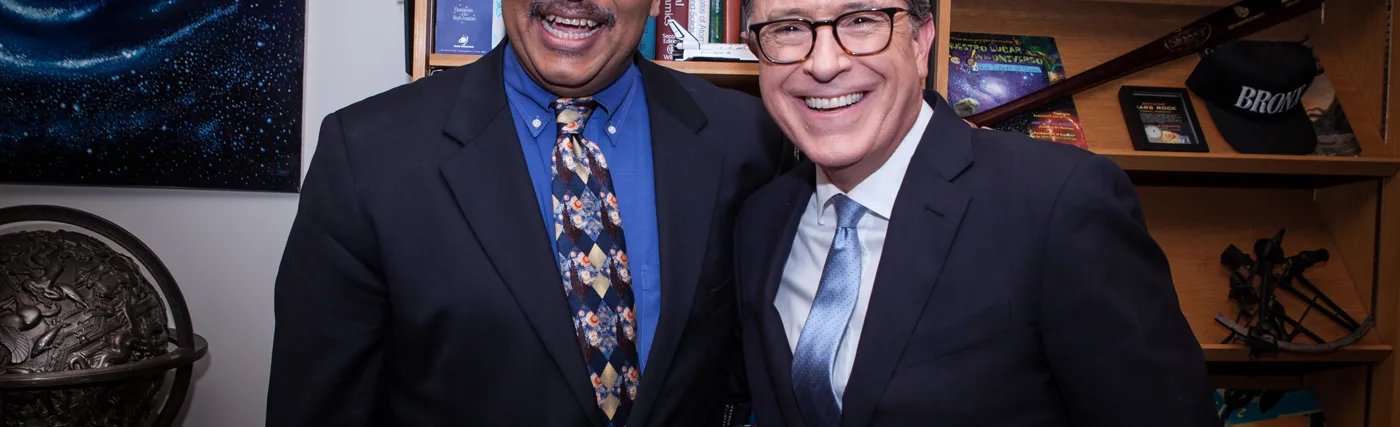
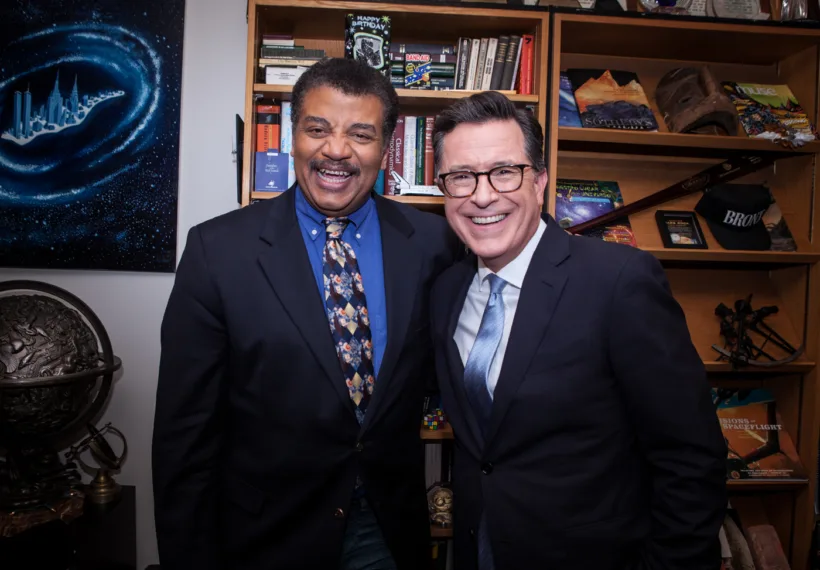
And he dropped by my office recently, and I had to clear up one thing right off the bat.
Let's check it out, so Steve, I gotta tell you something.
Don't start something, you're not gonna end.
2006, you were Time 100.
I was one of the Time 100 most influential people in the world.
In the world.
I personally represented 65 million people.
And.
That's math, man, 100 people, 6.5 billion.
There you go.
Good, gotcha.
Sure.
2007, you were not, but I was.
I remember.
And I seem to remember some monologue where you accused me of taking your spot.
I think I remember that.
Yeah, I think you got a contact influence off of me.
You weren't that influential before you were on my show.
Suddenly you're one of the most influential people in the world.
Yeah, pretty shady, pretty shady.
Then they have, then.
I got back on in 2012 though.
When was the second time you were on?
I forget.
I'm sorry, I just forgot.
Does anybody else?
Can we check the web for the second time?
He was most influential.
No, check, yeah.
Yeah, it's funny you start out, you start out looking like you're gonna fight, and you end up holding hands and crying.
I know, I know, I know.
As well, a good fight should end in hugs.
You know, I was on Colbert's show too, and now I'm on your show.
When am I gonna be on the time list?
Oh, yeah, okay.
We'll see, maybe there's a bump.
Maybe there's a bump.
Yeah, maybe I get the Colbert bump and the Tyson black hole, I guess, sucked into a black hole.
That's usually not a good thing, but that's what we're here for.
So the Colbert report had only been around for a year when he made the Time 100 list.
And so I'm just curious how he might have gotten so influential so quickly.
Well, the key thing that happens for Colbert in 2006 is he does the White House Correspondence Association dinner, right?
So take yourself back, feels like ages, and imagine Colbert five feet from George W.
Bush saying things that nobody was saying out loud.
And at the time it was such a big deal, right?
We think of it, but it was sort of panned, right?
So one of the things that also made it super cool was that a fan posted the whole bit online, thankyoustevencolbert.org.
It was then viewed hundreds of thousands of times and the media had to start to cover it.
Good, they gotta react to what people are reacting to.
So that was also part, it wasn't just that Colbert would do, he would impersonate a pundit and get away with saying stuff that other people would never say.
Oh, because he did it in character.
He did it in character.
Yes, yes, yes.
It was also that it was the beginning of this amazing relationship Colbert's had with social media and with like fan-based sort of that ongoing relationship he has with his fans.
What I found so fascinating about that moment, because as a comedian, as a young comedian, I was just, you know, I was an amateur comedian at that point, I was just doing open mics and stuff, but every comedian noticed that moment so much.
Let me be clear, open mic is anybody walks up.
Anybody walks up.
And your name is not on the marquee outside.
Yeah.
Right.
Do you ever have to do this as an astrophysicist?
You have to go up and just start reading your paper out loud in front of other astrophysicists because there's a microphone paper on the box.
If you're ever doing that, your name was in a schedule.
So, you know, everybody watched that.
It was such a huge moment for comedians, like we all noticed, holy crap, this guy is doing something really different.
The other shocking thing about it is that they would never book him now.
If they were booking the White House Correspondent, I mean, you know, if they were booking that kind of event today, they would never book Stephen Colbert because they didn't, the political class and the media didn't realize the power that comedy had at that moment.
Oh, he's just gonna tell jokes.
And there was actually some debate over whether they really knew what he, you know, who his character was.
You know, you can't be clear on it.
Maybe they set Bush up or maybe they didn't, right?
But no one's admitting it.
Since then, it has 31 Emmy nominations and nine wins and he's got a Grammy Award for a Christmas Comedy Album.
Okay, I forgot you can win a Grammy for comedy, of course.
And of course, for me, the most coveted of these awards has two Peabody Awards.
That's the one where they, you know, watching not just how popular you are, but what kind of messaging.
Change maker award.
Change maker, exactly.
So I can see why he might be influential, given that exposure, but why would he be so important a comedian in your circles?
I mean, he and Jon Stewart both, you know, I think as a unit, that classic hour back to back, you know, really showed me as a comedian what comedy was capable of doing.
That comedy could, you know, because they're, oh yeah, people used to make fun of the president, you know, but it was that comedy could really speak to people intelligently, with intelligence, and talk about actual issues that were happening today.
I never thought about that.
What you're saying is that the perimeter of what counted as important and good comedy grew.
Yes.
So for me, I picked up different things about it.
So there was all that what you described, but I was a guest on his show multiple times, and that was not unusual for scientists.
Yet they had scientists, all the both of them.
John Stewart and Stephen Colbert.
And so I just thought, wow, scientists now have a voice.
In an important outlet that wasn't previously accessible to them.
So I asked him about this heavy presence of science on his show.
Check it out.
There was kind of like a scientist every week, or an academic who had expertise that had to mean, unlike most talk show hosts, that you valued science.
Oh, I love it.
In the conversation.
I love it, I love learning things.
Yeah, but where does that come from?
Where does the science come from?
Where does the science come from?
Because you're a comedian, you're a talk show host, and it's not anybody's first thought.
Well, listen, comedians are great deconstructionists by nature.
You take things apart.
In this case, usually it's human behavior or something like that.
And then you put it back together in kind of a wrong way.
You know, like you rebuild the monster with some of the organs missing.
Go look how it flops around.
My dad was a scientist, he was an immunologist.
What he really wanted to do was, he loved bench science more than else.
Bench science and teaching, but...
Bench science.
That's what we call it, bench science, like basic sciences.
Like on the bench, you never heard bench science?
When I was a kid, that's what it was called.
Someone who was in the trenches, actually on the bench with the microscope doing the work.
Okay, that's the opposite of baseball.
Exactly, you want to get on the bench, exactly.
And then at a young age, I kind of fell in love with, I fell in love with science fiction.
And I was interested in thinking logically.
So the scientific method is applied to narrative, like Asimov is good in this regard.
Isaac Asimov, this sounds like you were a geeky kid.
Oh, I was a total geeky kid.
It was science fiction and fantasy to a large degree.
And computer programming classes, and before any of this stuff was cool, man.
So he says comedians are deconstructionists.
So just tell us a little more what that means.
I know what it means, you know, from a philosophical point of view, but when a comedian uses the phrase, what's going on?
We try to talk about, you know, all those questions you have about the world, you know, is, are things really like that, you know, or why are things this way?
And we turn that into telling you the awful truth about, you know, everything that you take for granted.
Okay.
Adam ruins everything every Tuesday at 10 on True TV.
Well, so, of course, on The Colbert Report, he plays a sort of satirical character with a persona of like an ultra conservative pundit.
And so we talked about the fun we had playing with that dynamic in the times I'd appeared on his show.
So let's check it out.
You were one of my favorite people to interview on that show.
And on the new show, too.
But one of the reasons was is that I think you like an argument.
Sure.
I can hang with you on an argument.
But that old show was a constant argument.
It was an argument with reality.
And my guest represented a slice of reality.
And you, being a scientist, seeking the truth, seeking the truth of our reality, were a perfect foil for his just profound love of strength through ignorance.
Well, and of course, the concept of truthiness is now in our vocabulary.
It's in our analysis.
We even use it in my circles, in my professional circles.
How truth-thin does that sound?
What it feels like?
Is it real?
Yeah.
Do I want to believe that?
Or is that really what's happening?
Am I letting my desire for that to be the truth?
Exactly.
And of course, as a scientist, you have to be inoculated against being a victim of feeling what is true even against what the evidence shows.
So Sophia, could you just lay out sort of more formally what truthiness is or what that word had come to mean in the Colbert nation?
Well, you know, on his first show, which is when he coins the term truthiness, he says, he says, I'm going to feel the news at you, right?
So it really was coded in the idea that what you know comes from your gut.
And when he did the first truthiness word segment, he said, you know, you have more nerve endings in your gut than you do in your head.
So he was playing all the time with what at that moment felt like a real assault on truth.
And truthiness became not just the word of the year.
Merriam-Webster made it the word of the year in 2006.
It is a thing.
I think xenophobia was the word last year.
So truthiness, though, was also important because it gave us a common vocabulary for a lot of things people were feeling and thinking, but we didn't have the word, and that's what he gave us.
So why are we susceptible to believing things that sound true?
This is like, you guys study this.
Yes.
It's depressing.
Well, it turns out...
Because in science, we care about evidence, and we have to train ourselves to trust evidence, even in the face of bias.
Right.
We're trained this way.
So I'm guessing I kind of understand, but how could it be so widespread?
So we have what we call confirmation bias, which is that you just like information that reaffirms what you already know, right?
So you can be presented with counter evidence, or what we call correcting information, and you just don't want it, it doesn't feel right, and you just ignore it.
It's fascinating how the brain will just forget that it got information that would contradict what they already believe.
So we all sort of do that, but the bigger thing that happened, especially during that period of the Colbert Report, is that we had a strange moment in US history where pundits, politicians, leaders themselves were not sort of champions of evidence.
And so it got worse.
It's definitely, the statistics show it's substantially worse today.
So you have people feeding that frailty.
Well, that brings us to a little segment I have prepared.
It is everyone's favorite game show, True, Truthy, or False.
Oh.
Where did you get this?
I made this during the last clip.
I built it myself with a hot glue gun and some magnets.
Okay.
Here we go.
I'm going to spin.
I'm going to spin the wheel.
Each card has a fact on it.
You two are going to tell me whether it is true, truthy, or false.
If you folded a piece of paper 42 times, it would reach the moon.
If you folded a piece of paper 42 times, it would reach the moon of any size.
If you folded it in half 42 times, yeah, it would reach the moon.
Yeah, you're absolutely right.
That is true.
It's 2 to the 42nd power times the thickness of the paper.
That's a huge freaking number.
Yeah.
I had to do the math precisely, but I...
Neil, you're right.
The moon is about 240,000 miles away.
That's the equivalent of 3.8 times 10 to the 12th pages, which is about right.
You get that, yeah.
Okay, let's do another one.
The power of doubling is astonishing.
More than 20% of Americans are related to Rick Moranis.
What do you think?
More than 20% of Americans are related to Rick Moranis.
No.
Yeah, that's simply false.
It is neither true, nor is it truth.
It certainly doesn't feel right.
It's not right.
But in the tree of life, we're all related to one another.
I'm going to spin again.
DNA is the only foolproof type of forensic evidence.
It feels truthy, but that's kind of...
Foolproof.
I'll give you a hint.
You were actually right the first time.
It is truthy.
It's truthy.
You got it right.
Because it feels...
It feels truthy.
It's something we've heard.
It's like, yeah, DNA.
Oh, it's sciencey.
You love science.
So you want to trust the science, right?
But the fact is that DNA can suffer from incomplete samples and crime scene contamination.
Oh, this is great.
Researchers asked pairs of people to shake hands and then handle separate knives, right?
But in 85% of cases, DNA from both people was found on the knives just because they shook hands, which goes to show even though it's science, and our emotional truth is that science is always right, we can't go with that just because it feels truthy.
We actually need to look at the evidence and be just as critical about DNA evidence as we are about science.
So it's a cog in the evidence wheel.
So you should shake hands before committing a crime.
That is technically true.
It's maybe not advice you want to give, but yeah.
Yes, yes, absolutely.
Well, that's the game, everybody.
Well, thank you for that.
So Sophia, I have to ask you, can news satire teach us more about news than news itself?
Well, it can and it has and it keeps doing it.
So it's just an empirical fact.
We have some really cool data.
So there are a number of studies, in fact, actually to the great dismay of a lot of cable news folks, multiple studies that came out and showed that viewers of Stewart and Colbert knew more about current issues than viewers of, say, CNN, Fox News, MSNBC.
And so what they found was that, and one of the things that's curious about this is you think, well, how could you know that that's the only source of the news?
But they correct for that.
So in other words, I could watch John Stewart in The Daily Show, but still consume 10 other newspapers and things, and therefore it would give a skewed result.
Yeah, you can't.
That won't work for the data.
So the data, there was a study, for instance, in 2007, Pew Research Study.
Pew?
Yes, and they put Stewart and Colbert at the top, up with NPR.
Right.
So just think about this for a minute.
Both Stewart and Colbert were a little freaked out to find out that was true because it turns out they wanted to do comedy.
They did not want to be the source of everyone's news.
They wanted to make fun of the news and make fun of pundits and politicians.
They didn't want all that pressure.
That wasn't what they were looking for.
It was just the sign of the times.
Well, I'm in that statistic because my primary source of news is through them.
And if there's a news story, that's kind of interesting.
Then I go and dig up other sources.
Well, you are exactly the story, right?
Which is that people would get the hook from those shows.
And then they would go and start looking into it more.
And that was, from a satire standpoint, a first of its kind.
Again, so this is the perimeter of the comedic circle growing even further.
That's why those guys, that's really the top of the mountaintop for a lot of comedians like me for what you can do with comedy.
Because nobody went to Rodney Dangerfield for current events.
Yeah, right, right, right.
Well, part of it, though, was that the news itself had gotten so ridiculous, right?
And so Colbert would make fun of the fact, especially morning news, right?
They're covering, say, an alligator walking down a street.
No wonder people are not really learning anything.
And so it turned out that this satire news was informing the public at a much higher rate, and that's still true, right?
They really control it at some level, some of the conversation.
Yeah, I mean, what we try to do on our show is, you know, we're...
Look, I'm just a comedian, right?
I'm not a scientist or a researcher of any kind.
But what we try to do is bring, and following in that mold, bring information to the audience through comedy.
So we mostly go to journalists, scientists, and we bring them on the show.
Well, plus, it makes a better bit if the information you bring in is current events.
Because then people bring an awareness of it to your bit.
Well, the thing is people also, people love to laugh, and they love to learn, and they love to be informed.
And so that template of doing both of those things at once while you're making fun of the information as you're giving it turns out to be really effective.
Well, next, in my interview with Stephen Colbert, we discover the roots of his passion for science and comedy when StarTalk returns.
We're talking about science and satire with comedian Stephen Colbert.
And I asked him about the origins of his sharp sense of humor.
Check it out.
I'm from a family that valued it, you know?
Like it was like oxygen, like it was a humorocracy.
I've said this before, but like the funniest person in the room was King at any one moment.
And there's a lot of us, there are 11 kids in the family.
So there's always, yes, and, and, um.
And which, what's your rank order?
I'm 11th.
Ooh.
Jimmy, Eddie, Mary, Billy, Margaret, Tommy, Jay, Little Paul, Peter, Steen, I'm the baby.
And so, you know, my sisters would say that they're, you know, I always had an audience.
There was always somebody ready to watch.
And so I wanted to entertain them.
I heard my mom say once, I said they were complaining to her about how bad my storytelling was.
And I heard my mom saying, he loves telling you his stories.
Just listen to them.
And after that, I thought, well, I've got to get better at this because I can't force my brothers and sisters to listen to my stories.
To realize that people will listen harder, will care more if they're laughing with you at what you say.
Yeah.
Was this a revelation or, because it's one thing to just make humor and it's another thing to be a pundit, but it's quite an entire other thing to merge the two.
Well, listen, I think you gotta do comedy about the things that interest you.
Especially if you're doing 200 hours of this a year, you can't fake it.
You have to talk about things that actually interest you.
So that's one of the reasons why I wanted to talk to scientists all the time, is that I don't have to fake my interest in that.
But also, I mean, comedy is essentially thinking.
You know, it elicits laughter but that's not the same thing as an emotion.
I think that comedy alleviates fog off the mind.
Because when you're laughing, you can't be afraid.
And when you're not afraid, you think better.
I think laughing leads to thinking.
We discovered that on our own in StarTalk.
There are people who don't know that they like science.
And other people who think they don't like science.
Then you package it in a way where they come and they smile and they laugh, that makes our show.
We don't have a show without that.
If you get their attention with comedy and then they listen to what the science is, they'll have their own emotional reaction that is greater than anything you could lay on them.
I agree with her.
You cannot feel science in people.
But science can make you feel.
Whoa.
The numinous, you know, the awe, you know.
The wonder of StarTalk.
Wow, you two just went at it.
You know, we were like feeling it.
Yeah.
So have you found that comedy helps people learn from your show?
Yeah, absolutely.
In two ways.
I mean, one, there's an incredible quote from George Carlin.
I'm gonna butcher it a little bit.
But it's, when someone is laughing is when they're most truly themselves.
You know, when their defenses come down and they're most true to themselves.
And that's when you can plant a little seed of a new idea in that moment and have it grow.
That had a real impact on me.
Does that also mean their defenses are down?
Yes.
So you can get in.
Exactly, because they're reacting so honestly in that moment.
So Sophia, how does satire help us connect feelings to facts?
So the-
Is that a fair question?
Yeah, no, it is.
And it's really interesting to ask this about satire, right?
Because not all comedy is satire.
Some comedy actually isn't very smart and is actually kind of stupid, right?
Making fun of how people look, not necessarily gonna get you smarter.
But what satire does, satire lives in the land of irony.
Right, so irony depends on, I say one thing, but I mean something else, right?
So suppose it's sort of pouring outside and we both show up at work and you say, hey, nice weather.
And I'm like, yeah, it's great.
And you know that I didn't mean great because I was being sarcastic, right?
Your brain has to hear what I'm saying and invert it into what I meant.
And so when we look at brain waves, like you said, you literally do see the brain light up when it has to process irony, sarcasm, snark.
Snark is really good.
Swearing is actually good, but that's a different topic.
So the brain is processing what you're saying and has to think it through.
Suppose the person doesn't get the satire and then takes it as fact.
That's sad.
So is that the failure of the person who didn't get it or the failure of the person who delivered it?
That's just a bad comedian.
There's some really interesting data on this, right?
So it turns out that there are people who have a difficult time processing irony.
We all know these people.
Yes, and...
You don't take them to the comedy club.
They don't like me, usually, because I tend to be somewhat sarcastic.
I mean, right, if you grow up in a sarcastic household...
Yeah, you can't say that's what...
And then someone's like...
It's survival.
Why are you being sarcastic?
Or they just find it offensive.
It's the most frustrating thing to a comedian when they take you seriously.
It is.
It is.
It is.
When you're taken too seriously.
It was a joke.
Well, my good friend Bill Nye, he's a big fan of Stephen Colbert, and he sent in this dispatch for our show tonight.
Let's check it out.
We're right off the famous Hollywood Boulevard in Hollywood, California, and Hollywood celebrates its stars, just as you do, Neil.
Stephen Colbert is one or two stars on his show every night, and Stephen celebrates knowledge and science.
That's why he has guests like Neil DGT and even BNSG once in a while.
Now, one thing the United States does export, for better or for worse, is our popular culture, our pop culture.
And a lot of it is produced right here in Hollywood, USA.
Now, here's hoping that Stephen Colbert's passion and good humor get exported right along with the memory of all these stars.
Back to you, Neil.
Sophia, I've known this for a while, that one of our biggest exports is entertainment.
You kind of stumble on it when you travel and you put on the TV and all the shows are like shows you have back home, but dubbed in the local language.
But we don't have any of their shows dubbed in our language back here.
So there's a great asymmetry there.
And so I'm just curious, how long do you think American entertainment will continue to influence the world?
Well, I mean, what we see is, especially with things like what we saw in The Colbert Report and The Daily Show, there are sort of versions of this everywhere.
In fact, there was a total Colbert Report ripoff in China.
It was really funny.
It was almost identical.
And in fact, we have these examples of satire news shows similar to what we had.
And part of it is, it's not a very expensive format.
And people enjoy it.
But the other piece of it that we want to remember is that across cultures and across time, human beings have always produced satire.
Because it's what you do when you need to mock systems of power that are abusing their status.
So there's always been a need for it.
So for instance, Colbert referenced Jonathan Swift on his show.
I love me some Jonathan Swift.
It goes all the way back to Aristophanes.
Juvenile and all that stuff.
Jonathan Swift wrote Gulliver's Travels.
Just showing off that I'm literate.
We all knew you knew me.
Thank you.
So Stephen Colbert's The Colbert Report had such a pop culture following that it reached all the way to space.
Let's check it out.
Dude, you've got a treadmill in space.
The Combined Operational Load Bearing External Resistance Treadmill.
Colbert.
Isn't that the greatest?
That's crazy, man.
I mean, Newton take me now.
I got a bust of Isaac Newton over there.
He's looking at you, smiling.
It's incredible.
Here's how it happened.
So the old show, I loved having things named after me because the whole show is an expression of the ego of my character, not of me.
I have no ego.
I'm a humble servant.
But one of the great things is that I could piggy bank my ego on his ego.
And we were on break or something like that.
I was about to go back to work the next day and I noticed online that NASA was having a naming contest for one of the new modules that would attach to the space station.
And I went, well, surely they're not letting people just submit names.
They have to be like a list of four and it's going to be like Tranquility or Serenity or some nonsense like that.
And I said, nope, you can submit your own.
So I submitted myself.
The next day I said, go vote!
And we beat everybody.
And then NASA, before they announced 2-1, said, okay, we need to talk because we're not going to name the module after you.
Sorry.
So this is what they first offered me.
It was through an intermediary or else I would have jumped on it right away.
They said, we have a water reclamation system where it reclaims the astronaut's urine, please.
Urine, this is a family show, urine.
And then it's filtered so it's drinkable again.
And I was like, I'm in.
You mean you could name the astronaut urine filtration system after me and then you could bring some of that water down and I can have a bourbon and astronaut pee?
You know, I want to have, that's a perfect cocktail.
That's the most American cocktail Kentucky bourbon astronaut pee.
Come on, carve my face on Mount Rushmore.
And before I could say yes, they said, okay, we've run it through the higher channels and they're not going to let you name because this is exactly why.
And they said, what about a treadmill?
And I said, that sounds fantastic.
Of course, that's not the only thing the man has named after him.
He's got a flavor of Ben and Jerry's ice cream.
There's a bald eagle in a zoo, which is, of course, the symbol of his show and named after him.
And he has a species of spider named after him.
So Sophia, what is it about him that he can rally fans with such thoroughness?
Well, so part of it is that he's a lot like you.
He combines sort of a smart bit with a lot of charisma.
And so he was also at the forefront of using Twitter.
I mean, he had such energy behind getting the Colbert Nation, right, the fans to get connected.
And also let you be in on the joke when you did that, like because...
Oh, your participant.
We call it citizen satire.
So this is a real kind of relationship with his fan base.
This was very new, especially at the kind of magnitude that Colbert had.
Well, you know, he's a true science lover, and he actually had a question for me about something he'd forgotten in science class from his days in school.
Let's check it out.
Can you explain to me something about the difference between a theory and a hypothesis?
I've had this explained to me all through my childhood, all over again, over and over again, and then when we get to this stage in my life, I forget the difference between a theory and a hypothesis.
Okay, so let me give a bigger answer.
In the old days, we would measure some phenomenon in nature.
We would repeat a zillion times.
That is law.
The law of, you know, Newton's laws of gravity.
Okay.
In the 20th century, we discovered that these laws were incomplete.
And at the edges of the law, they would like break down, and we needed a bigger understanding of what happened.
This is how Newton's laws became Einstein's laws.
Newton is a special case of Einstein's law.
We said, well, if this is going to continue, the word law just is too, is not appropriate.
So we'll just simply call them theories.
So a theory is an idea that accurately describes what you see and empowers you to predict accurately what you have yet to observe.
Theory of evolution, theory of gravity, we'll now call it the theory of gravity, quantum theory, all of this.
Now, if you have an idea, especially one you just pulled out of your ass, don't call that a theory.
I have a theory.
No, it's a hypothesis.
You have a hypothesis.
And until it is fully supported by evidence, you've got to keep calling it a hypothesis.
So Adam, did you get that straight from science class?
I remember that one from science.
I have a pretty good recall.
Well, up next, Stephen Colbert shares his thoughts on reason and religion when StarTalk returns.
Featuring my interview with comedian and late night talk show guru, Stephen Colbert.
And his shows are infused with a love of science.
But he's also been very open on his show about his devotion to Catholicism.
So I asked him about that aspect of his background.
Let's check it out.
I was raised in a regular church going Catholic house.
I was an altar boy.
Yeah, it was really a big part of my life.
So being in the South and having religion a big part of your life and having all this science, there was no problem there, I guess.
No, no, my dad was a perfectly logical, rational Catholic, devoted rightly to reason.
And I was not raised that those things were incompatible.
I was raised with the church as a teaching organization.
My dad was taught by Jesuits.
And the Big Bang was first postulated by Catholic priests.
So that's the church that I was raised in.
So Jesuits actually have some badass moments in their history.
They singularly invented the Gregorian calendar.
What?
Before the era of telescopes.
Okay, so how did they do that?
Yeah, yeah, no.
I mean, they were just careful measurements of the sun, moon, and stars.
And then math.
And a little bit of math.
And they showed that the old Julian calendar was mismatched to the beginning of the seasons.
I've always been taught that the Jesuits were pretty good on science, that they were a powerhouse.
Yeah, so they were mean to Galileo, okay?
But other than that.
Was the Jesuits were mean to Galileo?
They were terrible to Galileo.
Yeah.
I heard he was a jerk.
Yes, actually, yes, yes, yeah.
He was a real a-hole.
He lived.
They didn't burn him.
Yeah.
Oh, God.
They didn't burn him.
Put away the violins, everybody, he lived.
Right?
Did they kill him or not?
They put him on a house arrest.
All right.
Please.
All right.
Joining us now to tackle this portion of our show is an actual authentic Jesuit priest and author, Father James Martin.
Father, welcome.
So he was never taught, Stephen Colbert was never taught that reason and religion were incompatible.
So why would you say so many people have the impression?
Well, I think the same thing that drives bad science, which would be ignorance.
So this is the same thing that drives bad religion.
You know, people don't understand a lot of some of the theories of science and some of the actual facts about science.
And a lot of people don't understand religion and kind of what's behind religion.
And so I think it's a little bit of ignorance and also, you know, we're responsible for it too.
I mean, we haven't always been very pro-science, but you know, there really is no conflict between faith and reason.
I think most intelligent believers would tell you that.
Well, Colbert is apparently proud that the Catholics didn't kill Galileo.
That's a low bar.
So in modern times, Father, what has the Catholic Church done as a sign that it embraces science rather than shun it?
Well, I mean, in terms of what's going on in the Vatican, you can see a lot of conferences on science, a lot of conferences for both atheists and believers.
They sponsor professional conferences and scientific conferences and try to explain to people exactly how science and faith can coexist, which I think is very important.
If I remember correctly, the recent encyclical by the Pope included a lot of reference to science.
Well, right.
Laudato Si, which is about climate change and also about how it disproportionately affects the poor, drew on a lot of science and climatologists.
It was one of the first papal encyclicals that really kind of pulled that in, not at a sort of abstract level, but on a real granular level, actually saying that these are the effects of climate change.
To show that we have nothing, not only to fear from science, but we really need science.
It can help us in our religious beliefs and in the proclamation of what we're trying to do in the Catholic Church.
So, Father, you wrote a book, a best-selling book called Between Heaven and Mirth.
Awesome title.
Why Joy, Humor and Laughter are at the Heart of Spiritual Life.
So, this whole show has been about comedy.
And so, where does humor link to spirituality?
Well, the first thing is that joy is the kind of natural end to religion.
I mean, the Christian message is one of joy.
Christ is risen is supposed to be good news.
Although, in Catholicism, suffering is a major part of this.
It's a part of it, but it's not the only part.
I mean, the final part of the Christian story is the Easter Resurrection, which is joyful.
And, you know, Adam was talking about how we remember things.
That's good, because it was pretty bloody up until that point.
Yeah, for a few days.
But, you know, Adam was saying that humor helps us remember things.
And New Testament scholars say that Jesus used humor in his parables.
We don't understand it, because we're not, you know, first century Judeans or Galileans.
But there are sort of examples.
For example, he says...
You told me he cracks some jokes?
He does.
There's an example.
You're talking about how to remember things.
At one point with the scribes and the Pharisees, he says, you strain out a gnat and you swallow a camel.
And we say, well, that's interesting.
But in Aramaic, the words, right, for camel and gnat are gamla and galma.
So what he's doing is he's doing a little pun.
He's doing a little wordplay, which would have helped people remember things in his day.
So we don't understand it.
That's amazing.
There's another time where one of the disciples hears it's the Messiah Jesus of Nazareth, and he says, can anything good come from Nazareth?
Which is a little bit of a dig, basically.
So we don't get it because it's, you know, first century Colosseum.
Yeah, and so part of it is recognizing that in these stories that we know so well is some humor.
And the people in those times would have understood these things as funny and, as Adam was saying, memorable, too.
Some of the best satires when you make fun of yourself or your own tribe, I guess.
So, Father, how would a Catholic go about satirizing the Catholic Church?
Very easily.
Easily?
There's a lot to laugh at.
And I mean, I think that's a perfectly legitimate target.
I mean, they're human organizations.
We have to keep humble.
And so why wouldn't you make fun of, you know, people who are pompous or stuffy or things that we do that are crazy?
So why not?
Father, thank you once again for being on StarTalk.
Coming up, Stephen Colbert shares a hopeful reminder that knowledge is power when StarTalk returns.
StarTalk, from the American Museum of Natural History, right here in New York City.
We've been discussing the intersection of science and satire with comedian and talk show host Stephen Colbert.
Check it out.
So Stephen.
Yeah.
Neil.
Whatever are the challenges of politics between knowing what is true and what isn't, I think we feel that even more deeply in the sciences, when you have people rising up with platform, speaking objectively false things about the natural world.
It's frustrating.
And we don't even know what to do.
And all I can say is let's just fall to the bottom and then everyone figures out how they should pay attention to knowledge.
I don't know.
But in the process of that fall, things are broken and things are neglected when instead things could be built and action can be taken to prevent further damage.
A report was recently published, leaked actually from 15 different federal agencies, I believe, who all agree that climate change is happening faster.
The effects are more profound, more immediate, more palpable, knowable by individuals.
You can see it happening in your lives.
It was leaked because the fear was that the present administration would suppress this report.
So this is the world we live in now, that science has to be leaked.
Are we gonna get our weather forecasts from a guy wearing a trench coat and a shadowy, you know, deep throat is giving us our weather forecasts in a parking lot somewhere in Washington DC, you know, leaking the information that is partly cloudy tomorrow.
Just fear of knowledge, like fear of knowing things about the world is so weak.
And I think the thing that will save us from people who don't want to know is that knowledge is power and if they refuse to know, they will lose power.
So Sophia, is there a tipping point for the power of knowledge overcoming the forces of ignorance?
So the big thing that you see in Colbert is that he loves knowledge, right?
What we're seeing today isn't so much a distinction between ignorance and knowledge.
It's misinformed versus uninformed versus informed.
Okay, so if you're misinformed and I try to inform you, it's not likely to go well for me because I will actually sort of ask you to give up a thing you think is true.
And I'm hunkered down on it.
Right, but if you say, hey, there's a new planet and I say, oh, okay, I didn't know, I'm cool.
But I didn't know and you informed me.
That relationship is, that still works.
It's the misinformed versus.
So is this a pendulum?
Are we in a swing of the pendulum where misinformation trumps accurate information?
Your metaphor here assumes that there will be another swing, right?
That there's movement.
I'm asking you.
You study this stuff.
So no, it's not good.
The misinformation in the general public today is significantly worse than we've ever seen at a time when, in fact, people have so much information at their fingertips.
So Adam, if science is suppressed in society, like Colbert mentioned, what's going to happen?
You have thoughts on that?
I mean, nothing good can happen as a result.
Science is how we learn about the world around us.
It's how we take action.
If you don't know the world, you can't take appropriate action in the world.
So, I mean, if science is...
That's a beautiful sentence.
Thank you, thank you.
That means a lot coming from you.
Before we wrap, Stephen Colbert offered a final thought on the importance of knowledge and learning.
Through his own excitement for science.
Check it out.
Here's what got me excited about science, among other things.
I would say two things that happened in rapid succession.
The moon landing of 1969, the eclipse of 1970, which was totality going up the East Coast.
I live in Charleston, South Carolina.
But then all the missions throughout the 70s, I was glued to all of them.
I mean, I still believe that it's the most exciting thing, the most exciting way to light a candle in the mind of a child is to say, see all of that out there?
That's for all of us to discover.
We can go do it.
That is a tangible frontier for us.
I mean, I'm totally hooked into that hopeful vision of the future.
I'm still with the we do not choose to do this and the other things because they're easy, but because they are hard.
The harder it is, the more valuable it will be to do.
The better, the more we have to do them.
The deepest respect I have for any profession that's out there is for the community of comedians.
As a group, they're smart, they're clever, they're witty, they know stuff, and they have access to us.
They know how to reach us, make us smile, make us think.
And what is satire?
It's a way to open a door to an idea that you might otherwise be uncomfortable with.
But now you hear it in this comedic context, then you start laughing at it.
And you know what happens?
Which is why comedy at its best, there is no substitute for it.
You know what happens?
They get inside of who you are, and they understand society like no one else does.
And they connect you to society, they figure it out, they put it back to you in a way that makes you laugh.
And then you realize that the jokes you just laughed at, the comedian who's delivering the jokes, they're not really there at all.
Because all they did was hold up a mirror to society and a mirror to ourselves.
And that is the value of comedy in this world.
And we need it because without it, civilization itself would be unbearable.
That is a cosmic perspective.
Ladies and gentlemen, I've been your host, Neil deGrasse Tyson.
I want to thank our guests, Adam, Sophia.
Thanks for joining us.
And as always, I bid you to keep looking up.
See the full transcript



 Unlock with Patreon





 Become a Patron