Is there something about the human brain that makes us particularly susceptible to magic and illusion? Is skepticism the antidote to pseudoscience? All will be revealed when Neil deGrasse Tyson interviews Penn & Teller, two of the world’s most popular magicians, who also happen to be world famous skeptics. In studio, Neil is joined by co-host Chuck Nice and neuroscientist Dr. Susana Martinez-Conde, Ph.D., who co-wrote the book on magic and the human mind. You’ll learn how it’s possible to practice honest, moral magic – and also how a magic trick was once used to further the goals of colonialism through racism and misogyny. Find out why Harry Houdini went from believing that you could communicate with the dead to becoming the scourge of phony mediums. Michael Shermer, the Founding Publisher of Skeptic magazine, calls in to discuss what magical thinking is, and why we should be wary of superstition, psychics, astrology, and other flavors of pseudoscience. Plus, Bill Nye explains why we want to believe in magic, and Penn Jillette lets us in on the only secret in magic.
Transcript
DOWNLOAD SRT
Welcome to StarTalk, your place in the universe where science and pop culture collide. StarTalk begins right now. Welcome to the hall of the universe of the American Museum of Natural History right here in New York City. I am...
Welcome to StarTalk, your place in the universe where science and pop culture collide.
StarTalk begins right now.
Welcome to the hall of the universe of the American Museum of Natural History right here in New York City.
I am your personal astrophysicist, Neil deGrasse Tyson.
And tonight on StarTalk, we're featuring my interview with legendary magicians and illusionists, Penn & Teller.
What you might not have known is that they are also passionate about science and skepticism.
And so this conversation went everywhere to orbit those two subjects.
So, let's do this.
So I've got with me my co-host, Chuck Nice.
Hey.
Great to be here as usual.
Professional comedian.
Yes.
And smart aleck.
Well, I'm probably a professional smart aleck and comedian.
Oh, that's how that goes?
That's how you work that?
That's what your teachers told you?
You just took me back to so many bad memories.
So, I try not to ever do this alone.
I always get backup.
And so, tonight, we have Susana Martinez-Conde.
Welcome, Susana.
You specialize in sort of the neurology of magic.
I guess.
Is that the right way to say that?
I'm interested in the neural basis of behavior.
What do we act, what do we think the way we do?
And it turns out that magicians have taken some lead on neuroscientists to figure out how some things work in the brain.
But you're also a magician yourself.
Are you really?
I'm a retired magician.
What does that mean?
What, what?
No.
So I took magic classes for a year and I actually, I'm a member of a number of magic societies and one of them, the Magic Castle of Hollywood, requires a test, sort of like a thesis defense.
Do you have to perform in front of a...
And you passed this test?
Barely.
Barely.
Barely, what do you mean?
Is it like an algebra test?
How can you barely pass?
Would you cut the lady only partly in half?
Then you couldn't, like what do you mean barely?
I passed, but I was told in no uncertain terms that I should not quit my day job of being a scientist.
That was my first and only performance.
Now you co-authored a book called Slights of Mind.
You co-authored it with Stephen Mechnick, is that correct?
Because I know you did that because I actually blurbed your book.
And I've got the actual blurb here.
Tell me if this doesn't summarize the book.
I worked hard on this blurb, just so you know.
Here it goes.
Stephen and Susana persistently remind us that the human mind is a bad data-taking device.
And it's this fact that enables the science of magic to exist at all.
That is awesome.
He just said, you said, we are stupid.
So we're going to be drawing deeply on your expertise for this, because we're going to be going back and forth with many clips with Penn & Teller in my office, and we need you to help us understand, interpret, and make sense of it all.
So Penn & Teller, they've had a show in Vegas for 14 years with a theater with their name on it.
It's the Penn & Teller Theater.
Now that's badass.
It is.
If you didn't long enough, they'd name the damn theater after you.
So...
And it's an awesome show.
Yeah.
Well, I saw their show here in New York on Broadway, and if you did not know, Penn is the bigger fellow, and Teller is the littler fellow, but even as the littler fellow, he's still at least like 5'9 or 5'10.
You'd think he's tiny, but Penn is like 6'6 or something.
Better, maybe even 6'7.
It's kind of like, you know, like, we're the Black Penn & Teller.
Because people see us in pictures, and they're like, wow, Chuck, you are a little teeny guy.
I'm like, no, have you ever considered that Neil is giant?
So Teller, they've got a shtick.
Teller has a background in miming, and in their magic act, Teller never speaks.
He gestures what you need to know about what he's doing.
And I saw the show, and he doesn't need to speak.
He doesn't need to speak at all.
It's working.
It's working.
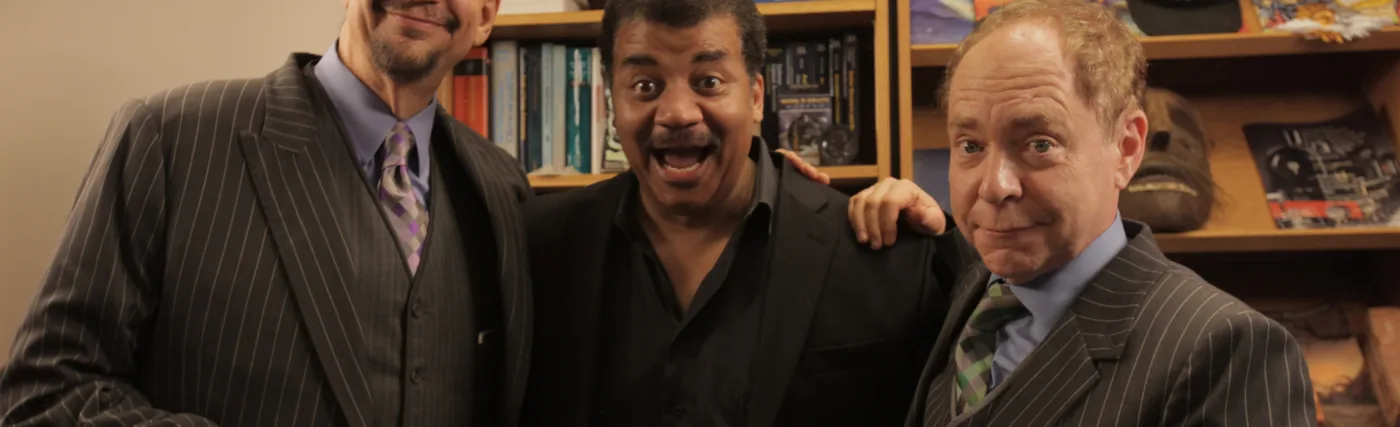
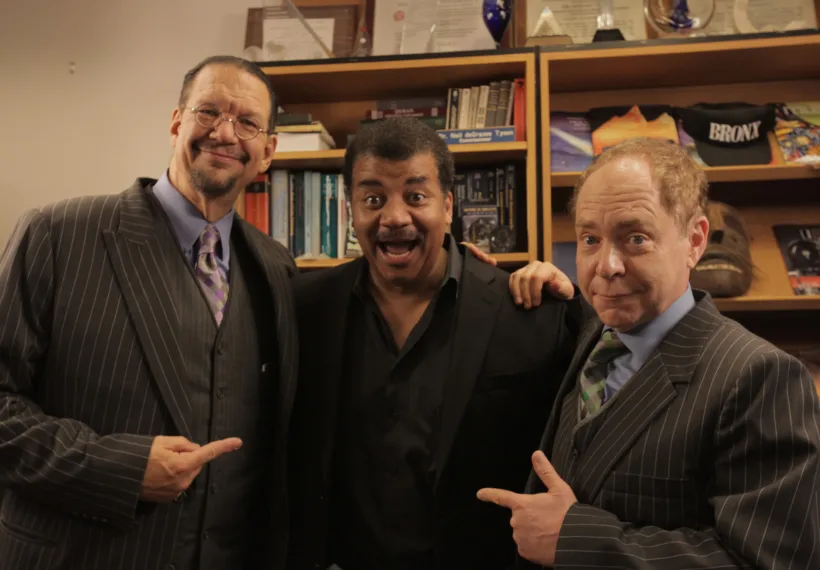
And so they came to my office, we sat him down, we put a camera on Teller, just in case he said something.
So, but anyhow, I put him down, we throw, we put him in the chair, and as I always typically do, I ask about their background in science.
Was it good?
Was it bad?
Non-existent?
Just let me know what your deepest influences may be.
So let's check it out.
I was rather good in science.
And rather good in loved science.
And I get to about ninth grade, and on TV, there is a fake mentalist, which is, of course, redundant, Kreskin.
And he had this ESP kit, which was a game.
They had a little pendulum.
I wanted to get that.
It was a kit you could buy.
Yeah, buy a little ESP kit.
And it was, he was doing magic tricks, you know, I now believe, but he presented it as experiments.
So I got the kit.
My parents bought it for me because it was a science thing.
So just to clarify, this kit purported to test whether you have ESP.
No, it was for you to help with the testing of ESP.
You know, this was, Duke University was cited and all these other things.
So I would be there getting out in my small public library the two books we had on juggling, because I was a juggler then.
And there were magic books.
Next to the magic books, you know, coincidentally, was a book on mentalism, magic.
And in there were tricks very similar to the tricks that he had done as experiments on TV.
Now, some people might have reacted to that with a joy of being let in on the secret.
I reacted to that with rage.
I could not believe that an adult had lied to me.
And forgive me for this.
For a young child, I believed it was scientists who had lied to me.
And I flew into such a rage that my parents had been ripped off and I was embarrassed in front of them and everything else, that my whole science stopped.
I went from A's to failing.
Right there, overnight, just saying to my teachers, you scientists just lie, I'm uninterested.
And my hatred for scientists and magicians was unbounded.
And that stayed and I went to rock and roll.
So this is because you had the impression that because this was an experimental kid...
Because he claimed to be a scientist.
It came out of the world and the culture of science.
Yeah, and of course it doesn't.
So this messed with you.
For those of us who fight the skeptical battles, this is the nightmare we're worried about, right?
What if children think that these tricks are being done by real scientists?
And people say, what's the damage that could be done?
I don't believe the damage done there was that the most brilliant scientist of the 21st century, who was born in Greenfield, Massachusetts, stopped his career.
I don't think there was any danger done there.
But there was a hurt to a child that's very, very real.
And it wasn't until I really met Amazing Randy and Teller that I realized that magic could be done morally and could be done honestly.
So you saved him.
Very, very clearly, yeah.
And then it was people just going, Pat, he wasn't a scientist.
That's the only sentence I needed, right?
It's like, chill out.
Well, that's the only sentence you need, right?
After you've been scammed, you need that sentence.
But there was nobody in my life, I mean, my parents tried to say, no, no, because there's one bad guy, doesn't mean Carl Sagan is lying to you.
But it was a hard thing for me.
And I'm condensing that into a story.
It took twists and turns.
I don't mean to over-simplify, but can we credit that experience for you becoming who you are today?
Well, you know...
Leaves me to wonder if that didn't happen.
I would certainly credit...
Linebacker for the New England Patriots.
But you're not even putting on the table that I would have actually decided to start with.
Linebacker.
We're trying to find something that's exactly suited to your intellectual...
You are six foot seven.
I didn't pull that out of nowhere.
Excuse me.
I didn't pull that out of a hat.
But, you know, so that kind of put me in...
I was very much in rock and roll culture.
Teller was very much in theater intellectual culture, but not particularly in the sciences.
Not particularly, no.
But, you know, you don't have to...
You don't have to be able to play a sport to love it and cheer for it.
You don't have to be funny to be a comedy fan.
And you don't have to have the raw processing power to just think that science is the most important thing in the world.
Susana, is this a common problem with people fearing magicians and scientists?
I don't think it's a common problem in kids, but it is a challenge I can see for some young kids to be able to tell the difference between what's legitimate science and pseudoscience.
So, ultimately, this came down to intellectual honesty about your craft, about your trade.
And so I went back in there and I just asked about the formality of their code of ethics.
And let's find out how that came out.
The fact that you have all this unpleasant stuff built into magic, the fact that the word fool, I am fooling you, I am making you a fool, the fact that I am tricking you, to make that a pleasant, consensual relationship is a difficult thing.
I never thought about that.
The word fool.
No one wants to be called a fool.
But somehow it is okay for you to say you are fooling me.
Well, yes, but is it?
I mean, you are someone we respect tremendously.
You are someone wicked smarter than us.
You are going to come and sit in a theater, and we have to make a contract with you that says, you know, while you were studying astrophysics, we learned a little bit about what to do with a deck of cards.
And we think we can share that that is interesting, the way you can share the stuff you found is interesting.
And we are going to trick you.
We are going to use your mind against you.
And we are going to do that in the spirit of sharing and pleasantness.
That's a difficult social contract.
That is so intellectually honest.
I don't even know how to think about that.
Other magicians don't want to do that.
We've had other magicians say, no, no, no, you have to leave open that you really have powers.
But if I come to you and say, you know, we don't have any powers.
But you know, Neil, there's this way of handling books and talking to people that make it look like I could read what's in your mind.
Isn't that kind of nutty?
Let's give it a try.
All of a sudden, we're on the same side.
And I'm still impressed with that.
I'm still completely, because I don't know how to do it.
Sure, you don't know how to do it.
And I would like to think when you do know how to do it, you'll still be impressed.
So Susana, why is it that I can still be impressed by a trick even though I know I'm being fooled?
And even if maybe I even know how the trick is done, it still works.
So what's up with that?
Well, just because you know about Copernicus discoveries, as you know, it doesn't mean that you're not going to enjoy the sunset.
And I think with magic, if you appreciate how magic works, how magicians, sometimes the manipulations that they do, if you know about them, it's so surprising that the method works because it seems so crude.
And that allows you to know both about what goes into the magic, how magicians may take months or even years to do something that takes a few minutes on stage, but also about how the human mind works.
And especially as a neuroscientist, it's even more amazing that magic does this and it lets us know so much about what's going on in our brain, not just in the magic show, but in general in everyday life.
So while the mechanisms behind many of the tricks, magicians will never reveal them, I would expect.
But you presumably can reveal how the brain works in response to those tricks, is that right?
That's not a secret.
You published that.
Yes, absolutely.
And well, the president of the Magic Circle in London said to us, the door to magic is closed, but it's not locked.
So that means that you can push a little and the door will open.
And the fact is that if you want to know how any trick works, just go to YouTube and you'll find out.
Well, one of the famous tricks of all time is the catching a bullet in the mouth.
Yes.
And when we come back, we're going to find out how Penn & Teller accomplished that.
Oh my God, I thought you were going to say when we come back, you're going to shoot Chuck in the face.
Let's do StarTalk from the Hayden Planetarium in New York City, where I serve as director.
That's like my day job.
Or shall I call it my night job?
No, your night job is superhero, we know it.
So we're featuring my interview with legendary illusionists and magicians, Penn and Teller.
And we, I have in studio, well, Chuck is here with me, of course.
And Susana, you're a neurologist.
And so you, you should be, you're in a position to figure out what the brain is doing in ways that other people aren't, I suppose, right?
Well, there's a ringing endorsement.
No, just for example.
Neurologist, we try.
You know, there's the traditional magic trick of pulling the rabbit out of a hat and card tricks.
And generally we think of our attention being sort of misdirected.
Rather than there being an illusion.
And so Susana, tell me about the kinds of misdirection that exist.
Well, we tend to think that what magicians do is they distract us from the things that they don't want us to see.
And this is not correct.
What magicians, rather than distract you, what the magicians do is they're extremely good at directing your attention to the places and the moments in time where they want you to be paying attention to.
And then your brain is the magician's best accomplice because whenever you're paying attention to something, your brain just suppresses everything else.
So paying attention is not enhancing.
What you're paying attention to is blocking everything else that is not relevant.
It's quite a show.
And of course, Teller doesn't speak in my interview here, nor does he speak on stage.
And so I had to compliment the show that I saw.
I was very impressed.
And I'd seen them on TV and this, but it's got to be in real life to really believe the illusion, to see what's really going down.
So I complimented them on their work and let's just see their reaction.
He is so good.
You are, excuse me, you are, I can talk to him.
He's walking.
No, you were so good with your body language and your facial expressions.
We all knew exactly what you were thinking and saying, or at least wanted us to think you were thinking and saying.
Well, Teller is fascinated with the idea of being able to lie without speaking.
And one of the things you learn most in magic, there's no better lie than the lie you tell yourselves.
Now in Vegas, we end the show with the bullet catch, which is a...
I've seen that done on a cruise ship.
Yeah, well.
You catch it in your teeth, right?
No, you don't, but that's what it looks like.
But our version is a little more complex.
Well, just to clarify, so there's a gun behind a glass, and the magician on the other side of the...
And the bullet is signed.
And you scratch the bullet in a way.
The audience member signs it.
And it is...
Goes through the, breaks the glass, and he recoils his head, and he pulls it out, and there it is.
And it's an interesting trick, because at least 15 people have died on stage doing it.
It's the most dangerous trick in show business, really.
And we do a version that we believe is safe, but we would not do it, because it would be immoral to do it if it were not safe.
But the bullet catch, now if I say to you, you know, we're gonna catch a bullet in our teeth, you say, no, you're not.
Yeah, of course, of course, right, right.
So we never, ever say, we're gonna catch a bullet in our teeth.
We say, we're gonna move the bullet from this side of the stage to that side of the stage using this magic wand, holding up a gun.
Now, what you do is you don't give the audience a sentence that they can say no to and let them fill in the blanks.
So after the show, they say that trick where you caught the bullet in your teeth is great, but I never said it.
So when you say something, so when Teller doesn't speak on stage and he just allows you to make all these assumptions, he is functioning as he's fooling you with lies you're telling yourself.
This is just downright diabolical.
Susana, you're a party to this conduct.
How do you sleep at night?
I'm innocent, but in my defense...
See, I think you're lying to yourself right now.
In my defense, we're all lying to ourselves and to each other all the time.
Magicians are just doing better.
I would say that very rarely, if ever, we get the full picture of reality.
So, at least in part, what we are experiencing the vast majority of the time is an illusion.
What you just said kind of has real life of very serious consequences, like when it comes to eyewitness testimony.
On which so much of our legal system is based.
So much of our legal system is based.
And it's the most unreliable testimony that there can be.
And normally the testimony ends up with somebody who looks like me committed the crime.
You know, and that's a little rough.
You know, which is why whenever I commit a crime, I'm just like, I'm a white lady.
The biggest problem is that when you give a testimony about a crime, you have witnessed a situation in which almost by definition there was high emotional content.
You might have been angry or scared or a lot of things were happening.
And we know and magicians know very well that you cannot pay attention when you're experiencing a strong emotion.
Right.
Now the problem is what you're remembering is very real to you.
Just like when you saw the illusion, that was very real to you.
We'll get more of that in another segment.
And when we come back after the break, we'll actually take your questions on the science of illusion when we return to StarTalk.
We're back, StarTalk, in the American Museum of Natural History, right here in New York City.
Got Chuck Nice, got Susana Martinez-Conde, professional neuroscientist at State University of New York.
Great to have you on the show, to have us come to understand what the world of magic is all about.
And we have the part of the program called Cosmic Queries.
Yes.
Cosmic Queries.
So Chuck, you are deputized for this, where you have reached into this grab bag of questions on sort of the science of skepticism and you have them, and it's the science of illusion, and you have them for me.
I've not seen these questions.
You never do.
You never get a chance to see the questions.
And if I don't know the answer, I'll just say I have no clue.
Still hasn't happened yet.
That's what I will say.
Still has yet to happen.
So bring them on.
Our first query comes from Mark Miller from Halifax, Nova Scotia.
This is actually a two parter.
Mark wants to know, what would the world be like without skepticism, in your opinion?
And then the second part of the two parter is from Adam Rammer from Toronto, Ontario.
And Adam wants to know, how do you know if your standard of proof is too high?
How do you know if you're not being too skeptical?
So what is the world without skepticism?
And what is the world with too much skepticism?
Oh, that's good.
So world without skepticism, we've experienced that in the history of civilization.
It's called the Dark Ages.
Yes, yes.
That is scary.
It's the Dark Ages, where no one is curious about how something works.
They believe they have all the answers, and those answers are wrong.
And so society does not function in any way that is enlightened or leads to solutions to the problems that confront people.
And so they live in misery affected by problems that they cannot solve and will never solve.
Which makes the afterlife all that much more attractive.
How about too much skepticism?
It is possible to be too skeptical.
And here's a way to think about that.
If you perform an experiment, you get a result.
And you say, well, maybe if I perform that same experiment tomorrow, I'll get a different result.
So then you perform it, but you get the same result.
And to a scientist in the groove, you do this enough times, you say, I'm done and I'm on to the next problem.
But you can have a level of skepticism where you say, maybe if I did it in the next building, I'll get a different result, let me try that.
Maybe if I do it in a garage, maybe if I did it with a, and then you could stay with it.
Okay, but there's a point where you say, look, you got the right answer here, all right, move on.
Enough is enough.
Enough is enough.
And you'll spend the rest of your life re-demonstrating something that you already showed was true in the first few experiments.
Now, in all fairness, you could be biased in every one of those experiments.
You get to get somebody else to do it.
And somebody else who wants to prove you wrong, and then they end up showing that you're right.
When that happens enough times, we're done.
We're done.
You didn't describe science this year right there.
You described a drug problem.
There's a famous definition of insanity, is doing the same thing over and over again, expecting a different result.
Isn't that a definition of insanity?
I think it works.
But I wanted to say also that in terms of when enough is enough, there are something that I think is missed sometimes is that science is not out to demonstrate the truth.
Science is out to find out what's false.
And so you don't verify hypotheses.
You set out to reject them.
And when you think you have evidence, you say that you have validated the hypothesis, which means basically that it is true for now until somebody finds something against it.
But when you reject something, you reject it once and that's good enough.
You find evidence that there is a condition.
I don't care if it's at dark or at night or when I'm jumping on one leg where this phenomenon does not happen and that can serve to reject the hypothesis.
OK, so really what you just said there is we never know what we're talking about.
That's OK, that's all right.
Well, coming up after the break, we're going to explore the dark side of illusion and magic on StarTalk.
We're back, StarTalk, the Rose Center for Earth and Space, containing the Hayden Planetarium.
Chuck, Susana, thanks for being on the show.
We've been talking about the science of illusion, featuring my interview with Penn and Teller.
And for this segment, I want to talk about the dark side of illusion and magic.
And you know, magic and science has a long history, long overlap.
And it turns out that magicians, I didn't know this until we did some homework on this, that magicians have been on the forefront of the application of technology to their trade.
Okay, fine.
If you got a new toy, a new bit of technology, use it, exploit it.
Don't have a problem.
But if you are diabolical, you are visiting the dark side of how technology not only can be used, but abused.
I brought this up with Penn & Teller.
Let's check it out.
There's some very, very unpleasant things with magicians using technology.
There's the light heavy box, which was the use of electromagnetism that was used to show that white man's magic was better than black man's magic during uprisings in Algeria.
They sent down Robert Houdin, right?
They sent down Robert Houdin, who Dini got his name from, the French magician, to keep the blacks down in Africa.
The idea was, we're gonna bring this box, and they brought a box on stage, and said, bring up the strongest man from the tribe.
And the strongest man from the tribe came up, and they said, lift that box, and he lifted the box.
And they put it down.
He said, now you are as weak as a woman.
Just in case the racism was enough, let's go for some sexism, too, shall we?
You are now weak as a woman.
And he reached over, and of course, because of the electromagnet being switched on, could no longer lift the box.
And that was seen as the power of the French over the Algerians.
And then, just because...
Now, that pisses me off.
Well...
I'm asked every now and then, is there some point in the time in the past that I want to go back to?
It would be then.
Well, no...
I will go back and kick some ass.
Then, just to make sure, they took the battery that they had in there and put a jolt through the handle that knocked the strongest, you know, just knocked the strongest man in the tribe back on his ass.
They electrocuted him.
So, yes, magicians have used emerging technology.
You feel good about that, sir?
Man.
So, Susana, you can perform magic using the...
using neuroscience that we are all sort of victims of, the shortcomings of our mind.
Or you can use magic that exploits well-known laws of physics, knowing that who you're doing the trick on, the way they don't know any physics at all.
Yes.
Yes, okay.
Well, I'm so glad we cleared all this up.
Thank you all for coming.
I think that it's the same concern whether technology can be used for good and evil.
And I think magic, as any other human enterprise, can misuse technology, but that's not a problem that specifically affects magic.
It's just how technology is out there and technology, per se, is neither good nor evil.
But there's also spiritualism, right?
Which is another point of access, I guess we imagine, into how people think and feel and certainly what they believe.
And you think of spiritualism, magic and science at one point all being one and the same because they all were some mystery that people didn't really know or understand.
I was curious about their connection and I asked Penn & Teller about it.
Let's check it out.
Spiritualism, which hits in the late 19th century, is really this very noble attempt.
It's an attempt to use science to look into religion.
It's a pretty noble attempt.
And the guys who first started looking into this were really sincere, running real experiments.
You want to see if there's ether that escapes at the time of death and we want to see if it lives on.
It was really noble stuff by very, very good men and women.
I, too, am respectful of people honestly attempting to measure their religion with science.
I remember back when, remember, I've read, back when x-rays were discovered, it was, if this allows you to see inside the body, let's look inside the body of someone dying.
And then at the moment they're dead, will there be a spirit that will manifest?
And the weighing of the soul?
Soul, yeah, all of this.
And so I don't have a problem.
No, that's not to be ridiculed.
Right, right.
That is to be celebrated.
I don't even have a problem with the phrenologists.
At least they were trying to measure something, the bumps and wiggles in the head.
The fact that it was irrelevant needs to be determined later.
Sure.
Right?
So I give them slack.
As long as it's not used for nefarious, evil, exploitative ways.
And even when it was used for evil, exploitative ways, the people who first started it out might not have had that in their hearts.
And we have to remember that.
It's when people start blaming Darwin for eugenics.
Well, no!
Another use of sort of illusion and pseudoscience is in the field of psychic mediums.
People who talk to dead people.
We'll hit that next when StarTalk returns.
Thank you Welcome back to StarTalk, right here in the Coleman Hall of the Universe.
I love saying that.
Welcome to the Hall of the Universe.
Yeah.
So, Chuck, great, always great to have you, and Susana, featuring my interview with Penn & Teller.
They're magicians, illusionists, and they also have deep respect for science and skepticism, and have used some of that energy and interest to explore claims that people make in the name of science, in the name of sort of spiritualism, that where they might actually be frauds, outright frauds.
And one sort of branch of this are psychic mediums.
These are the people who talk to dead people.
Yes.
Right?
People, they're spirits of dead people, not the decomposing body, I presume.
But more importantly, those spirits talk back.
So, I ask Penn & Teller about this.
Because I know they've thought about it.
Let's see where they take us.
The most valuable thing I have is the memory of my mom and dad.
Now, if you come along and say you can communicate with my mom and dad after death, and I believe you even for a moment, and I am grieving and desperate, you can lie to yourself and tell yourself that you are giving me some solace by letting me communicate with my mom.
But what you are also doing is you are giving me things that my mom and dad never said.
You are taking the memories that I have and you are polluting them in order for your money or glory or self-deception.
And that is to me, and I didn't understand this until my mom died.
I did not understand how horrific that is to take the most important thing in my heart and distort it.
Your mom says now she has a dog.
Whatever it is going to be, every moment that I had with my mom and dad is precious to me.
And if I am gullible, I say, you know, when I was a kid she said she liked dogs.
Of course.
But no matter what...
And all of a sudden I start filling it in.
So the memories that you have that are accurate are to be guarded very carefully.
Harry Houdini had a very similar way of thinking.
I was reminded of...
Harry Houdini started as a believer in communicating with the dead, and his mother had died, so he went to this famous medium who was the wife of Arthur Conan Doyle, the creator of Sherlock Holmes, and she held this session.
She started to contact with his mother, and then the mother spoke through the medium, and he said, Harry, I'm so happy to talk to you.
I love you so much.
And Harry Houdini was enraged because his actual name was Eric, and his mother only ever spoke to him in German.
Medium didn't know German.
And didn't know his name.
But if there are people not as astute as Harry Houdini, who might have taken the medium's read and say, oh, I wonder when she learned to speak to me in English and start filling in the memories and the rest of that story.
I mean, many people have that susceptibility in the face of even incorrect recovered memories.
And if you need to believe, no amount of evidence is going to convince you of the contrary.
And that's what it is.
It's the want to believe.
You know, my father passed just last year.
And a funny thing happened.
Right after him passing, I got a phone call from my father's cell phone two days after he died.
So I know he's dead.
And the phone rings with his.
And I picked it up.
And of course, it was a blank line.
And a friend of mine was like, yo, man, that's cool, man.
That's your father actually reaching out to you from beyond to let you know that he's okay.
And I went, you don't know my father.
The roaming charges from beyond the grave.
That man would never pay.
Good to see you come to terms with that and recover it and kept some rationality in it all.
So Susana, this need to believe even to fill in, I assume this is a well understood and well studied phenomenon among neuroscientists.
Well, we are wired to find meaning.
We try to connect cause and effect all the time, whether their cause and effect are connected in the real world.
Causally or not.
Or not.
And this is what happens in a magic show.
The magician gives you a false cause.
The magic wand makes the rabbit disappear.
And the magic wand is the cause.
In reality, the cause is something very different.
So they create the correlation without the cause and effect.
Exactly.
And you go to a psychic and they give you something that looks like a very tangible evidence if you don't stop and think about it.
And you may not want to stop and think about it because you're missing that person and you're in a vulnerable position, so you're not thinking clearly to begin with.
And so that's a really important point, and that makes me much more exploitable in the hands of someone who knows the neuroscience of my grief.
So skepticism, when I think of it, it's more of a defense, an antidote to pseudoscience and to all the charlatans who would try to fool you into thinking something is true that is not.
And some of them exploit the weaknesses of our neurological wiring.
Others use illusion.
But it's a good thing there are people out there fighting the good fight.
One of them is Michael Shermer.
Michael Shermer is the founding publisher of Skeptic Magazine.
He's also a monthly columnist for Scientific American.
And guess what?
I've got Michael Shermer standing by on a live video call.
Guys, can you put on Michael Shermer?
Hey, Michael.
Hey, wait.
No, you're just showing off your backyard there, you know.
Hey, you've been invited here, man.
You have a standing invitation.
And we can hike right up that hill behind me, which is where they hauled the telescopes up from Mount Wilson originally back in the 1890s by mule.
Yeah, he's right.
I'm 0 for 2 in his invitations to his home to have dinner on that porch, just so you know.
Well, I wouldn't go either if somebody was going to make me haul some telescopes up a hill.
So, Michael, you've written many books, most recently The Moral Arc, but that's not why we called you.
It's because in 2011 you wrote a book, The Believing Brain, and then you had a really long subtitle.
I got to look this one up.
From Ghosts and Gods to Politics and Conspiracies, How We Construct Beliefs and Reinforce Them as Truths.
This sounds like you're just out to ruin everybody's day.
So, what is magical thinking and why is it bad?
Isn't it just fun?
I mean, why should anybody care?
Well, first of all, our brains are incapable of not forming beliefs.
So, the natural propensity is to find patterns.
A is connected to B.
It sure looks like it is.
And sometimes it really is connected.
Sometimes it's not.
How can we really tell?
Science is the answer to that.
So, my thought experiment is, imagine you're a hominid in the plains of Africa 3.5 million years ago.
You're a little 3.5 foot tall primate called Lucy, let's say.
And you hear a rustle in the grass.
Is it a dangerous predator or is it just the wind?
Well, if you think the rustle in the grass is a dangerous predator and it turns out it's just the wind, that's a harmless type 1 error, a false positive.
You thought there was a connection, there's no connection.
But if you think that the rustle in the grass is just the wind and it turns out it's a predator, congratulations, you're lunch.
You've just won a Darwin Award for taking yourself out of the gene pool early.
So basically what I'm arguing is that our brains are designed to assume all rustles in the grass are dangerous predators just in case.
The cost of that is that we tend to think things are real that aren't.
So that's magical thinking, superstition, that's believing in homeopathy or astrology or tarot cards or palm reading or any of these kinds of things because people get just enough hits, like the gambler, you only have to pay off the slot machine every 30 or 40 pulls or so to keep the person sitting there.
We just glom onto those patterns.
You know, in a way, all science begins with the null hypothesis.
We just assume your hypothesis is not true until you prove otherwise.
You provide the evidence.
And then when you do, we're willing to believe it.
You know, show me the body.
I'll believe in Bigfoot, Loch Ness Monster.
You know, aliens, where are they?
Well, they're hidden in a, you know, a space craft area in Area 51.
Okay, can we go there?
Well, if we can't go there, if we can't ever see the evidence, then I just can't believe.
You just have to show me the evidence.
Well, Michael, thanks.
Thanks for being on StarTalk.
Good to see you again.
Good to see you.
Thanks for having me.
All right.
We're good.
Thanks for Michael Shermer.
So up next, my friend Bill Nye, The Science Guy, explains why we want to believe in magic when StarTalk returns.
We've been talking about skepticism, the science of illusion, magic, and who else would I do that with other than Penn & Teller, Penn & Teller?
They had a Broadway show, came through town, I nabbed them, we did this.
It's been beautiful, it's been beautiful.
Now, in this segment, we always like to catch up with my good friend Bill Nye, formerly a resident of the West Coast, but he moved to, he's now a permanent resident of New York City.
He's a New Yorker.
And we catch up with him to see what he's got to say about the subject at hand, and let's find out what Bill Nye has to say about why we want to believe.
This is the original metamorphosis trunk from the 1890s.
Harry Houdini would lock his wife, Bess, in a burlap sack in the trunk.
A few minutes later, Bess would be on the outside, and Harry Houdini would be in a sack, locked in the trunk.
Was it the supernatural?
Was it science, or was it just plain trickery?
You see, making observations and drawing conclusions, that's what we do.
And until very recently in human history, everything that we couldn't explain, we explained with the paranormal.
And the reason it works is because we want it to work.
We want to believe that there's a supernatural force permeating the universe.
And if we could just access that force, we'd have supernatural powers too.
We could escape from anything.
We could move physical objects with our minds from one place to another.
In fact, we could go anywhere we want to.
We could move ourselves from one place to another, anywhere in the universe, just like that.
Bill.
So tell me a little bit about Houdini and what legacy of his we have kept from all that time.
Well, certainly in the skepticism movement, Houdini was perhaps the most important skeptic a lot of people have followed in his footsteps.
At a time when spiritual mediums were at a height.
Yeah, absolutely.
So we're at the moment where spiritualism develops and they're trying to start off with good intentions and trying to figure out whether one can measure the supernatural, but then things don't work out as expected.
And some magicians, Houdini, Maskeline as well, start providing evidence that these seances, they're basically theater shows with special effects.
And they-
And a magician would be best able to reveal any trickery in ways that someone who is naturally wants to believe would be incapable of noticing.
Absolutely, and Harry Houdini, for instance, he was part of a committee that was put together by Scientific American back in the day to try to debunk some of these paranormal claims.
Or find out if they're true, I mean, either, right?
Experiment on them.
Exactly, and this is something that James Randi, for instance, is very careful about with the $1 million challenge to say that he's not taking the position that this is impossible, just highly improbable.
Just prove it.
But yeah, keeping an open-minded attitude that maybe there's something about it.
We don't think this is very likely, but why not?
Let's give it a try.
The brain is going to try to make sense of things.
We're always constantly trying to find order.
And if there is no order, we impose our own order and we call it reality.
So we do this all the time.
And especially if we are in an emotionally vulnerable situation, we know magicians use humor in their shows.
One of the magicians that we wrote this article with, Johnny Thompson, he says, when the audience laughs, time stops.
The magician can do anything because nobody's going to figure it out.
And this is humor, but it works with any other powerful emotion.
Okay, well, you're getting a little too close to home right now.
Well, Penn & Teller are some of the best at it.
And in my conversation with them, they revealed to me the one true secret of magic.
One true secret.
And I'm gonna share it with you right now.
You ready?
Ready?
Check it out.
You know, a lot of magicians make this stupid mistake of going, turn off your brain and come on a little bit of a fantasy trip with me.
You know, I had a dream last night where I was painting a picture and you go, shut up.
When you are watching Shakespeare, they say, let's pretend that there's been a wreck.
Let's pretend there's a storm and let's pretend that this guy you saw in a deodorant commercial is actually a king.
And the whole audience goes, okay, we'll do that.
We're good with that.
And then you play along.
In magic, it is not magic unless you have the skepticism underneath it.
So if we say during our show, this is a perfectly ordinary deck of cards, we have to give you some evidence of that.
Because if we say to you, this is a perfectly ordinary deck of cards, you go, okay, and then you picked a card at random, okay.
If you give us the willing suspension of disbelief, we can't work.
We can only work with the unwilling suspension of disbelief.
In other words, we have to take you there, you can't give it to us.
So, just so I make it clear to myself, because it's a very deep sentence.
If I actually believe that everything you did was real, then I don't think you're doing magic.
Right, we want the credit.
That's a real...
You want the credit for actually doing magic.
That's a really important point, really important point.
If we tell you that there's really this power in the universe that lets me read your mind, we get no credit for anything.
Everybody has this credit.
We want the credit that we spent years memorizing stuff to be able to do tricks.
We spent years and years and years learning stuff.
I mean, there's only one secret in magic, one secret at all, and that is we are willing to work harder than you think the tricks are worth.
There it is.
You said earlier in this program, Susana, that it could take them months or years to develop something that takes minutes to perform on a stage.
And that's one of the tragedies of magic, I think, that you go to a concert and you see somebody playing violin beautifully and you think, wow, that's a lot of work that got into that.
But if the magician is good, everything is going to seem so simple and so natural, not choreographed, that you have no inkling about how much work goes into it.
So Chuck, Susana, allow me to offer some concluding reflections on this topic.
Well, now that you're standing, I'm sure they're going to be very important.
When I think of a magician, what distinguishes them from people of antiquity who may have wielded a power that no one knew of, they didn't tell others that they knew something about how nature worked.
I see people taken in by charlatans, people who exploit what they already know to be the shortcomings of human attention, human consciousness, human awareness.
I'm angered by that.
Rather than go out and beat them on the head, I as an educator want, and Susana, no doubt as well, want to educate you upfront.
And that level of education, that level of science literacy, that level of skepticism becomes antidote.
It becomes an inoculation against all those who would exploit you for their gain.
You've been watching StarTalk, and I've been your personal astrophysicist.
Neil deGrasse Tyson, and thanking Chuck and Susana, I bid you, as always, to keep looking up.
See the full transcript



 Unlock with Patreon


 Become a Patron