Transcript
DOWNLOAD SRT
Welcome to StarTalk, your place in the universe where science and pop culture collide. StarTalk begins right now. Welcome to the hall of the universe. I'm your host, Neil deGrasse Tyson, your personal astrophysicist. And tonight, we explore the science...
Welcome to StarTalk, your place in the universe where science and pop culture collide.
StarTalk begins right now.
Welcome to the hall of the universe.
I'm your host, Neil deGrasse Tyson, your personal astrophysicist.
And tonight, we explore the science of storytelling.
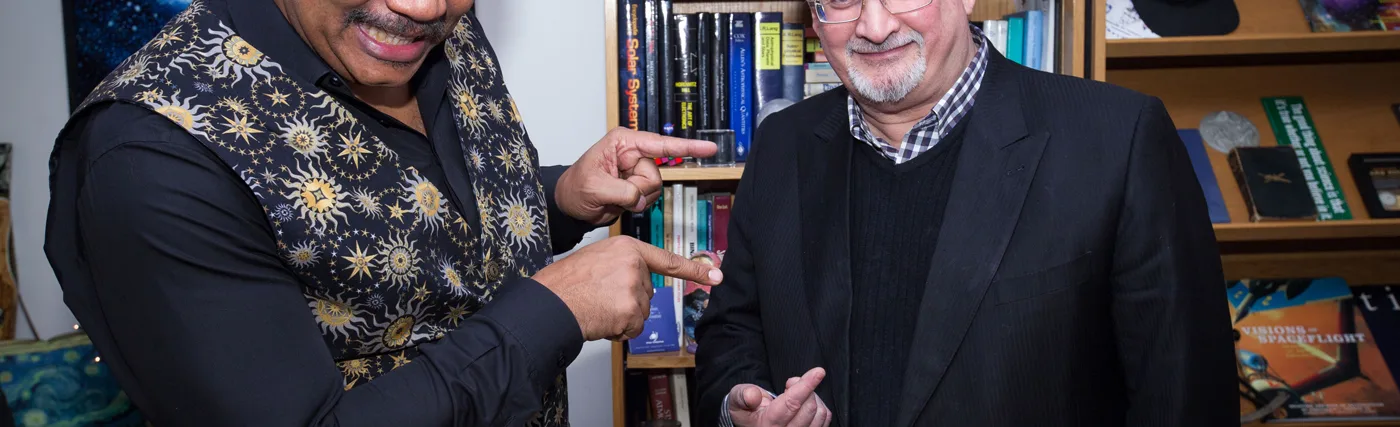
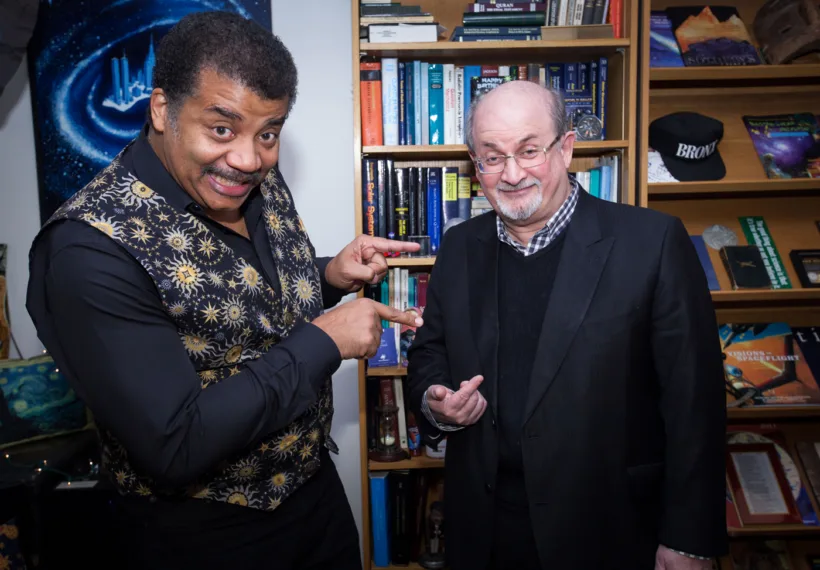
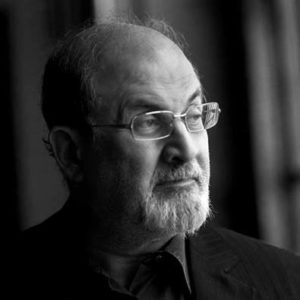
Featuring my interview with celebrated novelist, Solomon Rushdie, yes.
So let's do this.
My co-host, Eugene Mirman, Eugene.
Welcome back.
Great to be here.
And also joining us, because I have no expertise in any of this, is literary scholar, Jonathan Gottschall.
Jonathan, welcome to the show.
First time on StarTalk.
Yes.
I hope it's not the last.
You too.
You researched the connection between literature and evolution.
Yes.
Very nice.
Author of The Storytelling Animal, How Stories Make Us Human.
So we'll be heavily relying on your expertise tonight.
Excellent.
And we've got Solomon Rushdie, a novelist.
He's a celebrated author of 12 novels, including Midnight's Children, The Satanic Verses, you've all heard of that one, Two Years, Eight Months and 28 Nights.
In 2007, he was knighted for his services to literature.
Which country?
For all of us.
His work is considered to be among the best fiction there ever was.
And so what I found curious when I interviewed him was his path to becoming a writer might have gone another way.
So let's check it out.
I almost became a scientist.
I was supposed to be a scientist.
What do you mean supposed to be?
That was the plan.
This is America.
You can be whatever you want.
I know.
There's no supposed to be.
But when I was 16, my best subjects were math and physics.
Really?
Yeah, by far my best.
And so the plan was that I should go ahead and do math and physics and be either a mathematician or a physicist.
And I jumped ship and did history, French and Latin.
Whoa.
Whoa.
So we lost one.
But you know, I kind of regret it because I really...
Note to time machine.
Exactly.
Forget about books.
No.
I'm going to go back in time because I think you...
Well, okay.
Physics, I really love...
Of course, we love your books.
So I don't want...
Maybe there's a pathway where you could have done both.
Maybe.
Maybe.
But you know, I actually think...
I was lousy at chemistry.
I was really very bad at chemistry.
But I was pretty good at physics.
And what I think has happened, both in the physics of the very big and in the physics of the very small, it's become so interesting that it's almost like philosophy, you know?
And very inspiring, I think, to layman practitioners of a different art like me.
So Salman had the makings of a great scientist.
Are you surprised by that?
Not really.
Really, we think of science and art sort of as binary categories, and we isolate the scientists and the artists on different sides of the campus, make sure they don't interact with each other.
But they seem to be motivated by pretty similar goals.
They're both after deep, durable, that, that, and deep, durable, artful, and artful insight into what it means to be human.
There is a sort of crippling ignorance of science in many districts of the humanities.
I like that phrase.
Can I use that like forever and ever now?
Crippling ignorance of science.
Would you say that novelists or artists in general, sort of capital A artists, are not fundamentally different from scientists in the sense that both branches of human pursuit are in search of a higher truth?
I think it's exactly right.
I think they are both pursuing truth and they both say so all the time.
If you ask a storyteller what they're after, they're after the truth.
If you ask an actor what they're trying to capture in a scene, they're trying to capture the truth.
If you ask a scientist, they're trying to give you a mushy-mouthed answer.
They'll say, I'm after more reliable, durable answers, and truth is not capital T truth, it's lowercase truth.
Only people in insurance are looking for lies.
Everyone else is seeking the truth.
Do you see me reading that in a fortune cookie or something?
No, but one day you will, once I control the fortune cookie industry.
So I asked Salman just that direct question, given what I just learned about his background.
I just wanted to know how science can serve as that which inspires a storyteller.
And so I just wanted to find out what role that would play.
Let's check it out.
I think there's quite a few creative writers now who are very inspired by sciences.
By the way, that's my best indication that science, however slowly, but determinedly, is mainstreaming.
Because if it's just what scientists do, then you can always just circumscribe.
You draw a line around it and say, I will walk around that, under it, climb over it.
But that's what scientists do.
At the moment, artists start reaching in, so I like that, give me some of that.
Sometimes when artists do that, they don't get it right exactly.
For example, I've seen fiction based on the idea of the theory of uncertainty, which assumes that what Heisenberg's theory is saying is that, gee, everything is uncertain, which is actually not what it's saying.
It's actually talking about how to calculate the degree of uncertainty in anything.
It's actually about arriving closer to something like certainty, but the trouble is when you just use it as a metaphor, you can actually misuse it.
Right.
My ammo in that, my literary ammo is a quote from Mark Twain where he says, you might be familiar with it, he says, first get your facts straight, then distort them at your leisure.
No, I think that's right.
I mean, it's sort of like, you know, Picasso was a great realistic painter before he discovered abstraction.
But it's not that he couldn't paint a human being to look like a human being.
Right, but if you first see his ones with the two eyeballs on one side of the head and you just did that in your kindergarten classes, you're wondering what people are like.
I could do that as a very bad thing to think when you look at art.
So, Neil, is there someone who's the scientific equivalent of Picasso who started being very accurate and then became more abstract?
Not really.
I mean, if I had to reach in deep, maybe Einstein in the sense that he had some brilliant though sort of mainstream, on the main boulevard ideas that were just ahead of everybody.
So there, he's showing his street cred there.
Then later on, he invents general relativity.
This is later on, 10 years later, special relativity first, general theory of relativity.
We might not have that today were it not for Einstein back in 1916.
That's how innovative and different it was.
We all had to catch up with him.
But usually when people sort of step out of the box, they really are.
They're not coming back and no one is following them and they get lost in space.
So I think that concept is more familiar in the artist realm, where they're just going to take you someplace you've never been, and the center mass of all the creativity follows it.
Would you agree with that?
Yes.
Okay.
Thank you.
Actually, I don't know that that happened with James Joyce.
And Ulysses and all these other great novels that are so celebrated of his from the 20th century, where did that shift to center mass?
Did all writers start doing that?
Or does he stand out as a lone wolf?
He stand out as a lone wolf.
Think about somebody like James Joyce, is they're read by elite readers.
And they're read in-
That's the thing, elite readers.
Elite readers by college professors and the students who are forced to read Finnegans Wake or Ulysses.
Ordinary people really don't read that.
It's too hard, it's too demanding.
So it hasn't really penetrated the mainstream.
Okay, because it was a challenge and it's no less of a challenge today than then.
Although it was a challenge first listening to Jimi Hendrix when you heard these ballads sung by quartets before and now you hear this guitar, what is that?
And then everybody kind of drifted there, so it's not impossible.
It's not impossible, but somebody who's pushing it as far as James Joyce was, in a book like Finnegan's Wake, most humans simply cannot stand to read it.
So even the literary scholars I know who are Joyce fans, almost no one's managed to read Finnegan's Wake all the way through.
I got to the preface.
Sounds like a wonderful book.
I don't know.
You can admire it as a stunning work of literary artistic swagger, but you can't quite love it.
You can't sink into it like a narrative and lose track of the world.
A quick note at the end of that last clip, Solomon was referring to the uncertainty principle, and it's discovered by Heisenberg, who became the name, the alternate name of the character in Breaking Bad.
So, there are threads here in the storytelling.
So, let me ask you this.
If you know enough nature and science, and you want to somehow fold it into your story, from your point of view, I got my own opinions here, but I got you here now, must they have to get the science right in their storytelling?
I think of storytellers what they're trying to do.
I think storytelling is an ancient form of virtual reality simulation.
So you get a story and a storyteller, if they are good, they are building the simulation, scene by scene, character by character, smell by smell, texture by texture, until it comes to life vividly in your mind.
So you're not against dragons?
I'm not, as long as it's consistent with that world.
There's rules in a story world, and as long as it's consistent with the rules of the story world, in Game of Thrones, for instance, it's fine.
But in Borne, identity would be like, no dragons.
That would be a violation, and it would ruin the virtual reality simulation.
It jars you out of it if there's glaring errors.
Now, of course, most people do not see the scientific errors that you see.
So it doesn't have an effect on them.
I guess if you don't know and don't care, but somehow it works in the story, then it works, by definition.
Yes.
I mean, if people don't understand that there's a violation of the second law of thermodynamics or something, then it doesn't interfere with the simulation.
Because Salman Rushdie, he's known for creating characters and situations that actively and explicitly defy the laws of physics.
And I asked him why.
Like, where are you coming from with this?
Let's check it out.
Are you thinking this is violating the laws of physics?
Or are you thinking maybe one day physics can accomplish this?
No, I'm thinking about interestingly violating the laws of physics.
In my last novel, there is this character who begins to levitate.
And he ends up this much off the ground.
Now, the point is that this is just as great a violation of the law of physics.
Completely.
As if he's 20 feet in the air.
As Superman.
But it's funnier.
And then I think what you do when you have one of these moments when you do something which is physically not possible, you then have to take it completely seriously.
For instance, I had another novel, a more fairy-tale-like novel, in which there actually is a flying carpet.
And the question then is, okay, if there's a flying carpet, how does that work?
Because first of all, a carpet is a soft object, and if you're up there in the flying carpet, there's presumably wind currents, and how do you stay on the flying carpet?
Because it's going to be flapping about.
Secondly, if you get up even a short distance into the air, it gets to be very cold.
So how would you be staying warm on the flying carpet?
You know, et cetera, so you have to...
Generally, people who are on flying carpets are not wearing much clothes.
They're from a hot desert climate.
So, you know, there are some scientific issues to be solved in the whole flying carpet thing.
And again, similarly, once you have a character, once you've decided that you have a character who's walking half an inch off the ground, then you have to take that really seriously.
If you were half an inch off the ground, or if your foot was always half an inch away from any surface that it was trying to reach, how would you drive a car when your foot was always half an inch off the brake and accelerator?
How would you make love?
How would you go to the bathroom?
All these things have to be answered in order to make it, so you have to invent a pseudoscience, is what I'm saying, in order to...
Invent a world.
Yeah, invent a logic which explains the illogical thing you've done.
And I can tell you this, that in the sci-fi, sci-fantasy community, the tighter is your interior logic, the more you can get, the more freedom they'll give you to tell whatever story you want.
Absolutely.
The secret of this kind of writing is that the world must be coherent in its own terms.
And I think one of the reasons why people go on reading books like The Lord of the Rings is because of the enormous care that Tolkien took to create that world.
He created its languages and its mythologies and its histories.
His maps.
But his depth of knowledge is far greater than the actual story he's telling.
And that because we know that or feel it, we have great confidence in the world that is being shown to us.
I like the point that he was making that the story that exists from which the book is drawn, the story in his head, goes way deeper than what he actually writes.
And as a reader of The Lord of the Rings, you feel that.
There's something coming from much more than just what's on the page.
Yeah.
The storyteller knows much more about his world than he puts on the page.
Ideally.
Ideally.
Otherwise, you're not going to communicate that and it'll feel kind of shallow.
Yes.
And so what I liked about this is he's got the science background.
I have a bias there.
And now he knows he's going to violate the science, but at least be internally consistent.
So I would submit to you that many novels might be richer or deeper or stronger if they knew the science.
And then that had that as an anchor so you will knowingly violate it in a logically consistent way.
Or use it in a way to tell something else that you didn't have the latitude to even think of before.
Is that a fair requirement?
Make every novelist take some physics?
Oh, no, no.
Excuse me.
Every physicist takes English class?
Not in France.
So I take English class.
I read Shakespeare.
Oh, no.
I agree with you.
I'm still screaming at you.
Let me finish screaming.
Yeah.
I had however many years of English, right?
So we are doing a show in English.
I think it's pretty reasonable.
Because you have to convey information, and you're not sitting here just saying equations.
Are you telling me I'll be unrealistic by asking you this?
No.
I think people in the humanities should know a lot more science.
I do think science classes should be mandatory, including for scholars and graduate programs.
They should be taking courses on the scientific method.
They should be taking courses on statistics.
But is there a limit to how much you can expect your character to suspend disbelief?
I mean, can you end up taking them too far?
Like, suppose, suppose I told you just in the walls of this institution, Bigfoot lives here and walks around at night and he spends time in the planetarium reading exhibits and he's learning about the universe.
Is that too much to ask of a reader?
No.
Of a reader?
No.
No, people will suspend their disbelief for just about anything.
It's only when Teen Wolf and Bigfoot show up together in Game of Thrones that it shatters the disbelief.
But one of them is okay.
One of them, no, probably both wouldn't fit in that world.
But as long as that interior logic is on her...
So could you have like Teen Wolf...
Wait, wait, so our Bigfoot wants to learn.
That's why he lives here in the museum.
That's reasonable.
Could you have a Bigfoot and a rabbi in the same book?
Yes.
Yes!
Get ready to read my book, Bigfoot and the Rabbi.
So there are limits to how far you could take it.
But is this the talent of the storyteller?
It's himself, his or herself.
Is there a limit?
Is that limited by your talents to convey it?
Because we have Salman Rushdie, who loved physics, and then he says, I'm going to make you walk a half inch over the ground.
Now I got to make that plausible.
But he's got some street cred, some science, he's got the chops to even attempt that.
I think it wouldn't be a problem to float half an inch over a toilet, by the way.
Well, great writers like Salman Rushdie do it, and so do writers of sort of what you might call popular trash, who write horror stories and murder stories and mystery stories with implausible elements to it.
You leave Angela Lansbury out of this.
So do you guys, I mean, you analyze this, right?
So you're not just out there writing, you're analyzing.
So when you think of a story arc, is there a formula that you imagine for this?
I do, yeah.
I do.
Absolutely, yeah.
It's not the hero's journey.
It's not a very formulaic sort of thing, but it's something very fascinating.
When you travel around the world through story traditions, you find all this variety, but you also find uniformity.
What's a story?
A story always, always, always has a character.
The characters always has a predicament, some sort of trouble, some sort of problem, and they attempt to solve it.
Stories are problem-solution narratives, and there's usually some sort of moralistic element to it, but there is a sort of cross-cultural pattern.
And so these are the archetypes of your, these are the components that you bring together.
And does that mean you could know in advance whether a story will be a bestseller?
Uh, no.
People are terrible.
People are, those are necessary components, but they're not sufficient components for a bestseller.
Okay.
Are there characters in Fifty Shades of Grey?
Yes.
So Eugene, do you, in your craft, professional comedian.
Yes.
Alright, so do you have, do you got principles, do your jokes have to have a point?
I didn't mean that the way it sounded.
No, I think that, yeah, it has to have, yeah, it has to have a point, it has to be clear, even if it's somehow fantastical.
But you don't think of it as being formulaic though.
Well, no, I think you, well, you think of it as being formulaic and then you make it seem like it isn't.
Oh, there you go.
Jokes are wonderful lies.
No, yeah, I like that.
That is where the art comes in.
That is where the art comes in.
We're endlessly varying the same old basic patterns.
Joke tellers are doing it.
Novelists are doing it.
And the art comes, the storycraft comes from concealing what you're up to.
Well, coming up more on the science of storytelling when StarTalk returns.
Bye We are StarTalk from the American Museum of Natural History, and we're featuring my interview with the celebrated novelist, Salman Rushdie.
And he's a master of this genre called magical realism, and it injects supernatural elements in what would otherwise be an ordinary world.
And so I asked him, how that kind of storytelling works?
Let's check it out.
When you invoke magical realism, are you influenced by what might be possible technologically or scientifically, or does it just, you just make it up, and there it is without any reference to reality?
Well, some of each is the answer.
I mean, I think the problem with the way in which people hear the phrase magic realism is that when they hear it, they hear magic and they don't hear realism.
And so they think of it as just pure fantasy writing, which it's not.
I mean, I think that when that kind of writing succeeds, it's because it is very deeply rooted in a vision of the real world.
And then out of that, there arise, let's say, intensified metaphorical moments.
But they're always about real human relations and the way in which things actually are.
So, Jonathan, tell me about magical realism.
Well, it's realistic storytelling with magic in it.
Thank you, okay.
Like Teen Wolf.
Teen Wolf, like where it's like high school problems, but also he's a wolf.
Yes.
And maybe he'll surf on a vans.
So is Teen Wolf magical realism?
All these genre things are very blurry.
They're not like species, they all blend together.
So if like two wizards are kissing and then they get mad at each other and one runs away, that's like, that's magical realism.
Does there have to be lightning or something or fireballs?
No, how much?
I bet that face is a no face, okay?
So the wizards kissing is not magical realism?
Sounds pretty magical to me.
It's high in the magic and low on the real part.
So what is this notion of it playing an evolutionary role?
Storytelling?
Yeah, yeah.
Yeah, I think, you know, this is kind of hard for us to get our heads around because most of us go into stories because they're fun.
And we think of them as escapism.
We go there, we get to take a little vacation.
Yes.
But I think we evolved to delight in stories actually because they're so utilitarian.
Stories were humanity's first great technology for storing sort of vital cultural information, freezing it in the amber of the story and being able to make it transmissible across generations.
It's hard to imagine human cultures actually coming into being without stories.
So stories obviously long predated writing.
And for some cultures in the world today, stories still matter as the only means of communicating from one generation to the next.
Fewer and fewer, but probably yes.
And so what you're suggesting then is the stories, for them, are not simply escapist entertainment.
They are messages passed through generations.
Yes.
Until it's written down and turned into religion.
Yes, but also.
And then it's like, uh-oh.
But also for us too.
I think it's easy to see that for, for instance, ancient tribal people's story fulfilled that role.
They were communicating values, ideals, messages, a sense of tribal identity.
The leap is that I think that stories are still doing this today.
So how much of a story, story's role historically, if not today, has been to try to create sense out of the disorder and complexity of life?
I think-
By just simplifying it?
I think it's a massive part of it.
Story is above all a meaningful structuring of information.
So a story-
Otherwise it's just random information in front of you, how you can't even carry it as a coherent whole.
We have trouble tolerating incoherence and chaos, and story is how we convert it into something orderly and comforting.
What's this term I came across in researching this?
Homo fictus?
So homo sapien is a pretty good definition for our species.
It means wise man, but if you're paying attention to politics, we don't seem all that wise and rational most of the time.
Homo fictus, fiction man, story man, I think that's about equally accurate.
Man is a storytelling animal.
And what role would you say spirituality has in this?
Because so many stories, the ones that stay with us the longest, in particular the ones that become the foundations of religious texts.
Yeah, I mean religions are made out of stories.
For me, they're made out of fiction stories.
Yes.
Okay, but like, would you, are you saying even like, so you think Hermes isn't real?
I don't think he's real.
Yeah, yeah, I don't think so.
I don't think so either.
Wait, you both don't think Hermes is real?
Now I've heard everything.
Wait, wait, so I asked Salman Rushdie about this and how does he justify and draw his deep sense of sort of the supernatural and even spirituality in his storytelling?
Let's check it out.
Since your books are so successful and so celebrated, it must mean, just by, empirically, it must mean you are reaching people at a deeper level than just, oh, let me find the next novel to read.
Yeah, I hope so.
But if you are, that means this referencing to spirituality is deep and a fundamental part of what it is to be human.
Well, it's a part of it.
It's a part of it that I thought was fading, but seems to have made quite a comeback, which is the return of religion to a kind of central role in public affairs.
And, you know, I think greatly to our disadvantage.
Fine, but you write to the spiritual soul of the reader.
Well, you have to engage, look.
But that means you're admitting it's there.
It's in there, it's in people.
How can one not admit it?
I mean, if you're gonna write about the world as it is, you can't only write about people who think like you.
Otherwise, it's going to be a very narrow fictional world.
What I do think is that we have a sense of ourselves which is more than just flesh and skin and bone.
And I don't think you have to be religious or supernaturally inclined to think that.
And I think that imaginative, creative side of us, the side of us which is not contained in our physicality, is something which literature has always explored.
So Jonathan, is that the best literature or the most compelling that's out there?
The ones that touch our spiritual soul?
I don't know, I don't know.
That's a value judgment, you know?
And so different strokes for different folks.
I mean, empirically, if the Bible is the bestselling work of all time, then this is not a debatable point.
But it's also had a lot of time to sell.
I think if you compare it to how Thriller did, you'd be like, oh, give Thriller a little more time.
Well, to me, you know, religion is probably the ultimate expression of stories' dominion over the human mind.
So whether you believe that Hermes is real or not, so let's say you believe in the Greek religion, you still think everybody else's religions are made out of stories.
Yeah, that's true.
So based upon what these sacred stories say, we regulate all the aspects of our lives if we truly believe in them.
Right, but there's a difference then between taking such a story literally, Hermes as a literal god or anything that you have in a religious text as literal, and otherwise thinking of it as a story that has a lesson.
And you have these characters that help the storyteller communicate a lesson that you then walk away with.
Maybe if you want to find love, turn yourself into a goose.
You do what you think is right.
So I mean, I guess I'm asking you, at what point do you say, this is the reality of how you think and feel because it taps something deeply spiritual that is fundamentally in our DNA?
And at what point are you saying, this is another tool to tell a cool story where the point is not the truth of the story, but the message and the morality of the consequences to the characters?
Where do the Smurfs start and morality ends?
Well, yeah, so I can read Homer.
I can read the Iliad in the Odyssey.
I don't believe in any of the things that Homer believed in.
I don't believe any of those gods.
Even Rosie Finger Dawn?
I don't believe in her, but still the story works for me.
And the lessons and the deep wisdom of the story works.
It's still there.
So would you say there's a connection between a spiritual feeling and creativity itself?
Not for me.
I don't know what to say to that.
I think that there's a feeling, for instance, to go back to Homer, and you've obviously read your Homer.
Just the first sentence.
Oh, OK.
But the first sentence of the Iliad is different.
The first sentence of the Iliad is, sing through me muse of the rage of Achilles.
And so Homer is saying that my, I'm just opening my mouth and a goddess is literally singing through me.
It's a divine inspiration, it's deeply spiritual.
And I think creativity feels spiritual to people because oftentimes that perfect line, that perfect insight just pops into your head.
I believe that's the same way Air Force One became a movie.
So it popped into their head.
So it's fascinating you're saying that.
What you're saying is if we do not otherwise have our confidence in our own capacity to come up with a new idea, and you wake up in the morning and a new idea pops into your head, and if you happen to be religious or otherwise spiritual, you will be sure somebody put that in.
You do not feel like the author of it.
It just appeared there.
It was created in your unconscious brain and it kind of filtered up into consciousness.
So can you imagine there's some evolutionary value to this?
Yeah, there's a scientist of creativity I like named Barry Kaufman.
And he talks about the mind, creativity being a partnership of two neural networks.
One is the executive network.
That's basically you.
That's a conscious mind.
The other is the unconscious mind.
He calls it the imaginative network.
And the imaginative network is a wild, crazy bohemian whose job is to churn out creative variation.
The executive mind then filters through that, separates wheat and chaff and takes that cloud castle and does the sweaty work of making it real.
I love a cloud castle.
Coming up, we continue our scientific search into the power of storytelling when StarTalk returns.
We have Matthew StarTalk from the Hall of the Universe of the American Museum of Natural History.
We're featuring my interview with celebrated novelist, Salman Rushdie, and I had to ask him about the power of fiction to change the way we think.
So let's check it out.
I don't like preachy fiction.
I don't like fiction that tells me what to think.
I like fiction that allows me to work out what I think about the world I'm being shown.
And I think that what I want to do, or hope to do, is to create that world that the reader likes being in, wants to inhabit.
And while the reader is in that world, the reader may well be challenged to rethink or to understand things in a different way or to admit other possibilities, et cetera.
But the great thing about literature is I think it does change people.
I think it changes readers one reader at a time.
But neither the writer nor the reader knows when it's gonna happen.
Yeah.
That's deep.
So, Jonathan, how would you compare the power of fiction to change your ideas and values relative to nonfiction?
And the reason why I ask is when you go to a movie, they make it a point based on a real story.
That's upfront.
It's not, this is not just fiction, this is real.
So it seems to me that has some currency.
It does.
But at the end of the day, what do your studies tell you?
Stories are more persuasive.
So stories have really impressive cognitive power.
So in normal waking life, for instance, our minds are flitting all over the place all the time.
We have about 100 daydreams per hour.
But when you're in a good story, a story you love, your favorite TV show, let's say, you have approximately zero daydreams per hour.
Your mind goes totally still.
If it's a good story.
If it's good and pays rapt attention, sometimes for hours on end.
This is impressive.
It means story is a kind of drug.
It reliably lulls us into an altered state of consciousness.
Wait, meaning you literally, normally have just like, your brain is going everywhere, you have hundreds of daydreams per hour.
And then if you're watching...
I have at least that many.
I'm thinking about everything.
Absolutely.
Yeah, yeah.
Yeah, so, but when you're in the story, your hyper mind goes utterly still.
And it's not just a state of high attention, it's also a state of high suggestibility.
People are more open-minded when they're inside Storyland, both for better and for worse.
It prides you open and says, let me get inside and now I, the story, personifying the story, completely control your love, your hate, your emotions, your empathy, your sympathies.
Yes.
And if I'm a good writer and I'm a good storyteller, oh my gosh, you are putty in my hands.
It's, you are wielding massive power.
You're like a witch.
You wave your-
Tom Clancy, America's witch.
But you wave your pen like a wand, it casts a spell.
The spell allows you to enter, just like you said, into other people's brains, change how they think, change how they feel, change how they act.
So there's nothing about this that I could possibly disagree with because it sounds like it makes complete sense, but it would be good if we had actual physiological data in support of what feels obvious.
And so we actually have a researcher at Michigan State University named Natalie Phillips, who's studying the effect of stories on the brain, or the neurophysiology of this.
We have her standing by right now live on video call.
Natalie, are you there?
Hey, so you are a assistant professor of English?
Yep.
And affiliated faculty in cognitive science.
Yeah.
Very cool.
I've never heard of this field called literary neuroscience.
Like, what is that?
It's a term that I came up with to describe my work.
You have people hooked up to a MRI, functional MRI, and they read fiction, and then you watch what happens in their brain.
Exactly.
So the biggest surprise of the study so far was that instead of seeing activation in brain regions that are associated with reading and attention, we're seeing activation in regions far beyond this.
We found widespread, almost global activation for individual subjects, which shifts depending on what people are paying attention to as they read.
And to some degree, maybe this shouldn't have been such a big surprise because reading a novel involves losing yourself in a fictional world.
And these images aren't being provided for us like in film.
So we have to create them for ourselves.
Oh, so that's interesting.
So well-written story can activate parts of your brain that you are a participant in, in ways that if your imagination is not invoked, it's just not there.
Right, and we can begin to actually track these moments and the moments when people are actually getting caught by fiction and drawn in and immersed and sort of drawn into that, right?
It didn't habit that fictional world.
Well, Natalie, thank you for being on StarTalk and sharing this insight with us.
Okay, coming up, we'll take your questions about the science of storytelling next on StarTalk.
Welcome to StarTalk from the American Museum of Natural History, right here in the heart of New York City.
And we're talking about the science of storytelling.
Right now, we're going straight into a fan favorite part of our show called Cosmic Queries.
This is the part, we solicit questions from our fan base on this topic, and they come in, I haven't seen them, Eugene has them, she's going to read them.
I probably don't know any of these answers, they'll all go to you.
The questions will go to you.
All right.
If you're ready, I'll try to take a few.
Yes.
Don Rim asks, from Facebook, he asks, one of my favorite quotes is, we live in the condensation of our imagination.
Is this true?
Yes, that's true.
I'd say that we live in stories.
We live in stories all day long.
But stories are condensation.
And they are.
They are.
And we dream in stories all night long.
We all have life stories we use to sort of organize our lives and make them meaningful.
So yeah, I'd say that's true.
Is it true that if you can't actually make a meaningful story, you make any kind of story at all and that's where you get a weird story because your brain, that was the best your brain could do?
Absolutely.
We confabulate.
Confabulate.
I like that.
We just can't do without one.
And that's how we have Twin Peaks?
We're good.
Good answer.
Next one.
Michael Goldfinch from Facebook asks, is the ability to lie a trait which has proved to have large evolutionary benefits the reason we have the capability to tell stories?
Huh.
That's a good question.
I'm interested in the way that we lie to ourselves in our stories.
We make up stories about ourselves that are wildly optimistic about our own personal qualities.
Like how good I am at karate?
How good you are at most things?
No.
According to...
Whoa.
Sounds fair.
First of all, let me just throw this out there.
Not very good at karate.
So that's one thing.
But according to the science, you probably believe you're above average at almost everything.
Really?
Yeah.
Everyone thinks they're above average.
Everyone thinks they're above average.
I'm not above average at soccer.
I mean, unless you're thrown in babies, then I'm much better than babies.
And if you have the power to lie, you have the power to have a conversation with yourself by creating a reality that is different from the one you actually react to.
Is that a fair assessment?
I suppose so.
Back to the person's question.
Yeah.
But the ability to lie being a fundamental part of being able to tell a story that's not real, but somehow you want to believe it.
Yes, I think that's true.
And with the addition that we lie best when we can lie to ourselves as well.
So if I don't think I'm above average in a bunch of random traits, does that mean that I am really great at assessing stuff?
Are you sure you're not really good at karate?
Because I have a lot of thought.
Next question.
Pretty good at karate.
Steven Applegate from Twitter asks, how soon will society accept the full immersion of augmented reality as true life that is not discernible from fiction?
Seven years?
Just to be clear, augmented reality as I understand it from Pokemon Go is that the reality that you experience has been supplemented by some sensory encounter with things that other people put in place.
But I think it's even more.
It's like you have glasses and when you look here, you see a chess set and eventually it'll be that you physically do this and you can feel the piece.
While Pokemon Go I think is on your phone.
So I think augmented reality is like you put on a thing and there's like people crawling over stuff that's physically in the room.
Does that put novelists out of business?
I hope.
I think it may.
If you've ever been in an Oculus Rift situation.
Are you hitting on us?
Well I just did it for the first time.
Oculus Rift, was that one of the Transformers?
No it's a virtual reality headset.
But I took it off.
I had the whole experience.
I took it off afterwards and I said this would change the world and destroy it.
Because it's just so powerful and it's still early days and pretty soon the story of worlds that we will enter into through that machine are going to be so much better than the real world that we'll never want to leave.
So it's going to be the novel of the future?
It's going to be, yes, I think so.
I think so, yeah.
It's incredibly powerful.
But getting back to Natalie's point that if it's things you see, then you don't get to imagine it.
Yeah, it's doing a lot of the work for you.
So Jane Austen is trying to create a virtual reality.
Oculus Rift is just doing it for you.
Yeah, just doing it all for you.
I can't wait to be in that world looking for love.
Well, coming up, author extraordinaire Salman Rushdie defends rationalism in a political post-factual world on StarTalk.
Welcome back to StarTalk from the American Museum of Natural History.
We're featuring my interview with novelist Salman Rushdie.
And you know, he writes about fantastical worlds, but his view on society is decidedly rationalist.
So I asked for his outlook on rationalism, especially in today's political climate.
Let's check it out.
I think we have a real battle on our hands.
I think we live in a time of irrationality, and a time in which, as we've been seeing, there's almost a suspicion of people who know things.
That if you know something, you're called an elitist.
And I think it's very worrying to live in this post-factual world.
Stephen Colbert invented the term truthiness.
I think we live in that kind of world in which if something sounds kind of truthy, it's as true as something that's actually true.
And I think one needs to hold on to the sense that there actually are facts, and that science in fact exists, and that the world is not simply a mishmash of conflicting prejudices.
So, Jonathan, you study the science of stories, and how do we or should we distinguish fact from fiction?
Well, it's hard for us, especially if non-facts are embedded well in stories.
Because as I said before, we are very, very good at suspending disbelief.
We're very, very open-minded.
Another way of saying that is gullible.
We're susceptible, right.
Gullible when the story is good.
So this is a real problem for us.
This is why I was saying that homo sapien is kind of not the greatest name for our species, because we're not really that wise.
We're not really that rational.
We're not really that logical most of the time.
So we're doomed?
Well, yeah, I think, you know, I think we've, well, in a sense, we are.
We don't eat each other often.
We don't, but, you know, there's a sense in which I think we're all learning right now that we don't really have narratives.
The narratives have us.
We'd like to think that we form our narratives out of fact, but I think it's truer to say that we have our preexisting narratives and we let those narratives choose and shape the facts that we are going to believe in.
That is terrifying.
How do we function?
We basically lie to ourselves all day long and then we believe a bunch of myths and then somehow we still have to go to work and raise kids and then we don't know math, except you, who obviously does a lot of math.
So does that mean good storytelling will always override rationality?
It seems so.
It seems so.
It seems so.
It's very, very hard to find data that will argue someone out of their favorite stories, their most deeply held stories.
The only way to beat a bad story seems to be with a better story.
Now, it doesn't mean that there can't be data in that story.
You're bumming me out, man.
Sorry.
Maybe you haven't met Jeff the math god.
That's what we need?
Yeah, okay.
But part of how you convince people and part of why you're such a good science educator is you are embedding facts and information within really good stories.
I'm trying to do that.
Yeah, and there's nothing wrong with that.
There's nothing manipulative about that.
There's something very right about that, yeah.
Yeah.
So it's got me thinking.
I remember growing up jealous of creative artists because they had no bounds to what they could or wanted to create, whereas I as a scientist was constrained by the laws of the universe that I did not yet know.
So I don't even see the boundaries yet until I trip on them.
But then as I got older, I realized that the artist is not writing out of infinite possibilities because successful art is the art that actually touches us, touches us in some fundamental way.
Other art doesn't touch us and it gets forgotten, lost.
Lost.
Omitted from our historical reckoning of what has mattered to us in civilization.
Okay, well, here's what I wonder.
If our only hope of combating stories that are infused with false information that could derail civilization, if our only hope is to come up with a better story that is infused with facts and knowledge and insight into the actual world, then our limits are the universe itself.
And I'm reminded of a quote by JBS.
Haldane, who said, the universe is not only stranger than we have imagined, it may be stranger than we can imagine.
So quite the contrary to my thoughts growing up, that I'm constrained as a scientist and the artist has no limits.
Maybe it is the universe that has no limits and it is the artist that is constrained.
And if that's the case, if we draw the future stories from the universe and they're infused with a reality, that may be our best hope to trump the stories that are coming out, that are filled with lies.
Ladies and gentlemen, that's a bit of the Cosmic Perspective.
I've been your host, Neil deGrasse Tyson.
See the full transcript



 Unlock with Patreon

 Become a Patron