There are thousands of sightings of Unidentified Flying Objects every year, but why do so many people assume they are aliens visiting from another galaxy? Most UFOs end up being identified as clouds or other natural phenomena, or man-made objects such as balloons or aircraft.
Neil and comedian co-host Eugene Mirman discuss the tricks the human brain can play on our perception, the physics of space travel, and science fiction movies that depict alien spaceships. Neil interviews James McGaha, UFO investigator, about the many unusual things that can appear in the sky, and SETI researcher Seth Shostak calls in for a chat about alien visitations. With science as your co-pilot, the truth is always out there.
Transcript
DOWNLOAD SRT
Welcome to StarTalk, your place in the universe where science and pop culture collide. StarTalk begins right now. Welcome back to StarTalk Radio. I'm your host, Neil deGrasse Tyson. I'm an astrophysicist and the director of New York City's Hayden...
Welcome to StarTalk, your place in the universe where science and pop culture collide.
StarTalk begins right now.
Welcome back to StarTalk Radio.
I'm your host, Neil deGrasse Tyson.
I'm an astrophysicist and the director of New York City's Hayden Planetarium.
And I'm joined this week by comedian Eugene Meerman.
Eugene, welcome to StarTalk Radio.
Hello.
It's good to be here.
That sounded pretty canned.
Put on the welcome switch.
Hello, it's good to be here, yes.
Well, I've already been, I'm here.
Hi, no, it's great to be here.
Is that better, is that less, is that more sincere?
It is a true honor to be finally part of CBS radio family.
Oh, is that right?
Yeah.
Yes.
Well, this week our topic is UFOs, unidentified flying objects, about which so much is written and so many people think about them and care about them.
And I thought we should bring some sort of physics to the subject or some kind of analysis.
No more speculation.
You know, there are thousands of sightings of UFOs every year.
And, of course, most of them can be explained away as the consequence of natural phenomenon, like unusual cloud formations or bright planets, lightning, and especially meteorological or astronomical observations.
And some are just spaceships from other worlds visiting, preparing to take us over.
Yeah, okay, some would be that.
One explanation, along with your gas cloud thing.
But what happens is when you see something unfamiliar in the sky, the brain tries to understand it and come to terms with it, it'll go overboard in doing so.
And so what it doesn't understand, it connects the dots, it invents missing pieces.
And so when you try to judge what an object is, or just judge how big it is, your brain fills in the gaps.
That's the same reason the George Lopez show is still on the air.
The brain fills in the gaps making it make sense.
So, but what happens is our perception, about which there's still a lot of research going on in the neuroscience community, the depth of our perception is still being understood and how it can fool us and how we can think it's giving us correct information when in fact it's not.
And so what happens is when we find that we're ready to doubt what we see, the brain just figures it out for you, whether or not...
With lies.
With lies.
Using lies.
Exactly.
As its building block.
So have you ever seen a UFO?
Remember, use simply means unidentify.
No, no, I know.
Yes.
It's funny because part of me wants to go like, no, not really.
But what I mean is by saying that, I'm like, I can identify everything in the sky.
So in that sense, I can't, but I don't think I ever saw anything.
Well, then you have seen UFOs if you can't identify everything you've ever seen.
Yeah, but I don't think I ever saw a thing moving and was like, oh, that's coming for me.
I should get ready.
What's my welcome speech?
I feel like I haven't seen anything that was so unidentifiable, I wanted to blog about it.
Let's just say that.
So that means you've encountered some objects in the sky that you say, I don't quite know what that is, but it's not so weird that I'm going to freak out about it.
I think it's like a bright planet or something or a shooting star.
Like if I didn't know about shooting stars, I'd definitely be more scared.
Oh, so you have some sort of a foundation for your observations.
Did you ever have Astronomy 101 in college?
No, I went to a school where you decide your own major and I didn't include Astronomy.
It's one of those kind of schools.
Yeah, but I learned everything I need from TV shows about outer space.
So don't worry, I know plenty of science.
So what would you have to see for you to scare you and then have you blog and tweet about it?
I would have to have a thing fly up to me, maybe make a sound, ask me some questions, fly away.
That's definitely, that's at the top of the list.
That would work.
And then something sort of just floating and glowing too much.
Well, speaking of floating and glowing too much, one of the most mistaken objects for a UFO, well, it's not mistaken, excuse me.
If you don't know what it is, you simply don't know what it is.
One of the most reported objects as a UFO is the planet Venus in the sky.
Because it's so bright.
It is so bright.
Venus is 100% white cloud cover, so it's highly reflective, first of all.
So it's as bright, it's like as bright as it can be as a planet.
But it doesn't dart around, it just sort of sits there watching you.
Well, watch, if you happen to live near an airport and you're accustomed to seeing airplane lights coming in at twilight or at night, and this would be Venus, and if you didn't know it was a planet, it would just be an airplane hovering.
See, that's the thing.
The fact that it's not darting around leaves people curious as to what it is, because anything else would have come in for a landing a long time ago.
Of UFO sightings, how many happen near airports?
Because that would be slightly ludicrous.
Yeah, so I don't know that statistic.
But another thing about Venus is we orbit the sun farther away than Venus does.
And so if you're ever going to find Venus in the sky, it's not going to be all that far from the sun.
You'll see it just before sunrise.
In fact, these days, it's up for any night owls out there.
It's up just before sunrise, and it's as bright as can be.
And it's quite visible just after sunset.
Now here's what happens, since it's in the twilight sky and it's bright.
As it gets low in the sky, it could take on sunset colors the way the sun does.
And so now you have a bright hovering object that has lights that resemble sunset colors.
So you'd have orange and red and this sort of thing.
You combine all this together, and you get no limit of reportings of Venus being somebody's own.
So if aliens from Venus came here, it would be particularly confusing, because we'd be explaining this phenomenon to them, and they would be explaining where they were and…
Yeah, we'll keep a special chapter on the UFO books for when Venusians visit us.
Exactly.
The most confusing type of alien to visit.
Oh, by the way, you know the word Venusian is…
We kind of invented that after the fact.
After which fact?
Do you make it sound…
After the fact that if you are of Venus, the correct word for being of Venus is venereal.
Really?
Yeah, and the doctors got to that word before the astronomers did.
Right.
I don't mind saying, oh, venereal, like, okay.
I'm just saying.
But what…
Wait, and if…
Oh, Martian.
Wait, why venereal?
I mean…
That's the proper genitive form of the word Venusian.
Yeah, you'd be venereal.
I can't wait to arrogantly say that to people as I talk to them at parties.
That's really venereal.
Doctors had identified a disease common to lovemaking, and Venus is the goddess of love and beauty and all that goes along with it.
So, Venus is the number one cosmic target for misidentified UFOs.
That's right.
And then the moon.
The moon.
By the way, cosmic target.
Great band name.
Oh, is that right?
Okay.
You're keeping track of these.
Would be.
Sorry.
I'm saying you're coming up with things faster than you even know.
I'll take the compliment.
And the moon has been, of course, we all know what the moon looks like.
But suppose the moon is a crescent and only a little piece of the crescent sticks out from behind a cloud, so you don't see the whole thing and you don't know the moon is supposed to be there and there's a little cloud areas growing around it, it can freak you out.
Yeah.
And in fact, it happened to me.
I was on a beach.
Are you listening to Pink Floyd high on a beach and the moon sneaks up on you?
I don't listen to record albums that don't get their physics right.
The dark side of the moon, there's no dark side of the moon, just so you know.
You only listen to accurate physics albums.
Like Jethro Tull's Thick as a Brick.
Accurate rock albums.
So just as an example, I was once on the beach and I was, I saw a glowing object on the horizon and I couldn't associate it with any terrestrial object.
Of course it was at night because then you see less well at night when you have, that's where most of your UFO sightings are at night, when you can least identify what it is you're looking at.
And I saw something and I could not identify it and I was intrigued, pulled out my binoculars, which are never more than arm's reach for me.
There it was, it was the moon.
And so I'm just simply saying there are objects that can be out there.
Even if you're familiar with the sky, they can stump you, at least until you continue to observe.
But it's not only cosmic objects, you also get sort of meteorological objects, clouds, clouds.
There are some beautiful cloud formations up there, not just the puffy ones that make rain.
There are some, particularly if you live in...
Thanks for being so scientific about that.
I was like, but which ones make rain?
Is it the puffy ones?
The puffy ones.
Move on.
You got the ordinary puffy ones, right?
But then you have, there are clouds, there are orographic clouds, orographic clouds...
So the two are puffy, orographic, and then weirdo clouds, where they go back and forth.
And so, in fact, there was a guy who put cloud shapes on a scale, and the big puffy cumulus clouds was cloud nine.
And that's where you say you're on cloud nine, you're on a big puffy.
Is that why?
If you're on cloud nine, it's a cumulus cloud.
Not cumulonimbus, because then you'd be wet.
No, don't be an idiot.
Who would ever assume that?
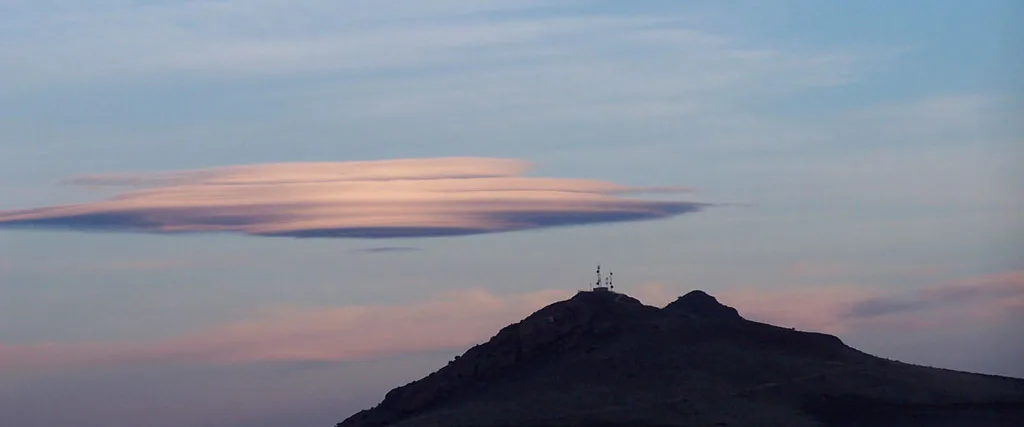
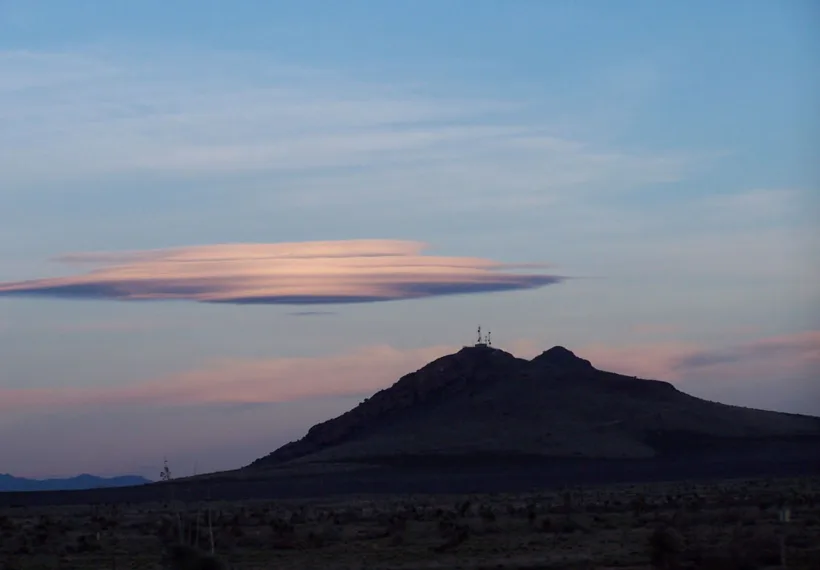
So, so an orographic cloud and you have lenticular clouds.
These are clouds that look like flying saucers.
You find them near mountains and they're very high up and they take on this cylindrical shape and they're isolated.
And so watch what happens.
The sun sets for you.
But if you're high up, the sun sets later for someone on a mountaintop than it would for someone at the base of the mountain.
We have a better explanation than that one.
But so what happens is the sun sets for you.
Your sky begins to darken.
This cloud is still lit up by sunlight.
It is still lit up.
And so it looks like it's glowing against the background sky.
Takes on the colors of sunset, bada bing.
You've got to, you've got to.
Does it make that sound?
I have to record it next time.
And one of my favorite kinds of clouds is our noctilucent clouds, which translates from the Latin to meaning nighttime.
I'm just kidding.
Was Latin one of the subjects you electively took in college?
Yes, exactly.
I know Latin and comedy.
So these are clouds that are so high up, they can still be lit by the sun an hour after sunset.
And occasionally, spaceships and missiles can leave a contrail that is so high up that they become these noctilucent clouds.
And people then identify and they say, oh, I saw this glowing thing in the sky when they knew nothing's supposed to glow there.
But if you know about these objects, then you have a ready explanation for them.
I can't wait to see that and then be like, no, no, it's not a spaceship.
It's a cloud left by a human spaceship.
And there's also lightning.
Lightning can do weird things.
Lightning is electrical charges going from cloud to ground, cloud to cloud.
By the way, most lightning goes from the ground up to a cloud.
Is that true?
Yes.
I know.
I don't know why.
Well, it's just so opposite of what I was told earlier by school teachers who were misinformed.
So much of reality is the opposite of what we're all told.
So lightning, it actually creates a plasma around, it's basically a charged gas that glows.
Remember those glow things you find in Spencer Gifts?
Yes, do I ever.
I wanted one until I was probably 30.
It's only five, six years ago that I was like, nah.
Then there are other things.
For example, you'd have weird airplane designs if you happen to be near an Air Force base.
That's testing unusual craft.
Like a triangle shaped spaceship.
So if there are secret experiments going on and you look up and it's something you don't recognize, you're not going to say, oh, that must be an Air Force experiment with a new airfoil.
No, if you're prone to imagination, as so many of us are, you'll say, oh, it's an alien spaceship rather than the more terrestrial accounting for what it is that you see.
So if an alien wanted to come here, if they just wrote US government on their ship, nobody would bother them?
Is that the point?
If they just covered themselves in a weird cloud near a mountain?
This signal goes out at the speed of light if you're giving them ideas.
And flares do an interesting thing.
In daytime, it's just a flare.
At night, it's this glowing thing in the sky.
And there's a famous sighting of flares in Phoenix, Arizona, March 13th, 1997.
There was the fighter squadron from the Maryland Air National Guard.
They dropped illumination flares as just part of an exercise at 8:30 p.m.
just after sunset, okay?
And hundreds of people reported seeing a V-shaped UFO or either a formation of lights over the city and surrounding mountains.
What their brains did was connect them into a single coherent object.
And so rather than just say, I saw these lights, they said they saw a V-shaped UFO, right?
And so the urge to do that.
They're balloons.
For me, the most hilarious UFO sighting was in Manhattan just recently.
October 2010, people saw glowing objects in the sky above Manhattan.
Now, here's for me the funny part.
I live in Manhattan.
Nobody ever looks up.
So when they do, they have no experience to identify anything in the sky.
I've had people say, what's that?
That's just the moon.
All right, they don't notice it, they don't see it.
So New Yorkers can be easily enchanted by balloons that are in the sky.
Now, these were shiny Mylar surfaced balloons.
And so that accounted for some extra glow that they had in the sky.
But this is, by the way, weather balloons also.
Yeah.
To me, everything you've said so far sounds like you're part of the cover-up.
Just so you know.
Anyone who's waiting for you to say that they're definitely aliens is getting more and more mad with each excuse you give.
When we come back, we'll talk a little bit about Roswell.
So welcome to StarTalk Radio, welcome back, everyone.
Eugene Merman, before the break, said that the way the aliens can infiltrate us is if they paint US.
Air Force on their spaceships, and then we'll just say that they were...
And then they'll be like, obviously it's a US.
Air Force spaceship.
It's a new...
And I worry, since this is a broadcast show, is that that signal is now going out at the speed of light, and you've given away our last hope of defense against alien invasion.
Yes, it was the last piece.
It was like, oh, that's a great idea.
And we'll put on wigs and dress like humans.
That's all they were missing.
So other things that can be mistaken, weather balloons.
You don't...
Weather balloons are not commonly launched near urban areas or near airports because they would tangle up your airplane.
So they're only in very secluded areas, and occasionally unexpected air gusts can carry it into populated areas, and no one has any experience looking at a weather balloon.
Why was it...
Does it look insane?
Well, no, it's just not something you've ever seen unless you are like a weather balloon person, where you live where they do this sort of thing all the time.
Or you have the money to Google the word weather balloon.
And so the Roswell, you know, the entire economy down there is alien-based, if you've ever visited the town.
I've been there a couple of times, actually.
I went to all the museums.
It's an entire alien economy.
The street lamps have alien faces on them and things.
And so that was later reported as...
that crash was later reported as a weather balloon.
And when combined with some other experiments that had been done with sort of dummies, people now sort of remember that as sort of aliens and dead bodies.
Are there photos of the actual weather balloon?
Of fragments of it, yes.
Oh, okay.
Well, of the payload that was part of the weather balloon.
The weather balloon exploded?
Is that...
That I don't know.
I don't know what was the consequence of that.
I can tell you this, that if an alien really did come that far and it crashed here on Earth, that's not the alien I want to meet.
That's like anyone who can navigate better.
You don't want to meet the alien that came here.
Do you think that there are also liberal aliens who would try to stop the meaner aliens from taking over?
The political alignments of aliens.
You know who we have on the line?
We have a good friend and colleague Seth Shostak.
He works at the SETI Institute.
The SETI is the acronym for the Search for Extraterrestrial Intelligence.
Let's see what Seth has to say.
Seth, how the hell are you, man?
Just fine, Neil.
Thanks for calling in to StarTalk Radio.
Our subject tonight is the physics of UFO sightings.
Notice I said physics of UFOs, not physics of aliens, because they're all kinds of accountings for things we see in the sky.
But you're sitting at UFO Central there, because you're advertising what it is you're interested in.
So what's life like in your job?
Well, in connection with UFOs, what's life like?
I mean, you know, we don't have enough time to really go into that deal.
But let me just tell you something with relevance to the subject at hand, and that is that I get at least five phone calls and emails a day from people who are having difficulties with aliens in their personal lives.
They send me photos, they send me videos of UFOs.
They often think that we're doing the wrong experiment, trying to eavesdrop on alien broadcast, because after all, they, like one third of the population of this country, believe that the aliens are here.
Well, so, but what do you tell them?
Do you say there's no evidence, or how do you handle these encounters?
Well, I listen to what they have to say, or I read what they have to say, because let's face it, it doesn't violate physics to go from one star system to another.
It seems a little improbable that they would come all this way just for salacious experiments.
Your mom wouldn't approve of that.
But on the other hand, you could say that's alien sociology, and we don't have a whole lot of data when it comes to alien sociology, so nobody knows what they'd really be interested in.
But the fundamental fact is that it's truly an extraordinary claim to say that aliens have come hundreds of light years to visit Earth with nothing better on their mind than these unfortunate experiments.
And if you're going to make that claim, then what I want to see is the good evidence.
So I look at what they have to say, and I look at the pictures, and I try and decide whether does this suggest that we actually have visitors here.
And so what have you concluded?
I guess I can guess, but I'm just wondering.
Yeah, I think you know the answer.
I'm not convinced.
Look, there are a whole bunch of arguments that could be made to suggest that this is a bit unlikely.
One thing you could ask is why are they here now?
Why now?
And I ask people who think that the aliens are visiting Earth, you know, how is it that we're so fortunate that they've come to Earth just while we are alive to improve our social lives or whatever?
Well, you realize that there are references to aliens or at least unexplained sky phenomena that goes far back as the Bible.
Ezekiel had a vision of wheels in the sky that had no other real account.
And real alien fans would suggest that maybe he was bearing witness to that.
And that's, you know, 5,000 years ago.
Yeah, but 5,000 years ago is, you know, one millionth of the age of the Earth.
So that's still now.
I love that cosmic perspective on the timeline.
Okay, so that doesn't convince me because what it requires is either one of two things.
Either the aliens are always visiting the Earth, so it really doesn't matter when you're born.
You'll have the opportunity to have an unpleasant encounter with an alien.
That's the men in black scenario.
They've just been around us all the time.
Yeah, there's that possibility, in which case I would think that the evidence wouldn't be so equivocal that I would occasionally go down to the airport and the captain would come on and say, well, folks, we're going to stay at the gate here for the next 20 minutes because there's some unidentified craft in the area and they haven't filed a flight plan with the FAA, so we're just going to stay here.
I mean, that doesn't happen to me.
And I think if the aliens were really here, it would be like asking the North American natives, you know, 50 years after Columbus arrived, you know, do you think you're being visited by Spaniards?
It wasn't something just for late night radio.
They knew.
They absolutely knew.
So I can't believe that they've always been here.
So the only other possibility is that they're here now because they have some interest in one of our contemporary problems.
They don't like the fact we have nuclear weapons or they don't like what we're doing to the environment.
So that's the plot of the day the Earth stood still.
Well, yeah, exactly.
But of course it doesn't make any sense because they don't know any of that stuff, right?
The only way they could know that Homo sapiens is creeping and crawling across this mortal coil is because of the high-frequency, high-power broadcasts we've been sending into space since the Second World War.
And we're sending into space at this moment.
Exactly.
But those things are only, you know, 70 light years out at most, which means you can only expect to visit with aliens that are no more than 35 light years out because they need time to get I Love Lucy, decide they don't like the jokes, and then get into their spacecraft, which are limited to the speed of light, and get back here just to haul you out of your bedroom.
So none of it squares with you?
It doesn't square because the number of stars within 35 light years is a few thousand.
That's a small number in astronomy.
I don't think any aliens know we're here.
So I really stumble across this problem of why are they here now?
Okay, so if anyone actually finds an alien, we'll take them to your office and then you'll have another argument.
Job security for me, Neil.
Okay, well, Seth, thanks for calling in to StarTalk Radio.
Can we call you at another time if we have an urgent need?
Of course.
Yeah, okay.
If we actually get visited, we'll have some champagne with you on that one.
Okay, box them up and send them even FOB.
Okay, thank you.
That was Seth Szostak, a friend and colleague at the SETI Institute in, where else could that be, but California.
So Eugene, have you seen any movies that have UFOs in it that you liked?
I wish you could ask a broader question.
Yeah, lots of movies from Men in Black to the Star Trek seriesies.
The Last Starfighter.
I still want to fight someone else's war somewhere far, far away and protect the Earth from an eventual, but not that great, costume-wise invasion.
You know who I have clips of?
You don't have clips of?
I interviewed, there's a UFO skeptic hunter, James McGaugh, director of the Grasslands Observatory in Arizona.
And I asked him about UFO investigations and how he got involved in it.
Let's see what he's got to tell us.
I got involved originally because as an amateur astronomer growing up, you mentioned to someone you were interested in astronomy and he always asked you two questions.
What's your sign and do you believe in UFOs?
And it got me interested in astrology and UFOs and studying it and realizing that there was simply no evidence for it and it was really a belief system that a lot of people had.
And as a result, I started investigating and critiquing and analyzing UFO reports over the years.
And so what have you found?
Because there's tons of them, right?
I mean, there's no shortage of them.
Well, there's tons of reports, of course, but I've found that there's no evidence.
Almost everyone thinks of the term UFO as being a spacecraft from another world.
And that's what I mean.
If you're referring to something that somebody sees as unidentified, then that's a different issue.
What you have to do is, most people see something in the sky and they interpret it as an alien spacecraft.
And there's no evidence that there are alien spacecraft flying around in the Earth's atmosphere.
So that's where the belief system comes in, where the brain takes over the interpretation.
Right.
And it's a very strong desire for humans to believe in things in the sky.
This is nothing new.
This has been around for thousands of years.
And it's related to the whole concept of humans wanting to find meaning and purpose.
And this revolves around superstition, magic, hope, salvation and doom.
And UFOs fit this bill perfectly.
When we come back, I'm going to check in with my co-host Eugene Merman and see what he's thought about the movies that have portrayed UFOs.
We'll see you after the break.
Back, everyone.
So, just before the break, we talked about some famous sort of alien movies.
I think one of the classic ones now is Close Encounters of the Third Kind, because most of that movie was actually about UFOs.
People saw lights in the sky, and they didn't understand what was going on.
And they were also making a lot of mounds.
Is that the sound of a piper?
Of like someone with a flute flying in from Venerealia?
The Venereal is coming in from Venus.
So, you know what my big gripe about Close Encounters was?
That it was factually inaccurate?
That if you remember the movie, they were decoding on a teletype, back when teletypes were the coolest thing, this string of numbers that would constantly get repeated from space.
And one person says, I know what those are.
That's longitude and latitude.
That must be where the aliens are going to land.
And I thought to myself, longitude and latitude, is that the best you can come up with?
That's a completely human construction, the coordinate system of our Earth.
It's not even in base 10, it's in base 60.
So what is this?
And if the aliens knew enough about our culture to give us longitude and latitude, they would know enough to learn our language and just say, hey, we're coming down.
We're going to land to the left of...
Of what you call Spain.
Yes.
So I was just...
Plus, the ship comes down, it flew across the galaxy.
It's a flying saucer.
And what do they have?
They have runway lights.
What's that about?
If you're a flying saucer, you don't need runway lights.
Hearing this, I both think that you're 100% right and also it would be unpleasant to see a sci-fi movie with you, where you'd be like, that's not how beaming would work.
Time travel's sort of not real.
So, you know, all the data from across the nation over the decades has been collected and investigated by the US government.
Did you know about this?
I would hope so.
This was...
I hope they're protecting us against...
This was called Project Blue Book, very famous project.
It ran for 28 years, right from the depth of the Cold War, 1952, up through 1970.
And they collected 12...
I got the exact number here, 12,618 reports of UFOs.
And the people who are giving them this information, they're thinking, oh, the government wants to know if we're being visited by aliens.
That's not what drove Project Blue Book, no.
Commies.
Commies.
It was like, what are the commies coming up to?
And now you have 100 million observers in our country looking up, reporting on what it is they see.
And this became this huge data gathering project.
And so other governments across the world are doing this as well.
But there are other things.
Back then, there was the U-2 spy plane.
It was very different proportions from a normal plane, very big wingspan to fly in a rarefied atmosphere at 60,000 feet, where the thing would so high up, it would be very hard to shoot it down.
And another famous place is Area 51.
You've heard about Area 51?
Yeah, yeah.
Isn't it a restaurant?
I'm not authorized to tell you what Area 51 is.
We were interviewing earlier James Magaha, who is director of the Grasslands Observatory in Arizona.
And as you heard, he's a former military pilot, so he knows all about what the Air Force might have been doing.
And so let's see what he has to say about Area 51.
Let's go.
Area 51 has never been called Area 51 by the Air Force.
There is an area near Groom Lake in Nevada that people call Area 51.
This comes out of the old Atomic Energy Commission areas when they divided up Nevada for nuclear testing.
There is a facility there by the US Air Force.
It's highly classified.
It does a number of flight operations and other operations.
I have flown in and around the area as an Air Force pilot.
To the best of my knowledge, there are no aliens or no spacecraft there.
It's all US technology that goes on there.
But that's about all I can say about it.
So what's your response to people who are certain there's a cover up?
Because surely occasionally, if not often, the government would find a reason to cover something up if they judge it to be in the interest of security or public safety.
So how do you reply to that?
The government generally doesn't cover things up because if it ever comes out, they're embarrassed by the cover up.
Now occasionally, some individuals will say things or do things that they shouldn't do.
The proper thing for the military to do when dealing with classified, and after all, there are reasons to keep secrets because a lot of classified information is stuff that is very dangerous and we don't want to get in the hands of our enemies.
The term, I will neither confirm or deny that.
That's not covering anything up.
It's simply not talking about it.
So there are people, though, who will then rely on the fact that they're not told what's going on there.
That's where, in their own mind, they can place everything for which they don't have evidence.
Right, and this goes right to the heart of conspiracy theories.
UFOs are wrapped in conspiracy theories.
And conspiracy theories are very attractive because they can explain complex social structures and problems, and they can simplify it and put a face on something otherwise that's very impersonal.
You know, another interesting fact about conspiracy theories is that to assert that there's a conspiracy, that's the battle cry for having insufficient data to actually...
So wherever you're missing data, you say, oh, that's been covered up.
I actually find conspiracy theories slightly infuriating because they answer things people don't really understand.
By making stuff, by saying that...
By claiming a bunch of random connections.
Right.
And the connectivity comes about because they're saying the actual information that would connect it is hidden or held under wraps.
Though there is something funny about playing a pilot being like, there's no secrets there.
I mean, I'm sure he's telling the truth, but also it's the same thing he would say if he was lying.
That's what it means to cover something up.
It's to come on the radio and be like, no way.
I flew all around that area, no aliens.
And I would know otherwise, yeah.
Because I totally was led into all the secret rooms, even the alien ones.
And another interesting thing about how much credence we give to the account given by one observer or another, we tend to believe someone who's in uniform more than someone who is not.
But they say, oh, he's a pilot or he's an astronaut.
I often dress up as a doctor just so that people do exactly what I say.
Yeah.
Well, James McGaha actually has some comments on what it is to be a trained observer.
Let's go back to my interview with him.
I've got over 40,000 hours looking at the night sky and thousands of hours of flying airplanes because I was in the Air Force for a career Air Force pilot.
And after doing all of that, I've never seen anything that I couldn't explain.
But the point is I have a background in looking at atmospheric phenomena, looking at astronomical objects and being able to analyze what they are and interpret them correctly.
And I've seen all kinds of phenomena, all the way from St.
Emile's fire to ball lightning.
St.
Emile's fire, that's that glow just before lightning strike, is that right?
Well, it's static electrical charge that can build up on something moving, in my case, an airplane.
And it can be quite beautiful, but also somewhat dangerous.
Something that's often talked about is this idea of a trained observer.
Somehow, the public believes that pilots and police officers are trained observers, but of course they're not trained to look at the night sky.
They're trained to do other things, and pilots and police officers make mistakes all the time in the way they look at objects in the sky.
Well, how about astronauts?
There's some one or two notable astronauts.
It's the same sort of thing with astronauts.
They're trained to fly a spacecraft or maybe trained if they're mission specialists to do some task.
They're not trained to look at the sky.
They're not trained to look at the reflection of dust particles and be able to realize that that's what they're seeing that's coming off the spacecraft.
They're not trained to see.
So you mean to imply that all you have to do is train people to know what they're looking at, and then the UFO sightings will go away?
In large measure, I think they would.
The sightings would, barring the hoaxes, of course.
If you think about in recent years, the most prominent have been what I call lights in the sky, the Phoenix lights and the Stevensville lights.
And it's incredible that people would see these individual points of light in the sky, which were very bright, and then connect them together to make a larger object connecting the dots in the sky.
Of course, then this happened at night.
When you have the least able to see things.
Right, and they believe it's a UFO.
They sincerely believe this, but they're simply incorrect in their interpretation and what they're seeing.
Yeah, so I can tell you this, as when I was a kid, Eugene, I was an amateur astronomer, and we're looking up all the time, and I care when there are clouds in my way, so I'd studied meteorology just to help me find out when I can make my best observing.
And I can tell you this, that among in the community of amateur astronomers who are always looking up, and among meteorologists who are always looking up, the sightings of things in the sky that they cannot explain is lower than that in the general public, and it's got nothing to do with who's wearing a uniform.
Right.
It's just based on who has the most amount of information.
Most amount of information.
And probably the most famous case of a person in uniform or with some kind of cultural authority who is a big fan of UFOs or that they're actually aliens is Edgar Mitchell, who's an Apollo astronaut.
And he was a lunar module pilot for Apollo 14, the sixth person to walk on the moon.
He spent nine hours on the lunar surface.
He believes that UFOs are visitors from other planets, or at least some of them.
Even one is enough if he believes it's one.
Yeah, exactly.
It's not like the question is, are there 50 UFOs?
Right.
One would work.
And he's pretty sure that the Roswell incident involved a real alien spacecraft.
Now, he has not claimed that NASA is involved with UFOs, but NASA felt compelled to issue a statement that they do not track UFOs and don't share his opinions on this.
We've got to take a quick break, but more StarTalk when we return.
This is StarTalk Radio.
Welcome back.
You know, Carl Sagan is famously among many famous quotes we attribute to him.
One of them is that extraordinary claims requires extraordinary evidence, which usually means more than just your eyewitness testimony.
And I have my interview with James Magaha.
James Magaha is director of the Grasslands Observatory in Arizona.
He's an amateur astronomer, runs an observatory, a former Air Force pilot, and let's see what he has to say about evidence.
What I'm not open to is unsupported claims, myth, magic, and superstition, anecdotal stories, and conspiracy theories.
So what do you want them to bring forth?
Well, if you want...
A dead alien?
I mean, what do you want?
No, if you want...
What would satisfy you?...
demonstrate that an...
This is an extraordinary claim that an alien spacecraft is flying around in the Earth's atmosphere and that maybe landing an alien is getting off of it.
If you want people to accept that in the rational scientific community, then you're going to have to bring forth evidence.
It's not enough to just say, I saw it.
As a skeptic, I'm open to the fact that if aliens exist in our galaxy, they could potentially build a spacecraft and fly here.
It's highly unlikely because it's so difficult, but it's not impossible.
But the point is, there's simply no evidence that it's ever occurred.
But what would you count as evidence?
I would count as evidence some artifact, a piece of metal from the spacecraft, some documented method that could not be hoaxed.
Today, the problem with Photoshop and other things is it's so easy to hoax a photograph that photographs aren't, for all practical purposes, evidence anymore.
Obviously, the best case would have the UFO land on the White House lawn and the aliens get out and go talk to the president, but that's not likely to happen.
But short of that, you need something that didn't originate on the Earth.
So Eugene, what that means is if you actually got a piece of an alien spacecraft...
He wants a flight plan from an alien ship.
He wants to see an alien's flight plan that was authorized by the alien president.
And then he'd be like, okay.
But it can't have been sort of falsified.
And you can't just bring something off the alien craft that's made of the same stuff as here on Earth.
Because even if it were actually from the alien craft, it's lesser evidence for that than if it's something that would be of alien manufacture.
Right.
So he wants it to say, like, made in space.
And you'd be like, well, why else would it say that on it if it wasn't made in space?
Yeah, I think that would not fully count as evidence.
With a flight plan and a doctored photograph of an alien.
For example, there's a famous object called the Bob White object featured on the TV show UFO Hunters.
And Bob White recovered a teardrop shaped metal object that he saw fall from the sky.
And analysis found it was mostly made of aluminum.
And the thing is, other objects that have claimed to be of alien origin, implants that people remove from their body, they found to be made of ordinary metals available here on Earth.
And our most high tech metals are very special alloys.
You know when some hand, it was the handiwork of some intelligent civilization.
It's not just tin foil.
It's not just tin foil.
It's not just tin foil that they found in someone's stomach.
And so here's something interesting.
The people have seen, they've asserted that lights have not only appeared in the sky, but have made abrupt changes in its movement, accelerating from...
That's what I was describing is what would make me think something...
Well, sure.
So what's interesting, if you are on board a spaceship that accelerated at the rate that some of these lights have moved, have been reported to move, you'd be a pile of goo at the end of the back wall.
Unless they had thought ahead and inside the spaceship created space belts.
In fact, good science fiction writers have actually come up with this kind of solution, and they're called inertial dampers.
That's how you can go from zero to warp speed, the speed of light in just a fraction of a second, and not have to peel you off the back of the spaceship with a spatula.
Because inside the ship there's inertial dampers.
There's inertial dampers inside the ship, and that way they can just stand there and not all roll back to the back of the ship.
And also what science fiction authors have come up with are things like warp drive.
That's a famous way to get around in Star Trek.
If you want to cross the galaxy, which is 100,000 light years across, even at the speed of light, you're not getting there very fast.
So you want to warp that space so you can cross the galaxy during the TV commercial and still come back in time for what you need.
What are you, folding space?
Exactly.
So you fold space and then you go through a tear in the space from one side to the other, kind of like what a wormhole would be.
Right.
That's how I would do it.
I highly recommend that to anyone building an alien spaceship or human spaceship.
So we can think of what would happen if a spaceship was doing that, but before I invest that much brain energy in it, I'd rather just somebody just drag an alien into the lab.
And then you'll have me convinced, we're good, go on to the next thing.
Isn't there also the thought that aliens would be hostile?
Yeah, yes, even Hawking was sure if they came to visit us, they would enslave us and suck our brains out.
And that's not a new idea, although we always try to credit Hawking with new.
You know, the War of the Worlds, what's that?
But aliens from Mars coming down and just wreaking havoc on the culture and civilization.
You know, I found a quote on the web from the famous physicist Richard Feynman.
And he was giving a talk at Cornell in 1964.
And let's see what he has to say about aliens.
I had a conversation about flying saucers some years ago with Layman.
Because I'm scientific, I know all about flying saucers.
So I said, I don't think there are flying saucers.
So the other, my antagonist said, is it impossible that there are flying saucers?
Can you prove that it's impossible?
I said, no, I can't prove it's impossible.
It's just unlikely.
That, they say, you are very unscientific.
If you can't prove it impossible, then why, how can you say it's likely?
It's likely that it's unlikely.
Well, that's the way, that is scientific.
It is scientific only to say what's more likely and less likely and not to be proving all the time possible and impossible.
To define what I mean, I finally said to him, listen, I mean that from my knowledge of the world that I see around me, I think that it is much more likely that the reports of flying saucers are the result of the known irrational characteristics of terrestrial intelligence rather than the unknown rational epithets of extraterrestrial intelligence.
That was the one and only Richard Feynman, Nobel Prize-winning physicist, having thought about this even back in the 1960s.
So we're coming to wrap up the show, Eugene.
This hour has gone fast.
It has, super fast.
At the speed of radio.
Let me offer just a perspective here that there are certain phenomena in the world that are rare.
They may happen once a year, once a decade, once a millennium.
Maybe you're not in the right place when it happens.
So for you, it would happen once every 10,000 years if you lived that long.
So what's interesting to me is if you see something you don't understand and it's because it's a really rare thing, it may simply be the weather doing something that it rarely does or the planet's doing something you've never dreamt they could do.
What you're saying is all spaceships are weird rain.
I'm just saying that there's a rare phenomenon you're trying to find here.
That's all.
You've been listening to StarTalk Radio, and as always, I bid you to keep looking up.
See the full transcript



 Unlock with Patreon



 Become a Patron