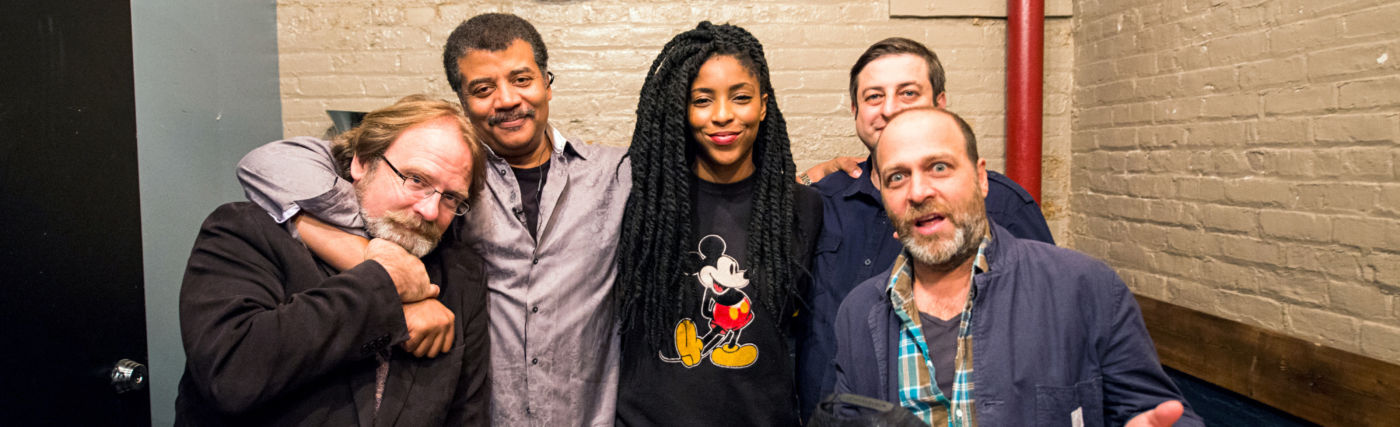
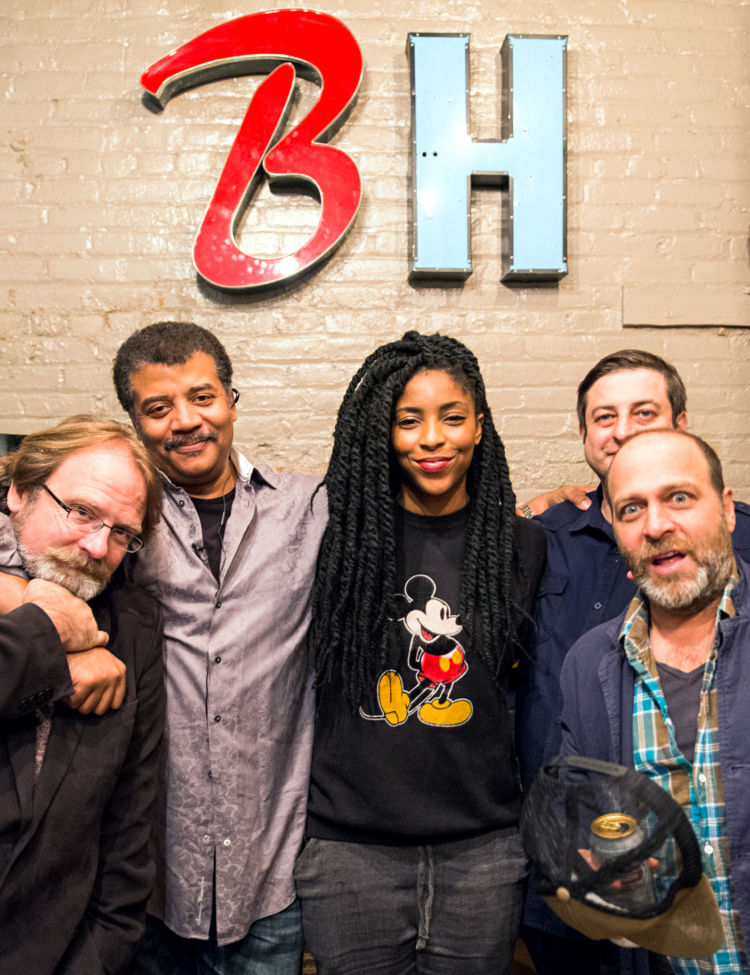
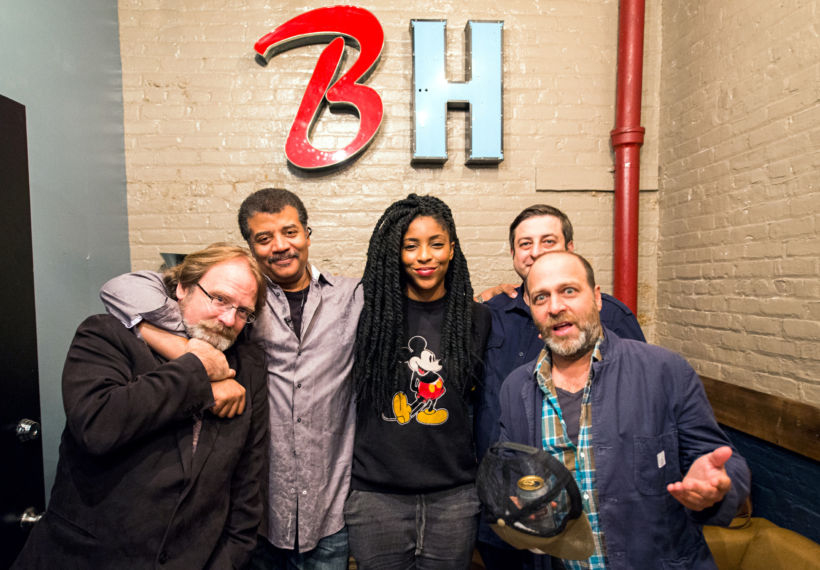
A strange, and surprisingly funny, brew of poisons, parasites and infectious diseases is on tap at The Bell House in Brooklyn when Neil deGrasse Tyson and Eugene Mirman welcome guests Mark Siddall, the Leech Guy, and comedians H. Jon Benjamin and Jessica Williams. You’ll learn the difference between poison and venom, why magic mushrooms are safer than blowfish sushi, and how plants protect themselves by using cinnamon, vanilla, caffeine and nicotine as insecticides. You’ll also find out more than you might ever want to know about snakes, spiders, tapeworms, pinworms, bedbugs, and the parasites that live in your eyelashes. And that’s before Mark brings up the really scary stuff: Malaria and Ebola, and why mosquitoes and fruit bats aren’t the only things we have to worry about when it comes to protecting ourselves from infectious diseases.
Transcript
DOWNLOAD SRT
Welcome to StarTalk, your place in the universe where science and pop culture collide. StarTalk begins right now. Well, have we got a show for you tonight. Do they know the topic? No, they don't know the topic. They don't...
Welcome to StarTalk, your place in the universe where science and pop culture collide.
StarTalk begins right now.
Well, have we got a show for you tonight.
Do they know the topic?
No, they don't know the topic.
They don't know the topic.
You all came not even knowing the topic.
The topic is poisons, parasites and infectious diseases.
The enthusiasm I've come to expect.
I wanna bring out my special guest for this.
Believe it or not, there are people in the world who are experts at this stuff.
He's a colleague and friend from the American Museum of Natural History.
Give me a warm Brooklyn Bell House welcome for Mark Siddall.
Mark!
Mark curated an exhibit on poison at the American Museum of Natural History.
So I got my man, who'd you bring?
Oh, can you do better?
Certainly not in the world of poison, but I will bring two comedians out.
One is a bit of a father and a bit of a spy.
From Bob's Burgers and Archer, H.
Thank you.
Tonight, I will be playing the part of the parasite.
I'm Jewish, so there you go.
Oh, by the way, just every night that we do this, we create a special drink just for that evening, themed by that topic.
And so Kim, the bartender, earlier, she and I concocted a parasitic poison drink.
Poison drink, that's what it's called.
A special drink just for this evening.
It did not exist before tonight.
Well, you really phoned in the name of that one.
You didn't even go for, like, paracetene or anything.
Anything would have...
All right, our final guest.
She is awesome.
This is so exciting that she could make it.
From The Daily Show, ladies and gentlemen, Jessica Williams.
All right, let's get this party started.
So, let's just clarify.
So, Mark, you're curator and professor at the Sackler Institute of Comparative Genomics in the Division of Invertebrate Zoology at the American Museum of Natural History.
His professional expertise is leeches.
And in fact, his Twitter handle is The Leech Guy.
I am The Leech Guy, and I can attest that Neil deGrasse Tyson could never possibly get that name because when we went in the field with Nova Science Now.
Yes, we profiled some of his work back when I was hosting Nova Science Now.
It took me into a leech pond.
And they wouldn't feed on you at all.
Yeah, none of the leeches.
I felt unloved.
Because he got out the leeches all, I had no leeches on me at all.
Did I ever say, they fed here and I swelled from my knee to my ankle.
That's just creepy.
I did this for you.
So that's really creepy.
How do you get dates?
Yeah, is that what it says on your Tinder?
Well, I don't need dates.
I have a charming and lovely wife who actually illustrated the book I wrote.
Oh, yes, yes, yes.
There's a book.
It's not about leeches.
We'll do a leech book next.
Okay.
These are the stories about poison that we couldn't put in the exhibition.
So sinister species with deadly consequences.
Yes, indeed.
It's not an allegory for our marriage.
I just want to make clear.
And your wife illustrated the book.
Yes, and I believe she's in the audience.
Aren't you, Megan?
Over there.
All right.
You couldn't get her a seat, apparently.
So let me ask you, Mark, let's just start off.
Isn't it true that almost anything will kill you given a high enough dose?
So how are we to know what's poison and what's just someone being stupid?
What's the most amount of regular blood you could drink before?
It's like too much.
Did you say blood or alcohol?
I'm sorry, I didn't get that.
So poison's a funny concept.
If you ate enough hammers, they'd kill you, right?
Right, right, right.
Does that make hammers poisonous?
No.
So the way we tend to think about it has to do with whether or not they're screwing with their physiology.
So salt, you all need salt or your nerves don't work, sodium chloride.
All of your nerves use sodium to get their stuff done.
If you eat like a cup of salt, it'll shut that down.
That's poisonous.
Water, well, you drink too much water, it dilutes everything.
Is it really a poison?
You know, it's not really a solid concept as to what is a poison or what is not.
It has a lot to do with...
Your field has yet to define poison.
This is what you're telling me.
I think I am.
And in fact, when we were working on these ideas...
For the exhibit.
The intersection between the concept of poison and toxin and venom and so on was really a very English language centered kind of semantic argument, and we just gave up on it.
So toxins and venom, I mean, how many movies have extracted venom from a frog or a snake, put it in a bullet and...
You know, there's a lot of this...
Seven.
You know your movies.
Name them.
No, go ahead.
No, I would rather be cut off.
Where?
Yeah, just the very, very front...
Okay, so poison affects you chemically, that's what you're saying.
It affects you physiologically and it invariably is chemically, yes.
And so when I think of some poisons that are just chemicals that you might find out there, like arsenic, right?
Yes, or dihydrogen oxide.
You mean water?
Yeah, water.
Who do you think...
you're messing with me.
Yeah, who do you think you're talking to?
No, but this actually makes the point.
People think things are poisons because of their complicated names.
Tell that story, if you know the story about dihydrogen oxide.
The story of water?
Yeah, yeah, yeah.
No, no, no.
It's a good story, go on.
Some of you might want to leave.
There was a kid who was sort of testing the gullibility of the public, or at least their fear of science and things that sound bad, set up a petition in the street to ban dihydrogen oxide.
Because if inhaled, it creates suffocation.
It is the biggest ingredient in acid rain.
It sure is.
And you go down the list.
Anybody sign the petition?
Oh yeah, I would have definitely signed the hell out of that.
So this is something that we get at the museum, right, is what's it like living on a planet with poison gas?
Because that's got to be terrible.
Yeah, so far I agree.
So far I love it.
That's why I don't leave Earth.
So it turns out you're living on one.
One of the most destructive elements to your body is oxygen.
I mean, all of the things that oxygen does to your DNA is absolutely terrible.
This is a poisonous planet and we're surviving, it's amazing.
So we should go in a room with no oxygen and we'll be healthier.
What are some of the bad things?
I'm just going to go home and eat a bag of hammers and get it over with.
Please elaborate on all the things that oxygen does to my body because I am a hypochondriac and this is a wonderful episode for me to be involved with right now.
I'm right there with you.
Suffice it to say ripping your DNA apart is probably not a good thing.
Yeah, but it obviously takes its time.
Wait, we're comparing ripping your DNA apart eventually and dying within three minutes.
Oh no, there's only one thing that will kill you in three minutes.
Whoa, whoa, whoa, do tell.
What's that?
It's not a bad joke by Jon Stewart.
I don't know, I don't care.
Wait, what's the Jon Stewart joke?
Yeah.
I'm so screwed.
I'm never going to be invited.
Is this something from Big Daddy?
No.
I'm just saying.
Do we want to dig deeper into his film career?
I'm just saying, if you complain about oxygen, if you don't have any oxygen at all, you will die sooner than whatever bad things the oxygen that did to your DNA would kill you.
Is that a fair statement to make?
Probably.
The thing is that what we're doing in our own bodies is ripping electrons off of things and giving them to oxygen at the end.
That's how we get energy.
But that's a pretty caustic thing to be doing.
And we've got enzymes and other things in our body that make that happen, and we control all of the free radicals and so on.
But it doesn't mean that oxygen isn't toxic.
It's wicked toxic.
It's horribly toxic.
There's a huge cottage industry on antioxidants.
What do you think that's about?
That's what anti-oxidants are.
I never even thought about the word, but I was buying all of it.
All right, so of all the animals out there, how many are poisonous?
So, poison and venom is a funny thing.
I like to say that there's no such thing as a poisonous snake.
There isn't a single snake you can't eat.
You can eat a snake.
He's looking at you, man.
There are boatloads of venomous snakes and, of course, the Aussies.
Are there any Australians in the audience?
Is that what you eat?
Again.
So, Australians love to say, Oh, wow, we've got 18 of the most venomous snakes on the planet and 12 of the most venomous spiders and 8 of the most venomous fish and yadda yadda yadda yadda.
Very fine.
But you're really very...
An idea of the drunkest ladies.
You're really unlikely, extremely unlikely to die of any of those things in Australia because Australia has Western medicine like we have and you're probably going to survive.
The place where you're going to die from a snake bite is where you can't get care, like Burkina Faso, from a snake that's not nearly as venomous but you're just not going to find care.
Okay, so you're cool with venomous animals out there just as long as you have a snake bite kit next to you.
I just want to get a sense of how dangerous it really is out there.
I don't like snakes.
How long would it take that snake to kill you, the one that you just mentioned?
I didn't actually mention it.
The snake where you're somewhere and it takes a while.
Okay, so the one in Australia, the inland Taipan, there's a guy named Kevin Budden who was...
A snake?
No.
What, they're naming him one by one now?
Oh yeah, that's Kevin.
He's been my cousin.
So this guy, Kevin, he's a herpetologist.
It turns out that most people who die of snake bites are probably herpetologists because they're the ones who are handling snakes.
You're the ones who study snakes, herpetologists?
I could help you with that.
They don't study herpes, they study snakes.
Sick, sick job, better job.
So herpy means creeping.
Creeping?
So we're in the same place here.
Good, all right.
So this guy, Kevin, in the 50s, he found this inland Taipan and he grabbed it with his arm and it wrapped around and it started spitting all over him and he couldn't hold on to it.
Some guy drives up in a pickup truck and sees this guy in distress and says, oh, come on, get in the cab.
So he gets in the cab and he explains that he's got this incredibly venomous snake, the most venomous snake on the planet.
The guy who's driving the truck is like, um, can you maybe get out?
But he takes him down to the museum.
Unfortunately, the snake gets away, bites Kevin Budden.
The point of Kevin...
Well, he takes him to a museum?
The Museum of Natural History.
Okay, these are great places where lovely things happen.
I work at one.
I thought in the story someone was bitten by a poison of a steak and then taken to a museum.
I get why museums are great.
That's what you did back then.
I'm doing a little story contraction.
That was hard to follow, though.
So, unfortunately, Kevin died.
He was bitten...
It's because they took him to a museum instead of a hospital.
What year was this?
It was in the 50s.
They didn't know the difference between hospitals and museums.
So, anyone who's been bitten by this incredibly venomous snake in Australia has Kevin to thank because that very snake was the source of the anti-venom, which we can create if we have a live animal, and he insisted that that animal never be killed so that it could be used to create life-saving...
I do have a question.
How do they make anti-venom, though, from a live animal?
So, that's a great story, especially as it concerns the origins of it.
The United Fruit Company, which you all know, was dull.
I didn't know United Fruit Company was dull.
Did anybody else?
Was I the only one?
It's now dull.
Great.
Somebody from Monsanto knew.
They're everywhere.
Logical progression, you clear a forest, you plant banana trees to sell bananas to people in the United States.
You've got a lot of people who are working in those banana plantations.
And all of a sudden, you got a lot of rodents in there that are eating the bananas that are not being sold to Americans.
So, the snakes come in and start eating the rodents.
But then people are working in a place with a lot of snakes, and people start dying, getting bitten, and so forth.
So, the United Fruit Company created serpentariums in places like the Honduras, and also down in Brazil in order to find ways to create anti-venoms for the workers, so that if they got bit, you could save their lives.
So, okay, as a leech biologist, my animal, the thing I've decided to study as a biodiversity scientist looking at leeches, they're attracted to me, so I don't have to really go looking.
Oh, that was clever.
Yes.
Wow.
How hard is it to find a black hole?
No, we can find it, we just can't, we're not gonna bring it, we're not gonna bring it to the lab, that's all.
Well, no, they'll bring us eventually.
Yeah, yeah, they'll get us.
It's a long way.
I happen to know something, you're not the kind of leech guy who studies the leeches that lodge inside of a hippopotamus rectum, are you?
Yeah, what kind of a leech guy are you?
I'm actually-
Are you a hardcore leech guy or are you like, so I don't come in the rectum?
So yes, I am that leech guy.
You are!
Oh wait, but I noticed that you just brought black hole and leeches into the same sentence with the hippo rectum thing.
Because that's how I roll.
Just so you know, I'm that kind of hippopotamus.
Have I got an undergraduate for you?
Have you got a forearm for me?
Here's what I want to understand.
There are all of these ways animals and plants can poison you or stick venom in you.
Could you give us an overview on what their poison and venom does to your body?
Because there was a whole recitation in Kill Bill as Darryl Hannah, Darryl Hannah, the eye patch.
Darryl Hannah sits there and watches the guy die.
As she's thumbing through her Google notes.
Could you give us some...
Well, that was a black mamba.
Well, she was black mamba.
That was her.
Of course, there was a black mamba.
So, snakes actually, typically with a snake, there's a cocktail.
And similarly, like your cocktail, there are lots of poisons in things like snake venoms and in plants and so forth.
Very rarely will you find any animal that has only one or plant that has only one.
When I said that I love plants because they can't run away, they're defending their cells with something.
Nicotine, caffeine, theobromine in cocoa, all of these things are actually insecticides.
Meaning insects won't eat like caffeine plants.
They eat them and they go lie down on a hammock and go, I need more chocolate.
Or that's just self-defense, right?
That's the way.
Okay, so the ingredients that resist insects, we find other uses for them.
Absolutely, cinnamon, vanilla, all of those things are insecticides.
They're delicious.
Which means you're not an insect.
Which means you're not an insect.
Yeah.
That's evidence.
That's how you can tell, that's the test I do.
That's the evidence, yeah, yeah.
I'll give someone vanilla and if they eat it, I'm like, not an insect.
Would you like to get dinner sometime?
So, all right, so I get it.
So, that's fascinating to me, that there are chemicals out there that the plant uses to protect itself, yet it doesn't work when humans come in because we, they're recreational drugs for us, right?
Well, it sometimes does work in the sense that things in the Belladonna family, for example, Belladonna.
That's a famous-
Sure, we get it.
Porn star.
A family of porn stars.
Yeah.
Which is flying arrangements where basically plants ground up and smeared on the skin.
Now, it's a very bad idea to do this.
We have this thing that we call a therapeutic index, which is the difference between the effective dose and the lethal dose.
And you really want those to be very, very, very far apart because if the effective dose is very close to the lethal dose, then you could overdose very easily.
That's death.
Just making sure you're with us.
You got that one?
Oh, I got you.
I'm not with you for a lot of it, but I am with you with death.
That's why people warn you about heroin.
Heroin, very good example.
And by the way.
Yes?
Wait, wait, give the example.
Don't buy it away yet.
What are you saying?
Mushrooms.
Yeah.
Psilocybin.
Wait, wait, confirm what I've just learned.
Wrap it up, Burning Man.
I just learned, this year, I learned, please confirm for me, that humans or mushrooms are more genetically alike than either humans or mushrooms are to green plants.
Oh, clearly, yeah, of course.
Their sperm is the same.
Wait, wait, whoa, whoa.
Okay, I didn't get that.
Let's go back, let's go back, let's go back.
I didn't get that far in the similarity.
But was that as the evidence, their sperm is the same.
You didn't want to go there, did you?
I didn't know that that was a place to go.
Wait, what did you say?
What about the sperm?
What part of it, what did you say about it?
Wait, I've been following nothing, and then that?
It's just science.
All right, wait, so you gotta bail us out of this one.
Okay, let's go back to them.
I just said we're related.
You're talking about sperm.
Okay, they're not exactly the same, but they look the same.
So, mushrooms, let's go back to psilocybin.
I think we're safe for them.
Please, okay.
Just for that guy.
So, which of you three have ever done, no, I'm not gonna ask you that, unless you want to answer altogether, or just individually?
Do you want three people to go like, when I was 19?
So psilocybin, the effective dose, the dose to get whatever effect that you might possibly want, is measured in femtograms.
Now, you're the astrophysicist.
How many zeros?
That's a metric prefix of a very small number.
So femto, so we have, I don't know, adofemto, that might be 10 to the minus 15, or 10 to the minus 12.
So it's like 14 zeros and then a something?
No, minus 12, so it'd be like.
And you don't want to switch to ounces right now?
You want to figure out the femtograms?
Do you want the smiley face, or do you want the rainbow?
Please don't draw on my face.
So it's measured in femtograms.
Just to be clear, so nano, as in sort of nanotechnology, that's one billionth of a thing.
And I think femto is like a millionth of that?
Yeah, I think it's a thousandth of that.
So you have nanofemto, oh, it's a pico.
Thank you.
Oh, right, yeah.
I think it's nanopicofemtoato.
Can we agree that it's a very small number?
That's what I was asking, I couldn't help.
Go, I'm good.
Whatever this number is, it sounds like I took too much.
So therapeutic, therapeutic index, therapeutic index is the ratio of what is effective for what you want and what is lethal.
The lethal dose of magic mushrooms is 15 pounds.
Really?
You have to eat 15, can you even, 15 pounds?
I was close.
I feel like, I was like, 15 pounds would be, I didn't, That's a mound, mussels are mostly air.
I'm thinking you're walking in front of a bus before that.
Yeah.
And after.
So if any, if you're listening, they're safe.
So wait, just, just wait.
This message is not endorsed by the American Museum of Natural History.
So some of these things people do recreationally, but other things we come next to and snuggle with knowing it'll kill us.
Like in Japan, they have the puffer fish.
What do they call it?
The Fugu.
Fugu.
People eat that and that'll kill you.
Yet they eat it.
Sure.
Why?
I don't know.
It's tasteless.
It really, it's terrible.
Look, okay.
So, and I think they eat it because of the risk of dying like a kabuki actor.
What was his name?
Do you remember?
There was a kabuki actor, Marcel Marto.
My total recall for kabuki actors is, I brought some poison, would you like some?
That's a book.
Or is it poison inside it?
Is it like one of those things you brought in a book?
It's a really unfortunate way to hide poison.
Wait, wait, wait, wait, this is-
Oh, that is a bunch of poison.
Sorry, that's not a book.
You really brought poison.
You walk around with this?
But it's like one of them salts and peppers or those-
Well, here, if you'll allow me.
Can you clarify this for everyone really quickly?
Barnes and Noble was fooled entirely by this.
Security of the Bell House was fooled entirely.
So, just a couple of things.
Would you pass that to the gentleman on your right?
Careful, dude.
Mark is now passing around poisons among the panel.
Passing cinnamon bark.
Do I have to wash my hands or-
Well, if you don't like the smell of cinnamon.
As we said earlier, a lot of the things-
You just eat all that now quickly and it'll be over soon.
Eugene, why are you licking something out of a box called poison?
Poison.
Because, first of all, I trust him, second of all, it tastes like cinnamon.
Thirdly, you shouldn't trust me, here's some curare.
What's that?
Ah, don't lick it, I think you've-
Jesus, I don't want to touch anything you give me.
When you said cinnamon bark that I stop being scared, but when you said the other word, I am a little scared.
But it does raise a really good point, is that plants can't run away, so they're producing things to protect themselves from insects or herbivores, and we, being thoughtful, thinking human beings, most of the time, have figured out how to leverage these things for our benefit.
Sometimes, for example, for hunting, sometimes for medical purposes.
Hunting as in tips of arrows that would show-
Sure, yeah, there's a bug, I shouldn't call it a bug, it's a beetle larvum bug, that the San in South Africa would grind up and put on arrows in order to take down big mammals.
It turns out that whole mythology of elephants chewing on marula fruit and getting high and getting a little bit drunk, there's not enough alcohol in marula fruit to make them drunk.
They're getting high off of the toxin from the beetles in the marula tree, which is the same one the San were using for killing things, because elephants are big animals.
So, elephants can get drunk off of beetles?
Beetle juice, yeah.
Say that three times.
What's in your alcohol?
Number one cause of poisoning in the world.
Alcohol?
Just to clarify, what you're saying is, what we call poison is in some sense is biologically arbitrary, because it's the thing that will kill us at a particular dose, but other doses could be just fine, be recreational, and we'll have fun and medicinal and all the rest.
So for everything we ingest, we got to measure where it kills us, then we call it a poison.
So I'm going to say, I'm going to pull on Neil deGrasse Tyson on you.
Anytime.
It's not biologically arbitrary.
It's actually biologically measurable.
We can actually measure the-
I really didn't mean arbitrary.
I meant it was, you don't know in advance that something is poison until it kills you, and then you back off from that a few notches.
Oh, and then you say it's recreational.
No, it's actually worse than that.
So the way this is measured is LD50, lethal dose 50.
What that means is that you've got at least 100 things and you've killed 50 of them with some dose and then you know what the-
so yeah, it's bad.
Say that again, but quicker.
No.
LD50, lethal dose 50.
You actually have to have like 100 mice and at what dose the half of them die.
Oh, nice.
What's nice is that we don't do it with comedians.
We do it with mice.
Yeah.
It would, I imagine, be illegal.
Well, my guess is it usually takes a higher dose for comedians.
Yeah, yeah.
We're going to wrap this segment.
So just for the wrap up, tell us what your favorite poison is and you can buy whatever metric you choose.
Your favorite-
because you're the man who's the poison man.
So you're going to tell us all, what's your favorite poison?
It's like asking, what's your favorite child?
I'm sure it's exactly like that.
Okay, I got to say it's probably tetrodotoxin, which is the poison in the puffer fish that you were talking about.
It's a poison that acts on neurons, but what's amazing about it is it does not affect your heart.
So, you get to stay alive as you're dying.
It's like real torture.
It's total...
Does it hurt or is it just upsetting?
Actually, you don't feel much pain.
You don't feel anything, but your brain's working and your heart's working and you're zombified.
Well, so your brain is working differently then, right?
Wait, wait, so what you're saying is you have an awareness of your death and there's nothing you can do about it.
Well, is it like the diving doll in the butterfly?
You have an awareness...
Like kiss at a dragon?
Did you see that?
You have awareness of all the people around you.
I missed that one.
That was a great one.
That's a gently...
It's a classic.
Oh, yeah, with the pin and he puts it in the guy, the French police or...
Yeah, yeah.
It's sick.
It's sick.
You have an awareness of all the people saving your life because you actually get to see them, you get to hear them, whatever.
But tetrodotoxin is kind of interesting because we know it from puffer fish, we know it from blue ringed octopus, we know it from the rough skinned Newton, Oregon.
And we only know that because some guy decided to eat his own pet in a bar.
People shouldn't eat their pets.
It's a bad idea because they're probably toxic.
That's why you shouldn't eat your pet, because it might be toxic.
So, does every animal out there have some parasite that just loves sucking its body fluids?
Well, given that most of the animals out there are parasites, because every animal that's not a parasite has about five to a hundred, parasitism is the most successful strategy for animals all over the place.
Way more than 60% of all animals are parasites.
What are we?
Parasites.
Right?
So, what you're saying is it's easier evolutionarily speaking to figure out how to live off the nutrients derived from the fluids of another creature than to...
Get a job.
Get a job.
Yeah.
That's what you're saying.
Part of the problem is, is that we consider things like tapeworms to be parasites, we consider malaria to be...
We consider tapeworms to be parasites.
So, we sound real judgy.
We consider tapeworms to be parasites, malaria to be parasites.
And they don't physiologically do the same thing.
And we call them parasites.
So, this is really just a semantic argument about what is a parasite in certain respects.
There's a textbook written by a friend of mine, John Genevieve Junior, and if you look in the glossary under, no, really, that's his name.
You made up that name, I'm just saying.
Definitely struggled through it.
John, John, John, Jeremy Junior.
Last name, Junior.
Junior.
Junior, Junior.
You know, he's gonna listen to this.
I mean, he's gonna know that he's loved.
Enough with the sham already.
You have no friends.
Come on.
I don't mean that.
I'm OK.
I'm your friend.
So the definition of parasite is the raison d'etre of parasitologist.
And if you go to the Gloucester under parasitologist, it says it's a quaint old fool who sits on one stool while looking at another.
Hey, but seriously, though, this is all great, but how many parasites do humans have?
Yeah, I'd like to know that.
What do I have?
What parasites do we have at any time?
What do you want?
None of them.
Does she have any parasites on her right now?
Well, sure, she's got Demodex follicularum probably up in her eyelashes.
Great, good night.
Good night.
Great, good night.
Good night.
Which one of these classes of sort of organisms, what shows up a lot are, like, when we read about worms, like nematodes and things.
So how many of them are worms in our body?
Yeah, how many worms do we have?
You might actually leave.
Shall we just go with New York?
Yes.
Sure.
OK.
What do you mean, there's a lot, like, Boston's like, ooh, you don't want to hear about that?
They have all their Cambridge worms.
I was thinking.
Everybody out there who had an itchy butt when they were a kid, raise your hand, OK?
All of you who are lying, raise your hand.
So pinworms, pinworms.
What about now?
No, so pinworms.
Pinworms are a very common nematode.
Even in the developed world, the females lay their eggs in the...
In your butt.
Because intense itching.
And it's actually adaptive for the organism.
Because it's itchy, you scratch.
And that lofts the very lightweight eggs into the air, and everybody around gets infected.
It's an incredibly wonderful way to transmit.
Don't aw, because you all got it.
OK, what's the third creepiest parasite?
No person is an island under themselves.
And you're never alone if you're parasitized.
But how many...
Do I have like 10,000 parasites?
But are there like 10,000 parasites, or are there like 85?
You're talking about number of individual parasites, or species?
So we're host to somewhere in the hundreds to low thousand kind of range that are...
No, these are just things that are strictly things that are only in humans or not in any other animal.
Oh, I feel better.
I was like, I don't have to share my research with cats.
No, this is great.
Well, wait, so these are living organisms.
We're their universe.
And we are the...
They thrive within us.
Only us.
Unless they're getting between us.
Then they're kind of not with us.
But do we need them too?
Please say yes.
Oh, that's a good one.
Yeah, yeah, yeah.
Great question.
Yeah, maybe they clean our hair and give us mustaches.
Yeah, yeah.
Yeah, yeah.
How many...
I don't know how anything works.
How many do we have a symbiotic relationship with?
Well, the good news is the word symbiosis just means living together, and that includes parasitism.
So you're thinking of commensalism or mutualism.
Yeah, that's what I meant.
I was testing you on that one.
Yes.
So, I'm sorry.
Yeah, yeah.
The question was sort of how many things live, what we used to call symbiotic, but I forget the new word, on me and us.
Stuff that'll screw you up kind of thing?
Something that's like, hey, thank God it's there because it'll eat all your rice.
So what we do know...
I don't know, but you get it.
The extra rice that you will not eat.
We do know that your immune response is educated by some of the things you might get when you're young, including parasites.
We do understand that some allergic-related things, some asthma, not all asthma, is correlated with environments where you don't get exposed to parasites when you're younger.
We also know that for some people with things like Crohn's and a few other immunologically-related diseases, you can actually give them parasites and it makes them better.
It makes the disease, it makes you better.
One woman loves Crohn's.
It makes you feel better.
It makes you feel better.
So when you're young, exposure to some classes of parasites help out your immune system for later, so that you become stronger, more resistant.
We think.
It's hard to do controlled studies on humans?
Yeah, yeah, completely.
Not for me.
Yeah, yeah, yeah.
You have a big basement.
An unstoppable attic.
All right.
How about malaria?
No, we're screwed.
How many people die?
Malaria?
I mean, what's up with that?
What can fix that?
Malaria is theoretically erratic-able because only humans get it.
Ebola is like, you just forget it.
You can't eradicate Ebola because it's in your body.
Eradicate it.
It's in all the bush meat that people eat and then get Ebola by eating bush meat.
Bush meat, what is exactly bush meat?
It's like a low-grade ground beef.
Get it, some of your major chains.
Well, you're saying you can eradicate Ebola then?
We're like incidental hosts.
Like it's in possums in the forest?
It's actually, we now know it's in fruit bats.
So you're saying we would have to vaccinate fruit bats as well as ourselves in order to get rid of Ebola?
You would have to either eat all the fruit bats or eat all the humans.
And all get Ebola.
You would have to not eat all the fruit bats, murder them.
So malaria is different.
The malaria species that infect us only infect us.
And so theoretically we can get rid of it, but we got 200 million people who die of malaria.
So 200 million people, big number, right?
Yes.
For that to be right, there has to be a time unit in there.
You want a time unit?
200 million per...
How about this?
747 jet crashing every minute and a half and it's all full of children.
That's malaria.
Okay, comedians, work with that.
Well, is there any way to get them to be teenagers?
So, Mark, so, so, if an actual 747 crashed every 90 seconds, in one day ever, no one would travel and they'd ground all airplanes for the rest of the universe.
Yet, this is going on with malaria, and what are we doing about it?
Well, there are a lot of people doing a lot of things, and in fact, what's interesting, and, can you only get it from a mosquito?
You get it from another human, and it's transmitted by a mosquito.
So, what's interesting is that it exists in places where people are infected, and then other people get infected.
So, mosquitoes are not the cause, they're the vector.
So, what does that mean, meaning, can you get it from a person and a mosquito, or?
No, the mosquito will bring it from one person to another, but if you actually cure someone.
It's like a terrible train.
All right, oh, I see.
I'm not flying or taking the train now.
So, you catch malaria from another person because the mosquito got it from the other person and brought it to you.
Absolutely.
Whoa.
Okay, so malaria we associate with the tropics.
By the way, there was a huge, you must know this, back at the turn of the previous century, there was a big exhibit on malaria and mosquitoes brought about by all the effort to make the Panama Canal.
And we have that huge model, I don't think it's on display, of this mosquito.
It's like this big.
Here's the funny thing, in our museum, we've got a mosquito on display that's called a...
It's this big.
Yeah, it's a malaria mosquito.
It's a male and the males don't feed on blood.
Idiots.
I knew that museum was wrong.
Okay, so I never knew, so I didn't know that.
I mean, that's not as bad as The Daily Show having the planet go on the wrong way.
It is literally worse.
They're a comedy show and you're a science museum.
But both can be corrected with money.
See the full transcript



 Unlock with Patreon



 Become a Patron