Transcript
DOWNLOAD SRT
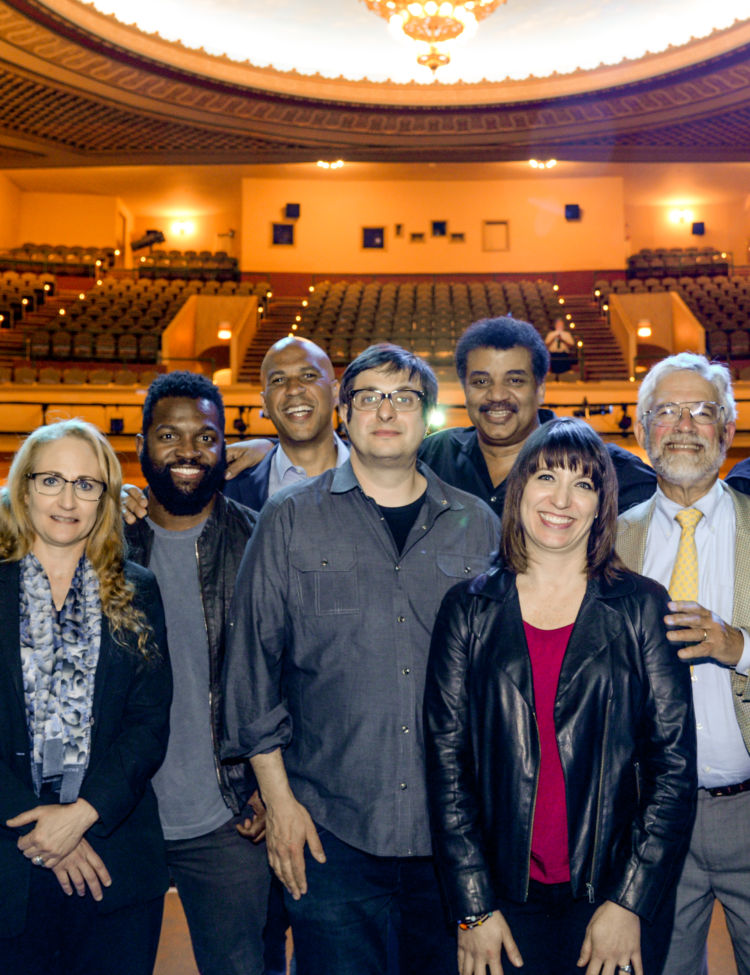
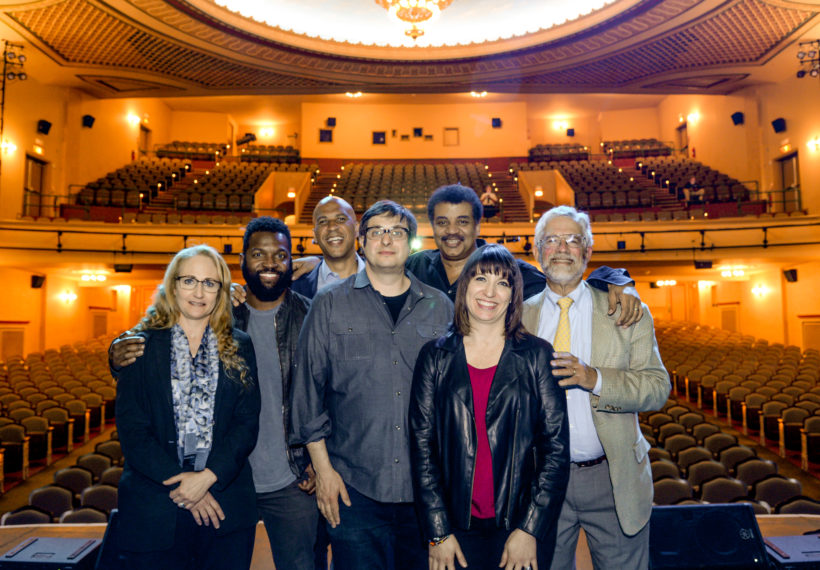
Welcome to Star Talk. Your place in the universe where science and pop culture collide. Star Talk begins right now. We are live at the Camp Basie Theater. We're talking about the marriage of science and policy. And I've got...
Welcome to Star Talk.
Your place in the universe where science and pop culture collide.
Star Talk begins right now.
We are live at the Camp Basie Theater.
We're talking about the marriage of science and policy.
And I've got a great panel up here.
What we're trying to do is make America smart again.
Trying to find out how science and policy come together to effect change for the greater good of us all.
And Eugene, we're here for you.
Yes, thank you.
It's still part of the Eugene Mirman Comedy Festival.
Can we set the stage here?
With me, Baratunde, everybody.
And Ophira Eisenberg.
And I've got John Holdren, who worked in Obama's Office of Science and Technology Policy.
Also, from the Obama Administration, we have a biologist, Jo Handelsman.
Jo, come on out.
Associate Director for Science at the Office of Science and Technology Policy under President Obama.
And now she's a microbiologist at the University of Wisconsin.
Is that right?
Cheeseheads, yes.
So, this event will be in three parts.
Initially, we'll talk about Earth and keeping track of what's going on and why.
Talk about the science and the policy related to that.
Next, we will talk about biology and all of how that affects health and get inside the National Institutes of Health and what they're all about and why.
And we'll end up with a final segment on the future.
The future of space, the future of AI, robotics.
And so, we're going to do it all.
All the science that matters in this country.
And we're doing it now.
Well, Earth Day is in April.
Earth Day, April 22nd.
And it coincides with the Science March on Washington.
So, John, Earth Day began in 1970.
Right.
Why?
Why not 1960?
Surely people cared about Earth in 1960.
No, people did.
But what had happened during the course of the 60s is there were the whole series of environmental disasters that got people's attention.
So, we need disasters to protect.
So, we don't know how to protect something proactively.
Disasters help.
What were like the three best disasters?
The Cayuga River catching fire was one of them.
Lake Erie becoming totally clogged with algae so that most of the fish were dying was the second one.
This one sounds worse.
And of course, the air pollution in the Los Angeles basin getting worse and worse so that on most days you couldn't see the mountains.
In fact, I was at Caltech in the early 1970s and I had been there in Pasadena.
I had been there for six months before I knew there were mountains right behind Caltech.
So, Jo, you worked with John Holdren in the Office of Science and Technology Policy.
What is OSTP?
I think most people have never heard of it.
So why?
What do you not do?
Well, we obviously didn't advertise ourselves very much.
Our job was to mix policy and science and that meant two things.
Some of it was policy for science, how to make our science enterprise as strong as it could be, using policy to shape it.
But the other side was using science to shape policy on issues that weren't obviously about science.
Like what?
Like forensics.
Forensic science is supposedly based on science, but in fact there's not that much science behind it.
And so we brought the science to bear on that issue.
And so, John, you were appointed by Obama, is that correct?
Did you have to be approved by the Senate?
Yes, but there are two different jobs involved.
Science advisor to the president is not subject to Senate confirmation.
The director of the White House Office of Science and Technology Policy is subject to confirmation.
Did you have both titles?
And I had both titles, but I could start serving as the president's science advisor on Inauguration Day 2009.
It took two months to get confirmed as director of OSTP.
And in those two months, I couldn't sit in the director's office, couldn't give any orders to anybody in OSTP, but I could talk to the president.
Glad this bureaucracy is going to be gone now.
So how is Obama among the presidents with regard to science, would you say?
Well, I think President Obama was the most science savvy president since Thomas Jefferson.
Thomas Jefferson, of course, was his own science advisor.
I hope Warren Harding never hears you say this.
But the president came into office understanding how and why science and technology matter for the economy, for public health, for the environment, for national security.
He was preloaded.
He just got it.
He understood it.
Alright, so Earth Day, I still, forgive me, don't really know what you're supposed to do on Earth Day.
What are you supposed to do?
I think you're supposed to draw a picture of the Earth and then get it on a tote bag and walk around.
Walk around with it.
Walk on the Earth.
Appreciate it.
Walk on the Earth.
Yeah, touch the Earth, you know, that would be a good thing on Earth Day.
Need a stick of pot butter.
Yeah, very common.
Look at a baby for as long as it will let you.
Neil, some of us...
Earth Day has a biological motive, doesn't it?
Absolutely.
Some of us think it should be renamed Soil Day because it's about the Earth, but the most important thing on the Earth is the soil.
That's where all of our food comes from.
Wait, don't you study soil?
I do.
When you say some of us, how many want to call it Soil Day?
A few of us.
See, I would say water was pretty important.
I can go more than a week without soil.
Keep telling yourself that.
But the Earth is dead really fast without soil.
So you can't use yourself as the standard.
Sorry.
But it's okay.
And Neil, you can't go for a week without air.
Air is really important.
Yeah, that's minutes without air.
So when I think of Earth Day, 1970, in that same year, the EPA, Environmental Protection Agency, was founded.
And so was NOAA, the National Oceanic and Atmospheric Administration.
So that was a benchmark year for people caring.
So I'm trying to understand.
Well, on a slightly more serious note, more serious than caring about the Earth?
No, more serious than you're going for a week without soil.
On a more serious note, what it's really about, I think, is talking with folks and reminding them about all the ways we depend on air and soil and water and sunlight.
And, you know, the trouble is most people today, too many people, think that food materializes de novo on supermarket shelves.
You know, they think that when you plug something into the wall, the electricity is coming from right behind the wall.
We don't understand there has to be a whole system connected to it.
And they think that most pest control is done by pesticides.
They think that most availability of water is through canals and dams.
They just don't get it that we depend on the earth for our well-being.
And that's what it's really about.
You guys worked in an office that should be household conversation.
And it's not.
How come?
Well, I think partly because we backed up the president.
The president was the face of OSTP in many ways because he rolled out the policy.
He represented it.
I remember.
When was it?
When C.
Everett Coop told people how to use condoms or whatever.
I forgot the details.
What was his title again?
No, I forgot.
It was something about sex.
It was something about sex.
I believe he told people to masturbate and then the president had to take it back.
Right.
I think I got totally wrong.
No, no.
That was the next...
Yeah, that was the next...
That was Madeline Albright?
Joycelyn Elders.
Yeah, that's right.
Joycelyn Elders.
I remember the masturbation lessons.
Why do I even know his name then?
Well, so he was around, I think, in the AIDS era, where...
So we all knew his name.
Yeah.
And so why didn't we know your name?
Because you were out of it.
You must have been out of it.
Everybody I know knows John Holdren's name.
You worked with the guy.
Well, but I know a few people who are outside the White House, and they all think that he's a hero.
Well, so here's the thing.
Earth...
Okay, so Earth Day, there was somehow in the air, no pun intended, a sense of concern for Earth as a planet that came out of...
that was right in the middle when we were going to the Moon, right?
I think we went to explore the Moon, we looked back and discovered Earth for the first time.
And in that discovery, Earth became a focus of our concern and of our...
we wanted to preserve this spaceship floating there in the void.
We basically took a planet size selfie.
Yeah, basically, that's right, from a quarter million miles away.
So it looks like we exploited that fact legislatively.
Absolutely, that blue marble photo, that selfie that Baratunde has just referred to was critical.
And so EPA gets formed, apparently not under any controversy, right, I guess?
Well, you know, it's interesting that, you know, President Nixon actually thought it was important to do that.
And I think he was Republican last I remembered.
It's true.
It was one of his better moments.
I think today he'd be considered a communist.
So the mission of the EPA to ensure that all Americans are protected from risks to human health and to the environment from where they live, where they learn and where they work.
So this sounds like an important organization.
Very important organization and one which has been built up since its inception and which has done on the whole pretty good job.
And what's the relationship between NOAA and the EPA?
Well, NOAA is basically an environmental monitoring and a science organization.
They're responsible for understanding what's happening in the oceans, what's happening in the atmosphere.
The National Weather Service is part of NOAA, for example.
So our weather forecasts come from NOAA.
And by the way, a member of Congress once famously said, I don't know why we have to fund NOAA, we have the Weather Channel.
And that's what's called unclear on the concept.
So, all right, so both organizations exist today.
And can you comment on their support in Congress?
Well, it's mixed, obviously.
NOAA and EPA have had strong support through both Republican and Democratic administrations over the years.
But now they are faced with severe budget cuts, most severe in EPA, if President Trump's budget is accepted by Congress.
And that's not a foregone conclusion.
He's proposed a budget for EPA, but Congress has to approve it.
But that budget cuts EPA's total funding by over 30 percent, and the research and development organization in EPA is cut by 50 percent in that proposed budget.
NOAA's budget is also being cut, particularly in respect to ocean monitoring and research and climate data.
Now, you don't have anything to do with that because you're not in Washington anymore.
That's right.
So why am I even asking you this question?
I want to ask that of a politician.
Senator Corey Booker, New Jersey.
So you can't come up in my house, Jersey, and not say hello, man.
I got word that you were in Jersey.
You did get word.
You crossed from the dark side of the Hudson.
I crossed the moat.
Into the light.
Across the moat of the Hudson River.
Welcome to New Jersey.
It's great to have you here.
I'm delighted to be in your home state.
Senator Booker, you're a former mayor of Newark.
That can't have been easy.
It was the best, hardest seat of my life.
There you go.
And so you're a sitting senator in midterm right now, correct?
Thank you, New Jersey.
Yes.
So we have people who previously served and you were in Congress while they were serving.
First of all, their names might not be publicly known, but they are heroic people that made Obama probably one of the greatest science presidents we've ever had because of the people he had around.
The people because of the folks he put in place.
Yes.
And so we're now talking about a president's budget because a lot of this I think is just a mystery to so many people.
It was certainly a mystery to me.
So the president puts out a budget and doesn't the Congress kind of have to go along with most of what that is?
Not at all.
Not at all.
You read the Article 1 branch of the Constitution, the first branch of government described as the Congress.
They have extraordinary powers.
They set the budget.
So the president suggests or presents something to Congress, but Congress actually makes the decisions.
That is like a constitutional smackdown.
That was so politely done.
By the way, we could do the Hamilton too.
We almost had a free style right now.
We will rhyme it backstage.
So you and your fellow 99 other senators actually wield real power on that budget.
Extraordinary power.
Extraordinary power.
Good.
I am happy to hear that.
I was aghast at the president's budget.
I think it was one of the most scary documents that basically he put forth in one document a reflection of what his values are, which frankly, if you look at his budget, the so-called skinny budget and the way he tears apart critical programs that affect every element of Americans' lives, even the base of the people that voted for him, it was a patent betrayal of those people who supported him and would, in terms of creating jobs and economic strength is what he preached in his campaigning days, it would have really debilitated this nation's ability to compete globally in a world that now is a knowledge-based economy, which means science and innovation and technology is so critical.
So to take away the government's role in that would really be putting both hands behind our back as we're competing with the Chinese and the German and the Japanese who are making significant investments, in fact beginning to outstrip America when it comes to investing in R&D.
So what is the, I want to compare sort of, what were some of the successes under EPA and NOAA in Obama that might be at risk right now?
Well, I just want to let people know, I mean, everything we touch represents your public dollars.
I mean, everything here from the batteries to the touch screen to the GPS, the origin of all the science and technology that the private sector is now using to create thousands of jobs is public sector investments in science technology.
Hardly anybody knows that.
Hardly anybody knows that.
A dollar invested, in fact, all of us probably are fiscal conservatives.
I had to be when I was the mayor of Newark.
Every taxpayer dollar was precious.
The reality is, is the best return on investment for a taxpayer dollar, one of the best ones you could get in government investments is in things like the National Institute of Health.
It's such things, investing in science, you get almost more than double the return in terms of long-term economic growth for our economy.
And so to savage those programs, to cut the EPA.
So there are people who don't recognize that the government is actually a good place where some kinds of money gets spent, rather than saying the government should have no money at all.
Yeah, well, let's take a step back and just look at the EPA.
I mean, I believe in the principles of a free market, but Newark, for example, their environment is a testimony to the free market run amok.
In other words, the River, the Prishek River is toxic, the soil in Newark is full of lead, the oxygen, we have terrible asthma rates, and those are caused by companies that weren't properly regulated, pouring toxins into the world and destroying not just the health of the environment, but also the fiscal competitiveness of the city in the long term.
So by the EPA being savage like it is, not just the research and development side, but just holding people accountable for the laws that they're breaking out there and hurting the environment actually costs all of us money.
So this is a message that needs to get out there, okay?
So you're a senator who's elected to office and you don't have a formal science background, so who's going to listen?
I have a degree in political science.
You got me there.
So, there are advisors.
There's the National Academy of Sciences, Office of Science and Technology Policy.
So, we would like to think that when they speak, the public listens and heeds.
But somehow, that's not happening.
And I don't think any of us understand why.
So, what's up with that?
Well, I think that it is really important now more than ever.
And I think a lot of folks learn this with this last election, that the only thing necessary for evil to be triumphant is for good people to do nothing.
Or to do like some but not enough.
The fact, yeah.
We've learned that retweeting is just not going to cut it.
It depends on the tweet though.
Some of those tweets are high-fives.
And so as the age-old wisdom, which I just cited, the reality is we did not have an activist citizenry.
And a lot of folks, and we were joking before about this concept of love, but patriotism by definition is love of country.
Love is not a beating word.
It demands action and sacrifice.
And so if you love your country, you've got to stay engaged on these issues.
You've got to stay involved and you've got to let your elected officials know that, hey, you're going to be overseeing a budget.
In fact, the budget of this country runs out on April 28th.
And the budget decisions are going to be made probably on a continual basis.
If you're not speaking up and letting your voice be heard, engaged in the process, then you're basically surrendering.
So let me just answer this in data.
So in order to make an informed decision, make informed protest even, you need data.
And NOAA is responsible for many, many satellites in orbit around the earth monitoring climate, for example.
And you would think that this would be sufficient so that people will then hear about the data, learn about the data, and act upon the data as citizen scientists, if you will.
So where is the disconnect here?
Well, first of all, the public actually understands climate change better than many members of the Congress do.
Well, he just…
Sorry, Corey.
Plus, he's no longer working in the government now, so he can say that, okay?
No, but it's true, that's what polls show, you know, polls show…
And I said this to President Obama at one point, polls show that in the range of two thirds of Americans believe that climate change is real, substantially caused by humans, already doing harm, we need to do something about it, two thirds.
By the way, only 50 percent believe evolution is a fact.
And when I told the President that, and I said this was…
He was saying, you scientists have to do a better job educating the public.
And I said, well, we've done pretty well on climate change, and it's more than evolution.
He said, that's no consolation.
So it's not 100 percent.
So people, they seem to be sort of in denial of data that they don't like.
Well, it's almost like they're afraid of what the data is going to say.
I mean, we have laws in Congress that were shocking to me that I found out, where we're blocking even studying things.
Like we're blocking even the studying of gun violence and understanding the effects of it.
We have supporters of blocking gun violence.
And so the question is why?
And I want to be very blunt with some of the things that we have to understand.
There are large moneyed interests, large corporate interests in this country that are very invested into the status quo right now.
And on elections they spend billions and billions of dollars supporting people who will protect fossil fuel industries and others, protect the status quo.
So you can't expect with that much money being poured into the system that the people that often get elected as a result of that won't be protecting that despite the evidence and try to do everything they can to fight the evidence.
Like the tobacco industry for so long they would fund scientists who would come up with funky science that was wrong and try to debunk or at least confuse people as to what the data was showing about cigarette smoke.
So Jo, if you, like, for a while worked in infectious diseases, is that right?
Or you were part of the programs that taught people about it?
Yeah, in OSTP we dealt with several epidemics like Ebola and Zika virus and we handled it.
John and I were the key people in OSTP.
So that's a case where if something goes wrong, people get sick and die.
So there's immediate cause and effect.
And climate change has a little bit more of a horizon.
But if sea levels rise and you start flooding, seems to me that's cause and effect.
Well, when heat waves and droughts and wildfires burning larger and larger areas, you know, in the Arctic.
Can't this weigh more than the billions of dollars of advertising?
I think we might be looking at this the wrong way.
First of all, funky science sounds amazing.
I don't know why you're dissing that.
I want to go to a funky science party.
Second, John, you started by talking about like the EPA and NOAA were born out of rivers on fire.
Maybe they're trying to return to that level of disaster and urgency to inspire us.
So I know it's happening.
I mean, the reasons so many Americans now believe that climate change is real and dangerous is they're experiencing it in their lives.
They're seeing it on their TV sets.
They're seeing it on their iPads.
And it's stunning.
If you look at the expansion of the areas afflicted by extreme heat every summer, if you look at the areas burned by wildfires, for the first time in modern times, the tundra is burning in the Arctic.
The tundra is burning.
That never happened before.
That sounds terrible.
Yeah.
It never happened before in the period when we were looking.
I went to a doctor for a sinus cold and she told me it was global warming.
I swear to you.
She sounds like a coop.
I did report her.
New Jerseyans are seeing the financial impact of climate change right now.
So most people don't understand we have a massive fishing industry in New Jersey.
What's happening with the acidification of our oceans, the warming of the oceans.
They're seeing fish that they used to be able to find off the coast of New Jersey are now being found further up in Connecticut.
And Maine.
In Maine.
That's kind of nice for New England.
Sorry New Jersey.
But New England is complaining because they're seeing lobsters and other things moving further and further.
That is a lot of them.
And so but more than that, we are a state that lives in flood areas and now the flood maps literally are now you're seeing what were used to be 100 year floods happening with more frequency, which is costing New Jerseyans a lot more money.
So I like what you were saying that who said it that maybe we are we are returning to the pre 1970 state of circumstances where we've got to drop low before we recover as one.
They're trying to inspire us, man.
I think the disasters are trying to inspire us.
Oh, that's an interesting way to think about it.
Yeah.
It's the only way to stay sane.
So do you think maybe it would help to just light a few local rivers on fire?
Do we need to light rivers that like Trump would come across like on his walks?
Like Mar-a-Lago.
Like Mar-a-Lago on fire.
Fifth river at my golf course is on fire.
So Jo, is it too late?
No I don't think it's too late and I think the...
Because the river on fire and that's all kind of local stuff.
And we talk about climate change, we're talking about planet wide.
So that requires planet wide cooperation and participation.
So is it too late?
Well, there was one study that showed that people believe in climate change based more on the three previous days of weather than anything else.
And so their belief goes up and down.
So are we just like three really warm April's away from people being like, fine, let's fix this.
So I'm sorry to return to this point.
The cynicism is killing me.
We are a nation that the majority of us, the majority of Republicans believe that climate change is real.
The disconnect is not the people of this nation realizing that there's a problem.
The disconnect is, King used to always say, and one of the more eloquent than I could ever say, the problem today, what we will have to repent for is-
Wait, who said this again?
Martin Luther King.
Martin Luther King.
What we will have to repent for is not the vitriolic words and violent action to the bad people, it's the appalling silence and inaction of the good people.
And so that's the problem is that it's not that you call Republicans, the majority of them as you said, believe climate change is real.
Millennial Republicans are so far progressive on these issues.
On everything.
On everything.
On all issues.
And by the way, the only major political party on the planet Earth, every other nation, their right party and their left party believe in climate change.
The official elected Republican leadership is the only one on the planet Earth that does not officially believe in climate change.
That's called American exceptionalism.
So should we put that leadership on a different planet?
I think what we need is...
There you go, Neil.
Let me give you an example.
This is simple.
I'm always a big believer that the power of the people is greater than the people in power.
But folks don't exercise that power.
As Alice Walker said, the most common way people give up their power is not realizing they have it in the first place.
And so the cynicism that gets thrown around is actually a toxic state of being, because it's surrendering your ability to make change because things can't be changed.
This is something very simple.
If just millennials alone, Barack Obama said this in his speech to Howard students, forget Republican or Democrat, if just millennial generation, the biggest population bubble coming up demographically right now, if they just voted at the same levels that ex-generals did, 40, 50% in midterm elections, the entire Congress would change.
And so, this is not, Obama said, this is not complicated.
He looked at the young people and said, you don't need to occupy anything, just vote.
And so, this is not a problem of knowing what is right to do.
And I fear.
How do we get that message on the Snapchat?
So, I get this, I get that.
And remembering that in the 60s, huge protests, all the time in every major city, campus unrest.
It was a time where citizenry was trying to take back the government.
And I get that.
And you're getting some of that now.
But at the end of the day, it comes down to policy.
That's what it comes down to, doesn't it?
I mean, what policies are in place that we can all agree to to solve these problems?
But you can win fights.
I came in and I actually took heat even back here in New Jersey for arguing, I said, OK, I need to figure out a deal to strike with Republicans.
And I worked with a lot of my colleagues on this and saying, hey, the problem is oil and gas industry get all kind of tax credits for innovation, for all that.
But renewable energy, which we are losing ground to the Chinese and the Germans and their innovation, their technology, the jobs of the future, we're losing ground because the tax credits for wind and solar are one year.
They're not predictable tax credits that industry needs.
And so we fought with an exchange.
We allowed the export of oil, something we had bought then, in exchange for seven years of predictable tax credit.
Well, as soon as Congress did that, what do you think has happened to the solar and wind industry in the United States?
Boom, the investments are going up, the innovation is going up.
It's just the art of compromise.
We won that battle in Congress.
It's not something that made the front pages of newspapers, but we're in there every day fighting.
And the thing that we need from the public, because I've watched, this has only been a hundred days of the Trump administration, but people don't realize the day Congress changed, the new Congress came in, one of the first things the Republicans tried to do in the House was to remove the watchdogs, the ethics watchdogs.
And it was the public that so was outraged that they stopped them in their tracks and they reversed course.
I've seen that a number of times since then, that the public and the press exposing what's happening has helped to move things back.
And you and I both know history.
When it comes to science, the ability for the right poets, the right inspiration to prick the moral consciousness and the urgency of people, whether it's Kennedy talking about going to the moon, which was fuel science like crazy, or just simple Americans, well-known people that have powerful platforms like Neil deGrasse Tyson bringing science to the mainstream.
I mean, you are a guy that is getting folk woke on science issues, and I think that that's really powerful.
I don't know if I was woken folks.
Well, no, what I'm trying to do is, through forums such as this and everything else, is just try to not tell people what is true about the universe, but empower people to understand why.
And in that way, they can take ownership of that knowledge without even having to reference me.
If all it was was, this is true because Tyson said so, then I failed as an educator.
You say this is true because A goes to B, and this caused that and that caused that, then you own that information and that then gets shared.
And I'm not even in that picture.
I don't have to be at that point.
And then everybody takes command of their lives and of the country in which we live.
It also helps a lot of us not just wake up every day screaming because we know that there's someone out there that sounds sane.
Okay, so one point Carl Sagan was once asked about...
Sagan, yeah.
I think they were celebrating that he was asking a question.
Did you catch that the senator earlier on said billions and billions?
Did you hear that?
Yeah, he actually said that.
I heard that.
He was asked with regard to superheroes, what was his favorite superhero?
And he's not a fan of superheroes because superheroes as they're portrayed, it gives us the excuse to not do anything about problems in the world because you're just waiting around for someone who has the power to solve it while you're eating popcorn watching movies.
And so to the senator's point, quoting, was it Alice Walker, the biggest, it's the power you don't know you actually have that is the failure.
Yes.
I paraphrase.
Yes.
Alice Walker, the most common way we give up our powers, not realizing we have it in the first place.
Not even knowing you had already ceded it to someone else who's using it.
Yes.
Possibly against you.
Most likely, if you check out of a system, that system is going to work against you.
It's like when Time magazine said that we were all Person of the Year.
Do you think I'm saying it?
They did say that.
I remember that.
That was lame.
That was like the lamest Person of the Year ever.
Or was it the best?
No.
What's the generation where there are no losers and everyone is a winner?
I think they had the editorial board in that moment.
Do you think Carl Sagan secretly liked Green Lantern though?
I'll check whose people on that.
Coming up in the next segment, we're going to explore and in fact celebrate the latest advances in medical research, genetics and health when Star Talk returns.
The universe is the man.
No, the universe is the gender-neutral human who we all love.
Red Bag, New Jersey, give it up for Star Talk!
We are live at the Count Basie Theatre.
Can I just point something out about Eugene?
Do your thing.
Eugene is one of the proud representatives of great tradition in America.
He is an immigrant.
From where are you from, sir?
I forget.
Russia.
You're from Russia?
Yeah.
Yes.
I'm a US citizen, so you can't get rid of me.
That's right, so he's a first-generation immigrant.
He's a first-generation immigrant.
You were born in another country, you came here.
I can't be president, but that's fine.
On that subject, I will add, because I just did this homework, that the average, decade-by-decade average, of first-generation immigrants in the United States since 1900 is about 10%.
So it's one in ten Americans were born somewhere else at any given time across the century.
Now, let's ask another question.
What percentage of American winners of the Nobel Prize in the sciences was a first-generation immigrant?
A third of all American Nobel Prizes in chemistry, physics, and human physiology were foreign-born.
So they're three times as represented in the science, this highest prize of science, than they are even in the population.
We'll give you an example of this.
So people who come down and lobby in Washington, I love when people don't hire lobbyists but they come down themselves.
I see lots of New Jerseyans come down.
And when I see college professors from Princeton to my University of Stanford come and they come to me and they say, look, this is crazy.
We bring these folks in, the brightest minds to study at our universities, on student visas.
We use our resources, giving them the best education on the planet.
As soon as that student visa runs out, what is our country now saying to them?
Get out of our nation.
And that's ridiculous when we have a country that attracts this greatness and then sends it back out in the world.
I would like to point out on that particular point that President Obama proposed in 2011 to staple a green card to every graduate degree in science earned by a foreign citizen.
Just staple the green card to the degree.
And it hasn't happened.
Let me just tell you what's worse.
Around Stanford, I was told there's a billboard that says, you can't get your H1B visa to stay, come to Canada.
And so other countries are seeing what we used to do to accelerate ahead of the rest of the planet Earth.
And one of those things that they saw was they had policies that tried to attract the brightest of the globe.
And they're saying, okay, if America's not going to do that anymore, we want to do that because we want to leave.
Just in all fairness, Newt Gingrich said that as well, to staple a green card.
Just so you know, I just want to be fair out there.
He said a lot of stuff.
One of his few sage observations.
I am Canadian and all my Canadian friends now treat me like I have an illness.
Is that illness being American?
Yeah, they're like, how's it going?
So two people on the stage now are foreign born?
Yeah, and I actually, I'm only on a green card.
Authorities?
Yeah, I'm a new mom.
I have an anchor baby.
Anchor baby.
So let me ask you guys something.
I've got science advisors here.
I have a politician here.
Clue us in how advice is obtained, received and enacted or not.
What is that dynamic here?
Because I don't know.
Well, first of all, I had a great relationship with Democratic senators.
But not Republican senators.
A few Republican senators.
Many fewer.
But part of the way it works is there's a lot of interaction between the scientists and government and the Congress.
The scientists and government testify all the time in front of the Senate committees.
In front of the Senate and the House.
You're on a committee.
You're on the Science Committee.
Yes, I'm on two committees.
One is called the Commerce Committee, but the full name includes Commerce, Technology, Science, a lot of those things.
And I'm on the Environment Committee, Environment and Public Works.
So I'm on two of the main committees that deal with issues of science, technology, innovation.
And they hear a lot of testimony, but they also meet individually with scientists and technologists from not just the White House, but from the Department of Energy, from the National Science Foundation, from NOAA.
Their staff meet all the time.
So these are all the people who they who the Senate approved.
Yeah.
So, so you, so they can just summon you at will?
Absolutely.
And just bitch slap you when they feel like it?
Well, you know, when I used to testify...
Is that a yes or a no?
I will, I will comment that on days that I was testifying, we used to call that piñata day.
Piñata day.
They swing at you with a big stick, they hope to break you open and some candy will fall out.
Did they ever hope you would just help their kids with their science homework?
Because I once testified in front of the science committee of the Senate and you either weren't there or you weren't a senator yet.
I would be there sir.
But since I'm a citizen, asked to testify, I didn't feel like a piñata, I felt that they were just kind of gathering information.
And I was commenting on the value of exploration, specifically space exploration, into a universe that has unlimited resources, especially the kinds of resources that on Earth we fight wars over.
So I just thought I would highlight this fact.
And so I was intrigued because I didn't feel like I was making much of a difference.
And I was just kind of going through motions, and then they were going through motions.
I didn't feel their energy.
So I don't, so does this work?
When you give advice, are they actually listening?
Sometimes.
Sometimes it works, sometimes it doesn't.
Corey, when they give you advice, do you listen?
Sometimes.
What I want to know is, is one of the bipartisan points of agreement health?
The National Institutes of Health.
Is that what, that's got to be in there somewhere.
Well, look, wow, that's a too long to say yes, that's a no.
Senator, that's a quick yes.
So we are screwing up in the larger sense in our investment in biotech.
And coming from a biotech and innovation health space state, New Jersey is, we are really screwing up in so many ways of this system.
We're screwing up in not investing in it.
Other nations are beginning to pull ahead in their investments in this area.
We're screwing up in the way the free market is contorting and making people's prescription drugs way too high price.
I can go through the ways that this space frustrates the hell out of me.
But what bothers me most is just the fact that Alzheimer's, my father died of Parkinson's just a few years ago.
All of this that is costing us, these illnesses that are costing us so much money, we could be investing more in the cures to these diseases.
We could lead humanity out of the darkness of the pain like we look at other diseases we conquer.
But we're just not making a commitment as a society to put our resources, our energy, our talent, our spirit into solving the problem.
John, it sounds like you can combine that problem with an analysis and throw in some economics and then you have an argument that has no holes, that everyone just agrees with and you create the policy and then you move on.
Why isn't that happening?
Everything you say makes complete sense.
Neil, some of it is happening.
In the Obama administration, we started the Brain Initiative, which is making tremendous advances in understanding how the brain works, which will help us ultimately figure out how to cure or avoid Alzheimer's.
Or how to make better political decisions.
Does that still exist?
Or is it just a place with a bucket of balls?
It still exists.
Maybe because I haven't found out about it yet.
So Jo, can you think of biomedical advances that more people need to know about?
Well, one of the big initiatives that I worked on, in fact it was my first initiative in the White House, was precision medicine.
Which is the idea of using big data about big populations of people to tailor medicine treatment and prevention to the individual.
So if you can sort of parse people into lots of different groups and based on whether it's their zip codes or their genome or their microbiome, something like that, you can then make predictions about their health.
And this is really the future of medicine.
But I had kind of an interesting experience.
This is my first memo to the president.
John and I wrote this memo and then we were invited a few days later very quickly to the Oval Office to meet with the president.
You got to write memos to the president?
Can we tell which ones will commit crimes and arrest them beforehand?
I saw that movie, yeah.
Okay.
So we had this great meeting and the president clearly had gotten precision medicine.
So I walked out feeling pretty good.
I said, John, he got it and this is pretty cool.
Next week I was sort of perusing some old legislation and I came across 2006 legislation written by Senator Obama on precision medicine.
I was simply crushed.
But that I think is an example of a bipartisan issue because when we rolled out precision medicine we had as many Republicans as Democrats at the event.
And just in December the 21st century cures bill which supports precision medicine and the brain initiative and several other things passed the Senate 95 to 5.
Thank you very much.
And that was certainly bipartisan.
He was in the 5 that didn't...
Was your thank you sarcastic because he voted against it?
Yes, thank you very much.
So, it seems to me that health would be the most bipartisan thing going.
But then I'm surprised to see a proposal to reduce the funding to the National Institutes of Health.
So I don't understand that.
By almost 6 billion dollars.
So, Corey, what's up with that?
It is...
What's up with that?
I've literally been in the scrum during these large budget deals where that exasperatingly you're fighting to try to say how can we be funding X, Y or Z like these broken programs that don't do anything and we're not funding something as obvious as this that frankly I work in a body that we're all getting old.
It's kind of a one of the more thoughtful senior bodies where a lot of these diseases are going to be visited upon us.
And so I don't understand if you forget about if you don't care about this country and you're not as much of a patriot as we all should be but think about your family.
Think about yourself.
Why aren't we making more of an investment?
And even worse, again, I keep repeating this over and over again, but we've heard all about this president promising that we're going to win bigly.
But the reality is our competitors are making massive investments in terms of percentage of their GDP investing in these things.
They're overtaking us.
They're going to catch us and overtake us.
And so I just look at what China is doing and what Germany is doing and what Russia is even doing in terms of what they're investing in.
I'm sorry, Corey.
I'm tired of something.
I'm angry.
Yes.
Bring it.
Let your inner jersey out.
Just hold me back.
So, the day I realized and this is a pretty I don't want to call it upsetting, but disturbing day for me.
When I look back at America's presence in the space race, from 1957 onwards, the launch of Sputnik, until we landed on the moon, essentially, every decision we made to go into space and what to do there, was reactive to what Russia, the Soviet Union, had already done or was already planning.
Every single move.
They put in a first satellite, we brought up a satellite.
They put up a dog, we put up a chimp.
They put up a human, then we put up a human.
And we are reacting at every time, at every turn.
And I wonder, can a democracy be proactive or do we have to wait around until we feel threatened and only then do the pistons align for us to act the way we should?
See the full transcript




 Unlock with Patreon




 Become a Patron