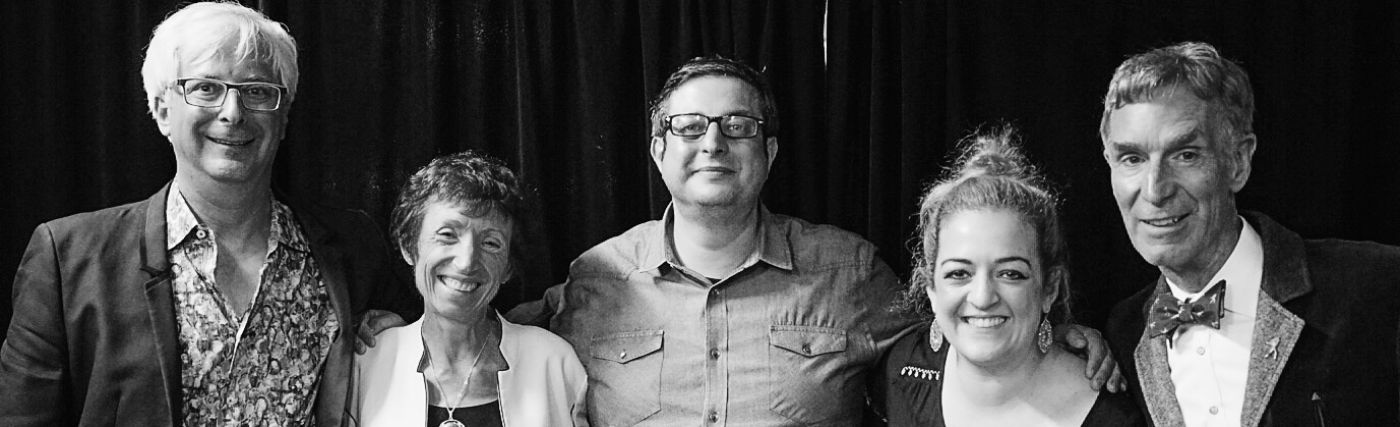
We live in an age of unprecedented communication and invention, but are we creating and innovating to the best of our abilities? In this episode of StarTalk Live!, recorded at Fun Fun Fun Fest in Austin, Texas, Bill Nye and company explore creativity and innovation in the Internet age. The crew includes innovative thinking expert Dr. Roberta Ness, cognitive psychologist Dr. Art Markman, comic co-host Eugene Mirman and comedian Maeve Higgins. You’ll learn about “frame-shifting” and find what tools are needed to break the mold of traditional thinking in order to bring out new ideas. Discover how genius minds work, including whether “mood disorders” are a cause or effect of innovative thinking. Find out about Albert Einstein’s annus mirabilis, or “year of miracles,” and whether it was actually a single year. Learn the effects of Johannes Kepler’s solitude on his work and mental state, and discover why his creative process could have benefitted from an online brainstorming session with his peers. The group describes factors that may lead to innovative breakthroughs, including a balance of knowledge and naiveté, a childlike willingness to look silly in the name of discovery, a culture of people working toward similar breakthroughs, and sometimes, years of hard work and deep thought.
Transcript
DOWNLOAD SRT
Welcome to StarTalk, your place in the universe where science and pop culture collide. StarTalk begins right now. Hello, everybody. Welcome to StarTalk Live. Yeah, we have a wonderful show for you. It is my very great pleasure to bring...
Welcome to StarTalk, your place in the universe where science and pop culture collide.
StarTalk begins right now.
Hello, everybody.
Welcome to StarTalk Live.
Yeah, we have a wonderful show for you.
It is my very great pleasure to bring up to the stage a hero to science.
Multi Emmy Award winning champion of science, Bill Nye, the Science Guy.
I'm on stage with the inimitable, the amazing Eugene Mirman.
And then also with us this week is Maeve Higgins.
Also with us this week, to talk about cognition, innovation, creativity, and things having to do with creating, with your brain.
We are joined by two professors from two different universities of Texas.
First, a professor of psychology at UT Austin.
And then with us also from the University of Texas at Houston is Dr.
Roberta Ness.
So, Dr.
Ness, may we start with you?
You certainly may.
You're an epidemiologist.
Has nothing to do with skin.
I just want to make that point.
But it has to do with epidemics.
It, thank you, yes it does.
But we are here talking about creativity.
That's right.
And for you there's some connection.
I'm hoping for an epidemic of creativity.
That's why I'm here.
An epidemic of creativity.
So is this something?
That would work well for me.
So, okay, is this something that you think is infectious and is transmittable?
I do think so, as a matter of fact, yeah.
I mean, I think that it can be taught.
Here's the deal.
We think, we know, actually, that innovation, creativity is what makes science go round.
Right, it's absolutely what fuels science.
Wow, we don't teach how to think innovatively.
So how crazy is that?
It sounds a little crazy, but only a little.
Doesn't it depend on your teacher?
Some teachers more, is anybody here, did anybody here have a sugar baby in middle school?
So this is where they give you a bag of sugar, and you have to cheat it.
I thought you meant, you date someone younger, but very wealthy.
Who takes care of you, and there is no upside for them.
Yeah, I'm already done with that.
Well, I claim it's a creative, it teaches innovation, or you have to innovate in order to take care of your bag.
You have to keep it with you all the time.
The bottom line is, I believe strongly, and in the books that I've written, that not only can you teach people how to innovate, but there is a systematic way that you can teach people to innovate, and in fact, this is exactly how genius scientists think.
Genius scientists think in the way that you're proposed teaching?
Absolutely.
Or they teach this?
They wish they could teach it.
Actually, genius scientists don't know how they think, which is really an oddity.
I've asked a number of them.
They have absolutely not a clue.
I was gonna ask Dr.
Mark.
So these two comedians are Creative for a Living, which enables the purchasing of chicken.
Commodities, mostly it's shrimp and chicken and paper.
That's what mostly my money goes towards.
I spend a lot of money on tickets to my own show, and that way I keep it.
You know?
You sold out along this line, and then Dr.
Ness, you teach creativity or teach how to be creative.
What's going, Dr.
Markman, what's going on in our brains?
Well, you know, I think that one of the things that's really important to understand is that we assume that when people are being creative, that they're fundamentally doing something that no one else is able to do, that they've somehow brought some new process online.
And in fact, a tremendous amount of what's going on when people are being creative is, for one thing, they know a lot.
So if you look at creative people, they've actually had to learn a lot of stuff.
And generally speaking, not just in the narrow area that they do their work in, a lot of them really have to have some breadth of knowledge that falls a little bit outside of what they do as well.
So the fascinating thing to me about things like creativity is that we often assume that it involves these very basic elements of what the brain is doing.
Like there's this thing called working memory, which is the amount of stuff you can hold in mind at one time.
I forgot about that.
And we think, well, if we could just increase that working memory capacity, then we would immediately become more creative.
But the fact-
Oh, wait.
Yeah, that's what people say.
No, no, wait a second, cause and effect.
Don't we all presume that children are somehow inherently creative and we stomp it out of them?
And I mention this, because kids don't have the life experience.
Right, but I think what kids do is they're willing to just try things and look stupid.
They are so stupid.
When they're small, they can't even sit up.
But it's not just that they're stupid, it's that they're willing to look stupid.
So that skill is certainly a part of what's required to be creative, but another big piece of it that's really important is having a very broad base of knowledge to draw on, which is why it often takes a fairly long time before somebody in any field goes from learning the skills that are part of that and learning the basic material to really being able to be creative in their craft.
So along that line, I was gonna ask you for an example, but I'm thinking out louding.
Well, Eugene and I were talking about how long it takes to be like a good comic.
And before he told me it took seven years.
When I was doing it for six years, he told me it took seven years.
And now he's changed it to 10 years.
I've always, yeah, but I've largely said, you were already doing well, she's a star in Ireland, but now she's here as a gift to us.
And I can't go back for legal reasons.
But is there like a number, like 10 years doing something?
We want there to be a number.
Isn't that great?
We'd love there to be, I mean, some of it has to do with the complexity of the domain that you're in.
So would you say Ted Nugent is at his most creative right now?
Not to challenge any theory, to say whatever you think is true.
It's great.
Yes, but.
Let me ask you this specifically.
Sure.
My understanding, this is from memory now, well, some part of it, that over half of patents are by people 26 years old and younger.
Yeah, but 26 is not 12.
Yes, you're saying that is the number.
Part of what happens is you've got to be willing to continue learning, right?
One of the things that happens in any field is, when you're 26 or 28, you've been studying the latest work for most of your life.
You've been internalizing all this.
And then a lot of people after that, they go off to work and they decide, you know what, I don't need to learn anything ever again.
Now, I'm just gonna apply what I know for the rest of my life.
Now, when you say decide, do they just get too busy to do it or?
Well, I think, you know, I think, yeah, I think what happens is, you know, your career starts and suddenly you have all these other responsibilities and there just isn't the time.
I mean, college and if you go to graduate school, graduate school are wonderful years because they give you all of this time to just, you know, get stuff into your head and move it around and see how something that you've learned here might be related to something that you've learned here without, you know, having to go and teach a class.
That's eventually all replaced with just Tinder.
I do have to add to this that there does appear to be kind of this sweet spot whereby people are knowledgeable enough, but they're also naive enough that they haven't kind of become really ingrained in a field.
So it actually turns out, I mean, this patent thing about 26, I mean, it's about right, but it also turns out that most Nobel Prize work is done about a dozen years after the end of training.
So people are quite young, typically, when they do the work that eventually gets them the Nobel Prize.
Of course, if you don't succeed early in your career, you don't get to have the second half of the career in order to be able to do stuff, which is another part of the problem, right, is that, you know, by, you know, at 26 or, you know, at 26 or 28, you get out of graduate school, you get a job, then you have somewhere between seven and nine years to prove yourself so that you can keep your job, particularly if you're in an academic setting, after which, if you didn't prove yourself in that period of time, you get set free.
So it's sort of hard to be a late bloomer.
Where does a new idea come from?
Like brand new, you're talking about building on your work.
By the way, did you notice, how many people are in grad school?
Did you hear?
They just presume you're gonna get a job, okay?
But yes, he's, ha ha ha ha.
So I think that the most brilliant new ideas come from what is called frame shifting or frame shattering, frame breaking.
So what's a frame?
A frame is your expectations and your assumptions such that when new information comes at you, you interpret it in a particular way.
And all of you, all of us have an enormous number of frames working at any given point in time.
They are so innate to us that we don't even recognize that they're there.
And in order to do something that is truly innovative, you have to do something that is truly surprising and shocking, which is in fact to shatter a frame.
Well, genius scientists basically broke frames, almost always broke frames.
So I'll just give you one example, Darwin.
So at the time, obviously when Darwin was working on evolution by natural selection, the going idea, the dogma was creationism, right?
I mean, that kind of God created every species.
And Darwin came along and said, I don't think so.
I think basically that mother nature really doesn't care in the slightest what comes out of her really rough and tumble environment.
It's not about ideal forms, it's not about unchangingness.
Everything is changing.
There's more to it too, because when you talk about having new ideas, sometimes what we need, if you're gonna do something new, a lot of creativity involves the recombination of things that we know.
And so one of the things that often really fundamentally changes the way we think about things is also an influx of new data and new information.
So research and development is slow and laborious in part because it's hard to create really good data.
And in addition to Darwin being away from church for a long time, he had opportunities to view both on his own and in Royal Society meetings and things like that, all sorts of wacky creatures and skeletons and things like that that changed the nature of the data that was available for.
If he didn't have that backup of education, because if I came across a platypus or whatever, I'd be like, somebody has sewn a duck to an otter or whatever, I wouldn't, I don't think I'd be like, hang on a second, evolution.
I'd just be like, yuck, put that away, you know?
Framebreaking is a super hard thing to do, which is why it took Darwin quite a number of years.
Now, interestingly enough, some of you may know that Darwin kept these wonderful diaries.
So we have this literally autopsy of the process by which he was thinking.
And this is also what I teach, is that there are these tools on the way to framebreaking.
Framebreaking is really hard to do, okay?
So one of the tools is analogy, another tool is reversal, expansion, there are a whole bunch of them.
I'll give you an example of reversal.
So Rutherford, who's the father of the atom.
He was shooting electrons in gold foil.
Exactly.
What did he do?
And they were popping back at him and he went, whoa, that's really weird.
How does that happen, right?
His famous quote was as though you shot a howitzer shell at a piece of tissue.
Exactly, and it bounced back.
That's right, you would not expect.
I haven't shot that many howitzer shells.
So he did that experiment and he was completely shocked and he didn't know how to interpret it, right?
So he basically goes and he thinks for a year, right?
And he comes back a year later and he goes, aha, I've got it.
So the conception of the atom at that time was that it was kind of this homogeneous bunch of mass, right?
In fact, his predecessor, his mentor said, it's kind of like a bunch of electrons embedded in English pudding.
That was literally, yeah, JJ.
Thompson.
That was literally what he said, okay?
So that's what Rutherford is thinking.
Rutherford comes back and he goes finally, whoa, actually what it is is it's like the solar system, whereby the nucleus is about the size of a pin if the electron cloud was the size of Saint Paul's Cathedral.
If you've ever been to London, this thing is big.
So the reversal is that JJ Thompson goes from it's a bunch of stuff to Rutherford saying it's the absence of stuff.
It's mostly nothing.
Well, that's kind of weird, isn't it?
I mean, that's a frame break.
And that's obviously the idea.
Well, it revolutionized chemistry and physics and everything we have in this room.
That's right.
But let me ask you this.
So Rutherford is one guy, JJ Thompson's one guy.
There are billions of people running around.
For one thing, the guys who make these discoveries, first of all, they know a lot, but also they have a lot of time.
I mean, one of the things about creativity that I think we don't appreciate is we live in a society that wants productivity.
So we wanna be making slow steady progress towards stuff and to be able to show that progress.
And if you can't show that progress, people are like, what's wrong with you?
But if you actually watch people being creative, it's like, what do you got today?
Nothing.
What do you got today?
Nothing.
What do you got today?
Nothing.
And then, oh, I got it.
Right, but it might take three months of nothing until you got it.
Yeah, it might take a year of thinking about atoms until you're like, oh, maybe it's the opposite thing.
But when you say it was a year.
A year, could you do that in a month or maybe it's the opposite?
In that year, was he like just thinking or was he taking actions or what was he doing in that?
Was he swimming?
If you look inside, if you look at the notes of scientists, I mean, so we did a lot of work with Kepler, who, you know, Kepler was...
He was a diligent guy.
He was, but the thing about Kepler was he gets a bad rap because mostly you think, well, he's just that guy, that math guy who noticed that there was a very small error in the orbits.
Everybody says that.
That's what they say.
On the street just today, walking in, something.
But hold that thought because we have to take a break.
We'll be back with StarTalk Radio right after this.
Bye Welcome back, welcome back, ladies and gentlemen, to StarTalk Radio.
And we are talking about creativity and innovation.
And you were talking about Johann Kepler.
I was.
And you said he got a bad rap.
He got a bad rap because while he did, was the guy who figured out that the orbits of the planets are elliptical, one of the things that he spent a lot of time doing was trying to figure out what was it that made the planets go around.
And he didn't get it right.
Newton was the one who ended up getting it right.
But he actually, if you read his notes, and this is to your question about, about what are you doing all that time, he was trying out different ideas.
And so he would try all of these ideas.
Now, he may not have been a happy camper while he was doing that because he didn't succeed.
But Kepler got some stuff right.
Kepler's laws are the real deal, right?
That's right.
Yeah, no, he was actually learning a tremendous amount about the planets.
But he was interested not just in the motion of the planets, but why they moved.
And that's what he struggled with, was what was it that was making the planets move around?
So along this line was, when I remember watching Cosmos, uh, Carl Sagan at first and then my beloved Neil deGrasse Tyson, uh, Kepler is depicted as a kind of miserable guy.
Is that a true fact or a false fact?
He seems to be miserable.
I mean, his writing is certainly miserable.
He, he, it's, and I don't mean that, we're all aware.
All right, his writing was miserable.
Ha, ha, ha, ha, that's the way it is.
Here's what I mean by that.
So luckily he wasn't constrained by editors of modern journals to keep his paper down to four pages.
So he writes pages and pages and pages of stuff where he goes off on some blind alley.
And then at some point he goes, the candy reader will no doubt have noticed by now the error I made four pages back.
And you can hear him banging his head as he's writing.
So is there a connection?
What year is this just to get an idea of when he was doing this?
15, 14 or 1500.
1580s I think.
1580s.
1580s.
So here's the thing.
Is there a connection between creativity, between innovation, between these new ideas and being mentally stressed?
Like to having what everybody nowadays calls mood disorders.
We used to call these people a pain in the neck, but now they have mood disorder.
Well, I would say as like, when I'm writing and it's the worst feeling in the world when you're trying to get to something and you can't get to it, and I feel lazy and I feel like bad and I feel like angry and that it's never gonna come and I've lost it.
I feel all those things.
And then like something happened, but I don't know what happens.
I would love if you had some kind of answer because it's really the worst feeling in the world.
And I don't blame him for being grumpy.
Yeah, he was trying to figure out how the solar system worked and he didn't really do it.
And that sounds like a bummer.
That would bum me out.
And it sounds like he did it for a while.
Not like that was a horrible week, but like.
Horrible, yeah, half a century, however long he kept.
As it turns out, there is actually data to suggest that there is a relationship between mood disorders, not only in the person, but in the family, and high levels of creativity.
But I think for kind of the average student, whatever it might be, this is hard work.
So it really is hard work.
And we do have this real misconception that great innovators kind of seem to do it through insight.
That you got this epiphany, they do it on the spot.
That could not be more untrue.
They do, exactly as Art said, they work at it and work at it.
They try all these different tools and come to all these wrong conclusions, generate an enormous number of different ideas.
And then at some point, they get that insight, that aha, oh, this actually happens this way.
Einstein is a perfect example.
In 1905, he has this Annus Mirabilis where he produces these four papers that completely overturned physics.
This is the miracle years.
Exactly.
Right?
It's the miracle years.
Applause for Einstein.
Einstein, yeah.
The geek physics crowd here, yes.
But in fact, it turns out he had been thinking about a lot of that stuff for decades.
I mean, there's good data to suggest that he was thinking about his special theory of relativity for 10 years before.
Did he call it my special theory of relativity?
It's fine if he did.
It's a little weird.
He didn't call it my precious.
Yeah.
So Einstein thought about it for years and then he had these ideas that changed the world.
But are there, when we think about history, we often equate innovation or rather invention with creativity.
And I think you can make an argument that if somebody invents a steam engine, he was working at it for a long time.
Right now, is that true?
Is that rather generally true?
That these, what we take as innovations or inventions are a result of years of messing around?
And communities.
I mean, I think the other thing that's really important to bear in mind is it is rare that there's a lone scientist or inventor who works all alone and comes up with this stuff out of nowhere.
And I think the steam engine, there are two people who are credited with the steam engine.
Alexander Graham Bell presumably is the inventor of the telephone largely because he got into the patent office a few hours before Alicia Gray did and they knew each other and were working together.
I mean, there are communities of people who work on these kinds of problems.
They're hard problems.
They take a long time.
But they also require a community of people who are interacting with each other and sharing ideas.
We love in this culture to crown a winner and to say, these are the people who did it.
Newton's famous saying was, if I've seen further, it's by standing on the shoulders of giants.
And that's really much more true about what's going on when people are doing creative things is that they're actually embedded in a culture of people who are working on difficult problems.
So is, okay.
Right.
So the city of Austin is growing at 183 people a day.
Is that right?
That's correct.
And it's mostly high tech jobs.
So why aren't you people at work?
And a few.
And that, this actually gets to the issue.
One of the issues that I talk about in the creativity crisis, I mean, kind of like what's wrong with science today.
So you know, clearly the greatest invention of the last generation or two is the internet, right?
I mean, I think we'd all, we'd all agree with that.
And it's not just because it's a communication tool.
It's because it has created the democratization of society.
So, and here's the problem, sorry, I know I keep over talking to you.
Yeah, here's the problem.
Science, academic science, can't use crowdsourcing, wow, why is that?
I mean, crowdsourcing is just this unbelievable powerful tool.
Oh, the academic science doesn't use crowdsourcing?
Doesn't it a little, like to find planets and stuff?
A little.
A little.
Chipping away at your lives!
I admit it.
I readily admit it, I stand corrected.
But the fact of the matter is, you can't get promoted in tenure on the basis of being part of the crowd of finding all those planets, right?
And the reason for that is because the way that academic science works is it's all about idea ownership.
It's all, you know, I have to prove that that was my idea, thank you very much.
I have to either get a patent on it or I have to be first or last author on the publication, I have to get the grant on it, whatever it is.
That's a real problem.
Right on, applause for first or last author shit.
That person clapping doesn't like the system, right?
That's what that is.
That was somebody who did not.
That's right.
That was the only person out there that didn't get tenure.
Some people might not have applied.
I didn't.
I don't know what that is.
I'm so glad that the rest of you did get tenure.
Congratulations.
Yeah, that's right.
But the fact of the matter is, so what happens is because you have to prove this idea ownership, you can't be part of the crowd, so really we don't use crowd sourcing anywhere near to the degree that it would be useful to use it.
So this is the crisis in creative.
It's part of it, yeah.
So is there a difference between stumbling on something and working, working, working hard at it and coming up with a new idea?
Or is it part of the same process?
Well, there's lots of ways that we get new ideas, and every once in a while you just get lucky and stumble on something.
In fact, the scientific process, when it works well, actually creates a lot of opportunities for serendipity.
I mean, people walk into experiments often hoping that their pet theory is confirmed by it, but if you look at where science advances, it's often in those situations where you set up those circumstances hoping to find something, and you actually found something completely different, and now everybody's got to stand back and scratch their heads.
I feel like it's the same with literature and art too.
If you go, if you're just writing, if you're like, this is really popular at the moment, it's going to sell, and then you just write some book about vampires falling in love with wolves.
So science is partially the search for more questions.
Yeah.
And a lot of times the surprising data then leads to a little bit of consternation because we've got to figure out, well, how do we take this into account?
And that really disrupts the field.
And so anyone who's doing good research, whether it's in a scientific context or research and development aimed at solving a particular problem, doing that research systematically is the way that you can discover things that are surprising.
But along this line, is it going faster than ever?
Are inventions being created faster than ever?
Is it accelerating?
The answer to that is inventions are being created faster than ever.
However, breakthroughs are not.
And perhaps just the opposite.
So if you look at the turn of the 20th century as compared to the turn of the 21st century, think about what's happening at the turn of the 20th century.
You know what's happening at the turn of the 20th century.
William McKinley is murdered.
That's right.
You've got-
What else?
Yeah.
You've got Einstein.
You've got Rutherford in the movie.
You've got the atom, you've got Montessori creating a completely different system of education.
You've got Ford basically creating assembly plants for the first time.
There were this enormous number of complete frame shifts, complete shattering of everything that had come before and replacing it with something disruptive and new.
Then you have the turn of the 21st century now where we do have an enormous amount of invention, I'm sorry, rocketing forward, technology, inventioning, rocketing forward.
But we don't seem to be having these same frame shifts, these same disruptions of kind of basic knowledge, everything we know.
So think about this for a second.
Think about, this is what makes me not able to sleep at night, these kinds of problems.
Climate change, water scarcity, Alzheimer's disease, cancer, obesity, preterm birth, I can go on and on, schizophrenia, depression, I mean, I can go on and on.
What do they have in common, yeah, really?
Thank you.
So if you weren't depressed when you came in, no.
But this is so, so what do they have in common?
They actually have one thing in common, which is we don't know what to do about them.
We really fundamentally.
I just got to disagree with you, Doc.
I love you more than life itself.
Thank you.
People used to die so much sooner than they do now.
For sure.
So many fewer people used to have clean water than they do now.
So many fewer people used to have communications tools than they do now.
And that is because of germ theory that basically dates back to the mid 1800s.
Yeah, but the Higgs boson was proven to exist.
And you know what that's going to do?
Nobody knows what that's going to do.
No, but you guys, it may lead to some extraordinary discovery.
You're passing through a plane of dark matter and you know what that's going to do?
I don't either.
Right, and that's a result of invention.
So, I'm agreeing with you, in fact, that invention is rocketing forward.
But this kind of the basic understanding of a whole lot of things that could potentially deep-six us really is not happening at this point at a rate that may be required to make sure that humanity and the planet are not harmed.
So, the question is, why are those frame shifts not happening?
For me, what's the difference between an invention and a frame shift?
So, what's the difference?
Well, you know what I keep thinking when you're saying, I keep thinking, I meet all these brainiacs who went to the best Ivy League colleges in America and they're working on an app to make laundry delivered faster or something like this, or they're doing finance and then they're just keeping that money.
So, maybe that's something.
There's something else too, which is a lot of the things that really fundamentally changed the way we think about a lot of the sciences were these very basic elements of our knowledge that we'd gotten wrong and we corrected some very basic mistakes.
And what we've reached is a point where a tremendous amount of what we need to know next is not just how do individual components work, like what's an atom, but rather how does a whole system work.
So, if you're going to try to understand what the brain is doing, you can't do that by understanding what this area of the brain does and then what this area of the brain does and what this area of the brain does.
You have to be worried about the entire system of the brain and the body that it's a part of and the society that that brain and body occupy.
All of that is ultimately going to influence our understanding of the brain.
And when you think about disease processes, that's a system.
So, at the point where you have to worry about systems, you actually have to shift from having lone investigators who do work to having whole teams with very different kinds of expertise working at very different levels of description actually collaborating on stuff in order to really understand the entire system.
Okay, collaboration is good.
That's how you build ships, big airplanes.
And even small airplanes, I think.
Yeah.
I could do a model airplane alone.
Agreed.
But do you need...
Right.
Do you need stress?
Do things have to be confronted with problems?
Why do you keep asking me that?
Yes.
That is, I think that...
I mean, it's a little hard to tell whether you need stress to do it or whether the act of engaging in this causes stress, right?
That's why I'm...
And I think they feed on each other.
When you're in the midst of trying to solve a problem that is, in fact, very difficult to solve, you have this goal that you want to achieve.
So James Watt, the steam engine guy, was trying to solve a problem.
And so you're trying to solve this problem, and you feel unsettled when there's something out there you're trying to achieve and you haven't reached that goal yet.
And that feeling of being unsettled is part of what gives you energy or what psychologists usually call arousal for the goal to keep working on this.
That's what they call O.
Now it makes sense.
That's not what he was talking about at all.
We're aroused by science.
We are joined with the cornerstone, I think, of StarTalk comedy, Eugene Mirman.
And this week, we are talking about creativity and innovation, and we have some remarkable people, including from Ireland, and looking for a gig in Austin, Maeve Higgins, and they've seen her on Amy Schumacher.
And up here on stage with me, the creative innovation professors of creativity and innovation, from University of Texas, Austin, Roberta Ness, and from University of Texas, Houston, Roberta Ness, science guy, ends career with Offended Confusion, Dr.
Arthur Markman, professor of psychology at University of Texas, Austin.
So, as we went to commercial break, we were touching on this big idea that people have to share ideas, and they do that in the old days, they would do that in a tribe, it is presumed, but now people can share information all over the place, but is there something about where you get together?
Like when we think now when you get together, you might do it by conference call, but was there a turning point or is there a turning point where people were, did they build buildings to get together like this and share ideas?
Yeah, people like to think that you need to actually see other people to really synergize, that actually turns out not to be true.
That's exactly right.
So, it actually turns out, this is really odd, that brainstorming over the web turns out to be more creative than brainstorming in the same room with each other.
And there's a reason for that, probably.
Okay, but to that assertion, you said at the turn of the last century, there were more breakthroughs than there were at the turn of this century.
But at the turn of this century, we had at least a rudimentary form.
Let's call it five years ago, not 15 years ago.
There was, we have this ability to share things electronically, yet you expressed concern about frame breaking.
Well, because as I said, academia unfortunately is not engaging in this greatest opportunity of the 21st century, right?
But let's not lose the thread of what you were talking about, because I think there's a really important point here, which is one of the things that, so one of the things that's important to me is that almost nobody knows how their mind works, and yet we ask people to think for a living.
And the more you begin to learn about the way your mind works, the more you can use it more effectively.
So one of the things we know about creativity is that individuals, when they think about a problem alone, diverge in their ideas.
And that one of the things that happens when groups get together is that they converge on ideas.
They get a consensus.
That's right.
So groups are creating consensus.
And so one of the things that you want to do whenever you have any kind of a process of developing ideas is to manage that.
When you want people to diverge in what they're thinking, make them work alone.
And when you want people to converge, get them together.
Now, if you think about what was going on in the late 19th, early 20th century, because people weren't necessarily living right next to each other and couldn't pick up the phone because darn it, Gray and Bell hadn't invented it yet, they had to send letters to each other, which meant they had long periods of time of divergence, followed by correspondence that might help them to converge a bit.
Okay?
Now, because we can be instantly interconnected by conference call, all of these people getting together and converging, and because it feels good to have a conversation with a group of people, ideas flow back and forth, you feel good when you leave, you think you must have been really productive, when in fact, what you were was you created a consensus too quickly.
Yeah, what I feel when, if we have brainstorming meetings for comedy shows, I go in there and I'm always agreeing with other people, and then when I go home and think about it, I'm like, that's not even funny, but I didn't want to be rude, or like, you know?
But what does help is a bit of brainstorming and then being on your own.
Yeah, what Art is saying is exactly the reason why the data shows that over the web, people in, you know, in combination and brainstorming are in fact more creative because they don't tend to converge as much as you do in the group think of, you know, sitting there and kind of looking at other people's faces.
But there's another aspect of this too, which gets to the web, which is the more heterogeneous the group is, the more likely they are to come up with something really creative.
Is there a way, is there a formula, is there a way to manage the too close together, too far apartness?
You know, we're not giving people any time to think anymore.
I mean, I think that's fundamentally the problem.
You know, our, our, the ability to...
So your students are kicked off, Professor, listen to them, they don't have time to think.
So we need to give people more space to engage in learning things, in trying to combine ideas, in trying to try things out.
And, and that actually requires not just time on the scale of, you know, days and weeks and months, it actually requires being able to put an uninterrupted hour together.
Now, anybody who works for a living, when was the last time you had one full hour with nothing else on your schedule and no emails came in that you had to deal with?
There was like seven of those hours today.
I don't have any money though.
You know, one of the things we're trying to do, one of the things that the Internet provides is this opportunity for more people to potentially get involved in the process.
But if more people are going to get involved in the process, we have to give them the time to do it.
And I think that, you know...
Who's we and who's they and who's giving?
Yeah, because I read that people have to work a certain amount of hours, but they like work even more than those hours.
So like they don't take their vacation.
Not only that.
I mean, what happens in the workplace is that we mistake being near your desk for working, right?
And so people...
People engage in a lot of what I call fake work, right?
You're talking about me.
You're talking about me.
Sorry, I didn't mean to bring it up.
But people sit at their desk and they look like they're busy, but they're half a step away from a kitten video.
But rather than changing people to their desk like that and saying, look busy, darn it, what if...
Because companies, the same companies that change people to their desk keep saying, we want to be more innovative, right?
I mean, you can't...
You pick up any business magazine and innovation is still a buzzword there.
But you can't be innovative if people are constantly trying to do stuff, rather than giving them an opportunity to step back, to read something, to think...
Look at a kitten video.
Well, the occasional kitten video to calm yourself down.
Put wheels on them and just put them in the street.
I mean, so we're not creating an environment that is at all conducive to people engaging in creative acts in part because we mistake hard work for that's going to somehow lead to creativity, which is a misunderstanding of the way that the mind works.
Okay.
So, you brought me back again to this question.
Is there an optimization?
Is there a formula?
Is there a certain number of hours you should be left alone?
You should leave your workers if you're, let's say, the CEO of a nonprofit involved in space exploration, hypothetically.
Is there a certain amount of time you should let people mess around on their own?
And is there a certain amount of time they should be brought together for a coffee house meeting?
Well, yeah.
I think that, for one thing, you-
I want numbers, Doc.
You're an engineer.
No, but I think it's not just numbers.
It's when the group feels like it's explored what it can do.
And when you feel like you're repeating yourself internally because you're working alone, that's the time to get together with some other people and to start talking.
So what is it we need to know?
Both of you guys, gal and guy, what is it we need to know to both claim that we can become more creative, that you can teach creativity, you can induce creativity in people?
So here's the deal.
Forty years of research and hundreds of experiments have actually shown that you can, in fact, teach people to be more creative.
So again, using tools, kind of getting to the point of frame shifting.
These programs, these training programs that have been done will actually show pretty consistently that you can get people to generate more original ideas by two to three fold.
I mean, it's a big, big deal.
You know, there's a lot of things culturally that make it very hard for us to do good, to do good creative acts.
And one of them is that our education system, the thing it teaches us best is to minimize the number of mistakes that we make.
If you're an airplane pilot, you don't want too many.
Sure, sure, but most of us aren't.
But actually, we have to be able to, let's put it this way, you would be a little worried if the stewardess got on, if the flight attendant said, our pilot is today is our most creative pilot.
Yeah, but you do want to keep passengers on their toes.
So, there are certainly jobs that prize doing the same thing over and over again exactly right, but creativity is not one of them.
I think that one of the things that you have to be willing to tolerate when you're doing something creative is making mistakes, failing at things.
What we're learning in school is mistake minimization.
So, you guys do things wrong as possible.
So, what we need to do is to make people more comfortable with error.
But is there something different now than at the term of the last century?
Are we losing our creativity?
Are we going more creative?
Are machines making us more or less creative?
Capitalism makes us very fearful about making mistakes.
Because the fact of the matter is if you've got kind of a quarterly bottom line that you've got to hit, and you don't, you're in real trouble with your shareholders.
And so, if you're working on some project and you're saying to your boss, okay, yeah, it's true, I failed last quarter, I failed this quarter, but man, next quarter, I mean, I've been thinking about this really, really hard.
Next quarter, I absolutely for sure are going to get it.
It doesn't sit real well.
So, that is why we have the Science Guy show, by the way.
I was working for people that were obsessed with making money every quarter.
And you can do that when you're landing planes, or now also you want to take them, have them take off.
Or if you're making sheets of paper, you can do that when you have a manufacturing process.
But when you're trying to make an autopilot for a business jet that's a third of the size of the competitor, you can't do that in four months.
I could.
I mean, not well.
I mean, it wouldn't work.
You would have fit right in.
That this expectation that you can do things quickly, I mean, I think it's been around a long time.
But you claim you can change that.
Is that true?
You claim you two, professors of creativity, claim that there's research that shows that we can change this old way of doing things.
I don't think that we claim that we can change people's necessarily, well, maybe we can, but necessarily totally eliminate the fear of failure, although I wish we could.
I mean, I wish we could have a conversation.
I can't wait to fail today.
That's right.
That's not a great attitude.
But I don't mind it if it happens.
That's right, I don't mind it if it happens is what's really important.
The attitude is we want to punish negligence, not failure.
We really, we want to get people doing the things that we think are related to what it is that is going to ultimately lead to creative outcomes.
And science really needs to have or wants to have kind of a conversation in a sense with society or certainly its legislators that says, yeah, right, that says, you know, there's a price to failure, and I understand that, but there's also a price to not failing.
And that is missing the opportunity to really solve these great threats to humanity and our planet.
See the full transcript





 Unlock with Patreon




 Become a Patron