


 Unlock with Patreon
About This Episode
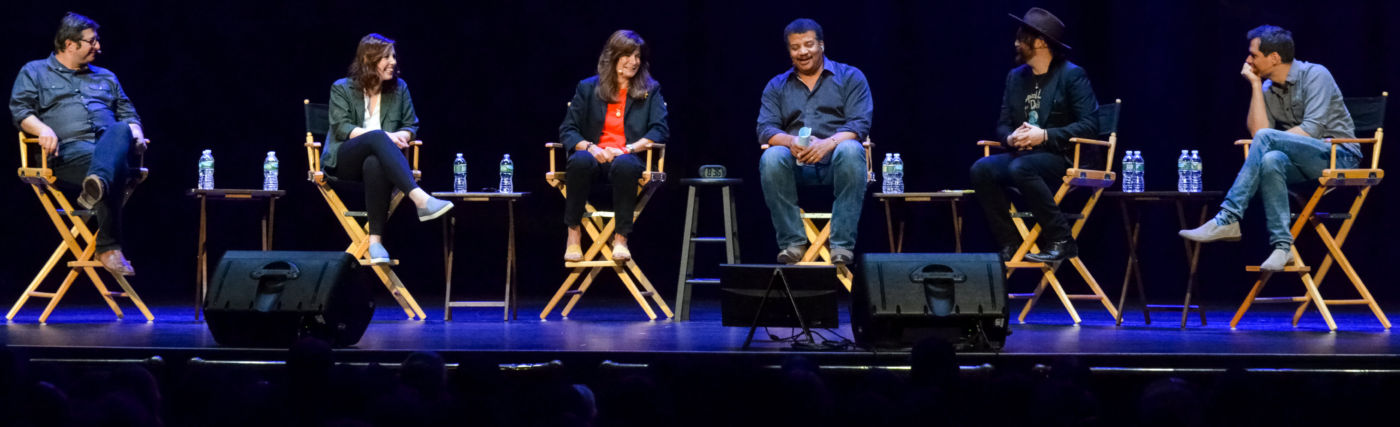
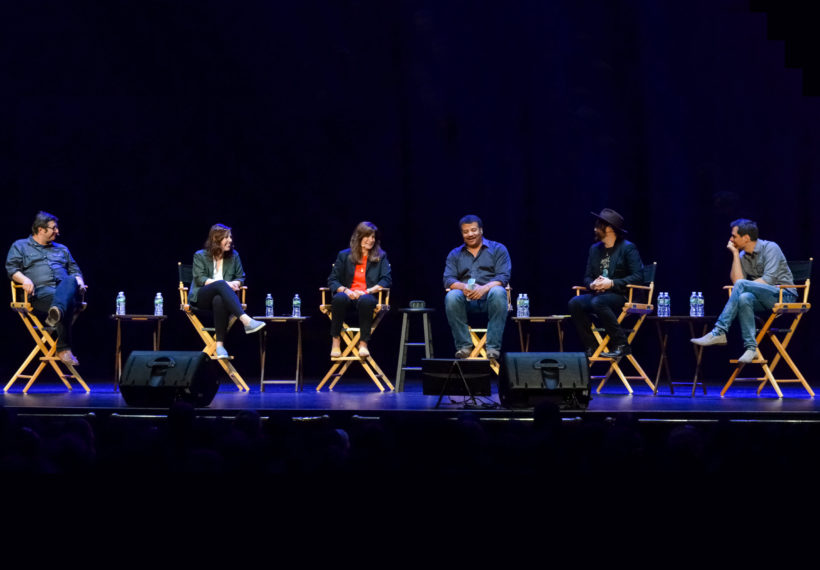
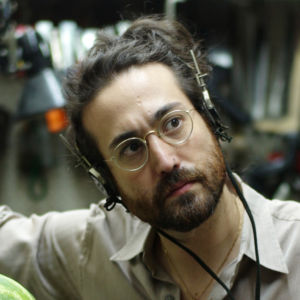
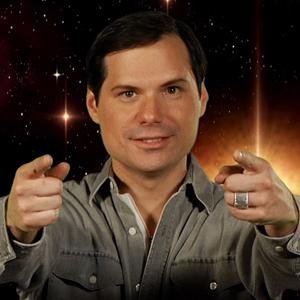
It’s time for Part Two of our StarTalk Live! recorded last September at the historic Beacon Theatre in NYC. Rejoin host Neil deGrasse Tyson and co-host Eugene Mirman and their guests, planetary scientist and StarTalk All-Stars host Carolyn Porco, musician and “bad-ass science groupie” Sean Ono Lennon, and comedians Vanessa Bayer and Michael Ian Black as they discuss how the exploration of the universe intersects with art and society. Get the scoop on Carl Sagan’s struggle to include cameras on planetary travelers like Voyager 1, and why bringing a sense of romance to studying the universe ignites popular culture’s interest. Carolyn, aka Madame Saturn, breaks down the process of photographing beautiful images with the Cassini spacecraft. She also sheds light on being a part of the Pale Blue Dot photo: the original idea, why it was so hard to pull off, and how it has a direct connection to her updated version, The Day The Earth Smiled, perhaps the biggest piece of performance art ever attempted. You’ll hear Sean talk about how science influences his songs, describing the “audio geometry” of music and how music is an “audio-mathematical” language. Neil and Sean ponder the history of science and art: how they were more integrated during Leonardo da Vinci’s era, and why the two paths separated over time. Explore some of the scientific poetry in Sean’s lyrics, how current artists now seek scientific accuracy, and whether sci-fi blockbusters are the only way to keep a society scientifically literate in the future. Speaking of popular culture, Carolyn talks about her famous Lego Ted Talk and explains her involvement in the 2009 reboot of Star Trek, while Neil rises to the defense of the Trekkie’s ongoing debates over the science behind Star Trek. All this, plus you’ll get to hear Neil read the Pale Blue Dot passage from “The Book of Carl” to cap off an incredible night at the Beacon. As a special treat for our podcast listeners, all but one of our music clips in this episode are Sean’s.
NOTE: All-Access subscribers can watch or listen to this entire episode commercial-free here: StarTalk Live! at the Beacon: Searching for Life in Universe (Part 2)
Transcript
DOWNLOAD SRTWelcome to StarTalk, your place in the universe where science and pop culture collide.
Star Talk begins right now.
Back on StarTalk, live at Beacon Theatre.
We are talking about space exploration, the search for aliens.
Is that a good thing?
Maybe, maybe not.
And what impact would that, should that have on our culture, on our civilization?
And we’ve got a panel of fun folks to help us decode these questions.
I’ve got a friend and colleague, Carolyn Porco, head of the imaging team of Cassini Mission to Saturn, Carolyn Porco, yes.
Thank you I call her Madame Saturn.
You okay with that?
I’m okay with that.
Okay, good.
Thank you.
It could be worse.
We’ve also got Sean Ono Lennon, who’s an artist and musician.
He’s gonna give us that side of this story.
And Eugene, tell us who you brought.
Michael Ian Black and Vanessa Bayer.
All right.
So Carolyn, some of the images that you were in charge of bringing back or assembling, creating, because the field of view of the camera is not so large that you get everything.
You have to mosaic many of the big pictures, sweeping pictures that we’ve seen.
The end of the day, we’re looking at shadows of the ring cast on the ball.
The sun is here, and you see how many tiny rings make up the big ring.
And I’m looking at it and say, I want this as a poster on my wall.
And so Sean, do you see the space pictures as art?
I certainly do.
In fact, even when I was very young, I actually gave Carolyn this painting because we became friends recently and I painted Saturn.
And I remember realizing later on that the coloring of Saturn was artificially colored and I was so depressed.
I was like, well, what does Saturn really look like?
And that’s what’s so cool about Carolyn’s work is that she’s actually showing us more, you know, beautiful images of what Saturn really would look like to our eyes.
But I was always kind of surprised that they color them.
And I know it’s for science and stuff.
He’s talking about false color pictures.
Yeah, you know, it looks so colorful Saturn, but actually I realized that Carolyn’s pictures are much more accurate.
So yeah, I follow it for sure.
So Carolyn, if you go back into the early 60s, space missions, no one really, the scientific community didn’t really want to send cameras.
Because the pictures are defined, but there’s no real data in a picture.
You want chart recorders and measure magnetic fields and spectral distributions.
And so how did photography of cosmic objects rise to such a height?
Well, let me, this is a very interesting little tidbit of planetary science history.
But in the early days of the space program, Neil is right, they didn’t want to send cameras.
And it was Carl Sagan, who was arguing for…
He argued a billion times.
He argued for bringing along cameras on planetary missions when all the other scientists thought pictures were for PR.
They weren’t basic science and they would just be taking up space on a spacecraft.
But he lost…
Not only space, but weight.
The weight of a camera.
The whole thing, money, budget, everything.
So the first…
I think I’ve got this right.
The first planetary mission didn’t have a camera.
But he eventually won the war and we’ve had cameras on spacecraft ever since.
But you know…
How did they get that reverse shot of the moon craft taking off from the moon?
I mean, you know what I’m talking about?
In 1969 when they actually land on the moon.
There’s this reverse shot where the moon lander goes back up off the moon.
Was there a cameraman sitting there?
No, there was a camera that was left on the lunar module that was left on and took a…
That’s a pretty spectacular shot.
It was the cameraman.
It was just a dude sitting there.
I just was always amazed that they got a shot of them leaving because I mean…
I think what ultimately happened, NASA is formed as an agency first to compete with Russia, the Soviet Union, and to show our technological might.
And you’re right, the public relations wasn’t so much about what you do with the science.
It was about here’s our astronauts.
The public relations was all through that lens.
And so later on you would learn that when you take those kinds of pictures, people eat it up and it transports them into that moment.
And then NASA’s budget becomes a little more stable and people, no matter who they are, have some sensitivity and interest in continuing this adventure.
That’s right.
But it looks like trouble and your mission did this like nothing else ever.
I thought that was funny.
Well, thank you.
I’m glad you noticed.
But I was on the Voyager mission and believe me, the Voyager was just absolutely the most magnificent romantic mission you could ever have been on.
You were young back then.
I was.
I was young.
There was a time when I was young.
And I noticed, I mean, as great as it was, I was noticing that the pictures were being processed basically to support press conferences.
So most of the pictures that were released to the public by the Voyager mission were put out in, you know, a period of about seven days around each of the flybys.
And they weren’t, there wasn’t a lot of attention paid to…
Just to be clear, Voyager visited many planets.
And it would not go into orbit around them.
So hence the word flyby had very high currency back then because you never hung out at the planet that you visited.
That’s right.
So you could fly by Saturn, Jupiter, Uranus, Neptune, and each of those had these packets.
That’s right.
So, and there wasn’t a whole lot of attention paid to how you process the images or getting the color right.
And so when I was made the leader of the imaging team on Cassini, this was like one of my cardinal goals.
It’s not like I could tell my fellow scientists this, but I had it in my mind that I was going to make the pictures absolutely as beautiful and as natural as I could so the public would feel like they were along for the ride.
So and that’s what we did.
And I’m, you know, really proud of it.
You’re welcome.
Who is that?
Where are the Voyager spacecraft now?
They’re about, don’t quote me on this, but something like 16 to 17 or 18 light hours away from here.
Have, are they out of the solar system?
One of them, Voyager 1, has crossed kind of the edge of the magnetic bubble, so to speak.
So we can legitimately say it’s an interstellar space.
But you can’t legitimately say it’s no longer under the influence of the sun.
So Voyager 1, the two Voyagers, so Voyager 1 passed Neptune.
Passed the orbit of Neptune.
The orbit of Neptune, the last planet in the solar system.
And you won’t leave it alone.
No, he’s right, he’s right, he’s right.
And they turned the camera around by who’s prompting.
Okay, okay.
So this was just an idea that I had as soon as I was made a team member of the Voyager Imaging Team, which was right after I got my PhD.
So this was like in October of 1983, I went to work for Brad Smith, who was the head of the imaging team.
You got your PhD, if I remember correctly, from Caltech.
Caltech in May of 1983.
So anyway.
Thank you, Eugene, for establishing that Caltech is a good school.
Somebody’s got to.
Somebody’s got to go.
So I just thought it would be great to take a picture.
Actually my idea was to take a picture of the solar system, because I knew Voyager 1 was not going to encounter any more planets after Saturn.
And I had a different idea than Carl, who eventually had also proposed this, but I didn’t know about his effort.
He didn’t know about mine.
I thought, wouldn’t it be great to show what the solar system would look like to an alien coming in from outside?
That’s what I wanted to do.
Carl, of course…
Yes.
And Carl wanted to take a picture of the solar system, too, but he really was after that that whole, you know, romantic idea of showing the Earth as…
He hadn’t coined the phrase yet, pale blue dot, but that was his idea.
And to show the picture of the Earth awash in a sea of stars, you know, just to emphasize the loneliness, the tininess of our planet in the hopes of engendering feelings of planetary brotherhood and so on.
So I was going around hawking it on the Voyager project in like 1984, and he tells me…
his wife tells me he had started two years earlier, Andrewian.
We both got like dull stares, like you want to do what?
You want to take a picture of the Earth?
It’s only going to be a pixel.
What are you, crazy?
Get out of here.
That kind of a response.
And finally, as the mission, we’re really getting near the end.
They slapped you?
No.
That’s just my audiovisual effect.
So finally, Carl.
When I say they didn’t want to do it, the Voyager project didn’t want to do it.
The big guys, the ones who made the decisions, Carl went to NASA.
He went all the way to the NASA Administrator and convinced him.
The head of NASA.
The head of NASA.
And so the people at the Jet Propulsion Laboratory were directed to take this picture.
And that’s what we did.
Why is it so hard?
Isn’t there a lot of downtime?
I mean, you’re just flying through space.
Can’t you just say, you just turn the camera around for a second?
Why is that so hard?
I think it required doing something that we hadn’t done on the Voyager project, and that was take the antenna, which was continuously in those days pointing to the Earth, and actually break communications, take it off so we could use the antenna to shield the camera from the sun, or else you wouldn’t be able to take this picture, and then take the antenna and point it back to the Earth, and they were afraid they’d never get it back there.
So it wasn’t until Voyager 1 was completely done with its mission, its planetary part of the mission, that they let us do this.
And they managed to regain communications anyway, but we finally did it.
This became the famous pale blue dot image.
That became the…
It became almost the spiritual inspiration for the book, Carl Sagan’s book, The Pale Blue Dot.
It’s iconic.
I mean, it just really…
People really love it.
It’s amazing.
So it’s just Earth, just barely a pixel in the image, and it was not in a sea of stars, but it’s a sea of nothingness.
But that’s just because the aperture of a lens, if you set it for the lighting of the Earth, then you’re not going to see the stars, but they’re there.
It’s not like they weren’t there.
Oh, yeah, of course.
There are stars there.
It wasn’t.
Correct.
Thank you.
He’s trying to keep us honest.
Keep it honest.
Your exposure matters here, and you’d blow out the Earth.
I don’t think there were stars there.
So, all right, so in the Pale Blue Dot, the book, Carl Sagan waxed poetic and philosophical and with great elegance on what our place is in space and in the universe in general upon reflecting on this Pale Blue Dot.
But you were not happy with the Pale Blue Dot, were you?
You decided to take another Pale Blue Dot.
I did.
I did.
So what did you do?
So, okay, so I had always since the first one had it in my, well, since I became the leader of the imaging team, I had it in my mind to do that picture over again, only make it better.
And well, because, you know, in a proposal that Carl wrote to the project, the Voyager Project to request that they take this picture, he wrote, this is not commonly known, but he wrote that the idea was to take a picture of the Earth, and I quote, a wash in a sea of stars.
And as Neil said, that picture didn’t capture stars and the Earth is sitting on a beam of scattered light.
And of course, none of this matters because Carl, you know, he was the master of romancing things and turning the whole thing into an allegory on the human condition.
So everybody-
Because Rose was bigger than the image itself.
Right.
It just gave him the opportunity to point out, you know, our cosmic circumstance.
So I wanted to take the picture that probably Carl would have wanted.
And as I was looking through the timeline of events that my colleagues were planning and I were planning for the science that we were going to collect with Cassini, and I found an opportunity that wouldn’t get anybody too angry, you know, I’m not taking too much time, too much resources to take this mosaic with the earth in it.
It occurred to me, wow, you know, why instead of doing what everybody seems to have done since the original Pale Blue Dot and take the picture of the earth and then two weeks later tell everybody, hey, while you weren’t looking, we took your picture and isn’t it beautiful?
Here it is.
I thought, why don’t we tell the people of the world ahead of time that on such and such a date, at such and such a time, your picture is going to be taken and go out as the window of opportunity opens and look up and think about your position on this planet and the never-ending blackness of space and how unique our planet is and its lush life.
You got people to step outside of their house and look up at Saturn while you took their picture.
I did.
It was the original Pokemon Go.
No, it was, it turned out to be…
You had a cute name for it.
What was it called?
It’s called The Day the Earth Smiled.
The Day the Earth Smiled.
Because I asked everybody to go out and smile.
You know, smile in celebration of being alive on a pale blue dot.
It was like the biggest cosmic performance art ever.
So is that art?
I mean, you’re an artist.
Kind of, yeah.
But we have a scientist here talking about beautiful pictures and engaging people.
And this is not how scientists usually talk, but it’s how artists live for that.
Sure.
I mean, I think, you know, the intersection of science and art and math and art, I mean, I think a lot of musicians think of music, for instance, as a kind of audio geometry.
You know, I mean, you can easily graph pitch and time and volume, you know, on a graph.
It’s chartable.
And so in a way, you know, melody and music could be considered a kind of audio mathematical language.
There’s actually this quote that I wanted to tell you.
I don’t know if you’ve heard it.
It’s kind of beautiful.
Wait, wait.
That was way deeper than the time it took you to communicate that.
Sorry.
That was just I have to pause on that.
So, so music is an audio geometry.
Well, yeah, there’s this quote that’s relevant to this.
It’s not I wasn’t on a tangent here.
But yeah, you know, this guy, James Joseph Sylvester, who is the tutor for Florence Nightingale, who invented nursing or modern nursing.
Anyway, yeah, he’s a good guy or she’s an amazing woman.
But he has this quote that some music is the music is the mathematics of sense and mathematics is the music of reason, which I think is beautiful, right?
We’re both going, what?
And Puff Daddy is the Jupiter of no, I’m kidding.
Anyway, so I do think that, I mean, in fact, most of my I notice, I mean, most of my mathematically and scientifically minded friends and professional scientists tend to be really big art fans.
So there’s definitely an intersection personality wise.
But one of the things I was thinking about, you know, leading up to this show was, was science and art actually the same kind of thing, you know, in Babylonian, Sumerian and Egyptian times?
I mean, what I mean by that was, was there art for art sake or did it always have a function?
I mean, hieroglyphs were telling stories and mythologies and, you know, being an architect to make a pyramid, you know, you were a scientist and astronomy and astrology were kind of the same thing because it was all part of religion.
And I guess what I’m saying is, I think science and art were, by definition, intersected until a period later on when they started to be totally separate because I feel like now art, what defines art from science or anything else is that art doesn’t have a function.
It doesn’t have a purpose other than to be art.
So art for art’s sake, I mean, that’s why it’s not math or science.
But I feel like, you know, in DaVinci’s time, for instance, this is more like a question.
DaVinci was a scientist and an artist.
Did he really feel there was a huge separation between those things?
I don’t know.
Based on the notebooks of his that I’ve looked at, it’s all the same.
Exactly.
I mean, he’s sketching horses and studying the muscular patterns and the skin.
And in fact, I think we have some residue of that time in some of our modern referencing.
So for example, today you would say, she’s got it down to a science.
And on the other side, you’d say, you’ve raised it to an art.
Raised it to an art form, right.
Science and art show up in those two phrases.
And in each of those cases, we kind of mean the same thing.
Somebody has taken a craft to an extreme limit of perfection.
And the only way you can reference that is to say, they’ve raised it to an art or got it down to a science.
So I want to bring this back to what started it.
Carolyn did The Day the Earth Smiled.
And everyone got engaged in an activity that was symbolic.
And people were touched by the science.
And I’ve seen lyrics that you’ve written and co-written that were touched by science.
And so you’re not just an observer of what’s going on.
It has infused who and what you are as an artist.
And I’m enchanted every time I learn that such a thing happens.
You’ve got a song here called Nebulullaby.
Yeah, well, I have a band with my girlfriend called The Ghost of a Sabre-Toothed Tiger.
It’s a catchy title.
And we have a bunch of songs.
I mean, we’re both kind of science groupies.
And I say we’re science groupies because if I were to say I was a science nerd, that would mean I’d actually have to know facts.
But as a groupie, I’m just kind of waiting backstage and waiting to be touched by science, as it were.
But yeah.
I don’t mean to specifically do it, but I’m open to it.
Well, the origin of that record title, which is the most recent record I put out with a band called The Delirium, is I don’t know if you guys have seen it, but there’s a C-SPAN interview with Buzz Aldrin, where he says, there’s a monolith on Phobos, and I don’t know who put it there, maybe God put it there, but we have to go boldly forth, and he kind of gets really excited, and I thought it was…
He has a T-shirt that says, Get your ass to Mars.
Exactly, he’s really into it, but I just thought it was the most amazing interview I’d ever seen.
I mean, I assumed it was gonna be front page news of every newspaper, but no one seems to have seen this.
Have you guys seen that?
Okay, because it’s pretty unbelievable.
I mean, it’s the second man who has landed on the moon telling us that there’s a structure on Phobos.
I mean, look, I know he’s not saying it’s artificial, but still.
Does he know about the hexagon on Saturn?
Right, that’s what I’m saying.
That’s what I’m saying.
I can’t wait to tell him.
Okay, but the point is you’re inspired by the science that’s unfolding around you.
Yeah, we have a song called Schrodinger’s Cat, which refers to, you know.
Schrodinger’s Cat.
Exactly.
And we.
So Schrodinger was a physicist, fundamental to the birth of quantum physics as a branch of physics.
Right, but didn’t he come up with the Schrodinger’s Cat scenario to disprove the Heisenberg Uncertainty Principle, meaning he was making fun of it as opposed to confirming it.
No, he proposed it as a test, as a thought experiment.
But he was against it, is my point.
He wasn’t for it.
I don’t know whether he was for or against it, but if you’re smart, it doesn’t matter.
You challenge people’s, other people’s thoughts.
Right, well, I wouldn’t know anything about that.
Yeah, no, no, you can be, no, what I mean is, if you’re smart in the room, you can pose a question that’s either right or wrong, but if it challenges other people to think more deeply than they were before, that is useful, whether or not it turns out the way you had intended.
Ptolemy’s geocentric known universe had Earth in the middle, everything orbiting around it, and he came up with epicycles.
It was a whole mathematical model.
It all turned out to be wrong, but it was fascinating.
It became a fascinating model to try to attack, to see if you could find out why that was wrong.
Is there an experiment that could falsify it?
And so this is what led to the great insult.
You want to insult a scientist?
You say, your work is not right and it’s not even wrong.
Oh, cold, that is cold, ice cold, oh, it’s not even wrong.
Put some liniment on that bird.
I like that.
That reminds me.
So I’m just, I’m looking at your lyrics here.
I’m very impressed.
Oh, well, I mean, I’m embarrassed now to read them, but I was told to, so I’m going to.
Can you give us just a few?
Okay, so Schrodinger’s Cat, it’s so dorky, isn’t it?
So yeah, we wrote this song and I guess there’s a few science references in here.
Well, this is philosophical.
It says, like a tree that falls alone in the woods without a sound, I can’t be sure that I exist when you’re not around.
Oh, is that romantic or what?
Wait, would you pause when you say something deep?
Just, just.
That was beautiful.
It was beautiful.
Can we hear that again?
Oh, well, yeah, that’s the chorus of Schrodinger’s Cat is like a tree that falls alone in the woods without a sound, I can’t be sure that I exist when you’re not around, Neil.
I just.
I love when physics, math, philosophy shows up in an artist’s creative layer.
So do you think today there’s more or less, what’s the trend line in the hunger people have, either for art or for science or for their marriage going forward?
And I say that because, for example, there are significant appearances of films where scientific accuracy was strongly valued, yet it needed an entire room full of artists to create the visuals for the stories that were told.
And that included Interstellar, the movie Gravity, especially the movie The Martian.
You are evidence of this.
Are you a trend line or are you an anomaly of artists…
I don’t really have an idea…
.
sneeching to the moving frontier of science to serve…
Just as an aside, as an aside, Neil, I’m also an artist.
Well, yeah, I was going to say I don’t really have my finger necessarily on the pulse of much.
I have my own pulse, but that’s about it.
Is the universe serving as the artist’s muse today?
I’ve thought about this, and I think that what’s interesting is that art until Deco, I think this is true, was always looking to nature for its inspiration.
If you look at Art Nouveau, which precedes Deco, everything was flowers and trees and naked ladies, and then something happens during the just revolution when everything starts to look like machinery, and it’s because we stopped looking to nature for inspiration, which I would say would be like looking to physics for inspiration.
I feel like that was the time in human history when we stopped really having as much reverence for the universe and nature and for our mother earth because we were no longer paying attention.
You know most of the architecture in old New York is art deco, right?
I mean not as much as Florida.
I’ve seen some serious deco cities there, but not to knock deco.
Florida has enough issues to lighten up on them.
I don’t want to knock art deco.
You’re going to be the first state to just go underwater.
They’re going to float themselves underwater.
Oh no.
You see what I mean?
So at the same time.
I heard you, but I didn’t see a cause and effect.
No, I didn’t mean it’s causal.
I mean, it’s interesting that they’re happening at the same time.
So at once we’re becoming more science literate as a society.
We’re also becoming less science literate.
But don’t you think that movies can, a scientifically literate movie?
But I’m just saying we’re talking about forces that operate on us in nature.
I just think sci-fi films, which are hugely popular, and they make hundreds of millions of dollars, that they may be our only hope to ensure that we carry a scientifically literate community into the future, lest the absence of science literacy lead to our own extinction.
Neil, may I ask a question about the intersection of science and art?
What about the reverse, which also seems common in art leading to science?
From what I see in my light reading of science, a lot of science is inspired by, or scientists are inspired by, things they saw as kids, like in Star Trek or Star Wars or whatever.
And what?
No, it’s true.
Have you guys heard of that book, The Science or the Physics of Star Trek?
It’s kind of dorky, but it’s basically what is possible in Star Trek and what isn’t.
Next Generation was pretty far ahead of its time in terms of trying to talk about real physics and wormholes and parallel dimensions and stuff.
But I remember there was this controversy where there was an episode where they went back in time and there were all these trekkie nerds being like, well, I looked at the stars and the sky and the star system, I calculated it wouldn’t have been that position of Orion and all that stuff.
Yeah!
Which I just think is so funny.
But I mean, I just find it so funny to be really uptight about like, well, the plasma engine wouldn’t have been this or that way, but they have no problem with the fact that they’re like, you know, in space talking to Klingons.
That doesn’t seem…
Whenever I release a tacky on pulse, it’s pretty much like it is in the show.
Now I can’t suspend my disbelief.
Orion would have been slightly to the left.
How am I supposed to get into this?
So…
So…
They have no life.
These are people who have no life.
I must defend the Geekiverse in this moment.
So those debates that unfold, unfold where actual known science has been attempted in the storytelling, which is why they’re not arguing about whether they can have a conversation in English with Klingons.
Sure.
Because that’s the fantasy side where they’ve stepped off the circle of science and then they made stuff up.
But if you’re going to say you’re going to have a photon torpedo, let it have some resemblance to an actual photon and an actual torpedo and we’re going to debate that.
If you’re going to use a phaser that stuns you, what is the mechanism?
You got to calm down.
Just take a breath.
If you can have warp drives, what is the warping mechanism so you can cross the galaxy during the TV commercial?
Speaking of which…
You got to think about this.
Didn’t they just make…
Aren’t they proposing at NASA, you would probably know about this, an actual plasma engine, which obviously would be much slower than jet fuel, but that’s what runs the Enterprise, is a plasma engine, isn’t it?
Dilithium crystals, which I also have.
Right, so this intersection of what artists do and what scientists do, Carolyn, you, you…
Did I get this right?
You advised one of the Star Trek movies?
I did.
Which one?
The first one, the first one of the modern era, Star Trek 2009.
Nice.
Okay, JJ Abrams.
Yes.
So the one where they’re near Saturn, hiding, you know?
Oh, yes, that was my idea.
Do you want the story?
Yeah.
Do it quick, do it quick.
Okay, so I met JJ Abrams at TED.
We exchanged, you know, cards kind of thing.
You gave a TED talk.
I did.
And he heard your TED talk.
Yes.
And he said, I, I, he, okay.
Okay, go.
He didn’t say it right then.
We, you know, went our separate ways nine months later.
I have to say this.
Her TED talk, somebody used her audio.
Oh, yeah.
And choreographed a little Lego woman painted up to look like her.
And the Lego person moved in Lego ways, giving the exact talk that Carolyn gave.
It is the cutest thing you ever saw.
Is that still on YouTube?
So it’s like Porco Lego.
The woman who did this, her name is Maya Weinstock.
She set up a stage, a little Lego stage, identical to the TED stage.
It was magnificent.
That is so, that is so…
Anyway, anyway.
Did she know we could just watch the TED talk?
It’s for all the Lego people out there.
So, anyway, nine months later, I get a phone call from someone who says JJ.
Abrams wants to talk to you.
And I said, JJ who?
I didn’t watch Lost.
I didn’t really, you know.
Anyway, he invites me to consult on it.
He was very generous about it.
He says, I feel like I need to include you in on this.
So I thought, okay, that’s great.
And I’m expecting we’re going to have like sessions in a big Hollywood office where we’re going to be shooting the breeze and talking about the planetary scenes or something like really cool.
He invites me out there.
Actually, I was on a trip anyway and he says, I asked him, could I come to Los Angeles and I wanted to see something being filmed.
I’d never seen a movie being filmed before.
And I was hoping, I was really hoping I’d see a scene filmed on the bridge, right?
Doesn’t every Star Trek fan want to see the bridge?
And what I get out there and I’m watching poor Chris Pine, is that his name, Chris Pine, get the crap kicked out of him in a bar.
That’s the scene.
You remember that?
Yeah, that’s pretty good.
It’s a good scene.
Well, I’ll just tell you, I saw this poor guy get hit in the face, fall on the floor, get picked up, punched again, fall on the table.
It wasn’t real.
It’s a movie.
But it happened like 25 times, he had to go through this.
Welcome to Showbiz.
Anyway.
I’d love to see the Lego version of that.
But what was real about how they hid the Enterprise on set?
No, wait, I’m getting to that.
That’s what we want to know.
So we break for lunch, very unglamorous.
I’m sitting with Abrams, I’m sitting with the head of special effects and we’re just eating these very boring meals.
And out of nowhere, he says, I’ve got a problem.
And he says, we’ve got the Enterprise coming back into the solar system to save the Earth and we’ve got to figure out where to hide it.
What did he say?
So I’m thinking this is so ridiculous, but he must be trying to test me, right?
He just wants to see if I could come up with any good idea.
So I say the first thing that comes into my head.
I said, well, why don’t you have it come out of warp drive in the atmosphere of Titan and then have it rise out of the haze and with the Enterprise and the rings and Saturn in the background, it’ll be a really groovy scene.
And to my surprise, it goes with bitching.
To my surprise, he says, my God, that’s brilliant.
And that’s all they ever wanted from me.
And they sent you back.
But they used it, they did it, and then this gets to your point.
They sent me like the first draft of it.
And I pointed out lots of errors.
I said, well, you’ve got Titan on an inclined orbit.
It’s not really on an inclined orbit.
You’ve got the atmosphere doesn’t look quite right.
And the guy who does the special effects, Roger Gayette, is saying, oh, look, don’t worry about it.
And I said, you don’t understand.
People are going to know I’m the science advisor on this.
And they’re going to think, I don’t know that Titan is not on inclined orbit.
You’ve got to fix it.
And he wouldn’t do it.
He just says, if anybody asks you about this, just tell them, it was my fault.
So what happens?
The movie comes out and there are blogs and blogs, never ending blogs about what the hell did that porco woman do?
And Titan’s not on an inclined orbit.
But doesn’t she know this?
I mean, it was just pathetic.
That is geekitude at its finest.
It’s cool.
Well, we’re going to explore all the challenges facing the survival of humanity today and whether we can appeal over each other, creativity and archery.
So, Sean, you think deeply about the state of the world.
Are you optimistic or pessimistic about the role of science or art as a savior to the human race?
Well, this is actually interesting.
I saw a documentary, and this is gonna make sense, on early…
We’ll decide.
And they had this problem where they couldn’t take the horse manure out of the city without bringing in more horses to bring it out.
And it was actually a disaster, whereas if you look at brownstones, they’re about eight steps high, because they had to build…
They started building the buildings with high steps so you could step over the manure.
So it was actually a…
Yeah, horses will poop about up to 30 pounds of manure a day.
And New York, well, yeah.
How many thousands of horses were there in New York?
Well, that was their only form of transportation other than walking, right?
Well, that’s a bad design.
Wait, wait, so was it actually…
Wait, wait, wait, so just…
You said something that I had to talk.
So, of course, to move manure out of the city, you need horse-drawn carriages carrying the manure and they’re pooping all the way.
And it was a state of emergency.
It was equilibrium.
It was an equilibrium.
So the poop, you get the same poop to take the poop out as the poop was when you started.
There was a poop resonance equilibrium, I think.
Yes, a resonance equilibrium.
So, I mean, I was looking at this and what’s interesting is the city was in a state of emergency.
They didn’t know how to solve the problem.
And then suddenly, I think the Model T came out and then it was just, it wasn’t a problem anymore.
So I always try to, ever since I saw that, I thought, you know, that’s a good metaphor for the unpredictable nature of technological innovation.
So I think we always have to account for that, even though we’re looking at our inevitable demise, that maybe some scientists will come up with something smart that saves us, that we can’t predict.
Okay, so your solution is completely bound up in hope.
To just basically hope that, you know, you and Carolyn figured it out.
Well, in fairness, you’re also counting on alien slavery to help us.
That’s the same guy, that was the same guy.
Yeah, but having said that, I did just, unfortunately, I probably shouldn’t have, but I read this book called Learning to Die in the Anthropocene, which is by this guy, Roy Scranton, who is very smart.
And I learned the word Anthropocene from him.
I’m sure you guys knew it already, but it’s the human distinguished epoch.
So it’s the time on the planet that essentially has been affected by humans.
It’s the epoch, that’s the anthro epoch.
In other words, all other periods in the geologic history of Earth have been marked by some natural disaster, volcanoes, asteroid strikes.
And right now, if you look at the signature of what’s going on on Earth, it is primarily that of human activity.
And so therefore, the geologists say, there’s nothing else we can call this but blame it on humans.
And so you get the Anthropocene.
Exactly, so it’s the human-caused environmental impact and all that other stuff, mass extinction, which we are also causing.
Vanessa, do you have confidence in science?
Well, you know, that reminded me a lot what you were saying of the finale of Dinosaurs.
I don’t know if you’ve seen.
Do you remember the show Dinosaurs on TGIF?
What did he say, the ad, in the finale, the dinosaurs die.
Anyways, what did you ask?
You know what, in reality, they died, too.
No, no, no, no, but it was a comedy, fair, but it was like a comedy show and everyone was having a great time.
Anyway, what did you ask?
You can laugh about the dinosaurs dying.
I’m just curious, he’s preparing himself for death.
What are you doing?
Yeah, what are you working on, a movie?
I do think that we should be able to just go to another planet, also, how do we know?
What good is that going to do you?
Well, if we put trout there, we’ll be fine.
No, no, Carolyn, she’s saying if we mess up Earth, he’ll stay here and die, and she’s got a new planet.
Well, also, how do we know that all the other things didn’t do that?
We’re like, oh, they stayed here and died.
What if they went to another planet?
But think about it, we can’t even terraform Arizona.
I mean, how are we going to terraform Mars?
No, Sean is very right about this, this whole idea.
And let’s get with the program here.
We’re not going to take 7 billion people and move them to Mars.
That’s not what going into outer space means.
We only need like 2,800 of us, right?
I think that’s all we need.
You just need a minimum amount of really fertile people.
Excuse me?
Just so they can…
I wonder if either aliens will come help us and save us from ourselves, or whether we will invent artificial intelligence that will then solve the problems that we measly humans cannot.
What are the problems?
The problems?
The problems.
You don’t know about problems in the world today?
You need me to tell you?
But no, no.
Here’s one.
The problem is we invent AI and the AI judges that we are a virus infecting the Earth and we should be destroyed.
But that’s not a real problem.
That’s not a real problem.
I mean, it would definitely be a problem if it happened.
For everyone but John, it would be like, That would be a real problem.
OK, but before you get there, our core, let’s like you’re a scientist, let’s dig deeper, OK?
Let’s dig together, go.
I think the core of all our problems is that there’s too many damn many of us.
That’s why.
There’s overpopulation.
Too many what?
Damn many of us.
Wait, wait, wait, wait, wait.
So we just, just, just terraform another planet, and we had two planets to live on.
I just said you’re not going to transport all these people.
Should we poison foreigners’ food?
Wait, wait, Carolyn, Carolyn, Carolyn.
Yes, Neil.
100 years ago, and 150 years ago, and 200 years ago, people were worried, ever since Malthus, Thomas Malthus, about too many people, and the people would outstrip the food supply.
Now, we got the fact that anybody is starving in the world today is not because there isn’t enough food.
We have more food than has ever been in the history of the world.
It’s a distribution political problem.
So what are you worried about there being too many people?
Why not innovate so that we can make as many babies as we want?
It’s just like it feels crowded, Neil.
Well, no, because the population as it is, and I know what you’re saying what Malthusianism is, and it’s kind of dark.
But we’re already just getting rid of lions and tigers and elephants.
I mean, these species, we can’t even coexist with them now.
Yes.
And human-caused environmental change is so extreme already that it may be irreversible.
So if there were twice as many people, there’d be twice as many mopeds and cars, and that’s just dangerous for the planet, right?
I mean, you know how much plastic there is in the ocean.
Twice as many mopeds?
Where did that come from?
What?
Is this a time warp here?
Somebody’s worried about Belgium.
You know, you say that, but in places like, you know, Malaysia, the Philippines, China, they’re all on mopeds.
I just haven’t even heard the word moped.
All right, we get rid of those.
Who else?
I like, I like.
I haven’t heard the word moped in 30 years.
This is a real retro show with bitch and mopeds.
Have you seen my bitch and moped?
I haven’t seen your bitch and moped, no.
Groovy, man, groovy.
Yes, I mean, what are the problems that I worry about?
You said I think deeply.
I mean, certainly environmental disaster that’s human caused by the Anthropocene.
And I wonder also, you know, Elon Musk and very intelligent people, it’s not just a joke, Carolyn, they warn against super malevolent AI.
Well, maybe not malevolent from its perspective, but from our perspective, certainly, if it decided, as you said, that we were somehow expendable or some kind of virus to be rid of.
I mean, have you heard of Roko’s Basilisk?
Roko’s Basilisk.
It’s a thought experiment thinking that if once AI creates itself, then as Kurzweil states, it’ll be able to infinitely improve itself in a sort of blink of an eye.
It’ll teach itself how to be the most intelligent thing, at least in the solar system.
And at that point, it will be essentially a kind of god because it will be almost omniscient.
But let’s just say that it evolves to be the most intelligent thing imaginable.
Then its morality could be based on that which helped bring me about is good, and that which didn’t help bring me about is bad.
Because if it had a morality, it would consider itself to be the most important thing ever.
And so that all decisions that led towards it are good, and all decisions that were not leading towards it would be bad.
So the people who are scared of Roko’s Basilisk, which is the name of the AAI are scared that it would figure out how to reproduce people through the DNA codons from the past in, you know, doctor’s archives or whatever, and recreate you and torture you for eternity in some kind of weird virtual hell to punish you for not bringing it about.
I think the people who write these things are sociopaths.
What?
I was just using the magic eyes thing, you know, I was back there.
So you love science, but you’re like a little scared of some science.
No, but you laugh.
But there are people that take it very seriously.
In fact, if you go on the website that the idea was first proposed, it’s now banned to speak about because no one wants to mention Roka’s Basilisk online because it’ll trace back to the person who posted it and torture them for ever.
Did you just endanger us all to some future AI?
You murderer!
I will delete the file tonight of this whole…
I love the Basilisk!
Can’t wait for it!
What I want to do is give the last word to Carl Sagan.
With your permission, we will end this evening with a reading from the Book of Carl.
If you look at Earth from space, you see a dot, that’s here, that’s home, that’s us.
On it, everyone you ever heard of, every human being who ever lived out their lives, the aggregate of all our joys and sufferings, thousands of confident religions, ideologies and economic doctrines, every hunter and forager, every hero and coward, every creator and destroyer of civilizations, every king and peasant, every young couple in love, every hopeful child, every mother and father, every inventor and explorer, every teacher of morals, every corrupt politician, every superstar, every supreme leader, every saint and sinner in the history of our species, live there on a moat of dust.
Earth is a very small stage in a vast cosmic arena.
Think of the rivers of blood spilled by all those generals and emperors so that in glory and in triumph, they could become the momentary masters of a fraction of a dot.
Think of the endless cruelties visited by the inhabitants of one corner of the dot on scarcely distinguishable inhabitants of some other corner of the dot.
How frequent their misunderstandings, how eager they are to kill one another, how fervent their hatreds, our posturings, our imagined self-importance, the delusion that we have some privileged position in the universe are challenged by this point of pale light.
Our planet is a lonely speck in the great enveloping cosmic dark.
In our obscurity, in all this vastness, there is no hint that help will come from elsewhere to save us from ourselves.
It’s up to us.
It’s been said that astronomy is a humbling and I might add character building experience.
To my mind, there is perhaps no better demonstration of the folly of human conceits than this distant image of our tiny world.
To me, it underscores our responsibility to deal more kindly and compassionately with one another and to preserve and cherish that pale blue dot, the only home we’ve ever known.
Beacon Theater, thank you for your time.
Thank you for my panel, Vanessa, Carolyn, Sean.



 Become a Patron