



 Unlock with Patreon
About This Episode
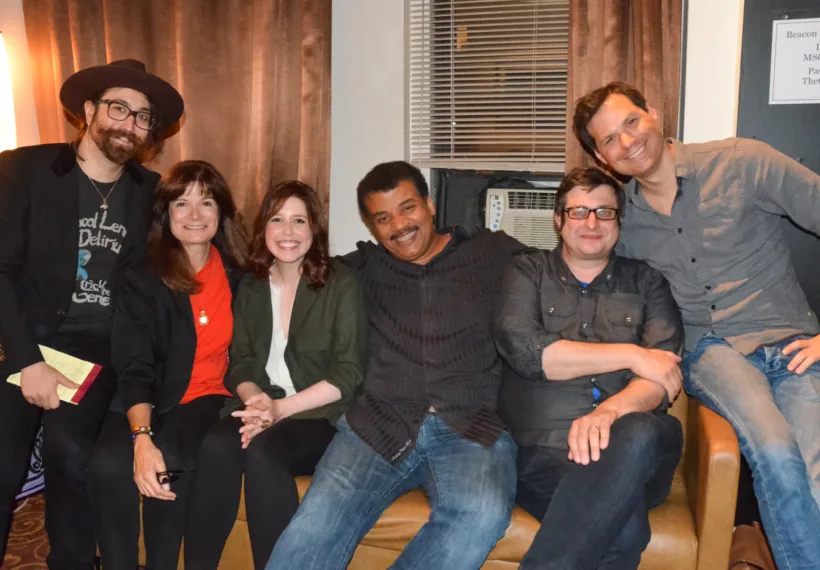
Is there life in the universe? That’s the question that brought Neil deGrasse Tyson and Eugene Mirman back to the Beacon Theatre in NYC last September with their guests, musician Sean Ono Lennon and comedians Vanessa Bayer and Michael Ian Black. And who better to guide our search for life in the universe than Carolyn Porco, aka Madame Saturn, the leader of the Cassini Imaging Team, who also worked with Carl Sagan on Voyager 1? Join Neil and company as we review that groundbreaking mission and how its first glimpses of Saturn inspired a return trip with Cassini. Explore the fascinating hexagon on Saturn’s north pole and find out why its rings can be thin but stretch 280,000 kilometers. Investigate the tantalizing possibilities of life on Saturn’s moons Titan and Enceladus. Find out how life could exist outside of Goldilocks zones. When first time StarTalk Live! guest Vanessa wonders if we could just throw some bugs into Enceladus’ ocean and see what happens in a few years, Neil and Carolyn explain the concern about forwards and backwards contamination. StarTalk Live! veteran Michael Ian Black volunteers his own hypothesis for how the moon was formed, while “Bad-ass Science Groupie” Sean doesn’t seem to mind becoming enslaved by a smarter alien race. The discussion on stage turns towards the current debate about whether we should broadcast ourselves to the universe, and Neil asks Carolyn if she warned Carl Sagan about including our cosmic address on Voyager 1. (Eugene wonders if sending a recipe for paella might not have been smarter.) Part One wraps up with Neil asking the audience for Cosmic Queries about the future of the human race on Earth and in space. Stay tuned for Part Two next Friday.
NOTE: All-Access subscribers can watch or listen to this entire episode commercial-free here: StarTalk Live! at the Beacon: Searching for Life in Universe (Part 1)
Transcript
DOWNLOAD SRTWelcome to StarTalk, your place in the universe where science and pop culture collide.
StarTalk begins right now.
Welcome to StarTalk Live!
We have an awesome show for you.
It is my incredible pleasure to bring out your host, the amazing science communicator and natural wonder, Neil deGrasse Tyson!
Eugene, it’s always great to have you here.
Thanks for making us a part of your comedic universe.
Thank you.
So I get to invite them.
Yes, Eugene Mirman.
StarTalk Live first appeared as part of Eugene Mirman’s Comedy Festival.
He organizes groups of comedians, and they make you laugh, and he said, let’s add a little science to one of the spots.
And ever since then, StarTalk Live was born.
Yeah.
And now it started out at a small bar in Brooklyn, and now we’re in the Beacon Theater.
So tonight we’re going to talk about the exploration of the universe and the search for life in that exploration and what impact that might have on us philosophically, culturally, religiously, on our artwork and all that we are and define ourselves to be as humans.
And let’s bring out, oh, yeah, if you like that, go ahead.
So let’s bring out one of my scientific guests, a colleague and a friend, in fact, a hometown native.
Give a very warm welcome to Dr.
Carolyn Porco.
Carolyn.
Carolyn Porco is a hometown native.
She’s a planetary scientist.
She was head of the imaging science team of the Cassini mission to Saturn.
If you saw any image of Saturn in the last 15 years, she did it.
And her team.
She and her team.
I call her Madame Saturn.
Thank you.
Thank you.
I love that.
It is my great pleasure to bring out a comedian, wonderful comedian from Wet Hot American Summer and many, many other things.
Ladies and gentlemen, he has a new show called Debate Wars out on CISO.
Ladies and gentlemen, Michael Ian Black.
Oh, you know what, I’m gonna go around.
I’m gonna go around.
And from Saturday Night Live and Trainwreck, ladies and gentlemen, Vanessa Bayer!
And rounding this out, we can’t do this.
If we’re going to talk about art, we need an artist.
If we’re going to talk about the impact of science on our lives, we need somebody who sits at that intersection.
Give a very warm welcome to musician and artist, Sean Ono Lennon.
Sean.
Do.
All right, so let’s just get some basic science on the table.
Carolyn, we went to Saturn.
We did indeed.
Did it in an awesome way.
We entered orbit back in 2004.
And it’s been going gangbusters since then.
Why go to Saturn?
Oh, wow, where do I begin?
I’ll be a little more specific.
What were you after?
What did we not know about Saturn that you found out?
Well, let me back up and start at the beginning with the Voyager mission.
Okay, the Voyager mission, we toured the outer solar system in the 1980s, and we had two spacecraft encounter Saturn in 1980 and 1981.
And that was really the first time we ever got a glimpse of what the Saturnian system offered.
So we got to see the surfaces of the satellites, we got to see the rings in some detail.
And as these things often happen, you know, it was just a wonderful exploration and journey of discovery and all those accolades you’ve heard.
But they really leave us with other questions that we like to answer.
And so as soon as the Voyager mission was over, everybody was deep into planning the next mission to return to Saturn because that was considered the system, the planetary system.
It is the planetary system that is the most phenomenologically rich.
So it has Titan.
That means it’s the most beautiful.
It’s also the most beautiful.
It’s also the most beautiful and I was in the privileged position of being responsible for the images that we returned.
So I just very much wanted to make them beautiful.
Yeah, let’s give it up.
Yes.
So you couldn’t just send Cassini there.
You needed some gravitational help, last I remembered.
So you launched it from Earth and you don’t have enough energy, enough propulsion to get it there.
So you steal orbital energy from what?
Well, this is a maneuver that was found before going to Voyager.
But if you fly a spacecraft by a planet, let’s say, that is already moving, then depending on how you fly the spacecraft by the planet, you can actually take a little bit of momentum from that body.
But because the planet is so big and the spacecraft is so small, you really give a big kick to the spacecraft.
So in order to get to Saturn, we actually flew around the inner solar system for two years, kind of parked it there, building up speed.
We flew by Venus twice, the Earth once.
And it never went back in time?
So you did a double slingshot around Venus.
Not around, we just flew by it.
You flew by it, slingshot Venus, and you also slingshot Earth.
Yes, we did.
Now did we just get, you just got lucky that you ended up on Saturn, or you had figured all this out?
Look, I’ll tell you, if they had left me in charge of the navigation, we would have ended up at Uranus.
So they do have a group of people.
They have a group, well anyway, I have a terrible sense of direction.
She just referenced your image.
I know what she said.
Yeah, I just want to make that clear.
But so this is like a three cushion pool shot off of three planets.
Any more planets on the way out?
Oh, no, no.
Then we went by Jupiter.
And we went by Jupiter, incidentally, on the eve of the year 2001, which I thought was like so incredibly bitchin.
Bitchin?
I mean, that says 1963.
Was the thing you sent to Camero?
You were bitchin.
All right.
It’s a surfer term.
So, all right, so you slingshot Jupiter, and now you got enough energy to get to Saturn, which is twice again as far away as Jupiter is.
Yeah, so it took us another three years to do it.
So it took us seven years in total to cross the solar system.
All right, cool.
And then it gets pulled into orbit, and you’ve got rings, you’ve got magnetic fields, you’ve got all manner of things going on there.
You know what my favorite?
I have two favorites.
One, you found lightning on Saturn.
We did.
Yes, we captured lightning on Saturn.
And is it raining?
What’s going on?
Well, it’s doing essentially what lightning does here.
It’s accompanied by thunder and rain and so on.
These are big convective storms that produce light.
You have rain on Saturn.
Yeah, we do.
Is it water or some other liquid?
This is in the water clouds, yeah.
The water cloud.
But you have other clouds.
If they rained, it wouldn’t be rain water.
It would be like rain ammonia or something.
It could be rain ammonia.
I guess that’s too deep for us to know much about.
We knew about the water clouds.
Okay.
That’d be weird.
Ammonia rain.
But think how clean your countertops would be.
Everything would be clean.
They used to have rain like that in New York.
Disinfected.
All right, so we got that.
And then what freaked me out to this day was this hexagon in Saturn’s…
South Pole, was it?
North Pole.
A hexagon.
No.
No.
There are no hexagons in the universe.
How did you…
What is that?
Okay, so this is…
I’m glad you brought this up because every time we released something about the hexagon on our website, cyclops.org, our hits went through the roof.
You know, because I think people think this has something to do with crystal energy and what’s…
Yeah, like a hexagon is a common crystal cross-sectional shape.
Yeah, but it’s the straight sides in an atmosphere that really blew people away.
So we’ve explained over and over and over again that this is just a continuous wave with just six waves in it.
It’s, you know, M number, you know that wave number?
So we have a wave number six jet stream that encircles Saturn.
It’s nothing more than that.
It’s very similar to what we have here on the Earth, except on the Earth it’s very discontinuous because the system, the jet stream is traveling over the oceans and hill and dale and so on and friction just wears it down.
But on Saturn there is no friction.
So it just is continuous.
So is it land?
I was just, so it’s like in my mind, it’s like the, I’m like picturing the shape that you learn about, like when you learn about octagon.
Hexagon is six sided.
So, right, I knew that.
So, and then there’s, and then there’s, there’s water?
Jet streams going between?
Well, it’s a jet stream of air on Saturn and at that level, I don’t know, it’s probably hydrogen, mostly hydrogen, but it’s, it’s here.
It’s just a jet stream.
It’s just very regular because there’s nothing to disturb it.
That’s really it.
And it’s at the bottom?
No, it’s in the top of the atmosphere.
It’s at the pole.
Got it.
Okay.
So, so, so, so Carolyn, I just want to comment that you’re all calm and casual.
Oh, it’s just the hexagon sustained waves.
Don’t tell me you didn’t freak out when you first saw the hexagon.
Well, we first saw the hexagon with Voyager and I was very freakable when I was young.
But, you know, by the time…
Why would you say funny?
Because if you get your freak on, you know…
So, so it’s just easy in retrospect to say how to explain what you’re looking at.
But it seems to me that’s a pretty impressive thing to discover on a planet, that’s all.
And you say, well, Earth has it too, it’s just not a hexagon.
But then we don’t have it.
Well, okay, so that’s why we went.
You asked why did we go?
That’s why we went.
We want to discover all those things that are the same and are different about our planet because ultimately we want to learn about process.
And process, the more we learn about process, about planets, the better custodians of our own planet we can be.
So that’s what planetary exploration is all about.
Aside from having a really bitching time.
All right, so tell me about the, any questions you thought you would have answered but didn’t get answered.
Oh, well, we still don’t know exactly what the mass of Saturn’s rings are.
And it’s important if you’re interested in figuring out how old they are, where they came from and that whole process.
So, in fact, that’s what the end of the Cassini mission is aiming to do eventually.
To measure the mass of Saturn’s rings.
Because they’re really skinny.
They’re really skinny.
They’re only about 30 feet thick.
Yet they extend for 280,000 kilometers, which is about one light second.
It would take light, the fastest thing we know, one second to travel across the rings.
They would fit in nicely between the Earth and the Moon.
And we’ve discovered so many things in there.
Just let me know when we can start.
I have a question.
Yes, yes, yes.
Now, I’m going to explain this in layman’s terms for the audience.
Saturn’s really big.
Really big.
Why are the rings so thin in comparison?
You really want to know the answer to this?
No, I just asked.
I felt like I should say something.
Just to be clear, they are so thin, when Saturn is edge on, when they’re edge on to us, they disappear entirely.
Well, not really.
Oh, snap.
Let me try that again.
They’re so thin, they disappear.
How thin are they?
They disappear mostly.
Mostly.
Fine.
But you wanted to know, okay, it’s a real simple Physics 101 explanation.
I didn’t get that far.
They consist of lots and lots and lots of icy particles, chunks of ice that are like that tiny, all the way to the size of small apartment buildings.
And when they collide, which they did in the early days after they formed, and we think they formed by two satellites colliding with one another, something like that, this creates a cloud of debris, and these particles are in very wild and crazy orbits, and when they collide, they lose energy, but they conserve angular momentum.
This is a process that even has produced the disks of galaxies that we know, the spiral galaxies, which are very thin also, compared to their horizontal dimensions.
Does that mean that Earth will eventually have a ring of space junk and debris?
Well, it could.
If we left enough junk up there so that they collided, that actually would happen, yeah.
And isn’t Saturn just like a mini solar system?
In terms of the way our solar system formed, can’t you make that analogous, the way the disks are?
What’s the moon count?
If you want to analogize them to planets, what’s the moon count for Saturn right now?
I’ve lost track.
It’s over 60.
Yeah, it’s over 60.
It’s a lot of moons.
Wait, you don’t know how many moons?
I’m sorry, I don’t.
Do you know?
Allow me to defend this bit of ignorance.
Thank you.
A girl can’t know everything today.
You reach a point where the number of something is not as important as what the thing actually is or is about.
Good for you, Neil.
That was brilliant.
Wait, wait.
Sounds like a cop-out to me.
So when people were taught that there were nine planets in the solar system and then Pluto got kicked out, people cried foul because they thought science was about the number.
And it got jacked to do with the number.
Wait, but didn’t they just find a ninth planet anyway?
And is that why science has since stopped measuring things now?
No, we’ve only stopped counting.
But hasn’t Pluto been replaced by some, they detected a wobble that might mean there’s another planet out there that we didn’t know about?
Way out.
Very far.
In the Kuiper Belt.
I just find that so hard to understand that we could have had a planet in our own solar system that we haven’t seen yet.
It’s way out.
But we see exoplanets.
It’s really dark.
I bet.
When we come back, segment two of StarTalk Muds!
The Beacon Theater!
All right, so among the 60 moon, 60 plus moons, there are a couple of moons that rise up in their significance to those in search for life or interesting things going on on moon.
So what can you tell us about that?
So these are the two best moons there are, okay.
The first one is Titan.
It’s about 50% larger than our own moon.
It has a thick atmosphere of molecular nitrogen.
It has a thermal structure that’s like our own earth here.
And so in some sense, it’s a mini earth, except that it does not have oxygen in it, free oxygen in its atmosphere.
And it has organic materials in its atmosphere.
And those organic materials we suspected would be found on the surface in liquid form and we didn’t find them at first.
And we didn’t find them after a year or two.
And then finally, we found that they went to the poles.
The liquids on Titan are liquid hydrocarbons that are ponded at the poles.
That’s a word, ponded?
Ponded.
That’s cool.
Someone get, where’s their phone?
No, it’s good.
I like it.
It doesn’t have, we made it a word here and now if it wasn’t previously a word.
OK, I think it was a word.
So liquid hydrocarbons like methane.
Methane and ethane, yeah.
So like methane is the gas that comes out of your stove, typically if you live in a city.
So that’s flammable.
Can I ask a question about moons, just for the audience, I do know the answer to this.
But the difference between like a moon and a planet is that the moon orbits?
Yes, and they’re generally smaller, generally smaller.
Are there some moons that are bigger than the planets?
No, I don’t really think so.
It was only when you said generally that I got confused.
I was just covering my butt.
No, no, so Eugene, if the moon were bigger than the planet, the planet would be the moon and the moon would be the planet.
Yeah, yeah, but that’s what I figured until you said generally.
And then I was like, I need I have a question now.
They’re made of like the same kind of cool stuff, right?
The cool stuff, but not the same stuff.
Right, well, they’re all different.
But do moons have elements in common that, you know, do moons all share certain elements that they’re all made of cheese?
And by elements, I mean like stuff.
All right, let me help you out.
Okay, help them out.
That was a nice passing of the book.
So in the Saturn system, for example, the moons are largely made of water ice because it’s so cold out there that water becomes, you know, it’s like a rock.
You get to Uranus and then you get to Neptune, which are much farther out.
You have moons that actually have methane on there, sir.
Solid methane.
So it just solid methane.
Yeah.
So you cool the gas down, you liquefy it, cool it some more, then you get a solid.
And that’s laying around the moons of Uranus and Neptune.
Yeah, it’s also liquid nitrogen.
I mean, you know, most of our atmosphere, I mean, a solid nitrogen, most of our atmosphere is molecular gaseous nitrogen.
But by the time you get to Neptune, we’ve got nitrogen on the surface, on Pluto.
You heard a lot about nitrogen flowing on the surface of Pluto.
Yeah, you used to hear about it.
Oh, but to Vanessa’s point.
Hey, let’s leave time to get to my favorite moon.
The best moon.
Vanessa.
Yeah.
Just to be clear.
Yes.
The fact that the moon is comprised of ingredients that are essentially identical to Earth’s crust is one of the factors that led us to suggest that the moon was formed by a side swipe of a planetesimal in the early solar system scattering countless tons of Earth’s crust into a ring of debris around Earth that would later coalesce and form what today we call the moon.
Hallelujah.
But didn’t they just study the moon rocks that they got in 1969 and they just realized that the collision that created the moon was not a graze, it was actually something a lot more impactful.
This guy reads up on everything.
You have to watch out for him.
We have to watch out.
So the question is how deep did it actually graze and it could not have gone too deep because if you get too deep in earth, on earth, when earth was molten in its early days, the heavy stuff fell to the middle, the lighter stuff floated to the top.
So nearly all of earth’s iron and platinum and iridium and gold is in our core.
And if you side swiped enough to reach the core, you would scatter the heavy elements into what would become the moon and the moon would have an appreciable amount of heavy elements and it doesn’t, it just doesn’t.
For something that size, it should have a whole iron core and it’s got, no, it’s got nothing, no.
So I shouldn’t go to the moon to get any platinum.
Correct.
Well, now I need a new thing to do in February.
So I just want to be clear.
You asked a completely sensible question and that question when applied to the Earth-Moon system led to an entire new understanding of the formation of the moon.
So which planet is a candidate to have sideswiped us?
What’s that?
Which planet is a candidate to have sideswiped us?
We think it may be completely destroyed.
Oh, just it’s gone.
Is that what the asteroid belt is now or something?
Asteroid belt, yeah, it’s got a lot of debris, but if you add it all up, it doesn’t come to much.
It comes to about like 5% of the mass of the moon.
It’s very, it wouldn’t have had to be a planet size thing and it’s likely that the projectile broke up and is now part of the moon.
Can I offer an alternate hypothesis?
Space ray, laser gun, camera ray, laser gun.
It could have been.
What level of feet are you?
I can’t remember.
Can’t divulge it.
All right, so we had Titan, but if we’re going to look for life, which inspires so much of our invested emotion and energy in space exploration, Titan doesn’t sound like the place we would find life as we know it.
Yeah, it would be very difficult to find life as we know it.
It wouldn’t look like a goat or it would be like super not a goat.
Yeah, yeah, not a goat.
So you’re asking him about his quittanism, is that what you were asking?
So, to me, the most provocative and most thrilling result we found is that this little moon called Enceladus, which is no bigger across than England, I mean, it’s very small, has geysers shooting out that extend hundreds of miles above the surface.
In fact, if you follow some of them, they go tens of thousands of kilometers away from Enceladus and they form the E-ring.
But these geysers, we now know after being there for a second, Saturn’s rings have been lettered, one of which is called the E-ring.
One of which is called the E-ring.
Okay, gotcha.
I think the Pentagon has an E-ring, doesn’t it?
Oh, does it?
I don’t know.
D-ring?
I’ve got a phone that has a ring.
How many rings does Saturn have?
Don’t ask those questions.
Let me finish one thought at a time.
I can really handle one thought at a time.
So tell me about Enceladus.
You know we don’t count things anymore, right, Eugene?
We don’t learn everything.
Thank you.
These geysers we know come through four major fractures at the South Pole, which is a really unique interesting terrain.
These are fractures in the ice.
In the ice.
In the ice shell, sorry.
There’s an ice shell that exists, lies on top of a global ocean of salty liquid water that is suffused with organic materials.
And we know that because after being there a while, we figured all this out.
And then later on in the mission, we actually send the spacecraft through the plume to pick up material and analyze its composition.
So like we got this down pat.
Do you have that much remote control over what next orbit your spacecraft took?
You know how you operate drones?
Yeah.
No, never mind.
Wait, so when you say organic material, what do you mean?
Like what constitutes organic material?
Cale.
Cale.
Did you say cake?
Kale.
Kale.
Did we find space kale?
Close to it, close enough.
But a simple stuff like, you know, things, compounds that contain carbon and hydrogen and oxygen and nitrogen and things like that.
Those are the basic, what?
I’m kidding, sorry.
The basic bio-elements that you and I are made out of, you know, plus a lot more, but especially you.
He’s laughing.
But, okay, so Carolyn, I’m less impressed that there are organic materials there because these, you just listed some of the most common kinds of atoms in the universe.
The question is, is Enceladus in a kind of state where we can think of it containing life as we know it?
Yes, because it has an ocean and we…
Why is it…
It’s outside the Goldilocks Zone.
Why is it…
It has a subsurface ocean.
Okay, I see where you’re going with this.
It has a subsurface ocean and we found through whatever it’s been now, nearly 60 years of exploring planets, both from ground-based observations using telescopes and our spacecraft, that there are several moons in our solar system that have subsurface oceans and so they’re…
Liquid oceans.
Liquid water.
Something had to be melting them and it’s not the sun.
Isn’t every ocean a subsurface?
Not the Pacific.
But isn’t it sub…
No, sub means it’s under the ground.
Think of it that way, except the ground on Enceladus is ice.
Wait, wait, I got it, wait.
The surface, it’s on the surface of the body.
Wow, I’m doing a really bad job here.
It’s like when you have a chocolate cake, the frosting is on top, the cake is sub-cake.
And then sometimes there’s a layer of frosting that is sub-cake.
Yes, do we have that?
Do we have frosting on?
Wait, just to be clear, Vanessa…
But Vanessa, until recently, the North Pole Ocean is an ocean under a layer of ice.
So, your question was not out of nowhere.
I mean, you can’t have oceans on Earth under layers of ice.
Yeah.
You used to be able to.
Used to be able to, yeah.
Can I ask a dumb question?
You referred to the South Pole.
How do we gauge north and south on a moon in space?
The way it’s spinning.
That doesn’t answer my question.
We know how…
What?
I got you.
Ready?
Ready?
Hold out your right hand.
Like this.
Curl your fingers.
If your fingers curl in the direction of the rotating object, your thumb points to the North Pole.
Wait, but Venus rotates the other way, so what would the north be reversed on Venus?
So, if anything that seems to rotate this way, you take a hand, do that, and then the North Pole would be down.
Okay.
So, Venus’ North Pole is south of everyone else’s pole, North Pole in the solar system?
It’s called the right hand rule to establish what is north.
Sure.
Yeah.
I got that.
So, go on.
So, okay, let me finish this.
That was a great question.
Great question.
Let me finish this story.
That’s why we can all agree what is north no matter what object we’re looking at.
Well, that guy doesn’t agree over there.
All right.
So, where were you?
Go.
So, liquid water, organic compounds that we know come from the ocean, and it’s being heated by tidal flexure, okay?
So it’s in a resonance which makes its orbit eccentric.
Sometimes it’s far away from Saturn, sometimes it’s close, and that means that the tidal forcing varies, and that’s how you get tidal energy injected into one of these bodies.
There’s enough of it to keep the ocean stable.
And so this is what NASA has been saying for decades now, would be the formal requirements that we would want to know existed on a body so that we’d mount the next kind of wave of exploration and go there particularly to look for life.
And so that’s where we are with Enceladus.
So the Goldilocks zone that is so celebrated can exist in other ways outside of the traditional Goldilocks zone.
There really is no Goldilocks zone as it pertains to distance from the sun.
But there is a Goldilocks zone in the sense that, well, there is not, no, it’s just because all you need is something that…
A source of heat.
Whether or not it’s the sun.
Yeah, but you ultimately need something like tidal energy.
How warm are the oceans?
How warm are those oceans?
Well, we don’t really know, but they have to be at least, you know, the temperature of liquid water, like zero degrees Celsius or 32 degrees Fahrenheit.
And they got to pack some punch if you’re blowing geysers 100 kilometers in the sky.
That’s not hard to understand because the weight of the overlying ice shell forces the water up the cracks.
And then there’s also volatile materials like we’ve seen ammonia.
In Japan, they have special toilets that do that also.
Do we want to go there?
They’re dangerous, those things, right?
I have a question about, okay, so if you’re looking for life on that moon, has anyone ever thought, maybe this is very irresponsible, but has anyone ever thought like, well, what if we just threw a bunch of bugs in there?
Why did you want to do that?
Well, just to see if they could like live and then you could create like a new…
This is not an aquarium.
I mean, we’re not…
But I know, but wouldn’t it be so cool and then come back five years later and they’ve all grown up and…
Neil, help me out.
Could we put…
This is just an idea.
We put enough trout that when we get there again, we can fish.
Is that really so bad?
So NASA has an entire office called Planetary Protection.
Yeah, they do.
And their goal is to preserve planets, this would include moons, that may have life from contamination of life from Earth and to preserve life on Earth from any bugs that might accidentally be brought back from our planetary mission.
It’s called forward and backwards contamination.
Forward and backwards contamination.
I don’t know that those planets have that with us.
So why are we like…
They don’t have an agreement, a treaty.
Yeah, like they never said to us, we’ll do this for…
You know what I mean?
It feels sort of one-sided.
So until we know that a planet is completely still, we wanna be real trash.
So Carolyn, you are also part of the Voyager team, which had messages for aliens that might find this spacecraft.
How old are you?
It has escaped our solar system.
And so this movement to try to contact extraterrestrial life, be it microbial or what we might call intelligent, it’s been going on for a while.
But some people might ask, since the Voyager record contained data that would allow aliens to triangulate back to find out what planet in the galaxy this was launched from.
This is basically our return address.
Do you give strangers your email address?
Other humans that have DNA in common with you?
If they’re in space, apparently.
Actually, I do.
It’s on my website, cyclops.org.
Yeah?
Yeah.
Vanessa, do you?
No.
I’m just saying, I’m curious about the, it’s not the ethics of it, but the sensibility of alerting, and we all know what aliens will do when they find humans.
We’ve seen this many times, played out in the movies.
So this is really-
Did you tell this to Carl Sagan at the time that he put the, and he and Andrew Ian put the record on the spaceship?
No I did not.
No I did not.
Everyone was very hopeful that aliens will be peaceful creatures.
Everyone thought it was, well you know, it’s on a spacecraft that is fast to us, but it’s going pretty slow.
It’s not going to get too far.
You know.
I mean it’s, you know.
But we have been, there are people, myself included, who wanted to send messages into the galaxy encoded on transmissions coming from the most powerful radio dishes we have here on the earth.
The Arecibo Telescope is one.
Frank Drake, a famous astronomer, radio astronomer started this in 1974.
He relayed a message to M31 as a globular cluster in our galaxy.
Actually it was a demonstration of the power of the transmitter on that telescope which they had just brought online and he and his creativity and his just exuberance and wondering about life elsewhere constructed this message that was encoded on the signals and they sent it into space.
Very celebrated thing.
And I wanted to do it again except do it better and there’s even a website where I described this.
But suddenly there is afoot this movement of people who think that this is a terribly dangerous thing.
It includes Stephen Hawking.
Yeah.
It does.
It includes, who else, Elon Musk.
Yes, and they think that we are endangering the planet to let aliens know where we are.
We endanger ourselves when one civilization encounters another in the history of life on Earth.
Right, so the extrapolation is, you know, so a much more powerful advanced civilization encounters us.
It’s going to be like humans encountering flies and they’ll just want to squish us and die, you know.
We’re already doing it.
That’s my argument.
That’s the counterargument.
What is the counterargument?
I have yet to hear a counterargument.
And the counterargument is not due to me.
The people have been saying this for a long time now.
But the idea is that any civilization that is advanced enough to come knocking on our doorstep has already filtered out.
I mean, if it got that far, it has to be benign because if it wasn’t benign, it would have destroyed itself.
So…
Yeah.
I just feel like even if this advanced civilization is so much more advanced that we’re like ants relative to these aliens, then whatever they want, even if it is enslaving me, I kind of feel like that would be the right thing to do anyway.
You know?
Wow.
Because I mean, if they’re so smart, if they think that, you know, I should be basically, you know, the coffee boy or something, then I’ll do that.
This is a guy who has no trouble with authority figures.
They know everything, so they must know what’s right for us, then.
And it might be squashing us like bugs.
Can I just clarify, you’re making a pro-slavery argument?
As long as it’s an advanced enough civilization, that I believe you think needs coffee?
That you would get them coffee.
They would come here.
How do you think they stay awake on those long interstellar flights?
It’s definitely Starbucks.
Yeah.
Wait, wait, so you were saying that a sufficiently intelligent alien species that made it here must number one be benign, otherwise with that technology and power, if they were evil, they’d be evil to each other and destroy one another as we were on the brink of a few decades ago, possibly even decades to come.
And so, fine.
And now you’re going to say they’re so smart.
They have our best interest in mind.
Well, they’ll know what’s right better than we’ll know what’s right.
Yeah, I think so, too.
I think that they’ll be so evolved, literally evolved, and they will have they will appreciate life because they will have studied.
They probably know already what’s going on and what I was going to ask is, what are what have we said to them?
And doesn’t it also matter, like what we say?
Like if we’re like, oh, everyone’s nice here, you guys should stop by or if we’re like we’re like, no, it’s usually our coordinates, like where we are, you know, we’re built on DNA.
This is what we look like.
Is it ever like a paella recipe or anything that like they could try this thing, be like this is fun, I wonder if they have more of that.
And they come and they all want paella.
Wait, wait, plus if they show up and there’s some appendage sticking out, maybe that’s not what you should shake.
Because you don’t know alien anatomy, for example.
I’d love to pull on an alien penis as a sign of friendship.
How did we give them our coordinates and stuff?
Do we just think that they know our…
Well you have to make certain assumptions.
It’s actually a very, in all seriousness, this is a very interesting, fascinating intellectual exercise to go through to figure out how you would communicate with an alien organism.
They’re not going to speak English.
They’re not going to speak English.
But they would know some French.
They’ll know…
I would freak out if an alien landed in my backyard and said, I would just…
It wouldn’t happen.
Telepathic, but only in French.
Some people think Gérard Depardieu was an angel from another world.
So you’d have to assume that they know the geography of the galaxy and that they know about electromagnetic radiation and all its properties and they know physics and maybe they have math too or something like it because they got here.
I mean, they had to get here from, you know, thousands, tens of thousands, hundreds of thousands of light years.
Of years away.
Yeah.
Right.
Yeah, they didn’t just fold space on a lucky guess.
So, Carolyn, you are hopeful and I’m delighted to hear that.
You’re more hopeful than I am because there’s, look at how, how tribal we are human to human and somehow you’re thinking we wouldn’t be human tribal against aliens or vice versa.
But there’s no guarantee that we’re going to make it.
We may be one of these failed civilizations if we don’t get our act together.
We, we haven’t, right?
We haven’t passed, we haven’t passed the test yet.
So we may, we may just go by way of all those civilizations that just destroyed themselves and we’re not going to get to participate in the nirvana that awaits all the peaceful.
Well, hopefully there’ll be a future generation.
What gets me is, we, there are all these outer space treaties that the UN comes up with and peaceful use of outer space and friendship in outer space.
And I’m thinking, I have very little confidence in that because why would you think that on earth we like killing each other, but in space, oh, that’s a place to be friends.
You don’t think Isis would be super nice on the moon?
I’m just saying.
I am not convinced that we will treat each other better in space than we do on earth until we know how to treat each other better on earth.
All right, it’s time to wrap up all this talk about death and AI.
We are going to take your questions on everything cosmic about the future of the human race on earth or in space on StarTalk.
All right, let’s go straight on in.
If you come from some place other than New York, I would welcome to know your point of origin.
Sir, go ahead.
What’s your question?
I come from ten blocks away.
Ten blocks away.
What country is that?
Is that right?
So my question is, Elon Musk has been doing a lot of stuff in SpaceX on launching stuff into space, but it seems like his underlying motive is really to colonize Mars to some extent.
And I just wanted to get kind of, I guess, everybody’s opinion about colonizing.
You’ll only get one because otherwise we’d be here all night.
But go ahead.
Very good.
That was one of mine.
I assume you want mine.
I’m all for it.
So specifically, you want a comment on…
On Elon Musk’s plan to colonize Mars with SpaceX.
Sean, what do you feel about colonizing Mars?
Well, my understanding was that Elon wanted to get to Mars himself.
I don’t think he cares that much about the rest of us coming along.
Because I think he said he’d rather die on Mars than live on Earth.
That’s what he said.
And, you know, I repeat, I think it’s obviously something that we should do is to send people to Mars because we want to study it.
But I don’t think we should consider that any savior for the human race because again, look at Arizona.
I mean, look at the Sahara.
It’s like if we can’t grow trees in the Sahara, then we’re not going to be able to do much on Mars.
There you go.
Thank you.
Where are you from?
Hi, my name is Carla.
I’m from an unfascinating place also called New York.
And my question is more on the social side.
You guys mentioned about Carl Sagan making a marketing move as far as taking images in outer space and all that.
What do you think is going to take for the 21st century, the quote unquote millennial kind of generation to get interested in space and actually propel the next generation towards space exploration?
Alien invasion.
Is there something working on that generation now, do you think?
Yeah, I’m sorry.
Oh, yeah.
So, there’s a next generation coming up, the millennials and those who follow them.
We had our sort of pale blue dot and our moon launch and our forces of science and technology to inspire us.
Do you see anything on the horizon?
Is that okay?
Paraphrase of your question?
Yes, good.
Thank you.
Is there anything on the horizon that you see?
Memes.
Well, I think…
Internet cats.
Yes.
This is what you guys have created for yourself.
Carolyn, any reflections?
I think the biggest thing that’s going on in the planetary science community now and also at NASA is this idea that we’re going to go and find life in the solar system.
And so, it’s going to take work to do that because it’s actually a pretty hard question and we’ve got to figure out what the best way is to do it.
But it’s not going to happen.
I’m going to be gone, but probably before that great big discovery happens and we’re going to need young people, people who are young now, to kind of carry the torch.
People today who were as young as you were when you joined Voyager.
Right.
So, it’s going to happen at some point.
I mean, there’s really good reason to think we actually might find life in our solar system.
We just got to, we just got to, you know, mount the, you know, get going on it.
All right.
Thank you.
My name is Zach from the smellier side of the river, New Jersey.
Across the boat, yes.
Kind of bouncing off of what you said about life within our solar system, I think everyone here is in agreement that there’s life in the universe.
And that’s kind of where I’m going at in the universe as a whole.
Coming from a non-religious man, I am Jewish, but you know, talking about…
It’s okay.
But you know, religion is a little…
No, wait, I can’t hear him.
But the universe in general, I was wondering what you guys think, you know, because I know when you put your head on the pillow at night, you think of what is the universe and what is the functionality of it?
Is there a greater cause?
Is it meant for a purpose?
Is it built for something?
I just…
In three minutes.
I’d love to know what you guys think simply, as fast as you could, you know, what you think the universe is.
Okay, Vanessa, this is for you.
Oh my God.
So, what is the universe to you, I guess, is the…
I do think that there has to be life on so many different parts of the universe and so that everyone’s coexisting, but I don’t see why we can’t just go to another planet, throw a couple things out, see what comes back.
But I do think it’s to have all these different species coexist.
Do you, Neil, think that we might be more likely in a matrix than in a real universe?
Do you ascribe to that philosophy?
I remain convinced that if we figure out a way to make a perfect computer simulation of a world or of a universe, and in that simulation there is what we would call life, and that life has free will as programmed in, that they could then decide that they want to make a simulation of a universe themselves.
And if each one of these simulations reaches a point where it makes a simulation of the universe, then most universes that will exist will be simulations.
And if that is the case, then the likelihood that we now are in a simulation, compared with being the first actual universe that created the life that made the simulations, is very high.
So I…
Why are there no dragons then?
I would be deeply intrigued.
I’m intrigued by that possibility, that we are the playthings of a higher intelligence, and every now and then they get bored, so they throw in, you know, they stir the pot a little.
And they say, okay, Donald Trump say this today instead of something else.
Everything is a frenzy.
And then everybody…
And then they’re watching this and they’re entertained by it all.
Thank you for your time.
Thank you for my panel.
Vanessa, Carolyn, Sean, Michael.




 Become a Patron