


 Unlock with Patreon
About This Episode
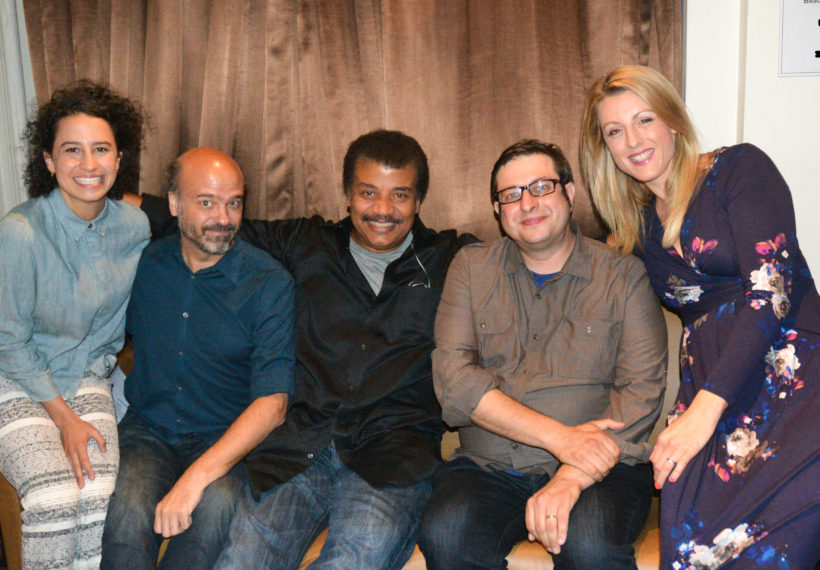
Join us as we go chasing comets and capturing “Stardust” in our show recorded live at the Beacon Theatre in NYC last September. Neil deGrasse Tyson and Eugene Mirman welcome Scott Adsit, Ilana Glazer and cosmochemist Dr. Natalie Starkey, who was a co-investigator for ESA’s Rosetta mission to Comet 67P and who has analyzed the data from the Stardust sample return mission – the only spacecraft to fly through a comet’s tail and come back to Earth. You’ll hear how the microscopic dust particles captured by Stardust have changed our understanding of how the solar system formed, and why the water Rosetta found on Comet 67P isn’t like the water here on Earth. Natalie explains why Rosetta’s discovery of the precursor elements for life (carbon, hydrogen, oxygen) is so important, and why life on Earth might not have happened at all without comets. You’ll explore the differences between asteroids, comets, meteors and meteorites, and find out which pose the biggest threat. Plus, Neil and Natalie discuss exoplanets, the Goldilocks Zone, and extremophiles that can exist in space – and that’s just in Part 1. Next week we’ll catch a ride with New Horizons to Pluto, “The King of the Kuiper Belt.”
NOTE: All-Access subscribers can listen to this entire episode commercial-free here: StarTalk Live! at the Beacon (Part 1): Chasing Comets.
Transcript
DOWNLOAD SRTWelcome to StarTalk, your place in the universe where science and pop culture collide.
StarTalk begins right now.
StarTalk Live!
It is my very great pleasure to introduce your host, a very genial and excellent science communicator.
And destroyer of planets, the Galactus of Earth.
Ladies and gentlemen, Neil deGrasse Tyson!
Eugene, so who’s next?
Yes, you have two guests of your own.
I do.
It is my great pleasure to bring out from Broad City, Ilana Glazer, and from NBC’s 30 Rocks, Scott Adsit!
Tonight’s topic is on the solar system, comets, and other vagabonds, including Pluto.
Let’s.
And we comb the world to find someone who has just that kind of expertise.
And I found, in England, there is a woman who will soon be moving to California, bringing her expertise stateside.
She’s one of the principal investigators on the Rosetta mission to a comet where we landed a probe on the comet.
Did that.
And she has general expertise about comets and will also take us to Pluto in all ways necessary.
Give a warm New York, United States welcome for Natalie Starkey.
Natalie, come on out.
So, Natalie, first, welcome to the United States.
So professionally, you care a lot about comets.
And I’ve spoken to people, much to my surprise, that there’s not enough clarity when people talk about comets, asteroids, meteoroids, meteorites.
So could you just straighten us out on that?
Okay, it is quite confusing, and people don’t seem to understand it because we use a lot of similar words.
So what we’re talking about is an asteroid is simply a space rock that is left over from the formation of the planets.
So it’s a rocky thing that formed quite close to the sun, whereas comets, on the other hand, formed very early.
They’re made of gas and ice and dust.
I get frozen gases.
Frozen gases.
They formed even earlier than the asteroids.
So, they take us back 4.6 billion years, right to the beginning of the solar system.
They’re the rolling stones of space.
Sing, rolling stones!
So we should also just mention a meteorite, which a lot of people have heard of.
That’s simply a space rock sitting on the surface of the Earth.
Before it hits the Earth, it’s either an asteroid or a comet or a piece of another planet, like Mars, or it could be a piece of the moon.
But anything that arrives from space and lands is a meteorite.
And we collect those all over the place and analyze them.
Is the moon throwing stuff at us?
Yes.
I know, I know, it’s crazy.
So yeah, but from quite a while ago.
So when the moon was impacted by different things hitting it in the past, it threw off material, ejected it up, and that flies around space for millions of years until eventually it ends up hitting the Earth or another planet.
So that’s how we get some samples of the moon.
That was true with Mars as well.
We have Mars rocks on Earth that we didn’t have to go there and get.
Exactly, we’ve never actually got a sample from Mars directly.
We’ve only been there and done analysis on the planet rather than bringing material back.
So we’re wasting an enormous amount of money.
You could look at it that way.
We get a lot of free stuff.
We don’t need, no, we do need to go.
We’ll come on to that.
You were saying, hello?
Yeah, okay, so you’re talking about like a meteor that’s sitting on a planet.
It’s a piece of rock that was, so once an asteroid hits another planet, it breaks up the rock and ejects it into the atmosphere.
So then it circles around and ends up on another planet eventually.
So you’re like talking about the same stuff, but you call it different words at different points in its process.
Exactly, well done.
Love it.
That is trippy.
Just to be confusing, yeah.
That’s not any weirder than calling a little human a child and an older human an adult.
They’re both human, right?
That’s right, but it’s just my vocabulary.
I’m like a meteor asteroid.
Are those the same?
A meteor is a little bit of an asteroid that’s kind of been broken off and is circling towards the Earth.
Which one makes you telekinetic?
Telekinetic.
It makes you what?
Telekinetic, when you can use your mind to manipulate the physical world.
That’s a really good question.
I thought you were a scientist.
I’m a scientist.
So, you spoke casually about finding a meteorite on the ground, but that meant it fell from the sky and hit.
And so not all of these can possibly be good for us.
So can you comment on the relative risks between getting slammed by an asteroid and slammed by a comet?
Yeah, so I mean, it’s a real possibility that we will be hit by a large asteroid or comet somewhere in our future.
Now, we think for the next maybe a little more specific.
Yeah, we’re in the future.
Like 100 years or a thousand years or?
We don’t know.
We think over the next 100 years, we’re not going to be hit by anything really devastating.
Kind of like the thing that kills off the dinosaurs.
I know, do you always say that?
Are you always like, ah, in 100 years?
Yeah, it’s a very scientific thing, you know?
And like 100 years ago, they’re like, I don’t know, 100 years.
Okay, so we think we know where all the big asteroids are and we think they’re not on a collision course with Earth at the moment.
So we’re kind of good, but.
We think?
We’re pretty sure.
We can’t be 100%.
So, but.
This is not the Bible, Neil.
Sorry, it doesn’t have that level of certainty.
I got that.
So when you say I think, those are your verbal margins of uncertainty.
Yeah, so.
Okay, fine.
Exactly.
We’re 90% sure, maybe.
Okay.
Around that kind of thing.
But the problem is we don’t know where every single object in the solar system is.
There’s millions of objects, asteroids and comets.
And the comets in particular come in at strange angles that we can’t really predict.
And we don’t see them coming.
They come very fast.
When you say strange angles, we have the plane of the solar system where the asteroids come in from and the asteroid belt.
But comets, does any old which way?
Yeah, pretty much.
And they’re coming in from much further out.
So they come in with a bit of surprise sometimes.
Some of them we know where they are and we’re tracking them.
But there’s always going to be one that we’re not going to see.
So they all came from our sun.
Yes, we, yes.
We’re not trying to trick you.
You can just tell us the truth.
But has a, can a comet hit the earth?
Is it going to happen?
Some of that, explore that.
The dinosaurs were probably killed off by a massive comet hitting the earth.
So it wasn’t the dinosaurs directly being hit on the head and being knocked out.
We’re all assholes, so that’s not.
Not all of them.
And we’re great.
So the problem with these impacts is that you end up changing the whole environment of the earth.
You throw up so much dust and gases, and you melt, really melt where it’s hit, part of the earth.
So basically, the earth becomes uninhabitable by many species.
It didn’t quite kill off everything.
Otherwise, we wouldn’t be here.
But yeah, it kills a lot.
So just to clarify, to just say that it melts and throws up gases, there’s the energy of the comet’s motion and its mass coming in, and then it stops moving after it hits the earth.
And where did all the energy go?
It melts the earth.
It kicks up, it devastates the climate, kills the dinosaurs.
We get a big crater, you know, that we’ve got plenty of them.
In fact, if you look at the moon, we’ve got loads of examples of where the moon has been completely hit by asteroids and comets in its past.
The earth was hit as much as the moon, but we have plate tectonics, which means that our surface is renewed all the time over geological history.
We cover the evidence.
Yeah, we’ve lost the evidence.
That’s why the moon has, like, acne.
Yeah, yeah.
So there’s been discussion about the possibility of comets, because when we analyze comets, there’s interesting chemistry going on there.
We find organic elements.
Organic molecules.
Like cheese?
What do you mean?
That’s the moon.
Good.
Sorry.
What kind of organic stuff do we find?
It’s the moon that’s made of cheese.
So if that’s the case, I mean, I remember reading speculative novels about viruses from space, or microbes from space, possibly comets, seeding Earth.
So is that still a thing?
I mean, this is really one of the main leading theories of how we think we’re all here.
We think that probably comets are asteroids delivered life to Earth, not as life like us, obviously.
Not an asteroid full of, or like a comet full of cats.
Fully formed cats.
Fully formed cats.
And from cats came people.
Were phetons or volcanoes involved in this?
We’ll come back to the comets first.
So, organic material.
What we’re talking about simply is carbon, hydrogen, and oxygen bonds.
And this is organic material.
So what we call this is like the precursors for life.
It isn’t life itself, but it’s the material that we need to form life.
And these are common ingredients in the universe.
Yep.
Common ingredients.
And we know that comets and asteroids contain organic material.
We’ve actually found amino acids on an asteroid.
And a comet, in fact.
So amino acid is the building blocks of protein.
Exactly.
If you believe Star Trek, real science does come up in Star Trek.
Okay, so…
They come up in other places too, Eugene.
Okay, so Natalie, I have a question.
If carbon, nitrogen, and oxygen benighted as organic elements, making organic molecules, if they’re common, then why do we need them to come to Earth from a comet?
Why wouldn’t Earth have been endowed with them from the beginning?
Okay, so one of the issues is that when the Earth…
I get it, like that was a good question.
Can I…
So there, Natalie.
All right.
I have an answer.
Don’t worry.
So when the Earth formed, it formed really close to the Sun.
So we’re talking about a really hot, chaotic environment next to the Sun.
Everything was flying about at the beginning of the solar system.
It was really energetic.
What this meant was that we didn’t really have rock.
We had magma of rock, like we get at volcanoes.
Melted rock.
So we’re talking kind of 1200, 1600 degrees Celsius.
This is really hot.
So as you can probably guess, these simple volatile elements like carbon, hydrogen, and oxygen…
that if you heat them, they become gas.
Yes, exactly.
They’re not going to survive in that kind of environment.
So we think when the Earth formed that we couldn’t have began with all the things we needed for what we’ve got now, including water.
We don’t know where all our water came from.
We take it for granted, we drink it all the time, but we don’t actually know where it came from.
So not only did comets potentially deliver organic material, but they might have also brought our water in.
So we need comets.
Probably, yeah.
I mean, they killed off the dinosaurs, that’s bad.
Maybe, maybe we wouldn’t be here otherwise, though.
But actually, we might not be here without them anyway.
So we have this love-hate relationship with this thing that can kill us, what enabled us in the first place.
Like our parents.
Okay.
Alright, so you specialize in comet dust.
What is that going to tell us?
Okay, so I work at a really, really small scale.
Because usually when you study an object, it’s to learn about the object.
But every time I hear people, yourself included, talk about studying comets, it’s so that we can learn about other stuff.
Well, yeah, and the comets themselves.
What’s important is that the objects I study you can’t really see because they’re so small.
I have to use really specialized instruments to study these bits of dust.
I’m talking 10 micron particles.
So these are, if you take a single human hair, it’s about 100 microns.
So these grains are a tenth of a human hair.
So they’re very small.
Where do you get them?
Where do we get them?
They come from comets, we think, and asteroids.
So this is the problem.
I have two types of samples.
But quite luckily, they just arrive on Earth quite naturally.
Sorry, where do you get them?
Oh, you’re getting there.
I’ll get them.
Sorry.
So about 40 tons of space dust arrives on Earth every single day.
It’s a huge amount of stuff, loads of it.
NASA have these high-flying aircraft, a bit like the U-2 spy plane, and it’s called the ER-2.
They fly high in the stratosphere, about 60,000 feet.
They’re in astronaut suits and everything.
It’s right on the edge of the Earth.
They just fly along, and it’s quite a simple technique.
They’ve got little sticky pads on the wings.
No.
It’s made of silicone oil, so it’s a special oil that kind of is sticky and slows down these particles as they enter from space through the atmosphere and hit these collector plates.
So then we get, effectively, free samples of comets without having to actually go in.
Yeah, it sounds very inexpensive.
Just 50,000.
That’s crazy.
It’s like I’m picturing Swiffer hands.
That’s unbelievable.
So this is like fly paper or something, except for comet dust.
Honestly, how much is it?
What are we talking?
How much dust or how much dust?
How much of a scoop of comet dust?
I don’t know what you measure it in.
What’s the street value of comet dust?
I know.
It really sounds like a drug.
If I tried to sell it to you, well, you wouldn’t be able to see it.
So you probably, I could sell you anything.
I’d just be like, hit some…
Are you saying scientists are invisible drug dealers?
No, dealers of invisible drugs.
That’s different.
Scientists are like mechanics, though.
They can tell us anything and we’ll just go, yeah, okay, yeah, yeah.
Yeah, once I saw a microwave, I was like, okay, anything’s possible.
But wait, wait, just to clarify.
So that’s one way to get space dust, whether or not it’s from a comet.
You don’t know.
We can’t ever be sure, no.
Okay, however, you studied an actual mission that went to a comet.
So now you’re studying the Stardust mission.
Yeah.
And what was that mission?
This landed back in 2006 in a little capsule in the desert.
And in that capsule, we had real samples of a comet.
For the first time, we collected actual samples.
I’ve got to get back to Eugene’s question.
How did it get comet samples?
You just said it landed in the desert, and it had comet samples.
Just arrived, yeah.
So the space mission used, again, quite a simple collection technique.
It was almost like a tennis racket.
This collector comes out, and a big, it’s about kind of this big, a metre or so, made up of these little blocks called aerogel, which I think NASA developed specifically.
And this gel is basically silica, and it decelerates the particles, because the thing is, this mission just flew through the tail of a comet, which I can explain what that is, and the particles coming off the comet that form this tail are going at about six kilometers per second.
So this is like fastening a speeding bullet.
They need to be slowed down as they are collected, otherwise you’re going to destroy them all.
You need to slow them down slowly.
Yeah, exactly.
But we didn’t slow them down quickly enough, or does that make sense?
Slowly enough, or whatever.
Because actually we lost the volatile components.
So we mentioned these kind of the organic components in the samples earlier.
So we just get the rocky bits of that comet, the dust rocky bits.
But this is the only sample return mission we’ve had from a comet.
So it’s the only sample we’ve ever had.
And it’s been quite a change for us in our understanding of comets.
We’ve learned a huge amount from this mission.
Just, it’s amazing.
We launch something from Earth.
We pass it through the tail of a comet, bring it back, land it in the desert, you open it up and analyze it.
Yep.
Now, there was a movie called The Andromeda Strain, which was exactly that plot.
Yeah, but she’s more like the scientists in Thor.
Now, if the volatile stuff had not been decommissioned, what is your hypothesis of what you would find among that material?
Good question.
I like this one.
I want to get good question.
I explained at the beginning that comets formed from this very early material in the solar system, the very earliest material from our sun, and it’s all the earliest dust and gas.
Now, we think that they formed really far away from the sun.
That’s why they’re cold and they have a lot of ice in them.
And we think the asteroids in the hands, the rocky bits that were left over from the planets, so the hot inner solar system stuff, formed in the inner solar system.
But what Stardust taught us is that we’re a little bit wrong.
There seems to be a bit of a continuum between comets and the outer solar system and asteroids because we found basically little pieces of the inner solar system within a comet.
Now, this was a complete game changer.
We didn’t expect this.
And so it’s really kind of led to a change in our thinking of how the whole solar system formed, how things were moving about over huge distances.
Can I ask a question?
I’m still having trouble picturing this.
Like, is it like, the dust, is it like astronaut ice cream when you get it?
Like, what, is it invisible to you when you’re measuring it?
Invisible to the naked eye, yeah.
But if we put it in one of our instruments.
Yeah, we get it on, like, literally one piece of dust on a normal glass slide you’d see in a biology lab, and I have to put it under a microscope.
People always find this hilarious.
And I use a little needle and a micro-manipulator, literally just a little needle, and I have to bring it really close to the sample, and it shakes, and then you just attract the sample onto the needle, and then I have to move this and drop it onto a sample holder.
It’s ridiculous.
I don’t breathe when I’m doing this sample preparation.
It’s so stressful, and you can’t, you know, sneeze.
You’ll just lose everything.
But it’s so cheap with that.
You could exhale, and the space dust lands on the ground somewhere.
Yeah, and you’ll never find it.
I have, don’t tell NASA, I have lost a few pieces.
Space dust you collect in your space airplanes?
It literally just depends how long you fly for.
So they’re up there anyway, doing other scientific missions, measuring environmental things, clouds.
That’s just one of the things they do is collect it up.
So they just stick these little collectors on as a byproduct.
And have you tried making them twice the size of whatever the size is?
There are two sizes, actually.
They’ve got small ones, which are about this big.
They’re a third bigger size.
Yeah, but then the plane might not be able to take off.
How big are the collectors?
They’re about maybe two foot maybe across for the bigger ones.
Yeah, something like that.
So yeah, two feet sounds impossible.
Yeah.
I understand that.
Before we break to segment two, I just want to find out from you, if you make a solar system, we get that.
And of course, lately we’ve been looking for other star systems with the Kepler telescope, which released a list of a thousand exoplanets recently.
But one got headlines, and that was, they call it Earth 2.0.
Yeah.
So, tell us about Earth 2.0.
Okay, so I think this official name is Kepler 452b.
So we call it Earth 2.0.
So what we’re looking for with exoplanets, because everybody wants to know, are we alone in our universe, solar system, galaxy, everything?
Is there anyone else out there?
So we’re looking for planets or exoplanets outside of our solar system that might be in that right area to actually contain life.
Like a Goldilocks zone or something?
Exactly.
It’s not too hot, not too cold, and what we’re really looking for is, does it contain liquid water on the surface?
Because we believe that to have life, we need water.
It might not be true, but in our current understanding…
Life as we know it, exactly.
But I think if you start to think about all other forms of life, we can’t really imagine it because we don’t have any evidence for it.
So we exist and all other forms of life on Earth have required water.
So we think that we’re looking for water.
So it’s in the Goldilocks zone, but that shouldn’t be enough to make it Earth 2.0, right?
What else was true about it?
There was champagne on it.
Just a guess.
I mean, about its size or…
So we believe that we need to be kind of Earth-sized in order to…
To have Earth-like life.
Yeah, exactly.
Do you agree?
I’m like, water and size?
Like, that’s us being like, we know what life is.
Right?
I’m like…
I like the little body edge.
We know what life is.
Yeah, it’s tricky, right?
I’m not sure.
I’m kind of thinking, well, maybe we shouldn’t limit ourselves with just our imaginations.
Maybe we’re just not good enough, you know?
Like, we don’t know what aliens drank or whatever.
But if we found water, it would be pretty likely that there would be life?
Or…
I saw a New Yorker comic.
Is there a lot of water in space?
There is.
Yeah.
There was a New Yorker comic where a flying saucer crash landed and these aliens are…
It was like in the desert, right?
And these aliens are crawling out of the crash saucer.
And one of them says, Ammonia!
Ammonia!
Exactly!
Exactly!
And actually we have what we call…
I do like the word extremophiles.
So we’ve got certain bugs, essentially, on Earth that like really bizarre environments that we couldn’t imagine surviving at.
So you’ve got them surviving at huge pressures and depths where there’s no light source.
And so basically we’re discovering these bugs that actually can survive in space as well.
They do experiments on the International Space Station where they take some of these bugs.
Some of them come from a cliff in Iceland.
There’s some weird bugs that live on this cliff.
And it so happens that they can survive in space on the side of the space station.
Now, we couldn’t.
If you put us out there, we wouldn’t survive.
Not only because of the vacuum and everything else, but there’s too much radiation in space, which is the main issue for any living cells.
So, I think we shouldn’t limit ourselves.
Although, we have to have a theory that we can test.
But life as we know.
We might be surrounded by life as we don’t understand it.
We might, right now, be surrounded by things that are alive.
We have no…
Wrap it up, hippie.
Theatre chairs could be living beings that survive on farts.
Theatre chairs surviving on flatulence.
They’re out there.
Methane.
Explain Broadway any other way.
I can’t rebut that.
Hypothesis.
That was an accidental pun.
So Natalie, you not only worked on the Stardust mission, you couldn’t stay away, and you were a principal scientist on the Rosetta mission to yet another comet where we landed on a comet.
I say we.
It was the European Space Agency, not NASA.
You mean mankind.
So tell us about that.
That made very good headlines here, even stateside.
So congratulations on that.
First time we’ve ever soft landed on a comet.
So Rosetta is the name of the mission, and then the probe that went down was named Philae.
So where do we get these names from?
So these names actually come from Egypt.
So they always try and name missions interesting names.
And I think they were looking for something interesting.
And the aim of the Rosetta mission was to unlock the secrets of the solar system.
Quite a big subject.
You said earlier that comets hail from the beginning of the solar system.
Exactly.
Understand them, we got some clues.
Exactly.
So they kind of wanted an analogy for unlocking secrets.
And actually, the Egyptians used hieroglyphs, but we didn’t understand how to read this language that they used.
But it was the Rosetta Stone that was found in Egypt that actually had all the languages on, plus a couple of other languages that we could understand what the hieroglyphs meant.
So that’s the Rosetta Stone.
So it’s basically unlocking the secrets of Egypt.
But in relation to that, the Philae is an obelisk.
A-H-I-L-A-E.
Correct.
So this is an obelisk, so just a really tall needle-like statue.
I don’t know why they made them, but this also had some of this language on.
And it helped us with the Rosetta Stone to unlock the secrets.
So you needed both of them.
And actually, you can go and see this.
It’s in the UK.
I think we kind of stole it from Egypt.
Kind of, yeah.
So, but you can go and see it.
Through war or borrowing?
I think we borrowed, borrowed, yeah.
That’s the official line.
So yeah, you can go and see it in Dorset in the UK.
There we go.
Look it up.
That’s probably what they had in mind when they built it.
Yeah, exactly.
Dorset?
So you, so the name of this comment was what?
Okay, so the comment is called 67P, Churyumov-Gerasimenko.
So presumably named for the two discoverers.
Yes.
That sounds very Russian, I presume.
They aren’t Russian, I forget now.
Well, they’re not Russian.
No, I think Ukrainian.
Ukrainian.
I didn’t, it sounded a little satellite country to me.
This is normal, we name comets after their discoverers.
But they also get a code.
So we tend to call it 67p because their names are quite long and hard to pronounce.
I maybe just completely pronounced it wrongly.
Sorry if I…
So Churyumov-Gerasimenko.
Okay, just checking.
Okay, so you were responsible for the Ptolemy instrument.
Well, I can’t really take the credit.
So I should just explain.
With space missions, I’m sure many of you know, they take a huge amount of time to plan and then to launch and get to their object in space, wherever it is, takes quite a bit of time.
So the Rosetta mission was planned over 20 years ago.
So, you know, I was at school at the time.
So I obviously wasn’t involved in the mission then.
I wasn’t some whiz kid, so, unfortunately.
And then it launched 10 years ago.
And the problem is, over this huge time scale…
So all the people who designed it, they’re dead now.
And so a whole next generation…
We need to bring young people in.
So I kind of help.
So I didn’t design it.
But you should be designing something now so that when you’re dead, someone else will come in and…
Were you involved in their death?
Just to get on experiments.
That’s hard.
That would be scary.
Thank you for not answering in the morning.
That’s mysterious.
But also know your day is coming.
Thanks.
So it was launched in 2004.
It took 10 years to get there.
But it seems to me it shouldn’t if you gave it enough fuel.
So what was going on?
So, I mean, this is one of the problems.
When we launch things into space, it is expensive because we need a lot of fuel.
So we try and make everything very small.
We try and miniaturize instruments so that they’re light and they’re small so that we use less fuel.
But part of the problem with the Rosetta mission is that this comet was really, really far away.
How far away?
Well, actually the spacecraft went on a journey of over 3.4 billion kilometers.
Now, when it was really far from the sun, the solar energy at that time is just, there’s none effectively.
So you have massive solar panels on the Rosetta orbiter.
When you say massive, you mean large.
Yeah, so they’re about the same.
Not literally massive.
You want them as light as possible.
No, it matters here.
So they’re about the same.
She didn’t mean mass, because we’re talking about the mass of the spacecraft.
You can say massive panels, they’re like big panels.
It’s going to be fine, Mr.
Literal.
But I do think she means large.
Okay.
Okay, they’re about the same size as an A320 plane.
So like a, you know, a smallish plane, but still can fit in like 200 people.
So quite large.
But the problem we have is…
A320 is like a Boeing 737.
This is America.
Welcome to the United States.
Go on.
It’s like one million Yorkshire puddings.
I’ve lost my train of thought.
Where are we going with this?
So, highly extended solar panels.
Yes.
Because it’s far away and it needs…
It’s far away, so it needs to be very, very heavy.
They need to be large enough so that they can take every single bit of solar energy that they can get.
But what we had to do during this time is also shut down most of the spacecraft.
It went into hibernation for about three years because it just, it didn’t want to use up power and it didn’t need it.
So then we had a whole waking up procedure, which was very scary because they didn’t know it was going to wake up.
It literally had an internal alarm clock on it that was set on launch and it was just ticking away, waiting for this wake up time.
It had one job in life, to wake it up.
Thank goodness it worked and there was no backup for that.
So if it hadn’t worked, mission would have been over.
But that doesn’t account for why it took 10 years to get there.
Okay, we can’t just take off from Earth and go directly to a comet.
What we need to do is get onto the same orbit as the comet.
And I think we just explained earlier that comets have a different orbit to all the planets.
So what we actually had to do was be a bit ingenious with it and use some of the planets as gravitational slingshots.
So this means just getting close to a planet, and we went around Earth three times and Mars once, to just build up velocity to get out on the right trajectory.
So it’s kind of like using gravity to get some power for free.
You’re stealing orbital energy from planets.
And then you send it to where the comet will be in like ten years, basically.
Exactly.
I mean, they had to do all this math to figure out, sorry, math.
I apologize.
We just used the one.
To figure out…
Does America math is singular in America?
Or non-existent?
One of those two.
We have Natalie Starkey visiting from the UK, expert on comets, welcome.
So, Natalie, you were a principal scientist on the Rosetta mission.
You gotta give it up for Isaac Newton’s Law of Gravity here.
Because here, we’re launching some, correct me if I’m wrong, as I followed what you were saying.
We’re launching a spaceship from a moving platform called Earth, doing a three-cushion-pool shot around three planets, Earth twice, Mars once.
That’s three times Mars once.
Arriving where a comet will be 10 years from when that launches.
That’s badass.
That is badass.
If Isaac Newton were sitting right here, his head would explode.
Because one of the greatest first uses of his equations of gravity were to predict the future arrival of what would come to be known as Halley’s Comet.
So, comets and his laws of motion and gravity have important history in the birth of modern physics.
It’s amazing.
I’m amazed that they can do this.
You know, it’s so clever.
And then they caught up with this thing, which is speeding along and entered into orbit around this body.
Now, the thing is, it’s small.
It’s about three by five kilometers in size.
I don’t know that in miles, but you can guess it’s not particularly big.
It’s the Niantucket of space.
So, bodies this small don’t have a lot of gravity associated with them.
Almost none, in fact.
So, trying to orbit around this thing is not trivial.
Basically, you have to be quite close before you can enter into orbit.
So, they had to do a lot of powered flight around it in a complicated motion to actually map this thing.
So, they had lots of cameras on the orbiter taking pictures of the entire 100% of the surface of this comet.
So, it’s really well documented.
Plus, you have to know where you want to land, Philae.
Well, that’s exactly why we needed to document it.
So, some of the images, one pixel on the image was just 75 centimetres.
So, we’ve got the resolution that we call that.
It is absolutely amazing.
We’ve not got that really anywhere, so…
One pixel is like this big on the…
That’s pretty good.
It’s really, really good.
That would be the best one.
So, they had to come very close to the surface in order to do that.
Now, there’s dangers coming very close because, you know, there’s material flying off this comet.
It’s active as it’s approaching the sun.
We saw Armageddon and Ursula trying to plant the explosion on the comet as it was heating up.
Yeah, that was an asteroid, but yeah.
But he was a very good…
But same thing, they’re also active in some ways.
It was a comet.
I think it was an asteroid, no?
Yeah, no, it was a comet.
He was very good at digging, though, right?
That was what?
Yeah, that’s why they got him.
He was like, the best at digging.
Yeah.
Anyway, it did well.
It’s fine.
Wait, wait, so, okay, so presumably you didn’t go to destroy it.
You went to study it.
So what did you find?
Okay, so we found out it’s a huge amount.
I’ll try and summarize it briefly here because we’re still getting data back at the moment.
So the orbiter is following this comet still.
It’s gone very close to the sun, as close as it will go.
We call that perihelion when it’s at closest point to the sun.
So now you have maximum heating.
Yep.
It’s really active.
The orbiter is backing off, I think, on the 25th of this month.
It’s backing off a little bit because it’s going to be studying how the comet and this material that’s coming off it interacts with the plasma of the sun.
Now, this is something we don’t know a huge amount about because we can’t recreate these conditions on Earth.
We just can’t have these plasmas.
So we have to go…
Not even in, like, France where it’s like, who cares what happens there?
I love that.
Just to be clear, this is astrophysical plasma, which are charged, very hot ionized gas, charged gas, that responds to magnetic fields.
And it’s sometimes called the fourth state of matter.
And yeah, it doesn’t exist in natural states on Earth’s surface.
And so what they’re trying to understand is that tail of the comet, which as it’s going away from the Sun, the tail is obviously behind it, the solar wind is coming out from the Sun and it’s hitting that tail.
So they want to understand how the solar wind is slowed down by that tail of material.
That’s just the orbiter, though.
We obviously had the land as well.
I think it’s cool that this mission is still in progress now.
It’s still going, yeah.
Until at least the end of the year, I think they’ve extended it even.
So we’ve got much more danger to come.
And will that ship eventually come back here with…
No.
It’s just going to stay with the comet.
Will you ever send it into the Sun or you’ll just leave it out there?
There are plans to crash it into the comet.
Ruin the comet?
Will you learn something?
Will it be like, are you crashing it because now we’ll know what it’s like to crash into a comet?
Or are you like, nah, f*** it?
Just because we can.
I think go out in a blaze of glory.
But they’re planning to do it.
Because what they can do is they get really close, is take loads of images and analyze.
They’ve got lots of instruments that can be on and transmitting data back to Earth.
And it’s the closest they’ll get with those instruments.
And…
Yes, crashing would be the closest you would ever get.
Pretty much.
Between an instrument and a cosmic object.
Once the mission is effectively over and the comet is getting really far away from the sun again and far away from Earth, we can’t get the information back.
So we might as well just…
Well, could you send it somewhere else?
How much can you direct it?
Can you go like, you know what, actually let’s go…
It won’t have enough power to do that, unfortunately.
So it’s just got to stay where it is.
But it could go off into space for millennia and then become worshiped by some alien race, right?
Why not do that?
Can’t we send it to an alien world to become a god?
But I thought, am I wrong?
Correct me, but if there’s no resistance in space, there’s no atmosphere, there’s nothing to slow it down.
But it’s now in orbit around a comet.
Now you have to unorbit it around the comet and send it off somewhere.
Everything takes energy.
Everything takes energy.
And so just back to your point, Eugene, because I can give a very serious answer to that.
For essentially all of our planetary missions that go into orbit, there is an end-of-mission plan where you will then get data doing something that is in the process of destroying the craft.
So when the Galileo spacecraft went to Jupiter, the end days of it were crashing down through plunging through Jupiter’s atmosphere, getting data as rapidly as you can until it’s crushed by the atmospheric pressures of the planet.
So this actually has a storied past of what you do with spaceships when you’re done with them.
I would love to be the one who crashes it, if that’s possible.
Just let England know.
But we haven’t mentioned what else we found out.
I should briefly mention also what the lander has found out.
Because, sure enough, we have loads of organic material on this comet.
As you expected.
As we expected, but we’re confirming it’s definitely there.
And we’re analyzing it still to try and understand how important it might have been in life on Earth.
Does its water match Earth’s ocean water?
So this is the interesting thing.
No, it doesn’t.
So we kind of thought, OK, we measure the water in our oceans.
We know the composition.
And we use isotopes to understand.
It’s the composition of the hydrogen isotopes in the water.
Water is obviously H2O.
We measure the same isotopes in the comet, in the ice or in the comet, and compare them.
And if a lot of comets crashed into Earth, bringing their water with them, we’d expect them to have the same composition in this isotope.
But they don’t.
This one has a different composition.
So we conclude from this that this type of comet didn’t provide our water, or not a huge amount of it.
It could have provided some of it and been balanced out by other compositions.
But it’s still an ongoing theory.
We can’t really explain it.
But we’ve only really been to a couple…
Well, we’ve been to one comet, and we’ve measured remotely the composition of some others with telescopes.
So there’s millions of them out there.
I don’t think we’ve really answered the question fully, but we know the composition of this one, which is a good start, because we had no idea really before that.
In simple terms, what are the differences?
Okay, so basically, I’ll go into this, and you can stop me if I’m being confusing.
But we have two isotopes of hydrogen.
Stop.
What’s the difference between an isotope and not an isotope?
I’ve actually just lied a little.
There’s more than two.
I’ll come back to this, but we’re measuring the relationship of these two.
So an isotope is literally a type of an element.
So just take hydrogen or oxygen.
And it’s basically got a different number of neutrons in its nucleus than proton.
It’s got the same number of protons, sorry, different number of neutrons, which gives it a different mass number.
So we’ve got deuterium and we’ve got hydrogen, and hydrogen has a mass of one and deuterium two, so we can measure the difference between these two, the ratio between them in different objects to try and compare them.
Just to highlight that further, so if we have more than one kind of hydrogen, and one is a little heavier than the other, they’ll still make water H2O, except one of the waters will be heavier than the other water.
Exactly.
Yeah, and so now you can say if this puddle of water has more of these heavy hydrogens in it than another, then they can’t have come from the same source.
But once you are heavy water, you are always heavy water, is that correct?
Okay, so it doesn’t become lighter later.
They are stable isotopes, yeah.
So isotopes, people talk about radioactive a lot, and you might associate that word with isotopes, but that’s only the ones that decay and are unstable.
The ones like oxygen and hydrogen are stable, so they stay the same over time.
Okay, so you are using this heavy hydrogen, which we call deuterium, to trace the water sources that exist on a comet or exist on the Earth.
And they didn’t match up, so we are still clueless.
Could we drink the comet water?
You could, yeah.
And you would be fine?
You would be fine.
I mean, if you took…
I think it would slow down, actually.
It would slow down your metabolic process.
No, no.
You haven’t drank water from a comet?





 Become a Patron