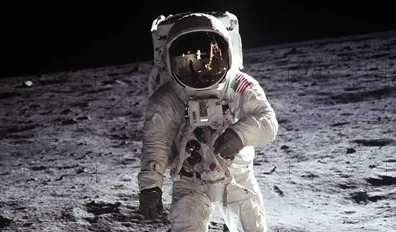
For StarTalk’s first mission to Town Hall in NYC on Feb. 27, 2013, Commander Neil deGrasse Tyson and Co-Pilot Eugene Mirman recruited a crack crew: NASA astronaut Buzz Aldrin, the second man to walk on the moon, Andrew Chaikin, planetary geologist and author of A Man on the Moon, and, in the spirit of international cooperation, a little known British comedian named John Oliver. In Part 1, the team explores why we went to the moon, what it was like once we got there, and why conspiracy theorists that say we never actually went are full of… moon dust. Buzz shares the unlikely path that took him from the skies over Korea to MIT to Apollo 11 and the lunar surface. But the most surprising discovery in Part 1 is that the guy who got the most laughs wasn’t Eugene or John, but Buzz Aldrin himself. The mission concludes with Part 2 next Sunday.
Transcript
DOWNLOAD SRT
Welcome to StarTalk, your place in the universe where science and pop culture collide. StarTalk begins right now. We have a super wonderful show. It is my great pleasure to bring on the host, the Robert Plant of astrophysics. Ladies...
Welcome to StarTalk, your place in the universe where science and pop culture collide.
StarTalk begins right now.
We have a super wonderful show.
It is my great pleasure to bring on the host, the Robert Plant of astrophysics.
Ladies and gentlemen, Neil deGrasse Tyson.
So all of tonight is about the human exploration of space.
So let's get to our guests.
Eugene, please.
I would like to bring out a very funny comic, someone who is sadly British.
Ladies and gentlemen, the wonderful and very funny John Oliver.
So, there's actually a good friend of mine, a journalist.
He's actually a geologist by Professional Training.
He wrote the book From Earth to the Moon, on which the 12-part TV series was based, that came out about 10 or 15 years ago.
He wrote a book on getting to Mars.
The guy's all into this, and he's been into it since he was a kid.
Join me in giving a warm New York welcome to Andrew Chaikin.
Andrew, come on out.
Andrew, you've written about the moon almost like you were there.
Yeah.
Well, I talked to all the guys who did go there.
You didn't actually go to the moon.
I invite you on the show.
Listen, I am a storyteller of space.
So what I did was I went around and talked to all the guys who went to the moon for eight years, collected their experiences and wrote it down.
By the way, the name of the book is A Man on the Moon.
Excuse me.
But you know, I like you.
There were six men on the moon.
You said a man on the moon.
Twelve.
Twelve.
Six missions, twelve.
Twelve.
Twelve.
Good.
So all you ever did was talk to these guys.
Well, yeah, but they said really cool stuff.
This is Town Hall.
We are in Times Square.
They said really cool stuff.
Ladies and gentlemen, Slido.
For those of you dragged here by your friend, he walked on the moon, okay?
So Buzz, you really need no introduction, except for the seven people who were dragged here.
So Buzz, you were on Apollo 11, the first mission to land on the moon and walk.
Your footsteps are there.
And I'm told that all the pictures of single astronaut images on the moon are of you, because Neil Armstrong took all those pictures, is that right?
He wouldn't let go of the camera.
Oh, okay.
Buzz, we might try to get you a hand-held mic, because we can hear you a little better.
Let's see.
I think it's out.
Oh, yeah, can you?
Is this thing on?
Okay.
Maybe not.
It's coming.
It's coming.
A voice in my head told me it's coming in 20 seconds.
I hear voices.
Isn't that incredible?
We can send a man to the moon, but we cannot amplify him to talk pregnant.
Boy, we've failed Buzz Aldrin in a big way.
So Buzz, you were a fighter pilot in which war?
Korean War.
So you must have been like fully aware that we're not just beating the Russians to the moon, we're beating the Russians flexing military muscle, right?
I mean, wasn't that, does that pervade them?
We were catching up.
You remember Sputnik?
Yeah.
I was born a year today after Sputnik launched.
So I was like.
Beep, beep.
Yeah, yeah, that's what it did.
That's kind of shocked the number of people because we didn't really think they were going to be able to do that.
Even though they said they're going to put up a satellite.
Done the dog.
Lyca.
Lyca didn't come back alive, yeah.
No?
No, the Russians killed the dog.
Sorry, sorry.
UG.
Mirman is part Russian, just so you know.
The part that I was born in Russia.
I would even add all the parts.
So Buzz, were any of you guys thinking we're doing this to explore for science, for anything other than flexing muscle?
Of course, yeah, we were doing it for that reason, but it was certainly a race.
We were told that.
I probably was more antagonistic than anybody else.
There were a couple of real cozy people, let's buddy buddy, but those were our enemies.
Were you hoping you'd get to the moon and there'd be a Russian that you could punch there?
All right, so you guys collected rocks.
I mean, Andy here is a geologist, so he must have been really tickled that you guys would collect rocks and bring them back to Earth.
I thought he was an astronomer, but you're telling me he looks down?
Planetary geologists, so I look up at the rocks, has that.
But that's the reason why I was 13 when Buzz and Neil walked on the moon.
The fact that that was going on, that's the reason why me and a lot of other people and probably you got into astronomy and space science.
That was our inspiration.
It wasn't true for me, but it's okay if it's true for you.
Well, it was that and then the exploration of Mars, by the robotic.
All right, so exploration, so the exploration of the solar system.
That's also the reason why Eugene and I have underachieved so much.
That's the key reason.
So Buzz, you're on the moon, you're collecting rocks.
So there's a little bit of science that comes out of that.
You lay down the corner reflectors, right?
Those are cool.
Corner reflectors.
Yeah, that was Neil's experiment.
It was pretty easy.
You just put it down.
That's all you have to do, put it down like that.
The seismometer was a hell of a lot more complicated.
And you deployed the seismometer?
Yeah.
There was a leveling device that consisted of kind of a round dish, and they had a BB in there, okay?
Now, with a low lunar gravity, guess what that BB was doing?
Come back an hour later and it's right in the center.
No, it sounds like a child's toy.
So, Buzz, today's dollar is like 100 billion dollars to put you on the moon.
You and 11 others.
That's often criticized.
You know, the excitement wears off eventually, and then they say, why did we do this?
What's your answer when people ask you that?
They told us to do it, so we did it.
That's a really clean answer.
The most important thing is how many people reach the moon.
That would include, I guess, Apollo 8, which orbited the moon.
The answer is 24.
24.
Now, you could almost say that the Saturn rocket got three people up on top, nine rockets went to the moon.
Little mathematics tells you nine times three.
But it isn't 24.
It's 27.
It's 27.
This is where we went to liberal arts schools.
All right, so Buzz, the answer is three Navy guys got to fly twice.
Oh, now it comes out.
Guess which branch of the service Buzz was in, not the Navy.
And there was a little bit of Air Force Navy rivalry in the astronaut corps, you know.
But that's going to happen in any group of competitive people, right?
Yeah, but the Navy is the one that really jabs and means it.
Well, the Navy fished you out of the ocean, so somebody's got to like give them props for that, right?
What aircraft carrier picked you up?
The Wasp.
Hornet.
The first time, then the Hornet, second time.
Okay, because we've got the Intrepid here.
Yeah.
And yeah, we've got the Intrepid Air and Space Museum, right?
They're parked walking distance from here.
You know what?
People still, you know, it's a very small minority of people, but there are some people who don't believe Buzz and the other guys went to the moon.
Now if somebody really doesn't believe that, there's no way you're going to convince them.
But one really neat piece of evidence is to look at the video of Buzz running on the moon and the video from the later flights and the movies and watch the way the dust moves.
It's not like anything you've seen on earth because...
It's the moon.
It doesn't, well, no, but why is it different?
And the reason is it's in a vacuum.
There's no atmosphere and it's in one gravity.
So instead of billowing up in a cloud, each particle of dust is like a tiny little cannonball and you get a spray of particles that goes out like an umbrella.
So what you're saying is that on earth...
And that's impossible to fake.
And certainly was impossible to fake in the 1960s and 70s.
And a lot of people don't think that avatar happened, but it did.
So on earth, the dust would have air resistance.
It would have air resistance and it would travel in different speeds.
You put your foot down, kick your foot, and here on earth, it just kind of moves stuff out in front.
But on the moon, you do that and it goes out and it all forms in a semi-circle.
Different, it really is different.
Because there's no air.
In space, no one can hear you go, yeah, yeah.
How do you know there's no?
How do you know there's no noise?
Were you there?
I...
Um...
I said it when, boop.
I'm trying to help you, Neil, but here, but there's only so much I can do.
No, I've not been to space, but I've done physics experiments that simulate the conditions of space, which tell me that in fact, in space, no one can hear you go scream, right?
But they can hear the dust part.
Can I bring up one other extremely cool thing that Buzz talked about when he came back from the moon?
The moon is one quarter the size of the Earth.
It's about 2,100 miles across.
And you want to talk about the fact that you could, when you stood on the moon, you could tell that you were standing on a sphere.
A smaller body.
A sphere.
You could see it curve well.
Yeah, there's no atmosphere, so it's crystal clear, and you can see and see and see.
And we were in a pretty flat area.
It was the dullest area they could find.
And that's where you're gonna land.
Because it was the safest, yeah.
But you could see, essentially, the moon curving away from you as you looked at it.
There was no doubt you were on a sphere.
So if civilization had started on the moon, you would never have had the flat earthers, right?
I mean, you would just.
Yeah, they would be truly ridiculous.
Where here it's like, no, you never know.
But on the moon, wackos.
Buzz, what inspired you to become an astronaut?
MIT.
The Massachusetts Institute.
To get away from it because it's like, ah.
What?
How do I put the most distance between myself and this academic institution?
I'll go that way.
No, the real answer is Buck Rogers.
Really?
Really, really.
Wilma.
Yeah.
Sexy babe.
Dr.
Hewer.
Remember that?
All the women in science fiction are good looking.
It's what makes them.
Not Gravel Gurdy.
Oh, okay.
Almost off.
All right, so it was science fiction.
That did it.
Yeah, well.
It was science fiction and a hatred of Russia.
Buck Rogers plus chess equals let's go to the moon.
So Buzz, back in your day, in the right stuff day, your preparation to go into space, I think is very different from today.
Today, anybody can go into space.
Back in your day, they left in the desert for a month to see if you, I mean.
Well, in between being on alert in Germany, Life magazine came out and you opened it up and you see this little capsule thing that these guys are gonna go in, the escape tower and Mercury and they're gonna pick some people and they're not poets, they're not philosophers.
Eisenhower said, we want success.
We're gonna get test pilots.
Okay, I read this and I didn't get trained as a test pilot.
I wasn't that good, okay.
No, I didn't want the risk of it.
But you did something between I'm not that good and I'm thinking I'll walk on the moon, so what was that?
I told you it was MIT.
You went to MIT and then were like.
And then I had to write a thesis.
About how you'd like to go to the moon?
No, about something that you're gonna become sort of an expert in.
What you don't realize.
So I knew how to intercept airplanes.
Shot down a couple of them in Korea.
Thank you.
So maybe in this space business, they're gonna have something up there and maybe you wanna get launched and you wanna go catch it.
The French word is rendezvous.
Oh, don't use the French word.
Unless you must.
So you majored in aeronautical engineering.
Astronautical.
That must have been brand new.
It was.
So you wrote a thesis on how to dock space ships.
Intercept.
Orbital mechanics.
So you wrote this thesis and then since the department is new and it's MIT, you are the only person in the world possibly the universe who figured out how to do this.
So now even though you were not a test pilot, you had value to these future activities.
Is that correct?
That's what I thought.
I got a letter from Ed White, good friend of mine.
He'd left our fighter squadron in Germany, went back to Michigan, got a master's degree, went through to test pilot school.
He writes me a letter, calls me up, whatever.
He says, 1962, they're looking for some more astronauts.
They picked up seven of them, the Mercury Seven, in 1959.
He says, Buzz, I'm gonna apply for this.
And I said, shoot, Ed, I can shoot gunnery better than you can, if you're gonna apply, I will too.
Wrong.
Ed was picked, I was not.
But, but, next year, next year.
As Peewee Herman once said, everyone's got a big but, okay?
So, your but is, yes?
They changed their requirements.
Somebody must have known that I was doing something of interest at MIT.
So you became an astronaut on a fluke.
On a fluke, right.
On a fluke that you wanted to do that though.
You wanted to be an astronaut.
Yeah.
You give me something bigger, higher, faster, brother.
Go do it.
So you just wanted, you wanted to push a boundary, whatever that boundary was.
If it was going higher than anyone else, that's one thing.
If it's landing on that thing, it's another.
No, I wanted to be a part of that group of guys that were gonna do something.
Right.
Pretty fascinating.
Pretty different.
And you're also one of the first people to walk in space.
Yeah, but that was.
Anybody can walk in space, Neil.
What Buzz did is truly impressive.
You know, Buzz was the guy that applied a training method that solved the problems of floating in space, EVA, extra vehicle activity.
They were in these suits that were pressurized, and they were so difficult to operate in zero gravity, where you're basically on a three-dimensional ice skating rink, I mean, action and reaction.
And Buzz was the first guy to say, let's train in a swimming pool.
So they...
No, no.
I've been a scuba diver since 1957.
And so when these two engineers from Baltimore decided that maybe this stuff in space could be done in another medium like underwater, neutrally buoyant, where the body weighs about, you know, how much percentage are we?
90% water?
Yeah, high.
Well, you get the same density as water, and you're just bubbling.
So anyway, it sounded pretty good to me.
Some of the other astronauts were, no, no, no, that's just not gonna work.
But it did.
So Buzz, you've been a scuba diver and an astronaut.
Do you just hate the surface of the Earth?
John, but there's more.
Not only does he hate the surface, even when he's on the surface of the Earth, back in his day, he was a pole vaulter.
Do I not have this right?
God, I would get away from the ground.
So you started with pole vaulting and then were like, I should probably try a space ship.
Well, I got tired of eating sawdust.
When you come down, you land in a pile of sawdust.
I identify with you so much, Buzz.
Buzz, do you ever dream about going back to the moon?
Back to the moon?
Not as a nation, but as a human being.
Why would I want to do that?
I don't know.
It sounds fun.
Richard Branson's guy said, how do you like to fly in our little thing?
Suborbital.
Just to clarify the physics of this, NASA goes into orbit and then perhaps at one time 40 years ago went out of Earth orbit to other destinations.
Branson is imagining a spaceship, what he calls a spaceship, that goes up and then comes back down.
Never achieves orbit.
There's no heat shields.
Are you up there for like five minutes at most?
62 miles.
When they're engineers, they wanted me to support their program, lend a little flavor to it.
So he said, what would you think about if we gave you a flight in our Virgin Galactic Spaceship 2?
Which other people are paying $200,000 a seat to get.
That's exactly right.
I said, if I did that, you would consider that you just gave me $200,000, right?
I don't see it in my bank account.
Now who's going to get the publicity out of me flying in your machine?
Not me.
This is peanuts.
Branson.
And who's taking the risk, me or you?
I think they should have let you do the commercial campaign for that, and that should have been the slogan.
Come fly Virgin, well, it's peanuts.
You know, I happen to be an Axe ambassador.
You know what that is?
A-X-E.
A-X-E.
The stuff they spray on your body.
See, Buzz, I would have thought at the bar telling the lady, I went to the moon, that that would be enough.
You know, you don't need something to smell.
You are the one man who does not need Axe body spray, Buzz.
We need that to smell like our concept of what you smell like.
But they gave away 22 rides internationally.
Thousands of people applied for the possibility.
And this was exactly what I was trying to do with the lottery that I thought about 20 years ago.
I thought there was a brilliant, tell people.
I thought that was a brilliant idea.
No, it wasn't my idea, but I thought the way to get thousands of people excited about it.
What was the share space idea?
What was the plan?
To share space among lots of people.
How do you do it?
You buy a share of space.
And if you win, if you win it, you win it.
Come over to this side.
These two are idiots.
Anyway, to try and get a lottery done, which is my objective, all of a sudden I get a call, go to New York, and start advertising this new product, and you're going to give away 22 rides.
In space?
No, in sub orbit.
Near space?
No!
Sort of near space?
How is it put?
Are you describing airplane flights in a way?
No.
It's more than an airplane but less than a spaceship.
Is that its tagline?
It's a rocket that somehow goes over 100 kilometers.
Sounds pretty good.
And then falls back down.
It's a good thing they didn't use 100 miles.
That's a little higher.
And when they come down...
Cometer Oliver, they call him.
I don't think anybody's learning this.
It's so close to learning that it's fine.
8 days.
So, with any like health effects or long term psychological effects, not to get personal, I'm just asking, that's got to mess with your head.
You got to give a lot of speeches, you got to travel around the world.
Answer that one, okay.
You had a lot of memorization to do in a lot of talks.
That was the psychological effect of walking on the moon.
And we got to see which motorcycle was the best in all these places we visited for parades.
Triumph.
Triumph was the best motorcycle.
But more important than that, this is 1969, where were the miniskirts the shortest?
So you did meet Jim.
Earth Australia, okay.
A new data point.
I've often wondered, Buzz, how returning from the moon, you navigate the concept of enthusiasm.
Because do you look at like a motorbike and think, yeah, that's a great motorbike, but it's a great bike.
But do you think, it's not as good as going to the moon, how do you enjoy anything fully ever again?
Oh, this is a delicious chicken cutlet, but it's not as good as going to the moon.
So can you please take that back?
You must think that that's a real pleasant place to go to.
But just in terms of the specter of what you saw in your mind, how do you how does anything match up to that?
How do you go and enjoy a movie?
Oh, I liked Alvin and the Chipmunks, but that moon thing kind of spoilt it for me.
It wasn't as fun as we think it might be.
Well, I called it desolate.
All right.
Magnificent desolation.
That make a lifeless thing you could imagine.
You can't find a place here on Earth that's more lifeless.
So Buzz, there are people who have a little bit of sort of nationalism within them here in America, and they don't want to see some other country stepping on your boot prints on the moon.
Good, good.
Except the boot prints that were on the wrong side of the sun.
The guy said, don't walk in front of the photo collectors.
What I did.
Did you go to the moon and did like you were just like fucking I'm gonna do whatever I want?
I'm gonna walk wherever.
I hear you Mission Control, but I have the high ground here and I think I'm going to...
Presumably, the moon has a special place in your heart and mind and soul.
So there's no talk today about moon bases.
You're okay with that?
Oh, I'm talking about moon bases.
You are?
Yeah.
You want moon bases?
No, yeah, but they're for international people, not the US.
We'll build them.
Yeah, sure.
Russia.
Not anymore.
So moon bases for international science research, such as what goes on in Antarctica, I guess.
Is it an international base there?
Tachynoids, Chinese tachynotes, German astronauts, Indian, Japanese.
Isn't that kind of what the space station is?
But they're doing things for prestige in their country.
That's for sure.
All of them.
We've done that.
So what should we do for prestige once again?
Lead what happens at the moon without wasting money.
Okay, so wasting money.
Yeah.
When you could use it, better go on elsewhere.
Oh.
Like San Francisco.
You have to go.
It's wonderful.
But Buzz, if we're going to go to Mars and hang out, shouldn't we practice hanging out on the moon?
No.
Why?
Well, because the gravity is different.
So?
It's got gravity at all.
Yeah, but you don't practice at one place to then go somewhere else.
Oh, yeah?
You're swimming.
Hell, we didn't do that.
Again Please don't fly a jet into me.
You're probably right.
So, Dennis Tito, who is a gazillionaire in California, who was the first space tourist, he flew to the-
Bought a seat on the Russian Soyuz.
Right, in 2001.
And how do the old timers feel about people just buying a seat?
When you guys were like starving in the desert, becoming the right stuff to earn that seat, you got people who would just pull out a billfold and plunk it down.
You okay with that?
No, I'm looking at how much I got paid for going to the book.
How much?
I filed a travel voucher when I came back.
You had to expense going to the book.
At the heart of the Cold War.
Most of the meals were government meals.
Most of the transportation was government transportation.
The rocket.
Yeah, the government rocket.
The air craft carrier, I did need to rent a car to get from the airport in Florida to the crew quarters.
Did the government cover that or were they like, sorry, you have to get there somehow and then we'll bring you to the moon part?
Look, I have a damn official government travel voucher, $33.31.
That was a lot more in 1969.
You did all right.
Yeah.
You're welcome.
You could buy the Rolling Stones' catalog at the time.
I keep thinking of Buzz Lightyear's phrase, to infinity and beyond.
The dude's name is Buzz.
Did you get any kickback from that?
You know what the name was initially?
What?
Lunar Larry.
That does not sound like a hit to me.
No, he said, we got to do better than that.
So we went to the list of guys and they liked Buzz.
And that is your official name.
That's not just a nickname.
Well, no, it's legal now.
At the time it was illegal.
It was illegal.
I had to sneak around.
It was a tax dodge because he knew he owed the government so much for going to the moon.
Especially the mileage charge was a killer.
Don't rent a moon vehicle from Avis.
The problem is, you can get to the moon in three days, it's a news cycle, people will think about you the whole way there, and Mars takes nine months, and then you're there for years, and then you get to come back three years later.
They're not coming back.
So you can't come back, or you'd have to mine stuff.
Let me ask you a question.
Sure.
You know history?
Barely.
But a little.
You were here to Christopher Columbus?
Yes.
He came and he went back?
He's a sissy.
Or not.
How about the Pilgrims?
The Mayflower?
They did a great job.
They came over, they landed at Plymouth Rock.
Did they hang around waiting for the return trip?
They came here to settle.
Yeah, yeah.
So let's go to Mars and definitely also maybe bring some smallpox blankets.
Colonize Mars with a colony that has no intent on returning.
The people that go there train them and they volunteer.
So they need to be a fertile community of people.
What's the point of sending six people there, then bringing them back, what are they gonna do when they get back here?
Go on parades like you did.
That's a good national effort.
That's worth expending that money.
You know, it costs four times as much to bring them back as it does to send them there.
Yeah, but they would be so promiscuous when they got back.
Here's a serious question and it's a real problem because once you go beyond the Earth's magnetic field, you're getting zapped by radiation constantly.
And even when you're on Mars, if you have your habitat and you put a bunch of dirt and rock over it, you're fine when you're in the habitat, but when you're outside in your space suit, you're still getting zapped.
So, you know, to me, the moon is kind of the Rodney Dangerfield of the solar system.
Doesn't get enough respect.
And let me just give you my three reasons why the moon deserves to be considered the jewel and the crown of the solar system besides the Earth.
Number one, the moon is the cosmic library where we can read the earliest history of the solar system most clearly.
That's reason number one.
Because it preserves its crater record.
Right.
And may even have pieces of the early Earth at the time life formed that were kicked there by meteorite impacts.
That's number one.
Number two, it's an outward bound school that's only three days from home where you can learn to deal with these problems.
And number three, it's the only place in the solar system where you can stand on another world and see the beauty of the Earth as a planet, as the oasis in the blackness of space.
That consciousness raising sight that we got when we went to the moon.
From Mars, the Earth is like a little star in the sky.
So I think the moon deserves a lot more respect than we've been giving it.
Does anybody agree with me?
Were you ever in the military?
No.
Don't you realize what leadership means?
I agree with you about that.
We led the world when we went to the moon.
I'm part of...
You think we're gonna lead when we get there and are greeted by Chinese?
See the full transcript



 Unlock with Patreon


 Become a Patron