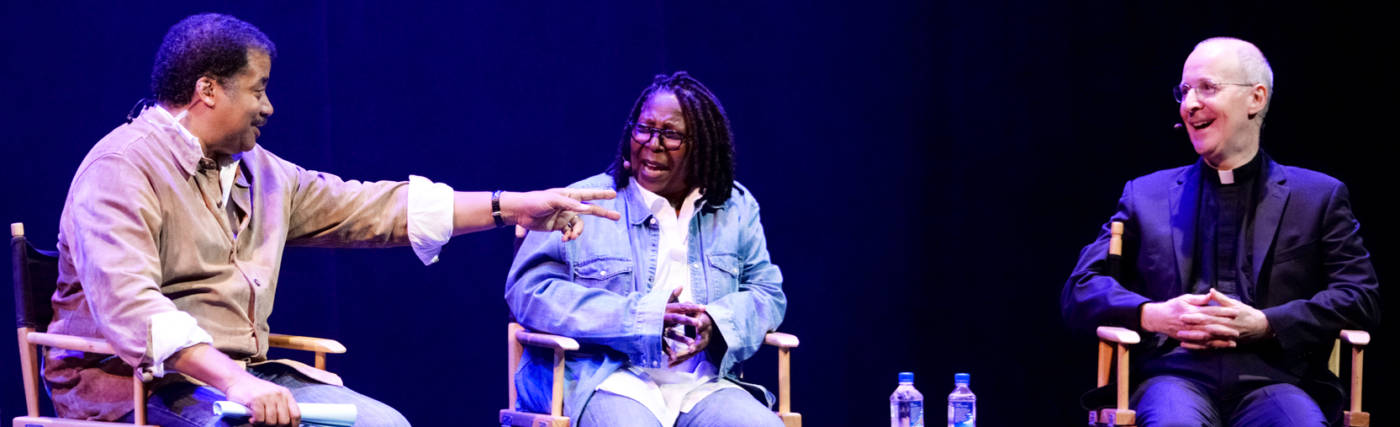
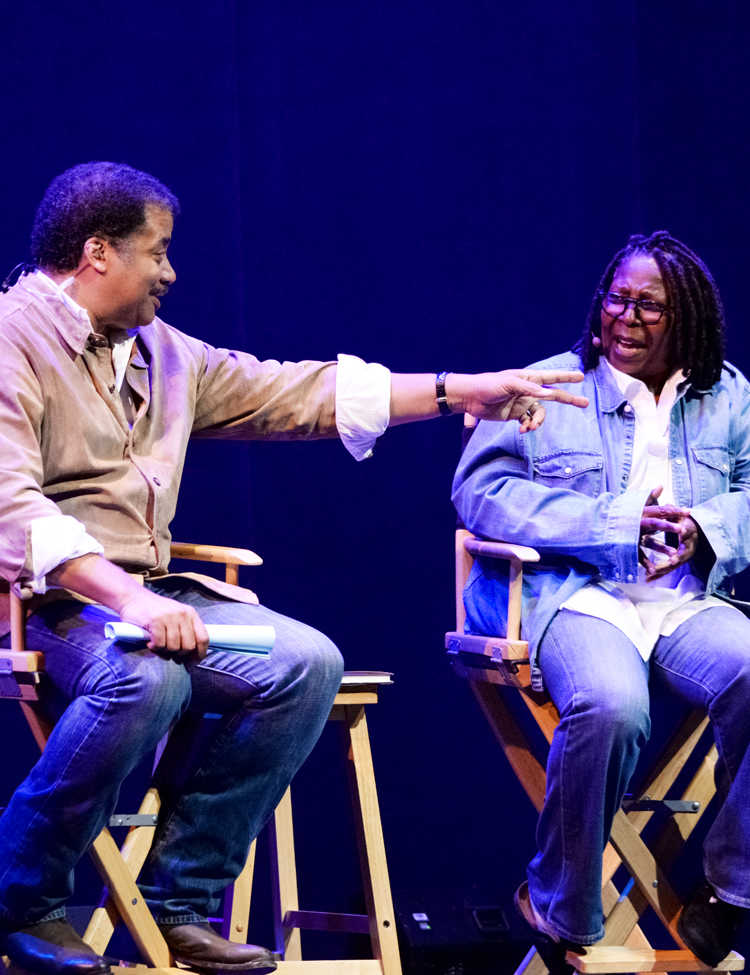


Elliot Severn's photo of Neil deGrasse Tyson, Whoopi Goldberg, and Rev. James Martin, SJ on stage at the Kings Theatre.

StarTalk Live! at Kings Theatre – Science and Morality (Part 2)

On stage at the Kings Theatre: Neil deGrasse Tyson, Whoopi Goldberg and Rev. James Martin, SJ. Photo Credit: Elliot Severn.
  • Free Audio
  • Ad-Free Audio

About This Episode

Is your moral compass still intact? It had better be, because we’re finishing up our investigation on science and morality by diving even further down the rabbit hole. Re-join Neil deGrasse Tyson, comic co-host Eugene Mirman, author and editor of Skeptic magazine Michael Shermer, Rev. James Martin, SJ, and comedians Michael Ian Black and Whoopi Goldberg as they continue live from the Kings Theatre in Brooklyn, NY (Recorded on 9/18/2017 during the tenth – and last – Eugene Mirman Comedy Festival). Part 2 picks up right as we discuss the importance of debunking wrong ideas that we’ve developed over time as a species. You’ll hear our onstage debate about whether science should help eradicate prejudice in the world – like the prejudice against the LGBTQ community. Explore the roles science and morality play in the public debate over reproductive rights. Father Martin shares his thoughts about the contributions of religion to our civilization’s moral arc – has it helped, hindered, or been neutral to moral progress? We also look to the future: is it immoral to kill a sentient A.I. machine? Is it moral to live forever? What will be considered immoral behavior in ten years that is accepted now? Last, but not least, we ponder whether, in certain moral situations, science is actually irrelevant. (Adult Language.)

NOTE: All-Access subscribers can watch or listen to this entire episode commercial-free here: StarTalk Live! at Kings Theatre: Science and Morality (Part 2).


Transcript

DOWNLOAD SRT
Welcome to Star Talk. Your place in the universe where science and pop culture collide. Star Talk begins right now. This is Star Talk Live from King's Theatre, Brooklyn, New York. We are talking about the science of morality with...
Welcome to Star Talk. Your place in the universe where science and pop culture collide. Star Talk begins right now. This is Star Talk Live from King's Theatre, Brooklyn, New York. We are talking about the science of morality with best-selling author Michael Shermer, lately author of The Moral Arc. He's also publisher and editor, I guess, editor-in-chief of Skeptics Magazine. Still enjoyable though. We're with Father James Martin. He's a Jesuit priest, his second time on Star Talk. We love him to death. We have a special guest appearance at Whoopi Goldberg. Whoopi, thanks for coming out for this. We've got Michael Ian Black, Michael, thanks, and also Eugene Mirman, Eugene. Eugene, I have a one-line bio for you in my notes here. It says, you're the voice of Gene Belcher in Bob's Burgers. I thought, surely there's more on his resume than that. But we'll accept the one-liner as a... Then I realized, this is part of the Eugene Mirman Comedy Festival, so that's a whole thing with his name. So, Eugene, thanks for keeping comedy. I don't know whether life would be bearable without the legions of comedians you bring to bear on all of society's challenges, so thanks for that. Thank you. It's probably safe to say we're the real heroes. So in your book, you have a chapter on LGBT rights. Can you comment on if science has anything to say about that? Well, okay, so first, at the very least, if the science informs us that it's not a choice, you're just born that way, that tells us that condemning it as a wrong choice is itself wrong, and so that at least gets us a step in the right direction. If we know something about biology and embryology and hormones and so on, and so there's this great spectrum in sexual choices and preferences, and so, not choices, preferences, that's why we use that word, it's just how it is, or orientation, then we can at least be more respectful. So in the book, I talk about the witch theory of causality. If you believe that burning women at the stake for cavorting with demons in the middle of the night as an explanation for storms and diseases and plagues, then you're either insane or you live 500 years ago. Now nobody burns women as witches in the West anyway, it's very rare elsewhere. And so we've been debunking essentially wrong ideas, mainly science, you know, that blacks are inferior, that women can't run companies and countries. These are wrong ideas, that Jews poison the wells or cause the plague or the stab in the back in the First World War. These are all wrong ideas and we debunk them to the point where no one even talks about it anymore. You don't even think about it. These are crazy ideas. And so... Oh, I don't poison wells, if that was the question. So Whoopi, you've had some LGBT activism in your day. Yes, I have. And so, here is someone who has been active and can comment on the success or failure rate of these efforts. Well, what's interesting is that what you're saying about science and what science knows and has been hesitant to say definitively, this is why you're wrong. Science hasn't come out and actively fought the prejudice people have. And in part, you're catching a lot of shit because when people think religion, you know, there are religious things, you know. People keep pointing to things in the Bible saying, well, it says man shall not lie with man. Well, I always tell people at my shows, have you read Isaiah? Have you read the rest of it? Because one of them is, you know, any man who has sex with an animal shall be put to death, but so shall the animal. My question, what did the animal do? You know what I mean? Anyone who curses their parents shall be put to death. Half the room is gone. It's so adultery to you have yes, I mean, you have you have this idea of what is moral and what is religiously moral and what is scientifically moral and trying to get the two to reconcile seems to be difficult because you just said as science knows, you know, it isn't a choice. You are born this way. I was talking and explain I often get into trouble because I say, well, if you believe in the Bible, you believe in Adam and Eve, you say, well, what happened? God said, hey, Adam, what's up? Adam said, I don't know. I'm feeling some kind of way. That was the black God. Yeah. What it be like? That's the TV black God. God says what I know what's wrong. You need some company if you believe, OK, what is it? Adam says, God says, take a deep breath, this is going to hurt. Goes in, gets a rib, pulls it out, pulls it out of the man, Adam. And structures a female, which says to me that God, if you believe in God and you believe in the Bible, gave us a sexual duality in us. So if you believe in God, this is God given. This is God given. So I say this in my show and people freak out. They don't they say that's not what God did. That's not God. So I don't know how to get both ends to stand up for community that desperately needs both your help. Very important point. Just to sort of still hit that but move it a little further. It's not only the LGBT community and you know, the woman within the man, the man within the woman, there's also lots of dialogue about whether contraception is immoral, especially from the Catholic Church and also abortion. Now here's what's interesting to me. I have conversations with my wife about this often. So you have generally the people who are anti-abortion. If you part the curtains, there's a religious foundation for their argument. But in principle, you could make just a non-killing another human argument without reference to God because Thou Shalt Not Kill is one of the Ten Commandments that's made it into secular law. So the rest, nobody really... Well, stealing. Stealing. Yeah. Sure. But graven images and stuff. That was very in its day. That was the thing. But just to be clear, I'm currently having sex with my neighbor's wife. That's cool, legally, right? Legally speaking, I'm fine. Frowned upon. It may be morally wrong, but you won't go to jail for it. So what I want to understand here is there's a moral judgment place coming from a religious community on abortion, yet one can say you are killing a living human being, whether or not it's yet sentient or viable, and you can say that the woman's body is her own. So all of these for her to choose. So all of these have arguments, some of them more religiously conceived than others. Can you now project into the future where morality will land on that spectrum? Well, we're about to go to the break and Neil wants to resolve the abortion issue. Yes, in 30 seconds or less. Can you invoke, are you going to invoke science to inform it? Well, you can invoke, okay, you can look at the trends, which has been more and more toward the autonomy and liberty of individuals to make their own decisions. So the abortion case is a special one in this case because, you know, the fetus is at least a potential human, but a higher moral principle is that the women should be free to choose because of a whole host of historical reasons and that there are certain moral values that are higher than others. But you're making a moral judgment by saying the woman has the higher moral principle. Well, so what I'm invoking is the historical tendency for liberal democracies to give more people more rights in more areas of life over time. And so, again, we're back to the arc. The arc. So women having reproductive control over their choices is a step in the right direction because for thousands of years, men have lorded it over women to make that choice for them. And that is a kind of slavery. It's a kind of controlling somebody else. So moving away from that. Now, you know, admittedly, the abortion issues complicate. You know, you can be against abortion and pro-choice. You can say, I'm not going to do it, but I recognize your freedom to choose what you want to do. Well, that's the that's the that's the gay marriage issue. So if you don't like gay marriage, then just don't get gay marriage. That's right. It's not it's not a requirement. Kind of. Yes. Not requiring it of you for this to be to be the case. Did you just kill my joke? If you don't believe in gay marriage, don't marry a gay person. That's the joke. Oh, yeah. That is how you should have phrased it, Neil. Ahead. So here's a point to those issues, okay? Religion is clearly bringing a pre-existing foundation of moral judgment to these issues, clearly, okay? Recognizing Father, as you've said candidly, that it can evolve as we go forward by discussion or analysis or whatever. If science, up till now, you've mentioned science only in the context of informing people about how they might make a decision, but at no time are you saying that the science itself is saying what is moral? Well, I am saying that actually. I haven't quite gotten there yet. You haven't said it like explicitly. If I ask you, if science has the power to shape morals, should it? Well, yes. Because wouldn't that then carry in just the way different religions carry in to this table? Wouldn't that carry in maybe the biases or preconceptions of the scientific community at that time? Go back a hundred... When was the Tuskegee experiment? Forties. In the 1940s. 30s and 40s. The medical doctors giving out of the Tuskegee Institute not treating syphilis when they could have, leading the black men to believe that they were getting medication so that they can study the progress of the disease, yet not telling them. This is like a moral failure of the medical community who were conducting a scientific experiment. But isn't that partially because the moral failure was not of the scientists but of the time because these men were not seen as human beings. But if it's already in you, why didn't it become a moral decision? Well, because again, we have the inner demons and the better angels or the sinful nature. There's that other side where, as you put it, we can get them cheap. Well, there's plenty of people that are willing to go along with that and rationalize it with biblical arguments or we're saving their souls for Christianity or whatever. But we don't think like that anymore because we've debunked this idea that they actually like being slaves. No, they don't. You're wrong about that. Boom. Now, sometimes you got to fight, you got to pass the laws, fight the wars, whatever. But once you get there, what are the chances? Okay, slavery is illegal in every country in the world, all 192 countries. What are the chances that any of those countries would bring it back as a legal institution? No, no. I don't even want to tell you this, but you would be shocked to find out how many countries are engaged in slavery. The point here is, there's whatever the country says and then there's what's happening as they turn a blind eye to it. The moral thing. So again, you got people that, bad people that just want to exploit people. The point is having a law first and then enforce the law. These are mostly in countries where the governments are weak or corrupt and they can't enforce their laws. So anyway, a lot of this is... Is there a place science should just stay out of in the moral fiber? And I might even ask the same of religion. If you have 10 different religions giving you 10 different moral interpretations of conduct, maybe none of them should be listened to and we go to a secular analysis of it. Yeah. I mean, I think there's... I think there are plenty of places. I mean, we have separation of church and state. Thank God in this country, there are plenty of places. I mean, truly, there are plenty of places where religion... You can bring your moral person who is informed by your religion. But there are plenty of times when religion does not need to be explicitly applied to a particular situation. Absolutely. And we have also seen times when religion has been applied unjustly, you know, or immorally. But I would say, I mean, I think the LGBT case is a good one in terms of how science informs us. So this idea that which we now discard, I think most, you know, reputable psychologists and psychiatrists, that it's a choice, right? So since people understand it as something that you are born, you know, as Lady Gaga says, born that way, right? No, it's true. But she said born this way. Thank you. Not that way. This way. I'm 56, so, yeah. That, you know, You get credit just for quoting Lady Gaga at all. That, you know, we understand that it is not, which we used to think, many people used to think was a choice and therefore a moral choice, right? And so therefore the person who chose that was immoral and bad and so needed to be condemned. And so now, I mean, I think you're seeing this diminution of people, you know, who actually think that. And the majority understand, not only through their own experience with their families and people coming out, but thank God, science, which actually, I think, is going to eradicate a lot of that prejudice, you know, or at least most of it that says that this is some sort of choice. And thank God. So, I mean, in a sense, that's where science can really inform. I think that's a great case where science can really inform and we can see it in a lifetime, a moral choice. Can I ask another very unfunny question? That's sort of what I did. Both. I feel like what both of you are saying is that in terms of how morality developed, it seems like it has to do with scarcity of resources that in order to propagate and make our species survive, et cetera, et cetera, et cetera, we need to cooperate. What I understand morality to originate in biblical writings is that it had to do with a similar thing, keeping the tribe safe, keeping people safe, learning how to cooperate for propagation and essentially harmony. Doesn't there come a point? That's not what he said, but we'll keep going. I'm not listening to what he said. I'm just saying what I understand. Doesn't there come a point? If everybody is harmonious and cooperating, doesn't resources become more scarce and doesn't that make us actually more likely to tip into entropy, leaning us back into the second law of thermodynamics? Back to the physicist. Isn't it too soon to say that World War II was 60 years ago? That's less than an eye blink. And that was the most devastating war in human history, right? So who are we to say that in 10 years, it's not going to happen again? I mean, there's a lot of people think we're going to war with China. They got a billion people there. That's going to suck. First of all, how are they going to get here? Who? The Chinese. Zeppelins. Just like people feared in 1910. I do want to make one small point. Even if it turned out that being gay was a choice, it's still not okay to oppress gay people because there's a higher moral principle that you have autonomy and freedom over your body to choose whatever you want if no one else is harmed. So to that point, I'm going to add punctuation and then I'm going to end this segment. If you hadn't made that point, I would have coming out of this segment. Because there's a point where... And if you hadn't, I would have. I think this is the easiest case to say this about, but there are probably other cases for which this applies. There are times where I would declare that the science is irrelevant. I was asked this from a magazine that served the gay community. They said, what's your stand on whether science shows that it is a choice or inbred? And I said, it doesn't matter what the science says. We live in a free country, or at least we tell ourselves we live in a free country. And for me, what consenting adults do is an expression of what it means to live in a free country, no matter whether science says that that's your choice or not. So you should not be waiting around for that scientific result and then grabbing it and putting it forward if it says it's not a choice. Because if the science happened to say it is a choice, then you're going to have to reject the science and say you need it on the principles of the founding fathers of this country. So that would be a case where if it's about human freedom, it's not about the science. It's about what we choose as a secular society. But do we only live in a secular society? I said, but that would be so if we only lived in a secular society. You know what I'm saying. I know. I'm just saying. You know. That ends our second segment of Star Talk Live. Bye. We're going to try to see if we can expand the moral sphere of this. And so let me ask you, Father, would you say that religion on the whole has helped, hindered or been neutral to this arc of moral progress that Michael talks about? Well, I would say, and this is going to sound very Jesuitical, but- That's a word. That is a word. Jesuitical. It is a word. I'm using it tomorrow. But it depends, do you mean the way that people have actually lived religion, or do you mean actual religion? I mean, that's like that Gandhi quote about, right, I'd love to meet a Christian one day. I think people who really live religious lives, someone like Francis of Assisi or say in our day someone like Pope Francis, does change the world for the good. But there are other people who have used religion just as evilly. In general, I would say that religion has been a moderating influence on some of our worst tendencies, our selfish tendencies, the golden rule, for example. But I would also say that religion has been used to subjugate people, and religious wars in particular, where religion versus religion has actually led to great suffering. For example, the foundations of a lot of anti-Semitism in Europe, which led to the Holocaust, were religiously based. So it's a very complex question. Once again, it depends what you mean by religion and who you're talking about, and how they live out their religion. So is there some sort of moral place you can see us heading towards? Again, I'm on this arc concept here. In 10 years, something going on now that you say religion will be a good force in that, and in 10 years that'll be better. Oh, yeah. I mean, I know I'm a little biased, but I think that, to be very specific, I think that Pope Francis' shift to a church that is more focused on mercy and compassion. I mean, that is his constant theme, right? As opposed to blame and judgment. He has said specifically, I think that we have been talking too much about sexual morality, right? And I think in a sense, everybody knows what the church teaches. And so I want to bring us back to the basics, which is mercy, compassion and desire for justice for the poor. And I think that if people actually put that into action, we'll be a lot better off. And he's not afraid to shake things up. The question is, again, and to your point, and I know you've raised this a couple of times, the question is, do we accept that or not? I mean, do we as individuals accept that migrants and refugees have as much place as anyone on the stage does, right? I mean, they're individuals who are desirous of something good. Or do we individually and as a community and as a nation reject that? Right. So I mean, that's the that's the difficult thing, because we are sinful and selfish and we have to work against those things. Do you agree with I mean, I can't see how you do. But Father, do you agree that the higher moral principle in the abortion debate is that women have autonomy versus an an an a fetus? I mean, that is a very, you know, I thought we left abortion before the break. But but but look, it's going to get this is going to get cut out anyway. But yeah, you're both you're both moral authorities. You're from a scientific point of view, you from religious point of view. I assume you both feel like you can claim the higher moral principle from your point of view. So how does a layman like me go? Yeah, he's right. Or he's right. Or in Whoopi's case, well, but I think I think that's where your conscience comes in. I mean, it's not simply I know that old thing. You know, it's not it's not simply. I mean, in a sense, you know, it's not simply sort of an imposition of rules from the outside. It's also your own conscience. I mean, you know, one of the great things about the church that people I think forget about is, is this this idea of the primacy of your conscience, you know, where as as one church document says, you know, God's voice resounds in you. Right. And so so there's that, too. And it's I mean, because we don't know. This is one of the things that Pope Francis is trying to remind us of. You know, life is not about black and white laws. Right. There are black and white laws and in some cases, yes or no laws. But in most cases, you know, our lives are very gray. And so it's a it's a development of the conscience and a development for the Christian. I mean, I'm sorry to focus on Christianity so much on Jesus and an encounter with Jesus and seeing and noticing what he does and how he treats people. And so one one one moves from that. The degree to which you agree with Pope Francis may certainly be genuine, but we should be reminded that he is your boss. That's right, that's right, clear about that. Let me go back in time. Darwinian evolution was used by anthropologists. Can I just get a response to that? Well, because I have a few comments to make on religion. And I'm reminded of Winston Churchill's comment about Americans. You can always count on Americans to do the right thing after they've tried everything else. I thought it was to do the right thing eventually. Eventually. One of those. Yeah. Okay. That was Spike Lee. And you can't. Do the right thing. Religions do come around slowly. And so when the Father talks about we change our conscience, religion is almost always lagged behind by a decade or so from the culture that's already making the shift. Just think about interracial marriage. Remember when that was a thing? Yeah. Me neither. In 1967, it was illegal in the United States. It was illegal. And now it's not. No one even talks about it anymore. In 1959, a poll showed that 96 percent of Americans were against interracial marriage. Now they don't even ask the question anymore. Oh, no, they do. Religions oppose. Oh, they do? Well, religions opposed interracial marriage. Now they don't. What happened? The culture shifted. And so the wave is like this and religion is kind of coming up behind the wave. The surfer that catches it after it's already broke. That's my metaphor. He lives in a surfing community now. Yeah. Whoopi. So is it? Is it? Are we actually talking about morality or are we actually talking about empathy? Well, I think they're I think they go together. No, I don't know if they do. That's why I'm asking. Because I think when you ask a question in 10 years, I think depending on how you educate your children, I grew up with Trick or Treat for UNICEF. And because I grew up with Trick or Treat for UNICEF and the chocolate bars that we sold, we were told this was helping children like us around the world. You were selling chocolate bars to other children on Halloween? That's immoral. No, no, no. That's immoral. But when I was a kid, I went to Catholic school. And so we would have these drives to raise money for the school and also to raise money for other communities. And you bring home these few pennies, and that was your bit. And you, well, you know, if you did it for Halloween, you got a lot of money, got those pennies. But see, people don't give pennies anymore. But we felt we were, we had some hand in making the world better. And so I don't know if we thought of it as being moral. We just thought of it as doing the right thing to help the world. So do we actually just sort of whittle this down to empathy? Well, that's a great question. Let me broaden it by asking, do you teach this in schools? Can you teach morality in schools, even if it's this little exercise of a UNICEF collection? I think it starts with parents, siblings, peers, and so on. It gets inculcated in culture. Most of the kinds of shifts we've been talking about have come more from the bottom up than the top down. Yes, you do need the laws passed, sometimes you need the military to go in, but most of the time it's just our language changes. If you look at literature from the 30s versus the 50s versus the 90s and so on, comic books, films, novels, all of it shifts, the words you use, the way you describe characters and all that, just that moment when Ellen says on that show, into the microphone, I'm gay or whatever, the words she said, that was a big step. Now, 10 years later, Seinfeld makes a joke about not that there's anything wrong with it. Now we laugh about it, now it's just kind of commonplace, gay, whatever dude, who cares? And that's how it kind of just, it happens slow enough you don't really notice it. And the other problem is the media only covers the bad stuff. So for every act of violence, school shootings you see on TV, there's 10,000 acts of kindness every day that go unreported. So going forward, should the religious leaders, the religious community work with scientists to shape this moral arc? And it's one thing to say religion has lagged a decade behind or more. But religion has huge influence in the Western world, especially in the United States. So it's not something that should be discounted in its role in shaping society. So are there, is there your, you or your counterparts reaching out, I know Carl Sagan did. Carl Sagan would have meetings with religious leaders just to talk about saving the world and how can that best be accomplished. So I have to presume, Father, that your very presence on the stage is a step in that direction to reach for scientists to find out what we're thinking and how and why. That book was almost called Who Cares Your Gay Dude. You suggest, might there be a future of collaboration with what scientists, philosophers are thinking? Well, yeah, I would think, I mean, there already is. I mean, in most sort of forward thinking churches, there is no fear and there should be no fear of science. Well, I mean, they're both geared towards the truth, basically, and sort of unearthing the truth and helping us understand things better and understand the world better. In the latest encyclical, the Holy Father spoke at length about climate change. Of course. Right. And you know, it's interesting. Of course? Did you say like that? Oh, no, I know. Why, of course, for him. But not for a religious leader. He's a politician to talk about it. He is also a scientist. He was a chemist. You know, as a Jesuit, he studied chemistry and taught chemistry. Yes, hooray for chemists. And so, you know, and I think this is, I think this, the encyclical Laudato Si, which talks about climate change and the economy and the connection between the effects of, the disproportionate effects of climate change on the poor. I mean, he links those things. He uses not only, you know, science, quasi-science, but economics, right, in terms of helping us understand the world. So there, I think that's a really great example of a way that the church or a church can use things like science, climate change, economics to help us understand what is, I think, at heart a moral document. It was funny, I was on this panel with Cardinal Turkson, who was a Cardinal from Ghana, and he was the one in charge of the encyclical Laudato Si, and he said, you know what? He said this is not an encyclical about the climate, it is a social encyclical. It is about encyclical about society, right, and about our culture. And so that's a great example of how those two things can be brought together, and we have nothing to fear from that, nor should we. I mean, there are some people who do, but we shouldn't. I think at least once a week, I ask myself, because as I see the landscape shifting under our feet, particularly for old fogies, you say, oh, young whippersnappers, they, you know, I don't want to be that guy. So I'm trying to stay with it as things shift, and my kids are keeping me in touch. So I ask myself, I pose to my kids, I say, what do you think you're doing today where your kids will say, Mommy, Daddy, you are so out of it. And so I came up with one. I think I came up with one. I would say there's at least a dozen or more sports in the Olympics that should not be segregated by gender, like archery and shooting and badminton. But they are still segregated. I think there's a day when all these attentions will be focused on competitive sports. Even why women's tennis, why don't they play the same number of sets as men? They're just as fit. They can last just as long. It's just so ridiculous. Right. I've forgotten about that. Right. They play three sets instead of five. Right. Right. So there are things like that that no one is focusing on yet. But it is a difference, in that case, between men and women, built into, baked into society on a level that we're not even recognizing because maybe there are too many other more important things we've got that are distracting us. But you know, I think that's a great example. You can see the shift in how we look at football right now in terms of the brain injuries, right? And what that does to people who play. And maybe in a couple of years we'll say, how could we have ever allowed people to play in that particular way, football, if it was hurting their brains and was not a form of exploitation of those people, particularly those young men? Yeah, I agree. And I think we have to start thinking about those things now. You Father, if we create a sentient robot, is it immoral to kill it? Oh my gosh. Okay, that's the next papal encyclical, I guess, right? Can we talk about the eclipse instead? No. Well, yes. Yes, absolutely. Data is a person. Personhood is what we're talking. Sentience leads to personhood, leads to rights, it's murder. So who will judge that it's sentient? I'll do it. If I pulled you from 20 years ago, and I just had you have a conversation with Siri, you would say that my device was sentient. If I took a sledgehammer to it, you would then object. I don't know. Today is thinking Siri is sentient. That's right. We have a little ways to go before this happens. So now is the time to be thinking about how should the law deal with that. Same with animals, higher primates and so on. Higher, you value judging them. Well, the criteria. Just say yes and you value judge it. Yes. Okay. Yes. Yes. It's not higher or lower. They're all around today, evolved from the beginning of the family tree. That's right. Okay. Yes. But I eat plants and some meat. Yeah. But not much like what just like dumb ducks. A subset of the vegetarian community sees eating animals as immoral, not just something for health or environment or whatever. Do you see that as? Yeah. As you were talking, I was thinking, I can imagine, I don't know, but I can imagine in 50 years people looking back and saying, I cannot believe people ate those animals. I cannot believe they killed them and raised them. Yeah, I mean, I can see that. I'm not a vegetarian, but I can totally understand how someone could feel that, and I could understand in 50 years how that becomes law. Well, let's not predict something so horrible. Why am I going to be dead? You don't know me. I could live to be 120. Yeah, that's the plan. There is that generation who will be born where they will never die because they will always be available for the next thing that will prolong life. Yeah. Isn't that immoral? Do you live forever? If you're living on a planet with limited resources, isn't it? No, you explore outer space. Yeah. Resources are unlimited. Let me ask each of you just for some parting thoughts. Why don't we end on the father? I mean, he'll be something about like, love it up, lovers. But then I'll be like in here as I've studied over the generations. Okay. Eugene, what do you have for us? Just give me some summative thoughts. You can even reflect on what would morality look like in a hundred years. So is this Jerry's final moment? Yeah. What will morality look like in a hundred years? There will be, I think, unless we destroy ourselves. Are you optimistic? Say it again. Are you optimistic? I am. I think that it will be largely better. I do think that overall things get better and better. I think that football will either be significantly more violent or gone. That's basically it. But I think overall, yeah, I think it'll be better. Hopefully, the people still eat fish. Jesus, come on. Sorry, I didn't mean it. Anyway. And he did. Michael. Well, I've rarely been as frustrated in a conversation as I have been in this one. I think they're both full of shit. I think everything that you're saying is great and scientifically based. And I think everything you're saying is great. And I think that one nuclear bomb or one crazy person obdiates all of it. And it doesn't matter what you're saying. That's the power in the hands of those who are immoral. Yeah, but I also think that- Renders moot the statements of those who are. Yeah. Nothing inevitable about this. I didn't call on you yet. Nope. Okay. All right. So you're not optimistic about this. It's not that I'm not optimistic, but I don't feel like we've come any closer to solving the question of morality in this conversation. But I was mostly thinking about jokes the whole time. Agreed. It's not inevitable. The whole thing could go south, absolutely. Go south, that's a value judgment of this direction. All the more reason to keep working on- You pass moral judgment on the south in that sentence. Sorry. Things could go north really fast. We end up in Canada because of global warming. Yeah. Then they're going to build that wall and make us pay for it anyway. So- The Canadians building the wall making us pay for it. It's three steps forward, two steps back. We have to keep chipping away at it and working at it. In part, science and technology is part of the solution. Synthetic meat, we are getting there. Within a few decades, we won't need factory farms anymore. You can just grow it and make it a profitable thing for companies and we'll have burgers and steaks that are just as marbled and tasty. Oh, boy. But isn't there also the argument that cows- I didn't ask you. I know, but the cows will go extinct if we do that. The what? Cows will go extinct if we do that or close to that. Well- Unless you can make cows your pets, the only place you'll find cows is in India. Yeah. Right. So isn't that a rule? Cow only exists for that purpose. They still use them for milk, I guess. Yeah. So one- Butter. Butter, yeah. Butter, cheese, all milk products. Yeah. So technology. Then I agree, Neil, I think in the last chapter of the Moral Archive, I speculated on us becoming a multi-planetary space-faring civilization in which there's no more nation states either. Nation states is a temporary stage in human history. Cities are the oldest structures we have, the oldest collective organizations we have. There are cities that are thousands of years old. There are no nations that are thousands of years old. The borders change. These will come and go. Once you just open the borders up and let people do whatever they want to do, then there'll be more freedom and autonomy and this will reduce the chances of nuclear war and things like that. So I'm optimistic. Optimistic. Okay. Just one note. In Martin Luther King's, I have a dream speech. There's a very significant moment where he speaks of the moral arc bending towards righteousness. Justice. Justice. The moral arc bends towards justice. Whoops. What's it got for us? I know you got something, don't you? I don't know what I got for you. I think that it is incumbent upon us all as individuals to decide who we are morally. Whether it's inbred in you, these are things that come to you because of your experiences, what you learn, what you know, who's taught you, what you believe, what you've come to believe. I think that those are important things. You can put it in science and you can put it in God and whatever it is, it's still you. You have to decide morally what and who you're going to be and you can blame it on God or blame it on science but when it comes down to it, it's your choice, I think. But that's just me. I smoke too much weed. So, Jesuit James, what do you have for us? I smoke just as much, probably. I know. That's why they put us together. Not recently, though. No, I mean, I would agree. I would agree with that and say it's up to the individual. I would also say it's up to us as a community. So, in terms of where we're going, I'll try not on a positive note, but I think that the last two years have made me not optimistic. The last two years, I think that at least in the United States, that we've gotten angrier and more divided and more coarsened. I think you could make the argument worldwide too in general. But I would say that as a Christian, I'm hopeful. But it really, it's up to us. I mean, it is a choice. I mean, and it is a moral choice whether or not we're going to be generous or not. So I'm not optimistic, but I remain hopeful. So I'd like to offer a system. I'm an astrophysicist, so that's the lens through which I view the world for better or for worse. A bit of this that we lost a little bit track of from the beginning, was the sense of cooperation and how morality feeds into the survival of a community, and not only the survival, but whether or not it thrives. And so when I think of the reasons people have fought wars, many of them, if not most, have been access to limited resources. Many other wars fought on the premise of one religion versus another. When you part the curtains, again, it's access to resources, either natural resources or land itself. So when I think of space, space, in fact, has unlimited resources. There are ingredients on earth called rare earth elements. It's an entire row of the periodic table that are fundamental to modern electronics. And most of those are in China. And so that's kind of interesting. So that's a limited resources. By the way, there are asteroids that are primarily made of metal that have an abundance of rare earth elements, an abundance of iridium, platinum, gold, silver, copper. So in the future, let's go 100 years, a thousand years into the future, it's possible that we can remove war over limited resources. We can remove that incentive entirely if we have access to the unlimited resources of space. Not only mineral resources, but energy resources. Wars have been fought over energy. And so when I see this, I add to this fact that the Hubble Telescope, the most productive scientific instrument there ever was, responsible for 20,000 research papers with collaborators in every country in which you find an astrophysicist. Wait, what word did I use? Collaborators. Do you know the International Space Station is the greatest collaboration of nations outside of the waging of war that there ever was? The Olympics and the World Cup are a distant second and third to that. The scientific community and especially astrophysicists, because our targets of interest are up there and up there is not divided by national boundary or religion or by who's in charge. Up there is space and it's over everybody's head. And so when we study the universe, I'll pull out a telescope, I look here, somebody in another country also looks at that object and we compare notes. We are scientific colleagues. We publish papers together. It may be that the future of morality is rolled up in what it takes to get along. And what I know firsthand is that when you do science, you get along. You get along because the object of your affection sits outside of ourselves. It's a higher purpose, a higher goal to understand the nature of this universe in which we live. So, I foresee in the centuries to come, if space becomes accessible to us, I see a time where we will only know peace and look back at a time when people killed one another because of our differences and we said, my gosh, how could that have ever happened because today we celebrate one another because of our differences? And that is a cosmic perspective coming to you from Star Talk. Join me in thanking Father James Martin, Whoopi Goldberg, Michael Shermer, Michael Ian Black, Eugene Mirman, the Eugene Mirman Comedy Festival. This has been Star Talk. We have been live at the King's Theatre in Brooklyn and you've been an amazing audience. Thank you all, and good night. Good night.
See the full transcript

In This Episode

  • Host

    Neil deGrasse Tyson

    Neil deGrasse Tyson
    Astrophysicist
  • Co-Host

    Eugene Mirman

    Eugene Mirman
    Comedian
  • Guest

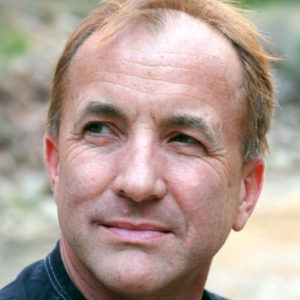
    Michael Shermer

    Michael Shermer
    Founding Publisher of Skeptic magazine; Author of The Moral Arc: How Science Makes Us Better People
  • Guest

    Michael Ian Black

    Michael Ian Black
    Comedian
  • Guest

    Rev. James Martin

    Rev. James Martin, SJ
    Jesuit Priest, editor-at-large of America, The National Catholic Review, author of Building a Bridge: How the Catholic Church and the LGBT Community Can Enter into a Relationship of Respect, Compassion, and Sensitivity
  • Guest

    Whoopi Goldberg

    Whoopi Goldberg
    Actress, Comedian, TV Host

Get the most out of StarTalk!

Ad-Free Audio Downloads
Priority Cosmic Queries
Patreon Exclusive AMAs
Signed Books from Neil
Live Streams with Neil
Learn the Meaning of Life
...and much more

Episode Topics