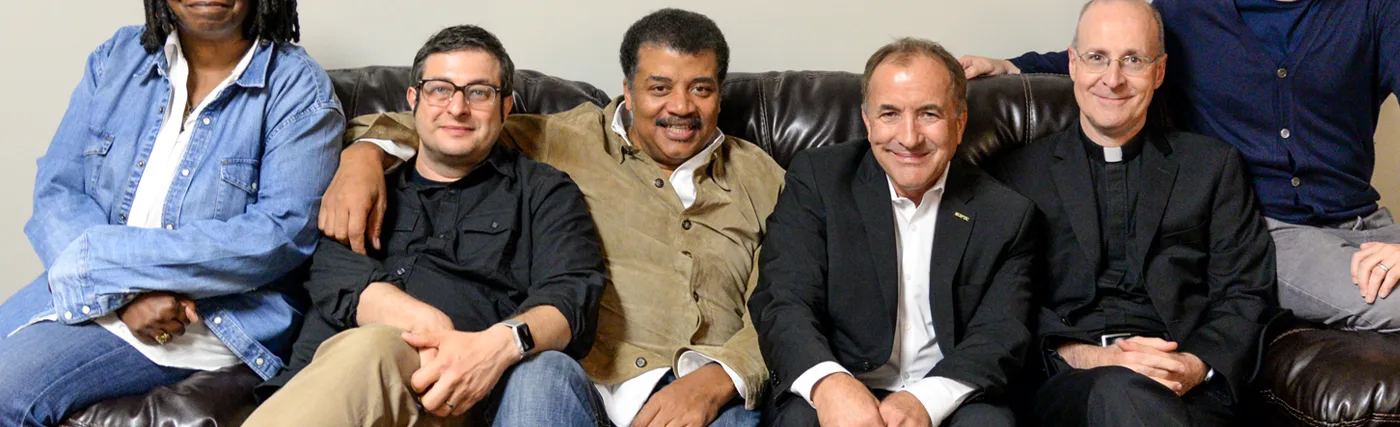
What is right and what is wrong? How do we set our moral compass? On this episode of StarTalk Radio, recorded live at the Kings Theatre in Brooklyn, New York, as a part of the final Eugene Mirman Comedy Festival, we explore the intersection of science and morality. Neil deGrasse Tyson is joined by comic co-host Eugene Mirman, author and editor of Skeptic magazine Michael Shermer, comedian Michael Ian Black, Rev. James Martin, SJ, and the legendary Whoopi Goldberg. Explore the different origins of how people get their sense of right and wrong, including how Whoopi got hers from her mother. Ponder the definition of morality through the lens of religion in our modern society. You’ll confront the idea that morality might just be a constructed narrative that humanity uses to justify actions. Discover if other animals have any sense of morality. You’ll also ponder how much of morality is culturally conditioned and/or shaped by the time in which you live. You’ll hear if science can be used to determine human values, whether the moral arc of civilization is constantly evolving, and more about the comparative method of natural experiments. Be on the lookout for Part 2 next Friday! (Warning: Adult Language).
Transcript
DOWNLOAD SRT
Welcome to StarTalk, your place in the universe where science and pop culture collide. StarTalk begins right now. Brooklyn in the house, yes. Tonight's subject is on the topic of morality and all the ways that science might or might...
Welcome to StarTalk, your place in the universe where science and pop culture collide.
StarTalk begins right now.
Brooklyn in the house, yes.
Tonight's subject is on the topic of morality and all the ways that science might or might not inform our future judgments regarding it.
And we have a panel specifically tuned for that purpose.
People of high and low moral stature just...
Let me first introduce a comedian, Michael Ian Black.
Michael, come on out.
Not only a comedian, an actor, a director.
You've been seeing the Jim Gaffigan show.
Comedy Central is another period.
And Netflix, we had a wet summer.
Wet Hot American Summer.
Wet Hot American Summer.
Wet Summer.
Close enough.
I'd also like to introduce the founding editor and publisher of Skeptics magazine, Michael Shermer.
Michael Shermer, come on out.
Michael Shermer is author of The Moral Arc, How Science and Reason Lead Humanity Towards Truth, Justice and Freedom.
Audacious of you to do such a thing.
Who else do we have here?
Because not all morality perhaps comes from rational thought.
Perhaps it comes from religious thought.
And we'll bring out Father James Martin, a Jesuit priest.
Father Martin, come on out.
Hello, Father.
He's actually the best-selling author of A Jesus Pilgrimage.
Did I get that name right?
The name of that?
Jesus a pilgrimage, correct.
Jesus a pilgrimage.
And most recently, Building a Bridge.
And this is subtitled How the Catholic Church and the LGBT Community Can Enter into a Relationship of Reflection, Compassion and Sensitivity.
Whoa, where did this come from?
Will you be excommunicated tomorrow for having done this?
Depends what I say tonight.
Excellent.
How many seats we have left?
One seat left.
Join me in giving a warm Brooklyn welcome to Whoopi Goldberg.
All right, let's do this.
StarTalk Live, Kings Theatre, Brooklyn, in the house.
So, Michael, you're, this is not your first rodeo with books on morality.
Third rodeo, okay.
What is your sense of the origins of what is right and wrong?
Do you have some thoughts about that?
I think since you're a physicist and you have the best-selling physics book of all time, I'd start with physics.
For the moment.
I'm going to start with physics.
The second law of thermodynamics, entropy, the universe is running down, everything dissolves, hot things get cold, organisms wear out and so forth.
So the first, second law of thermodynamics is the first law of life, which is to push back against entropy.
That is to go up the energy gradient by doing things with your cells, by replicating, by flourishing, by consuming energy and so forth.
Okay, so the most selfish thing you could do would be to hoard all the resources you can, be selfish.
This selfish gene kind of thinking.
But the problem with that is that if you live in a social community, everybody else who acts like that, it's not going to work.
It's going to fall apart.
If you're super selfish and I'm super selfish and if we're just hoarding the resources from each other, this is going to dissolve.
So the most selfish thing I could do at times...
That could dissolve into war and death and bloodshed.
Or simply into Ayn Rand novels.
Yes, that's a dystopian Atlas, right?
It's true.
Well, it's sort of a Hobbes, you know, nasty, brutish and short.
So part of life is like that.
But sometimes the most selfish thing you can do is to be cooperative, altruistic, helpful, nice, be a good friend, be a reliable, respectful person with a good reputation.
Because that way, when you help somebody, when they're in need, when your time comes, when you need help, then they're more likely to help you.
Now, it's not a cold calculation, like I'm going to trick you into thinking I'm nice and then I'm going to stab you in the back once I get your resources.
No, because you'll know that I'm faking.
Because our brains are fine-tuned to notice when people are lying or people are dissembling or where they're narcissistic in an inauthentic way.
And so it's not enough to fake.
He's not talking about any one in particular.
No, no one here.
Our brains aren't fine-tuned enough to tell when someone's narcissistic.
It's those people in California.
No, no, that's where I'm from.
No.
No, it's not enough to fake being a nice person.
You actually have to be a nice person.
Not in my experience.
There's our one.
We have picked out the psychopath on the panel.
We found him because it's about three out of 100 or so.
Anyway.
Three out of 100?
Three out of 100 people are psychopaths?
Yeah, about three out of 100.
Well, men, three out of 100 men.
Sure.
I could have told you that.
It's true.
I'm sorry to say.
So you're describing something that is evolutionarily pre-selected for our own survival.
That's right.
So it's not enough to fake being a good person.
You actually have to feel it.
You have to have the genuine moral emotions of wanting to help and feeling good about that.
Now, it's not to say that human nature is we're all good because we have a dark side.
We have our inner demons and our better angels in competition.
So the whole point of structuring a civil society in a way is to nudge the incentives to get people to be nicer and knock back those super selfish tendencies.
And it's a constant tug and pull of what we should do in this particular community or society or whatever to get people to be nicer.
So you're saying to be moral is for our own collective survival.
And that is sort of self-selecting.
And your survival.
That means better for you.
Okay, you maybe can benefit by being super selfish and betraying your friends and so on.
Yes, those people can get away with it.
But if too many of us act like that, the whole system falls apart.
So we've evolved the propensity where most people, most of the time, are nice.
Wait, so what number, like in a culture, like in a society, what's the number of like assholes that can handle?
Yes, that's right.
The threshold.
Yeah, what's the asshole threshold?
It's about, really, there's studies on this, it's about 20 percent, about 20.
About 20 percent, well, if you go out from the backstabbing psychopaths out to just the not so nice assholes.
So someone will eat your doughnut when you turn around.
Yeah, that's about like one out of five, but those people, most of those 20 percent are reformable.
You can, in other words, if you catch, if you put a mirror in front of the doughnut stand there at the company.
Then there's two doughnuts.
That's very good.
You're right about it.
What's the physics of that with the?
So, so, Father.
Father, Jesuit Father.
Another big laugh line.
First, this is not your first time on StarTalk.
I am very happy to be back.
You, you, you, you came back.
Thank you for coming back.
Thank you for inviting me.
And.
Earlier, we wanted to get cozy with you, call you Jesuit James, that kind of sound like Jesse James, Jesuit James, whatever you want.
So if you can first speak more broadly about religion, certainly as manifested in modern American society, and then perhaps more specifically from the view of Catholicism, does, does what Michael said.
Is that embraced as something that God knows about and put in place or, or do you require some other deeper infusion of understanding of morality in religious thought?
That's a great way of asking the question.
A lot of what Michael says makes sense to me and is accepted, and certainly science and faith, there's no sort of conflict, I think, at least for a Catholic.
You know, for example, the idea that we would have certain emotions that would lead us to do good things, I would definitely agree with that and that those emotions will ultimately lead to the common good, we would say, in the Catholic Church.
I think the added gloss I would put on that is that for us, for a religious person, those notions and those emotions come from God.
And so I also agree that there are these different forces pulling us apart and pulling in different ways, and we all know that.
We have sort of selfish and selfless desires, and we can feel that tug of war.
And what I would say is that the desire to do good is really God's voice within you, right?
I mean, you don't hear voices, but you feel this desire to do something good.
And that's one way that you have of helping other people and, in a sense, carrying out God's will.
And what is that called?
That's called your conscience, basically.
And so that's how I see it, that God, that the moral law is spoken to us through our conscience.
And then, you know, through reflection, throughout thousands of years of history, we have given voice to that, you know, in terms of laws and the Bible and things like that.
You know, the Ten Commandments are kind of an expression of that, for that culture back then.
So, yeah, so I mean, I would agree with a lot of that.
OK, OK, but the the so what I'm curious about here is the there are many people who are not moral.
So would you say that all the people who are not moral and all that, which would include everyone who is justifiably in prison, they as a community are without God?
That's what you would be forced to conclude that based on your statement.
So that you cannot say this moral imperative is put into everyone by God.
It is put into some people and not others by God.
Well, I would say that actually God is with everyone, right?
But they're not those in prison who committed multiple murders.
Well, there may be a bad guy inside just one over their God conscience.
Just throwing out ideas.
No, I mean, I'll leave it up to Jesuit Jim to tell us if it's true.
We also have we also have free choice.
God gives us free will.
And so those people in jail who I still think God is with and, you know, have have consciences and souls and God loves them.
You don't think some of them God just likes?
You know what?
Actually, I think God likes them more.
I think.
Well, no, because that's who if you think about for the Christian, who does Jesus go to?
Jesus goes to the people who are seen as in the society, sinful or on the outs.
And who is more on the outs than an inmate on death row, right?
Who is more forgotten?
And so I would say that this is the person who God kind of goes out to first.
God also loves the Nazis.
People don't like them.
People hate them.
They are, to quote James, on the outs.
Yeah, they're on the outs.
So Whoopi, you've been...
I'm on the outs with everybody all the time.
First, let me be a fanboy here for a minute.
You're one of a dozen living humans who have won the Grammy, the Emmy, the Oscar...
and the Tony Award.
And still I work every day.
Still you work every day?
Still I work every day.
It's a wonderful thing, but you know, you still gotta get up and go to work and dance for your food.
So I'm just fanboring a little bit there.
So you've led what I have judged to be a very real, even raw life, absorbing reality and manifesting that in the decisions you make for a greater good.
Where does your morality come from?
How do you decide what's right or wrong?
Well, I judge it by my mother.
Because my mom pretty much said, look, you can go over there and rip those people off, but you can't be surprised when they beat you to death with a baseball bat.
Now you can go and do it, you can still do it, but you have to take responsibility for your choice, which is what you're talking about.
You know, if you subscribe to some religious thought, the idea is that God is basically saying, listen, I'm not going to do for you.
I'll be here if you need me, but I'm not going to do for you.
Now, not everybody wants to hear that, because you hear first the story God got pissed at Gamora.
Look what happened.
Old Testament, there's a lot of getting pissed off.
Well, there's a lot of smiting and shit, you know, it's just.
Yeah.
Sorry, Father.
He's here to forgive us all at the end of the night.
But you know.
So it depends on which book you're, you know, there's so many religions and so many ideas, so you have to at some point make a decision.
What's going to work for you?
Now, sometimes people end up killing people.
They don't mean to, but they did.
Does that make them a godless person?
I don't know.
We'll have to ask Dick Cheney.
So Michael.
I didn't do it.
Back in 2004, you wrote a book called The Science of Good and Evil Why People Cheat, Gossip, Care, Share and Follow the Golden Rule.
Clicks, right?
It's for clicks.
I'm just trying to get to the bottom of this.
You spent the opening remarks saying that there's a force in our culture that leads people to be honest and moral.
Well, in our nature.
In our nature, fine.
So whether that was sort of genetically inbred, evolutionarily or imparted by God, the point is it is clear that not everybody behaves this way.
So let me hear a little bit more about that 20% that can percolate up.
Because in every office environment, we know people who lie, steal, cheat.
They take the paperclips.
They don't pay for the doughnut.
But the point of the mirror was if you put a mirror in front of them, they're more likely to pay for the doughnut.
They see themselves and that reflects literally their conscience.
So what you're doing with the mirror is reminding them, like Whoopi's mother, don't forget to be a good girl.
Okay.
And so think of the moral sense like a language.
We all evolve the capacity to learn a language, everybody.
Which language you learn depends on which culture you grow up in.
So think of like a moral sense.
Moral emotions are like a language.
We all get it just by dint of being human.
Which thing, like the capacity to feel guilt, everybody can feel guilt.
Not everybody.
Except the 3%.
Except for the 3%.
Yeah, they're guiltless, but most of us.
Now, what you feel guilty about specifically depends on your culture.
Now, Catholics feel guilty about certain things that Protestants don't feel guilty about, or Buddhists don't feel guilty about.
Everything.
Am I approximately correct there?
Not this Catholic.
Okay, do you feel guilty about your predecessors prosecuting Galileo?
Just had to get that off my chest.
Well, you took it all the way back, huh?
That was all the way back in the day.
Galileo, Jesuit priest.
There you go.
But it wasn't until 1992 that the Pope forgave Galileo back in early 1600s.
Speaking personally, I'm still not over it.
We are talking about the science of morality with bestselling author Michael Shermer, Father James Martin.
He's a Jesuit priest.
We have a special guest appearance with Whoopi Goldberg.
Whoopi, thanks for coming out for this.
We got Michael Ian Black.
Michael, thanks.
Yep.
And Eugene Mirman.
So Michael, so what of the people who are not just simply passively or opportunistically cheaters, the people who are presumably not only in the 3% who are actively aggressive?
Yes.
Huge armies set to lay waste on to what are declared enemies.
So the myth is that they're not moral.
In fact, they're overly moral.
They're uber moral.
They the most homicides, the majority of homicides are moralistic in nature.
They're not instrumental.
Well, I killed him to take his Rolex or his car.
No, it's the bastard scratched my car.
He insulted me in front of my girlfriend.
He cheated at cards.
That's why mostly men cheated at cards.
Oh, this used to be a thing in that, you know, the right in the West.
Yeah.
Smith and Wesson beats four aces.
So I mean, there are studies of all these guys on death row.
Like in the in I've studied the database in the state of Texas.
They've executed 545 people since 1982.
And only two were guilty.
Was it?
I said and only two were guilty.
Well, a lot of them are.
So probably a good 10 to 15 percent didn't do it.
But a lot of them did do it.
And when you ask them, why'd you do it?
They don't say because I'm a bastard or an asshole that, you know, it's like, well, the guy cheated.
She cheated on me or he stole my, he insulted me in front of my girlfriend, this kind of thing.
In other words, the murderer acts in a form of self-help justice as judge, jury and executioner in one shot.
Can I ask a question?
It seems like what you're saying is morality is a narrative we tell ourselves to justify our actions.
So to flip that around, you would then say that Texas, the state, is acting morally by killing these people, and therefore, if you extrapolate further, any state or nation, which is basically what you said, tells themselves the narrative of they are acting morally to commit genocide.
But stepping back from that, we go, well, that's not moral behavior.
So then it seems like morality can be anything you say it is as long as you tell yourself you're doing the right thing.
He's hilarious.
These psychopaths, they have their moments.
So here's what happens with this.
Here's the problem.
Because there are bullies...
The problem is people are killing each other.
That's the problem.
Yes, yes, yes.
Okay, so because of this 20% or so of free riders, bullies, assholes, you have to stand up and fight back.
You got to just slap this guy back.
You have to develop a reputation.
You don't spit into the wind.
You don't take...
And so forth.
You got to fight back.
And that's the one way, like your mom said, if you go steal that, they're going to punch you.
Well, she said she'd kill her with a bat.
And I believe she was talking about robbing a baseball team.
I grew up in New York.
So let me just finish that thought.
So individuals all the way up to groups, to states, to nations, develop this belief that comes from nature.
Like you got to fight back.
You got to stand up to bullies and free riders and people that steal your stuff.
You got to stop them.
All right?
So then this ends up getting into this sort of just war theory.
When is it okay to go to war?
And the problem is, is exactly what you said.
There's a new database I've just been reading about in this book called The Internationalist.
500 war statements by nations.
This is why we're going to war.
It's 500 different versions of why we should kill these people and take their stuff.
And it's all rationalization.
So everybody that commits a crime or an immoral act or whatever, they don't think they're doing that.
They think they're doing good.
But what's happened over the centuries is that we've been adjusting that rationalization to be less and less, hopefully violent, aggressive, justified violence, and more and more toward international courts, the UN, the Hague, all these kinds of international laws.
And this really is just the last 50 years.
You can't do that anymore.
War is illegal.
And so to get around it, because you've noticed people have gotten around that over the last 50 years, but the idea is first you outlaw it, like slavery, you outlaw it.
Now it still goes on, but then you enforce the law, and eventually it stops, and then we stop thinking about it as an option.
Except that, you know, that sounds really great, but people get really pissed off when they lose a war.
They just, they can't let it go.
Well, if you think about Germany and Japan.
I'm thinking about the US.
Oh.
You're talking about us?
Civil war.
And people can't let it go.
You know, you're dealing with it.
We're dealing with statues that were put up in the 50s.
Yes.
Well, here's an, this is a perfect example of the adjustment of our sensibilities.
These used to be heroes, these martial statues honoring military men.
That's just not cool anymore, and that's good.
No.
The statues that have gone up were of the guys who actually broke the law.
They were the, you know, a lot of those statues that went up were, what happened?
He said traitors.
Okay, they were, all right, they were traitors.
We'll take care of it, thank you, sir.
You know.
Well, let me ask, let me ask, are there any sense that other animals have any sense of morality?
Oh, they did a purely human thing.
Oh, no, no, no.
Other than penguins.
The most moral animal in the world.
That's what we need, another penguin movie.
Yeah, we didn't have enough.
We know that chimps and bonobos fight a lot and then they have makeup sex afterwards.
So it's usually the females that break up the fights and, you know, and smooth things over.
They have all kinds of behavioral ways of calming things down after hostile interactions.
We know that we've seen dolphins and whales, like, push their wounded brothers and sisters up to get air.
We know that elephants grieve.
You can see dogs that feel guilt grieve, grieve, grieve.
What kind of would dogs that feel guilt, like, if they eat too many snacks or they like, they steal your stuff and they, you know, you come in and go, hey, and they go, you know, the tail goes down.
But is that guilt or is that fear of punishment or is that is or are those two distinguishable?
I was visiting some folks house and we left some cheese on the table and went out for an hour and came back and the cheese was gone.
It was a big slab of cheese.
And we said, where, where did the cheese go?
No one knew.
And then we all looked at the dog, just just looked at the dog and the dog cowered and went behind.
We didn't even say anything.
But if you did that, that was, that was, you didn't even use language.
But guilt, guilt implies the ability to correct.
If you did that a hundred times, that dog would eat that fucking cheese a hundred times.
Until he tried to poo.
Is, is, is God in a thieving dog's soul?
Well, there's a famous experiment by Franz de Waal at Emory University with two capuchin monkeys in side-by-side capuchin monkeys.
They're little tiny ones, cute little, like that.
Yeah, yeah, they're like, yeah, yeah, just anyway, they're like bad boys.
Am I the only one who didn't know what a capuchin monkey was?
I didn't know, but I felt like you had already gotten to the question.
Just think of a tiny brain little monkey, just tiny, you know, like 20 pounds.
Anyway, so there's two of them side by side in this cage, translucent wall, they can see each other.
And they've been trained to give a pebble to the experimenter who gives them a piece of food in exchange.
So they just learn to associate that.
So the pebbles are like money for exchange, all right?
So in comes the experimenter.
You can watch this on YouTube, it's quite hilarious.
So she gives him a pebble and he gives it back to her and she gives him a cucumber slice.
And he's all excited, oh boy, and he eats his cucumber slices.
They like cucumbers.
Then the other one does the same thing and she gives him a grape.
Now, they like grapes even more because, you know, who doesn't?
But the first one now sees that this one got a grape and he's very excited, like, oh boy, I'm going to get a grape.
And he gives the pebble to her and she hands him a cucumber and he goes, boom, like this.
And then he's like pounding on the cage and rattling the cage wall.
He is pissed.
He can clearly see, I did the same amount of work as that guy and he got paid twice as much.
And that is not cool.
Whoa, so that's now they don't have language.
They can't say, you know, I hear by protest and I'm going to unionize.
They got pulled out.
What kind of monkey is it again?
Capuchin.
Is there a capuchin Bernie Sanders?
That's right.
We're going to smooth out the income.
So interesting.
So this is the frustration felt by not being compensated for the same work.
Exactly.
Right.
It's there.
And we are evolutionarily separated from these capuchins by about 30 million years.
So this goes way back in mammals.
So it's the social mammals that you have to have a sense of right and wrong in order to get along with your other fellow group members.
So Father, does the Catholic Church have some definition of or operational discussion, a way to describe what is judged as pure evil?
Well, evil in general is what distances you from God or an act that itself distances you from God.
And it's contrary to, you know, what we would say would be the moral law.
But there's different kinds of evil, too.
All right.
So I'll grant that.
But historically, what we may have judged to be evil has evolved.
Right.
So there are people not blaming you for this, but we can say without hesitation, there are many people who justified slavery as the moral thing to do to help out the African savages.
Okay.
As a moral imperative.
And so and now that is not it's not viewed in that context.
So something is evolving a sense of morality and judging what is evil and what it isn't.
And what is that?
Wait, wait, wait, what are we doing?
Well, I, I never heard that explanation.
I always thought it was like, look, we can get them cheap.
And they went and grabbed people, which makes it immoral.
Are you a descendant of Ham?
Your skin is darkened and you are cursed.
And so this is in Christianity.
Christianity.
But so when does the when does when does the moral compass stop?
Because there's force and always influx.
Well, depends, doesn't that's what I'm asking.
Well, you would hope that it's always evolving and that it's always improving, that, you know, as as the community reflects on what is good and what is bad, that we have a greater sense, you know, as one gets when one ages right or gets older.
And so we see that that's clearly immoral now and evil, which you're right.
They didn't see that back in the day.
And also that was in the Bible.
You had slaves in the Bible, you have slaves in the New Testament.
And so they not only looked at it as, you know, kind of justifiable, but something that's in scripture.
And so now with more.
Not only that, not from my read of scripture, there is no indictment of the possession of slaves.
So it's not even just a neutral thing.
There's not even any.
Yeah, I mean, and negative statements.
Right, right.
And so the question is, to your point, Michael, about, you know, how do we discern and how do we develop, I think, as an individual can develop a sense of right and wrong and kind of deepen it, right, as you get more mature and understand more about the world, I think a community can do that too, right?
And so a community can look at a statue and say, there's this person who now we no longer, you know, want to honor, right?
Because we are developing our sense of morality.
But if this is laid down by God, shouldn't it be an eternal truth?
If you went to heaven and you had slaves and then you were like, I was a great person, I had these slaves and that was the moral thing to do.
And then a hundred years later, people are like, you shouldn't have slaves.
Does that person get kicked out of heaven?
That?
That's a very important question.
I mean, how much of, and I don't have an easy answer to that, how much of morality is culturally conditioned and is also conditioned in the time that you live?
And I sometimes wonder, what are the things that we are doing today that 100 or 500 years from now will be seen as, you know, unbelievably immoral?
Animals.
Well, I sometimes think that, you know, animals.
Candy corn.
Well, I think we can all agree on that.
The cultural change, though, is not random.
It's not just cultures are just bouncing around, believing different things.
It's moving in a certain direction.
The arc is bending towards justice.
Thank you, thank you, Neil.
Available at fine bookstores everywhere.
That is to say, the moral sphere is expanding to include more people as equal under the law, under rights, under treatment, dignity, respect, and so on, such that more and more we are tending to think of people that are different from us, whoever that is, are equal to us.
And that's what's been changing.
It's taken centuries to do it, but it's slowly gradually getting.
So civil rights, women's rights, gay rights, animal rights, in that sequence.
That's right.
That's how that unfolded.
So Father, coming out and defending LGBTQ rights is a big step, because somebody on your team that comes out and says, we are going to treat these people equally, whatever your argument is, God created them all equally.
I don't care.
That's good.
That's part of the step to one more step.
The moral arc.
We're getting there.
This is StarTalk Live from Kings Theatre, Brooklyn, New York.
We are talking about the science of morality.
So Michael, can science inform or even determine human values?
If that's the case, that's opposite.
We're very different from what so many people have learned or been taught throughout their lives.
You attend some religious service and your most people's understanding who are religious is that your morality comes from God.
And so it seems like you're not even going there.
You've got other explanations for this.
So how is it that facts that drive science can inform values, which are the products of our feelings and of society that we create?
Yeah.
So this is the hard problem.
Almost all scientists and philosophers say you can't.
And they always turn to the great philosopher David Hume, who said you can't derive an ought from an is.
This is the way nature is.
That doesn't mean it ought to be this way.
We can change it.
OK.
In other words, scientists can describe nature, but not use science to inform how nature ought to be.
That's right.
OK.
So I would like to challenge that a little bit in this sense.
Just think about, say, mathematics or physics.
Again, we'll go back to that.
If you're doing your calculations correctly, there are certain things you will find out that are more likely to be true than other things.
So say Kepler discovering that planets travel in elliptical orbits rather than circles.
Given that he was doing his calculations correctly and planets really do travel in ellipses, he could hardly have discovered anything else.
OK.
So this is true in biology.
Had Darwin not discovered the theory of natural selection as the mechanism of evolution, somebody else would.
In fact, somebody else did, Alfred Russel Wallace.
And then, so I would say the same thing with the moral sense.
What we've been doing for centuries is discovering that there's certain ways of structuring a society, a community of people that live together that are more harmonious to our collective and individual well-being, our survival and flourishing as sentient beings.
You're saying we're discovering a pre-existing fact.
That are there in nature.
It's there in our nature.
We desire to be free, to be autonomous, to be treated equally.
That is, for me to convince you to be nice to me, I have to appeal to your sense that I will be nice to you back.
This is the golden rule.
This is the kind of thing that's been covered up.
I think I don't understand what you're saying because...
That means she doesn't understand, but yeah, she's polite.
Okay, Whoopi, go.
Because if it is in fact morally in us because of science to do and make these decisions, why is it that it hasn't morally been able, we haven't morally been able to treat women equal to men?
We haven't been able to, if it's a science, if it's in there and it's in our DNA.
Why is it so hard to do that?
That's what I'm asking.
Okay, good question.
My answer is that 2017 is the best year in the history of human civilization for women.
It's never been this good.
It's got a long ways to go.
Oh, you're about to get, I wouldn't say that.
I might walk that back a little bit.
You wouldn't put it in 2015 or so?
Wait, wait, I got this.
If you were female or if you were black and you walked into a time machine, is there any time in the past where you would say, yeah, things were better than today?
Give me a year where that was the case.
I can't give you the year, but I'll tell you, Egypt seemed a lot more interesting when Cleopatra was running shit.
I'm just saying.
She seemed to have it together and, you know.
Well, just different.
I mean, yeah, but then I guess, but like Jews wouldn't go back.
Very few Jewish women would go back and change it around and make it work.
See, if women ran things, we would actually, I believe if women actually ran things, we could help men adjust to a lot of things.
A typical woman.
No, a typical woman would be much nicer about it.
Let me get back to a time that we generally think of as the Scientific Revolution, after the scientific method was advanced by Galileo Francis Bacon and the enlightenment that generally we think of in Europe, where science flourished, culture flourished, art flourished.
There were wars and things and the rest of that, but that kind of has always been happening.
The rest of this was different.
And there was great cathedral building, church building over that time.
Would you say that over that time, there was moral progress?
Yes, absolutely.
I mean, just think about some examples.
Okay, abolition of slavery, abolition of torture, abolition of capital punishment, except for the United States.
Civil rights, women's rights, gay rights, these things have all happened.
No, go back to the 1600s.
It begins with the idea that the universe is discoverable and it's governed by natural principles and laws that we can understand.
That starts with the physical sciences, into the biological sciences, into the social sciences.
The idea that a society, a political system, is a system we can study and look at it and go, look, these systems are better than these over here.
Their democracies are objectively better than dictatorships and theocracies by every measure.
And this is my point.
These are experiments.
Just to be clear.
Objectively better would mean it spreads happiness more.
Well-being, survival, flourishing, rights, all that stuff.
Our mutual friend, the late great Carl Sagan, has a great chapter in the demon-hunted world on these kinds of experiments.
We have 50 different states with 50 different laws, constitutions, different gun control laws, different alcohol laws, and so on.
These are experiments, and we can look and go...
Social experiments.
Social experiments.
So this is called the comparative method of natural experiments.
You can't control the variables in a lab, but we can look at what happened.
So just go back to 1970s Korea.
So North and South Korea are divided.
In the early 70s, they split economically and politically.
One went super dictatorship, the other liberal democracy.
You can see the difference from space.
One is dark and impoverished.
The other one is light and enlightened.
The South Koreans are five inches taller than North Koreans.
So a liberal democracy is objectively better than a dictatorship.
That we can measure and say with confidence.
And not just democracies, but all these other concepts of civil rights and civil liberties.
Just ask the people that are affected, would you rather live in which you are treated equally under the law or not?
Of course, people say, yes, I want to be treated equally.
Okay, when is that?
It's not perfect.
So if our metric is, it has to be perfect.
We're not there and we're never going to be in Utopia.
But it's better than it was last year, better than it was 20 years ago, better than a century ago, and so on.
Your time machine, overall, on average.
So Father, is there...
What do you see as the...
Okay, Whoopi, what?
I'm just going to say it again, you know, if you go back and trace...
When you're talking about science, female scientists in Galileo's time were not...
They were burned as heretics.
And women...
Witches, witches, they had powers.
Witches, witches...
See, the H word is because I was talking to you.
But I just think to myself, yeah, lots of things have changed, but some things have taken an inordinately long time in doing.
And education for people who are not wealthy, women for women.
I mean, science and all of these things you all are talking about are things that kept women out.
Wait, wait, wait, let me add something to what she said.
Now I want to back up my woman here, okay?
If what you guys are saying is true, it shouldn't have required centuries of bloodshed to get to the bits of equality that we have today.
It should have flowed naturally.
Martin Luther King would have had to march on Washington.
You wouldn't have had to have all the women's demonstrations.
You wouldn't have had to have the gay rights movement because it would have just been natural for people to think of equality that way.
And the fact that it has been so delayed, thousands of years of history argues against your thesis and Father, your thesis, that this is somehow deeply within us and that it is an inevitable consequence of being racial.
I think that's a very important question, but I also think that it is deeply within us, but it is also deeply within us to choose the wrong thing.
I mean, we're also, we are, I mean, it's a word that's not popular, but we are sinful people in many ways, and we have subjugated people out of it as about power.
We have been selfish.
We have been selfish as community towards another community.
So, yeah, it's taken a ridiculously long time to get to place of women's rights and African-American rights and LGBT rights, because we are, as you were saying at the beginning, there are those conflicting forces that we see, I would say, on a small scale within us.
You struggle with selfish and selfless as the society does.
I also think a lot of it has to do not only with power, but who we see as other, who is the other.
As we understand more and more people as ourselves, there's no us and them, there's just us, then we can come to understand what their needs are.
Yeah, it's terrible it's taken so long, but I think a lot of that is human nature and our own terrible sinfulness.
But also morality is deep in there.
This book, trying to put a knowledge branch out between the Catholic Church and LGBT community, I would say most of the nation's resistance to the equality of that community, if you part the curtains, has religious foundation.
That is absolutely right.
Okay, so they are making a moral judgment.
Yes, they are.
On people's private lives.
Right.
And so one of the things is that-
This is what put you on the shit list of the right-wing conservative Christian right.
Right.
Yeah, but in 20 years, you wouldn't be on the shit list because no one's going to be-
They'll all be gay.
An army of fuckable conservatives.
Yeah, and so the challenge for people is to be able to see, in my case, in the Catholic Church, LGBT people not as other anymore, not as the them, but as the us.
That's why you wrote this book.
Yeah, and part of it is this is what Jesus does in the gospels.
Jesus is always going out to people on the margins, right, the Roman centurion.
Margins of the day.
Right, exactly, right, which were different than the margins of our time.
And he's getting, you know, to use a theological term, he gets shit for it, too.
And I think that...
But think about how fast this has happened for the gay community versus, say, women, African-American slavery, death penalty and so on, which took centuries to change.
You know, the equal marriage laws and all that changed pretty quick once it started cascading.
In other words, there's kind of an acceleration as one moral movement uses the techniques and methods and strategies of the previous moral revolution because they know they can see what works.
So like when Martin Luther King Jr.
did his marches and so on, these were calculated to do certain things to change the laws and subsequent generations of moral crusaders can look and see what worked.
Now let's try that.
It turns out violence doesn't work.
Almost never worked.
Let me find out.
Father, you make an argument about a two-way bridge.
Could you describe that from your book?
Yeah.
So I say that there are two groups.
There's the institutional church, which is the hierarchy and the bishops and anyone who works in any sort of official capacity in the church, including lay people who would run schools, women and men.
And there's the LGBT in this book, it's very sort of specific, the LGBT Catholic community.
And the onus is on the institutional church to reach out to the LGBT community because it is the institutional church that has marginalized the LGBT Catholic.
But it is a two-way bridge because the LGBT community has to kind of enter into a dialogue as well, even though it's more difficult because they're the marginalized ones.
And so it's an attempt to try to build a bridge between those two groups.
And it frankly, just to start the conversation.
And it's a difficult conversation as, you know, since I'm on the shit list.
But the point is, you know, I think I would say this, you know, I would say this.
I think your point is, Agubna Michael, that it is up to, see, it is up to the religious person to stand for the other, at least in the Christian point of view.
It is up for the, that Jesus always takes the side.
You know, Desmond Tutu said that the simplest way, God sides with the outsiders, period, right?
And so it is actually up to religion, which unfortunately has been used against the outsiders, you know, as an excuse, right?
But the only time in history that has happened.
Well, no, but I mean, you look at, I mean, for example, like you look at the Reverend Dr.
Martin Luther King, you know, who comes out of this, this Christian tradition, right?
And who uses his, his Christian background.
Dr.
Kings mentor, his sort of role models were Gandhi and nonviolent social change, because nonviolence works faster and better than violence to bring about social change.
And that itself has progressed over the last half century.
So let me make one final statement that'll bring a heap of hate on me just because I don't have enough tonight.
Conservatives today are more socially liberal than liberals were in the 1950s.
Yeah, that's probably right.
Just think about how people talked about Jews and Blacks and women in the 1950s than now.
Still.
I know we're not there yet, but we've all shifted, that the whole moral zeitgeist has shifted through a thousand different little avenues.
I mean, today you can hook up in a car and nobody would care in the 50s.
You were a judge.
That's right.
Yes.
If it's a Kia, I'm still judging.
See the full transcript




 Unlock with Patreon



 Become a Patron