



 Unlock with Patreon
About This Episode
The observer effect? Rotating bodies? The science of rocket fuel? On this episode, Neil deGrasse Tyson and co-hosts Gary O’Reilly and Chuck Nice answer science questions from our favorite professional athletes: Jerry Rice, Lindsey Vonn, Eli Manning, and more!
When you look away from a quantum particle, where did it go? We break down the observer effect for Tony Gonzalez. Find out how the quantum realm is probabilistic instead of deterministic. How does light affect quantum particles? Are there some things that we can never observe? Like the refrigerator light? Does the act of observing change it?
Next, Shawn Green asks how far away we are from exploring other solar systems. Will we witness interstellar travel in our lifetime? Discover the science of rocket fuel and the difference between endothermic and exothermic reactions. How can chemicals create such potent reactions? Could there one day be electric rockets? Or wormholes? Jerry Rice asks us: why does the football go farther when it spins? Find out about the aerodynamics and friction of a flying football. Eli Manning asks us about the physics of tackling. What’s the momentum of a two player system? We break down the classical physics at play in football.
Lindsey Vonn asks us if there is any validity to astrology. Can planet or star alignment impact people’s behavior? Neil takes us back to the pre-scientific era and the human notion that we are the center of the universe. Finally, Joey Brezinski asks us about the changes to our climate during COVID-19. Is there a way to maintain the unintended environmental benefits of the pandemic in a post-pandemic world? We discuss air pollution and worldlines. Should the virus be a motivator to clean up the planet? All that, plus, watch out for a scientific literacy virus: it may impact your stance on vaccines.
Thanks to our Patrons Ken Abe, Al Long, Chloe Rudel-Holland, Sara, Rafał Żak, Alexander Whisnant, and Galactic Raven for supporting us this week.
NOTE: StarTalk+ Patrons can watch or listen to this entire episode commercial-free.
Transcript
DOWNLOAD SRTWelcome to StarTalk, your place in the universe where science and pop culture collide.
StarTalk begins right now.
This is StarTalk Sports Edition.
Neil deGrasse Tyson here, your personal astrophysicist and one-time athlete, although not of the professional kind.
For that, as my co-host, we got Gary O’Reilly.
Gary.
Hey, Neil.
All right, man, former pro soccer player, a footballer as I think they call him, over across the pond.
Always good to have you there as my co-host.
And of course, Chuck Nice.
Yes, someone who has actually seen a pro soccer game.
So for this episode of Sports Edition, it’s a new format, really.
And it’s called, Gary, what do we call it?
Athletes Ask Neil.
Yes.
That’s what it’s called.
So what have you cooked up here, Gary?
Well, I think what we’ve done is we’ve gone and found some super elite, world famous athletes and said, hey, why don’t you ask Neil a question?
Oh, OK.
And they went, really?
I get that chance?
I get the opportunity to ask Neil a question?
I said, yeah.
Come on.
I love it.
What’s on your mind?
And so this is a little taster of what we’re hoping to bring forward in the future.
Yeah, it’s good.
Let’s see how this goes down.
And if I can’t answer the question, that means this format has failed.
Well, Chuck and I will jump in.
You’ll jump in and help out.
And it may or may not be.
It won’t be the same.
I think I’m looking at the list here.
Oh my gosh.
We got Eli Manning.
We got Lindsey Vonn, Jerry Rice, Tony Gonzalez.
Oh my god.
I’m looking forward to this.
OK, this is actual recordings of them asking me questions.
I love it.
I love it.
And we have three segments.
And did you theme the segments, Gary?
Maybe.
But it’s a surprise, so you’ll have to figure it out.
Yeah, something like that.
All right, all right.
Well then, who’s up first?
Who do you have?
All right, I’ll jump in.
Let’s introduce each athlete as they come.
First up, Tony Gonzalez, friend of the show.
He’s a former NFL tight end.
I’ve been on his podcast.
Look, he’s a lucky man.
So, and I mean, a lot of people in the sport consider him to be one of the best ever in that particular position.
14 times, yeah, 14 times pro bowler.
And he probably owns more records than Tamela Motown because he just played and played and played and played.
So, and just to be clear, a pro bowler is the football equivalent of in baseball, you’d be an all-star, right?
That’s the counterpart, okay.
Let’s line Tony up and see if he is a science-curious athlete.
Let’s do this.
I’m obsessed with quantum physics and you’ll look at certain molecules or neurons or whatever you want to call it, or protons, right?
And you look away and they’ll be in a different place.
That quark or whatever, where does it go?
When I look away and it’s now in a different place, where did it go?
Oh, he’s got a magic question.
Whoa.
He’s like, how do you make the coin disappear from your hand like that?
Wow, that was amazing.
Wait, let me-
Wait, wait, wait.
Chuck, you’re accusing an entire branch of physics of being just a cheat magician.
That’s what you just insulted.
A century of physics.
Quantum physics, Hogwarts.
What’s the deep note?
Well, actually, Einstein ruminated on this and when he started uncovering how quantum physics actually works, which is probabilistically rather than deterministically, he famously said, no, I don’t believe this, God doesn’t play dice with the universe.
Oh, wow, what a, wow.
Yeah, and he mentioned God a few more times and then Niels Bohr, another fellow physicist of the day, said, Einstein, would you stop telling God what to do?
So yeah, quantum physics, however uncomfortable it makes people feel, first of all, the universe has no obligation to make sense to us, to any of us.
It’s under no obligation at all.
Just make that your first sort of point of reference in trying to decode the operations of nature.
Second, quantum physics, what he’s referring to is the observer effect, all right?
Where you want to observe a particle, the act of observing it has a changed state, and then it’s somewhere else doing something else.
And if you’re not looking at it, it’s doing something that you can’t see, but you know it’s doing it, but how do you know it’s doing it if you can’t see it?
So all this-
It’s a refrigerator light.
I tweeted about the refrigerator light in a list of unsolved problems in the universe.
I should repost that.
I just said, you know, the origin of the universe, the origin of life, and what is dark matter, and does the refrigerator light go out?
People got into battles over that.
People even mounted their cell phone cameras in the refrigerator to film it.
What’s interesting, Neil, when Einstein references God, you spin it around another way and look at it.
This thing being there and not being there is about faith, that you have faith in the fact that this is true.
I don’t know if that would be the case though, because what we’re really looking at is the probability or the likelihood of something happening as opposed to just believing that it might happen or not.
Right, and here’s what’s interesting, interesting thing about quantum mechanics, even though everything is statistical, essentially everything is a statistical statement about what will happen.
That implies, well, you don’t really know.
Well, the statistics that we compile for it are precise.
This will happen exactly this number of times out of this many trials, okay?
Will it happen on this particular trial?
I don’t know.
Will it on the next?
I don’t know, but the ensemble trials, it will happen with high precision.
So in a sense, we are certain about our uncertainties.
Deal with it, okay?
Okay, so here’s how it goes.
We are macroscopic objects, we are human beings.
And if I say, Chuck, I enter a darkened room and I say, Chuck, where are you?
And I can’t see you.
Is that a black joke?
Seriously.
No, no.
What the hell just happened?
Okay, I’m in a snow bank and.
Chuck, why everything gotta be black to black joke to you?
I told you, cause I live in America.
Cause you live in America.
So, all right, so I’m in a room, it’s dark.
I don’t know where you are.
So I turn on the lights and then I see you.
Right.
Okay, so how do I end up seeing you?
Because the light came from the bulb or whatever, went to your skin, reflected off your skin and went to my eyeball and I say, that’s where Chuck is.
All right, now you’re a big object.
If I start making you littler and littler and littler, then the energy of the light that hits you becomes significant compared to who and what you are getting illuminated.
So if I make you small enough to be the size of a particle and I say, oh, particle, where are you?
And then I turn on the lights, the light beam, the photons of light will hit the particle and kick it somewhere else.
So the very act of observing the particle, it has nothing to do with consciousness or your brain.
It has to do with shining light on it so that I can identify where it is and the very act of doing so kicks it out of that place and sends it somewhere else.
Do I know where else?
Actually, no.
Because I have to put on another light and figure out where that point is.
And by the time I do that, it jumps to another state.
So all we can do is describe the probability of where it is at any given time.
And so, yeah, I mean, it’s a striking phenomenon that freaked us all out.
My century-old brethren trying to figure this out coming out of the classical era of physics, where, yeah, so you push a particle, it moves, it’s there, it’s where you expect it to be, when you expect it to be there, and all of that had to get tossed out the window.
So, where does it go?
I have no idea, but I can answer you statistically.
Where it likely went after I did it, and that’s the best I can do.
That’s the best the universe can do.
And Einstein, in fact, God does play dice.
He plays dice with the universe.
Come on.
Papa needs a new pair of shoes.
So, we found a way to have deeper thought because of science.
But we found a way to have what?
Deeper thought.
So the way that we look at this quantum mechanics, quantum physics, has meant that we need to think in a deeper, different way.
I would say different.
I don’t want to call it deeper.
It’s all deep.
But we definitely have to think differently.
And that was hard for many people.
Some people just died fighting.
And by the way, here’s Einstein not believing that the universe is actually statistical, yet he made major contributions to quantum physics in the 1920s and beyond.
We’re approaching the centennial decade of the discovery of quantum physics, which by the way, would become the foundation of the entire world of information technology.
There is no creation, storage and retrieval of information without a deep understanding and exploitation of the rules of quantum physics.
There you go.
Not just knee deep, totally deep.
Wait, so Gary, did I just blow an entire segment answering only one question?
Maybe.
Now we can get two shows out of this.
All right.
When we come back, I’m told Gary has even more questions for me from other professional athletes who are at the top of their game.
When StarTalk Sports Edition athletes ask me.
I’m Neil.
We’re back, StarTalk Sports Edition.
A new feature we’re testing called Athletes Ask Neil.
And Chuck and Gary, you all went out there and got marquee athletes to ask me stuff.
Maybe these are questions about the universe that have plagued them since childhood, perhaps.
But I look forward to this, so who do we have up next?
All right, so the next player is a former Major League Baseball player with the Mets, the Dodgers and the Blue Jays, a Golden Glove winner, hit the most home runs in one game, which was four, hit most home runs in three consecutive games, seven, okay?
And there’s another athlete who really wants to know something about the cosmos, and his name is Sean Green.
Sean Green, bring it on, all right.
Hey Neil, are there any promising propulsion and energy storage technologies that can help us go beyond our nearest neighbors and explore other solar systems?
And if so, how far away are we from doing this?
Why do they sound so young?
Is that because I’m just an old fart and professional athletes are like in their 20s?
How do we say this not to upset you?
Just think of it like this.
Just think of it like this.
They don’t have a lot of 50-year-old pro athletes, that’s all.
Okay, is that what it is?
Unless they’re bowlers or somebody.
Okay, yeah, all right.
Nicely done, Chuck.
All right, so that’s an age-old problem we’re still grappling with, okay?
Our rockets today use combinations of chemicals that are what we call exothermic, whereas you bring them together, energy gets released when the atoms and molecules combine, exothermic.
If it absorbs energy, it’s endothermic.
And Gary probably knows about this because you have ice packs and heat packs that you can just crack, you crumble it.
How does it work?
It’s a package, right?
It’s sealed back.
And one variety, you smack it to get down.
It makes the molecules merge and it generates heat.
Another one, the molecules merge and they absorb heat and then it’ll feel cold to you.
You probably use both of those in your day, is that right?
Yeah, absolutely.
So yeah, that’s a really easy analogy to get in your mind.
So yeah, thank you for that.
Yeah, so with rockets, we have exothermic reactions.
So imagine Gary doing that and then exhaust comes out the side.
So much energy is produced that your heat pack enters orbit.
Okay, so we’re very clever about our chemistry.
We find the atoms that when you combine are highly exothermic.
Among them is the water molecule.
I don’t know if you knew this, did you guys know this?
Okay, do you remember the space shuttle way back when we used to have our own space program in the United States?
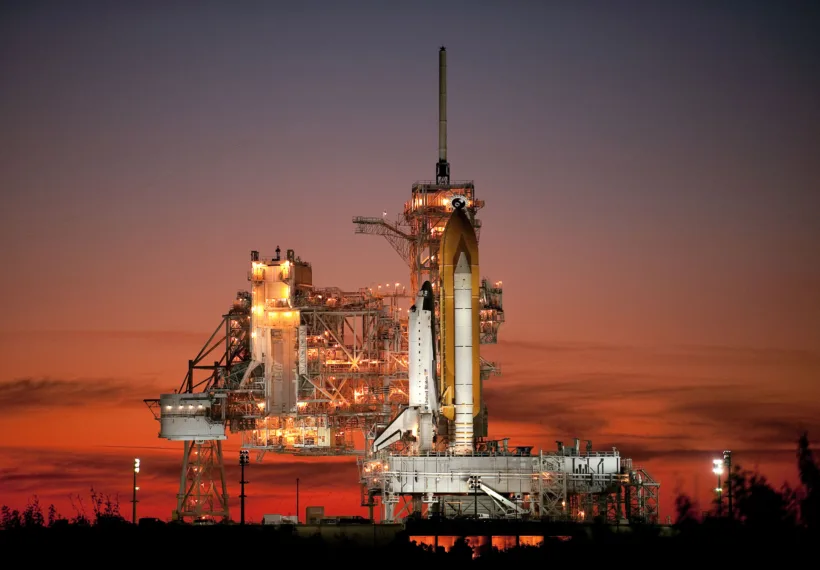
We had the space shuttle and had two boosters, booster rockets on the side and a big old orange tank in the middle.
That orange tank has two tanks within it.
One of them holds oxygen, the other holds hydrogen.
And the hydrogen tank is twice the size of the oxygen tank all inside the orange vessel.
So you have twice as much hydrogen as oxygen.
Chuck, put them together, what will that make all by itself?
H2O, there you have it.
And to make the water molecule is hugely exothermic.
So you combine them with valves and nozzles and jet cavities and boom, you have a rocket.
And so when we go to Mars, it’s important to know that there might be water under the surface of Mars.
So then you extract the water, separate the molecules and now you have ready-made rocket fuel.
And by the way, there’s no such thing as a free lunch.
The energy it takes to break apart the water molecule is the energy you get back by having them come together again.
Okay, so just keep that in mind.
There’s no such thing as a free lunch.
All right, so the point is ever since Robert Goddard, 110 or whatever, how many years ago, we’ve been using chemical rockets, the chemical fuel for propulsion.
And we haven’t been using nuclear, we haven’t been using nothing else.
And so that’s kind of embarrassing.
It’s like our batteries, it’s still chemical batteries.
It’s embarrassing.
All the other advances we’ve made in this world and we’re just kind of stuck on this.
And so, no, it’s a problem.
So the two ways around that.
One, you have filling stations in space where you burn all your fuel, you run out and you just refill.
Then you can burn a lot of fuel again.
If you do that, it won’t take nine months to get to Mars.
You can get to Mars in a few days.
Yeah, excuse me.
Guys, can you get the windshield and chuck the oil too, please?
That’s a way back machine you just pulled up right there.
I live in Jersey.
That’s still.
Oh, that’s.
Jersey’s full service gas stations.
That’s not way back.
I forgot there’s no self-serving in Jersey.
You can’t pump your own gas if you live here.
I forgot about that.
Wow.
Neil, are we gonna get anywhere with electric rockets?
Is that ever gonna be a thing?
We’ve got electric cars.
We’re talking about electric planes.
Yeah, well, so in a sense, your electric cars are not running on electricity.
In that sense, they’re running on batteries, right?
So you plug in the car to charge a battery, which is a storage device of energy, a chemical storage device, and then you run the car based on that.
So it would be something different if we could just plug in the car, plug in your spaceship and have a long cord that gets you all the way to Mars and back.
That would be kind of cool.
So for me, the future is not any of this.
Ion propulsion, where you charge a gas and until the point where like electrons fly off their atoms, you make an ionized gas, you might remember from your chemistry class.
And if you let these ions fly off in a direction that you choose, then the ship recoils and goes in the other direction.
It’s very efficient.
They become the propellant.
It’s very efficient, but it’s not good for like fast takeoffs.
It’s good for a slow readjustment of your orbit or to send a supply ship or something where you can wait a few months before you get there.
So these are all challenges.
What I really want are wormholes.
Then you just open a wormhole and walk through, come out the other side, you’re in Mars in 10 minutes.
That’s really what I’m after.
And so I’m leaning very sci-fi in this moment.
Otherwise, we’re just kind of stuck here in the solar system.
That’s the Rick and Morty approach, by the way.
Yes, exactly, exactly.
Or the Captain Strange, no, what’s his name?
Dr.
Strange.
Dr.
Strange, yeah.
Dr.
Strange, you just sort of open up a portal, step through, close the portal, there you are.
There you are.
That’s exactly how a wormhole that you control would operate.
Sweet.
All right, thanks for that question.
So who’s next?
All right, someone a lot of people know, but not everybody, a gentleman by the name of Jerry Rice.
Jerry Rice.
Jerry Rice, right.
So, yep, a former wide receiver in the NFL, probably the greatest wide receiver ever in the history of American football.
Three times Super Bowl winning player with the 49ers, Super Bowl MVP, an NFL MVP, and of course a Hall of Famer and another NFL player with a record collection of his very, very own.
So this is Jerry’s thought.
It’s a very sport specific one, but this is what he’s thinking.
Let’s try it.
Hey Neil, Jerry Rice here.
I hope you’re doing well.
And I have a question for you.
Why does a football go further when it has spin?
Oh, look at that and him relating it to his own sport.
I like it.
Yeah.
Ooh, I love it.
I love it.
Okay.
So, so I had to remember that that’s even a true statement.
Right?
And of course he would know that’s true because the boy played the game.
So here’s the thing.
If you just have a blunt object such as a ball or that it’s not sort of an aerodynamic airfoil like what you’d find on an airplane, it’s just a blunt object and you try to move it through the air, the air has to part for it to move through it.
That creates friction, that creates drag and that will slow down the ball.
Slows it down.
Okay.
Not only that, if it’s just sort of moving through the air and then there’s a current of air moving sideways to it, that’ll just sort of carry it to the side.
Okay, it’ll just sort of move it.
By the way, in baseball, forgive the cross pollination of sports here, there is a pitch that will move in whichever way the breeze blows.
And what is that pitch called, Chuck?
The baby pitch, no, it’s the knuckle ball.
It’s a knuckle ball.
That is a ball that has no spin.
And when you don’t have a spin, you are susceptible to small air currents that are taking place in the air through which you move.
If you spin an object, a frisbee, a baseball, a football, you spin stabilize it, okay?
And when you, and by the way, you spin a soccer ball, that’s a whole other thing that I can talk about in just a moment.
But when you spin a football, you gyroscopically stabilize it as it moves through the air.
It becomes less responsive to something that would try to alter its trajectory.
And by spinning, it’s actually corkscrewing through the air, reducing the total friction on the ball itself.
So a spinning thrown ball will always go farther than one that is not.
So it continues with its profile.
Yes, it maintains its profile and there is no Hail Mary pass that was not a perfectly thrown spiral.
Just check on that.
So think about it from Jerry Rice’s point of view.
As a receiver, he has to know that this ball is gonna be coming in a certain way so he can set himself up to get it.
A trajectory, correct.
Oh, very important point, excellent point.
So when you have a spin stabilized thrown football, the trajectory is more predictable than with any other kind of moving object.
So he’s running and he’s doing the brain calculation, be it active or subliminal.
In either case, he is moving at the rate that his body judges where he and the ball will be at the same place at the same time.
And not only that, a little known fact about the American football is that when you throw it into the air with the nose of the ball pointed upwards, as it reaches the peak of its arc, the ball becomes horizontal.
And then on its way down, the nose dips so that it is always corkscrewing directly into the wind, which is the minimum air resistance that it can receive.
And in that way, the ball goes straight into the receiver’s arms, nose first.
It’s a beautiful thing to watch.
Yes, wow, that’s cool.
There it is, there it is.
All right, so give me one more before we end this second of three segments of Athletes Ask Neil.
Okay, so our next player is somebody who, he’s played for the Giants.
Anyway, he’s a two-time Super Bowl.
Wait, the Giants baseball team from Brooklyn?
The New York football Giants.
No, no, actually the Giants were not from Brooklyn.
You know the Giants actually played in Manhattan.
Really?
Right under the.
That’s why they had to name his team the New York football Giants because there were other Giants here.
Giants, exactly.
Two-time Super Bowl winner, two-time Super Bowl MVP, Walter Payton, NFL Man of the Year, which I think is the most impressive thing because he’s actually a good guy.
Four-time Pro Bowler, Eli Manning has a question.
A brother’s Manning, yes.
The other Manning with actually more.
Just a quick thing about the Walter Payton Man of the Year.
Walter Payton died prematurely, if memory serves, and devoted a lot of his off-field time to charitable and humanitarian causes.
So I’m delighted that the NFL recognizes the player of the year who does the same.
So this is one of the great acts of recognition in the sports calendar.
Do you know what his nickname was, Neil?
No, what?
Sweetness.
Oh, Walter, I mean Walter Payton.
Yeah, not Eli Manning.
Eli Manning’s nickname was Eli Manning.
What question does he have?
Hey, Neil, Eli Manning here.
I was hoping you could answer this question for me.
During my professional career, I got hit by a lot of big people, some big mass.
Can you explain the physics of some of those hits, please?
Wow, interesting.
Yeah, okay.
So there are two laws of the universe that we have never seen violated ever.
One of them is the law of the conservation of momentum.
And the other one is the conservation of energy.
We would broaden that to be the conservation of mass energy, but for football, we only need to think about energy.
So when two people collide, what you do is you add up before the collision, how much momentum is there, and how much energy is there, energy of motion, kinetic energy.
Just add it up.
And then no matter what happens, after they collide, you have to be able to account for that momentum and energy.
Now, momentum is a vector, a vector, which means if Eli, because I don’t think he was a very big quarterback, he might have been 190, 200 pounds, he’s running in one direction, and let’s say someone wants to collide with him in the other direction, who also weighs 190 pounds, you have momentum in one direction, and the exact opposite momentum in the other direction.
Those directions cancel, which means the total momentum of this system is zero, even though two players are moving.
So watch what happens.
After they hit, they’re not moving, okay?
So the momentum successfully canceled, and there they just fall down on the ground, they’ll stop in their tracks, whatever.
Now, if the person running after Manning has twice the mass of Manning, what’s two times 190?
380 pounds.
That person has twice the momentum.
If they’re going the same speed and collide, there’s more momentum moving in the direction of the tackler than in the direction of Eli Manning.
So what happens is after that collision, the entire system is still moving in the direction of the tackler.
Which means Eli Manning’s forward motion got stopped and got reversed for that to happen.
Now, how about the energy of the collision?
That has to go somewhere.
That’s why they have these football pads.
Have you ever donned one of these pads?
They’re these like plates of plastic on the shoulders and plates across your chest.
So that if you hit it, that energy dissipates throughout the pads so that it doesn’t land in only one spot on your body.
The energy still goes into your body, but not all in one place.
So that these are physically fit muscled men.
So they can accommodate it, but not always in the one spot where you get tackled.
So the energy gets dissipated and the momentum continues and he ends up flattened on the ground.
So that’s why I’ve reported, Dooley, that American football is one of the greatest displays of classical physics that there is in this world.
I say spin stabilized projectiles in an arc following the forces of gravity and you have endless examples of momentum and energy transfer.
And if it’s a really good hit and they’re playing the Eagles, then that energy ends up on my couch where I’m like, yes, yes, because Fletcher Cox just flattened Eli Manning and I’m celebrating and hoping that Eli gets up so I can see him get knocked down again.
Damn, Chuck, where’s this coming from, Chuck?
Unresolved.
Do you have problems with every NFL quarterback that isn’t from the Eagles?
That isn’t from the Eagles.
Yeah, Chuck being a native Philadelphian.
No, I just listened.
Wait, wait, wait, Chuck, aren’t you from the city of brotherly love?
Yeah, that just means that when they take your wallet, they go, thanks, brother.
Okay.
All right, we got to take a break.
We’re going to come back with more questions from professional athletes and I think including Lindsey Vonn, the skier, the Olympic skier, when StarTalk Sports Edition returns.
We’re back, StarTalk, Neil deGrasse Tyson here.
You’re a personal astrophysicist, and it’s sports edition, Athletes Ask Neil.
We’re testing this out, because the athletes out there, some of them have geek underbellies.
Chuck, Gary, did you know this?
You must have known this.
Yeah, we’re all cut from different cloths, and it’s no surprise that people call…
Now, some of these guys are super, super, like Ryan Fitzpatrick, he’s a pretty smart guy.
Yeah, but you don’t have to be smart, you just have to be curious.
I’m not judging people’s smartness.
See, I am.
I will judge how curious you are.
I’m gonna judge how…
If you’re not curious, go back to the cave, because that’s where you would still be if there weren’t other curious people in your species that got us out of the cave in the first place.
Well, that’s because you’re a science educator, you say that, I’m a comedian, and so what I say is, there are some stupid people out there.
So Chuck, Gary, give me who’s next up.
All right, next up, and you said it before the break, Lindsey Vonn.
Lindsey Vonn, we all love Lindsey Vonn.
For those of you who aren’t familiar with Lindsey, she is Team USA’s alpine skier of all the different events in alpine skiing.
She’s considered probably one of the greatest skiers of all time, period.
Twice world champion and an Olympic gold medalist.
And this is a question that obviously she feels is important, otherwise she wouldn’t have asked it.
No, let’s do it, okay.
Okay.
A lot of people I know are super into astrology and I’m wondering if the planetary and star alignment has anything to do with people’s behavior.
Okay, that reminds me of a really cool meme where the bachelor in Australia, who by the way was an astrophysicist in the last season, he’s an actual astrophysicist and the girl walks up and she goes, oh, hi, what do you do?
And he says, oh, I’m an astrophysicist.
And she goes, oh, that’s so cool.
I’m a Gemini.
Did he say next?
So here it is, in all fairness to the idea that the universe affects us, just consider what it was like in the pre-scientific era.
You got your farm out back and when the stars align in a particular way, the crops bloom, right?
And you say, oh my gosh, I wanna have a home.
Yeah, hey, and the sun and the moon and the, and you start, and by the way, all of this stuff moves around you, all right?
It rises for you, it sets for you.
So the notion that we are not only in the center of all of this motion of the universe, but that the universe cares for us, it runs deep and across culture.
Do you realize the brightest star of the night sky, it’s called Sirius, it would rise just before the sun, 5,000 years ago, and it happened to do that at the time of year when the Nile flooded, enabling the ancient Egyptians to irrigate their lands and their fields.
And so you say, there it is, this caused the rise of the Nile.
So you can get a correspondence, a correlation, but miss the cause and effect of it.
And so that’s how we went for thousands of years, believing that the universe actually cares about us and cares about who you are and your social life and your financial life.
And then we learned, no, the earth is not in the middle of it all.
We orbit the sun like the other planets.
And these constellations, which are really, really sorry excuses for what they’re pretending to be.
All right, you connect the dots.
Are you really drawing a crab?
Connect the dots.
Is there really, there’s a centaur archer, really, really is that what we’re drawing here?
And you’re not only gonna draw that, you’re gonna put personality traits in.
By the way, and the people who came up with this are sleepless Babylonians, Romans and Greeks, right?
They’re not getting any sleep.
So they wake up, oh, I got a story.
They tell the story, they put it in the sky, named gods after it.
And now you’re gonna say that the stories of these sleepless civilizations have such meaning that these stars in your night sky, which would look different from any other angle, somehow know that you were born and wants to influence you.
Well, everything you said so far makes perfect sense to me.
I’m just saying that it’s a holdover from a pre-scientific era when we genuinely thought the earth was in the middle of the known universe.
And that is not the case.
No, so the answer is no.
None of this has any effect on us at all, including the one, oh, the moon affects the tides and the tides are made of water, so we’re made of water, so does it affect us?
So it’ll raise tides on your body by an amount less than the weight of the pillow that you sleep with in your bed.
You can calculate this.
It’s a trillionth of that, by the way.
Yeah, so if you’re worried about gravitational tidal forces on your head, look for other stuff that’s walking around you first before you start thinking about the moon.
And by the way, the tides raised on the moon are a few feet, 10 feet, whatever.
That’s on the entire diameter of the Earth.
So we got 8,000 mile diameter of the Earth and we’re getting 10 foot tides on the edge.
Oh, look at the tides, they’re big.
No, they’re tiny.
So what would raising tides on your skull look like?
It would be a trillionth the magnitude of a pillow that you happened to sleep with on your head that night.
So all I’m saying is we can calculate what effects it might have and the answer is none.
So I now quote Shakespeare.
The fault, dear Brutus, lies not in our stars, but in ourselves.
You got another one out there.
All right, okay, so Joey Brzezinski is a professional skateboarder, he’s in the street skateboarding rather than park, just so as you know.
He’s a dude that is full of tricks.
He’s a four time winner of the Manny Mania, which is obviously a big deal in skateboarding and is co-founder of Andale Bearings, which is obviously one of his sponsors as well.
So this is interesting because I think this is possibly the hottest of hot topics right now.
So listen to his question, Neil, and see what you think.
Yo, what’s up, Neil?
Since the COVID-19 put us all on lockdown, the earth has seemed to really benefit from it.
I mean, the skies over here in Los Angeles are cleaner than they’ve ever been.
So my question to you is, how do we maintain this positive reaction as we come out of quarantine and open our cities?
Damn, that’s a good question.
Oh man.
Yeah, it’s interesting.
You have these unintended consequences of other things that happen in our lives.
You know, we have an attack virus which targets humans and so we go on lockdown and then our air is clear to breathe.
There are no contrails because we stopped flying and for a big period there, we didn’t go out.
And so the air got clean and you could, wow.
And so how do we maintain that?
I don’t know, dude.
Dude, I don’t know.
I think it’s, what it is, as we say in mathematics, if we don’t know how to prove something but we know that it exists, we call it an existence proof.
We say, I can’t get from here to there but the there has already been gotten by whatever other means that remain mysterious to me.
So we call that an existence proof.
So the fact that we can do that is an important sort of revelation.
The fact that so much business then got conducted by a video conferencing that we thought maybe you had to be in person for but you actually you didn’t, all right?
These are things that I think that not all of that will entirely reverse.
I think there’ll be many meetings for which that will take place.
And that means you don’t have to travel.
A lot of what was putting pollution in the air goes away.
When that becomes the solution.
And if I can give a geeky Einsteinian response to this, so much of what makes that pollution is the need to be at a time, at a place that coincides when another person is in that same place at that same time.
These are called world lines in relativity.
Where are you?
And when are you?
And for us, pre-COVID, to have our world lines meet, I would say, Chuck, I’ll meet you for lunch tomorrow at noon.
And Chuck, what’s your next question to me?
Can we do it at Eric Repair’s restaurant, please, since you’re paying?
Okay, fine, but you have to specify where.
I gave you a when and you had to specify where, otherwise we don’t meet.
We could be at the same place at different times or at the same time at different places, but we have to be at the same time at the same place in order to meet.
What Zoom has done is removed one of those coordinates from our timeline.
Now Chuck, we only have to be at the same time.
Yeah, that sucks because that means that you’re not buying lunch and I’m eating peanut butter and jelly again.
We don’t have to be.
And so that’s the same place turned out to be one of the great consumers of fossil fuels, being at the same place at the same time.
So if there’s anything that has stayed with us, I think it’s gonna be the video call, the video conference call.
After that, you know, there are other ways to reduce the footprint, but I don’t want another virus to be the motivator.
I want it to be other ways that we can be inventive and creative about how we acquire and consume our energy needs.
It’s shown us we can.
Thank you for that question.
Yeah, it’s a great question.
And as I said, it’s probably the hottest of hot topics right now with everybody’s mind and climate.
But it shows that actually, even though we were painted into that corner, there is a way for us to deal with, or at least try and improve this way, our own climate.
So whether or not people want to grab this thistle, Neil, is the way I look at it.
Whether or not there’s enough energy in the thinking to grab it and make it happen.
Right, or inventiveness and creativity.
And especially in Los Angeles, where the 405 in some sections is 12 lanes of dense traffic.
You’re not gonna walk out and say, hey, everybody, tomorrow, no one drives.
So let’s see what effect that has on the air.
That’s gonna be a failed experiment.
COVID became that commandment.
And then we got to see what effect it has on the air.
It’s just the air we breathe.
Forget the greenhouse gases, just the air you breathe.
All right, that was the first immediate effect.
Because you can see and feel that in your lungs.
The CO2 is invisible to you.
So that’s a whole other thing.
By the way, if CO2 were colored purple, I bet you we’d have solutions to this practically overnight.
Yeah.
You see this purple gas coming out of your exhaust pipes.
Well, maybe we can get it.
But anyway, I think we got to call that quits.
Maybe we can get a virus that will increase scientific literacy and then we won’t have to worry about any of this.
Yeah, or a visible virus.
And then people will not say, I don’t need the virus.
That dee, dee, dee, dee.
Right, exactly.
It’s like, gosh.
Yeah, exactly.
You either take this vaccine or this thumb continues to grill out of your forehead.
That would be great.
Okay, Chuck will write the sci-fi novel.
A possible thumb head.
All right, guys.
So this has been StarTalk Sports Edition in a new version called Athletes Ask Neil.
I’m proud of you guys for soliciting these questions from these great athletes.
I feel I’m reminded that, like I said, athletes can often have a geeky underbelly.
Well, I’m glad you said proud of you guys because you should have said proud of Gary.
There’s a team involved in doing this and the whole StarTalk team.
Yeah, the whole StarTalk team.
Rally together.
We’re gonna do a whole show celebrating the team.
At least get some web pages where you can see them all.
They’re working behind the scenes, making us look good and sound good.
So anyhow, we gotta call it quits there.
Gary, always good to have you.
All right.
This has been Neil deGrasse Tyson, personal astrophysicist, as always.







 Become a Patron