



 Unlock with Patreon
About This Episode
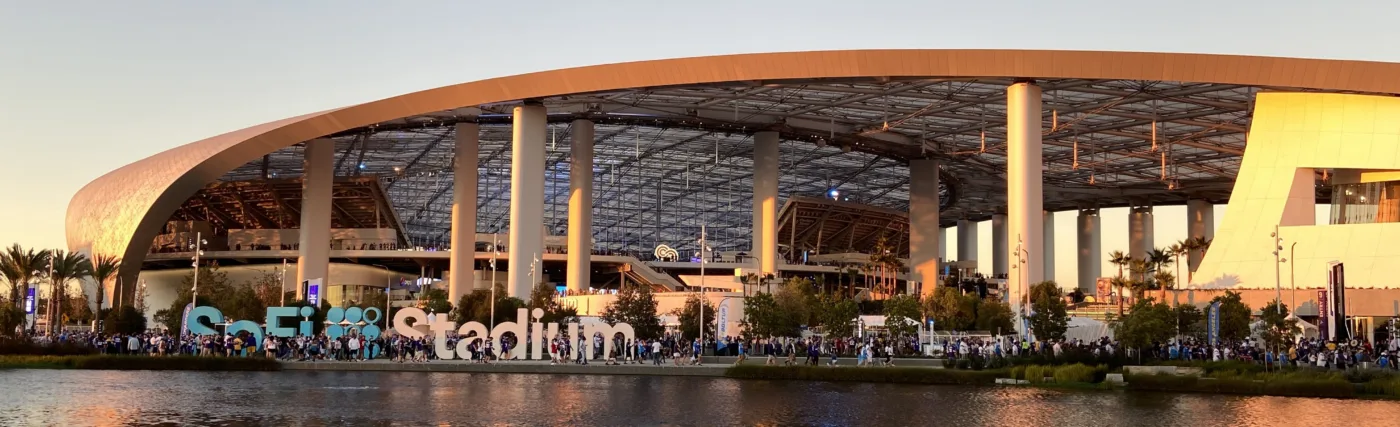
What will stadiums look like in the future? On this episode, Neil deGrasse Tyson and co-hosts Chuck Nice and Gary O’Reilly investigate stadium technology and “future-proofing” in Los Angeles’s SoFi Stadium with Chief Infrastructure Architect at IBM Sports, Benjamin Brillat.
How do you future-proof a large building project? You’ll learn how IBM approaches technology in today’s rapidly evolving climate. How do you build to predict what technologies are yet to come? Are some recent stadiums already obsolete? We explore Los Angeles Rams SoFi Stadium. Discover more about the transparent roof that covers the field and how the builders earthquake-proofed the stadium. You’ll hear about the record-breaking jumbotron that wraps around the entire stadium and more incredible engineering.
What sort of advancements in technology would eliminate the need for stadiums? How close are we to having an augmented display to watch your team in your home stadium when they’re playing an away game? Could you ever have an artificially intelligent football game that people watch? Benjamin tells us about the technology that’s happening behind-the-scenes that the fans don’t see.
Lastly, we turn our attention towards the bigger picture. You’ll hear why user experience is the first and foremost thing on Benjamin’s mind when developing ideas for new stadium experiences. We also explore the rise of gambling in the United States and its possible impact on stadium experience. All that, plus, we discuss the trend of developing a stadium “campus” that encompasses many assets of entertainment to keep fans coming during off-days.
Thanks to our Patrons Kyle Odren, Eileen Aldrin, Francis, Ashvin Lakshmikantha, Tarun, Olivia Chang, Blaine Torkelson, ANKreutzberg, and GibbousLife for supporting us this week.
NOTE: StarTalk+ Patrons can watch or listen to this entire episode commercial-free.
Transcript
DOWNLOAD SRTWelcome to StarTalk, your place in the universe where science and pop culture collide.
StarTalk begins right now.
This is StarTalk Sports Edition.
I got Gary O’Reilly with me.
Gary.
Yeah, Gary, you’re going to take us someplace.
Let me dredge my memories from a couple…
Pre-COVID, I think this was.
Yeah, just rewind two years.
Was there a world before COVID?
Did the world exist?
It feels like a lifetime ago, but only two years ago.
And this is, as I say, it’s something that we’re looking at, and it’s our trademark.
We look at things in a very StarTalkian manner, and this is a perfect, perfect show for us to introduce in the February of a new year.
So back in February 2020, we released a show called Stadiums of the Future.
Now, it’s interesting because the stadium we picked hadn’t been constructed yet.
It was still in the process of finding itself.
Now, that stadium is the SoFi Stadium, and that will be the venue for this year’s big game, the NFL’s big game, the 56th time it’s taken place.
And we’re not allowed to say the S word, they get all upset.
Now, the thing is, if you remember, Neil, we actually sent you there in a hard hat and a high vis vest to go and find out what it was like to see this thing emerge and what the logistical challenges were and how it came to be and the people that were behind bringing it.
This is a very StarTalkian approach to sports and stadium because there’s no athletes, there’s no head coaches, there’s no TV dramas, there’s just the guys and the girls that bring this thing to fruition.
So if you remember, the SoFi has this gigantic transparent roof and it doesn’t have that bigger profile out of the ground because it’s been sunken, because it is directly underneath the flight path to LAX.
So go on, Neil, give me a thought of what it was like to walk into that arena as it was being constructed.
Yeah, I remember that.
First, there was the bit of pride when you speak to the engineers for what it is they were designing for it, what kind of technologies would enable and empower not only future teams who play there, but future visitors.
So it was a delight.
I was geeking out, basically.
And I’d forgotten that, yes, this stadium has sunken into the ground, kind of like I think the Rose Bowl is partly underground as well in Pasadena, if memory serves.
And so that gives it a much lower profile on the horizon.
Otherwise, it just kind of sticks out, you know, like a sore thumb.
But the fact that it has a lower profile, and you’re right, it’s on the takeoff and landing path of LAX.
So they were, I was going to say they were considerate for this.
That’s not just being considerate, that’s being safe.
All right, there’s probably some legal limits surrounding that as well.
But just to look at how they were attempting to future proof this stadium.
And I was there not knowing that it would one day carry the big game.
What do you mean, the bowl that is super, that game?
So, no, so I was delighted and I asked, I think, all the right questions.
And we had a good time feeling the enthusiasm.
As well as sending you out into the great wild of the SoFi Stadium, we had a guest, and this guest is from IBM Sports.
He’s the chief infrastructure architect at IBM Sports, a guy called Ben Brillat.
And he was involved in the construction of the Mercedes-Benz dome in Atlanta.
If you know the Atlanta dome, it has this sort of tethylated lotus flower roof that opens up.
It’s magnificent.
And he explained to us to do this, and the same with the SoFi.
You have to be thinking five, ten, maybe even 15 years advance for technologies that are going to emerge, but that you are able to adapt to.
Otherwise, you’ve got a stadium that doesn’t work.
I mean, there are stadiums now that are probably being constructed in the early 2000s.
But as far as technologies that we have now in 2022, it’s more or less obsolete.
So Gary, there are two challenges there.
So one of them is, yeah, you want to future proof everything you do in all construction.
But future proofing involves projecting, and the scientific word for that is extrapolating.
When data are informing your future expectations, it’s called extrapolating.
So you have a plot of the way things are trending, and you say, no, let me continue the slope of that line of these parameters that I plotted and go into the future and have this thing I’m building today be able to accommodate this growth curve.
That works to a point.
Problem occurs, and you’re right, Gary, it’s typically a 15-year horizon.
People can be good if you invest brain energy projecting five to 10 years out.
15 years, you know, it begins to happen.
You get discoveries and inventions that come out of left field or come in from the end zone, whatever sports reference you’re comfortable with, but it comes from a different place.
It comes from a place that’s not even on the plot, on the chart that you were using to make those predictions.
And those are game changers for everything.
So, you know, I don’t know what a good example would that be.
Okay, here’s one.
How are you going to…
This is not a big challenge because we have accommodated it, but it’s an example.
You want a future kitchen and you say, well, what kind of modern stoves are we going to have?
Okay, they might be electric.
So let me put the stove near a power plug.
That’ll future proof it.
Okay, maybe there’s some other electricity that needs to go.
Let me make a conduit there.
And you do all of this and then a microwave oven shows up.
Who ordered that?
That’s not an extrapolation of a modern oven that involves heat and flames or coils.
It’s a whole other technology.
So where do you put that?
So modern kitchens, of course, are designed to fit those comfortably and nicely.
That was not much of a stretch as far as construction goes.
But you can imagine something that would be completely transformative that would make SoFi Stadium look like something, like Wrigley Field.
Yeah.
I mean, the thing is, they will want to leave intentional space to accommodate anything new and the hardware that needs to be in place for that new technology to be productive.
I mean, the other thing they did was they earthquake proofed because it’s downtown LA and things shake and wobble on occasion.
Shake and bake, yeah.
Yeah.
They earthquake proofed the whole stadium.
Now, this is a big deal.
This is a four billion, beginning with a B, billion dollar project.
I mean, it is an entertainment pass.
But just to be clear, I’m an astrophysicist.
You don’t have to extra explain the number billion to me.
No, no, no.
It’s just in case people don’t understand my version of English and they think I’m saying four million and it’s actually billion.
So it’s so interesting.
If I remember rightly, we also then take that, as you say, extrapolate what might be coming along before we’ve quite got there, but using what we know now.
We thought maybe augmented displays for people in stadiums could be something in the future.
So if you imagine you’ve decided you want to be a defensive end, you could end up having a sensory experience that feels like hitting a quarterback.
Yeah, or before you get there, just imagine you buy a stadium experience from the NFL or from the home team or from SoFi Stadium, and they’ll sell you the ticket at the 50 yard line, 20 rows up.
And then you go into your augmented reality room in your home, and you experience the entire game from that seat.
And then you don’t need ticket price.
You don’t even have to go to the game and then take that up a notch.
So now you’re saying, why be in the stadium at all?
Why not be on the field?
And you could be sort of an avatar on the field as players are running by you.
Because if you sensor, you have sensors that monitor everything about all the players, which IBM currently does, or has the power to do.
If you do that, and I know where all the players are, I know what their heartbeats are, because the coaches want to know that.
When is it going to bring them out?
When are you going to put them back in?
When have they recovered their oxygen levels?
I have all that information, and information is power.
Information is money, right?
So now, you put me on the field.
I’ll be eating Cheetos, sitting on the line of scrimmage, while the whole game is going on around me.
You’ll be eating crisps in the second quarterback, so it’ll be a dream come true.
But you’re saying you want to also include the physical experience of getting hit.
So does a person pay extra for that?
Well, the answer to that is simply yes, pay extra for anything that I’ve added, so yes.
So that’s it, Neil.
You see, the thing is, this is where we take the show.
As I referenced before, only StarTalk will do this.
Only StarTalk will think this way towards the subject matter.
And so this is why we’re re-releasing this particular show from two years ago, to stand on the shoulders of this big game, but to give our audience an understanding of the environment they’re in that will sit nicely next to the performances, hopefully, of the players.
Beautiful.
Beautiful.
So good work there, Gary, and I look forward to checking out the episode again.
Today’s topic, modern stadium design and the tech that informs it.
So who do I have here?
I’ve got Ben Brillat.
Did I pronounce that right?
You did.
Thank you.
Ben, welcome.
Thanks very much.
You work for IBM.
I do.
You design stadiums.
Wait, you got a title here.
Global Chief Architect for Sports and Entertainment Services.
That’s a lot of syllables to say you design stadiums.
Well, I design technology for stadiums.
Yes.
Yes.
I don’t want to cause any fights.
All right.
We’ll get back to you in a minute.
Gary?
Yes.
Oh, it’s good.
Good to be here.
Gary O’Reilly.
Chuck.
Hey.
You’re my people.
My sports people.
My sports people.
So, recently, I visited the SoFi Stadium just outside of Los Angeles.
Absolutely.
They’re in the middle of building it.
And I’m looking at the numbers at $5 billion.
Wow.
Since when do stadiums cost that much?
Recently.
Recently?
Since 20 minutes ago.
Just saying.
70,000 seats opening summer 2020.
And it didn’t look like they’re going to be…
You’re saying they’re not making it.
I’m saying.
I was there.
I flew over it.
It didn’t look like…
But anyhow.
I’ll tell you this much.
They better be ready by August of 2020 because they already said goodbye to the old stadium last year.
They’re playing pick up game in the parking lot.
Oh my God.
Just like you could tailgate and watch the game at the same time.
And be in it.
And be in it.
Hey, you missed it.
A little help.
Yeah, that’s great.
So that stadium houses the LA.
Rams and the Chargers.
And so, Ben, so obviously we’ll get back to that when I get footage of me visiting it.
But, Ben, how long has IBM had such a thing?
IBM engagement started really with the Atlanta Olympics in the 90s.
You guys have been in that space for a while.
That’s right.
So you were the chief technology architect for the Mercedes-Benz Stadium in Atlanta.
That’s right.
But that was way after the Olympics.
Absolutely.
So totally different design.
They didn’t have the benefit of your brilliance.
No, although some of the fiber infrastructure actually ended up being reused.
Oh, really?
You mean recycled and reused or?
Nope, nope.
It was still there.
Still good.
And you just actually, okay, well, way to save them some money.
So how are you combining this sports and tech at IBM?
Because in these stadiums where big muscle football players play, it don’t look like you have ever played football in your life.
No, I have not.
So how do you land in that pot?
Yeah.
So IBM is approaching technology in stadiums really from two sides.
The first is sort of the digital, where we’re doing AI programs and how can we help coaches make better decisions about players?
How can we analyze data, be able to take a coach and put them virtually after the game in a VR room standing next to their player and say, can I understand better why he missed that or why he made that?
Can I watch this from a 3D perspective?
Things like that.
Why not put him in during the game?
Wouldn’t that be cool?
You have a holographic coach on the field.
Right.
Yep.
I think that tech is almost around now.
You can virtually, with only a few seconds delay, you can put someone back into the space and analyze that play almost real-time.
And that’s where I come in, actually, is that the limitation now is the technology and the data bandwidth available on the field.
How can we get enough antennas, enough kinds of radios to be able to move that information from the field to the stadium?
In real time.
In real time.
To make real-time decisions.
Exactly.
And so I’m involved in all of the physical infrastructure, the antennas, the cell phone radios, the Wi-Fi access points, the security cameras, all of the physical tech that makes the digital tech possible.
So I just got to tell you, I’m really feeling good listening to you, because I lead a geeky life, but it was early enough in the geek timetable that we all, not I, because I was bigger than others, but most of my geek friends all got beat up by the football players, okay?
Until the football players needed the geeks to help them with their computer homework.
So the balance of power changed.
And so now you are enabling professional sports.
And now you are like a patron saint of what enables them to do what they do.
Now you have sports people as your protectors.
Yeah, I mean, we want that data.
We want them healthy.
We want to know where they were.
We want to know that predictive insights in the injuries.
That means she’s never gotten a wedgie.
That’s well, that’s, but that may be true, however, this isn’t the show to explore that.
It’s the one thought that’s crystallized in my mind.
All my people got wedgies coming out.
I think what Neil is saying is before you leave here.
I mean, yeah, just watch yourself.
I got a linebacker on the speed dial.
That is a cool thing because you can just be like, yo bro, one line of code and I can make it so that you…
One line of code.
Oh, that’d be a great name of a company.
One line of code.
One line of code.
Oh, man.
You saw the difference.
So what point are you brought in?
So I’m rich and I want to build a stadium.
At what point do I call you?
The earlier the better.
So we started in Atlanta when it was still a hole in the ground.
Literally still there because the technology, particularly as we start to talk about, of course, Atlanta is a 4G stadium, but as we look at 5G, more and more antennas means more and more wires to the antennas.
And so we actually have to bury conduit in the concrete before it even gets poured.
So you have to have a design for that ready to go right from day zero.
With enough conduit to future proof it.
So we got some footage of me at the SoFi Stadium outside of Los Angeles.
The LA, the Chargers and the Rams both will play there.
That’s right.
And obviously, unless they play each other.
Not on the same day.
Unless they play each other.
Right.
Unless they play each other.
There you go.
Then they do play on the same day in the same stadium.
That’d be kind of cool.
I’ll go to that game.
So I visited and one thing I couldn’t help notice is just the enormous roof.
A lot of thought went into that roof.
So let’s check out this high tech roof.
What is that transparent roof made of?
It’s called an ETFE system.
How transparent is it?
About 60% from what I understand.
So what you’re saying is it’ll block out about 60% of sunlight that could come in.
That’s what I understand.
Either reflect it or do something else with it.
That’s correct.
Okay.
So those are 60 foot by 60 foot grid areas.
I see them.
And then what we do is we build that frame on the ground outside the building.
And as we load this diaphragm in place, we go ahead and put those in and we pull the ETFE system over time.
How long does it stay transparent?
It’ll stay transparent from the time we finish the project on.
Not as long as birds poop on it.
You got a way to clean that off?
There is a way to clean it.
How do you do that?
And they’ll go up there.
I don’t see any way you, anybody’s going up there to clean bird poop.
There is access up there and there is a gutter system up there to go ahead and allow for washing down and also for rain.
Oh, she can hose it off.
That’s one thing we can do as far as the bird’s oh is also use a falcon air.
So you can actually have falcons that come around here to keep birds away.
Does that help?
I’m trying to be as smart as this man.
That’s very National Geographic.
All right.
You’re glad you turned up for this show.
All right.
So there’s a little insight.
I want to say window, but I’ve done it now.
Onto what’s going on in this 21st century stadium.
What else could we build into a roof like that?
Because that’s a massive expanse.
And by roof, he means bird toilet.
Yeah.
So, I mean, is it so are we going to have solar panels?
Because California, I think every new construction has to have solar panels.
Thank God.
Can we use it like a TV screen?
Can we check things out?
What could we do to play with this and make it just…
Yeah, I mean, you love to, right?
The technology for solar panels.
I mean, the problem is the weight today, right?
Can you make it light enough to be able to cover the surface and still have it span that enormous distance which it now spans?
We’ve moved from stadiums where you used to have, you know, limited site view seats to stadiums where there’s no such thing in the entire place because these roof materials have gotten so light that now everyone can see from everywhere.
So, the more technology you want to put up there, of course, the heavier it is.
We actually had problems.
But just to be clear, heavier roofs require more structures to hold it up that would block your view.
Potentially.
A light roof, you don’t have to hold up the roof.
Yeah, you can stand further away from it.
Stand further away.
So, that’s what you meant.
Fulcrum.
Okay, I was just trying to follow that.
So, it becomes a span.
Exactly.
So, how much distance are you trying to span?
How light do you need that material to be in order to make the span so that you don’t have a blocked view?
How does a roof like that affect what you would be able to do in the stadium?
You know, it’s interesting.
In Atlanta, and presumably, they’ll have the same problem in Los Angeles as well, the fact that these materials are now plastics, you know, if we look at an older building, like if we’re in the lower levels here, concrete, rebar, iron, the RF energy of the city…
Radio frequency.
Yes, the radio frequency.
To be clear…
.
doesn’t make it into your basement here, right?
Whereas when you build out of these new materials, these hyper thin plastics, transparent materials, one of the challenges we’re actually having is that all of the RF energy of the city is penetrating into the building now.
And you don’t want that.
You don’t want that.
Does that create interference?
Absolutely.
Yeah.
How can you deliver cell service to 80,000 people sitting in a space which need low signal strength because they’re not that far from the antenna?
But wouldn’t you want to not provide them cell service?
Wouldn’t you want to block their cell service and provide them your own particular frequency?
Because then you can determine what they’re going to watch, see, hear, and how they’re going to interact with the stadium and other people because you’re the puppeteer electronically at that point.
Absolutely.
Absolutely.
Who do you work for?
Are you an IBM operative?
Captain Verizon.
Sounds like you work for a DAS company, a Distributed Antenna System, which is the local cellular system in a stadium.
And the problem with that is we want to run our DAS in a stadium and not have it leak out into the city and not have the city leak in.
So these new materials are really creating challenges in how we can do that successfully.
Can’t you put wires in it and turn it into a Faraday cage?
Yeah, you could.
You know what a Faraday cage is?
It has nothing to do with prisons or anything.
Faraday is credited with this.
So if you have something that conducts electricity, like wire or any kind of metal, and you surround yourself in it, then electromagnetic energy cannot penetrate that surface because it tries to get through and it gets conducted into the surface and it never goes inside.
So, for example, you can walk out in a lightning storm and if you’re surrounded by one of these cages, lightning will hit, it will never go inside your bubble.
And the aliens can’t read your thoughts.
That too.
Hence the aluminum foil hat.
Exactly.
It’s just nothing more than an aluminum foil hat.
That’s really what it is.
It’s exactly what it is.
Okay, sorry, go on.
Pick it up.
So with these new materials, it’s just become very difficult to create the separation that we need to deliver that kind of service.
So that’s meaning new antenna designs, new antenna placements, more antennas.
In fact, in Atlanta, we have a first-of-a-kind deployment of the cellular phone antennas are actually under the seats in the upper levels of the stadium.
Wow.
Because what we want is very low signal power to only go a few meters to the nearby seats.
And it sterilizes your gonads.
Oh, that’s so that you get strong signal, don’t you want that?
Ticket sales have just gone down in Atlanta.
We did a lot of testing.
A lot of engineering went into making that.
So another interesting fact that we don’t think about much here on the East Coast, but on the West Coast, it is in every design point.
What do you do about earthquakes?
Can you earthquake proof a stadium?
Yes.
So at the SoFi tour that I took, I had to ask him about it.
Let’s check it out.
This bowl structure is a separate element to the roof structure.
And it’s separated by what’s called an MSE wall, Mechanical Stabilized Earth wall.
So it’s panels that go in.
So if you’re to walk through the rest of the stadium, you go to a back area that has about 12 foot of gap in between, so that this stadium can change.
It can move independently.
It can move independently.
And then the blade columns support the roof structure that actually go to butterfly caps and struts and to dead men.
And that acts independently with isolators at the top that can move up to 81 inches.
So you can sustain an earthquake, it sounds like.
Yes, we can.
That’s code for the stadium can shake and bake.
It can shake and bake.
It’s got a little bit of movement to it.
It does.
And you got it.
And you wouldn’t even know, because as you walk in, we have a moat lid.
So there is a moat that goes all around that most people don’t know.
A moat.
A moat.
MOAT.
MOAT.
With crocodiles.
Exactly.
It could.
You see it?
Because the history of learning about earthquakes and other sort of issues is you don’t want movement over here to have to be felt in the rest of the structure.
No.
Right?
Because that could take down the whole structure.
So everything can have some independence.
Right.
And then it just lives as almost an organic element.
And you have these, almost like these cut lines.
Yes, expansions.
Yeah, yeah, the usual.
That’d be thermal expansions and things.
So Ben, working in the Mercedes Benz Stadium in Atlanta just a few years ago, did they have to put in any sort of disaster proofing, if not earthquakes, some other kind of protection?
I mean, it has to be built for the environment that it’s in, right?
So Atlanta is a very wet, very windy place.
The movable roof is there because Atlanta has quite a lot of days when it’s rainy.
So the tech…
You can’t play football in the rain anymore.
In my day, you couldn’t even see the gridiron.
That’s how much snow would be on the field, and they’d still play, right?
How many fans were there?
I don’t know.
But in my day…
In my day, we played football with a baseball bat.
That’s right.
That’s how tough it was.
Sorry.
I know you’re not apologizing to me.
So, all of the facilities are instrumented throughout.
So, within the roof, within the columns that support it, the structural steel, the structural concrete, there’s instrumentation throughout all of it, which today is more wires that we have to bring to be able to measure the stresses that are on a given piece of steel.
When you say instrumentation, you mean diagnostic tools.
Absolutely.
So, you always know the structural health of your facility.
Yeah, so in Atlanta, there are pedals that open and close to move the roof, and you want to know the health of the pedal system.
So, all of that is instrumented so that you know that it’s in balance and all of the motors are operating correctly.
Okay, so you wouldn’t be taken by surprise if anything was about to fail.
Thinking about what you said about footballers can’t play in this rain, da-da-da-da-da.
So, when you or someone like you is involved in design in a stadium, who are you looking to please?
The owners?
The coaches?
The players?
The fans?
Yourself?
All of the above?
Why would that be mutually exclusive?
No, I’m just wondering.
Is there, you know, the owner says I want it done this way and the owner’s the guy with the paycheck, therefore the owner gets what he wants.
Or is there…
Even if that might conflict with something else.
Correct.
Got it.
I think it starts with the fans, right?
Because…
Because they’re paying.
That’s right.
They’re paying the owners.
Right.
The owner works for the fans.
That’s right.
They’re the source of revenue for everything else that comes after it.
And what you want to deliver is a great experience for them.
And with stadiums, huge stadiums, they’re getting bigger, they’re getting more complex because you have to compete with the fact that it’s not that expensive to buy an 85-inch television with 4K Ultra HD and put it in your man cave.
That’s what I did.
You’re working against yourself there, man.
That’s what I did.
No, that’s got to be the thought process of every owner.
Yeah.
How do we get you out?
How do we get you out of the house?
Well, you can give crappier television coverage.
That’s why I missed that.
Well, you got to be at the game.
That’s true.
We’re going to show the replay only at the game.
Yeah, well, there you go.
Well, we want to do both, right?
We want to have you have fun on the days you can make it, have fun on the days you can’t make it.
You want to have everything bringing together best possible experience.
But the stadium itself is really competing for that.
Let me get you out of your house in Atlanta or in Los Angeles to come in to the stadium.
We got to take a quick break when we come back more on the innovative designs of modern stadiums on StarTalk Sports Edition.
Thank StarTalk, we’re back.
Gary O’Reilly.
Yep.
Former footballer.
Apparently.
Apparently.
You keep telling yourself that.
Yeah.
Yes.
Who do we have here?
Ben.
Ben.
Brillat.
Brillat.
None of us even knew that such a person as you existed.
The tech geeky person who empowers modern stadiums to do and be what they need to be to satisfy the fans, the owners, the players, all of the above.
The great and wonderful Oz of stadiums.
That’s what that is.
That’s what you are, man.
That’s what that is.
I mean, we hope it’s that way, right?
If we don’t want to be too noticed.
Man.
Right on.
So, as you know, we’re featuring my footage from my visit to the SoFi Stadium under construction.
They’re not even built.
Outside of Los Angeles.
It’s great because one of the landing routes and takeoff routes from LAX goes right over the stadium.
So, you just look out the window there.
It’s very cool.
That’s why I know it didn’t look like they’d be ready when they said they’d be ready.
I’m just saying.
I’m just saying.
A lot of late nights coming up.
There’s the exterior design, but there’s also what’s going on on the inside.
And as you said, the user experience comes first.
That resonates with what I learned from the designers of this stadium.
Let’s check it out.
The Oculus will actually start over here in this corner.
So, what is the Oculus?
So, the Oculus is actually the TV screens and or scoreboards, everything that will be announced.
The world’s largest scoreboard.
And where’s it gonna be?
Is it gonna be in the middle or somewhere else?
It actually follows the line of all this.
So, right where that green box is, that hydraulic box, imagine about eight feet away from that.
We start building sections of it.
And we start building section and we stack sections on it.
Such as this one too on this side as well?
All the way around the entire bowl.
And then we go ahead and put a strand jack, similar to this assembly up here.
And we introduce load, we pull down, it pulls on the roof.
It weighs two million pounds when it’s completed with components.
We assemble it here, we commission it here, and we take it all the way up.
And you hoist it up.
And we hoist it up.
So when you’re standing on level eight, you see that guy there in the yellow?
So that’s level eight, and then level nine above, you’ll actually be staring right out of that Oculus.
Got it.
So you’re gonna have those types of seats in those views.
But you can still see the field.
Still see the field.
So that was access for the cheap seats.
The cheap seats.
Helping those guys out.
Yeah.
It seems to be there’s an arms race with stadiums now for the world’s biggest, like Jumbotron or Spansky.
Jumbotron, that’s so 80s, dude.
I know, I haven’t been to a game in a long time, can you tell?
I mean, Atlanta’s the current record holder, so they’re.
They’re trying to beat Atlanta.
Absolutely.
Over at SoFi.
Ooh, see, he’s like, do you see him?
Yeah, you were.
He did.
A little chest beating going on right there.
So now, this will definitely be the world’s largest screen or fan screen in the world after it’s done.
Yeah, so the new Oculus here has screen services.
Here in SoFi.
In SoFi, it has screen services on both sides of the circle.
So it’s not just a single ring.
There’s display elements on both sides of the circle that’s hanging down.
Ooh, so it’s a double-sided screen.
Oh, it’s inside-outside.
It’s a Kandinsky painting of jumbo screens.
Oh, Kandinsky, man, damn, Chuck.
He’s on something today.
So, I don’t know who said that.
All right, let’s play the game here.
What other tech could you introduce to improve something like this Oculus?
What could then take it to another level?
Because this seems, as Chuck says, a bit of an arms race.
Yeah, I mean, the holy grail, really, is to have VR players on the field, right?
Oh my.
Projected augmented reality more than VR, really.
But augmented reality players projected on to the field.
We’re still some ways away from that.
Oh, that would be so cool.
I don’t get it.
So check it out.
So an instant.
I asked him, please.
Oh, I’m sorry.
Are you there?
Do you work for IBM?
No.
Well, I mean, let’s just take this example.
If you are an Atlanta fan and your team is playing in Los Angeles, you want to be able to go to Atlanta and watch that game on that field in front of you in your home stadium.
As a matter of fact, they do that now.
Oh, so I could be in the field.
They don’t see me, but they run through me.
Well, you could have that maybe.
You could also have just an away game played at home.
Right.
You could have.
So like they have viewing parties now for the playoffs?
Like your team goes to another city, right?
So you all put on VR and you’re all in their stadium.
And now you’re in their place.
But you’re in your stadium watching the game on your field.
Oh!
So here’s the thing, as a stadium owner, you gotta love this, because that means everybody’s gotta buy hot dogs and their soft drinks.
That’s true, and they’re not watching on the 85-inch.
And not watching.
They’re actually watching the field, just like a regular game.
Give another reason to get out of the house.
No, get out of home and go to the bar and put on your, because you know, the truth is, no, actually, Neil makes a really good point.
The truth is, if you bring that technology to a stadium, it will only be a very short period of time before bar owners bring that technology to their venue.
They get a miniature version of the stadium, right, baby?
A miniature version, and then basically, you’ll be watching.
More work for me.
You just think that works for you, too?
He’s like, hey, guess what?
Wait, so is that real?
I mean, we’re really going there?
Not yet, not yet.
The display projection technology is the problem.
I think with Pokemon Go, if they can just show up in places.
So we could do it today with looking through your phone, right, but that’s not the best experience.
You want to be able to look at it in a seamless way.
So there’s a couple of barriers, one of which we’re about to solve with 5G, which is the ability to get that data out of the field, real time, recording what they’re really called voxels, volumetric image data, so that you can project from any position.
So three-dimensional pixel.
Three-dimensional pixel, and get that out of the current stadium.
So 5G will help with that.
Where we’re falling a little short still is in the display technology.
So right now you need something like maybe Google Glass, an augmented reality display to look at it.
Eventually we’ll be able to project it in fog or something like that.
That technology still weighs off, but I mean, they’re working on it.
Man, that is so cool.
I mean, like, but in a way though, let’s play this out just for a second now.
Cause see, if I’m an NFL player and I’m smart and I hear you say what you just said, you’re no longer my friend that helps me.
You are now my competition.
And now we go back to where jocks beat the hell out of geeks.
Okay, because-
The biggest regressive.
Exactly.
Because let’s be honest.
What you just said there is one step away instead of an augmented reality, which is basically the real time transmission of data, to why do I need that?
I’ll just create the data myself and transmit it so that you’re seeing a game that is really an algorithm that even though it may be predetermined, it’s still a game that happens, right?
And you can watch football.
Nobody gets hurt, it’s AI football.
Isn’t that just John Madden football?
No, it’s not John Madden because see, John Madden, you’re playing, whereas this would be an indeterminate algorithm.
So none of the outcomes are predetermined and you will see a real game.
Put Watson up against Siri, right?
Right.
So in this next clip, I snared one of the engineers to ask him, is there any other technology that the public doesn’t see that might be going on on the field with the players or the coaches?
Let’s check it out.
In modern times, football teams keep track of their players and with high tech monitoring systems and GPS, how far they’ve moved.
Will there be any sort of high tech sensor systems that can be invoked at field level?
It’s actually not GPS based.
So we have a ring of basically sensors around.
So when the players walk out of the dressing room, they have a chip in their pads that gets turned on basically when they exit the locker room.
And then within the playing surface basically, they track the movements.
They can then figure out things like velocity and top speed.
But that’s not unique to the stadium if everyone has a chip in the modern NFL.
The league basically mandates that system and…
Plus for the health and well-being of the players too, right?
You can track how far they run, how fast they run, how much they’re on field, et cetera.
That means you can also measure how fast they decelerate in a block.
Like you’re running and I run at you and I got your speed, all of a sudden, bam!
You go from 20 miles an hour to zero in…
In a meter or whatever.
Right, right.
So Ben, why are they using RF technology if 5G is basically available?
So it depends what is that sensor trying to accomplish.
So on a high school field, you have GPS.
You’re out in the air.
You can see the satellites, the GPS trackers will fit in their pads.
More importantly, the GPS satellites can see you.
The GPS?
Well, no, but that’s okay.
And indoors, now you have again the roof, which is blocking those signals.
You need to provide some sort of local system that can now provide that location data.
Okay, so 5G is not a local system?
Well, 5G is a local system and they’re…
Even within a stadium, local?
Absolutely.
So to that technology of DAS that I mentioned earlier, we have to build our own 5G network inside of a stadium to meet the density of people who are there.
80,000 devices in, well, we might even call 160,000 if you’ve got a watch and a phone, right?
Devices in a small space.
Now you need dedicated electronics, dedicated antennas and radios just for that stadium by itself.
But that tracking versus making phone calls, all different kinds of 5G that are starting to come to life and the density, the number of devices as we look at IoT and really those sensors are IoT is just going to balloon as we start.
IoT stands for?
Internet of Things.
That’s what that abbreviates?
Internet of Things.
Things should never be abbreviated.
That word.
It’s not important enough.
Thanks for clearing it up.
Internet of Stuff, I don’t know what it is.
As I sit here and listen to you explain that, Ben, I’m looking at my cell phone is dating an out of date within two years.
How do we future proof?
What’s coming that we can do that you’re going to be able to jump on and utilize?
How about 7G, 8G, 10G?
It’ll all be there.
The way that we future proof in our architecture is we say we don’t have a crystal fall.
The only thing we can do is put more pathways for more antennas.
Make sure that you have the ability to put today you have one antenna in this room, tomorrow you have two, four years from now you have four or five.
I’ve got to interrupt you, okay?
And back to the future too, which took place in 2015 or 16, I forgot, somewhere in our past right now.
Back when it was made, people had fax machines, okay?
That was the thing.
Oh, that’s cool.
So they imagined in that distant future that households would have multiple fax machines.
Okay, of course.
So when Marty was fired from his job, it was sent to him by fax, and every fax machine in his house out came to think you’re fired, and you say, wow, that’s the future.
We’ll have more than one fax machine.
So isn’t that a little bit short-sighted to say, let’s just put more of what we already have?
No, we’re not so much putting more.
We’re putting more capability, but just the path.
We don’t know what kind of cable will go in it.
We don’t know what kind of antenna will be there.
So you assume it needs a path.
You need to have a spot to put it, right?
And that’s becoming particularly challenging because architects also want their stadiums to be beautiful, right?
You want to experience the technology, but not have to see it.
So you need to really design in from day zero the ability to put all of this electronics there and be able to hide it.
Tell me about helmet cams.
That would be another.
It would be first, it would be interesting just to monitor helmet concussion, the forces that operate on a helmet.
You should be able to do that.
My iPhone can measure accelerations no matter what I’m doing.
A helmet could do that too.
But not only that, just point of view cameras.
Suppose I’m going to experience a game as a fan and I can flick on, let me see what the quarterback is looking at.
Let me see what the center, let me see what the wide receiver and that’s their camera.
How about that?
With 5G, we will be able to do that, especially in a sport like football where you have a lot of room to put the heavier batteries and the camera sensors, things like that.
Oh, this is too heavy.
Yeah, but that’s a baseball player, but as a soccer player, the good news.
You guys, when you get clipped on the side, oh, man, that’s it.
I can’t get up.
The white’s too much.
You soccer players.
What the hell is wrong with you all?
Well, we got good news.
We got good news for soccer football is that with the 3D volumetric pixel imaging, it’s now possible computationally to recreate any view from an array of, say, 32 cameras around the stadium.
This is like bullet time.
Like in the Matrix where you can get any camera angle.
So you as a viewer could pick, you wouldn’t even have to be limited to a specific helmet cam.
You could pick the view right in between the two helmets and have that computed for you dynamically from the images that are already taken.
That’s pretty wild.
I’m liking that.
That’s badass right there.
See, now, once again, it seems like you’re working, okay, so this would be an, see, that’s something that you want to keep to an in-stadium experience, right, because to be able to come and look on your phone and see a completely different game than you’re actually watching on the field.
Right, why be limited to some cameraman who’s parked on some spot on the sidelines?
You can actually curate your own game in real time as you’re sitting there.
Let me see that replay, you know, that’s kind of cool.
Yeah, you could end up, you know, with Twitch style re-edits of the game.
We got to take a break.
Can you hang around for like the third segment?
Absolutely.
Because normally we just sort of, you know, chew the fat, but I want to chew the fat with you in the room.
Sounds great.
Yeah, that’d be cool.
All right, this is StarTalk Sports Edition.
We’re back, StarTalk.
We have a special guest brought in from Central Pennsylvania where this dude lives.
Nobody’s out there.
Well, no, he’s here.
He was the only one there, now he’s here.
Ben Brillat.
Now, thanks for hanging out.
Normally, we just sort of chew the fat this segment, but I want you there.
Thanks.
While we chew the fat.
Sounds good.
So, I just, I’m curious about some…
I’m looking at the rate at which stadium design is changing, and that always tells me things.
It says if the rate is changing rapidly now, we can praise any newly opened stadium, but if the rate is fast, it means in five years, that’s gonna be an old stadium.
Just like technology itself.
Technology itself.
Yeah, you’re actually a cell phone.
So, how do you feel about this?
I mean, it’s good news for me, right?
The more tech changes.
Job security.
But now, do you build that into your design?
Yep.
Well, he said he future proofs by putting conduits and places where you would put stuff.
Yeah, I mean, there’s capitalization terms for all of these things.
You want to be sure you get your money’s worth out of it.
You need to be able to.
Especially when it’s $5 billion worth of your money.
Yeah.
But go ahead.
But it is a big challenge.
What can you do?
How far into that crystal ball can you see?
And we make our best attempts at it, but sometimes it’s a reflection.
Okay, so we touched on augmented reality.
Now, I’m just thinking if we really throw it a long way away, do we actually need stadiums?
Because you’re going to sit there with your VR goggles and I’ll give you an immersive suit so you can actually feel the hits yourself while you’re sat there.
Well, you can dial it up.
That’s too much.
It just depends, you dial it up or you dial it down.
Oh, dial it down, yeah.
Can I dial it down to a relaxing massage?
Yeah, if you want.
We’re talking about we’ve got to get people out of their homes.
We need to, you know, our competition isn’t this, this, this.
It’s getting people away from their TV sets and it’s the arena.
But is it just gonna come down to, let’s save the money and put it all into the fan experience?
You know, you’d think that would have happened with video gaming, but what has actually happened is that e-gaming has now become a huge spectator sport.
Spectator sport segment.
Watching other people play their e-game.
But in a stadium.
You go to a stadium to watch on the big screen video games get played.
It’s true.
Don’t look at me like that.
We’re all sitting in this room looking at each other the same way.
It’s like, what?
Which is, what the hell is wrong with these people?
It’s a huge thing.
Is that Gen X?
Is that Gen Y?
Is that Millennials?
Let’s get to the bottom of this.
Yeah, it is.
Who’s doing this?
The under 25 set.
It is, yeah.
My son is totally into it, and I was completely-
He’s 12.
Right, and I was completely against it until I found out that these so-called E-athletes, many of them have seven figure deals.
And now he gets home, and I’m just like, you better get upstairs and play that video game.
Yeah, get those thumbs moving.
Boy, what’s your problem?
Don’t read a book.
That’s right.
Are you reading?
Oh my God, are you reading?
Yeah, are fans the whole thing here now?
Stadiums were built to honor the gladiators and the athletes.
Now we are seeing a shift away to the fan, the spectator, the person who provides the income as being the point of view that is the most interesting.
Where can we take that?
Where can IBM, where can the stadium builders and architects of the future take that?
Yeah, I mean, the fans, what we’re trying to do with technology is deliver a better game through improved insights into how the players are moving their physio mechanics, the coaching calls.
Physio mechanics?
I hope so.
And help the coaches to be able to make the best decisions that they can, help the players to be able to get the most that they can out of their own body to put it into an ever more entertaining game, right?
So I think everybody is benefiting.
We talk about the greatest players of 60 years ago versus sort of your mid-tier players today.
The mid-tier player had so much more information available to them to help them train exactly the right muscle, rest on exactly the right rest day.
The level of play is just going up, up, up.
All right, so let me ask you this.
With that in mind, talking about the fan, let’s talk about the owner for a second, because here’s the way I’m thinking.
I spent all this money.
I got this high-tech stadium.
How am I going to make even more money off of all of this 5G-capable technology that you put in there?
Where’s the business model?
How’s the money come back into his pocket?
I need that money to come back to me.
So am I going to be charged to see like certain replays that nobody else can see or, I mean, what?
Because you know no fan-
What kind of paywall are you going to put up?
Right, there’s no fan experience that’s complete without an owner saying, nah, you’re going to have to pay for that.
I mean, all of that is possible, right?
You can have, you know, premium subscriber level features.
You can have entry features.
You can have features you can only get if you are actually there.
That happens today a lot because of TV licensing agreements.
We can do more when you’re physically in the stadium than we can outside.
I’ll give an example of that.
A really lame, but heartfelt example.
When I was nine, we went to the Bronx Zoo and we were very frugal as a family.
I saw other rich kids, they could buy the elephant key.
There’s a plastic key in the elephant, nose sticks out.
And at every cage, back when animals were in cages, there was an information recording and you put the key in and turn it and you get a narration about the animal.
Right, but you had to buy that key.
You had to buy the key and we didn’t buy the key.
Yeah, I would just stand next to the rich kid.
Mommy, why does this black kid keep following me everywhere?
I’m sorry.
So I felt, I didn’t feel like I was a part of the experience and it didn’t feel good to me.
Even though we had paid admission to the zoo itself, I felt left out just because I couldn’t afford it.
And that was a visitor experience in 1968 to 67 that was its version of what you’re describing.
Okay, so picking up on your elephant key analogy.
By the way, I still own that elephant key.
Just want you to know.
For real.
For real.
I’ll bring it in.
You did get one.
The elephant in the room or the stadium.
Gambling.
When you’ve got all of this ability to stream and do stuff.
There’s a lot of money.
Now you’re talking about more money gambling than any of it.
Oh my God, Gary, you are brilliant.
How do we get in on this right now?
Because I’m telling you.
Okay, shut off the cameras.
We’ll find out.
Let me tell you some real time betting while you’re in the stadium.
That’s a money maker.
Shake it.
It happens a lot more overseas than it does here.
We have stronger laws.
Anti-gambling.
If I’ve spent $5 billion to create my stadium entertainment palace, I’ll be pushing really hard to get the gambling laws changed in the state of Richmond.
Oh, without a doubt.
Every state, yeah.
We’re seeing data that comes just for fantasy football, right?
So, fantasy football, fantasy baseball, the decision-making data that’s available to you for your own fantasy league would probably knock the socks off of a coach from 1955 to have access to the kind of information that you’re…
No, 1975, 1985, the data they have.
So, going back to your point of what else happens, how does the owner, you the owner, make money?
I put a massive big complex of theaters, show movies, I have shopping malls…
I was about to say that.
Why aren’t stadiums, when we were about to come out of it, why don’t stadiums have multiple use built into…
It’s like the stadium sits empty for most of the time.
This is the whole deal with SoFi.
SoFi is a great example.
So, SoFi…
So, in a professional football schedule today, it’s 16 games, if you don’t go into playoffs, correct?
So, most football, pure football stadiums are used 16 weekends out of 52, period.
Then I noticed 10 years ago, 20 years ago, they tried to turn them into conferencing centers and things, get a little extra money on the side.
But still, what are you doing?
Hold your event here.
Maybe hold a rock concert, okay?
So with SoFi, it has two teams interlaced, so now it’s 32 weekends.
That’s way better than 16 out of 52.
But still, you got another 20 weekends when nothing’s happening.
Is the business model so lucrative that you can go unused for 20 weekends?
No, you need to drive that attendance up and the use of your facility.
So in Atlanta, they have also Atlanta United, the MLS soccer team.
Is Atlanta your Mercedes facility?
So the Atlanta United MLS soccer team has games that are played there also.
So that has really driven up the usage of the building.
And then immigrants come in, they get something to watch, right?
Right.
Because all the immigrants play soccer.
Absolutely.
Every last one of them.
They’ve put 70,000 fans in the Atlanta Stadium for MLS soccer.
It’s a huge drop.
It’s not an American emote.
No, but in a way, you’re right.
When the World Cup is on and you walk around Manhattan.
People are so indifferent to it.
It’s like people don’t care.
And then you look in every bar and it is filled to the brim.
Right.
You know?
And none of them are Americans.
Atlanta’s culture is changing with the Atlanta United, actually.
The Atlanta United are driving fans into that sport at a rate that is just crazy.
Yeah, I mean, you walk by bars in Atlanta and there is an Atlanta United flag.
There are kids going to watch Atlanta games.
So Americans might come around on this, the soccer thing.
But I think the footprint of the SoFi Stadium, I think, is greater than Disneyland.
Including parking.
Yeah.
Are you for real?
It’s this multi-use district.
What else is there?
What else is in that stadium?
They’re building in the multiplex.
Hotels.
Everything.
There’s shopping.
So the idea is to make it a destination area.
The area becomes a destination.
And then the game is just one other thing you do.
One more thing.
Something to do that you can walk to, yeah.
OK, cool.
Because there’s a finite amount of people that can go and watch a game.
But they want to come and enjoy the experience.
So you will build fan parks outside.
I have an obscure, geeky, sciency comment, if I may.
I’m ready.
OK.
OK, if you’re charging a battery, either an electric car or any kind of rechargeable battery, if it’s dead and you start charging it, the first 20% happens very quickly.
And then as the battery gets more and more charged, the rate at which it reaches the top gets slower and slower and slower.
So that last 5% takes almost as long as the previous all the time it took to get to that 95%.
Okay, do you know why?
No.
I’m about to find out.
The analogy is a stadium parking lot.
Because in a dead battery, you have all these electrons in the wrong place.
They done served you, now you gotta punch them back so that they can serve you again.
They gotta swim upstream and they gotta park on the other side of that battery.
But they can only park in pre-designated places.
So, if you’re the first electron upstream, you park anywhere.
So, in a stadium, if I’m early at the stadium, I can park anywhere, I can park within seconds.
The later I come, even if there is a parking spot for me, it’ll take me longer to find it.
So that when the parking spot is almost entirely full and only five slots left, it could take me a half hour to find a parking spot.
I have to look for those spots.
That’s why it takes longer to charge the last part of a battery than the first part, because of the parking lot problem.
Have you solved the parking problems?
Yeah, we have.
Smart parking systems.
Smart parking?
So, yeah, in terms of-
Assigned parking?
Well-
Predetermined assigned parking?
We have assigned parking predetermined.
We also have smart parking systems if you’ve been like in Heathrow Airport with red and green lights over every single parking spot, so you can look down a hallway and see if there’s a green light.
Oh, what a hidden spot.
Yeah, signs that tell you how many are left on each level.
Turns out this is a huge source of pollution in cities too.
So there’s companies working-
People driving around.
Not just in parking lots, period.
In every metro-
Driving around looking around the parking lot.
80% of all cars that are in motion that are not taxis are looking for parking.
Yeah, so this company’s trying to solve this now to be able to help you.
There’s some new deployments out in Europe of smart parking systems in cities so that you can know where to go.
I like the fact that you could just see above all the cars and the green one is right there.
And if that’s some little car that’s hidden behind the SUV or motorcycle.
Don’t you get angry when it happens?
I always flatten their tires.
So now, how many people are now looking for a space and there’s only one green light?
No, then no.
And then they all converge on the same space.
The lights break out.
How fast can you drive up to that point?
See, this is LA so Larry David’s gonna be there.
You know that.
You know he’s gonna be there with his little electric car.
Of Curb Your Enthusiasm, yes.
So we can actually, using cameras, we can actually follow your car through the parking garage and provide you individually appropriate signage at every turn for where you should go to your parking.
Can you talk to the car?
That turn left you, idiot.
Well, you can change the sign that they can read.
Talk to the thing and I’m gonna sit back and do that.
You know, that’s where it’s actually going.
Let the car park its own name.
I’m watching the game, you park yourself.
All right, so final thoughts, Chuck.
What do you have?
You know, I’m gonna go to a game and probably be disappointed because none of the cool crap we’re talking about is gonna be there.
It’s not happening yet.
Get his phone number, he’ll call you.
Exactly.
Absolutely, we’ll go together.
Gary.
I think it’s great.
I think it’s brilliant because everybody wins.
The players are gonna win.
The coaches, IBM could become the best football coach ever.
Right?
All the bio data, all the telemetrics, all the players are gonna win and the fans are gonna get better experience.
So it’s a win, win, win.
Brilliant.
Brilliant.
So what thoughts do you have at night before you go to sleep about all this?
I wanna make sure that my son, when he goes to have, he’s four now, when he goes to a game, that he will be able to have the experience that he is imagining when he gets there.
So his world, his world already, he can talk to the house, right, and have the lights turn on.
He can type because he just talks to his computer.
The information of the world is at his fingertips.
15 years from now.
Yeah, 15 years from now when he’s there.
Your four year old child’s running the house with his apps.
Yeah.
Alexa, change the locks.
He hasn’t found that command set yet.
You better get some really good parental guidance.
You know, the world that he imagines is different than I can imagine.
And I want him to have a great experience that keeps his attention and keeps him going.
Here’s what I look forward to, because I think about this all the time.
I’d like imagining tomorrow’s technology for many reasons, but including the fact that if it’s good enough, it will make everything I think is modern today look old.
So, in the future, I want the technology to not even be anything you are projecting for it.
I want it to benefit from innovations, may I say, out of left field.
Something you didn’t even know was on its way in, that lands in your lap technologically and you say, oh my gosh, that’s a game changer.
And with that, there’s a future experience for the player, the visitor, the coach, the coach that today we can yet imagine.
Sweet.
Looking forward to it.
That’s a cosmic sports perspective.
Dude, thanks for coming.
Thanks very much.
Chuck, Gary.
Pleasure.
Always good.
I’m Neil deGrasse Tyson, your personal astrophysicist.
This has been StarTalk Sports Edition.
And as always, I bid you to keep looking up.




 Become a Patron