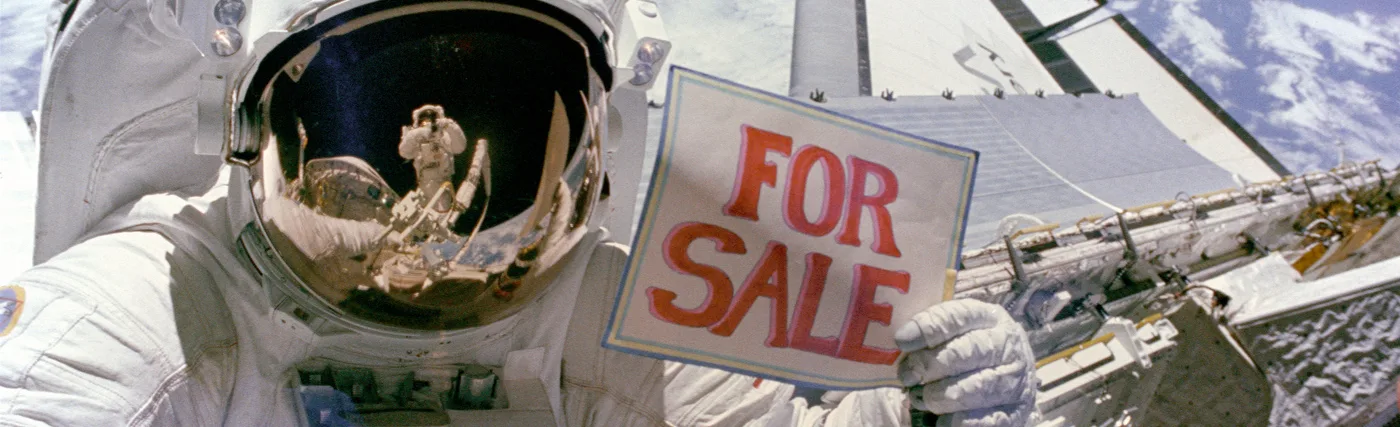
Who owns the moon? Should we have timeshares on the International Space Station? Can you buy property on Mars? Bill Nye the Science Guy is back alongside comic co-host Iliza Shlesinger as they investigate the politics and the future of the privatization of space. Throughout the episode, Bill and Iliza answer fan-submitted Cosmic Queries on a variety of topics from SpaceX to the “Space Force.” To start, Bill gives us some history about who “owns” the Moon and you’ll learn how space exploration shares similarities to early European explorers. You’ll also hear how private companies like SpaceX and Blue Origin work in unison with government space agencies like NASA and the ESA. You’ll find out how private companies will try and make space travel affordable. Ponder the thorny question of how we’re trying to deal with the build-up of space debris and space junk. Discover how going back to low Earth orbit is key to helping us travel to Mars and beyond. Bill reveals where he would buy real estate in the solar system (just for bragging rights, of course) and what it would mean to privatize the International Space Station. We also discuss whether asteroid mining is a real possibility or just science fiction, how we can use water from asteroids to create rocket fuel, and if bringing asteroids down to Earth would have any benefit to the human race. Bill tells us which he finds a more pressing matter: planetary exploration or extra solar system exploration. We investigate the merits of the proposed “Space Force,” Bill tells us about his time working on the Joint Strike Fighter program, and you’ll discover more about NASA’s “big rocket” – the Space Launch System. All that, plus, on the non-space-related front, find out more about Isaac Newton’s birthday, the San Francisco 49ers, and the origin of California’s state motto!
NOTE: All-Access subscribers can watch or listen to this entire episode commercial-free here: Selling Space, with Bill Nye.
Transcript
DOWNLOAD SRT
Welcome to StarTalk, your place in the universe where science and pop culture collide. StarTalk begins right now. Bill Nye here, welcome to another episode of StarTalk All Stars. And I am joined today by my co-host, Iliza Schlesinger. Her...
Welcome to StarTalk, your place in the universe where science and pop culture collide.
StarTalk begins right now.
Bill Nye here, welcome to another episode of StarTalk All Stars.
And I am joined today by my co-host, Iliza Schlesinger.
Her special, Elder Millennials, is streaming now on Netflix.
Turn it up really loud, and your life will be redirected forever, and you will be so much happier.
And that's good for you.
Just like this show, it's really good for you.
It's really good for you.
So, Iliza, let's start with a question.
All right, speaking of things that are good for you, and things that make our viewers happy, we've got our first question from Renee Douglas.
She says, hey, she wrote it that way.
What's the rule on who owns what as far as asteroids, moons and other planets go?
Is it finders keepers?
Kinda.
Right now, this is being discussed, outer space treaties.
There's been discussion that no one can own these bodies like no one could own the moon.
Right.
But let's face it.
It's gonna be us.
Well, not that so much as-
It's gonna be China.
No, but if you get out there, if you have a spacecraft that can get there and get the ice off an asteroid and use solar energy to make electricity and turn the ice into hydrogen and oxygen, you know, H2O and then use that for rocket fuel, who's gonna stop you?
A crashed asteroid or a moving asteroid?
That's the trouble, moving, super moving.
When it comes to crashed asteroids, there's a couple of issues.
For those of you who have not been to Barringer Meteor Crater, Meteor Crater Arizona here in the United States, it is amazing.
It's like this.
It's amazing.
What's it like?
It's cause you're in space, there's no sound?
Well, it's just cause it's jaw dropping.
It also could be forehead slapping.
I forgot the crater.
No, just you look at it and you're amazed.
And so the guy Barringer who first found it thought I got an idea as you might that there must be a big rock at the bottom of this crater.
That caused the crater.
Yeah.
And so he started drilling for the rock.
But it turns out that the asteroid is made of kind of the same material as the earth.
So he couldn't find it.
Well, so it shattered.
When it hit the earth, it disintegrated.
And so you don't get a lump.
You have dust within dust particles that are very, very hard, very tough, like trying to straighten a paper clip.
You can never quite get it straight.
So the earth is quite hard and trying to drill in it was hard.
And the other thing that makes the crater, we might think it would be this ball going in, but it's a shock wave that disintegrates the earth's crust, the material that is the earth.
And so it's really hard to recover that material.
Yeah, I watched Broken Arrow last night and the bomb went off and a shock wave is what disrupted it.
Shock wave is trouble, people.
And so you're going to catch up to a moving asteroid.
And then who's going to stop you?
The earth.
Treat-y, schmeety.
Treat-y, schmeety.
The answer is who's going to own it?
Probably Time Warner, maybe Lockheed Martin, just a giant company, General Electric.
What about SpaceX?
SpaceX.
I don't know what that is.
Is that who's paying for this?
Hold on.
Aren't you a Los Angelino?
No.
I mean, yeah.
What is it?
Hold on.
Sorry.
Don't you have a sort of a crush on Elon Musk or a thing for him anyway?
No, no.
But if he wants to come to a party or come to a show.
He should go to your show.
I'm at the Comedy Store a lot.
You can check me out on Twitter.
Yeah.
So you should do that, check out her show.
Anyway.
I knew what the fire triangle was, by the way, in the last episode.
That was cool.
Sorry I didn't know Elon Musk and his dalliances.
No, no, but you did.
You just, you just, it was a lot to ask.
So what I mean is a private company may go out to an asteroid someday and get some material from it.
Yeah.
The idea of mining platinum or whatever your beautiful white gold rings are made of.
It's really difficult to bring that back.
There's a lot of platinum on the earth if you know where to look.
I think the question everybody wants to know is, would you rather have it be privatized or run by the government?
Long lines of the DMV folks.
I'm just saying if you want more government.
Yeah, but as we say, there is no business for, let's say, exploring Europa, the moon of Jupiter with twice as much seawater as the earth.
Nobody is selling tickets to go to Europa.
So you use the government, the public sector, to do this extraordinary exploration, and then the private sector can, if I may, do what it wants within reasonable regulations.
Not everybody is allowed to launch rockets anywhere they want all the time, because what if they land on somebody else?
You hear that?
By accident.
Well, this is tangentially related to that.
Ashley Aron of Facebook, you know, of the Arons of Facebook, ultimately, would people with the ability to reach space, millionaires, corporations, etc.
be able to claim uncharted territories as their own?
For instance, Amazon claiming part of the moon for commercial travel, or Virgin claiming parts of Mars for colonization, would this be a good or bad thing?
So there's a treaty about the moon.
You can't own the moon.
Sorry about that.
Yeah.
What is this, Despicable Me?
And so we also don't, we want to de-emphasize, we want to no longer use the expression colonize, because colonies are...
Very white.
It's a very white thing to do.
It's got a bad rap.
Yeah.
So we want to say settle.
We want to settle.
The same thing.
But, well, so the trouble with settling on these places is there's nothing to eat or drink and nothing to breathe.
That third one...
It's the last one that really...
It's really, you're really going to notice it.
Flirt trapping is going to get you through that.
And so speaking of European people and their tradition of wandering around the world and settling, we all have, many of us in Western Hemisphere, like we're in the US or Canada, have this come from, or South America, we come from this tradition where people from Europe showed up with superior technology and germs, smallpox, and just started taking over.
Well, when you go to Mars, and they lived off the land, they showed up, you know, my old 44.
God glory and gold.
Yeah.
But on Mars, there's nothing, there's no salmon.
There's nothing there.
There's no food.
There are no nut trees.
There's no Starbucks.
There's no...
Yeah.
You can't soil.
You can't till the soil.
You can't farm.
It's really hard.
And so...
It's like Arizona, the whole thing.
Well, it's like Antarctica.
It's really a good model.
It's like red.
If you want to think about it.
There's no...
You got to bring everything.
Is it its own country?
Do we own it?
No, there are slices that have been, treaties have been acknowledged.
But it's just like its own thing.
Is there a capital of Antarctica?
No, not right now.
No one, like, people don't know that.
It's an opportunity.
It's an opportunity, it's a gold rush.
If you live in LA and you're annoying, please move to Antarctica.
But it's, you guys, the word gold rush is quite relevant.
Is there gold in Antarctica?
Just tell me about it.
If there were.
We'd be there.
Yeah.
Right.
So here in California, the name of the National Football League team, if you're listening to this podcast somewhere 30 years from now, we used to play football.
This is getting to someone in space right now.
With helmets, yes.
Far away.
With helmets and there were brain injuries.
We used to play football, period.
And kids were now, no parents let them sign up.
But that aside, the name of the football team is the 49ers, named after the gold rush.
Of 1849.
And this tradition is still with us.
So California is so out of hand.
Do you know the state motto?
That's not a parking space.
That could be of California.
That could also be Manhattan.
Yeah.
No one drives in there.
The state motto is Eureka.
I found it.
Which is what?
Who said?
Well, I did say it, Eureka.
I found it.
And so people came from Europe across North America, shooting everything, eating everything, growing food and farms in the Midwest.
And got to California and there's nuts on the trees, oranges grow like weed, salmon come up the river bigger than your arm, and there's protein everywhere and it's fabulous.
And then it got so out of hand, the rocks are made of gold, like it's just nuts.
Anyway, the gold thing kind of has done, but the 49ers are still a team.
We saw it just like Oklahoma has the Sooners, which is a little derogatory, but it was like a land grab.
And the Sooners were ones that went to like they went before the before the gunshot.
I've had some great times in Oklahoma, some disclosure.
I'm just saying that's the name from Texas, so I can't say I like Oklahoma.
No, in fact, I think a lot of what keeps you all going is the knowledge that Oklahomans really are not that great.
That's a lot of what keeps a Texan going.
But then when you meet when you're like, it's fine.
Oh, it's really it's fine.
It's the main that great experience, it's the main export of Texas is what hatred for Oklahoma.
Oh, yeah.
It's our understandable.
You know, I used to work in an oil patch in an oil patch in the oil field.
Oh, Snyder.
I did know that big spring Midland Odessa.
The Texas Crossroads, Victoria, but that aside, let's take another question.
Okay.
We already said this one about the millionaire.
So moving and I feel like this is kind of going back into it.
But just so we can people can get their questions answered.
How would private companies, everything physics on Instagram says, how would private companies help keep space travel affordable to the common man, assuming interplanetary colonization and travel becomes a common desire?
Before the interplanetary travel and settlement, Elon Musk, by way of example, went to what we call the community and said, I want to go to Mars.
How do I get to Mars?
And scientists and engineers told him, told everybody, is we're going to lower the cost of getting to low Earth orbit.
Because everybody thinks that the best way to go to Mars or anyplace, another planet, is to get fuel in orbit around the Earth, go up there with your other spacecraft, refuel and then go the rest of the way.
But.
Well, not but.
So that's what SpaceX is working on.
Ways to lower the cost of getting to low Earth orbit as a step to go to another planet.
To bring it to you, the consumer.
And I flew the flight simulator of the spaceship two, the Virgin Galactic, a fabulous machine just a few weeks ago.
It's going to be wild.
People will be able to go to space for a few minutes and come back and apparently everybody who sees the Earth from space is changed forever.
The way you feel about our home planet.
I'm thinking about that.
It is cool.
That's the perspective.
Yeah, that's what everybody talks about.
All right.
Well, related to that, Sean underscore Falcon on Instagram says, Do you feel that SpaceX is working toward the interest of the American people and of this nation compared to NASA?
Hold it.
So everybody, SpaceX sells rockets to NASA.
It's not one or the other.
Their big business is NASA and the Air Force, the US Air Force.
Who else is going to buy?
Well, once in a while, a company like the Planetary Society comes along.
With donations from people like you.
Yes, thank you.
And we are flying a spacecraft.
But it's a consortium of us, NASA, the National Air Force and Space Administration here in the US and SpaceX.
It's business.
All the money spent in space is really spent on Earth.
So SpaceX sells rockets to NASA.
It's all good.
It's all good.
It's all part of a big machine.
It's commerce.
It's what we do.
So piggybacking off of that, Blue Jade 127 of Instagram says, as space travel increases, how will pilots cope with the growing cloud of space debris from old satellites that remain trapped in Earth's orbit?
Also, who will be responsible for the cleanup efforts, the polluters, governments, private enterprises or volunteers?
Jade Tallis from Ringwood, New Jersey.
So it's a great question.
Space debris is a big issue.
If you can solve this problem, we love you, man.
So people have talked about sending up spacecraft to catch debris and burn it up in the atmosphere.
Easier said than done.
I mean, everything's going in English units, 17,000 miles an hour, you know, 10 kilometers, 12 kilometers a second, seven or eight miles a second.
It's very hard to catch these things.
But when you run one into the other, all this debris gets spread all over the place.
And there have been a couple of major accidents.
Air Force booster blew up many years ago and the Chinese space agency ran things into each other on purpose and created a mess.
What is their problem?
Well, it was just trying to show their capability.
And then the US or the Navy shot down another Ucar satellite to show how this is how you really do it.
This sounds like us.
It's a complicated issue.
So let's have a big net and catch this stuff.
I was going to say a net made of a clay polymer.
Yes, the net has to be going really fast.
And so we have treaties in the communication industry especially to deorbit satellites after they're warred out.
To bring them back home?
You burn them up.
You burn them up.
Burn them up in the atmosphere and then we inhale whatever's in that atmosphere.
So keep in mind the Earth is hit with hundreds.
Maybe it's a thousand tons of space dust every day.
So a few...
Is that why I feel nauseous?
Yeah, a few kilograms or pounds of spacecraft is kind of in the lost.
You don't even notice it.
All right.
Burn it up.
Burn them up.
Justin Stewardson of Facebook says, How far could we advance our race?
If we bring asteroids full of exotic materials to Earth with space mining.
So this is a romantic idea that you'd go catch an asteroid and drag it into Earth orbit and then lower it onto the Earth and get platinum or whatever the heck you want to make your wedding ring out of.
But I'd be overseeing this project.
Well, it would be cool to have a space metal thing.
Like I have a I have a pin made of an asteroid.
It's kind of cool.
But my heart stops every once in a while, but it's cool.
No, no, no.
The thing is, asteroids are made of the same stuff as the Earth.
So why bother?
We have the Earth.
Well, not that.
I mean, it's cool.
But it's expensive.
The idea is romantic, but it's very difficult.
These things are going very fast.
They're very far from the Earth.
And bringing them back here is rocket science turned up to 11.
So I'm not saying it can't be done, but...
Why?
Well, the big why now is take your rocket to an asteroid, and many asteroids have a lot of ice.
Where do they get that ice?
Just from being cold?
The primordial solar system.
Well, that's the obvious answer.
So one of the questions is, where do the ice come from in the primordial solar system?
What are we doing here?
What does life happen?
Primordial solar system means an old solar system that's...
No, it means four and a half billion years ago.
That's old...
Our solar system.
Because I think a primordial ooze is what like, living has crawled out of.
Yeah, that's three and a half billion.
Probably three and a half billion.
So recent.
So since MySpace has been around.
Yes.
I had to think that's an older reference, MySpace, lost on many of the younger listeners.
So it's just not so easy, but it's a cool idea.
So we'll see.
There are companies involved and what they want to do is go to an asteroid that's got a lot of ice, use the ice for rocket fuel.
Is that a thing?
Are we deciding that ice will work as rocket fuel?
Well, water works as rocket fuel.
Oh, well, there's your answer.
If you break the water into hydrogen and oxygen and recombine it really fast, in a fire.
In that order?
Yeah.
Okay.
And then you could, it's a lot of energy, but you'd convert sunlight into electricity, into chemical energy, into rocket fuel.
So what you're saying is we have all that we need right here in this room to make a rocket.
Yes, we do.
If you had an unlimited supply of energy.
Well, I don't know.
I drink a lot of coffee.
Somebody wants to, this is kind of a whimsical question.
This is from John Tweek.
It's rocket fuel.
Now that I've tried it, I don't think I could live without it.
Is that rocket fuel like an energy drink or isn't it like Red Bull and it's like, okay.
John Tweek of Instagram says, if you could purchase land, this is to you, obviously not me because they don't know me.
If you could purchase land on any other world simply to brag about your real estate, which I don't think you would do.
So it's not really for Bill Nye, but if you were a megalomaniac, simply to brag about your mad scientist, simply to brag about your real estate, which world would you choose and why?
World meaning planet, I'm assuming.
It would probably be Mars.
It would probably be Olympus Mons, the largest volcano in the solar system.
From there I could see the world.
This is StarTalk All-Stars, I'm here with my guest, Iliza Schlesinger, we'll be back right after this.
Okay, so wait, wait, wait.
Welcome back to Star Talk All Stars.
We have a little issue that we are discussing.
Iliza, your concern.
My concern was in the last question, he said, any other world?
And I said, well, it's really a planet.
World is sort of a fluid concept.
Like my world is this room right now.
He meant planet.
But you said, we love World here.
I love World.
I said, I'm sorry I showed up in Pasadena at 9 a.m.
to do your show.
I'm sorry.
No, you're not.
No, I get paid to be here.
So anyway, but that's not the only reason.
We're having fun.
So the thing is, World is not bad.
One of the striking things that strikes me, I am struck when I look at a picture from Mars.
Yeah.
It's a place.
I mean, you can walk around if you were dressed properly.
Yeah.
And so it's a world.
It's a world.
I'm sorry.
It's just, it's romantic.
The moon is a world like thing.
You know, Buzz Aldrin, the second guy that said magnificent desolation, meaning it's just amazing because it's a place.
But of nothingness.
It's out of our everyday experience.
Most of the places.
No, no.
Here's the difference.
There's a somethingness.
Well, there's a lot of people.
On the moon, when he was there, there were very few people.
Just one other.
Yeah.
All right.
It makes a somethingness.
Jay Rice APR on Instagram says, Hi Bill, in your opinion, what should take priority budget-wise?
Planetary exploration or extra solar system exploration?
If planetary, where would you head first?
So, that's a great question.
This is what we do at the Planetary Society.
We work very hard to advocate for what we believe are reasonable uses of our resources, our intellect and treasure.
Reasonable.
Our money and thankfulness.
So, planetary, I claim, planetary science is where you get these extraordinary returns on investment.
If we were to discover life on another world, like Mars or Europa, moon of Jupiter, twice as much ocean as the Earth, it would change the course of human history, which would be cool.
Furthermore, you're living at a time where we have telescopes that can observe atmospheres of other planets orbiting other stars.
If we were to find evidence of industrial pollution in an atmosphere on a so-called exoplanet, a long way from here planet, it would change the world.
It would change everything.
So what you want to do is evaluate the NASA, ESA, European Space Agency budgets, Japanese Aerospace Exploration Agency, JAXA, evaluate those budgets and allocate your resources appropriately.
Here at the planetary side, we want planetary science to be at least over 2 billion a year, 2 billion US.
Get those patreons.
2.3, 2.5, 2.7.
I mean, all it costs is like $5 to ask a question here.
So you guys got to pick up the pace.
No, it's great.
Thank you.
It's not enough.
Trying to get to Mons, Europa, whatever.
Olympus Mons?
Olympus Mons.
Largest volcano in the solar system.
And Europa, the ones got all the ocean.
So are there Europanians?
No, we don't know.
Maybe under the surface.
Swimming under the ice?
We won't know unless you donate.
Are there Europanian comedians?
Definitely not.
There's barely any comedians in this country.
Do we have Europanian?
Maybe they're full of Europanian comedians talking hilarious Europanian fish person jokes.
Maybe.
Maybe they're the funniest species in the galaxy.
We won't know because you're not donating enough.
But.
They hired me to come in and be the hammer and let you guys know.
He doesn't want to, but.
It's like public broadcasting.
I'll play the bad guy.
Yeah, we kind of beg for it.
Okay, this question.
This is the big one.
Here we go.
It's time for a Cosmic Query presented to you by My Radar.
He also wants to know if we are exploring the solar system, will we need to bring our own water or will there be enough water out there for us to mine?
Don't forget Europa, the moon with a lot of water.
And that's right, which is water like on Earth under a shell of ice and the liquid water is maintained by the gravitational action of Europa going around Jupiter, whoo, whoo, whoo, except it's in space.
And so, if there's some asteroids have a lot of water, so people speculate there's a company, Planetary Resources believes there's enough water ice on asteroids, you go there and mine it, use electricity to make it into rocket fuel.
So that's possible, but I don't know if it's going to happen in our lifetime.
And then along this line, Mars has water if you can dig down deep enough and somehow harvest it.
It's an extraordinary future, Iliza.
Yeah, it's extraordinary.
Do you think the world, did I say this?
Therealeo3 on Instagram, do you think the world can agree on non privatization of the moon and similar objects treating them like national parks or better yet international parks?
The thought of advertisements on the moon terrifies and disgusts me.
I think so.
I think we can work that out.
This idea, let's just go to the moon, you know, set up a tent and be great.
It's not that easy.
You need billions of dollars or euros or yen or yuan to try this.
Yeah.
And then once you're there, what exactly are you going to do?
It's not like going to the beach.
It's not like going to the beach.
Although what do you do at the beach?
Well, I watch the ocean.
Yeah, I watch the ocean.
And I like to jump in the ocean or walk into the ocean.
I like to surf in the ocean.
I like to watch all the garbage come in.
And that's fun, too.
All right.
But in other words, it's not so simple.
So yes, I think we can work this out to your question.
This is related to the last couple of questions because if you're talking about colonizing, you're talking about funding, obviously politics come into play.
Nataraj of Instagram says, if we already underfund the space budget in the USA, what are the chances that politics will actually affect the progress of space travel for independent companies?
These are all related and when you say underfund, it depends.
There are some people who resent the heck out of NASA spending $18 or $19 billion a year.
Other people think it should be twice that.
And so this is why we vote, everybody, is to figure out what's the best thing to do with our resources, our intellect and treasure.
And so when it comes to is it private, is it public, it's both.
When NASA sends a space probe to Jupiter, did you see the amazing pictures of the swirling atmosphere of Jupiter?
It was all over the news.
The spot and then nearby the spot, the word nearby, a few Earth diameters away, are more swirling, amazing swirlingnesses.
Jupiter is a gas giant.
That's right.
And we discover this because we sent spacecraft there and the spacecraft was sent there on rockets and with equipment and materials and technicians and engineers and scientists who work for private companies.
This is going to be, I don't mean to politicize this, but I think this is an interesting question.
I want to ask you.
You ready?
Yeah.
Roger Warren of Facebook says, how do you feel about this administration, you have to be more specific, no, about this administration's gutting of all things climate related, including low Earth orbit observation?
So I don't think it will last.
Because the administration is only four years?
Well, the administration is only four years.
In fact, I've spoken a couple of times with Jim Bridenstine, who's the new administrator of NASA's controversial guy, because he was nominally a Trump supporter, but he is a Navy pilot who wanted the job of NASA administrator.
Turn it around.
Well, and he got, well, NASA does pretty well, everybody.
Everybody just wanted to go to the moon for free.
Okay, so Bridenstine is there.
It's just you have to have somebody in charge just to sign checks by law.
All right.
That aside, I think when you, if you look at the US Constitution, we are here in the United States.
That's what we're broadcasting.
Yes.
The US Constitution was become a model for progressive democracies around the world the last couple centuries.
Right there, Section 8, Article 1.
Article 1, Section 8 refers to the progress of science and useful arts.
So useful arts to me was an 18th century word for engineering.
Or paintings of Christ.
Because that was like all you could paint for a very long time.
But by these guys, I know what you mean.
The founding fathers were...
I'm just kidding.
I know.
It's pretty funny.
But they were nominally a religious.
I know that.
Thomas Jefferson.
This whole Unitarian...
Wasn't into it.
And so they realized the value, the economic value of investment in science and protecting so-called intellectual property, patents and trademarks.
They realized the value of that in the 1700s.
They knew back then before they even knew how to cure polio.
How come we can't get a grip?
That's right.
They were also geniuses.
Well, here's my claim, Iliza, that they were nerds who sat around thinking about how to design a very good government and built in, just like science, built in to the US Constitution.
The provision is change.
Change.
Change is built in.
I don't know if they were nerds because I've seen paintings of those and they look pretty in shape.
So you're saying nerds are out of shape?
You can send your hate mail to my Instagram.
So, you know, I consider myself pretty in shape, pretty live, pretty nerdy.
You're very nerdy.
And I'm okay in shape for especially a guy with this many decades.
So you can't stay economically competitive in the world today without science.
You will not be able to maintain your economy.
So I think this anti-science movement is going to go away pretty quickly.
Furthermore, as the old joke goes, I am not the first guy to bring this to the microphone.
Science advances one funeral at a time.
Trial and error.
Well, not just that.
The old ways, the earth is flat.
Is that old?
I feel like a lot of people still think that.
Actually, let's come back.
Yeah, that's a bad example.
Good point.
That you can't maintain your international commerce presuming the earth is flat.
Right.
If you get on a boat or a ship or an airplane and think the world is flat, you will get lost and die.
Can I say one thing to the people?
Please, please.
If you want to prove to yourself that the earth is not flat, all you have to do is watch a ship disappear over horizon, over horizon.
If the earth was flat, you would watch it go on forever.
But by virtue of the fact that it disappears, it's not flat.
Iliza Schlesinger, ladies and gentlemen.
That's it.
That's it.
Because I was like, oh, it's totally flat.
I'm just kidding.
I never thought that.
So you will not be able to compete economically if you don't embrace science.
And so people will realize that pretty soon.
And the anti-science movement will disappear.
Along that line about climate change, not always, but almost all climate change deniers or contrarians or extreme skeptics, whatever you want to call themselves, are old.
Really?
Interesting.
Yes.
And stupid.
Well, very few young people are climate deniers.
Once in a while you meet one.
So when these people, the example I think about these days, you know, Stoneman Douglas High School, these kids, students live through this extraordinary experience.
When people of that political motivation come of age and become part of the voting cohort, as it's called, things will change.
Three presidential elections, things are going to get done.
The future, everybody, shoot the messenger.
But the future is much more likely to be a progressive democracy than a regressive totalitarian thing.
Those totalitarian governments are just not going to stay in business.
They're surrounded by the internet.
They can't, they can't, they're not going to last.
Will not sustain.
So then this is kind of a fun one.
You don't have to answer it.
Daniel Junius from, Daniel, sorry, Junius, I made you a girl.
Now you're a boy from Facebook says, when do you think President Donald Trump will claim Mars?
Is that a waste of time?
Should we ask a real question?
Well, what do you think?
What do you think?
He's not, I mean, I claim it right now.
Like whatever.
Done.
And who's going to honor that?
No one.
They're changing the name from Mars to Schlesinger.
To Mars-a-Lago.
You get it?
Huh?
There you go.
I don't know which camera I'm supposed to be looking at.
Okay, here's a real question.
And the question for you is, in your opinion, this is from Eric Varga from Facebook, in your opinion, what is better for the future of space exploration?
Countries and their governments working together to explore space like currently on the ISS, or private companies competing against each other?
In other words, competition or cooperation?
So it's both.
The answer is it's both.
A space agency buys rockets that perform the best for the least amount of money.
As the old saying goes, and I think it was Alan Shepard who's credited with this quotation.
If I'm getting it wrong, I apologize.
He's an astronaut standing on the moon.
He said, you know, it's sobering to realize that we got here on equipment built by the lowest bidder.
That's a charming insight.
So space agency, space agencies buy rockets and spacecraft and support, ground support from private companies.
I mean, that's how it works.
When NASA buys electronics, they're from a company.
It's not a bad thing.
When we buy weapons, it's from a company.
That's right.
It's a thing.
It's a feature.
How else would you do it?
And so it's not one or the other.
And just I'll tell you as the CEO of the Planetary Society, World's Largest Non-Governmental Space Agency, empowering you to be connected with space.
The fundamental thing is it's not one or the other.
It's everybody working together.
And when you use international cooperation, you in general raise the cost of the overall project.
Let's say sending spacecraft Huygens into the atmosphere of Titan, Moon of Saturn.
Let's say you work together.
You raise the overall cost.
But you lower the cost for each space agency.
Each space agency has to contribute less.
And so that's of great interest.
International cooperation, as I like to say.
Space exploration brings out the best in us, Iliza.
Well, I think what you're also talking about here, Bill, is basic economics.
I am.
So working together, we can do wonderful things.
A lot of these questions sort of circle around the idea of is space exploration, is it a good thing?
Brett Gabe's dad, I guess Gabe's dad from Facebook says, what will be the consequence of privatization of the space station?
So if we could privatize the space station, you know, the space station that would free up, let's say around $3 billion to do something else.
And the private space station owners or leasers, leasors would maybe do extraordinary things that aren't being done right now.
The big value of the space station that came up early is really diplomatic.
When you get people from all these different countries working together, it's extraordinary.
So it would be great if we could sell the space station to somebody like you, Gabe's son.
It would be a fantastic thing.
And we could change the world.
And then with that money and refocus of the world's largest space agency, perhaps we could get to Mars in my lifetime and find evidence of life that would change the course of human history.
Yes!
That would be great.
I feel like we're right on the precipice of doing that.
So close.
What makes you feel that way?
Just because we talk about it a lot.
It's in the ether.
There you go.
And speaking of the ether and radio and electronic internet, you are watching StarTalk All-Stars.
Greetings, greetings, everyone.
Welcome back to StarTalk All Stars.
I am joined by my co-host, Iliza Schlesinger.
We're having the time of our lives here.
If it's on or before July 24th, please watch her special, Elder Millennial.
And that's you.
That's me.
And please rate it five stars, even if you don't watch.
Five stars for Christmas.
Is that asking so much?
Is that so hard?
Now, hold on a second.
You said for Christmas?
I was just trying to do a pathetic voice.
It was, it was pathetic.
For Christmas, please.
Five stars.
So do you have a Christmas tradition in your family?
No, because I am fully Jewish.
Yeah, that's what I thought.
Not that it's a bad thing.
It's a thing.
But that being said, I love Christmas and I have a Christmas party every year.
And so what we do here in the non-believer community, we have Isaac Newton's birthday, also on the 25th of December.
Newtonless.
What's that party like?
Just apples being thrown.
No, we have an Isaac Newton's birthday tree.
We have Isaac Newton's birthday decorations.
We have Isaac Newton's birthday gift exchange.
I mean, technically the main decoration would be gravity.
Well, it's always there.
It's always there.
Every Christmas I've been to.
And so it's just something to think about.
So Isaac Newton was born on the 25th of December as reckoned in Britain.
Yeah, as reckoned in Britain.
That's, I'm not just jamming here, GF.
You're not just jamming here.
What did you call me, GF?
Girlfriend.
Oh, GF.
Oh, a book of the laws of physics you shouldn't have.
And so, but he was born on the 4th of January as reckoned in Italy.
So no one knows for sure.
Well, yeah, we do.
So it's a cool and amazing thing.
And I know it's come up on the show in the past that it wasn't that long ago that people weren't exactly sure exactly how long it took the earth to go around the sun.
Yeah.
We all take it for granted.
You go to the office supply store, you buy calendar with puppies, calendar with kittens, puppies and kittens.
No.
Firemen, whatever, with that sort of thing.
That kind of thing.
And you all trust everybody.
Who buys a calendar?
But you've seen them.
I've seen them.
Yeah.
I've posed for them.
Really?
No.
Comedy and calendar.
It's a lot of, it's 12 months of gross outs with issues.
Wow.
Because then you feel better about yourself looking at the calendar.
For sure.
Anyway, it wasn't that long ago that people didn't know how long a year was.
And so Pope Gregory XIII commissioned some very skilled astronomers to re-recon the calendar and they did.
And we use it to this day.
People say, well, Isaac Newton was not born on the 25th of December.
That's wrong.
It's totally wrong.
It's born on the 4th of January.
Here's my claim.
His mother thought it was Christmas Day.
And so you're wrong.
No, you're right.
It's all human construct anyway.
And as far as changing the world, the discoveries of Isaac Newton, which we've all embraced, have changed the course of history.
All right.
So you were saying, read a question, Iliza.
Big question for you.
John L.
Marie McGee from Facebook says, what are your thoughts on the Space Force?
Oh, so it's everybody.
And what is it?
So it's been proposed by certain congressmen here, member of Congress rather here in the United States to add a sixth branch of the US military.
So you'd have the Navy, the Army, or let's start with the Army, the Navy and the Marines, the Coast Guard and the Air Force.
He wants to add a sixth one, the Space Force.
Now we're not supposed, as the head of this, CEO of the Planetary Society, it is not recommended that I express my political views in this regard.
You kind of already did.
Well, the thing is...
The Mars question.
Well, the space, if you go to, you don't go to the Air Museum here in the US.
The second most popular museum on Earth is not the Air Museum, nor is it the Space Museum.
It's the Air and Space Museum.
And so what the US Air Force does now is largely space.
So maybe you could think of the US Air Force as the US Air and Space Force.
Just add it onto the bench.
And we'd all move on, maybe.
I mean, I'm not in charge.
But what is clear is Russia is having a space force.
And so that's probably what's motivating somebody thinking we need a space force.
FOMO.
But it would be new stationery, new uniforms, a new song, a new everything.
I think that's the big hiccup, is the new song.
And so BT dubs from my personal experience, myself personally speaking for myself, Iliza, I worked briefly on what's called the Joint Strike Fighter.
This was an airplane as an engineer.
This is an airplane that was gonna be bought by the Navy, the Air Force and the Marines.
And it was gonna do all these great things.
And the great things it was gonna do was lower the cost of fighter planes.
That was gonna be the great thing it was gonna do.
Well, it didn't.
I mean, instead of 70%, this is a great noun, 70% commonality, the parts would be interchangeable between the Air Force, the Marines and the Navy.
It ended up to be about 30%.
In other words, instead of 70% common, it ended up 70% uncommon.
So it was, you guys, I'm all for it.
But what everybody's trying to do is integrate the services, not add another one.
But I want you to be happy, congressmen and senators.
If you can show voters and taxpayers that you're saving money and doing a great thing and knock yourselves out.
Let's see the Venn diagram.
Let's see that commonality.
Show it.
Let's see the Venn diagram.
Let's see the Venn diagram because I will believe anything on a Venn diagram.
Really?
Yeah, yeah, yep.
So give me an example.
Okay, reasons I love puppies and reasons I love small dogs and they overlap because they're both dogs.
I believe it.
So is the ultimate a small dog puppy or is that taking it too far?
You can't have a small, well, I guess all puppies are small to start.
So that's the ultimate, that's the goal.
So I mean, the so-called teacup Yorkie?
Yeah, what about it?
I don't know, it's too small.
I mean, I change my mind, it's too small.
It's too fragile.
Well, so let me talk briefly as a guy who's written a book about evolution.
I wrote a book because I was concerned about people's literacy with respect to evolution.
So you wrote a book to taunt them?
No, to enable them to understand the most fundamental idea in all of biology.
Or at least discuss it.
They're all dogs.
Yeah.
If your Blanche.
Your dog.
Interacts, Blanche is a dog.
If Blanche, who is not especially big, and we're talking about science and space exploration.
She is dense.
Okay, if Blanche were to interact, can I say interact with a Great Dane?
Oh, yeah.
All you're gonna get is a dog.
You're not gonna get some new thing.
You're still gonna get a dog.
All you're gonna get is a dog.
Fun fact.
Did you know that a baby horse is not a pony?
It's a cult.
A cult.
Most people don't know that.
Yeah, it's a cult.
A pony is a pony, it's its own thing.
Yeah, it's not the Indianapolis ponies.
By way of example.
It's the Indianapolis cult, so it's baby horses.
That's your team.
And cult 45 is a baby beer.
Well, the other thing about a cult, I've spent a little bit of time with cults.
I have.
I thought you meant like got brainwashed.
No, no, no.
They're rambunctious.
As babies are.
Yeah, and so that's not a totally unreasonable name for a football team.
Okay, fair enough.
Fair enough, fair enough.
Frost Jarvanen on Facebook says, as much as I love NASA, and it's a lot, he wants you to know, it seems as though they're beginning to fall behind private enterprise in terms of pushing the envelope, so to speak.
I love Bill's thoughts on this, hopefully to ease a bit of my doubts about the challenges NASA might be facing now and in the future.
So I think what you're talking about is SpaceX and Blue Origin.
So these two crazily rich guys, Elon Musk who invented PayPal or was involved very early on in PayPal and Jeff Bezos who...
Invented Amazon.
Yeah.
These guys are so wealthy.
How wealthy are they?
They're so wealthy they want to make rocket ships.
But bear in mind NASA buys rockets from these companies.
NASA is building an even bigger, bigger rocket because it was believed that there wasn't a business model to make a bigger, big, big rocket called the Space Launch System, the SLS.
And whimsical wags, I think is a political term.
It's not wives and girlfriends like that show.
No, no.
Unless they all are critical of Congress, then they'd be wag wags.
I doubt they have opinions.
Yeah.
Anyway, they called it the Senate Launch System because it seemed like it was a political thing.
However, if the Space Launch System can be built successfully, this big rocket, it will lower the cost of going to deep space and that'll be good.
And this is something you're touching on for all of these, is like the more we funnel our energies into this and the more there is, then we can trickle down and there's less of a cost.
And let me say, it's very cool and showy that SpaceX is landing the rocket boosters and reusing rocket boosters and trying to catch the drogue, the block the wind mobile nose cone on a ship.
It's all very cool.
But it's not clear that you're not losing money doing that.
Not clear yet.
So if they can get up over 30 launches a year, it'll be economical.
That's what people speculate.
So we'll see.
It's competition is good.
And just remember the space agencies buy stuff from contractors.
It's not one or the other.
It's all at once.
All the money sent to space is spent on Earth, as I like to say.
Iliza, take it.
That's where we spend our money.
And you should watch her special.
Because it covers all of these topics.
It does.
She is the elder millennial.
Yes, I am.
So my question, Matthew McDaniels says, my question is if Space Force becomes a workable branch of the military, which you prefer it not be a thing.
Well, I mean, if somebody can show it's worth it, I'm in.
If it's worth it.
Scientific proof.
Could the first step to actual colonization of the moon and possibly could it be the first step in colonization of the moon and possibly Mars or at least manned orbital observation posts?
So a couple of things.
No.
Great.
We'll be right back.
Because it's military.
That's not the military's business.
The military doesn't go to established colonies.
In the good old days, you hired General Custer, George Custer.
We all know what happened there.
Well, here's what happened.
He was defeated because the natives had better weaponry.
Strangely enough, they had traded for better guns.
But after that happened, that's when the US said, okay, that's it.
We're taking over.
We're knocking.
We're wiping these people out of here.
And so there was an example where the US military was involved in colonization.
That wasn't good, probably.
Historians generally think that was unfair and troubling.
So you will not use the US military to establish settlements on other worlds.
The way to think about it is NASA, ESA, European Space Agency, Canadian Space Agency, Australian Space Agency, they look up and out.
The military looks down and in.
Two different jobs.
Two different things.
Yeah, different perspectives.
Looks down and in to keep the peace.
Well, what we call situational awareness.
We used to call spying.
Oh, I like that term.
Situational.
So it was situational awareness that helped you find out your boyfriend was cheating on you.
Well, that's right.
And situational awareness also tells you where the weather is.
It's not bad.
I went a little, I got a little edgy there.
I felt it.
Yeah.
I'll pull back.
Rated R.
Thank you for tuning in here to StarTalk All Stars Edition.
I want to thank especially the wonderful insights of my co-host, Iliza Schlesinger.
Thank you for letting me answer all your questions.
It was fun.
Her special, Elder Millennials, is streaming now on Netflix.
Yeah, you can catch it now, right now.
Next click.
Thanks for watching everyone.
We'll see you next time on StarTalk.
See the full transcript




 Unlock with Patreon

 Become a Patron