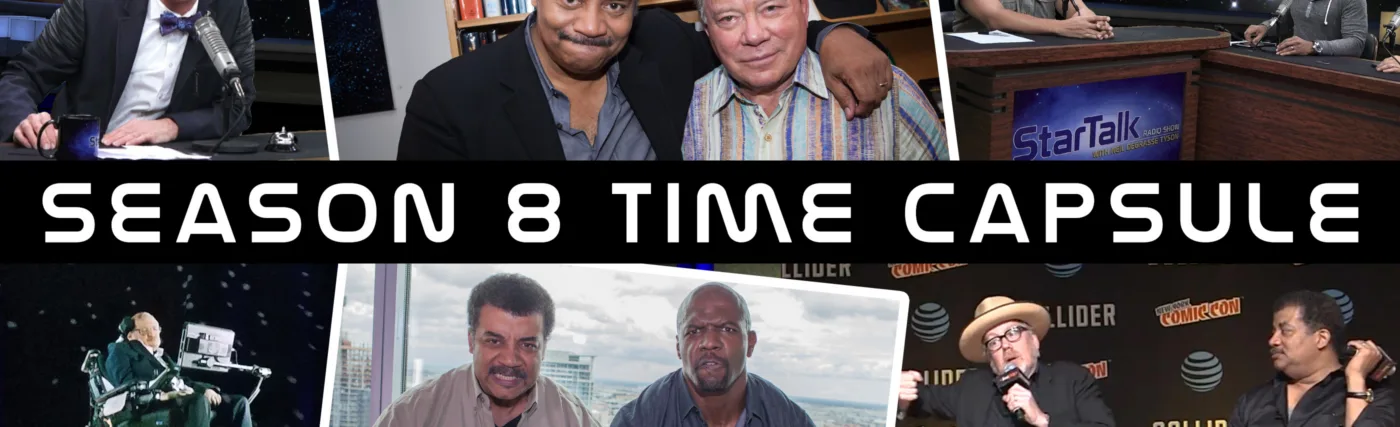
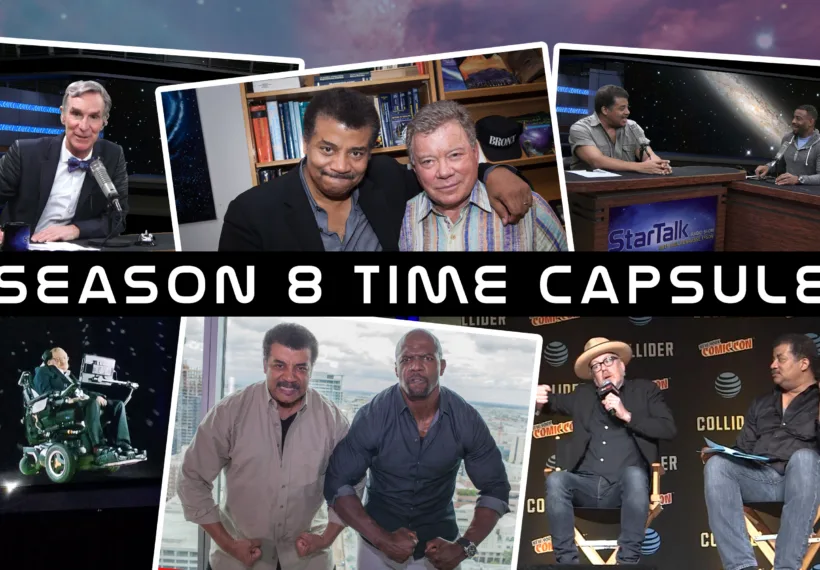
Every year we look back at our fan’s favorite episodes and guests – and our own – and pick the best of the best to put into our Time Capsule episodes. To kick of the Season 8 Time Capsule of regular episodes (Cosmic Queries are coming next week in Part 2), Neil deGrasse Tyson sits down with CNN’s Fareed Zakaria and Chuck Nice to explore the impact of immigration on science and innovation in America and how the United States became a science powerhouse. Next, Neil, William Shatner, Chuck, and astrophysicist Charles Liu investigate the magic of science fiction and its projections of the future, the issue of race relations in America as seen through the lens of Star Trek, and the imagination required to study science. After that, Neil chats with actor and former NFL player Terry Crews, Chuck, and Dr. Felicia D. Stoler, America’s Health & Wellness Expert™, about Terry’s path of fitness, where his desire to be strong comes from, and the positives and negatives of working out. Col. Chris Hadfield, former astronaut and ISS Commander, then takes over the hosting chair to discuss his visceral experience “walking through” the Northern Lights on a spacewalk, and what extraterrestrial life might look like, with help from comic co-host Maeve Higgins, Scott Adsit, electrical engineer Katherine Pratt, mechanical engineer Suveen Mathaudhu, and, via hologram technology, Dr. Stephen Hawking. Next, geek out with Neil, Chuck, former MythBuster Adam Savage, and NYU philosopher and author Matthew Lao, about the promises and perils of human augmentation, Iron Man vs. Batman, exoskeletons, and the ethical dilemmas human augmentation might create. Lastly, Bill Nye, Chuck, and Ross Andersen, Senior Editor at The Atlantic, answer fan-submitted Cosmic Queries about science and the search for the truth: whether social media is making us dumber, if we should consider re-structuring the way we vote, and more. Tune in next week for the best of Cosmic Queries in Part 2!
Transcript
DOWNLOAD SRT
Welcome to StarTalk, your place in the universe where science and pop culture collide. StarTalk begins right now. Welcome to StarTalk. I'm your host, Neil deGrasse Tyson, your personal astrophysicist. I'm also the director of New York City's Hayden Planetarium...
Welcome to StarTalk, your place in the universe where science and pop culture collide.
StarTalk begins right now.
Welcome to StarTalk.
I'm your host, Neil deGrasse Tyson, your personal astrophysicist.
I'm also the director of New York City's Hayden Planetarium at the American Museum of Natural History.
This week, we're ringing the new year and prepare to launch yet another season of StarTalk Radio.
But first, we say goodbye to 2017 in the only way we know how, by our annual time capsule show.
By the way, this completes our eighth season.
Eight, count them.
Every year, we send out a survey to you, our fans, and ask you to vote for all your favorite episodes, guests, co-hosts.
Then, we create the single mashup episode of the winning picks.
And so, we have done just that, selecting the best moments from this past season with your help.
We kick this off with your number one favorite episode, Let's Make America Smart Again, with Fareed Zakaria.
This was the first of our several special edition episodes where we highlight facts and root out fallacies surrounding the politics that influence science in America.
CNN journalist Fareed Zakaria joins comedic co-host Chuck Nice and me to help us understand the impact of immigration or absence thereof on science and innovation in America.
Check it out.
So, I look at things like the Manhattan Project, so crucial to what became 20th century politics and science and it landed us where we became, where we were for the entire second half of the 20th century and most of those scientists were foreign born nationals.
And so, what from your world view, could you just explain how this works?
It's fascinating, you're absolutely right.
We think that America was always the most scientifically innovative country in the world.
We look at the Nobel Prizes and we take it for granted, 5% of the world's population, we get about 75% of the world's prizes and that doesn't even count Obama's Peace Prize, which I regard as kind of a weird one in his first year of office.
Come on, it's like a lifetime achievement award.
At age 25.
At age 25, you didn't really earn this, but we gotta give it to you just because we like you.
Exactly, but if you look at the early 20th century, in 1910, 1914, I forget the exact date, Germany had won more prizes in science, Nobel Prize in science than Britain and the United States put together.
So the US becomes a powerhouse in science, basically for three big reasons.
The first is the destruction of Europe.
Basically, World War I, World War II, Great Depression, the place gets flattened, all the universities shut down.
With the last man standing.
With the last man standing, and particularly Germany gets destroyed.
Germany was the scientific superpower.
Second, we take in all these immigrants.
People forget, even in the 30s, with all the restrictions, 100,000 Jews came in from Europe, many of them scientists, as you say, many of them worked on the Manhattan Project.
After that, of course, the door opens even wider.
And the third is massive government funding.
So let's think about it.
Europe ain't destroyed anymore.
Government funding is down to half what it used to be.
Our only hope, frankly, is that we keep taking in the best and brightest in the world, otherwise, you already see the world catching up.
You already see that Japanese scientists win Nobel Prizes routinely, that you now have the Chinese getting in on the action.
So we have to recognize, we're 5% of the world.
We want to make sure that we're not winning just 5% of the Nobel Prizes.
Well, that very fact then is enabled, only if you then not only have access to, but mutual interest in coming to the world's greatest talent.
And the world's greatest talent isn't always in your country, because everybody's human and innovation is not some.
Nobody has a monopoly on innovation.
Innovation, it's just a matter of opportunity to express it.
So when I go back to, again, the Manhattan Project, I go back to the Apollo Project, each of those had sort of military motivations.
I mean, we don't like remembering Apollo as military, but NASA was in response, of course, to Sputnik and the threat that we perceived by that.
But you look at, of course, Einstein came over.
Like you said, this whole flux of Jewish scientists.
Then after the Second World War, we build our space program on the back of Werner von Braun, for example.
And now you have all these people, Enrico Fermi.
We have labs named after this guy, Fermi Labs, okay?
He's Italian, his wife is Jewish, and all of this is going on.
And this is America.
That's exactly right.
It's not even being fine-toothed for what that is.
It's just, of course.
You know, you go, I just look in our notes for this, that apparently, you know, of course, Benjamin Franklin, let's go back to him, one of the first great scientists of the United States, he, I mean, I, he wrote books on research and electricity.
So he's probably, he might even be, been a better scientist than founding father.
I mean, if you look at what his record is and what he's discovered in the books that he had published, but regardless, he, he, his parents fled England because of religious persecution and he's here.
And so he's basically an immigrant, his immigrant lineage, which would have been easy back then, I guess.
See, the thing is though, doesn't really count when you're, when you're not brown.
What's happening there, I'm just saying.
Like, you know, it's, this is the way it works.
Let's get to that.
There are rules.
There are rules.
Let's get to that.
So, so, so, so, so Fareed, let me be devil's advocate here.
So we have these, I cite all the famous scientists of the 20th century that shaped modern, you know, we have Wernher von Braun from Germany who birthed the, he basically designed the Saturn V rocket that got us to the moon because he had that knowledge and awareness from his, from developing the V2 rocket and that was basically the first ballistic missile.
It left Earth's atmosphere, found its target, fell on the target.
That's a ballistic missile.
V2 being the rockets that the Germans developed and rained on London in 1940.
Correct, correct.
Although rain would be a little too delicate a word for what these things did.
So yeah, they fall out of the sky supersonically.
So it's not like, whistling Not a whistle.
No, you do not, you're walking and then the block explodes.
Okay, that's how that.
My dad was a graduate student in London in 1945 and was having coffee with a bunch of his friends in a cafe.
He was, they said to him, stay for a while.
He said, no, I gotta get back.
I gotta get some work done.
He walks out and he turns his back and a V2 rocket hit the cafe.
Everyone there, every friend of his died.
If he had just stayed when they told him, just have one more cup of coffee, he would have been dead.
Then we wouldn't even be having this conversation.
Right, right.
Or I think of it the other way.
That's how it sounds.
How many others might have been having a conversation and not him?
Because they would have had to say.
Did he ever use that as a motivated factor to get you to do your work?
Let me tell you something, that would do it.
Yeah, you know what?
I got back to work and I'm alive.
You know, be a different, be a little different.
My dad had a tough upbringing as a self-made man and he always said, I went through stuff I don't want you to ever have to go through.
Uh-huh, uh-huh.
That was his attitude.
Well, let me just complete this list.
Steve Jobs, as we know, his family lineage is traceable to Syria, if I remember.
Syria, his actual father was a Syrian immigrant.
And Elon Musk, a South African, Bavaria Canada.
Sergey Brin, Google.
And Google, right, all of this, all of this.
And so.
Not to mention all the real, I mean, the scientists.
These are all we're talking about.
We're trying to.
It's just the entrepreneurs.
Right, we're just talking about the entrepreneurs.
Devil's Advocate.
This is a list of people any country would want.
So, do you say, yes, you can immigrate, if you have these kinds of ambitions, or if you're gonna, if you're gonna, we'll let you in if you go get a degree in engineering.
I mean, is that, is that the devil's advocate posture here that has not yet been resolved in this conversation?
So there's no question we should take any of those kinds of people.
I mean, there's, I think Michael Bloomberg had the idea, if you get a PhD in science, you should have a green card staple to your degree when you get it.
And that makes a lot of sense.
There's no question we should.
There was also Newt Gingrich with a very strong posture on that.
And I think that, you know, that seems to me a no brainer in one of the parts of immigration reform one hopes eventually will get to.
The harder question, as you say, is we've taken lots of people who are not like that.
That's called the family unification policy.
I think we've probably taken too many that way and too few who are skills and brain-based.
But, you know, there's also something to be said for the sheer drive that low skill immigrants bring.
Obviously, in the right numbers and in a way that they can be integrated, but the biggest problem for a rich country is you lose that drive, you lose that hunger.
I mean, you know, we all have children and the more fortunate the parents circumstance, the kids are going to be great, they can't have the same drive, right?
The United Arab Emirates has a similar problem.
It's a very wealthy country, but who's going to clean the laundry and who's going to...
But some guy who comes from, you know, Mexico or Guatemala, Honduras, who's willing to risk everything, abandon, you know, home culture and come here to wash dishes.
Just to do that.
And by the way, that person might end up doing something remarkable.
His children might end up doing something remarkable.
The real thing you have to keep in mind is the children of those people tend to be the ones who have that same drive, but they are also educated here in America, which gives them a distinct advantage when it comes to it.
Bigger drive than American with the same American education.
What we're doing is we're creating better Americans.
2017 saw StarTalk's fourth season on the National Geographic Channel and our third Emmy nomination.
This next clip is from my Nat Geo interview with Captain Kirk himself, William Shatner.
I was joined in studio with astrophysicist and StarTalk All-Star Charles Liu, as well as NASA technologist David Batchelor to talk about the power of science fiction.
Co-hosting this episode is Chuck Nice, who you selected as your number one favorite co-host of the season for a second year in a row.
Check it out.
Did your work on Star Trek introduce you to the world of science fiction?
No, I had read science fiction prior to that.
I was fascinated by science fiction.
The greatest Star Trek episodes were stories suggested by the great science fiction writers.
Asimov being one of the most obvious, but there were others who had great story ideas, but they didn't know how to write a well-made television play.
So we had television writers take their great ideas and make the great Star Trek episodes.
That magic of science fiction and its projection into the future, its ability to try to imagine an explanation of some of the things we can't explain, moving lights, back in time, that whole thing that astrophysicists wrestle with, science fiction wrestles with, but with an imaginative explanation.
Even Shatner is doing Shatner.
He looks like he's doing an impression of himself, explanations.
So, Charles, you're a colleague, we both work in the same field, and there's always some imagination at the frontier.
Oh, 100%.
You and I both know that if all we did in the stereotypical sense was, as scientists, be in our white lab coats and do the same things over and over again that you expect that somebody who doesn't have any creativity to do, we would never get anywhere.
We imagine answers to questions, whether we have the technical expertise yet or not, to answer them.
And it just turns out that in real science, we try to use our technical abilities to produce legitimate experiments, whereas in science fiction, they are freed from that constraint.
So what they also do is not just imagine what science is in the future.
In almost all cases, certainly the best cases, they're finding all the ways that new science affects culture, civilization, humanity.
That's right.
And, of course, Ray Bradbury is famous for saying…
The Martian Chronicles.
Ray Bradbury was accused of saying, why are you always all dystopic about the future?
You know what he said?
He said, is this the future you're wishing we go to?
He says, no, I write these futures so that we don't go there.
That's right.
Oh, that's pretty cool.
That's deep.
We have to imagine both the good and the bad in order to prepare for either one.
So when you have science fiction and an imaginative palette, they're all…
It's like a multiverse of options of where you can take the future of our civilization.
And I'm trying to think, you go back a few decades, let's say to the 80s, people were already making movies, dystopic movies about pandemics, of course, nuclear destruction.
We were still in the Cold War, cloning, a little bit of cyberspace was in there.
So it's just fun to think about what the creativity of a science fiction writer will do and how much we have to pay attention to.
That is so depressing.
Not at all.
Yeah, it is.
The 80s were a few decades ago?
Oh my gosh.
It's nice that you mentioned Ray Bradbury.
Just as much as scientists of our generation were inspired by his, say, Martian Chronicles, he too was inspired by scientists who were just studying Mars at that time.
So it all interplays together.
It's a very, very nice combination, the creativity and technology.
Well, up next in my interview with William Shatner, we'll be discussing race relations in America through the lens of Star Trek and was created, as you know, by producer Gene Roddenberry back in the 1960s.
Let's check it out.
Were you self-aware of Roddenberry's larger mission statement that he was trying to make a difference in the world?
Well, both of those statements are suspect.
I'm not sure how much of a difference Roddenberry was trying to make in the world.
He had a wonderful idea, no interference, live long and prosper, whatever the edicts were, except the crew did go down and interfere.
That resulted in a plot.
That was the story.
If you didn't interfere, you just say, hi guys, we'll just fly by.
Yeah, right.
Good going, guys.
So you had to interfere to have a plot.
So we throw that out the window.
But those ideas that were in the individual plots that each movie, each segment of the series, was based on, those were great ideas.
Half white, half black, half black, half white, fighting over the stupidity of racial fighting.
In a time when the civil rights movement is in full swing.
Right.
And so this is a story in space forcing us to…
Forcing us to look at the inanity of race relationships.
That's science fiction at its best.
So that idea, I don't know where it came from, I don't know who suggested that idea.
And I would imagine Roddenberry had the last statement saying this goes, we'll do this story.
So from that point of view, he was doing something.
From my point of view, whether I was aware, I read that story, my gosh, what a wonderful story idea this is.
How dramatic.
They fight.
I hate you, because you're black on that side.
That's great.
And it's obvious I'm fighting you because I'm black on the other side.
Yeah.
And that was clear to them for whatever reason.
Right, right.
So, it was clear to everybody what a glorious story that was.
And we had so many others down the line with other subjects in mind.
So, yes, I was very much aware.
Welcome back to StarTalk.
This special time capsule episode is a mishmash mashup of your favorite moments from all of season eight.
You cast your votes, and as always, it was a tight race, but the results are in.
This next clip features one of your favorite guests from all of season eight, former NFL star, actor and fitness enthusiast Terry Crews.
He and I became fast friends.
Exercise physiologist Dr.
Felicia Stoler joined Chuck Nice and me in the hall of the universe to chat about the science of fitness.
I asked Terry where his path to fitness began.
Let's check it out.
It was a lot of lonely nights and days as a 14-year-old boy in my room, looking in the mirror, doing this kind of stuff, and it's like, oh, and now you're paid to do it.
What's so crazy is that?
Well, you were buffing at 14, what do you mean?
I have to say, I always wanted to be strong.
That was the thing.
I think it comes from I had a father who was addicted to alcohol and a mom who was addicted to religion.
So it makes a very caustic mix.
I mean, very-
Combustible.
I mean, it was like-
There's no common path out of that.
Your life, you deal with shame, and then you deal with being a child of an alcoholic parent, you want to be a pleaser.
And the only thing I had to myself was the need to be strong, like the physical thing.
Plus, we're of the generation where if you were bullied, the advice was become strong so you can kick their ass.
I just felt the need to be strong.
And I remember, you know, I actually, my earliest memory is I would lift couches and chairs and stuff.
And I actually had a hernia when I was five years old because I was always walking around and my earliest video footage, I'm making muscles and I'm like, I wanted to be strong.
And once I discovered weights, I was like, I can, I'm going to do this.
I'm going to get my, I think it was because of fear.
You know, I was always scared.
I was scared when my dad come home drunk.
I was scared I didn't do something my mom wanted me to do.
You know, it was that fear of just everything, fear of the world.
You didn't know and I thought I had to protect myself.
Felicia, in your life experience, do people lift weights more out of fear or out of fitness?
I think more people lift weights out of fitness.
I think today, today, I think they do.
I can totally understand where he was coming from, that it was something that he was able to put his energy into for himself and he could make something of himself with that.
But I think most people today, I mean, there's a difference between lifting weights for health and well-being versus bodybuilding.
And he sort of is on that fringe of athlete and bodybuilder.
He was afraid.
I understand that.
I had the same kind of experience.
And then I discovered weights and I was like, oh, this is hard.
He had a hernia at age five from lifting stuff.
All we can think of is bam bam from the Flintstones.
And so that seems a little early in one's life.
So let me just ask, then, if you go into a fitness center, yes, there'll be the bodybuilders, then the health fitness people.
But then how about the people who are the people who do it for sex appeal?
I mean, being fit is sexy, right?
But but but what I wonder if evolutionarily, there's a driver for that in your studies, does that come up?
Not so much in terms of sexy.
I mean, we look at art throughout the years and you look at what the evolution of beauty was and what was maybe perceived sexy a few hundred years ago versus today.
I think the male Greek statue still holds today.
I'm thinking lady, is that right?
But when you look at who's the sexiest man or the sexiest woman, they're usually fit, they're not necessarily bodybuilder-esque.
So I think that there's a very big difference in that.
And then when people are training for those types of events, they don't look like that 12 months of the year.
That's the one thing that I always caution people about when they are training for those events.
You're looking at one moment in time.
When they have to look that way.
When they have to look that way for competition.
So you're saying it's all a lie.
What's a charade?
A one-day charade.
A one-day charade.
A one-day facade.
Right.
But I can tell you flat out that when I was a kid, any incentive to lift weights was not for health.
It was really because there were bullies out there.
Bullies back then were physical bullies.
It wasn't only this word stuff.
It was physical bullies.
And we were told sticks and stones can break my bones, but words will never hurt me.
So I got to stop the sticks and stones from breaking my bones.
The only way I can do that is to go build muscles.
And the ads in the back of comic books were, are you a 97-pound weakling?
Go come lift weights with Charles Atlas, and then you can come back and kick some ass.
And so I have to agree with Terry, at least in my childhood, the motivation was for protection.
And so...
But you were also an athlete as well when you were a kid.
Yeah, but I wasn't lifting couches and stuff.
And I didn't have a hernia at age five.
It was later.
I mean, middle school.
You got your hernia at 13.
No, no, so for me, I viewed myself as, because once I got bigger and stronger, I was protector of the nerds.
Yeah, if I were to be a superhero, that's the superhero it would be.
Like nerd shield.
I am nerd shield.
So, so, so let me just get back to this.
So does lifting weights make you healthier?
Yes, it does.
Absolutely.
So lifting weights does a few things.
One is it increases your muscle mass.
And we all want to increase our muscle mass because the flip side is that we burn more fat for fuel at rest, like when you're sleeping, right?
The other thing is that the…
So that we…
that allows you to eat more.
That's right.
You actually have to eat more, right?
You do need to eat more.
Well, it depends on what your end goals are at the end of the day.
So it's good for bone density.
It's also good for overall, like, strength.
So for activities of daily living, right?
As we get older, we should continue to lift weights and to do resistance exercise.
And the other thing is that when we're getting toner and our muscles get bigger, actually the circumference of our limbs gets smaller because our whole body, everything is round, right?
Our arms, our waist, our legs.
So as you get tighter and you get toner, everything gets smaller.
So there's a benefit to that.
This is if you're not trying to get big muscles, if you're just trying to get fit muscles.
Right, fit muscles.
Fit muscles, okay?
Right, correct.
So hopefully you're balancing out any of the strength training that you're doing with some stretching and flexibility training as well.
I loved being well-stretched, as I was when I wrestled.
I could put my foot over my head and do a split.
It was the best kind of...
I'm just envisioning it.
Alright, so normally we don't think of lifting weights as strengthening joints.
That's an interesting added feature to this.
And so, can you lift weights too much?
Oh, absolutely.
Overuse injuries can happen all the time.
So it's important to allow rest in between.
So that's actually a common problem.
I see that a lot with individuals that I'm working with.
I see that with people at the gym that think they can work out every body part every single day.
The truth is you need to allow your muscles at least two days of rest in between working that muscle group.
To recover.
To recover, because in order...
That's where I'm a viking, allowing rest in between.
I just never go to the gym first.
So really allowing that rest in between muscle groups.
I'm not saying you shouldn't exercise every day because you actually can exercise every day, do something physically active every day.
Upper body, lower body.
Yes, that's how I actually do it, because that whole back and bicep, chest and tricep thing, I got a problem with that.
I like that, back and bicep, chest and tricep.
That's a whole thing.
Well, but that's been like the traditional mantra of weight training.
Alright, I got you.
But the problem is you need the other muscles to do those other exercises.
So you really need to do everything from your chest to your fingertips in one sort of day of resistance training.
Do your core and your abdominal stuff, and then do from your tush down to your toes, right?
From your butt down.
So then you would do your lower body, and hopefully you're doing cardio in between, and doing a little bit of everything.
Next up, NASA astronaut and Canadian hero, Commander Chris Hatfield took over the driver's seat at StarTalk Live from FutureCon.
Commander Hatfield hosted a talented panel to discuss engineering of the future, including the one and only Stephen Hawking, who joined the stage via hologram to lend his words of wisdom.
Comedic co-host Eugene Merman brought along comedic guests, Maeve Higgins and Scott Adzit.
Joining as expert guests, electrical engineer Katherine Pratt and mechanical engineer, Suveen Mathaudhu.
I was lucky enough to do two spacewalks.
And we understand pretty clearly what causes the Northern Lights.
We know it's energy from the sun being caught by the earth's magnetic field and reacting with the upper atmosphere and the little electron states going up and down and fluorescing, and that's why the Northern Lights glow green and glow red.
But while I was outside on a spacewalk, we went through the Southern Lights.
And what started out as sort of a robotic, technical understanding of how a planet behaves suddenly became so visceral and so beautiful and so entirely different than just the science that's behind it, to be surrounded by, with it flowing between my legs and around the ship, to see our world that way.
I think that is very much the essence of discovery and exploration.
And I don't think we're gonna have robots that are gonna appreciate that.
Well, Ray Bradbury always said that we should be sending up artists into space so they could capture the motion.
I agree with you, I agree with you.
But the thing is, we have three artists right here who have a great wealth of knowledge about science, but you all are artists as well, and I think that's very valuable.
Thank you.
I validate you.
And when you speak about the two working together, humans and robots, it makes me think of the photos that we got back from, is it the little voyagers, those two little crafts who went and took a picture of Saturn's rings and I took a picture.
And then when we could see them back here, people who will never like walk in space, that made me feel like, oh, I am actually connected to this and I can picture it and I can see it.
And that's magic too.
I mean, it's not magic, it's science.
So let's, we have the opportunity, I think, if the technology will allow us to bring in an expert who has sort of thought about a lot of different things and has had time through an extremely long and successful career of invention and discovery and original thought to talk about a lot of different topics including the idea of exploration in life.
So could we ask Dr.
Stephen Hawking to join us, please?
Hello, can you hear me?
Yes, loud and clear.
Can you hear us?
I can hear you too.
I am delighted to have the opportunity to use ArtMedia's hologram technology to transcend time and space to be with you today.
Well, if anybody can transcend time and space, it should be you, sir.
We have a question for you, and that is, if the combination of humans and their technology and the robots, if it takes us far enough out into the universe so that someday we eventually can find evidence of life somewhere else, what's it gonna look like?
What do you think life in other planets or other solar systems might be like?
Our civilization is only about 10,000 years old.
But the universe is about 14 billion years old.
Therefore, any other life in the universe is likely to be much more advanced than us or so primitive that it hasn't even begun to evolve.
In the former days, the universe was a place where the breakthrough listen project should be able to pick up their radio transmissions if they are close enough.
But in the latter case, one has a rather boring universe full of potentially dangerous bacteria or other life forms.
A far cry from the usual science fiction picture of glamorous aliens.
Any other life we discover is likely to be artificial because robots with artificial intelligence are far better equipped than biological life to survive the long duration and radiation damage of interstellar travel.
I wish I could do that.
So that's intriguing that one of the deepest thinkers we have thinks that if we do encounter life in order for it to have survived over the immensity of distance and time, it will have had to no longer be biological, but will have had to transfer itself into some sort of technical or robotic kind of form.
So some sort of hybrid between the two.
But for now, we're kind of stuck with these biological forms.
We're not far enough along yet.
And we're fragile, physically fragile, psychologically fragile.
The crew up on the space station is very much separate from the world.
I was talking to Susan Helms when she was up there back on my second space flight.
And at one point, Susan said to me in passing, she said, hey, Earth said that we need to do this tomorrow.
And I thought, Earth said that her psychological fragility, just her makeup was such.
And she's became a multi-star general in the Air Force.
I went to test pilot school with her, wonderful person.
But in order to stay healthy that far away from home, even that close, but that's separate, she had to completely split herself from the rest of humanity.
You have to recognize that you are no longer an Earthling.
You are a space link.
Earth is a separate, discreet entity from yourself.
And you and your crew are that way.
And I think as we go further, we're going to have to honor that.
We put a lot of psychological support equipment up on the spaceship, in fact.
We have a big movie library up there.
We have a huge audio library of songs, books to read.
Yo-yos, yes, which are fun in weightlessness.
You can walk the dog forever.
Next up, a StarTalk live edition from New York Comic Con.
Former myth buster and king of nerds, Adam Savage, joined me on stage alongside comedic co-host Chuck Nice and NYU philosopher Matthew Liao to geek out over the promises and perils of human augmentation.
We're talking about Batman and Iron Man.
Batman and Iron Man, those are my two favorite because their secret power is their brains.
And they're human.
Yeah, yes.
Well, we got some people taking issue with this out.
You can't express that strong an opinion in front of this crowd, that's all I'm saying.
So, but they clearly have augmentations to their bodies in some way or another.
I think it's more they have augmentations to their bank account.
You're bringing up, there's a poster that shows all of the philanthropic giving that Bill Gates has undergone in the past like 20 years, you know, 30 billion dollars.
And that by conservative estimates, he's saved over six million lives.
This is as of a few years ago.
At the bottom it says, suck it Batman, this is how a billionaire saves people.
Oh!
But does he have a utility belt?
If Bill wanted a utility belt, I'd make him one.
If Bill wanted a utility belt, I'd be it for him.
So let me ask Adam, how do we define super in this regard?
Well, is Batman a superhero?
He can't fly, there's a lot of stuff he can't do.
Yeah, where super gets into the realm of the fictional is in both of the Batman and Iron Man augmentations.
Because Iron Man's exosuit, while in any small piece of it, is somewhat possible or plausible that there are mechanical linkages you could build that would be self-perpetuating and give you all sorts of extra strength.
The idea that it would work without flaw repeatedly is an absolute fantasy.
Or one might say a myth.
That's no longer my job.
But I mean, there's a reason NASA has never used cables to assist astronauts in their grip or their ability to move the suit because they engineers at NASA, as brilliant as they are, understand that extra moving parts is extra things that can go wrong.
So you're saying there are a million ways Iron Man's suit would fail and the movies don't show any of them?
It's a movie.
I have actually tried to build a device that shot a cable into a wall that you could hang off of.
And then I talked to an agency that tried to build one of these for the government.
And they failed in exactly the same way I did.
Okay, I'm old enough to remember Batman in first run on television.
And when he had that little device, you know, the gun that shoots the...
The grappling gun.
I said, how does that dart stay in the wall?
That's like not happening.
Actually, what I...
Not happening.
No.
And, wait, see, he got me started on this.
Then, then they throw the thing up and then climb up the wall.
And I said, they're not climbing up a wall.
They're just walking along a flat thing.
And he tipped the camera.
Because the guy sticking the head out of the window is that...
All the angles are wrong.
And I knew this.
Sorry.
Sorry.
I feel you, brother.
You feel my pain.
So, so here's my point.
You have these, in the modern Batman he's got, it's really kind of an exoskeleton.
Yeah.
Not an exoskeleton, a body armor, I guess, is what you would call it.
Yeah, it's segmented body armor.
And so is this, so, so if, between the two of them, who do you think would win?
Oh, Batman.
Oh, no.
Understand.
No.
I think Iron Man will win.
Iron Man.
Wait, wait.
Tony Stark for life, baby.
Ha ha ha.
Yeah, you're outnumbered, so you're wrong.
Ha ha ha.
Thank you, one person.
I appreciate it.
My thinking is, is that Iron Man would be like, I'm gonna punch.
And then he can't move, and Batman's like, doonk.
Ha ha ha.
Okay, the reason why I like Iron Man better is because he builds his own stuff.
With Batman has, he's got like, other people who do it for him.
Well, Wayne Industries.
Wayne Industries.
That's who builds all his stuff.
Technically, that's Wayne Enterprises.
Oh.
You are correct, sir.
So, are there any real life examples of exoskeletons used in the world?
Yeah, so the military's been creating these exoskeletons for soldiers.
I think, Adam, you probably know about them.
Thank you.
And they're prosthetic limbs for people who are disabled.
Are they working the way Luke's hand worked in Star Wars?
You know, where you look at the thing.
I mean, are we there yet?
Let me ask that question.
Not yet, not yet.
Can I bring this back, though?
Like, there must be an attachment that someone who has no arm below the elbow has asked a prostheticist to make, and the prostheticist has said, no, I'm not gonna graft a 45 caliber pistol onto the end of your prosthetic.
Or a buzz saw for a fist.
That's good.
But that's where we're talking about, that's an ethical problem that the constructor has with the goal of the person who needs the device.
That's right, that's right.
So, I mean, right now they're just doing it mainly for treatment, for people who are injured, right?
So that they can move about, but eventually you can think of, you know, you can sort of add more things to it.
You can add weapons, you can add swords.
Laser pistols.
You want to be like a Swiss Army knife, human.
Oh, my son, one of my sons once asked me when he was about four years old.
Is it thing one or thing two?
He said, daddy, the penis is a very special part of your body.
And I said, yes.
Yes.
You're right.
And he said, because all children are Jailhouse lawyers, he said, is it more special than a foot?
And you should have said, son, just wait 12 years.
Here was my metric.
I thought, well, let's see.
If I lost my foot, I could make an extremely usable functional replica of it.
Yes, the penis is far more important than the foot.
Oh, so this is from the point of view of a...
Of a repeal and replace.
Of a remodel maker.
For our final clip, Bill Nye takes over the host seat to explore the pursuit of truth in a world of alternative facts.
He's joined by co-host Chuck Nice and senior editor of the Atlantic Monthly, Ross Andersen, in the episode Science and the Search for Truth.
Drew Huber from Facebook says this, Are there still scientists that are using alternative facts to claim that climate change is not real?
Well, there's the cherry picking of data.
Ross, you deal with this all day, I take it.
Yeah, absolutely.
You do have people who will, for instance, point to a particularly heavy snowstorm in California or a cold day in January and say, oh, see, yeah, no, climate's not changing, just like we thought.
Senator Inhofe showed up on the Senate floor with a snowball.
We laugh, but he and his, the people that vote for him at some level think he's on the right track.
Wow, yeah, stunning.
That is absolutely stunning.
There are fewer snowball days than there used to be.
That's something to consider, but it's confronting people or embracing people or becoming partners with people who have doubled down on ignoring scientific, what seemed to be provable scientific facts.
Let's try another query.
All right, John Clemens from Facebook.
Is social media making us dumber?
Is my-
StarTalk on your electric phone, your device, StarTalk's enriching your life and making you that much smarter.
Right, everyone?
Ross, you deal with, you used to be a print magazine exclusively.
But how much of, what fraction of your business is online now?
Oh, I mean, the vast, vast, vast majority of it.
I mean, we publish maybe 10 to 15 pieces in the print magazine monthly and we publish maybe 40 or 45 articles a day on the web.
Oh, wow, it's a factor of 100, thereabouts.
So do you feel that there's a, people who follow you online don't accept your reporting as accurate?
Do you have the pushback, because it's social media and it's dismissed, as making us dumber?
Sometimes, well, I think there's a couple things going on.
First of all, I want to say that, of course, like any human beings, we make mistakes and we regret them and we try to be really transparent about correcting them and as quickly as possible.
But yes, as far as social media making people dumber, I'm just not, I feel like any totalizing narratives around social media and it making us smarter or dumber are usually sort of themselves dumb.
It's obviously a nuanced phenomena.
I don't know about you guys, but I've been, I mean, I've found social media making me smarter in all kinds of ways.
I feel more kind of in touch with what's happening in the world on a moment-to-moment basis.
Now, what that's doing for me is-
But I remember Gil Scott Heron, with the revolution will not be televised.
Turns out it is being, if you have a revolution, it better be on Twitter.
It's not happening.
Absolutely.
So to that end, imagine how much more difficult it would have been, no matter how you feel about these ladies, how much more difficult it would have been to organize the Women's March without social media.
That's right.
With social media it was millions of people showed up in several cities, dozens of cities.
And how do you, Ross, do you have any opinion about this proposed science march?
Yeah, well, so one of the responsibilities of my job is not to advocate for political activism of any sort.
But you're reporting on.
We'll be watching it with interest.
Let's take another query, Chuck.
All right, this is O-I-O-cha.
O-I is how you spell the first name.
I don't know how to say that.
Oye.
Okay.
Oye-o-cha.
Oye-o-cha, there you go.
If people can't use facts and reasoning to make well-informed votes, and there's little hope of improving that situation.
It's a theme today.
I'm telling you.
Today on Everything Sucks, StarTalk Radio.
I'm going through pages of them.
I've got stacks of them.
Is there a payoff phrase there at the end?
Well, the payoff is, should we consider changing the way we vote?
Well, this is, hey, Ross Andersen, you know, no matter what else happened, this is the second time in my lifetime, I guess it's the fifth time in my lifetime, that the popular vote did not determine who became president.
Do you think there is any way ever that the electoral college would be modified in any way?
It sounded like that questioner was referring more to, should we be selecting out people who-
Are stupid.
Demonstrate some capacity for evaluating judgments, scientific evidence to vote, and I would say absolutely not.
That is an ugly history to ideas like that.
But electoral college reform, I'd probably want to bring on one of my colleagues from the political section to talk about.
He's blushing.
But it's interesting.
It's an interesting idea.
Well, everything's interesting.
Do you think it's possible?
No, not in the near term.
And would it be any better or would it just be, the electoral college, as I understand it, was created to prevent New York and Pennsylvania from having too much influence?
Right.
I think Trump has a good point, too, when he says, look, I didn't campaign on that.
The campaigns would have looked totally different.
It's not the case that, oh, if we had run for a popular vote, Hillary would have easily won by three million.
He would have lived in Texas, for instance.
Yeah, but he also said that the electoral college is a disaster.
So.
They also thought it was genius.
Right, and then it's the best invention ever once he won.
You've been listening to StarTalk Radio.
I'm Neil deGrasse Tyson, your host and your personal astrophysicist.
Join me next time for part two of our Time Capsule Show.
That's all for now and as always, I bid you to keep looking up.
See the full transcript



 Unlock with Patreon








 Become a Patron