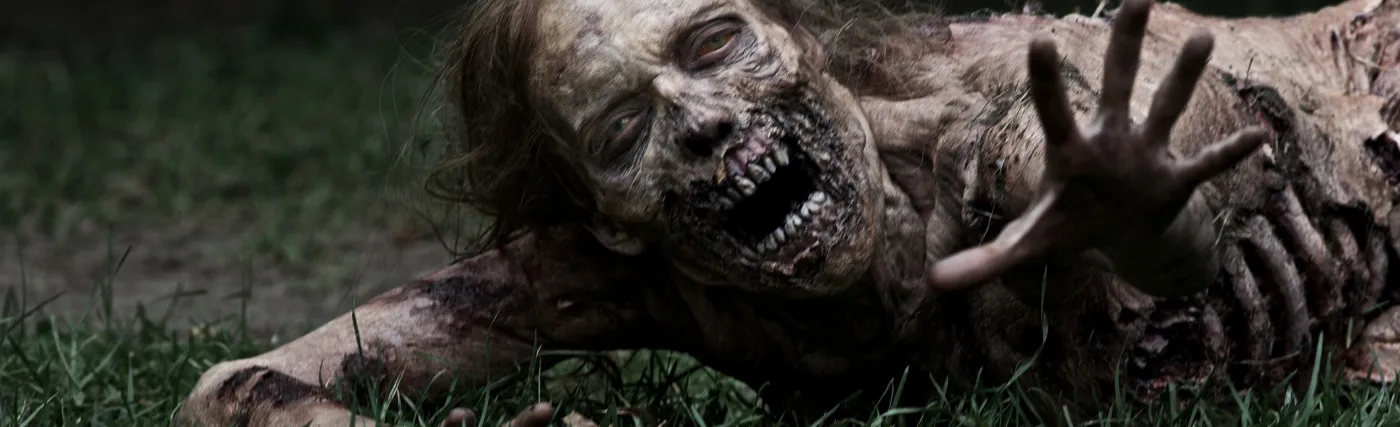
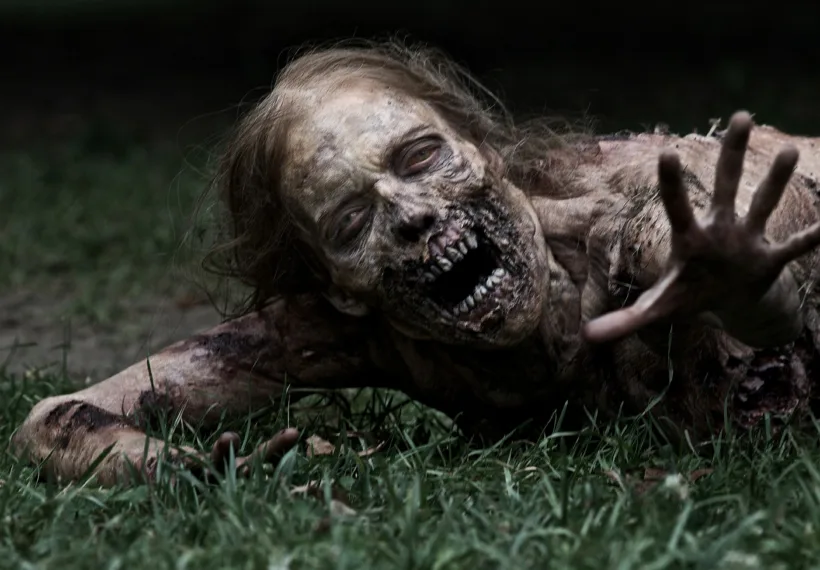
Can we learn anything about anthropology, sociology, morality and physiology from fictional zombies? To find out, Neil deGrasse Tyson interviews Robert Kirkman, the Creator/Executive Producer of The Walking Dead, who says that his show is less about science fiction and more about the way people interact in extreme situations. To bring a scientific frame to the discussion of zombies, Neil and co-host Maeve Higgins talk with anthropologist Jeffrey Mantz, who once taught a course using zombies to examine how real world societies deal with fear, and Harvard professor Dr. Steve Schlozman, who wrote the fictional The Zombie Autopsies, which addresses the medical etiology of the zombie process as if it were real. You’ll find out how a virus like rabies can preserve muscle processes, and what role the ventromedial hypothalamus plays in zombies’ ravenous hunger. Explore how people establish affiliations during times of scarcity, how group dynamics influence the success of tribes, how charismatic leaders can bring their societies to wage war, and why moral relativism based on changing circumstances can make otherwise shunned and perverted behavior seem acceptable and even normal. You’ll hear why civilization is so important to establishing and preserving morality, and why the fear of a fragmented or non-existent civilization as the result of a major disaster may be at the heart of why The Walking Dead is so popular. Plus, Mona Chalabi explains mathematician Robert Smith?’s formula about zombie outbreaks, Chuck Nice asks people in Washington Square Park how they plan to survive in a zombie apocalypse, and Bill Nye compares the smallpox epidemic to a fictional zombie apocalypse to reassure us why science will save us.
Transcript
DOWNLOAD SRT
Lenovo is sponsoring Life with Machines, a new video podcast hosted by comedian and tech whiz, Baratunde Thurston, where he discusses all things AI. Lenovo's Smarter AI is your AI. Personalized and easy to scale, Smarter AI delivers outcomes that...
Lenovo is sponsoring Life with Machines, a new video podcast hosted by comedian and tech whiz, Baratunde Thurston, where he discusses all things AI.
Lenovo's Smarter AI is your AI.
Personalized and easy to scale, Smarter AI delivers outcomes that matter most to you and your business.
With full stack AI hardware, software, and service solutions, Lenovo is bringing the transformative power of AI to industries, organizations, and people of all kinds.
Discover how Lenovo and Baratunde are using AI for good to power people forward.
Listen to Life with Machines, now streaming wherever you listen to your podcast.
The holidays bring the world together, and language can help us enhance our connections.
How will you be connecting with others this holiday season?
As the most trusted language learning program for over 30 years, Rosetta Stone immerses you in an enriching experience.
I'm learning and practicing Spanish with Rosetta Stone, so that I can say things at the holiday table and nobody will know what I'm talking about.
Things like, Estas terriblemente equivocado, which means you are horribly mistaken.
Start learning today with Rosetta Stone's Lifetime Membership Holiday Special.
Visit rosettastone.com/startalk for unlimited access to 25 language courses for the rest of your life.
Available for a short time at rosettastone.com/startalk.
With incredible new features and upgrades, there's never been a better time to armour up and play the critically acclaimed action RPG Diablo IV.
Get ready to continue the epic story in your battle against evil in the new expansion Vessel of Hatred.
As darkness spreads through the lands of Sanctuary, it's up to you to fight back the encroaching corruption.
Read the benefits of massive updates to character progression, loot systems, difficulties, and tons of added activities.
Face off against new and iconic bosses teeming with the spoils of Sanctuary.
Plus, harness formidable powers of the jungle with the all-new Spirit-Born Class, now yours to customise and progress alongside five other iconic classes.
Embark on the epic journey solo or with friends.
You'll quickly understand why Diablo IV has been called one of the best action RPGs of the last decade by PC Gamer.
Forge your own path through hell-torn lands of Sanctuary.
Get Vessel of Hatred, available now in the Diablo IV expansion bundle, rated M for Mature.
Welcome to Star Talk, your place in the universe where science and pop culture collide.
Star Talk begins right now.
Welcome to the American Museum of Natural History.
I'm Neil deGrasse Tyson, your personal astrophysicist, and tonight on StarTalk, we're gonna talk about the zombie apocalypse.
And we're gonna feature my interview with Robert Kirkman, who is the creator of the hugely popular TV series, The Walking Dead.
We're gonna find out what makes zombies so creepy and what we should all do to prepare for the zombie apocalypse.
Let's do this.
I got with me here, Maeve Higgins.
Maeve, my co-host and comedian.
And we have with us a professor of anthropology, Jeffrey Mantz.
Jeffrey, thank you for coming up.
You came up from Washington.
You're a professor at George Mason University.
Now, we did some homework on you.
You actually taught a course on zombies.
And so can you tell me what anthropology has to do with zombies?
I mean, professionally speaking.
Quite a bit.
So it's just, the course was just basically a gimmick for teaching different ways of thinking about how societies deal with fear, how they deal with things that are sort of foreign to it or that are out of the ordinary.
So zombies were a hook for you.
Or zombies were a hook.
Yeah.
And so depending on how zombies are treated in storytelling, they are either the main story or how the rest of us react to one another becomes a story and that's where you come in.
Yeah, that's where I come in.
Okay.
And so do you also teach about the origin of zombies?
Yeah, I do quite a bit on that.
What is that?
I mean, I hear it's, is it like Haitian voodoo?
Is that right?
So the term came from Africa.
There's debates about where it came from, but it was probably from the Congo, from a key Congo word or another West African language word.
It was imported into Haiti probably at the end of the 18th century and then flourished into a full-blown, what they call, syncretic religion.
It brought in parts of Catholicism, parts of West African religion.
So, syncretic, you mean it synthesizes?
Yeah, it synthesizes.
Into one thing that matters to that culture at that time.
Yeah, yeah.
So, that's cool.
So, dead people rise up and hang out in Haiti.
Is this what you're saying?
Actually, no.
So, the idea of a revenant corpse, a corpse that comes back to life, actually, probably comes...
Wait, wait, wait.
There's a word for a corpse that comes back to life?
Yeah.
Revenant?
Yeah, from the French revenant.
That doesn't help me.
No?
Revenant, from revenant?
It's spelled revenant.
That doesn't help me.
I need some more help here.
What does the word mean?
So, a lot of Western, a lot of European, particularly Northern European folklore, has some figure of the dead that comes back to life, either usually because they lived a bad life or they died badly.
Like a ghost?
Like, they're kind of like a ghost.
Like a banshee.
Except they come back in a corporeal form, which is worse.
You know, ghosts can be relatively harmless.
Ghosts are spiritual, right?
They pass through things.
But if you're a physical thing and you're dead.
Yeah, you find this throughout Europe.
That's actually why we stick nails in coffins.
I mean, like, why are you going to run away or something?
Yeah, they're going to run away.
It's a little, rather than just dumping the body in the thing, you put it in a box.
You don't want the box to accidentally pop open, so you put your nail in the chest.
Have you seen how many nails they put in this?
Yeah, it seems more than was necessary, I agree.
And if the person was unpopular, there's like more nails.
Yeah, more nails.
Just to make sure.
So I heard that, that, you know, the idea of zombies originally came from Haiti.
But was there zombies or what, what, what was the thing that was there?
So the zombies in Haiti, that what we would, what are called zombies and were popularized by the, you know, Wes Craven's adaptation of a book called The Serpent and the Rainbow are sort of these.
Historically, those figures are slaves.
They are kind of, you know, put into trances and made to do certain sorts of things.
The early American zombie films like the 1932 film, Victor Halperin directed called White Zombie, actually kind of more closely depicted that.
In 1968, it shifts to this new figure, which actually for a while and after 1968, they weren't called zombies.
They were, you know, Romero didn't call them anything.
But that's when the modern zombies sort of emerged.
Early American.
So it's been in our culture ever since anyone is thinking about the culture in movies, in TV, just lore in general.
And so The Walking Dead is the most successful TV series ever.
Right.
Like the most watched show on cable.
Yeah.
Some of you on cable.
I should have said to qualify that.
And I sat down with the creator of that show, the creator Robert Kirkman.
He wrote the graphic novels on which The Walking Dead is based.
And I asked him, just, why is this the most popular show on cable?
What's up with that?
Check it out.
What I did is I made it so proper.
I was like, what if people kiss while zombies are trying to eat them?
And then people were like, I like this romance stuff.
There's some relationships really.
I don't know.
I'm interested in that kind of stuff.
I mean, I'm a huge fan of zombie lore and zombie stories.
And there had never been the zombie movie that never ends.
You know, is what I've always said Walking Dead is.
There had never been a story that focused on the characters and showed how they lived from year to year to year after the fall of civilization.
You know, most zombie stories are about the initial outbreak and things happen and they try to survive and they live in a place for a while and then they all die or they all ride off into the sunset and you never see them again.
And to me, you know, not only like seeing people try to find food and try to build shelter and try to protect their families, that stuff is very fascinating, but also like living in these extreme situations and just changing fundamentally how we interact with each other and how we relate to each other and, you know, because in The Walking Dead it becomes very scary, very quickly to encounter a new person, let alone a zombie, you know, because you have no idea what other people have done to survive and how their mindset has changed because of this and whether they want to rob you or kill you or whatever is happening.
And so seeing people, you know, struggle through this world, you know, was, you know, fascinating to me and as a writer when I'm like, oh, I don't know what happens next.
I think, well, hopefully there'll be some readers out there, viewers out there that also want to see what happens next.
So what it does is you are living in extreme conditions when the zombies are coming and it's not just one thing.
It's not just a flood or a crash.
These things are out there and they want your brains.
So what does your study of anthropology tell you about how we civilized people behave under those conditions?
Well, anthropologists would probably tell you different things than, than some creators of zombie shows.
I think what's interesting about-
No, no, no, just snap, wait, wait.
But the success of the show must in part be due to how convincing the portrayals of our behavior are.
So how different can your research be from how much we know we identify with characters that he portrays?
That's an interesting question.
If his characters were not believable, nobody's gonna watch it and nobody's gonna care.
So tell me what your people say.
I think some people say that-
Your people.
My people.
My people say that maybe human beings aren't as inclined to sort of kill one another under conditions of scarcity as we think they are.
Really?
That's very hopeful.
Yeah, it's hopeful.
Yeah, I don't believe any of it, but it's hopeful.
I think, especially in America, people open up their gun cabinet, you know, the day there is no law and order, then the guns come out, especially here in America, and then we'll have this conversation again.
Yeah.
Yeah, it'd be terrible.
How do you know who to trust?
And are there any analogs from very early societies that you can draw upon?
Yeah, exactly.
So this is what anthropologists look at, theorize what early societies might have looked like.
And there's a presumption sometimes that if we don't have a strong government, that we're all just going to eat each other.
In fact, there are philosophers who have said exactly that.
And anthropologists have kind of long argued, we've been sort of an outlier in the social sciences, that have kind of contended that actually it's only when the resources are scarce or when people attach value to them that we start arguing over them.
So if people figure out ways to cooperate with one another, then there's no reason for them to kill each other.
And they're not naturally inclined to do it.
Okay, that's still very hopeful.
I mean, I'm glad some people such as you still exist in the world.
Yeah.
Now, it's...
It wouldn't make for the best show, though, if everyone's just like, I've got a potato and I've got a...
You know, you can see why they have to be like, everyone will go crazy.
Yeah, we're kind of the buzzkill of the social sciences.
So is there some sociological, anthropological reason why a zombie is scary to us?
Yeah.
Why do we fear dead things?
Because they look like us, but they're not.
I saw there was an episode of The Twilight Zone where somebody dies and they put him in a casket, and then there's some twinkle dust on him that no one knows about, and then he just pops up out of the casket, and he's just alive again, and people run out of the church.
They freak out.
I think, wait, he's alive.
Love him again.
They're not happy to see him.
No, they know.
When you're dead, they don't want you alive again.
Yeah.
Can you explain this?
I know that was a TV show, but still.
You can't understand it, right?
It goes against everything.
The one thing we're sure of is that we'll die.
Yeah.
Spoiler alert.
I don't know.
Right.
But then when that happens and then it stops happening, and you come back to life, that's what terrifies me about zombies.
They still look like us, like a terrible version of us.
Yeah.
That's what's so scary about them to me.
The Walking Dead is post-apocalyptic.
Zombies have already collapsed society.
That's it.
What Kirkman does is try to explore what the struggle is to survive under those conditions.
And I asked him about this.
Let's check it out.
A lot of what happens in The Walking Dead is the terror I have from the fact that I'm completely dependent on the existence of civilization around me.
And that really scares me.
I could not grow a garden today.
You know, I mean, never mind a virus that I can't actually see that could wipe out everyone I know, which is a very real possibility, unfortunately.
Like I couldn't do any little thing to actually survive at this point.
I think that we have we've all made ourselves so weak, so terribly weak.
So dependent.
And dependent, yes.
And so, you know, it is, you know, I don't know, like I like thinking about that kind of stuff.
I like analyzing it.
And that definitely does go into the, you know, The Walking Dead and seeing how people can kind of change and adapt.
It's like a hopeful thing.
Like, hey, maybe people can change and adapt if these bad things happen, which I think they can, but I would certainly not be able to.
So maybe that's another sort of strong point that you know, implicitly and explicitly, that so much of the storytelling that you capture is reflective of how we actually rose up from the caves to defend each other, to create tribes, to, and what happens if you're out alone, well you're at risk, you gotta come back in the wall.
There's a lot of sort of anthropology going on there.
Yeah, I mean, Rick often says, you know, you need people to survive.
And I think that's really the story of civilization, people realizing when you work together on bigger and bigger levels, you know, you can accomplish more.
So is our dependence on civilization, is that a bad thing?
Yes and no, civilization does wonderful things like it civilizes.
But you'll see through, good zombie film has depicted for a good number of years, this sort of loss of creativity.
So you take a film like Dawn of the Dead, and it's sort of showing, you know, people shopping who are kind of, they look like zombies at the windows and they sort of use the zombies at the windows later look like the people who were shopping.
And you know, people with cell phones.
I like to sit on a park bench sometimes, eat my lunch and wait to see how long it takes for two people to run into each other.
I wish I could have known.
While they're on their cell phone.
Yeah, while they're on their cell phone.
That's funny because when he said like that, we get so weak, I was thinking, without my phone, like when my phone runs out of battery, I just lie it down on the ground.
It's not even about can you get food.
It's just your phone.
Because my phone.
Your smartphone doesn't work anyway.
If that's gone, then I'm gone.
I lie in the ground, maybe someone could charge it for me, I'll be back.
That's great.
So in a way, our smartphone is the epitome of our civilization.
It gives us access to our other people.
It can tell us where the nearest Starbucks is.
We can play games on it.
And so I have to agree, I don't know what I would do.
I have no idea.
I'm too dependent on civilization.
You're saying that's not a bad thing.
Well, I mean, what the concern is, is that these things are turning us into something that is post-human, which is in effect a zombie.
What's turning us into post-humans?
You know, technology.
Oh, yeah, it's a next step, a next point in our evolution.
Our next evolution, yeah, our evolution is essentially towards post-human.
So the fact that we stare at our devices is a measure of the zombification that has descended upon us.
Yes.
And is that why the walking dead is so popular now?
Because that's like in the culture that we're all afraid that we are turning to zombies.
So we're like, let's just watch them on TV and forget about what's happening.
Maybe if we see them on TV, we won't be afraid that we can sort of say, oh, they're dead.
I was in a card shop around February 14th, so Valentine's Day.
So one of the cards was there was no one I would rather sit in bed and look at my cell phone next to than you.
It was just so romantic.
So one of our men about town, Chuck Nice, he sent us a dispatch because he wanted to find out more about the zombie phenomena.
Let's check them out.
That's right, Neil.
I'm here in Washington Square Park to talk about the scientific issue that's on everyone's minds.
Zombies.
A zombie apocalypse breaks out right now.
How do you survive?
Baseball bat filled with nails wrapped in chains and I have a whip.
How would you survive a zombie apocalypse?
Well, I naturally live in Wisconsin, so I don't think Wisconsin is a high zombie target.
A zombie apocalypse happens.
How would you survive?
Oh man, I would probably just hide because I wouldn't know what to do.
That's not a bad strategy.
What would you do?
I would offer my children.
Okay.
Wow.
Yeah, I don't know.
I can run pretty fast.
I saw some good track speed and they sort of amble along, I think.
So I think I could outrun them.
So yeah, so basically evasion is your strategy.
Right.
Plus I'm kind of hairy and balding, so I don't know that I'm as high.
So grossness, grossness.
You gross them out.
Let me give you a little conundrum.
Your significant other, whoever that might be, becomes a zombie.
Do you stay with them and love them in their zombieism?
It honestly depends on the type of zombie, because you have the viral infection ones.
So you could keep them until you find a cure, if you're going for that route.
But if it's the classic night of the living dead, raised from the dead mythically, then you're done.
If intelligence makes brains more delicious, how delicious would the brain of Neil deGrasse Tyson be?
Oh, yeah, he'd probably have a pretty delicious brain, yeah.
But you're a zombie chef, how would you cook Neil's brain?
Probably stir-fry.
There you have it, Neil.
What have we learned?
Your brain is delicious and I am starving.
Chuck Nice, this match from Washington Square Park.
We're going to have more on the zombie apocalypse when StarTalk continues.
Experiences make life more meaningful.
And with MasterCard's priceless.com, you can immerse yourself in unforgettable experiences in dining, sports, art, entertainment, and more in over 40 destinations.
From a round of golf with a legendary player, to a cooking class with a celebrity chef, you can fuel your passions and create lasting memories.
Explore experiences today at priceless.com exclusively for MasterCard card holders.
Terms and conditions apply.
Lenovo is sponsoring Life With Machines, a new video podcast hosted by comedian and tech whiz Baratunde Thurston, where he discusses all things AI.
Lenovo's Smarter AI is your AI, personalized and easy to scale.
Smarter AI delivers outcomes that matter most to you and your business.
With full stack AI hardware, software and service solutions, Lenovo is bringing the transformative power of AI to industries, organizations and people of all kinds.
Discover how Lenovo and Baratunde are using AI for good to power people forward.
Listen to Life With Machines, now streaming wherever you listen to your podcast.
If you're ready to elevate your driving experience, the first ever Kia K4 is worth a closer look.
It combines style and performance with a sleek futuristic design, featuring star map LED headlights and an available panoramic display for unforgettable looks.
Sirius XM comes standard in every Kia K4, bringing you closer to what you love.
Plus, with an available 190 horsepower turbocharged engine, the Kia K4 delivers everything driving enthusiasts crave.
Learn more at kia.com/k4.
Star Talk, and tonight we're talking about Zombies, the Zombie Apocalypse and The Walking Dead, one of the most popular shows ever on cable television.
Now, you study how people behave under those situations.
Yeah.
How do you study something that doesn't exist?
You would see how they would behave in comparable situations of scarcity or crisis.
Okay.
Sort of speculate how they would behave in those sorts of situations.
Okay, so you have enough examples of human conduct in different stressful situations.
You bring it together and say, and you suggest plausibly that we would behave in exactly that way.
People make certain kinds of inferences, but they might like look at a disaster situation, following a hurricane or some other earthquake or some other natural disaster.
So there's the need to co-exist to support one another.
And the risk of that one person will tribe-ify, I don't know if there's such a word, become a tribe and you're not in the tribe and we have resources and you don't.
None of that is good.
None of it.
I asked Robert Kirkman about the fears of what you will confront, just trying to co-exist under those situations and in that stress.
Let's check it out.
I think another strong point of The Walking Dead is the exploration of individual and group dynamics.
Yeah.
Group dynamics is like a really fascinating thing.
The way that whether you want to or not or even without realizing it, you can change your opinion of things just based on the way people are reacting around you and it's not necessarily a conscious desire to conform, but it's an evolved behavior in us to keep us from standing out so that we don't get kicked out of the group and die, right?
You don't get culled from the herd.
Right.
The evolutionary things that remain in us today, it's awesome.
Just being reminded how much we are really just animals at the end of the day.
But yeah, it's heightened a little bit because there's zombies around and there's danger and people are willing to do whatever they can to survive.
But there's a lot of group thinking, a lot of things going on that would change people's perceptions of things and it's the thing that kind of goes from the show to the audience.
Yes.
Yes.
It's cool.
Yeah, I feel it.
It's real.
So Jeff, group think in society, that's got to be a major topic of study among anthropologists.
Yeah.
So anthropologists would tend to focus on the value that people attach to developing affiliations with one another.
So that something like exchange is not grounded in barter, but it's grounded in the importance of establishing relationships with one another.
The foundations of economic anthropology, for instance, are in that.
But, so let me ask, if group think means we think alike, that's not always good for the group.
If the thinking alike is based on a wrong idea.
Yeah, that would be bad.
That would be not good.
You agree?
Yes.
Okay, so that would just get rid of the whole tribe.
Now, this is a topic that is touched upon in Walking Dead.
Okay, in that there's a character called the Governor.
Okay, and he's just a little suspicious.
I mean, initially, you're looking at, I don't, he seems nice and people like him, but something is not right and I can't quite put my finger on it, okay?
And so, I think Kirkman has put some deep anthropological analysis into this.
So I asked him, where is he balancing the storytelling?
Let's check it out.
The Governor, you know, was this horrible character who did horrible things, but his daughter had died and he wasn't able to deal with the fact that his daughter had died and became a zombie.
So he was like keeping her in his apartment and feeding her and he would like brush her hair and stuff and.
In careful way so he doesn't get bitten.
Exactly.
Yeah.
And Rick Grimes is the hero, you know, and Rick Grimes has his son Carl.
And so I always thought like the Governor really is just Rick Grimes if something bad had happened to Carl at the right time that would have led him off into this different path.
And that was really the kind of thing that we're doing.
One of the coolest things about getting to Walking Dead Season 6 is that if as a viewer, if you've never watched The Walking Dead before, if you sit down and you just watch Season 6, you're going to go, this Rick Grimes guy is a lunatic.
These people need to watch out.
Why are they letting him do these things?
This is crazy.
This guy is a bad guy.
This has been the hero for the first five seasons.
And he's been the hero for the whole show.
But if you've been watching from Season 1, you've been there for every little thing that's happened.
To change his moral compass to get him to this point.
So you're watching Season 6 going, why aren't they listening to him?
He knows the truth.
Good Lord, these people, what are they doing?
So it's a lot of fun.
So tell me about moral compasses in anthropology.
Well, the examples there really relate to how charisma is established and how you can get Rick's group and the governor's group to essentially go to war with one another.
And there's been a fair number of anthropologists who have studied exactly, tried to study exactly how that emerges, how people relativize certain kinds of morality.
Relativize, that's a word?
Yeah, that's a word.
What does that mean?
To make relative?
Okay.
Is that to do with like something bad happened to the governor, so that's why he's acting this way?
Yeah, it's okay to kill him because he's the governor.
That would be, because there's some sort of moral relative.
So the moving, the changing platform of circumstances gives you, allows you, empowers you to change your moral compass.
Yeah, exactly.
In the face of that new information.
So certain rules are established.
For example, you're allowed to kill anybody who has actually killed someone else before, which seems sort of counterintuitive on its face value.
I mean, don't you then become the thing that you're then killing, but these are rules that are established in Kirkman's universe.
Okay, so if that changes, where does our morality come from?
If it can turn on a dime based on what happened that you just witnessed, then there is no morality.
The morality is just whatever we kind of agree to from one moment to another.
Oh, I think that's exactly what it is.
And morality can become completely perverted as viewed by us, but be completely normal as viewed by them.
That's right.
Yeah.
I didn't want you to agree with that.
I wanted you to say, no, no, Neil, there is a higher morality.
So we have found it in my research.
So this is the power of a system like civilization, because it's an agreed upon morality with a certain kind of code.
So that's what contains it.
That's what contains it.
So the larger civilization is, the more we can agree on a morality.
But once civilization fragments, then moral centers can rise up that are not in agreement with one another.
Yes.
Oh, and those moralities can change from day to day.
Yep, absolutely.
That is spooky.
That's spooky.
Whoa.
I got to think about that.
Okay.
All right.
We're going to take a break.
More on the analysis of the post-zombie apocalypse when StarTalk continues.
Welcome back to StarTalk, here in the hall of the universe of the American Museum of Natural History.
And we're talking about zombies, featuring my interview with the Walking Dead creator, Robert Kirkman.
Now, I want to know, how did they all become zombies?
I asked them, check it out.
The Walking Dead to me works because zombies are alive is the only biome.
I think that once you start dealing with and explaining zombies are alive and they're coming to eat you, then you get into the realm of science fiction.
It's a spore from space.
It's an alien thing.
It's a radiation.
Then it gets into more of the realms of science fiction and it makes everything less believable.
So my whole thing is zombies are here, deal with it.
So for your storytelling vocabulary, it's unnecessary to know how and why they became zombies.
Yes, and that drives a lot of people crazy.
It's frustrating, but that keeps the interest factor high.
Yeah, I think so.
I mean, to me, it needs to be very clear from minute one, and I think it has been that this is not the show about a group of people working to find out what caused the zombies, because that's a very interesting show and could easily be a show.
Oh, we got to stop this problem.
We got to find this out.
Instead, it's a bad thing happened to these people and their lives were ruined and they're dealing with it.
And we do try to keep a scientific consistency.
It's, you know, we try to make sure that, you know, it's muscle tissue that's actually moving limbs.
It's not like these things can magically, you know, operate themselves.
And so you do encounter zombies that are so rotted that they can't really move.
And, you know, it's, you know, if you don't keep things as believable as possible, then things aren't scary.
And so aside from the fact that zombies exist, the bodies operate in a very real way.
And, you know, hopefully that makes things all the more terrifying.
So he's bringing up human physiology into this equation.
And we're going to talk about the physiology and viruses.
We got to bring in a medical doctor, not just any medical doctor, okay?
I got a medical doctor who is known by his colleagues as Dr.
Zombie.
It's Dr.
Steve Schlozman.
Hello, sir.
Hello, doctor.
Thanks very much for having me.
So you wrote a book called The Zombie Autopsies.
Right.
Which intrigues me greatly because as a work of fiction, but you're a medical doctor, you can bring a lot of knowledge into making that an interesting story.
Yes.
So when I wrote The Zombie Autopsies, just to be clear, they're not real.
Zombies don't exist.
But you can't look at a zombie and be a physician and not think to yourself they're sick.
So I wanted to try to explain as best I could the medical etiology of the zombie process, knowing that zombies aren't real.
So I started with the brain because I'm a brain doctor.
Their frontal lobes are gone.
They can't think in any kind of complicated way.
They can't open doors.
They can't open windows.
You can eat a sandwich while you're running away from a zombie.
They are rabinously hungry.
That's the ventromedial hypothalamus.
That's the region of the brain that's responsible for hunger.
Now there's other issues that I actually find really fascinating, like how do they move if their muscles decaying?
So, you'd have to have a virus that preserves muscle processes, the actin and the myosin, the two proteins that have to run past each other, one for muscles to move.
And there are viruses that do that.
An easy example, that would be the rabies virus, which still creates clonic movements where you jerk around a lot and you have decreased cognition, but you remain mobile because a good virus wants you to stay mobile long enough to spread yourself to other people.
So, I tried to address each of these issues in the book as I told the story of essentially the impending end of the world.
So in your, now you work at the Harvard Medical School, is that correct?
Yeah, I do.
I'm at Massachusetts General Hospital and I teach at Harvard Medical School.
So in your professional opinion, what is the prognosis, the psychiatric prognosis for a zombie?
How would you, I'm just curious.
I mean, this is the future, you know?
Right.
So it's not good.
You don't want to get the zombie bug.
But like any disease, it has a natural history.
So if you are noticed early in the progression of this disease.
So let's say you present to the emergency room with the early stages of what's already recognized as a zombie outbreak, then we have the opportunity to interrupt that outbreak, both in the general population and also in the individual.
The longer we let it progress, and more importantly, the more frightened we get, the worse the prognosis becomes for the individual as well as the society.
Okay, so the real bottom line here is, it's whatever attempt we can all invest to preserve civilization, but really, civilization is gone.
That's the prognosis here, it seems to me, based on all that I have heard.
Dr.
Zombie, thanks for being on StarTalk with us.
And yeah, you have a unique expertise here.
We might come back to you in case we need it.
Just so you...
I don't know what city zombies will attack first, New York or Boston, but we'll call on you first, when that happens, all right?
I am always on call.
Excellent.
He's on call, everyone.
All right, thank you, Dr.
Z.
Thank you.
It's been my pleasure.
Thanks for having me.
So, when we come back to StarTalk, we're going to get hard data on the zombie apocalypse when we return.
If you're ready to elevate your driving experience, the first ever Kia K4 is worth a closer look.
It combines style and performance with a sleek futuristic design featuring star map LED headlights and an available panoramic display for unforgettable looks.
Sirius XM comes standard in every Kia K4, bringing you closer to what you love.
Plus, with an available 190 horsepower turbocharged engine, the Kia K4 delivers everything driving enthusiasts crave.
Learn more at kia.com/k4.
When it comes to hiring, the best way to search for a candidate isn't to search at all.
With Indeed, don't search, match.
Indeed is your matching and hiring platform with over 350 million global monthly visitors, according to Indeed data, and a matching engine that helps you find quality candidates fast.
If you need to hire, you need Indeed.
You can even use Indeed for scheduling, screening and messaging to connect with candidates faster.
93% of employers agree that Indeed delivers the highest quality matches compared to other job sites, according to a recent Indeed survey.
And since Indeed's matching engine is constantly learning from your preferences, the more you use Indeed, the better it gets.
Join over 3.5 million businesses worldwide that use Indeed to hire great talent fast.
Plus, listeners get a $75 sponsor job credit to get your jobs more visibility at indeed.com/sxm.
Just go to indeed.com/sxm right now and support our show by saying you heard about Indeed on this podcast.
Terms and conditions apply.
Need to hire?
You need Indeed.
Welcome back to StarTalk from the American Museum of Natural History right here in New York City.
We've been talking about the zombie apocalypse and the sociology, the anthropology, the biology of zombies.
I'm an astrophysicist.
You're a comedian.
We got the anthropology side of it, but I need some data.
I need some numbers.
Anytime I feel the need, we need some of Mona.
Mona, can I get some data please?
Everybody, this is Mona Chalabi and she's a data journalist, and she's here to enlighten us on zombies by the numbers.
So, Mona, yes, what do you have for us?
So, it's not exactly data, it's a formula that I have for you.
And it's a formula that comes from a mathematician called Robert Smith.
And this is his formula that you need to know if you want to understand zombies.
It is BN in parentheses, S over N in parentheses, multiplied by Z equals BSZ.
Okay.
So, the B is the risk of transmission, the N is the total population, S is the number of people who are susceptible, so I assume that's basically humans, that's us, and the Z is the zombies.
And basically the outcome of that formula is that humans and zombies cannot peacefully coexist.
There's no such thing as a stable equilibrium because zombie population growth happens so quickly that in an us versus them scenario, they're going to win.
So is this like a predator prey scenario?
Exactly.
Where one rises, the other falls, and they don't coexist peacefully, somebody's always eating somebody else.
Exactly, and the number one question for that is how many predators are there?
So now we want to try and quantify how many zombies there would be if this were to actually happen.
And to do that, you need to understand how many people have ever been born on planet Earth.
I'm guessing you probably already know this number.
I totally know that.
I mean, this is like this, we just know this.
Actually, there's some uncertainty, but isn't it like between 70 and 100 billion people?
I would put it at the upper end of that.
And the reason for that is because...
Closer to 100.
Yeah, and it comes from a demographer at the Population Reference Bureau, and what he did was he took as his starting point 50,000 BC, and that's when the UN thinks that they're first about, like the homo sapiens first appeared.
And obviously, you're going to take that all the way up to present.
And they estimate that population growth was pretty much steady until 1850, when wars and famines started to happen.
And it's quite possible that there were wars and famines before 1850.
We just don't have good statistics from the Middle Ages.
Okay, right.
And then going on from that, we have about 108 billion people who have ever been born.
But obviously, we want to subtract from that everyone who is alive today, which I'm sure you know this number, Neil.
You have seven, seven plus billion.
Exactly.
So what we're left with is the kind of overall ratio of the dead to the living, which is about 14 to 1, which is kind of crazily low, that there's only 14 people dead for every single one of us.
I would guess like 20,000 dead people.
Yeah, so that is an interesting fact.
So I once tweeted about this, because using some of these numbers, I said, if everyone who has ever died is a ghost, then there's like 14 ghosts per person.
That would just be annoying.
It's like, get out of here.
I think what's kind of more interesting is how Americans think they would fail in an apocalyptic scenario.
Again, we have data, right?
Last year, YouGov asked a thousand respondents how they think they'd do if there was an apocalypse.
Americans are kind of confident about this.
So only 11 percent think that they'd die early on, 42 percent think they'd do as well as everyone else, and a third think that they'd outlast other people.
Yeah, that's because they all have guns.
This is pretty, in America, yeah, I get it.
The CDC, however, disagrees.
So the CDC spoke-
The Center for Disease Control.
That's exactly the one.
At the Center for Disease Control and Prevention, one of their spokespeople said, the CDC does not know of a virus or condition that could reanimate the dead or could produce zombie-like symptoms.
That's their final word on things.
Okay.
So Mona, thank you for sharing your data with us.
Yes, the Center for Disease Control, they're the ones who have something to do with protecting us or alerting us if there's a problem.
I asked the Walking Dead creator, Robert Kirkman, about a zombie outbreak in America and what role the Center for Disease Control might play in this.
Let's check it out.
The CDC actually issued a zombie preparedness guide.
What?
Yeah, because the things that you need to prepare for a zombie apocalypse are also the things you need to prepare for a hurricane and earthquakes.
Or an asteroid.
Tornadoes.
Well, asteroids, there's nothing you can do to prepare for an asteroid, right?
Well, the aftermath of the asteroid, right?
I would just eat a bunch of cheeseburgers because I'd be like, it's over, I can eat as many cheeseburgers as I want.
But the CDC put this guide out that I think crashed their website.
Like people were clamoring to get this stuff.
And if any part of what The Walking Dead has to do with this zombie phenomenon leads to people being more prepared for natural disasters because the CDC is tricking them into reading this cool thing about the zombie apocalypse, I think literally that it might be the best thing that's come out of The Walking Dead.
So he's got the CDC paying attention to what he's doing.
Now, we actually have possession of this booklet.
And it's amazing.
Just check it out.
So there it is.
And I am in physical possession of this booklet.
That's what the American people's tax dollars have paid for.
Yes.
Because we know what's important here.
This is America.
We do important stuff.
But it's like about how to survive a hurricane and stuff, too, right?
It's like, get your matches.
Yeah.
Collect your pets.
Yeah.
So there you have it.
An official guide for surviving the zombie apocalypse.
Brought to you by America.
So I thought you were terrified of zombies.
No, I hate them and I'm scared of them.
Okay.
So how about right here?
We got...
Yes!
Oh my God.
Wait, no, I got...
Wait, wait.
Where did she come from?
Is that your intern?
Neil, who...
Is that what happens to your interns?
If you work here too long, that's what we'll do.
Are these real?
This is...
This is...
My heart is actually racing.
Right now?
So, coming up, we'll answer your questions about the science of the zombie apocalypse when StarTalk returns!
We're back on StarTalk.
And for this segment, we have the ever famous Cosmic Queries edition.
Are you ready?
Yes, Maeve, you're gonna read questions that are drawn from our fan base.
And these are all about the zombie apocalypse directed to me, but I don't claim, I gotta bring it, I'll bring in some anthropological insight if we need it.
You're allowed to ask a friend.
I'm allowed to ask a lifeline here.
Okay, bring it on.
Okay, ready, go.
James Kultus from Arkansas.
If zombies can't die, could we pop them in a giant hamster wheel for energy?
That is brilliant.
Yeah.
Brilliant.
Yes.
Okay, if you gotta live with zombies, let's put them to work.
Okay.
What you do is you dangle some brains in front of them and they just keep walking and they're like on a stick that sticks in front of them and they're too stupid to know that it's dangling.
Don't be sad for zombies.
Don't be like feeling for them.
They're zombies.
Yes, I would so do that.
Go next.
Mike H from St.
Louis.
Would an undead zombie violate the laws of thermodynamics by reversing the irreversible processes we call death?
So death is only irreversible because we do not know how to reverse it.
All right.
I don't make any proclamations like that.
So I'm not even having that conversation.
But let's talk about the physics.
Okay.
The physics reason why zombies don't work.
Okay.
Yeah.
They are moving.
They must have a metabolism.
Yeah.
If they do not get human brains, their energy source, whatever it is, is going to run out and they will die.
That's how that goes.
Okay.
Okay.
Good.
Tom Rick's from Perth in Western Australia.
Are you more scared of zombies, climate change or an unseen asteroid collision with Earth?
Okay.
I have equal fear of all three.
But I share all three fears as a second place fear to my number one fear.
Mice.
Mice?
No.
No, no.
No.
Oh, no.
Sorry.
Thank you, somebody else.
So my number one fear is the consequences of leaders of the world who are not scientifically literate.
That is my biggest fear.
Because if you're scientifically literate, all of the rest of that will happen.
Yeah.
But if you're literate, you'll take precautions and you'll understand and you will put in the kind of legislation and changes necessary to protect the future of the human species because that's what science has been doing ever since it was invented.
Nick, let me hear that.
Let me hear that.
Okay.
You got one more?
Okay.
Okay.
This is from Jesse Anderson in Seattle.
Since the living pump tons of CO2 into the earth's atmosphere and zombies don't, is this earth's way of staying healthy?
So to make us extinct and put the zombies in place, is that part of the Gaia hypothesis where earth wants to take care of itself and keep its own equilibrium no matter what else is happening?
If it has to render us extinct by creating zombies, then why not?
What we don't know is what the zombies will do with the earth once they eat all of our brains.
I don't know that that has been researched.
So I will not assert that a world with zombies not spewing CO2 is better than a world with humans who are.
Okay, Grace.
So coming up, Bill Nye the Science Guy, good friend of mine as you know, is gonna explain why science will save us from the zombie apocalypse when StarTalk continues.
Welcome back to StarTalk at the Rose Center for Earth and Space.
We've been talking about the science of zombies and the zombie apocalypse, and we've been featuring my interview with Robert Kirkman, the creator of Walking Dead.
There's nothing like it, just nothing like it.
And I talked to him about science characters that he has in his show.
Let's check it out.
You've got a scientist character, Eugene Porter.
There's no pre-requisite to having a science character on a show, such as one about zombies.
So where did that come from?
Well, I mean, I don't know.
I needed somebody who could accomplish things.
I mean, you know, I'm sorry.
And not just wield weapons and cut heads off?
Well, you know, when we get into season six, you'll see that, you know, and it kind of starts in season five, and it's been going on for a while in the comics, but they have some semblance of civilization.
The story has gone on long enough that these people are getting to a point where they have a safe zone that is established, and the world's still very dangerous, but, you know, in the comic now, they're building windmills and they're milling bread, and, you know, having a scientific character there.
We always borrow from the knowledge that came before, right?
So, and adding to it.
So if civilization were to fall, someone with, you know, limited scientific knowledge, like Eugene Porter, who's not the greatest scientist in the world, but, you know, he's got some scientific knowledge, could utilize all of that stuff that's been established to very easily get us back to civilization.
So, who are the most useful people to have around?
Comedians.
Comedians, do we need comedians?
I mean, I know that we're not needed in an emergency.
You know, there's that like expression, laughter is the best medicine.
Yeah, okay.
But probably like medicine is the best medicine.
I'm thinking, yeah, I would kind of agree with that.
So, I'd probably be the first to go.
I don't know, I guess you, would you say anthropologists are useful in the?
No, no, I mean, we're a step above like actuaries, but.
But you, so you've studied cultures and civilizations.
So if you were to make an arc of people to survive whatever happened, but the arc would move on, what mixture of professions would you put in it?
I think you would need people who were capable of servicing basic needs for the rebuilding of society.
Okay, does that include leaders who have no such talents?
Leaders don't have any talents.
No, no, they do.
They bring people together.
I'm amazed that leaders exist at all and not everyone can be a leader.
Some people are like not leaders, right?
And so you go to a leader and a leader can compel communities to stick together, to bind, and so even though they can't build a windmill.
Yeah, well, I guess you might need a psychologist, a social psychologist who can identify who a non-tyrannical leader might be, someone that's not like the government.
Oh, there you go.
So that's why we need you, to help us know who would not be a totally messed up leader.
Yeah.
See, I found a way to keep you.
And they're like symbols, but actually useful people would probably be like a farmer, right?
Or an engineer.
Yeah, yeah.
No, we agree.
And we need the comedian at night just so we can laugh at ourselves.
Yes.
So Maeve, you're in the arc, I promise.
Thank you.
Now, as you know, for every one of these shows, Bill Nye, we catch up with him.
He has a dispatch from somewhere in the city, and this one is on how science will protect us from zombies.
Check it out.
This is the ruins of the old Smallpox Hospital.
It's isolated on an island, right in the middle of New York City.
It's where Smallpox victims used to come to try to recover or die.
It's a horrible disease.
Your skin gets covered with fluid-filled pox, scars you for life if you survive.
Now, by all accounts, Smallpox victims were low-energy, lethargic, exhausted, zombie-like, and this may have led to certain cultures believing that you could bring people back from the dead or the nearly dead.
They tried all sorts of things, incantations and witchcraft.
It may have led to the belief in zombies.
But for my part, I've never seen any evidence of zombies or witches, except for this one woman I used to know.
But that aside, smallpox is serious business.
300 million people around the world died from it.
And it was Benjamin Jetsy who realized that milkmaids, women who milk cows, who had contracted the non-lethal cowpox, never got infected with smallpox, which led to Edward Jenner inventing the world's first vaccine.
And that word, by the way, comes from the word for cow.
Now if there ever is anything as scary or deadly as smallpox, or the zombie apocalypse, science will save us.
All right, Bill Nye.
When I think of zombies as this pop culture phenomenon, I recognize that sometimes studying one thing gives you deep insight into something else.
And so when I think of zombies, I think of them as an analog, as others have, to disasters that could otherwise befall us.
And one of the powers of science and mathematics is certain problems that don't even have to be real.
If you can represent them mathematically, and if there are science analogs to it, then the fact that everybody is interested in this, even when it's not real, can give you insight into solutions for that.
And the zombie phenomenon has done just that.
How quickly does it spread?
At what rate?
Who does it affect?
And why?
And how?
Some of the greatest discoveries in the history of the world have come about simply because somebody had a little side interest and we saw the new math and the new science that arose from it.
And it transformed civilization.
And these are the lessons from Star Talk this evening.
This has been Star Talk from the American Museum of Natural History.
I'm Neil deGrasse Tyson, your personal astrophysicist.
And as always, I bid you to keep looking up.
If you're ready to elevate your driving experience, the first ever Kia K4 is worth a closer look.
It combines style and performance with a sleek futuristic design featuring Star Map LED headlights and an available panoramic display for unforgettable looks.
Sirius XM comes standard in every Kia K4, bringing you closer to what you love.
Plus, with an available 190 horsepower turbocharged engine, the Kia K4 delivers everything driving enthusiasts crave.
Learn more at kia.com/k4.
See the full transcript



 Unlock with Patreon


 Become a Patron