Transcript
DOWNLOAD SRT
Welcome to StarTalk, your place in the universe where science and pop culture collide. StarTalk begins right now. I'm your host, Neil deGrasse Tyson, your personal astrophysicist, and tonight we're going to be talking about the science of sports, featuring...
Welcome to StarTalk, your place in the universe where science and pop culture collide.
StarTalk begins right now.
I'm your host, Neil deGrasse Tyson, your personal astrophysicist, and tonight we're going to be talking about the science of sports, featuring my interview with US.
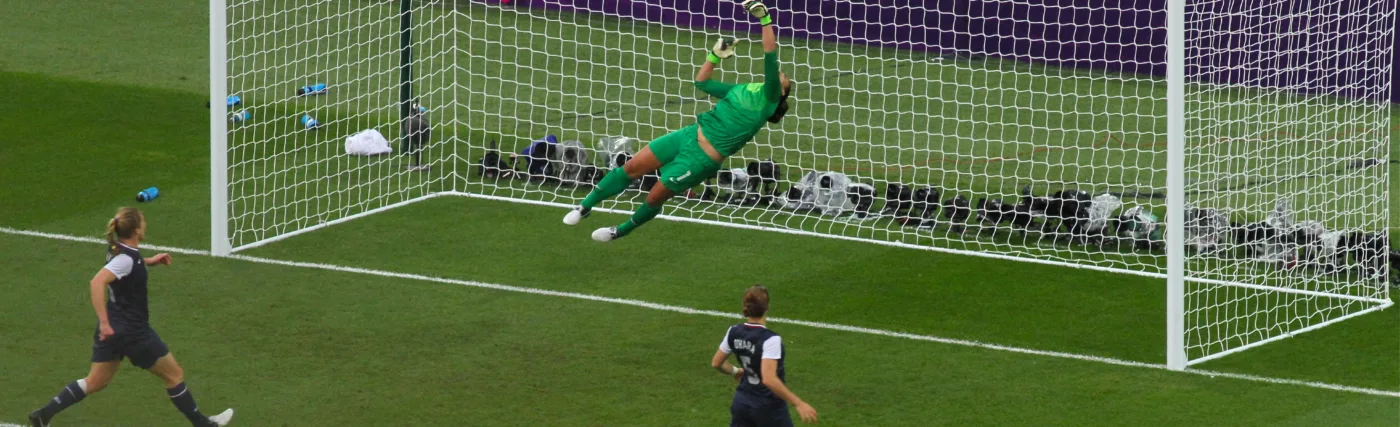
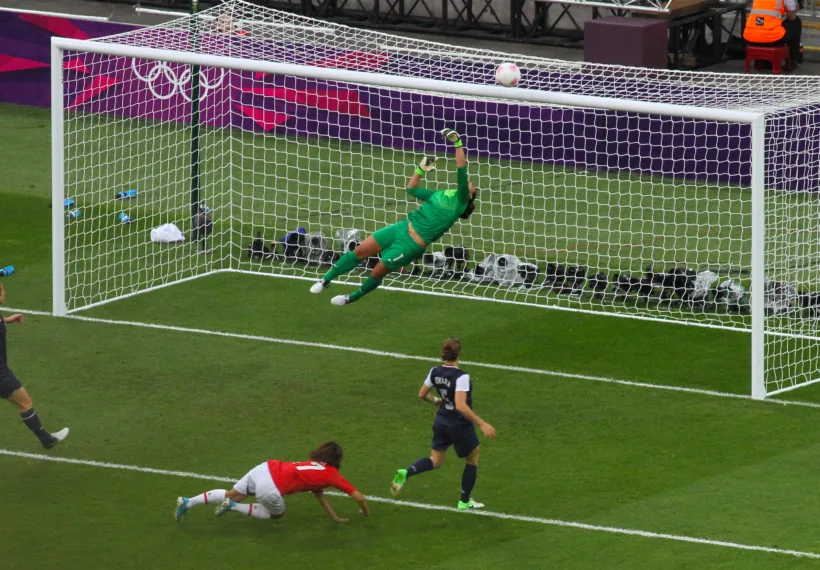
National Women's Soccer Goalie, Hope Solo.
Hope Solo led her team to the World Cup Championship and brought home gold medals from the Olympics.
We've got her on StarTalk tonight, so let's do this.
I've got Chuck Nice helping me out here, Chuck.
Always good to be here.
Give it up for Chuck.
And if this were an astrophysics show, it would just be you and me, Chuck.
That was the topic, but it's sports.
And I've got right up the street Dr.
Brent Walker.
Welcome to StarTalk.
Thank you for having me.
And you, professionally, you're a kinesiologist, but you're also a sports psychologist.
I didn't even know that existed.
I know we surely needed one.
There are some athletes that clearly are in bad need of counseling.
So is that what you do?
Well, if you look at the field of sports psychology, it's relatively new in terms of full time positions.
Believe it or not, it goes back to the 1930s.
Originally, the first consultant in sports psychology worked with the Chicago Cubs.
And that worked out perfectly, as you can see.
They haven't won a World Series since, I don't know, 1900, 00, 08, whatever.
So it's any edge that you can give an athlete.
That's what it's about.
And I'm looking at you and I'm thinking you've never played any sport ever in your life, right?
I played field hockey.
No, seriously, what you play?
Basketball and baseball.
Okay, so he's got street cred.
Yeah.
He's got some street cred.
So we'll be returning to you often in this conversation because this is StarTalk, which means we want to get to the bottom of any science that percolates within any of the guests that we have.
And that is exactly how I began my interview with Hope Solo.
Check it out.
So Hope, I always have to ask, no matter who's sitting in that chair, when you grew up, sort of K through 12, were there any fond or horrific memories of your science or math classes in school?
Third grade, I had to, I think we all had to, build a rocket, right?
Really?
Yeah, built rockets.
Okay, what did you blow up?
Yeah, I did, I did blow up.
It was such a sad day because I invited my family members to come to this day.
It was like parent day.
Everybody watch your kid, send the rocket off that we spent a week building.
And I go to light it and it just kind of crumbled to the ground and imploded.
And I just stood there, had no idea what to do.
You know, I was so excited for this day and nobody came to my rescue.
My teacher just stood there and kind of was like, okay, kind of laughed and was like, next kid up.
And I remember it was nothing for him because he had like, you know, 12 other students that had to light their rockets and send them into space.
And I just stood there and I just had to pick up all the pieces and grab it and just kind of walk away.
And I felt like I let down my parents and everybody.
So does this mean you might have been a rocket scientist?
Had that worked?
I don't think that was going to work for me, but I wasn't cut out for it.
What town was this in?
In Richland, Washington.
Richland, so I know the Richland.
There's a pair of cities.
They were built to help the Manhattan Project.
Yeah, so my high school I went to was called the Richland Bombers.
And our mascot, so on the back of our letterman's coats, we'd have a big R with the mushroom cloud coming out.
So our mascot was the mushroom cloud, and my city is very proud of helping with Day's Pay, which is the airplane, the B-52 bomber, Day's Pay, that flew over Nagasaki and carried the plutonium that bombed the cities.
And my city is very proud of that.
It is not even an animal.
It is a mushroom cloud.
That's not even an animal object.
You know, my town is very proud of how we contributed to...
So the legacy is there.
Yeah, I mean, people gave up their Day's Pay to help carry out their duties for their wartime duties, and they're very, very proud of that.
And so the Day's Pay is what the B-52 bomber is named after my hometown.
The one that delivered the payload.
Yeah, uh-huh.
You know, the reactor is now closed, and a lot of people had to move to the city to help clean it up, so it employs a lot of people.
It employs my entire town, the Hanford nuclear reactor.
You know, nobody would have known that Richland, Washington, or Eastern Washington would have existed unless, you know, all the scientists moved there.
Put them on the map.
Put us on the map, yeah.
So were your parents involved in the warp effort?
Somebody must have been, because...
Yeah, so my mom was an environmental scientist, and she actually helped with the cleanup.
You know, I still, you know, I take pride in it, but I realize, you know, you know, we all look back in history, and we realize what we all could have learned.
So I'm very proud of my town.
I'm very proud of what my mom did to help with the cleanup crew at Hanford Nuclear Reactor.
So it's especially embarrassing that your rocket didn't work.
It's very embarrassing, right?
So you're in the middle of nowhere, and your rocket didn't work.
That better luck next time.
You know, our fight song...
You're in a nuclear zone.
Nuclear zone.
Our fight song at sporting events was Nukem, Nukem, Nukem till they glow.
I think...
We are very proud of our nuclear city.
Evidently.
People like to say there was, you know, I drank special water, and that's what made me such a great athlete.
Yeah, Nukem.
So if you have access to a nuclear arsenal, you will win every athletic contest.
Absolutely.
So it's clearly that made community there.
The legacy of the Manhattan Project influenced the name of the teams and how they behaved and what they chanted.
And the fact that the Hulk played for their football team.
From the gamma ray.
That's a different lab that they got that one out of.
So if I know I got a thousand people cheering for me, do I perform better?
Depends.
For some people, yes.
For some people, no.
Oh, because it makes them nervous.
There were some interesting studies done at Duke with their basketball team.
What they found was in shooting free throws, they tried several different things.
Sometimes they would jump around.
Sometimes they'd be quiet.
Sometimes they would yell right before the shot.
For their own team or the opponent?
The opponent.
Okay.
And what they actually found was one of the most detrimental things was to be quiet.
Right.
Which is counterintuitive, but it's also interesting that if you go to any sporting event, any basketball game, people are quiet when the home team shoots.
Right.
Which makes no sense when you really look at it because you can hear a pin drop.
That's going to get in the shooter's head.
Because he's expecting noise.
He's expecting distraction and instead he gets silence.
And would it be better effective if in that silence, they started whispering things like, your father doesn't love you.
Emotional, psychological stress calls.
You're a disappointment.
So maybe there's not a general one answer to this.
You look at baseball players where somebody is throwing a ball at you at 95 miles an hour and you have to hit it with a round object and the crowd is cheering either for you or against you.
And yet golfers with a ball sitting at their feet not moving want silence for them to hit the ball.
I have no...
Don't get me started.
That's funny.
Silence, otherwise I'll miss the ball.
That's sitting still.
Sitting at my feet on a pedestal.
That's awesome.
Well, of course, one person who has definitely made it to the top of her game is Hope Solo.
And I think she's arguably one of the best goalkeepers, maybe the best goalkeeper ever.
So I asked her if in her own mind she thought that she was destined to that fate or whether something else went down to make that happen.
Let's check it out.
You know, I'm a great goalkeeper.
So I have to, you know, really have faith in that decision to become a goalkeeper and believe it was the right one.
But pardon me if I think so.
I would have been one of the best goal scorers of all time.
Watch out.
Well, but okay, but it's too late.
You're already the best goalie of all time.
So we got you.
It's too late.
We'll stick with that.
But this day and day, there's so many expectations on kids.
And people think that they can spot talent at five years old.
And I disagree because it's not just your athletic prowess.
It's not your skill and your build.
It's so much more your mentality and even what's in your heart.
There's so much more to it that you can't just pick a kid at five years old and say he's going to be the next Michael Jordan.
I don't believe in that.
And when I was five years old, I had the skill and I had the competitive nature.
But my parents didn't want to push me.
They wanted me to be a kid and have fun and play other sports and go camping and go fishing and learn about the world, not just live and breathe on a soccer field.
So Brent, there's psychology there, right?
Yes, so if you look at the opening of that clip, you heard her confident.
She's a great goalkeeper.
So I think reaching that level, she had to have a very high level of confidence.
What was interesting, though, was how she talked about trying to predict great athletes from an early age.
And there's no success in doing that.
It's very little that would...
But that's all we ever try to do, find a five-year-old, a ten-year-old and say, they're going to be the next this, the next that.
Because daddy never made it to state!
So it's not just, do you have the mental drive to do it?
There's the external forces, the parents who want it out of you.
What's interesting about that is if you look at early sports socialization and specialization, if you specialize early on, there's really no benefit long term.
There's a benefit for the immediate future.
Other than gymnastics and figure skating, if you specialize at an early age, it doesn't lead to success on the back end.
Some studies of college athletes show that over 80% played multiple sports growing up, so they didn't specialize.
So the general good body performance.
So when is a good time to suck your kid dry of any hopes of anything else in life except living out your personal dreams that are failed?
Chuck!
What I meant to say was, what's a good time to get kids into sports?
Do you have any advice on this?
I mean, there will be parents watching, kids watching.
You've got a key here to...
I think it's getting kids into as many sports as you can early on and then letting them go with what they enjoy.
And it's not just sports.
People talk about the child prodigy in Mozart.
He turned out pretty good, but...
But how many 10-year-old concert pianists have you seen and then you never hear about them later?
And so maybe it's detrimental to the development of kids.
I'll give you the opposite end of the continuum.
I actually went to college with a guy by the name of Marcus Pollard.
And we didn't have football at our school.
And I'll never forget this conversation.
I said, Marcus, what are you going to do when you're done?
He said, I'm going to put on 30 or 40 pounds and play in the NFL.
And I remember thinking, and I'm going to be an astrophysicist.
So two years later, he's with the Indianapolis Colts, had a 14-year playing career.
And I think you can find more of those examples where people didn't play the sport, they ended up playing professionally, than the kid that specialized at the age of five and made it all the way through.
There's a huge burnout factor.
So, okay, I get that, but what about all this talk of the 10 years, 10,000 hours?
Is that urban legend or is there something to it?
Believe it or not, Malcolm Gladwell, who popularized the 10,000 hour rule, first of all, it's not a rule and he misquoted the research.
The research was done by Anders Eriksson and it was on practice of all things.
So to really think about research on practice and becoming part of pop culture is a little bit odd in the first place.
But what that research actually showed, it was an average of 10,000 hours.
For instance, one study with pro hockey players showed that they only played organized hockey about 3,000 hours.
Only 450 of those hours occurred prior to the age of 12.
So it's a bit of a myth in the fact that they didn't sit there and practice for 10,000 hours doing that.
It was an average across entities and it could range from 3,000 up to 25,000.
You know, now when you said organized hockey, it just sparked something in me.
A lot of times in basketball, what you have are kids who play not on an organized level but on a schoolyard level.
And that gives them a great deal of improvisation and they exhibit a certain creativity that they bring to the game.
Including no blood, no foul.
No blood, no foul.
But then they get into the organization and they can function.
So how important is it to have your kid...
You gotta behave according to rules.
So how important is that in terms of getting your kid to move along the continuum?
I think it's a combination.
What's interesting about that, if you look at just the playground play of sports, is that studies of kids who just played pickup games, they actually are better at decision making and conflict resolution.
Because if we had an argument, we had to settle it.
There's no referee.
Right, exactly.
And what it also shows is that when you put adults into the equation, kids actually play less.
So when we're pickup, we keep it going.
If the teams are lopsided, we change it.
When adults got involved, kids stood around a lot, the games were lopsided, nobody corrected that.
And so in some ways, kids are less competitive.
The damn adults, they mess up everything.
They mess up everything.
Coming up, more of the science of sports when StarTalk continues.
We are here, Haiti Planetarium in New York City, featuring my interview with Hope Solo, who is like the world famous goalie for the US.
National Women's Soccer Team.
And I wanted to know, among many other things, what does it take, what is behind becoming the greatest soccer goalie there ever was?
Check it out.
Goalkeeping isn't, it's not about, you know, acrobats.
It's not about making a circus out of this position.
It's about finding the quickest path to the ball.
And I think for me, it's about efficiency.
I want to be quick and agile, but I also want to have great angles to make my work less.
And I want to find the quickest path to the ball to make my work less.
And oftentimes, people don't give me praise because I'm not making this huge acrobatic save.
And it drives me crazy because unless you're being a showboat and making these acrobatic saves, you're really not getting praise for it.
And so people, my goalkeeper coaches, believe that what makes me great is my ability to make things look easy.
This is one of the most fascinating topics I can think of.
If you are an amazing athlete, you can make things look easy and then you show up fewer times on the sports highlight reel.
So is there any truth to that?
Definitely.
I think some of the best, they do make it look easy.
So in part of that, and I think what Hope's alluding to is she has unbelievable anticipation skills.
The reality is she's looking at things that your average goalkeeper wouldn't even think to look at.
She's probably thinking two steps ahead.
I saw a great example of this in the sport of baseball.
Now we have the ability to monitor where we look.
So they put glasses on people and they look at their eye tracking, yeah.
And so they put major league hitters against minor league hitters.
And what they found was when a major league hitter hits a home run, his gaze just stays in one spot, sees the ball, hits a home run.
The minor leaguers were looking at the shoe, they were looking at the dirt, they were looking at the hat, they were looking all over the place.
Okay, so with respect to what she just said about the fact that it's about acrobats, do you find that players now psychologically are trying to showboat so that they can get the glory?
I mean, if I'm a high school player and I wanna go to college and get a scholarship, maybe I'm the guy that gets a little more attention on the field, maybe I'm the guy that takes my helmet off and blows kisses, is that part of it?
Yeah, definitely, I think some people know that you can get, you're in the limelight by doing those types of things.
Yeah, but so in the case of, let's say a center fielder in baseball, if you're slow, then you make, I bet you make a lot of shoestring catches.
Correct.
Because you're slow.
If you're fast, you're standing there waiting for the ball to hit your mid.
Yeah, but I think that's where.
But wouldn't the slow guy get on ESPN a lot more than the fast guy?
But no, but maybe it's not so obvious because if you're fast, the perimeter of the area that you can cover is larger so that more balls will come to your attention than that of a slow person.
You can be so slow, it just bounces between the outfielders.
And there's not even a catch to show.
So you never get there.
You never even get there in the first place.
But that's where I think data analytics has become important because it exposes the person.
That slow person that doesn't get to as many balls, now the data clearly shows that they don't get to as many balls.
Can't hide that.
Right.
And so on top of this is also your state of mind throughout all of this.
And is it fair to use the phrase emotional intelligence for an athlete in this?
Do you have a term that you use?
Well, I think-
The athlete's mental focus.
Yeah, I think with emotional intelligence, I think of that in sport related to leadership.
And I think that people who are emotionally intelligent, they know how the people around them feel.
To be honest, though-
So team captains, folks like that, okay.
But I think honestly, if you look at the greatest of all time, they're often, they fall on the opposite end of the continuum, where they're just, they're so focused on, hey, this is how I'm gonna do it.
I don't care what you feel.
I don't care what you think.
I'm gonna get it done.
And that would be, yeah, the bottom end, because other people's emotional state is irrelevant to you.
And also when I think of focus, you can think of soccer goalies come to mind, especially during penalty kicks.
It's like, which way is the ball gonna go?
It's one on one, one on one.
The goalie, in many cases, if not most cases, has to almost pre-commit.
But I had Hope Solo, she's one of the best at this.
I had to ask her, what is going through her mind?
Emotionally, psychologically.
Let's check it out.
In a shootout situation where at least five kickers are going to shoot on me, I hope to make one.
I hope to make two, but one is for sure you have to make one to help your team win.
I go for two, and that's two out of five.
Two out of five.
So it's still not 50%.
That's not 50%.
And how much of it is luck?
And how much of it is you reading a person?
Because that's now mental.
That's not reflexes.
That's not I'm strong and can jump high.
That is I've out psyched that person.
So talk about evolution.
The game has evolved.
The game has absolutely evolved to the point where the athletes are better and they're smarter.
They know how to disguise the way they're going to go.
And so if you asked me this probably even six years ago, five years ago maybe, I would have said that I can read it.
I can read some of these players who step up.
I know what way they're going to go from their arm swing to their leg swing to how many steps they approach the ball with to their hip shape.
I can read it.
But within six years, players have gotten so good at disguising what way they're going to go that I'm not as confident in saying that anymore.
I try to read it and oftentimes I get it wrong.
So I don't think it's a guessing game.
I don't think it's luck.
It's not luck.
There's, you know, I still believe in...
So it's an arms race.
It's you can read them.
They figured out that you're reading them.
Now they've hide that and now they can outdo you.
So now what can we do as goalkeepers to put them back on the defense?
Yeah.
So we got some statistics on this.
The men's penalty kicks, they were successful 70% of the time.
So it's really the odds are stacked against the goalie in this one.
And I wonder, is it kind of an arms race?
Because if you figure out that I know how to read which way you're going to kick it, then you're going to switch that up and then I've got to like respond to that.
I've got the perfect example of this.
I was talking to a professional referee.
Odd situation, there was a lightning delay in a soccer game, professional soccer game, right before a penalty kick.
What is a lightning delay?
So there was lightning in the stadium, so they had to get off the field.
Such wimps.
Yes.
So both teams go back to their locker rooms.
The goalkeeper goes and looks at all the PKs of the player about to take the PK.
The PK penalty kick.
The penalty kick, sorry.
And then the person taking the penalty kick went and looked to see what the goalkeeper did on all the PKs he's faced.
So they come back out and they both overthought it because they have no idea that the other guy did the exact same thing.
The referee knew it because he had talked to both of them.
But it was a perfect example of technology and we have too much information.
Yeah, so again, that's the arms race.
Right.
They cancelled each other.
So it becomes like a poker game.
You know, you're really sitting there trying to figure out if this guy, what he has in his hand.
You don't play the hand, you play your opponent.
You play the person, not the hand.
You play the person, not the hand.
Yeah.
Right.
Yeah.
And so do you teach this?
Yeah, so in part of this too and with Goalkeepers, what we do is we take video and break it down and we'll stop a shot right before someone takes it and then we measure their reaction time.
Is it going right or left?
So they start to develop the ability to read what a player is doing and they start to be able to anticipate that.
So basically every school is going to want one of you in their...
So more on the science of athleticism when StarTalk continues.
And now, as amazing as she is, she has a weakness that she revealed in my conversation with her.
Let's check it out.
I shouldn't tell everybody this, but I'm actually pretty weak upper body.
I'm pretty weak.
Yeah, but there's not a lot of shouldering going on.
I land and fall on my shoulder every single day.
Oh, sure, but you're not fighting with other people with your shoulders the way defenders are.
When I go up for a ball in a crowd, I have to hold them off.
They're trying to hit me and get the ball, not the ball.
But I'm focused on the ball.
My arms are up here, focused on the ball.
So they're hitting me in here.
So I have to have the shoulder strength to not get moved.
Oh, mm-hmm.
But I've been fortunate enough for the most part to be healthy throughout my career, besides the shoulder injury, which happened in 2010, as you said, but.
Did you fall on your shoulder?
But I had been dealing with the pain for probably a couple years prior to when they actually said enough is enough.
Let's go get this taken care of.
Oh, it wasn't a catastrophic injury.
No, it happened over time.
And when I went in, because I was still strong, my doctor was like, oh, you're fine.
Solo, you know, we'll do some x-rays and MRIs, but Solo, you're fine.
And then he went in and he looked at the x-rays and he was like, how in the world are you plain?
And I basically, my arm was basically hanging off my body.
I mean, I had, my biceps tendon was unattached.
I had a 360 degree tear of the labrum off the bone.
They had to do a micro fracture because I had no cartilage left.
And there's 13 anchors now holding it together.
And they reattached the bicep tendon.
And so now, I'm, that hurt just talking about it.
So this is my range of motion now in my arm as a goalkeeper.
On your right arm?
On my right arm.
Yeah, I'm raising it right now.
And I've managed to play five years since surgery, which is kind of unheard of, but.
But you're missing five inches of reach on this side of your body.
I'm missing a lot of range of motion.
Is that a secret?
Should we like edit that out?
We didn't edit that out.
And now we know how to defeat Hope Solo.
We found her kryptonite.
That's right.
So, Brent, have you been in, you played sports.
Were you ever injured?
Yes, I actually had a shoulder injury as a baseball player.
Okay, so did you just suck it up and keep going like Hope Solo did or did you wimp out?
Oh, I sucked it up.
I was just wondering.
So in my life, I rode competitively and I also wrestled.
And wrestling, you're in pain, but you're focused.
I want to put this guy's shoulder blades on the mat.
And even though I'm twisted and I don't know about those until later because I'm really, really focused at the time.
So it must be a true supposition that athletes just have a higher pain tolerance than like other people.
Is that true?
Fellow athlete.
I believe so.
So basically, Hope is, she's surviving pain at every, possibly every day of her life, but certainly during a game.
But her ability to focus transcends all of that.
And your research shows this as well?
Yes.
And do you help athletes actually deal with pain while they're or playing through pain as in, I don't know, disassociating from the pain so that they can continue on in the game?
So if part of that's ethical, if, if I know right tells them, right?
Yeah.
Your arm is broken.
We'll tape you up and go back out on the field.
Put some ice on it.
But if they're not going to do any extra damage, then we work on dissociation strategies would be one technique.
Just to be clear, dissociation means I'm in pain, but I will separate my focus from that pain so that I don't have to think about it.
And I I'm worried about something else.
If you're, if you're just, if you're actually being dissociative, what do you train the athlete to focus on?
Is it the task at hand?
Is it?
I mean, it depends on the sport.
So for instance, sometimes with swimmers who swim distance, they may count strokes at one point.
They may sing a song at another point during a race underwater.
Underwater?
Okay.
Just wondering.
Yeah.
But, you know, in runners, same type of thing, rowers, a lot of times, rowers will just focus on the shoulder in front of them and they'll put their, their attention there.
So they're not thinking about what's going on in their body.
What I consistently see with racers, for instance, what kind of racers, rowers, swimmers, runners, whenever they come into my office, whenever they have a poor performance, they talk about how much pain they were in.
They never talk about the pain when they perform well because they're not focusing on the pain.
And so I think a lot of times that thought of someone just passed me, I'm falling back.
How do I feel?
Now you're creating the context that I don't feel that good.
So not only does overcoming this pain enable you to focus and then perform, there is a rise of science being applied to athletic performance that is like nothing we've seen in previous decades and we've got someone, I think we've got someone on video call, Mark McClusky from Wired magazine of all places.
But then we think about it, maybe that makes sense.
He wrote a book called Faster, Higher, Stronger and the Olympic motto, of course.
And he's thought a lot about enhancing athletic performance and what tools you might invoke to make that happen.
And I think we got him on video call.
Guys, can you bring him up?
Mark, welcome to StarTalk.
Thanks for having me.
Yeah, thanks for being on.
What is the leading force that you can see that we can look forward to in the future?
I think the use of data and the use of analytics to really understand athletic performance in a more granular way.
We see it in basketball.
We see the game actually changing because we have a better understanding of sort of the relative value of a shot from different places on the court, for instance.
A lot about sleep and recovery and how that feeds into athletes' performance.
And sleep is an incredible performance enhancing drug.
It might actually be the most effective one.
And we as a culture and especially athletes tend to under sleep.
So I think that was a really interesting thing to write about.
It's because they're partying the night before.
Sometimes.
It's not unheard of.
So all I can think of as you speak is that scene in Rocky IV where Drago is being basically invented by all the Russian scientists and they're giving them these injections and they got all this science and then but Rocky is in the mountains.
Rocky himself is in the mountains lifting logs.
And so since movies are true, what that movie says is that raw guts and determination beat science every time.
And I don't think that's true.
I think that the combination of raw guts and science beats anything.
Well, as you know, we've been talking about Hope Solo and her motivation to be the best.
And she had some concerns about what role science will play in this.
But I think we'll all just get used to that.
It's just another force operating on the performance of athletes that we all pay to watch.
So thanks for your insights into this and we'll all look for your book.
Thank you very much.
Mark McClusky, everyone.
Yeah.
Coming up, we'll be answering your questions from our fan base on the science of sports when StarTalk returns.
We're talking about the science of sports.
And in this segment, it's time for Cosmic Queries.
This is where I answer questions from our fans.
And tonight, we took your questions from me about the physics of soccer.
Yes.
Actually, my undergraduate degree is in physics, the rest is in astrophysics.
But once you get the foundation of physics, it could take you pretty far.
Yeah.
I'm just saying.
You pretty much got it.
Now you get it.
And Brent, if I need help here, I'm gonna call on you, okay?
And if I don't know the answer, I'll just say I don't know the answer.
Go to the next one.
Okay.
Let's get our first query.
It's from Dan Woods, Chicago, Illinois.
Dan wants to know this.
How many factors affect the distance a ball flies?
Humidity, PSI, force of kick, altitude, et cetera.
Ooh, good.
So, yes, all of that.
So, a couple of things.
If the air is thinner, the ball will travel farther, because air provides resistance to movement, and the air just slows down the ball.
You can't kick the ball faster just because you have lower gravity, for example, but after having kicked it, it will slow down more slowly.
Gotcha.
Okay, so that's one example.
Another one is humidity.
People think humidity, things don't travel as far.
Humid air is thinner than dry air.
Oh, yes, it is.
There you go.
You know why?
It's really quick.
You ready?
Okay, because humid air has H2O in it.
Okay, one oxygen, two hydrogens.
Weigh that.
That weighs less than the molecules it's displacing, such as N2 and O2.
Nitrogen doubles up with itself.
It's got an atomic weight of 14.
Two nitrogens is 28.
Write that down.
Two oxygens is 16 times two.
That's 32 atomic weight.
What does water weigh?
Two hydrogens.
That's just two.
One oxygen, 16.
Add them together.
It's 18.
So water molecule weighs way less than the rest of the molecules you're breathing for your sustenance, the oxygen and the nitrogen, which actually doesn't do anything.
So damp air, you can definitely hit stuff farther.
Wow.
That was fantastic.
All right, Steve Ball from Kalamazoo, Michigan wants to know, how does the ball spin, how does the spin on the ball make it bend in the air?
So I can show you.
All right, here, give me a ball.
Oh, you got a ball?
I got a ball.
Okay.
So it's actually amazing, beautiful and simple all at once.
So if you spin the ball, so when you kick the ball and give it spin, if there is stitching on the ball or any irregularities on the surface, such as these hexagonal pentagonal shapes, such as the stitching on a baseball, what happens is as this spins, it drags a layer of air around it.
Okay, so it's ball plus air that's spinning.
Now, as the ball is spinning and moving through the air, this side of the ball and its air adds to the air that's moving past it, having it go by the ball faster than the air on this side of the ball that is fighting itself.
Okay, now we know from Bernoulli and other folks who have studied aerodynamics that if you have fast-moving air relative to slow-moving air, there is a force that descends upon that object.
And the force is against the side of the fast-moving air.
And I can show you, I got it, can you hold that for a second?
So check this out.
Okay, so here we go.
All right, I got a sheet of paper, all right?
See that?
Okay.
So if I blow across the top of this, okay, you'd think I'd be pushing it further down because I'm putting air pressure on it.
But let's, but now I'm going to move fast moving air on top and no moving air on the bottom.
And what did I say?
If you have fast moving air, the force goes against it, okay?
Okay.
So watch, right?
Right, it's lifting.
It looks counterintuitive.
It looks counterintuitive.
It looks like when you're blowing the top, it should be going down.
So what's happening is this is the side of the ball that's feeling a force pushing.
Right.
And there you have it.
And that's how you throw a curveball in baseball, a bend in soccer.
And, in fact, if you try to play soccer on the moon, you ain't bending nothing, okay?
Coming up, we discuss the role of gender in sports, next on StarTalk Radio.
Welcome back to StarTalk.
We are here at the American Museum of Natural History.
Yes.
Central Park West, New York City.
We're featuring my interview with, basically, the world's greatest goalie, I think, in my book, Hope Solo.
And in those conversations, we explored sort of the role of gender in professional sports.
And I thought maybe it's time, this being StarTalk, to put some data on the situation.
You know what we have for that?
Mona.
Mona.
So everybody, this is Mona Chalabi, and she is a data journalist.
And she breaks down all manner of phenomena into data.
So Mona, what do you have for us today?
Please.
Today, Neil, I have some data on participation in high school sports, specifically girls participating in sports.
High school sports.
High school sports.
And the oldest data that we have on this national data is from 1971.
Can you guess how many girls were playing soccer in high schools in America in 1971?
I got it.
Two.
Eleven or something.
One team with no one else to play against.
What, you're saying that's the most recent data from 1971?
No, no, no.
This is as far back as it goes.
I've got some recent data for you.
Don't worry.
That's a good baseline of data.
So that means you're going to be talking some real data smack right now.
So in 1971, 700 girls in the US were playing soccer.
But in 1972, everything changed because Title IX came into force.
That was a piece of legislation that basically banned sexual discrimination in any educational program that was federally funded.
So the year after Title IX was passed, the number of girls playing soccer in the high schools in the US jumped from 700 to 10,700.
And since then, it's continued to grow.
And today, it's 376,000, which is great.
So with numbers that large, that's a large enough repository of people.
So now if you get the best people out of 300,000, they will be better than your best people out of 100.
Probably.
Yeah, that's right.
Yeah.
Yeah.
Probabilistically, this is true.
But the way that you express those numbers matters, right?
So it kind of makes more sense to express this as percentages.
So again, if you track the number of girls playing soccer from 1971 all the way up to present as a percentage, it has climbed from basically zero to about 20%.
But that hasn't happened for all sports in the US.
So basketball among girls in high school has actually dropped from 40% down to 20% over the same period.
Tennis has also declined and so has volleyball.
So soccer is kind of interesting in that respect, right?
It tells a different story.
Is there any obvious, other than what the data are telling us, do you have an explanation for that?
Yeah, all those other girls are now playing soccer.
Oh, maybe that's good.
That could be part of it for sure.
The one last thing I would say about this is that all of this stuff matters.
The American College of Sports Medicine has found that when girls participate in sports, they're more likely to get higher grades in school and they're more likely to graduate from college.
So it's very important.
There you go.
Mona, thank you.
Thank you.
All right.
So I asked superstar goalie, Hope Solo, about these very same issues.
Did you know that in 2015, the US.
National Women's Soccer Team won the Women's World Cup?
The World Cup.
Yes.
They won it.
Yes.
That's got to mean something with regard to gender in sports and what force that has on the rest of us.
Let's check it out.
The ratings for viewers of that game rival that of major men's professional sports.
Absolutely.
I mean, what a sign of the future that is.
What a sign of the coming of times.
Watch out, men.
We are here to stay.
So, you summoned the force to change the world.
Oh, we needed all the force possible.
And we still need it to change the world.
Also, of course, as the popularity of women's soccer grows, the base of people who will enter the field statistically.
Let's just hope more male soccer players decide to play soccer so that we can have an American team who might win a World Cup.
You're talking about the base number.
We brought you home the trophy.
It's like your turn.
So, do you know, 27 million people tuned in to that World Cup match between the USA and Japan to watch us win.
To watch Japan get crushed.
Okay, okay, and it shattered every single viewing record for a televised soccer game ever played by men or women.
So you think this would make a difference.
Yes.
But no.
No.
You look at the data here.
What do I have here?
So, so, so it turns out the team pulled in.
So you there's prize money for it, right?
So what did the winning women's team get to share?
Two million dollars.
Oh, the team.
Shared two million dollars.
Now the German's men team, okay, what do they take them?
Thirty-five million.
So there's an inequity.
So something's got to, something's got to, something's got to change.
And do you have any insight into this Brent?
Because I, I don't know what to make of it.
Well I think it shows that we've come a long way since Title IX, we still have a long way to go.
And I think, you know, the interesting part about this one is the, the argument against women's sports is always television viewership, but this is a perfect example that blows that out of the water.
You can't make that argument in this case.
And it's got to also be the case with women's tennis.
I mean, women's tennis arguably is more fun to watch than the men.
But I think there's another issue of play here.
For instance, Seth, Seth Blatter, who was the former president of FIFA, made the comment that women's soccer players need to wear tighter shorts.
And to the point of tennis, for years, Anna Kornikova was the highest paid player in tennis.
She never won a single tournament.
She was a model.
She was very attractive.
Right.
So there's still this baggage.
Sexism, yeah.
But it's also true, just to be fair, but though that's impossible in this situation, the most successful male athletes tend to be the better looking guys, right?
Tom Brady, no one ever accused him of being ugly.
So the looks for the men also matter, but perhaps not nearly as much as has been invoked with women.
But up next, Bill Nye, the Science Guy, he's going to explain the science of goalkeeping when StarTalk returns.
We're back on StarTalk and we're going to wrap up my interview with gold medal professional goalie Hope Solo.
And in my last clip with her, we just talked about her success and what that means and where that takes you.
Check it out.
Excuse the analogy, I truly did reach for the stars when I was just a young girl.
In this place, you can say you reach for the stars.
In my office, you're cool with that.
We're good with that.
Okay.
Reach for the stars.
I really did at a young age.
I wanted to become a professional soccer player, and professional soccer didn't even exist for women, and here I am today as a professional soccer player.
I didn't see the gender equalities at that time growing up, and now I see them every day and I live them, and we see them with this last summer's World Cup.
Wait, wait, wait.
Maybe you have more power than you think, because it's not that you became a professional professional soccer player, it's that the world invented professional women's soccer for you.
Because you dreamt it.
So now you're worrying me a little now.
What kind of power does she actually wield over the space-time continuum?
So there's Hope.
She's all there.
She's all there, Brent.
She's your model candidate for what you try to make other athletes into.
Yeah, the ultimate level of having a dream and having the dedication to achieve it.
And you're bringing science to this.
That's good.
Because we've got someone on our payroll who brings science to everything he thinks and does.
And who would that be?
I believe it's Bill Nye.
Bill Nye, the Science Guy.
And let's find out what Bill Nye has to say about the science of goalkeeping.
Let's check it out.
A soccer shot comes at you fast.
Especially if you happen to be standing right here.
So I hope you're hip.
For a goalie like Hope Solo, there's a lot of science involved.
The ball is going faster than a car on a highway.
Two hundred joules of energy coming right at your face.
The ball is a smooth skin with sewn seams.
Air flows smoothly over the smooth parts, but when it hits a seam, the molecules start to tumble.
This makes air pressure build up and slack off suddenly.
The ball moves side to side and up and down.
The goalie has to track that trajectory so she can make the catch.
Otherwise, the other team scores a goal.
Now, if she can make the catch, she can give it a nudge, even a strong nudge.
But then the ball ends up back out there where it can fall in enemy hands or enemy feet.
So a goalie has to develop toughness as well as a soft touch so she can absorb that energy.
The more science this goalie senses, the more successful she'll be.
The idea is to grab every kick by the ball.
That's Bill using his head in many ways, you know.
So Brent, do you have any reflections on what we've just been discussing?
Well, I think when it comes to Hope Solo, she's a great example of where confidence can take you.
I mean, she believed in herself, she had a vision.
I think the big difference between someone who achieves what she's achieved is not only she had the vision, she had the dedication to stick to it and separate herself from other people.
It was an honor to have Hope visit me in my office, just to be in her presence.
You see her on TV doing these amazing things that are not even human.
They come from some other place.
And what I was reminded of is to recognize that whatever people say is your talent, at the end of the day, it goes nowhere without determination, without focus, without drive, without the all-consuming urge to want to be the best.
And that's why not everyone is the best.
From the hall of the universe of the Rose Center for Earth and Space, I'm Neil deGrasse Tyson, your personal astrophysicist, as always bidding you to keep working up.
See the full transcript



 Unlock with Patreon





 Become a Patron