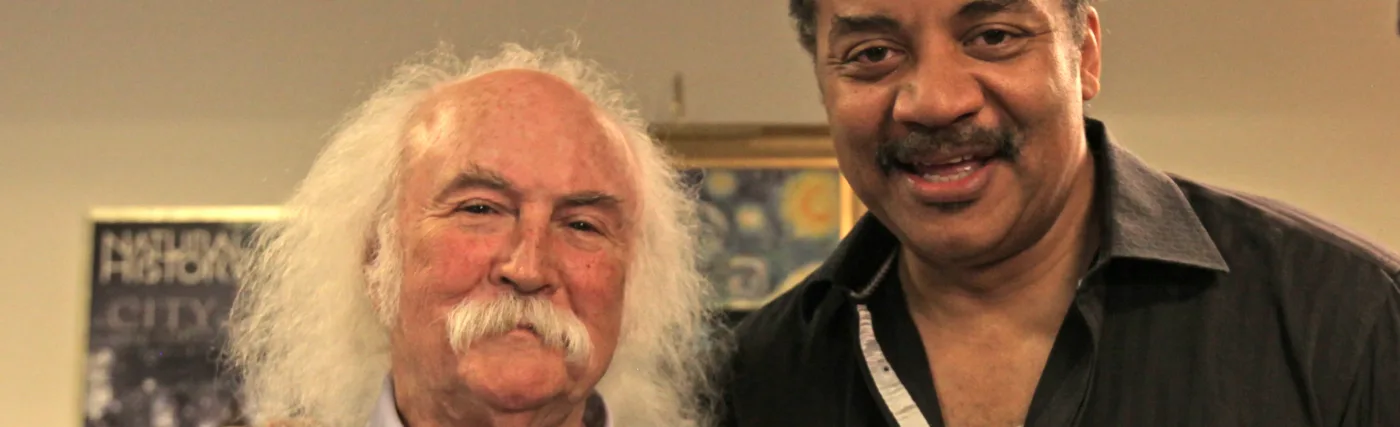
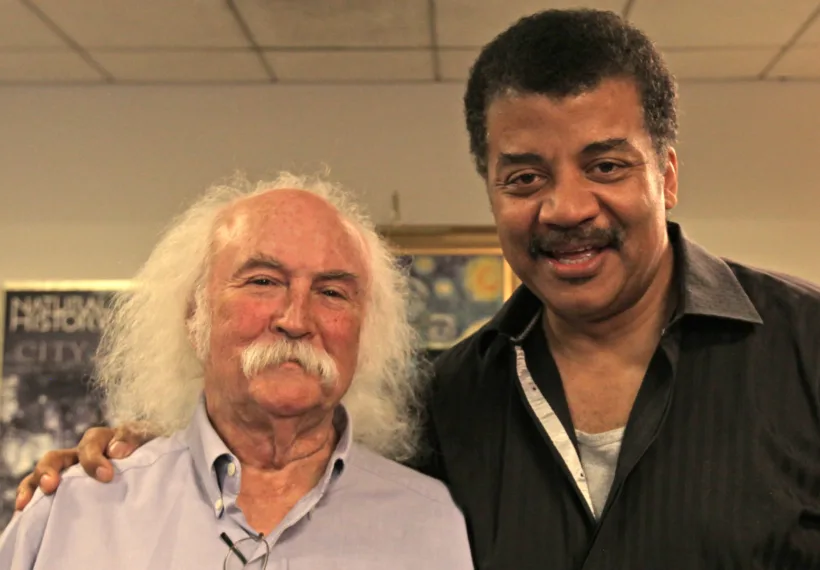
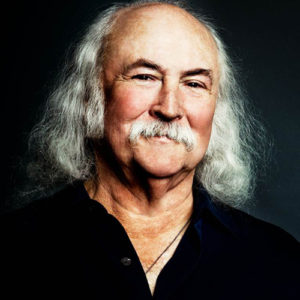
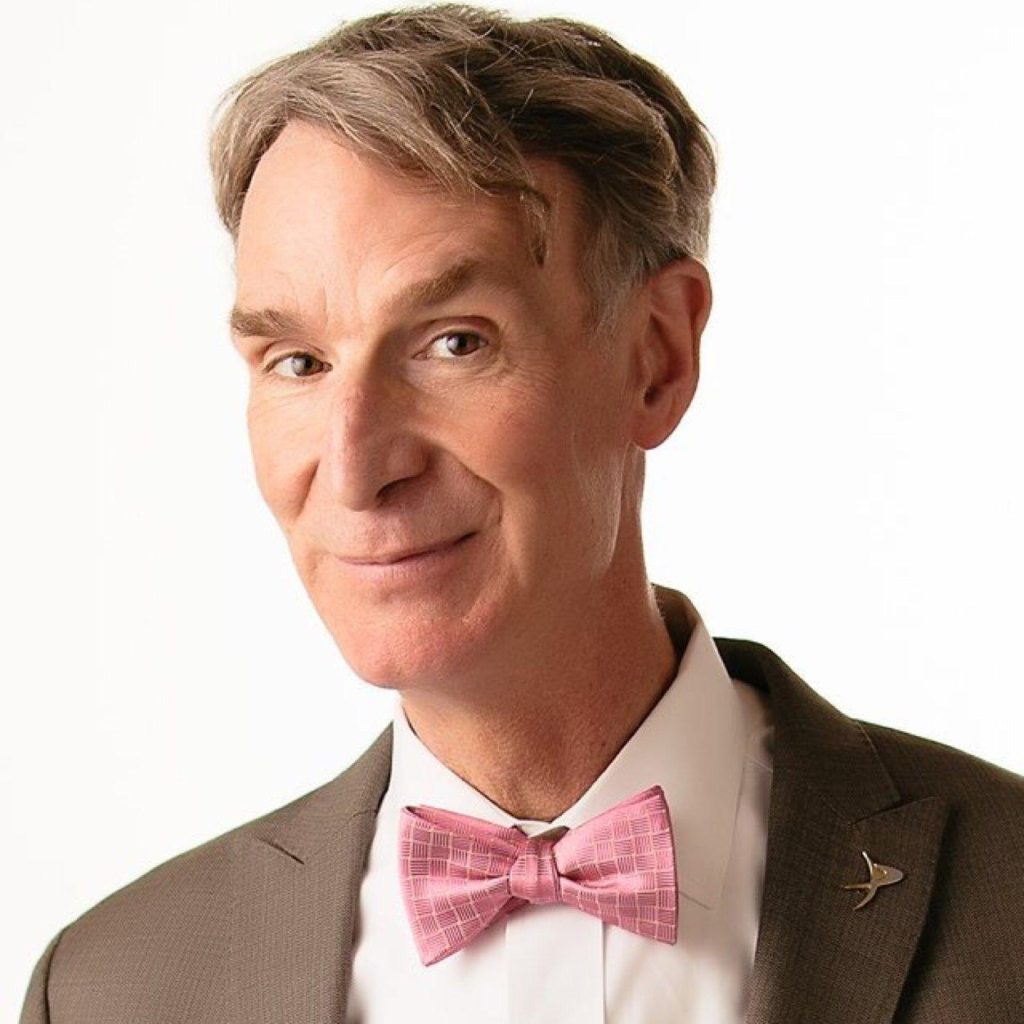
Neil deGrasse Tyson talks about science fiction, folk music and social justice with rock and roll legend David Crosby. It turns out that David is a major science geek, and has been ever since a librarian suggested the chubby, unpopular teenager might enjoy reading Robert Heinlein. Neil and David discuss the role that science and the lunar landing played in his music and his life, and you’ll even discover why Crosby credits scientific advances with keeping him alive. The pair explore the likelihood of intelligent alien life, and David asks Neil his own Cosmic Query, about dark energy and dark matter, which Neil claims should be renamed dark gravity. In studio, Neil reality checks the Sixties with help of Chuck Nice and Dr. Thomas Sugrue, an NYU professor specializing in the history of an era where, as Neil puts it, “We were inventing tomorrow.” You’ll hear about the role music played in the social upheaval of the ‘60s, and why Crosby believes that kind of societal consciousness raising is still around and important (“It’s 12:00, Congress is bought, things are bad.”), though more fragmented than when everybody knew somebody affected by the draft and the Vietnam War. Plus, Bill Nye drops in from Greenwich Village to talk about the sexual revolution and loving the one you’re with.
Transcript
DOWNLOAD SRT
Welcome to StarTalk, your place in the universe where science and pop culture collide. StarTalk begins right now. Welcome to the Hall of the Universe. I'm your host, Neil deGrasse Tyson, your personal astrophysicist. And tonight, we're featuring my interview...
Welcome to StarTalk, your place in the universe where science and pop culture collide.
StarTalk begins right now.
Welcome to the Hall of the Universe.
I'm your host, Neil deGrasse Tyson, your personal astrophysicist.
And tonight, we're featuring my interview with 1960s icon David Crosby.
And in that conversation, we talk about folk songs and politics and the universe itself.
And I would learn when he came to my office during my interview that he is as passionate about science as he is about communicating his passion for music.
So, let's do this.
I got with me Chuck Nice.
Welcome back.
Oh, it's a pleasure to be here.
A day is not complete without a Chuck Nice in it.
I wish I believed you.
And we have as my special guest for this evening, Dr.
Thomas Sugrue, and you're an expert on everything 1960s.
I think so.
That's what people say about you.
That's why we have you here.
So, you're the right person and the right time for the right conversation, because my interview with folk singer and social justice activist, David Crosby is tonight.
In the 60s, he was part of the band The Birds.
B-Y-R-D-S, The Birds.
B-Y.
B-Y.
And after that, he became the C in CSN, Crosby, Stills and Nash.
And he was active in the 1960s, the Civil Rights Movement, Vietnam, the whole wave of political and cultural change that swept the nation of that time.
David Crosby was inducted into the Rock and Roll Hall of Fame twice, for The Birds and once for his work with Crosby, Stills and Nash.
He's also got some serious street geek cred.
And you know how I learned this, initially?
I was giving a talk in another city in their theater, a talk on the universe.
It happened to be the same theater that he appeared the night before with Crosby, Stills and Nash.
Unbeknownst to me.
I enter the hotel room and there's a basket of fruit, as there often is by the Hotel Concierge.
Because you roll like that.
I roll like this because that's how I roll.
And there's always a little note in the fruit.
Why should I rush to open it?
It's just from the hotel manager saying, welcome, thank you, call us if you need any help.
So hours go by and I say, let me finally eat some fruit and open the damn letter.
I open the letter.
It is from David Crosby.
And he said, I just saw them change the marquee.
It's got your name on it.
I've been a big fan.
If you're still around until three o'clock, I'm in the suite down the hall.
Come by, we'll talk, we'll take a walk.
I got a thousand questions for you.
It was 3.15 when I opened the letter.
I went down there and like the maid is in there cleaning the thing.
Nobody was there.
So that's how I knew that we got to connect at some point.
And we ultimately did.
And so I had to ask him, where did his passion for science get started?
And how did he discover this inner geek within him?
Let's check it out.
The way it happened, man, was I was not a popular kid.
I was a chubby little kid.
And a librarian said, here, try one of these.
The kid seemed to like these.
And how old were you?
On early teens.
He handed me a Robert Heinlein book.
A great science fiction author.
Great science fiction author, great thinker.
First guy I ever read to describe a cell phone or a nuclear power plant or a rolling road or a number of other things.
Brilliant imagination, great guy.
And it took me by storm.
Right from the first one.
This is an epiphanic moment for you.
Yeah, I read everything.
Everything he's ever written, I've read.
But that led to Arthur C.
Clarke and Asimov and early big guys.
Okay, so now let me ask.
Not to get in your business, because I'm a consumer, not a...
You come with it, babe.
So, let me...
If you were sort of a short, dumpy kid and then you find science fiction, this doesn't necessarily play into your social life any more than you had before you started that, correct?
So...
Yeah.
So, but that was okay?
Yeah.
I hadn't really discovered the other half of the human race yet.
But...
The reason why I bring that up is, today, via the internet, geeks can find one another.
Is this true?
And so an entire social universe has risen up.
They can mate.
They can mate?
They have little baby geeks.
This is a wonderful thing.
It's a wonderful thing.
It was much more difficult before.
That's true.
But it is true now that we can breed more geeks.
Yes.
No, no, I guess you're right.
It was difficult because non-geeks would never breed with geeks.
And geeks didn't know you were like the lone geek in a class.
You couldn't gather.
And maybe there was like the chess club or something.
But yeah, the rise of the geek.
I joke, what's that line in the Bible?
I think it was mistranslated.
It's, and the geek shall inherit the earth.
It was mistranslated.
Because in the long run, intelligence is a survival factor.
And in the long run, intelligence is how we evolve the race further.
And it is much to be treasured.
And with the current crop of people for whom science is inconvenient, to their quarterly report, or they have a...
Or their philosophies, yeah.
Yeah, there's a good part.
Nice euphemism.
Their philosophies contradict that.
No, really, it was made 6,000 years ago, really.
No, he wrote Dinosaurs, really.
It's really crucial that we do encourage it more.
And it is great that they can communicate, that people with intelligence and an education can communicate with each other, and that they feel they have a sphere to exist in, and that they have value, that they feel that there is a life for them, and that they get recognized for achievement in that arena.
You know what I think started it all was the rise of the people who were computer experts, and then you get people like Bill Gates, like a patron saint of the geekosphere, and the richest person in the world is a geek, that something's going on there.
And so I think the football quarterback stopped slamming geeks into the lockers at about the time the football quarterback recognized that they needed the geek to fix his computer.
Exactly.
Why isn't this thing working?
And the geek walks over and goes, and gives you this look.
And walks off.
Yeah, and walks off.
So it's like, wait, hey, let me protect this geek.
The quarterback is going, wow, what did he do?
Of course, we're stereotyping dumb athletes.
I was a varsity athlete in high school and college, but we're just making the point.
I don't think you were fair.
A, big, C, B, good looking, C, smart, all at the same time.
That's really not okay.
I don't think, I don't, no.
You don't see yourself that way.
Because you know what a buzzer you really are.
That's me.
You say, oh Mr.
Crosby, you're just legendary.
I know that I put my pants on the same way you do, one leg at a time.
And you know, we have different view of ourselves.
No, I have a special machine that does it.
That's science for you.
No, it's not healthy for us to look at ourselves the way other people do, man.
The entire rest of the world looks at you as the voice of science and reason.
And I think that's good, you're a good spokesman, you do a good job.
I don't think that you look at yourself the same way they do, because I know I don't look at the people, look at myself the way other people do, because it's not healthy.
Right, yeah, I agree, I agree with that.
First of all, that's not why I don't, I just still feel like I'm a kid inside, and I have just some enthusiasm, and just for life and curiosity and discovery.
I do too, I'm old and dirt.
We need to carbon date you to verify that statement.
Carbon dating, what an inconvenient thing that is.
No, 6,000 years ago, really.
There's dirt, and there's David Crosby.
And there's, mm-hmm, yeah.
You're a little older than I am.
So I'm pleased to discover that there's an inner geek.
I look for that in everybody.
Not that I judge you based on it, but I like knowing if it's there.
It is there.
And what it tells me is that many more people have a little bit of inner geek than has ever been admitted before.
I think that's true.
You know, I mean, at the basic level, people have curiosity.
You know, intelligent people have curiosity about it.
If they have any education, then they know that science is fascinating.
If they have a fair amount of education and some reading, they know that it's terrifically fascinating.
And then, you know, the geek comes alive.
Gets ignited.
Gets ignited.
But the science fiction was so expansive and it was so unlimited.
There was no...
anything could happen.
You know, and that was just rich to me.
And I lusted after it.
And it led, you know, to better and better writers and better and better experience with it.
And, you know, admittedly, you know, it didn't hurt to smoke a joint in West Star Wars.
Yes, that never hurts.
Right off the bat, we're like, there it is.
I know, I'm hard just looking at them.
And so, Tom, you know, sci-fi, particularly in the 60s, had some veiled politics and culture and philosophy in it, including some statements regarding active stories, current events of the day, including civil rights.
Of course, what comes to mind is Star Trek.
In your studies, do you think much about the force that science fiction played in that era on anybody?
It was a really important force.
As he said, anything could happen.
It gave people a sense of almost unlimited possibility.
In the storytelling.
The storytelling did.
It was envisioning a different society than the one we're living in now.
It was a critique of what was going on, but it was also an imagination of what we could be if we wanted to be.
And there's a profound sense of optimism in that work.
But it was also subversive in all sorts of subtle ways.
During the 1950s, when there was prosecution of folks for being Reds, for being suspected communists, many of the, yeah, many of McCarthyism, many of the science fiction writers in the pulp magazines became havens for folks to talk about things like class struggle, things like inner, but disguised as inner planetary battle.
So they could do that and not show up in the McCarthy hearings.
Exactly.
Because that was just science fiction.
Yeah, and who reads science fiction?
Just kids who cares, it's minor stuff, it's in pulp newsprint.
Right, right.
It's not permanent.
That is brilliant.
And subversive.
I think that's really cool.
Okay, so we established that there's an entire geek side to David Crosby that I never knew until that moment.
So I wanted to know, was he able, did he care, did he want to fold this geekitude into his music?
So I asked, has his passion for science inspired him as a songwriter?
Let's check it out.
I wrote a song with Paul Cantner from Jefferson Airplane called Have You Seen the Stars Tonight?
You know, you want to talk about it and you want to say, I want to go out to the stars.
It's humanity's destiny.
But in order to communicate it, I looked at it through the eyes of somebody who was there on a ship saying, hey, do you want to go up on ADEC and look at the stars with me tonight?
And talk about their feelings from a human point of view.
It's a tough thing.
You want to look at the world, the universe out there, through someone's eyes who's feeling something about it, I think.
Otherwise, you're not communicating with your...
Otherwise, it's tougher to communicate, yeah.
Yeah, and so you've done this a few times, why not more?
Or is it you just have a whole other secret life that you leave?
It's not an easy thing to do.
It's easier to write about love because we all experience it and because it has such a wide spectra of, you know, things.
I've never thought about it, but that is now so obvious a thing, now that you say it that way.
It's because we all feel it or want to feel it that it always shows up in these songwriters' portfolio.
Whereas the wonder for the universe happens to a person only when they get out on a clear night in a place like the high desert or out on the ocean, where it's where I've seen it, and they look up and all of a sudden it comes on them and they realize, wait a minute, I'm standing on the side of a tiny mud ball out in the middle and they're starstruck.
And there's a reason there's a name for it, because at that moment, they're like me and you.
And that's the moment I want to try to communicate.
And I use that image when I can, but it's a much rarer feeling.
So, what I learned from this is that if we get everybody feeling science, then all the love songs will be about science going forward.
Because it's what people think about more often.
And he's right, people think about love or being in love or falling out of love, or more than they might think about the universe, but...
Oh, I can't wait to hear the songs about the black hole.
What?
I just want this lot of low-hanging cosmic fruit to be sung about.
Do you agree?
Is it just need to get in a pop culture and people start writing about it?
He was writing about the star, sure, but he was also very much shaped by his encounter with another plane of consciousness in the 1960s.
I mean, Eight Miles High, which is one of the Bird's real big hits.
It's one of the introductory songs to psychedelia, right?
On one level, it's a song about looking down on the world from a transatlantic jet, flying from Britain to the United States or vice versa.
But he's also writing about another kind of Eight Miles High.
Of course.
He is flying high.
And a lot of radio stations banned it at the time.
So these are folk singers being subversive.
Definitely.
His song Ohio, which was done after the Kent State shootings in 1970, takes on Richard Nixon, it takes on the National Guard.
It's pointed.
It's political.
It was about what was happening in the here and now.
Well, whether or not people write about the universe or society, it's clear that the folk movement of the 60s was bringing general awareness to the turbulence of the 60s, turbulence that resonates to this day, the anti-war movement, the civil rights movement, pollution.
And what I wonder about is how come we don't hear much of that kind of folk activism today.
That will be next in my interview with David Crosby on StarTalk.
Welcome back, StarTalk, All of the Universe, the American Museum of Natural History in New York City.
As you know, we're featuring my interview with folk singer, songwriter, card carrying science geek, David Crosby.
And you know, when he wrote songs in the 60s, he took on the most heated issues of the day and made people pay attention.
You know what I wondered?
Today, with Facebook and Twitter and all of these other distractions, I just wondered if there's a place for folk music today.
Do you need music to give you those messages if people are barraging you with social media?
I just wondered what his take was on this, given the long baseline of time over which he's observed it.
Check it out.
Is there low hanging fruit in the folk song storytelling universe to address the topics that face us today?
Not as much.
Why not?
Shouldn't there be?
I thought you might ask me a good question.
Shouldn't there be?
Couldn't there be?
Yeah, there are young people who are inspired to do that.
They see the world and they look at it and they look at our Congress being bought and they look at our air being polluted and our water.
I don't hear songs about it.
You haven't listened to me enough.
Ooh.
Neenu neenu neenu.
Throwing down.
Jack's double.
You know, I do, but I'm not the only one.
There's a lot of us still writing anti-war and pro-civil rights and pro-women's rights and pro-equality and anti-violence and pro-human race grow up.
It is there, it's not there as much.
Now, at the time that we were being so active anti-war, we had the draft, big dividing line.
All of those kids were facing it right here.
That made it-
Even rich kids.
Even rich kids.
Every kid was facing it right here, okay?
So that made activists big time by the million.
Today you can have people who just simply want to enlist and go to war and-
That's different.
That's a different-
That's because, largely because they're economically got the deck stacked against them.
It's not because they think war is cool.
It's because they need a job and an education and that's a way to get it.
But there's no song that comes to my mind that captures this movement.
There are.
There's a dozen at least.
They are not like A We Shall Overcome.
They are not like, you know, we write the occasional anthem, the occasional Ohio, the occasional teacher children, the occasional, you know.
Part of our gig is to make you boogie.
Part of our gig is to take you on little voyages, express stuff for you.
Part of our gig is to be the town crier.
Hey, it's 12 o'clock, Congress has bought, things are bad.
That's part of our job.
He sees that as his job.
So that's putting it right out there on the table.
Can you reflect on the role of music in political and social activism in general, but specifically today, based on what you know from that era?
I mean, do you agree with him that it's still happening?
What are the forces operating today?
I don't see them.
I'm not sure I see him either, at least not in the way that he does.
The musical marketplace today is really fragmented.
There's not the same anthems of the movement, anthems of politics that were so central in the 1960s.
I guess the question is why?
Why?
You're the expert, why?
I think a lot of it has to do with the market, the way in which now folks sample from all over the place.
They pick and choose, they don't listen to a canonical set of singers or music.
There's a lot more diversity, even among the more politicized genres of music, like hip hop, for example.
There's black nationalist hip hop, there's libertarian hip hop, there's misogynistic hip hop, there's geek hip hop.
I mean, it's fragmented.
It doesn't have a single message anymore in a way that for a moment in the 1960s, the confluence of civil rights and antiwar activism gave that a single powerful, we need to challenge the system.
And do you agree the fact that the draft kind of forced everyone to have to think about it, even if they didn't want to?
Whereas today, you can just kind of turn a blind eye to it?
It's totally possible to turn a blind eye to it for many people today.
The number of folks who've served and died in Iraq in that long war was less than a tenth of the number who died in the Vietnam War.
Your brothers, your cousins, your uncles, your nephews were on the line in the Vietnam War because of that draft.
They served or at least they were at risk of being drafted and they had to think about how to dodge it or how to keep from going if they didn't want to.
Now, you've taught a course for 20 years about the 1960s.
Who does that?
You do it, okay, fine.
So what made that era sort of more special than others?
Or is it more special?
Or is it just the nostalgia that you want to have for something at approximately that age?
Yeah, there's definitely a lot of nostalgia about the 60s.
It's a more complicated period than our conventional stories, least to believe.
It's a period, after all, that brought us Ronald Reagan and Barry Goldwater and Richard Nixon.
But it's also...
Oh, we should be so thankful then.
Exactly.
But it also was a moment of a coming together of folks really imbued by the same optimism that you hear in David Crosby, a sense that we can change the world.
But consider other parallels.
In the 60s of the civil rights movement, the 70s was the women's lib, basic modern lib, women's lib movement.
Of course, there was a century earlier, there were movements then for suffrage and this sort of thing.
But now we have the gay rights movement reaching certain points of maturity in legislation.
And so I still think we have these forces in society today.
And I wonder if it's just gone out of style to write folk songs about it.
I just wonder.
I mean, the 60s combined both the idea that music was a vehicle for pleasure, right?
It was a way to end the night in a way that you want to end the night.
It was a way to seduce.
It was a way to party.
It was a way to have a good time.
Because we talking about the 60s, yeah, okay, right, right.
Yeah, so let's do it.
But it was also a way to build a collective consciousness, right?
It was a way to build a vision for what you.
A shared concern.
A shared vision of an alternative.
And that's what you hear in David Crosby, even looking out, I think probably too optimistically at what's going on today.
Well, we'll have more of my interview with David Crosby when StarTalk returns.
We're featuring my interview with, of course, David Crosby, the 1960s pop folk singer icon.
And it's when I learned he's got geek credentials, science geek credentials.
And he emerged from the heart of the folk movement in America in the 1960s.
And it all happened here in New York.
It began here in Greenwich Village, where you now live.
That's right.
On the faculty of New York University.
That's right.
Very cool.
Of course, the 60s, enormous cultural social change.
The response to the Vietnam War, the campus unrest, counterculture was the thing, right?
That was what was driving the news.
But something else was going on in that decade.
And guess what I'm going to say it is?
I hope it's not syphilis.
Because seriously, there was an outbreak.
I was going to say we were going to the moon, but...
Well, it was the sexual revolution.
Yes, it was the sexual revolution.
All of this was going on and we were going to the moon.
So I had to know, given the geekitude that David Crosby, of himself that he was sharing with me, did that have any effect on him?
Check it out.
Did the fact that we were going to the moon, did that operate on him?
Tremendously.
It did.
It was my dream, was that we get off of here and go out there.
They're out there.
Because it's a weird juxtaposition of Vietnam, a hot war, a cold war, assassinations, civil rights movement, anti-war, and we're going to the moon.
Like, who, who, who ordered that?
That's the good part.
You know, see, I've always believed they're out there.
You look at the deep field picture.
They?
You have to be a little more specific.
Okay.
They are out there.
If you look at a, at any-
They, capital T, they.
They, capital T, they.
If you look at any picture of the sky, but the deep field shot is especially good.
Because you think those are all stars.
They're galaxies.
Whole galaxies.
And every one of them is a billion stars.
Now you're going to tell me, now, there are very few laws I really believe in, but the law of averages?
Oh, I do believe in the law of averages.
You're going to tell me we're the only time-
You can believe in the law of gravity, too.
I go for that, and the law of unintended consequences.
We got that one.
But you're going to tell me that's the only time life happened and the only time it matured into a sentient life?
Not a chance.
They're out there.
Capital T, they are out there.
They may not be near here, and they may not know about us, or they might.
We might have been quarantined.
They might have come by and said, oh, primitives, look, we'll just keep everybody away from them for a while until they grow up.
Wow, I think that's left over from the 60s.
That was very X-Files of him, like, they are out there.
He was like, intense.
Really intense, but the 70s was a period when UFO books were on the bestseller list, where people were reading about the Bermuda Triangle and talking about how Easter Island had been created by extraterrestrials.
And there was a lot of that stuff in the air at the time, and he was breathing it in.
Do you think the moon landing had an impact on this countercultural movement, or was it seen as mainstream establishment?
I'd say it was a little bit of both.
I mean, clearly, David Crosby was moved by that.
It was a pretty profound moment.
It was one of those moments everyone watched on television.
That's as event TV as it gets.
That is.
That is, and everyone was watching it.
Now, I got my notes here, there's Mr.
Spaceman, which was a song sung by the birds.
It was the third track on their 1966 album, The Fifth Dimension, which was a sort of a meditation on the existence of extraterrestrials.
So they were totally in it.
You know, I hear a song and you don't create the total gestalt of where it's coming at, what part of them it's coming out of, but after this interview, it's all wrapped up in it.
I mean, it's there, in him.
Yes, and he loves space, that is for sure, which makes sense, because he just said it was Vietnam, it was social unrest, it was civil rights and, you know, and aliens.
And now we're getting out of here.
Like, that made sense.
Yeah, they're getting out of here, right.
Right.
We're getting off this planet.
We're going to some place else we can go.
That made sense.
Well, when we come back to StarTalk, we will go into our Cosmic Queries part of StarTalk, where we will take questions from our fan base about the search for aliens, when StarTalk continues.
We're back.
StarTalk.
So, featuring my interview with David Crosby, he's a science geek.
We got that established, this geekness, if you will, that infused some of his songs.
He was deeply moved by Going to the Moon, and he started thinking about aliens.
And so are we, at this moment, for StarTalk Cosmic Queries segment.
This is where I get questions sent by fan base, they're given to my co-hosts.
I have not seen them or heard of them, and if I don't know the answer, I'll just tell you I don't know the answer, and we'll go to the next question.
Yes.
Yes, we will.
All right, who do you have there?
Query one is a question from John McLinn from Livingston, Louisiana.
John would like to know this, Neil.
If we did find sentient life and we were able to communicate with it, what would you ask it?
Oh, that's beautiful.
That is very nice of him.
He wants to know what you would ask.
Yeah.
And he tells you in life from another person.
The first thing I do, I would lay out all the science we've discovered and compare it with the science they've discovered and try to get as much science we have yet to discover as possible because in the discoveries of science, history has shown lie solutions to society's deepest problems, as well as sources of our deepest evils.
And so I would ask them, have they evolved their own moral code to accompany the powers that they wield in the science that they've discovered?
That's what I'd ask them.
So long story short, what you get for number six?
Copying off their science exam, in a way, just in a way, a little bit.
All right, next question.
All right, number two, this next question is from, okay, let's see, this is from David Crosby.
Oh, okay.
And in his interview with you, he was asking me questions.
You told me you snapped, you clipped the question.
I clipped the question and he was very fired up about it.
So let's see what he had to ask.
All right.
What what what?
I totally don't understand what dark energy or dark matter are.
Why are you like, you sounded angry with me.
Because I got nobody else, man.
You're coming to my office saying, what the hell?
This is messed up.
It's your job to be able to know this stuff.
And who else I got to ask?
Okay, so, Neil, what the hell?
What is dark matter?
Okay, so I'm happy to answer that question.
We have no idea.
Wow.
Next question.
We do not know what dark matter is.
It's probably misnamed.
I know what it is.
It's, well, sorry.
What it should have been called is dark gravity.
There's gravity in the universe.
We have no idea what's causing it.
If you say dark matter, that implies it's matter, but we don't even know if it is or is not that.
But we do know it is gravity with no known source.
So it's dark gravity.
We can see its gravity.
We don't know anything else about it.
We can't see it.
We can't taste it.
We can't touch it.
Our light doesn't interact with it.
It doesn't make spectra.
We are clueless.
Same goes for dark energy.
Dark energy are mysterious pressure in the vacuum of space that's pressing against the fabric of the universe, making it accelerate in its expansion against the gravitational wishes of the galaxies it contains.
We are deeply steeped in this ignorance.
You combine dark matter and dark energy.
It is 96% of all that drives the universe, and all we really have command of is that remaining 4%.
All the known laws of physics, chemistry, biology are in those 4%.
Now, Richard Feynman, Richard Feynman noted that the universe is like a cosmic chessboard that you come upon, yet you do not know the rules of chess.
You don't even have the instruction booklet to go with it.
You can just observe it passively.
So let's do that.
You watch two people playing chess.
You make notes.
This piece moves only this way, or the littlest piece sometimes goes two spaces, and other times goes one.
I wonder what conditions those are.
I don't know yet.
I'm just taking data.
Some of the pieces go diagonal.
Some stay only on their own color.
Actually, you're groping in this, you figure out the basics, and then the little piece becomes the most powerful piece.
Whoa!
It's rare, but it happens.
Can you understand that based on all you've observed of the game before?
No you can't.
It doesn't derive from earlier observations, yet it happens, and it happens in many games, not all games.
So, as we observe the universe, we are trying to figure out the game of nature in the absence of being in possession of a rule book, such is our challenge as astrophysicists in this universe.
Man, that was the most fascinating way to say, I don't know, I have never heard.
I'm just saying.
That was pretty intense.
So he asked this question, but then he got on a roll.
He got on a roll.
And he decided he was going to ask me another question, okay?
He just kept going.
So he has another cosmic query.
So I've just been told, like in my ear, but so let's go find out what that is.
If there's four dimensions, up, down, sideways, forward, back and time, why not a fifth where the rules are different?
Why not exactly what they do in Star Trek?
Why not a way to pop out of this frame into another frame, exceed 186 and go faster than light, much faster than light, so we can get out there and look around?
That is the burning urge of a curious man.
It truthfully is, man.
I want it back.
I hope you lose sleep over those things.
I do.
Please, Mr.
Tyson, please tell me it's possible.
In all the ways we have ever experimented, nothing has ever gone faster than light.
We are contained within our three dimensions and we're contained.
We are contained if we figure out how to gain access to a higher dimension.
That is a whole other cauldron of rules that we would then explore, figure out, codify, and exploit.
Those rules will show in probably most cases that our previous constraints were very contained.
Our vision was contained.
We didn't have enough information yet.
Here it is.
Yes, it can go fast in light in that little universe that you call your home.
But in fabric of space and time, yes.
So this is what wormholes are.
They're cutting through the fabric of our space and time, traveling great distances in short amount of time, effectively going faster than light.
So, yes, it will require a dimensional expansion of our understanding of how this universe is put together.
Oh my God.
You guys sit around and talk about a fifth dimension the way I sit around and talk about Kate Upton.
Taking you to other places faster than light.
Just quickly, Tom, is there, how common is this level of cosmic curiosity among 60s folk singers?
I can't generalize from an N of one, but what I will say is he's a really interesting guy for having these big picture questions.
Yeah, intense and intelligently formulated.
Like I said, bring it on.
I was asking you questions all until now, but why don't you just let loose, and that's what he did.
But when StarTalk continues, we're going to find out how science literally saved David Crosby's life.
Chuck, Tom, we're trying to understand the 60s here.
And we've been featuring my interview with David Crosby, and we've been talking about his interest in science and music, the era of the 60s.
But of course, after the 60s came the 70s.
And in the 70s, the culture of folk music began to fade relative to the 60s.
And I asked him about this sort of transition and what impact it had on him, so let's check it out.
We got involved in drugs, hard drugs, and they killed us.
And that's when we started losing people, left and right.
And then after that, disco.
Interesting that hard rock and disco kind of coexisted in the 70s.
It was rough.
The 70s and 80s, very rough time.
Not anywhere near as much creativity and an awful lot of downfall.
And we lost a lot of really good people.
How good would Jimi Hendrix be playing by now?
How well could Janis Joplin sing by now?
How much could John Belushi make you laugh by now?
We lost a lot of people.
Very, very tough stuff.
And then I went down the tubes.
Just like the rest of them, only I didn't die.
I don't know why.
And then you come to more recent times.
You said that so casually.
I went down the tubes, but I didn't die.
Well, they saved me.
Science saved me.
If it had happened to me 10 years earlier, I'd be dead right now.
But they were able to transplant somebody else's liver into me.
And bang, I'm alive.
And that's science-winning.
I like science.
Science is good stuff.
That's a matter-of-fact dude.
So I was wondering, because earlier he was talking about the fifth...
He wanted to go into other dimensions.
Yeah, I think I already went to the fifth dimension.
And the seventh and the eighth.
Yeah, other dimensions.
Chemistry can help you get there, I think.
This was a common way to get there in the 60s.
It was a common way to get there, but it came at a high cost, as he tells us.
A lot of lives were wrecked because it often turned into serious addiction, and he struggled with it mightily in the 70s and 80s.
Yeah, yeah.
But today, he's thankful in a very respectful way, and he's still kicking, he's still writing music, and some things get better with time.
Wine certainly does.
It can get better with time.
I think people can get better with time if you make it a point to get better.
Yes.
You can't just sit there on the couch and expect you to become a refined product as you age, right?
I have found that out.
So I asked David, is he getting better over the years?
How is he staying creative?
What's his secret?
So let's find out.
I have noticed, and this is a fascinating thing, that recently a number of people in their late 60s or 70s have done some of the best work of their lives.
James Taylor just put out one of the best albums of his life.
So late period creativity, is there something to be said for that?
There is late period creativity.
It is happening.
It doesn't fit the romanticized stereotype of the young genius.
Our culture is aimed more at surface rather than substance.
It has been for a long time.
And that leads you to aggrandize young people who are good looking and beautiful and attractive.
And when they are also talented, they are sort of archetypes.
And that's where the focus goes because it's sellable.
And there is a steady train of them coming up in every generation.
Well, a lot of that is manufactured.
A lot of them are just pop tarts.
You know.
But there are people...
Pop tarts.
Yeah, there are people who come along who are immensely talented and are carrying that torch of intelligent good art.
So, Tom, is there a connection between sort of intelligent good art, using his phrase, and social and political activism?
I think a good artist allows you to find something that you didn't know that you had or that you were interested in, right?
They bring it out of you.
They touch something that might be latent, but it's not right there out on the surface.
I like that.
Because if it's not there at all, it falls on deaf ears.
But if there's some latency function, then it's a, hey, I feel something in me aroused and uplifted, enlightened, and then it's a call to action at that point.
All this talk of latency and arousal has really sparked something in me.
Coming up, we will find Bill Nye somewhere in the city and see what his take is on the times as they were changing in the 1960s on StarTalk.
And featuring my interview with David Crosby, we've been talking about social change and music and being a geek, folk singer, and no matter what we're talking about, we always gotta catch up with my friend Bill Nye, the science guy.
And he's always somewhere in the city offering his take on things.
Let's see where this dispatch is coming from today.
When people talk about the good old days, they usually mean a simpler time.
Let me tell you something, there was nothing simple about the 1960s.
The Ruskies had a spin in 5% of the federal budget to beat them to the moon as part of the Cold War.
And then there was a very hot war going on in Vietnam.
That's another war that didn't work out so well.
Meanwhile, the British were invading.
The Beatles, the Rolling Stones, and Herman's Hermits.
Fifth Avenue used to run right under this arch, right through here.
But the local citizens got together and redrew the map.
It was People Power.
And ever since then, this park has been a place where people come to celebrate our evolving culture.
There was a lot going on back then.
There was the futuristic World's Fair.
People wore bell bottoms to march for peace and love in this very park.
The Stonewall Resistance was right over there.
Now 46 years later, people say, well, you can marry anybody you want.
It's no big deal.
But the sexual revolution was a big deal and the pill was spelled with a capital P and that revolution's still going on.
If you're ever here, by the way, greet everybody, say hi to your fellow citizens, the ones you love.
And I say, if you can't be with the one you love, well, love the one you're with.
Right on.
Back to you, Neil.
One of the famous lines from the Crosby-Sills mash.
The one you with.
And I'm alone.
I had to ask David Crosby in my interview, where did he think humanity was headed next?
Because I knew he'd have some thought on the matter.
However, fifth dimension it might be.
It is.
Let's pick up the last bit of my interview with David Crosby, with his reflections on the future.
In order to function positively in the world, you cannot let war, death, disease, ignorance, plague and all the other things defeat you right at the opening.
As soon as you wake up in the morning, you got a choice.
You can either look at that and say, oh, I give up.
Or you can say, okay, I get it.
But I'm going to believe that we can't.
I'm going to believe that intelligence can triumph.
I'm going to believe that kindness can surpass anger.
I'm going to believe that the human race can evolve into something that I would be proud of and go out there.
So that's profoundly hopeful.
You know, for a long time, I've been saying, and I have felt deeply that humankind's destiny is out there, that we need to stop beating each other over the head with rocks, grow up.
Or any other implement.
And other implements.
And grow up, build some stuff, and go out and see who's in your neighborhood and try and learn.
Lessons for life.
Yeah, I think that is our destiny.
If we don't kill ourselves, that's what we should be doing and hopefully will be doing.
Awesome.
That's 60s hopefulness but modernized to 21st century parlance.
I love that he keeps saying grow up.
It's evolution.
Yes, it is.
I just love he keeps saying grow up.
I think that that is really the greatest challenge facing mankind is that we are adolescent in the way that we look at and treat one another.
I have a teenage daughter.
It really is like living with somebody who is possessed by the devil.
Well, given the age that I am, I was an observer of the 60s, a participant in the 70s, and I actually owned disco pants, by the way.
Yeah, yeah.
And one of the things, and I have tweeted about this, this decade, the 2010s, I did not want the 2010s to be all about celebrating the 50th anniversary of stuff that happened in the 1960s.
Because I am pretty sure that in the 1960s, nobody was reminiscing about the 1910s.
No black people were, that's for sure.
There weren't these, oh, now let's celebrate.
I don't think that was happening.
We were inventing tomorrow in the 1960s, with all the turbulence.
There was such innocent forward vision that I miss that.
I miss the vision, not the rest of the turbulence.
I miss the vision statement.
Am I biased to say that going to the moon was fueling that vision statement?
I don't think so.
And so I ask, what is the great grand vision statement in this decade that will fuel another generation, the next level of cosmic perspective that we so desperately need?
And I don't see that happening.
And so I don't want this decade to be only about reminiscing events of the 60s.
What I want is people to take this decade by the horns and say, it is our decade, we will make the memories of the future within it.
You've been watching StarTalk.
I've been your host, Neil deGrasse Tyson, your personal astrophysicist.
And as always, I bid you farewell.
See the full transcript



 Unlock with Patreon

 Become a Patron