We’re waving two very different green flags this week when Neil Tyson interviews NASCAR driver and environmental activist Leilani Münter. She’s an environmental activist who drives a Tesla Model S and refuses sponsorships from companies that are not environmentally responsible. But she’s also competed at Daytona, and she uses her access to help educate NASCAR’s 75 million fans about renewable energy. Join us as we explore the impact of oil and the transportation sector on our environment, with a little help from guest Don Anair of the Union of Concerned Scientists. You’ll hear about the benefits of alternative energy, even in the pits of NASCAR races, the dangers of diesel fuel with its higher release of particulate matter and N2O emissions, and the political and economic repercussions of stalled and impending legislation. Moving from the racetrack to the environment, Leilani, a vegan who generates more energy with solar panels than she uses and grows her own vegetables and composts her food scraps, talks about fighting to end dolphin slaughter and the sixth mass extinction of plants and animals. Plus, Neil and co-host Eugene Mirman look into the dangers of “one-size-fits-all industrial farming” and the black market trade in endangered species with our other guest, agroecologist Dr. Marcia DeLonge, also from the UCS.
Transcript
DOWNLOAD SRT
Welcome to StarTalk, your place in the universe where science and pop culture collide. StarTalk begins right now. This is StarTalk, and I'm your host, Neil deGrasse Tyson, your personal astrophysicist. And I'm also the director of New York City's...
Welcome to StarTalk, your place in the universe where science and pop culture collide.
StarTalk begins right now.
This is StarTalk, and I'm your host, Neil deGrasse Tyson, your personal astrophysicist.
And I'm also the director of New York City's Hayden Planetarium at the American Museum of Natural History.
Co-host today, Eugene Mirman.
Eugene, love having you.
Great to be here.
Yeah.
How's your brain so quick when you get a joke so quick?
I never understood that.
You have a joke ready-made, and I just invented something to tell you, and it fits it perfectly in a nanosecond.
It's the science of comedy.
We'll do a whole show on that one day.
Today we're featuring my interview with Leilani Münter.
She's a professional race car driver and environmental activist, and will be juxtaposing those two seemingly incongruous concepts to find out if and when driving a race car might actually help to make the world go more green, if you can imagine that.
I can if it's a car that uses alternative energy.
Or very efficient.
So a little bit about Leilani.
She's a little weird, okay?
Maybe the weirdest race car driver ever, or at least certainly the weirdest one I know of.
She part robot.
Okay.
No, she's kind of a she's a paradox rolled up into a single person.
Okay.
So first of all, the list of female professional race car drivers is short.
All right.
Definitely a male dominated sport.
Guys love their cars.
She was a biology major, a vegan.
She refuses to accept sponsorships from any company or cause that is not environmentally responsible.
And you've seen race cars that they're spattered with all manner of corporate sponsorship.
Oil companies, you know, it's just there's no end of it.
And so she also adopts one acre of rainforest for every race she runs.
And she uses this platform, this racing platform to stimulate awareness, public awareness, certainly not only in the NASCAR and broader racing community, but in the general public.
And she made a documentary recently called Racing Extinction.
And it came out in December 2015.
And so I know a little bit about science and its role in the environment, but I always want to bring someone who knows more.
It's always fun because then I...
Thanks for having me.
Yes, Eugene.
So to help us pick apart some of this sort of science behind environmental issues, we bring in a scientific guest from all the way across the country coming to us via Skype.
Thanks for joining us.
Don, and I pronounce your last name, Don Anair.
Is that correct?
That's right.
Excellent.
Thanks for being on StarTalk.
And you are what I have here, your research and deputy director of the Clean Vehicles Program at the Union of Concerned Scientists.
So, I see you run a car wash.
I see.
Was that a good joke?
That was a good joke.
That was a very good joke.
You know that it's a good joke when you point to the comedian and say, Is that a good joke?
That's the hallmark of it.
So who knew that your position even exists?
So can you tell us a little bit about it?
Sure.
The Union of Concerned Scientists is a national nonprofit.
We put rigorous science to work for a healthier planet and a safer world.
What that means is we put scientific analysis first when we're thinking about smart government policies to address issues like climate change, oil use, increasing renewable energy, and those types of things.
So in the Clean Vehicles Program, I work on issues around electric vehicles, making gasoline and diesel vehicles more efficient, expanding the use and development of low carbon alternative fuels.
And we are in the Clean Vehicles Program at UCS, we developed a practical plan to cut oil use in half for the next 20 years.
So we're working hard to implement that plan today.
So, to cut oil use in half, since the primary use of oil in the world is not heating oil, it's not for not even for electricity, it's for transportation, isn't that correct?
It's not even for baking, or even deep frying, frying chicken.
So it's a transportation issue.
And that's why vehicles are so important.
I'm surmising here.
Is that correct?
About two thirds of our oil use in the US is in the transportation sector.
And so that's from passenger cars, heavy duty trucks are the biggest users of oil in the US.
So from my notes here, it says you're a member of Cornell's Formula Society of Automotive Engineers, vehicle team, is that right?
What is that?
Is this Cornell University?
That is Cornell University.
And a number of other universities have similar teams.
And basically, it's a collegiate competition, which requires a group of students to manufacture a race car from the ground up, essentially starting with nothing, building the frame, installing an engine, tuning it, operating it, building the fuel system.
So what's good about a competition is that you get to exploit the sum of creativity far greater than what just hiring a single team to solve that one problem, because you get to see how creative many, many different teams can be and then compete that creativity, really.
That's right.
Yeah.
That's right.
And dozens of teams compete in this competition, and it's an international competition.
When I was doing this in the late 90s, it was in Michigan, we raced around the parking lot in the Pontiac Dome in our open wheeled race cars.
It was a lot of fun.
And so what was the award winning car that you designed?
What did it run on and what was fundamentally different about it?
Yeah.
So the competition kind of covers a lot of different areas, but obviously having a fast car and one that handles well is is key.
And one of the key actually if you it's if instead you had just race tracks that were straight.
Yeah.
Handling wouldn't matter.
Maybe if the race was just in Nebraska, this wouldn't be such a big deal.
But that's right.
So yeah, one of the key pieces here around alternative fuels was we were running the vehicle on methanol, which is an alcohol based fuel.
And it was of interest in the 80s and 90s as an alternative to gasoline.
And so there were additional points for getting your vehicle to run on methanol.
So I worked on some of that.
It was an interesting challenge.
We you know, I was designing some of the fuel system for the vehicle and trying to find fuel injectors, for example, that were compatible with methanol, which is a corrosive and toxic fuel.
Because they're not on the shelf.
You have to create it from scratch.
That's right.
How could it run on whiskey?
I mean, like how similar?
They didn't let us try that.
No, no, no.
Well, now that you're your own person, you could try it yourself.
And tell me, tell me about the impact of diesel fuel on the environment relative to other fuels.
I don't think the public knows much about that, but in the, in, in your world, it's a very well known fact that diesel is sort of singularly more polluting than other fuels.
Isn't that correct?
That's, that's right.
And it's less about the fuel and more about the how it's used in the combustion of the engine.
So emissions from diesel vehicles have typically had higher nitrogen oxide emissions, emissions of which contribute to ozone or smog, which obviously has significant health impacts from respiratory disease, heart and lung disease, exacerbating asthma attacks and those things.
And diesel engines have a much higher rate of nitrogen oxide emissions as well as particulate matter, which is also a significant health risk.
And so over the years, there's been a focus on trying to clean these up and typically this has been a problem more in the heavy duty truck sector where diesel engines are more prominent.
Right.
Right.
Right.
And they do all the traveling.
I mean, they're the ones that do thousands of miles.
That's how we get our bananas.
That's right.
Destroying the earth.
In fact, interestingly, trucks themselves, they're responsible for about 25% of the fuel used on our roads and only about 7% of the vehicle.
So they are a big contribution.
So again, we're featuring my interview with, I had to say her name a hundred times just to make sure I get it right, Leilani Münter.
Leilani Münter.
And she's a walking paradox.
And I just want to find out what, how can you race cars and at the same time be an advocate for the environment?
And I just, let's just see, let's see where she takes us.
Check it out.
So you're okay.
You're mad.
I'm environmentalist.
I get that.
But do you take this to heart?
Do you live environmentally?
I'm currently producing more solar power than I'm using for my house and my electric car.
I have a vegetable garden.
I'm vegan.
I compost my food scraps and I've got a 550 gallon rainwater collection tank in my backyard.
So you also race cars, which is the least green thing anybody can imagine doing.
Sometimes solutions are not always through the path that have the rose garden, the flowerbed.
Sometimes the path is messy and then the result may even be stronger.
Okay, so there are pathways that are not always what you think they should be, yet they could be accomplishing something greater than whatever it is you thought couldn't happen.
Like an environmentalist driving race cars?
Because if I didn't drive that race car, the visibility of your cause would have...
None of the race fans would listen to me.
Could you imagine if I was just a biology graduate showing up at the NASCAR race trying to get them to go vegan and put solar panels on their roof and buy an electric car?
So, you drive 150 miles at 7 miles a gallon to a cause that ultimately will pay dividends far beyond anything that could have happened otherwise.
He gets it.
You understand me.
Yeah, I'll get attacked for that.
The 35 gallons that I burned during the race because my gallons being burned are on TV.
I can actually turn on Fox Sports and watch Leilani burning fossil fuels like how can she be an environmentalist when she's like I can see her burning fossil fuels on TV.
But they're not considering like outside of that.
The last time I went to a gas station, September 2013, essentially my car I try and use it to raise awareness around environmental issues.
The most recent car that I was running was actually it was called the Energy Freedom car and we were trying to highlight the battle that's taking place between utilities and people like me who want to put solar up on their rooftops.
So like the last car that I ran was actually a private donor who was a woman that just understood that the Nascar crowd, you know, there's 75 million Nascar fans in the US and she wanted them to understand that.
Yeah.
We've got about a little more than 300 million people, 75 million fans, that's almost everybody.
I mean, I don't know anything other than football that has that kind of sort of support to it.
It's a really big sport and it's typically not being, a lot of environmentalists are not reaching out to Nascar fans.
Yeah, let me ask you something.
Is something, was it Congress or the courts that knocked down a plan by Obama to reduce carbon emissions?
What was, could you catch us up on that?
Sure, just recently the Supreme Court put on hold implementation of the Clean Power Plan, which is a plan to reduce carbon emissions from power plants across the US.
Why did they do that?
It's the courts, why did they do that?
The courts did that.
There's been lawsuits against the plan and there are some initial deadlines that are coming up pretty soon and so they didn't throw out the plan, but they did put on hold some of the implementation dates so that there was time to address the legal issues that are being raised.
So was anything deemed unconstitutional or was just deemed too quick?
That's what I was wondering, yeah.
I mean, is it a constitutional thing?
No, at this point there's no decision on the merits of the actual plan.
It's just basically a holding that they're not going forward with implementing it until they make a decision.
So it's not a political thing?
I mean, because if Leilani was way even more effective than she is, could the court have even found itself in this situation to say no?
I didn't quite get that.
Yeah, neither did I.
So let's try it again.
Well said.
I almost answered it.
You know, okay, if Congress resists some movement, you can say, okay, they believe they're representing an electorate and they're carrying an opinion into law and policy, but the Supreme Court has the Constitution.
So is there something that could have happened before that for the Supreme Court to have said, yeah, this is a good idea, let's pursue it and we're not going to block it?
Well, you know, I guess they haven't said they're going to block the plan.
I think obviously there's a lot of legal steps.
I'm not a lawyer, so I can't speak to all the details on this.
But I think that the main issue here is that despite some of the challenges at the federal level for these policies, there's obviously states who don't want to follow these rules and they're going to they're going to file lawsuits.
But on the flip side, there's dozens of states that are actually moving forward with clean energy now.
I think that's the important piece.
So we can shame some states into acting because they might be laggards compared with other regions of the country.
Absolutely.
Yeah, I think I mean, you know, the state leadership is really critical and has been in moving clean energy forward, deploying renewable energy like solar and wind power.
On the flip side, we've had some really significant successes in federal policy, moving towards more efficient vehicles and saving oil.
Actually, oil is the largest fossil fuel climate source of emissions in the US bigger than coal and natural gas.
And so the fact that we're making some significant progress on the oil side of things is also good news.
And those standards are going forward.
Essentially what's in place now would roughly double the fuel economy of new vehicles by 2025 compared to 2010.
Well, that's something to look forward to.
When I got here, I'm looking at sort of some data on NASCAR.
Of course, it's the number one spectator sport in America.
And if you add up the real estate on the skin of a car, it's huge and the camera stays on them as they go around for the duration of the race.
So it's very high sort of marketing real estate value if you want to even think about it that way.
It says here it's a $43 billion a year industry.
And here's Leilani whose that's her megaphone, that's her landscape.
And I wanted to know by what rules she governs herself as she enters this contest.
Let's check it out.
I have some rules.
I do not work with any companies that work with fossil fuels.
So no oil, no coal, no natural gas.
I don't work with any companies that-
Work with you mean get sponsored by?
Yeah, I will not.
I will not.
Because you are putting gas in your car.
Yeah, I have to do that.
At some point, like, Sunoco is putting gas in your car.
That's something I can't do anything about.
But they are not a sponsor of mine.
So they are, I have to run their fuel in order to be in the race because they are trying to even the field out.
That's the goal of NASCAR, stock car racing, right?
You're trying to make everybody running.
So it's just the driver.
It's supposed to be, which it's, you know, obviously, if you have more money and more sponsorship, you can afford to have, you know, engineers that are going to find ways to make your car faster.
And that's the goal.
So it's, you know, it's still not completely even, but we all do have to run the same fuel.
So what are your criteria to be sponsored?
What is it?
What's your rule book?
So I have a rule book of people I won't work with, but it's a pretty big list of people I won't work with.
I don't work with any fossil fuel companies, so no oil, no coal, no natural gas, no companies that test on animals, no companies that produce meat or dairy products or use leather or fur.
So, for the NASCAR marketing groups, when I'm talking to them and I give them this list, they're kind of like, well, you've just eliminated, you know, 95% of my clients.
Yeah, so most of my cars…
So do you have blank areas on your cars that you're waiting for somebody else to come up?
Well, usually when I run the car, I get enough sponsorship that it's one primary sponsor.
So like when I ran my Prairie Gold solar car, it was their logo on the hood, on the quarter panels.
Prairie Gold solar.
And we actually, and we charged all of my pit box, we used a portable solar device that was developed for the military actually.
And I powered my entire pit box and all of my, all of the equipment that my guys are using, the air guns, we didn't have a generator, we use solar.
So normally the guys are using diesel generators and they're very loud.
So the interesting thing that happened when we started using solar in our pit is that other race teams were coming over and were like, oh, it's so quiet in your pit.
I can talk to my crew without screaming over the generator.
So now I think there's actually some teams that are looking into getting solar, not based on like my reasons.
I'm doing it because I don't want to use any fuel, right?
But they're going to do it because there's actually an advantage to having it be quieter in the pit.
Better communication.
Right?
See, there's all kinds of benefits to going green that doesn't necessarily have to do with saving the planet.
It might have to do with winning a race instead.
Let me ask you, Don, what would NASCAR be if cars were silent?
Actually, interestingly, there is a Formula E racing series now, all electric Formula race cars.
Whoa.
So it would be quiet.
It could artificially make a sound.
Yeah, just, just.
With speakers and yeah.
It's like your smartphone artificially making the tapping sound.
No, no, the click of a shutter.
Yeah, or the tapping of a keyboard.
So in an electric car, the obviously they're not refueling.
They have to swap out the batteries, I guess.
So that would be the test, such as swapping out wheels, you'd be swapping out the batteries.
Or they have to.
They have two cars to do the race.
So they switch.
They switch vehicles.
But yeah, in this typical race, they've got they go about an hour of driving with two different cars.
Well, when StarTalk returns, we're going to feature more of my interview with race car driver Leilani Münter on StarTalk.
Welcome back to StarTalk.
I'm with co-host Eugene Mirman, and our guest Don Anair.
Don, you know stuff that most people don't know about vehicles, about energy, about energy conservation, about alternative sources of energy.
And you are working in a field that's gonna have to change if we're gonna bring civilization into.
Existence.
To exist.
Continued existence.
Continued existence.
And of course, we're featuring my interview with race car driver, Leilani Münter.
She drives professionally and she's an environmental activist.
And we reviewed in the last segment just how big Nascar is.
Remind me what Nascar stands for?
The national, what?
I was like, yeah, so you can environmental it.
No, so national stock car.
Racing.
Racing is probably in there.
I think it's Moonshine maybe in there.
So it began as a Moonshine.
Wait, what's that you say?
I've always just known it as Nascar.
Nascar, yeah, I thought I was the first to determine this, but of course, clearly I wasn't, that race car is its own anagram.
Oh.
You didn't know that?
No.
I thought it was, oh.
Not an anagram, I mean, what do you call it when it's, you just say it backwards.
Oh, palindrome.
Excuse me, excuse me.
I was like, what does race car stand for if it is a race car or that you can take the letters and spell Washington or something?
Yeah, so my crack team of researchers, so the National Association for Stock Car Auto Racing.
There you go.
Great.
Sounds fair.
Now we're on the same page.
Now that us and everyone in it know what it is.
So yeah, race car spelled backwards spells race car, FYI.
Why they're so popular.
And so in my interview with Leilani, we chatted briefly about a race that she was in that she didn't win.
And that was better for her than having had she won the race.
No, I don't know what that meant.
Let's find out what she's talking about.
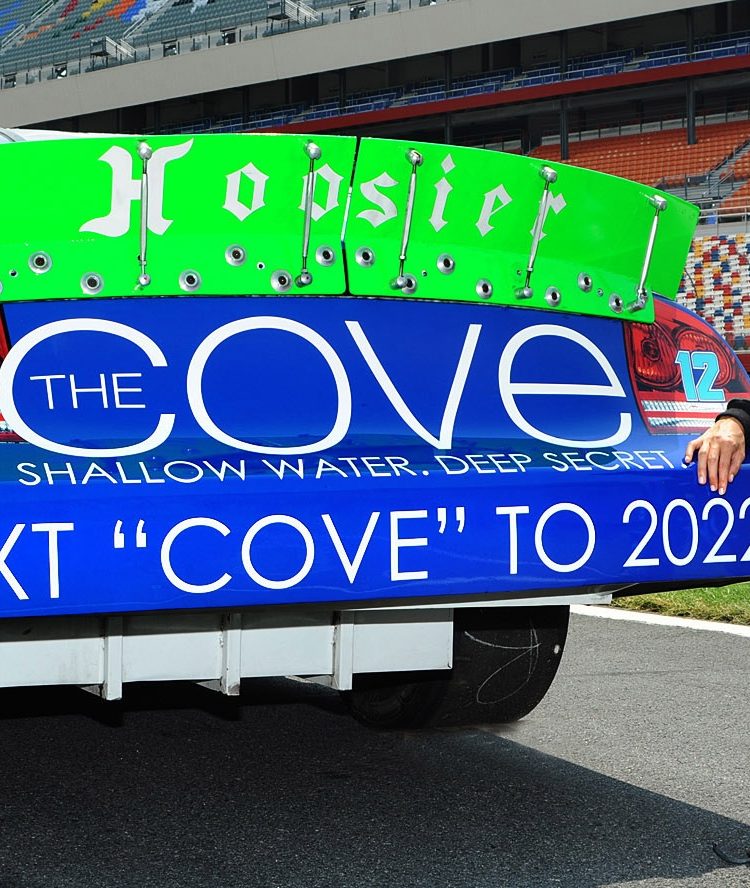
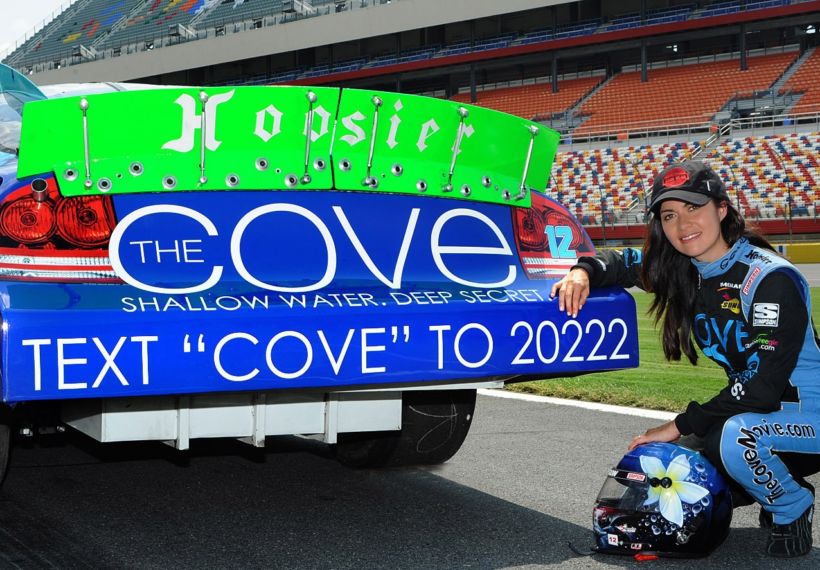
One of the moments that I had with my car, one of my favorite race cars that I raced was the Cove car.
So the Cove is a fantastic documentary that won the Academy Award in 2009.
It's about the dolphin slaughter in Japan.
And I became a passion.
That was very warmly received at the Academy Awards.
Did you see it?
Yes, yes.
Okay, so the Cove car, I was driving this for the Dolphins.
It was my first time that I ever did crowdfunding to get enough money to go run a car.
So the Cove highlights the connection between the dolphin slaughter in Taiji and purchasing tickets to dolphin shows.
So I wanted to get this in front of the NASCAR crowd, especially the NASCAR crowd at Daytona that's only an hour away from SeaWorld Orlando.
So I had been to Taiji, I'd seen thousands of dolphins getting slaughtered, and I felt like I was on the track representing their fight.
And so I said, I need you to help me get this car on TV so that people can find out about what's happening.
And then my tire blew.
And when my tire blew, I was coming out of turn two, I spun around, I kept it off the wall, so I was able to not wreck the car, but my tire exploded, my left rear tire.
And so the cameras cut to my car.
And you did this without hitting another car?
I didn't hit anybody and I kept it off the wall.
But I mean, essentially my race was ruined.
But the commentator, the television commentator, when they flashed to my car and they were showing my tire that had exploded, what did he do but talk about the movie The Cove and what it was about and how it was about dolphin captivity.
And so my wish kind of came true that I was getting their issue in front of millions of people on TV.
But it wasn't, I've learned that I have to be more specific about I want you to get me on TV by helping me win the race.
So yeah, you either want to win or be running up front or you want to wreck.
The dolphins didn't know.
They didn't know.
I wasn't specific.
Yeah, the dolphins got you on TV, but it wasn't by the how you wanted.
Yeah.
So I wouldn't, of course, if you were in a wreck, all the cameras are on you.
That's a whole other occasion.
That's a great way to promote something.
What if all the cars start just crashing?
Nobody's winning, but they're all getting their issues out there.
Getting paid.
They're getting their payday.
Do you guys in your community, do you follow race car driving as a sport or you just analyze it to see how to make it different?
I think to some extent, the race car industry has actually led to innovations in automobile technology, which are helping to improve efficiency and safety of these vehicles.
So to some extent, we're following that.
By the way, that's been true from the beginning, as I understand it.
There are advances in NASCAR, like the Tiptronic gear changes, the paddles, as I understood, those started with NASCAR.
Fuel injection, weren't anti-lock brakes NASCAR initially or not?
A lot of the innovation actually comes from the Formula Racing series rather than NASCAR.
As we learned from the name of NASCAR, it's stock car racing.
So they're stock vehicles.
Oh, they're already vehicles that are, okay, gotcha, of course.
So they've been a little bit not as cutting edge as some of the other racing series.
But the idea that racing cars itself, which so many people would say, oh, that's a Cro-Magnon sport, basically, it has contributed.
The trickle down engineering from it has indeed influenced the only time trickle down works through race cars.
So okay, if it's not NASCAR, it's the open wheel cars.
But nonetheless, it's I'm heartened to learn that there is this this transfer of technology, the NASA of cars.
There you go.
That's what they'd like to be known as.
I always thought NASA should have a race car and then they could just strap solid rocket boosters on the side.
It would probably win win every race, of course.
So I asked Leilani what car you had.
I had to ask.
I had to ask what car does she drive when she's not driving a race car?
And turns out she drives a Tesla.
Yeah, let's let's let's what I would have guessed.
Let's let's let's check it out.
I actually drive a Tesla Model S Tesla Model S.
So it's 100% electric and $100,000.
Yes.
They're they're they're not cheap, but there is a cheaper version coming out next year.
The $90,000.
No, the Model 3 is supposed to be in the $35,000.
Oh, okay.
And that should be unveiled in the spring sometime.
So you plug in your car.
So, technically, I'm running off of free solar electrons.
And then when I drive long-distance road trips, I'm using the Tesla superchargers.
So some of those are solar-powered.
Which are dotted across the country.
Yeah, they're all over the place.
I've driven 5,000-mile road trips from actually from here in New York.
I drove all the way to San Francisco.
And I kind of zigzagged, so it was a 5,000-mile road trip.
Right, because that would be twice as far.
Yeah, it's about 2,500 miles.
Yeah.
So, the efficiency of an electric car is much higher than an internal combustion engine.
So, in an internal combustion engine, only about 17 to 21% of the fuel, of the energy that's contained in the fuel actually makes it to the wheels to push the car forward.
It's very inefficient.
And you know where the rest of the energy goes?
It goes into heat.
Very inefficient.
So, most of the inefficiencies of engines of any kind, machines of any kind gets dumped as heat.
And so, you have hot exhaust coming out, the engine gets hot, everything gets hot, you have to put your heaters on if it's in the winter, it all goes there.
And you've got greenhouse gases coming out the back.
And the little thing called greenhouse gases out the back.
So, the electric car, even if I'm plugging into the grid, I am still far more efficient.
Even if I'm plugging in in West Virginia where the majority of the grid is coming from coal, I'm still going to be reducing my greenhouse gas emissions because of the fact that an electric car is much more efficient.
And also because of the fact that you use electricity to refine oil.
So wheel to wheel, it's more efficient to drive an electric car, even if it's coming from fossil fuels.
Now, the other thing you have to keep in mind is the electric grid is getting cleaner and cleaner as time goes on.
We're starting to put up wind farms, currently in the US every two and a half minutes a solar array is going up on a home or a business.
So the grid is getting cleaner and therefore people who have electric cars, even if they're plugging into the grid and don't have solar panels, their cars are getting cleaner and cleaner, something that will never happen with the gas car.
Let me ask you, Don, what is, what is, is there any downside to everybody having an electric car?
Not that I can think of, you know, I think Leilani really nailed this in terms of the benefits of electric vehicles.
You know, we've been looking at this question very closely around the emissions of electric cars and everybody's asking the question and a lot of people are saying, hey, what, you know, if I'm powering these things by, on the electricity grid and there's coal on the grid, are they still good?
You're better.
And the answer, the answer is yes.
I mean, she's right.
Pretty much across the country, no matter where you live, plugging in an electric car is going to be better than the average new gasoline vehicle.
Okay.
The last I looked at a Tesla, the mass of a Tesla Model S is primarily in its batteries.
And it holds the, you know, the five passengers.
It's not clear how that would scale to an 18-wheeler truck, where most of a truck's mass is going to have to be the cargo that it wants to carry, not batteries that it's going to...
Pineapples.
It's all pineapples and microwaves.
So isn't there a point where electric transportation stops working because it doesn't scale?
Well, so that, I mean, so that's a good point overall.
There's no silver bullet to this challenge of transportation and electric vehicles have a role to play.
But I'd also say it's not just battery electric vehicles that have opportunities.
You may have heard of fuel cell vehicles.
They were something NASA used early on in the space program and actually, though there are some passenger vehicles on the market now in California, they're fueled by hydrogen.
They turned hydrogen into electricity to power an electric vehicle.
In fact, in my office at the Hayden Planetarium, I have a liter bottle of water and on it, it says exhaust and the BMW gave it to me because they drove a car from Washington to New York using a fuel cell and the exhaust is essentially water.
You're recovering the energy from the hydrogen and oxygen when they recombine to become water because it's highly exothermic, if you will.
Yeah, so I interrupted.
Sorry.
They gave you the bottle of water, not the car.
Not the car.
That's what you need to flip that.
Yeah, I'm still working on it.
Can you get me a discount on a Tesla, Don?
I can't do that, but I'd be getting one, too.
I'll look into it for both of us, then.
So now, how about the batteries?
There's a lot of talk about caustic chemicals, rare earth elements in the batteries that might be bad for the environment when you want to dispose them.
So how does that enter the equation of how green a vehicle is?
So we look specifically at what the global warming emissions are from creating the batteries.
And like you said, a lot of the mass of the Tesla vehicle is the batteries itself.
So it actually does increase the manufacturing emissions of the vehicle compared to a gasoline vehicle.
But over the life of that Tesla, you're plugging into the grid instead of pumping oil out of the ground.
And you actually make up for those emissions pretty quickly and then save on the emissions.
In terms of the battery toxicity, I think that is an issue that can be addressed through proper disposal and recycling of the batteries.
And so that's an area that continue.
We're in the early stages of these vehicles in the market.
So we need to move forward with making sure that those batteries, after they're used in the vehicles, are actually 80 percent, 70 or 80 percent still left in those batteries and they can be used in a second use for energy storage on the electricity grid, for example.
And then after that, they could be recycled as well.
So I don't have much experience in a Tesla because I like looking at them and thinking about them.
But one time I was getting an award in California and by the Planetary Society and they picked me up at LAX in a Tesla.
I mean the car service.
And they said, hey, I'm in a Tesla and that's kind of cool and it was silent as they all are.
And then I realized, I don't see any Teslas in Manhattan.
There are no Tesla car services in Manhattan.
And then I'm sitting there with the driver and we figured out why.
Because the backseat of any car that's picking me up as a car service is bigger than the backseat of a Tesla Model S.
And if all I want is to get to where I'm going in comfort, why squeeze into anything just because it's electric?
I want the comfort.
And so Tesla doesn't have currency in New York City the way it does on the East Coast, on the West Coast.
And so do you foresee sort of regional, it's the region to region, this is going to, we're going to have to resolve this.
We need a luxury Tesla with luxurious backseats, drinking their fine exhaust, their purified exhaust.
I would just say, you know, it's an exciting time in the transportation sector.
There's over 20 electric vehicle models out there, so there's going to be more options coming.
OK, so what you're saying is we're in such infancy, I shouldn't try to make any conclusions about anything at all that still can benefit from the creativity of engineers, folks like you, to guide them to where they need to go.
Absolutely.
It's just the beginning.
Excellent.
We'll soon have roomy electric cars.
Roomy electric cars.
Thank you.
So, Don Anair, thanks for being on StarTalk.
And it's good to know you do that.
Can we find you again?
Absolutely.
Excellent.
We will find you again.
Where are you?
There you go.
We will find you again.
Thanks for being on StarTalk.
Thank you.
I appreciate it.
When we come back to StarTalk, more of my interview with race car driver, Leilani Münter.
Welcome back to StarTalk.
I'm with co-host, Eugene Mirman, and we've been featuring my interview with Leilani Münter, professional race car driver and environmental activist, one of the oddest combinations of things I've ever known in my life.
We've talked about, does it even make sense for a race car driver to double as an environmentalist?
What does it even mean?
We talked about the pros and cons of electric cars, the importance of renewable energies.
And now, if we can dig a little deeper into some of those issues that Leilani brought up, we've got someone to help me out here.
This woman is a professional in a topic I didn't even know there was a word for it.
So we have on video call Dr.
Marcia DeLonge.
Hello.
Yeah, and I have on my notes here, you are aggroecologist.
Forgive me for having no fricking idea what that is.
And you're also with the Union of Concerned Scientists, is that right?
That's right, yeah.
Okay, so you're also an activist.
All right, so.
She's just concerned.
Or she's just deeply concerned at it.
She's a scientist.
I am a deeply concerned scientist.
Okay, so what is an aggroecologist?
Well, let's break it down, right?
So you have in there clearly ecologists.
So ecology, I think more people know about.
Ecology is the study of the interactions among organisms.
So that's plants, animals, humans, and their environments, right?
And so then we add aggro, aggroecologist, whereas aggro is referring to agriculture.
So we're talking about ecologists who are studying specifically the kinds of systems that include farming and ranching.
Whoa, okay.
Then that's an important place to be because we via our agriculture are completely transforming this planet.
That's right, we are having a lot of impacts on our planet these days through our agriculture.
Okay, so other than Leilani's activism, because you're going to watch this with us and her races and this sort of thing, she released a documentary on the Discovery Channel directed by Louis Tsihoyos, I think I pronounced that right, and he also did The Cove.
And in that film Louis points out how much energy and fuel and CO2 emissions are involved in agriculture, in farm animals and all the rest of this.
So let's check out what she says about this.
So it's called Racing Extinction, and it's about the sixth mass extinction of species.
So there's been five major mass extinctions on the planet.
Racing Extinction, I see what you did there.
Racing Extinction.
I'm clever.
I figured that out.
I didn't come up with that name, by the way.
That was the Oceanic Preservation Society.
But it's good.
So Racing Extinction.
So where is it going to take us?
So, yeah.
So the film touches on a pretty big issue.
I'd say one of the biggest issues in the world, which is that we're driving species to extinction at a rate that's like a thousand times greater than the natural background rate.
So we're losing species faster than we can even record there here.
They actually estimate we could lose up to half the species on the planet by the end of the century.
By the end of the 21st century?
Yes.
So our film is highlighting first the endangered species trade, which is second only to the drug market, and it's excluding lucrative in terms of how much money is being exchanged.
So we do a lot of undercover work.
You'll see undercover cameras and us going into the markets.
Why would anyone want an endangered species?
So in some cases, it's an issue of wanting a trophy, right?
Like Cecil the Lion, good example that got a lot of attention.
The one bow and arrowed by the dentist, I guess.
The dentist, yeah, our favorite dentist in Minnesota.
There's also a lot of myths around treatments for cancer or that there's some sort of medicinal quality, which there's no scientific proof, and I know you're a data and a proof guy.
It's just kind of old-wise.
Also things for aphrodisiacs, which is anything that can somehow enhance or improve your physiology.
Right.
So we expose a lot of these sort of black markets, but we also address the indirect hand of man.
So us driving our cars around and burning fossil fuels, eating meat, for example.
So more greenhouse gas emissions actually go into the atmosphere from raising animals for food than the entire transportation sector.
So we address these issues of people that are not necessarily going out and trying to buy rhino horn, but their personal choices every day and the things that we're all just doing to live and how that is affecting the planet.
Man, this is bumming me out.
So Marcia, I get it that we're just messing everything up, okay?
We read about this every day.
Do you have a solution?
Because I'm not going to stop eating.
Of course, you can't stop eating.
Well, let's just think for a minute about what we're working with today.
Today we have a system that strongly incentivizes a particular kind of one size fits all industrial farming.
And I think we all know that one size fits all means doesn't fit anything quite right, right?
So this is the system that is damaging our soil quality, is creating dead zones in our waterways, our favorite lakes and oceans, polluting the air, promoting lots of troublesome weeds and of course contributing to climate change.
So in addition to climate change, there's all these other problems, but this is huge.
When you dig in a little bit, what you see is that below the surface of what looks like a very monotonous landscape in the US, soils, weather, climate and other conditions that are underneath that actually vary quite a bit.
And so we're not really considering that in the way that we farm and ranch today.
We also have different plants and animals that give and take different things from our farms and ranches.
And right now we're putting the same plants and the same animals in the same spot year after year.
So we're blunt instruments on the environment.
That's what you're saying.
What's that?
We're blunt instruments on the environment.
We are, exactly.
We are blunt instruments on the environment, but it doesn't have to be that way, right?
So if we think a little bit more carefully about how we might be strategic, how we might design our landscape so that we are integrating our crops and livestock in a smarter way so that we are thinking about what kinds of plants can give back to the places where different ones took a different year.
Okay, so you are talking about a more intelligent way of using nature, rather than trying to get people to change their own behavior by making everyone vegan, for example.
Yeah, that sounds...
Just eat a little, maybe just a little chicken, we can have a little chicken.
Did you hear how big the problem that was?
Because I think we need to be approaching it from all angles, right?
So only a little basil and a little chicken.
Yeah, you know, I mean, that piece of basil, that piece of chicken, of course, there's a lot of different ways that you can grow and produce those that they could be from your garden or they could be flown across the world.
It could be a chicken produced in a factory farm or it could be a chicken that's produced by a farmer who's really a true steward of the land, who's using it as an instrument for a healthy farm.
So you're both, you're both smart about this, but she's doing it obviously in a very different way.
Kate, I guess there's room for all of these tactics, I guess.
Is that right?
I mean, the answer to that, I guess, has to be yes.
But what I'm asking you is, in the end, should more people do what Leilani is doing?
Or do we need more people like you who are in behind the scenes in the trenches trying to make this work?
We need everybody on board.
We need to have all of us when we have the option to develop a relationship with our local farmers, to buy food from places that we really know how it's created.
Then, when we can't do that, when we can't have that local access, we really need to think about where our food is coming from, what our food companies, how are they promoting farming practices in a bigger sense.
Also, we need to think about the leaders that we have in this country and everywhere, really, thinking about wanting to have leaders who are thinking about these issues, who are making decisions that shift the economic and policy setting that we have that can really help farmers to produce healthier foods, that can help people have access to those foods on a day-to-day basis.
But a cow is going to produce methane out of both ends of its digestive tract no matter what it does.
And methane is, of course, a greenhouse gas.
So at some point, it can't just be, let's be a little smarter, you're really going to have to change people's behavior, aren't you?
Or grow cows underwater.
I haven't, I haven't read any scientific papers on growing cows in the water, but maybe you should write one.
That'd be a very interesting, very interesting opportunity.
Cows with snorkels.
You just saved the world.
No, but it might be some, I mean, not to, we're poking fun at his idea, but maybe a revolution idea such as that, or even just simply growing beef in a laboratory, synthesizing proteins, right?
That's not the way you turn your head when you're excited about an idea.
You know, I mean, like I said earlier, this is a really, this is a really serious problem.
There's no silver bullets here.
We need to be approaching the problem with every angle that we can think of.
But as an agroecologist, of course, I'm thinking about how the whole system works together, how we get the most benefits out of not just our farms and ranches, but the communities that are around them, supporting farmers, supporting the parts in the forest that we all love.
How can we get, how can we design landscapes that really work together to give us the food, the fiber and the fuel that we need and also protect our natural resources?
So how do you then affect policy?
Do you publish research papers and then do a white paper based on that?
Or you're part of your, we agreed at the beginning, you're a concerned scientist.
What are you doing when you are most potent in affecting change in our lives and in our culture?
Yeah, I mean, I think that there's two pieces to that and one is of course continuing to do research, to develop new ideas, to make sure that we're finding the best ways of moving forward in all these areas.
But another is really just to be staying tuned to all of the great research coming out from scientists who are all across our nation's universities and institutions and raising the profile of their research, right?
Because we really, we've seen that these practices are working.
We know that they work.
We know that people don't know that much about them.
And part of this is because we're not hearing about it.
And part of it is because we need more of it.
So that's just another thing that we're doing is we're trying to increase the amount of funding that's going into this kind of agricultural research because we know that when we invest in research and agriculture, it pays off.
And we want it to pay off in these really sustainable forms of agriculture that we are desperately in need of right now.
So you need a scientifically literate public so they even know how to listen to you.
And we need to be better at communicating to the public in a way that they can really hear our message.
So some of that is the responsibility of scientists as well to improve our communication skills, to get out there with our message.
So it's all your fault, yeah.
You're a scientist too, Neil.
Well, Marcia, thanks for being on StarTalk and teaching me that you even exist as a profession and as a person in that profession.
And we'll surely want to come back to you for future StarTalk topics because now that we know you exist, we're going to be calling you like your mother.
Could you come over?
I love it.
Please keep making the phone calls.
It's a real pleasure.
Thank you.
Okay, excellent.
I want to thank Eugene.
Thanks for doing another StarTalk here.
And Leilani Münter for being the first ever race car driver I've ever interviewed.
And it turns out she's vegan green.
Get her message out.
It makes so much sense.
When people get mad at Al Gore for traveling in an airplane, it seems foolish.
But now I'm like ruined for life.
How am I going to go to any other race car events?
Race car driver.
Now that you know you could do it green.
So let me just say, I think she's right.
I think she's right.
We got to tackle this on many frontiers.
And I think at the center of it all is science and human behavior.
And that's kind of what StarTalk is always about.
I've been your host, Neil deGrasse Tyson.
As always, I bid you to keep looking up.
See the full transcript




 Unlock with Patreon



 Become a Patron