Transcript
DOWNLOAD SRT
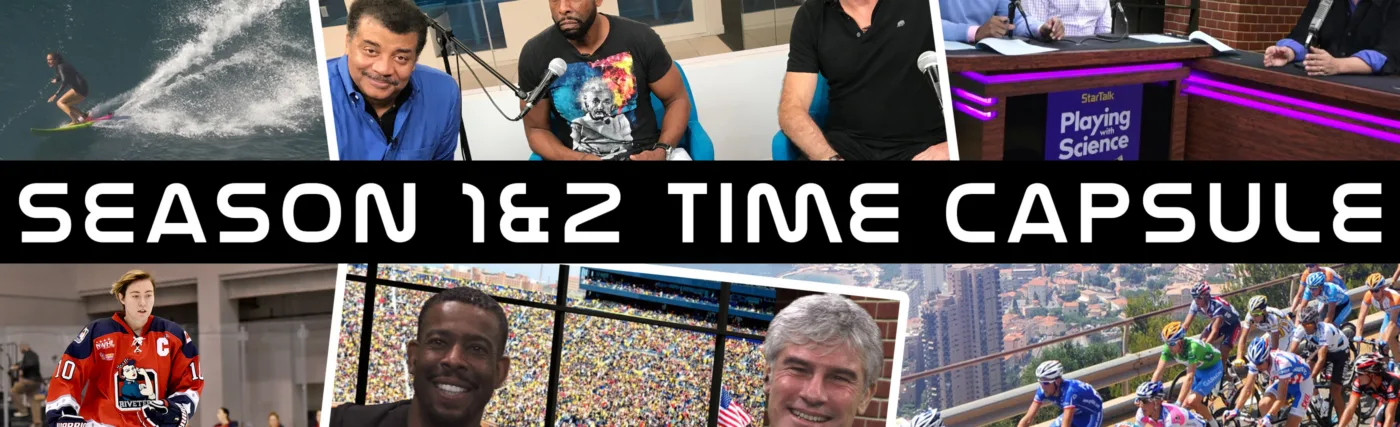
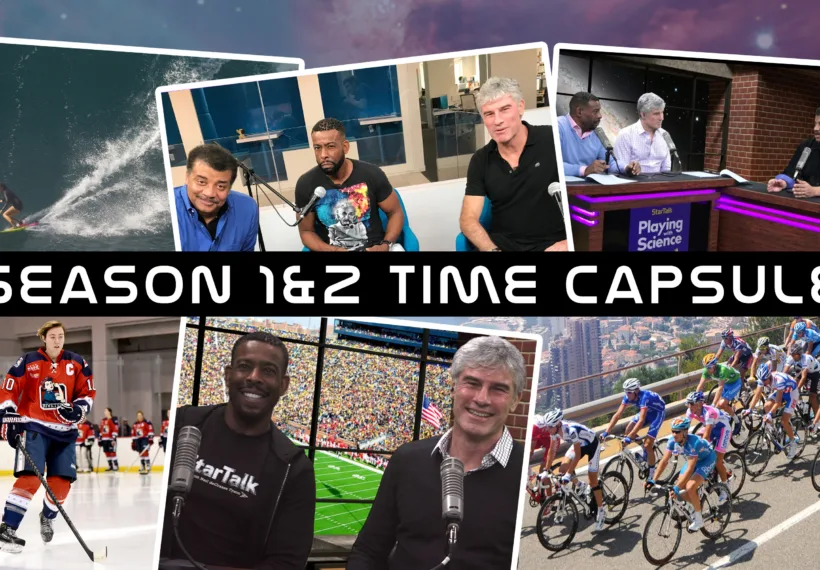
In your... This week, we bring you a special episode. That's right, we sent out a survey and asked you to vote for your favorite episodes of 2017. And we've compiled moments from the winning picks into this special time...
In your...
This week, we bring you a special episode.
That's right, we sent out a survey and asked you to vote for your favorite episodes of 2017.
And we've compiled moments from the winning picks into this special time capsule episode smashup.
Let's start off with our favorite episode of 2017, Fight Like a Physicist.
In this one, our good friend, physics professor, Eric Goff of Lynchburg College, breaks down the science behind Krav Maga and teaches us how to throw a mean punch according to physics.
Check it out.
We are talking martial arts and the physics therein.
And joining us now is our very good friend, Professor Eric Goff, not just a man with a plan, but a man with a book coming out next year, that'll be 2018, The Science Behind Krav Maga, which, if I'm not mistaken, Professor, is the hand-to-hand martial arts of the Israeli military, is it not?
That's right.
The Israeli Defense Forces employ this, and then it's becoming a much more popular sport here in the US.
You're seeing a lot of billboards going up for Krav Maga instruction these days.
Well, what is it?
I mean, it sounds like, I gotta tell you, when you talk about the martial arts, you got some cool names out there, okay?
You got your judo, all right?
Your akido, okay?
That sounds cool.
Your jujitsu, which sounds very dangerous.
Even karate, which is like, oh, I know what I'm getting into.
But then you say Krav Maga, and it sounds like-
You're thinking food again, aren't you?
Yeah, I'm like, Krav Maga, mm, delicious.
You know what?
I had the best Krav Maga the other night, I've gotta tell you.
It was unbelievable.
I'm telling you, the outside was crispy, the inside was tender, it was the best Krav Maga I've ever had.
My stomach's already rumbling, behave yourself.
All right, so what is Krav Maga?
Firstly, Professor, welcome back to Playing With Science.
And please put this man in his place, thank you.
Well, if Chuck had had good Krav Maga the other night, his face would look a lot different, I think.
All right.
All right, Professor, way to go.
School's in.
Way to go.
Nicely done, my friend.
So is it kicks, flicks, all the sort of flashy stuff, or is this more hand-to-hand, let's sort of like end up wrestling, or is it a combination of a lot of different martial arts?
Is it eye gouging, and like rip your throat out stuff?
It's got some of that in there.
I've studied karate myself, I'm a first degree black belt, and I really enjoy karate, but it has a lot of elegant katas and movements.
But Krav Maga is a much more realistic fighting system, so I think I'd be more comfortable knowing a little bit more Krav Maga than karate if I were on a dark sidewalk somewhere and had to fight somebody.
I'm guessing that the good professor never has an issue with pupils.
Yeah, I gotta tell you, I'm sure there's a great deal of discipline in the professor's class.
So Krav Maga is basically a street fighting style then, huh?
Or more?
It is.
I mean, you've got some Aikido in there.
You've got some boxing, wrestling, some karate.
I mean, you've got an amalgam of all kinds of different systems and it's an ever evolving system.
It employs whatever works well and it changes techniques as new ways to perform them come along.
So you've worked on an article for The Ring Magazine on boxing.
Yeah, we've looked at different punch techniques.
We've looked at punch speeds.
If you do just kind of a standard jab cross combination, we also do this in Krav Maga, you can get speeds close to 20 miles an hour with these jabs and crosses.
And one thing to keep in mind when you're punching someone, if you extend your arm out straight, when your arm reaches its full straight extension, your fist is moving at zero miles an hour.
If it wasn't, it would keep moving and your arm would stretch.
So the maximum speed of your punch is gonna be about halfway into that extended arm.
So is it better to be closer and hit somebody halfway through a punch than to hit them at the end of a punch?
Absolutely.
Your elbow is gonna be bent about 90 degrees or so when your fist is moving at its maximum speed.
And then as the fist extends, your fist has, or the arm extends, the fist has to slow down to zero when you get to a fully extended arm.
So you have this rising speed and then going back down when the arm is extended.
So the most damage on the punch is gonna be when the elbow's bent.
Oh, wow.
So when I look at the biomechanics of my shoulder, my elbow, my fist, if we're gonna call it that, my shoulder's not built for kind of rotating around the outside.
It's more in a vertical upwards and downwards and my elbow is a hinge.
So how do we utilize the way we're constructed to the most effect if we are to throw punches?
Well, the most effective way is to not just use your arm and shoulder.
You really wanna engage your core, this kinetic linking that we talk about where you're starting from the feet, you're gonna start rotating your body into the punch.
So your entire torso is creating a rotation.
So you've got a lot of stored energy that you're gonna convert to kinetic energy as through that rotation.
So you really wanna be rotating your trunk so that you are using, it's almost like a golf swing, huh?
Yes.
The same with the throwing action, a golf swing.
We're getting the same with the rotation for a kick in martial arts.
The same thing applies, you're maximizing the energy.
Is that right, Professor?
Or by incorporating rotation?
That's right, and when you have, for example, a side kick, we also use side kicks, front kicks, back kicks in krav maga as well as karate.
The idea is you're gonna cock your leg for a kick, so you're gonna store a bunch of energy like a spring in your leg when you've got your leg cocked, and then you release that energy as you're kicking.
And you're gonna rotate your hips at the same time, so you're trying to get as much energy released during the kick or the punch as you can.
When I've spoken to boxers and to people who practice martial arts, they said some guys punch harder than others, and it's not the big muscly guys that you'd think would have the hardest punches.
Quite often it's the little guys with not a lot of bulk, but they punch so hard.
Is that down to rotation, or is it something else that they're employing?
A lot of it's rotation.
I mean, keep in mind, your kinetic energy grows like the square of your speed and only the first power of your mass, so if you can get a lot of extra speed going in that punch, somebody's gonna feel that a little bit more than kind of a lumbering, bigger mass fist coming at you.
So really, it's more about the speed and the rotation than it is about, oh, I'm a big strong guy.
Sure.
I mean, you really wanna get hit with that speed.
I mean, when these punches are coming at you at 15 to 20 miles an hour when you're getting hit, you're gonna feel it.
It is really interesting when you look at it from the point of view of physics and martial arts.
It's, yeah, I have a friend, he's got an older guy.
There's nothing of him.
And he just turns around to me and says, this guy can punch so hard, it's ridiculous.
And you look at him thinking, he couldn't punch his way out of a wet paper bag.
Yeah, when the martial arts expert says, this guy can punch, you're thinking, okay.
Up next, we brought on your personal astrophysicist, Dr.
Neil deGrasse Tyson, to discuss some of his many tweets about sports for an episode we called, Out of This World Sports.
Today we enter Twitterdom, through the vast multiverses of Neil deGrasse Tyson's mind and light up the cerebral spheres that engage with the complex and ever-evolving world of sports.
Yeah, so did you change your meds, Custis?
Hey, Neil deGrasse Tyson has many opinions and many things which he chooses to share on a regular basis, but he has a heartfelt connection to sports that's constantly filtered through his scientific lens on Twitter.
So when you play with science, there can be no better play date than the man himself.
And to take us to sports that are out of this world, we have, yes indeed, out of this world sports, we have Neil deGrasse Tyson.
Yes, thanks for joining us right now.
It's the one, the only, the inevitable Neil deGrasse Tyson!
You like that?
That's all right.
Where'd you get the gong?
Normally that's how you get someone off the stage, right?
I saw the gong show.
All righty, no, no, don't take it personally.
No, that is a royal entrance right there.
That's what the gong is for.
Now, normally I'm sitting there.
That's right, sir.
Now you just took your own damn show.
Now I'm a guest on your damn show.
Weirding you out?
I'll get used to it, that's all right.
It doesn't happen without you no matter what though.
What's up?
Neil's gonna start asking us questions.
You won't be able to help him set it up.
Yeah, no, I'll happily be your guest on this show.
Yeah, that's when the, please don't ask us any questions.
It means I feel loved, I feel loved, yeah.
That's very cool, thanks for being here man.
We appreciate it.
And of course, you are a prolific tweeter.
Yeah, but it's not, well, so a couple of things.
First, you said I have many opinions, which I do, but I hardly ever tweet opinions.
This is true.
Okay, the most opinionated tweet I ever posted, which was clearly an opinion, was after Star Wars The Force Awakens, I said BB-8 is way cuter than R2-D2.
That was clearly an opinion.
That's an opinion.
And of course, there were fights and things.
Oh, you're kidding me?
That was generational fights.
Yeah, without a doubt.
But what I try to is not give you an opinion, because frankly, I don't care if you share my opinion on anything.
Okay.
What I care is that whatever opinion you come up with, it is informed with objectively verifiable truths.
Nice.
Say it, there you go.
This man is always about science education, right down to the tweets.
Then make whatever old damn opinion you want.
I don't care, but I mean, I care broadly, but specifically person to person.
Just, I'll give you more information that you may have had before to help you understand your decisions, that's all.
So, what we're talking about today are the tweets of Neil's with respect to sports, which is-
You called all my sports tweets?
Yes, we did, my friend.
There's a few, but it's not like that's what I do.
No, but there's more than 40 of them.
40?
Out of 5,000?
Okay, so there's one in 100 is a sports tweet.
One in 100 is a sports tweet.
And a lot of times they surround very significant sporting events.
Yes, yes, just to keep it in the mood.
So it's like the Super Bowl or the Olympics.
It's your gray matter.
Yes, it does.
Even if it's one in 100.
And you are an athlete, you know.
I mean, 40 pounds ago, yes.
I think we've established everyone here is an ex-athlete.
So, you know, I'm sure that you're a person who looks at...
So as a former athlete, you were a wrestler.
But can I just say, since we're like three guys here, so you know how I wear my 40 pounds.
So a lot of it is everywhere, but of course we're guys, so most of it just goes to the belly.
But I've always had broad shoulders and a large chest.
And my chest, even at my chubbiest, was always bigger than my waist.
So all you have to do is cut a jacket, a sport coat, to come in at the waist a little bit.
Then it still cuts and you don't look like some slob that clearly was once in shape but is no longer.
So I've been able to fake this extra weight in my...
Next week on Playing With Science, we'll have colors for spring and fall, as well as tailoring and other ideas.
It's haberdasheral advice from Playing With Science.
This is from the 2012 Olympics.
I said, how about a Mars Olympics?
Yes, all athletes would suffocate.
Ignoring that complication, way cooler than an Earth Olympics, that's all.
Way cooler than an Earth Olympics.
I'm setting you up for tweets that follow up.
Yes, I was gonna say, because when you say way cooler, then you actually give us some examples of why an Olympics on Mars, or pretty much any sporting event on Mars, might be cool.
It's also a couple hundred degrees below zero on Mars, so way cooler has double meaning there.
I think we picked that one up.
You picked that up, okay.
All right, so let's look at one of the Mars tweets, and this is cycling on Mars.
Okay, all right.
So go ahead.
So this is again during the summer 2012 Olympics.
If there was cycling on Mars, try Olympic mons, a volcanic mountain five times taller than Mont Blanc in the Alps.
So you think you got tall mountains here.
No, the tallest mountains and the deepest valleys are not on Earth in the solar system.
They're on Mars, they're on the moon, so we ain't got nothing.
We ain't nothing, right?
Yeah, we're not.
We're not winning those contests.
As you know this, the atmosphere on Mars is how much less than the Earth's atmosphere?
It's about 1 one hundredth.
Yeah, pressure, atmospheric pressure.
So, in other words, for every breath you take on Mars, there's 1 one hundredth the amount of air in that breath, and it would be on Earth.
As an athlete, altitude becomes your enemy in terms of the oxygenation.
If you're performing in altitude, but the ideal way to do this is you train in altitude, and then compete at sea level.
What we need to do is go to Mars.
That's why Sherpas don't have any problem getting up the mountain while all the tourists are like, huh, huh.
That's right.
All the baggage.
I need more oxygen.
Here's what you do.
Even better.
We're gonna train on Mars.
I'm gonna make a suggestion that's never been made before.
You ready?
You drain the Pacific Ocean, okay?
And then hold the Olympics at the bottom of the Marianas Trench.
But you train at high altitude, but now you compete at the bottom of the, which is six miles down.
Now every breath of air has way more oxygen.
And at sea level.
And so now you have heroic feats.
Before, you don't even have to dope your blood.
The air itself will put the oxygen and force it right into your lungs.
I'm sure the IOS are gonna stump up for that draining of the Pacific Ocean.
I just like the fact that you're thinking like a super villain.
I'd have gone the other way and said, let's all go train on Mars, on the mountain.
On the Olympic mons.
And come back to Earth and compete.
Problem is it's only 40% the gravity of Earth.
So the weight that you are carrying is not as much going up the hill.
Yeah.
So there is some trade-offs.
Some trade-offs.
There's some trade-offs there.
Some leaded suits.
Oh yeah, yeah, just lead yourself down.
Another thing, once you've drained the Pacific Ocean, that had nothing to do with sports, just while we're on the topic.
If you drain the Pacific Ocean, that is the great toilet bowl of dead satellites.
Oh really?
Yes.
Oh yeah, because they always splash down on the Pacific.
Oh, they crash down.
If it's a dead satellite, they're not splashing.
They're not splashing down, they're crashing down.
So the reason why is the Pacific Ocean is almost a third of all possible longitudes on Earth.
So if you de-orbit and you do it, you have a lot of latitude, no pun intended, to where you begin the de-orbit so that it's gonna plunk down in the Pacific no matter what.
And people don't live there, so not over the great bulk of the expanse.
So it's a safe place to drop your stuff out of orbit.
The day we de-orbit Hubble, it's going straight into the Pacific.
It's going into the Pacific Ocean.
And it's the size of a Greyhound bus, by the way, if you know.
Wow, nice.
Hubble Telescope.
Yeah.
Hey, time to take a short break.
We'll be right back with our 2017 Time Capsule episode.
Don't go away.
Welcome back to Playing With Science.
On this time capsule episode, we're revisiting some of your favorite shows from this past season.
Up next, you voted for The Physics of the Tour de France.
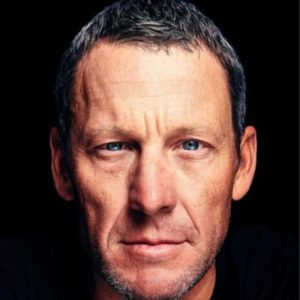
This show features Neil deGrasse Tyson's interview with the one and only Lance Armstrong.
Check it out.
Today on Playing With Science, we ride.
So fill up your water bottle, get your lycra on.
It is centuries old and said to be the most efficient means of transport known to humankind.
Pretty simple, really, a wheel at each end, somewhere to sit and something to steer with.
Yes, very simple, but not so simple, because you know, cycling is now one of the most sophisticated sports on the planet and it's loaded, and I mean loaded with lots of tech.
But don't worry, you're not gonna miss out on that.
We have a whole nother show that's gonna be devoted to the tech of cycling.
Oh yeah, but for now, we'll be exploring The Physics of the Tour de France, which is a tour, me oui.
It is a test of man's endurance, man's need for speed while not falling off and with more twists and turns and devious strategies than an Agatha Christie novel.
I see what you did there.
Yeah, I like that, that's good.
To explore this lesser known world, we sent the intrepid Neil deGrasse Tyson to meet with what some might say is a controversial figure in the sport.
We know him simply as Lance Armstrong.
From when you began riding to when you retired, did the aerodynamics of the sport change?
Well, yes, I mean, the aerodynamics absolutely.
It's still your body.
It's still your body.
But the biggest thing that changed was in the late 80s, they invented a whole new type of handlebar, which changed, you know, in the late 80s or in the mid 80s, you would have been sitting out like this.
They took, which originated in the triathlon, they took the idea of that and they said, well, what if we, and the guy who invented this is a guy named Boone Lennon, and he was an old ski racer.
But he also rode bikes.
And he worked for Scott, the ski manufacturer, to make poles and skis.
And he said, well, what if instead of, I wouldn't ski down the hill like this, what if, you know, a skier who's tucked like this, what if we rode like that?
That takes away the aerodynamic drag of my arms outside.
Everything inside.
Everything inside your body.
So it was called the Scott Bar.
And it looked like a downhill ski racer.
Posing like that.
We were out a bit.
I've seen it.
So that revolutionized the aerodynamics of Triathlon initially, and then it moved into cycling, which was a harder transition because they were so traditional.
They saw these bars and these guys, they said, no way.
Ain't no way I'm riding that.
Well, it proved so much faster that actually Greg LeMond was the first one.
He won the Tour de France in 1989 on these new aero bars.
That's what it takes.
I mean, that was the tipping point for that bar.
So then when did the conehead helmets come out?
Those were around for a long time.
Yeah, those were around before the bars.
And then came, and then people try to make an aerodynamic frame.
I mean, I remember in the...
Yeah, the tubes became these, you know...
They're very, they're oval-shaped.
You can even go back...
A British guy, when the UCI, when the governing body was a little more lax on the double triangle thing, a British guy in 1996 by the name of Chris Boardman set the hour record, which is on the track.
I love the hour record.
Which is like the ultimate test.
I love that.
I mean, you're indoors, there's no wind, there's no draft, it's like the ultimate.
And the track is banked, so you just...
It's banked at 30 degrees.
There's nothing against you.
Right.
So he broke the hour record on a bike.
It's called the Lotus bike.
It was not a double triangle.
You can look it up.
I mean, we can go to the lab.
It was a very...
This is, to me, if the sport said, okay, you guys evolve technology-wise, do whatever you want, that's what the sport would look like.
You'd have that...
That's what a bike frame would look like.
But...
The Lotus frame.
The Lotus frame, which your audience will see.
We'll get a picture of it.
So, but then they backed off that and went back to the double triangle.
But you'll see how radical it looks.
So...
And obviously he went.
I mean, nobody's ever...
What's your best hour?
I've never done...
Tell me that.
You lying.
I've had a lot of great hours in my life, but I've never done that.
Look at that, Lance.
I like the track inside, doesn't he, loves the road.
Yeah, absolutely.
It's interesting, Eric, that they borrowed from other sports.
You listen to that first bit, the Scott Bar comes out of skiing.
Lotus is a British car manufacturer.
They had a Formula One race team.
So cycling's been borrowing from all these different sports in an attempt to get that speed.
Get faster.
And why not?
We all follow the same laws of physics.
Right.
So, a skier's facing the same kind of error that a cyclist is gonna face.
So, we can learn a lot from other sports by seeing what technologies have advanced in other sports and apply them to cycling.
So now, what, no, I was gonna say, what is the optimum way to increase airflow for a biker, aside from the tuck, which makes perfect sense.
You ever see a downhill skier?
They're actually, not only are they tucked, but they're as low to the ground as possible.
So, what is the optimum means of increasing airflow for a bicyclist?
Well, we learn about air resistance when we're children and we stick our hands out the car window.
We get into airplane mode and the hand is sideways and we have a very little drag and then we turn it 90 degrees and all of a sudden we're getting smacked by the air and the hand will fall back.
So we know that-
Which, by the way, Eric, is why I only have one hand, but thanks for bringing up my pain, sir.
Thank you.
No, go ahead, I'm joking.
If you drive on the other side of the road in England, then you can lose the other hand.
All right, Eric, don't encourage him.
Please, just don't encourage him.
Now, am I right when, and Chuck loves this term, skin friction, is that the technical or the cyclist term for the problem that you face as a competitor?
What you're trying to do is reduce the area.
So when you get into that tuck position, you are reducing the amount of area that the air can hit.
So if you're going really slow, the air resistance might just be a couple of pounds on you.
If you're going really fast downhill, it could be 15, 16 pounds.
And remember, 15 pounds is the weight of the bike.
So you've got the weight of a bowling ball being pulled back behind you in the air resistance.
So you can really feel it.
It's really slowing you down.
So as Neil said, if we get the Conehead helmets, then I get the super slippery Lycra bodysuit.
I get really smart booties for my shoes.
Nice.
That reduce all of the wind resistance.
How much can I gain?
In the time trials, they're allowed to wear this very sleek clothing and aerodynamic equipment.
They've got the back wheel is covered and you can reduce drag by about 20%.
You've got the teardrop helmet.
You get a cyclist like, I think of Tony Martin from Germany on the bike who just absolutely almost gets himself completely two dimensional on that thing, the way he can compress his knees and his body.
It's an amazing thing to see.
But they could reduce by 20% or so the drag area that they feel.
Okay, one question Eric.
Why only the rear wheel is covered and the front wheel has the spokes or whichever system is preferred?
So when the air is coming around the object, think of the water going around a boat.
You have a wake in the back and that wake is taking away some energy that you have.
So when you close off that back wheel and you have the teardrop shape, you're allowing the air to flow a little farther back and the wakes not quite as chaotic.
You don't have quite as many swirls.
So you don't lose quite as much energy.
Just to clarify, what you're saying is behind the bike, what happens is the air turbulence creates like a curl.
And so that curl of turbulence happens much farther behind the bike itself, freeing the bike to move faster, right?
Yeah, if you just have a round object and you got air flowing behind it, you can get all these swirls behind it in the air.
And that's taking energy away from the ball, let's say.
But if you can teardrop the object, the air will flow much smoother behind it and you don't have quite as many swirls, so there's less drag on the object.
Wow, and now what are the speeds?
Have we got to a place where we're kind of reaching an optimum speed?
What are the kind of speeds that we're talking about when we look at these aerodynamic advancements?
Well, you go back a couple of years and the first stage you had Rohan Dennis setting a time trial record.
Now this was only about eight and a half miles, but the guy average.
Only.
Yeah, only, I say only, yes.
The guy averaged about 35 miles an hour on the bike.
Wow.
I mean, that was an incredible speed.
We're talking over 55 kilometers an hour.
Sustain that for.
Yeah, that's insane.
That's insane.
Yes.
Super cool.
In this next episode, NASA oceanographer Bill Patzert breaks down the science of surfing the big waves.
Check it out.
Today, we head for the beach and we are so amped.
We may shoot the curl we might have to bail.
We will probably get mullered.
And if you understand any of that, you then are no Barney.
Dude, total poser, dude.
And helping us stay away from the gnarly stuff and steer us to the serious science of the big waves is Bill Patzert, oceanographer at NASA.
And of course, super cool surfer from California.
Then we go all pro with professional surfer and big wave champion Paige Alms, who is based in Maui.
I don't like her already.
Cool, right.
There are few sites in sport that are as awesome as seeing a surfer take on the big waves, make that huge descent, and then emerge through the barrel.
It is breathtaking and possibly the most fun you can have with physics, and when I say awesome, I don't mean it in that cliched way.
I actually really mean it is awesome.
Yeah, it is.
It's a beautiful thing to behold, to watch somebody drop in and ride a wave and shoot the curl and come out at the end of that barrel and stand up.
It really looks like a human being triumphing over the entire ocean.
Take that, Mother Nature.
Albeit temporarily, because we don't like to upset her.
That's for sure.
She does have a temper.
All right, let's get up to our first guest, shall we?
Bill Patzert, absolutely.
Yes, research scientist and oceanographer at NASA.
And a former surfer.
Oh, I don't know.
Should I say former?
Bill, welcome to the show.
And do you still surf, my friend?
Okay, aloha, dudes.
I could have been, I should have been a contender, but I spent too much time in the classroom, got my PhD, but I've been surfing now for over 50 years.
Take a bow, sir.
That is amazing.
So that's a lifelong surfing career, really.
You seem to have a unique approach on the sport of surfing, being an oceanographer.
Has it been an advantage to have this, I'll call it inside knowledge of the oceans, as regards to getting the best out of your surfing?
Well, you know, the answer to that, of course, is yes and no.
You know, it's one thing to know the physics, but it's another thing to be a great surfer.
All world-class athletes, either you have it or you don't.
And I definitely did not have it, all right?
All right, modesty is, we appreciate some modesty.
Yeah.
Let me ask you this, switching gears just a little bit, back to you being a surfer, what makes a good wave?
Well, you know, these great storms, they generate waves of many wavelengths from, you know, a few inches or a few centimeters up to waves that have three to 400 feet of wavelength.
Now, the interesting thing about waves is that depending on the wavelength, the length between the peaks and a big swell, the longer wavelengths travel faster.
And so the first waves to arrive from a giant storm are usually these very smooth, long period waves, the precursors.
And of course, these are the waves that surfers love.
You get essentially anywhere between 15 and 25 seconds between the peaks.
And if the storm is large enough, these great swells can generate waves anywhere between 10, 25, 30, even 40 foot waves.
And of course, the real surfers, the guys and the gals that live the sport, these are the waves they love.
They're smooth, they have one large wavelength, but that is interesting that waves, the longer waves travel faster.
And so usually they're the first to arrive followed the next day usually by what we call storm surf, which is mixed surf of all different wavelengths.
Yeah.
Many surfers call slop.
Slop?
Yeah.
And so what you want are these long period waves that are the first arriving waves.
So it's a small window of opportunity if it's only going to last a day or so.
Yes, the best waves are usually less than one day.
And you could travel half of the way around the world or further, just for one day on the board.
I've forecasted waves, these waves, of course I call them great travelers.
They travel across what we call great circles, which is the shortest distance from one place to another.
But I've seen great storms in the Indian Ocean and more than a week later, they arrive on the coast of California.
And so these are truly world travelers.
Hey, we've got to take another break, but we'll be back shortly with our time capsule episode of Playing With Science.
Stay tuned.
We're back with more Playing With Science.
You're listening to a special time capsule episode.
And keeping with the StarTalk tradition, we sent out a survey to our fans asking you to select your favorite episodes, and the results are in.
Let's now take a listen to Space Jam.
In this episode, your personal astrophysicist, Dr.
Neil deGrasse Tyson, answers your questions about basketball.
Today, we throw ourselves deep into the cosmos and plot a course for the superstars of a faraway galaxy known by those who search such stars as the NBA Nebula.
Oh, man, I like what you did there, Gary.
Yeah, that was a really cosmological NBA reference thing.
Well, guess what?
We're armed only with our enduring minds and our listeners' fabulously creative questions because we're going to trek towards those faraway stars, and our guide for this journey is none other than the one, the only, your very own personal astrophysicist, Dr.
Neil deGrasse Tyson.
That...
you were getting low.
Now we've got the irony of the next line as not wasted.
So let's not waste any time.
Let's make some space jam, shall we?
I don't know why, but just hearing you say, let's make some space jam...
It's like the Great British Bake Off.
Only in space, but I think, Neil, the way I've introduced the show might be flawed.
No, no, NBA Nebula, I love it.
We have nebulosities across the cosmos named for whatever they happen to look like.
We have a crab nebula, the North American nebula.
We have the eagle nebula.
They just look like...
Whatever it looks like.
Whatever it looks like, we call it as we see it.
So let me ask you this, and I know this is a sports show.
As does any good umpire.
As does any good umpire.
Nice.
I saw what you did there.
Let me just ask you...
So, no reason why they couldn't be an NBA nebula.
They would have to look like a...
Like LeBron James.
A court or some, you know, the paint patterns on the court.
Or a basket.
Or a basket hoop.
Or the net.
I don't know of any.
Maybe I could reinterpret some that already exist and come back with...
That'd be cool...
.
sort of a sports version of previously named nebulae.
Sportify the universe.
Maybe I could reinterpret some that already exist and come back with...
That'd be cool.
Maybe I could reinterpret some that already exist and come back with...
That'd be cool...
.
sort of a sports version of previously named nebulae.
Yeah, nebulae is like Latin for cloud, basically.
That's what it is, yeah.
But since it's a cloud, wouldn't they change shape over a period of time?
Oh, yeah.
You just don't live long enough to watch that happen, okay?
So the eagle nebula will remain the eagle nebula as long as I'm alive.
So the eagle nebula will remain the eagle nebula as long as I'm alive.
You're talking about something that's hundreds of times bigger than the solar system.
It's not going to just sort of move around and be anything it wants in any given moment.
So you do see some changes deep down where stars are being born, this sort of thing.
But overall, these structures have a certain permanency to them.
Sweet!
All right.
And now, remember, this is a sports show, okay?
So we're going to get back to our sports show.
It is a science sports show.
Okay.
And that was science.
That was science.
All right.
So how are we going to get to the sports?
Because what we're doing today is we're taking your questions.
I have no idea what you're doing today.
Oh, that's right.
You're a guest.
Yeah, I'm a guest.
Normally, you're driving this bus.
I ain't driving this bus.
You go to Ticket.
The short bus.
Apparently.
That's when I'm driving it.
Well, check Neil's Ticket, yes.
They're like, wait a minute.
Who let that kid drive the bus?
Drive the bus.
Uh-huh.
Yeah.
All right.
So today, what we're doing is we're answering your listener questions submitted about our Kareem Abdul-Jabbar show that aired.
That was fun.
I really enjoyed that.
I really enjoyed that.
That aired on Nat Geo a little while ago.
And so we only got to answer a couple of them the first time around.
So we took the rest of them.
We figured, hey, why not revisit this and dedicate a show and have your personal astrophysicist come back and answer these questions.
Well, let's do that.
All right.
First one, go ahead, Gary.
Okay.
So this is from Ranjit Rudra on Facebook.
That was great.
Look at you.
You practiced.
He's showing off.
He's showing off.
This is not cool because everyone knows that.
Namaste.
And everybody knows that I never, ever prepare.
And so therefore I look stupid.
And now I got to start preparing because you just made me look dumb.
No, you just got to learn to roll your R.
So namaste from New Delhi, which is obviously a very, very interesting place to be.
Which planet in our solar system, says Ranjit?
Wait, is that called Delhi now?
I thought they...
No, no, no, no.
India kind of got rebranded and they changed a whole load of names that were associated with the Raj.
Yeah, New Delhi is New Delhi.
Bombay became Mumbai.
Calcutta became Kolkata.
Kolkata?
Madras?
Kolkats?
No, Kolkata.
Kolkata.
So then Madras...
There's American Jack saying Kolkats.
You say whatever you wish, sir.
Madras became Chennai.
Right, that's enough of the geography and history.
But that happened in China as well.
And when Peking became Beijing, but they didn't change Peking duck.
To Beijing duck?
Yeah, right.
It's still Peking duck.
Absolutely.
I'm pissed off at that.
Why?
Change it, change it.
Beijing duck doesn't seem like I would like it.
And it's still Bombay gin.
It's not Mumbai gin.
Trade name.
There you go.
So, right.
Okay.
Which planet in our solar system would be the best for having a game filled with super cool high-flying dunks?
This would mean greater hang time in the air.
Take it away, sir.
Ooh.
So, we're talking about basketball here.
We are all about the NBA and the superstars within it.
The National Basketball Association.
Correct.
So, here's the thing.
You don't want the gravity to be too low.
Right.
Because you know what will happen.
Because these guys can jump, right?
For sure.
And you want to talk about hang time?
If the object has a low enough gravity, then you will jump and achieve escape velocity and just never come back.
So, that's the limit.
By the way, that's the game I want to watch.
Everybody jumps.
Everybody jumps and just disappears.
Next group comes in.
Nobody comes back.
It's going to cost an awful lot in uniforms.
So, there's that limit.
Then you don't want to limit the other limit where the gravity is so heavy, your muscles can't get you off the ground at all.
We know what Earth is like.
Is that not enough acrobatics for this person from New Delhi?
No, no.
Ranjib is possibly exploring the fact what actually would happen.
Would we see?
I think the moon is pretty good.
Mars would be good too, but moon would be better.
So, here's what they are, just to remind you.
Mars has about 40% of Earth gravity.
So, if you're 200 pounds on Earth, you are 40%.
You'd be 80 pounds on Mars.
So, what that means is all your musculature, all the strength of those muscles that's accustomed to moving gracefully 200 pounds, because you guys are all 200 pounds at least, okay?
Now, I mean, in my day, they were like 160, 70, 80 pounds, but it's before the...
Everybody's working out.
Everybody's working out.
Weight training.
Weight training.
So, 200 pounds is a good average weight if you want to think about it.
So, think about the strength you have to move your own body gracefully.
And now, at 200 pounds, now you weigh 80 pounds.
So, now you can jump much higher.
Your hang time is much longer.
And you're already acrobatic.
Now, you could do a triple pirouette dunk because your hang time allows it.
So, Earthmen become supermen on Mars.
Earthmen become supermen on Mars.
That's correct.
Now, that's 40% your weight.
Now, you get used to that.
Now, this person writes in, you Mars basketball players, I want to do C1 more, one up on that.
Now, you go to the moon.
So, now if you're 200 pounds on Earth, you'll be 32 pounds on the moon.
So, now you'll be even lighter.
And a little known fact is that the body weight plus equipment of the astronauts on the moon was like 350 pounds.
And there they were skipping like they were not eating a thing.
Like they were after their little lambs.
So, if they're 350 pounds on the moon, they're like 50 pounds here.
We're one sixth of that.
But now, see, on the moon, when you would see the guys skipping along, as you said, with this 350 pounds worth of equipment on them, they looked a little more bouncy.
So, they went up and they came down slowly.
It's because not only are they lighter, you fall slower.
Right.
So, you go up slower?
Oh, so now we've got hang time.
So, there's where the hang time comes in, OK?
So, you don't go up.
You will come down as fast as you went up, is what I'm saying.
But if you go up fast, you'll go that much higher.
So, here's the thing.
So, you could be, depending on how high the basket is, if the basket is still ten feet up, everybody would be waiting around for you to come down.
See, how long is the game going to last?
Yeah, it'll be longer.
Right, right.
So, what you really would have to do would be raise the basket.
And then you just have more high-flying stunts within a game.
Correct.
And you can imagine, remember those few moves that I first saw Michael Jordan do it, surely it's been done since then, where Michael Jordan was going with one hand, changed his mind, changed hands, and Flip came to the other side of the basket and put the ball in?
Now you could do that, you could change your mind four or five times.
So, all of a sudden you've introduced freestyling.
Freestyling, yeah, exactly.
There's enough time to do a freestyle shot and maybe to be judges for how beautiful the shot was.
I like it.
Improv B-ball.
Oh my gosh.
Make it up new sports that will never ever happen.
You come down on the left side, I come down on the right side, and I pass to you, you pass back to me, I throw it behind my back, someone shows up behind me, it goes down, back up, because what you've effectively done is added a third dimension to the maneuverings of the ball.
So what would we call, so we have the Harlem Globetrotters here, what are we going to call ourselves on the moon?
We're closing out our 2017 time capsule with hockey, aka physics on ice.
In this episode, physicist Dr.
Alain Haché breaks down the science behind hockey's signature move, the slap shot.
This is playing with science!
Yes, it's high time we got our skates on.
Grabbed our pads and took to the ice, and found out why hockey probably has more science in it than any other sport on earth, period.
So let's begin by taking a look at hockey's signature move, the slap shot.
One of the fastest, most powerful shots there is.
If you like, call it the slam dunk of hockey.
Yeah, and we have a clip that we'd like to show right now, and then after that we're going to bring in our physicist, Alain Haché, and the reason why we picked this clip, it's a former hockey player, retired now, but his name is Al Iafraty.
And for many years he was with the Washington Capitals, and this particular play represents the slap shot at its best because it's a breakaway play where Iafraty receives the feed, and he's all alone, almost like it's a penalty shot.
And you see him just skating as hard as he can.
And the thing that's funny is that whenever you see a breakaway play in any sport, and you know as a former professional soccer player, right?
The guy gets alone, and it's one on one with the goal.
But then now there's a whole other thing going off because it's not on the ice anymore, it's between his ears.
The whole mentality, if I've done this much, I've got to finish the play.
But am I right?
This is the fastest recorded slap shot in NHL history?
Well, he held the record for 16 years for the fastest recorded slap shot in history.
And he's also known for having one of the fastest and hardest slap shots in NHL history.
And on this particular play, he is just haul-assing down the ice.
He's by himself, isolated one on one with the goalie.
Now a lot of guys at that point, you would see them kind of finesse the shot.
They might go left, right and backhand.
They might do a little wrist flip.
But what he does, he rares back and pow!
Just slaps one and I mean, the goalie never knows what happens.
This must be Al's dream.
Yeah.
And it's come to fruition.
So let's watch this.
Let's see how this pans out.
Comes to Cavallini.
There you go.
You even hear the announcers say, not too many guys are going to take a slap shot on a breakaway, but you see the cannon that Ioffredi has.
It is.
I mean, this thing's traveling more than 100 miles an hour.
Yes.
I do that in my car.
Well, you know what?
I'm in charge of a lethal weapon.
I never even thought about it like that.
It's like driving a tiny little black car 100 miles an hour on ice into a net.
That's insane.
All right.
So Chuck's driving down the ice in his little slick mobile.
But there's some serious physics, some serious science behind what we just witnessed.
And to help us break it down is Professor of Physics, Alain Haché, from the University of Moncton in Canada.
Not just a professor, but an author too.
Author of Slapshot Science as well as the physics of hockey.
Alain, welcome to the show.
Now, you've seen the clip, you've heard how Chuck feels about it.
Firstly, are you a hockey player yourself?
And then we'll go from there about what you felt you saw going through that whole show.
And before you answer, let me answer for you.
I just want to see if I'm right.
So, were you born in Canada?
Yes.
Okay.
And you have lived there your whole life?
Yep.
Okay, then I am going to say that you are a hockey player.
Otherwise, they would have murdered you by now.
You guessed right.
All right, Alain, so what is happening in terms of the physics and science through that whole process?
Yeah, so it's a bit like you have a rotating body.
You have the upper body that is rotating, and it's transferring that energy to the puck.
So you have what they call kinetic energy of the upper body that is rotating.
And you have an indirect collision, actually.
That's a very important point because let's say you look at golf.
You have the club hitting the ball directly.
And when you have that situation, you have the ball leaving at up to twice the speed of the club.
You never exceed that speed limit, no matter what the golf balls manufacturers will tell you.
The physical absolute limits of the speed of the ball will be twice the velocity of the club head.
And you would also get the same thing in hockey.
And that would be very hard to get 100 miles per hour.
Instead, what happens is they hit the ice before and they load the stick with a lot more energy that would be normally transferred to the puck.
So that way you can reach higher speed.
Well, this concludes our 2017 Time Capsule episode.
We hope you enjoyed it.
Thanks for tuning in.
Join us next time for a new season of Playing With Science.
And remember, when you play with fire, you get burned.
When you play with science, you get learned.
Until then, I've been your host Chuck Nice.
We'll see you next time with Gary O'Reilly.
See the full transcript



 Unlock with Patreon


 Become a Patron