We start at the beginning – you’ll learn about George’s early fantasy and science fiction inspirations. We discuss the creation of A Song of Ice and Fire, the books that inspired the Game of Thrones series. Discover how and why George likes to blend fantasy with real life in his writing. Racha takes us through a history of the Dark Ages: what defines a period as the Dark Ages, why the time of the Dark Ages varies depending on where you are in the world, and if we still might be in the Dark Ages in some respect.
Explore the “science” behind fire-breathing dragons. You’ll learn about dragons and their prominent myths and connection to the world of heraldry, including a legend about a splash of dragon’s blood creating the English flag. Investigate the anatomy of a dragon and how Game of Thrones got it right. Mark explains what fossils contribute to our love of fantasy creatures.
Dr. Zombie breaks down the “science” of the undead. George tells us how he used re-animation to create the army of Wights. You’ll also learn if re-animation is possible in the real world. We debate if re-animation is at the center of some of the world’s most popular religions. We ponder skinchangers: If you transfer your consciousness from one host to another, is it still you?
Transcript
DOWNLOAD SRT
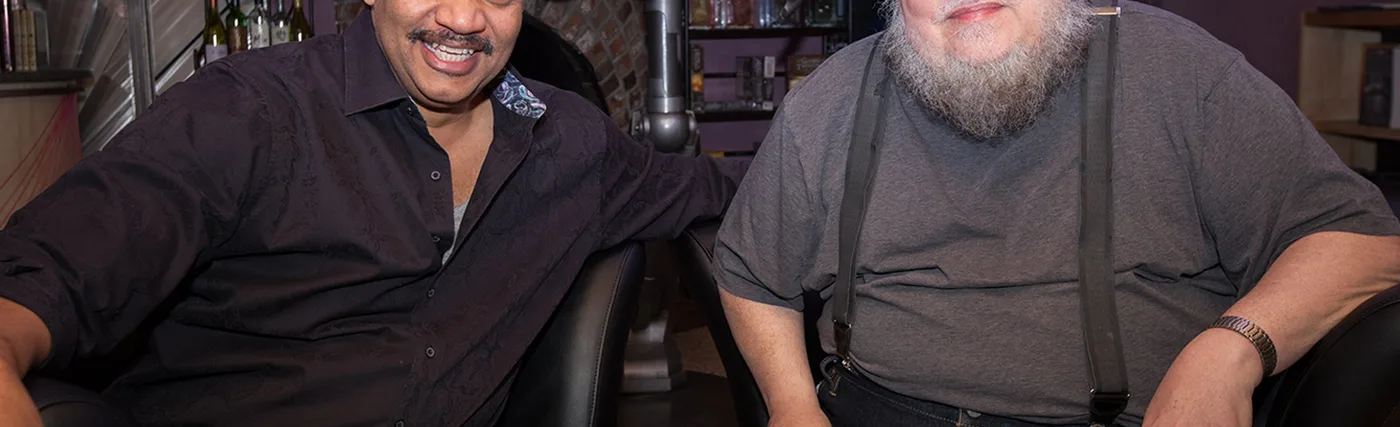
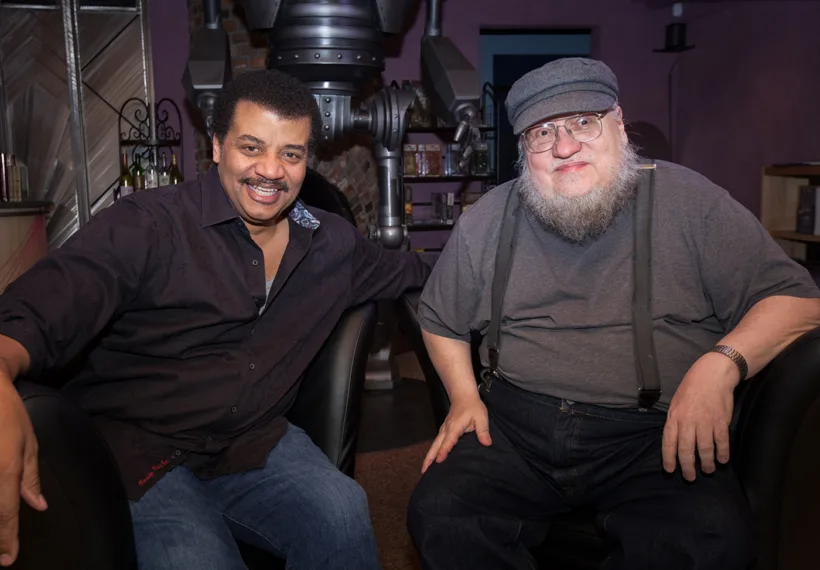
From the American Museum of Natural History in New York City, and beaming out across all of space and time. Welcome to the Hall of the Universe. I'm your host, Neil deGrasse Tyson, your personal astrophysicist. And tonight, we explore...
From the American Museum of Natural History in New York City, and beaming out across all of space and time.
Welcome to the Hall of the Universe.
I'm your host, Neil deGrasse Tyson, your personal astrophysicist.
And tonight, we explore the science and history behind the epic fantasy series Game of Thrones, featuring my interview with the author himself, George R.
R.
Martin.
So, let's do this.
Yes.
So, my co-host tonight, comedian Matt Kirshen.
One of the comedy writers on the Jim Jefferies show, and you're also the host of the podcast Probably Science.
You go for the definitely, we keep the probably in there.
Yeah, I said I'll come back on the show when it becomes definitely science, rather than probably science.
I'll take it.
Also joining us, we need somebody with an expertise in this, is medieval expert Racha Kirakosian.
Racha, welcome.
You're a professor of German and the study of religion at Harvard University.
Thanks for coming down from Cambridge.
To New York.
And you teach a class called The Real Game of Thrones, Culture, Society and Religion in the Middle Ages.
You just set in the record straight.
Yeah, that's correct.
In there, do you say there are no dragons?
I'm guessing.
I'm going to be honest, this is the first time I've realized that Game of Thrones isn't real.
Well, we'll be tapping your expertise tonight as we feature my interview with the creator of a pop culture empire.
His sci-fi fantasy author George R.
R.
Martin.
And he wrote the best-selling fantasy series, A Song of Ice and Fire.
And that was adapted into the world's most popular TV drama, Game of Thrones.
And characters in this story, they fight for an iron throne with swords and shields.
But also with dragons and zombies.
So I asked George R.
Martin about blending fantasy with the real world.
So let's check that out.
Game of Thrones is largely based on medieval history, so, but it is a fantasy.
My technique on a lot of it was to, you know, to find some real element of history, some real event or castle or something, and then to turn it up to 11 or 12 or 13 or 14.
You know, like the ice wall, the wall of the north, was inspired many years ago when I visited Hadrian's Wall, and I stood on Hadrian's Wall as the sun was going down, and most of the tourists had left during the day.
I pretty well had it to myself, and the wind was blowing, and I was trying to imagine what it would be like to be a Roman legionary stationaire, and looking at these hills so north and wondering what might emerge from them to attack the wall, because they kind of thought of it as the end of the world, or at least that was the myth.
But of course, then I turned it up to 11 and 12, and instead of 10 feet tall, I made it 700 feet tall, and I made it full of ice, and, you know, five times as long as Hadrian's Wall is, you know, because it's spanning a much larger continent.
And that's the same technique you do for a lot of fantasy stuff.
You always want the fantasy to be bigger and bolder and more colorful than the real life.
That being said, I also, and maybe this is my, again, my penchant toward a certain amount of realism, that I didn't want to go all the way into high magic.
Game of Thrones compared to other fantasies is a very low magic fantasy.
Magic is there.
It's present, and we have magical beasts like the dragons.
And there's certain sorts of magical things going on, but it's not high magic.
In a certain sense, I took my inspiration from JR Tolkien.
If you actually look at Lord of the Rings, as suffused as it is with magic, there's very little onstage magic.
You know, Gandalf is a wizard, but when orcs attack, he draws his sword and he fights just like the people next to him.
He doesn't just go and then disappear.
That's the end of the movie.
So, you know, that's the kind of stuff I did with it.
A wildfire, which is another of the quasi-magical things, plays an especially big part in the Battle of the Black Water, was partly inspired by the legends of Greek fire that the Byzantines used, which supposedly we've never been able to duplicate.
The Byzantines kept it a secret.
They used this Greek fire on attacking fleets from other nations, and somehow the secret was lost, and now we don't know what was in Greek fire.
You have resurrected this...
Yeah, it's a little bit Greek fire, it's a little bit napalm, it's a little bit nitroglycerin.
It has the coolest characteristics, and it's jade green.
It burns with green flames.
Why?
Because I thought that would be cool.
And indeed, when we saw it in film, it was really cool.
There are chemicals that will emit only green light, so you can just say that's in the mixture, and you're good for my tweets.
So Racha, George says Game of Thrones is based on medieval history.
Could you just straighten this out?
Is it the Middle Ages, the Dark Ages?
What is medieval history?
Just set that record straight for all of us.
Once and forever.
Once and forever, yes.
So the first issue that we have to bear in mind, really, is that the term Middle Ages is mostly, not only, but mostly connected to European history.
So that's the first thing to bear in mind.
So other parts of the world could have different periods that you might call Middle Ages.
Exactly.
They divide it into different periods.
So then when it comes to Dark Ages, the scholar of the Middle Ages will scarcely refer to any period of time as Dark Ages because no period was actually dark.
So usually Dark Ages is used...
For me, where there was no science, it is dark.
But there have always been a science.
What kind of science?
Yeah, exactly.
Because the thing is, with Dark Ages, usually it's used to denote a non-Roman world before the ascent of Christianity.
And when you take that definition, you see how erroneous it actually is.
Because there have always been high civilizations, also in the early Middle Ages.
Let's think about Muslim Spain.
Right, of course.
The Mongolian Empire.
So that's the other thing.
And then when it comes to when have the Middle Ages actually begun, when have they ended, minds differ on that.
Usually we say the fall of Rome.
And then when it ended, maybe when Columbus stumbled upon America.
Or did they actually ever end?
That's the other question.
Have the Middle Ages ever ended?
Because societies, you see, don't shift unitedly.
And the Middle Ages end for different parts of the populations at different times when we take women's rights, children's rights, equality before the law, regardless of ethnicity or belief.
We realize that the Middle Ages have lasted far into the 20th century, also in Europe.
I thought there was going to be a simple answer.
1624.
No, you're like, oh, actually, no, we are still in the Dark Ages a lot.
So, Matt, would you go back to the Medieval Times?
I mean, I don't know.
I think...
I don't think either of us would fare well.
I mean, sort of a black man asking a Jewish guy how...
Yeah, let's go back to Medieval Times and see how that works out.
But here's the other thing.
Here's the other problem you'd have back in the day.
If you went to Medieval Times, there's no Twitter.
I can so live without Twitter.
Could you?
Because we investigated, we actually found out, this is what we think your Twitter account would look like back in Medieval days.
It's actually Medieval, not Medieval.
Lord Tyson of the stars.
He, he, he, before every tweet.
He, he, he, if you took a bath every now and again, lots of you would stop dying from the plague.
Oh, very good.
Yeah, I would tweet that.
Maybe, yeah.
So Game of Thrones is all about like a ruthless battle for the Iron Throne.
And my buddy Bill Nye recently claimed that throne himself and sent us a StarTalk dispatch.
Let's check it out.
Iron weapons, swords especially, have changed the course of human history, both here in the real world where you and I live and on the Game of Thrones.
And if you want an iron sword, first you need iron.
And you get that from a mine or a peat bog.
And before there was dynamite, that was not easy, believe me.
But blacksmiths then take the iron and cook in a tiny bit of carbon.
And blacksmiths do that so that they get a very hard sharp edge backed by a relatively flexible broad part.
And once you have that nice sharp edge with the flexible back, you can just start slinging and swinging your sword around till you eviscerate or decapitate everyone you meet till you either give up or die.
Or both.
After you do that, this baby's all yours.
Well, back to you, Neil.
Or Sir Neil.
So, Matt, would you sit on the throne?
I don't know.
I've just seen it already go to Bill's head.
Well, up next, we will discuss the science of fire-breathing dragons when StarTalk returns.
This is StarTalk.
Welcome back to StarTalk from the American Museum of Natural History.
We're talking about the real science and history behind the hit HBO series Game of Thrones, featuring my interview with author George R.
R.
Martin.
Check it out.
When I watch Game of Thrones, maybe I pay attention to different things than other people do.
I'm looking at the anatomy of the dragon.
Is this legit?
I think I tweeted once, I complimented the dragon.
Yes, I like that tweet.
You like that tweet, good.
So I just wanted everyone to know that whatever other fantasy you're observing, the dragon has biological skeletal authenticity.
Because anything that flies in this world had to forfeit its forelimbs to do so.
Right.
You get A+.
Good.
I mean, this is a real dispute in dragon things.
So I've always been insistent on the two-legged dragon.
But there are the four-legged dragon things.
And in heraldry, of course, I've learned with writing these books a fair amount about middle heraldry.
The two-legged dragon is not a dragon, it's a wyvern.
And only the four-legged dragon on a heraldic shield is counted as a dragon.
So I have the heraldic purists on my ass.
I lived my whole life and I did not know this.
Yeah.
We got to bring in a new guest to get to the bottom of this stuff.
So joining us now for a discussion on dragons is paleontologist Mark Norrell.
You're division chair and Macaulay Curator of Paleontology right here at the American Museum of Natural History.
You once curated an exhibit on mythic creatures, and I've got the exhibit companion book here, Mythic Creatures, and you're a co-author on this.
Yes.
And so what's the connection between paleontology and dragons?
Well, I think it could be one of many things.
I mean, it's like that certainly that, that, you know, dragons are giant reptiles of some kind or universal amongst all cultures.
But at the same time, I mean, dragons mean really different things, depending on what culture you're from.
And that, you know, in the West, it's always like, you know, awful stuff like there are guardians of virginity and tombs and gold and all these kinds of things.
Those saints had to slay them.
But in the East, you know, the dragons are something which is really great.
That's why everyone wants their kid to be born in a dragon here, in China and Japan, Thailand, everywhere else.
But what does that have to do with fossil evidence of dinosaurs?
Well, certainly people in the past, like, knew much more about the anatomy of, like, animals than people do now.
We go to the butcher shop, we buy stuff, it's pre-packaged and stuff, where foods have to slay their animals.
So when they'd find, like, fossil bones that in the old days, they would, like, you know, see that, yeah, this is really unlike the sheep we just killed for dinner last night.
So there would be this kind of, like, legacy kind of stuff, thematics that they make up stories to explain what was going on.
Because presumably that's how you're making connections.
Yeah, but certainly we know that a little bit from Europe, because, like, in Crete and other places that there was, like, miniature elephants that were found and that nobody had ever seen an elephant skull before, if, you know, all you guys out there had never seen an elephant skull before, that you saw one.
And it has a big hole in the middle of it, which is where the trunk attaches and stuff.
So there's actually Greek vases that show these and say, this is the head of the Cyclops.
Oh.
So, I mean, like, whether the myth of Cyclops existed before that or that happened because of these finds, nobody really knows.
But, you know, we know that people in antiquity looked at fossils and they were able to make some stories about them.
So, Racha, George Martin mentioned heraldic purists who used dragons on their coat of arms.
What can you tell us about that?
Heraldry is, for example, coat of arms is part of heraldry.
It starts as a visual literacy.
So you imagine you're in a battle and everyone looks a bit the same, all kind of male clad in male clad armor.
How do you distinguish foe from friend?
You need some sort of a sign and that sign needs to be actually simple, right?
So you can actually catch it immediately.
So that was the initial idea of heraldry.
Then in tournaments, which are not about life and death, they became more intricate because it was not so much about actually recognizing who's in your unit and who's not.
Dragons have different...
Dragons in heraldry have different background stories and Mark already explained some of them.
And certainly, in English coat of arms, the dragon also comes into it because of the legends that surround St.
George, the patron saint of England, who's said to have slaughtered a dragon.
So he went out with a white coat of arms, so he didn't have a specific sign, and killed a dragon that was just pissing everyone off.
Or so he said.
That is my patron saint.
And if he said he killed a dragon, he killed a dragon.
And so what happened?
The dragon's blood splashed a cross on his shield, and that red cross is, of course, the flag of England.
I should have known that, and I didn't, so thank you.
Whoa.
So I think the scariest dragon on Game of Thrones, it's got to be the zombie ice dragon.
Yeah.
Just look at this thing.
And so I asked George R.
R.
Martin about the origin of the idea of the ice dragon.
Let's check it out.
I wrote a book long before Game of Thrones.
The one children's book I've written, the ice dragon, which is a dragon that breathes cold instead of fire and freezes things.
The cold is just equally deadly.
It comes over you and you're frozen and then you splinter into a million pieces because you've been dropped into liquid oxygen or something like that.
So I think the ice dragon was my original contribution to the fantasy bestiary.
So they make a zoo of fantasy creatures and it'll be in there.
In the books, I do have the dragons are various different colors.
And the color of their flames varies with the color of the dragon.
So, you know, Balerion, the black dread, probably the biggest and meanest dragon in the history of Westeros is black and his flames are black and they're really, really hot.
They, you know, at one point, there's a lord who says, well, I don't care, you know, you have a dragon, but I have a stone castle and stone doesn't burn.
And well, stone will melt if the flames are hot enough.
Called lava.
Yeah, and that's what he discovers.
Exactly.
If your castle melts, give up.
So, Mark, what other fossils have sort of contributed to this bestiary of fantasy creatures?
Well, there's a really famous fossil called Protoceratops, and it has a remarkable resemblance to griffins.
Just remind me, a griffin is a lion with wings.
Yeah.
Right, okay.
It's like mermaids, and it's like dragons.
Every culture, it seems to be a universal, every culture has invented these things independently.
You know, what was the spark of that?
We really don't know.
But certainly, because it has very different meanings, I think we can say that it's independent origin.
Interesting.
Well, that's our segment on dragons.
Mark, thanks for joining us tonight.
Hey, thanks, Neil.
Up next, we explore the science of reanimating the dead when StarTalk continues.
Bringing space and science down to earth.
You are listening to StarTalk.
And I asked about the army of undead corpses that he created for Game of Thrones.
Let's check it out.
If I just landed on Earth and I saw them, I'd have to call them zombies.
They were dead and now they're alive.
Well, they're moving.
I don't know that they're alive.
I mean, obviously, when you die, you know, if I die, you know, five minutes from now and, oh, I have a heart attack, I fall, I'm dead on the floor.
My body is still there.
My body is still there and some force can animate it.
In principle.
And bring it up and get it going again.
Send electricity.
I mean, it said, what moves our arms?
It's electrical impulses from our brain and all of that.
So if the impulses come from somewhere, can our arms move and all that?
It's the Frankenstein thing.
This is what inspired Mary Shelley to write Frankenstein.
Well, she read about the experiments with dead frogs.
If you poked them with electricity, their legs jumped.
So Frankenstein comes from that.
And...
Okay, so they are just reanimated dead people.
Yes, essentially.
We need some extra expertise for this one, Matt.
We need some zombie expertise.
So joining us for the science of the undead is Steven Schlozman.
Steve.
You're a professor of psychiatry at Harvard Medical School?
You wrote The Zombie Autopsies, which is a fictional medical journal of zombies.
Yes.
A matter of fact, the medical school requires me to tell folks it's fictional.
Like I'm actually not making this up.
The dean has mandated that I say that zombies are not real yet, but they're not real.
That sounds like something Dr.
Zombie might say.
That's exactly what we would say.
So George Martin says that some force could, in principle, reanimate his dead body.
So how true a statement is that?
I'm imagining, of course, within a certain amount of time, you can be reanimated, but then we don't call you a zombie.
We can stop your heart.
There was a day when they just said you were dead, and then a minute later bring it back.
Now you're alive again, but you're not a zombie.
So at what point are you just alive again?
And at what point are you a zombie?
So organs all have different viabilities.
And when they stop receiving oxygen through the blood and they start to make their way from aerobic to anaerobic states, many of those organs remain viable for a long time.
That's why we can harvest organs, which is not a term we use so much anymore, but use them for transplants, including the brain.
Right now we're not there, obviously, but we can do things.
We can use brain signals to move cursors on a screen.
We can use brain signals to move automated limbs, even though they're not connected to the brain.
It's like a Bluetooth moving an arm.
That's pretty amazing.
What is the mechanism?
So you have the somatosensory cortex, which is still working, but these are spinal cord injuries, right?
So as much as the motor cortex, region of the brain, wants the left arm to move, it can't get the signal there because the spinal cord's been severed, but it can send an electrical signal, literally a Bluetooth signal, to the muscle here, cause that muscle, through electrical impulses, just like Mr.
Martin was saying, to move.
So it's an electromagnetic signal that's sent over there.
So, I'm curious, aside from using electricity or magic, is there some disease that can produce a zombie outbreak, like the kind we see in the movies?
We don't have anything that exactly mimics the sort of zombie infection that George Romero so famously invented in 1968 with Night of the Living Dead.
We just don't have that.
But we can have aspects of it.
We can make people lose their balance, we can do that with booze, right?
But we can also do it with germs.
We can make people full of rage with bugs like rabies.
We can make people lose their capacity to open doors, open windows, to think clearly with things like Creutzfeldt-Jakob's disease.
The hard one is to make you hungry.
That's a hard one.
You think about when you've been sick, like really sick with a fever, you usually lose hunger.
There are some viruses.
Adenovirus, which is just a cold virus, but in some people it messes with the hypothalamus and makes you forget that you've eaten enough and you keep eating.
So there are some infectious agents that actually increase obesity.
So you have a whole catalog of these infectious agents that do different things to different urges of the human body.
Oh, yeah.
Now, can any of them reanimate a dead body?
Nope.
We're not there yet.
Yet.
He said yet.
Yeah.
And he also said we.
I'm just speaking for my community of scholars.
He has an alter ego, right?
Right.
Dr.
Z makes me sound like a rapper or something.
So Racha, are there Game of Thrones type zombies in any medieval literature or cultures or legends?
I'm really glad you say Game of Thrones type zombies because not the zombies we have grown to be accustomed to thanks to fantasy literature and fantasy films.
But actually, when you think of what we just discussed, zombies being basically reanimated matter, that's actually at the core of the Christian belief.
Think about it, resurrection.
And it's the Judeo-Christian belief, the resurrection of the body, the resurrection of the physical matter.
And in this vein...
She said it here first, Jesus was a zombie.
I did not say that.
Basically...
That's actually...
And there will be an army, right?
The heavenly hosts say, we'll be an army of zombies.
No, okay, I didn't say that.
In the same vein, we have legends of martyr saints whose body parts that were cut off or tortured reappear, physically reappear, but that's a marker of their sainthood.
And mostly these body parts do not decay, which is also a marker of their sainthood.
So these are early zombie concepts.
Well, there's another power, mystical power in Game of Thrones, is the ability of some characters to become an animal by taking over their mind.
So let's check it out.
Skinwalking, shapeshifting, you know, there are various words for it in various legends in various cultures.
The Navajo have a version of it here in New Mexico, and of course it existed in Europe in various forms.
But again, how to do this realistically, I think the actual bodily change where, you know, the bones get longer and the mass gets heavier and the whole body rearranges, well, it's cool for horror story and I've used it that, but it didn't seem to fit in Game of Thrones.
So I thought, well, the skin changer would be someone who actually moves his consciousness into another thing.
Not that his body actually changed, but he got his mind into an eagle or a wolf or had some bond with them.
Can I tell you how brilliant that is?
Because it took us a while to learn and to embrace, but that objects that have physical existence, that's one thing, but the concept of information doesn't have the same constraints of a physical object.
Plus it's valued differently, right?
So I can give you two oranges and you have two oranges.
But if I give you two newspapers, you don't have twice as much information.
No.
It's the same information, but duplicated.
So, and we've also found that...
Unless one of them is to Times and one of them is to Harold.
That's something that you have a completely different version.
Completely different version.
So for you to transfer a consciousness, in a way you're transferring information that is completely plausible relative to bones growing, like the Hulk becoming the Hulk.
Well, where did that extra mass come from?
You have issues.
I mean, in some ways, the ability to transfer your memories, transfer your consciousness into something else is the possibility of immortality.
If your memories survive, then you survive, your personality, whether it's in a robot body or a clone body that we grow.
I mean, science fiction has done many different ways.
If you assume, of course, that that's really you, that's always been my issue with the Star Trek Transporter.
Okay, they disintegrate your body, and at the end, they put together a new body from random atoms that they get, and it has your memory, and it thinks it's you, but is it really you?
Steve, if you transfer your consciousness, is it still you?
If you transfer your consciousness, is it still you?
No, no, actually, because the you has changed from the time that you did the transfer to the time it's received, right?
But if it's your consciousness, who else's consciousness is it?
So it's a different consciousness that's a different you.
So consciousness, technically, folks, it has to have three things.
It has to be qualitative, so it's not measurable.
It's the concept of being like something.
It's subjective, so the subject experiences it, and it's unified.
Like, I'm not thinking about the feeling of my butt in this chair, except that I just said it.
So now I'm thinking about the feeling of my butt in this chair.
All those things have to come together, combine with my memories and my thought of what's going forward.
You take my consciousness out and put it into you.
Now I'm thinking of what your butt is like in that chair.
I don't mean that in any sort of untoward way.
That's what I'm thinking about.
So suddenly that's a new consciousness.
That's what's so interesting about the concept that he created in the story.
So it's not just a consciousness that had extra stuff that happened to it, extra life experience.
You're saying it's a whole new consciousness.
Yeah.
Yeah.
So I'm curious, Racha, is there a, in medieval history, is there any accommodation for the transference of mind in religion, for example?
Sort of.
Especially in religion, actually.
There are mystical traditions according to which a soul can be so connected to the divine that it can get the qualities of the divine, including looking into the future, looking into the past, looking into the present time, but seeing other spaces that the actual physical body is in.
Now, telepathy, telekinesis were not categories that medieval people operated on, but they rather talked of visions and prophecies.
Yes, of course.
It's full of references, such references.
Yeah, absolutely.
Okay, so here's the question then, Steve.
What's more likely to happen first, reanimated dead bodies as zombies or transference of consciousness?
Honestly, I think transference of consciousness.
Because as we get better at mapping the way the brain works, we can then translate that into the ones and zeros that we make things like our smartphones possible.
And then if anyone's watched Black Mirror, any of these shows, they'll just watch Game of Thrones.
We know that we can start to then create a cookie of ourselves in ways that are both horrifying but also kind of invigorating when you think about it because then you can start to think about horrifying and invigorating in the same sentence.
I'm pretty sure that's the motto of his lab where they're doing these experiments.
I didn't say we.
Right, right.
Yeah, so I actually think we'll be there.
I think in some ways we're there-ish.
Okay, when you get there, can you come back on the show?
I would be honored.
Well, Dr.
Zombie, thank you for joining us tonight on StarTalk.
Up next, we discover fantasy author George R.
R.
Martin's early sci-fi inspirations when StarTalk returns.
This is StarTalk.
We're featuring my interview with best-selling science fiction and fantasy author George R.
Martin.
And I ask where his passion for science fiction writing began.
Check it out.
The biggest influence for was comic books.
Superman and Batman and all the other comic books of the day, the kiddie books, and of course the superheroes most of all.
It was before Marvel initially, but I read those DC superheroes books, and that was much more interesting.
You know, fighting the Joker or the Riddler or Lex Luthor, other planets, Krypton blowing up.
I mean, there's my introduction to astronomy.
You got to watch out, you know, if your planet's going to blow up, you put the kid in this little space chute and you shoot them off at the outer space and hope that someone finds them.
So we didn't have to term astronaut.
They invented that term with the Mercury 7.
Nobody had ever heard of astronauts before the Mercury program.
They were spacemen, you know, and there were a lot of shows on TV about a spaceman, you know, Tom Corbett, Space Cadet, Captain Video, Rocky Jones, Space Ranger, you know, and I watched all of these shows.
I did an encyclopedia of space here where I combined my fictional creations here with real creations.
I designed my own solar systems and then I had the real solar system.
So these are from the 1950s?
Yes.
See, here's the real solar system.
Okay.
I did a map.
Sun, Mercury, Venus, Earth, Mars, Jupiter.
And here, remember this one?
Pluto.
Let's not go there.
No, we're not going there.
And then I invented fictional solar systems.
Here's Alpha Centuries fictional solar system where I invented weird ass names for the planets.
Cosmo, which I obviously got from Oz.
Throg, I don't know where I got that.
And then I had little entries here where you can read all about them.
These are the real things that I looked up here.
Here's some more.
Here I graduated to color.
Color them in.
So it looks like your imagination had higher precision than your ability to color in a circle.
George, this goes on and on.
These are continents and oceans and...
So, yeah.
Oh, here's the history of Throg and...
Yeah, here's Flakelar, Soria.
These are great names.
And how old are you in this?
You're in elementary school, I guess.
Yes, definitely elementary school.
I take it back.
You were not a normal kid.
Okay, probably not.
Joining us to discuss George R.
R.
Martin's geeky origins is StarTalk's resident geek-in-chief, astrophysicist Charles Lewis.
You're a professor at CUNY Staten Island?
And you're a good friend and colleague of mine.
So what do you think of his space encyclopedia?
I think he's a perfectly normal kid.
I had one, too.
Mine was more about spaceships.
So you kept a notebook like that?
Yeah.
Well, it was actually a file folder.
It was like I held one to lose paper in it.
I wasn't as sophisticated as he was.
And so what were your pages?
Oh, they were mostly about spacecraft.
I was inspired by the 1970s movie Battlestar Galactica.
And what I would draw was like, well, this ship could go this fast and had this much firepower and could contain this many people.
That sort of thing.
So he's perfectly normal, I promise.
I mean, if I'm perfectly normal...
If he matches you, he's normal.
Is this the measure of things?
So Charles, in Game of Thrones, the winter and summer seasons can last for decades.
Yes.
So I tried to imagine a planetary system that could be that.
And I just gave up and I said, let me just enjoy the show.
Here's the trick about that season stuff.
And I've thought about this.
See, the seasons, not only are they long, they're also unpredictable.
Sometimes they can be only a few years, other times they can be lifetimes long.
This would be a chaotic orbit.
Right.
So if you talked only about astronomical orbits, you could imagine a strong precessional tilt.
You could imagine multiple planets doing some sort of chaotic activity.
But really, there's got to be something else that's changing the time scales on like a decade-like level as opposed to the centuries and millennia.
Global warming.
They're volcanic activity or other kinds of particulates that perhaps the solar system is moving through in its host galaxy.
So it would not be an orbital phenomenon.
It would be a local phenomenon to the climate.
Yes.
You have to add in something in the atmosphere and in the oceans surrounding Westeros in order to create these kinds of unusual climate situations.
Well, I asked him how his early interest in science helped him shape his writing career because one can influence the other.
So let's check it out.
I've never been a hard science writer.
Like I said, science was hard.
But maybe because I grew up reading and writing science fiction, there's always been something about me that applies a certain level of realism to whatever I do.
One of my books before Ice and Fire was Fever Dream, which was my historical horror novel set on the Mississippi in 1857 about vampires.
And I did a lot of research for that and I'm reading all this stuff about vampires.
And then I said, well, OK, how am I going to do my vampires?
You know, I looked at all the vampire legends and I went through them.
OK, they can't come out in sunlight.
I can make that work.
You know, they're very photosensitive, their skin burns or something like that.
They're not reflected in mirrors.
No, I can't make that work.
I mean, that's just ludicrous.
Why are they not reflected in mirrors?
It violates everything we know about light and all that.
So I rationalized my vampires as much as I could possibly rationalize them and made them, if not quite science fictional vampires, certainly more realistic vampires than those in many other works.
And when I came to dragons, this is the same thing.
I looked at these dragons and, yeah, I can't claim to be scientifically rigorous.
They still breathe fire.
I mean, there's no way you can get around the breathing of fire.
Allow me to put you at ease.
I'm a big fan of, for me, a famous quote from Mark Twain, which every artist needs to take to heart.
And you clearly have.
It is, first get your facts straight, then distort them at your leisure.
Exactly.
So you have your basic anatomical dragon, have him breathe fire.
We're good with that.
There's certain things you need.
You need the dragon has to breathe fire, the vampire has to drink blood, you know.
Right.
The other stuff you can fiddle with as need be.
So, Charles, as scientists, can we get so embedded in reality that it would prevent us from writing a good sci-fi story?
We could, but good scientists avoid that.
Albert Einstein said it really well in 1932.
He said that the feeling of being awed by the mysterious things of the universe, das gefühlte Geheimnis vollen, is the same...
The house is German, is it okay?
Yeah, it's impeccable.
Das gefühlte Geheimnis vollen is the thing that powers all great art and science.
Jeffrey Landis, PhD in space science, great science fiction writer.
David Brin, PhD, also great science fiction writer.
And who can forget Isaac Asimov, one of the greatest science fiction writers all time, PhD scientist.
PhD in biochemistry, it was.
So not at all should there be any siloing between people who do science and people who don't, because that same origin of energy is where we get all of our ideas and imagination and the moving forward for discovery.
It's the same for fantasy authors, when you think about it.
Really fantasy became a genre with Tolkien.
And he was a medievalist.
And he was an academic medievalist.
He was an academic medievalist.
And the same was CS.
Lewis, who wrote The Chronicles of Narnia.
And they were actually friends.
Both of them were professors for medieval English.
Wow.
Okay, so when's your story coming out?
Well, watch for that.
Charles, thanks for joining us tonight.
My pleasure.
You're our geek in chief.
Up next, we discuss the portrayal of violence in the hit series Game of Thrones when StarTalk returns.
Unlocking the secrets of your world and everything orbiting around it.
From the American Museum of Natural History, right here in New York City.
You're featuring my interview with author George R.
R.
Martin.
And I asked about the portrayal of violence in his hit series, Game of Thrones.
Had to go there.
Check it out.
Game of Thrones, the TV show, Chris, is adapted from my books, so these elements were there in my books to begin with.
At that extreme?
Yes and no.
In some ways, more extreme, in other ways, less.
I mean, there's something about seeing something that makes it more visceral than just reading about it.
But obviously, I wanted to include sexuality.
I mean, it's one of the usual, one of the driving forces of all of us.
It governs our decision-making, it has shaped history.
And violence was, you know, it's a war story.
And a lot of fantasy, the great epic fantasies are war stories.
Tolkien's is a war story.
Yeah, you're right.
All of these are war stories.
That was a stupid question.
It seems to me that if you're writing a war story...
The word violence should have come out.
You're absolutely right.
All the great epics, somebody's fighting somebody and somebody's dying.
Whole tribes are at war.
That's there.
But no, I don't object to the word violence at all.
I think it's a good, honest word.
Working on that show gave me a real, really brought home to me this hypocrisy about action versus violence, you know?
We want to show people killing each other, gunfights, you know?
We have no objection to scenes where people are shooting a gun repeatedly and someone is hit and they fall down and they're dead.
But we don't want to show what a bullet actually does to a human body when it hits you.
You know, we like a little hole to appear in the chest or something, or at least element of our people do.
And to my mind, the more I reflected on that, the more I became convinced that on some level, it's actually immoral here.
If we're going to show, if you want to do a show that has no violence, I'm all in favor of that.
But if you want to show guns or swords and people killing each other with guns or swords, show what guns and swords actually do to human beings.
You know, show what war is actually like if you're going to do a war story, you know, and show the horrors of war as well as the glories of war.
And that's what I tried to do in writing, you know, Game of Thrones.
Racha, I think we have the stereotype of violence in medieval times.
How authentic is that?
Yeah, I'm glad you say stereotype.
Of course there were feuds, of course there was war, and of course it was also brutal when there was war.
But also in the Middle Ages, the preference was that one would find a diplomatic solution.
Because when you think about it, no one wants to have a heap of corpses to clean up afterwards, right?
So is it just that these violent stories are the ones that survive more, because they're more exciting than the story of just, ah, we reached an agreement and signed a treaty?
I think that's again, more refashioning of the Middle Ages.
Killing, you know, was not an honorable thing to do.
So how much worse was it for women?
Were women bought and sold and traded?
That's the one thing, of course, in the event of war, women and children were in the danger of being abducted.
Absolutely.
But of course, we have powerful women in the Middle Ages.
That's not...
To me, that was not an of course.
I mean, the earliest powerful woman I know of is Queen Elizabeth I.
Before that, I don't know many...
What history am I missing?
Yeah, a lot.
That's what I'm guessing.
So, one figure that I find very interesting is Ellen of Aquitaine.
She was Duchess of Aquitaine, but in her own right, which means she was actually reigning Aquitaine, her first husband was the King of France, her second was the King of England, but she also led armies strategically.
She didn't fight on the battleground, but she led armies strategically, among others in the Second Crusade.
We have Joan of Arc, the woman warrior.
We've got Hildegard of Bingen.
A visionary in Germany who sets out to found her own monastery.
So there are enough of those cases where you can draw from them and still make plausible portrayals of women in Game of Thrones.
I don't think Game of Thrones needs to be historically accurate because it's so a fantasy world.
No, no, I agree.
It just can be historically inspired.
Yeah, absolutely.
For sure.
For sure.
New Mexico.
I asked about infusing his passion for outer space into stories such as Game of Thrones.
So let's check it out.
These concepts are so vast that I don't know how you write stories about them with a meaningful human interaction, dealing with quasars and pulsars and dark matter.
They're amazing concepts, but so difficult to come to grips when you're writing a story about human beings.
But there are elements that, to me, are astronomical.
There's this long winter that's coming, and then when it comes, it's there for a long time.
There's this huge sort of ice wall.
I think of glaciers when I think of this.
There are tap roots that allow me to grasp some greater reality in which that world is embedded.
Well, a lot of that, of course, is based on magic, because it is a fantasy.
And I gave a lot of thought...
Magic is just science you haven't discovered yet.
Or that Arthur C.
Clarke.
Any sufficiently advanced technology is indistinguishable from magic.
So the blade...
I look at that and I say, okay, that's magic, but they've figured something out and they can do that.
Why is it any different from me flicking a lighter?
If I flick a lighter in front of cavemen, they freak out.
They would write a story about me with the lighter.
They're storytellers.
They would improve it, though.
It wouldn't just be a lighter.
It would be he could make fireballs glow from his hands.
Right, right, right.
But there's more going on in there.
There's other languages.
There is...
It's world building.
You have to create an entire world.
And you can see if you are engaged in world building, you have to try to get everything right and you're not going to succeed.
You know, because I am not the font of all human knowledge.
As much as I may research and learn things, you know.
Plus they may pay more closer attention to what you wrote than you did.
So, yeah, yeah.
So you will get letters.
You know, I tried to be very accurate, for example, with horses.
A lot of fantasy fans get horses all wrong.
Or fantasy writers.
They just make them, you know, these tireless beasts that can go anywhere and, you know, gallop for seven days straight or whatever, and etc.
So I tried to get the horses right.
But there are always things you don't.
You know, I tried to research the ships to get the ships right, how the weapons work, etc.
You didn't give the horses wings on their backs?
Like Pegasus?
I didn't, no.
Good, good.
So, no, this...
I have an interesting take on unicorns coming up, but in a new book.
Oops.
When I think of these sort of fantasy stories, in almost all of them, and especially in Game of Thrones, there's the portrayal of some creature.
In this case, it's dragons.
It's a creature that is not real, and we know it's not real as a consumer of the story.
But the advantage of it not being real is that you don't really understand it.
You have no experience with it.
There's no scientific analysis of it.
There's a mystery to it.
And where there's mystery for something that is large, bigger than you, with teeth and flames, there's fear.
It's a metaphor for the sum of all of our fears wrapped into this entity.
That might make you behave right.
That might make you think differently about the things that promote life, rather than take life away.
So for me, a dragon is a force that acts on your behavior to be good, to do something right in the world.
So in a way, we need that force.
It's a force of evil outside of our bodies and a force of good within us.
And that is a cosmic perspective.
I've been your host, Neil deGrasse Tyson.
And as always, I bid you to keep looking up.
See the full transcript



 Unlock with Patreon





 Become a Patron