



 Unlock with Patreon
About This Episode
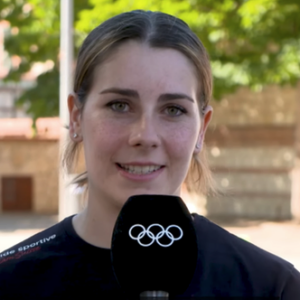
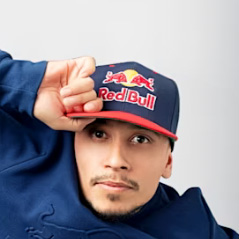
What are the physics present at the Olympics? Neil deGrasse Tyson and co-hosts Chuck Nice and Gary O’Reilly with the help of Charles Liu, explore the science in some of the newest additions to the Games with pro-breakdancer RoxRite and freestyle BMX rider Nikita Ducarroz.
What is the physics of breakdancing? We break down some of the most popular moves on the breakdance floor and what makes it so difficult. How does the scoring system work for breakdance? How do you turn a style of dance into an official sport? Learn about the history of breakdancing and how it is making its Olympic debut on the Paris stage.
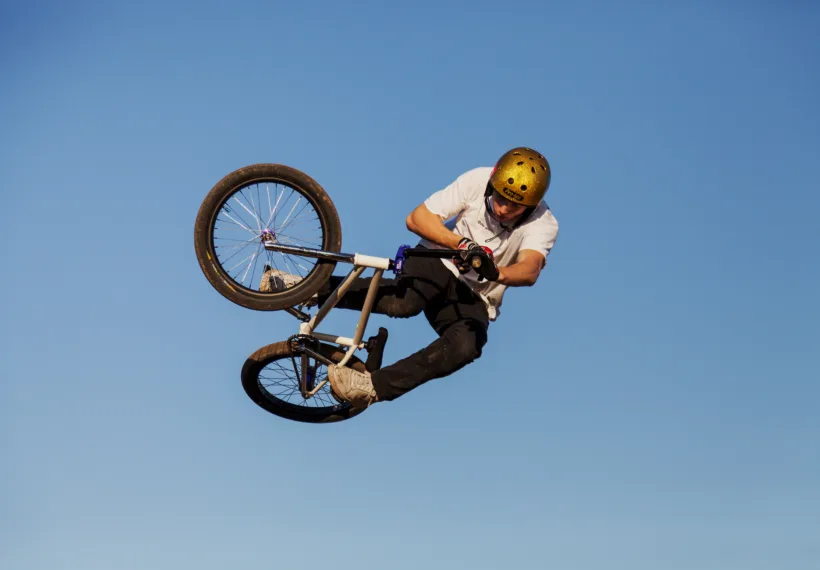
What differentiates motocross from freestyle BMX? We drop into some of the crazy moves BMX riders are doing and how the bike, the ramp, and their momentum influence their tricks. Learn what makes for a good freestyling course and the trajectory of the sport in its second Olympics.
Charles Liu joins us to break down the physics we heard from Rox and Nikita, drawing parallels between the two sports. We explore how generating torque allows the athletes to complete their moves, the forces at play, and The Tennis Racket Theorem. We discuss how these spinning moves operate on the same physics as our space telescopes in orbit. Can Charles break Neil out of his conviction that the only Olympic sports should be ones you’d see on a Grecian urn?
Thanks to our Patrons Amanda_Mensen, F.X. Flinn, Richard Mylyk, Theresa Anoskey, Jessica O, Cayla Slaughter, Tom Cez, Colin Steifel, John Keller, and Chris Brinkley for supporting us this week.
NOTE: StarTalk+ Patrons can listen to this entire episode commercial-free.
Transcript
DOWNLOAD SRTThis is StarTalk Special Edition.
Neil deGrasse Tyson here, your personal astrophysicist.
I got Gary, Gary O’Reilly.
How you doing, man?
I’m good, man.
It’s good to be on again.
Very good.
And Chuck, of course.
Yes.
Chuck Nice, calling in from wherever in the universe you might be this moment.
In my skin, in my skin.
Where I wasn’t, I was not in my skin.
You were not in your skin.
I’m not even aware.
A while ago.
No, I’m not.
That’s another conversation.
That’s a new episode.
So, Gary, you’re a resident athlete and a resident professional athlete.
I was never paid to be an athlete.
So, what did you tee up today?
Well, we got an Olympics coming up fast and it made us think.
But because it’s us, we have to think slightly differently.
StarTalk, we badass when we do stuff.
Today, we’re going to get into two sports.
One’s making its debut in the Olympics in Paris.
The other one made its debut in 2021 in Tokyo, the delayed Olympics.
One is considered to be an art form and a lifestyle.
The other one rolls around on wheels.
So, if you haven’t guessed it already, this is going to be breaking and BMX.
We’re breaking.
Is that what I remember as break dancing?
Is that what you’re saying?
Yes, but dancing has in time disappeared.
Once we’ve spoken to these two athletes, we’re going to stick it in a physics splendor that we’d like to call the geek in chief, Charles Liu himself.
And then from that, we will explore exactly what’s going on in these two sports.
I’d love with a geek in chief, my wingman, or when he’s on the show, I’m his wingman.
That’s how that goes.
Whichever way you want to play it.
Welcome to StarTalk, your place in the universe where science and pop culture collide.
StarTalk begins right now.
We got in the house, Roxrite.
R-O-X-R-I-T-E.
Roxrite, a breakdance legend.
Thank you guys.
Thank you for having me.
It’s a pleasure to be here.
You have a hundred victories.
So these are like full up contest with like trophies and things.
Is this how that works today?
Basically, a tournament of 16, around 16.
So you go through the whole tournament and that’s what I count as the victory of the full tournament.
Each battle by itself.
Oh, that’s all the whole tournament victories.
Damn, you’re like, there can be only one and it’s me.
Yeah, I don’t take a victory lap for one battle.
I got to take the whole thing.
So Rox, can I call you Rox?
Is that it?
We’re on a first-name basis.
Rox, I mean, I’m old enough to remember when this stuff landed, right?
Back in the late 70s, mid 70s, if you’re really deep in there, what is breakdancing’s connection back to hip hop?
Well, I mean, the connection to hip hop is the first hip hop dance.
So when hip hop was put together as a cultural, like it’s the culture, and they had the elements of hip hop from DJing, MCs, straight art, and then the dance was breaking.
So from the very beginning, breakdancers were there at the parties, and that’s where it was discovered.
And from there on, it reached different people, and they started developing it, and getting it to grow more and more throughout the world.
That’s how you know it’s a real cultural phenomenon, because it touches so many people.
So what triggered your interest?
And you’re based in Los Angeles, right?
Yeah, yeah, I’m based in Los Angeles, but I started actually dancing in a small town, north of San Francisco, in 1995.
I just saw a bunch of kids doing it at my school.
And I just thought it was the coolest thing I ever saw.
And the way that they would spin, it just caught my attention.
And right away, I just started trying it, went to a friend’s house, started breaking on carpet first.
On carpet first.
First on carpet.
Small move.
Yeah, that’s the way you ease your way into it.
Okay, so you’re starting to do this thing in the 90s.
Did you ever imagine breaking would become an Olympic sport?
To be honest, I never thought I would see it in my lifetime.
Because when I started, I mean, in 95, there wasn’t so many people doing it.
It had been considered dead for so many years in the States.
That only certain people that knew about it, or in certain communities, they were doing it.
And they kept it alive through just parties and kids that just did it every now and then.
So for me, it was something new.
And when I started at that time, there’d be guys from the 80s that still were active in some way in the community.
And they always talked about breaking being in the Olympics.
They would always mention, it should have been in the Olympics, it should have been in the Olympics.
So for me, in my lifetime, I never thought I would see it.
So when they told me that it was gonna be happening, it just blew my mind.
How do they qualify you for the Olympics?
Like, are there 10 sets of moves that you have to be able to do that they judge?
Or is it like X Games where you put together a routine and then they just, the people who know, you know, the kind of like verbiage of the, or the language of the movements, they just say, oh, okay, this is, you know, this is how great that was, or how do they judge you?
Right, and plus, some of the history of that was, as I understand it from my nephew, who studies this professionally, that some of the breakdancing was an art form as a substitute for a gang fight.
Yes.
Wow.
Yeah, break battles, yeah.
Was it done so?
Battle breaking, yeah, it’s a real deal.
Right, right.
Same thing with MCs, that’s, you know, instead of fighting, MCs will come together, and basically, lyrically, you would battle, and you would show that your dominance on the mic was a metaphor or a representation for me kicking your ass.
It’s still good if you could kick their ass anyway.
Yeah, if you could have both.
So, let’s pick up from Gary’s question, then.
This ascends to the Olympics, somebody has to make the rules around it, so that the world can participate with the same set of expectations.
So, who set that?
I mean, there’s a system was developed for judging the dance publicly at the Olympics because people from the community were getting together and were creating a format to where you can keep statistics of the rounds that were being scored in tournaments because we wanted to see the results before people would just point and give you their opinion.
Now, we have statistics where they can keep track of what rounds you were voted for or against and then you can have a better idea of your performance round for round.
For the Olympics, this is where they developed a judging system format where they can give you feedback and information as to how you performed, as to what you asked about how does somebody pick a winner.
There’s a lot of different moves.
You don’t have a choreographed routine because most of the time you don’t know what the BJ is going to play.
He’s going to start with the song and you have to adapt in the moment on the go and adjust your moves as you move.
Some dancers that break, we choose to have sets, which means you choreograph beginning to end what you’re going to do.
Or you have people that freestyles movements that they already know how to do, right?
And this is more to the roots of the culture and the dance because it was created as a sporadic form of dance where movements were just done in a sporadic form.
So that is the style that is in many ways, many people are utilizing today.
So then they’ll adapt in the moment with the music or they’ll adapt their whole round based on what they see.
And as you’re performing it, there’s many things that come into play from execution, how well your moves connect, how well you’re taking the opponent out in the battle.
The choreography, yeah.
Yeah, how well you’re battling.
So they took all these things into consideration.
And then from there they score it.
And as well as the tournament goes on and progresses, repeats, crashes, those things take points away if you start to repeat the moves, the exact moves you did already.
If you start to make small errors, those things matter and then that can cost you the battle.
How did they know it was an error?
Maybe you did it on purpose.
Sometimes, you can make an error look like a move, right?
But if you’re not good at that and you don’t look comfortable when you fall out of something, it’s set out and you can see the errors being made.
Somebody had to decide one day, you know, I don’t want to dance on my feet.
Whose idea was it to dance on your head?
B-boys.
This was not anybody’s mama said that, okay.
I mean, it was just B-boys and then a lot of them from the Bronx, from New York.
I mean, for example, we take The Continuous Heston, was innovated by a guy named Kit Freeze.
And to think of a continuous heston without your hands exploding and just spinning for as long as you can, that idea is just incredible.
And to have been somebody that innovated that, I can only imagine his thought process must have been crazy for the time, to be able to not see that and then just one day just start doing it.
I kind of think of it like the balance beam in gymnastics.
When you look at the old balance beam routines in gymnastics, it literally was about keeping your balance.
And like, there were no flips.
Can you not fall off?
Yeah, can you not fall off?
And then as you watch the progression, it’s like, all right, well, you know what I’m gonna do?
I’m gonna spin on this little piece of wood.
And then somebody was like, oh, okay, you’re gonna spin?
I’m gonna jump and spin on this little piece of wood.
And then it was like, you know what?
I want to do a cartwheel on this little piece of wood.
You know what?
I’m gonna do a backflip on this little piece of wood.
And then before you know it, when you look at the balance beam today, it’s like these incredible physical feats that these women are doing.
Chuck, you just invented a new Olympic sport, breakdance balance beam.
There we go.
Yo, that would be so dope.
Breakdance balance beam.
So, Rox, I come to this sort of from the point of view of physics.
In any physics class, in the first couple of months, you learn all about momentum, linear momentum, angular momentum.
You learn about energy.
And these are sort of the entry level ideas that infuse so much of what we understand the physics of the universe to be.
So, when you go into these moves, you’ve got to start out, especially when you spin, you got to start out with a certain sort of beginning angular momentum, right?
So that you can keep spinning once you go into that move.
So, how much thought goes in to your body parts in advance of a move that is the real money move that you’re trying to display?
Yeah, I mean, for some moves, you really have to already know how to do it as you practice it.
So, when you’re going into it, you really have to have already a center of gravity where you feel you feel very well balanced.
Say like a move where your feet don’t touch the ground, right?
We’ll take the headspin for example, I’m gonna go into a headspin, keeping my core in and my center of gravity low to the ground.
So, I’m not throwing myself off balance.
So, I can go straight into it from one throw and just spin for as long as I want.
Got it, got it.
And also, it seems to me, we know in sports, especially in football, when you rotate the football, it spins stabilized.
So, we do this with spacecraft for example, and some satellites, you spin state, we have gyros in there.
So, is it correct that if you stop spinning, it’s harder to stay balanced on the top of your head.
So, the spinning actually improves while it’s acrobatic.
In fact, you kind of need to do that to keep your balance.
Is that true?
You’d be surprised.
Some guys can actually just stop on their head with no hands and just from spinning.
Oh, man.
That’s insane.
I’ve seen a few people do it, but we actually have what we call a freeze.
So, a freeze is the sudden stop of momentum.
So, when you’re completely spinning full speed, and I don’t know where you stop, that’s a freeze.
The amount of energy that goes into stopping your body from full speed.
That’s a lot.
That’s got to be a lot.
Yeah.
And just sometimes you do it on one hand, you do it on two hands, you can stop on your head, you can go to your elbow, you can catch it in a position where your elbow is on your rib, and you’re just stuck there.
And to see those type of-
Like you’re posing.
I’ve seen that.
Yeah, man.
That’s-
It’s very cool.
So, it means you’re in full control of all your body parts and all the motion of your body.
By the way, there’s something called the law of conservation of momentum, linear and angular momentum.
So, there you are spinning, and then for you to instantly stop, that momentum has to go somewhere.
So, you can only stop if you brace yourself against the earth.
Yeah.
And so, what then happens is you transfer your angular momentum back to the earth.
The earth doesn’t care.
The earth eats it and it absorbs it, but it’s still in there in the tiny little bit.
So, this is you interacting back and forth with the earth, first to give you the spin to begin with, and to have the earth take the spin away once you’re done.
But there are other ways, like what skaters do.
Ice skaters, they’ll start with their arms extended, and then they’re spinning at a given rate.
And we did a whole show on this.
Who was our ice skater?
Sasha Cohen.
Sasha Cohen.
Sasha Cohen, right.
Thank you for reminding me.
We did that on stage in front of a live audience.
So, if your arms are outstretched and you start spinning, you’ll go whatever rate, and then as you bring your arms in, naturally you will spin up.
Yeah.
Now, I don’t know that I’ve seen break dancers do that consciously.
How much have you thought about bringing your body parts in close to your rotation, the way skaters do, to speed up or then to slow down?
We do that for sure.
It’s called the drill.
So, when you’re doing, for example, you take a headspin and you’re open, so your body’s open, and then as you lock in, the spin starts to speed up faster and faster, and you end up locking like a pencil drill.
The skinnier you are, the faster you’ll spin, yes.
That’s what we call a drill.
And then for other types of spin moves that we utilize that have a similar sort of spin and speed is what we call 1990s when you’re spinning on one hand and your body’s locked in a pencil position and you’re just drilling.
Wow.
Let me take you back to something you said earlier on.
You don’t know what music the DJ is going to play, so that means you’re freestyling.
How are you and how quickly are you adapting your shapes, your flares, and keeping them on beat?
Because if I wasn’t amazed beforehand, once I heard that, I am off the chart because that’s ridiculous.
Yeah, yeah.
So I mean, it’s just knowing the rhythm.
So when you hear the song before you go out, usually the musical star, just see a standoff where each dancer is waiting to go out.
Usually at that time, the dancers are listening to the rhythm of the song and figuring out the count.
If they’re counting or they’re following a certain drum or a certain instrument in the song that they want to interpret and they want to highlight for you when they go out.
So once they figure out who goes first, then they just keep adapting to the sound.
And I mean, the ones that are choreographing the rounds or they have their sets from beginning to end, for them, it’s just more like them following the counts and rhythm that they have built in the round, whereas somebody that’s freestyling and adapt them, they’re going to highlight different parts of the song, somebody that’s watching and listening to the music.
They’re going to start to see the song more.
So they’re visually showing you the music with some of the concepts.
So this is character interpretation.
So you as your individual character through the music.
Yeah.
Fantastic.
So Rox, tell us about friction.
If you’re spinning, there are two surfaces in contact with each other.
One is the top of your head.
The other is whatever the surface may be.
And this surface is not Teflon.
It’s, well, first, what is that surface in the Olympics?
And I’ve seen kids spin on their head on the cement sidewalks in the city.
They all have male pattern baldness.
Well, so I’m asking, you’re wearing a Red Bull hat.
Are you just completely bald right on the top of your head?
Oh, man’s got a healthy head ahead.
Good for him.
They’re blessed.
Yeah, I mean, when you’re spinning, you feel it.
I mean, say I practice, for example, certain moves that I like, like an elbow spin.
So I spin on my arm, actually, but I don’t want to say that.
It hurts for you to say that.
I spin too much.
If I don’t have something on, either a catalyst or you’ll burn your hair off from here.
So when you do head spins or anything related to that, you always want to have some sort of protection whether it’s a beanie, some sort of a rag or we’ll have a spin cap where it has a material for you to help you spin.
Because yeah, floors, it can vary.
You can have Marley, you can have masonite, you can have a nice wood gym floor or over-polished gym floor where the skin is just burning every time you slide.
So you have to be careful.
Now, back in the day, they used to take their hat off.
If you want to spin on your hand, I don’t know what it’s called.
You put your hand down flat, and then your elbow gets tucked in under your torso.
And then you use that as kind of like a spindle, and you just keep spinning around on it.
It’s a springing action, right?
And back in the day, they would take their hat off their head and put it on their hand and then use that to spin.
Yeah, that’s a hang glide or a hand spin.
So we still use that today.
But you can’t take your hat off because then you have to deal with the hat after you finish your spin.
So now what people do, they’ll put their sleeve on their hand as they’re dancing.
So it doesn’t take away.
It doesn’t distract as you’re watching it.
Because if you see me take my hat off, there’s a process of taking the hat off, put it in my hand, spinning.
Then I have to get out of the hand spin.
And that’s a whip move too.
Yeah.
So you spin here and just…
People do a bare-handed.
Hell, wow.
And also I’ve seen in many moves, again, this is from I guess decades ago.
You’re not so much spinning.
It looks like you’re spinning but you’re actually sort of rolling around on the ground.
Right?
Yeah, that’s a windmill.
It’s a…
You are rolling in contact with the ground.
So there’s still very good movement, but it’s not pure spin on it at its stationary spot.
What do you call that category of moves?
They’re called power moves.
I think they relate to a spin where you define gravity, your feet are off the ground, it looks like you’re hovering.
We consider a lot of those power moves.
Unless you’re doing freezes where you’re doing sudden stops and you’re combining that, then that’s considered, we call that stacking.
But power moves are basically what you’re mentioning right now.
So a windmill would be considered a power move.
And that’s one of the first power moves that was utilized in breaking, that really helped innovate the dance to where it got to, in terms of the dynamic side of it.
And another quick thing before we end up with Gary’s question, I happen to know in gymnastics, the best gymnasts do not tend to be big people.
They tend to be smaller, both men and women.
Because I guess your body can tuck faster, you there’s the distance you have to maneuver to get your body to do something is much smaller.
So in breaking, is that also true?
Are there any big, like how tall are you for example?
I’m 5’5.
Okay, so that’s that’s like right in there, like a gymnast, male gymnast are easily 5’5 to 5’7 tops, right?
Do you see any LeBron James types out there breaking?
No, I did not.
There is a few, but the one thing I will say, there’s some guys that are maybe 5’8, 5’9, 5’10, that can actually break really well.
And when they dance, they just, they stand out way more because their movements are so exaggerated.
The way that they attack and the way they connect, it’s really something special to see because it’s not so common.
Usually we’re all 5’5, 5’6, within the same height.
But when you see somebody taller come in, and they pick and dance and have a really fresh style with the music and be able to mix all the dynamics that the dance has to offer, it’s really hard to beat people like that because they just, they know how to control the floor more.
Let’s get to the Olympics, Paris, 2024.
People watching the Olympics and watching breaking will not possibly have no exposure to it.
Maybe you’ve seen it briefly on TV or something.
So what, the whole thing, what can we expect, what will happen, et cetera?
Well, you’re going to see basically a completely different art form than anybody has seen compared to what we saw in the 80s.
I mean, we’ve been competing steadily since like early 90s when competitions really started to emerge on a yearly basis.
The dance has evolved so much, you have so many different styles and breaking now.
It’s not just what we saw back in the day.
I think people are really going to be blown away by the moves that people do, the concepts, the way they connect with the music.
Just the styles that you will see on stage, you will see a good diversity and it’s really excited for the world to see the new story of breaking and not what it was and what inspired the world, but it’s what it’s gone now worldwide.
Well, we’re going to look for this, Rox.
Thanks for your time to spend with us and we’ll be cheering you on and maybe we can follow up, you know, after the Olympics.
Well, let’s find out first if Rox is competing.
Oh yeah, are you competing?
No, I’m not competing.
But he’s invested in mentoring and coaching.
So in spirit and soul, he’s going to be there through people that he works with, but possibly not himself busting any moves.
Yeah, I’ve worked with a lot of people that are in the process.
A few of the ones that are already in it, I’ve worked with as well.
Okay.
Sweet.
So your influence will be felt.
Yeah.
I hope so.
All right, Rox, we got to end it there, but thanks just for being a good sport and for cluing us in to the future of hip hop battle on the world stage.
Yes.
Thank you.
Thanks for having me.
It’s a pleasure.
Where no one gets hurt unless you hurt your own damn self.
Exactly.
Exactly.
I’m Kais from Bangladesh, and I support StarTalk on Patreon.
This is StarTalk with Neil deGrasse Tyson.
We have with us Nikita Ducarroz.
Nikita, welcome to StarTalk.
Thank you.
Thanks so much for having me.
Yeah, so you’re a freestyle BMX racer in the park discipline, park discipline, a bronze medalist in the 2021 Tokyo Olympics, if I remember correctly, that was delayed from 2020, obviously due to COVID.
It was, yeah.
And a silver medalist, I got your whole resume here, UCI BMX World Championships 2021 and 2022, European Champion 2021.
And so, oh my gosh, we got the right person here to talk about this.
Cause I want to talk about the bicycle, the course design.
I don’t want to talk about all the physics that might be flowing in and through it.
So Nikita explain, just so we’re on the same page, explain BMX, what does the B, M and the X stand for?
Explain freestyle and explain what park means.
Okay, so BMX stands for bicycle motocross.
And that originated more with the racing side, when as you said before, they kind of started imitating motocross races on bikes.
And then that evolved into different areas and disciplines.
And so now BMX Freestyle Park is essentially same like small bikes, but riding it in skate parks or which could be cement or wood, different materials, but it’s basically just doing tricks on ramps on small bikes.
Like flips and things and twists and all the kinds of things we can imagine.
Yep.
And one of the surfaces you do this on is cement.
I just want to, I heard that correctly.
Yes.
I mean, that’s kind of, I think what it originated with.
Right.
Okay, and tell me about the design of the bicycle, because I’m guessing originally, if you’re just trying to imitate the motorcycle, you’re going to get a regular bicycle and try those tricks.
But over the years, it looks like the bicycle for your sport has changed.
And I have to presume some engineers got behind it and say, if we make this shorter or this longer, you can do more flips or be more acrobatic, or give you more balance.
So what kind, what do you know, at least in your lifetime, that is infused into the design?
Yes.
I mean, there’s so many different specs of the bike, all the geometry, everything that you can get into.
And like some of its personal preference, but of course, you know, every little change of degree or size, like you said, affects how you can, what you can do with a bike if it’s easier or harder.
So these days now with the part bikes, they tend to be a lot shorter.
The back end will be a lot shorter because that makes, you know, rotation spins a lot easier versus like a race bike, for example, where they’re trying to go fast.
They’re not really doing jumps like crazy and they manual a lot, which is basically like a wheelie without pedaling, just balancing on the back wheel.
So they have a longer back end on their bike because it’s a lot more stable.
Okay, so the bikes are tuned for your actions and your activities.
Interesting.
Yes, exactly.
I feel like it really comes down to the bikes because in BMX, even just in like the specific discipline that I do, you will find every single body shape, tall, short, bigger, smaller, like, and it all seems to work.
So I think it really kind of comes down to the bike itself and how we run them.
When you see a course for the first time, do you immediately know which tricks you’re going to bring forward or do you have to, do you get a chance to ride that, feel it and let it speak to you?
It’s a bit of a combination.
Like a lot of times we’ll get the image layout of a course, and you can start to think about, it would be cool to do this here and this there.
But when you get to a course, it’s always so different because from a picture, you could never tell the distance between the ramps.
You can’t feel how steep the ramps are, what the transition, what the radiuses are like.
And all of that really affects how easy or hard it is to do certain tricks.
And so until you actually get on the course and fuel everything, you can’t like exactly set your routine.
So in the Olympics, how much time do you get to practice on the course that you’ve never seen before?
We’re never really sure.
Last Olympics, we did get a decent amount of time.
Like we had a couple of days in a row, maybe like an hour practice because a lot of events, we don’t get a lot of practice, like actual on course time, which makes it kind of hard.
Yeah, it makes it pretty difficult.
So, but the Olympics last time around, at least we’re like generally good about giving us a lot of time to figure things out.
Cause yeah, I think it is a sport where it’s like, for example, I might know how to do a backflip just to keep things simple.
Simple, backflip, simple.
How casual was that?
Keep it simple.
Backflip.
Okay.
You start getting into all these crazy combinations, but like doing a trick on one ramp is going to feel completely different when you move to a different ramp that has a different radius on it.
Because all of a sudden, the way you cop off, the speed at which you rotate everything changes.
And so you really have to like have time on that new ramp to figure out the little tweaks you have to make.
Wow.
Are the surfaces only concrete?
For most of our competitions these days, it’s now wood.
So since wood has a certain give to it that concrete doesn’t, if you have energy landing on the wood, some of that energy will come back to you in ways that would not have from the concrete.
So the courses that they build for events are usually temporary courses.
So they’ll put up a scaffolding base and then build the course on top.
And so because of that, it’s not a permanent structure.
There is a lot more flex.
Everything feels softer.
So your speed isn’t going to be as much.
You’re going to have to really, depending on the course, either pedal a lot more or pump a lot more to get the speed because yeah, everything’s kind of soft compared to, even compared to a wood park that’s like more permanent, a permanent structure or it’s on top of a concrete base.
Okay.
So you’re saying something beyond what I said, because what you’re saying is because of that give, the wood is actually absorbing energy from you and you have to compensate by pedaling a little harder or pushing off the turn a little harder.
It’s like a box spring and a mattress.
The base that you put it on, like if you have a really nice firm base, then you’re going to get more return from the wood course.
If it’s squishy, it’ll just absorb it out.
Yeah.
Okay.
Gary, what other questions do you have?
What happens if the ramps are so high?
How do you then deal with that?
Is it advantageous to you and your routine or is that just you’ve got to change the whole thing because the ramps are higher?
Does that work?
In fact, don’t you want high ramps?
Because then you have, if you come off of it, you have more time and distance to do your flips and gymnastics?
So it would depend because you could have a high ramp that has a mellower transition or you could have a high ramp that has a steeper transition or vice versa, a shorter ramp with a steeper one.
So I think it’s less about the height.
Like we typically ride a lot bigger ramps at competitions and I think they have gotten bigger over time and we don’t notice it too much because it’s been so gradual.
But I think it’s a lot more about the radius of the takeoff that affects things because obviously a steeper radius will send you straight up which gives you more time for tricks but also you will have to push through it a bit to make it over versus just getting shot straight up and coming back down and like not making it to the landing.
You don’t want to come back down when you’re started.
No, you need some forward motion there, yeah, okay.
Exactly.
And then like a like a mellower landing or a mellower takeoff, sorry, is obviously easier to get over the jump but you’re going to stay lower to the ground so you won’t have as much time for tricks.
So there’s really like a sweet spot.
You said you don’t get much access pre-competition to the park course but what happens when you come across a fast one?
Does that allow you to go max on the tricks or is it like you know what I really have to control this better?
Because our courses are just flat like it’s not downhill or anything we’re not going in in a straight line down a set course trail or whatever.
You know we just have like a square or rectangle tangle surface with different ramps and you can go wherever you want.
Just to be clear, unlike snowboarding and unlike skiing, in your sport you are pumping energy into what you’re doing at all times.
So you can go against gravity in ways that other people cannot really do so.
The gravity vector does not stop what she does because she can pedal against gravity.
But you can’t just on a ski slope turn around and say, I’m going to ski upslope and do half of this course again.
You can if you’re peekaboo street.
Never mind.
Sorry.
I’m sorry.
Well, yeah.
So we’re kind of using the transitions again.
Everything’s about pumping down the transitions and up to maintain your speed.
So when you go up and you do a trick, you want to land really nicely in that transition and you pump out of it to really get the back speed for the next thing.
You can throw pedals in here and there as needed.
But yeah, a faster rolling course, which would be, of course, that maybe is a little more solid on the ground, or there’s more space in between the ramps.
That just helps you to, I guess, not have to work as hard to get over a thing, to jump over.
Because you won’t have to pedal as much.
You’ll be able to just use the momentum from the ramps to go to the next one.
What’s more valuable when they’re judging you?
Because some of the tricks, there’s a lot of stopping.
Like you’ll see, they’ll come to the top of the ramp, they’ll come out of it, they’ll land on the back tire all by itself, take a hop, turn around, go back down.
Or they’ll do the same thing on the front tire and stop.
And then there’s other tricks where they come out of the ramp and they’ll like do something crazy, like just spin the whole bike around and go right back into the ramp.
How do judges determine what is more valuable to judge?
I mean, I think with Free Style BMX, it’s always been a bit difficult because it is kind of biased.
Like there’s no set points for specific tricks or whatever.
So now, like the first thing you said about, you know, like balancing on the wheel, I think that’s kind of phasing out a bit from the park competition specifically.
You’ll see that maybe in other disciplines.
Chuck, that’s old school.
It’s old school, yeah.
So now, it is a lot more just like going out of the ramp and doing some crazy spinning thing.
So the Olympic model will have to be amended.
So faster, higher, stronger, cooler, like cool.
Now, you stood on the podium last time in Tokyo.
I guess the itch is there to be scratched.
You want to be gold.
What’s it going to take?
Man, it’s going to take a lot.
There’s since the last Olympics to the next one, there’s been a surge of young women joining the sport, which is super awesome because women’s VMAX was really slow for such a long time and we’ve had just this massive explosion.
And with that, the tricks are getting crazier and crazier.
I’m now considered like one of the old dogs, which is crazy.
I wasn’t ready for that.
But like we’re competing now with kids that are like 16.
So wait, have you been maimed yet by one of the younger…
I haven’t.
I don’t want that to happen.
I haven’t been maimed yet.
Thank God.
You haven’t been maimed yet.
That’s…
I’m told that’s a day.
That’s a day we don’t forget.
I might go home and cry if that happens.
But yeah, it’s just going to take a lot of training.
New tricks are really going to be necessary.
This time around, because every girl out there is really pushing the tricks, like tricks that women haven’t done in competition yet.
The judges really do appreciate like an overall solid run where you’re hitting kind of all the criteria, like use of course, the heights, the flow, and obviously like the tricks and like I said, new tricks, because there are also judges that have seen us ride in the past.
So there is going to always be that bias.
And if you bring something new to them and something new to the crowd, you know, the crowd will go crazy.
And I think that kind of affects these as well.
So a lot of work.
So Nikita, it’s been a delight to have you on StarTalk Special Edition.
In our third and final segment, we’re going to bring back our geek and chief, Charles Liu, up next on StarTalk.
All right, so we gotta make sense out of all of this.
And you know who I reach for when I wanna make extra sense?
I can make some sense, but to make real sense out of the physics of the universe, we bring in StarTalk’s geek and she, Charles Liu.
Charles, welcome back.
Hey, great to see you everybody.
Neil, Chuck, Gary, you guys are awesome.
These two athletes are amazing, Nikita and Rox.
I mean, I love it.
And the physics, gotta say, is amazing too.
Can’t wait to talk about it with you all.
Oh, well, let’s do it.
So, the things that are rotating, if not the body, then wheels.
In addition to the wheels rotating, the handlebars and stuff.
So, where should we start here?
What’s your spin on this, Charles?
We went there so soon.
You know what?
And I’m so ashamed.
Now, you got no joke left.
The word has turned.
I’m so ashamed.
Oh my gosh.
Go ahead.
Listen, these two sports are fundamentally about rigid body rotation.
When you have things that are spinning around other things, systems of rotation, really, right?
A human body, you think of, say you’re doing a head spin, or Rox is doing a head spin, for example, you have your foot hinged to your leg, hinged to your hip, hinged to your torso, hinged to your arms, hinged to your head, and every one of those has got its own rotational thing going on.
Charles, I have to clarify, you said rigid body rotation.
Some people are less rigid than others.
Oh, yes.
When I turn over on the couch, is that rigid body rotation?
Surprisingly, perhaps, yes, but it’s not that your whole body is rigid, is that you have numerous pieces that are rigid that are attached to things, and together they create this net effect of rotation and motion.
Now, in physics, the amount of motion we use loosely could be referred to as momentum.
That’s a term we’re all familiar with, even if we don’t know it mathematically, we have an intuitive sense of momentum.
Sort of the amount of motion you have.
Now, the amount of rotation you have, we kind of call angular momentum.
In the same way that force is a change in ordinary momentum, torque, like the thing you do on a wrench, right, is the analog when you change rotation.
So why don’t they call it angular force?
They could.
It wound up being called torque for some historical reason, which I do not know.
Torque sounds much more cool and, you know, I gotta say, it’s more superhero.
It’s a superhero, not a jork, you’re right.
It’s a superhero, like, you know what I mean?
Yeah.
Well, super villain, perhaps.
I shall torque you.
Ha ha, Spider-Man.
You know, that kind of thing.
There you go.
Torque is a French word.
I wonder if it was developed after the Newtonian history.
I don’t know, Neil, you know much more about this than I do.
It had to.
The angular stuff all came after the linear stuff.
Right, right.
So maybe Lagrange or Legendre had something to do with it.
Well, Gary, you know much better than we do.
As an athlete, you’re always thinking where your joints are, where your arms are, your legs are, your head is in relation to what you’re about to do with the ball.
You’re always setting yourself up for the next event that you’re going to execute, whether it be on a bike or whether it be in your choreography.
What I found really fascinating when we spoke to Rox was, they don’t know which piece of music is coming up.
It’s not as if it’s like ice skating where they know it’s Ravel’s Bolero, and they’re going to do certain moves all in a string.
These guys are feeling it.
There’s a certain amount of improvisation.
That’s totally so intuitive.
And they’ve got to feel what move is about to go down, correlates with the music.
Once the music starts, they might know this piece of music, in which case they can drop a certain move in at a certain time.
They’ve got to get there.
That’s the sort of intuitive, athletic ability.
That’s why if I was the DJ, I would play a waltz.
Oh, breaking to three quarters time.
I would love to see that.
But never minding that, right, Gary, you hit the nail on the head.
When we are talking about torque, what’s really cool is you can generate a tremendous amount of torque with only a little bit of force.
And how so?
Well, it has to do with the lever arm.
What we call, sometimes, a lever arm, think about when you’re trying to stop a door from slamming.
If you put a little tiny bit of energy near the door knob, a little bit of force will stop the door.
But if you’re near the hinge, you have to push a lot harder to keep that door from slamming.
So by the same token, depending on whether it’s your fingertips or your wrists or your elbows or your toes or whatever, you can exchange a tiny bit of force and put it into the system and bingo, you get a big effect.
This is what Archimedes was referencing when he said, Chuck, you surely know this quote.
Of course.
Give me a long enough lever and I shall move the world.
Oh, I thought it was, give me a long enough lever and I will bust a move.
Archimedes in the toga, right?
Dancing the waltz.
No, no, that’s Archimedes in the hood.
That’s a different Archimedes.
My goodness.
Wait, wait, wait.
I thought it was Charles, instead give me a place to stand and I can move the world.
Yes, that might be even more accurate.
After the show, I’ll call him.
We’ll find out exactly what he said, yeah.
So he knew that with a long enough lever arm, even someone with the meager strength of a mere human, the torque can very much work in your favor, provided you know the physics as he certainly did.
That’s right.
So with the bikes.
Wait a minute.
And so when you’re talking about levers, and you have the point where the lever is the fulcrum, whatever, is it always you have to have the shorter side, which is doing the work, and the longer side is where you’re pulling, like you can’t have them be equal, right?
You don’t get torque that way, do you?
You do.
I’m asking.
You do.
Great question.
There are three different kinds of levers.
Okay.
And in fact, each one of them is useful in a different way.
So one kind where Archimedes is moving the world, you’re way longer on your side of the fulcrum than the other.
Okay.
When you have something equal, that’d be like a pair of scissors, right?
You don’t need that much force, but you’re pushing two wedges together, thus creating a cutting motion.
If it’s too long, then you don’t gain any advantage.
Got you.
Now then the third kind of lever, which is super cool, right, is where you actually have the fulcrum closer to you than to what you’re doing.
That’s when you actually produce more force, but you want to spread it out more.
An example is like a broom.
If you want to sweep something, say a whole bunch of dust off of the ground, you don’t need a lot of force, but you need area.
So you use the lever in such a way, the broom, where the fulcrum is, you’re holding it up in the corner.
Right.
The pushing starts way up top.
Right.
Nobody brooms with their hand down near the sweeper because then you don’t get any motion.
You don’t get the advantage.
So you’re literally improving the sweeping effect by having that weird kind of lever that you don’t think of when you’re trying to move the world.
That was Archimedes the janitor.
Right.
Okay.
So, Charles, are we looking at multiple axes of rotation here for either of these guys?
Absolutely.
That’s where the beauty and the athleticism come along, right?
Nikita was talking about this amazing trick being worked on, right?
Where you are back flipping with the bicycle, which is one axis of rotation, and throwing at handlebars, which is the other axis of rotation, at the same time.
They actually affect each other in ways that are so complicated that she can’t calculate them.
She has to try it and try it and try it until it works by falling into the foam pit, right?
This is true in our physics as well.
As soon as you throw in a second and a third rotational axis, things start getting very complicated.
I heard a story once.
One of my colleagues, senior colleagues, was working with the Chandra X-ray Observatory.
What he said was, the hardest thing for the flight engineers and the aeronautic engineers to work on is actually measuring things like the roll, pitch, and yaw of the telescope as it’s orbiting the earth while it’s orbiting in this highly elliptical orbit, while it’s doing this and that and spinning, actually to point it at the place you want it to point for seconds or minutes or hours at a time.
And to stay pointed to the thing.
That’s right.
It’s very, very complicated.
And so doing it on this human microcosmic scale with no computer other than your brain, you’re just simulating, you’re redoing, you’re practicing over and over again to get these kinds of things lined up.
You’re literally calculating things like the tennis racket theorem and the moments of inertia in real time.
What’s the tennis racket theorem?
Oh, oh, oh, yes, that’s right.
We should talk about this.
But you can’t just drop that on us and walk away.
Exactly, yeah.
All of you are interested.
Go read about moments of inertia.
OK, think about momentum.
When you are creating a momentum in physics, it’s the mass times your velocity, right?
Mass is like the amount of stuff that is moving when you’re calculating in momentum.
So, moment of inertia is the thing that allows you to figure out like, the characteristic of your object or your bodily system with many parts that will react to rotation, what we call angular velocity, in the same way.
So, angular momentum is angular velocity times the moment of inertia.
OK, so that’s the technical phrase.
But just to clarify, what we’re saying here is, we have math that we have an intuitive understanding of.
The math equivalent in rotation is the moment of inertia.
Well said.
OK.
That’s right.
So, conversationally speaking, we are always looking at objects with different strange shapes.
OK, they may be oblong, they may be multi-part, things like that.
If you can calculate its moment of inertia in the same way that you can weigh an object and figure out its mass, then you will know how it will react, or how that part of your system will react when it gets spun.
So, the tennis racket theorem is one of four really cool theorems about spinning and moments of inertia.
You should try it yourself sometime.
Take a tennis racket, and if you try to spin it in three different ways, you throw it up in the air, in one axis, it just comes right back to where it was, no problem.
You spin it in another axis, it also comes right back to where it was, no problem.
I did this with Chuck.
Yes.
Chuck, didn’t I demonstrate this to you with a book?
That’s right.
I didn’t know there was a tennis racket.
Well, you could call it the book theorem if you want.
It’s technically called the intermediate axis theorem.
But basically, you spin it in the third direction, in that intermediate direction, and it will always do a flip.
Charles, this blew my mind when we first did it in physics class.
Yeah.
When I was in high school.
Yeah.
Isn’t it cool?
So let me give a gander at it.
So if you have an object that has three different axes of rotation, so let’s just take a book or like you said, a tennis rag.
I think books because they’re like rectangular.
They’re flat.
Thank you.
Each axis has its own moment of inertia.
Exactly.
So you can spin it horizontally.
That’s easy.
You could spin it vertically.
That’s easy.
But if you want to spin it top to front, that moment of inertia, the value of that moment of inertia is lower than one of the values and higher than the other.
And the system is unstable rotating around that axis.
And it goes to the other axis all by itself.
It’s mind-blowing.
So we’ll always flip.
That’s always flip.
By the way, you could do it with your cell phone, but you might drop it.
Do it over a foam pit.
So Charles, we have these athletes.
So you’re giving me much more appreciation of what they’re doing.
Yeah.
By, in the way you describe it, I’m thinking, what?
A sprinter only has to move one leg in front of the other.
Kind of, yeah.
Really?
Like, that’s all you St.
Paul’s doing?
The athlete is not just doing singular direction of motion, but the body as a whole moves in the singular direction.
That’s the key.
When we’re judging the BMX, or we’re judging the braking, you are judging motion in multiple dimensions, which makes it more complicated.
In soccer, Gary, the obvious analog about rotating multiple times and trying to get something to move is the bicycle kick.
Yeah.
Right.
And when every time I see a bicycle kick, I’m just going, there’s some moment of inertia change going on there.
When you connect with it and it goes in, that’s like the hundredth time you’ve tried it.
Because generally, it’s more likely that you miss.
But honestly, it’s true.
But Gary, are you speaking for yourself?
Of course.
Yeah.
Have you ever done a bicycle kick, Gary?
Yeah.
So I’ve connected, but the thing is, even a blind dog can find a bone.
Wait, Gary, is there a video of you connecting?
Of course not, no.
Oh, man.
Well, in that case, I remember when I did a bicycle.
Exactly.
When we talk about muscle memory in athletes, you practice, you practice, you practice, you will remember it.
It has another neurological imprint.
Imagine Nikita’s doing her double-axis flip and all the rest of it, to be able to practice knowing where her head should be, knowing everything in the landscape around us, and learning and learning and learning, just like you would strengthen muscles to achieve certain performances.
That’s right.
What I want to bring from what Charles said into this is, when you do a bicycle kick, not only is your body rotating, but when you are in the proper position, your leg not only moves forward, you then pivot at your knee so that you get like three times the extra force on the ball.
The rotation of your body, the movement in your ball joint of your hip, and the movement of your knee joint.
Am I right here, Charles?
I think I’m right there.
It’s a series of levers.
That’s right.
Yeah.
Each lever adds to the ultimate amount of acceleration you provide to the ball when you strike it.
It’s amazing.
It’s so amazing how quickly the ball comes off the foot in a bicycle, get faster than if you just ran up to the ball and kicked it.
Cause you got all this rotation going behind it.
Usually, yes, but it doesn’t always have to happen that way, right?
It also depends, cause like Ronaldo had an amazing kick just right off the ground, because he is tall and lanky and he was able to snap those levers, those pieces of his body in such a way as to provide tremendous energy.
You have to make a really clean contact as well on the ball.
If you only get a grazing blow on it, then that kind of theory goes away.
And then it’s embarrassing and you don’t make the highlight reel, right?
No, you don’t.
No ESPN for you.
Okay, so all their body parts are moving in all different ways that they’re in control of.
And we watch this in awe.
That’s right.
Again, now I’m not impressed with Usain Bolt.
You ruined the Olympic.
No, no, no, no.
Usain is amazing.
No, please.
But just remember that this is three-dimensional motion, right?
It’s the difference between enjoying watching something linearly and watching something going in all directions.
I mean, you were talking about Rox being able to adapt instantaneously to the music that’s available.
Yeah.
Let’s say Chuck puts on that waltz, right?
And Rox has got to break to the waltz.
He already has in his brain the muscle memory to do certain things in three-quarter time, right?
And what do you do to make all those things come together?
In the end, it’s that beautiful artistry of body parts moving in concert, in sync, together with what you have in your brain, what you’ve learned to do, what your muscles know how to do instinctively, that creates these amazing routines and amazing athletic activity.
Now that you mention this, I think we’ve been primed to receive this because of what we’ve already come to love in gymnastics.
The body is twisting, turning, tumbling.
The body is doing things more than one thing at a time.
And so now you take the time-honored displays in gymnastics and apply to these two new sports, new to the Olympics.
And now I’m looking forward to it because I was indifferent at first.
But no, no, no.
And think about skiing aerials or the skateboarding where you’re in the pipe and you’re doing rotations and moving at the same time.
Think about diving where you’re being accelerated constantly in one direction while you’re twisting your body back and forth and back and forth.
It’s all there.
We just never really think about it that much on the Greek statues.
Right.
They’re only one directional most of the time.
Let me ask you this.
What is keeping you from the drift?
What is it about this motion that’s keeping you on the line of your gravity?
You’re just falling straight down, but you don’t see the person, they jump off, but they don’t keep going to the left out into the pool.
They go straight down even though they’re twisting and turning and twisting and turning when they do the same thing in gymnastics, the same thing in break dancing.
What is keeping you in place?
Gravity.
Your launch.
Gravity.
Gravity.
Your initial launch, if the diver jumps outward too far, they will go in a parabolic path.
The diver must know how to jump pretty much exactly straight up and straight down, right?
Also, if there’s a wind, they will drift, right?
It’s as little lateral movement as possible, is what you have to incorporate in order to get.
And I’ll tell you something else.
Unlike golf, we can slice, or what’s the other one?
You slice or-
Hook, hook, hook.
Or hook.
That’s because there’s a spin on the ball interacting with the air.
That’s right.
Now, the gymnasts are not spinning that fast, or moving through the air that fast.
That’d be a 10.
They got to worry about a spin deflection through the air.
That’s right.
That would impress the Russian judges, that’s for sure.
I don’t think there will be Russian judges in this one.
That’s right.
There won’t be Russian judges this year.
So Charles, encapsulate this.
What’s the physics we should pay attention to?
When you’re looking at the BMX and the breaking sports, look for the combinations that show the most rotation in the most numbers of axes.
Watch for the breakers body as they are rotating maybe on their head in this direction, clockwise, counterclockwise.
Meanwhile, their other parts, their hips, for example, may be rotating in a different angle.
And meanwhile, they’re doing all these things together.
The complexity of what they can do in different axes is what’s going to matter.
Similarly, in the BMX, especially in the tricks, see if they are doing the combination of the back flip with some other twist.
Are they doing another turn?
The complexity, the more you put in, the cooler it is.
And the physics just pops out in this sort of beautiful display.
For BMX, I might be looking for a Swiss gold.
OK, let me just say, I just might.
Oh, look at you.
OK, but but how about breaking it?
You know, I’m from the Bronx, you know, you would tell me like, no.
We all must love the art form.
But just like you said, Neil, if you’re thinking about the culture expanding, wouldn’t it be amazing if a Swedish or a French or a Korean athlete won a breaking gold?
No.
Right.
The hell you talking about?
No, it would not.
It’d be good if they won silver, but not gold.
OK.
OK.
Silver is fine.
Imagine if it’s gotten to that point.
Right.
That means that America has overall, once again, been able to influence the world in a positive way.
Let me say that another way here.
So, Chuck, if America loses to a Scandinavian nation, America still wins because our influence has spread far and wide.
Now, I want to double win.
I don’t care about none of that.
This is America, man.
America.
I don’t want no dog going to what you call it.
A moral victory.
A moral victory.
We don’t need that.
No, no, no.
We’re not here to touch the world.
We’re here to win.
All right.
We got to end it there.
Charles, it’s a delight always.
As always.
On these conversations, you ratchet it up with torque to another level every time you participate.
Thank you.
Thank you so much.
What a pleasure.
Let me just end with a quick cosmic perspective.
I’m an Olympics purist.
I only want the sports that ever appeared on the Grecian Urns, but I can be warmed to other human exploits.
The whole world is not just the javelin and the discus, it’s how the inventiveness of people, cultures, places, things come together and reach for the aspirational goals established by the Olympics faster, higher, stronger.
I’ve been softened in this conversation and in others I’ve had.
For those who want to see the growth in all the ways people can express their own talents of mind and of body on a world stage.
And that’s a cosmic perspective.
Again, Charles, good to have you.
And Gary, Chuck, until next time, Neil deGrasse Tyson, as always, keep looking up.

 Become a Patron