


 Unlock with Patreon
About This Episode
What is the greatest scientific breakthrough? Neil deGrasse Tyson answers co-hosts Chuck Nice and Gary O’Reilly’s burning questions they have been saving all year about the age of the universe, the double slit experiment, and the nature of time. Is time even real?
Chuck gets specific and asks about an argument he overheard Neil have with a colleague. What is the age of the universe? Is there even meaning to that question? Learn about when Galileo tried to measure the speed of light and what the size of the universe is including expansion.
Would it ever be possible to communicate in deep space in real time? Would the delay make any communication useless? We also discuss the interference pattern in the double slit experiment and what it means. What does the observer effect really mean?
Is time a real thing? We break down time dilation, the atomic clock, what time really is. Is it a human construct? What other things measure time? What scientific breakthrough has shaped the current world the most? We discuss energy and a fundamental truth that helped unlock many fields of science we see today.
Thanks to our Patrons Jessi Strong Spear, Jeffrey Brenman, Dr. Cy (she, her, hers), Amanda Kerschen, Andrea Chitwood, Glenn Downing, and Lucas Reames for supporting us this week.
NOTE: StarTalk+ Patrons can listen to this entire episode commercial-free.
Transcript
DOWNLOAD SRTFord is electrifying its icons to keep the soul of driving alive while shifting towards an electric vehicle future.
The all-electric Mustang Mach-E gives you the bold style of a Mustang, along with the practicality of an SUV, an electric vehicle for people who want the freedom to experience the thrill of the drive while making sure their needs are met.
Get the excitement of a Mustang and the space to share it with five seats and a frunk, aka front trunk.
That’s right, it has room for you, your people and your things.
Learn more about the all-electric Mustang Mach-E SUV at ford.com/mustangmach-e, M-A-C-H-E.
Again, that’s ford.com/mustangmach-e.
Reboot your credit card with Apple Card.
It gives you unlimited daily cash back that can earn 4.25% annual percentage yield when you open a savings account.
A high-yield, low-effort way to grow your money with no fees.
Apply for Apple Card now in the wallet app on iPhone to start earning and growing your daily cash with savings.
Today, Apple Card is subject to credit approval.
Savings is available to Apple Card owners subject to eligibility.
Savings accounts by Goldman Sachs Bank USA.
Member FDIC terms apply.
Today on Star Talk Special Edition, I got my co-host Chuck and Gary asking me their most burning questions.
And you will learn why Chuck could lose a gasket over thinking about time.
And you’ll also find out what Gary’s deepest question is about this universe.
And I have an answer for it coming up.
Welcome to Star Talk.
Your place in the universe where science and pop culture collide.
Star Talk begins right now.
This is Star Talk, Neil deGrasse Tyson here, your personal astrophysicist.
I got my co-host Chuck Nice, Gary O’Reilly.
How you guys doing?
Hey Neil, what’s happening?
All right, this is a Star Talk special edition.
It’s just Chuck and Gary burning questions.
This was just for you.
It’s a gift back to you for being such good co-hosts throughout the year, because I know you have burning questions, I think you do.
Not to be confused with the kind of burning questions that I ask my doctor.
Yeah, you got ointment for that.
Okay, I got some ointment to put on your burning questions.
So guys, what do you have for me?
Chuck, you want to kick off?
Okay, let’s see.
Oh, you know what?
Let’s start off with something a little personal, all right?
I always wanted to know, after a show a long time ago, you may or may not remember, your colleague from Princeton University, who I believe at the time was the head of the Department of Astrophysics.
A friend of yours, not just a colleague.
Because I post-doc’d at Princeton.
Yes.
And spent another many years there, so I have very good friends and colleagues there, yes.
Yes.
So afterwards, we were sitting around, and you guys got into this discussion about the true size of the universe.
And I tried to follow it, but then you went down a geek hole that was so deep.
Geek hole?
That I was just like, what the hell?
And I was fascinated by just why, and I didn’t want, of course I was just sitting there trying to soak up as much of it as I could.
Right, because that never posted.
That was just-
No, that was just the two of you.
Yeah.
Oh, going at it, okay.
And I was like, and I didn’t have my phone on set with me because I wanted to pull out my phone and just secretly record and be like, this is how they really talk when they are alone.
This is what they really talk about.
But anyway, you guys were disagreeing ever so slightly.
It’s not like the word saying the universe is this size and he was saying, no, it’s this size.
You guys were disagreeing very slightly on the size and how you get to the size.
And you started talking about, the only thing I understood was redshifting, but after that, there was some stuff, man, that you guys were getting into.
So I just want to visit that.
You want a piece of that?
I want a piece of that.
All right.
So a couple of things.
All right.
If you ask any of us, what’s the age of the universe?
We’ll come back at you with 13.8 billion years.
That’s up slightly from a couple of decades ago with better measurements.
If you’d asked me 20 years ago, I would have said 13.7 billion years.
That’s up slightly, but we have better data.
All right, when I was in graduate school, we did not know the age of the universe and nor the size of the universe to within a factor of two.
Okay, the universe was either 10 billion years old or 20 billion years old, two different camps, depending on how they valued the data that was being put forth.
It turns out the correct answer was in between those two numbers, as you might expect.
Okay, as we narrow down the uncertainty of the measurements, it turns out there are two different measurements of the age of the universe.
One of them comes from supernovae that are exploding.
What’s good about supernovae is when they explode, they’re brighter than the galaxy they’re contained in.
That’s how much energy they’re putting out.
So you can see supernovae basically to the edge of the universe, all right?
So they form a good sort of what we call standard candle.
All right, supernovae have commonality among them.
You see where one explodes, how bright does it get, how quickly does it drop off in brightness, you calibrate that, you can get a distance to that supernova, okay?
And by virtue of the expansion rate of the universe, you get an age of the universe.
There’s another method you get by observing the cosmic microwave background, does not use supernova.
Each of those are highly precise methods, yet they do not agree with each other on the size or the age of the universe.
By a little bit, you can say, oh, it’s just a little bit.
No, the uncertainties in each of these measurements precludes the other answer from being correct.
Because we’ve narrowed the uncertain.
So the point, it sounds, you can have two numbers.
Is it 13.75, 13.83?
Well, who cares?
Between friends.
But if those two measurements are tight, then that’s a problem.
It’s a scientific problem.
And it’s called tension.
It’s called tension in the cosmological model.
You can Google tension, cosmological tension.
And it’s unresolved at this point.
Last I checked, we can’t resolve the difference between these two methods.
So either we don’t understand supernovae or we don’t understand the cosmic background, but we think we do.
And therefore we’re getting the wrong precision in the answer or something else is going on that might involve both of them.
Or maybe to think about the age of the universe is a question that doesn’t have meaning unto itself.
It’s like saying, what kind of cheese is the moon made out of?
You could try to answer that question.
No, we know it’s Swiss.
See, we already know that.
We already know it’s Swiss.
That’s been solved.
That’s scientifically solved.
That’s a stupid question, sorry.
All right.
But if the universe is constantly expanding, Neil, doesn’t that make measurement irrelevant?
So the measurement will be in this moment, in the current epic.
Yeah.
So now, beyond that, because I’m trying to remember what that conversation that you were eavesdropping on was, that could have been part of it.
But also, but also, we can say, well, how big is the universe?
You might hear some people say, well, it’s 13.8 billion light years to the edge, okay?
I’ve said that.
That’s a very common thing you’ll hear people say.
More precisely, and this is where we get into the weeds, that is how long it has taken the light to reach us emitted by objects on our horizon.
Okay, but over that time, the universe has expanded.
So you can ask a different question and say, how far away is that object today?
You can’t see it today because this light hasn’t reached us today.
It only just released this light today, okay?
How far away is it today?
You go back to your equations, your models, and that object is like 46 billion light years away in that direction.
And then that horizon goes in the other direction too.
So the total size of the observable universe today is nearly 100 billion light years across.
Right, today.
But we don’t see that.
And so I’m raised in the, you only talk about what you can see camp.
And so we see the galaxies on our horizon and we say they’re 14.8 billion light years away.
Their light was emitted from the galaxy when it was 13.8 billion light years away.
So that’s what we were hashing out when the cameras weren’t rolling that you rudely eavesdropped on.
Yeah, well, I’m glad I did and I’ll do it again.
So while we’re discussing the size of the universe, Neil, will the universe continually expand or will it get to a point and go add enough?
Okay, yeah.
So wait, let me finish something up with Chuck.
You can say, well, I gave you the size of the observable universe, but how about the actual universe?
We don’t know.
I don’t know how far beyond our horizon the actual universe goes.
Any more than if I plunk you down in the Nina, the Pinta and the Santa Maria in the middle of the Atlantic, just plunk you down there, you would not know how far the ocean goes beyond your horizon.
You’d have to like sail it and continue to sail it.
Until one day you run out of ocean.
So…
Yeah, but that horizon, although it appears to be moving, is actually not.
Whereas the universe’s horizon is actually moving.
Oh, so our horizon, yes.
It is moving outward.
At the speed of light, okay?
That has nothing to do with the expansion speed.
It’s the speed of light with which our horizon is growing.
So in a billion years, our horizon will not be 13.8, let’s round it to 14.
Our horizon will be 15 billion light years away, okay?
The light horizon and in another billion, it’ll be 16 billion.
And every next billion years, it is our horizon is washing over whole other parts of the universe that previously never reached us, whose light had previously never reached us.
So here’s the freaky part.
You get to 15 billion years, what do you see?
You’re seeing the Big Bang for those galaxies because their Big Bang light is only now just reaching us.
So the Big Bang signature is a continual signature that’s expanding at the speed of light because every next generation, every next layer of galaxies, you’re watching them being born and then the next one being born and then the next one and then the next one.
And that’s because the speed of light is not infinite.
If the speed of light were infinite, you’d have no knowledge of the past.
And you know who one of the first people to try to measure the speed of light?
Take a guess.
I’m gonna say-
Well, maybe people tried earlier, but it’s Galileo.
Oh, Galileo.
Galileo, he put two people on mountaintops with lanterns.
Okay.
And when one flashed, the other would open the shutter on one and close on the other.
And I love the results of his experiment.
I bet you the results were George is too slow.
I don’t know what the hell is wrong with George.
I give him the cue.
Yes, somehow he is missing this damn cue.
No, wait, this is Italy.
So what’s George in Italy?
Oh, Giovanni.
No, that’s John.
Giovanni is too slow, too damn slow.
Giovanni is Johnny.
Yes, Giovanni is Johnny, but whatever.
That’s why George isn’t, that’s why George is getting it wrong to keep calling him Johnny.
That’s a dude on the other mountain.
Exactly.
So I got to remember, he said something like, if it’s not infinitely fast, if it’s not infinite, it is remarkably fast.
Wow.
Because he could not measure the speed.
Couldn’t measure the speed.
But he was, he’s a scientist, so he doesn’t have a number, it’s just faster than he could measure.
So he allowed it to be like infinite, but, or really fast, faster than Giovanni could open the shutters of his lantern on the opposite mountain.
So the point is, if light were infinitely fast, we’d see the entire universe all at once.
All the time and all at once.
So the Big Bang is not some moment in time that happens to be captured by these galaxies and the cosmic microwave background in this moment, that will always be there.
And it’s not because it’s the same thing that’s there.
There’s other galaxies being born that are now giving you their information.
And at 15 billion years, the cosmic microwave background that we now see, all of that became galaxies, stars and galaxies.
So it’s a fascinating time machine that the expanding universe, the extent of the universe and the speed of light hands us, which is why we have cosmology at all.
Damn.
Now, so Gary, the expansion of the universe, all data points to that’s a one-way trip.
When I was in graduate school, we were always considering might we one day we collapse.
If you want to re-collapse, you need enough mass and gravity to sort of pull it back again.
The universe is expanding at the escape velocity of the universe itself, so it will not come back ever.
So get over it.
Oh, wow.
Yeah.
No, no, no, no.
It’s just, you know, hey, it’s our burning questions and needed to put this fire out.
Hey, you’ve been searching for a hotel for that epic trip that you’ve been planning, but there’s so many options that you can’t decide which one to book.
The Choice Hotels family of brands has over 7,500 locations with a hotel for every type of stay, like Cambria Hotels with offerings like rooftop bars, spa-like bathrooms and convenient downtown locations, or a comfort inn for the whole family to enjoy.
Cambria Hotels offer spa-like bathrooms with many that have Bluetooth mirror connectivity so you can listen to your favorite podcast, and we all know that’s StarTalk, or songs while you get ready.
Each Cambria Hotel is curated with locally-inspired design elements, providing guests with a sense of space and place in the city you’re visiting.
Cambria Hotels offer hyper local craft beers on tap.
Okay, you had me at craft beer.
How about rooftop bars, lounges, and outdoor spaces for guests to enjoy?
Comfort offerings include a free hot breakfast, great pools for the entire family, and spacious rooms.
Make your travels come true today when you book direct at choicehotels.com.
That’s choicehotels.com, where travels come true.
Many of us travel a lot, whether it’s for work or for play.
And you know with me, it’s mostly for work.
And whether you’re on the road, which I am, or at home, we all use our phones to stay connected.
Maybe you use your phone to download apps, or play games, make playlists, or download TV episodes in seconds.
Or maybe you’re like me and you like to use your phone to watch football because you’re on the road and you can’t see your favorite team lose to the d***s.
I’m sorry, I’m so sorry.
Where’d that come from?
Well, no matter what you’re doing, it requires a strong network like T-Mobile.
T-Mobile is America’s largest and fastest 5G network.
It’s built for speed and coverage.
Stay connected to what matters when in town or on the road because they cover more highway miles with 5G than anyone else.
Coverage like that just makes everything easier.
You know, I’ve been a T-Mobile customer for years and I have to tell you, everywhere I go, it works.
To find out more, visit tmobile.com/networktoday.
Coverage not available in some areas.
Fast is based on median overall combined 5G speeds according to analysis by OOCLA of Speed Test Intelligence Data Q2 2023.
See 5G device coverage and access details at tmobile.com.
Different people have different reasons for wanting to get healthy and stay healthy.
Teladoc understands that reality and accordingly offers the tools and programs to help members achieve their goals.
What’s your reason for wanting to be healthy?
Is it because of your job?
Is it because your kids depend on you for like, oh, I don’t know everything?
Is it because you just wanna feel your best and live life to the fullest?
Everyone has their own reasons for wanting to be healthy.
And those are the exact reasons why Teladoc Health was created.
Simply stated, Teladoc Health relieves the burden of getting sick.
It gives you access to doctors and nurses 24 hours a day, 365 days a year, all from the comfort of your own home.
With Teladoc Health, you can connect with a board-certified doctor who will help diagnose your issue, provide a treatment plan, and even write a prescription if needed.
I am speaking from experience here because I like to be healthy, and that’s why I use Teladoc.
Actually, I use it for the convenience because quite frankly, who really wants to go to the doctor when the doctor can come to you?
Teladoc is not only convenient, it’s affordable too, and it’s covered by a surprising number of insurance plans.
For more information, visit teladochealth.com/ what’s your why.
That’s T-E-L-A-D-O-C health slash what’s your why.
Yeah, Gary, you had another burning question?
Oh, God, one of many.
I’m sure Chuck’s the same.
Give me one.
All right, let’s focus.
I’ll see if I have ointment for your burning question.
Well, that is so kind of you, sir.
Right.
You’re gonna apply the ointment in your own damn self.
We’re just friends.
That’s the difference between being a doctor of astrophysics and a medical doctor.
The doctor and astrophysicist are like, here’s the ointment, now go on about your damn business.
So if I think about us as a species and our intentions to go into deep space, okay, that’s most likely gonna happen at some point in the future.
I’m not gonna put a number next to it, but at some point in the future.
But how are we gonna communicate in deep space?
I mean, how do we get through to the point where we got reliable, real time communication between ourselves?
I mean, is it even possible, viable?
It’s not Star Trek, where they have, if we had my, what’s it called?
Subspace.
Subspace communication.
Yeah, there’s something called subspace where they can communicate basically instantly.
And we have no way to do that.
So what I would say is, because, so for example, by the way, this shows up with our rovers on Mars.
Those rovers have to be at least semi-autonomous because we can’t say, look out for the cliff.
And then 20 minutes later, the signal gets there, depending on where Earth and Mars are relative to each other in our orbits.
That’s how long it can take the signal to get there.
And then it drives off the cliff and you lost your rover.
Rover has to know what to not do without you giving an instruction to tell it to not do it.
So, and by the way, if it did go off the cliff, you wouldn’t know it for another 20 minutes because then that’s when the signal comes back to you.
So it’s a 40 minute round trip.
When the astronauts were on the moon, the moon has like a two to three second round trip delay.
So the phone call between the most, billed as the most expensive phone call ever conducted between the president of the United States and the Apollo 11 crew on the moon, that had delays.
So you can’t have witty repartee, right?
When you’re talking to people in deep space, not even on the moon.
You can’t say, hey Chuck, how you doing?
And then I got to wait one and a half seconds for it to get to you.
And then the answer.
Okay, I get that three seconds later, okay, he’s okay.
Okay, so this doesn’t work.
And by the way, so bad that is, here’s something people forgot about.
So bad that is that the delay to our communication satellites is too long to be acceptable in a phone call, okay?
Before we had GPS and before we had cell phone towers, there were communication satellites, we still have them, but they’re not used for talking to each other, that you park it between Europe and the United States because they’re geosynchronous, geostationary.
So they’re so high up, their orbit exactly matches the rotation rate of the Earth, all right, 23 hours, 56 minutes turning.
All right, that’s the rotation rate of the Earth, once and four seconds.
All right, so it does that.
So now, you beam something from the United States up to that satellite, which is 23,000 miles up.
Then it goes back down to Europe, which it can do because it sees both continents, because it’s sitting right between us over the Atlantic Ocean.
And then it beams back up and back.
So that full round trip, it’s 23,000 miles up, 23,000 miles down, 23,000 miles back up, 23,000 miles back down.
That’s basically 100,000 miles.
The speed of light is 186,000 miles per second.
So that full round trip is basically a half a second.
Now, when you have a conversation where everything you say is delayed a half a second before the person replies, you can’t, for example, interrupt them.
It’s like the old days when people spoke on CBs.
You just give information, you say over and out and wait for them to get it and then they’d speak back.
Okay, that’s called simplex communication where you can only take signals in one direction at a time.
Then you can have duplex or multiplex.
But point is even that was too slow, which led to, so Elon Musk has satellites that are in lower Earth orbit, lower Earth orbit, so that the time travel up and back is just fine for you to talk on a cell phone.
And so these are issues.
So that’s a long conversation to say, Gary, that these delays are important and they’re a problem.
You would hope that if you’re far enough away, you don’t need to talk to Houston.
You got all the solutions you need.
Or you don’t have to speak to them with ready witty repartee.
It’d be really hard for standup comedy.
You wouldn’t know people were laughing.
Yeah.
You know what I mean?
No.
I know you’re out there.
I can hear you breathing.
But is there another means of…
So, if we don’t travel through space until we invent wormholes with this mythical substance that has negative gravitational energy, but negative gravitational force to pry open the fabric of space and time.
If we move through space through wormholes, then so could communication.
So, if you’re on your way to Alpha Centauri on our fastest spaceships today, it would take you 70,000 years.
And you could be in a generational spaceship and make babies that they grow up and then they make babies and they grow up and you all die.
And then, you know, 30, 30, no, what would it be, 2,000 generations from now, then that civilization on the ship arrives.
Okay, that’s a long time in the future.
And all I’m saying is between now and then we might invent wormholes.
At which point we just step past you and wave and say, we’ll see in 35,000 years as we get to Alpha Centauri system.
So if we have wormholes, communication goes through it and the communication is instant.
Yes.
All right, Chuck, burning question, what else you got?
Yeah.
Okay, so this is a very, I’m just gonna read the question, but then you gotta break down everything that’s a part of it in order for everybody to know what I’m talking about.
Well, this is your day and Gary’s day, so I’m at your service.
Okay, cool.
How can a single electron passing through bi-prisms or slits interfere with itself?
Nobody knows.
Oh, man, come on.
Yeah, no, these are the mysteries of quantum physics.
Like I said, and Gary, finish my sentence, the universe is under no obligation…
No obligation to make sense to you.
All right, so in that case, then…
The point is, particles can behave as waves.
Right.
Okay, so I get the duality of light in that it’s a wave and a particle.
But, so first of all, maybe we should tell people what the double slit experiment is.
And…
So here’s the thing.
You’re looking at electrons coming through…
You have this barrier.
And you put two slits adjacent to one another.
You know, six inches, it doesn’t matter.
Just separate them.
Then you have a screen on the other side.
And you fire electrons into this…
And you know where the electrons are.
You fire them in and you’ll get two points of intensity on the back screen.
One in front of one slit, one in front of the other slit.
And there’s to be some fade off to the left and right of that.
Because some will get bent a little.
That’s what happens if they are electrons.
Now you don’t look at it.
And you do the same experiment.
On the back wall, you don’t see two peaks.
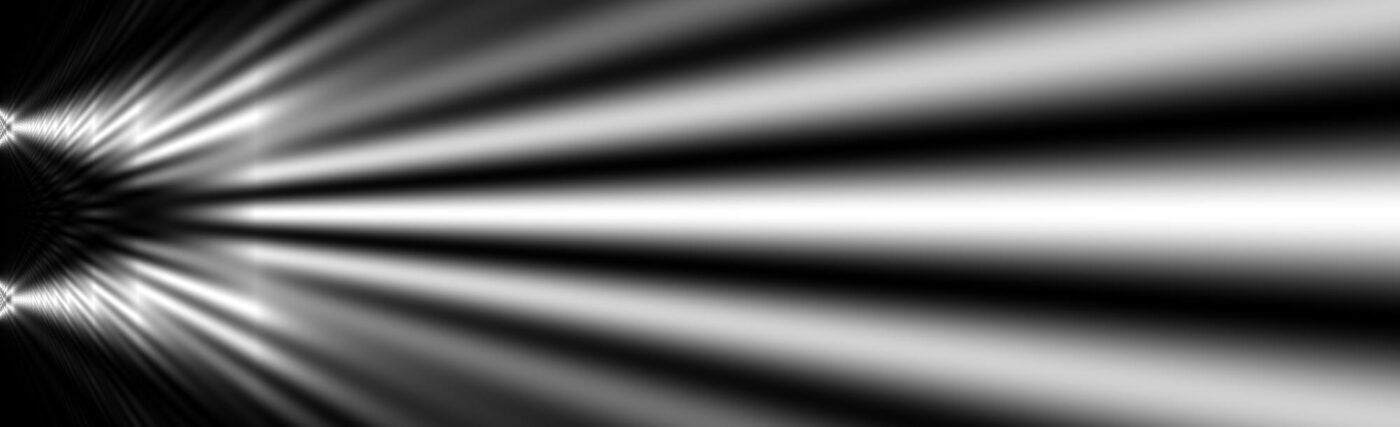
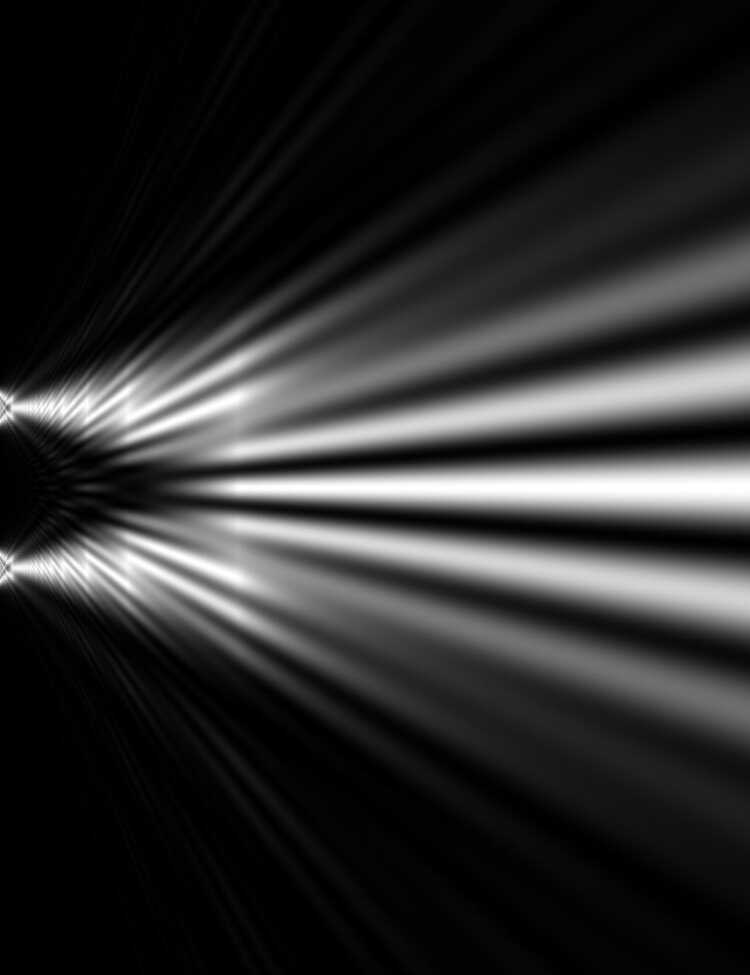
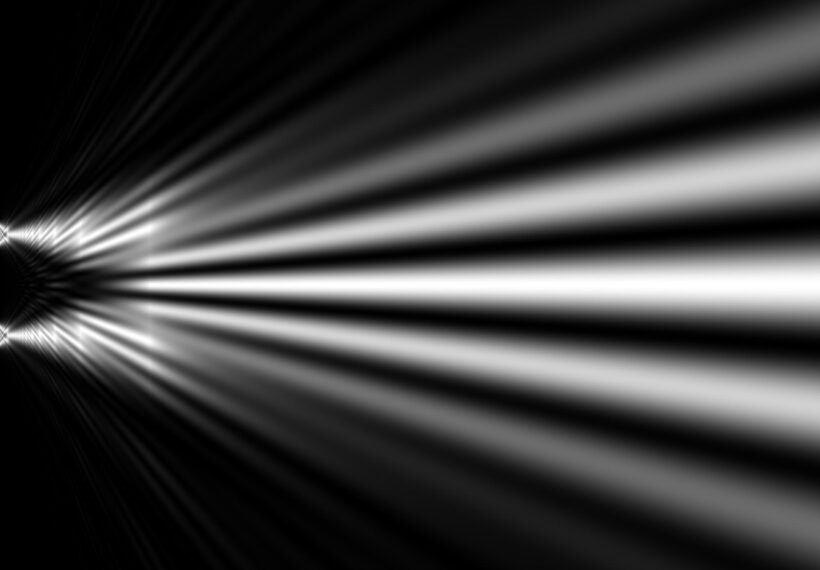
You see what’s called an interference pattern of the variation of light and dark peaks that completely spreads across the projection surface.
Because when you didn’t look at it, the electron behaved as a wave.
And when you did look at it, it behaved as an electron.
And so when a wave, waves can interfere.
So a wave is just what you think it is.
It’s ups and downs.
If you have two waves that are intersecting with each other, there’ll be points where the crests match up, you get an extra high peak.
Points where the troughs match up, you get an extra low peak.
And these just continue.
And you get all combinations of the two.
And what that looks like and what we call it in physics is an interference pattern.
And that’s evidence that for that variant of the experiment, the electrons were behaving as waves.
Now, what does looking at it have to do with it?
Because if you’re looking at it, you’ve got to shine light on it.
Right.
If you shine light on it, because otherwise it’s just an experiment in the dark.
You have no idea what’s happening at all.
The moment you shine light on it, the light interferes with the electrons being waves and they become particles at that point.
And so, it’s called the observer effect.
And the New Age circles want to believe that it’s your consciousness that’s affecting it.
And that’s one of the biggest misconceptions.
That’s ridiculous.
Right.
Who was it first discovered this with waves back in the day, way back?
Well, we knew about the wave interference, okay?
Because you were always shining light on your electrons.
But electrons had to be discovered, right?
Electrons were not known in antiquity.
They had to be discovered.
And then you had to know how to manipulate them.
And then you do these experiments.
This is all…
We are in the centennial decade of the birth of quantum physics.
The 1920s was a seminal set of years where quantum physics was discovered, Hubble discovered that we’re not the only galaxy in the universe, and he discovered that the universe was expanding.
So a lot went on in that decade.
You see…
So Chuck, we don’t know.
It just is.
It just is.
It is a correct description of nature.
And an important philosophical point.
Just because we don’t know how something works, why something works, doesn’t mean we can’t describe how it works.
You can know things and predict things, even if you don’t fully understand what’s happening.
And that’s where we are with quantum physics.
It defies our common sense, but so does practically everything else about quantum physics.
We don’t live in the quantum.
There’s a book called…
Oh, what’s the guy’s name?
Oh.
George Gamow, a physicist, wrote a book called Mr.
Tompkins in Wonderland.
And it’s a series.
And one of the stories is the physical constants are different in his world.
So as he’s driving down the street, he starts seeing relativistic things happen.
And all Einstein’s relativity shows up in his rear-view mirror, in his front-view mirror.
Very clever educational tooling there.
So one of them, it’s quantum physics.
So Planck’s constant, which measures the things in the quantum, is some much larger value, which means when you walk through a doorway, you end up diffracting, just the way particles would.
I mean, it’s freaky stuff.
It’s called Mr.
Tompkins in Wonderland.
It’s a whole series.
Very clever, and he illustrated.
It has fun little cartoons in it, too.
I learned everything I know about the quantum from Ant-Man Quantumania.
Oh!
The Marvel Universe.
Yeah, which is why I know nothing about the quantum.
Because of us.
The Natural Resources Defense Council works to safeguard the earth with over three million members fighting to confront the climate crisis, protect wildlife and ensure the right to clean air, water and healthy communities.
We’re in the fight of our lives to adapt to a rapidly changing climate with less than a decade to slash greenhouse gases in half or have climate disasters wreak havoc.
We’re in the midst of the next mass extinction, driven by human activity.
We could lose over a million species in mere decades.
Our health is immediately tied to our food, water and air.
The future depends on delivering a clean and healthy environment for all.
Seven million people die from air pollution each year.
Join the fight to protect our planet by making a donation to the Natural Resources Defense Council.
Make your gift to support NRDC’s battles against polluters in and out of court.
Every donation will be matched, which means your impact doubles for a limited time.
Go to nrdc.org/startalk.
That’s nrdc.org/startalk.
Whether in person or remote, open communication with your doctor is key to managing any condition, including heart failure.
How have you been feeling?
Both are great options to continue having open conversations with your doctor about how you’re feeling.
And when you speak openly with your doctor, they’re better equipped to help.
Visit heartfailuretalks.com to learn more.
Dreaming of overseas adventures or connecting more deeply with family from afar?
Rosetta Stone bridges the language gap.
I’ve tried others, but Rosetta Stone’s immersive lessons and voice feedback technology are game changers.
Dive into 25 languages by learning intuitively, just like when you were a kid.
And here’s the holiday sparkle.
Grab a lifetime membership now and save 50%.
Gift yourself the world.
Head to rosettastone.com now and save 50%.
So, this is something that we have talked about in the past several times, and the fact that it is real is just very difficult to wrap my head around.
And that is, we have kinematic time dilation, we have gravitational time dilation, and these are not perceptions, because you told me about the atomic clock experiment.
And so, the atomic clocks are the most precise chronological measurement of time, and we end up with different readings in these experiments.
Is time real?
Is it a thing?
Is it even a thing?
Is it a thing?
Is it a beast?
I mean, come on.
Chuck is blowing a gasket.
I’m serious.
She just blew a gasket.
Are humans the only species that kind of measure time?
No, no, no.
So for example, you’ve heard of half-life, right?
Of course, yes.
Half-life, okay.
At half-life limit, let’s make sure we’re on the same page.
There’s certain elements that are radioactive, which means they decay into different elements.
You start with a blob of one element, and if it has a half-life of a week, let’s say, that means in a week, on average, half of those atoms will have turned into a different kind of atom.
Right.
They would have decayed.
And then in another week, half of what remains turns into it, okay?
It’s half of a half of a half of a half of a half of a half.
And it drops rapidly.
It’s two to the n power, right?
So it drops rapidly.
Okay.
So if you have 10 half lives, then you have one one thousandth of what was there before left over.
Because 10 is two, it’s one half times one half times one half times one half times one half.
And you get 1024, I think.
Right.
So it’s basically one thousandth of what was there.
You can take an element that has a half life and accelerate it to near the speed of light.
And its decay will be delayed by the exact amount that you calculated in Einstein’s relativity.
And it’s not carrying a Timex with it.
Or a Rolex.
It’s whatever internal clock tells atoms to decay, that is affected by relativity.
So time is real.
Relativity is real.
Now, one way to think of it, which Jan 11 has tried mightily to get us to understand, if you have two axes, and one axis is distance, and the other is time, not distance, it’s just space.
One is space, the other is time.
And they’re like right angles to each other.
So it’s two axes.
Now, if you’re sitting there going nowhere, you are not moving on the space axis, but you are moving in the time axis, aren’t you?
Time is going forward for you.
Right.
Because your lazy ass is on the couch and you’re not actually moving anywhere.
So if you start moving, then the line on this graph that applies to you is not the one that’s going straight up the time axis.
Because now you are moving from your previous location and now you’re in a new location and you’re continuing to move.
So now as time progressives, you advance a little bit in the space direction.
So you have a line that’s at an angle right now from the vertical.
Can we picture this in our heads?
Of course, yeah.
Okay.
You got it.
Okay.
Okay.
Great, great.
So now, so now, so Chuck, you’ve been slow lately.
Gary is a former ex-pro footballer.
He’s gonna run while he watch you walk, eat and potato chips.
He will run.
You are both moving forward in time.
Yes.
But he’s moving farther in distance than you.
In the same amount of time.
So his line will be at an even greater angle than yours will.
We got this?
So far.
Yeah.
Now, everybody’s got to measure the speed of light to be the same.
This is one of the great insights that Albert Einstein had in his relativity.
In order for both of you to measure the speed of light to be the same thing, your time coordinates have to change.
Have to change.
His will have to slow down in order.
If speed of light is a constant, his time, which is…
Because the speed of light has got to remain the same.
Correct.
So, that means his time would literally have to slow down in order for him to observe me eating the potato.
The same time that you…
Jesus Christ.
See, this is what I’m talking about.
What?
What?
What?
We’re both seeing the time.
The time slows for him.
But it’s the same for me because the speed of light is…
Time is bullshit, man.
It literally slows down for him.
Literally.
It is not like it’s a perception.
His metabolism, his thoughts, his…
Any radioactive material he’s carrying in his pocket, his clock, everything.
The vibrations of the atoms, everything.
And referentially, for me, everything is exactly the same for me.
My time is staying the same for me, okay?
But for him to observe me, his time actually has to slow down in order for that observation to take…
No, no, no.
So, let me be more clear.
You’re watching him, and from where you are, you both want to measure the speed of light to be the same, but the only way that can happen is if you see him move slower.
He’s got to move slower because his time…
And it’s not like I’m perceiving him to move slower.
His time literally has to slow so that he can be…
Make the same measurement.
Make the same measurement that I…
Correct.
Okay.
Now, if you go at the speed of light, time stops.
So that would be a line moving along the distance axis, but not advancing along the time axis.
It would just be flat line there.
And so therefore, a beam of light can get…
between any two places with zero elapsed time.
So a photon, particle of light, emitted in the center of the galaxy, which was the object of my affection for my PhD thesis, the Galactic Center, those photons, I will see them travel for 30,000 years, but if you’re that photon, you don’t live for any time at all.
No time.
That’s right.
There’s no time that has passed.
You’re emitted in the same instant you are emitted.
Correct.
You’ve got to get the truck off the ledge there.
It’s crazy.
And seriously, it’s so funny because it’s all…
Okay, forget it.
It is mind-blowing that these are…
For the measurements themselves, these are true measurements.
You would think that these would be perceptions because you’re talking about it being relative to an observer, but they’re not perceptions.
Yeah, in fact, observer is an unfortunate word that we still use today.
Yeah, we still use the word.
We refer to observer and a phenomenon, and people then think it’s something to do with you being human.
Exactly.
And it really isn’t.
These are actual measurements, and the measurements themselves are true and correct as they relate to the time and the constant being the speed of light.
That’s insane, man.
Yeah, it’s crazy.
It’s just crazy.
It’s crazy.
And another example, we’ve given it before, but now we have our own private burning question session here that this phenomena occurs in the strength of a gravitational field as well.
So the stronger is the gravitational field, the slower is your time.
So the time moves.
So GPS satellites fly in MEO.
We have LEO, MEO and GEO.
So MEO, Middle Earth Orbit.
And so those are like 12,000 miles up.
And so that’s high.
That’s farther away than the diameter of the Earth is above the Earth.
So they’re far enough away from Earth’s center that the difference in timekeeping for them is different than it is for us.
So their clocks, since they’re farther away from us, are moving faster relative to us.
So when they keep track of time and send us the time, we have to correct it.
Because we care about the time in our reference frame, which is Earth’s surface.
So who calibrates this?
What calculation are they?
We got people.
Because we’re very constant.
We got people, haven’t we?
We got people.
That’s why there’s a National Bureau of Standards.
I mean, there are people who think, you got to be glad they’re there and they’re the unsung heroes.
You don’t even know they’re there.
And they’re figuring this out for you.
And let me tell you how deep it goes.
I’ll use the Timex.
So what?
How deep it goes.
So we’re on Earth’s surface and we think of it as just one surface.
But there’s something called the geode.
And the geode is the grid that the GPS satellite is actually talking to.
Now, in that grid, is the geode you’re using for Earth a perfect sphere?
Okay, that’s a model of Earth’s surface, but that’s not Earth’s surface.
The equator is farther away from Earth’s center than people not on the equator, which affects which time frame you are in relative to the GPS satellites.
So, if you want to be really, really, really, really precise, you have to know where you are on the geode relative between the perfectly spherically modeled Earth and the Earth that’s slightly wider at the equator than at the poles.
And by the way, we’re not only an oblate spheroid slightly wider at the equator than at the poles.
We are slightly wider below the equator than at the equator.
So, we’re a pear-shaped oblate spheroid.
And that’s harder to model mathematically.
And usually, you don’t care about that level of precision.
So, typically, they just use a spherical approximation for Earth’s surface and let the dust fall where it may.
But you might arrive at a place and if you…
I mean, are we talking nanoseconds here or…
We’re talking about one doorway away from where you had intended to be, that sort of thing.
But you’re usually tracking down an address.
And so, once you see the address, you’re not still using GPS to decide that.
You know who needs these coordinates?
The military.
Because if they’re sending a missile via GPS guidance…
Yeah, that doorway can make a difference.
Yes, the doorway to the left or the right makes a difference.
So, yeah, they have to know what the exact shape of the Earth is at the point where they’re interacting.
And of course, GPS was invented by the military, by the US.
Air Force, now under the control of the US.
Postal Service.
Chuck, let’s try…
Because they don’t want to get the wrong mailbox.
We’ll excuse them on this one, Chuck.
The GPS was designed and built by the military, and it was controlled by the US.
Air Force until it is now under the control of the US.
Space Force.
Oh!
You know why?
I have never accepted Space Force.
Oh!
That’s why I was wondering, I was like, why am I not getting this?
And Chuck, I cannot begin to tell you how irrelevant that fact is to the world.
I know, and I need to…
That you don’t accept it.
And I need to get over it because guess what?
And I just felt, first of all, I thought it was a dumbass name and…
What?
It’s Space and it’s a Force?
Because, listen, we already have the Air Force and then you’re just going to…
And now we’re going to make it Space Force.
So, we still have the Air Force.
Yes!
They worry about the air, okay?
Space Force worries about stuff that is not moving through the air, okay?
Those are called satellites and other rockets, all right?
Did you complain in 1947 when the Air Force split from the US.
Army?
Wait, no.
I didn’t.
No, because you weren’t born.
But had you been around, would you be imitating…
Who was president in 1947?
Who was it?
Truman?
Would you be imitating Truman and saying, why have an Air Force when we have the Army who can fully take care of the Air Force?
The Army has soldiers on the ground with tanks.
Because Air Force sounds cool.
It sounds cool.
Truman had him right.
It sounds cool.
Whereas Space Force sounds like something that…
Science fiction-y.
No, that Seth MacFarlane came up with.
That’s what Space Force sounds like.
Sounds like they were like, Seth, we need a name.
We need a name for an organization that’s going to put us out in space and take care of all our space related…
How about Space Force?
Let’s go with Space Force.
No, but anyway.
So the entire space branch of the Air Force basically pulled away to become the Space Force.
Where command and control is different, all of the…
There’s so much that…
It’s maybe not entirely as different from the Air Force as the Air Force was from the Army, but it’s different enough to justify its own branch.
And now they have a seat at the table in the Joint Chiefs of Staff.
Gary, we’ve got time for only one more burning question, but it has to be…
It can’t just be any question.
It has to be burning.
Okay.
It’s our own burning man.
All right, here we go.
What is the one scientific breakthrough for you that has shaped the world the most?
And maybe what is the next one for you?
That has shaped the current world?
Yeah.
The fact that matter is made of atoms and atoms are made of particles.
Particles.
Really?
I don’t think anything has shaped the world more than that knowledge and awareness.
That’s a really cool answer.
Because that’s what gives us electricity.
Yep.
It gives us the nuclear power.
All of our communications.
It gives us our understanding of molecules, how and why they work.
It gives us our understanding of the periodic table of elements.
Why is it periodic?
All of that comes from that fundamental realization.
Because think of it before then.
It’s like, oh, I’m a woodcutter.
I just care that my wood atoms.
You say is atoms.
Okay, I got wood atoms.
Fine.
I don’t care.
I’m just going to cut.
Oh, but wait a minute.
When you burn wood, what happens?
Oh, there are molecules there that have energy that break apart.
So, there it is.
Yeah, that’s a really cool answer.
I would have never thought of it that way.
But yeah, that discovery changes everything.
And if I can tell you one other thing, there’s some professors at MIT who created a course called Energy.
And big fat textbook.
Everything you ever wanted to know about energy.
Machines, the conversion of energy from one thing to another.
This goes on and on and on.
How I can get more of it in the afternoon?
Because I feel so bad around 2 o’clock.
I don’t know if they get the caffeine energy going.
Oh, they don’t get that?
So let me get the book.
Hold on a sec.
Here’s the book.
The Physics of Energy.
Robert Jaffe and Washington Taylor.
Two professors.
Look how fat the book is.
And so I want to read to you my…
I wrote a blurb for it.
Okay?
Is that a technical term?
Yeah, it’s a total technical term.
Here it is.
You ready?
And I pride myself on always having the shortest blurb.
But this one is about the same length as the others.
Okay, so here it goes.
Ready?
If your task was to jump start civilization, but had access to only one book, then The Physics of Energy would be your choice.
Professors Taylor and Jaffe have written a comprehensive, thorough and relevant treatise.
It’s an energizing read as a standalone book, but it should also be a course offered at every college, lest we mismanage our collective role as shepherds of our energy-hungry, energy-dependent civilization.
And then they inscribed it to me, a little inscription there.
I’ll read that to you.
Dear Neil, here’s hoping we don’t have to jumpstart civilization anytime soon.
Yeah.
So I would say a close second to knowledge that there are particles is the fact that we have learned to understand, measure, harness and transform energy from one form to another.
That, in fact, is the backbone of modern civilization.
Very cool.
All right.
Good answers, man.
My question got a great answer.
Or was it just a great question?
And I gave an average answer.
Take credit, Gary.
Take it away.
You can get it.
I’m taking and running.
I’m running.
All right.
Well, I enjoyed this.
Get my co-hosts, giving them a chance to ask burning questions.
We might make this a regular thing.
I don’t know.
But you have to earn it.
All right, Gary.
All right, Jack.
This has been Star Talk.
Neil deGrasse Tyson here with burning questions from Chuck and Gary.
And as always, I bid you to keep looking up.
Intresto, Sucubitriol Volcertain Tablets, is the number one heart failure brand prescribed by cardiologists, and has helped over one million people with heart failure.
It’s a prescription medicine that treats adults with long-lasting chronic heart failure, and works better when the heart cannot pump a normal amount of blood to the body.
Don’t take Intresto if pregnant.
It can cause harm or death to an unborn baby.
Don’t take Intresto with an ACE inhibitor or Alice Kirin, or if you’ve had angioedema with an ACE or ARB.
Don’t take with Alice Kirin, or within 36 hours of taking an ACE inhibitor.
The most serious side effects are angioedema, low blood pressure, kidney problems, or high blood potassium.
Angioedema is swelling of your face, lips, tongue, and throat that may cause death.
If it causes difficulty breathing, get emergency help.
Ask your doctor about Intresto.
To learn more, visit support.intresto.com or call 833-446-6699.
For pricing, visit intresto.com backslash cost.
If you can’t afford your medication, Novartis may be able to help.
Shopify is the global commerce platform that helps you sell at every stage of your business.
With the internet’s best converting checkout, 36% better on average compared to other leading commerce platforms.
Shopify helps you turn browsers into buyers.
In fact, Shopify powers 10% of all e-commerce in the US.
Sign up for a $1 per month trial period at shopify.com/podcastfree.
All lowercase, shopify.com/podcastfree.
shopify.com/podcastfree.



 Become a Patron