First, Neil and Dan try and figure out what can now be defined as “journalism.” We discuss the shifting landscape from two to three main networks to the overcrowded airwaves of today. Is it a good thing or a bad thing? How do news organizations balance entertainment value with news value? Jeff explains why some news programs are just entertainment programs in disguise. And, Jeff tells us why civility is needed in order to have productive discussions and debates.
You’ll hear why transparency is the new objectivity. Find out more about the current administration’s war against the press. Dan tells us why he thinks the United States is in a decisive battle for the “soul of the country.” Paula leads us in two games: “Defeat the Press” and “Bullshi* from Brass Tax.”
Discover more about the role of science and data in impactful reporting. We also explore why science has been integral to the United States becoming a leading nation. We take a look back on the Space Race and ask, “Is fear the best motivator for a society?” Dan tells us why he thinks President Nixon might be the reason that the United States lost its drive for space exploration and the great irony in Nixon’s dislike for space travel.
We ponder whether we are now living in a post-truth age, or headed into one. You’ll learn why it has become difficult to predict the future of journalism. You’ll also hear about Dan’s early dreams to become the first journalist on Mars. Dan gets to ask Neil his own Cosmic Query about nuclear fusion. Lastly, Bill Nye shares why the reporting process is similar to the scientific process. All that, plus, Neil gives us the evolution of news through the cosmic perspective.
Transcript
DOWNLOAD SRT
From the American Museum of Natural History in New York City, and beaming out across all of space and time, this is StarTalk, where science and pop culture collide. And tonight, we are featuring my interview with one of America's...
From the American Museum of Natural History in New York City, and beaming out across all of space and time, this is StarTalk, where science and pop culture collide.
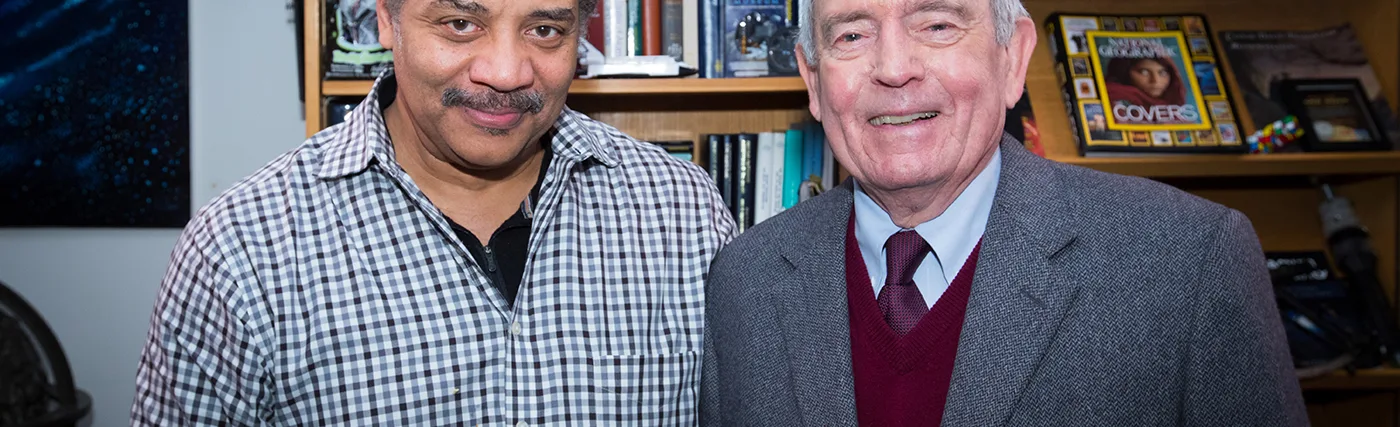
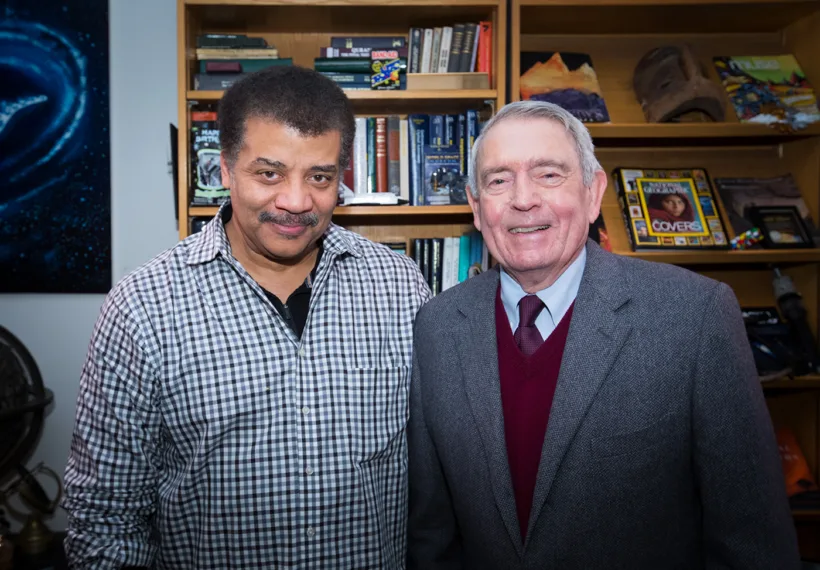
And tonight, we are featuring my interview with one of America's most iconic reporters, former CBS news anchor, Dan Rather.
Yes!
We discuss sharing science and knowledge through the news, from the space race to the White House.
So let's do this!
All right.
My co-host tonight is Paula Poundstone, comedian.
Oh, my gosh!
I've followed you since the 80s, and I love you to death.
It's the first time meeting you on this show tonight.
Thank you so much for having me.
Thanks for doing the show, and you've got a new podcast called Nobody Listens to Paula Poundstone.
Yeah.
So if you decide to listen, you'll be nobody.
You'll be no...
Oh, I hadn't thought about it that way.
And also joining us on StarTalk is journalism expert Jeff Jarvis.
Thank you, Dr.
Not your first rodeo with us?
I'm honored to be back.
I'm delighted to have you in.
And you are a professor at the Craig Newmark Graduate School of Journalism at CUNY.
We'll be tapping your expertise tonight as we discuss my recent interview with broadcast news icon Dan Rather.
Dan has reported the news for nearly 70 years.
Wow.
Just to...
That that sentence even exists is mind-blowing.
He began in 1950 in Huntsville, Texas, and had spent 44 years at CBS.
24 years as anchor of the CBS Evening News following Walter Cronkite after he retired.
So I asked for his perspective on the evolution of news in the digital age.
So let's check it out.
You're basically a battle-tested journalist, something that you get less of today.
I don't know what counts as journalism.
Somebody in their garage with a blog.
With a mama calling them for breakfast or dinner.
But that brings up something very important, that there was a day when we were all funneled through just a few channels of access to the news.
That is true.
When I first came to CBS News in 1962.
Oh, the way he says it, CBS News.
That's his set.
When I first came to CBS News in 1962, it was primarily a two-network, national network situation.
NBC and CBS News were seen as a kind of national hearth around which people gathered in the evening and got the delivery of quote-for-days news.
So that created a commonality of outlook, understanding.
That's true.
Of trust.
True.
And I want to be able to say that the more news outlets, the more perspectives become available and that that would be a healthy thing.
But systematically, the number of news outlets has grown, and I'm not quite sure it has become a healthy thing, and I don't even know why I'm saying that.
Well, I'm reasonably sure it's in some ways healthy.
There's greater choice, far greater choice today.
On the other hand, it has led to a kind of silo effect, which is people choose a place on the dial, whether it's cable television or over-the-airways television or radio, a place on the dial, where they think they are hearing what they want to hear, and they don't experiment much with other points of view.
And this is the downside now of having so many outlets for news.
Let me note that many of these outlets advertise themselves as news outlets are in fact designed to be, and are basically entertainment, which is another problem those of us in journalism have, entertainment values, overwhelming news values.
Entertainment is very important to a culture, but it has its own value system, which is quite a bit different from the value system in news.
Jeff, how should we balance news value and entertainment value?
Because we care so much about entertainment here in the United States.
We do, and it's so hard to answer that question now when the White House is a show, when entertainment has taken over reality, and reality is not reality anymore.
But I think it's important for news to also have some level of entertainment, some level of relevance and compelling nature, so we can interest people in it.
When they have news panels, I always think it's kind of like news theater, because everyone has a personality, and they have to disagree at some level of engagement.
So I never really take it all seriously.
It's just, I say, oh, this is fun to watch, as a source of my knowledge.
There's a level of humanity to that that's kind of okay.
Rather than having the omniscient anchor reading everything to you out of a teleprompter, maybe an improvement.
Really?
So, Jeff, is having more news sources a good thing or a bad thing?
I think it's a good thing, because I think we hear diverse voices who were never represented before.
Even if they get it all wrong?
They don't all get it wrong.
Don't be such a pessimist.
Some do, but I think the problem is we're paying too much attention to those who get it wrong, and it's hard to figure out what's what.
But we're out of this world, which Dan Rather was the king of, of having just one voice, a monolithic voice.
Was there more or less trust in the news when we got it from only a few sources?
I don't think we know.
I think we presumed there was trust, but what's happening now is that the public is telling us, you know what, we really didn't ever trust you much.
Dan Rather, although he's an old school journalist, he's actually embracing fully the tools of the digital age.
Check it out.
You may be the oldest person in the world with two and a half million followers on Facebook.
But that's an important fact because the internet leans young, but it means you have a voice of influence on a community that leans young.
And your contributions are, they're literate, they're insightful, they're not too long, because who's got time, right?
They're just the right length to get the job done, make the point and then get out.
Thank you.
Okay.
What I'm trying to do is get back to what I call my base camp.
Professionally, who I am, what it is that I'm trying to accomplish.
And I can truthfully say, widely believed it may not be, but true it is, I'm not left wing, I'm not right wing, I'm not chicken wing.
I'm a working reporter who's been at it for quite a while, who is dedicated to both the idea and the ideal that Our Heavenly Father put me on earth to try to find facts, try to make sense of those facts, what I call analysis, to do it as honestly as is humanly possible and let people call me what they want to call me.
So Jeff, Dan's been criticized over the years for being lefty in spite of what we just heard him say.
Is that true?
Is it fair?
I think that we in liberal media, I'm liberal, I'm media, were not honest enough over the years about our worldview.
And that's part of the reason that the conservative half of America doesn't trust us because we couldn't be honest even about that.
How can you avoid claims of political bias?
We are all biased, that's how.
We're all human, we all have a view.
I think transparency is the new objectivity.
And being transparent about our worldview and our background is what can give us greater trust than acting as if we are above it all up in the stratosphere looking at Earth as if it's an alien.
That misrepresents the reality.
So he said he's on Earth to find facts and to make sense of those facts as honestly as possible.
Would you cite that as a journalistic credo?
Certainly.
I'm not going to argue with that.
Especially in a democratic society where we have free press.
But if you look at this society today, especially in this country and some others around the world, we have a worse problem, I think, with civility.
I think civility is a precondition to being open to other people's viewpoints and indeed to facts themselves.
I don't the hell agree with you.
I'll see you on Twitter, Tyson.
So, well, I asked Dan about our current president's approach to journalists and press in America.
Just, I had to get his opinion, his point of view.
Let's check it out.
There's nothing like the Donald Trump presidency anywhere in American history.
Nothing even close to it?
Nothing even close in this sense.
And I say this, whether you like President Trump, don't like him, or haven't quite made of your mind about him.
This is different.
We've never had a president so relentlessly attack the institutions there's supposed to be a check and balance on his power.
He's attacked the courts, the free press, anti-science, anti-knowledge is part of it.
That's what's new.
So we find ourselves now, again by any objective analysis, there's possibly decisive battle for the soul of the country.
Thank Dan Rather has some breaking news there, which is that there's someone in the country who hasn't made up their mind about Trump yet.
So, Jeff, why does Trump attack the press?
Well, you said earlier, you compare it to China and Iran and Russia.
It's a trick of the authoritarian.
Think of it-
So it is a playbook-
Absolutely.
That preexists that he's playing.
And it's also almost like being a cult leader, and cult leaders need enemies.
And we are a very convenient enemy.
And so, we've never seen-
We journalists.
We journalists, yes.
My fraternity.
And we've never seen this kind of attack.
Richard Nixon had his enemies list.
I wish they were on it.
But now to be called the enemy of the people is depressing.
Paul, what do you think of Trump's approach to the press?
Trump hates the press.
He said so, and that's the one thing he said that I believe.
Now, this brings us to a game show called Defeat the Press.
I'm gonna have you guys match the anti-press quote to the world leader.
All right, first question.
You're gonna identify who said this.
The press is your enemy.
Enemies, understand?
So is it Castro, Nixon, or Lenin?
I would say Castro.
Lenin.
Neither of you are correct, because it is Nixon.
It's Nixon.
But I'm gonna give you a chance on another one.
All right, the first thing dictators do is finish free press to establish censorship.
There is no doubt that a free press is the first enemy of dictatorship.
Who said that?
Castro, Nixon, or Lenin?
I'd say Lenin.
I'll go with Lenin.
Castro.
All right, this is the last one.
This is the last chance to redeem yourselves.
Yeah, see if you can get your science tie around this.
The free press is a liability unto every sustaining government and should be kept under strict review.
I'd say Nixon.
Lenin.
Unfortunately, we're gonna turn over all the cards.
So, Jeff, Dan said he was in the midst of a battle for the soul of the country.
It was poetic and deep and scary, but is that an overstatement?
No, I think it's true, and I'll ask you, Doctor, are we also in a battle for the intellect of the country, for the survival of the notion of intellect, of science?
I would say we're in a world where being smart is considered a liability, and you're rejected from the table.
By the way, I think the intelligentsia are partly to blame, because they spent a lot of time walking around like, oh, you're not in our club, and we're smart, and we don't even have to pay any attention to you.
And if you don't pay attention to the people who outnumber you in a democracy, then you lose.
So who's going to win this battle?
We don't know yet.
We don't know yet.
Let's pass that on to Trump.
And our children.
Up next, CBS News anchor Dan Rather gets fired up for science when StarTalk returns.
This is StarTalk.
We're featuring my interview with former news anchor and staunch science advocate Dan Rather.
Check it out.
I got here one of your tweets.
January 2018.
I hear this in your voice, actually.
Listen, folks.
Science is national security.
Period.
End of story.
You can't say you care about the health and safety of this country, let alone the planet, and be anti-science.
Not buying it never will.
That's in your face.
Well, it's true.
And it has the benefit of being true.
It has the added advantage of being true.
So, generally you expect a scientist to be all that in your face.
So, what gurgled up in you to say that?
Let the record show I didn't call him up, I didn't tell him.
He did that all on his lonesome.
So, what were you thinking that morning?
Well, what I was thinking about my experience in the world, I'm not an extremely smart person.
What you're looking at here, and let's not get ourselves, is a reporter, a lifetime reporter who got lucky, very, very lucky.
And part of that luck and being blessed is just I've been a few places, more places than most people have been, seen a few things, including, by the way, that period when we were raising the Soviets to the moon in 1960.
Science has been a very important part of making our beloved United States of America what it is.
We are an economic superpower and a military superpower, primarily because we've dedicated ourselves to being leaders in science.
Joining us to discuss the role of science in society is data journalist, Mona Chalabi.
Welcome to the table.
So, Dan says that we became a global superpower because of our investment in science.
To me, that's obvious, but is there clear data to back it up?
Yes, so the US currently invests about 2.8% of its GDP in research and development, but that actually places the US in ninth place behind a whole bunch of countries.
Ninth place behind Israel, South Korea, Japan, Sweden, Austria, Denmark, Finland and Germany.
In that order, yeah.
But I'm not sure about this claim about the US being a superpower necessarily anymore.
Like, Trump has just signed a bill for $716 billion for defense policy, and 13% of people in this country live in poverty.
Does that really constitute a superpower if all of your investments are going towards the military?
I don't know.
But if you divide superpower as how much you spend on the military, we win that contest hands down.
So Dan Rather mentioned the space race shaping sort of an arc of science in America.
So I asked him, what was it like to live through that period?
Let's check it out.
The Soviets had stunned the United States and they had stunned the world by being the first to reach into the cosmos.
The shock of Sputnik, the first Russian man-made thing in space, was such a deep shock to the country that almost immediately, some of the best minds in the country said, we have to re-emphasize the teaching of mathematics, science and engineering.
And you could feel it.
I mean, I was an adult at this time.
You could feel the country moving from kindergarten on, a re-emphasis on first arithmetic and later math, science, engineering.
And it was sort of like the spirit of World War II.
We either re-dedicate ourselves to science, math, engineering, the STEM, what we call STEM now, or we're all going to be speaking Russian.
You know, I don't think we're quite out of the woods on that Russian thing yet, on that speaking Russian thing.
So Jeff, is fear the greatest motivator for society's investment in science?
I hope not.
I hope that wonder is.
I hope that utility is.
But it's not.
So I'm asking you about fear.
Don't hope for what it isn't.
Well, that's an interesting point.
I love hope.
Don't get me wrong.
But that's not what I asked you.
I would think that now the Internet connecting all of us around the world, connecting us to any piece of knowledge, would be a tremendous motivator to be curious and to build and to care about facts.
And oddly, it's not turning out that way so far.
But it's young.
It's very, very young.
The Internet is young.
Yes.
You think it will shake out and...
In Gutenberg years, we're at the year 1474.
We don't know what the Internet is yet.
That's Steve Gutenberg?
The dentist.
So what you did was you took the year of the Gutenberg Press, added to it the number of years between the Internet and today.
And then you got 1474.
Martin Luther was not born until 1483.
He didn't tack his theses until 1517, 500 years ago now.
I think we are coming to the end of the Gutenberg Age.
And we are starting a new age.
Now, meanwhile, at the beginning of the Gutenberg Age, we had a few wars.
A few, like a century and a half of them.
So this may not be an easy period, but we are in a period of tremendous change.
Mona, what's the best data you have on the connection between the progress in science and conflict?
It's actually really, really hard to measure.
I think it's more likely that correlation isn't causation, as you well know.
So I think it could be an intervening variable, right?
We know that scientific progress happens faster in wealthier countries, and we know that wealthier countries are much less likely to be at war.
So it could be wealth as the explanatory variable rather than science.
All right.
Well, up next, we'll discuss how and why America lost its science mojo when StarTalk returned.
Bringing space and science down to earth.
You are listening to StarTalk.
Welcome back to StarTalk from the American Museum of Natural History.
We're talking about news, science and politics, featuring my interview with veteran journalist Dan Rather.
I asked his opinion on how we lost our science mojo in America after the golden age of the space race.
Let's check it out.
I think what happened is that once we reached the moon, we began to lose our mojo almost immediately after that.
And here's why.
It's actually a good story.
You know, journalists love a good story, love to tell a story.
That President Richard Nixon, a very intelligent man, set aside the trouble he got into later, a very intelligent person.
He detested the Kennedy's soul.
And he associated the space program and this whole period with the Kennedys.
When we landed on the moon, Richard Nixon wanted to, in effect, do away with the space program, which had been the engine that pulled interest in science, mathematics, engineering, law.
He saw it as a Kennedy deal.
He really wanted to kill it.
And I think that was the beginning of losing Mojo because NASA had a plan.
Okay, now let's make our next go going to Mars.
And they came with one proposal after another.
And President Nixon, ain't going to happen, guys.
There's one final thing I'd point out.
The irony in all of this is that there is a plaque on the moon, and it has the name not of President John F.
Kennedy, not the name of President Lyndon Johnson, who is a great champion of space exploration.
That plaque has the name of President Richard Nixon, because when man landed on the moon, the first Americans, the first humans on the moon, President Nixon was in office.
Irony of ironies.
So, Jeff, Dan puts the beginning of the decline of science in America squarely on Richard Nixon as a consequence of squashing the space program, which was so inspirational.
Would you say that's a fair assessment?
It's never shocking to see how petty politicians are.
By definition, that's why they're politicians.
But I wonder if there's something more going on here in that it's said that science and technology are at their most useful when they're at their most boring.
And I think to an extent we conquered so much and it was not a big deal anymore.
It was a shrug and we didn't see the next frontiers.
So you're agreeing that politics messed up our path to science leadership?
Yes, but I also think we got complacent about science.
So we the people.
So, Mona, again, you're a data person here at the table.
Is there any data on how science and politics are co-mingled?
Kind of.
We've got some evidence about which were the most science-friendly presidents.
So we know that Nixon created the National Science Foundation, really important in the development of science in the US.
Truman signed the National Cancer Act.
But I think given that if we don't tackle climate change, all the other questions are kind of a moot point, I would say that the most science-friendly president would have to be Obama for having signed the Paris Climate Agreement.
Oh, I see.
But so when I think of science-friendly, I think of sort of money invested in the science portfolio, the science R&D.
And what kind of...
If that were the measure, what would...
Oh, I'm not sure if that is the numbers.
I'm sorry, I can't make that up.
Where do you think we should be investing in science?
It's 2.8% of GDP at the moment.
But I don't know how that's kind of varied over...
Me?
I think all science frontiers need attention.
That was not an answer.
It is so an answer!
Because...
Because great innovations arise from the cross-pollinations of frontiers.
And if you only tunnel vision down one scientific pathway, you ignore possible crossroads that could give you leaps.
Not just evolutionary change in your field, but revolutionary changes.
How much impact does the Internet have?
The ability to share with scientists around the world?
It's without precedent.
Yes.
Just as the Gutenberg Bible enabled people to communicate in its day.
Yes.
For me, the jury is still out.
Which was more significant in its day?
The Gutenberg Press was stunning in what it could do and be.
I'm still thinking this through.
It took about 50 years for the book as we know it to emerge.
About 100 years for the impact to be known.
For the bound book.
We had books before then.
No, for the printed book.
For the printed book.
Printed books.
For movable type.
So it was about 150 years before the first newspaper was invented.
This is a long process.
Where do you put 50 Shades of Grey in that?
Yeah, I think that's significant.
So I got more from Dan Rather on the decline of science in society from like the Apollo era on to today.
Let's check it out.
Wait, you know, I want to make note of the fact that he has a little Russian coupling doll, is it?
Not on the shelf there.
Because that worries me.
If he has that and Facebook, then Putin's listening in to your whole conversation.
What?
So that's my office.
Oh, that's your office?
Putin's got you bugged.
Did he ever give you a soccer ball?
So the little nesting doll I got from Star City outside of Moscow.
Oh, wow.
Yeah.
Was Trump inside?
No, no.
They have a version that doesn't have political leaders.
It has spacecraft.
And little ones all the way down to the littlest one.
And the littlest one is, guess what?
There's one with Sputnik.
It's a beautiful thing.
And the biggest one on the outside is the International Space Station.
Because Russia is our partner in that.
They have one that has Trump's lawyers.
Open up the first one and then he needs a lawyer and then the next lawyer needs a lawyer.
So here's more from my interview with Dan Rather on the decline of science in America, taking it from the Apollo era to today.
Let's check that.
Well, you had a slow erosion of the belief that, in science in general, to the point where we now are, where these same forces are attempting to move the society completely over into a post-truth political era in which facts virtually, as we know them, don't really exist.
Facts are fungible.
Now, this is not true, but this movement is pretty far along.
As you say, no, there are facts.
Water does not run uphill.
Two and two equals four.
It doesn't equal five or seven.
Right down the line.
But to my surprise, I'm frequently surprised, being a journalist means being surprised.
I'm surprised how far this has gotten.
I have such a confidence in the common sense of the American people, in the ability of most people to separate bullshine from brass tacks.
But I have been surprised.
Jeff, have you been surprised by this shift in the value of facts?
Do you agree we're living in a post-truth political era?
No, I don't.
I think what we're seeing is a small number, and I emphasize small number of people who manipulate facts and media for economic reasons or psychological reasons, they're trolls.
Isn't it irrelevant that it's a small number if they're as effective as they would be in big numbers?
Well, we've got to look at why they're effective.
And I have to be self-critical in my business that I think that we in our business are chumps too often.
We have to get better at judging the larger information ecosystem.
We used to hear just from Dan Rather.
And that was a convenient world, and it was a packaged world.
It was easier.
It was easier.
Lazier.
It could be, but now we have all this information, and now we all get to speak, we all get microphones, and I celebrate that all in all.
But we don't know what to do with it yet.
We don't know how to find new systems.
I've trained how to sift the bullshine from the brass tacks.
Bullshine from brass tacks.
Now, Neil, it is time for the game Bullshine from Brass Tacks, where you have to guess what percent of the American population believes pseudoscience malarkey.
So what percentage of Americans believe that the moon landing is a hoax?
I say 10%.
15.
But this is price of right rule, so you're not allowed to go over.
All right.
Data person?
I saw the numbers.
So you accuse yourself?
I recuse myself.
Wait till Trump hears.
All right.
It's 7%.
So you both were over.
7%.
You were the closest.
Okay, this one.
What percentage of Americans believe that humans did not evolve in any way?
Americans.
I'd say 40%.
Jeff?
Did you say 40%?
40%.
I would say 30%.
30%.
10.
34%.
34%.
Based on a few numbers about the number of religious people in America, I made a guesstimate.
Oh, what is the number of religious people in America?
Well, I mean, they look at different faith groups, but I think if you were to add together all of the people who are very strong believers in different faiths, maybe you'd get to about 34%.
And that comes with the portfolio of beliefs, right?
Yeah.
I'm an atheist.
I still go to church.
I'm not a heathen.
What's that line in a Blood, Sweat and Tears song?
I know there ain't no heaven, but I pray there ain't no hell.
I always figure if I go to hell, the music's going to be better anyway.
I mean, the heat of hell is the humidity, I think.
So this one, what percentage of Americans believe that the earth is flat?
Tining.
Three percent.
Two percent.
One percent.
Wow.
Our statistics guest is fantastic.
Two percent.
Oh.
All right, this one, what percentage of Americans believe that the earth is less than 10,000 years old?
Let's go to track the evolution numbers.
Can I do the really cruel thing where I go one percentage point higher than you just to get closer?
36 percent.
Oh, she's being strategic.
Ten percent.
You know, Mona, once again, 40 percent of Americans.
You do not clock out, do you?
All day long.
Mona's just kicking.
The statistics and the percentage.
All right, here we go.
What percent of Americans believe that Bigfoot is real?
I'd say 25 percent.
Fifteen percent.
Twenty-five is way too high.
Jeff?
Ten.
Oh, once again, the statistician, 16 percent.
Well, up next, Dan Rather has a question for me about the future of space exploration when StarTalk returns.
Thanks Bringing space and science down to earth.
You are listening to StarTalk.
We're featuring my interview with American news icon, Dan Rather.
Dan had a question for me about using the power of the atom to explore the cosmos.
Back in the day, back in the 60s, there was some talk, and we in the United States had a program of trying to harness nuclear fusion, fission, splitting the atom, that the atom bomb.
But nuclear fusion, as I understand it, is cleaner.
And in the context of the 60s was, if we could conquer nuclear fusion, harness it if you will, that would give us propulsion into outer space, into the cosmos, much faster, much deeper than anything else.
So my question is, do you hear any scientists around still talking about propelling man exploration into the cosmos using the power of nuclear fusion?
No.
Next question.
No.
No, well, that's fair.
One of the challenges is a rocket has unique needs.
And for every increment of mass you wanna put into orbit or send to the moon or send to, for every increment, you need that much more fuel to get it there.
And that grows exponentially.
Now, you want a nuclear fusion reactor, that itself has a certain mass associated with it.
This was the big problem of airplanes.
We had the steam engine, it produced power.
Let's make an airplane with a steam engine.
But to have a steam engine that wouldn't explode, you need these iron, steel things so that the pressure wouldn't explode.
And the more powerful was your steam engine, the heavier it was.
You couldn't get the thing off the ground.
Right?
So, lately, there's been a lot of effort of what they call high impulse, but low acceleration engines.
So, plasma engines will do this.
It'll send out a particle very fast.
Right.
Okay, now, you don't feel that.
But, you went a little bit faster, because a little bit faster, but you can keep doing this, okay?
So, you can introduce a low acceleration for a long time.
And if you're accelerating for a long time, you can reach very, very high speeds.
It just takes patience.
Right, understood.
So.
But the idea of having renewable fuel with nuclear fusion you don't hear anybody talking about it.
Yes, but not in line to be used anytime soon.
One of the great challenges in the physics problem solving was plasma that gets you the fusion has to be millions of degrees.
Okay, so what vessel are you gonna put million degree plasma in?
What metal can stand up to that?
Here's a suitcase of million degree plasma.
Why is there still a suitcase there, right?
So, by the way, we have no problems making fusion here on Earth.
We just can't control it.
An uncontrolled fusion is called a bomb.
So fusion, just to be clear, you're taking light elements from the periodic table, bringing them together and making a slightly heavier element.
And it turns out if you do it right, through the right pathways, the element you make has slightly less mass than the parts that assembled it in the first place.
And that mass is converted to energy, according to E equals MC squared.
And so it's highly efficient, and stars make their energy from nuclear fusion.
In fact, we, as astrophysicists, had members of our own community calculating sort of the energy yields of exploding stars from nuclear fusion, while someone on the other side of the wall was using that same software to calculate the yields of nuclear bombs, of fusion bombs.
It's the same code, the same physics.
This is the world in which we live.
Just saying.
So it turns out Dan Rather's interest in nuclear fusion technology has some personal motivation behind it.
Let's check it out.
You're going to think I'm crazy, which is fair enough.
But you know, one of my dreams, when you're younger, your dream, one of my dreams was to be the first journalist to go to Mars.
Really?
And as ridiculous as it sounds and as ridiculous as it was, I even made efforts to kind of keep myself in better physical shape in the night.
Just in case?
Just in case I got the call.
So, hoping you guys told what I was thinking, you know, maybe somebody who comes up with a medal can resist this fusion, control the fusion.
And bingo, like magic, we'll be going to Mars tomorrow and it'll only take a month.
And maybe, just maybe, they'd ask for volunteers and I would say in the biblical thing, send me.
Me.
So without the fusion rocket, he's not going to Mars, is that right?
He ain't going, he ain't going.
How does it feel to break the heart of a beloved news man?
So Jeff, you want to be the first journalist on Mars?
Yeah, I would have retired there, right?
Because I figured I'm not coming back.
Yeah, if we sit, yeah, yeah.
If I go there, that's it, right?
Mona, how about you?
You're cool on Earth.
Yeah, I mean, nature scares me enough as it is.
I don't like to go into mountains or anything like that, let alone Mars.
Nature scares you?
I don't do backpacking or anything like that.
Apparently, that's a theme here.
When I go driving to the countryside, I keep saying, I'd really have a good view if the mountains weren't in the way.
Yeah, yeah, it's weird for a science guy.
I thought science involved like nature and stuff, but you don't see it that way?
The astrophysicists concerned, we concern ourselves with everything outside of the Earth.
Did you have astronaut dreams yourself?
Never.
Never?
Never.
Why not?
Because astronauts are going into low Earth orbit the same distance above Earth as New York is from Washington, DC.
That is not space.
That's an Amtrak ride.
That's an Amtrak ride.
Do you know that the schoolroom globe, you can ask, how high up is the space station above a schoolroom globe, if you scaled it?
Three-eighths of an inch.
As an astrophysicist, that is not space.
No interest if you're on the moon.
No, if you take me somewhere, I'll go to the moon, Mars and beyond.
You are, but not just what everybody today calls space.
That is like this high above the schoolroom globe.
I need better than that.
So if we had no atmosphere at all, we would look up in the daytime and see the stars, and somehow we all say, oh, I'm in space.
So I have issues.
Oh, you have issues.
Well, up next, Bill Nye the Science Guy shares his thoughts on science and the news.
When StarTalk returns.
We're here.
This is StarTalking.
Welcome back to StarTalk.
We're featuring my recent interview with journalist and American broadcast icon, Dan Rather.
In his last clip, I asked Dan Rather about the future of his profession.
Let's check it out.
The acceleration of the pace of change has reached the point where it's very, very difficult to look ahead in any person's craft or profession.
But we'll see if it's...
That's the real answer.
The pace is so fast.
You can't...
Two years from now, it will change more than it has its whole history.
So where could you possibly think it's gonna go?
Right, it'll be hard to judge.
Yeah, hard to judge.
But what won't change in journalism is, one, the bedrock of the craft is writing.
Because to write well, you have to stop and think.
What?
And that's the fundamental skill of our credit.
And that won't change.
What also will not change is that there will always be an audience that is interested in getting facts and have those facts analyzed who connect the dots, to use the metaphor.
Now, I can't foresee what the equipment is going to be.
But it will astound us today if we live long enough to see it.
Jeff, what do you think the future of journalism will look like?
I've changed my definition.
Do you prepare your students for it?
Absolutely.
I tell my students that I'm too old to do it.
They're the ones who have to do it.
And I redefine journalism in my own mind.
It's not just about facts.
It's our job to convene communities into civil, informed and productive conversation.
That's the essence of the democracy.
That's what we have to serve.
Town halls.
In a way, yes.
We have the tools now to do that.
Facebook and Twitter are our...
Virtual town halls...
.
infants, but they really are.
And we can bring people together and we can build bridges between communities and we can make strangers less strange.
Mona, you're a data journalist.
I have to say, you're the only person with that title I have ever met.
So it's a beautiful fact that such a person exists.
How do you think advances in technology will affect the way we use data to report on politics and society?
I think it depends on who's doing those advances in technology, right?
If the domain of business is they don't necessarily have an interest in selling that data to us for us to be able to report on it effectively.
I also think it's very important who's in office.
We're talking a lot tonight about the attacks on scientists.
I also want to talk about some of the attacks on social scientists in this country.
I don't feel like people are talking enough about how the Census Bureau is under attack and it's under attack because its budget is being cut so aggressively.
And if we can't actually...
The Census Bureau is a data-taking enterprise.
It's the foundation of everything that I do.
If I don't understand how many citizens are in this country, all of the averages that you hear, all of the statistics that you hear are based on that, and they are fundamentally misguided if that one fundamental number is not correct.
And the Census Bureau's budget is being cut so aggressively that they are concerned that they cannot conduct the 2020 Census accurately.
And without that data, Ray, all of the activists who are claiming that, I don't know, systematic prejudice is happening in their neighborhoods, that racial injustice exists, it's going to be reduced down to anecdote unless we have that data to demonstrate that it's systematically happening.
I'm really frightened about it.
And the census is...
The fact that a census needs to be taken is writ in the Constitution.
Absolutely.
It's the reason why statistics are called statistics because they come from the state.
The state is uniquely positioned to be able to collect these numbers.
Private enterprises aren't because they have their own interests in doing it.
You're telling me the word statistic comes from the word state?
It does, yeah.
And the thing that people don't realize in all of this age of, like...
Wait, let me finish opening my mouth.
To every camera, okay?
Yeah, go on.
But you need to have people in the newsroom with a really deep understanding of statistics to be able to take apart those algorithms.
These are algorithms that decide things like people's credit scores.
They're algorithms that decide the sentencing in the justice system.
They have huge effects on people's lives.
So you're saying we're all screwed.
You're all just so depressing.
And Dan Rather can't go to Mars.
Well, my good buddy Bill Nye sent in his own special report on the importance of news and journalism in America.
Let's check it out.
Good evening, Neil.
Thanks for joining us.
Tonight, News, Society and Science.
Are they connected?
We find out as Nye News starts now.
The process of reporting is much like the process of science.
It takes careful observation, critical thinking and respect for the facts.
Now, the news media keeps an especially sharp eye focused on those who govern.
The role of the media is so important that we often refer to the media as the fourth estate, fourth after the Congress, the executive branch and president, and our system of laws and courts.
The fourth estate is essential for the functioning of a healthy democracy.
So tune in, pay attention, be part of keeping things balanced and in check.
That's all the Nye News for now.
Back to you, Neil.
Be right back.
We are StarTalk.
We are StarTalk.
We are StarTalk.
We are StarTalk.
We are StarTalk.
We are StarTalk.
We are StarTalk.
We are StarTalk.
We are StarTalk.
We are StarTalk.
We are StarTalk.
We are StarTalk.
We are StarTalk.
We are StarTalk.
We are StarTalk.
We are StarTalk.
We are StarTalk.
We are StarTalk.
And I think back to the invention of the printing press with movable type, where people could read the same document.
It didn't have to rely on sort of storytelling to move the information.
And as we heard earlier from Jeff, it would be more than a century, multiple centuries before the idea that what is printed would contain news.
If you have no communication with outside towns, there's no news that you didn't already get at the grocery store, locally.
So you needed to be able to communicate.
Okay, so you have the broadsheet.
Then you introduce the newspaper.
People got quite wealthy running newspapers.
People valued the news.
But you know what was going on?
There was a set of people trained to report the news.
We weren't trained to do it.
But they are.
What then happened?
You get the news over the radio.
A new means of communication.
Do you mean have to go outside?
Then television.
You could see a person deliver the news.
Read their emotions, their reactions.
You could feel for them.
Emotions started showing up in the news.
Not only broadcast television, cable television.
A proliferation.
I remember the day when the half-hour newscast said, I think we need to go to an hour because we have that much news.
We said, no, there can't be that much news.
Today, we have 24-hour news stations.
So I wonder what's going on here.
Why are so many people trying to give me the news from their own perspective?
Maybe the future of journalism has we, the people, more as a participant in the analysis of that news.
Maybe news in the future will be, let us bring you the data.
And now you have the tools to analyze the data and interpret the data and come up with your own views, not the views of someone who's yapping at you 24-7.
But you know what that takes?
That takes training.
Something has to happen in the school system where you learn how to turn data into information, information into knowledge, and ultimately knowledge into wisdom.
That is a responsibility we have as a people.
And for me, that is a cosmic perspective.
I've been your host, Neil deGrasse Tyson, and as always, I bid you to keep looking up.
See the full transcript



 Unlock with Patreon





 Become a Patron