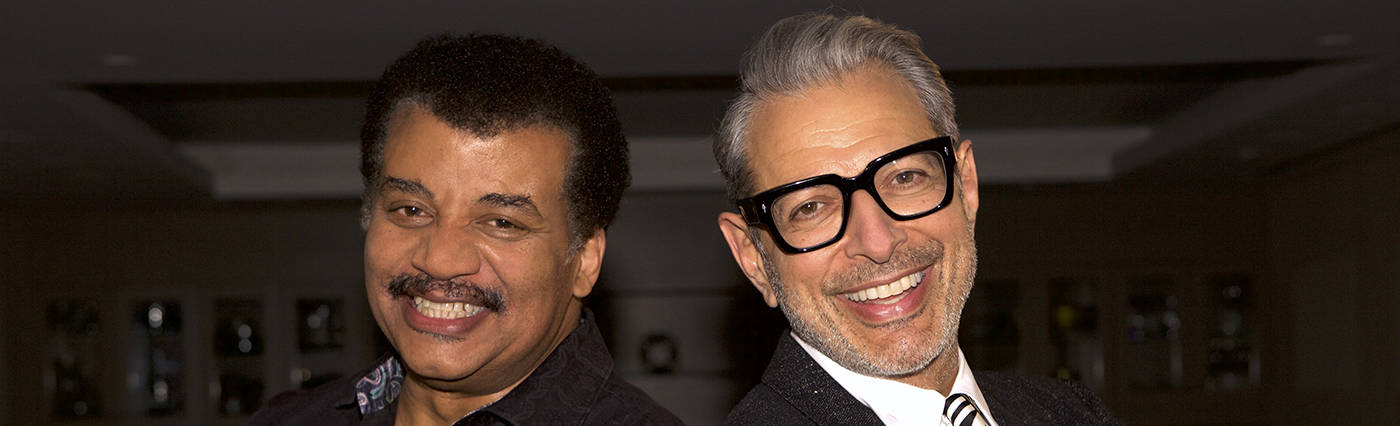
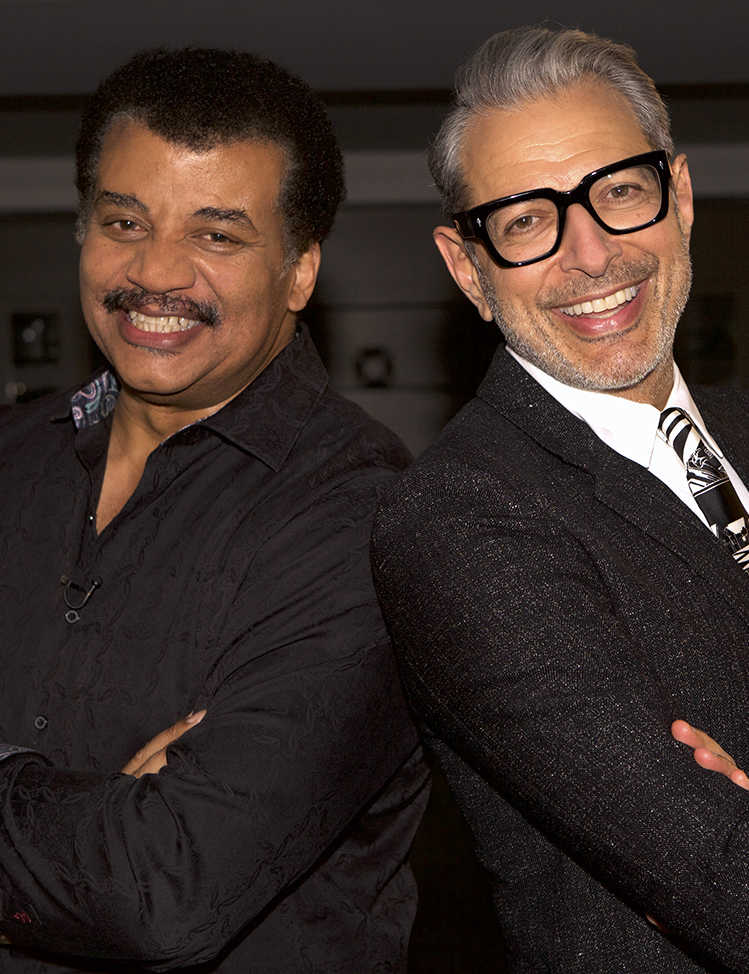
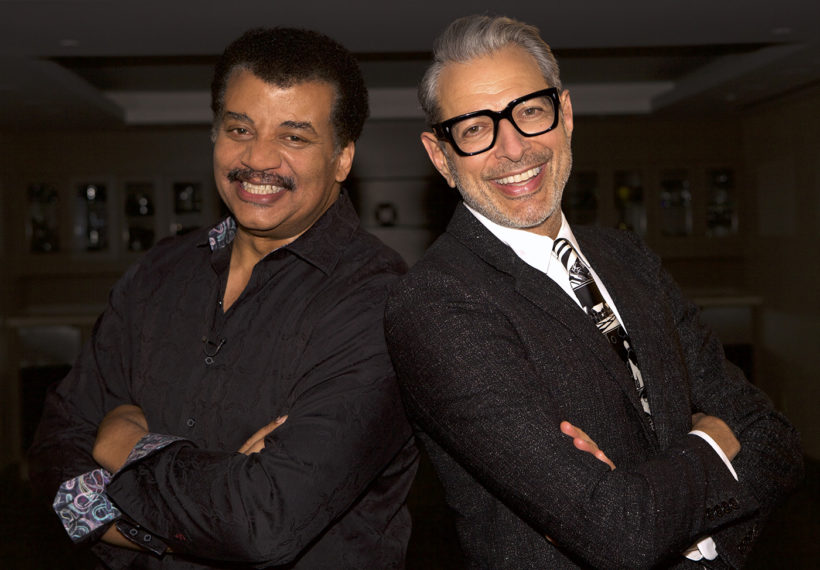
“Your scientists were so preoccupied with whether or not they could, they didn’t stop to think if they should.” On this episode of StarTalk Radio, Neil deGrasse Tyson sits down with actor Jeff Goldblum to explore his iconic roles in Jurassic Park, Independence Day, and his passionate scientific curiosity. Joining Neil in-studio is comic co-host Chuck Nice, paleomammalogist Ross MacPhee, economist Raphaële Chappe, and Kelly Fast, Ph.D., who is the Near-Earth Object Observations Program Manager, in the Planetary Defense Coordination Office, in the Planetary Science Division at NASA.
We start with the pre-historic. Get details on how Jeff brought his classic character, Dr. Ian Malcolm, to fruition in Jurassic Park. You’ll learn about Jeff’s love for the original script and the research he did for the role. We discuss how Jeff’s character broke the usual stereotypes of scientists being portrayed in film and television. You’ll hear about where the term “geek” came from and Jeff tells us why smart people should not be undervalued.
Ross sheds light on some of the big discoveries going on in the real world of fossil hunting and dinosaur research. You’ll find out if there are any controversial practices occurring in the field including gene editing and cloning. Bill Nye the Science Guy stops by to give his thoughts on de-extinction: should we bring back the extinct? Hasn’t nature already dealt its hand? Raphaële enlightens us on why Chaos theory and why chaos is not always a bad thing. You’ll also hear more about the “butterfly effect.”
Then, we switch from the pre-historic to the interstellar. Neil and Jeff dive into his role as David Levinson in Independence Day. Jeff explains why, contrary to the film, instead of fighting aliens, we must solve things with non-violence. You’ll also learn about NASA’s plan to defend the Earth from asteroids as Kelly tells us about the Double Asteroid Redirection Test (DART) mission. All that, plus, Neil offers up a cosmic perspective on how humans can do better than the hand nature deals us.
Transcript
DOWNLOAD SRT
From the American Museum of Natural History in New York City, and beaming out across all of space and time. This is StarTalk, where science and pop culture collide. Welcome to the hall of the universe. I'm your host, Neil...
From the American Museum of Natural History in New York City, and beaming out across all of space and time.
This is StarTalk, where science and pop culture collide.
Welcome to the hall of the universe.
I'm your host, Neil deGrasse Tyson, your personal astrophysicist.
Tonight, we're featuring my interview with actor and geek icon, Jeff Goldblum.
We talked about everything, from bringing back dinosaurs to fighting evil aliens.
So, let's do this.
Yes.
My co-host tonight is comedian Chuck Nice.
Chuck in the House!
Tweeting a Chuck Nice comic.
Thank you, sir, yes.
And also joining us tonight is a colleague of mine at the museum, paleontologist, Ross MacPhee.
Ross!
Thank you.
You're curator of mammals right here at the American Museum of Natural History, and you travel the world digging up fossils to learn about extinct animals.
Is that like what your business card says?
It should.
That'd be a good line.
Yeah, very good.
So thanks for joining us on StarTalk.
We're featuring my interview with geek actor Jeff Goldblum.
And he plays scientists with a swagger, right, from the blockbuster film Independence Day and of course in Jurassic Park.
So I asked him how his sort of iconic scientist character in Jurassic Park came to be.
Let's check it out.
Well, it was beautifully scripted, you know, I'm sure you read Michael Crichton's book, I'll bet, you know, and then Steven Spielberg and they'd written a beautiful script.
So it was really that character.
But I did try to influence, I did have this idea that, you know, I could hip it up a little.
Well, right, because there's swagger, you know.
Swagger isn't always in the script.
Yeah, well, it was maybe a little bit, that Richard Attenborough has that line, you know, I bring a scientist, you bring a rock star.
So somebody calls me a rock star.
So I thought, hey, I have license to shop for a jacket that I think will be right.
I kind of had tried, lobbied for a few articles of clothing.
What year was that?
That was 90?
93.
Okay, that may have been the first ever badass geek person portrayed in movies.
I mean, think about that.
Well, there you are, brilliant mathematician.
You're glib, you're clever.
You've got philosophical points.
You're good looking and you got a little kind of, you got presence.
This was breaking stereotypes, I think.
Yeah, I think so too.
And it's important, I'm sure you have feelings about this.
I'm passionate that smart people not be undervalued.
Yeah, smart people have feelings too and they have attitudes and things that are never, not previously ever explored.
Right, and their contribution of intelligence is in itself sexy and valuable and...
Good point.
Intelligence as a point of sexy.
Yeah, you're using geeky.
I see now, because you're using geeky to kind of agree with the conventional thinking of geeky smart is geeky.
I don't call a smart person a geek.
Geek is originally the term is usually, it originally comes from circus life.
Geeks were the people who bit, for entertainment, bit heads off of live chickens.
I didn't know that.
Well, I think that's where it comes from.
And then it became, you know, a smart person.
But you know, the next logical step is the movie Idiocracy, where anybody who can read a little bit is called, oh, you're a sissy or you're a geek.
You know, that's where that goes.
Yeah.
No, no, no.
It's a future where there's the dumbing down of the population of the world.
We see where that goes and could go further.
No, no, no.
We must uphold and champion, as you do better than I do, intelligence as beautiful, sexy, powerful, virile.
Chuck, did he, did he, did he pull us off in the movie?
I don't know, man.
I think, I think he's super sexy.
You know what I mean?
Did you notice his reaction though, when you, when you said he was sexy?
Yeah, but I said good looking.
You said, he was like, hmm.
So Ross.
Yeah.
What was your reaction to Jurassic Park when it came out?
Implausible, but great.
Impossible.
Implausible.
Not impossible.
Oh, well, you want to make a fine distinction.
You're not gonna bring dinosaurs back with ancient DNA.
You're such a spoilsport.
So what?
The show has science fiction, emphasis on fiction.
It was fantastic.
In fact, science, in a real sense, did play a role.
Things were explained.
It wasn't just assumed.
Oh, right.
There was that descriptive section where they talk about evolution and embryos and this sort of thing.
So that had some academic value.
Yeah, I think so.
No, you don't, Ross.
No, no.
I don't know why you said that.
You just let us know exactly how you really felt.
Here's what I liked about Jeff Goldblum.
He put the bad ass in glasses.
That's called bad glass.
So professional scientists have the reputation that they can't talk to the public, right?
You've got this guy quite in contrast to...
Yeah.
But I don't think that's true.
And I think it's increasingly true that we're very interested in talking to the public.
And whether that comes through from interviews like this that we're going to have or through movies, there's an interest.
There's practically even a need for people to be better informed about science.
It's just interesting.
And that's the point.
So, how about the part where they're just dusting a fossil and the fossil just pops out of the ground?
It could happen.
Really?
Because I've seen videos of you guys.
That's a hard thing, getting a fossil out of the ground.
It can be.
It really depends.
So, if you're talking cretaceous dinosaurs, it's mostly going to be rock.
Jackhammers are the sorts of things that you need most of the time.
But I deal with much more recently extinct organisms.
Like the ones from the movie The Ice Age, right?
Yeah.
Perhaps not cartoon characters.
I was thinking more 10,000 BC.
Yeah.
Not as much fun as the little squirrel with the nut, but that's okay.
You had saber-tooth tigers then, didn't you?
No?
10,000 years ago, we certainly did.
Yeah, okay.
And mammoths and other things.
We were coming out of the Ice Age.
So I just arrived at this museum when Jurassic Park came out.
So I only got sort of bits of the mood and emotion.
Did we see institutionally a rise in public interest towards dinosaurs after Jurassic Park came out?
Absolutely.
You know, up until that time, mammals sort of ruled in paleontology.
Dinosaurs were seen as kind of an evolutionary dead end.
But with Jurassic Park and the animations showing that dinosaurs were in some cases extremely athletic, able to move around at great speed and things like that, bite lawyers, this really changed things.
So since then, what are some big discoveries in the last 20 years, let's say?
For things that I'm working on, the biggest change I guess would be moving not away from bones but toward genetics, so that we're able to get ancient DNA from things that are not too old and do increasingly a lot with them.
We're learning a heck of a lot about species that are no longer with us as to basic physiological processes and things of this nature that we never would have guessed we could get.
Just from bones.
From bones.
There would be no way.
So, in Jurassic Park 1, there's the now famous line uttered by Jeff Goldblum, which is, you scientists are so preoccupied with whether or not they could, they didn't stop and think if they should.
So, let's start out with Jeff's reaction to the ethical implications of that line.
Check it out.
It's very interesting.
I want to talk to you about that and canvas your feeling because I'm interested in seeing what I can contribute to that conversation.
It would be nice because you started it.
Right.
So, maybe you can help me.
Maybe before I leave here, you can even enhance my thinking about it.
So, here's what my current thinking is that, well, I'll just tell you what's happened in this last, in this next version that's coming out without ruining anything.
We talk about some issues that came up in the one 25 years ago.
I talk again about science and ethics.
Issues.
I like that.
How polite.
Dinosaurs eating people.
We call these issues.
Well, that's true, but especially these issues that I am thinking about and my character talks about, which is ethics around science and all that.
That line in the one 20 years ago, maybe now we want to tweak it a little bit where there's no ambiguity in what we're saying, which is that we shouldn't deprecate science at all.
We shouldn't indict science at all.
And we tweaked my little speech so I say something about, whether it's still in the movie, glorious science.
I say something about the wonderful investigative curiosity and the continuum of the scientific approach is a wonderful thing, but it's the exploitation and the non-ethical use of it for profit, screwy entertainment, cheap entertainment, heaven forbid militarism, et cetera, nationalism, et cetera, that must be fought with every breath in our bodies, something like that.
All of those thoughts went through my head when I heard you utter that line 20 years ago.
Really?
Except one could think, hey, scientists, yeah, these scientists, these Frankenstein, Dr.
Frankensteins, they got to be, you got to watch those guys.
Yeah, I said to myself, he's blaming scientists.
Oh, good.
Which I don't want to do now, right?
And I said, scientists don't actually have the power that you think.
Their actual power comes from governments and legislations and funding sources that have priorities that go beyond what a scientist does in the lab.
And then they decide how they want to use it.
But I said, all right, it's a movie.
We got to let the line go.
Yeah, but now...
So I said to myself at the time...
Yes, see if you like, I don't know if you've seen it, but see if you like this new one where I think we're clearer and we tweak that so don't blame science.
Ross, how do you feel about the urge of some to blame science for the fallout of the applications of science in the world?
Here's how I feel about it.
It's yin-yang.
You want progress?
Progress comes from science.
Can it be misused?
Of course it can.
And there is nothing that an individual can do, except be well-informed on what the issues are.
So when this kind of misuse does come up, like in weaponization of space, that people speak out against it, that they're an informed electorate.
I'm blaming scientists.
Why?
Well, you can do that.
But it's like this young man said.
They're powerless.
Their products are used by people who do have power.
So do you have issues with Goldblum movies for this reason?
No.
I just love the fact that he called getting eaten by dinosaurs issues.
So Ross, in your field, do you have controversial ethical issues going on right now?
And I think specifically about, because you said now it's a genetic analysis, not just what bones fit together in a puzzle.
So how about cloning, gene editing, that sort of thing?
Here's the idea that we can now go into the genome, to the genetic material of a species, and alter it in a way that is favorable to us or perhaps favorable to the organism.
It depends on what the problem is.
So in a way, you're playing God.
Now, that brings up all kinds of issues about what the heck you think you're doing.
My view of it is nature by itself is not subject to human ethics.
It's not that there's good and there's bad.
It's just the way it is.
But to the degree that we interfere with nature, which is inevitable given the numbers of us on the planet, you have to ask the question, where do you want to stop?
And where I personally want us to stop is to intervene as little as possible in the parts of the planet where we haven't made a complete screw up.
So that includes parts of the ocean.
It also includes parts of the continents where humans are not as ubiquitous as they are in most other places.
Make those sanctuaries.
Make them safe.
Keep us out.
No humans allowed.
No humans allowed.
That's beautiful.
That's very nice.
Well, up next, we discuss the possibility of bringing dinosaurs back to life when StarTalk returns.
Unlocking the secrets of your world, and everything orbiting around it.
This is StarTalk.
Welcome back to StarTalk from the American Museum of Natural History.
And we're featuring my interview with actor, geek icon, Jeff Goldblum, talking about his role as a scientist in the Jurassic Park movies.
And I asked about the idea of bringing extinct animals back to life.
Check it out.
De-extinction, would you bring back T-Rex, the dodo bird, or none of the above?
I think the world has to work for everyone.
Nice, very important.
I think that's a good credo.
The world should work forever.
Let's make a world that works for everyone, whatever works means.
And I think we know what that means.
Nothing mysterious about that.
It works for everyone.
So, in thinking just about the, this is not to poo-poo my successful franchise, participation in the successful franchise, but no, no.
Well, my character says this is a bad idea.
It's a bad idea.
Evolution had its say.
Darwin is a hero of mine.
Evolution had its say and the dinosaurs went out from the universe.
That's their shakes.
A story that the universe told and now it's our turn and like that.
And yes, especially, you want to bring it back for, because you want to make an amusement park?
You want to sell some tickets?
Because, you know, I would say no.
I would say no about that, certainly.
Now, if it's just pure knowledge, like splitting the atom, is there something about resurrecting?
That means we could bring back everybody who's ever died, I guess, or every species that's ever been.
You know, we'd have to talk about that.
But before we get into dinosaurs, aren't there, aren't the, aren't elephants, aren't all the species, not only the beauty, beautiful human species, but every other species, aren't they infinitely mysterious and magical and worthy of our respect and awe and protection?
Elephants, you know what we're doing with elephants, that are, if we're just talking about, hey, we like dinosaurs because they're big, so we have big creatures here and in the oceans and all the creatures there.
Shouldn't we tend to those first and make sure that we protect them, not put them in zoos, not make money off of them, but just make sure we all, that it works for everybody?
And we all get along.
That would be my moral instinct.
I'm no doctor.
Oh, you played one on TV.
I played one on TV.
Ross, you specialize in this among your multiple specialties that I know of.
One of them is extinction and de-extinction.
So tell me how de-extinction would work.
Very simply, de-extinction is the idea of bringing back species, populations that are no longer with us because they've disappeared.
So think woolly mammoths.
We've been talking about woolly mammoths.
As a good example, the last of them died out on continents about 10,000 years ago.
There were remnant populations on islands until about 4,000 years ago, but they're gone.
And the question, accordingly, is were we responsible?
A lot of people think so.
So do we owe it to woolly mammoths to the degree that we can bring them back to bring them back?
Because we were accountable.
Whereas we're not accountable for the death of T-Rex, so let them stay dead.
Well, it goes beyond that.
That's right.
It goes beyond that because ancient DNA, which is the building blocks that you'd have to use for the experiments to bring the animals back, has a life of no more than a million years.
So you're not going to go back 66 plus million years and bring back the dinosaurs.
That was always the fundamental problem with Jurassic Park.
Okay, so let's just imagine if we could bring back T-Rex, should we?
What's it going to do?
What's its ecosystem function?
It's going to eat lawyers.
What else is it going to do?
And the answer is nothing.
It has no place.
You're right.
It'll be in a zoo.
It has no...
Yes, exactly.
So it's going to be an exhibit, like we have here at the American Museum, except everything here is dead and stuffed, which is a difference.
But you might consider, Britain, if we are entirely responsible, our cave troglodyte ancestors are responsible for the extinction of the woolly mammoth, you feel some guilt there, I guess.
Well, that's the ethical question.
See, I don't think we should bring it back because...
Here, woolly mammoth, they were thriving during the Ice Age.
We're going to bring it back just in time for global warming.
They will be so uncomfortable!
My God, it's hot.
What have you done with the place?
So Chuck, would you bring back animals, Chuck?
I would bring back animals, but quite frankly, I like food, and so as a foodie, I would only bring back those that are delicious.
Oh, well, how would you know what was delicious?
I don't know, that is why I have a little game that I would like to show you right now, where Ross will tell me if these animals are delicious.
Are they tasty or not?
Could we bring it back?
To eat it.
My first submission would be the Clip-Do-Done.
All right, first of all, I will tell you...
Wait, is that a real...
Ross, is that real?
Is that real?
Yes, it is.
It's a gigantic armadillo that lived in South America.
Some also lived in North America.
Some of them were upwards of 2,000 kilograms.
So 4,000 pounds.
So a ton.
Yes, these are big armadillos.
Now, what would it be like for Chuck?
I think it would be a lot like eating a tennis racket, frankly.
Damn it.
If you just look at the beast, you can see that it's very heavily armored.
There's bone sort of everywhere, like a little tank.
And in order to support that mass, it needs really tough tissue.
Really tough, yes.
Tough tissue.
So it's not good.
It's not good to eat.
But could we bring it back?
The last of them died out about 10,000 years ago.
It's within reach of ancient DNA.
So that's a yes.
That's a yes as to could we?
And then we go Jeff Goldblum to say should we?
I don't know, an animal that looks like Epcot Center?
I think I want to bring it back.
All right, here's my next one.
Megatherium.
OK, Megatherium.
Megatherium.
This is now getting very serious in body size.
This could be upward of 4,000 kilograms.
So we're talking the size of the largest elephants that are around today.
What I need to say is that this is a sloth.
You know about tree sloths, right?
Those are the only sloths that are still with us.
They come in at 5 kilograms, so 11 pounds.
This guy, a couple of orders of magnitude larger.
I think more tennis racket, more than anything else.
Once again, not a good, doesn't taste good.
Well, I don't know.
But easy to catch is a sloth.
So, can we bring it back?
It's the same as the glyptodon.
It died out 10,000 years ago.
There's ancient DNA.
I've worked on its ancient DNA.
It's there to work on.
It's within reach right on.
The question, boy...
But don't worry, Megatherium, we're going to take our time bringing you back.
Here's the last one.
Last one, go.
We talked on it.
We touched on it.
The wooly.
First of all, how would a wooly taste?
And, I mean, if we were part of its extinction, I can only hope that we were eating it.
Well, you know, there are stories when these carcasses appear in places like Siberia, as they do from time to time.
When they emerge from a receding glacier or something?
Yeah, where they melt out of riverbanks.
That's the commonest way.
There are stories of people and dogs in particular, of having had a steak or two.
Now, I personally have never done that.
Nor would I want to.
I mean, think about it.
This is something that's been dead 10,000 years.
This is the worst road pizza you can imagine.
Well, my buddy Bill Nye the Science Guy, has some thoughts on Jurassic Park style de-extinction.
Let's check it out.
We're all fascinated with dinosaurs.
That's part of why the movie Jurassic Park was such a hit.
It's a classic and classic science fiction.
Now, keep in mind that science is not inherently good or bad.
It's a process.
But, let's face it, in science fiction movies, we want to see scientists doing something dangerous.
And those scientists are usually evil.
But what if we could really do that Jurassic Park DNA thing and bring back an extinct species to de-extinct some extraordinary animal?
Well, I guarantee you we'd learn a lot about biology.
We'd learn a lot about evolution and ourselves.
But is it a good idea?
What if we accidentally produced a population of vicious predators who would think nothing of biting your head off and chewing you up and spitting you out?
Now, that really would be scary.
Fortunately, that technology is a long way off.
Up next, in my interview with Jeff Goldblum, we discuss the butterfly effect when StarTalk returns.
This is StarTalk.
Welcome back to StarTalk from the American Museum of Natural History right here in New York City.
We're featuring my interview with actor Jeff Goldblum.
And I asked about his character in Jurassic Park, where he evokes the concept of chaos theory.
Let's check it out.
Did you have to do any homework to justify, as an actor, using the word chaos in a sentence?
Oh, you know, chaos itself or chaos theory, that's what I was talking about in that movie.
You know, I did my due diligence.
I'm nothing if not conscientious.
That's good.
I'm a good worker.
My dad was a work ethic person who was a doctor.
Yeah, I read that book and whatever else I could get my hands on in the time I had and tracked down a couple of pioneering high class, I was told, practitioners, devotees and…
Because you delivered the line with some panache.
Well, you know, I knew enough to pretend like I can't…
You know, when you play these parts, you realize, hey, I could never…
I'm not a brain surgeon.
These people have…
I'm not an astrophysicist, but I can be curious and I do enough in the time, from the time I get the part to do my best at pretending well so that I can credibly say, whatever I say.
I think you pulled it off.
Well, thank you.
In chaos, I think in modern times, the word has less currency today than it did a couple of decades ago, unfortunately, because it's still a force to be reckoned with in the world.
Oh, good.
The chaos theory is you can model a system that's very complex.
You put in the initial conditions and watch it go, and it makes a cloud or in the case of weather, you can make wind patterns.
And the butterfly effect of cars.
That's just what it comes down to, right?
And so then you say, okay, let me change these initial conditions by the tiniest amount and see if I can change the result by a little bit.
So you change by a tiny amount, you get a completely different result.
Can you imagine us in our lives when we say, hey, should I make this decision?
Should I have that impossible?
The contingencies of branch points in our lives.
I guess that's a kind of a chaotic analog.
You don't know how different your life would be from that one little change.
If you've been one little thing.
One little thing.
Okay, joining us to help make sense of chaos and chaos theory is economist Raphaële Chappe.
Welcome.
You're a faculty member at the Brooklyn Institute for Social Research.
And you teach a course called Chaos Theory, Complexity, Emergence and Chaos.
Right.
So how do you explain chaos theory to your students?
Right.
So in ordinary speech, chaos means disorder, lack of rules, lack of order.
But chaos theory is a bit more subtle.
And it gives us a new understanding of dynamical, deterministic systems.
Dynamical means you have variables, they change over time.
Deterministic means if you know everything about the state of the system, the equations at any time, the equations unambiguously tell you what happens next, and only one thing can happen.
So there's no room for randomness.
And yet, these systems can sometimes behave in ways that are, seem to be, appear to be random and unpredictable.
Some examples of chaotic motion, the drip of water in the faucet, the oscillation of a double-rod pendulum, the motion of a moon of Saturn called Hyperion, it's a little rock that just moves erratically, but also climate, weather.
So these are very diverse manifestations of chaos theory in our lives and in the world.
Indeed, you can find it in many places.
And you teach economics.
Correct.
So we don't want to hear that there's chaos in economics.
We don't want to know that.
Please, my 401k is tentative as it is.
So tell me about the butterfly effect.
So the sensitivity to initial conditions in popular terms, that's called the butterfly effect.
That's really what has captured our imagination.
And it comes from the title of a paper by a gentleman named Edward Lawrence, who presented this paper at a conference in the early 70s.
And the title was, does the flap of a butterfly wing in Brazil set off a tornado in Texas?
But the idea that's captured here is really the fact that a very seemingly inconsequential event, right, a butterfly with the wing can have a really huge impact in another side of the world.
It's very poetic.
That's the butterfly effect.
Exactly, which is why I hate butterflies.
Hate them.
They're nothing but tiny little colorful bats.
So, Ross, does chaos play a role in extinction?
Could there be some series of events that just go out of control and gone as a species?
Well, I don't think that it's necessarily as ordered as...
Chaos?...
as Raphaële was just talking about.
But it could be similar in some ways.
So, let's go back to dinosaur days, since that's what we've been talking about.
About 75% of everything living at the time disappeared.
But that means 25% survived.
You're talking about the 65 million years ago.
Yeah.
So, who is that 25%?
It's all over the place.
So, for example, crocodiles survived, whereas a lot of other groups that are reptiles, including everything, except birds, disappeared.
Why should that be the case?
Why should everything that's sort of on the wrong side of the fence or the wrong side of the railway tracks in the case of dinosaurs have disappeared?
You had dinosaurs by the end of the Cretaceous 66 million years ago that were the size of chickens as well as the Tyrannosaurus.
So size is not the issue.
There was something going on there physiologically, so they didn't make it, the birds did.
And there were feathered dinosaurs that were not avian.
My point is that people like me spend a lot of time trying to sort out logically why these things disappeared.
And maybe the logic is not there that these catastrophic effects were so general that in some cases you just have bad luck and in other cases you made it for similar reasons that you had good luck, but it had nothing to do with anything else.
I'm sure the dinosaurs are very happy to hear that right now.
Sorry, guys, you just had bad luck.
So Raphaële, people generally think of chaos as something bad.
Like you said earlier, we want to avoid chaos in our daily lives.
But is there a way to think of chaos as something good?
I think the reason that chaos is bad, we tend to think of that as something bad, is because order gives us a sense of security, safety.
And there's an old philosophical idea of chaos, and for the Greeks, it was this state of the world before creation.
So it was a real placeholder for the mystery of the universe.
Everything that makes us uncomfortable, we put that label on it.
In terms of our daily lives, chaos is everywhere in simple systems.
It doesn't have to be a lot of variables, and it can also be found everywhere.
So you turn on your faucet in your bathroom, the water, that's chaotic.
In your bathtub, it's chaotic.
In your kitchen, you whisk some egg whites, that's chaotic.
You take some dough, you fold it and stretch it, that's chaotic.
Your brain, your brainwaves, your heart rate, if it becomes chaotic, you're in trouble.
You have a heart attack.
OK, so what you're saying is we are living with chaos on the assumption that it's bad, but in fact, it's a fundamental dimension of life itself.
Well, there's the question of the implication of the butterfly effect in our daily lives, in our decisions.
Going forward, yeah.
You know, one interpretation could be if the long-term consequences can be predicted, it doesn't really matter what I do, so like I can do whatever.
Or you could think about it in terms of, well, seemingly inconsequential things that I do in ordinary life can actually change the world, right?
They can matter a great deal.
They can be that bifurcation of the world into a different future.
So that puts a lot of pressure on us, right?
It can be nerve wracking and maybe paralyzing.
It's a pressure that you ought to be able to confront in life.
Otherwise you're a victim of your future rather than a master of it.
Well, Raphaële, thank you for joining us on StarTalk.
Up next in my interview with Jeff Goldblum, we discuss how to deal with evil aliens invading Earth when StarTalk returns.
You Bringing space and science down to earth.
You are listening to StarTalk.
StarTalk, featuring my interview with actor Jeff Goldblum.
And Jeff plays a scientist in the classic film Independence Day, where evil aliens come to exterminate humans.
And I asked if he thinks we should be prepared to fight aliens the way they did in the movie.
Let's check it out.
We must learn how to resolve differences nonviolently.
And even though the universe may be a violent place and a hostile place, we shouldn't like Independence Day to figure out how to arm ourselves and survive against the hostile universe.
We should revolve as a species, as a peaceful species.
However, what will happen before the Martians come.
Yes.
Let me double check when the Martians are coming.
What will happen before the Martians come is that an asteroid will come.
Right, right.
And we will need the power, the wisdom, the energy, the financing to deflect the asteroid lest we go extinct, as did the dinosaurs.
So that's my question.
So when they're developing the bomb, maybe they didn't think about it then, but there is a use.
You think you could, are you saying that with a nuclear weapon you could...
There are multiple ways you can, if you want to destroy the thing in space, yes, a nuclear weapon is our best understanding of how to do that.
But if you want to have it not hit us, you don't need to destroy it, you just deflect it.
Okay, but with this technology...
No, there's kinder, gentler ways.
You just sort of shove it a little.
Amazing.
It doesn't take much, and if you do it early enough, that gentle push can completely miss Earth.
So interesting.
Joining us to discuss defending Earth from asteroids is Planetary Astronomer Kelly Fast.
Kelly, welcome.
Thanks for joining us.
You're a program manager in the Planetary Defense Coordination Office at NASA headquarters.
That sounds really bad ass, protecting Earth.
Somebody's got to do it.
It's a tough job.
But somebody's got to do it.
Somebody's got to do it.
So what is NASA doing to defend the planet?
And against what?
Against asteroids or anything else?
Well, against near-Earth asteroids, the one that end up in our neighborhood.
Like you mentioned, you want to do something early.
And so the first step in doing that is to find them before they find us.
And so NASA's Planetary Defense Coordination Office supports efforts that survey the skies, looking for near-Earth asteroids, cataloging them, but also calculating their orbits to figure out where they're going to be in the future.
As you know, two bodies in the same space at the same time is not good.
And then also looking at mitigation possibilities, should it become necessary to get them before they get us?
You sound confident because like, okay, but we have funding to detect them, but not funding to deflect them.
Correct?
Well, it's actually there are studies.
That's a no.
That's very nice of no.
No, that's not.
Actually, the DART mission is a NASA mission in development.
DART.
DART.
It stands for the Double Asteroid Redirection Test.
And it is in development to demonstrate a mitigation technique so that, should it become necessary to do it one of these days, we'll at least have looked at how that technique performs.
And in this case, it would be the kinetic impact technique.
I mean, you had mentioned, you know, if you could do this early, if you find them and you know well ahead of time, you don't have to deflect it a whole lot in order for it to miss Earth in the future.
So how likely are we to detect a bad asteroid early enough?
Well, that's the thing.
And the larger near-Earth asteroids, one kilometer and larger in size, the ones that would have global consequences.
The nice thing is they're the low-hanging fruit.
There are fewer of them.
They're larger.
They're easier to find and probably have a better handle on that population.
But it's the...
For once.
It's worked in our favor.
Right.
Yeah, the big bad ones are easy to detect.
Yeah.
But as you get smaller and smaller, there are more and more of them and it's harder and harder to find them.
And so when you're talking about a size range now that 140 meters and larger, let's say, that could have regional impact should it hit Earth, that population is estimated to be more like 25,000.
And after 20 years of surveying the skies, even though capabilities have gotten better with telescopes and doing this from the ground, there still are about two thirds of that population left to be found.
And so that's the thing, being concerned about what we have yet to find so that at least there are some things in the toolbox should this become an issue.
Ross, you study extinction.
And so of the other five, there have been multiple extinction episodes, but five major ones, if I count.
The big mass extinction.
The big mass extinction.
How many of those implicate asteroids as a source?
Well, it's interesting.
When it was first proposed with evidence in the early 1980s, people started thinking, OK, it wasn't just the dinosaurs.
It was the same sort of thing again and again.
We'd have these extraterrestrial visitors that blew the place up.
But then you don't mean aliens.
You mean asteroids in this case.
But it didn't work out that way.
So you have two problems.
You've got big extinctions without any correlated or obvious impact or anywhere.
And you've also got impactors, some of which must have been very large in size, that didn't do anything.
Well, you have a smoking gun with no damage.
Yeah.
So that's awkward.
That's very awkward.
So now the thinking is going to earth processes, particularly the release of tremendous amounts of lava, tremendous amounts of magma.
Supervolcanoes.
Supervolcanoes along with all the noxious gases.
So you get widespread poisoning of both the air and the sea, and that that's the thing that has driven at least some of these situations.
Earth's trying to kill us.
Well, NASA can't help that.
Well, Independence Day, it was aliens that were coming to destroy the earth.
And Jeff Goldblum and I discussed the idea of contacting aliens that could be hostile.
So let's check it out.
You don't give strangers in the street your email address.
Much less the return address to earth, to aliens.
Yeah, but wait a minute.
No, no, there's no but wait a minute to that sentence.
That's a totally good sentence.
That's true.
It requires no modification.
Well, but sir, doctor, let me see.
Yes, that's what we do and I wouldn't, I agree, I wouldn't.
You don't do that.
They're your own species.
I'm not going to tell him my address.
They're your own species.
That's true.
Okay.
But we're a funny species and that's interspecies, I don't know, especially.
The aspiration to make contact is huge.
Yes.
Can't we forgo that paranoia, which may not, which we know on earth between ourselves is justified.
Well, it's justified because there's someone who you don't know who could do harm to you.
Yeah.
But if they wanted to do harm, they could do so much harm that we can't do what we did in Independence Day.
There's no, I would not build up our nuclear forces because who knows what.
So I would not use it as a reason to weaponize and to further fund our weaponry.
No.
I think we have to err on the side of, hey, here we are.
I don't know.
What do you think?
I mean, you're an expert.
I would say if I was going to make the decision, it was up to me, I'd say, yeah, here we are.
Here we are.
Here's our address.
Here's everything about us.
You know, here's all our diseases.
Here's my medical records.
Here's my tax records.
Here's whatever you want to know.
Kelly, Kelly, what does NASA's planetary defense think about the several occasions and surely more to come where we beam the return address of Earth out into space with the attempt to contact possibly hostile aliens?
And we know the hostile because every movie except Spielberg's ET has them sucking our brains out.
Well, that's what I was going to say.
Yeah, I've seen Independence Day and I've seen enough science fiction movies to know that it's a really bad idea.
Well, you agree it's a bad idea.
I agree it's a bad idea, but at least as far as NASA's planetary defense coordination office is concerned, we're concerned about the asteroids, about the hard stuff and not about the squishy stuff with tentacles.
That's somebody else's job.
Well, up next in my interview with Jeff Goldblum, we discuss cultivating a curious mind.
And Jeff expressed deep passion and interest in science and learning in our conversation.
And I asked him where that curiosity began.
Check it out.
As an academic and as a scientist, I deeply respect curious minds.
Where does that come from?
Where does it come from?
I'd be remiss if I well, when I'm with somebody like you, who would I be shame on me if I didn't start to bubble with a little curiosity.
You're a fountain when you're right near the fountain.
Don't you get a little thirsty?
I'm a fountain of curiosity.
Well, there you go.
So my curiosity, well, I think it's in us if we don't snip it off and undermine it and sabotage it.
So it just never left you?
Something like that.
Yes.
I see my kids.
I got a three-year-old and a one-year-old, two boys.
Whoa.
Well, it must be in us.
They're not so special, I don't think.
But boy, they go from one.
And until they're three, half their curiosity would kill them.
So it's up to you to prevent them from checking out the edge of the cliff.
That's our main job.
It's a night.
It's a very...
Yeah, yeah.
And then when they're five, six, seven, then they can be on their own with reduced risk of them having their curiosity kill themselves.
Many parents over-constrained their curiosity.
Yeah, over-constrained their curiosity for safety reasons.
For safety, yeah.
They think even something that we're just...
Or for they don't want to break something when the child is playing with a plate.
Oh, don't touch that.
You might break it.
Maybe there's something to be learned if it breaks.
It makes a sound, something is hard, but then it's in a million pieces, the pieces can cut you.
There's knowledge there.
Somebody told me that we adhere to this thing called RIE, R-I-E, which is, yes, don't you teach them.
They're doing physics, they're doing something.
Let them do it.
They're doing something you don't even understand.
You want free-range children.
All of that, yes.
But after that, why do I show them so that they can really...
Well, I would show them.
What I would show them is the entire series of Cosmos.
I would show them you before I showed them any other so-called wisdom literature or other.
I'd say, this is where you are.
This is who you are and this is what we know about...
Our place in the universe.
Yes.
So, Ross, we have a mildly privileged position being experts in two fields that are intensely fascinating to children, the dinosaurs in space.
So why do you think that is?
Big?
Big is good.
I saw that movie.
That's why people love elephants and don't love rats.
I do, of course.
Part of me thinks that kids like our respective fields because they respect anything that can eat them.
So their favorite dinosaur is going to be T-Rex and their favorite cosmic object is going to be a black hole.
Both of them will eat you.
It's a very depressing view, but I get it.
Kelly, you have any thoughts on that?
Certainly, there's always this curiosity about some place that we want to go.
And so space, it's obvious, especially since you can see so much.
You just go outside and you look.
So you can't help but just want to go to a place that you can see and just can't reach.
So would you agree that kids who don't lose their curiosity as adults are scientists?
Or rather, that scientists are kids who never lost their curiosity?
Oh, there's certainly kids.
And we're certainly kids who absolutely haven't lost their curiosity.
Yeah, I feel like I'm a super-annuated kid all the time because I work in a place like you.
I don't even know what that word means.
I was going to say, I never heard a kid use the word annuated.
Mother, mother, I'm feeling quite annuated right now.
Stick with me, I'll improve your potential.
But you and I do have privileged positions because we work in a place here that is absolutely devoted to understanding the most complicated, the most interesting, the most diverse kinds of phenomena that people have ever dealt with.
And that is a beautiful place to be in if you have that kind of attitude where everything is novel, everything is interesting.
Well, Jeff Goldblum, to my surprise, brought a copy of one of my books to the interview.
The book he brought was Astrophysics for People in a Hurry.
And so he asked about my inspiration for writing it.
Check it out.
It's everything spiritually and intellectually mind blowing in the universe that I've collected into that moment.
Yes, and I love your, and because I've heard you on other times besides what I think you touch on in this, do we need, in order to be creative, inspired, spiritual, feel grateful, feel uplifted, ennobled, connected with each other, poetical, musical, need we go any further than the facts that have already been uncovered by you and your friends, by science?
And what's going on around us?
No, of course not.
We don't need to make up things or believe in things that are just fun to believe in just because we're lazy and we don't want to kind of investigate a little bit.
I agree with everything you just said, and I can neither add nor subtract from it.
I love you.
Thank you.
Just some parting thoughts on our show today.
Dinosaurs were around for hundreds of millions of years, in some form or another, until all the ones we celebrate, especially the ones with big teeth, all went extinct 65 million years ago.
So in fact, they were around for longer before they went extinct than the time that has elapsed since they went extinct.
So if they didn't go extinct 65 million years ago, there's no reason to think they wouldn't still be here today.
But what happened?
We fear asteroids, yes.
But an asteroid takes out the dinosaurs, pries open an ecological niche, enabling our mammal ancestors to evolve into something somewhat more ambitious than the rodents that they were at the time.
So I think about it, wow, can asteroids be all that bad?
Can extinction be all that bad?
We have the technology, we have the intelligence to avoid that fate.
We can do better than the hand that nature deals us.
We can deflect an asteroid, we can develop a viral serum, we can be good caretakers of the earth that we are borrowing from our descendants.
Until that day comes, our extinction is inevitable.
For me, that's a cosmic perspective.
See the full transcript



 Unlock with Patreon






 Become a Patron