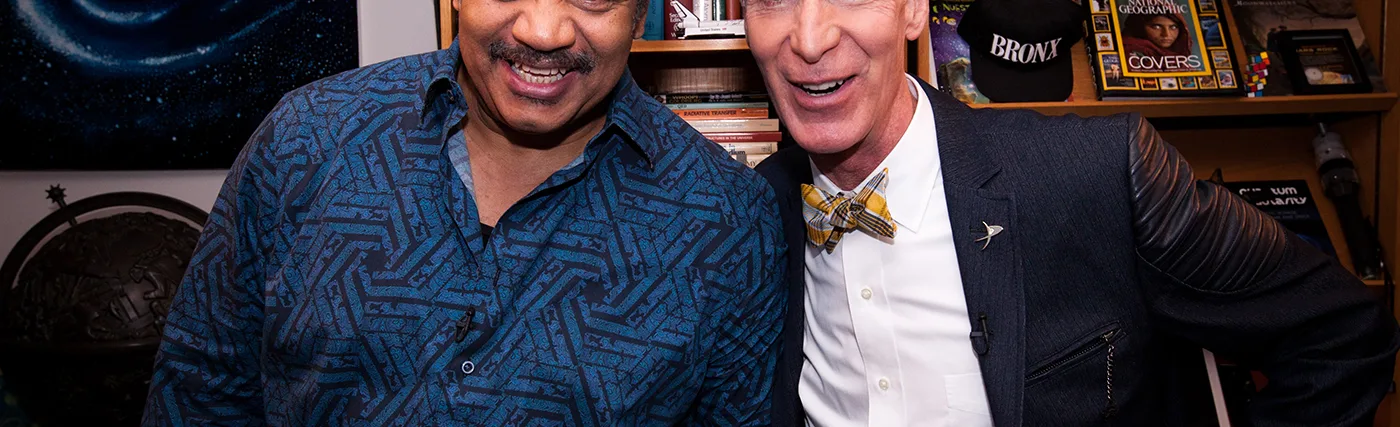
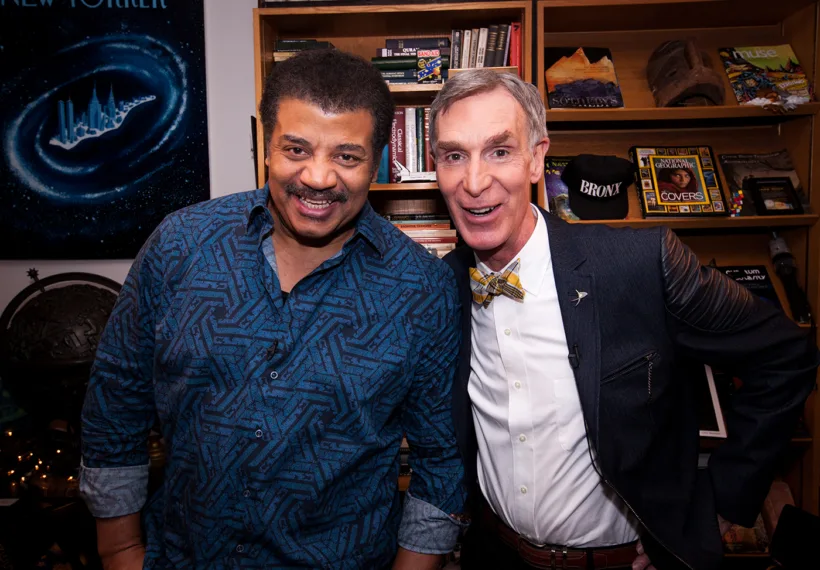
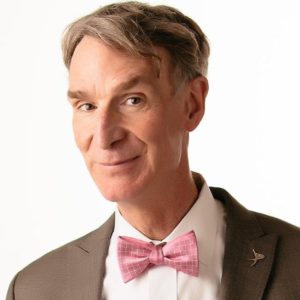
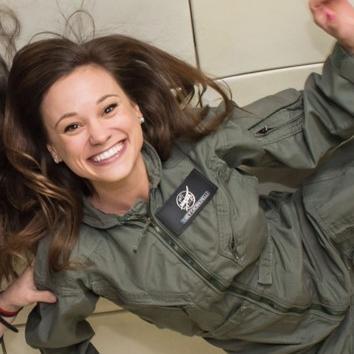
How does one become the “Science Guy?” Where did it all begin? And what’s with the bow ties? On this episode of StarTalk Radio, Neil deGrasse Tyson sits down with his good friend Bill Nye to find out from the man himself. In-studio, Neil is joined by comic co-host Chuck Nice and science communicator Emily Calandrelli.
We start at the beginning. You’ll learn about Bill’s upbringing and his mechanical engineering background. Bill explains how his father’s love for investigating the night sky influenced his decision to take astronomy. We talk about his first foray into astronomy class…which happened to be taught by Carl Sagan. Bill tells us about his class’s influence on the music for The Golden Record attached to the Voyager spacecraft.
Learn more about Bill’s time spent working at Boeing developing aircraft. Investigate Bill’s patents which include a throwing machine, a ballet slipper, and a “hydraulic pressure resonance suppressor” which is still used on 747s today. Emily tells us about “Ada Lace,” a character she created that helps children engage with science and invention. You’ll finally find out why Bill wears the bow ties! And, we discuss the signature style of other scientists.
Bill shares his favorite love story with us which just so happens to include the development of the atomic bomb. Biological anthropologist Helen Fisher, PhD, drops in to discuss the science of falling in love. We answer fan-submitted Cosmic Queries that explore love at first sight, the brain chemistry of love, and Bill asks his own question on the science of love.
Re-visit the catchy, era-defining theme song from Bill’s original show as Chuck advocates its importance to kids growing up during that time. Neil ponders if “Science Guy” is a misnomer for Bill. Lastly, Bill tells us how he’s currently working to change the world. All that, plus, we cap off our Bill celebration with a mash-up of some of his best dispatches for StarTalk TV.
Kohl Chrislock, Bradley Desrochers, Katelyn Hague, The Fellowship of Doge, Stu Glassner aka Neurocleric, Tabitha Bradley
NOTE: StarTalk+ Patrons and All-Access subscribers can listen to this entire episode commercial-free.
Transcript
DOWNLOAD SRT
From the American Museum of Natural History in New York City, and beaming out across all of space and time. I'm your host, Neil deGrasse Tyson, your personal astrophysicist, and tonight is a special night on StarTalk because we're featuring...
From the American Museum of Natural History in New York City, and beaming out across all of space and time.
I'm your host, Neil deGrasse Tyson, your personal astrophysicist, and tonight is a special night on StarTalk because we're featuring an interview with one of America's most recognized science educators, Bill Nye, my good friend.
So let's do this.
Tonight, my comedic co-host, Chuck Nice.
Tweeting at ChuckNiceComet.
Thank you, sir.
Yes.
Also joining us is engineer and science educator, Emily Calandrelli.
Emily.
Welcome.
And your executive producer and Emmy nominated host of the educational TV series, Exploration Outer Space.
You will also serve as a correspondent on Bill Nye's Netflix show, Bill Nye Saves the World.
So, Bill Nye is, as we all know, he's beloved and he's a frequent contributor to StarTalk.
Yes.
But tonight, he's the main attraction.
He's my main interview.
And he came by and he sat down in my office.
And I wanted to get the full story on how he created, how he forged his unique path to become America's most beloved science educator.
Or maybe he's America's most equally beloved science educator.
I'm just going to say.
He knows who's paying him.
Let's check out the first clip.
Bill.
Dude.
Welcome to the show.
It's great to be on the show.
We have a show called StarTalk.
I've never heard of it.
Tell us about it.
So, you weren't always the science guy.
No, that's true.
So, you went to college at Cornell.
Yes, I went to Cornell.
From DC.
From Washington.
Born and raised.
Born and raised.
Okay, so you went to Cornell, majored in?
A mechanical engineer.
You were an ME.
I'm an ME.
BSME, because I always liked bicycles and airplanes.
What were your years there?
73 to 77.
This coincides with the man himself, Carl Sagan.
With Carl Sagan, yes, yes.
He was a professor at Cornell.
Professor at Cornell.
So what happened was I completed my engineering requirements.
I took three years of calculus.
I was good.
I took heat transfer, fluid mechanics, strength and materials, design mechanical components and control systems.
Then with that completed, I decided to take astronomy.
Now as you may know, my father was a prisoner of war for 44 months, longer than anybody else from the US.
And during this internment, apparently-
A German prisoner of war or Japanese?
Japanese.
And if you get a chance to be a prisoner of war, don't do it.
It sounds like a real drag.
But he became fascinated with the night sky during this time.
He could easily tell you all 88 traditional constellations and he could just look up in the Northern Hemisphere and do what, four dozen?
Something about that.
Is that about right?
In the Northern Hemisphere?
Yeah.
Yeah.
Well, Northern Hemisphere you see also some of the Southern Hemisphere.
I say, yeah.
Anyway, so I decided to take astronomy from this famous guy, Carl Sagan.
And my claim, Neil, is I was in class when he asked us what rock and roll song should we put on the records to go out of the solar system aboard the two Voyager spacecraft.
And my claim is…
This is the famous Voyager record.
Golden…
It contains sounds of Earth.
Sounds of Earth.
And so my claim is, we were there, he wanted to put on Roll Over Beethoven, a sort of a inclusive rock and roll classical music embrace somehow.
But we said, no, no, rock and roll, Chuck Berry, it's Johnny B.
Goode.
And that's what we told him in class.
And so that was an exciting time, Neil, it was exciting.
In fact, Johnny B.
Goode was sent on the record.
So Emily, you tweet as the space gal.
The space gal.
Very cool.
Very cool.
And so when did your interest in space begin?
So I wasn't really a space nerd until I got to college.
And I remember exactly when it happened, because I was walking down the hallways of West Virginia University, where I went for undergrad, and I was choosing what engineering major I wanted.
I knew I wanted engineering, but I didn't know what kind.
And I saw a poster of a student floating in weightlessness.
And it said something corny like, at West Virginia University, you can do your homework weightless.
And I was like, what kind of nerdy metaphor is that?
And it turns out that if you studied aerospace engineering, you can fly in something called the vomit comet, which, as you know, I'm sure that plane that flies like a roller coaster in the sky and allows you to float weightless inside of it.
And so I wanted to fly in the vomit comet.
And that's why I did aerospace engineering.
Did you fly in the vomit comet?
Three times.
Did you vomit in the vomit comet?
One time.
Because if you vomit in zero G, the vomit doesn't go to the ground.
It just floats and gets in everyone else's hair.
And that is just nasty.
So after Bill Nye's degree, he landed a job at Boeing up in Seattle.
And he worked on the design and production of America's most famous jet, the Jumbo Jet.
Nice.
The Boeing 747.
I asked him about that.
Let's check it out.
You graduate from Cornell, get hired by Boeing.
Yeah, recruited.
HQ is in Seattle.
At that time, Seattle.
They got their own runway.
That's a cool thing about airplane building if you decide to go in the business.
Your factory has to be at the end of a runway.
And so you might not, like when you buy a car, you're very happy that your new car only has a mile on it or a mile and a half or even six miles if you're giving somebody a test drive.
Your airplane doesn't come on the back of a truck.
They fly to wherever you are.
And in some cases, they take, we take all the seats out or don't put the seats in until it gets there because they're a little too heavy to fly nonstop on these extraordinary journeys back then.
So in other words, if you're going to deliver a 747 to Thailand, Thailand, you could, how about Cape Town?
Cape Town, sure, crossing the equator.
So you got to send it there light.
Yeah, yeah.
And they thought of that.
That's engineering, which is all physics, Neil, applied physics.
It's using physics to make things.
That's our biz.
So what did you do for Boeing?
I worked mostly on the horizontal stabilizer, a little bit on nose wheel steering.
Of the 747?
747.
But I did work a little bit on 737, a little bit on 27 and...
Excuse me, 27.
727.
27.
Well, that's how you say it.
What are you going to do?
No, so 273747, and just the 57 is a great airplane, but it is, as we say in the business, a derivative bit.
So what's your favorite 7?
Well, I have great affection for 747.
747 had a whole bunch of innovations.
Did you know that 747 has no direct connection between the yoke, the steering and rudder pedals, and the control surfaces?
The first fly by a hydraulic airplane.
It is an astonishing thing that I find thoroughly charming.
If a 737 loses all its hydraulic power, a human can operate it with his bare hands.
So what you do is use the energy of the moving air to operate control surfaces and steer the plane.
You lose maneuvering performance, but you can do it.
But the 747 can't do that.
The 747 relies on windmilling engines, which have a lot of drag, aerodynamic drag, but it works.
It's quite a thing.
You go on a flight test, turn off all the engines.
Is it going to land?
I guess we'll see.
So, what was missing at the end of that bit, that segment, was the question is, well, will it land?
The plane will always land.
The plane will land.
It's just mad whether it lands softly.
Gravity takes care of the landing part every time.
The landing will happen no matter what.
Will happen.
Gotcha.
Okay.
So, Emily, do you know about this hydraulic system that he was talking about in the 747?
So, I'm not a plane person.
I'm more of a space person in the aerospace.
That was just a disk.
Didn't that sound like a disk?
I know.
You earthlings.
You just need air.
With your air.
You know what I mean?
Thanks for watching!
I'm a space person.
Okay.
Space is a bit cooler.
It's pretty cool.
Yeah.
But so, flying without engine power, it's just a glider, I guess.
Yeah, it's just a glider.
And so, I did a little, this, that was kind of over my head.
And so, I would be a bad science communicator if I couldn't quickly learn about things like that.
So, I did a little research.
And what he's talking about is that large airplanes like the 747 use hydraulic systems to help the pilot control different things on the airplane.
Like things like landing gear and flaps and stuff like that.
When the engines cut out, those hydraulic systems don't work.
And it becomes a glider and it kind of loses altitude fairly quickly.
But on the 737, an older airplane, the pilot can maneuver it himself or herself.
But it's really difficult.
You need a lot of strength to be able to do it.
And it's definitely not an ideal situation and a very, very, very not ideal situation.
With the 747, they have these windmilling engines where it's like a windmill.
And if you see a 747 on a runway and it's totally turned off, but there's a strong breeze, you'll see those.
You see them inside the turbines.
They start moving.
And I know that because they have a little teeny like hypnotic little thing on there.
And I look at them all the time and then I want to kill somebody.
Oh, it's an unintended side effect.
But on windmilling engines like that, they can help provide more air pressure for those systems.
And so it's just a more innovative design to help in that very unideal situation.
Unideal.
Unideal.
I like that.
Yeah, you're about to crash.
That's unideal.
Ladies and gentlemen of Flight 666, we're in an unideal situation right now.
I like the C cushion can double as a toilet.
So when Bill was at Boeing, he invented a hydraulic resonance suppressor that is still used today in the 747.
But he also holds several patents for other inventions.
I don't know how many, but we have a few of them, right?
So we've got a few.
So one of them is a, these are legit.
These are real.
Totally real, legit thing.
So this is a throwing technique training device and it helps optimally position the athlete's throwing hand and elbow before throwing a ball.
You ever see some people that they really know how to throw?
Right.
This will help them know how to throw.
There you go.
There you go.
Next one, he's got an improved ballet slipper that puts less stress on your toes.
So this one, it supports the ballet dancer's foot while dancing on point.
That's cool.
See that?
So it's got structure.
I know it's real because those are real patent numbers up there.
This one is an educational lens and it's a magnifying glass created by filling a specially shaped plastic pouch with water.
That is really cool.
Yeah, give it up for Bill Nye's patents.
Well, before we get the full story on his like the Science Guy, I had to get the story on his bow tie.
Yes.
What's going on with that?
So, let's check it out.
Are you wearing bow ties this whole time?
So, I was flirting with bow ties.
You know, I'm of European descent.
So are a lot of people in Seattle.
So are a lot of people doing stand up comedy or trying to do stand up comedy.
So one seeks to distinguish oneself.
And this was at a time when I started working, everybody wore a tie to work.
It was still in that era.
You look at black and white pictures of people working on airplanes or aerospace in the 1950s.
Everybody's got a white shirt and a tie.
White shirt and tie.
Yeah.
So I would wear a tie to work and then work on a drawing board, I would tuck it in my shirt.
So, just derived from that, I experimented with bow ties.
And then I found that they have great practical use.
I just never thought about the fact that you'll never get spaghetti sauce on a bow tie.
That's right.
They do not flip into the flask.
They don't go into shredders.
So, Emily, so Bill got his bow tie, and his lab coat and little pencil neck coming through his shirt, and that made him a recognizable, lovable character.
And from our crack team of research on your activities, you created your own science communication character.
I did.
You did.
I did.
Who is Ada Lace?
Ada Lace, yes.
So Ada Lace is a third grader who loves science and technology, and builds her own robots and gadgets to solve mysteries and problems.
And you invented her.
Yes.
That's beautiful.
That's really cool.
That's beautiful.
Ada Lace on the case.
Ada Lace on the case.
And I like this little telescope here.
Oh yeah, she's a huge space fan, obviously.
How could you not be?
So it's hard to picture Bill Nye without his signature bow tie.
Without a doubt.
And if you become, if you start living your character, you become one in the same.
So I'm always intrigued by people that have these signature things.
There's a lot of people in science who actually have like signature swag or, you know, like for instance, you know, you have your ties.
And that's your best.
You know what I mean?
There's Carl Sagan, signature.
The turtleneck.
All right, up next, we find out how Bill Nye actually became Bill Nye the Science Guy when StarTalk returns.
The future of space and the secrets of our planet revealed.
We're featuring my interview with science communicator, extraordinaire, Bill Nye.
And I asked how his interest in comedy and his background in engineering coalesced into the identity of the science guy.
Let's check it out.
It's a wonderful thing to get people to laugh at your comedy jokes.
And so I started doing standup, or trying to do standup.
Like in standup clubs and stuff?
Yeah, yeah.
So I would work on a drawing board and then I would go home and take a nap and then go to comedy clubs.
So you were engineer by day, comedian by night.
Yes, that was what I was trying to do.
It's a problem.
The thing that always...
Is engineering still in your head at some point?
Yeah, I miss it.
While you're doing that?
Yeah, yeah.
So was the stick engineering informed?
Yes, that's what I say.
Hilarious jokes about electrocuting yourself while trying to fix a blender.
Wow, is that funny?
And chewing marshmallows frozen in liquid nitrogen so that steam comes out of your nose.
That's hilarious.
Come on, it's a payoff.
And I realized that what I wanted to do...
I came of age at a time, for me as a mechanical engineer, it was really troubling.
We had the Chevy Vega and the Ford Pinto.
And these were just badly designed cars.
The administration decided not to embrace the metric system, something you and I haven't fully agreed on, is my belief.
There's America, Jack.
Yeah, I thought the United States was falling behind industrially.
There's America.
So I got very concerned about the future.
I'm not kidding you, very concerned.
And I realized working at the Science Center in Seattle that young people are the key to the future.
I mean, this is obvious, but they're the key to our industrial future.
They're in key to our economic competitiveness.
The future of civilization.
The future of civilization.
And so I wanted to get kids excited about science in the same way I had been excited about science by my teachers and a television guy named Don Herbert, Mr.
Wizard.
I remember Mr.
Wizard.
So all this came together into a unique arc of life.
That's my claim.
That's my story.
So Bill Nye became a pop culture phenomenon.
Anybody growing up in the 1990s who that is in school in the 1990s knew about his show in science class.
And it originally aired on PBS from 1993 to 1998, 100 half hour episodes.
So why do you think the show is so successful?
I'm gonna be honest that when you look at Bill Nye's show, one thing sticks out and anywhere he goes, people go, Bill, Bill, Bill, Bill, it's the theme song.
The theme song is awesome.
Check this out.
Here's the Bill Nye clip.
By the way, I was so as creepy that a severed head would be rotating.
I just thought, like, if you guillotine someone and put it on a rotisserie...
Very Roman.
That's what that looked like to me.
A scene from, you know, Game of Thrones, where the heads are on spikes.
I like it even more now.
It was just a little creepy to me, but...
However, I will say this.
I liked it so much.
I took the liberty of making one for each of you, okay?
So we have Emily.
Here's yours.
Here you go.
Emily, Emily, Emily, Emily Calandrelli, the science something.
Chuck, that was the lamest song ever.
I know what you're thinking.
I know what you're thinking.
How'd you get it that good?
You couldn't find anything to rhyme with Calandrelli.
No, I couldn't.
So, you know, but I still think it works.
And I got one for you, bro.
I got one for you.
Check it out.
Neil, Neil Tyson, the astrophysics guide type of Tyson.
I'm not by you, but that was pretty spooky, actually.
So, Emily, so research has shown that kids who watch the Bill Nye Science Guy show are more likely to think about science as playing a role in their lives and in society.
They're most likely to like science.
And so did you watch his show growing up?
Oh, yeah.
Yeah, everybody.
Everybody did.
I remember, you know, the wheeling in of the big, hunky TV and then seeing Bill Nye in our classroom.
In the classroom.
Yeah.
So was there a particular episode that you?
The one that stands out that I remember the most is the planets and moon episode.
The space episode.
But I remember it because he was on his bike and he did it to show the actual scale of the distance of the planets, which I had never seen before.
You know, you like see those models in your classroom and you think that everything is so close to each other and so neat and perfect.
And it fits on two pages of a book.
And it fits on two pages of a book.
But he showed that that is nowhere near the scale of the universe or the solar system.
So demonstrating things are what works there.
So that helped you think scientifically about the world?
Well, see, I think thinking scientifically is a very specific way of thinking.
And for me, I don't know, honestly, I don't think I started thinking scientifically until grad school.
Because for me, thinking scientifically means like having very specific rules for how you think, having a filter, having standards of thought.
But in undergrad, I suffered from being a perfect student all the time, which meant...
Suffered?
I suffered from it.
Oh, I would definitely say it was suffering.
Because you just always have to get perfect grades.
And what you do in school is you memorize a bunch of stuff and then you regurgitate it.
That's not scientifically thinking.
At all.
At all.
But that was the best way to optimize my schooling.
That's how you get good grades.
That's how you get good grades.
It's not how you learn, but it's not how you become a scientifically-minded student.
Well, you can learn accidentally.
You could.
So were you valedictorian?
In high school, no.
I was never a smart kid.
That was never like one of my...
I'm a slow learner, so it takes me a long time to learn things than the average Joe, I think.
Interesting, because the school system requires that you learn it on a timetable for when the test comes.
If it takes you twice as long, but you still learn it, or maybe you learn it better, you don't get as high grades as someone else who learned it in the time slot allocated.
You're absolutely right.
And by the way, you feel so much better when you actually learn something.
Rather than lament not having learned it at the time you were supposed to.
There you go.
Well, Bill's known as the Science Guy, but his background is in engineering.
So I wondered if we really should have called him the Science Guy if his background is in engineering.
It was just a thought.
So can I ask, am I allowed to have that thought, Chuck?
Let's check it out.
So I guess there's no way to have called you Bill Nye the Engineering Guy that doesn't have a ring to it.
Well, I call myself that often, yeah.
But engineering is based on science, everybody.
I know, but there's no...
No, but Neil, you see we all suffer our own insecurities.
What I'm saying is, it seems like scientists are a dime a dozen in the media.
Oh, now?
But no one can name an engineer.
We can name you, but you're Bill Nye the Science Guy.
Should we have somebody, you know, Betty Lou, the engineering woman or something, so that when a bridge falls down, when the levee breaks, when a plane falls out of the sky, when they can't find a sunken ship, they call the engineer person?
Doesn't the world need that?
Yeah, and I've been called on plane wrecks and train wrecks, and I pointed out to people how we all rely on engineering.
Everything in this room, perhaps these chairs especially, these electronic cameras, all of these things were engineered.
We use science to make shapes and things and solve the problems associated with those things.
You don't just show up and design a car with a certain amount of kilowatts or horsepower.
You've got to think it through.
So you know how many times I'm asked who would win in a cage match between you and me?
Oh, you'd kick my ass.
I get asked a stupid number of times, and I say, so rather than say I can kick your ass, I just say, if we were on Gilligan's Island, you'd want Bill Nye as the professor.
Well, thank you.
I have a tinker.
He would save Gilligan.
I would romantically point out the night sky stars, but that's not saving anybody.
Well, up next, we'll discuss the science of dating and romance with Bill Nye the Science Guy when StarTalk returns.
Welcome back to StarTalk from the American Museum of Natural History.
We're featuring my interview with science educator extraordinaire Bill Nye.
And I asked Bill if his love for science permeates his love life.
Do you bring any science or engineering analysis to your dating?
Sure.
The most romantic story I know, Neil, absolutely the most romantic story I know, is of course associated with the making of the atomic bomb.
So this is where they recruited young scientists and mathematicians to go to Los Alamos, New Mexico to work on the Manhattan Project to try to finish this thing off, get this war over with.
And they approached Arthur Compton, and he was a young guy at the University of Chicago.
We want you to come to Los Alamos, let's go right away.
He said, yes, I'll come, but I've got to have security clearance for my wife, Betty.
And they go, no, no, no, come on, Mr.
Compton, maybe it was Dr.
Compton at that point.
You've got to get down here, we've got this matter of national security, let's go.
And besides, Arthur, why do you want security clearance for your wife?
And he said, I'd just like to be able to talk things over with my wife.
That's pretty good, that's pretty good.
So, you want a scientifically literate girlfriend?
I want a girlfriend I can talk things over with.
Oh my God, nothing says love like nuclear holocaust.
Well, for this segment on love and science, we have to bring in another guest.
A friend of StarTalk, not her first rodeo on this program, Helen Fisher.
Helen, welcome.
And every time you're on the show, there's some other book, Why Him, Why Her, How to Find and Keep Lasting Love.
Right, exactly.
Like you're some kind of expert?
Hope so.
So, in fact, you are the chief scientific advisor to the internet dating site match.com.
I am.
So Helen, is this, he said he wants a girlfriend he can talk science to.
Right.
So how important is your mate as a sounding board in this kind of situation?
Not everybody wants what I call a mind mate.
He wants a mind mate.
Some people want a soul mate.
Some people want a help mate.
Some people want a play mate.
I prefer a play mate.
Probably most of you guys would too.
He wants a mind mate.
He's a very high testosterone guy.
And he wants somebody to talk things over.
He's talking straight out of his biology.
Wait, so why does being a mind, looking for a mind mate mean it's testosterone driven?
I think sex.
Sex what?
Sex too.
Sex, like testosterone.
Isn't that like what makes men like super?
And women, and women too.
And women too.
Sure, absolutely.
I mean, testosterone is linked with a whole pile of biological traits.
People who are very high testosterone tend to be analytical, logical, direct, decisive, tough-minded.
Good at what we call rule-based systems.
Everything from math to engineering to computers to music, etc.
And that's what he is.
Interesting.
Well, this brings us to the part of StarTalk we call Cosmic Queries.
And because what do we do?
We took our audience, our fan-based questions about the science of dating and romance.
And we've got one of the world's experts right here at the table, Helen Fisher.
So Chuck, did you bring questions with you?
Indeed I did, Neil.
I haven't seen them, but we got right expertise here.
Yes, we do.
Let's do this.
And so our first question is from Layla Beam from Facebook.
Is there a scientific basis for love at first sight?
Yes.
I put people in brain scanners and study the brain circuitry of romantic love, and it's a basic brain circuitry, and it can be triggered instantly.
Yes.
And I know that for a fact because I wanted to marry my wife the moment I saw her.
54% of men have experienced it and 47% of women have experienced it.
It's not magic.
You know, I mean, when you think of a squirrel in the beginning of the mating season.
Took my whole marriage and boiled it down to me being a squirrel.
Just got your thanks.
Well, the bottom line is that all animals feel an instant attraction.
And a squirrel in the beginning of the mating season, she's got to find another squirrel who's got nice perky ears and a nice fluffy tail and a nice good gait.
And she can't spend three years talking about his college plans.
She's got to get on with the program here.
So this brain circuit tree can be triggered instantly in all kinds of mammals and certainly in people, too.
And what a lot of people don't know, just to say, is that if you stick around long enough, it happens over and over again.
That's a beautiful thing that you said.
Because, you know, we have put people into the brain scanner who are in their 50s and 60s who came into the lab saying that they were still madly in love, not just loving, but in love with their long-term marital partner.
And in fact, it can happen over and over and over, just like you said.
You have to realize what you sound like.
People come into my lab and we stick them in the brain scanner.
This just sounds...
So romantic.
When in doubt, stick them in the brain scanner.
All right, Chuck, what's that?
All right, here's our next question from Sidereal Synapses from Instagram.
Can love solely be attributed to the chemicals in the brain?
Or is there something still magical and wondrous about it?
Are we just chemical love lab?
Or are we tapping into the beauty and the passions of the universe itself?
Sure, why not?
There's always magic to love.
I would say no to the universe part of it.
I would too.
Helen, what you're saying is you will allow there to be some dimension that you're not measuring that might still sort of wrap this package in a bow.
I've never met two people who are alike.
I'm an identical twin and even she and I are not exactly alike.
How do I know we have the right Helen Fisher?
Chuck, next question.
Well, we have one last question.
And I believe this one is from the man that we are discussing himself.
Ladies and gentlemen, Mr.
Bill Nye.
Bill, you got a question for us.
Yeah, so the question would be, you answered several of my preliminary questions, but Helen, in this case of chemistry, is there something to human pheromones or are they overwhelmed?
And I have a follow-up.
Are they related to this mythic, multi, what is it?
Major histocompatibility complex.
So those are two separate questions.
I've already forgotten the first one about pheromones.
I didn't understand either question.
Okay, well, I'll repeat.
So there's two things.
I'm not a person who does believe that humans have basic pheromones.
If you were to talk to a couple scientists, they might support that, but most of us do not.
We are basically an animal that, we are a sight animal.
You know, we don't say love at first smell.
We say love at first sight.
For millions of years, you'd fall out of your trees if you didn't have a good vision.
And those huge parts of the brain are built to look at somebody.
So we look at somebody and size them up rather than smell them to size them up.
And it may play a tiny little role, but it's nothing that's gonna be really important in made choice.
Unless somebody smells perfectly horrible and that's a different issue.
And then MHC compatibility.
They have found that it's a certain part of the immune system, and if you and your partner share a lot of the genes in that part of the immune system, the female's gonna be likely to be more adulterous on the side.
So there are chemical things that are playing a role in pair bonding and romantic love and adultery.
And the MHC compatibility is one of them.
But there's many other things.
I mean, we fall in love with somebody for a great many reasons and chemistry is one, certainly.
That's what we've been talking about.
That's probably about 50% of the show.
But we also fall in love with somebody from the same socioeconomic background, same level of intelligence, good looks, sense of humor is essential.
And the more you get to know somebody, the more you like them.
So it's not just good looks.
Well, Bill, we gotta run.
Thanks for dropping in.
Science!
And Helen, thanks for dropping in on this love segment.
Next with Helen Fisher, everyone.
Why him?
Why her?
She's still at it.
Up next, Bill Nye gets all fired up for science in the continuation of my interview with him when StarTalk returns.
Hey, we'd like to give a Patreon shout out to the following Patreon patrons.
The Fellowship of the Doge, Stu Glassner, AKA Neurocleric, and Tabitha Bradley.
Thank you guys for your very normal names.
Well, at least you Tabitha.
And if you wanna support us on Patreon, go to patreon.com and support us.
The future of space and the secrets of our planet revealed.
This is StarTalk.
Welcome back to StarTalk, from the American Museum of Natural History, right here in New York City.
We're featuring my interview with America's Science Guy.
Who could that be?
None other than Bill Nye.
So let's check it out.
In your sort of later life, post Science Guy, you've written a couple of books.
Three books.
Three books?
Three books.
One of them's about evolution.
Now here's an example, Neil.
I'm not an evolutionary biologist, but I claim I have enough science literacy to have written a book about the fundamentals of evolution.
And I did.
It's not only the science literacy, it's street cred as an educator.
Thank you.
Yes, I do consider myself an educator.
There's plenty of science literacy where people don't know how to communicate, and then that could be worse.
I've worked very hard at becoming a competent educator, and, Neil, I will say this to the audience, one of the most moving things I've ever received and I've kept is a note you wrote me, long about 1998, saying, Bill, you are an educator.
And you meant it with, I believe, you meant it with respect.
And I treasure that.
But it is an extraordinary time where this anti-science movement has gained so much strength and momentum, and we have people who sincerely question whether or not the Earth is a sphere, or an oblate spheroid, or whatever the heck it is.
Are you kidding me?
Are you really real?
And they seem to be quite serious about this, and I know you fight this fight.
Our real understanding of our real place in the cosmos is so exciting.
You just wanna go up to people on the street and go, hey, man, the Earth is a ball.
Isn't that the most exciting and extraordinary thing you can imagine?
Wait, wait, Mars is a smaller ball.
It cooled off faster.
It got an ocean before the Earth did.
It got an atmosphere before the Earth did.
Perhaps life started on Mars before it started on the Earth, and you and I, through an extraordinary solar systemic collision, are descendants of Martians.
That is an hypothesis that I would like to investigate in my lifetime.
Just thinking about it fills me with reverence.
And then I was at Cornell when Hans Bethe would do the freshman lecture, something by all accounts, he insisted on doing.
Brilliant physicist.
And he's the guy that discovered or quantified or wrote down the CNO cycle, the carbon nitrogen oxygen cycle in stars that produces all the elements of which you and I are made.
No matter who our ancestors were, you and I are made of the same star dust.
That is extraordinary and fills me with reverence every day as a human, as a scientist, a science educator, and frankly, as an engineer.
It is amazing.
We would not have light-emitting diode lamps for this television interview without rare earths, which came from some exploding supernova.
Rare earth elements.
Rare earth elements.
Heavens, pun intended.
That is amazing.
Emily, why isn't everybody this fired up about science?
Well, it's hard to be as fired up as Bill, but I do think that Bill has been studying this for such a long time that he understands it so well and understands how seemingly miraculous science is.
I think that it can be really intimidating for people that don't understand science.
It can be sort of a hit to your confidence.
And so if we as science communicators can make science nicer and more welcoming, I think we're gonna get more people just as excited.
So is it just nicer or is it what he was doing?
He connected exploding stars to studio lights.
So relatable.
So there's a sort of a down to earthitude about it.
And so I have to ask Bill, if he's that influential on the world, what went wrong?
Oh yeah.
Yeah.
Yeah.
Yeah.
Yeah.
What happened?
Let's find out.
You have influence in an entire generation of people in this land.
Why is the country so messed up?
Well, we're not done.
That's what I tell people.
I'm serious.
I'm hopeful.
Would it be much worse if you never existed?
Oh, yes, Neil.
Without me, the world would have flown off the rails much sooner.
What sort of ego maniacal thing is that?
I've tried my best to get young people excited about science so as they come of age, become captains of industry, they will make different decisions about the Earth's climate, about the role of industry in improving the quality of lives of people and the role of science.
We have people running around not getting vaccinated.
So you have targeted kids?
On purpose.
Okay.
But you also step out of that zone in your later life and you've targeted some adults.
Yes, sir.
Like, creationists.
Creationists.
Head on.
Yeah, yeah, and the creationist thing, understand, is motivated by the children.
That guy and his organization in Kentucky are contaminating the minds of young people so that they are scientifically illiterate, so that they do not trust their own perception of nature.
They do not have the critical thinking skills to evaluate evidence.
And so that as they become voters and taxpayers, the people they elect make good decisions for the betterment of society.
So, Emily, you're in the biz, how do you engage science deniers?
Oh, very carefully.
It's not an answer I'm going to accept.
Yeah, well, I think that you have to first ask your question, is your goal in that conversation with a denier to be right about the science, or is it to change that person's mind?
Important distinction.
Very important, because if you just want to be right about the science, you can be snarky and condescending and super witty, and you can rally a bunch of people to shame that person, but you will be right in isolation, because that's a one-sided conversation.
That person is not listening to you.
As my father used to say, it's not good enough to be right, you have to be effective.
All right, up next, Bill Nye reveals his plan to change the world when StarTalk returns.
We are celebrating the life and legacy of my really good friend, Bill Nye.
And I asked Bill what he thinks is the key to science education.
Let's check it out.
It has to be entertaining first.
It has to be entertainment first.
The information and science and passion, beauty and joy come with, but it's got to be entertaining.
PB&J.
Without the PB&J, nobody's going to be into it.
Without it being entertaining, nobody's going to be into it.
And what is it you loved about your favorite teacher or professor was his or her passion.
Oh, yeah.
And you are passionate.
It had nothing to do with what grade I got or anything.
It's the passion.
It's that infectious passion.
Yeah.
And my proposition is if we had a scientifically literate society, we would be addressing climate change.
The three things we want for everybody in the world, clean water, renewably produced reliable electricity, and access to the Internet or whatever the Internet can…
Electronic information for everyone in the world.
If we could achieve that, we could change the world and we could save it for us humans.
The world is going to be here no matter what we do.
Earth.
Yeah.
I want to save it for us.
And that's an extraordinary goal, but make no small plans.
And, Neil, I'm honored to be on your show from time to time to promote science literacy, to have fun, and dare I say it, change the world.
The man, Emily, how can science literacy change the world?
I think science literacy is going to be the next wave of literacy because if you think about it, in 1820, only 12% of the entire world could read and write.
And today, that's switched a bit.
Now, about 15% to 17% of the world is illiterate.
And so that alone, it's an indicator of how advanced a nation is, how advanced a society is.
Just regular literacy.
And I think science literacy is going to be the next wave, the next requirement for how advanced a society is.
Now, he says science has got to be entertaining first.
Can't it just be intriguing, or?
Yes, it depends who your audience is.
It doesn't need to be that entertaining for people that already love science.
Right, exactly.
Right?
Exactly.
But for people on the outskirts, yeah.
I think you have to get them with the entertainment to welcome them into this circle.
So you might have known, Bill has been a contributor to this show.
And on and off, because he's a busy guy.
But he would send us dispatches from around the town.
So our editors did a mashup just to pay tribute to his contributions over the years.
Cool.
So let's check it out.
Greetings.
Hey, Neil.
Yo, Neil.
Science communication is what guys like Neil and I do.
To get people like you excited about the world around us.
Let's roll that tape.
Science leads to innovation.
Just look at that skyline.
All of those shapes came out of somebody's head.
In your brain someplace.
We've turned bunny trails and cow paths into streets and super highways.
We've been able to preserve the lives of millions of people around the world.
That's simple enough.
So how do we bring science to life?
Soaring above the city gives you a new perspective on the world below.
And our expanding universe.
Take it all in.
You have to breathe.
We're all animals.
Humans are in a class by themselves.
We share all kinds of information with everybody all the time.
Our imaginations could soar.
Oh, I'm okay.
And that's looking in.
Looking up and out, perhaps we can answer the oldest, deepest questions asked by all of humankind.
Is time travel possible?
Where did we all come from?
Are we alone in the universe?
Is what you're watching real?
Am I real?
You look so real.
Science will save us.
Was it science?
Or was it just plain trickery?
It's not magic.
It's mathematic.
Furthermore, there are more stars in the sky than there are grains of sand on a beach.
We've flown vehicles like this up into the icy blackness just to see what's out there.
So let's do that.
Let's honor the great tradition of exploring new worlds.
Let's embrace the process of science for a better tomorrow for all of us.
We've got to get to work.
See you down the track.
The track.
I will assert that the infusion of Bill Nye's videos into the classroom, as early as elementary school, had the following effect.
It enabled children to retain their curiosity through middle school.
That is the great trash heap of all curiosity.
And I said to myself, my gosh, there's this rising demographic up through our civilization, but they're not old enough yet to become senators or members of Congress or captains of industry or president.
They're not old enough yet.
So most of the complaining we're doing about science illiteracy in the world, from my read, is not from the younger generation.
So my generation may be unique in the posture of saying, I can't wait until the next generation takes over so they can fix what my generation f***ed up about this world.
And that is my tribute to Bill Nye.
You've been watching StarTalk.
First time on StarTalk.
As always, I bid you to keep looking up.
See the full transcript



 Unlock with Patreon

 Become a Patron