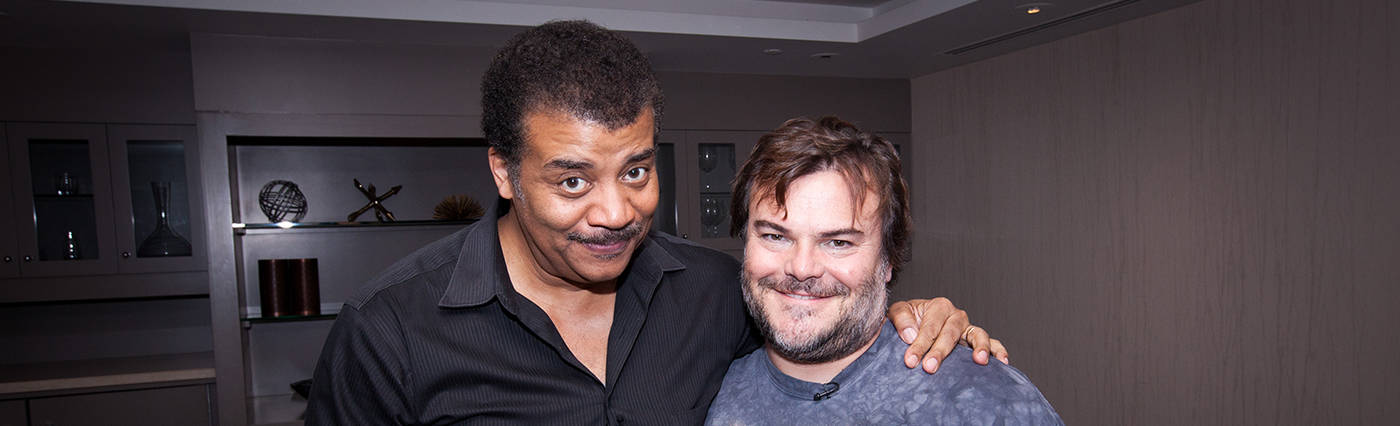
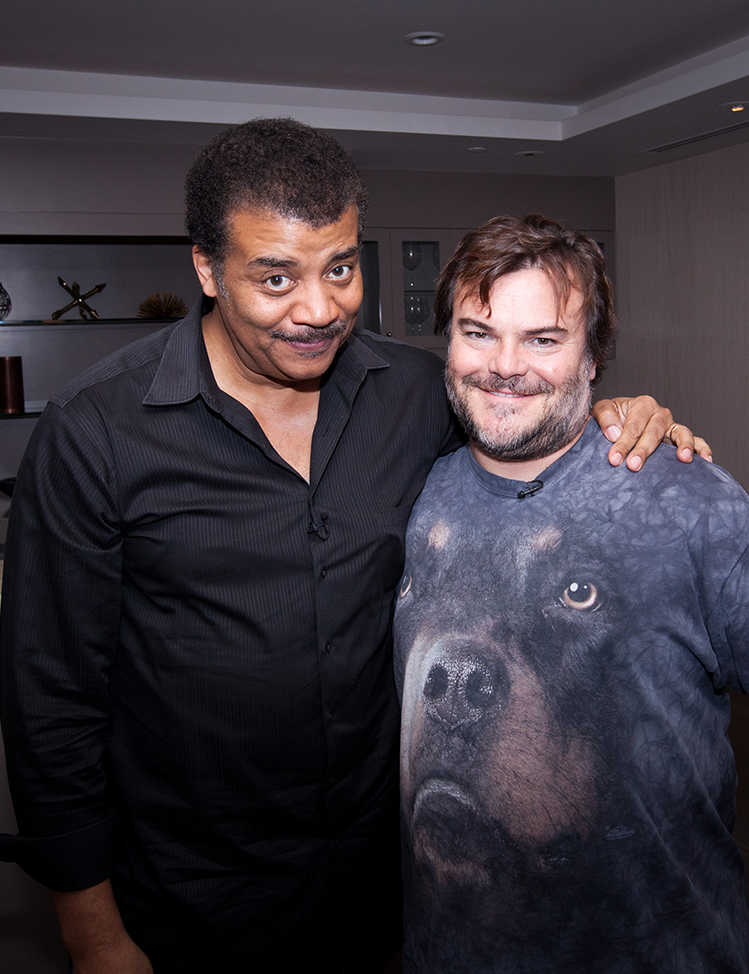
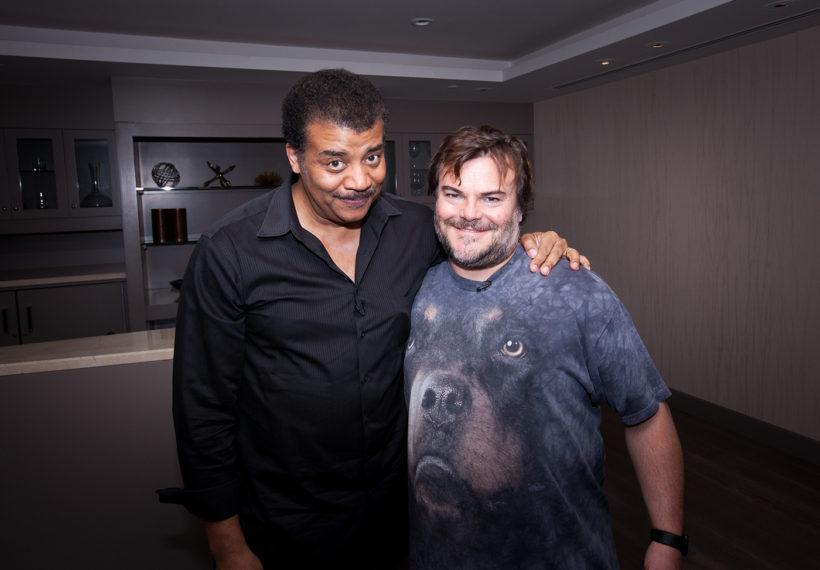
You’ll learn about Jack’s scientific upbringing and his almost career in aerospace engineering. Jack tells us about his parents’ connections to the Apollo missions and the Hubble telescope. Discover more about the origin story of Tenacious D and how it was responsible in helping launch Jack’s career.
Then, Jack turns the interview around and starts bringing the Cosmic Queries to Neil. We discuss black holes at the center of galaxies. Charles explains why that’s pretty much settled science and why we’re now searching for more than one black hole in each center. We dive into “quantum weirdness” and the weebly-wobbly world of quantum mechanics. You’ll learn about the “Observer Effect.” Investigate why Jack thinks Ant Man’s shrinking powers would be the best superhero powers to have.
Chuck leads us in a game to see how many mind-blowing facts Neil can list off the top of his head. We ponder if our universe is a simulation and if we have any semblance of free will. And we ask, even if we are in a simulation and we don’t have free will, does it matter? We explore humanity’s future and its possible path to destruction. Kate helps us understand the science of our own extinction and the global impact of climate change, and we answer fan-submitted Cosmic Queries about climate change.
Transcript
DOWNLOAD SRT
From the American Museum of Natural History in New York City, and beaming out across all of space and time. To the hall of the universe, I'm your host, Neil deGrasse Tyson, your personal astrophysicist. And tonight, we're gonna explore...
From the American Museum of Natural History in New York City, and beaming out across all of space and time.
To the hall of the universe, I'm your host, Neil deGrasse Tyson, your personal astrophysicist.
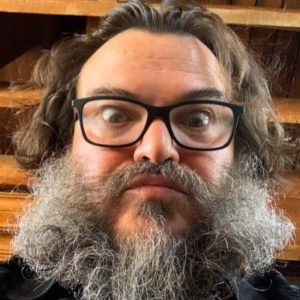
And tonight, we're gonna explore the cosmic curiosity of actor and musician, Jack Black.
He's had questions for me on everything, from black holes to the size of the universe itself.
So, let's do this.
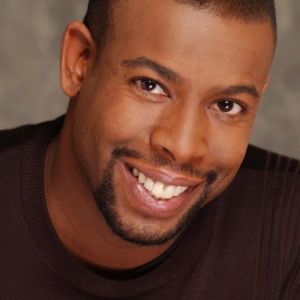
So my co's tonight, Chuck Nice.
Welcome back.
Always a pleasure, buddy.
Welcome back.
Also joining us is my friend and astrophysicist, Charles Liu.
Charles, welcome.
Excellent.
I'm a professor at the City University of New York at Staten Island, and you are our Star Talk resident geek-in-chief.
I am truly honored.
Thank you so much.
So we got our dream team here to discuss my recent interview with multi-dimensional actor and musician, Jack Black.
Best known for his lead roles in comedy films like School of Rock, like Nacho Libre, like Kung Fu Panda.
So I learned recently that he has genetic roots in math and science.
Let's check it out.
You know, my parents were both aerospace engineers.
Ooh.
Yeah.
My mother, she actually worked on one of the Apollo missions, but her calling card, her claim to fame was working on the Hubble Space Telescope.
So what town were you in where this was happening?
Hermosa Beach, California.
California, okay.
My mom worked over at TRW for a time.
Yeah, one of the contractors to NASA.
Right.
And your father was?
My father also worked at TRW, and they were both in the same field.
And he said-
You were primed to be a total geek kid.
They were very worried about me, because I was not going in the direction of an aerospace engineer.
But-
You don't have to make a face when you say it.
You don't have to put a-
I'm fascinated by it, though.
I'm interested in it.
It's just whenever I pick up a book on the subject, I can't get past the first page and a half.
But I am still drawn to the subject, not just because my parents were interested in it and were great at it, but also I'm just fascinated by the enormity of the universe.
And who isn't?
So Chuck, do you think he should have followed his parents' footsteps as a rocket scientist?
You know, I think maybe in a different universe he may have just been, you know, doing science-based comedies.
Oh.
That's all.
Like, you know, School of Rocket Science.
So Charles, science, you teach at a university.
Yes.
And science courses are typically required for, in most liberal arts schools, and if you major in liberal arts in any school, they make you take some science.
So what do you do with students like Jack, who struggled to get past, what, page one and a half?
You get another book.
You get another book.
That book's fault.
It's not Jack's fault.
Jack is great because he has this innate sort of desire to learn and be interested.
But if he's turned off by the book, get another book.
Okay, suppose he's turned off by the teacher.
Get another teacher.
It's our fault.
We gotta help him.
I like that answer.
That's, I like that answer.
It's too easy to blame the student.
That's right.
And the most transformational figures in history in any field have always been those who've had interest in something or an innate maybe parental support for something like aerospace, but gone on to do something else like performing arts.
Yeah.
We got that.
So Chuck, you get bored reading science?
Um, yeah.
Cause you're pretty science literate as a...
It doesn't stop me from being bored.
You know what I mean?
I enjoy it, but I am still bored.
Well, Jack Black is also the front man in a rock band called Tenacious D.
That just sounds bad ass.
So I asked him about this dual identity.
Let's check it out.
I just think of myself as a showman.
I like to put on a show.
That's good.
That's what I like to tell my kids.
You know, don't think about what you wanna be when you grow up.
I think that's a false thing that we put on our kids.
Think about what you wanna do when you grow up.
Because if you're trying to be something, that suggests ego and like, I want the title.
What do you really love to spend your time doing?
And I love putting on a show.
Love to get up in front of a crowd.
And all three of those, acting, music, comedy.
That's right.
They're all performing.
And truth be told, I wouldn't have an acting career for the music and vice versa.
I needed to combine those to get it going.
I met Kyle, my partner in my band, Tenacious D, in a theater company.
We were in the Actors Gang Theater Company.
By the way, I love the word tenacious.
It's a very SAT.
That's a very SAT word.
It means to doggedly go after your goal.
Correct.
Yeah, and it was in reference originally that came to us to basketball players.
There was a guy on TV, he talked about the Lakers playing Tenacious Defense.
And it was just something so funny about us naming ourselves after that.
But I really got my career going once I started that band with Kyle.
And we were writing our own material.
And your guitar?
Yes.
The singing and telling stories through music.
So Charles, you're a dad.
Yes.
And so what do you think of Jack's parenting philosophy of having his kids pursue what they want to do rather than what they want to be?
I think it's fantastic.
Because it's, I'm just thinking, if it's something you want to be, that implies, like he said, it implies title.
And some kind of achievement that everyone then looks at your title.
But if you want to just do something, nobody's going to pass judgment.
And suppose your kids just want to do nothing while laying on your couch and eating up your food and watching your TV.
Oh.
Give him time.
I didn't know the food in your family household was your food.
Who bought it?
So it didn't take long for Jack to turn the interview around on me.
And he started asking me questions.
This one about black holes.
Let's check it out.
Is there a black hole in the middle of the Milky Way galaxy, our galaxy?
Yes.
Okay.
Not a regular black hole, a supermassive black hole.
For every galaxy we've ever had the precision of measurement to ask the question.
They have revealed to us a black hole in their center.
And so even galaxies we have yet to test, we just say it almost certainly has a black hole.
We're done with that question.
Now we're on to what is the black hole doing to its environment?
Is it flaying stars that come too close?
Was the black hole necessary to nucleate the galaxy in the first place?
Was that the first thing that formed?
Did it form later?
These are all questions we ask.
Here's a question I'm going to ask.
You know when you take a bath and you pop the drain and the vortex happens and there's a little tornado of water going down the drain?
That's what the Milky Way looks like to me.
Is that what the black hole is?
Is it the drain?
And are we all?
Will that be our fate?
No.
We are safe from the black hole.
We are in orbit around the black hole.
We're safe.
But is it the same phenomena?
If you get too close, yes.
If you get too close.
But the Milky Way is spinning around.
Yeah, but all that material is safe.
It is not a vortex feeding the black hole.
Oh, good.
So you can sleep.
Because I know you were grappling with that.
I was worried, yeah.
We're not just a toilet bowl ready to go down the drain.
I just love the fact that you put his mind at such ease.
It was like you sold him homeowner's insurance.
Oh, okay, I'll do that.
So Charles, give me the latest on the evidence for black holes in the centers of galaxies.
Well, it's just as you said, every time we look at the center of a galaxy with enough precision, we basically always find a black hole there.
So that's settled science.
Now we're looking for two black holes or three black holes.
So which came first, the black hole or the galaxy?
That's still uncertain.
It looks like the cosmological simulations will allow that to happen either way.
But if you go from the very, very beginning, when the first stars form, it is true that the first black holes form before the first galaxies.
So it most likely starts with the black hole.
But that doesn't mean that the other way can also work.
So the egg creating the chicken.
So what is at the center of the black hole?
Something called a singularity.
It's a point with zero volume and infinite density.
But we don't know what...
Void those.
You see one coming.
Stay away.
Oh.
I feel like Jack Black now.
We literally do not know the physics of those singularities.
And we can't find out because we can't even get close enough to the singularity.
There's a thing called the event horizon around the black hole.
If you're standing on the event horizon and you shine a flashlight up, the light goes up and back down.
It never escapes.
So we can't even send radio signals.
Let's say we send a space probe down to the black hole and we see this is what the singularity looks like.
We still can't send a signal out.
We won't know unless we go ourselves.
But then we can't tell anybody else beyond us.
And as soon as you...
It's a beautiful name for a point of no return.
The event horizon.
You cross that sucker, you ain't never coming back.
I know.
It sounds like when my grandmother went...
Oh, don't worry.
She's dead.
No, we knew...
Oh, you got it.
Up next in my conversation with Jack Black, we discuss the physics of shrinking as in Ant-Man when Star Talk returns.
This is Star Talk.
We're featuring my conversation with cosmically curious actor, Jack Black.
He asked me about the quantum realm where the laws of physics get weird.
Is the quantum weirdness really just about, if you really break it down, is that when you look at a thing, it changes the thing?
Is that what it's really about?
That's an important aspect of it.
I mean, it's weird if it's true.
Okay, so, I wrote a book recently.
It's called Astrophysics for People in a Hurry.
I have a quote in the front of the book, something that I want people to know.
That is, the universe is under no obligation to make sense to you.
Because your senses are forged over, you know, a million years in this Serengeti not wanting to be eaten by a tiger or a lion.
Our senses are good for that.
Oh, that's moving this speed, not faster, not slower.
If I run, there's a day, sun rises, sun sets.
Time, we're not honed on a billion-year time scale.
In our awareness, we're not honed at the time scale of the vibration of an atom.
In the 20th century, we started looking at the edge of the universe and down into the atom.
We were seeing stuff that completely defied anything your five senses ever dreamt of, imagined or could relate to.
And we started saying to ourselves, it is true simply because we measure it to be true, not because it makes any sense at all.
Wow.
That was awesome, man.
Like, I was just waiting for you to just, like, go, like, straight Southern Baptist.
And I will rain down and fire.
Like, it was pretty damn cool, man.
Let me heal you of your questions.
So, Charles, explain the observer effect to everybody.
The quantum mechanics of the observer effect.
Yeah, the regular observer effect is very simple.
Like, if you're taking, say, a tire pressure gauge and you're just trying to measure a tire pressure, every time you push it in, a little air comes out.
So you've already affected it, right?
Before it closes it off to get the measure.
That's right.
So that's an observer effect on the non-quantum level.
On the quantum level, you can just put a machine to look at a subatomic particle thing, and it will lock in a quantum state.
And therefore, you've changed whatever that thing was doing just because you're trying to measure it.
One of my favorite observer effects is if there's a coin that falls in the car seat between the bottom and the back, and you reach for it, the act of reaching for it spreads it more and then it goes further away.
But if you're not doing it, it's happy just sitting right there.
Right.
So that's in effect an observer phenomenon.
That's right.
Because you're trying to interact with it.
The act of interacting with it changes its state.
That's right.
And the quantum mechanical level, the amounts of energy required to change the state of something is so tiny that just the act of measuring it will cause it to be completely different from what it was just a nanosecond before.
So are you saying that we can never have an accurate measurement on the nanoscale?
On the nanoscale.
Quantum mechanics is so different from our daily existence that you can almost imagine doing anything, right?
Schrodinger's cat, for example, very famous.
You assume that the cat's in there, but you don't know whether the cat is alive or dead until you open the box.
So that leads imagination while...
But that's always been true.
Why is it gurgling up now in new age philosophies and...
I think it's the latest new thing, right?
A hundred years ago, regular physics, what we might consider regular physics, was the coolest thing, right?
Now we have this quantum physics, and it's been, well, maybe 70 or 80 years or so since quantum mechanics was firmly established.
And now it goes into the realm of the imagination in pop culture.
Well, Jack Black sings about a superhero named Wonder Boy.
And when I asked him about it, the quantum realm came up again.
Let's check it out.
Well, Wonder Boy, just between you and me, was actually stolen from my favorite comic book.
There's a comic called Miracle Man by Alan Moore.
Genius.
He did The Watchman.
But before The Watchman, there was Miracle Man.
Love The Watchman.
And there was a character in there, but it was very much like The Matrix, where he was inside.
And in fact, I think Matrix stole a thing or two from Miracle Man, if you look back at that.
I like the way you whispered that to me in front of three cameras.
What is this bogus conspiratorial?
It's between you and me and the million people.
But it won't go outside of that circle.
But you know, I was thinking about superpowers, and I was thinking that the best one is from Ant-Man.
To be able to control your size and go down to the tiniest, tiniest subatomic level and conversely giant to, you know, the size of, I mean, although you would kill, you would destroy.
What are you saying is size matters?
Yes.
Well, does it?
Charles, how realistic is it for Ant-Man's ability to shrink to the size of an ant?
Utterly unrealistic.
Okay.
But how would it work?
Yes.
Okay.
There is so much space, actually, between the subatomic parts of atoms and molecules that if you took, say, Manhattan, where we are now, and took all of Manhattan, all of its skyscrapers, taxicabs, people, took the space out from between the protons, neutrons and electrons and squished them together, it all fit inside Chuck's nose.
Wow.
Yeah.
And Chuck's nose is perfectly ordinary size, by the way, just so you know.
Well, thank you for that.
So you could certainly imagine Ant-Man shrinking down and there's still plenty of space left.
Can you do that just by changing the physical constants of nature?
I just know.
And the reason is now you have a circumstance where you're beating up against these particles, pushing too close to one another, completely changing their quantum mechanical structures.
Not to mention that even before you go quantum mechanical, let's say he is the size of an ant, right?
His voice is going to be the pitch of like a cricket because the air frame, whatever's vibrant...
Because he's the size of a cricket.
Yeah.
You don't have enough air to make a large enough tube to create those things.
So, you know, he should be shrinking to go...
You know, that's the smallest, tiniest problem with shrinking down.
I like your movie better.
So even if you did do that, what do you do with all the mass that was there?
Because there he is riding the backs of ants.
For example, you would squash the ant.
The ant would totally collapse.
So which would mean that the mass is going somewhere, right?
Which means that the mass would literally disappear from our universe.
And that's totally not cool.
Well, it would have to be liberated.
Yeah.
That means you would have to turn into energy, whatever mass was there.
The amount of mass turned into energy in both the atomic bombs dropped over Hiroshima and Nagasaki was less than that of a tic-tac.
So you take a hundred pound human being or something and turn into the size of an ant, you are wiping out the entire continent.
And you know...
I can calculate that.
Through E equals MC squared.
That's right.
That would become a f**k ton of energy.
Yes.
You've never heard of it?
A f**k ton is just 2,000 f**k pounds.
Up next, we contemplate whether reality is a cosmic video game when StarTalk returns.
Bringing space and science down to earth.
You're listening to.
American Museum of Natural History, right here in New York City.
We're featuring my interview with actor Jack Black.
And I had to ask him, is he a sci-fi fan?
Let's check it out.
Well, you know, I just did this movie Jumanji.
That's got some sci-fi elements, kind of.
Yeah, I saw the original, it scared me.
Right.
It was just kind of, no, I don't want that to be possible.
Right, with Robin Williams.
Yeah, with Robin Williams, right.
Well, this one's more like the hologram, not hologram, but like a virtual reality game.
And I've heard, tell me if this is true, that there's a theory out there that this whole thing, this whole universe we're in is actually some advanced alien technology virtual reality game.
It's hard to, it's hard to say no to that.
It's hard for me to say, we have evidence that that's not so.
We don't have evidence that that's not so.
But would I be part of the game?
So watch.
I don't want to freak you out.
Are you seated?
All right.
You know, you ever play Mario?
Yeah.
There's Super Mario Brothers.
Yeah.
Now watch.
Donkey Kong.
Yeah, sure, okay.
So there's, so they're the characters, they're collecting coins and they're jumping.
Now, if you had the computing power to render that world so real that the characters believed they had free will, then who are you to say that they in that game are any different from we on Earth in this universe, having been programmed by a more intelligent alien species, and which has characters their Mario game?
So Charles, how likely is it that we're living in an alien version of The Sims game?
Um, we have no idea.
Yes, you agree with me, we have no idea.
This question has been asked for centuries, starting with René Descartes from almost the 1500s.
And all this time, there's still no real way to figure out whether we are brains and vats that are so carefully controlled, or whether actually we're living out a real life.
So the Matrix is real.
Well, it depends.
Red pill, blue pill.
You don't have to imagine that it's a higher intelligence till it's created the Matrix.
Remember, we've had billions of years of evolution.
We're programmed by DNA, by RNA, by our environment, by epigenetics.
It could be that this video game just happened by chance.
And therefore, we are the products of a video game, but not of a higher intelligence.
Does it even matter if we're in a simulation?
Almost not.
To some extent, it'd be nice to know.
That's spooky and calming at the same time.
Exactly.
It's really no big deal if you have a crappy day.
You know, tomorrow you just push A.
So Chuck, is this blowing your mind, this conversation?
I think, actually, in a way it does.
That brings me to something that I want to do.
What's that?
It's a little game show I like.
Okay.
Since we're talking about video games, it's called Blow Jack's Mind.
Here's how it works.
I need you to just list as many mind-blowing facts as you can.
On the spot, okay.
Yeah, you're on the spot, so think of some.
Wait, take a second.
I got this.
You good?
You blowing my mind.
All right, here we go.
So, in one centimeter of your lower colon lives and works more microbes than all humans who have ever been born.
Damn.
That was mind-blowing.
That was a good one.
Okay.
Keep it coming, come on.
Okay, that means when we think we are in charge of this world, all we actually are to those microbes is a darkened vessel of anaerobic fecal matter.
Oh my God.
That's mind-blowing.
All right, keep it going, keep it going.
One more.
Okay, the universe will never re-collapse.
It is on a one-way expansion to oblivion as the temperature drops to absolute zero and the density of space also goes to zero.
So the universe will end not with a bang but with a whimper, not in fire, but in ice.
What?
What?
Well, Jack Black continued our mind-blowing conversation with a discussion about the concept of free will.
Check it out.
Do you believe in free will or do you believe that everything we say and do is the way it has to be?
So, free will doesn't mean that everything is exactly predetermined necessarily.
It can simply mean that you don't have as many options as you think you do.
You think you have unlimited options, but when you actually decide, you are picking them on four things.
Now, if, now, this is where I feel like I'm really smart.
You tell me if I am smart.
If there is no free will as I, that's kind of my belief is that, no, everything that we do, we had to do, because we're like computers.
There is only one path and there's a, and if that's true, that everything is happening the way it has to happen, then in a way, time doesn't exist because it's already happened.
If it has to happen a certain way, then in a way, it's already happened.
Okay, so first, that's deep.
Yeah, you know what I'm saying?
You're officially deep.
I'm, oh, thank you.
That's what I, I guess that's what I was looking for.
You heard that.
We have it on, we got it on, on.
Okay, as long as we got that on the record.
So, what you're saying is that in the timeline of life, you were born, you live out your life, and then you die.
And if that is predetermined, then the concept of the passage of time has no meaning.
So, the very question, when were you born?
Well, I was always born right here.
Well, when did you go to school?
I always went to school.
It's right there.
That's like saying, in the length of this room, this spot is always there.
It's 12 feet from that spot.
That's not a thing that is happening, it just is.
So, the intersection of all our lives, if there is no free will, you're right, time is an illusion.
An illusion of being a prisoner of the present.
I'm glad we cleared that up.
That's sweet.
So, Charles, do you think physics has anything to say about free will?
Absolutely.
Really?
You have a circumstance now where we know that we can make choices.
For example, I can decide in 10 minutes that I'm going to walk over there.
However, in between that 10-minute period and now are literally thousands or millions of micro-decisions.
Individual chemical or physical reactions in the subatomic level, in our brains, in our bodies.
And if each one of those is predetermined because there is no choice, let's say nature requires that you have this many of that molecule and that many of that molecule, they have to do this, then if every single step is predetermined, maybe my decision ten minutes later has been predetermined because of all those individual steps.
So you're saying that physics is telling us that free will might be an illusion.
Correct.
But free will might not be an illusion if indeed, even under a thousand to one odds or a million to one odds, those chemicals or those molecules can do things that are unexpected every once in a while.
And that's what quantum mechanics allows in uncertainty.
So quantum physics would disrupt any predeterminism of free will.
Yes.
So maybe we want quantum mechanics.
We need quantum mechanics.
That may well be exactly what physics is telling us about free will.
So what do you think of time being an illusion?
What I think is that you always do this.
No, seriously, you always, like, everything comes down to time relatively with you.
And Jack Black was like, oh my God, you know, but I've been there before.
Seriously, we had lunch last week.
All right, check this out, because listen to this.
Just listen.
Hey, Neil.
I'm here at the restaurant.
What's your timeline?
In the timeline of life.
You're born, you live out your life, and then you die.
Right.
So what time you think you're going to get here?
Time is an illusion.
Okay, so you're in a cab or?
An illusion of being a prisoner of the present.
Got it.
I'm hanging up now, Neil.
Allow me to reaffirm we are indeed prisoners of the present.
Yes.
Forever transitioning from our inaccessible past into our unknowable future.
So up next in my conversation with Jack Black, we discuss the timeline of our own extinction when Star Talk returns.
The future of space and the secrets of our planet revealed.
Star Talk, the hall of the universe of the American Museum of Natural History.
We're featuring my recent conversation with lovable, curious, multi-talented Jack Black.
Check it out.
We actually acted in the same series.
What?
Yes!
Yes!
What, what, what, what?
Yes, what, what, what?
Okay, I had a cameo as a little cartoon weasel in Ice Age 5.
Yes!
Yeah, I think you were in the first one.
Yeah, I played a...
A tiger, a saber-toothed tiger, I think.
Yeah, and I was starving and I was not a likeable one.
All right, all right.
Yeah, so I was a character helping them save the world, because in Ice Age 5 there's an asteroid that's going to render them all extinct.
Oh, yeah.
And what was weird to me is here I am trying to help them not go extinct from an asteroid.
Yet every single Ice Age mammal in Ice Age goes extinct after the Ice Age.
Not from an asteroid.
They're all gone.
The saber-toothed tiger, the mastodon, the giant sloth.
They're all gone.
So I said, what the hell am I saving them for?
We're going through all this just to say...
No, they're dead.
Hey, while we're on the subject, I hope you don't mind me asking another question.
Go.
But you reminded me of something.
Are we going to go extinct?
It's highly likely.
Right.
So we're in a race against time kind of like...
I'm just saying the average life expectancy of a mammal species is about between two and three million years.
We are early in that interval, so we can hope for much longer, but we have the power to do much better than that.
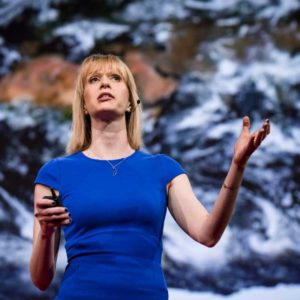
So joining us now to discuss the possibility of our own extinction is climate scientist Kate Marvel.
Kate, welcome.
The Associate Research Scientist at NASA's Goddard Institute for Space Studies up at Columbia University.
So Kate, we were just talking about climate coming out of the Ice Age and they all died.
And it leaves us to wonder, what right now do we think is the greatest threat to the survival of the human species?
Is it climate or something else?
So here's the thing.
I actually don't think climate change is going to make humans go extinct anytime soon.
But the thing is, I have higher standards than not going extinct, right?
So I don't think we're doomed.
But I do think that what climate change threatens is human civilization and human happiness.
And I think that's something that's even more important to me.
We're already starting to see some of the worst consequences of climate change.
So now that I think about it and the way you've described it, other threats that we consider, like asteroids or super volcanoes or even nuclear exchange, they lead to climate change of their own.
So that if you don't die where the explosion or where the event happened, this event still touches you because the atmosphere is different.
Exactly, exactly.
But here's the thing.
I'm not an asteroid and you're not a super volcano.
And we are so sure, the scientific community, that the climate changes that we're seeing right now are due to human activities.
So you can't negotiate with a super volcano, right?
Not yet.
Not yet.
But we have the power to change our own actions.
We have the power to make decisions to alter the course of climate change.
And that's kind of amazing when you think about it.
So Charles, how do you think we'll go extinct?
Well, we have free will, don't we?
In this case.
What Kate is saying is that we have the free will to change our behaviors.
The power to change our behaviors.
So I think that we will go extinct by something over which we actually have no control.
For example...
So you have confidence that we will not render our own selves extinct from our own stupidity?
I believe that we will be alright.
Maybe a large percentage of us will succumb to our own stupidity.
But the entire species will not go unless we have, say, a rogue black hole coming through the solar system ripping us away from our sun and thus freezing us out to nothing.
Something that we don't have control over will eventually be our greatest threat.
Tell me about the October 2018 UN report on climate.
So that freaked a lot of people out, right?
And I kind of feel like that's a good thing.
Like we should be freaked out about that.
But I feel like a lot of the way that it's gotten reported is we have a cliff and we're going to fall off the cliff.
What did it say?
So it said basically we have limited time to limit global warming to a degree and a half Celsius above pre-industrial.
We are already at a degree.
Just to be clear, a degree and a half above pre-industrial levels.
So before we started pulling oil out of the ground.
Exactly, before the Industrial Revolution.
And can we change that to Fahrenheit so people in America can take it seriously?
I mean, I just don't understand.
What the hell is happening with the conversation around climate change that, you know, we don't talk to people in ways that they can understand.
We say aerosols instead of shit in the air, right?
Like seriously, why do we do that?
We say Celsius.
No one does anything in Celsius in America.
Why do we do that?
There's America, Jack.
There's America.
I like my temperatures in Fahrenheit.
I will pass your thoughts to the IPCC.
So it introduced the concept of a cliff.
It did not introduce the concept of a cliff because it's not a cliff.
I feel like a lot of people are thinking, oh, we have 12 years.
It got reported that way.
It got reported that way.
We have 12 years to limit warming.
And if in 12 years we haven't done it, then boom, we're all gone.
And it's not a cliff.
It's a slope.
And we are running down that slope.
Is it slippery, that slope?
Thank you, Neil deGrasse Tyson.
All of you can go to hell.
So, are there other species, if not us, whose survival is put at risk by our own negligence?
Oh, absolutely.
When we talk about the difference between a world that's a degree and a half warmer, Celsius, sorry, or a world that's two degrees warmer.
Multiply by nine-fifths.
Right.
Easy.
We're talking about a world in which 90% of the coral reefs are gone versus a world in which 100% of the coral reefs are gone.
And so, what is the direct fallout of 90% of coral ecosystems being destroyed?
What does that mean to me?
Sitting in my apartment in New York City or in the middle of the country in Kansas, what does that mean to me?
I feel like that's actually a really good point, right?
Because when we talk about climate change, we talk about polar bears.
And most people are like, I like polar bears, but I don't really know any.
And I feel like that's not the best way to talk about climate change.
Because who is affected by climate change is people.
So people working in the tourism industry around coral reefs really care about coral reefs.
People who are fishermen, people who care about ocean health, they really care about coral reefs.
But in New York City, we care about sea level rise.
We care about changes to precipitation patterns.
By 2100, the subway has projected the flood every year.
The New York subway?
The New York subway, under business as usual.
By 2100?
By 2100, every single year.
Well, at least I'll have an excuse for being late.
Well, break out the canoes on that one.
Is there a sequence of species that will go extinct in order?
Like a checklist?
An X-list, yeah.
What I will say is that there are some species that have proven very, very resistant to human activities.
And these are the species that we really hate because we see them a lot.
Pigeons.
Rats.
Cockroaches.
So there are some species that are incredibly resilient and may do really well under climate change.
But the point is that warmer winters mean longer breeding seasons for rats.
And so when people say, climate change is going to be good for some species, that's probably true.
But I don't think humans are one of those species.
Well, our Star Talk fans have their own questions on this very topic.
And that brings us now to Cosmic Queries.
Yes!
We took your questions about the threat of climate change.
And I've got climate scientist Kate Marvel here to help me out.
So, Chuck, you got these questions.
I have them here, and let's go right to it.
Bring it on.
From Akil in Philadelphia, he says this, Is it true other planets in our solar system are going through a warming trend?
If so, could that contribute to the rise of the temperature here on Earth?
No.
Okay, next question.
There were some reports that Mars was getting warmer as much as Earth was getting warmer.
So I feel like if you take a picture of Mars when there's a dust storm, and then you take a picture of Mars a little bit later when the dust storm has dissipated, it looks like Mars has gotten warmer when the dust storm has just gone away.
The only thing that could make all of the planets warmer at the same time is if the sun were getting stronger, if we were seeing changes in solar luminosity.
And we're not.
In fact, the sun's actually getting slightly, slightly weaker.
So the sun getting stronger can't explain climate change that we're seeing on Earth.
There you go.
Alright, from Michael in Atlanta, Georgia, in the Futurama episode, Crimes of the Hot.
Oh, that was a good one.
Earth solves global warming by having every robot vent their exhaust upwards from a single point on Earth to push the planet slightly further from the sun.
How much cooling would Earth actually experience if our orbit increased just a bit?
So if we were farther away from the sun, would it help?
I just feel like you can't say it's too hard to reduce greenhouse gas emissions if you say let's move the Earth instead.
So whatever effort it is to shift Earth out of its orbit, it's got to be less effort to reduce greenhouse gases.
That's my feeling.
You guys are the astrophysicists.
I'm totally with you on that.
Quick calculation.
Even if you push Earth out a million miles further, it only reduces the Sun's energy by 0.1%.
But I feel like that does bring up a really good question that goes back to your discussion about the ice ages.
So we know the Earth wobbles a little bit on its orbit over time spans of tens of thousands or hundreds of thousands of years.
And little tiny changes in those orbital parameters, which we call Milankovitch cycles, can actually lead to ice ages.
And so we're pretty sure we know what caused the ice ages.
And we're pretty sure that it's not the Earth's orbit that's causing climate change right now.
One more question, Chuck.
Here we go from Russell Bailey in Abbott Springs, Louisiana.
He says climate deniers are excited about the NASA report stating that the amount of sea ice in Antarctica has actually increased over the last few years.
Please explain why this is happening in Antarctica as we lose ice in the Arctic.
So the Arctic and Antarctica are two very different places on the planet.
Antarctica is a giant continent that's very, very cold, and the Arctic, the North Pole, is mostly water.
So we're talking about, it's apples and oranges.
The Arctic is one of the fastest warming places on Earth.
One of the other fastest warming places on Earth is West Antarctica.
So saying Antarctica is gaining ice is like saying America has really good bagels.
That's true in New York, but if you go outside of New York, that's not true anymore.
It is so not true.
It is so not true.
And so because Antarctica is large and varied, in the East, it's not losing ice as quickly as it is in the West.
But the ice that it's losing in the West, that ice loss is accelerating, and that's got scientists really worried.
So the cherry picking the locations to make that point.
These are BS points that deniers use to actually further an argument that is specious to begin with.
I know you can't say that because you're a scientist, right?
All right, up next, my friend Bill Nye the Science Guy demonstrates the physics of size and scale when Star Talk returns.
This is Star Talk.
Featuring my interview with actor Jack Black.
Who, it turns out, is a fountain of cosmic curiosity.
Check it out.
Did you ever see that movie?
When I was a kid in school, there was a movie that showed...
Powers of Ten.
Charles and Ray Eames.
Right.
So if you go down to the...
Zoom in from the atom all the way out to the edge of the universe and back.
And then go Powers of Ten all the way to everything.
Somewhere in between there...
Where are we in those Powers of Ten?
Are we smack dab in the middle?
Or are we closer to the smallest than we are to the largest?
Great question.
Oh my gosh.
We are pretty close to the middle.
We're pretty close to the middle.
Not the exact middle.
It's probably a little bigger than us.
So the way to quantify that question is, how many powers of 10 bigger than us is the universe?
And how many powers of 10 smaller than us is the nucleus of an atom, is an atomic particle?
That would be the two limits of what matters in the universe.
We are a little closer to the big size than to the little size.
We're closer to the big size?
That's crazy to me.
But Charles, did I get that wrong?
Well, the answer is up in the hall of the universe itself.
We are 26 powers of 10 lower from the observable universe.
And we're 15 powers of 10 higher up from the size of a proton.
Yeah, but only by a little bit.
And if you go down below the size of protons to subatomic particles or even to the Big Bang itself, you are getting further.
Then we're right back in the middle.
Well, that's where I was headed.
There you go.
OK.
So we can measure from quarks on the smallest scale up to the size of the universe on the biggest scale.
So I'm just curious as colleagues and scientists here, what scale of the universe interests you the most, Charles?
I think the most interesting scale is the scale of DNA.
Nice.
Whether or not we are alive or whether we think or whether we can reproduce is completely based on molecular scales where they're just at the border between quantum mechanical and classical physics.
That's a really interesting boundary for me.
Kate?
I think the most interesting scale is between 1 and 10 meters because that's us, right?
And I actually started my career as an astrophysicist until I realized that really this is the best place in the entire universe.
The Earth is awesome and it's great in large part because everybody I like lives here.
And everybody you like is between 1 and 10 meters.
Exactly.
And that power of 10.
Well, my buddy Bill Nye the Science Guy sent in a dispatch on this topic related to size and scale.
Check it out.
Some people might say that these aren't real trains.
Of course they're real.
It depends what you mean by real or even train.
I mean these are real miniature trains.
Just that a foot out there where you are is only 3.5 millimeters down here.
It's 1.87 scale.
So whether a train is carrying a miniature circus to the next town or bringing you a crate of books in a boxcar, the same rules of nature apply.
I mean whether it's a supernova or a locomotive or the atoms that make it all up, making trains of any size operate properly means acknowledging the rules of nature of scales and speeds.
I mean, we can't change the laws of physics.
All aboard Amtrak 91 leaving for Midway.
Ladies and gentlemen, please take your seats and have a safe journey.
Back to you, Neil.
Before we wrap this up, we've got one final clip with the always curious Jack Black.
Check it out.
I like to just ponder the enormity of the universe.
That's the thing that I like to do.
It's my go-to meditation.
When I'm alone and I'm just thinking about my place here and what is it all about, it's all just about the strange, incredible size of this place.
So it doesn't disrupt your existential angst?
It brings peace to it?
There is a peace to it.
Because when you think about the stresses and the worries and the problems and then you imagine the enormity of the universe, it all just seems so...
It rescales.
What am I worrying about?
That's called the cosmic perspective.
Yeah.
Well.
There it is.
You don't need to be an astrophysicist to have a cosmic perspective.
That's our show tonight.
Thanks to Chuck Nice, Charles Liu, Kate Marvel.
I've been your host, Neil deGrasse Tyson.
See the full transcript



 Unlock with Patreon

 Become a Patron