


 Unlock with Patreon
About This Episode
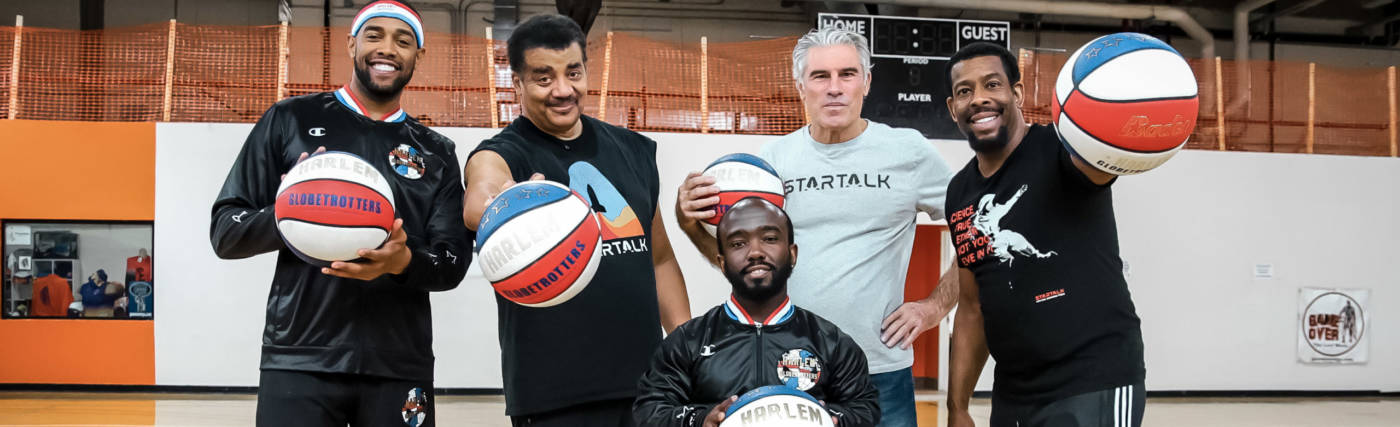
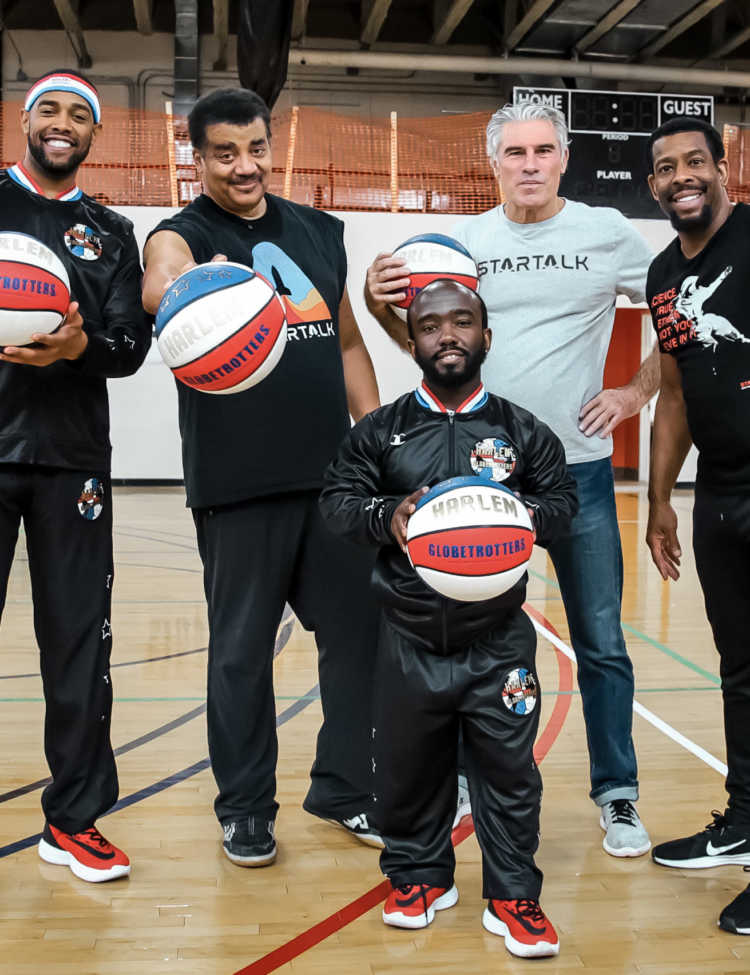
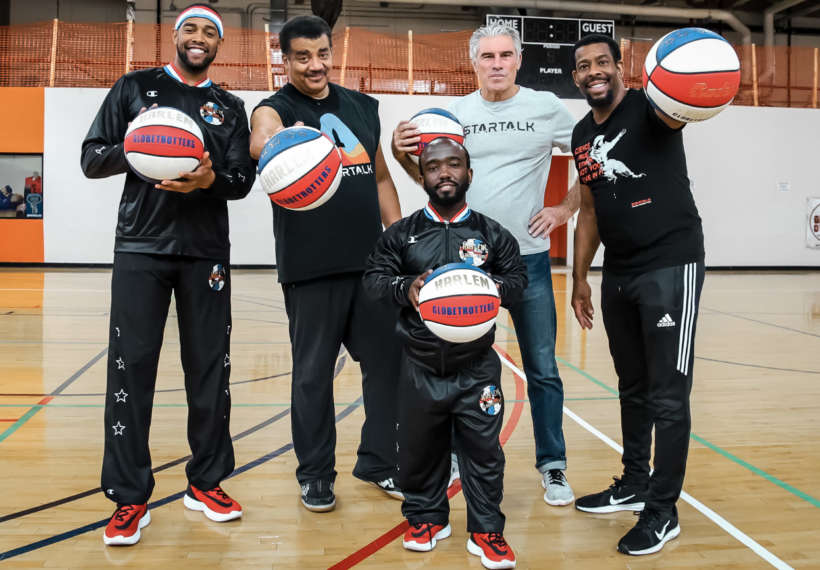
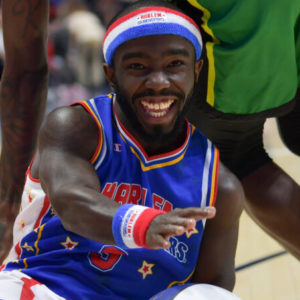
How does a gravity assist work? On this episode, Neil deGrasse Tyson and co-hosts Chuck Nice and Gary O’Reilly run us through physics phenomena with the help of our friends from the Harlem Globetrotters, Hot Shot Swanson and Cheese Chisholm.
You’ll learn about the law of reflections and how spin helps stabilize a moving body. We answer the ever-present question: How do you get a ball to spin on your finger? Neil talks about what it’s like to become a mini two-planet solar system. Is Earth just one big treadmill? We break down momentum, mass, and velocity as we break down the Globetrotters’ signature shots. What makes a trick shot work?
We invent some StarTalk signature shots, a shot Neil likes to call “The Far Side Of The Moon” and “The Gravity Assist.” How do we demonstrate the physics of our solar system on the basketball court? Did they pull it off? How does a gravitational slingshot work in space? Is there really a dark side of the moon? Plus, we learn a few Globetrotter tips for making a trick shot.
How do you make a half-court shot? We look at the different techniques used by Cheese and Hotshot. What was the one dimension that gave them a problem? Is a half-court shot a trick shot? Does Gary have the right definition of “dribble”? Neil demonstrates to us why players should never miss a jump shot. Just how big is the basket? Would practicing with a smaller rim make you a better shooter? All that, plus, find out what cool tricks the StarTalk team was able to pull off against the Globetrotters.
Thanks to our Patrons Helen Gilchrist, Elliot Frost, Lupita Valenz, Danny Andersen, Alex Thorne, Philip A. McKinney, and David Williams for supporting us this week.
NOTE: StarTalk+ Patrons can watch or listen to this entire episode commercial-free.
Transcript
DOWNLOAD SRTWelcome to StarTalk, your place in the universe where science and pop culture collide.
StarTalk begins right now.
This is StarTalk Sports Edition.
Today we’re extending our analysis of trick shots.
We did a whole show on billiards.
Today, it’s basketball and there are those who reign supreme in the trick shot department.
And that’s none other than the Harlem Globetrotters and Gary, Chuck.
We spent all day with two members of the Harlem Globetrotters over at a court, indoor court in Brooklyn.
And that was some fun time.
Just, oh my God.
Yeah, to find the Globetrotters in their natural habitat.
And be part of their kind of thought process and ability was brilliant.
Because the two guys we had, Cheese Chisholm and Hot Shot Swanson were out of the top drawer.
They were very, very good with us and incredibly talented.
Chuck, give me some natural habitat narration for that.
And here we find the Globetrotters in their natural habitat.
Yet somehow, still in Brooklyn.
Quite an irony that we would find the Harlem Globetrotters here in Brooklyn indeed.
Thank you, Chuck.
We see now the spinning of the ball on the finger.
Because everything is a mating sign.
Everything is a mating sign.
To the narrator.
So, yeah, I mean, I saw the Harlem Globetrotters when I was a kid.
I mean, they come through each year to the Madison Square Garden, and there were sort of the marquee names at the time, Metal, Lark, Lemon, Curly, Neal.
It was just a treat every year.
And part of the timing of this…
Name a player on the Washington Generals.
Yes, yes, yes.
The team they used to beat.
Oh, no, there was Bob White Guy Smith.
Bob White Guy Smith, Chuck.
Yeah, and then there was Jimmy White Guy Johnson.
Whitey Johnson.
Whitey Johnson.
Yes, that was their opponent.
And they beat him every time, every time.
Yeah, I lost a lot of money betting on that team.
So it was just a beautiful memory to carry with me.
We look forward to it.
And for this show, it’s timed to coincide with the…
Was it International Trick Shot Day something?
Yes, December 7th.
December 7th, Trick Shot Day.
So we said, let’s catch up with the Harlem Globetrotters and see what they got.
So they showed us all kinds of trick shots.
And I had some physics explanations for them.
But which ones do you want to do first?
All right, well, let’s…
I suppose day one stuff for a Globetrotter is spin the ball on your index finger.
Now, then it’s take it to whatever level you’ve got.
And then Cheese Chisholm, who was amazing with us, just a natural Globetrotter, unbelievable ability with the ball.
And his first name again was…
Cheese.
Cheese.
As in cheddar, as in provolone, as in brie, cheese, chism.
Because he likes his smile.
And he didn’t just spin the ball on his index finger.
He then jogged up on an angle towards the hoop and then just popped it up off the fingertip, off the backboard and in.
And we just, oh my God, this is for starters.
This is the entry level trick shot.
So take it from there, Neil.
What just happened?
Yeah, so spinning, there’s panache and display in that.
Anything that spins is sort of stabilized in space.
And I used to be good at spinning the ball.
And for something happened over the years, maybe, I don’t know, but then I was no longer good at it.
They would show me once again how to sort of balance it there.
I think what I was doing, I was trying too hard to keep my finger under the axis of the spin.
But what they reminded me of, shame on me, that the ball is stable.
All you have to do is keep your finger still and the ball will just stay there.
Okay, so that’s exactly what they did.
And in fact, the two of them, we had cheese and we had, what’s the guy?
Hot Shot Swanson.
Hot Shot Swanson.
He was a bona fide little person, by the way.
We have to let people know that.
Yeah, he was probably less than four feet tall, right?
But seriously stacked with talent.
Yeah, dribbling, shooting, maneuvering.
And so they both spin it for me and then place it on my finger.
And they hold my finger while my finger is doing the spinning.
So that was kind of fun.
And so, yeah, it’s been stabilized until it slows down.
And so you were like your own little solar system there for us.
Yes, I had a two planet solar system going around.
So that was fun.
Plus we reminded how to spin the ball.
But now that’s not useful unless you can do something about it in a game.
And so what Cheese did was now he’d be called for traveling on this because he the ball is spinning on his finger as he’s running towards the rim.
So that’s not allowed.
That’s actually not allowed in basketball.
Unless you’re LeBron James, in which case you can get four steps on every shot.
Nobody cares.
No, no, they let some stuff slide.
Did he do something against your 76ers you didn’t like, Mr.
Philadelphia man?
Everybody does that against the sixers that I don’t like.
It’s like every team.
LeBron’s just got a seat next to Tom Brady, hasn’t he?
That’s what he says.
I don’t have a problem with King James.
I don’t have a problem with him.
I mean, he’s a whiny little baby.
But, you know, like all great superstars, you know.
Even Jordan was a whiny little baby, but he hid it very well.
You know, he’s just…
Says the man who tells jokes and can’t play basketball.
So, guys, an ordinary layup, all right, you’re coming at an angle between the backboard and the rim.
And then you throw it up at an angle to the backboard.
And the law of reflection says, whether this works for light, it will work for a basketball.
If it comes in at an angle to the backboard, it will reflect off the backboard at that same angle.
And if you do this enough, you get an intuitive sense of what that law of reflection is going to do for you.
But here’s the rub.
If you pre-spin the ball, then the law of reflection doesn’t apply to you.
Because what happens is the spin forces it to come off at an angle all unto itself, regardless of the angle you came in on.
So you could come straight to the backboard, toss the spinning ball straight into the backboard, and it’ll spin off the backboard at an angle straight into the rim, provided you know where that sweet spot is.
So that’s what he did.
So he has to know that the sweet spot has changed from a linear shot.
Correct.
And the faster you spin the ball, the more severe that angle is going to be as it spins off the backboard.
So that’d be kind of fun if you can just sort of spin it up and just put it in and watch the ball all by itself, find that angle to put it back through the rim.
So yeah, yeah, that’s another thing.
In Newton’s laws of motion, for every action is an equal and opposite reaction.
What that means is you cannot just up and move in a direction unless something recoils behind you.
Simple.
So a box that is standing in the street can’t just start moving.
It can’t just start, it can’t just elevate unless there’s some reactive force moving in the opposite way.
Okay, so why is it that you can stand there and then start running?
Because your shoes, your feet have friction against the ground and the friction is pushing you forward.
If you were on wet ice, you’re not taken off for a fast start.
Okay, so you’re pressing against it.
Well, what is the reaction to that?
I don’t see an exhaust coming out of your heels.
You know what it is?
It’s the earth itself is getting pushed backwards ever so slightly by you trying to push forwards.
Take that earth.
So you don’t notice this because the momentum is equal and momentum is mass times velocity.
Earth has such a huge mass relative to you that the velocity that it moves backwards with, you don’t even notice it.
Plus everybody’s going every which way, cars, people running.
It all mostly cancels out.
So the point is you can put things in motion if you pre-give them a spin and the friction will use Earth as a launch point to send it into motion in the direction the spin would take it.
That’s a little weird fact, but it’s true.
That’s crazy.
You’re basically…
I hadn’t thought of it like that…
.
to go anywhere.
To go, yes!
Chuck, you said it beautifully and more simply than I just did.
Say that again.
Let me hear.
That’s a beautiful sentence.
You’re pushing the Earth around to go anywhere.
Anybody going anywhere is pushing the Earth around.
Correct.
If you don’t have exhaust, rockets on your feet.
Basically, it’s a giant treadmill.
We’re all just rats on the wheel, God.
That’s why I occasionally get this question.
If all humans stood in one spot and jumped at the same time, what effect will that have on Earth?
Well, again, these are humans thinking they’re really significant and important entities on this planet.
The mass of all 8 billion humans relative to the mass of the Earth is like a gnat on the back of an elephant saying, yeah, let me jump off and see if I can knock over the elephant.
No, that’s not how that works.
We don’t weigh enough.
Wow.
Yeah.
Wow.
It’s there.
You can calculate it, but it’s too small to measure.
All right, got my little solar system here, all right?
What do you want to talk about next?
All right, our surprise package Globetrotter was Hot Shot Swanson, because as Chuck has alluded to, he is nowhere near six foot tall, but he has a signature shot.
Now, he now comes through the key of the basketball court, approaching the hoop on an angle, curves his run like a high jumper would in a Fosbury flop.
Then he gets beyond the basket, and we’re all thinking, what is happening?
Really?
And I was thinking maybe a reverse hook shot or something.
No.
Right, why go past the basket?
Right, right, right.
What good, where’s that going to get?
Yeah, exactly.
So why go past the basket?
He then just grabs the ball both hands, because he’s been dribbling at this point through his legs, really special stuff, slams it into the court and gets it up and over the rim and in.
And that was just…
OK, so you missed the point there.
You did not see that coming.
Not only is he facing away from the rim, he jumps up, spreads his legs, and bounces it backwards through his spread legs.
Through his spread, yeah.
Like he’s doing a leapfrog over the basketball, but in doing so, he rebounds the ball off of the court floor into the basket.
Correct.
Did not see that coming.
Did not see that coming.
None of us saw that coming.
And so what’s interesting there is anytime you’re going to have a ricochet, whatever is the error in your angle gets magnified, OK?
If you’re going to try to ricochet a shot off a wall or off the ceiling or off the floor.
And so you need extra precision to make this happen because the ball is not headed straight for the basket in the first place.
So yeah, that was very cool.
And since you don’t expect it, what makes a trick shot work is you don’t expect it, right?
If everybody saw it coming, it was…
And then he uses the backboard.
He doesn’t just slam it into the floor of the court, up and straight in.
He uses the backboard.
So you’ve got two different surfaces in play.
It’s a two cushion cue shot on a pool table, right?
Bounce off the floor, off the fiberglass and then in.
So this one, he’s got to know what spot on the court he’s going to do it with.
He’s got to know what angle and he’s not facing the basket.
So he needs good court sense.
And he’s got to know how hard to slam it down and what angle to slam it down.
So that it doesn’t hit the rim from below.
It’s got to be higher than the rim and be higher than the rim before it hits the rim and hit off the glass.
So all of this has to go in.
And I’m just saying multiple angle bounces.
If you’re off by an inch on the first bounce, you could be off by a foot on the second bounce and ain’t going in.
So it needs very high precision and he clearly practiced that really well.
So what was interesting was not that he just curved his approach in towards and beyond the basket was he knew whereabouts on the real estate he needed to be to set himself up, to open his legs, to then detonate that reverse pass through the floor.
I mean, it’s just it’s not intuitive because this has to be practiced.
Suppose someone is blocking his spot unknowingly.
Somebody just happens to be taking up the sweet spot.
He’ll say he’ll go to a different trick shot.
How about that?
That you can instantly dial up your own series of trick shots if you see the landscape around you isn’t conducive to the one you planned.
Yes.
I mean, that’s just genie.
I love that.
I love that in an answer.
We got to take a quick break.
When we come back, more physics analysis of Harlem Globetrotter trick shots.
Wow, that’s a sentence probably never before uttered in the history of the world.
Yeah.
If only Metalark Lippman was here to hear that.
That’s the StarTalks 4 tradition, Globetrotters.
We’re back, StarTalk Sports Edition.
We’re talking about the Harlem Globetrotters.
Gary, Chuck and I had the honor to spend some quality time on a basketball court with two of them.
Now, give me their full names again.
I just know one is named Cheese, and the other’s name is Hot Shot, but surely their mommy gave them some other name than that.
Those are their birth names.
Those are their birth names.
Okay, so Cheese Chisholm and Hot Shot Swanson are their names.
Hot Shot Swanson sounds like that guy could have his own sitcom.
The Hot Shot Swanson show.
Okay, so it wasn’t enough to go and see the Globetrotters.
We had to bring something.
We had to give them a challenge.
We had to see if they could raise their game for us.
And then they then turned it back on us because you came up with the idea and you came up surprisingly enough with a shot that got dubbed Far Side of the Moon.
Now, this shot that you invented, Neil, is the player is backing in to the guy guarding him.
Yeah, the offense is backing in.
Right, backing in.
He’s back obviously to the hoop.
And it’s a shot that has to go up, over and in.
So this is the shot that you challenged them to do.
And it kind of started off as a two-handed affair.
And then Cheese just went, I got this.
And just one-handed.
Like you would do a three-point shot, just flip the fingers underneath it and roll it off and up and in.
He did it in reverse.
Now, you tell me exactly what you had in mind when you envisaged this particular shot.
Yeah, I was just thinking to myself, is there any trick move I can come up with that hasn’t already been invented?
And I was so sad.
I spent weeks and weeks, nothing came up.
Then the morning on the drive to the court, I said, I got it.
I got something called the far side of the moon.
Now, let me remind people, the moon only shows one face to earth.
That’s the near side.
And the face you don’t see is the far side.
But all sides of the moon get sunlight.
A day on the moon lasts a month.
So there’s no such thing as the dark side of the moon.
There’s no such thing.
It’s a lie.
It’s a misconception.
It’s a great album.
1973 Pink Floyd, indeed.
Yes.
And I’ve had to undo the damage the title of that album has caused for entire generations.
These Brits.
These Brits.
So Earth’s gravity has tidally locked the moon to always show the same face.
Chuck, you and I have a couple of explainers on that.
So I won’t go into more detail there.
But it means if I’m backing into you and I’m at the top of the key and I’m dribbling the ball, if I shoot the ball from my front, which is facing away from you and the basket, that’s like the far side of me, right?
That’s my far side.
Meanwhile, my butt is facing you and Chuck, that’s what?
That’s gotta be the moon.
That’s the near side of the moon.
I can rely on Chuck to just stoop.
I’m going there.
I’m sorry.
There is no bar that’s too low, people.
I’m letting you know that right now.
We all know what it means to be moon.
But of course, all the clothes, we kept our clothes on.
Point is, my butt is towards him, and the butt is a very good thing to give yourself space to maneuver in.
You know, you stick your butt out, that clears at least, you know, foot, foot and a half for you to maneuver.
Otherwise, they could be all up on you.
So, at the top of the key, I throw the ball backwards over my head towards the rim.
So, I was originally thinking I could bend over far enough to see the rim, but I’m not that flexible.
So, I had to just sort of know my distance, and then all I had to figure out at that point was the alignment.
And that’s easy because if I align to the basket, because of full court, in front of me, the basket behind me is going to be on that same line, unless somebody didn’t know how to arrange the baskets on a court.
Right?
So, this is the far side of the moonshot.
And Cheese pulled it off.
So, the thing is, Neil, when you were doing it, and to your credit, you got in there and you wrestled with this whole thing that you’d invented, what did Cheese keep saying to you?
Cheese said, shoot it the way you would shoot a jump shot.
Because I kept using two hands to toss it over my head.
And each hand was competing with the other hand, for which was controlling more, and I couldn’t get it lined up.
It would sway to the left, it would sway to the right.
And frankly, my distance was pretty good.
It would just be an air ball to the left or to the right of the rim.
And so, he said, how would you shoot a jump shot?
Just now, just do that in reverse.
So, I’m right handed, so I guide the ball with my left hand and shot it with my right hand.
Bam!
That sucker went in, all net.
And I said, oh yeah, the far side scores.
See now, if you said to me, shoot it like you would shoot a jump shot, I would say, you want me to pass it to you.
That’s how you do that.
That’s how I shoot a jump shot.
I pass it to somebody who can actually shoot a jump shot.
So it’s not so much a trick shot, but it was a shot in need of a name.
And so I thought we would endow it with the far side of the moon.
Thank you.
So, we came up with another shot, the StarTalk Sports Edition team, because we kind of canvassed opinions as to what might be a good thing.
And we came up with another sort of out of space themed idea, which was a gravity assist.
So, as a space shuttle or a satellite or something would orbit a planet and then slingshot itself off on its next journey, we thought maybe we can incorporate that into a shot.
And then we gave you this thought, Neil, and you went, no, let’s multiply that, start at the back of the court, come forward, bring motion of players into the game, pass, run it around the other player who then passes.
So if it receives it with the right hand, moves it around their back, and then passes with their left hand, while another player is moving, in the meantime, another player has moved forward and it ends up with a layup.
And I’ll be honest with you, Neil, credit you, you saw this whole choreography of passes and this gravity assist.
So what is actually happening when we enact this quick break using your kind of technique of gravity assist and passes?
Well, so what we did was we’re not using gravity, of course, we’re using arm strength and our own body speeds, but in the solar system or in any real place where you have things orbiting other things, if you don’t have enough energy to get to your destination, energy of motion, as is true for almost every one of our space probes that went to the outer solar system, that takes a lot of energy to climb away from the sun.
And our engines just aren’t powerful enough.
So you get enough to get to a nearby planet.
And then you fall towards the planet.
And then you slingshot around the other side.
And you gain the orbital speed of the planet you fell towards.
And we call that a gravitational slingshot.
And if you line up the planet…
Well, we don’t control the lineups of the planets.
But if you wait until the planets are sort of conveniently configured, you can get a multiple planet gravitational assist to give you enough energy to just exit the solar system like it’s nobody’s business.
Cosmic pinball.
Cosmic, yes.
Yes, like I said.
Energy goes off of one, off of another, off of another.
And each time it’s gaining energy in order to achieve its ultimate destinations, to reach its ultimate distances.
But now you got to explain the most fascinating part of this, which you taught me and I just was blown away, is it’s not just the gravity of the planet that’s pulling it.
And I’ll let you finish the rest because I know I’m going to mess it up, even though I do understand it.
People are thinking that the gravity pulls you in and flings you out the other side.
That’s false.
That’s not it.
That’s not it.
What’s happening is because the gravity that accelerates you in, remember if you try to come out the other side, the gravity is going to pull you back.
And in fact, it is exactly symmetric.
So all of your gains…
It’s a tease.
That gravity is a tease.
Purely from the gravity.
What gravity giveth, gravity taketh away on the other side.
The speed you gain is because not only do you accelerate from the gravity, which is symmetric, you fall towards the moving planet in its orbit around the sun.
And that extra energy you get to keep.
And where did you get that energy from?
You stole it from the planet.
Both of you attracted each other.
And so it sped you up, you slowed it down, and you came out the other side the winner.
That’s what’s happening in a gravity assist.
I think that is amazing.
Because intuitively you think that the gravity is pulling you in like a slingshot, because that’s what we call it.
But it’s the whipping motion, but it’s not.
It’s the speed that you needed to catch up to the planet.
To catch up, correct.
It’s the catch up speed that really…
It’s misnamed.
It’s not a gravity assist, it’s an orbital assist.
Maybe we should…
It’s misnamed.
It’s misnamed.
Because it’s the orbital speed that you’re catching up to, and then you get to keep a little of that.
You get to keep all of it.
Yeah, you get to keep all of it.
Okay, so here’s what we did on the court.
So we said, all right, the ball is going to be the space probe that’s going to sort of get this gravity assist.
The space probe’s got to work its way down the court, and its destination is the basket.
So the first player, this was Cheese, takes it out from the back court.
He flings it around his back over to Hot Shot.
Now Hot Shot and I are in motion down the court, okay?
Hot Shot dribbles, slings it around his back.
So this is like the planet coming around the backside and coming out the other side.
He’s in motion and throws it, so the ball has not only the speed with which he threw it to me, it has his movement down the court.
Meanwhile, Cheese, who’s fast, runs all the way down the court.
I’m dribbling, he’s now ahead of me.
I fling it around my back, give him a lead shot, and then he grabs it and goes in for the layup.
So it had four body contacts, and each time the ball hit one of us, the ball speed increased until it went to his layup at the other end of the court.
And I thought we executed it.
I don’t know what we’ll ultimately show on video.
It took a couple of tries, but when we finally executed it, I thought that was looking beautiful.
It was looking kind of LA.
Lakers’ fast break.
It was looking good.
Yeah, it did have a fast breaky kind of thing.
And the difference is, of course, the around the back, each one of us threw it around the back just to give it a little sort of flinging momentum there, which might not have been necessary in an actual play.
But they kept saying, they are the Harlem Globetrotters.
They said, it’s got style.
It’s got to have style, baby.
Why do you go to a basketball game unless you want to see people with style?
Why do a slam dunk if you can do a 360 slam dunk?
There you go.
With style.
So I enjoyed executing that.
And we call that the gravity assist, all the way to the layup.
Well, we did because no one on our StarTalk Sports Edition team is an astrophysicist and didn’t think to call it an orbital assist.
But it looked like both Cheese and Hot Shot enjoyed knowing what kind of physics related to it.
But plus, you know, Chuck, your name is Chuck and the guy’s name is Cheese.
We couldn’t have stopped thinking of Chuck E.
Cheese.
Chuck E.
Chuck E.
Cheese.
See, what it does again, Neil, remember our armless archer?
And the intuitive…
We have a whole show on him, yes.
Yes.
Yeah.
So the intuitive calculations he was making for distance and wind change and direction, etc.
I feel like these guys are very much in the same way of intuitive.
Like you said, if there’s someone in my space blocking the trick shot I want to do, I go to another trick shot that I know will take that person out of the game.
You know that they’re able to recalculate, recalibrate and then come up with something.
And they seem to be just relishing challenge.
And I want to emphasize that in cases such as this, where muscle memory matters, what you’re going to do with your body, court memory matters.
You know, often we think of intuition as something that just comes naturally or something.
But I would say you can get intuition if you’ve done it 10,000 times.
You’ll know exactly what to do, when to do it, on a level where you don’t have to think about it because thinking about it might take too long or throw you off your game.
Let your body do what comes naturally.
And you can impart within it a lot of things that come naturally simply because you did it a thousand times before.
So more analysis of the Harlem Globetrotters trick shots when StarTalk Sports Edition turns.
We’re back, third and final segment of StarTalk Sports Editions.
So Gary, Chuck and I spent all afternoon with two members of the Harlem Globetrotters.
They need no introduction here, particularly in this Sports Edition audience.
I watched them when I was a kid.
Every year they came through Madison Square Garden, New York City.
You would get tickets.
And everybody knows the Harlem Globetrotters.
And they performed around the world, more places than any other basketball team ever.
And they’re delight.
They’re brilliant.
They’re talented.
And I felt it was a privilege and an honor to spend several hours with them.
And Gary, you lined up all the trick shots to analyze today.
So which one do you want to talk about next?
Let’s go with a half court shot, shall we?
The interesting thing about this is, we have two Globetrotters and they both have a different technique to solve the half court basket.
Now, we had Cheese.
He hits it with a natural over the top shot.
But Hot Shot comes with what I now know is referred to as the granny shot, which sounds a little bit dismissive and anti-granny.
But that’s the way I’ve learned to describe it after our time with the Globetrotters.
So, both result in baskets.
But it’s an interesting use of technique to solve the same problem.
So, it’s not a trick shot.
If you’re shooting from half court, Chuck, what must be happening if you’re taking a shot from half court?
You either like showing off and you’re Seth Curry or the buzzer is about to sound and you’re out of time.
You’re out of time and you can’t take another dribble because you’ll run out of time with a ball in your hand and nobody wants a ball in their hand at the buzzer.
So, exactly.
So, it’s not so much a trick shot, but it’s certainly a crowd pleaser if you hit a half court shot.
And so, when Cheese took it, he took his normal jump shot posture and did it from the center half court.
If you’re in the center, it means you don’t have to figure out any angles at that point.
If you’re off to the left or right, well, what’s the right angle and what’s the right distance?
Whereas, if you’re dead center, you don’t have to figure angle, you just have to get the right distance.
So, it seems to me, just thinking as a physicist, it’s easier to do it from the middle.
And that both of them took shots from there and didn’t…
But, Neil, what was the one dimension in our space where we spent that time with the Globetrotters that really gave Cheese a problem for his half-court shot?
Yeah, in this particular indoor court, the ceiling…
I don’t want to call it low, but I threw a couple of shots from distance and it hit the rafters.
You hit a line.
Yeah, I hit the ceiling.
You hit a line.
So, it means your ball has to go a little straighter without that rainbow arc.
And rainbow arcs, we learned from a show…
Chuck, was it five years ago now?
We had Kareem Abdul-Jabbar on StarTalk.
This was before we had StarTalk Sports Edition.
It’s because we were getting access to people like him.
We said, yo, we got to make this its own thing, right?
Plus, he’s a big…
he’s smart and he likes science.
He likes science.
He’s smart as all get out.
And so, he was describing the fact that is retrospectively obvious that the higher is your arc, if you have the right distance to the rim, the better is your chance that it will go through the rim.
And in fact, we’ll say a little more about that towards the end of this segment.
But so, there’s Cheese.
Didn’t he hit six in a row or something from that distance?
Yeah.
Cheese is crazy, man.
No, we gave him three shots, didn’t we, Chuck?
And he just went pop, pop, six.
And it was like breathing.
It was just so natural to him.
He’s a phenom.
He’s got such a sweet stroke.
It’s unbelievable.
Yeah, it’s sweet.
That’s the term.
And then Hot Shot got a hold of it.
And so, now he’s four feet five, so he needs different sort of leverage angles on the ball to throw at that distance.
So, what does he do to get that extra sort of distance is he stands there, crouches, and he shoots it underhand.
And as we’ve learned, this is still called the granny shot.
And throws it underhand with backspin, but he does it while leaning forward so that he has forward body momentum added to the ball that he releases.
And so, there it goes, straight in.
Straight in.
And so, both of these, I like the backspin because that deadens the movement of the ball no matter what it hits.
And the ball is coming from so far away with such high speed, you don’t want high speed bouncing off of every which way on the rim and on the backboard.
So, I like the backspin.
And if it hits the backboard a little too high, the backspin will give it a downward angle and it can go straight in through the rim when you do that.
What happened?
And the rest of us tried our half court shots.
And Gary, you tried something.
You tried a kick from half court, right?
Not quite half court.
That was too far for you.
Mr.
Soccer Man.
Yeah.
I had proven to everybody that I was absolutely useless.
Throwing free shots with my hands.
And I’m probably better off kicking it through the hoop.
Yeah, so we gave you some space.
You would let you try that.
Now, just so you know, Gary.
In the end, I got there.
There’s a rule, unless it’s changed since I was in Charlotte.
There’s a rule.
If the ball touches your feet, it’s called kickball, and the ball is dead.
Yeah, that’s it.
So I’m just a rule breaker.
Yeah, you’re a game changer rule breaker.
So you also did it from dead center, maybe at the top of the key around there.
And so what were you thinking when you did that?
So the thing was, I can’t kick it from the ground.
I can’t get underneath it, get the elevation and get it in.
So I pick it up and I drop it.
But I then have to wait for the ball to rise because once the ball is rising, I get my foot underneath it and I will then rise with the ball and get the ball just to find its way, find its arc towards the basket.
So you have to time your drop and your kick.
Okay, got it.
Because if I hit the ball when it’s coming down, it will stay lower.
So I have to get the elevation.
So I have to hit it and contact the ball as it’s rising.
It’s got to go 10 feet up.
That’s the height of the rim.
If you don’t go 10 feet up, go home.
Right.
We’ll edit this down so it looks like you did it on the first try.
But it took you like 30 tries.
Like I said, I got there eventually.
But it was fun.
Yeah, it was fun.
I haven’t kicked a ball in a while in a basketball.
Although the basketballs we had were leather.
They were the real ones, not those outside court ones.
But a thick, heavy, vulcanized rubber.
Slightly different dimensions, but I’m making excuses.
Well, soccer ball is smaller and lighter right now.
Yeah, exactly.
Yeah.
We’ll catch you some slack.
But it was good fun.
It was good fun.
It was a socket ball.
Socket ball is the newest thing.
It’s going to be sweeping the nation soon.
Plus when we all said, when we said, Chuck Hot Shot, let’s dribble.
And then Gary runs off and he dribbles the basketball by kicking it around with his feet.
And it’s like, no, why wouldn’t I?
There’s a marker, Jack.
Wrong.
For real.
Wrong.
Do it again.
Do it again.
But I tell you what, Neil, you blew everybody away on court, Globetrotters as well.
When you said, can someone bring me a rim?
I have something to show you.
And I’m like, well, where’s this guy?
So Cheese turns up, hands you the rim.
He said, no, you hold on to it.
You pick up two basketballs.
And then you said, I made a calculation.
Now what this calculation means, Neil, is anyone who misses a free shot should go and do 50 push ups as a punishment.
Can you explain what?
That’s not a good enough punishment.
How about this?
Give me 50,000.
Yeah.
Nobody’s guarding you.
Nobody’s guarding you.
You got to give up 50 Gs for each one of those you miss.
And you’re not going to love for the missing free shot, have you Chuck?
So, Neil, what inspired you to make this calculation?
And what was the conclusion of your calculation?
Well, one afternoon, when I was otherwise bored, I wanted to know how big is a golf cup compared to a golf ball?
How big is a basketball compared to the rim?
I just wanted to see how hard these tasks were.
And obviously, the bigger one is relative to the other, the easier it would be to sink the ball.
So, once I looked up the dimensions of a basketball, an authentic sort of NBA basketball, I think the women’s ball is slightly smaller to accommodate on average the smaller hands.
But the official NBA basketball, the rim is twice the diameter of a ball.
Factor of two.
You can take two balls and drop them through the rim simultaneously.
They won’t go through the net because the net wants only one at a time.
But you can pass through the rim.
Two of them together.
And if you run the math, you run the geometry of that, it turns out the total area is four times the area of what we say the cross-sectional area of a basketball.
So you got plenty of room to sink your shot.
Just saying.
No excuses then?
No excuses.
Four times the area of the ball.
You can’t get it through the rim.
Go home.
I don’t care what.
I did.
And so, yeah, so we demoed that.
And I was surprised they didn’t know it either.
Because when you’re holding the rim in your hand, it looks huge.
But 10 feet up and down the court, it looks as small as any of us think it is.
And you think you got to be really high precision to get it through there.
And that’s not the case.
Unnecessary.
Now, I always thought that if you wanted to train…
Do you think…
Yeah, go on.
Do you think if you explained this, and you just have, if you put this knowledge in front of a basketball player, their head would get less crowded.
And they’d say, well, you know what?
The size of this rim isn’t changing.
I can do this.
I have a better chance of doing this.
Rather than in their head, where they can’t get out of that space, this rim is actually reducing and getting smaller and smaller and smaller.
Do you think that knowledge would help people?
If I were a coach, and I’m surprised no one has done this.
I’m pretty sure no one has done…
If I were a coach, I’d have a separate set of practice rims that are smaller.
That way, you don’t make the highest percentage of your shots, and you have to be that much more precise to get it right down through the middle in every shot.
And so then you come to a regular game, it’s like, whoa, there’s like a bathtub there to toss the ball in.
And then that’s how I would train them.
That’s like the times you practice jump shots with the weights on their ankles.
On top of that, you’ll be able to take all of their money because they’ll never be able to win the teddy bear.
Because you made the rim so the ball won’t go through it.
What’s the teddy bear?
So at every carnival there’s basketball games.
The rims are too small.
Sorry.
The rims are too small.
And that’s how they take all your money.
That’s true.
So yes, the ball does fit through because they will demonstrate it.
But what they don’t tell you is that the rim is extra bouncy.
So if you hit the rim, the ball just bounces right off and doesn’t go in.
Man, you’d have made an excellent…
You’d have made an excellent Carney grifter.
Like, you got all the scams down.
Yeah, if it’s a physicist, the world is just an interplay of matter, motion and energy.
And so rather than actual objects.
So, it turns out the rim…
We learned this recently, that the rim…
That the rim has a very specified and measured and regulated sort of bounce coefficient.
Right?
Not too bouncy, not too dead.
And there’s a range.
But if you made it really bouncy, a lot of balls that do hit the rim and fall in, would hit the rim and bounce out.
But you calibrate to that.
I’m saying I think the best training would be to make the rim smaller.
Smaller, yeah.
Maybe only 50% bigger than the ball, not four times bigger.
Man, you would have everybody would be shooting like Seth Curry.
Dead Eye.
Dead Eye.
Do you think Curry does that?
Do you think Curry actually uses that technique?
No, I don’t think he needs to.
Or he just has that much talent.
It doesn’t matter.
I don’t think he needs to.
Right, right.
So why not?
People should do that.
That would totally tighten up your game.
You hear some players talk about how they see the rim bigger or smaller, depending upon how well they’re shooting.
They actually use that term.
I see the rim smaller.
When Billie Jean King, I heard her say when she was playing some important game, afterwards she said the tennis ball was like a beach ball.
Right.
It was like…
You know, Neil, there’s the same thing in soccer.
When you take a penalty kick, it’s like that potion in Aniston Wonderland.
It makes things go bigger.
It makes things get smaller.
The ball gets bigger as the goal gets smaller as you set up for a penalty kick because it’s in here and you cannot get out of your head.
And that’s really quite interesting, Chuck, that that kind of is portable because so many sports in this really important moment.
When I was a kid, the catcher for the New York Yankees, I’m born in the Bronx, was Thurman Munson.
And there was a year he had the batting title.
He was catcher.
And if you just watch the pitches come and he would swing, make contact and hit singles, and it was as though nothing you could do to the ball would fool him.
And you speak to him and it’s like, yeah, the ball’s there.
I’m hitting it.
All right.
And there’s some combination of reflexes and age and awareness and acuity of vision and all coming together.
Right.
It’s not some mysterious spinning thing.
You hear them say the ball looks like the size of a grapefruit.
Like when they’re hitting the ball well.
Yeah.
But that was a fun outing.
And of course, Harlem Globetrotters have many more tricks than that.
And we just were treated to some of them.
And not only that, I didn’t know that every year, December 7th, is National Trick Shot Day.
Or National International is just Trick Shot Day.
I didn’t even know that was a thing.
And so, I was delighted to get in ahead of that, just to even look for it every December 7th, at a basketball court near you.
Oh, wait, wait, wait, Gary.
One other thing before we wrap.
There was, they sometimes will pass the ball using their forehead.
And you were good at that.
Yeah, well, that’s the surprise.
That was part of my game as a defender.
You know, the ball, they would cross, balls would be kicked up in the air.
You had to fight and tussle for it.
And invariably, the head becomes part and parcel of your body.
Wait, so before that, Gary had three Nobel Prizes in physics and in chemistry.
And then he started using his head.
And that’s it.
Man, that’s something you need to be concerned about.
So actually going forward in soccer…
That’s the whole thing.
Football, yeah.
The heading will come out of the game.
Yeah, yeah, we’re going to have to do a show on that.
It will diminish and we’ll find that young players will grow up not heading a ball.
And what will happen is that will move itself up through the age ranges until you get to adulthood where they’ve never headed a ball.
So that aspect of the game will be taken away.
Guys, we’ve got to call it quits there.
But everything we described in this podcast was filmed and we’re putting together some bits and pieces for our YouTube channel.
So if you want to see what these trick shots look like and meet Hot Shot and Cheese, and when Chuck was standing next to Cheese, you get to meet Chuck E.
Cheese.
Just cross over to our YouTube channel and you get all the visuals.
It took you that long.
It’s taking you the whole show to get there.
It was worth it.
So cross over to the YouTube channel to catch how else we’re putting this online.
This has been StarTalk Sports Edition.
Always good to have you Gary, Chuck, Neil deGrasse Tyson here.
Keep looking up.



 Become a Patron