Transcript
DOWNLOAD SRT
Welcome to StarTalk, your place in the universe where science and pop culture collide. StarTalk begins right now. I'm your host, Neil deGrasse Tyson. I'm an astrophysicist right here at this museum where I also serve as director of the...
Welcome to StarTalk, your place in the universe where science and pop culture collide.
StarTalk begins right now.
I'm your host, Neil deGrasse Tyson.
I'm an astrophysicist right here at this museum where I also serve as director of the Hayden Planetarium.
And we're here in the hall of the universe of the Rose Center for Earth and Space.
And I'm gonna first introduce my co-host, Leighann Lord, professional comedian.
Welcome!
No stranger to StarTalk?
No, not at all.
Yeah, well today I wanna talk a little bit about Star Trek and its legacy.
There she goes, yep.
Sorry!
I knew in advance you had some trekkie flowing through you.
Just a little bit.
You love you some Star Trek.
I do, there's a couple of restraining orders out there.
And also...
Well, you know who we're featuring my interview?
George Takei.
I know!
And I know some Star Trek stuff, and not like what you do.
But also, sometimes I gotta reach for my homie on this.
Okay, I've got a friend and a colleague who knows everything about everything that's not otherwise astrophysics, but he's also an astrophysicist.
Nice.
He's my go-to man for all these kinds of occasions.
Give me some love for Professor Charles Liu!
Charles Liu!
He's a professor of astronomy and physics at College of Staten Island, the CUNY system.
Yes, Neil, you have only the slightest inkling of how happy I am to be here today.
George Takei is the man.
Yeah.
He's the man.
He is the man.
The man.
Right.
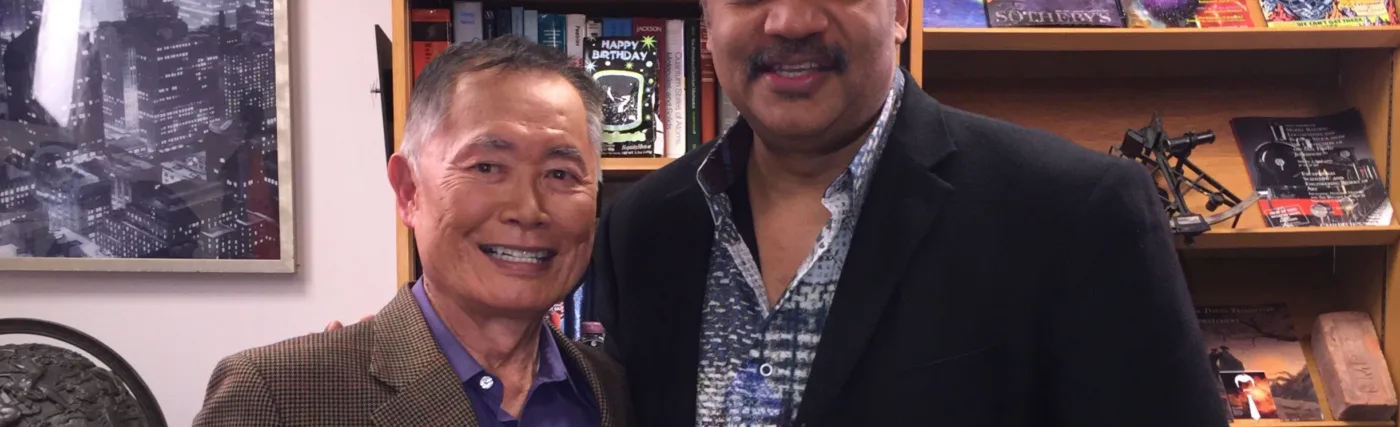
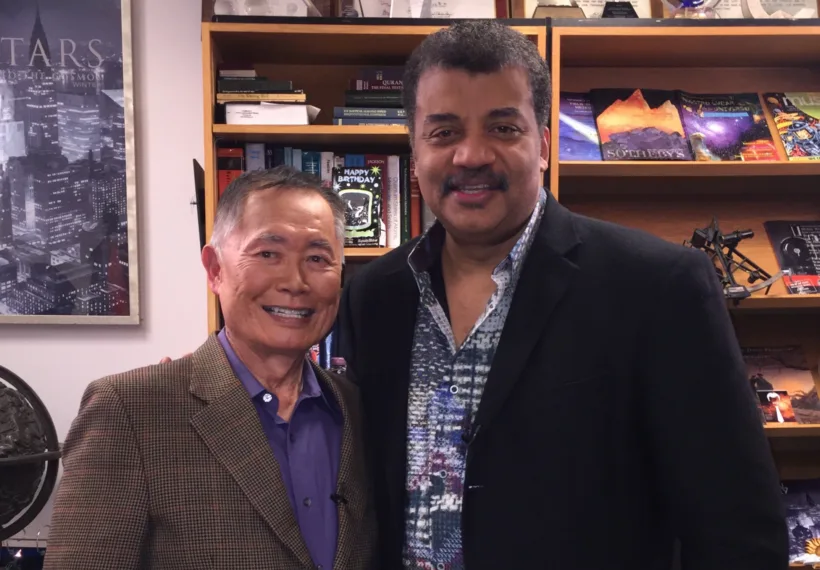
So, he came to my office.
He comes in, you can't not talk.
You try not to talk about Star Trek.
You do?
But you have to talk about Star Trek.
Yeah.
He comes through town, you got him.
Yes.
He understands that.
He understands that.
But I didn't want to feel like I was just somebody else that's just getting on his...
I wanted to be different to him.
You can be different after you do Star Trek.
So we get a little bit of Star Trek prehistory in this clip.
It was a very strange interview because when you're going up for what could be a running part in the series, you have a whole group, a team of people interviewing you.
Network people, advertising people, the studio.
Because you're not a one-off character.
Right.
They're marrying you for this.
Exactly.
It's the marriage arrangement.
It's tribunal.
And I was prepared for that.
When I walked into Gene Roddenberry's office, first of all, he mispronounced my surname, he called me Takei, but I corrected that.
I said, my name is pronounced Takei, but I don't object to Takei, because that's a Japanese word that means expensive.
And he said, oh my goodness, you're definitely Takei.
And I told him, Takei doesn't mean cheap either.
Gene Roddenberry, creator of Star Trek.
Creator of Star Trek, producer, writer, visionary.
All-around creative guy.
Creative guy, and with a vision of what we could be.
I think they sent his ashes to the moon or something?
No, not to the moon, to orbit.
To orbit, so he's made it into space.
He's still out there.
And Jimmy Dewan had his ashes sent out there too.
But I guess he wasn't quite in orbit, because he fell back down to New Mexico.
Gene Roddenberry really deserves and should be up there, because Star Trek was more than just, and he felt the television certainly needs to be entertained, but it also needs to inform and inspire.
Did you know this at the time?
At the time, are you just doing television?
Or are you saying to yourself, this is some good shit going down here.
This is, whoa.
Because the show did get canceled.
Right, right, but I knew that it was a...
The Kardashians went longer than the original Star Trek.
Yeah, but on Star Trek, we had the Kardashians.
We talked about books we had read, movies that we liked, current events, issues, you know.
We had a wonderful, engaging conversation.
He described the show, and it was thrilling.
That vision that he had, Starship Enterprise, a metaphor for Starship Earth, and the strength of the Starship lay in its diversity, coming together and working in concert.
Nobody was thinking that back then.
Nobody was thinking.
I mean, you know, minorities weren't...
In anything.
No, no.
I mean, to have Nichelle as a chief communications officer, a woman and a black woman at that, and Asian man, well, you know, there are Asian chauffeurs.
But nevertheless, crack technician and a member of the leadership team, half alien, pointy-eared, you know, bi-species, not bi-racial.
That kind of vision of the future.
There he is.
He gets his gig after the interview.
You know, he actually was the helmsman of the Enterprise.
So in a sense, he was the chauffeur.
I'm just saying.
Well, the bottom line is that even though there was an expansion of wisdom and understanding and diversity in that show, there were still some things that could not yet be broken at that point.
Right around the same time the Star Trek was running, you know one of its great competitors on TV, the Green Hornet.
I remember the Green Hornet.
Yes, and guess who was the chauffeur?
That was...
Bruce Lee.
Yes.
Asian chauffeur.
But he could still kick your ass.
Oh, hey, it was one of the few things that Asians were allowed to do on TV back then.
Still?
No, now we can solve astrophysics problems.
What intrigues me is that the opening, the now famous opening lines, let me read them to you.
Sorry, I don't have been committed to memory.
Space, with pantomime by Charles Liu.
Space, the final frontier.
These are the voyages of the Starship Enterprise.
Its five-year mission to explore strange new worlds, to seek out new life and new civilizations, to boldly go where no man has gone before.
So here's the thing.
This is a five-year mission.
The show only lasted three years.
Yes.
So what's up with that?
Listen, if you don't ask, you don't get.
They had to put it out there.
Roddenberry was trying for five years, I'm sure.
A hundred episodes.
Who doesn't want that?
But you know what happened?
He was beaten out by Batman, The Green Hornet, other shows that were more popular at the time, but didn't have the kind of lasting legacy that some far-looking, far-reaching show like a science fiction show would have.
So one of the features of it, which you alluded to, but let's like get in there, was in spite of George Takei being the chauffeur.
Yeah.
If you had to be a chauffeur, let it be of the Starship Enterprise.
Darn, too.
I'm just saying.
There's this diversity of crew, a little bit from everywhere, essentially everywhere, or as everywhere as could possibly be represented in 1960s television.
So this is an extraordinary construct, an extraordinary step to take.
You know, it's funny, you say it's extraordinary, but for me, this was normal.
Ooh.
Which I guess means it did its job.
Like, that's what TV's supposed to look like to me.
Yeah, that was very not what it was looking like in the day.
Yeah, and I got that in retrospect.
And one thing we should all remember also was that Gene Roddenberry used a large number of excellent science fiction writers to write his scripts.
Many of his plots were based on classic short stories in science fiction as well.
So in a sense, he was looking forward, as science fiction often does, to a future which could either be much worse or much better than the present time.
And part of this combination of ethnicities and skin colors, that's part of a philosophy that he put forth that permeates through the scripts, through the casting, through everything.
Even to the point where Spock himself is a half alien, half human.
Half Vulcan.
Is Vulcan not alien?
Yeah, but she said it like it was a bad thing.
So Spock has a pin that he wears that is this combination of geometric forms and different material substances.
Different textures, yes.
Different textures, which is the iconic, emblematic representation of this philosophy.
Right, the idea is that when you bring in all these different elements, it creates something beautiful.
And lasting.
And lasting, so there's truth and beauty in that symbol.
By understanding that, we can slowly but surely bring ourselves to our better nature.
And there were Star Trek episodes almost to a topic.
Absolutely.
Oh, the famous one, Let That Be Your Last Battleground, where there was one half of the face was black and the other was white.
And they hated each other because one was black on the left side and one was black on the right side.
Now, critics like me think that that was one of the...
And that was during the Civil Rights Movement.
Oh, absolutely.
And the Vietnam War.
Yes, extremely important.
I have to tell you that was...
What a backdrop this was.
Yeah.
So if we're hardwired for stereotypes, that makes it very hard...
Very hard...
.
to overcome.
That's right.
And you look at the struggles during the Civil Rights Movement, the Women's Lib Movement, the Gay Rights Movement.
Each of these in some way represents...
An additional......kind of overcome.
Precisely.
Right.
Overcome what we somehow...
We're constantly fighting ourselves.
That's right.
It was a message that lasted.
And that was Star Trek.
So Charles, you...
Star Trek predates you as well.
I'm an old timer here in the threesome.
Well, my first interaction with Star Trek was on reruns on Channel 11 at 5 p.m.
before my father came home from work.
And I never saw an entire episode because he would always come home before the end of the episode.
But there were certain lines that I remembered that always stuck with me that I remembered the most.
And one of the lines I remember from George Takei was in the episode called Mirror Mirror where he says, Regrettable, but it leaves me in command.
I remember that.
From there, my Star Trek grew, expanded, and reached the point where it is today only a little bit.
I couldn't claim to be a true Trekkie or a Trekkie, but I do love it, and I have enjoyed it for many, many years.
So it wasn't the episode where Sulu, the naked episode where he...
Oh, the naked time, yes, where he comes around.
And this is interesting.
They're around a star which somehow, through some way, makes people feel drunk, lose their inhibitions.
What was interesting in that episode was he became a swashbuckler, and they originally wanted him to go around with a samurai sword and whacking at people, and he said no, he wanted to be...
That would be too stereotypical.
Japanese, give him a samurai sword.
Precisely, and so he wound up going around with a rapier, dancing and quoting...
Excuse me, rapier...
Wit?
No.
Rapier?
Rapier.
A rapier, it's a sword.
Excuse me, I'm from the Bronx.
We have switchblade knives, not rapiers, okay?
Go in with a rapier, and he was going, ah, hoo, like this, and that was cool.
And he had the proper form, I mean, he was really...
And he was kind of shiny.
They oiled him up, it was a great scene.
This is like a little too hot and heavy for me.
That's a different channel, right?
So, no, we've all been touched by Star Trek.
What I wonder, I mean, Star Trek has folded into some of your routines and comedy.
You're a scientist, I'm a scientist.
And I sometimes wonder if it affects other people as well, whether or not they became scientists.
Clearly it has, because...
Did you know next year is the 50th anniversary?
Oh, did we know?
I'm on the email list, what are you kidding me?
So next year is Paramount going to make a 50th anniversary movie?
Yeah, well, they've got it lined up for the future.
Their alternate future Star Trek, of which now there are two movies, that Sulu does use a samurai sword.
What does that say about the evolution of our society from that past to the present, where it's now okay to glorify that stereotype in a positive way, whereas at that time he chose to defy the stereotype in a different way.
Right.
And so this whole thing about diversity is an interesting juxtaposition because as you may know, he at one time in his youth was in a camp, in the retention camps, in the basically concentration camps, for the Japanese citizens and immigrants during the Second World War.
And when we come back, we're going to learn of an episode in George Takei's past, in his childhood where what he experienced was the opposite of all the messages that Star Trek wanted to convey to this world.
We are back.
Leighann Lord.
Sir?
Charles Liu.
We're featuring my interview with George Takei.
He came through town.
I snared him, put him in my office, and we just talked.
We were like old buds.
We like went on and on and on about everything.
We can't fit it all in the show.
You lucky man.
Yeah, we were totally chilling, and talked about everything.
So during the Second World War, he was living in California with his family.
And one morning, soldiers with rifles showed up on his doorstep and took him away with his family.
Let's find out.
I was a child of whom we were incarcerated.
This was age four to eight?
Actually five to nine.
Five to nine.
My brother was four to eight.
Very formative years, my gosh.
Very formative.
There were 10 camps all together in some of the most god-awful places in the country.
Can you imagine the blistering hot desert of Arizona?
No air conditioning.
We were in the sweltering swamps of Arkansas.
Wind swept cold high plains of Wyoming, Idaho, Utah, Colorado, and two of them were in the most desolate places in California.
But the actual incarceration for us as children, we didn't understand what it was all about.
It's just life.
It was just life.
And everybody around us lived just like we did.
We lined up three times a day to eat lousy food in a noisy mess hall.
We went to mass showers with our father.
When I made the night runs from our barrack to the latrine, searchlights followed us.
But as a five-year-old kid, I thought it was kind of nice that they lit the way for me to pee.
That was about the extent of it.
It was coming out that was terrifying for us because we were literally penniless.
They took everything from us.
My father's business, our home, our freedom, and the Fosar bank account.
We had nothing.
And then the war's over, they let us go.
Our first home was on Skid Row.
And that to nine-year-old me or eight-year-old my brother or six-year-old my sister was terrifying, living with derelicts and lunatics and drunkards.
On one occasion, a derelict came staggering in front of us, fell down and barfed.
And my baby sister said, she screamed, I said, mama, let's go back home.
Because that's all she knew.
That was our home.
We didn't have alcohol.
We didn't have derelicts.
We didn't have lunatics.
Well, we did have lunatics.
People turned and went crazy under those circumstances.
There it is.
Now, originally when I learned of this, just in American history, because they don't really teach it.
I was about to say, you don't miss it.
You gotta go get it.
Yes.
And once you get it, I said, well, okay, they're being interned, not because they're Japanese, but because they're the enemy.
But then I thought it threw it, the enemy during the war.
But then I thought it threw it.
We didn't intern German, people of German descent, even though we were at war with Germany, or people with Italian descent.
So it was really just, if you look like who bombed us in Pearl Harbor and you're on the West Coast, you're going into the camp.
That's exactly right.
So it's basically a racist conduct.
Basically, yes.
Correct.
There's no question about it.
And only now in the past several years or decades have scientists tried to understand this concept of race.
What is it actually?
Even though it's so dominant in all human transactions, it remains a mystery scientifically.
The reality is that we human beings, and you know this as well as I do, we are wired to discriminate.
Wired for tribalism.
Yes.
We are wired to discriminate between whether or not that rustle in the trees is a predator or whether it's a food source.
Or someone who's not well-dressed.
Someone who...
When we find chairs, we don't have to test every chair to see whether or not it'll bear our weight.
We naturally sit down because our brains have organized these things called chairs into things we can sit down on.
And only very rarely will they break when we sit down on them.
And so when we translate that to the 21st century, our ideas of difference, our ideas of what are the same, what is safe, what we fear, they're all wired in thousands and maybe even millions of years of evolution.
And it's a lot of effort to overcome that, even today.
But there's so much.
So we're victims of our own evolutionary past.
Very much so.
And we have to be aware of that, right?
Because a hundred years ago, people who looked like me were stupid.
We could only work on the railroad.
Maybe we could wash our clothes.
And now the stereotype is different.
That Asians are great at math and science.
Right, how did we change so rapidly in a hundred years, right?
Are you good at math and science?
Yes.
But the...
But the case made.
But the point is precisely that, right?
Now, the discrimination, ironically, is in the other direction, as it has now been shown that Asian people are discounted almost 150 points in their SAT scores in terms of getting into prestigious colleges compared to non-Asian students.
Do you see how that switches?
And it's easy to make that error.
You're saying we're all messed up.
That's what you're saying.
But the more we realize it, the more we can overcome it.
See, but that's where it gets a little confusing for me.
Because the way America is set up, if you read the brochure and believe it, we had all these things in here that were supposed to prevent that.
You know, when the Japanese were taken to the internment camps, there were two lawsuits.
And both times the Supreme Court stepped in and went, no, your case is turned away.
This is the exact opposite of what Star Trek tried to show in terms of diversity.
Taken to a Japanese internment camp.
When we come back, we want to look at technologies, ideas that pervaded the Star Trek storytelling.
That at the time were, wait, that's way in the future, that actually became true on StarTalk.
We're back, StarTalk, in the hall of the universe of the Rose Center for Earth and Space.
And of course, I'm your host, Neil deGrasse Tyson, Chuck Lue, Leighann Lord, thanks for being here, my co-host, my special guest.
Thank you.
We're featuring my interview with George Takei, and we're talking about Star Trek.
I was in traffic coming here today, and I say, it'd be great if I had a transporter to transport me to where I'm going, but then I thought, that wouldn't be the biggest use of the transporter.
It would be transporting goods, right?
I don't have to go to the store, just transport some milk into my refrigerator.
Ah, I need to go look.
No, think about it.
Look at all these trucks I'm behind in traffic as they offload goods.
How about transporting a stent into your artery?
That's good.
So you don't have to do any surgery.
Okay, you guys are like so missing the point.
I'm just looking at this from a dating perspective.
Like, I don't want somebody just popping up on my doorstep because their transporter's working.
Thank you.
Thank you.
Our colleague Lawrence Krauss wrote a book, The Physics of Star Trek, some years ago.
We've had him on StarTalk.
That's right.
And he once made a calculation that in order to get a single transport correct, you'd have to have 10 billion times the total computing power in the world today just to get one loaf of bread or a glass of milk.
Okay, we're almost there.
Yeah, what is that, an iPhone 16, 17?
That'd be nice.
Just aim the iPhone at somebody.
Exactly.
Put them somewhere else.
There's an app for that.
There's an app for that.
So, let's get back to the Enterprise.
I remember looking at all of these things that they had, the replicator and this thing that heated food fast and cards that they put in machines that had data on it.
And I was thinking how impossibly far in the future that was.
And I wanted to just get, I just wanted to sort of chill with George Takei and just get his reaction to the stuff that came true.
Let's find out.
We're putting a benchmark out in the future of what we could be doing.
And that's a goal that we can reach today with our technicians, our researchers, our scientists, our innovators.
This is the 1960s, we are going to the moon.
And we know we're going to the moon.
That's right.
So, no one is thinking that anything is impossible.
And three years later, we did in 1969, you know.
And beyond that, we had this amazing device that was attached to our hip.
And we would walk around with it all the time.
And whenever we wanted to talk to someone, we'd rip it off, flip it open, and start talking.
At that time, it was an astounding piece of technology.
Today, we've gone way past that.
So, you know, what's science fiction?
Science fiction serves a good purpose, because it sets those goals, those benchmarks out in nowhere.
And we reach, we work toward that.
And then now we surpass that, because that communicator that we had now, we watch movies on it, we hear, listen to music, we send messages.
None of us would want the Star Trek communicator, because we had some better stuff.
Absolutely.
I only pray for the early invention of the transporter, when we can just sparkle and pop out.
That's a little scary to me, but...
Well, it was scary to McCoy as well.
So, they were a little afraid of the transporter.
That's interesting.
Well, McCoy was, absolutely.
Yeah, I would not want to be the first one in the transporter.
Oh, I didn't say first.
And Gizmodo published an article in 2013 estimating how expensive it would be to build the Enterprise today.
And obviously, we don't have all the technology, so you get our counterpart to that technology.
So, the engines, you put in some kind of engine fuel.
For the weapons, you put in nuclear weapons.
Instead of phasers and photons or pedons.
Yeah, you put lasers, maybe.
So, they did this.
The size, the scale came up to $476 billion.
So, you think, wait, wait, that sounds like a lot.
But actually, what do we spend on defense every year?
$400 billion?
No, no, not $400 billion.
Oh, $4 trillion, excuse me.
Well, if you add it all up.
But just the Pentagon, Department of Defense, it's hundreds of billions of dollars a year.
So, you're just talking about a year and a half of defense money and we could get a starship enterprise.
Well, you also have to figure in that that's going to go over budget.
I'm just saying.
And you didn't even talk about 10 forward.
You got to put in a little nightclub.
Oh, all the rest.
And nowadays you got to put in the holodeck.
That was assumed.
Yes, of course.
Did I just go next gen and I shouldn't have?
Well, Star Trek involved many aspects of real science.
And wormholes, warp drives, the warping of space and time.
When we come back, let's talk the science of Star Trek on Star Talk.
This is StarTalk.
It is our job to collide pop culture with science.
If we don't do that, we're not doing our job.
We've been featuring my interview with George Takei, Sulu, on Star Trek.
Star Trek had some science in it, I thought.
Or some science that had yet to come that we have now and some other science we know we ain't never getting, right?
Like I like the warp drive.
Who doesn't like the warp drive?
Who doesn't like the warp drive?
Well, let me confess publicly right now.
I have described the warp drive incorrectly in my past.
I can't work under these conditions.
When I first knew of the warp drive from the original series, I'm thinking, well, they're warping space.
Just like I would fold this piece of paper.
If you're trying to get across the galaxy, which is 100,000 light years across, if it's our Milky Way, and so you warp the space like that.
That is so wrong.
You wrap the enterprise in a subspace field, and then you send it faster than light.
So you'd warp the space, and then you'd travel through a little wormhole, and then you unfold it, and then you get across the galaxy during the TV commercial, and it wouldn't take 100,000 years.
So people must have been timid, because I was saying that for years, until I was at Comic-Con, and some Star Trek people met me in an alley, and they had the...
What's that weapon?
The Batlet.
Batlet's the big one.
The Mechleth is the little one.
Tell me how the warp drive works.
What happens is that the warp nacelles create a subspace field around the ship, which allows it then to slide through ordinary space faster than light.
Okay, so the warp factor is how fast you're able to slide through this subspace.
So what are they warping?
It's a complete fabrication.
Well, at least mine had...
Yours had a tie.
You didn't use your tie.
This is real.
The warp thing is a bubble.
At least I'm describing something that's real.
So, I was wrong about the show.
I'm sorry.
I'm sorry.
I'm sorry.
I'm sorry.
I'm sorry.
I'm sorry.
I'm sorry.
I'm sorry.
I'm sorry.
I'm sorry.
I'm sorry.
What if we use-
Oh yeah, I mean, yeah, yeah.
What if we use quantum wave technology?
Quantum wave or quantum teleportation, whatever.
I'm down with that.
We'll do a whole show with that.
The point is that the idea that we can bend space easier than we can bend ourselves seems to me backwards.
But that's just the physicist in me.
What do I know?
Well, George Takei, in my interview, asked me about the plausibility of wormholes.
So I like seeing this curiosity in folks.
So let's check it out.
What is your thought on wormholes?
Wormholes?
You know, we're not going anywhere without them.
Well, we haven't been there yet.
What?
Forget that we don't know how to make one yet.
And we know on paper we can do it, but not physically.
And on movies too.
And in movies.
We're really good in movies.
Matthew McConaughey.
Exactly.
And it was a stunning.
So forget that we don't know how to make one.
We don't have the command over space, time, matter and energy yet to make one.
And do you think we will eventually?
I don't see why not.
As the communicator became so many other things.
Yeah, I don't see why not.
Because what you want to do is be able to control the fabric of space and time.
With matter and energy curve the fabric of space and time.
Einstein tells us and we can experimentally verify that that happens.
So right now, how much energy do we command?
Not that much.
How much mass can we manipulate?
Not that much.
We're not there yet.
But the day we can, the day we can summon the energy of a galaxy, the mass of all the stars in the super cluster, we can then tune it to bend space this way, that way, pry open and use it almost as space-time sculptors.
How many lifetimes, though, before we get to that point?
You know, I don't know if it's farther away than someone in 1900 saying, oh, we'll never get to the moon.
And then 69 years later, we're leaving boot prints.
I don't, it's hard for me to assess how far away it is.
For me, the most important moment recreated in the later generation movies, in the Star Trek series, was when they went back to the guy who invented the warp drive.
The warp drive is essentially manipulating the fabric of space and time.
Without that, we're really not going anywhere, even if you could go the speed of light.
Even if you could go the speed of light.
It's still 100,000 light years across the galaxy.
And you gotta really start folding space.
And so I can imagine manipulating matter, energy, putting curved pockets within the fabric of space between you and your destination.
And then the universe becomes a wormhole, Swiss cheese set of highways.
And then you go wherever you want and arrive instantaneously.
I do believe because of our genius, that fiction can become fact.
Can I tell you a quick wormhole story?
I was in the airport.
I think it was North Carolina, it was Charlotte.
I had to change planes and I was like, on one side of the airport, I go to the other, I must have walked three miles.
And I thought I'd be clever and I tweeted, and I said, I can't wait until there are wormholes.
And that way all gates can be right adjacent to one another through a chosen wormhole.
And I thought I'm being clever and you know, and then someone tweeted back, if you had wormholes, then you don't even need airports.
And yet somehow you'd still have to pay for your carry-on bag.
But the idea of traveling through the galaxy, even if we do only travel at the speed of light or a little bit less, as a species, it's only a matter of time before we spread out through the entire galaxy, only a very short period of time.
But the individual wouldn't do it, the species would, is what you're saying.
Because you have to star hop at that point.
And you percolate out like a disease spreading in a Petri dish.
Yeah, and in that sense, we might ask ourselves if wormholes did exist, and some engineering society already created them, why haven't we seen them already?
This is what Enrico Fermi asked.
Yeah, it's the Fermi paradox.
When we come back, let's talk about what kind of a hope Star Trek gave us all on StarTalk.
I'm your host, Neil Tyson, deGrasse Tyson.
Charles Liu, longtime friend and colleague.
Pleasure to be here.
Astrophysicist, par excellence.
That's not why we have you here.
No?
One day I'll bring you back because you're an astrophysicist.
We have you here now because you're just all around smart guy who knows everything about everything.
Am I wrong on that, Leighann?
He is guest extraordinaire.
Guest extraordinaire.
I got Leighann Lord, comedian extraordinaire.
Great to have you on the show.
We're featuring my interview with George Takei.
Now I've told this story before, but now I just want to tell it again.
I saw Star Trek in its first run.
That's how old I am.
All right, and in the first run, I was actually accepting all of these things in the future.
It is the 23rd, 24th century anyway.
So many, many years in the future.
Sure, you'll have starships.
Sure, you'll have photon torpedoes.
Sure, you'll have transporters.
But the one thing I said we will never have, were doors that knew you were coming and they just opened.
No.
How does the door know?
It can't possibly know you're, how does it know?
There's no, and so, so never come to me to get me to predict the future.
That's all I'm saying.
You're saying you don't have shares in Amazon.
That was like the first thing that we made were automatic opening doors.
When we walked to the supermarkets, right?
But they found out we were there because you stepped on a pressure pad.
You stepped on a pressure pad.
Right.
And then the pressure pads disappeared and there was that little infrared thing from the top.
Yeah, yeah.
But I'm just saying, don't come to me to get me to predict the future because I failed that badly in Star Trek.
Wow, so now we got two things.
We got the warp thing.
Yeah, I know.
This is my confessional here.
So George was interested in other kinds of ideas and phenomena, technological phenomena, but he wasn't always happy about all of them.
So let's find out what the next things that he was thinking about.
In the Star Trek universe, we had warp drives.
Those are great.
And transporters.
Was there anything else that you really wanted that you thought might have been in the future?
Anything else?
How about the thing that makes food real fast?
Or heats food?
Any of these things you were thinking, hey, that'd be cool if we had that?
Or information on little disks that you pop into the box?
I'm old fashioned when it comes to eating.
You know, in Seattle, they have a lab that's working on hot cuisine, all done with technology.
Oh yes, I've read about that.
Yes, at Microsoft, I think.
It's very high physics, the physics food technology.
I didn't like it.
Not so much.
I love my good old enchilada from East LA.
Off the street corner, right?
I'm too much of a down to earth guy.
Okay, me too.
Food should come from the heart, not from the land.
And you know who made the best enchiladas in all East LA?
Who?
My mother, Mrs.
Takei.
She had a friend, Mrs.
Gonzalez, next door, and they lived in each other's kitchens.
And I grew up on my mother, Mrs.
Takei's enchiladas and tacos.
Only in America can that even be a story to be told.
And that's the strength of America.
That we are, we do have this diversity coming together without warring with each other, without discriminating while we do, but we're making progress.
Well, I hate to break it to Mr.
Takei, but all the food we eat is lab food.
Yeah, of course, but he's referring to something different.
Not the generation of the raw food stuffs, but the preparation of the dish that you're about to eat.
Oh.
Yeah, what goes into that?
So on our radio show, we interviewed Nathan Myrvold, who I don't know if we've aired that episode yet, but he's a physicist turned chef.
And so...
So when he looks at food, he's thinking of the physics, of the molecules and the atoms and the flavors, and he takes it to a whole other dimension.
I happen to like wine.
I've accidentally asked him about wine.
So here's what happened.
You know how people will decant wine so that it can breathe?
He said, well, if you're trying to let it breathe, why don't let's do that in the extreme.
And he takes wine and puts it in a blender and blends the wine.
And so he did that and then gave it to expert tasters.
Hey, this is...
Oh, you must have...
It improved every bottle that he did it to.
Really?
Yes.
And then he told them that he put it in a blender, then all of a sudden they didn't like the wine.
I need a blender.
Well, yeah.
And anybody who has never...
And so then, because he's a physicist and he's an experimental physicist, well, is it that it got blended or is it that it introduced oxygen in?
Is it the oxygen that's doing it?
Exposure to oxygen?
Or is there something dissolved in the wine that would then be released upon blending it?
So one time he blended it with just air, atmospheric air, 21% oxygen.
The next one, he removed all the oxygen and blended it in a neutral gas.
The wine tasted the same in both cases, so that in fact it is not the oxygenation of the wine.
It is dissolved gases in the wine, which when you swirl it is primarily what's coming out of the wine, thereby improving what remains.
That's why people go drinking and dancing.
Aeration.
And anybody who has ever had ice cream made by pouring liquid nitrogen on the stuff?
There's a place in LA.
You never go back.
Yeah, you never go back.
There's a place in LA.
They did it.
I forgot what it's called, but I like ice cream no matter where I find it.
And I go in there, and they just sit there with this big bowl.
You dump in your ice cream batter, and they put in liquid nitrogen.
When you pour liquid nitrogen, it's very cold.
And it's so cold that it condenses moisture out of the air.
And you see this cloud rise up out of it.
It looks something very much out of Frankenstein.
But once you have this very cold liquid, you dump in your ice cream batter, and you just stir it.
It was the best ice cream I've ever had.
I just had a...
Physics!
Yes!
And cooking, yes!
Physical cooking!
Yeah, yeah, physics.
No, physics.
Physics does some badass things in the kitchen.
When we return, we're going to go to Bill Nye, the science guy.
He's going to share with us a vision of the future as seen through the lens of a Trekkie.
We're back on StarTalk.
I'm Neil deGrasse Tyson, here from the Hall of the Universe, under the Hayden Sphere of the Rose Center for Earth and Space.
You feeling the...
I am feeling it now.
It's a nice place you got here.
I got a thing.
Well, come by and visit sometime.
So, Bill Nye took a minute to tell us what the future can be if it was truly inspired by all the great ideas of Star Trek.
Science fiction is based on science and imagination.
But right now, as an observer of the human condition, it looks to me that almost all of our science fiction is apocalyptic.
It's about a future for humankind that kinda sucks.
But on Star Trek, it's not like that.
It's never like that.
In all the versions of Star Trek, the future for humankind is optimistic.
They've solved all the problems of food, clothing, and shelter.
You know how they solved them?
Through science.
Not only that, in the Star Trek future, everybody gets along.
People from the continent of Australia, from North Africa, South Africa, North Asia, South Asia, from Europe.
Everybody gets along because they point out over and over again that we're more alike than we are different, that we are all in this together.
Let's embrace that happy Star Trek future.
Let's embrace the process of science for a better tomorrow for all of us.
We can all, through science, dare I say it, live long and prosper, people.
That's a very hopeful future.
It is.
It's something we can all aspire to, for sure.
Absolutely.
The Star Trek future.
And, you know, of course we were featuring my interview with George Takei.
Generally when I have sort of people who are best known for acting and other, maybe they don't spend much time with scientists, so I try to give them a chance to sort of ask any questions that might be lingering within them, especially of the universe, because there aren't that many astrophysicists in the world.
That you can just call.
There's just not that many.
There are about 7,000 of us.
Yeah, I was about to say, and I know two, so I'm doing pretty good here.
Yeah, you're doing real good, honey.
So there's about 7,000 professional astrophysicists and about seven billion people in the world.
So Charles, you do the math, what do you get?
We are one in a million, everybody.
Yeah, yeah.
And you got two right here.
We are one in a million, everybody.
So I try to give them that opportunity.
So we closed out the interview.
I just ask, you got any questions you got for me?
Let's see.
What are some of the achievable things in my life?
I want to think that by the time you're 90, so next decade, decade and a half, we will know whether or not there's life elsewhere in our solar system.
Whether there's life somewhere in the soils of Mars, deep down, NASA's mantra is follow the water, because anywhere on Earth...
And that's the exciting thing that's been found.
And that's a completely reasonable thing.
One of the most famous Star Trek episodes was the one with the Horta, which is life not based on carbon, based on silicon.
And that silicon wasn't pulled out of the ether.
Silicon appears directly below carbon on the periodic table.
And all the elements that line up above and below one another on the periodic table of elements, they all form the same families of molecules.
So if carbon can make life in all of its varied molecules, the suspicion was maybe silicon can just be swapped in for it.
They have silicon-based life instead of carbon-based life.
So that episode with the Horta was deeper than I think people noticed at the time.
Only later would we be searching for life and having to ask, what should we look for?
Should we look for ourselves?
Carbon-based life, silicon-based life, or some kind of life that we have yet to dream of?
Energy-based life?
So it's one of the challenges.
We know life does exist based on water, so we can start there, but we should not be too blinded by that, because life, nature might be cleverer than we are.
Fascinating, isn't it?
I mean, here you took a fictional story, the Horda, fictional creation, and there's a real possibility.
You know, when I was a kid...
It's got people thinking.
If it gets you thinking, there it is.
Absolutely.
Again, you have that benchmark that's unimagined, or imagined, but way up...
Just out of reach, but you can create the path there.
And then we start putting the bricks together, this chunk of information, that chunk of information.
You know, when I was a kid, I was thrilled when I went to see a movie titled Destination Moon.
And now we have our surrogate on Mars, roaming around, sending back information, like the ones with which we now speculate on what might be up there.
That's great that you remember Destination Moon.
That came out in 1950.
About half of the movie was about why we should go to the moon, and the other half was about an adventure where people actually went to the moon.
Why do you know all this, Charles?
Because he's Charles.
But that's great that he was inspired as a child to do that, to the present day.
So I got a list of all kinds of life that appeared in Star Trek.
So you had the humans, of course.
You had the hoarder.
You had the borg going through across next generations.
Vulcans, Klingons, Romulans, the Cardassians.
Not the Cardassians.
The Cardassians.
Interesting, even the Gorn, think about it.
They were all bipedal.
Had arms, legs and a head.
So maybe as much as we celebrate the diversity of their aliens, maybe they're not actually all that diverse.
Well, the obvious reason they were like that was because they couldn't find actors that had six heads and three arms.
Okay, that's the blunt reason.
Well, and it's also, we tend to project ourselves into what aliens will be, you know.
We just think it's a bad hair day and bad makeup and that's an alien, but Star Trek did, there were other aliens that weren't bipedal.
What about species 8-5, something that's the Witteans?
8-4-7-2.
8-4-7-2 that made their appearance in Star Trek Voyager, you know.
Plus the Horta was not bipedal, in all figures, a rock.
Right, no, no, but I mean, but that's the, I guess the contribution from the original, but, you know, that species, the fluidians, because they were from fluid space, the only, by the way, the only ones to actually beat the Borg, because they were so powerful.
And how can we forget the best absolute best alien, the triples.
It's the only impression I can do.
Fuzzy things that brought out the kindness in us all.
Except for the Romulans.
And there's an episode of Star Trek, The Chase, that was the attempt to spread human DNA all across the galaxy.
It was almost Star Trek's way of trying to justify retroactively why all the aliens we've ever seen on Star Trek had two arms and two legs and one head.
It was kind of a backwards way of saying it.
But in the sense, you're right.
It's sort of the ultimate in diversity and saying that we are much more alike than we are different, even though we come from different planets.
So, people, this has been a wonderful hour.
Yes, it has.
That we have spent together.
Thank you so much.
Dr.
Charles Liu, friend and colleague, Leighann Lord.
Sir.
My co-host.
Yes.
Thanks for being on StarTalk.
And I've been your host, Neil deGrasse Tyson, your personal astrophysicist.
And as always, I bid farewell, asking you to keep looking up.
See the full transcript



 Unlock with Patreon



 Become a Patron