Transcript
DOWNLOAD SRT
Welcome to Star Talk. Your place in the universe where science and pop culture collide. Star Talk begins right now. I'm Neil deGrasse Tyson, your personal astrophysicist. And tonight, we're featuring my interview with Oscar-winning actress, comedian extraordinaire, Whoopi Goldberg....
Welcome to Star Talk.
Your place in the universe where science and pop culture collide.
Star Talk begins right now.
I'm Neil deGrasse Tyson, your personal astrophysicist.
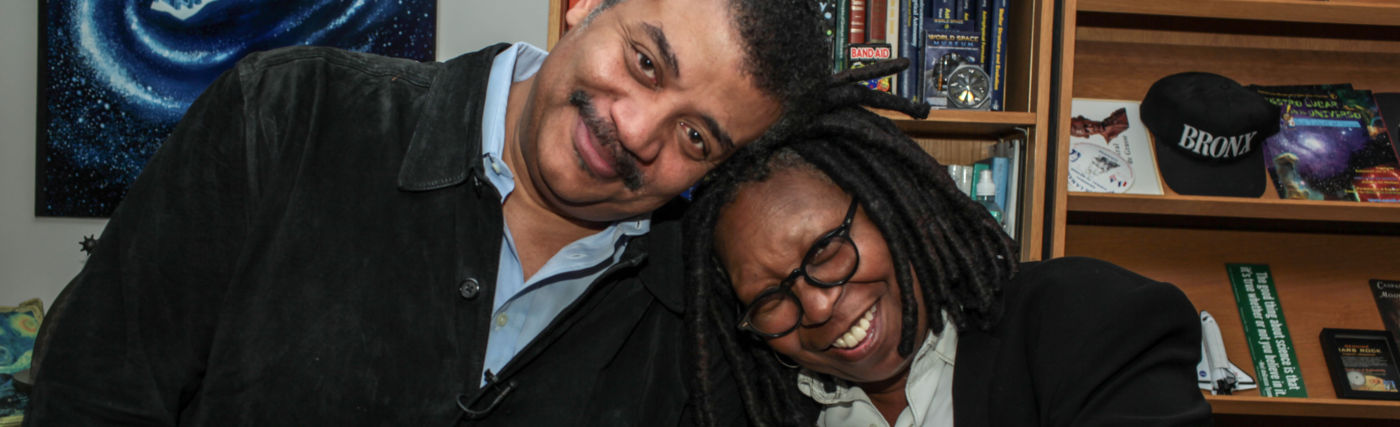
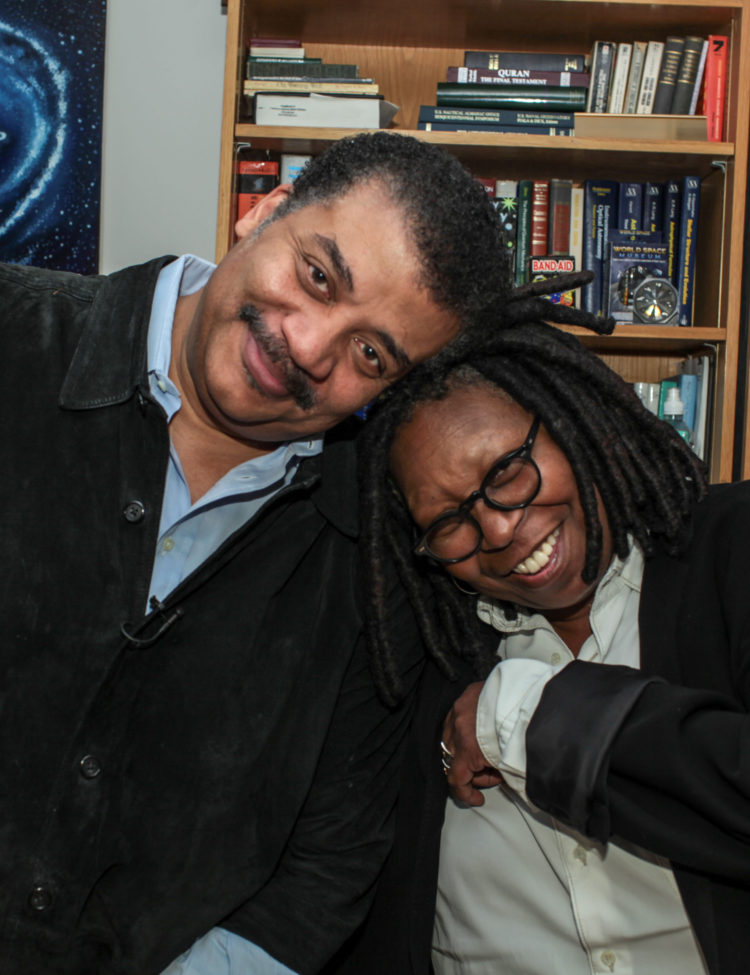
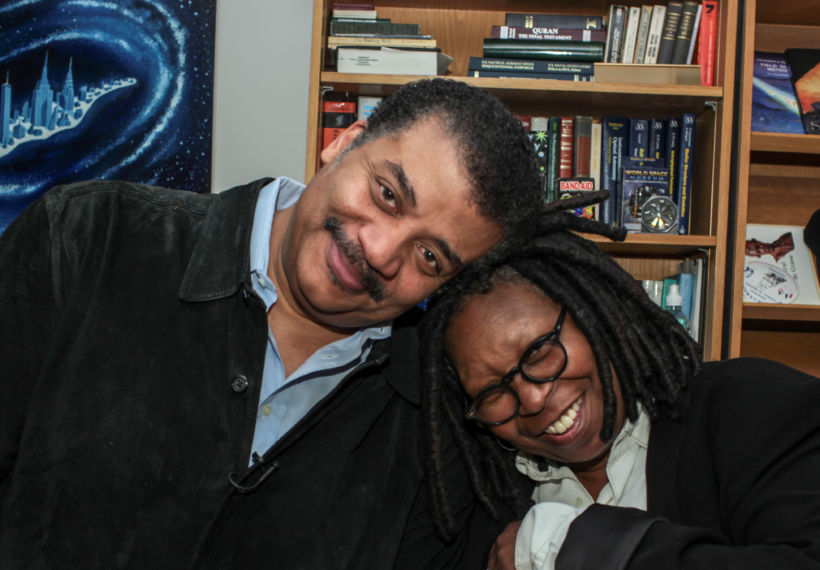
And tonight, we're featuring my interview with Oscar-winning actress, comedian extraordinaire, Whoopi Goldberg.
Whoo!
And she came by my office, and we talked about everything in the universe, from our mutual interest in Star Trek and superheroes to her interest in medical marijuana.
Whoa.
So let's do this.
Yes.
Tonight, I got my co-host, Chuck Nice.
Always a pleasure, my friend.
Give it up for Chuck Nice.
And also, this evening, I've got a friend, a fellow astrophysicist, Charles Liu.
Charles.
You are the Patriot Saint of all things geeky.
And so, so, so-
Then that's a compliment.
He meant that in a good way.
Well, if Charles is Patriot Saint of Geeks of the World, I can tell you that Whoopi Goldberg is a card-carrying member of that community.
Absolutely.
We've known each other for a while.
And so, anytime we chat, we rediscover our mutual interest in space.
And so, I love that about our conversations.
And let's check it out, see where that took us.
You and I attended a party at my house.
And kids, they want to talk to you.
They know who you are and they have questions.
It's like, because my teacher can't understand what I'm asking.
I think adults also have questions, but they forgot how to ask them.
Well, because you never want to look like you don't know.
Yeah, yeah.
See, they're ego-
I don't mind being dumb as hell.
I don't mind people knowing I'm dumb as hell.
I would tell you, I'm dumb as hell.
But I try to meet as many people who can just drop little droplets in my head.
Just let me know what's out there.
I mean, there are questions that everyone has.
And that's how I feel about our place in the universe.
You know, the idea that we are the only things out here doesn't make any sense to me.
That would be inexcusably egocentric to even suggest it.
And is it a human thing or is it an American thing?
I don't know.
No, it's human.
The history of our species is one we are certain we are in the middle of.
You know, what does Mediterranean mean?
It means Middle Earth.
Mediterranean.
So, back then, they named the region because they believed they were in the middle of the flat earth at the time.
You know, with the announcement recently of finding, what do they say, 120 other?
Oh, no, so 1,200.
1,200 exoplanets out there.
So, that didn't make me feel better, I will tell you, because I don't know where those planets are, where they are, what are they doing, who's on it?
Who's on it?
They could have a press release on their own planet today saying, we've just discovered planets on a thousand systems, including this one over here, where they call themselves Earth.
We could be in their sky.
Yes.
And then thinking about it the way we're thinking about them.
Now, we're not looking to hurt those planets.
Not initially.
What?
What?
Yes.
Excuse me?
What do you mean, excuse me?
We'll exploit them later, is that what you're saying?
Yeah, exploit.
This is what, that's how we roll as a human species.
You know, Chuck, you know it.
That is who we are.
That is who we are.
At the same time, I'd like to think...
I can't call you Chuck because that's Chuck.
I got to call you Charles for this episode.
You can call me whatever you want.
Okay, Barbara.
No, no.
Okay, no.
So Stephen Hawking came out famously saying that aliens would...
It would not be a good thing for us to encounter aliens.
Right.
And because they might treat us the way we know we've treated one another.
But in the Star Trek universe, the way we got around that was something called the Prime Directive.
Which was?
Where benevolent, more advanced civilizations agreed not to interfere in less advanced civilizations because that was the right thing to do.
So you think these aliens out there that they've watched Star Trek and so they would have this rule and regulation in their book.
If they're that advanced, maybe.
And they saw Whoopi on some of those episodes.
I mean, she was on Star Trek Next Generation as an alien.
That's right.
Which alien was she?
In season two, she was debuted as the bartender named Guinan.
Guinan.
In the bar called Ten Forward, which was on the Enterprise D.
Guinan as a character is at least 700 years old, as far as we know.
So in an episode called Time's Arrow, which was a two-parter going through two separate seasons, she...
I can't believe that the audience is actually nodding in agreement.
I'm looking around, people are like, yes, yes, that's exactly right.
Go ahead.
In Time's Arrow, she was actually portrayed as having been in the United States during Mark Twain's lifetime.
Yes, Mark Twain's era, right.
And so it was then that actually she first met Captain Picard and then later on developed a relationship that went on.
But she met Captain Picard because he had gone through a temporal rift that put him back in time, but she met him and helped him.
I am not worthy.
Chuck, I think right now, everybody listening is amazed that either one of us has a woman.
This is true.
They're both married with children, yes.
So I asked her about the story and the significance of her taking on that role in Star Trek.
There's a backstory there.
Let's check it out.
Not until Lieutenant Uhura, do we even appear in the future, you know.
Did that sensitize you to taking this gig for the next generation Star Trek?
Well, you were a recurring character.
Yes, what it did was I thought, wow, not only is she gorgeous, but everybody wants her.
And she knows her stuff.
She's the communications officer.
You're talking about Uhura?
Yeah.
And she's wearing that hot pants from the 1960s?
Looking fly, looking fly.
Not hot pants, but you know what I'm talking about.
A little skirt thing.
She had that thing.
She had the legs.
Because her title is Lieutenant, she's in direct ascendancy to captain of the ship.
So the first time ever, someone of color would actually.
Yes.
Now, Gene Roddenberry didn't realize how big a deal this was because he didn't realize that we didn't appear anywhere else.
The social impact of it.
Because it's the right thing to do.
So when LeVar comes to my house, I say, what are you doing?
I'm getting ready to do Star Trek.
I was like, dude, I want in.
I want to do Star Trek.
He's like, I'll tell them.
I said, okay.
I said, set up a lunch for me and Rick Berman and Gene.
So they do.
And Gene says, so you want to do Star Trek?
I said, yeah, you don't understand.
This was a huge part of my life.
This was a huge part of my life because as a kid who loved science fiction, it wasn't until Lieutenant Uhura did I realize that I was in the future.
That you were allowed in the future.
He said, what do you mean?
I said, Gene, if you look at science fiction movies that predate Star Trek, there are no people of color anywhere.
He was like, I don't think I knew that.
I said, well, you know now.
So I would like to uphold that tradition because we know that we're in the future.
The tradition set up by Lieutenant Uhura.
Lieutenant Uhura, that there is someone else of color.
Now you got LeVar.
So my God, you might put two of us on the ship.
And I know that's probably unusual, but I'd love to do it.
He said, all right.
So he created Guinan.
I may be the last creature he created.
That is awesome.
So Star Trek, one of its great accomplishments is not just storytelling of future scenarios, but it also, I think hope was a big part of the messaging.
There are elements of the future that we can ascend to obtain.
That's right.
Star Trek showed humans living in peace and harmony, regardless of what race or nationality or language or anything like that.
So I wonder if science fiction is a unique tablet for shifting the stereotypes that are within our culture.
Because it's not showing a scene you're familiar with.
You'd say, no, I won't allow that because I know that.
And that wouldn't happen that way.
But it's the future.
So you can't prejudge it.
It just happens to you.
And then you can actually affect social change just by displaying what's going on.
And then sometimes you even do things by accident.
You may have noticed that costume that Guinan was wearing.
Yes.
She's completely covered head to toe with cloth except for her face.
These days, we have a lot of that in New York City and in parts.
And sometimes these folks are, say, in traditional Muslim garb.
Mm-hmm.
When Gene Roddenberry created that costume, I'm sure he wasn't thinking of that.
But today, he's projecting forward to what we see today, the common view of differing people with religions and cultures from all around the world that when those episodes first aired, weren't even on the consciousness of the American public.
So I got a list here.
So we look at what well-known science fiction storytelling has brought to us.
So in the original Star Trek, we had Sulu.
And it was uncommon to have had an Asian anything.
Now, anywhere wasn't it your servant?
Or a cook.
Or yeah, cook, your cleaner.
Or an awesome kick-ass sidekick named Kato.
The Green Hornet, played by Bruce Lee.
Thank you.
Because they looked at me like I had two heads.
Yeah, yeah.
But he was also, by the way, the chauffeur, if I remember correctly.
I didn't like that part.
Yeah, yeah, that's what I'm saying.
That's what I'm saying.
But his wheels were pretty awesome.
The black beauty, this rolling arsenal.
I got to tell you something, man, you're the biggest geek I've ever met.
Thank you.
You have just made my day.
So, wait, I got more here.
So in Battlestar Galactica, I've forgotten about this.
Admiral William Adama.
Adama.
Yeah.
James Olmos.
So we have Latino in that.
What else do we have here?
I guess we have Billy D.
Williams as Lando Calrissian.
Lando Calrissian.
Hey there, Darth Vader, you better watch yourself.
Because I'm about to crack open a Colt 45.
Sorry.
The old TV show.
And also in the most recent Star Wars, okay, the lead two characters, one is a woman, one is black.
Finn.
Finn, the black storm trooper.
But he was a storm trooper clone, right?
Well, a lot of people lost their mind.
Why did they lose their mind?
I didn't follow this.
Well, I didn't know if they lost their mind.
People lost their mind for all kinds of reasons.
I know.
Some people lost their mind because it was just like, oh my God, he's black.
And I'm like, oh my God, he doesn't exist.
So why can't he be black?
Wait.
Why couldn't he be?
But the other part is...
That doesn't answer my question.
No, the clones are cloned from Boba Fett, right?
Right.
And so we know that...
I've never seen Boba Fett's face.
Boba Fett is actually South Asian.
He's like a South...
He's Pacific Rim.
Why you...
He's a Pacific Rim Asian.
And so, yeah, Jango Fett, we also know.
And so the idea, the reason...
South Asian, not just Asian, South Asian.
Pacific Rim.
So some people thought that...
Some people thought maybe, maybe they're mad because it's not true to the actual story of the Clone Wars.
But the whole thing's made up anyway.
But my point is, what difference does it make?
It's all fantasy.
And as it turned out, the stress was completely unfounded because Finn is not a clone.
Right.
What is he?
He's black.
And that's the answer for everything when things don't work out.
Why did this happen?
He's black.
Turns out Finn wasn't a clone.
Finn was an army that had been created from young people that had been brainwashed from an early age to become soldiers for the First Order.
So it wasn't even a stormtrooper to begin with.
So all the controversy evaporated when people actually saw the movie.
I got you.
Okay.
So basically he was black Hitler youth.
And ain't nothing wrong with that.
Apparently.
He got better.
So is there any science fiction today that you think is shifting stereotypes?
Well you know what?
By the way, are stereotypes shifted and people don't even know it when it's getting shifted?
So does that question even make sense?
Are we being influenced without even knowing it by some force of science fiction that's out there now?
I think so.
It depends.
Let me tell you what I think might be some of the most interesting and original science fiction is going on today.
If we take the assumption that the best science fiction at any given time describes the anxieties of the time in the society there and that right now the greatest anxiety we might have has to do with disease and environmental degradation and plagues that might affect all of humanity, I think some of the most interesting and relevant science fiction going on now is with zombies.
Really?
Yes.
Think about The Walking Dead.
Think about World War Z.
But how does that advance the social cause?
Well, it makes viruses a lot more scary and you know, I think we should start discriminating against them.
What I think what it's doing is it's uniting all of humanity as we know it against a common enemy, which means that it doesn't matter what you look like or where you're from as long as you're still breathing and not eating human flesh.
All right, that's cool.
I mean, I'm all down with the not eating human flesh thing.
Excuse me, Chuck.
No, but I do think that science fiction does have the ability to shift our perspectives and that's a good thing.
That's a good thing.
Well, coming up next, Whoopi Goldberg gives her idea of what a perfect superhero should be.
And we'll tussle over that when Star Talk returns.
This evening, we're featuring my interview with Academy Award-winning actor Whoopi Goldberg.
And did you know she was a card-carrying geek?
Well, let's check some of that out.
Here it goes.
I'm a woman of a certain age who's always grown up with Superman and Batman and Supergirl and all of the DC and Marvel universes.
And there's nothing out there for us.
For women of a certain age, I want to see, you know, somebody who saves the Earth who looks a little bit like me, who's behind is a little bit bigger, whose chest is on the floor.
But when that super powers kick in, she can slap a whole nation of people on the way to taking care of business.
That's what I want.
And you don't find a lot of humor.
It's just like, you know.
And I feel the same way about science fiction movies.
You know, I'd like it to be men and women in black.
But men in black included women.
I mean, it's like, like ex-men that includes women.
It's men like the old-fashioned man.
You know, ex-broad.
It should be ex-broad.
I'm still trying to think of a superhero with a big ass.
I can't.
I'm trying to...
No, there isn't one.
There's not.
There are not.
Everyone is built.
I'm talking about natural ass.
Natural 50-year-old ass.
Natural 50-year-old ass.
Now, my ass is older than that.
On the body of a superhero.
Yeah, because superheroes, nothing says superheroes have to be fit.
Yeah, of course.
I tweeted this once, and I said, how come no one's talking about this?
Superman does not need muscles.
No.
If he's Superman...
He's Superman.
Hello?
He's just like any damn guy.
He has ED, okay?
What?
What?
There is one thing I can say.
What?
Whoopi should be happy because in 2013, there was a series of X-Men put out by Marvel Comics, which only contained women.
Really?
Storm, Shadow Cat, Psylocke, Jubilee, the list goes on.
And then in 2015, Marvel has put out something called A-Force, which are Avengers only women.
Yes.
She-Hawk, Spider-Woman.
But do they have big behinds?
Well, there's Big Barda.
And what's interesting is that the geek culture has been associated with superheroes and other sort of comic book adventures.
Historically, that wasn't always the case.
But geeks have kind of taken ownership of it.
Now, we all know that Whoopi has serious geek credentials.
Just to be having that conversation with her.
We got that.
But I don't know that everyone knows the full depths of her nerditude.
Yes.
And I'm told, Chuck, you went on the street.
Yes, we did, man.
We went on the street.
And, you know, just to pretty much seek out and find out what people, where they are on the nerd scale.
And I got to tell you, I was very surprised.
Can I ask you some questions, my friend?
I'm gonna give you three names.
Tell me which one is a nerd.
Uh, Whoopi Goldberg, Bill Gates, Morgan Freeman.
Bill Gates.
Whichever one makes more money.
Bill Gates.
Nope, trick question.
All three.
All three.
Yes, it is Whoopi.
Whoopi's cool.
Whoopi is cool, but she's a cool nerd.
Uh, yeah.
Yeah.
She's totally into sci-fi.
She played guidance on Star Trek.
You're a nerd?
Are you a nerd, sir?
Why do nerds get bullied, in your estimation?
Because we're different.
People are really jealous.
People are afraid of knowledge.
People are afraid of knowledge, and they're jealous because nerds rule, right?
Nerds of the world, unite!
How do nerds get revenge?
I mean, you want to talk about the movie, or you want to talk about real life?
Wow, you really are a nerd, aren't you?
In real life?
Yeah, in real life.
You get your PhD and you hire the people that bully you.
Boom!
Well, coming up, Whoopi and I continue to engage in nerd speak, and this time we'll talk about people in space, and she's all over it.
Next on Star Talk.
We're back on Star Talk in the Hall of the Universe beneath the Hayden Sphere, right here at the American Museum of Natural History.
We're featuring my interview with Whoopi Goldberg, and she and I are just geeking out in my office.
Let's check it out.
If we could send folks to the moon, they got out of the capsule, they party.
Yeah, played golf, drove around.
Played golf, drove around.
What did we see up there that prevented us from going back?
What slowed us down?
What did we see up there?
How come there's no Mickey D on the moon yet?
I will tell you.
You ready?
You're not listening.
I am.
All right.
Ask why we went to the moon in the first place.
Was it because we're explorers?
We're discoverers?
No, we went to beat the Russians.
And we got to the moon, and we saw the Russians have no actual plan to get to the moon.
Once we figured that out, we were done with the entire quest, because it was never a quest to begin with.
It was a demonstration of might in a cold war against a sworn communist enemy.
That's why we have not left low earth orbit since 19 fricking 72.
Now, we want to go to Mars.
We'll never go to Mars unless we find oil on Mars.
Or China says, they leak a memo, then you have to be true, leak a memo and say, we want to put military bases on Mars.
We'll be on Mars like that.
Are the Chinese going into space?
They're called taikonauts.
We don't even call them astronauts, they're called taikonauts.
Okay, so...
Chinese said they're going to space, they went into space.
But did anybody see it?
Can they prove it?
We got people.
We have cameras in high places.
Yes.
What's it going to take to get out of low earth orbit?
First of all, we already out of low earth orbit.
Humans, you know exactly what I'm talking about.
Don't mess with me.
I still think that discovery using robots counts.
I so don't agree with you.
Let's go back to those Chinese, okay?
The taikonauts, by the way...
Let me tell you something about the Chinese.
The Chinese space program is alive and well because the government wants to make a point.
You're actually right.
So they're trying to knit some sort of national identity into going into space, right?
I think what we need is an identity, an importance of going out into space that supersedes mere competition to convince everyone that it's actually worth it for us to go out into space for something greater than either vanity or military or economics.
We're doomed.
So, when I think of American accomplishments in the great Apollo era and I compare them to today, we know the golden age of space exploration from the 60s was way different in terms of commitment, expense, love, when you compare it to today.
And there's surely some data lurking in there that will give me some insight in how to think about these two eras.
And anytime I need some data, I need some Mona.
So, Mona, can I get some data, please?
Mona Chalabi, she's a data journalist with The Guardian.
So, Mona, what do you have on space for me?
So, as you know, we haven't been back to the moon specifically since 1972.
But there's still a lot of money that's available to be doing this stuff.
So, in 2013, the space program's budget was $39 billion.
That's more than every single other country's budget for this combined.
So, the US is still the world leader by a long, long way.
So, this is all very hopeful that the budgets are going up, companies investing it are going up.
So, you're saying my skepticism is unfounded.
Not quite, because the budgets aren't actually going up.
As a percentage of GDP, spending on the space program has fallen in the US over time.
The difference is that the gap between the US and the rest of the world still remains vast despite that.
Okay, so it means we'll still be doing stuff in space, even if we don't go any place truly extraordinary.
Maybe.
Alright, Mona Chalabi, thank you.
We got to go to commercial, but we actually changed topics in this next segment.
And so, Charles, as much as we love your geekitude, we need to swap you out with somebody else.
I happily accede to yet another awesome geek.
Charles Liu in this segment.
So up next, we change gears in my interview, and we talk about the science of medical marijuana with Whoopi Goldberg.
Star Talk returns.
Welcome back to Star Talk, right here in the Hall of the Universe of the American Museum of Natural History.
And we're featuring my interview with American icon, Whoopi Goldberg.
And we've been geeking out over Star Trek and superheroes, and then the conversation changed, and we started talking about her latest passion, medicinal marijuana.
So, let's do this.
Yes.
Now, I am no marijuana expert, but we found one.
Yes, we found Staci Gruber.
Staci, welcome to Star Talk.
You're the Director of the Marijuana Investigations for Neuroscientific Discovery.
MIND, yeah.
MIND, MIND.
The MIND program, yeah.
Okay, the acronym.
Okay, cool, and you're a psychiatrist?
Associate Professor of Psychiatry.
Associate Professor of Psychiatry.
The neuroscientist.
Neuroscientist.
Neuroscientist.
Whoa, so she's got it all.
She's like, there it is.
Listen, you covered it, and listen, this is a very good lesson to children to stay in school until you can have enough credentials to say, I need to smoke weed for research.
So your patients call you pot-doc.
Among other things, that's true.
Among, okay.
That is true, that is true.
So your expertise will come in handy for this next section of my interview with Whoopi Goldberg because it's all about her interest in marijuana.
Excellent.
So let's check it out.
I'm interested in marijuana as medicine.
I think that if I don't have to take an oxycodone, I don't want to.
If I don't have to take Valium, I don't want to.
If I can rub something and get relief, I'm all for that.
When I was younger, I got horrific menstrual cramps to the point where I had to take really hard drugs to quell the pain.
Now, if you've never had cramps, it's not something you would think about.
But this is a lot of people on the planet who go through this every day or every month.
So I created, along with my friend, Maya Elizabeth.
You got it in your pocket?
I have it in my pocket.
This is like hair balm.
It does.
Can I put some on my...
Yes, actually, you can, because this is what I will tell you.
If you are having issues with your muscles...
Yes, is good for you.
You can't smoke it.
You can't get high from this.
But you can catch relief.
And so, for me in particular, for me, I just wanted to create something that would give you an alternative to pills.
There's nothing wrong with pills.
And this is not going to work for everybody, but it will work for some.
Staci, what are the most common ailments that marijuana is prescribed for?
So patients often seek certification or recommendation from doctors for lots of different things.
Chronic pain, post-traumatic stress disorder, epilepsy.
Every state has different indications for which you can be certified.
Okay, but there's a tandem story going on here, and that's what the consequences are of people taking other sort of traditional medicines for many of those same ailments and the consequences of it.
So tell me how bad is this addiction to prescription drugs?
It's really a national epidemic at this point.
I think people have acknowledged that we really have a problem here with prescription misuse and, again, things like heroin.
You know, oxy.
I just got to understand, if I'm in pain and I take medicine to cure the pain, why is that misuse?
I'm not sure that that would be misuse.
Unfortunately, that may be how it starts.
So what happens?
My pain actually goes away, but what is my urge to want to keep taking the pill?
So you have a reward circuitry system in your brain, and you get used to having this exogenous, let's say, opiate on board, and you like it and it feels good.
Exogenous.
Outside.
Outside of you.
Thank you.
Outside of you as opposed to your...
Is it erogenous?
That's different.
That's a whole different topic, a whole different show.
A whole different show, although she did talk about rubbing it, so I, you know...
Okay, right, right, okay.
No judgment.
No judgment.
But, yeah, so outside...
Exogenous.
You get used to having that on board, and people love the feeling of feeling good, and it makes sense.
Our reward circuitry, the reward circuitry in your brain is very powerful.
Very powerful.
And drugs really hijack that circuitry.
They hijack the circuitry.
So now my ailment is, the pain is no longer there, but I'm liking the drugs.
You're liking the drugs.
And I keep taking it, and I have to take more to get the same pleasure from it.
And there it is.
And there it is.
And it is a biological drive that is unbelievably strong.
It's not about will.
It's not about, you know, I just want to take the drug.
You cannot stop yourself.
Despite the fact that you may lose your job, your family, everything that's ever meant anything to you, you have no choice.
You're fighting biology.
So let me go back to the marijuana for a moment.
Are there known positive effects beyond what the obvious ones are from smoking it?
Can you really rub it on and cure the way Whoopi describes?
Yes, there are different routes of administration.
You can use a transdermal patch.
You can use a topical.
You can use a sublingual tincture.
So under the tongue, put a little, you know, a few drops and see what happens.
In fact, lots of people use things like this.
These are all ways to get the chemical into your system.
Yes.
Don't forget brownies.
Right, right.
Don't forget edibles, right.
Don't forget edibles.
That's exactly right.
Well, Whoopi had plenty to say on these topics.
Plenty to say when we chatted.
Let's check out more on that conversation.
I've been a believer in medicinal marijuana for 40 years because I've seen...
Forty, not four.
Forty.
Four zero.
Because I've had friends, a couple of them who have passed from cancer and I saw the relief that they got from marijuana and wondered why no one said, hey, we should look at this because it's, you know, there's some medicinal points here.
And it's apparently because Nixon put a thing together saying, yeah, well, we can't make it illegal to be black or to be a hippie.
So we decided we're going to get marijuana.
We're going to make it a Schedule I drug, which means there are no redeeming qualities in it.
A drug that was frequently used by the hippies.
By hippies and black folks.
They said, so we're making this a Schedule I drug so we can really bust people.
Schedule I drugs are drugs.
There are no reason for them to be in existence except to get you high.
That's not the case with marijuana.
It's never been the case.
I mean, Queen Victoria used tinctures of marijuana for pain.
I mean, there are a lot of things that we know happened.
So if we discover that this law, this idea that it's become a Schedule I drug, stems solely from Nixon, says to me maybe we should kind of revisit this just based on that.
Staci, I'm looking at a list, a partial list of Schedule I drugs.
Marijuana is on that list right alongside heroin.
Heroin, LSD.
Yeah, and Schedule II drugs are cocaine.
I don't understand.
That's a great question.
I wish I knew.
Why did I bring you on the show?
You can't answer.
Well, let me try.
So Schedule I by definition, as will be mentioned, means it has no accepted medical value.
There's demonstrated risk of liability for abuse, and it hasn't demonstrated safety.
Those are the three mandatory requirements of Schedule I.
So all the substances in that class are supposed to meet that requirement.
There are a lot of people who think that marijuana doesn't belong in Schedule I, and in fact, it seems like there was an awful lot going on politically during the Controlled Substance Act that classified marijuana.
So the Controlled Substance Act, traceable to 1970 I guess, that's been modified along, that's a changeable thing, I presume?
It's a changeable thing, and there have been things that have been added.
And in fact, there's questions right now in the DEA about reclassifying marijuana.
Drug Enforcement Agency?
DEA, yep, Drug Enforcement Agency about reclassifying marijuana.
Okay, so you look at the data, apparently marijuana has been used since 2700 BC, earliest records.
But it's been used throughout history.
I have a great slide, and I show Adam and Eve in the Garden of Eden, and instead of a fig leaf, it's a cannabis leaf, to sort of demonstrate that it's really been around since the beginning of time.
Okay, you got to know your leaves.
That explains the talking snake.
Exactly right, exactly right.
That's it.
All right, coming up more about the science of medical marijuana, we'll find out what we know and what we don't know when Star Talk returns.
And we're featuring my interview with pop culture icon Whoopi Goldberg.
And we've been talking about her deep interest in medicinal marijuana.
Let's check it out.
There are children in our country that suffer from these horrific seizures.
And the medicines are very hard on the body of little children.
The current medicines.
The current medicines.
Now we find that there were growers who have been growing marijuana for many years and working with it and extracting oils and really looking for ways to make it something that works for humanity.
So they discover something that seems to pull back the seizures and allow children to live as children.
Is there laboratory evidence that this works?
Well, there would have been, but as you know, it's almost impossible to get laboratory evidence with a Schedule I drug.
You see, so what we've done and what many parents have done is they've given up their lives and moved to where they can get it so their kid can have a...
Diminish symptoms.
Diminish symptoms and just some kind of quality of life.
So for me, if parents are that desperate, why are you not looking at what they've put together?
They are your trials.
They're your trials.
But the minute you denigrate them and say, well, you don't know what you're looking at, you know if your kid is back or whether your kid is monosyllabic because they are in the throes of their illness.
Parents who are only really trying to find a way to make their children's lives better, they're not trying to go get high because all you need is an app.
If you want to get high, there are weed apps.
You can go, you can find weed anywhere.
Chuck, the cameras are rolling.
What are you doing?
No, man, I'm just downloading the app.
Staci, tell me about this seizure condition that she's referring to.
So, I think some years ago, there was an awful lot of attention paid to a little girl named Charlotte Figge.
Charlotte Figge was very unfortunately diagnosed with an intractable form of epilepsy called Dravet syndrome.
And this little girl was having upwards of 300 seizures a week.
She couldn't walk, she couldn't really talk.
She was really not doing well.
And I think doctors had basically told her parents that they were at the end of the line with regard to medicine.
And someone mentioned the possibility of trying medicinal cannabis.
And now there are some clinical trials.
But that little girl is walking and talking and having a life.
And lots of other kids are having similar response.
The clinical trial, which appears to be showing some very promising results, is really quite extraordinary.
And so this wouldn't have been possible unless...
Was she one of those, what do you call them, marijuana refugees?
So I think they lived there.
Yeah, the medical marijuana refugees are people who relocate.
They give up everything.
These families give up their homes, their lives, their everything to move across the country to a state where it's legal for their kids to get treatment because there's no other way with regard to the federal laws, as they are, to get products that are able to treat their children.
So what's the research on the effect of marijuana on the developing brain?
So what we know about the developing brain, and my budding neuroscience fellow over here is going to corroborate this, the brain, it's true, just wait a second, the brain develops from the back to the front, bottom to the top, last part of the brain to become developed is, I'm telling you, right here, right here.
Which is why teenagers are dumb as hell.
If you're a teenager, you're the stupidest person on earth, and you don't have the ability to make good decisions because the part of your brain that allows you to make the best decision has not been developed yet.
Am I right?
I'm telling you, he could have a job.
Hey, listen.
I never read about any of this.
I'm high right now.
There you go.
But it's true.
But should there be an age restriction on legalized marijuana?
The developing brain really is vulnerable, not just to drugs, but to alcohol, to injury, to illness, to everything, because the frontal part of your brain...
I don't know that I'd say the stupidest people.
I'd say really...
That's very true.
I do not.
I see a lot of them, but I do not have one.
I got one at home right now.
There we go.
And let me tell you something.
She was smart until she hit 13.
And once the teen went on the...
I'm like, what happened?
What happened?
But they're vulnerable.
Vulnerable to lots of different things.
And so people have suggested...
We know the brain develops throughout the second and into the third decade of life.
It's a long time.
So we don't want to really expose them too much to things that may affect the ways in which their brain develops.
And in fact, exposure to cannabis, our research and lots of other research studies shows that if you're exposed early, you're going to look a little bit different than those who are exposed later.
Well, coming up, Bill Nye the Science Guy is going to give his take on medicinal marijuana use when Star Talk returns.
We're featuring my interview with Whoopi Goldberg, and we were talking about medicinal marijuana.
Let's check it out.
I use marijuana for two reasons.
I get, not blinding, but I get pretty bad headaches from glaucoma.
So, I didn't realize that the weed helped me until I stopped.
I stopped smoking cigarettes about five years ago, and discovered I could no longer take a breath with a paper.
And I thought, well, okay, that's kind of sad, because I can't smoke anymore.
What, does it irritate you?
You just can't get the breath in?
I can't.
Inhale it.
It's just, it's hard.
It hurts, it can't do it.
So, and I was talking to my daughter, I said, well, I'm starting to get these crazy headaches again, so I got to figure out what to do.
She said, I think I might be able to help you, because there's something called a vape pen.
And I thought, well, I don't want to, I thought it was she was talking about a hookah.
And she said, no, no, it's the THC oil, and it may help you.
I call it my sippy pen, because I can sip it to the place where I need it to be where it doesn't hurt anymore.
So I'm not, again, I'm not looking to get high high, because at this age I don't need to get high high.
But I would like to be pain free, and so this works.
So I use it for that, and this is what it looks like.
From your other pocket.
This is what it looks like, and this is the oil inside.
So this burns and you, and the vapor of the oil.
Yes.
And that gives you that effect.
Yes.
And it works well for me.
You know, there's a lot of ill people, and this is really a way for them to get through their day.
And so, you know, I just, I want people to feel better.
So Staci, the three layers of, I guess, three stages of marijuana access.
One stage is just illegal, the next one is medically legal, third one it's recreationally legal.
And different states have this at different stages.
So in a perfect future, what should these laws look like?
I think the laws would be informed by science.
What we have now as policy has outpaced science, and we have laws that have been passed without much science to back it up.
Okay, so why are we passing laws without the science behind it, when in fact they're based on things that science can resolve?
Another really good question.
Since I'm not a legislator or policy maker, I can't answer that for you, but I can tell you that policy is over here.
Okay, so somebody needs to be out there saying, here's the science, here's what we know, here's what we don't know.
You're going to make legislation based on what we know.
Exactly right.
Is anybody doing that?
I think people are starting to pay attention to the need, and now there's a little bit of an attempt to sort of back and fill, and people are making strides at trying to get to the bottom of what we might be able to understand from cannabinoid based therapies, for example.
So what you're really saying is, all of Congress needs to smoke a bone.
If we could just get Congress to smoke a bone, they would realize that they're being ridiculous, and we would have some common sense legislation surrounding this.
I guess that's one way to look at it, for sure.
Well before we wrap, I want to make sure we catch up with Bill Nye, the Science Guy, a good friend, and in our segment we call Nye Times in the City, and in this case, it's about medicinal marijuana.
Let's check it out.
Oh man, a day in the park, isn't it beautiful?
You know, the first written records of cannabis use goes back over 5,000 years to ancient China.
In all that time, people have used it for medicine and for rituals.
When the leaves are burned, it releases good old tetrahydrocannabinol, which you might call THC, replaces certain chemicals in your brain, affects your decision center which is above your right eye and in front of your right ear, up here, in your brain some place.
People use it to relieve the symptoms of multiple sclerosis, to control seizures, and to take care of the nausea that comes sometimes after chemotherapy.
It's amazing.
Now, for my part, I've tried to smoke cigarettes on camera a few times, I just can't do it.
Smoke makes me sick.
And since I don't smoke, I just come out to a park like this and get high on life.
Back to you, Neil.
He's in the grass.
I love the metaphorical, the visual metaphor.
So it's not often I might have parting thoughts that are based entirely on the profile of of our principal guest, and this show was Whoopi Goldberg.
But I couldn't stop reflecting on the fact that we are talking about marijuana.
Earlier in the show, we talked about Star Trek.
We talked about superheroes.
We talked about all their roles in pop culture.
And we're doing this because she cares about it, because Whoopi Goldberg cares about it.
And then who is Whoopi Goldberg?
She dropped out of high school, dropped out of high school.
And her ambition carried her from the depths of what anyone would consider is society, that the lowest points in society.
She rose up, became a comedian, an actress, an Academy Award winning actress, wins the Tony, the Emmy.
And I'm privileged to call her a friend.
So, the fact that people like that are walking around, I think gives hope to us all.
That no matter your background, no matter your skin color, no matter your educational profile, there's a place for you in the future of this country in a way that can influence millions of other people simply because of your passion and your love for what you do.
That's a message from the universe and from Star Talk.
I'm your host, your personal astrophysicist, Neil deGrasse Tyson, and as always, I bid you to keep looking up.
See the full transcript



 Unlock with Patreon





 Become a Patron