This episode is bursting with conspiracy theories and strange hypotheses, but that doesn’t stop your own personal astrophysicist Neil deGrasse Tyson from dropping some serious science. You’ll learn why the government isn’t secretly using HAARP to manipulate weather and why we shouldn’t dispose of pollution in our atmosphere. Explore where black holes go when they die, the difference between black holes and white holes, and whether we could use quantum teleportation to explore inside a black hole. Find out what would happen to the planets if we moved the Sun, and why there is no speed of dark. Neil also explains atmosphere, air pressure and vacuums, why hot air rises but air is colder at higher altitudes, and why time passes differently on Jupiter than on Earth. Plus, he tells comic co-host Eugene Mirman how to use physics to communicate with a 3-meter tall alien “gummy bear.”
Transcript
DOWNLOAD SRT
Welcome to StarTalk, your place in the universe where science and pop culture collide. StarTalk begins right now. This is StarTalk. I'm your host. You're a personal astrophysicist, Neil deGrasse Tyson. I'm here in studio with Eugene Mirman. Eugene, welcome...
Welcome to StarTalk, your place in the universe where science and pop culture collide.
StarTalk begins right now.
This is StarTalk.
I'm your host.
You're a personal astrophysicist, Neil deGrasse Tyson.
I'm here in studio with Eugene Mirman.
Eugene, welcome back.
Great to be here, Neil.
That sounded way too rehearsed.
But it's true, it is great to be here.
But you're right, it sounded terrible.
It sounded like a fake announcer.
We are in a Cosmic Queries edition.
That's one of my favorite kinds of StarTalk.
And this one, people writing questions, and this is the Grab Bag edition.
The Grab Bag of all sorts of questions.
All sorts of, we collect them in the bottom of the bin, and we still think about you.
These are questions from all of our fans.
Yeah, I mean, this is literally from Denmark.
Why would you even bother?
Merlin, no, this is what Merlin asks.
Merlin from Denmark.
I know.
Okay, cool, let's do it.
I recently found an article describing a relatively recently found quasar cluster, which apparently is too big to exist in the universe, according to our current state of understanding.
I am wondering now, of course, how an object could be, even be too large for the entire universe and also what that exactly means for our understanding of the cosmos.
No, so that's a great question.
So I think there's a mix up of information there.
So if there's an object, you have like galaxies out there, right?
And then you have like pairs of galaxies and they know about each other because they orbit one another.
You can have clusters of galaxies and they orbit like bees in a hive would.
And so you can see that galaxies can know about the existence of other galaxies that are nearby and they create what we call a cluster.
Now, if you have a cluster of quasars and they know about each other, but they're too far away from one another for the age of the universe to have allowed them to know about one another at the time they were created, that's a problem.
Yes, it's definitely a problem.
So in other words, it's a coherent structure that is larger than the universe at the time would have allowed to have existed.
Right, but now it's fine.
No, well, now it would have been fine.
But back then, we're talking about quasars in the early universe.
The early universe, back then, the universe was smaller.
It was the size of like a pan, the size of a marshall's.
Pick a time and any, pick a time and we can find a time in the universe where, pick a size, there's a time in the universe when it was that size.
Marshall's?
A marshall's, yes.
A marble, yes.
An atom, yes.
A football stadium, yes.
I see.
So it's a challenge when you have this.
The universe brims with mysteries.
We don't have answers to them.
Is that the name of your band?
All right, here's a question from Nick.
Christoph Wederich, theoretical physicist at the University of Händelberg in Germany.
If he's a theoretical physicist, he should have no questions for me whatsoever.
Well, it's too late.
This guy is quoting him.
It's too late for me.
Oh, he's quoting the other guy.
Oh, I thought there was a question from him.
Oh, yeah, yeah.
No, Nick is like expanding universe, and then this is the message.
Christoph, a theoretical physicist at the University of Händelberg in Germany, has recently…
That would be Heidelberg.
Yeah, I'm just testing you.
has recently proposed an idea that the universe isn't expanding, but instead gaining mass.
If the entire universe is gaining mass at the same proportions, it makes his theory impossible to test, though it remains mathematically possible.
Nature News ran the article with a couple of opinions.
Cosmologist Hong-Hong Sheng Zhao, who thought it should be entertained, and Naish Ashfordi, an astrophysicist in Canada who preferred the standard Ockham razor approach.
Have you read this paper?
Whether you have or have not, what are your thoughts on or initial reaction to it?
Thank you for having me read all these names that I have tried to do justice to.
But you didn't even get the city right.
Yeah, but that's because I was terrified that I was going to say Hong-Hong Sheng Zhao incorrectly.
So what we have going on here is a new idea that someone puts forth that could explain what we already know to be true, but in a new and novel way.
There's a time-honored history of this going on in the sciences.
In fact, Copernicus, who put the sun back in the middle of the known universe, turning our geocentric world into a heliocentric world, his book called De Revolutionibus, that book, which is one of the most coveted books in the history of publishing that goes for millions of dollars at auction, if you want to pick up one from the original first.
I would love to.
Maybe I'll start a Kickstarter to buy it.
The original first edition, that idea was so heretical to put the sun in the middle and not the earth.
It is clear and obvious from any read of the Bible that earth is in the middle of all motion and everything goes around the earth.
That's how any movement is described.
And the earth is stationary.
So to say something that's not that is heretical and at the time punishable by trial and the inquisition.
So at the beginning of it, there's a disclaimer.
And the disclaimer, not written by Copernicus, it says this is probably not true, but it makes the math a little easier.
So for that reason alone, it's worth publishing so that the mathematicians can calculate where the planets are in the night sky.
That's a great way around it.
So the point is, if you have a new idea, it could be completely radical from what was prevailing at the time.
And it could be right, it could be wrong.
First, you want to make sure it doesn't predict something that you already know is not true.
And you want it to predict something that you haven't discovered yet.
And that will give you confidence that it's a real idea.
And it's not just exactly mapping onto what you already know is true.
If that's all it is, it's not useful.
It's just somebody else's other idea.
And you don't want to turn it into a Rudyard Kipling…
Just a big idea party.
A Rudyard Kipling Just So story.
It was how the leopard got the spots.
It got before this way.
And here's how the elephant got its trunk.
You could just come up with another explanation.
Right.
That doesn't make it right.
It's just another explanation.
Right.
And it's got to survive the testing.
You're not a fan of multiple origin stories.
No, you want to make a prediction that we can test it.
And if the prediction fails, then we discard the idea.
So I don't know the idea well enough to know what kind of predictions it makes.
If it makes no predictions, it's not useful to anyone.
Right.
Not anyone scientific.
Sounds like you're not a huge fan of theoretical physicists.
No, that's why.
Or they're fine.
On a scale of one to ten, where would you put them?
They're eleven.
My wife is a mathematical physicist.
Okay.
I've got to say nice things.
Okay, right.
I don't want to ruin your marriage.
What else you got?
Okay.
Well, is it a long question because we're running out of time in this segment?
Yeah, it's longer than nine seconds.
You could do an outro.
You are listening to StarTalk Radio– Cosmic Queries Edition.
I'm here with Eugene Mirman.
We're back, StarTalk Radio, Cosmic Queries edition.
Grab bag, stuff we found at the bottom of the bin.
Yeah, bottom of the bin questions.
Every question matters.
Each one from a conspiracy nut.
Here it is.
There are no conspiracy nuts who listen to StarTalk Radio.
No, there aren't.
There are people with valid questions.
All right, so what do you got?
Gareth asks, I've read some theories that harp can be used to manipulate the weather.
Is this possible?
Yeah, harp is a high altitude radio, pension, amoeba.
I always forget the acronym.
There are people who are sure that the government is stockpiling aliens and controlling everything about anything we would ever think about, and they clearly have never worked for the government because the level of incompetence in the government and inefficiency knows no bounds for starters.
It's true that you could manipulate the weather like they did during the Olympics in China.
It's not that you can't manipulate the weather.
It's the weather you would really have any serious control.
Well, weather happens in many places, so it comes about from the heat balance, from the energy coming from the sun, what it reflects off of, what it gets absorbed by, what the upcurrents do, what the downdrafts do, what the rotation of the earth is doing, all of this factors in.
And so I have not been convinced by any of the reports to suggest that experiments in the upper atmosphere, physics experiments, are having any effect on our weather whatsoever.
Right.
And it would be tragic if we wanted to say, oh, that's why it's getting hotter in the world, okay?
Because there's some experiment happening.
That would be tragic because we would be missing the 900-pound gorilla in the room.
Right.
And then, but can you…
The carbon dioxide gorilla, yes.
Yes, the 900-pound carbon dioxide gorilla.
All right.
Here's another question.
By the way, I don't think gorillas can weigh 900 pounds.
Is that true?
The biggest one I've seen, so not 900 pounds.
500 pounds, yeah.
Not 900.
So, 900-pound elephant.
Like a pumpkin.
I bet there's like a pumpkin that someone has made with a gorilla, like a 500-pound gorilla, holding a 400-pound pumpkin.
That would work, yes.
That would be in the room, which would also should attract attention.
Here's the question, though.
I don't know who it's from.
Yeah.
Is it possible to somehow direct pollution through our atmosphere and dispose of it in space, all without harming our atmosphere?
Love your show, by the way.
Thank you.
It depends on what kind of pollution you're talking about.
Dust.
What you're saying is, rather than pollute your rivers or your oceans, you want to pollute the space environment.
Well, since it wouldn't be, we'll throw it into space.
Throw it in.
You'd want to actually get rid of it.
You drop it into a black hole, drop it down into the sun.
You'd want to actually remove the thing entirely.
But would it matter to throw it into space?
Like, would that be bad to someone?
You have to calculate the energy it takes to throw it into space versus the energy it takes to completely break it down on Earth into some non-pollutant ingredient.
You don't want to send a whole thing of, like, sporks into space because that's the way to dispose of it.
And I don't know that sporks are destructible at all.
But so you'd want to not just scatter it into space.
Space, we might want to travel that one day.
Yeah, but we wouldn't put so much pollution into space that we'd be like, oh, we can't get to Mars.
I think they said that when they had built smokestacks.
Oh, it's just a little bit of dirty air.
Look how big the atmosphere is.
Don't worry about it.
Yeah.
All right, all right.
I won't throw my trash into space.
Let's have some foresight here.
Okay, George asks, if we take an open jar into space, to outer space and close it once up, thereby filling it with the vacuum of space, what would happen if we bring it to earth level atmosphere and even to the International Space Station?
It would be the best vacuum we would have ever encountered on earth ever.
Really?
Yes.
We can't make vacuums as good as space vacuums.
Really?
Last I checked, we can't do it.
Unless somebody last week pulled one off.
We can't have as much as space is just top notch.
Space is a far better vacuum than anything we've been able to create in our laboratory.
So why don't we always bring back jars of vacuum?
I now have a new business where I'm gonna sell jars of the best vacuum you've ever seen.
But I like the way the question was worded.
When the vacuum gets inside the jar, what happens is the air inside the jar escapes.
By the way, once you put the vacuum in it and then you bring it back to earth, what will happen is the inner surface of the glass and presumably a metal lid will out gas into that volume.
Their gas is dissolved on the surfaces of all solid objects and it just stays there.
It's molecules that are just stuck in the jaggedy surface of every solid object.
If you now evacuate the center of that jar, it dislodges those gas molecules and so it'll then put some kind of gas pressure back in.
If you're ever trying to create a perfect vacuum, you first vacuum it out, then you heat the sides of the container that releases the gas that's attached, then you vacuum it out again.
So what would you bring into space to bring the vacuum back home?
Something that has a really, really smooth surface with hardly any gases attached to it.
More smooth than glass.
Oh yeah, oh yeah, so glass is way more smooth.
And you could preheat it before you did this.
And-
You bring like Jon Hamm, just somebody who's super smooth.
You'd be like, yeah.
All right.
Oh, by the way, you might ask if quote unquote nature abhors a vacuum, which of course it doesn't because most of the universe is vacuumed, how come all earth's atmosphere doesn't just rush out into the vacuum of space?
It's true.
You might ask.
A vacuum on earth, we think of nature abhorring it because air wants to get inside the vacuum.
Air wants to go into the vacuum.
Air wants to go into it because you are in a place where there's air pressure that wants to get inside.
As you get higher up in the atmosphere, the air pressure gets less and less and less and less and less because there's less air above it pressing down.
And when you get less and less and less and less and less, the air doesn't want to do anything.
It's got no forces.
There's no air pressure to make it, it's just gonna float away.
Okay, so our atmosphere goes out thousands of miles getting ever so thinner as it gets out there.
And so it's not that Earth is holding the atmosphere down, although it is, because Earth has gravity and the gravity keeps the atmosphere separate from the rest of the vacuum of space.
But the air pressure out there has no urge to go anywhere other than just staying right where it is.
Right.
Yeah.
Okay, so here's the question from Kyle.
Kyle.
It is the same exact time everywhere in the universe.
Like, I know you've talked about how the moon and space station is on Houston time because that's who they talk to.
But is the whole of the universe within the same unit of time at the same time?
Or do the vast expansion of the universe do something funky with that?
Yeah, I mean, different parts of the universe are moving at different rates and time has some relative aspects to it.
So for example, the GPS satellites, the clocks on them tick at a different rate than clocks on Earth's surface because when you move far away from the gravity, from a source of gravity, your time speeds up.
So the clocks on the GPS satellites are not ticking at the rate of the clocks that they are informing down here on Earth.
The military puts a correction into the clock time you get from a GPS satellite so that it matches the time we need it to have here on Earth's surface.
So if you're in motion, if you're near a gravity source or far from one, your clock is ticking at a slightly different time from everybody else's.
Then what time is it on Jupiter?
Well, so you go to Jupiter and set up a-
Is it like 3.15?
No, you set up a time system.
So the way you want to answer that in an interesting way is you take two identical clocks, you put one on Earth and one on Jupiter, and watch what happens.
The one on Jupiter will tick slower than the one on Earth.
Really?
Because of Jupiter's gravitational field.
Slows down the ticking of the clock.
So one way to live forever is to go to Jupiter and sit there?
No, you'll just live longer than you would on Earth.
Right, right, not forever, sorry, longer.
Yeah, you'll suffocate and die of pressure.
You would bring a jar of air.
Ignoring that complication, yes.
You can go to Jupiter and live slightly longer than you would here on Earth.
How much longer, actually?
Let's say your life is 100 years.
Like minutes or years?
Yeah, no, minutes.
Oh, oh, that's really not worth it.
Sorry, I got excited.
You're like, yeah, you'd live for 100 years and 10 minutes.
Oh, that's super not worth it.
It's minutes.
I mean, off the top of my head, I think it's, the answer is minutes, yeah.
Yeah, yeah.
All right, here's a question.
I'm writing you from Kabul, Afghanistan, and my question is, we know the speed of light.
Do we know the speed of dark?
And what is dark?
Oh, okay, so philosophers like-
I find Batman.
Philosophers like asking questions such as that.
The problem is if you align the verbs and nouns so that it makes something that sounds like a question, doesn't mean that it's an actual, legitimate question.
It's like saying, what flavor cheese is the moon made of?
Right.
It's a question.
It's a literate question.
Watch out, you're gonna spark a war in Afghanistan.
Just saying.
So what is the speed of dark?
If dark is the absence of light, dark has no speed at all.
There's an answer, it's zero.
Well, the moon is not brief.
So.
So just because we have a word for something that is the absence of light, doesn't mean the absence of light is a thing for you to then ask questions about.
Right, right.
That's the point.
Physically.
Like I said, philosophers go, you know, what is the sound of one hand clapping?
It depends if it's doing it well, it's still like this.
I don't know if you can hear it, but that is literally one hand clapping.
It's not so bad.
One hand clapping itself, yeah.
So then that's the back door answer to that.
So Dark has no speed because it in fact does not exist as an entity.
What we call Dark is the absence of light.
We are StarTalk Cosmic Queries, and we will be right back.
StarTalk Radio, Cosmic Queries edition, Neil Tyson here, Eugene Mirman there.
Eugene, comedian extraordinaire, always great to have you on StarTalk.
Always wonderful to come.
We are Cosmic Queries edition grab bag.
Grab bag, oh, you had more about darkness.
Oh yeah, yeah, somebody asked from Kabul, Afghanistan.
Yeah, what's the speed of dark?
The speed of dark.
By the way, at night.
Great metal band.
In Afghanistan, where there are very few city lights, at night it gets really dark.
So, interesting that someone from Afghanistan is asking about dark, and no one from New York City, would ever ask about dark.
Yeah, yeah.
Because they don't experience the, they don't experience the dark.
So, there's an interesting question kids sometimes ask.
You can pose the question, when you turn on the light, how do you know that light comes out of the bulb, rather than darkness leaves the room and enters the bulb?
Yes.
Is there an experiment that you can conduct?
And the answer is yes.
You can put up a thing in the middle of the room, and detect the light hitting one side of that object, and you will not detect anything else going back towards the light bulb.
If dark was a thing that had speed, you'd be able to measure it.
You'd be able to measure it, exactly.
And this is one of the hallmarks of science that is underappreciated.
In science, we measure stuff, and when you measure it, you can tag and bag it, you can…
It's why you know that the universe is probably not 5,000 years old.
You can't prove it, but you've measured that it's unlikely.
What else you got?
Cosmic Queries.
Rafa from Norway.
I love these questions.
I feel like we know that Europe listens.
Let's suppose you encounter an alien race.
It looks like a 3-meter tall gummy bear.
It has discernible anatomy parts, but you don't have any idea of what does what.
It makes sounds, but of course you don't understand anything.
You are not sure that it has eyes.
You are not sure it has ears.
You are not sure if you touch it, he would...
You do know it's a guy, though.
You're like, definitely a guy.
You're not sure if it would react, overreact and disintegrate you with a phaser.
Or if it would be just toxic and make you die instantly.
But you know that it is very intelligent and he understands, he understands at least college level mathematics, physics, chemistry, and in general has a good background in sciences.
How would you proceed in order to communicate with it?
Yeah, okay.
So what would you say if there's a...
I see now that the question is, what would you do to a three-meter-tall gummy bear that's intelligent and studied our earth sciences?
What, is it three meters tall?
Is that the...
Three meters tall, yeah.
Three meters.
So that's bigger than us, right?
Yeah, tall human is two meters.
Yeah, and he's like, if you touch it, it might hurt you, which you would instantly already assume.
Right.
So, yeah, I wouldn't go for the appendages.
Plus, you know, if it extended something to shake your hand, you don't even know what part of its anatomy you're touching.
But it's a gummy bear, which actually is...
He doesn't realize this is shaped like a bear.
It looks like a gummy bear.
It doesn't mean it is a gummy bear.
But it does have legs, arms, a torso, and a head.
I guess it would, but you don't know what the torso does versus the head.
So you just don't even go there.
So what I would do is I would take the vocabulary of the universe.
By the way, even if I didn't know that he got A's in his astrophysics…
He didn't say he got A's.
He just said he had a pretty good student in mind and he had B pluses.
I would not have to know that he, this he gummy bear, took these classes.
I wouldn't have to know that.
I would know if he arrived here in a spaceship, the dude knows physics.
So I would set up certain physics demos.
You can't imagine somebody would put a dummy into a spaceship, send them here, and they'd be like, how'd you get here?
And the dummy would be like, I don't…
I have no idea.
I really, I just walked into the bright light.
All I have is this soup I brought from my world.
I mean, think about Tom Brokaw famously said, I was a Tom, I think it was Tom Brokaw.
You know, I've been news anchor for 30, my whole career, and I still don't know how a TV works.
And most people don't know how this stuff works.
So it'd be unfortunate if they sent, you know…
Someone who couldn't explain it.
Someone who was impressed by our old cathode ray tubes.
So if they got here, the dude knows some physics, right?
So I would take out a simple physics experiment, like you know the swinging ball experiment.
I'd take some out, make sure they knew what that was, and you'd start to build a science vocabulary.
Because that is the only thing that is not only international on Earth, it is intergalactic.
Right.
It'll start speaking French.
You don't start asking etiquette.
You start understanding science and math.
Understanding science.
You start throwing up.
You start your first things or you throw up and loud sounds upset you.
I would start building a vocabulary of scientific methods and tools.
That way we have a common place to start, and then you increment your way from there.
That's what anyone does even on a speed date.
You start with what's common.
You do a science example on a speed date.
Yeah.
All right, here's another question from Gwendolyn.
Gwendolyn wants to know, is it possible to use quantum teleportation to explore inside a black hole?
Since a teleported particle is not a light particle, it does not have to obey.
Therefore, would it be possible to send a particle in a black hole and get data from it?
Oh, no.
Black holes don't distinguish matter from energy.
You want to go into a black hole.
What if you wore a helmet?
So a black hole, you want to go in and then come back out again.
Hawking radiation allows this.
All the particles that enter a black hole will come out eventually as the black hole evaporates by way of Hawking radiation.
So that's a really slow way to find out what the inside of the black hole was doing.
Could you go in a black hole, wait 10,000 years and come out and be alive and fine?
No, because your particles will go in one by one and they'll come out one by one.
You'll have to reassemble who and what you were as well as your brain and your memory.
We don't have that power yet.
So just briefly, Hawking radiation is particles get spontaneously created in the gravity field outside the black hole.
The particle pairs, one falls back in, the other escapes.
All the particles that escape, it's the same inventory as the particles that it had eaten over its entire life is an awesome fact of the universe.
You're listening to Cosmic Queries Star Talk.
We're back, StarTalk Radio.
These questions came from the internet, startalkradio.net, from Twitter, StarTalk Radio, from Google+.
Yeah, some of these emailed.
Facebook, so give them to me.
This one's from Australia.
And I haven't seen any of them.
No, this one's from Australia, from Dave Willis.
So if I don't have an answer, I'll tell you.
Not the one who created Aqua Teen Hunger Force.
So anyway, here's a question from Australia.
Would you be able to explain the differences between black holes, supermassive black holes, quasars, and white holes?
I'm very interested in this subject, but any information I find is vague and sometimes contradicts previous info.
In the 1970s, the black hole formula that told us what a black hole is and how it works, it was discovered had a second solution to it.
And the second solution was the mathematical opposite of the solution that described a black hole.
So a black hole, nothing comes out, anything always goes in.
The white hole, everything only ever comes out.
Oh.
And so people wondered, could a black hole be connected to a white hole through a wormhole in the fabric of space?
I think you're describing zebras now.
So anything that goes into a black hole would then come out a white hole.
And if that were the case, a white hole would be a highly radiant thing.
And if it is, what are these radiant things at the edge of the universe?
They're quasars.
Could a white hole be a quasar?
So we mapped out what a white hole should look like.
We looked at what quasars look like and they don't match at all.
So we have no evidence for white holes.
So white holes might not exist.
They likely don't exist.
And if they do, they're full of stuff that would be awesome to have.
That would be so awesome.
It would be energy.
That's just pouring out of nowhere.
Pouring out of nowhere, exactly.
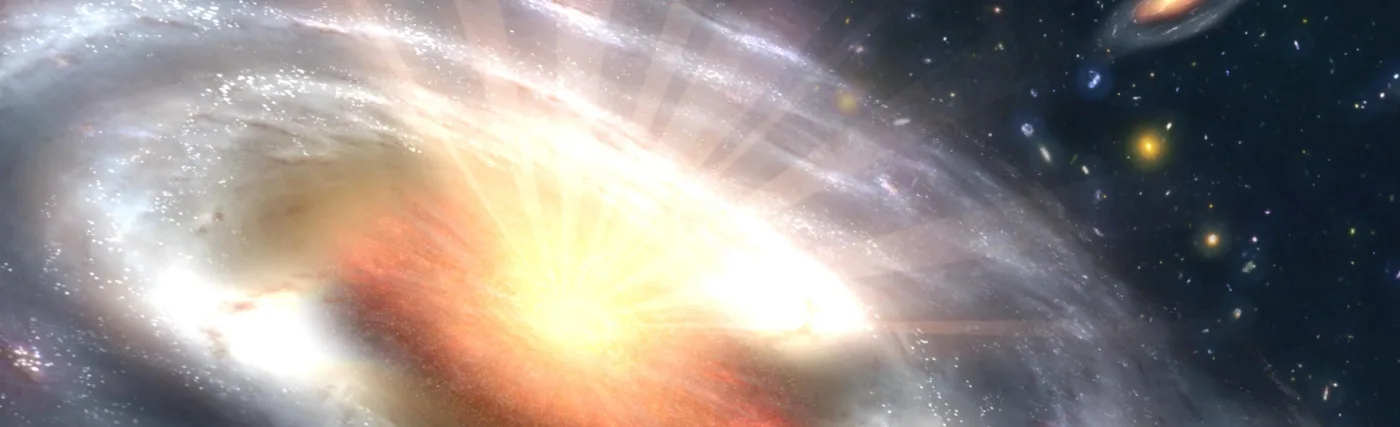
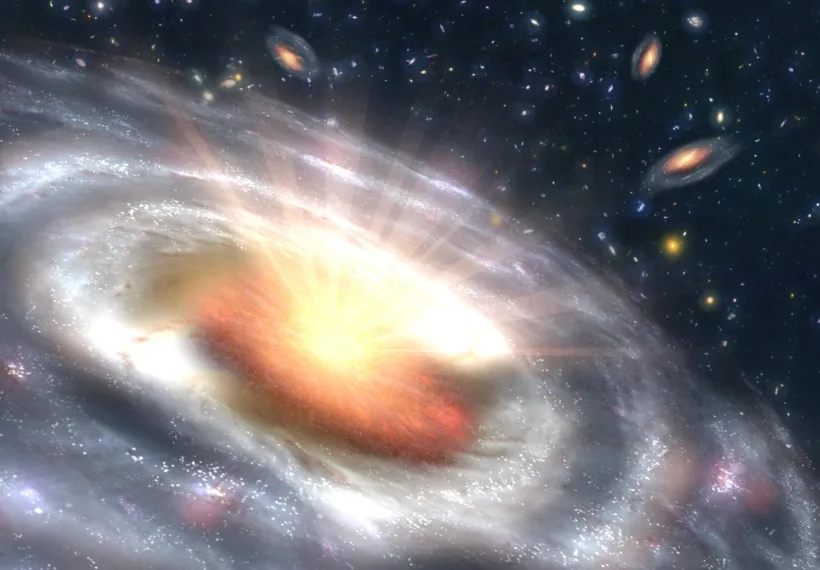
So quasars, our current model for quasars, which is stable, and we all sort of agree what's going on here, is that there is a black hole in the center of a galaxy.
And it is dining upon material that comes too close.
And the act of dining upon it, swirling down toilet bowl style, heats up the stars, the gas, and everything else, and it radiates profusely.
That is what we call a quasar phenomenon.
And quasar stands for quasistellar radiosource.
It's a loose acronym for that, because the energy is coming from such a tiny spot on the sky, because it's the volume of a black hole in the center of a galaxy.
They call it quasistellar, because stars are points of light.
These are points of light.
Even though they have nothing to do with stars themselves, they're supermassive black holes dining upon matter that came too close.
And there you have black holes, white holes, quasars.
All right.
So here's a question.
It's from Jay.
With enough resources and energy, would we be able to move the sun?
And if so, would we come along for the ride?
This is how diabolical evil people are.
Yeah, this is how.
He's like, I'm building a machine.
I don't think I have enough copper for it.
All right.
So yeah, and would we go along with it if we did?
I just wonder why one would want to do this.
But if you move the sun, that would be hard.
Yes, the planets would come along, but you would disturb their orbits briefly.
They would resettle, but in a slightly disturbed way.
So in other words, we're orbiting where the sun is right now.
Now you move the sun.
Yeah.
We still orbit where the sun was for eight minutes and 20 seconds, because that's how long it takes gravity to reach us.
Then we figure out, oh, the sun is now in a different place.
Yeah.
Our orbit no longer applies to the sun in the new place.
So the earth starts moving.
So then we say, well, we got to find a new orbit.
It works.
All the planets have to find new orbits if you're going to start accelerating the sun.
The fact is the sun is already moving in orbit around the galaxy with all the planets and comets and moons and Pluto in tow.
So we are already a moving system.
And in fact, if you plotted this through space, the sun would make a sort of a straight line and all the planets would stay around the sun as they move forward and you get this helical, beautifully artistic spiral.
So the sun is already moving.
We don't need to push it.
You don't need to push it.
How much energy would it take to push the sun?
Without blowing it up, I wouldn't want to put in the sun's worth of energy into it.
Well, the sun is 4 times 10 to the 33 grams.
So you do the math.
So 4 to the 34 grams, would that be enough, Neil?
No, you have to find out how to do it.
You can't push a gas, so you have to figure out how to do this.
You'd need a giant hand.
All right, this sounds complicated.
All right, one minute left.
Okay, here's a question from Michael.
If hot air rises, why is the temperature at the height that airplanes fly so cold?
Ooh.
Solid question.
Nice question.
Well, the sun doesn't heat the air, the sun heats the ground, basically.
That's how that works.
And there's a little time delay.
The heat on the ground then heats the air.
And that's why the hottest time of day is not 12 noon.
It's a couple hours later.
It takes time for the ground.
3.30.
Yeah, it can be as late as in Texas, 4 o'clock, depending on where you are in the time zone.
And so that can happen.
Also, it delays the hottest month of the year from otherwise being June to being July and August.
June has the most direct sunlight on the first day of summer.
But otherwise, it's delayed.
So these are the effects of what happens when the sun is heating the Earth.
The hot air doesn't rise enough.
When we come back, you'll find out why it's cold in airplanes.
StarTalk Cosmic Queries Edition.
We're back in the last segment of Cosmic Queries Star Talk, Grab Bag Edition.
We left off, someone asked a great question, how come it's cooler up in the sky, up in the atmosphere where airplanes fly, if hot air rises?
The reason why hot air rises is because it's less dense than the air around it.
That's the only reason why it rises.
So as it rises, it is looking for air that has the same density as it.
Mm-hmm, and where does it find it?
And where does it find it?
It could find it at any altitude, but while that's happening, that pocket of air is expanding and cooling.
So there's no such thing as a free lunch here.
And this hot air does expand, does rise up, and that gives you thunderheads.
Right.
Thunder clouds are hot, unstable air, and you look at the clouds and stop action, you see the top of the cloud roiling as it rises up.
And if this happens in a big way, you get cumulonimbus clouds and rainstorms and even hail.
But it'll reach the point where it's equal, and that point is not as high as where planes fly.
Planes fly higher.
We are in the– Lightning round.
Lightning round.
Eugene, I take too long to answer all the other questions.
We're going to blow through this list.
This is an easy question.
If the multiverse theory is true, is it possible to travel to other universes?
How would it be possible for us to exist in those universes if they have different laws of physics?
Okay, it may be possible to travel to another universe, but I would not be the volunteer to do so.
If it has different laws of physics, you could end up in a pile of goo, because the forces that guide and control your molecules and atoms, if they're different, you don't want to be the first one to go.
So you'd go to the second.
Even if you could go to that universe, send somebody else.
Are there any plasma rockets that are close to being ready to go to Mars?
What is the time frame?
How do they work?
He's like, is it true?
Tell me how to build one.
So that's my lightning round question.
Yes, we do have plasma rockets, they're ion drives, and they are not good for sort of launching things.
They're good for slowly changing the direction, and they're good for very long trips.
Yeah.
Or if you're going to send cargo to Mars and you can take years to get it there, you know, a high shelf life product, go ahead.
But if you're going to move people, the ion drive is not a good option for people at this point.
Would you ever use an ion?
It takes too slow to move you.
Oh, okay.
You would use it on Earth?
No.
No, no.
Good.
Great.
If we could manage to build a spaceship that could accelerate at a constant 1G, could we leverage time dilation to reach the nearest galaxy within the lifetime of a human on the spaceship?
The nearest galaxy, no.
But you can definitely– if you could accelerate at 1G, and that way you can walk around in the spaceship as though you're on Earth, because you'd have a 1G acceleration, that would be cool.
No bone mass loss or anything, all these problems you hear about being in 0G.
We can go ahead and do that, go to the nearest stars and come back.
And yes, time dilation– you'll eventually reach near the speed of light.
Time dilation will allow you to not age very much, but people on Earth will continue to age.
And when you come back, everyone will have forgotten about you.
Next.
Okay, it's my understanding that a black hole will just vanish and disappear and at the end of its life.
If that is so and E equals MC squared, what happens to the energy of all the particles the black hole has consumed?
Ooh, so there's no such thing as a free lunch.
So all the energy and the stuff that fell in, in Hawking radiation, it all comes back out again and you leave nothing left behind.
Great.
Not even the smile of the black hole.
Next.
Okay, a galaxy several hundred thousands of light years across.
How do we know what a galaxy actually looks like if we are not seeing the same time from the galaxy, from the entire galaxy?
Oh, great point.
So the point is, if our galaxy is a hundred thousand light years across and you're on one edge, you don't see the whole galaxy at once.
You see the nearby stuff as it was yesterday, the stuff farther away as it was a week ago, the stuff at the other end of the galaxy as it was a hundred thousand light years, a hundred thousand years ago.
You're not seeing the whole thing at once.
So the best way to do it is to come above it and then all the light comes to you at once.
And we have galaxies out there that are face on to us.
We see them all at once.
And the galaxy is not doing nasty things over the hundred thousand years that that takes.
Galaxy lived for billions of years.
It's not going to do anything really drastic in a hundred thousand years.
Next.
Okay, what will building the square kilometer array allow us to see in space?
So what you want is huge, huge telescopes to make big buckets to see, get more light of any kind, radio waves, microwaves, x-rays, and astrophysics bigger is better, period.
So the square kilometer array sees radio waves and microwaves, and you will look into the universe seeing things dimmer than you could have ever seen before, because this will be the bigger telescope than we've ever made before.
So what we'll see is a lot more, is what you're saying.
Because you can see things that are bright, or you can see dim things that you would not have even otherwise shown up, right?
So we'll be able to use it to see the movie Grown Ups 2?
So you see it to see stuff you could not have seen before.
One more.
Go.
Okay, excluding size and distance from the sun, does Venus have more in common with the gas giants than the terrestrial planet?
Venus is like our twin.
It is about the same size, the same gravity, nearly the same composition, except that it's 900 degrees Fahrenheit, and we are not.
It has a runaway greenhouse effect, a carbon dioxide atmosphere that is nearly 100 times the pressure of what you have here on Earth.
If you go there, you will die.
But it is otherwise a twin-to-Earth, appropriately called Earth twin, a sister planet.
You're listening to StarTalk.
Stay tuned for another segment.
This is StarTalk, Cosmic Queries edition.
I'm your host, Neil deGrasse Tyson, your personal astrophysicist.
I've got with me, as always, my co-host, not as always, as sometimes.
As sometimes, as always.
As sometimes, always.
I'm always.
Sometimes, Eugene Mirman.
And this topic today is science literacy.
And I've got with me a YouTube star who is a science educator herself, Vanessa Hill.
Vanessa, welcome.
Thank you.
It's lovely to be here.
You're up from down under, apparently?
You would have to.
For a few years, like I'm not so fresh, but I still, do I sound fresh?
Yeah, yeah.
You sound a little Aussie.
Good, good.
I'd like to keep it that way.
I don't know what else I would become.
We'd love ourselves some Aussies here in the United States.
So welcome, you've got a YouTube channel.
We are here in the YouTube studios.
That's the connection.
It's called BrainCraft.
BrainCraft, very nice, very nice.
Yeah, just like that.
It's a PBS digital studio.
It's a PBS digital studio.
They're in the game, very nice to hear that.
Yeah, doing lots of cool educational content, and it's just youtube.com forward slash BrainCraft.
Go watch.
Okay, all right.
And so this set of questions pre-solicited are on science literacy.
So we'll get to compare our notes.
Being both kind of in the business, right?
Adam Fazio from Facebook asks, in the information overload era, how do we determine what to pay attention to?
How do we convince others to pay attention to impartial data-based information when it's not as sexy or scary as the mainstream media or advertising, which is carefully engineered to play to our psychology?
I wish I had just a short and concise and really good answer for this, but it's so complicated.
That sounds completely like a question you should answer.
Well, I think in the Internet ages well and on YouTube, clickbait and sexy thumbnails and things like that play into this so much, where with PBS, like how can we get our PBS information over buzzfeed?
Through all of that.
Well, through the buzz feeds of the world, right?
And it's really, really difficult.
And it's, I think, a fine line between education and entertainment to try and get that information out to people.
Edutainment.
Yes.
Possibly.
But it doesn't matter, isn't it?
I hate that word.
That's a horrible word.
We don't have to say the word.
You can just do it.
Yeah.
Well, yeah, yeah, yeah.
So what's your answer?
Ask me the question again.
And how do you get people to focus on the data and the information?
How do you make basically science, I guess, science sexier and more fun?
Yeah, I guess the way that we do it is just, I mean, as YouTube shows, it's just through sexy visuals in a way.
Like we have lots of cool animation.
We like to try and draw analogies to things.
You do this every week.
I do.
We have a lot of shows.
How do you have it in you every week?
I'm a shell of a human.
I'm, I'm, I'm.
It's interesting when you say the words information overload, because I'm like, I can't fit a single thing into my brain.
It's full.
But I mean, it's interesting though, because there is so much information out there, and sometimes the credible news sources aren't the sexiest news sources.
So I think it's hard.
I don't think there's a perfect answer for it.
I think we can possibly just try to share credible news and not this fake news that we keep hearing so much about.
But then sometimes it's hard to spot.
So I think we need to think critically, we need to be discerning, and I think we need to be open to information sources that maybe aren't just like little pieces of candy.
Right.
Yeah, longer.
Like more of like a piece of chicken.
Less candy, more chicken.
Something substantial.
Yes.
Yeah.
So I have two reactions to that question.
One of them is, the older you are, the more likely you are to say the following sentence.
Yeah.
I suffer from information overload.
I thought you were going to say back in my day.
So what I found is older people cannot keep pace with the level of information that's coming out.
Right.
Whereas younger people, whether or not they can or can't keep pace, they don't feel overloaded by it.
I don't know anyone 20 and under who works away from their computers, say, I'm overloaded by information.
This is not their state of mind.
It is a playground.
It is an information playground to them, and they embrace every bit of it.
I remember before the Google search engine, there was a big joke that went around.
The Internet is great.
It's a great library except all the books are scattered on the floor, and you didn't know how to make sense of them.
Then Google search it.
So now that's not a joke anymore.
It's all right.
So now we can search it.
But now you can search something that's not true and find everyone else in the world who believes that not true thing.
Right.
Thereby affirming your not true idea, making you think that it's mainstream.
That's one of the problems of the search engines.
Right.
So there ought to be a way to rank the integrity of information in a search, so that you can then choose, do I want high integrity information or low integrity information?
And maybe some days you want low integrity information and just have fun there.
It's got to be a playground of weird cockamamie ideas.
I would love to learn a bunch of lies and then apply them to my life.
But really I think it's right now the educational system doesn't have as any part of it internet intelligence.
So you think that the educational system should prepare us to to be discerning so that when it is time to learn what is true, you put in your truth filter and then you know how to interact with all of this information.
So we need to build a truth filter into the curriculum.
Into the curriculum.
That is our answer.
That is my answer.
That's definitely going to happen.
Jamie Robertson asks, a lot of science journalism is faulty using hyperbole, misconstruing findings and giving the people the impression that the evidence is stronger than it is, and can create the illusion that scientists are always changing their minds and thus have no idea what they are talking about.
How can we combat this?
I think this feeds perfectly into the last question because a lot of writers report on science who aren't specialized science writers and then a lot of science writers just need to get clicks on their articles to get paid.
So, they put the hyperbole in so it makes the article seem more appealing.
Because if we're thinking about science journalism and reporting super accurately on things, you can report a study, you can talk to someone else and then at the end it's like, well, we're not quite sure because we need to do more research to…
Yeah, it's not a good conclusion.
So, you almost need to take a side in a way to make it an interesting article.
I've had a lot of trouble with this professionally because all of my…
Where you write a bunch of lies because it's a little more fun.
Where my conclusions have been, well, everything in moderation, oh, we're not quite sure, we need to do more research and it doesn't make a good story.
So, I think it's a problem between balancing the facts and the realities of the process of science, which is slow and it's not that sexy sometimes because it takes years and years and years with something that makes a good story that will get clicks on articles or sell newspapers or whatever.
And by the way, the rabbit hole goes even deeper than that because even at the level of universities where they issue a press release based on research that was conducted by the research community, there's usually a little bit of extra hyperbole there or certainty that is not actually there.
So the source press release on which journalists base their story has some of that already built into it.
And so, I think my community, the community of scientists in general, and our institutions that want the publicity, you want your university to be mentioned in the New York Times or the LA Times.
Yeah, I'd like my university to be mentioned.
Or I'm coming up for tenure, and if you write about my, if you do a story on me, that always looks good, right?
So I think there are two sides to that fence that need to be tended to.
And, so I think, again, getting back to the educational pipeline, not only do we need to be internet savvy, but we also need to know what science is and how and why it works.
So you're saying education can solve all of our problems.
What a concept!
That is the theme.
Is that brilliant of me?
Yeah.
It was so innovative of me to tell you that.
So, no, but if you learn that science is a way of querying nature, and it takes multiple scientific experiments to arrive at an emergent truth, then the article that says, new scientific result changes everything– no, it doesn't.
It hints that maybe if it's confirmed by other experiments, it changes everything, but no one experimented, but the journals jump after those single papers.
A lot of the popular news media do as well.
You can watch every breakfast TV program that will be, study says red wine is good for us and chocolate is good for us, please watch my TV show, please don't change the channel, I'm just going to report on all of these single studies.
Wine.
That's pretty good for you.
Next question.
I'm not giving up the wine and chocolate.
I want to believe.
The wine and chocolate.
I don't care what they say about the wine and chocolate.
No, no, but here's the thing, here's the thing.
So, if they say wine and chocolate is bad for me, then my response should not be I don't believe it.
My response should be, and if that's a truly emergent scientific truth, my response should be thank you for letting me know I will fold that into my behavior, but I will knowingly still drink wine and eat chocolate.
The way people who smoke cigarettes, they all know it can give them cancer.
So it's awareness of the causes and effects of things that I think are important.
Definitely.
And you don't go and say, oh, I will choose not to believe it, like anyone who denies an emergent scientific truth, be it global warming or anything else.
Yeah, yeah.
We've got to wrap this up.
That was quick.
Oh, is that it?
That was quick.
I have so many questions, so much I want to learn.
Oh, well.
But we had very thorough answers.
We did.
I feel good about those, too.
I feel very good about it.
Education.
Those largely.
That's it.
Education, education.
Yeah, exactly.
Yeah, you've learned a lot.
Yeah, yeah, I have.
So, Eugene, thanks for being my co-host.
Thank you very much for having me.
On StarTalk.
And, of course, we had this woman here, Vanessa Hill.
She's got her own YouTube channel.
Nobody ever gave me a YouTube channel.
She got her own YouTube channel.
If you put your mind to it, you can do it.
Is that what it is?
Yeah.
If I put my mind to it.
That's all it takes.
And you work every single day of the year.
So, BrainCraft.
BrainCraft, yes.
At a channel near you.
No, you can search for it easily on YouTube.
Just put BrainCraft into Google, into YouTube search, it will pop up.
You'll see my face.
And you know why it comes up in a Google search?
Because Google owns YouTube.
It'd probably come up in a Bing search.
I mean, I would not recommend.
Don't Bing it.
Bing it.
Bing it.
You're never allowed to use Bing again.
We are in the YouTube studios.
Is that even still a…
anyway.
AltaVista, the number one.
I remember AltaVista.
Ask Jeeves, that's like 15 years ago.
Yep, it did well.
I'm older than I look.
There's a planetarium called the Ask Jeeves Planetarium.
Yeah, and they have to change that up real quick.
Can I end the show, please?
No, I want to mention WebCrawler.
You've been watching, possibly even only listening to StarTalk.
I've been your host, Neil deGrasse Tyson.
Thanks again to Vanessa and of course to Eugene for helping making this show what it was.
It was Cosmic Queries Science Literacy Edition.
See the full transcript



 Unlock with Patreon


 Become a Patron