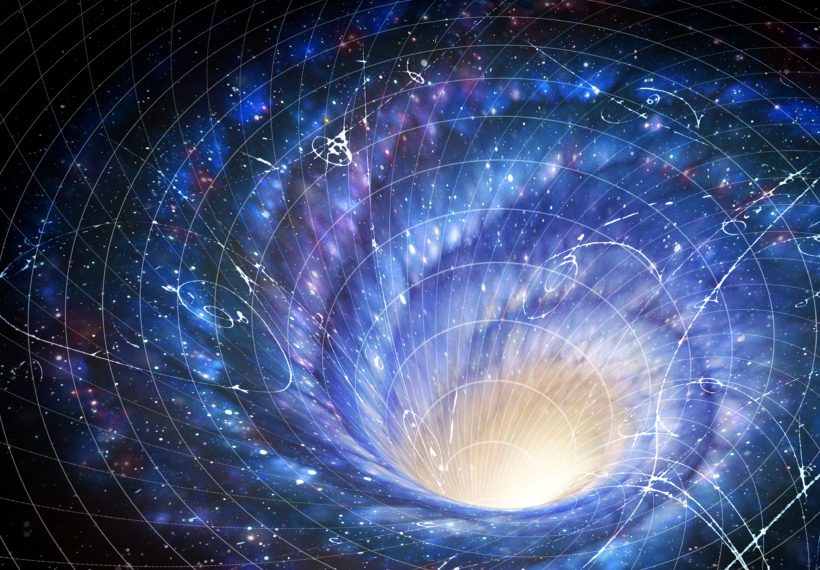
Curious about general astrophysics? Then join us for class this week as Professor Neil deGrasse Tyson and teaching assistant Leighann Lord explain some of the basics. Discover why everything in the universe spins (and how you can test the theory of Conservation of Angular Momentum with a plate of spaghetti), how the gravity from a black hole can affect light even though light has no mass, and why we can be so sure that the universe is 13.7 billion years old. You’ll learn about dark matter and dark energy, the difference between weight and mass in planetary measurement, and why our galaxy isn’t expanding even though our universe is. Find out how we know that our solar system was formed as the result of a super nova, and whether a planet could orbit 4 suns. Plus, Neil trash talks Edwin Hubble and explains how NASCAR cars can steer in a straight line without crashing on a curved track.
Transcript
DOWNLOAD SRT
Welcome to StarTalk, your place in the universe where science and pop culture collide. StarTalk begins right now. Welcome to StarTalk Radio. I'm your host, Neil deGrasse Tyson. I'm an astrophysicist with the American Museum of Natural History, right here...
Welcome to StarTalk, your place in the universe where science and pop culture collide.
StarTalk begins right now.
Welcome to StarTalk Radio.
I'm your host, Neil deGrasse Tyson.
I'm an astrophysicist with the American Museum of Natural History, right here in New York City, where I also serve as director of the Hayden Planetarium.
Come by and check us out sometime.
I've got with me, Leighann Lord, comedian extraordinaire.
Leighann, welcome back to StarTalk.
Thank you, Neil.
Good to be back.
I got you for this special needs of this hour.
Not special needs, that didn't come out right.
Right, special needs.
Are you a special needs?
Well, you know what, actually, I think it did come out right because these questions make me feel very special needs.
Oh, because this is the Cosmic Queries part of StarTalk Radio.
Yes, and these questions, whoo!
These are questions from our listeners.
Yes.
And we've got some seriously knowledgeable listeners out there.
Yes.
Very impressed.
These questions are very challenging.
Yeah, and so what we try to do is spend some time of our StarTalk airwaves just receiving and responding to Cosmic Questions shared with us on our Twitter stream, on our Facebook page.
You can find us on Facebook and like us there, of course, or find us on the web at startalkradio.net.
And we have a Twitter stream, StarTalk Radio, and all these places you can send in questions and we collect them.
In this particular case, we've got all the ones just about general astrophysics.
Yeah, and you're gonna read them to me and I haven't seen any of these questions in advance.
And I wish I had because I need some help.
All right, so mentally was the clarifying word there.
All right, so give it to me.
What do you got?
Okay, our first question is from, I believe this is Jin or Jisin Divs, DBS.
Could the Big Bang be the destruction of super massive black holes?
Ooh, so the Big Bang itself is what birthed all the space, time, energy and matter of the universe.
Yes.
So once the universe began to expand and the matter coalesced, the matter coalesced into objects like stars and galaxies and every large galaxy we know has a super massive black hole in its center.
Only one, there's no room for two.
If there's ever two, they will soon merge.
Okay.
And become one mondo.
The alpha.
The alpha black hole.
Yeah, so what happens is you can have galaxies that collide with each other.
And their black holes sure as night follows day will find each other, merge, and become the new center of that mega galaxy that just formed.
Because galaxies collide, they go bump in the night.
Yeah.
So can they destroy super massive black holes?
No.
A black hole is a black hole until it evaporates using the special, did you know if a black hole is a black hole evaporates?
You didn't know that.
I had no idea.
You gotta come more often.
That's what I'm saying.
Or get out more.
You know, if you get out more, you would learn this.
Yes, but this is general, casual conversation.
Hey, everybody, black holes evaporate and over on 15th Street.
So it turns out, Stephen Hawking showed, among many discoveries of Stephen Hawking, we all know Stephen Hawking, the brilliant physicist at University of Cambridge, England.
So he proposed, he discovered using quantum physics, the laws of quantum physics, that sort of particle by particle, a black hole slowly evaporates.
And the black hole in the center of a galaxy is large enough, it would take about 10 to the hundredth years, a Google years, to evaporate.
Did you know 10 to the hundredth is a Google?
I had no idea.
Does Google know that?
Google, they're spelled differently.
They put the L in front of the E.
Google, the number, 10 to the hundredth power, a one with a hundred zeros, is spelled G-O-O-G-O-L, Google, as opposed to Google.
Got it.
Yeah, Google, Google.
So that's way longer than the age of the universe.
So this is not something you should wait around to watch happen.
That's not a quick cup of tea.
Right, no, no.
And so in the birth of the universe, there's no reason to think that if somehow another universe got born, that it would destroy a black hole that was adjacent to it, because black holes really have their own agendas, and it has matter gone bad.
I love that.
They have their own agenda.
Well, they don't care what's happening.
Around them, they don't care.
They're super massive centers of gravity and mass at very high density.
Some new law of physics would have to rise up that we would then discover to show how you would then tear apart a black hole or destroy it.
But there's no known force large enough to accomplish this.
Moving on.
What else you got?
All right, this is from Mikael Gorbachs.
About the accuracy of the age of the universe and the Hubble constant, how are we able to refine the 12 to 14 billion year estimate to 13.75 billion?
Which, that's really rude.
What?
Maybe he doesn't like the Tellar Age.
Does the universe really want you know when that's 13.75?
Couldn't we go with the estimate?
For the longest time, in fact, my entire time as an undergraduate and in graduate school, we didn't know the age of the universe by a factor of two.
There was some research that indicated that we might be 10 billion years old.
Other research that indicated we might be 20 billion years old.
And there were warring camps at every conference.
There were the 10 billion year old people, the 20 billion year old people, all right?
What did that fight look like in the lunchroom?
What foodstuffs did we reach to throw at each other?
And this all relates to what's called the Hubble constant.
Named in honor of Edwin Hubble, the man.
There was a human being that predated the telescope whose name was Hubble.
What you say?
Now here's an interesting case.
He had an affected British accent.
Did he really?
Yes, yes, he was so fake and wore all these tweedy things.
He smoked a pipe.
I love it.
And he was a misogynist racist, totally.
Well, if you're gonna be one, you should be the other as well.
Yeah, they go together.
Two for one.
They often go together.
And the good thing about science is that none of that's relevant.
What matters is how good was his science.
In many other walks of life, you fold all that together and you say the person is reprehensible.
I don't want any part of them.
I don't want them speaking to my children.
And in science, science distinguishes itself from other activities of the human condition for that reason.
It's got nothing to do with culture.
That's right.
So, he in 1920s discovered that galaxies in the universe were moving away from one another in all directions.
And so, you look this, you look one direction, they're moving away from you.
Look another direction, they're still moving away from you.
I want my space.
You need, I need my space.
They're not coming towards you in one direction and away from you in another.
They're going away from you in all directions.
If you plot this up, the line that is drawn has a slope.
The slope of that line is the Hubble constant and if you know the slope of that line, you know the age of the universe.
So the Hubble telescope was first designed to get the best, most accurate measurement of the Hubble constant.
So the battle of the Hubble constant went from 10 billion to 20 billion and then it was like 10 billion to 15 billion and it got narrower and narrower and narrower and finally we refined that slope of that plot and we can say the universe is 13.7 billion years old.
We gotta take a break.
We'll come back more Cosmic Questions on StarTalk Radio.
This is StarTalk Radio, we're back.
I'm Neil deGrasse Tyson.
My cohost today, Leighann Lord.
Yes.
Comedienne.
Extraordinaire.
Do people come up to you, they know your profession, they say, tell me a joke?
Yes.
Yeah, don't you want to hit them?
All the time, and I have, so there's an issue.
Okay.
You're still resolving this within you?
I'm still resolving.
Case is pending, I can't discuss.
So I've got you here to read me these questions that came in from the internet, and I haven't seen them before, but they're all about modern astrophysics.
Yes.
And they came from our listeners, and we're just trying to give back.
And this is the Cosmic Queries part of StarTalk.
So what do you got?
I have a question from Tony Schultz, and he says, regarding a subject brought up on the Origins TV series, why-
The TV series that I hosted for PBS Nova.
Nice plug.
I'm just so people know.
Just so they know.
Uh-huh.
Okay, go.
Moving on.
Why is it even a question whether our solar system came from a supernova explosion?
I mean, how else would heavy elements like gold on Earth come from?
Well, how, what a luxury it is to retrospectively assert that of course our heavy elements came from supernovae.
I know, right?
This was not known for a while.
Do you know when I was a kid and I'm in chemistry class and you ask the chemistry teacher, where did these elements come from that sit up there on the periodic table?
So we find them in the ground.
That was the chemistry teacher's answer.
You don't get the real answer to that question until you take astrophysics.
We say, where do these elements come from?
They are cooked in the crucibles of high mass stars, forged from small elements like hydrogen and helium.
They are fused together to make high mass elements.
And they ride their way up the periodic table of elements.
And then that same star explodes, scattering its guts into the galaxy, out of which you make subsequent solar systems.
Somebody had to discover this.
A Nobel Prize was awarded for that discovery.
You know, if they explained it like that in high school, that was like the opening of a movie.
It was forging an explosion.
Is this how it goes?
My science class was not that interesting.
And so, but in a TV series on origins, you can't assume people know that in advance.
And how heroic it was to deduce the fact that these heavy elements owe their origins to stars that have given their lives so that we can live.
I love that.
There you have it.
Move it on.
StarTalk, the Cosmic Query session.
I love it.
Leighann, what else you have?
I like that.
Okay, this next question is from William M.
Sacrin.
And he says, this is a Google Nexus commercial where a girl asked Google, Google, how much does the Earth weigh?
And the device responds with, the Earth has a mass of, I mean, obviously mass and weight are not the same measurement, but this made me wonder, how do you measure the weight of a planet when it's the planet itself that provides the gravitational force by which you make the measurement?
Ooh, well, a couple of things.
So if you say, what is the weight of something that's a physical object, we assume you mean what is its mass.
We have to assume that, yes.
Hence, the answer comes back with a mass number, not a weight number.
Earth is in free fall towards the sun with sideways motion that keeps it in orbit.
And anything that's in free fall towards anywhere is weightless.
So you could justifiably say the Earth is weightless in space, because that's true.
Earth has no weight, any more than an astronaut has weight in orbit around Earth itself.
So in other words, for the same reason that astronauts and space stations and the space shuttle is weightless in orbit around Earth, Earth is weightless in orbit around the sun.
The sun is weightless in orbit around the center of the galaxy.
So the minute we stop moving fast enough...
Oh, if we stop moving sideways, then we fall directly towards the sun.
If the space shuttle, space stations, no more space shuttles, space stations stops moving sideways, it'll fall directly down towards Earth and crash about 15 minutes later.
So the Earth is as felt nothing, is what you're saying.
It weighs nothing, but it's got mass.
So when people go on weight loss programs, what they're really doing is trying to lose mass.
Because if you want to lose weight, just go into orbit and then you weigh nothing.
But what we're really trying to do is remove atoms from your body.
That's what you're trying to do.
I really am.
Fat atoms.
Fat, they're molecules, fat molecules.
That's what you're trying to remove from, there's no element on the periodic table called fat.
It's a rather complex-
Well, we have a different table, sir.
It's a rather complex molecule that has a lot of stored energy.
That's why fat is an extraordinary, that's why you can go for days and days before you burn off all the fat layer that might have accumulated on your belly or on your butt.
So, getting back to the person's question, Earth is weightless because it's in free orbit around the sun, as in anything that's freely falling towards anything else.
So the moon is weightless in orbit around the earth, just as Earth is weightless in orbit around the sun.
So now you wanna measure the mass.
Okay, that was done by a fellow named Cavendish, and he's a British, actually, I think he was a chemist.
But real British, not affected.
No, I always get it confused if you're British, or English, or from the UK.
I always get, every time I learn it, I never retain it.
And so I'll say he's from somewhere in the United Kingdom, all right?
But the point is, he was the first to measure the mass of the earth.
And it's a hefty number.
You know what's useful about-
The earth is a little chunky.
Yeah, so the mass of the earth, we get six times 10 to the 27 grams.
So if you want this in tonnage, that would be, let's see here, that would be six times 10 to the 21 tons.
So six sextillion tons.
The earth is a brick house.
Now, what's useful about that number is, if you wanna know what happens to earth if we get hit by an asteroid, find the mass of the asteroid.
I was about to say, doesn't it depend?
Well, yeah, exactly.
So you look at the mass of the asteroid compared to the mass of the earth, it's like a mosquito flying full speed ahead into the buttock of an elephant.
That's an image.
Or a gnat.
A gnat is better than a mosquito because gnats just kind of, they're annoying and they fly into you.
So the relative mass, I think, last time I did that calculation, that was about right.
All right.
So asteroids are bad for life, but they're not gonna harm earth.
When people say save earth, earth does not need saving from anybody.
They mean save life on earth.
Yeah, yeah.
So you do it with a special, an experiment.
If you Google Cavendish, you'll read all about his experiment where you can measure what's called the gravitational constant, which was first predicted by Isaac Newton.
And once you know that constant, you can calculate the mass of the earth.
It rolls out of the equation that you just used.
Well, all right, William.
You got it.
Thank you for your question.
Moving on, I have a question from Ken Duncan.
And he says, Dr.
Tyson, where does all the spin in the universe come from?
Planets, solar systems, galaxies?
I'm thinking Madison Avenue.
Spin?
From Madison Avenue.
That's the best place for spin?
There he is.
Everything spins.
Everything.
So when little kids do it, mommy shouldn't say stop?
Everything.
Mommy should never tell kids to stop doing anything.
Oh, well, hold on now.
So everything spins and here's...
You say, well, that's odd.
Why is there anything that doesn't spin at all?
Take a huge gas cloud, all right?
For example, in the galaxy.
If there's any movement at all, like one atom's width per year, if anything is moving in it, as the gas cloud collapses, the speed of movement increases.
This is why, if you suck a strand of spaghetti through your lips, it is guaranteed to flap you in the face.
Guaranteed.
Guaranteed.
Try it.
I know what I'm eating for dinner tonight.
Try it, okay?
Put start at the bottom of the spaghetti.
Make sure there's not a loved one at the other end of the spaghetti.
Oh, that would have made it.
This experiment wouldn't work.
It's got to dangle below.
You suck it up in your mouth.
Initially, it's wiggling just gently.
As you suck it more and more, it starts wiggling more violently.
And then eventually it slaps you in the face.
I'm just saying.
Yes.
Okay, so this is a major principle in physics called the conservation of angular momentum.
That's what it's called.
And skaters know that.
And it's not called flapping spaghetti.
That would be so much easier to remember.
Yeah, the flapping spaghetti rule.
It's skaters that pull in their arms and they spin faster.
Oh yeah, of course.
If you start out with even the slightest speed, you will speed up as you collapse.
And everything in the universe, because of gravity, collapses.
And whatever speed it had before, it speeds up.
This is why everything in the universe rotates.
We got to take a quick break more from Cosmic Queries when StarTalk Radio continues.
Of course, we're on the web, startalkradio.net.
You can download our archival shows.
They're fun if you're a new listener to Star Talk Radio.
We've been at this only for a couple of years, but there's some cool guests that we've had in the past.
Check it out.
And we're also, of course, findable on iTunes.
Just find us on Star Talk Radio.
Leighann Lord, you're my co-host today.
Great to have you.
I'm loving it.
You're reading me cosmic queries.
I am.
And this session, they're just general astrophysics.
It's the grab bag bin of Cosmic Questions sent to us by listeners from our Facebook page.
So what do you got?
Well, you know, I'm feeling richer and smarter with every question.
Excellent.
You know, I've done the spaghetti thing.
Oh, the spaghetti, yeah.
Coming off the break.
Yeah, yeah, yeah.
You suck spaghetti through your lips and it flaps in your face.
And I had no idea there was a physics principle going on with this fun.
Major law of physics operating, getting spaghetti sauce in your face.
Now, I think as adults, we don't do it as often, right?
Oh, right, yeah.
Because you flap food in your shirt and all this sort of thing.
But kids certainly remember this.
And it's a major law of physics.
It's the conservation of angular momentum.
And so what it means is if you're rotating slowly and you have a big extent to your physical system and then you start pulling things in towards your axis of rotation, something's gotta compensate for that.
And the way you compensate is you end up spinning faster.
And there are equations that prescribe this with precision.
I'm a rollerblader, so yes.
Oh yeah, you know it.
Oh yeah.
Yeah, you got it.
I didn't know.
I should have known it was physics.
I just know, oh wow, I'm faster.
All right, I have more questions if that's okay.
William Jesse Miller has a question.
And William asks, how does a person-
It's another three name person.
Another three name person.
Maybe they're feeling it with my Neil deGrasse Tyson.
So they gotta come in with three names.
Yeah, so that's how I gotta get their entree.
William Jesse Miller, go.
How does a planet have four suns?
Wouldn't some stars be ejected?
I thought three or more star system is unstable.
How does a planet have four suns?
Okay, yeah, sure.
So the universe, if you look up at night, most of the stars you see are not alone.
More than half of the stars in the night sky are multiple, double and multiple star systems.
Okay.
And so the solo star, like Earth or like our sun, is, I don't want to call it rare, but it's not the most common case in the galaxy.
Really?
Yeah.
And what a surprise that was to the first person with the telescope who looked up and saw, hey, that's not one star, that's two.
Oh, it must be a chance alignment of a star in the foreground and a star in the background, they said to themselves.
Then they looked around and they said, wait a minute, way too many stars are close to each other than statistics, than the randomness of stars in the galaxy should allow.
If you just randomly throw stars up on the sky, how often are they that close to one another?
It should be rare, yet it was common.
So the original research paper did this statistical calculation and concluded this must be real.
There must be actual double stars up there.
Hey, there's a triple star, there's a quadruple star.
You keep looking, whoa, we have a whole cluster of stars.
A beehive of stars, in fact, there's an actual cluster called the beehive cluster and all these stars orbiting a common center of gravity.
Yes, occasionally you get an ejected star because not all orbits are stable when you have all this action.
But there is what we call a parameter space where, think this through, right?
Two stars orbiting close to one another, it's a tight orbit.
Now you pull one out a little kind of far, have that orbit, that pair.
It's orbiting so far away, it thinks it's orbiting one star.
So that's stable.
Now you get a fourth one, pull it far away, make it so far away, it thinks it's orbiting sort of one gravity field.
The questioner is right, Jesse's right.
When you orbit really close, the path, what path are you gonna take?
Who are you next to now?
Some different tomorrow.
That could be hugely turbulent, hugely unstable to the orbits within the system.
But you can configure a system where you have a whole set of stable orbits and everybody's happy.
You know another set of stable orbits?
A pair of stars here and a pair of stars there and those pairs orbit each other.
Right, isn't that cute?
So that'd be a double, double star.
And they're actual stars in the night sky visible to the naked eye that are double, double.
I feel like I'm ordering Tim Hortons coffee.
So now I'm thinking about it.
The question was, how does a planet orbit safely around four suns?
That's what his question actually asked.
I'm talking about how do you get four stable suns to begin with.
Oh yeah.
So now, if a planet were among the stars, it's not stable, it'll fly away, right?
The planet will fly away.
Yeah, if the planet's orbiting within the orbits of the stars themselves, it's gonna fly away.
So you're saying the planet is commitment phobic?
It's totally commitment phobic.
It needs one sort of committed feeling.
So it can't be big love.
It's gotta go in one direction.
So in Star Wars, where they had the double sunset planet, the double sunset, those two stars are close enough to each other and the planet is far enough away from both.
So it executes one orbit around both.
That's how you pull this off.
But four, not gonna work.
The four, if you can't start moving in and out, what's your allegiance?
As you get pulled to one star versus another and it wreak havoc on the planet and you just get ejected.
In fact, you know something?
We think most planets in the universe were ejected in their early solar system.
And they're floating free in space and they're called planetary vagabonds.
And if any of those planets have internal heat sources, like geothermal heat that doesn't require a host star, maybe there's life on those planets.
And it might be that life is teeming far away from stars in this galaxy.
Wow, that's a possibility?
So we got to take a break.
StarTalk, the Cosmic Queries edition.
This is StarTalk Radio.
I'm Neil deGrasse Tyson, here with Leighann Lord, comedian, Bianne.
Thanks for being here on StarTalk, and you're reading me questions today.
I am.
On the universe, submitted by listeners, posted on our Facebook page, and I'm ready for them.
Well, are you ready for Ryan Smith, who wants to know if light has no mass, why does the gravity of a black hole affect it?
This is right up your alley, sir.
Bring it on.
Bring it on.
Yeah, light has no mass, but light has energy.
Oh.
And you need to rethink of what mass is.
Mass, this is how to, let's move forward into the future, thinking about the universe in this way.
Okay.
Mass can reveal itself as either matter or energy.
Okay.
All right.
That's a way to think about it.
And so, therefore, light, which has energy, has a mass equivalent to that energy.
And since a mass has gravity, a gravitational field will pull a beam of light into it.
Not very well, it turns out, unless you're a black hole.
You got to totally tear a new one through the fabric of space to pull a beam of light into your surface.
So, light beam coming by earth bends a little bit, barely perceptibly.
Light coming by the sun bends perceptibly.
That got measured in 1919 when, after Einstein predicted it, Sir Arthur Eddington, an astrophysicist, brilliant dude from England, measured the bending of starlight as it came by the sun during a total solar eclipse.
You can't see the stars in broad daylight, but you wanna see a beam of light coming by the sun to see if the sun tugs on it in a measurable way.
Wait for a total solar eclipse.
The light of the sun is blotted out.
There's starlight behind it.
You know where the image of that star should be.
You measure it, it's in a different place.
The light bent on its way coming around the edge of the sun to get to your telescope.
You measure how much it bent, bang on.
It's Einstein's general theory of relativity with gravity field bending the curvature of space and it curves the path of light.
But I shouldn't say it that way.
You know how I should say it?
I should say-
With a deeper voice.
I'll say it with a deeper voice.
Gravity curves the fabric of space and time and light travels on that fabric.
So it's not that gravity curves light, it's that gravity curves the very nature of the space-time continuum.
And all light is doing is following that form.
Hmm.
Yeah, so that's why.
That's why.
Light is following the path of space in a black hole curved space.
Light goes in right alongside it.
So light is along for the ride.
It's along for the ride, exactly.
So it's wrong to say that gravity curves the path of light.
Gravity curves space.
Light, as far as it's concerned, is always traveling in straight lines.
As far as it's concerned.
As far as it's concerned.
But the space happens to take it in a curved path, that space is a problem, not the light, okay.
Officer.
All right, yeah.
I was in the car.
I had no idea what was gonna happen.
Think about it on NASCAR, because I know you're a big NASCAR fan.
Huge, huge, as I get in my hoopty, speeding down the Belt Parkway, huge.
So in NASCAR, there's this joke about NASCAR drivers.
Can they, in real life, are they always just turning left?
Do they ever know how to turn right?
Well, that's actually not an accurate joke.
That's like a scientifically flawed joke, right?
The track is banked in a NASCAR track, right?
Of course it is, right?
It's banked.
You know why it's banked?
I'll tell you why it's banked.
If you are driving at the right speed for that bank, you do not have to turn the steering wheel and the track will turn you.
So as far as the car is concerned, it's going in a straight line.
Yes.
They don't ever have to turn the steering wheel to bank those turns.
But they've gotta be going at the right speed.
At the right speed, exactly.
And so it's banked for a particular speed and depending on the slope of the track.
So when they're steering, they're steering just to maneuver in front and behind each other on the track.
Yeah.
Oh yeah.
So that's a car driving in a straight line with the space-time continuum of the NASCAR track curving its path into a U-turn.
Oh yeah.
That is so cool.
Yeah, it feels good.
It feels good for you.
It feels good.
Okay.
Well, do we finish that segment already?
My guys, you have more questions for me when we come back?
All right.
Yeah.
You're listening to StarTalk Radio and like I said, find us on the web at startalkradio.net and Leighann, you tweet.
Leighann Lord, L-E-I-G-H-A-N-N.
So more when we come back.
StarTalk, after hours, the cosmic queries.
You're back, we're back on StarTalk Radio.
I'm your host, Neil deGrasse Tyson.
I'm an astrophysicist, and this is StarTalk, the Cosmic Queries Hour.
And I'm with Leighann Lord, who is delivering me questions culled from the internet, from listeners, from you, the listeners of this show.
And in this particular satchel of questions, these are all just general questions about the universe.
General astrophysics questions?
I'm happy to serve if you're happy to deliver.
I am.
All right, go for it.
I have a question from Angie Suave.
I love that name.
Is she Rico Suave's sister?
Sister, absolutely.
And she wants to know.
Rico Suave.
How sad is it that we know that?
I know, right?
That is so sad.
We gotta get a life.
We lost our street cred.
All right, could we send a probe of some kind into a black hole?
I realize it would be destroyed, but couldn't it transmit some relevant data at least for a short time on its approach?
And have we already done this?
We have not already, excellent question.
We haven't already done that.
We're not close enough to a black hole to even think about that experiment.
Really?
Now the dangerous part is suppose a black hole comes our way.
Like first, how would you know what was coming if it's black?
Space is black.
I know, well, I'm saying.
So what you have to do is you look for the distortion of space around it, right?
So you have a star field.
If all of a sudden the star field starts looking like a funhouse mirror, run.
Just pack up the planet.
Pack up the planet and get the hell out of that solar system because a black hole is on its way.
Just as a quick aside, most of the black holes we know, we detect from, because they're in a binary star system, there's another star adjacent to them being flayed.
Love that word.
A rare word, it means getting skinned alive, by the way.
Yes, yes, very middle ages.
And you're a word person because you tweet word of the week.
It's very middle ages, right?
It's very like the Spanish Inquisition.
So a black hole can flay an adjacent star.
If it becomes a red giant and its outer shells expand too much, that it'll then remove those outer layers and those layers will descend into the black hole.
Our X-ray telescopes detect material descending into a black hole that gets heated on its way down because of the friction of the disc that it makes.
It basically gets flush toilet bowl style.
And as it descends down, it releases energy that it has from falling and that energy is very high.
It's like X-rays, X-ray telescopes detect black holes in the galaxy.
There's none that we know of that are nearby.
Lucky for us.
But if we did send a probe, yeah, we could get some fascinating data on the gravitational field, the radiation field, and we get it all the way until it hit the point of no return, the event horizon.
Ah.
I love that.
Clearly.
It's a poetic term for the place where you're never coming back.
Because within the event horizon, even if you could travel the speed of light, it's not fast enough to escape the gravitational field of the black hole.
So there you have it.
Is there something, I mean, are there plans to do this?
And can we really get some knowledge from this?
Yeah, we could get knowledge, but I'm saying there's no plan.
I mean, we don't know our own solar system, much less trying to poke around in a black hole.
Right?
It's like, stay out of that, don't play, you know.
We gotta choose our play pens and our sandboxes.
Don't poke the bear.
Don't, until that day comes.
If we were to find a black hole, I'd try to find a way to exploit its gravitational field for the purposes of the production of energy.
That'd be cool, yeah.
Reduce my light bill.
That'd be good.
I have a question from Gary Routh, and I love this.
Is there dark matter in my bedroom right now?
I love it.
Is it dark energy?
Is it inside of me right now?
Dark energy is, I guess, but dark matter, I'm not sure about.
Also, if the universe is expanding, does that mean that I'm expanding too?
This is a Dexter question.
This is, golly!
Is it dark matter in the right now?
I got like two minutes left, and I gotta like, I don't know that I can answer all three in two minutes, but I'll try.
Dark matter, we don't know what it is, but we know where we can find it.
But I can tell you that if it's in your room, there's not much of it.
Okay.
Dark matter does not interact with our matter, and it doesn't interact even with itself.
That's assuming that it's matter at all.
So you don't have solid dark matter planets.
What does it take to make a planet?
Matter has to interact with itself, and make molecules, and cling together, and make rocks, and molecule, and people, and places, and things.
Dark matter has no such properties.
That's why it's diffuse across the galaxy.
We have what's called a dark matter halo around our galaxy.
And all the dark matter is scattered into this halo.
Huge quantities of matter.
I don't even know if it's matter, but it has gravity.
And it's huge.
But it's so dispersed.
And so that there's not a meaningful amount of it in any localized place that you're gonna find.
Very antisocial.
Yeah, very antisocial.
And dark energy, that's everywhere you find the vacuum, you have dark energy, the vacuum of the cosmos itself.
Yeah, so, and when the universe expands, are we expanding with it?
The molecular forces that keep your body together, those molecular forces are stronger than the force that's expanding the universe.
Thank goodness.
So as the universe expands, you don't.
Neither does our galaxy.
Well, until you hit middle-age and then it's all downhill from there.
Or the solar system.
We've gotta wrap this up.
Leighann Lord, thanks for coming.
Thank you for having me.
I have so much fun here.
Excellent.
And I learn so much.
And I hope people will follow you because I follow you on Twitter.
So others will follow you too.
You learn a lot and laugh a lot.
Yes.
You've been listening to StarTalk Radio.
I'm your personal astrophysicist, Neil deGrasse Tyson, bidding you as always farewell and compelling you at all times to keep looking up.
When we come back, I'll be with special guest, Bill Nye, the Science Guy, along with co-writer of Cosmos, Steven Soter, who dropped by the Cosmic Critic to share their personal experiences with Carl Sagan.
Www.zeoranger.co.uk This is the StarTalk Radio and this is the Cosmic Crib edition.
And in the Cosmic Crib, these are conversations that I conduct with friends, with colleagues, with strangers, but all on some topic related to the show you just heard.
And it takes place in my office, here at the Hayden Planetarium at the American Museum of Natural History.
The Cosmic Crib today, I've got the one, the only Bill Nye, the Science Guy.
Bill, welcome to the crib.
It's good to be in the crib, Neil.
In the crib.
And I also have Steve Soder.
Steve Soder is co-writer of the original Cosmos television series in 1980.
More significant than that, I think.
Steve Soder gave me an A on my paper, an astronomy class.
We'll get there.
We'll get there.
So, Steve Soder also co-wrote the modern Cosmos, Cosmos, Space Time Odyssey, along with Ann Druyan.
And there's something that all three of us have in common.
What is that?
Carl Sagan.
Carl Sagan.
We've all been touched in some way by Carl Sagan.
So, Bill, you were a student at Cornell.
Yes.
Did you take a class with Carl?
Yes.
How did you do?
I don't remember, but I think I did well.
Okay, that means he didn't.
It was an elective.
I think people got As.
Remember that they got As.
Well, so that's my, the main thing, I got an A on my paper.
And so, I probably got an A in the class.
What was the class in?
Astronomy, solar system.
Okay, I suppose I could have guessed that.
No, but I took it as an elective after I had accomplished all my mechanical engineering.
What year in school were you there?
Senior.
Senior, you were senior.
So I took a freshman course.
And you majored in what?
Mechanical engineering.
So you're ME, all right.
Yeah.
BSME we say, Bachelor of Science, mechanical engineering.
And I took astronomy as an elective, I'm gonna win, and it kinda changed my life.
Changed your life, why?
Why?
First of all, I got a deep appreciation for this idea that we are all made of star dust, star stuff.
I'm partial to dust, by the way.
I know you are.
But Carl and stuff go together, right?
And, mm-hmm.
Star dust memories, yes, it kind of has a romance.
The dust has a romance.
Also, my father was quite the amateur astronomer, or interested in astronomy.
And in astronomy, when you say amateur, it's actually a badge of honor.
I know, I know, I know.
I had to stop myself.
No, it's good.
A serious amateur astronomer is a serious undertaking.
It's a serious thing.
Very different from amateur neurosurgeons.
Yes, yeah, for example.
Amateur attorneys, you would not give them business.
Today, astronomers, amateurs are actually discovering extrasolar planets.
Yeah, yeah, amateur astronomers are rockin.
They got a great backyard telescope.
Now, through knowing Carl Sagan, an amateur astronomer at the Planetary Society found an asteroid, 2012 DA 14.
So I have tremendous respect for the expression amateur astronomer.
That aside, my father could name me 50 constellations out of 88.
That's good.
And if he were to set back, and he could tell you all of them, but they're not visible from the northern sky.
And he taught astronomy merit batch in the Boy Scouts.
My father.
You were a Boy Scout?
I was a very good Boy Scout.
I'm a tinkerer.
You're like total all American guy.
Sort of.
We're missing a few things.
Boy Scouts.
I had a great experience in the Boy Scouts.
I mean, I meet people that had miserable experience.
I had a great time.
And this thing, if you were stuck in the woods, get out of the woods.
Though you're stuck on the island, you're lost.
Well, get off the island for crying out loud.
Now, I'm sympathetic.
Yes, Mr.
Professor.
If Marianne is there, I could seem being motivated to stay on the island.
This would be Marianne from Gilligan's Island.
Yeah.
But just in general, like the Blair Witch Project, sorry, get out of the woods.
Follow the stream down the hill and get out of the woods.
What's wrong with you people?
Because all streams go downhill.
Pretty much.
And little streams generally lead to big streams.
Yeah, pretty much.
Eventually to the ocean.
Yeah, pretty much.
So Steve, you were also at Cornell.
Yes.
Yes.
You obviously overlapped with Carl.
Did you overlapped with Bill?
I guess.
I guess Bill said you took a class with Steven Soter.
He gave me an A on my paper.
Well, I was helping Carl sometimes, grading papers for his class and giving lectures.
Were you like a TA?
When he was traveling, yeah.
Oh.
I thought you were so hiply down with that, Dr.
T.
No, I don't get all in people's business.
So you had enough control over class to assign grades.
Well, I think I graded the papers, graded some of the exams.
And you gave Bill an A?
Yes, I don't remember the paper, but I remember that I gave him an A because he's reminded me many times.
No, no, no.
So Bill, it's an implanted memory.
It's an implanted memory, I confess.
You claim you remember.
Well, I've forgotten now.
It was about Curlean photography.
Oh, okay.
Oh, this is a pseudoscience thing.
Yes, yes.
And I had a picture of a dime giving off Corona discharge.
Right, right.
This was a course, I think the paper assignment was to investigate some pseudoscience or borderline science and get to the source and try to find out what's really going on here.
He did it on Curlean photography and did a first class job.
And this is not an implanted memory that Bill constantly...
No, I remember it now.
Now you remember it.
And did you see Promise in Bill or was he just another student at the time?
I don't know that I met him personally, so I...
Now he's sitting right to your left.
No, at that time...
Note that in English the expression right to your left is meaningful.
I don't give easy A's, so that was an impressive paper.
Okay, oh, excellent.
So Bill, you had some Promise.
In that one area.
Okay, so I did not go to Cornell.
Now in Cosmos we did not complete that story.
And I didn't even realize we didn't complete it until I'm sitting back at home and say, wow, nobody knows where I actually went to college.
Not only that, after you tell the story, everybody figures, well, that's why I went to Cornell and I had Carl Sagan and got inspired, but no, that's not my role.
So in Cosmos, in episode one and we reprised some of it in a later episode, I retell the story of when I first met Carl Sagan.
And I was applying to college and I got accepted to Cornell when it was one of my high-
Shocking.
No, of course, they pleaded with you to come there.
And I didn't know, they sent my application to Carl Sagan to get him to, well, first I think to assess whether I'm somebody worthy of his attention.
You were worthy.
That's gotta be in there somewhere because my application was dripping with the universe because I've known since I was nine.
And so he then sent me a personal letter.
Couldn't freaking believe it.
I still have the letter.
It's a hand sign.
I'm down and hit.
And I said, is this Carl Sagan?
Because back the time he was already on Johnny Carson, Yeah, so we used to whistle.
The then host of The Tonight Show.
He would come into class and-
Best selling books.
Yeah, so this is how we all knew Carl.
Now I have my best Carl story after that, but let me, do you have a Carl story you can share?
Well, I went to my 10th reunion.
Well, just for people who are completely not knowing what's going on here, Carl Sagan was a professor of astronomy at Cornell University, and he was one of the first scientists, certainly first astronomer, to make a very big deal of bringing your trade, your research fruits to the public.
And this was not an embraced activity at the time.
Even Steve Soder confided in me, actually he confided in me, so should I.
He said when he first heard that Carl Sagan was going to appear on The Tonight Show, what did you think about that?
I was a little shocked, actually.
Shocked, because it's not a documentary, and it's not the news, and it's entertainment.
And you were shocked.
I thought it might hurt him.
And he made how many appearances by The Tonight Show?
Many, dozens.
Dozens, dozens.
And you learned that the host of The Tonight Show, Johnny Carson, was an amateur astronomer himself, and that helped for sure.
And of course, where did billions and billions come from?
It was Johnny Carson?
Johnny Carson, not Carl.
Yeah, not Carl.
He never said billions and billions.
Which is not very precise, actually, when you think about it.
There's a great many.
A great many billions.
Johnny Carson, for those of you who don't remember, heard of this guy, what he brought to the table, which was so good about him, was he's curious.
That's something we're all trying to instill in the world.
So do you have an excellent Carl Sagan story?
You can tell in like 45 seconds.
I went to my 10th reunion and I said, Professor Sagan, I'm working on this.
10th college reunion at Cornell in Ithaca, New York.
Schmoozed and schmoozed with his assistant.
Are you famous by then?
No.
You're just Bill.
Working on television in Seattle.
I got this idea for a kids show about science.
Bill, what have you been working on?
I had to think about bridges and I got this idea about bicycles.
He goes, no, no, no.
Don't do technology.
He said focus on pure science.
Kids resonate to pure science.
That was his sentence.
I left his office and it kind of redirected my life.
Really?
The reason this Science Guy show stands the test of time and it was so successful or continues to be so successful is because we focused on pure science.
As a major educational element in the school system.
It's because we focused on pure science.
Pure ideas and concepts.
Well, as opposed to technology.
Which would look so dated.
With that said, we did do a computer show which focused on switches.
Like the dip switches of a computer?
Well, dip, dual inline package switches are one thing, but a transistor.
You're showing off now.
Well, just remind everybody what dip comes from.
I never knew what dip stood for.
It's a 0.1 inch, still the inch standard.
Don't be such a dip switch.
Anyway, transistor, transistor logic, TTL, which runs our world, is based on switches.
Small current controls another current.
Good foundational stuff there.
Excellent.
And you changed the world.
So, Steve, how about you?
Good Carl story?
Well, I just had an impression comes to mind of Carl lecturing, public lecture at Cornell in a big auditorium, a thousand people.
He's walking back and forth on the stage and he's describing the escape of atmospheres from planets at the very upper levels, but molecule by molecule, and he's impersonating the molecules.
And he's doing it brilliantly with wonderful sound effects.
How do you impersonate a molecule?
With sound effects.
That he made out of his own...
That he made out of his own mouth.
Right.
He's walking back and forth and he's obviously having a great time, and the audience is having a great time, and he's got them completely in the palm of his hand.
He's personifying evaporating molecules from planetary atmosphere.
Yes, and he's making it exciting and funny, and the audience is hanging on every word, and that was Carl as a real master teacher.
He could really convey the excitement and make it fascinating as it really is.
For me, I attended his, and you were there as well, his festrift, he had a 60th birthday celebration at Cornell, and during dinner there were all these testimonies to him from all around the world, letters that are read by the organizers, and they were so praised, so filled with praise, I said nobody could be deserving of this much praise.
They are not describing a real person.
This is some cult figure.
And then later he would give a public talk in the main auditorium of Cornell, the big hall, and he delivered the most amazing public talk I have ever witnessed in my life.
So you saw the same kind of thing?
The same kind of thing.
It wasn't even that talk, it was a different talk.
And I said to myself, he is beyond the praise that he received during this dinner that I found so unbelievable.
And I said to myself, if I am ever, if I am ever going to be in a position to give big lectures, I will aspire to be a fraction of what he delivered to us.
We gotta run.
This has been The Cosmic Crib.
Bill Nye, thanks.
Steven Soter, thanks.
Thank you.
Neil deGrasse Tyson, The Cosmic Crib holder, Cosmic Crib occupant.
So this is Neil deGrasse Tyson, chilling in the Cosmic Crib.
See the full transcript




 Unlock with Patreon


 Become a Patron