


 Unlock with Patreon
About This Episode
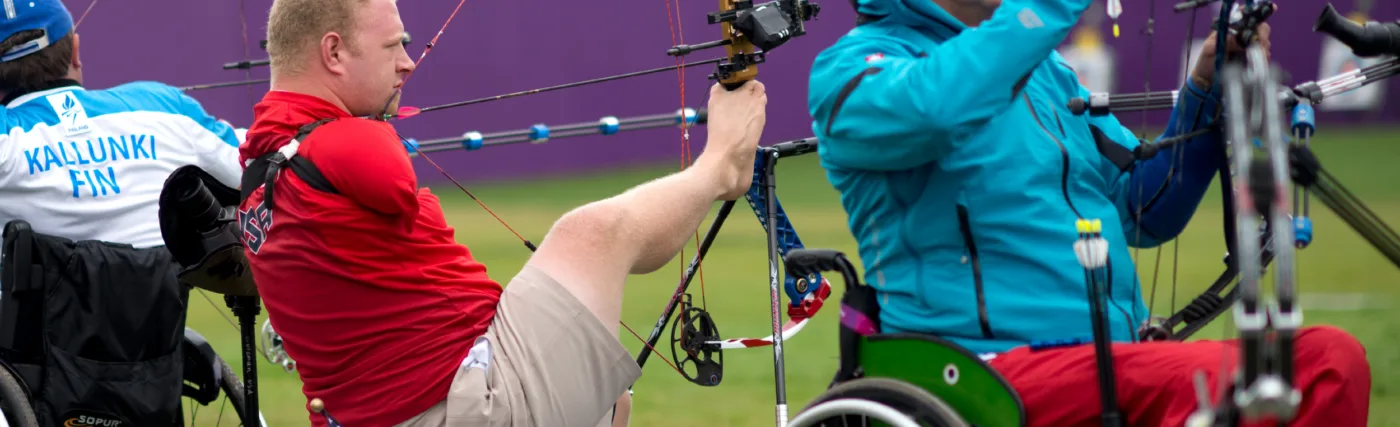
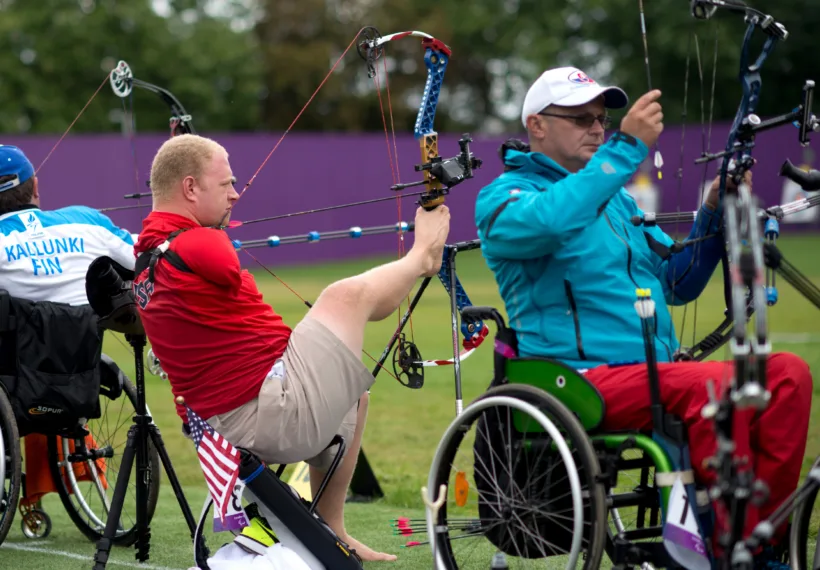
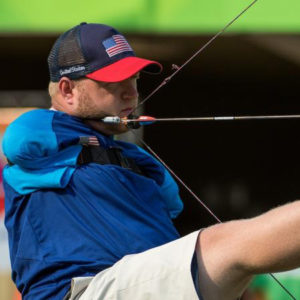
How do you shoot an arrow without arms? On this episode, Neil deGrasse Tyson and co-hosts Gary O’Reilly and Chuck Nice break down more Olympics events– swimming pools, archery, and skateboarding– with materials scientist Jud Ready, “Armless Archer” Matt Stutzman, and physics professor Bill “Dr. Skateboard” Robertson.
We dive into swimming pools: are some pools better built for speed than others? Jud Ready walks us through the fastest swimming pool in the United States at Georgia Tech. Find out about aquatic drafting and the reverberation of waves in the pool. Learn about the materials science at play in swimming pools. Some pools are just built different.
Next, we talk with Matt Stutzman, “The Armless Archer,” about his records, Olympic Archery, and how to use a bow without arms. You’ll learn how paralympic divisions work and which one Matt is in. How did he adjust for wind and gravity to hit his world record of 310 yards? How much math is involved? Find out Matt’s journey to become an Olympic Archer and how much of his brain is used for “foot stuff.” Plus, Matt gives us a demo on the mechanics of how he shoots a bow.
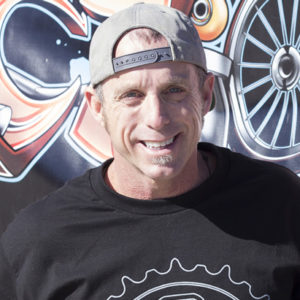
Dr. Skateboard instructs us on what Olympic skateboarding looks like. How can you use a skateboard to teach physics? We go over the different categories of skateboarding events. How does skateboarding differ from snowboarding besides snow? How does using gravity change a move versus using your leg to build speed? We discuss the technology of skateboarding and how it’s not just a sport, it’s a culture. All that and more on another episode of StarTalk Sports Edition!
Thanks to our Patrons Nicholas Grigalashvili, Jilam Dickson, Aden Hahn, Kaz Barnes, Ashleigh Cooper, Ridge Kimani, Tom Cardarella, Michael Webber, Justin Nelson, and Mike Reno for supporting us this week.
Photo Credit: English: D. Myles Cullen, Public domain, via Wikimedia Commons
NOTE: StarTalk+ Patrons can watch or listen to this entire episode commercial-free.
About the prints that flank Neil in this video:
“Black Swan” & “White Swan” limited edition serigraph prints by Coast Salish artist Jane Kwatleematt Marston. For more information about this artist and her work, visit Inuit Gallery of Vancouver.
Transcript
DOWNLOAD SRTWelcome to StarTalk, your place in the universe where science and pop culture collide.
StarTalk begins right now.
This is StarTalk Sports Edition.
I’m Neil deGrasse Tyson, your personal astrophysicist.
And today, we’re gonna be discussing three kinds of Olympic activities.
First, fast pools.
Second, can you hit a target, an archery target, if you have no arms?
Well, check that out at mid-segment.
And we’re gonna end with the one and only Dr.
Skateboard, a new feature of the Olympics this year, the 2020 Olympics, of course, being contested in 2021.
I got with me the one and only Gary O’Reilly, Gary.
Good to be here.
Dude, dude, I was telling people I stumbled.
You got a Wiki page of you and the time you were a pro footballer over in the UK.
I’m very proud of that.
So congratulations on that.
And you also were a sports commentator there before you joined StarTalk.
I’d like to think you’re still a sports commentator.
I still am, thank you, yes.
Sharing that expertise with us.
I could not find a Wiki page on Chuck Nice.
You gotta work on that.
Chuck?
That’s because I don’t have legs as nice as Gary.
Oh, is that what that is?
Yeah, man, when you go to Gary’s Wiki page, he’s in some short shorts.
And I’m like, who wears short shorts?
That’s what Gary wears, short shorts.
And now my man has got some gams on him, baby.
He’s got some great legs.
So Chuck, you’re a comedian and a longtime StarTalk co-host and an actor of late.
We’re delighted to see you in all these things.
And I just want you to know that we knew you when, okay?
As you ascend.
Yeah, well, I’m not going anywhere.
You’re not going anywhere?
All right.
Yeah, you can’t get rid of me that easy.
Like Chuck got a couple TV shows and he’s gone.
I know.
I’m like this, no I’m not, I’m right here.
And I swear I saw you in a Tide commercial with your daughter.
So you’re everywhere now.
That’s good, very good.
Keep that going.
Keep it going.
So we’re gonna talk about the Olympics, which dates back to, of course, ancient Greece, when I think life was simpler, but I bet back then they didn’t think so.
No one ever said, gee, life is simple today.
No one’s ever said that ever.
You have to look back on it and say, it was simple then and they didn’t even know it.
But generally-
We look back on their life and we go, God, we have it so good.
So the modern Olympics, which is what it’s called, dates back to 1896.
And they tried to sort of jumpstart the traditions of ancient Greece.
Some sports were, all the ones then were included, I think, if not all of them, but some were added.
And of course, the ones most people cared about in the day were track and field.
And today, many, many more events are part of this contest, this every four-year contest.
And for this first segment, we’re gonna talk about swimming pools.
Swimming, that’s one of the events as a category where records seem to be dropping all the time, every Olympics.
And it’s like, did something change with the water?
Is there some thing about the bathing suit?
Is it the ball head that you shave?
What’s going on there?
And so what we need is someone who’s thought about this, an engineer.
This is StarTalk, so we’re gonna bring some, we’re gonna science the shit out of this as Matt Damon said, from the surface of Mars, or at least his character did.
And we’ve got an old friend of the show, Jud Ready.
Jud, welcome back to StarTalk.
Hey Neil, hey guys.
Thank you for having me back.
You’re based at Georgia Tech, and Georgia, I think even your campus, co-hosted the 1996 Olympics.
Home of the Olympics in 1996, indeed.
With the city of Atlanta, I’d love it.
And you’re Deputy Director of Innovation Initiatives for the Georgia Tech Institute for Materials.
This materials is one of the hidden things.
It’s not purposefully hidden, but just no one thinks about it, it doesn’t make headlines, but new stuff shows up on the shelf with new properties.
And I think of you every time that happens.
I just want you to know.
I was thinking of you yesterday when we were, because we always have the dossier on everybody.
And I was like, I wonder as the Chief Research Engineer, do you ever come up with something to go, oh no, this is too good, I gotta keep this.
We do that a little bit with patents.
We do keep it to ourselves just a little bit, but not forever.
Yeah.
Okay, because yeah, as your Principal Research Engineer at the Georgia Tech Research Institute, GTRI, not quite an acronym, but we’ll take it because good stuff happens there.
So let me ask you something.
Swimming pools, you know, if you see somebody with like eight gold medals around the neck, they probably got it for swimming.
And in recent years, we think of Katie Ledecky and Michael Phelps, of course.
And so our pool-
Michael Phelps doesn’t count.
He has gills.
Michael Phelps is related to that, whatever that thing was in the shape of water, that fish got it.
Are you talking about the movie?
The movie.
That movie, yeah.
If you ever look at Michael Phelps, he almost kind of looks like that little sea monster.
And I think he’s got big flappy feet, too.
Like they might as well just be webbed, you know.
Let me ask, what’s going on?
Are we just getting better, or is something happening on the back end of that where the pools are getting faster?
And if they’re getting faster, how does it get faster?
It’s just water.
I know the properties of water from chemistry and physics.
What are you-
What’s going on?
And I know you’ve been thinking about this.
Yeah, it’s all of it.
It’s the materials as well as just the technology for the pool.
The main problem with the water is the resistance created by the other swimmers.
If we just ran one swimmer at a time, a lot of this technology we introduced wouldn’t be necessary.
But when you put eight lanes of swimmers, big, huge, you know, six foot strapping men and women in there, they displace a lot of water and create waves.
And those waves create friction, create resistance to-
Wait, excuse me.
Not if you’re in the lead.
Yes, but only if you do the single link.
As soon as you make a turn, you interact.
Oh, you got everybody else’s wake who’s still, yeah, who’s behind you, right, all right.
Sometimes that’s a good thing, though, having that wake behind you.
One of Phelps’ medals was achieved by one of his teammates in the relay riding the wake of the, who was then the world record holder from France, riding his wake and then right at the last minute, surfing over top of the wake in several powerful strokes and winning it.
You can see it right on the footage.
It’s pretty impressive.
Wow, so wait, wait, so you’re saying some of the disturb…
He was drafting?
Yeah, he was in the fourth leg.
Lazo was in the fourth leg.
Aquatic drafting.
Yep, exactly right.
Just like geese do the same thing when they’re going through the air.
He was doing the same thing.
You can see him move over towards the lane line.
Yeah, but the geese didn’t take your course at Georgia Tech, so…
They just know it innately, like a lot of Georgia Tech students do.
Giving that shout out.
They don’t fly over campus, huh?
They don’t get to Florida, they don’t get a medal.
So if the waves, if all of this turbulence in the pool is your major problem, and we’ve built pools out of concrete for ever and ever and ever, it seems, how has it been overcome?
Yeah, there’s three different ways that we do it here at Georgia Tech, and we’ve got the fastest pool in the United States.
The first is that we’ve got tremendous pumping power to recirculate the water.
You want to recirculate an Olympic-sized pool at least every four hours to keep the algae growth and everything down.
So that’s 60 gallons at least per second.
Wait, don’t tell me the algae prevents you from swimming faster.
I don’t believe that.
It does, because you want to pump and keep the water clear.
And so by pumping that water so fast, you’ve got gutters to extract it, and then you have to return it to the pool.
So are you saying that it creates a jet stream in the water?
Yeah, if you swim in any pool, there’s current that circulates the water for filtration.
And if we did that in this pool, with 60 gallons per second, we would create a very noticeable current that the inside and outside lanes would experience.
And so instead we send it through the bottom through these things called rosettes, which is like a mushroom that allows the water to come up and sweep everything to the side.
So that cuts down on those currents.
The other is the gutter system.
That the waves, as the wave reaches the wall, it falls off into the gutter rather than hitting the wall and bouncing back.
And then the third thing is-
Because waves just love to reflect off of surfaces.
They do.
Waves and surfaces go way back.
And the depth of the pool is important as well for that wave.
The Olympic pool here, as well as Tokyo, they’re three meters deep.
So that’s like 10 feet, nine feet.
And anything-
Quick question.
Is that the depth that the water polo folks work in?
Yeah.
All the Olympic pools are always, it’s both as well as the rhythmic swimming.
The diving pool is actually five meters deep because you don’t want to hit the bottom for that, of course.
So you’ve got a little extra depth.
If you’ve got those side drains, Jud, then that means the pool has to be completely full.
Over full, in fact.
When these eight strapping young men and women jump into this pool, they displace that equal volume of water, just like if you dropped an ice cube in a glass of water.
So that volume-
Who do you think you are, Archimedes here?
I love that.
You got to get rid of the water.
What stops it flooding?
You have to keep sucking that away every time that they’re doing it.
You really have to have a complete system.
It’s a full circle, fully enclosed system that’s overfilled slightly because you don’t want air to get entrained into the suction system because that will create cavitation on your impellers or your pump and can cause those to break down prematurely as well.
So what you’re saying is your system dampens the waves as they hit the wall, okay?
But it can’t do anything about the waves until they get there.
So if you’re in lane one and lane eight or whatever the edge lanes are, you’re going to feel everybody else’s wave before it gets deadened to your left.
Sorry, Neil.
No, they’ve got those paddle wheel lane dividers.
And in fact, here at our pool, we actually use two side by side so that the paddle wheels absorb the weight from the lanes immediately adjacent to you.
Oh, so those serve a purpose.
I thought it was just to show those guys where to go.
If you look at them, they’re not stationary.
They spin as the wave takes them, and that absorbs that energy and prevents it from going over there.
We found the reason why we set so many records at this very pool is that we use two lane lines along there to dampen it even further.
All right, so why doesn’t every pool have this?
Secret stuff.
I guess we filed a patent on it or something.
Now everybody knows.
Yeah, but then why don’t they discount the gold medals or the world records at your pool?
We didn’t start doing that actually until a couple years ago.
In fact, after this wake surfing incident that occurred and people became kind of aware of this, that was in the early 2000s when Phelps was winning those.
And so, if you look at the footage from 1996 Olympics, not only is there a single lane line, but the starting blocks have changed as well.
The starting blocks there are flat, whereas now they’re inclined.
Why?
Why didn’t anyone figure out that you might want to incline the starting blocks long ago?
Yeah, because you’re pushing off of something.
I mean, in track, nobody starts flat.
Right, right.
So why did this take so long to figure out?
Well, the first starting block was 1936, the Berlin Olympics was literally just a wooden box that was bolted to the pool deck.
And that’s what they stuck with.
It got slightly better when they started using metals.
But up until the 1996 Olympics, it was still just essentially a box, but a metal flat surface that had an anti-slip surface on top of it.
So you needed to dig with your toes to grab onto the edge.
And so I went back and looked at the footage, and all the swimmers, except for a couple, are always two-footed on the front, curling their toes over where there’s only a few sprinter styles.
And after that Olympics, they first inclined the surface to add it, and then they added an additional incline, so it was two inclines, so something to push off with.
And so, yeah, you’re starting with that extra oomph, just like a sprint.
When you say two inclines, you mean for the two different feet?
Yeah, well, yeah.
So one foot’s on that and one foot’s pushing on the back pedal.
Like a sprinter in a track?
Exactly right.
Okay, very cool.
All right, Jud, does your pool have ten lanes or eight lanes?
Yeah, all Olympic pools have ten lanes, but you, lane zero and lane nine are not occupied.
But that would reduce the impact on the swimmers on the outside lanes.
Am I correct in thinking like that then?
Yes, they do not have that swimmer, so you would want those.
Though there’s downsides in that, depending if you’re a right-handed breather or a left-handed breather, sometimes you’re not able to see your competition, perhaps on the critical final leg.
So that would be the main thing, probably.
What is the best lane?
And why do they always give the fastest to the best guy?
I’m superstitious.
With horses and everything, I pick lane four.
So I would pick lane four, but I think a lot of it depends on just your training and your strategy.
Even though we’re introducing these things in good swimsuits, there’s a lot of biomechanics that go into it.
So we can provide all these things, but when it comes right down to it, it’s the human in the loop that really makes a difference.
Well, wait, but then you wouldn’t have a job.
So let’s stick with the technology.
We’ve got to actually bring this to a close, but it’s been a delight to have you back on.
And sorry there’s only one segment because there’s a lot we’ve been covering for our Olympic, the attention we’ve been giving to the Olympics.
But like I said, you’re in one of my favorite fields, material science, and the more people know about what you do, I think the better offer will all be.
So, we’re going to keep on keeping you happy, Chuck and Neil.
So thanks again for being on StarTalk.
And when we come back, we’re going to talk to an ace archer who happens to not have arms.
We’re back, StarTalk Sports Edition.
We’re talking about the Olympics, a series of these programs where we’re just trying to figure out what’s going on, how does it work, and all the ways that science might be informing it.
So Gary, who do you have for this segment?
We have the most wonderfully interesting athlete, Paralympian, Matt Stutzman.
Won silver in the London Olympics in 2012.
Guinness World Record holder for the most accurate arrow shot at a target over distance by any individual, 310 yards.
That’s three football fields, all in a line, and then some.
And then some.
Now, team gold in the Parapan Olympic Games and an individual silver in the Parapara Olympic Games.
Okay, Matt, welcome to StarTalk, dude.
Thanks for having me.
So if I’m going on a hunting trip, I’m taking you.
I’m down, I’m down.
Do you ever hunt?
Do you go bear hunting with a bow?
You know what, I haven’t bear hunted yet because I feel like if I don’t do good, he will chase me down and try to eat my arms off.
I can’t afford to lose any more appendages.
Yeah, no more limbs for you.
Could you just explain how, forgive my naivete here, but how do the Paralympics work?
I presume each sport has its own rules about what needs to be your circumstances in order to participate.
So in the case of the Paralympics archery, what are the rules about that?
So the division that I’m in is basically, they’re looking at the least amount of disability possible.
So pretty much everybody in my group of, let’s say 100, all of them have, most of their disabilities are from the waist down.
Whether they’re paralyzed and have to be in a wheelchair or they lost a leg and they have to stand on a prosthetic.
There’s different categories, but that’s the most competitive category.
And that’s where I wanna be because I just wanna be the best.
Yeah, well, I mean, really you’re just showing off.
That’s what he’s doing there.
Let’s be honest.
I mean, here’s a guy who’s just like, yeah, I have a prosthetic leg and I can hit a target from a hundred yards.
And you’re like, bro, I don’t have arms.
I don’t have arms and I hit a target.
And I can do it from three times the distance.
How about…
He wins every argument there ever was.
There’s no argument to have, man.
Hands down, you know.
Okay, Matt, let’s roll back a little bit here.
This Guinness Book of Records, which you own outright, someone was saying to me that when you attempted this, because of the crosswinds, you had to aim at an air conditioning unit on a building in a completely different place to hit the target.
What is going on?
So that the air would move it onto the target and you have to know that in advance.
Is that what happened there?
So the rules state you have to use a 60 pound bow and you only get three attempts ever to make it.
You have to call your ship.
Wait, wait, wait, just wait.
For the non-archers, when you say 60 pounds, that’s the force necessary to pull the string.
To draw back the bow, yes.
Okay, not that the bow weighs 60 pounds.
Correct.
Just to be clear.
Correct.
That is the kinetic energy that pushes the arrow forward is 60 pounds.
Yeah, if it weighed 60 pounds, you’d be Hercules.
I would definitely need bigger arm muscles for that one.
Yeah.
Yeah, so to figure out how to shoot that far away, when you do the math, you have to aim at a certain angle, whether it’s 32 degrees or whatever that is, and you have to calculate the arrow speed.
And so for me, it just so happened that where I needed to aim to calculate all this to actually hit the bullseye, I aimed at an air conditioning unit across the street at a high-rise building.
It happened to be like right in the perfect place.
So I was aiming at that.
In all my calculations, that’s where it ended up being.
So you’re not only an expert bowman, you’re a sniper too.
No, but that’s the hallmark of a great sniper is that you’re able to adjust for crosswinds and distance, man.
No, we need a poster with Matt, with the target hit, and the captain just says, do the math.
So Chuck, I just thought you’d ask the simple question, how many times did you hit the air conditioning unit?
That’s a Chuck, Chuck.
You should have used, that was you, Chuck.
You dropped that one, Chuck.
So, Matt, how many times did you hit the air conditioning unit?
Well, he killed three people in that apartment building before they…
So, real quick, they never actually found out it was me because I don’t leave fingerprints to prove it was me.
I told you he was a sniper!
Wait, wait, so Matt, let me ask another naive question and forgive me if this sounds sort of ableist, right?
So, do you have an advantage over those who would have lost their arms later in life, you having been born with no arms, so you only ever have known life with no arms?
Absolutely, there’s an advantage.
It’s funny because when I first got into archery, they’re like, there’s no way you can shoot a bow, you have no arms.
It’s impossible, you have to use your arms to shoot a bow.
Well, then I started shooting a bow and then they’re like, wow, that’s like…
And you aimed at them.
Here’s how I can’t shoot.
Wow, that would be a great argument.
There’s no way you can shoot a bow.
Oh, damn, damn, I guess I was wrong.
The last words on his tombstone, I guess I was wrong.
It’s funny because when I first started shooting, there was a TV show that does spoof news, and they said, armless man wins silver but shot several people along the way.
Oh, okay, all right.
It was funny, but yeah, so when I started…
But your brain has never known arms, so you’re not fighting a pre-expectation of what you can do.
Yeah, if they tested my brain and they said that the average person’s brain, the area of their brain that controls their feet, motor skills, is the size of a pea, and mine’s like the size of a softball.
I would never train my brain to do all this extra stuff with my feet.
It probably just said, we don’t need hands, let’s just throw that chunk of the brain out, and we’ll use that to store foot stuff, I guess.
So for those only hearing this, I can describe that it looks like you’re sitting in some kind of a garage workshop, and there’s some badass looking vehicle over your left shoulder.
What’s going on in that?
What is it?
Is that a safe house?
Is that a bunker?
Where are you?
Do you know something?
It’s where I keep my arms.
That way the people in the house will think I can’t do anything.
Oh yeah, there you go.
So when I’m not shooting my bow, I love cars, and I love working on cars.
I do almost all the work myself.
And what’s behind me right here is my race car that I just got done building and fixing up.
So tell me about some of your science background.
You sound sufficiently physics-fluent, so that tells me you must have had some physics in your portfolio.
To be honest, not a lot.
A lot of it was just kind of self-taught growing up.
I lived on a farm.
That works too.
I lived on a farm, and I had to a lot of times think of how I was going to do it.
For example, I remember I was eight years old, and my dad said I needed to carry this five-gallon bucket of feed out to the trough.
I had to figure out how I was going to take a board and put it across from one feed bucket and then stand up underneath it and balance it.
I was out there with a measuring stick trying to find the middle of the stick, so when I lifted up on it, it wouldn’t fall.
There was things like that throughout my whole life that I had to rely on, like physics and math, to just kind of overcome things, really.
So, Matt, you’re a father of three boys, right?
So how do you do the super dad hero at home while you prepare to go to a Paralympics in Tokyo and race a car?
Yeah, you know, what’s amazing about my boys is just like they don’t know anything different.
This is who they know, this is their dad.
They go along with my craziness, whether I’m shooting my bow, working on cars.
They just support me.
In fact, they are one of the biggest motivations in my life on why I push myself to where I’m at because without them pushing me, I mean, that’s honestly how I fell into archery in the first place because nobody would hire me and I couldn’t figure out how to get a job because people would say you have no arms and so they wouldn’t hire me.
So I found archery to put food on the table for them.
So if it wasn’t for them, I probably wouldn’t have done this.
I would have been trying to figure out something else.
Wow, man.
You know, I’m reminded of an episode, thanks for mentioning The Family There, Gary, because that reminded me, I don’t know if it was Twilight Zone or One Step Beyond, one of these sort of half-hour, short story format TV series from the 1960s where there’s this kid, middle school kid or younger, in school and in their art class they’re modeling clay and they had to make a clay model of their hero.
And so one person did Superman and then Thor and one person just said, I’m doing my father, okay?
And he’s doing this clay thing and he only gave it one arm.
And the teacher says, no, put the other arm, no, this arm.
And then later on the teacher meets the father and the father has just got one arm.
And it was like, oh my gosh.
That father went to go on and star in The Fugitive.
No, but the point is, like you said, if that just is life and you don’t know any different, you’re not in a position to judge it or it just is.
And then you live life and celebrate life for being alive.
So let me ask you this, when it comes to…
I got to throw this out there.
And I’ve tweeted this too.
I’ve been thinking about this a long time and I thought, I wonder if octopuses pity humans for how few limbs we have, because they’ve got eight.
So, I mean…
So when you shoot, what are the mechanics behind your shooting?
Yeah, take us through what that is.
So how about as I’m explaining it, I can also show you?
Oh my gosh.
And do it.
Because many people will only hear this.
If you can be a little more descriptive than you otherwise would be.
This right here is a release aid that I had made.
This is the only modification that I used to shoot my bow.
So when you look at a bow or when you’re listening or in your mind visualizing a bow, I’m shooting a normal bow that you would buy off the shelf that you would use to shoot with your hands.
So like, they didn’t specifically make this bow for me whatsoever.
Cool.
And that’s legit?
There’s that within the rules.
Everything’s within the rules.
So, and even this thing that’s on my shoulder right here is within the rules.
So I put on a…
It’s a kind of a yoke around your shoulders.
I put on a strap that goes underneath my armpits and across my chest, and then I tighten it up.
And over my right shoulder, I have a release aid that looks like a trigger of maybe like a gun or something like that.
And it has a long bar.
That bar goes on my chin.
So when I’m aiming, I pull with my shoulder.
That applies pressure to that little trigger, which allows the bow to shoot.
And so is this, but is it your chin or your teeth that engage that?
That’s my chin.
So I put it in my mouth to hook it onto the bow.
Then you hook it onto the bow.
And as you pull back with your shoulder, that causes the bow to come back.
But then all you have to do is put your chin down on the release.
And then the hook pulls up and bang, bang.
So so this bow that I’m going to use right now is a bow that I’m actually going to use at the games.
And it is shooting a little itty bitty skinny arrow.
And I know you guys are into this stuff, but this this arrow weighs four hundred and twenty nine grains.
OK, well, it shoots out of my bow at 200 miles per hour.
Ow.
Oh, my God.
So literally, as I fire the bow, when you guys see this, what by the time this arrow hits the target, which is only going to be about three or four feet away from me, it’s already doing 200 miles per hour.
So it would be at 200 miles an hour the instant it separates from the string.
And so because that’s the last moment where it’s getting any energy that you supplied.
That is correct.
And then the rest is just is aerodynamics and gravity at that point.
OK, so now you’re seated.
It does slow down over a period of three hundred and ten yards.
But you have to calculate that into, you know, how much is it going to slow down?
I know when I did that shot, it was about a six second arrow flight.
OK, so you had to.
So you had to shoot wherever that air conditioner was.
It was surely high to the side of the target because of the crosswinds, but also had to have been above the target because you have to allow the arrow to drop.
Yeah, it was about 20.
I think it was like a 28 or 30.
It might have been a 32 degree angle that I was aiming in the air.
So 32 degrees up.
That’s like like that.
Gotcha.
Wow.
OK, so I rest the bow for people who can’t see.
I rest the bow against my left leg and I’m sitting in a chair.
I use my right foot to pick up the arrow and load it onto the bow like that.
I then use my right leg and grab the bow and I pick it up and I sit gentleman style where I cross my legs.
So it kind of brings my right foot up to my chest.
At this point, I take my release aid and I bend down to the string and I hook it on.
And now that it’s hooked on, I pick the bow up with my right foot.
And so now it’s very weird awkward yoga position.
Okay, so at this point, I’m going to take my right foot and push it away from my chest.
And now you’re now you’re getting that 60 pounds of force.
I don’t know if you guys can see all that, but that’s what it looks like.
Okay, then I aim at the target, bring the trigger up to my jaw, and then I add pressure until it shoots.
Bam.
Just like that.
Look at that.
That results in bullseyes and medals and lots of smiles.
You’ve got to do that.
You’ve got a set number of arrows to release in a set period of time.
That’s intense.
How are you controlling?
How are you able to dial yourself down and focus in the middle of competition?
So you shoot 72 arrows for qualification and you shoot six arrows at a time.
And you get four minutes to shoot each six arrow group.
And then you go score them, pull them and stuff.
But when I do that, I’m so in the zone that when I draw my bow back, I don’t know who’s around me.
I practice the timing.
I do a lot of mental prep.
What a good shot feels like.
So the distance that we’ll shoot in Tokyo is 50 meters.
And the bullseye.
Oh, that’s nothing for you.
The bullseye is smaller.
They should just hand you the metal and then you keep.
The bullseye is smaller than a CD.
So a perfect score is 720 points and the world record is 705.
And the last several months or so, I’ve been shooting to practice about 708 to 712 range.
Oh, oh, oh, wow.
We’re going to be watching your ass.
Oh, my gosh.
This year has been amazing for me as far as mentally.
I just got back from trials and beat the old world record by 12 points.
No, over 20 points is what the new.
So I now own the new world record.
So that’s amazing.
That’s two world records.
So just in comparison, if you guys want to know.
So I average right 700 points at 50 meters.
The number one ranked able bodied archer in the world shoots for United States of America.
And on the same day, on the same field, when they were shooting their scores, they shot a 704 maybe, and I shot 700.
So I’m only like three or four points off.
The number one able bodied archer in the world.
So as a comparison.
Right.
Yeah.
Well, there is no comparison.
You make him look like dog food.
Let’s be real here.
So Matt, when you rock up, do you all of a sudden get a lot of attention because of who you are?
Yeah.
Yeah.
And do the other athletes get a similar sort of attention?
And does that kind of blow them out?
But for you, you seem to have grown, obviously, into this attention.
And is it you know what?
I’ve been here before.
I’m not fazed by this.
Do you see the other athletes getting kind of outside of their comfort zone with the attention?
Oh, for sure.
You know, one thing that’s interesting is I’ve been my whole life used to attention.
And what I mean by that is, is it could be negative attention to like people making fun of me because I have no arms or like I’m at a restaurant, especially as a kid, especially as a kid in a restaurant with my feet and everybody in the restaurant staring at me.
Right.
So my whole entire life, I’ve been able to say, you know what?
I don’t care what they think I’m going to do me.
None of that bugs me.
Like, I don’t care.
I’m going to block them out.
So when it comes to archery and I get into this on the on the stage of it means something and we have thousands of people watching, I don’t even know that they’re there.
Whereas, let’s say for you, let’s say, let’s say I’m shooting, you know, against Gary or something.
He’s never been in that situation.
Right.
So you shot really good.
And now you’re shooting for a gold medal.
But you’ve never shot in front of 10,000 people before.
So there is an advantage there for me, you know, because I’ve been dealing with my whole life and they haven’t been.
You’d make a great stand up comic.
You’ve got to have that.
You’ve got to have that same mentality.
I don’t care if these people are not laughing.
No, only Chuck has to feel that way.
Other comics, they’re actually laughing at them.
So I’m delighted by how much physics you picked up in your life.
And as Gary said, a lot of it would come intuitively to you if you didn’t have the formal training.
You’re thinking about nature and forces and energy the right way.
And on this show, we’re delighted to learn when athletes throw in some math to get their medal.
And so, Matt, it’s been a pleasure to have you on this program.
We will all be watching you in Tokyo.
And good luck, but it doesn’t even sound like you need it.
I’ll take all the good luck.
I appreciate you guys inviting me on the show.
It’s been amazing.
I loved all the laughs.
Thank you again.
Thank you.
We’ve got to take a quick break.
I want to thank Matt Stutzman for being on for this segment.
And when we return, we’re going to have Dr.
Skateboard on yet another one of our Olympic installments of StarTalk.
We’ll see you.
How can you get your own Patreon shout out, like Michael Weber, Justin Nelson, and Mike Reno?
Well, go to patreon.com/startalkradio and support us.
And thank you to Michael, Justin, and Mike, because without you, we couldn’t do this show.
We’re back, StarTalk Sports Edition.
We’re talking about the Olympics.
And in this segment, we’re going to address skateboarding.
Yeah, I said it, skateboarding.
It is a new Olympic sport.
Gary.
Do we know anybody?
Who did you get for this segment?
Well, there’s only one telephone number that we needed.
And this guy can drop the science, and he can drop the tricks.
This has to be Bill Robertson, AKA-
Okay, anybody named Dr.
Skateboard is fine by me.
Okay.
I know, so let’s give him his props, okay?
PhD in education.
Selected as a Fulbright Scholar.
Nominated by the UTEP in 2008.
UTEP, dude, I know you’re British.
That’s UTEP, University of Texas, El Paso.
Okay, thank you, UTEP.
For Professor of the Year, he is a Ted, yes.
Professor of the Year.
I know, the dude’s got some chops.
And then, you give him a board and he’s two times US Masters Champion, 2013 and 2014.
He’s three times Masters Freestyle Champion and he is in the Freestyle Hall of.
So, freestyle means you do creative stuff that no one ever dreamt of doing and then you get remembered for it.
Drop it like it’s hot.
Provided you don’t die from it.
Those, the people, there’s a selection effect there.
Yes.
So Bill, Dr.
Skateboard, I resonate deeply with you because I know you’re a science educator and but in what ways have you folded skateboarding into that enterprise?
I’d be delighted to learn how you figure that out.
And at my notes here, it says you call it action science.
So what’s going on there?
Yeah, well, so originally it started, I was a middle school teacher in New Mexico trying to get people interested in physical science concepts.
And the kids at middle school was very difficult and challenging.
They didn’t like the traditional experiments.
But one day I decided-
It’s called hormones, just to be clear.
Middle school.
It’s not that I choose, I don’t think I like these traditional experiments.
That is not what’s going through their heads for sure.
But bringing my board out, made a difference.
And I could present things about forces, motion, Newton’s laws of motion, and things we had to cover.
And they really enjoyed it.
So that sort of started my journey with that.
I’ve been a long time skateboarder and performer.
So I just worked on the ideas of integrating physical science concepts related to forces, motion, Newton’s laws of motion, and simple machines into that approach.
And then it took off from there, not only using skateboarding, but other action sports, you know, BMX and other ways to try to connect kids to things they’re interested in, and then also to the science.
So to put, if you will, put the action science was putting physical science in the context of things young people like to do.
I love it.
An educator who can’t stop telling people, as Carl Sagan used to say, when you’re in love, you want to tell the world.
And so you’re in love with skateboarding and you just fold that into wherever you, whatever the lesson plan is gonna be.
Very good.
You’re not just shredding, bruh.
You’re learning something.
So, doctor, when we get to the Olympics and like we said, it’s a debut for skateboarding.
You’ve got two categories, street and park.
What?
What?
I’m out.
Street, street, skateboarding.
Street, skateboarding and park.
Now, I mean, what can we expect from those two categories?
So in both the disciplines of park and street skateboarding, you’ve got 40 of the best women and men athletes in each area competing for Olympic medals.
So it’s going to be quite interesting.
The street is primarily something you would see with rails and stairs and ramp.
Yeah.
It’s a, and we love them.
Everything you’ve ever seen on YouTube, baby.
Right now, in the Olympics.
That’s right.
Watch me grind this out, baby, for gold.
I’m sorry.
Well, no, the top athlete is, number one is really an American by the name of Nigel Houston, who is all over the place.
And he’s, I think, you know, our best chance for gold, but we have a strong team, both on the men and the women’s side.
And then in the parks, you have really transitioned bowl riding, bigger transitions, and you have really a good team there as well.
So they’re kind of two unique disciplines in skateboarding.
Wait, you didn’t say bull riding.
You said bowl riding.
Yeah, I said bowl riding, yes.
Bowel, bowel, okay.
Where the sides are curved and you sort of rock up and back and forth, okay.
I know I’m from Texas now, but you know, it’s definitely a bull ride.
No hoofs and horns.
So what can we expect?
What kind of tricks are we going to be seeing and what kind of language are we gonna be coming away with?
And what part of Newton are you using the most?
That’s what I wanna know.
Yeah.
Well, I think a lot of times it’s, you know, with this idea of action and reaction is one of the things that comes across in the science, you know, as they’re moving towards obstacles or working with the obstacles.
Going back to your, what can we expect?
You know, you’re gonna see, I think some really interesting things like kickflip, blunt slides down rails.
You’re gonna see 360 flips across stairs.
You’re gonna see in the bowls, things like 540s, the McTwists.
You’re going to see a wide.
Well, just to be clear, 540 is 360 plus 180?
Okay, so that would be a one and a half.
Half.
So I just like the geometric angular measure of this.
Instead of saying it’s one and a half flips, we’re doing a 540.
You’re counting out the degrees.
That’s very good, very mathematical of you, okay.
And so I think that’s the big thing.
And then the riders are gonna have, you know, a timed runs and they’ll, you know, they’ll be judged on not only their degree of difficulty, but their creativity and then probably their amplitude and a few other categories.
So you can kind of tell, you know, who’s shining in those moments, but you’ll see the best riders in the world.
I’m just curious.
So in the pod portion, I’m sorry, go ahead, Neil.
Quick, so I want to distinguish two things.
When I see skateboarding and then I see in the Winter Olympics, they have the, what is it called?
Snowboarding, snowboarding, snowboarding, okay.
Yeah, in the half pipe.
In the Winter Olympics, at all times, they are descending a hill, okay?
Whatever else they’re doing in the middle of it.
So they’re using gravity as a force of their forward motion.
Whereas in skateboarding, you are pumping your action almost the way you do on a swing.
Where how do you go from nothing to a big arc?
You are pumping your own body energy into your motion.
So is it true that all the skateboarding you’re describing, maybe other than the going down the stairs, but the bowl skating, the park skateboarding, you’re not going downhill.
You’re always pumping your own energy back into your new position.
Is that correct?
Yeah, that is correct.
You’re going to be using the transitions as a way to push down them, to gain speed, and then to go up the transition, to bring yourself into the air.
You’ll probably see very little pushing except as someone is moving through a trick, but they’re going to be using the momentum of the obstacles to ride the bowls and to do the tricks and to create the trick.
Is this an important distinction then between the skateboarding and the snowboarding for me?
Yeah.
So what’s the most we can expect?
Because I read that it’s during quarantine, an 11-year-old threw a 1080 into on a vertical ramp.
Now, if an 11-year-old can do it, Dr.
Skateboard, surely the top people in the world should be working a lot harder.
Well, I think-
I gotta do my math.
A 1080 that’s four?
A lot.
A lot.
You’re welcome.
In the IT world, 1080 is like the resolution 1080p.
So a 1080, so Dr.
Skateboard, tell me about a 1080.
What is that?
So a 1080 would be, if you go 360s, one, 720, 1080.
So it’d be three revolutions or three spins on that.
And Gary, there’s a discipline that’s called the mega ramp.
It’s not in the Olympics, but it’s something they do.
And that’s how this person was able to do that.
These are much larger structures.
And so, you really need the bigger space to do that.
But you will see things here.
I mean, conceivably, 540s, 720s, you’ll see a lot of also motion where they’re spinning, but they’re also flipping their boards.
So you’ll see like kick flip burials, kick flip McTwist, which are where you’re spinning the board of 360 and you’re spinning 540.
So the degree of difficulty goes way up for that.
So what about, I don’t know if it’s gonna be a part of it or not, but are the mega ramp vert drops gonna be a part of the competition?
What is that?
I’ll let Dr.
Skateboard explain it.
You know, cause he’s the-
In mega ramp, you have a large ramp.
It’s probably, I don’t know, six stories up.
You drop down an incline, you hit a ramp.
There’s a gap.
It’s usually 50 to 70 feet that they go across.
And then they hit a huge quarter pipe, you know, which is probably 15 to 20 feet high.
And then they go 15 to 20 feet high above it.
Above it.
And then they land.
And if they’re successful-
Wait, while doing tricks, while doing tricks.
So that would be a gravity-assisted maneuvers at that point.
Yeah.
Yes.
Yes.
I guess that’s in the next Olympics.
They’ve limited, you know, the types of skateboarding.
So that’s one of the things I think is both a plus and a criticism is you’ve got these two disciplines of street and bull riding, but skateboarding is, you know, a much larger phenomenon that is actually not just a sport, it’s a culture and extends everywhere that people live and ride their boards.
It’s the hip hop of sports.
It really is.
So have we got any technology that’s emerged in the last couple of years?
Because it’s been a couple of years since we last spoke and we got into sort of like sealed bearings and things like that, but has there anything new come in to make this sport even better?
Yeah, Bill, in your educational circle, there’s Newton’s laws and then there’s material science.
Yeah, so where do you fold that in?
Yeah, so the one thing about a skateboard is it’s actually stayed pretty stable in its components since the 1970s.
And specifically with the advent of urethane wheels, it really made a difference.
But the one thing you do see now in skateboarding is you see more customized or different designs of deck shapes.
So people are really using the width, the length and the wheelbase of decks to differentiate themselves.
But skateboarding has pretty much stayed the same since we last talked.
You know, it’s a board, two trucks and four wheels going through this.
Now, the wheels can vary in hardness.
You could have the sealed bearings, but I think ultimately it’s a pretty stable technology.
It’s seven ply laminate.
Maple is typically what it’s done.
And then it’s set under pressure to create a concave.
And that’s another big difference over the years.
The concave or the contours for the board have really helped riders stay on their boards rather than just a flat board itself.
Plus if it has that kind of give, you can, the energy that goes into deform it can be recovered when you jump off of it, right?
As any good sort of spring action would be.
Here’s what I want.
In 2028 Olympics, I’ll give it one Olympic cycle to get there.
I want the hoverboard event, okay?
Hoverboard.
They do have, wait, you know they do have a hoverboard.
A third category.
That was, yeah, that was actually sponsored by Lexus where they make a superconductor and they make the hoverboard ride on like that superconductor where it levitates above these magnetic rails and you ride the hoverboard around their little track.
But it’s a skateboard.
Okay, so eight years, I’ll give it.
Eight years feels right, okay?
Bill, I don’t know how you feel about hoverboards.
Well, you know, Sabi, I’m a purist, you know, I kind of grew up in the 80s.
Old school, old school.
Get off my lawn.
I’m an old school guy, so, you know, I’m all about four wheels, two trucks, a board and the ground as you’re antagonist.
I like that.
So are you going to Tokyo?
You know, I’m not going to Tokyo, but I’ve been actually been working with some of the people from USA skateboarding.
Have a couple friends who are involved with that.
And so that it’s been, I’ve stayed in touch about what’s happening and they’re all preparing to leave here, probably I think by July 23rd.
Gotcha.
So I mean, I’m delighted just first to have you on the show, but also to know that your expertise is helping sort of Marca try to get some medals in this inaugural event.
And I think, you know, we’ve debated what sports maybe shouldn’t be in the Olympics.
That comes up often on this show.
And one criterion I used was might you have ever seen it on a Grecian urn?
Like, would the Greeks have put it on an urn?
I think they would have put skateboarding on the urn.
What do you guys think?
Yeah, we’ve got a guy in a tunic with a skateboard giving you the hang loose sign.
So, okay, Neil, let’s think about, if we’re talking classics here, which is the ancient Greek event, you think about the jumping, long jump, triple jump, things like that, that used Newton’s laws of action-reaction.
This then has to reconnect to the classic action-reaction with skateboarding, so it does have some resonance back to…
Yeah, yeah, so I think the Greeks would have been cool with it, I think.
Yeah, I think so, too.
Yeah.
All right, dude, we’ve got to bring this to a close.
Bill Robertson, thank you, Dr.
Skateboard.
What a moniker that is.
Is this on your business cards?
Well, I do have some business cards, but you know, I’ve been doing it ever since I got my PhD and, you know, really my mission has been to combine education with skateboarding, to reach out to marginalized students, but also to give, you know, pathways to success for students and education to the things they like to do.
So that’s really what Dr.
Skateboard’s all about.
So you’ve got a Ted Talk, any other place we can find you online?
Yeah, you can go to drskateboard.com, got all my…
You can’t get any better than that.
You can’t get any better than that, okay.
Yep, no way to find you.
Very excellent.
We’re delighted to showcase your work here.
And so thanks for being on StarTalk.
Thank you all for having me.
Neil, it’s a pleasure.
Chuck, Gary, thank you so much.
And it’s really my honor to be associated with StarTalk.
And thank you for all the good work y’all are doing.
All right, all right.
So this has been another sort of Olympic explainer, the inaugural appearance of skateboarding in the Tokyo Olympics.
Neil deGrasse Tyson here, your personal astrophysicist.
Keep looking up.

 Become a Patron