Transcript
DOWNLOAD SRT
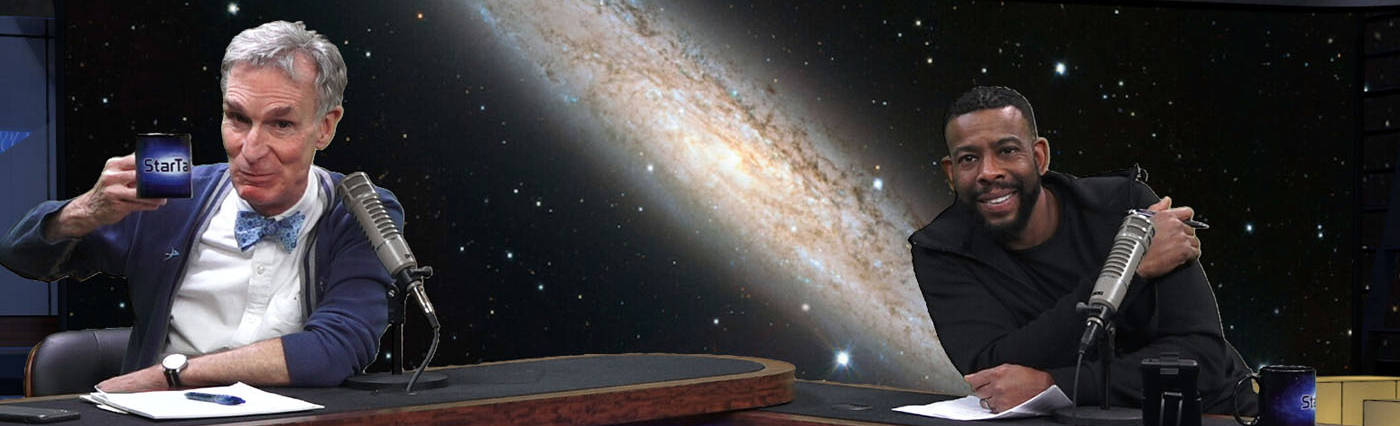
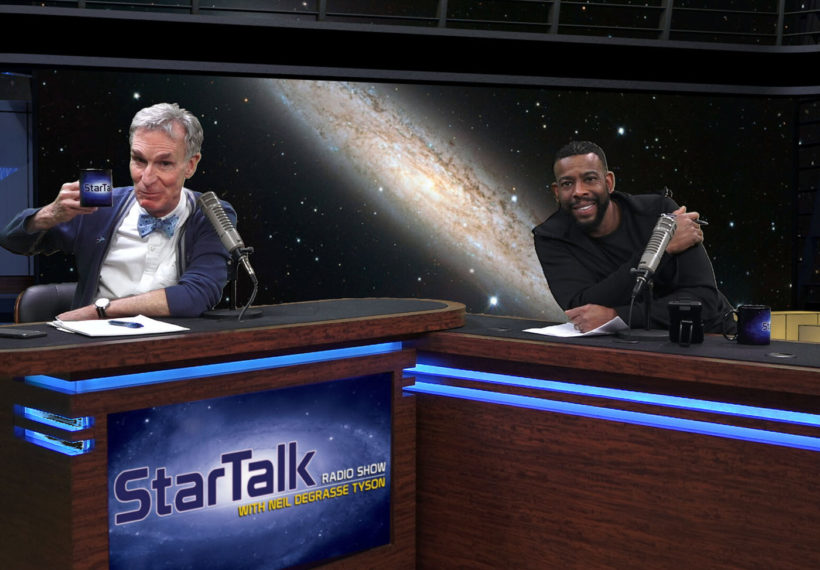
Welcome to StarTalk, your place in the universe where science and pop culture collide. StarTalk begins right now. Greetings, everyone. Bill Nye here. I'm your guest host this week on StarTalk, and I'm joined with your friend and mine, our...
Welcome to StarTalk, your place in the universe where science and pop culture collide.
StarTalk begins right now.
Greetings, everyone.
Bill Nye here.
I'm your guest host this week on StarTalk, and I'm joined with your friend and mine, our beloved Chuck Nice.
Hey, look at that.
Applauds and everything.
Chuck, it's good to see you.
This week on StarTalk, we're just talking.
Yes, we are.
About stars.
Exactly.
And you're going to start with a question from our beloved audience.
Yes, we are.
We're going to do a Cosmic Queries where we have gathered questions from all over the interwebs and-
Over the cosmos.
Over the cosmos.
That's why they're Queries of Cosmic Nature.
Here you go.
Our first one is actually from Alpha Centauri.
Really?
Yeah, really.
Before we get going though, let me just say, one, you're wearing a very fetching sweater.
It's quite fashionable.
And two, I really did the Planetary Society pin that you are sporting.
And I would like to know where I can get one because, well, first of all, I will have to join the Planetary Society.
So maybe you can tell me how I can do that.
Oh, yes.
Well, you should check out planetary.org.
The world's largest non-governmental space interest organization, Advancing Space Science and Exploration, so that people everywhere would know the cosmos and our place within it.
Elevator door closing.
So, I took one class from Carl Sagan back in the disco era.
I joined the Planetary Society when it started in 1980.
And now I'm the CEO of the Planetary Society.
And Chuck, we advance space science.
We advance exploration in three ways.
We make things.
We create.
We made a spacecraft.
I know that.
Or a sail spacecraft.
It's a light sail, right?
Light sail.
And we are on the second Falcon Heavy rocket.
The Falcon 1 had how many engines, Chuck?
One.
Falcon 9 had how many engines?
I'm going to say two.
How about nine?
The Falcon Heavy is, in a sense, three Falcon 9 strapped together.
27 first stage engines, yeah.
Wow.
And so this spacecraft is built by people like you, who just thought it would be cool.
And so we are going to prove that we can orbit the Earth with a solar sail.
Right.
This will be the Earth.
Right.
So we come, you're the sun out there, we come karate chop toward you this way, twist in space, get a push, our orbital energy takes us out here, you go like this, whoa, and increase our orbital energy and we're excited.
So may I ask you, when the solar winds come rolling in?
Solar wind is barely a hundredth of the effect of the photons.
So is that what that is?
It's the sun.
It's the sun itself.
Crazy.
And you can do it either from classical physics with pointing vectors, or you can do it with relativity.
Okay.
E equals mc squared.
Do you know how we express momentum in physics?
It's mass times velocity.
So now let us divide both sides of E equals mc squared by c.
The constant, and so you get...
E over c equals mc.
mc is an expression for momentum.
Gotcha.
So it's about nine micro Newtons per square meter.
Wow.
But because you're doing that in the vacuum...
Vacuum and it's day and night.
It's day and night.
Go ahead.
We're in space.
There's no night.
Whoa!
Whoa!
And so then at the planetary side, we educate.
We have, I believe, the world's foremost long-form journalists on the web.
And then we advocate.
People like me go to Washington, DC and get congressmen, senators on board with planetary exploration.
Two things I want in my lifetime with respect to planetary exploration.
Chuck.
OK.
I want to look for signs of life on another world.
Very cool.
Or yet I want to find signs of life, like fossil bacteria on Mars or, stranger still, something still alive.
Something alive.
Living bacteria.
Yes.
Twice as much ocean water as the Earth.
Are there Europeanians swimming around out there, around the moon of Jupiter, on the moon of Jupiter?
And the other thing, Chuck, don't want the Earth to get hit with an asteroid.
You know, I've got a feeling that might raise our insurance premiums.
So it's like, control, alt, delete for civilization.
Exactly.
You don't want that.
Just this thing in Chelyabinsk a couple years ago, three years ago.
Relatively small rock.
Thousand people go to the hospital.
Right.
Windows shattered everywhere, sonic booms, the whole deal.
The whole thing.
Well, that's pretty cool.
All right.
Well, let's get into...
Thank you for the promo.
I'm glad you like the pin.
I set you up by Noah Guy.
C freaking O.
I'm going to take you up on that.
Let's get into our Cosmic Queries.
Let's go with David Zuniga.
David Zuniga.
Zuniga.
He is a PhD and he is at Dr.
David's, Dr.
David Z.
Promoting David.
We're promoting David.
He's a, because he's promoting himself.
He's smart enough to actually write down all this good stuff.
Read it.
You didn't even, you know, but go ahead.
He says from a perspective of, from your perspective, what are the problems that faces the US the most pressing and what should we do about it?
Well, the most pressing problem for any country, anybody is climate change as far as I'm concerned.
And the longer we ignore it, there's two problems.
First of all, the climate will change faster and faster.
The second thing is our competitors.
You know, you, I believe, are also native USian.
I am.
Our competitors in other countries will produce better, cheaper solar panels, better, cheaper wind turbines, that are cheaper electrical distribution.
And we will have to be buying, the US will have to be buying these commodities from other factories overseas.
So interesting you say that.
I just read a thing in Financial Times about the fact that...
I think Chuck reads Financial Times.
You're a nerd, man.
You know, I don't want to promote that, Bill.
Let's keep that on the DL.
You're a hipster.
So anyway, what happened was...
Nobody's going to believe that either.
No, especially the wife.
So anyway, a great article on FT about the fact that...
China is trying to corner the market when it comes to solar panels.
And we are...
We were ahead.
And because of how our government has basically treated, they've suppressed our attempts to continue to be the leader in this area.
China has, in that void, stepped in.
And now they are not only surpassing us, but they are about to make it so that we're not going to be able to catch up.
Well, we'll see.
I mean, you know, the US has been behind before.
That's true.
But the opportunities are huge.
And so if you're out there, you want to make solar panels get on it, I am the first to confess or point out, I did a bit for a company that was going to have this new manufacturing technique using instead of a saw to cut silicon, we're going to use protons.
And you put your silicon in your particle accelerator atom smasher that you have.
And they go to it's very apparently for people who are into it, you can control the depth that the protons penetrate.
Okay.
You give it an electric charge and you get this perfect thin slice of silicon without any sawdust.
Wow.
But that company, my estimate, and we'll see what happens, was when I recorded this thing, it didn't have enough money, undercapitalized.
Right.
And so maybe it'll come around.
It's a cool idea.
Anyway, here's, I mention it because it's just one idea.
If we were encouraging innovation in solar panels, we would be innovating in solar panels.
Right.
If we're giving tax breaks to fossil fuel industry and deregulating that industry so that they can impact other people's environments recklessly or aggressively.
That's what we're going to be doing.
Going the wrong way.
So let's get to work, people.
Let's get optimistic.
All right.
Let's go now to Chris Marcello or Marcello, if you so will.
Chris Marcello.
Chris Marcello from Facebook wants to know this.
From Facebook.
At this time.
I'm sorry.
That was...
I apologize.
It's just irresistible when you...
Science Guy Ends Career With Off-Mandate Off-Mandate.
Take it.
At this time, should we, as a world, treat science as anything but a global pursuit?
Should we abandon the competitive nature of science discovery?
Or have we reached that point where science should be pursued with as much collaboration as possible?
Is there cooperation among scientists worldwide to the point where they have eliminated the competitive aspect?
Scientists are so competitive.
And BT dubs, there's an old, there's an adage, where the money is small, the politics are big.
A lot of scientists.
Now you might associate scientists with inventors who invent something that makes somebody rich because not only are they inventors with some insight into material science or electricity or software, but they're also extraordinary business people.
But actually, most scientists are academics.
Some of them drive, you know, Honda Civics.
And so they're very competitive.
And that's good.
That's good.
But in the case like, Neil's not here.
Do you remember Neil deGrasse Tyson?
I think I've heard of him.
Yeah, well, there's pictures on the web.
Anyway, he is an astrophysicist.
You may have mentioned that seven or eight times a paragraph.
And in astronomy, especially, people cooperate worldwide because when you're looking at the heavens from a spinning platform to wit the earth, only a third of the earth is practically in looking at the sky at any one time.
And so these guys and gals really do cooperate.
Well, you need the help of the other person.
It's actually an additional set of eyes.
That's exactly what it is.
And you know, space exploration would not really be possible without Canberra in Australia.
And I mention it because Australia just started its own space program.
Way to go.
Oy!
Right there, September, October.
Way to go, Australia.
There you go.
Hey, great question there, Chris.
So let's move on and have Don Violetto.
Wow, look at that, two very…
Your accent's compelling.
Well, yeah, actually.
Anyway, go ahead.
Don Violetto says this, what effects will the dismantling of the EPA have on this country and our globe as well as future research and, I like that she threw this in here, education?
Yes.
What a wonderful inquiry about education, and I don't know where that…
You've choked him up.
Yeah, I like it, but go ahead, Don.
He's choked up.
Yeah.
So, the EPA, you might think it's being dismantled, it's just being run by or somebody's been put in charge who doesn't much care about it.
But I think the environmental protection professionals, the bureaucrats…
People who've been there.
They're just going to be there.
And they're all just looking at their watch, we'll be here after you're gone, sir, carry on, Mr.
Pruitt.
It's like agents in my business, as they say.
Talent comes and goes, but agents are forever.
So I think the bureaucrats know what's up and they're doing their jobs despite their leader.
The problem is going to be that all the environmental damage that's done over the next few years because of this upheaval at the agency is going to have to be undone.
And it will be because people will realize the great value of the environment and they won't put up with it.
So I predict, and it's not extraordinary, that the days of the anti-environmental movement within the Environmental Protection Agency are numbered.
All right.
This is not sustainable.
Yes.
By the way, EPA was set up by Richard Nixon for crying out loud, everybody.
You know, the word conservative used to have to do with conservation, people's, people's.
We'll reverse this.
You'll see.
Read on, Chuck.
So let me, before we go on, let me just ask you this.
Do you think that as we see a, I will say, a depression of activity at the EPA, along with a burgeoning economy, which although we've been in it for many, many years, you know, it can't continue forever, that what will happen is, as we enter into some type of recessive contraction in the economy, a correction, as they say it, they don't talk plainly.
It means stocks are going to be worth less.
No, no, it's a correction.
So, as we see this kind of correction or economic downturn, we will also probably be at a place where maybe we're not in this type of administration and we'll have to re-institute the proper regulations and then you'll have people blaming those regulations for the economic downturn.
As we say at this point, you may be right, but keep in mind the economy is expanding and the stock market especially is doing well, but the disparity between rich people and poor people is growing.
That I also claim is not sustainable.
I don't think that's an extraordinary economic point of view.
This is you concentrate more wealth with wealthy people and less with middle class and poor people.
The tax base is not sustainable and public works will...
Everybody loves the word infrastructure, will not be maintained and that this is obvious to everybody is interesting.
So we'll see what happens in the coming years, but I think the pendulum is going to swing back hard in the US.
All right.
Bill Nye, giving us hope.
Well, you got to be optimistic, but you know, you guys, I'm not the world's foremost authority in economics, but banking, I guess, literally on extraordinary growth in the economy to pay off the debts you're accumulating now sounds cool, but I don't think it's going to work.
You know, I'm of an age where it didn't work in the 1980s, this notion that you could just cut and cut and cut.
All right.
We'll see what happens.
And along that line, if you degrade the environment, everything is worthless.
So the this value that you think you're creating isn't there.
If an oil company can't extract oil, it's not worth anything.
You know, it's assets are underground, literally.
Read on.
All right.
Kafka-esque me from Instagram.
That's the name.
It's creepy.
Kafka-esque me.
If you haven't read Kafka and you're feeling great, read Kafka and you won't take a chuck.
Here we go, which if humans never existed, speaking of Kafka, Kafka asked, if humans never existed, would there still be climate change?
Yeah, this is what we talk about all the time.
Climate change is naturally, but humans are causing it to change much faster than it would otherwise.
Our guest, Kate Marvel, pointed out that humans are changing the climate more than 100% faster than it would have happened normally because the solar activity, the sun is not as hot and bright as it is sometimes because it has its own cycles.
It has storms and weather as it's called.
The sun's actually cooling us off a little bit, but humans are warming the world up so fast that we're outstripping the sun's effect.
Don't forget that.
More than 100%.
If you like to worry about things, Chuck, you're living at a great time, fantastic time.
Human beings doing more than the sun.
That's basically what it is.
We're holding in all this heat with all this carbon oxide and stuff.
This is Brad because we're almost out of time, right?
So here we go.
Almost out of time for this first segment.
Hang on.
But I like what Brad Crott's-
I need more to come.
So Brad wants to know this, why is it that the scientific community stays out of politics?
And I'll add to that, especially when you guys know more than the politicians.
Well, okay.
I don't stay out of politics.
Because I'm involved in the politics of space exploration.
And the reason I am in the politics of space exploration, it brings people together.
Politicians that would otherwise not get along about anything can agree that space is good.
And if you're in the United States, NASA is the best brand the United States has.
This is StarTalk Cosmic Queries edition with Chuck Nice.
I'm your guest host, Bill Nye.
We'll be back right after this.
Greetings, greetings, greetings.
Bill Nye here.
I'm your guest host of this edition of Cosmic Queries on StarTalk, along with everybody's favorite, Chuck Nice.
Oh, thank you, Bill.
Chuck, you have a stack of questions there.
Store it outside of your body on this plant-based medium, and you have a good one, you said.
I do.
A three-parter.
I have a three-parter for you, and this is from Anthony Fisher.
And Anthony comes to us from Facebook and would like to know this.
Hey, Bill, if you could ask any extraterrestrial intelligence just three questions.
Three questions?
Three questions.
What would those three questions be?
What's the significance of water on your world?
Do you have a situation?
What do you use for your standards, like your meters and your kilograms?
What is your standards of measurements?
And then, I guess, what's your favorite color?
You got me.
You got me on that one.
From a scientific standpoint, what if they look in the infrared?
Right.
What if their favorite color is some extraordinary thing that we, you know, some ultra x-ray, some deal, they live near some pulsar and they're radiated with, illuminated with x-rays.
All, or every 30 times a second.
I guess it's also because Dr.
Tyson and I disagree on this.
Really?
Wait, first of all, let me just say, I am shocked that you and Dr.
Tyson would disagree on anything.
So he embraces Fahrenheit, nobody else does.
Furthermore, I claim, and he's not here to defend himself.
Part of what threw him off, pun intended, with the deflate gate, was his unfamiliarity with degrees rankin.
Now I'm going to have to acknowledge my own ignorance, degrees rankin.
So in other words, my answers to the extraterrestrials, which were not thought through, I was under pressure here on StarTalk, I went with something that I thought would be a topic of controversy here on the talking of stars.
So when you make an air conditioner or refrigerator and you want it to work, you have to do all of your calculations in absolute temperature scales.
So are you familiar with this idea of absolute zero?
Absolute zero.
I think it says, is it minus 273 degrees Kelvin or zero degrees Kelvin and minus 273 degrees?
Here it is.
So let's start with absolute zero is where there's no molecular motion.
And it is nominally a theoretical place.
Because anything you have in the box is going to be connected to the world.
The freezer is going to be sitting on a table which is on the earth.
So in a sense, there's no way to get to absolute zero, but what these people love to do and who wouldn't.
You get an atom in a vacuum and you it with a laser, except in a vacuum, there's no sound.
It stops for a moment and then you try to understand its properties at absolute zero.
All right.
So in the Fahrenheit scale, absolute zero is minus 460.
All right.
So there was a Scottish engineer and to honor him, we have the Rankin scale and so degrees Rankin.
And if you live in the US, Israel, Australia, most of your air conditioners are going to be run in degrees Rankin.
But that's changing.
We're going to Celsius now.
And you mentioned minus 273.1 degrees Celsius.
The other expression for that is zero Kelvins.
So it is not degrees Kelvin.
A Kelvin is a unit.
You don't believe me?
Go to the hardware store.
Look at the little package for your light bulb.
It says 2700 K.
That K are Kelvins.
Same thing on my camera.
There you go.
The color temperature is 5600 K is daylight.
So there is a fabulous thing in physics described in English as a black body.
Have you ever heard this?
And it is not about our different accessories.
It is not about this beautiful machine that I live in.
So a black body is a theoretical thing that either if it is colder than its surroundings absorbs 100% of the heat that strikes it.
Or if it is hotter than its surroundings, it radiates all that energy.
So you have seen the fireplace poker, orange hot, that is 1700 kelvins.
The yellowish light bulb is 2700 kelvins.
The white hot fireplace poker or lightning, you are getting into your 5700 or 9000 kelvins.
And so it is a cool idea or hot idea.
So anyway, it is a fascinating thing what we choose for standards.
And so the meter, which was the start of the whole thing, was intended to be a ten millionth of the distance from the North Pole to the equator if measured through Paris.
And it was pretty close.
But now we use a certain number of wavelengths of the light emitted by Krypton gas when zapped.
What?
Cool.
That is really cool.
So these lights that are here, some of them are fluorescent.
They work with mercury vapor.
You jolt the mercury vapor with a few hundred volts of electricity.
Volt is also a metric unit.
So are amps, so are watts, everybody.
You jolt the mercury vapor, it gives off a black lightish ultraviolet thing and hits paint inside the tube and the paint glows in the visible.
There you go.
Man, that is, wow, look at that.
All of that from standard measurements.
Science is the coolest thing ever.
It really is.
I got it.
I was under pressure talking to the aliens.
I'm glad, though.
The aliens, cosines, you know, math stuff, how about Laplace, transforms, things.
Well, what a great, great answer.
All right, let's move on.
This is Lines by Lund wants to know.
How creative are the soberkays, the nicknames?
Yeah, those nicknames are great.
In plural in French, I guess it's soberkays.
Lines by Lund wants to know this.
There's a word after it.
Yes.
Shouldn't New Year's be on the 21st of December when the distance to the sun is the greatest?
That changes because of the wobble of the Earth's orbit.
Now, so, you guys, what happened is the thing of it was they had this great idea to have 360 days a year.
Babylonians.
Divide 360 by 60 and six.
But they loved the 60.
Divide it by 2, 3, 4, 5, 6, 10, 15, 20.
Babylonians thought this was fabulous.
This is a great number.
They still have 60 seconds in a minute and 60 minutes in an hour.
We still have this.
But if you do 360 days a year, there aren't enough days.
Right.
And in the tropics, my understanding is you don't notice it right away.
You can go through a whole generation without quite noticing that, you know, it's not as hot or cold as it was.
Right.
But so they would just have a big party for five days.
And the Romans had Saturnalia.
Saturnalia.
Yep.
And then the Christians reconfigured the birthday of Jesus so that it happened at the same time to get everybody on board with this.
Hey, listen, no better way to popularize your religion than attaching it to a five-day party.
Yes.
And then the pagans got this thing where, is winter ever going to be over?
I'm going to bring evergreens in my house.
Right.
And that's why we have these traditional Isaac Newton's birthday trees.
In the Isaac Newton birthday days.
Yes.
So one of my favorite things, and I got into a little thing with our beloved Neil about this many years ago, is the Catholic Church likes to tell everybody, and quite reasonably, that Isaac Newton was born on the 4th of January 1643.
But his mom thought it was the 25th of December 1642, because they weren't reckoning calendars the same way.
And to this day, pun intended, we rely on the Gregorian calendar after Pope Gregory the 13th, who, did I get this right?
1572, 1582, declared that October 5th shall be followed by October 15th.
Threw away 10 days to adjust the calendar.
Wow.
As they could tell, you know, yeah, my dad told me to plant the crops when the sun's passed that hill over there.
But, you know, the sun's way past the hill and it's got to be time to plant the crops.
So this 10 day thing, if you're a landlord, this is great.
You owe me another month's rent.
If you're a tenant, I do not owe you another month's rent.
That's funny.
So they literally had wars about it.
And it was until 1756, I believe, that the British government decided to get on board with the Gregorian calendar.
So you guys, this is the coolest innovation.
Understand, appreciate the insight of our ancestors who came up with the following rule.
Chuck.
Go ahead.
We were around for 2016.
We were.
Was it a leap year?
It's not a trick question.
No.
Yes, it was.
No.
Oh, no.
Yeah.
Was it?
Yeah.
2012.
2008.
Right.
2004.
Leap years.
One and all.
What about 1900?
It's your question.
No.
The Gregorian Calendarians decided that if the century is not evenly divisible by the number 400, it shall not be a leap year so that you would not be adding too much time as the Julian calendar is doing, still does, if you subscribe to Julian Calendration, horology, if I may, study of time.
So it's just this amazing insight.
They did it without spacecraft.
They did it without flat earthers on the Internet.
They figured it out with this extraordinary precision by studying the night sky.
You got to respect that.
That's very, very.
You got to respect that.
So, if you add a leap day all the time, you add 11 minutes too much.
And after a few centuries, you get a lot of 11 minutes.
That's a lot of time over a little bit.
11 minutes plus some change.
End up having to throw away some time again.
Which is...
So I'm all for...
Hey, I'm all for having a big party at the end of the year and starting the party on the 21st to this guy's...
I think it's great.
All right.
Here we go.
We'll have nine days of craziness.
Cool.
Let's go to Jim Fitz.
Jim Fitz on Instagram would like to know this.
Why do I feel closer to the universe now that I've done acid several times in my life?
Okay.
So let me say...
Oh, by the way, everybody, you should, of course, when you're not listening to this podcast and enjoying the video, you should be watching Bill Nye Saves the World on Netflix.
Yes, I know.
So, on one of the shows, we had a guy who subscribes to prescribing, was it Surgic Acid?
Is that how we say it?
LSD?
And, do respect.
You may feel close to the universe, but my interaction with this guy, I just think he has brain damage.
I'm not joking.
I just think there...
And I bet it's genetic.
This is like alcohol.
I bet there's some people that can tolerate LSD without any changes.
And there's other people that can't.
Some people can tolerate alcohol, and some of you inherit, and some people can't.
Yeah.
Some people are addicted to alcohol from the moment from their first drink.
They just don't know it yet.
And cigarettes, and so on and so on.
So, I wouldn't be surprised if there's a huge genetic component.
But if you feel close to the universe, and you're able to function, I guess it's a pun, knock yourself out.
But I would be Trey's careful aides.
I'd be very careful with that stuff.
I don't think you're really closer to the universe.
I think your mind has changed.
Your brain has changed enough, or your perception has changed enough.
There you go.
The old man Bill.
So, dude.
Kids today.
The answer to your question is, you're high, dude.
Well, you might.
It's called a flashback, okay?
I knew somebody that lost eyesight in a part of her eye.
From tripping acid?
She says she has a spot.
It's interesting.
That is interesting.
There you go.
She looked at a bright light when she was high.
I mean, too bright a light and damaged her eye.
Beware, kids.
That's all.
Just beware.
Jim Beam from 17.
Jim Beam 17, speaking of, says, can you please talk about NASA and science funding being redirected to outer space?
What happens to the satellites providing data about Earth to they continue to get the same funding?
So this is what we do at the Planetary Society, Jack Daniels.
What's his name?
Yes.
That's what we do at the Planetary Society, advocate for supporting the exploration of the planets in the solar system and the Earth.
The Earth is a planet.
So there's controversy about certain people being nominated to be the administrator of NASA.
And there's been a proposal to move NASA's Earth science budget to NOAA, National Oceanic and Atmospheric Administration.
But NASA generally lets the contracts that build the Earth studying satellites.
So unless the money goes to NOAA, you don't want to do that.
The quo is status enough, if I may interpunify.
So we fight for this.
Space exploration is an extraordinary investment, whether exploring farther and deeper in space or we're exploring our own world.
Space exploration brings out the best in us.
We don't want to cut the NASA budget.
It's the best brand, the best, most recognizable logo at anybody in the world.
So let's fund this.
Consider planetary.org.
Check us out.
We advocate for you.
Washington is a small town based on relationships and that's what we do, is establish relationships in order to imbue in Congress people and their staffers the passion, beauty and joy, the PB&J of the cosmos.
So with that said, you're listening to StarTalk Cosmic Queries.
Greetings, greetings, StarTalk listeners.
Bill Nye here.
I'm your guest host this week on Cosmic Queries, and I'm joined with the Cosmic Enquirer himself, Chuck Nice.
That's right, Bill.
We have a stack of plant-based information storage media.
Yes, we do.
Papers.
Paper.
With your questions on them, and they are really, I gotta say, Chuck, the questions are generally pretty great.
Yeah, they are.
You don't have to sound surprised.
These are StarTalk listeners.
This is true.
These are your fans, man.
We have a better quality of listener.
That is for sure.
We have the best.
Best, yes.
So, are we under some obligation to take a Patron?
You know what?
I forgot to take our Patron.
Patreon.
Yeah, it's not the Patreon.
You know what?
So, let's do our Patreon question for them.
Yes, just go for it.
Yeah, from Ben Ratner at Ben Makes TV.
He wants to know this.
At Ben Makes TV, he wants to know this.
Can we terraform NYC?
I'm currently cold and I would like to not be cold.
Here, NYC is New York City.
Can we terraform it?
Can we terraform it?
This is in the range of an ironic, charming question.
Not really intended to provoke a reasonable answer.
Oh, exactly.
Well, we do kind of terraform NYC.
You go on the subway train, it's warm.
That's right.
You go into buildings, it's warm.
Chuck, Chuck's gonna take a sip from his official size and weight StarTalk mug.
I hope we don't cut any of that out.
You really think you're back?
I'm gonna press on.
And Chuck, you can tell us all, now that you've tried New York City water, you feel you can't live without it.
I gotta tell you, that's good water.
It's good water.
I wonder if it's raw water.
No, you don't want raw water, people.
What's your feelings on the raw water, Bill?
Seriously.
Seriously?
Let's take, for example, Louis Pasteur.
It's 300 years ago, 250 years ago.
He figured it out with a microscope.
But believe me, Aug and Augette, they're in what is now France in their cave dwelling.
People in what is now Congo or Zimbabwe, they knew that you don't want to drink water with bacteria in it.
That's right.
They conducted that test repeatedly.
They're all over that.
So raw water with bacteria in it is just probably not good for you.
Wow.
All right.
This is Craig F100.
And Craig wants to know this.
Other than our own universe, could it be possible to contain a black hole?
Can black holes contain enough matter to have any density?
What was the universe part?
He said other than our own universe, I guess being the universe itself, within that you have black universe.
You have black holes in the universe.
But that notwithstanding, is there another way to contain a black hole?
Black hole is a star so massive.
How massive is it?
It's so massive that not even light can escape.
Supermassive.
I think you may have interchanged some big ideas there.
If there is another universe, that would be cool.
Can we get there by falling into a black hole or this mythic other idea, wormhole, which would be another modification of space-time, so-called warping.
But as Lisa Randall, the astrophysicist, remarked, having multiple universes is the most satisfying worldview or cosmic view.
Yeah.
Not only are we not alone in the universe, because there might be some extraterrestrials, but wait, we're not alone because we're not even the only universe.
Wow, that makes you feel good.
All right, there you go, buddy.
Let's move on to Jason Edwards from Facebook who says this, asking for my daughter's eighth grade class, how will we make water in either a spacecraft or a planet since it will be hard to take with us when we go to wherever it is that we're going?
So on Mars, by way of example, there is a lot of water under the sand.
Oh, really?
If you could get to it.
Then it's been proposed that you use a jacket of water, a shell of liquid water to protect astronauts from radiation.
And then when you get to Mars, you'd have a bunch of water.
You'd have water.
You'd drink the shell that protected you.
And this idea of recycling urine on a spacecraft is a fine one.
That's a good idea.
They didn't need, we didn't need to use it on the space shuttle because it was only up there for a little while.
But NASA has been thinking with this for years.
You filter it then, I would assume.
Yeah, and you want to filter it and then shooting from the hip, you might just distill it.
All right.
But distillation takes a lot of energy.
And so this is a problem that space utility workers have been addressing for 50 years.
So if you're out there, get on it.
I mean, the problem is sort of solved, but you want to solve it in an efficient and very, very simple way and not throw water away once you're on a spacecraft.
I don't always drink my urine on a spacecraft, but when I do, I make sure it's distilled.
Stay healthy, my friends.
Okay.
I love that guy.
He isn't either best.
Well, it's good.
My favorite joke was for the most interesting man.
Yeah.
Sharks have a week for him.
That was a really good joke.
I didn't write it.
I thought that was really funny.
All right, cool.
Let's move on with Rocket Labs wants to know this.
When are people going to really start seeing the impacts of global warming?
They're affecting right now, everybody.
It's very, very difficult to connect any one weather event with climate change.
However, what is happening now?
Fires in California, wet winter, all this vegetation grows, extraordinarily dry summer, lightning strikes, and you got fires that go like crazy because it's dried out and there was all this low shrubbery vegetation that grew in the wet season of the previous year.
Then another rainstorm comes and there's not enough vegetation to hold the hillsides.
You know, I live out there some of the time, and these are not solid rocks.
Every big hill is just a big sponge, and it fills with water, and then days later it goes sliding down the hill.
It soaks, soaks, soaks, heavy, heavy, heavy, heavy, and then it breaks loose.
So that's what you'd expect.
Furthermore, there have been more days above average temperature last year than below.
This is to say you can measure that the world's getting warmer.
And the other place where you really notice it is Miami, Miami Beach, where the tides are coming in higher because the ocean is getting a little bigger.
And it's getting bigger because it's getting just a little bit warmer.
And more pests show up on our farm sooner and stick around later because it's a little warmer.
We're already feeling the effects of climate change.
All right.
Well, there you have it.
Right.
Look at that.
Way to go climate change.
Winning the battle.
Let's see here.
This is at Skull and Crossbones from Twitter.
Better known as Caleb says this.
Is it possible?
Probably.
There you go.
And there's your answer, Caleb.
Moving on.
No.
Is it possible that the universe has collapsed on itself in the past and there have been multiple big bangs?
If so, could the remnants thereof explain dark matter?
Thanks.
From West by God, Virginia.
Maybe.
There you go.
So right now, the universe seems to be accelerating in its expansion.
So if this universe is, not seems to be, is accelerating in its expansion.
So if our universe is accelerating in its expansion, why would a previous universe or manifestation of this space-time have not accelerated?
And there may be a very good reason.
And right now, we subsume this unknown idea, these unknown ideas, with dark energy and dark matter.
These are unknown things.
And Dr.
Tyson likes to refer to it as Fred.
Why not Steve or Hank or Al or Mary?
And so there's something pushing everything apart.
We don't have an especially good understanding of it yet.
But I think back.
When my grandfather was working, coming of age, nobody knew anything about relativity.
But relativity still existed.
And so just think what will happen 100 years hence.
People will very reasonably understand dark matter or strings, the strings of vacuum energy that is stretched out over kilometers, hidden from us and our dark energy.
The reason we believe there's dark matter is we observe these stars, which are held together a little bit.
And the thing that we know of that holds them together is gravity.
So we presume there's some mass.
So stay tuned, this summer, last summer, humankind detected gravitational waves predicted by the theory of relative.
And we found them using our intellect and treasure.
We built these two huge observatories and we're building a couple more, four kilometers on a side.
Super cool.
Cool.
Crazy cool.
All right.
Good stuff.
Good stuff, brother.
All right.
Here we go.
Very interesting question to hear from.
I've always been your Sancho.
I've always been your Sancho.
I've always been your Sancho.
That's what it says.
That's your...
I don't...
Okay, yeah.
Wouldn't it be possible for humans to photosynthesize light for sustainable energy the same way plants do?
So I guess he's looking at world hunger.
Could there be some type of apparatus that we could apply to our skin?
We kind of photosynthesize vitamin D right now.
When you say...
Yeah, I guess.
But when you say photosynthesis, we in science education think of green plants.
Right.
So you want to have green skin like a vulcan, and so then absorb sunlight and metabolize it.
Interesting irony for you, irony buffs.
In a sense, green light is the most common frequency of light brought to us from the sun, by the sun.
The green light.
Yes.
Is that why everything is green on earth?
Well, why do plants reflect it?
Why wouldn't they absorb the most plentiful wavelength?
And the best idea anybody has is that evolution processes of molecules making replicas of themselves stumbled on this chlorophyll compound that works.
Okay.
And here we are.
In evolution, you only have to be good enough.
That's it.
That's all you got to be.
You don't have to be a guy who can do more sit-ups.
You just have to be able to do enough sit-ups.
Just do one more than the other guy.
So, it's a cool question.
But instead, I think what you'll find in a more practical sense is our crops will become increasingly efficient.
This is to say, we plant crops on industrial scales, plants and crops much closer together than we did 50 or 100 years ago.
We now engineer the genes of crops so that we can use less pesticide or less herbicides or different herbicides and different pesticides.
And we are going to feed more people, 9 billion people, on less arable land, less farmland, because cities are expanding into farmland and the ocean is encroaching.
Like Delaware is a big farmland shoreline, and things are going to change there.
And so we will, in the biggest picture of your question Sanchez, we will use technology and agricultural innovation to use photosynthesis to feed us.
We eat plants, or we eat things that eat plants, or we eat things that ate things that ate plants.
We are at the top of the pyramid and the plants are at the bottom.
If you live in some exotic place, St.
Louis, or Paragon, Indiana, in the winter time, a third of the oxygen you breathe comes from the ocean.
Wow.
In the summer, it's half.
Those numbers were old, that may have changed, but it's a huge fraction of the oxygen you breathe is made at sea by phytoplankton.
Right.
How cool is that?
It's cool!
Humans are going to use photosynthesis.
Very cool.
Well, there you have it.
That's your answer.
By the way, look at a tree.
It's big.
It doesn't run around.
No.
We take all that energy and concentrate it.
That's why there are people who eat meat.
You've probably met them.
And they do it because that protein, all that energy is concentrated in such a small volume and mass.
It's fascinating.
So Chuck.
Yes, Bill.
This is a fabulous episode of Cosmic Queries.
It certainly was.
I want to assure you that there's more to come on a next episode of Cosmic Queries.
But for now, this has been Chuck Nice and I've been your guest host Bill Nye.
And we encourage you to keep looking up and listening to StarTalk.
See the full transcript



 Unlock with Patreon
 Become a Patron