


 Unlock with Patreon
About This Episode
How can we use AI to explore the universe? Neil deGrasse Tyson and co-hosts Chuck Nice and Gary O’Reilly answer grab-bag questions about simulations, black holes, warp drive and more with astrophysicist and “Geek-in Chief ” Charles Liu.
What does the shift towards machine learning mean for exploring the universe? Learn about Halton Arp’s Atlas of Peculiar Galaxies, artificial intelligence, and some of what the JWST is looking at. What happens during a galaxy collision? We discuss the idea of a runaway black hole and the role of gas in galactic collisions.
Is there any evidence we are NOT in a simulation? We explore glitches in the matrix, miracles, paranormal activity, and our human biases. Why do we want to find a glitch? If we live in a simulation, does it matter? Neil and Charles debate whether a computer would be able to generate or recreate love. Is behaving like you’re in love the same as feeling it?
What is our universe expanding into? Find out about the location of the center of the universe and how it expands into multiple dimensions. If Earth’s magnetic field is generated from a molten metal core, how do gas giants have a magnetic field? Learn about hydrogen as a metal and the center of Jupiter. Finally, what’s the biggest obstacle holding us back from inventing warp drive?
Thanks to our Patrons Heike Stoll, Mugglewatcher, Chip Gallo, Alexander Rauschenbach, Samuel Joseph, and Capt. James Riley for supporting us this week.
NOTE: StarTalk+ Patrons can watch or listen to this entire episode commercial-free.
About the prints that flank Neil in this video:
“Black Swan” & “White Swan” limited edition serigraph prints by Coast Salish artist Jane Kwatleematt Marston. For more information about this artist and her work, visit Inuit Gallery of Vancouver.
Transcript
DOWNLOAD SRTSupport for this podcast comes from WISE, the account that lets you send, spend and receive money internationally.
50 currencies, 170 countries, one account designed to take on the world.
So whether you’re taking on Rio or Rome, Miami or Mumbai, you’ll always get the mid market exchange rate when you convert currencies with no markups or hidden fees.
WISE helps you save money no matter where you’re going next.
Join 15 million people in businesses who are going global with WISE.
Learn how the WISE account could work for you by downloading the app or visiting wise.com/startalk.
It’s time to un-mosquito your life with Thermocell Zone Mosquito Repellent.
By the way, I use this and it works.
Thermocell uses heat to diffuse repellent into the air, creating an invisible barrier around you that keeps mosquitoes away with a 20-foot zone of protection per device.
It’s people and pet friendly, no more having to use those itchy sprays on your skin.
Plus, it starts working quickly and is 100% satisfaction guaranteed.
You will be satisfied.
I’ve already done the testing for you.
Find Thermocell Zone Mosquito Repellent at retailers nationwide, including Amazon, Walmart, Home Depot and Target, and my house too, but you know, you can’t shop there.
Welcome to StarTalk, your place in the universe where science and pop culture collide.
StarTalk begins right now.
This is StarTalk Sports Edition, and this time we’re doing a Cosmic Queries Grab Bag.
Wow, you just married us.
You married us, and somehow I had to take Gary’s name.
What does that say?
What is going on here?
Gary O’Reilly.
I think of you as my one common conjoined co-host.
I’m sorry.
Yes, Dr.
Frankenstein, good to be here.
All right, Gary O’Reilly, former footballer from the UK and broadcaster.
And we’ve got a little piece of him for us.
Very good to have you.
This is a grab bag.
And anytime we have a grab bag, this is like the bat signal going up into the clouds.
We gotta reach for our geek in chief, the one, the only.
Hold your applause till the end.
Charles Liu, Charles.
Hey, Neil.
Hey, Chuck.
Hi, Gary.
A friend and colleague, astrophysicist Charles Liu, who’s a professor of astronomy and physics at the City University of New York in Staten Island.
And always good to have you here.
You’re a fan favorite.
And so you’re gonna help us in this grab bag.
I mean, I might be able to do some, but when it comes to really geeky answers to cool questions, I am unworthy.
And I will just sit back while you take the mic.
But I’m happy to be here.
It’s always fun.
And the questions are always the best.
They’re always cool.
They’re always cool.
So Gary, Chuck, you got questions lined up?
Yes.
Right, let’s start with one of our very favorites.
And I can’t do the voice anywhere near the ability that Chuck has, but it’s Alejandro Reynoso.
No, no, no, give it to Chuck.
Why are you reading that?
Chuck?
I didn’t know we were starting here, so.
I gotta pull up Alejandro.
Pull up the magic.
So again, all of our cosmic queries today are exclusively asked by Patreon members with our new entry level category of $5 a month.
So you can’t argue with that.
All right, here we go.
Let’s start it off with our friend, Alejandro Reynoso, who comes to us from Monterey, Mexico.
And he says, hello.
My question is, how do you think we can use artificial intelligence in exploring the universe?
So there it is.
So Charles Liu, what do you have to say about AI and our field?
Alejandro, let me tell you, you are right on the mark.
And in fact, we are already trying to do precisely this.
As many of you know, I am part of the Cosmos Collaboration working with the James Webb Space Telescope.
Neil, you’re familiar with that.
Yeah, back when we were working on it with just the Hubble Space Telescope data, right?
But now we have a James Webb Space Telescope.
Just to be clear, the Cosmos Collaboration is a consortium of people and institutions that have targeted sections of the sky and others just to hammer it with as many kinds of telescopic observations and detectors as possible to learn basically everything knowable about sections of the sky that we target.
So continue.
So now we’ve applied this to the James Webb.
So what do you have going?
Well, the James Webb Space Telescope’s first seasons, the most significant observing project is to use the James Webb to aim at the cosmos field, which you described so aptly just a few seconds ago.
And so we are spending 270 hours of James Webb time in just a small patch of sky about the size of your pinky fingernail.
At arm’s length.
Yeah.
At arm’s length.
That’s right.
When you’re looking up at the sky.
Right, pinky at arm’s length, nut finger in your eyeball.
Yeah, that would be difficult.
So there’s literally terabytes and terabytes worth of data coming from all the different observatories around the world.
And James Webb is just layering on that next layer of information about this patch of sky.
And no human being can individually process all of that information in any meaningful way.
So what we need instead is the opportunity to use machines, machine learning, deep learning, artificial intelligence, to help us make sense of all of this incredible amount of information.
So for example, we have information about possibly 2 million or so galaxies within this cosmos field ranging all the way out to 13 and a half billion light years away.
Just to be clear, this fingernail at arm’s length blots out 2 million galaxies on the sky to the edge of the universe.
Each of these 2 million galaxies has thousands of pieces of information about it that have been gathered by all these telescopes that have been trained on it for the past 20 years, off and on.
And now we’ve added James Webb on top.
Can we make a pattern?
Can we understand what actually matters?
Can we ask ourselves, can we look at all 2 million of these galaxies and find something new?
Actually, probably not.
But using artificial intelligence, we can do that.
We can say, here are the parameters of what we think are normal.
Can you please find for us all the normal things and then all the abnormal things?
And then tell us what is normal and what is abnormal?
Or what should we be looking at that allows us to understand the change of the galaxies in the universe from 13 billion years ago to the present day?
I mean, that’s a heady question, which any individual human can grab the most creative and interesting ways.
But processing all of that information, AI is the answer.
We’re not there yet.
So Charles, why isn’t this just more powerful computing rather than what people generally today think of as AI?
Because we’ve always needed computers ever since computers have been brought to our field.
We’ve needed it to reduce and analyze massive amounts of data, even when massive amounts of data in the day was only a kilobyte or a megabyte.
And so now we’re up to terabytes.
So isn’t it just more powerful computing?
Number crunching as opposed to thinking.
Right, is it really thinking?
Number crunching has been going up.
It actually is extremely important.
And you’re right, that’s most of what computers are doing for us in astronomy today.
But it’s that next step.
I think it started maybe three or four years ago that we really started shifting over toward machine learning and artificial intelligence.
So both are still working hand in hand together.
And in the current circumstance, the AI part is still in its infancy.
A lot of times when people publish scientific results that they found using AI or machine learning, they’re probably not right.
But we publish them anyway because we say, hey, it might be right.
Please let us let the rest of us colleagues go back and check to see if what this machine found is actually something in reality.
The all-important verification step.
That’s right.
And so compare all of that to neural nets.
Well, neural net is just another way that we can abstractly map the idea of intelligence and pattern recognition.
Because we think that’s our brainwork.
That’s why we say neural.
That’s right.
It’s just the connectivity to find patterns and whatever it is that might manifest.
That’s right.
The neural net itself is a pretty complicated thing, but we can strip it down to very basic components and say, can you do a one-dimensional or two-dimensional or three-dimensional discussion about all this information, try to make connections that we otherwise wouldn’t be able to see if we were just trying to use one CPU by itself, one brain or one process.
The neural nets in our brains are not just three-dimensional.
There are four, five, six, ten.
Each neuron attaches in many unusual ways to many others.
So there’s a sort of an emergence of awareness that comes about from these networks of that kind of complexity.
So these are the things, I think you did a Cosmos episode on this, right, Neil, once, about how intelligence and the concept of a very complicated neural net like a human brain can actually be more complicated than even an entire galaxy worth of stars and their interactions and so forth.
It’s very, very powerful, but orally understood.
All right.
Are we looking for the right things?
I mean, using AI obviously should be an advantage, but are we looking for the right, because there must be things out there we don’t know exist, but we should be looking for, but we don’t know to look for them.
Is AI going to be able to assist in that kind of capture of data?
In other words, can it discover what it’s not looking for?
Right.
Thank you.
It can discover what it’s not looking for.
That’s a great question.
It can discover what it’s not looking for if we tell it to look for things that it’s not looking for.
So, in a sense, your number crunching, data reduction or, say, computational work, that will give you the answers to things that you are looking for.
Now you tell a machine and say, these are what we are looking for.
Can you tell us any exceptions to what we found?
So, anything, it would have to be something anomalous, but wouldn’t you have to program the parameters of what an anomaly is in order for…
No, no.
You only have to know what we are familiar with.
Well, anything else would be an anomaly.
It doesn’t fit in that box.
That is an anomaly.
So, that means, well, that is kind of like…
That’s the easiest part of the job.
If it doesn’t fit, stick it in a box.
It goes, oh, that’s odd.
Okay, now let’s look at that.
In fact, 60 years ago, one of our colleagues did that.
He looked at all these beautiful galaxies in the night sky.
It was a beautiful spiral and a beautiful elliptical-shaped galaxy.
Who ordered this one, which was tangled and mangled?
And he made a catalog of just the tangled, mangled-looking galaxies.
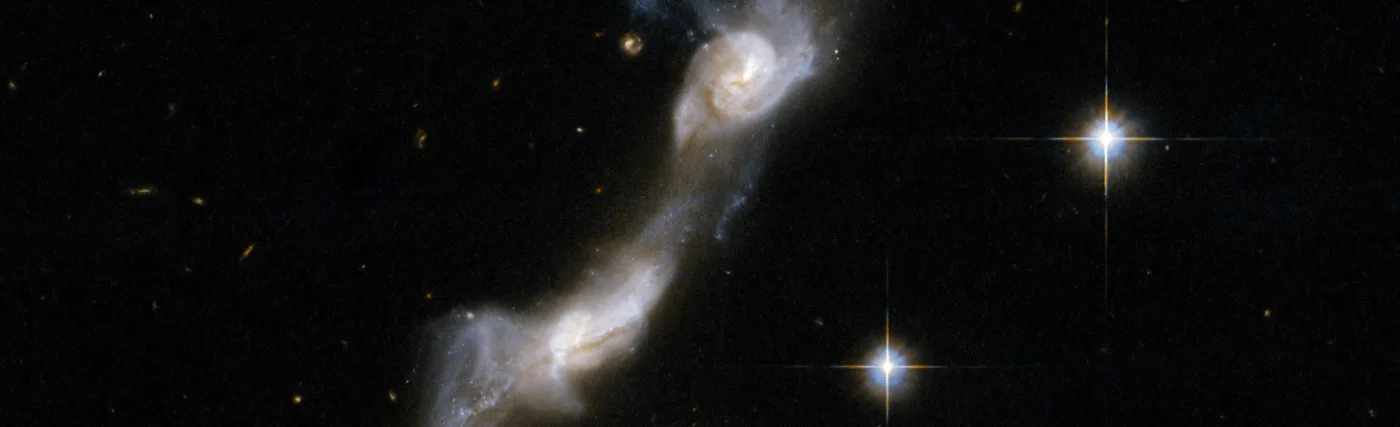
And it was called the Atlas of Peculiar Galaxies.
And it was just…
It was the catch basin of nothing that fit anything else.
And Charles, you remember, it became one of the most studied catalogs in the canon of cosmology.
Alton C.
Arp.
Chip Arp’s Atlas of Peculiar Galaxies published in 1966.
Yes, tremendously interesting.
And what it was was it turned out that Chip Arp’s ideas of why they looked peculiar were incorrect.
But by putting them together into a catalog, people could look at them and start wondering and thinking about what actually was going on.
And it helped us understand that galaxies collide, that they crash into each other, and they create amazing structures, which we could not have imagined had they not collided.
And that led to the entire field of computational astrophysics as applied to galaxies.
And by the way, we needed the computers to make that happen.
So that was in the 1970s, computing power rose to then say, well, I wonder what a galaxy would look like if it collided with another galaxy.
Hey, that matches Arp’s catalog number 32.3.
And then you look at it at a different angle, that’s a different object in the catalog.
And so all of a sudden we heard explain all the galaxies just as witnesses to train wrecks.
You guys keep saying collide.
When you say galaxies collide, is it that the galaxy’s gravity affects another galaxy’s gravity?
Or are you looking at actual objects hitting one another because aren’t galaxies so spread out?
What is it?
What’s an actual collision?
Chuck on the case.
Beautiful, beautiful question.
When galaxies collide.
When galaxies collide.
They do, the stars are so far apart that they almost never hit each other directly.
So it’s like swarms of bees, or hornets, you know, nests, wings brass through one another and affecting one another from a distance.
But a collision doesn’t have to happen only when a physical object hits another physical object.
What you said, the gravitational effects of one object affecting the other is indeed as much of a collision as we might think of, say, two vehicles hitting one another or something.
And so instead, you get these twists and turns, you get bends, you get loops and whirls, and it is all gravitational, yes indeed.
So we count a gravitational encounter as a collision because they affect each other.
But I’ve quantified this bee analogy.
So if there were four bumblebees flying randomly across the continental United States, the chances of them accidentally bumping into one another is the same as two stars colliding in two galaxies.
Ah!
So yeah, basically two stars are not going to physically collide, but they’ll all feel each other’s gravity and that’s enough to make a train wreck.
And a beautiful train wreck they can be.
These kinds of train wrecks cause the formation of new stars, new planets, sometimes in the billions at a time.
They feed supermassive black holes.
They create quasars and active nuclei.
They’re one of the most important engines of the evolution of the universe itself.
Wow!
The engine of the evolution.
We’ve got to take a quick break.
When we come back, more Cosmic Queries.
Grab back, we’ll be right back.
Hey, you’ve been searching for a hotel for that epic trip that you’ve been planning, but there’s so many options that you can’t decide which one to book.
The Choice Hotels family of brands has over 7,500 locations with a hotel for every type of stay, like Cambria Hotels with offerings like rooftop bars, spa-like bathrooms and convenient downtown locations, or a comfort inn for the whole family to enjoy.
Cambria Hotels offer spa-like bathrooms with many that have Bluetooth mirror connectivity so you can listen to your favorite podcast, and we all know that’s StarTalk, or songs, while you get ready.
Each Cambria Hotel is curated with locally-inspired design elements, providing guests with a sense of space and place in the city you’re visiting.
Cambria Hotels offer hyper-local craft beers on tap.
Okay, you had me at craft beer.
How about rooftop bars, lounges, and outdoor spaces for guests to enjoy?
Comfort offerings include a free hot breakfast, great pools for the entire family, and spacious rooms.
Make your travels come true today when you book direct at choicehotels.com.
That’s choicehotels.com, where travels come true.
It doesn’t make a difference if you’re driving across country or on your daily commute.
The time in your car is perfect for listening to podcasts.
Use T-Mobile’s network to help keep you connected to all your favorite podcasts when you’re out and about.
Now here in New York, people don’t really drive that much, but you do use ride share and you’re on public transportation.
You might be on a ferry or you might be on a bus.
And you know what you’re doing?
You’re listening to something.
And if you want that something to come through on the fastest 5G network, well, then you better be using T-Mobile.
T-Mobile covers more highway miles with 5G than anyone.
Seems obvious if you need great coverage, especially when you’re on the go, check out T-Mobile.
They’re the largest and fastest 5G network.
Find out more at tmobile.com/c-y, that’s S-E-E-W-H-Y.
Fastest based on median overall combined five speeds according to analysis by Ucla of Speedtest Intelligence data download speeds for Q4 2022, C5G device coverage and access details at tmobile.com.
We’re back, StarTalk Sports Edition, Cosmic Queries, Grab Bag, with our geek in chief, Charles Liu.
All right.
And of course, Chuck and Gary.
What, so what, give me some more questions.
We’re on a roll here.
Okay, this one I think is pretty topical.
So this is from Samuel Fairchild, greetings from San Antonio, Texas.
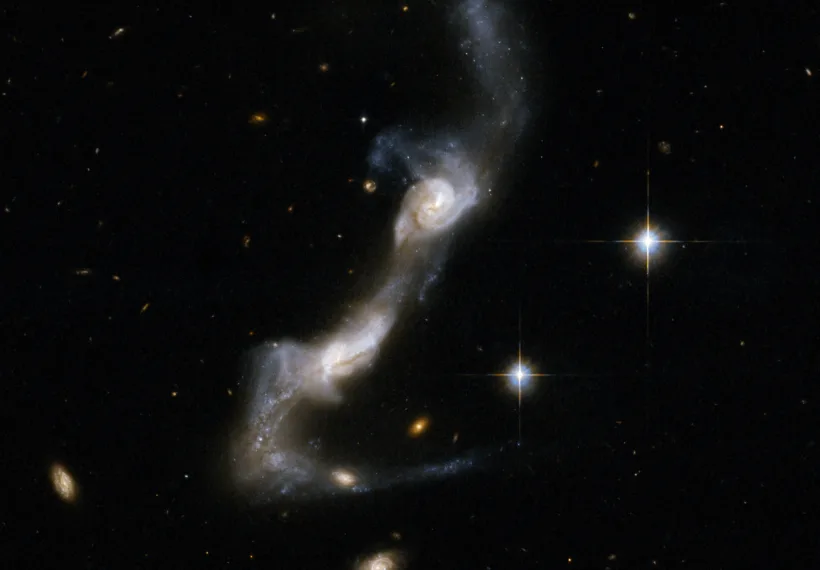
What can we learn from the runaway supermassive black hole that was spotted by the Hubble Telescope trailing a 200,000 light year long tail of new star formations?
Answers, please.
It is most likely a classic example of what happens when galaxies collide.
When galaxies collide.
Lots of things can happen.
In a galaxy far, far away?
They could be far away.
We hope they’re far away, but they could be close by.
Remember, in a few billion years, the Andromeda galaxy will collide with the Milky Way.
Then we’ll have a close up view of what happens when galaxies collide.
So the story is this, right?
You have a galaxy and it’s about 100,000 light years across.
Here comes another galaxy that’s also 100,000 light years across.
They hit each other at just the right angle and you can pull a trail of gas outward a couple hundred thousand light years long.
When that happens, you’re basically creating a stream of new stars forming all along this trail.
And so there’s your 200,000 light years long trail of new stars forming.
Meanwhile, part of that collision could have hit, and there are many different ways galaxies can collide, but perhaps at just the right angle and at just the right speed, the supermassive black hole in one of those galaxies got stripped out of the body of the galaxies that are colliding.
So whereas the rest of the galaxy’s material is sort of coalescing into a single blob, that supermassive black hole is out on a trajectory that looks like it’s following that gas going outward.
There’s a lot of possibilities, and we’ve only just begun to figure out what’s going on.
And by the way, the gas, unlike the stars, the gas doesn’t really pass through itself.
When the gas collides, it’s like two hot marshmallows sticking.
So a lot of interesting things can happen in the gas part of the colliding galaxies, separate from the stars.
Right, you can often think of the gas in a galaxy, like the water in a swimming pool or something.
They have a dissipative force, they are viscous.
Even though they’re very sparse by Earth standards, they wind up out in space, sort of along the millions of years type time scales and the millions of light years type size scales, acting very similarly to what you might expect.
So Charles, I did an episode of Nova Science Now once where it was exactly that reference.
I was at a swimming pool and I had a bucket, if I remember this correctly, I think I had a bucket of ping pong balls and so did someone else.
And we tossed them towards each other and only a few of the ping pong balls hit, would hit each other.
But then we had buckets of water and we threw the buckets of water at each other and the water just smacked.
It was there, as you said, it’s dissipative.
And we did it in slow-mo and you can see it.
It was pretty cool.
All right, keep going.
What else you got?
All right, next question up is from Moe.
M-O-E.
Aloha, Neil and Chuck, what evidence can you provide to show that we aren’t in the simulation?
Aren’t.
Are not.
Oh, interesting.
Proving the negative.
Can you prove the negative?
I have an attempt at it, but go on, I want to hear what my geek in chief has to say.
René Descartes, hundreds of years ago, right?
The guy who, you know, after whom we’ve named the Cartesian coordinate plane, but also a great philosopher, a rationalist at this time.
I think, therefore, I am.
I am.
Yes, yes.
That’s right.
And he basically set out the idea that if there were a simulation that was good enough, we would not be able to tell.
There’s just no philosophical way to tell, as long as the simulation is good enough.
So the only evidence that we can give that we are in a simulation is if somehow we see a glitch.
You may remember the movie Inception, when the people in the dreams were trying to figure out whether or not they were in a reality or not in a reality.
And one particular person figured out that he was in a dream because the texture of the carpet was different from what he remembered in reality, right?
So every single piece of evidence out in the universe has to be consistent with what we think is real, right?
And if not, if there’s a glitch, then we’re in a simulation.
We can also go to The Matrix and talk about that and how the reason they were able to know they were in a simulation was because something just didn’t happen correctly.
That’s the only way, according to Descartes, that we can prove that we are in a simulation.
But how can we prove we’re not in one?
You just have to keep looking for the glitches.
Oh wow, look at that.
Well wait, so if we don’t find any glitches, we’re either not in a simulation or it’s a perfect simulation, and therefore what’s the point of even distinguishing the two?
Well then, okay, so with that line up with paranormal activities counting as a glitch.
So paranormal activities are not following the laws of nature, physics or what have you, with that count as a glitch.
That would say that we are in…
So what are we calling a glitch?
Or a miracle.
A miracle or something that happens outside of the laws of physics.
Miracles and paranormal activity at this point in our understanding of the universe are only things that we don’t understand yet.
There’s nothing that’s been shown to be conclusively a violation of the laws of physics, just something that we haven’t explained the rest of physics yet.
Wait, wait, wait.
Jesus walking on water violates a ton of laws of physics right there.
If that actually happened.
Well, in all defense, he has some really good sandals, okay?
Jesus sandals.
He had Jesus sandals now.
So we all have to think about these questions as skeptically and as optimistically as we can at the same time.
Okay, I got to add another pop culture reference.
My single favorite episode of the two and a half seasons or whatever it was of Black Mirror was the episode titled Hang the DJ, which has nothing to do with the entire story.
But it’s the name of the song that you hear at the end.
In that, it’s a dating community.
You go, you date multiple people to see who, when you like, and then at the end, you get married to them.
And we learn, should I give it away?
I have to give it away, otherwise I can’t talk about it.
We learned that all the people in this story are being simulated.
But you don’t know this because you’re with them and they’re testing their dating and, oh, that didn’t work out.
I got to stay three months with this person.
It’s all prescribed and it’s all do it.
And they hate each other or they love each other, whatever.
And one of the people, one of the women who likes skipping rocks, skipped rocks and said, you know, every time I skip rock, it only skips three times.
And she said, oh, so she figured out the glitch.
Some should skip one and some should skip four.
She just tossed it up.
And you don’t even know to pay attention to that when that’s happening.
All right.
These are characters that have their own sense of free will.
And one of them noticed that every time she skipped rock, it was exactly and identically three times.
And we later learned that all of these people are a simulation so that when at the end you emerge and the two people, they escape the the similar, they escape this place.
And as they escape, you see the digitization of things happening.
And the next scene are two people meeting up in a bar who were matched by that simulation.
It was like, holy shit.
It’s the ultimate swipe left or swipe right.
Yeah.
So the simulation tested everybody’s compatibilities and it was like, oh my, but in it was that one observation.
So ever since then, and a little bit before then, I’ve been checking for things that maybe should have different kind of variation than what should.
That’s interesting about the carpet though, Charles.
But do we then project our desire to find a glitch into our thinking and observations?
Without question, Gary, that’s a great point.
We humans are biased in one direction or another in general.
And just like it’s very hard for all of us to be rational all the time and maybe we shouldn’t be, the circumstance is of our detecting whether we’re in a simulation or not, our almost secondary in importance to whether or not we are in whatever environment we are, real or simulated, and live the way we want to live and do the things we want to do.
So in my recent book, Story Messenger, I reflect on what a simulated world would be and I use that as evidence that we’re not in a simulated world, you know what it is?
A simulated world is created by computers and computers are absolutely logical and so, no set of computers would ever create the world we live in.
So it’s the inanity defense.
It’s like earth is inane in every way, computers have higher integrity than that, even in a simulation.
That’s my evidence.
That’s great evidence, except that you may be putting too much stock in our inanity.
It may well be that inanity is an inherent part of logical systems.
Okay, Neil, would a computer be able to generate or recreate love?
Oh yeah, I don’t see why not.
You sure?
Yeah, I don’t see why not.
It depends on what you think love is.
Depends on what you think love is.
Well, no, no, I got this, I got that.
I’m past that, okay?
So watch, so watch, you get everybody who’s in love with something or some other person, right?
And then you do a brain scan.
And I’m making this up, but it’s plausible.
You do a brain scan and everyone has the same part of their brain lit up while they have these feelings of love.
Then you take someone who doesn’t have those areas of the brain lit up and show them something that’s completely neutral, right?
Like a book, just a book cover or something.
Then you light up that part of their brain and see if they fall in love with the book.
And if they do, we know exactly what love is.
It’s the neurosynaptic of this section of the brain.
There it is.
And we can create it for you if you want it.
If two people are in long marriage and they’re falling out of love, go back and re-stimulate them.
Back in love if they’re like newlyweds.
I mean, clearly love is a neurochemical synaptic function of the brain.
I mean, it just has to be on a biological level.
Otherwise, you can attach ethereal qualities to it, yes, but I mean, people who, if you are brain dead, you can’t be in love, period.
Right, in fact, you don’t have to be fully brain dead, you can be partly brain dead in the section that would matter in that category.
But sometimes it makes no sense.
No, no way, as a matter of fact, we have people who are incapable of love, okay, we call them sociopaths.
Capable of empathy, but you have to have empathy to have love.
So imagine a person who does not, imagine a person that is somehow, perhaps what we might call defective and unable to experience empathy or love.
This person carefully studies thousands of people who are happily in love, figures out all the behaviors that are observable from an outside person of how to be a person who expresses and shows love, and then just mimics all those behaviors beautifully.
Running into a person or choosing a person to treat that person that way, to work with that person that way, to do the things with that person that all those other people in love are behaving.
Is that person exhibiting love to another person?
That’s why we go inside your brain with the brain scan.
That’s what a brain scan is for.
That’s the whole point of the brain scan.
If you don’t have that part of the brain lit up, but you behave as if that part of the brain were lit up, are you still behaving with love?
So I’m gonna say from a utilitarian standpoint, no, you are not because the only reason you would do that is because somehow you are being served.
Otherwise, you would not be a sociopath.
You would actually be exhibiting love itself.
Perhaps your definition of behaving in a way that’s self-serving is to behave in a way that everybody else in the world looks to you as if you are in love.
But then, are you?
You may not be from your brain’s point of view.
Charles, that’s why I introduce you to science here where you go inside the brain.
That’s the whole point of that.
I’m asking you a different kind of science.
From the observable perspective, assuming no hidden variables, okay?
Assuming that the interior of the brain is unknowable.
But quantum mechanics, for example, suggest that indeed there are things about particles at certain levels which are not observable.
I agree, but we’re talking about your brain and not a particle.
Can your brain behave in that way if the brain were considered, not something that you can poke and prod?
What if love, in fact, does not light up the same part of your brain?
All right, when we come back, more StarTalk Sports Edition Cosmic Queries with our geek and chief, Charles Liu.
Don’t you just love good communication?
Isn’t it wonderful to be able to talk to somebody in their very own language?
It makes you feel good.
Do you wanna learn a new language this year?
Well, Rosetta Stone makes it easy to get started and they’ll create a learning plan for you that keeps you on track.
Rosetta Stone has been the expert in language learning for 30 years, helping millions of people build fluency and confidence to speak new languages.
Rosetta Stone offers 25 languages from Spanish to Chinese to Polish.
And with the Rosetta Stone app, you can learn anytime, anywhere at home while traveling on your commute.
I said anytime, anywhere.
Rosetta Stone focuses on speaking practice for real life scenarios using a unique immersive method that helps you learn intuitively.
Plus Rosetta Stone’s true accent feature helps you perfect your pronunciation.
You’ll get feedback on how well you said specific words compared to native speakers.
That’s a nice ego stroke.
For a limited time, StarTalk Radio and StarTalk Sports Edition listeners can get Rosetta Stone’s lifetime unlimited subscription, which gives you access to all 25 of their languages forever.
All for 40% off.
Visit rosettastone.com/startalktoday.
That’s rosettastone.com/startalk.
Rosetta Stone, how language is learned.
Remember house calls when the doc came by and took your temp and tucked you in when he was all done?
No, you don’t remember that.
Those days are long gone, but one company is giving new meaning to the term house call, Teladoc Health.
Their primary 360 program lets you choose a board certified doctor that’s right for you and get primary care from the comfort of your own home.
You can connect via phone or online with a board certified doctor who will get to know you and provide whole person care, including offering advice, prescriptions, even mental health support and referrals.
They can also help with chronic conditions like hypertension and diabetes, as well as weight management.
I have used Teladoc.
Here’s what I love.
When you’re sick, you don’t feel like getting up and going to the doctor.
Why not let the doctor come to you?
That’s right.
Download the app to get started today or go online to register or schedule a visit at teladochealth.com/startalk.
That’s T E L A D O C health.com/startalk.
We’re back to Star Talk Sports Edition, Cosmic Queries Grab Bag, with our geek and chief Charles Liu.
Charles, how do we find you on the internet?
Oh, well, at Chuck Liu, C-H-U-C-K-L-I-U on Twitter, and at The Luniverse, T-H-E-L-I-U-N-I-V-E-R-S-E, on a wide variety of platforms.
The Luniverse.
Yeah, the podcast is going, wherever you get your podcasts.
We have lots of conversation and fun with that, yeah.
All right, cool, cool.
And Chuck Nice, you’re still, Chuck Nice Comic?
Everywhere, sir, thank you.
Everywhere, cool, cool.
Gary, are you still Three Left Feet?
Yes, I am, on Twitter.
On Twitter, all right.
My Three Left Feet, all words.
My Three Left Feet, you got it.
All words.
Sorry.
So, we got more questions here, bring it on.
We have, right.
Matt Berg says, hello from Sheboygan Falls, I believe that’s Wisconsin.
Sheboygan.
You’re welcome.
I have used many of your discussions in my classroom to have my middle school students think a bit deeper about things.
Teacher in the house.
Is there a simple, so here we go, pay attention.
Is there, sit up straight.
Is there a simple way to, well, let’s start now.
Is there a simple way to explain to students what our universe is expanding into?
In other words, if the Big Bang Theory created everything in our universe, does that mean that there has to be something outside of our universe, or how can there be a nothing that is being expanded into?
At this moment, this gentleman, Matt Berg, his mind starts to hurt.
Ooh, that’s not so bad.
There’s nothing wrong with the head hurt.
Yeah.
Have you know that a friend of mine who is a doctor, graduated from Ivy League School in Stanford and stuff, asked me that very same question not that long ago.
So, you are in good company, Mr.
Berg.
Here’s my way of explaining it.
You are at the center of the universe right now.
When we make measurements and try to figure out where the center of the universe was that it was expanding out of, it always goes to you.
Whoever is observing, observes that they are the center of the universe.
So, in other words, we are part of the Big Bang.
When the universe was microscopically tiny, that is what has become us today.
There’s no central point because we are at the center.
The center just happens to have gotten really, really big.
That’s one way of thinking about where the center of the universe is.
You are the center of the universe.
I’m sure your mom told you that at one time or another, or you thought that you were that at one time or another.
I loved when she told you that.
So what do we expand the into?
Because that’s what it started.
The expansion into, you can think of as a different dimension.
You can think of it as, say, space being three dimensional, length, width and height, expanding into a fourth dimension, which is not.
Yes, a fourth dimension of space, which is not length with their height.
Or you can actually think of it as a four dimensional space time, where the expansion direction is in time.
Where t equals zero, at time zero was the big bang, the universe was very small.
And now time has gone on, t is about 13.8 billion years.
And now the universe has expanded in that fourth dimension of time.
You can find lots of different ways of thinking about it that are mathematically equivalent.
So maybe if you’re not exactly getting the way that I’m describing it, maybe the way that you foresee it or think about it or envision it is just as mathematically valid as the way that I’m talking about it right now.
Wow, that was elegant, Charles.
I gotta give it to you.
I can’t take credit for that.
That’s really cool, man.
Well, thank you, Chuck.
But remember, I didn’t come up with this, right?
Our scientific forebears have been working on this for a long time.
And when they first came up with these ideas, they were hard pressed to explain them and understand them because they’re so different from what we thought about when we were in those times.
I like to add to it that you can have a multiverse where everybody’s expanding, but if you’re embedded in a higher dimension, then you will not necessarily collide, even if you can go to infinity.
So if you take a sheet of paper and send it to infinity in every directions, so it’s an infinitely large sheet of paper, now I can take another sheet of paper, lift it off of that into a higher dimension, a third dimension, all right?
And now it’s just quote parallel to the other one.
That can go to infinity and never intersect the other sheet.
And I could do that into infinity.
To infinity.
And beyond.
To infinity and beyond.
So if you embed our three dimensions into a higher dimension, you can expand higher dimensions and then they’ll never collide if they’re all in a dimension yet higher than themselves.
Interesting.
So there you have it.
That’s amazing.
All right, another question.
Let’s keep them rolling.
We’re on a roll.
So what else we got?
Is it Gary or Chuck?
Who’s got the next question?
Go ahead, Gary.
Okay, you want another one.
Just like the other one.
All right, Kartik.
Kartik is from Germany.
If the Earth’s magnetic field is caused by the iron inner core rotating within the magma outer core, how does gas giant planets like Jupiter also have a magnetic field?
Do we know anything about the composition of the interior of the gas giants?
We do.
And the answer we think at this moment is that far enough down in a gas giant like Jupiter, the hydrogen, which we think of as a gas, turns into a metal.
It becomes what we call metallic hydrogen.
And so you have a core of metal, of conducting stuff that can swirl, just like the core of metal in the earth.
And that’s how you can get a magnetic field.
Just to be clear, we didn’t pull this out of our ass.
If you remember your periodic table of elements, if you remember your periodic table of elements, hydrogen is, if it’s a full fleshed out table, hydrogen appears twice.
Once in the upper left and once in the upper right.
Once in the upper left is hanging out with the metals and then the upper right is hanging out with the gases.
And if I’m remembering that correctly, Charles, is that right?
It can be written that way, yes.
Written that way.
And I said, well, why is it twice?
And somebody said, well, sometimes it’s metallic.
I said, it’s a fricking gas.
What the hell are you talking about?
Later I would learn under pressure, behaves just like a metal does, just like iron.
And so yeah, so it doesn’t have an iron core, but it’s got a metallic hydrogen core under all that pressure for sure.
And there it is, running a dynamo on Jupiter.
A rather ferocious one at that.
Sweet.
Oh yeah.
Look at that.
That was good.
We got one more in there.
Quick one.
Let’s get a quick one.
A quick one.
Okey-dokey.
Let’s see.
Pim Bilek, I was wondering what you think is the biggest obstacle for developing working warp drive and would you see this becoming a reality?
And if yes, when?
Curious about Charles’ theoretical view on this.
Oh.
An impatient Patreon member.
Pim, here’s the answer.
Charles has already built a warp engine in his basement.
That’s it.
And he can’t tell you when it’s going to be released because that’s classified information.
The 1.3 gigawatts are soon to see.
The thing that is most blocking our ability to create a warp drive quickly is physics.
The actual ability to travel faster than light at this point through the universe that we have right now, we don’t have it.
We don’t have that ability.
So, you have to find a way to travel through space, but not in the way that everything else travels through space.
So, can we actually do what the Star Trek folks are thinking or Miguel and Kubiere said, where you create a subspace field and you put yourself inside a warp bubble, which can travel through space faster than time because the warp bubble can, but you can’t, right?
Or is it some other way where you actually have to exit our three dimensions and go into a fourth spatial dimension and then come back in?
These are the questions.
The basic fundamental physics are still beyond us.
We can imagine, we can have fun with it on television.
Give me a date when we’re gonna have it.
Next Wednesday.
Next Wednesday at 3 p.m.
According to reliable sources, the date is April 5th, 2063.
That is, according to Star Trek First Contact, the movie where Picard travels through time and goes to the board.
He goes and sees Zephyrum Cochrane in Montana.
The one who invented the drive.
That’s right.
And the Vulcans came.
The Vulcans just happened to notice it.
And they picked up his warp signature.
And that changes all of human history.
Right.
That event happened on April 5th, 2063.
Okay, well there it is then.
Wow.
That was, I gotta tell you, that was amazing.
Let’s get reality imitating art.
And make that happen.
All right, I’m looking, I’m gonna put that in my calendar right now.
Right when we’re done here.
All right, Charles, always good to have you, man.
Thanks so much.
All right, love to the family.
And Chuck Nice, always good to have you there.
Gary, we’re all in here.
Thank you, pleasure.
StarTalk Sports Edition Cosmic Queries Grab Bag.
That’s like the randomest fun anyone can ever have.
All right, Neil deGrasse Tyson here.
Thanks for listening.
And as always.



 Become a Patron