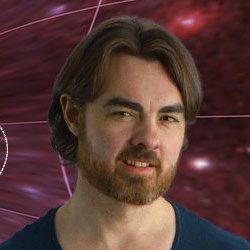
Neil deGrasse Tyson and comic co-host Eugene Mirman sit down for a special edition of Cosmic Queries with their guest Matt O’Dowd, astrophysicist and host of PBS Space Time. You’ll discover if Neil and Matt think physics imposes limitations on what we might find in the universe, from planets made of diamond to dinosaurs the size of buildings. Find out more about the accuracy of mapping our galaxy and why it’s important not to confuse an objective universe with a subjective universe. Ponder whether it’s possible for the fabric of space to be ripped apart. Matt and Neil debate the concept of an “ancestor simulation” and the logistics of existing within a universe that’s really just a simulation. You’ll learn about dark matter: tools that could help us “see” it, why “dark matter” is a misnomer, and the possibilities of dark matter planets. Neil and Matt also explain to Eugene why vacuum decay is frightening on many levels and how the Higgs field works. Also up for discussion: whether any time passed before the Big Bang, the atmosphere of Venus, and a few favorite theories about the multiverse!
Transcript
DOWNLOAD SRT
Welcome to StarTalk, your place in the universe where science and pop culture collide. StarTalk begins right now. This is StarTalk. I'm your host, Neil deGrasse Tyson, your personal astrophysicist. And for today's edition, it's Cosmic Queries Popery. And I've...
Welcome to StarTalk, your place in the universe where science and pop culture collide.
StarTalk begins right now.
This is StarTalk.
I'm your host, Neil deGrasse Tyson, your personal astrophysicist.
And for today's edition, it's Cosmic Queries Popery.
And I've got Eugene Mirman visiting in from Boston.
You used to be local, and now you're not anymore.
I know.
Why?
You know.
You got married, you got kids and stuff?
I got married, children, moved to Massachusetts.
Damn, that happens.
That happens.
Well, welcome back.
Thank you.
We're here in the YouTube studios.
I don't know why, but that's where we are.
Lindsay, why are we in the YouTube studio?
We're collaborating with YouTube.
Well, how do we know that?
Because Matt O'Dowd is here, in from Australia.
That's your home motherland?
Well, Australia once upon a time.
Once upon a time.
And we've got you now.
You're a professor of physics and astronomy.
Happy to be got.
At the City University of New York.
That's right.
The Lehman College up in the Bronx, where I'm from.
And you're here because you have a YouTube channel.
I do, yeah.
And it's part of the PBS universe.
I'm very delighted to learn that PBS has a digital studio.
Exactly.
And your program within that is called?
Space Time?
Yeah, so Space Time, it's a PBS digital studio show.
And these are shorts.
There's like four or five minutes each, or what?
We go a little over.
We tend to go eight to 10.
Can people focus for that?
I'm kind of a brother now.
No, I feel like people take naps part way through.
They wake up for the end where the jokes are.
No, that's great.
So that's why we've got you here.
That's why we're in the YouTube studios.
And you're here to help me handle these Cosmic Queries solicited from the internet, from basically our social media base that gets solicited.
And sometimes we solicit by topic, and then some don't fit in exactly right.
And so we put them all in the grab bag.
And so, Eugene, we haven't seen these.
And so the two of us will work.
We'll work at this.
OK, so this is where we prove we have anything up here at all.
So let's do this.
Jordan Thompson from Indianapolis asks, Neil, there once were reptilian the size of buildings, planets made of diamonds, stars five billion times that of our sun and holes that lead to nowhere.
Do you think the universe has any limitations within creation?
So many things to pick on.
Well, first, let me just start up by saying, I'm from New York City.
There are no reptiles the size of buildings.
I don't know where he's from.
This feels like Iron Maiden lyrics.
I want to live in this universe, actually.
Were there ever planets made of diamonds?
Planets, well, yeah, yeah.
So tell us about that.
What do you know of it?
So a diamond is a very, very dense form of carbon.
Put carbon under a lot of pressure, and those little atoms all align into that beautiful diamond lattice that we like to wear on our fingers sometimes.
But planets can be crystal lattice.
Exactly, yeah.
Planets are sometimes massive enough that the interiors can presumably crystallize carbon.
And carbon is not rare in the universe.
So there are planets, the whole planet, made of diamond.
In fact, there are sections of the universe where it's mostly carbon.
There are places where stars in their effluences will actually release copious amounts of carbon.
It's a super common material.
Yeah, yeah.
So the planets would be, the diamond would be inside.
You need to get that pressure.
And so you need a bunch of stuff on top so there'd be carbon outside.
You've got to dig for it.
Planets.
Not all carbon, not all diamond.
And the other thing is, diamonds aren't that rare anyway, even on Earth.
I think we, you know.
Iodalize them too much?
Yeah, I mean, they're not that uncommon.
Wait, so we've got the diamond.
And like I said, in New York City, there are no reptiles the size of buildings.
But if you live in a small town, T-Rex would be bigger than your house.
Although, I know you know this because I think you assembled the T-Rex skeleton yourself at the museum.
I didn't know it.
It was a kit.
So reptiles descended from the same ancestor as dinosaurs, but dinosaurs themselves.
Modern reptiles, yeah.
Yeah, and were not reptiles.
As far as I understand, they are basically closely related to birds.
In fact, birds are dinosaurs, really.
Aren't birds more closely related to the dinosaurs than modern reptiles are?
My understanding, really, from the phylogenetic tree at the American Museum of Natural History, is that birds and dinosaurs are really the same thing.
Birds are the only surviving.
Yeah, my issue was that reptiles, that's what I'm saying.
So, everyone's talking about birds being the descendants of dinosaurs without mentioning the crocodile.
And is that true?
Is that, I don't know.
Crocodile is the worst bird.
Yeah, it's a famously terrible bird.
Neither of us is a paleobiologist.
So all I can say is, there were never dinosaurs the size of New York City buildings, that's all I'm saying.
Right.
And all I want to say is, is there a limit to this universe?
I would say absolutely yes, in that not everything that can exist does, but so many things.
It's an educated guess.
I think the laws of.
Name something that can exist that you think doesn't.
Name something that can exist.
Well, for example, the mathematics of, say, of relativity describe things like wormholes and quantum mechanics says it's tachyons.
These.
You're saying Star Trek isn't real?
Wait, wait.
Like if I admit I can't admit a tachyon pulse?
I would say an infinite universe contains an infinite number of things, but it doesn't contain everything that you can imagine.
I said the laws of physics still have to be obeyed.
Well, so I'm with you on that.
So you're not gonna have an Empire State Building sized reptile, because it can't hold itself up with a very interesting, you know about this?
They teach this, I don't think they teach this outside of like Physics 101, but so as you get bigger, your volume grows, your weight goes up according to your volume, but the strength of your limbs goes up only according to this cross-sectional area.
So it's a matter of area versus volume.
So Godzilla is, Godzilla would collapse under his own weight into a puddle of guts.
Yes, correct.
Even if it was irradiated, just because.
Oh, he was irradiated.
That changes the volume area thing completely.
Right, right, and so.
Does it affect it at all?
So it's why big animals, heavy animals have thicker legs.
So you can't just scale up an insect and make them this big, because their body weight.
That is great news.
That's good news.
Yeah, yeah, and it completely negates half the horror movies of the 1950s.
Wait, so if an ant was gigantic, it would.
That would have to be a lot stubbier.
It would have to have serious cankles to be able to.
So as the ant gets bigger, the body weight goes so much, grows faster than the strength of its spindly legs can support it, and would just collapse under its own weight.
So you can't just scale up insects and get big insects.
That's just not gonna happen.
Well, I'm gonna remove that as a fear I had.
So the laws of physics prevent that, which is why you can't have Godzilla as big as Godzilla is.
How big could a person be?
Like, could you have a giant person that's the size of a building?
No, no, no.
I'm talking about any kind of life.
Any kind of life.
Right, right, right.
So we don't need to fear giant elephants or King Kong.
Plus, there's another thing that involves blood pressure.
So if you're really, really big, and you have to get blood to your brain, if your brain is at the top, you would need a seriously pumping valves to do this.
Well, if you had a heart, though, that was the size of a house inside your body that's the size of a skyscraper, would that be fine?
You mean that could pump with that kind of energy?
Yeah, I guess so.
I mean, you'd need maybe two or three hearts is what we're saying.
He's inventing the creature here.
I'm just adding a heart to a giant thing that doesn't exist.
I think that's fair.
I think part of the problem is these things evolved from smaller versions, and so they have to kind of co-opt those miniature organs to something that works on the large scale.
They didn't come out of the box big.
Yeah, exactly.
That's a good point.
So the biggest creature that ever existed is how, like, so.
No, it is the blue whale that exists today.
Great.
So what's fascinating to me is that mammals have some of the widest size range of any branch in the Tree of Life.
What is the smallest mammal?
It's like this big.
There's a little.
You can eat it for sure.
Pop it in.
Life is in order, yeah.
But you go from this to the blue whale.
Now here's where the blue whale cheats.
You look at blue whale in the book.
Is it, blue whale weighs four gazillion tons?
Yeah.
Not really.
Because gazillion isn't a number?
Well, no, because, not only for that reason, but it's actually floating in water.
Right, it's cheating.
It is not holding up that weight.
And so once you are in water, then there is no limit to your mass.
Wait, so could Godzilla exist but only in water?
Godzilla loves being in the water.
And he could then exist.
But he couldn't have come out of the water and start terrorizing the town.
In the same way, a crocodile is basically useless on the ground.
A crocodile has to do a pushup just to walk and then go back down.
Because his legs are not directly under it, which is a big evolutionary advance.
I don't need muscles to hold up my body weight.
Because vertically, I'm just supported.
So to redo this, Godzilla can exist, but not out of the water.
So it has to go into the water, that's right.
And that's why huge clumsy things can be highly nimble swimming in the water.
Giant squids or jellyfish would just be a sack of stuff you can eat.
Yeah, exactly.
Okay, great.
All right.
We learned a lot, thanks.
And that was from whom?
That was from Jordan Thompson.
Jordan, thanks Jordan.
Yeah.
Susan.
Was that a Patreon question?
No, it was Instagram.
Okay.
These are all sort of largely Facebook and Instagram, so this one's from Facebook.
We're supposed to read Patreon questions first.
Because they like give us money and they bribe us to read their questions first.
No, I, hey, first of all, I'm totally with you excluding the part where I have no questions from Patreon.
So, I can make them up.
All right, go on.
If that's helpful.
That's how you can bribe us.
Yeah, yeah.
No, I agree.
Susan Minoub from Facebook asks, how sure are we about our map of our galaxy and the universe in general?
Could our tools, techniques be mapping an illusion and that the universe is much smaller or larger than we've calculated?
Your show is called Space Time.
So why don't you take this one?
Is everything we know based on lies?
I mean, it could just be that there's a giant dome that's painted kind of like the Wizard of Oz set.
And.
Are we in a super complicated Truman show?
I think that the closest thing to that is the idea of the holographic universe where you have this vastly distant shell that's a hologram and that our three dimensions are protected from two.
Highly, highly hypothetical, I'm going to say theoretical.
So how do we measure this stuff with many scientists working independently, making measurements independently and getting agreed upon results?
In the case of the map of our universe, it's pointing multiple different telescopes at distant galaxies and basically calculating red shifts and also getting distances by different independent methods.
So I would add that we use a regular telescope that is sensitive to visible light, and that's the extension of our retina, and we see a galaxy there.
Now somebody else invents an infrared telescope or a microwave telescope or a radio telescope, and we scan the sky, we find the same object, but now emitting in these other bands.
So this gives us confidence that the object is real, that it's actually there, and some interesting things are happening in it.
And then, as you were saying before I interrupted you, that you can get the distance to this object by multiple ways.
They're not standard ways you would measure distances on Earth.
On Earth, you can pace out the distance.
You could get a little tape measure.
You can use now one of these...
Like a wheel?
Laser thingies.
So there are multiple ways.
If you get the same answer from all those ways, and all those ways are completely different from one another, you have confidence you have the right distance to the object.
And so, yeah, you combine all of these factors, we think the universe is real, and it is what we measure it to be.
But you can take a deeper philosophical point, that there is no reality beyond the measurement.
The measurement becomes the reality of the universe that we describe.
So to say it really is this other thing, you're just not measuring it to be.
So I'll say, how will you ever know that it's this other thing?
Well, I don't know.
The question wouldn't be that it's another thing.
It's just that we are wrong.
How would you know that we are wrong?
So we learn in quantum physics.
You learn in quantum physics.
The reality of the world only makes sense through the measurement.
Right.
In a sense, yeah.
Yeah, in a sense.
So you cannot, it doesn't mean anything to talk about a world that is outside of a measurement.
So that's what Neil's board would say.
You have no access to it.
I think others, I think, for example, David Bohm and realists would argue otherwise.
I think the important thing is not to confuse, though, the idea that we have a subjective experience of the universe.
And that subjective experience isn't the universe.
It's a different thing to the actual universe.
But nonetheless, the universe remains consistent.
Our subjective experience of the universe matches other people's subjective experience.
We can all make measurements that agree with each other.
And that gives us confidence that there is something objectively real out there, even if we can't say exactly what it is.
And I would add to that, but I'll tie a bow on it, that I look at something and I say, okay, that looks red to me.
Well, am I on drugs or not?
So that would be a subjective reality.
So then you devise an experiment, an apparatus that measures wavelengths of light.
And you've already calibrated it to that this wavelength is a red over here.
So now you come to this and the machine measures red as well.
Is the machine on drugs?
You're going to teach the machine what red means first.
We have to teach it over here what red is.
And then we look at this thing that I'm looking at.
And so now we both query the machine, what color is this?
And the machine gives us the same answer.
So I've removed my own brain from this experiment, and I'm getting the same answer.
So to a limit, our subjective experience is reality, but we know the limits of our subjective experience.
And the whole point of science is to probe reality, reducing our subjective interpretation by as much as is humanly possible, ideally to zero.
Yeah, or refining the subjective model so that it better and better predicts the objective reality, even though it will never be the objective reality.
It's a highly effective predictive apparatus.
All right, next question.
I think we have time for one more question in this segment.
From Leo Zusa on Instagram.
How about the recent articles about the possibility of us being part of a simulation and the Big Bang being just the seeding event of such simulation?
Thanks!
I'm totally there.
I'm digging it every minute.
You don't like it?
I want to hear your opinion.
I'm loving it.
I want to hear this.
I'm loving it.
So who made the simulation?
Some snot-nosed kid in the parent's basement of an alien civilization who's bored and they're more advanced than we are and they have way more computing power than we do.
Right.
It's like a little handheld Nintendo you can use.
Exactly.
And so they program in enough detail to completely simulate every molecule in this universe and we are here for their entertainment.
How else can you explain where things are going on just fine in the world that all of a sudden there's a complete disruption?
The Stunt Nose Kid.
Culturally, politically, economically, a complete disruption.
I think that they throw it in for entertainment.
That's what I think.
I'm going to say, I have two things to say.
Firstly, I predict that you don't believe that.
That's my first prediction.
But I don't want to put thoughts in your head.
There's an argument for why that's more likely than any other scenario.
I'll tell you that in a minute.
The numbers game, okay, so the idea that you need to produce one universe capable of producing universe simulations.
And if that universe produces billions of universe simulations, then any universe that you happen to find yourself in is more likely to be one of them.
Than the one universe that started it all.
The way that virtual reality now exists and video games have advanced, it is likely that in say a thousand years, whatever our virtual reality would be.
30 years.
30 years.
Well, 30 years, whatever it was, would potentially be physical.
You would be able to feel it.
No, it doesn't even require that.
It just requires that what you program in there in your Nintendo, whatever it is, has enough complexity that in the mind of the characters in that game, they think they're real.
It can't simulate the whole universe because to simulate a universe perfectly, you need to compute the size of a universe.
Do you?
Yes.
I don't know.
Because, I mean, assuming it's a perfect...
I do want to hear, but we got to take a break.
When we come back, more of this Cosmic Query on StarTalk.
We're back on StarTalk.
Neil deGrasse Tyson, Eugene Mirman.
Hello.
Back in the house.
Eugene, you're tweaked by what handle?
At Eugene Mirman.
At Eugene Mirman, you got it.
And I've got a friend and colleague, Matt O'Dowd, who is, he's an associate up at the American Museum of Natural History, my day job, who I serve as the director of the planetarium, but he's an affiliate of ours, and a professor of his own up at Lehman College.
So welcome, and you got your own YouTube channel, I'm jealous, you got a good YouTube channel.
Well, my team's YouTube channel, I would say.
Okay, that's good.
PBS Digital Studios.
PBS Digital Studios, very good.
Titled Space Time.
We left off before the break, you asserting to my disagreement that you need a computer the size of the universe to program the universe, and I'm saying that the universe that's created doesn't have to be the whole universe.
It can be just some other universe.
It can be whatever less than the original universe needs to be to be whatever it is where they think it's their whole universe.
That I agree with.
That I agree with.
We have no discussion.
No, no.
Let's go for a beer, right, all right.
I do have one thing to say.
So this whole idea recently came up, I think it got a bit of oomph because Elon Musk asserted that this was quite likely that we were part of the simulation.
By the way, just to be clear, this thought did not originate with him.
Oh, of course not.
It goes back to the 90s and there are a few philosophers who started, who set this ball rolling and then many others, many others.
And one of those writers whose name I'm blanking on.
Pearl Jam?
That might have been Pearl Jam.
So the idea was that we are most likely in what he called.
You gotta know your groups and when they peaked.
This is good, this is good, Eugene.
So the idea is an ancestor simulation.
The idea that some future version of ourselves, when we're more advanced.
Nick Bostrom is one of the original thinkers of this.
Okay, but go on.
The idea was that in the future, scientists or kids with Nintendo would choose to simulate the entire mental life of ancestors of, you know, from hundreds of years ago, just as a study, as a study in past psychology.
But that's all they have to do.
They have to simulate only the activity of the mind and input all of the senses as long as they're consistent.
Now, that probably will be able to do.
I mean, the brain doesn't have that many connections that we can't, you know, in a couple of Moore's Law doublings, sort that out.
The problem with...
I recently heard that Moore's Law is now no longer 18 months.
It's three years.
I just heard that.
Until we hit the next, I guess, iteration of once we move beyond silicon, maybe quantum computing.
I'm just saying, I heard that.
You might be right.
By top people.
Sure.
I cannot.
This might take a little bit.
Very good people.
Top people.
Great.
Okay, so where are you going with this?
So the idea is it's not simulating the universe, as you suggested.
But I think it requires a lot of assumptions that future us will want to simulate the entire mental life of our ancestors and that we're more likely to be that.
But my main objection is that part of the idea is that if something goes wrong, for example, we figure out we're part of the simulation, then whoever's running the simulation can edit it and remove that thought and business as usual.
Sure.
And so, it's the most useless hypothesis.
There are people who disappear and no one knows where they are.
But that would be-
But that would be-
Yeah, we blame the Russians.
That would be-
That would be similar-
You've had thoughts that popped into your head today that you never had previously in your life.
So there's no way that the conspiracy can be proved or denied because everything's programmed, including evidence that we see that it is true, people disappearing, Roswell, all of this stuff is presumably programmed in.
So I reject it because I think we need to continue on as though it's not true.
Well, you could do both.
You could be like, well, maybe we're a simulation, but we should clearly live life as if we're people.
As we have free will.
We would also still, even in a simulation, if you murdered someone, you'd go to simulation jail, which I'm sure is terrible.
That's true.
Yeah.
I don't know.
All right, next question.
All right.
BigDogD1223 asks, if Venus doesn't have a magnetic field, then how does it keep its thick atmosphere?
Shouldn't it end up like Mars?
That's a good one.
So one of the things that keeps our magnetic field stoked is that down in our sort of semi-molten iron core, you get iron sort of moving, and Earth is spinning.
And so since we spin once a day, it's relatively fast, much faster than Venus.
How fast does Venus spin?
Like a little less often than once a year.
And in the wrong direction.
Right.
That spins.
What a dumb planet.
You can have that as a book title.
Yeah, what a dumb planet.
So, you are fewer days old on Venus than you are years.
So, it's not churning, you know, you don't get this sort of, what they call differential rotation.
So, Venus, right, does not have a significant magnetic field.
The magnetic field protects you from the ablative effects of the solar wind.
And so, there's Venus closer to the sun, getting twice the flux of solar wind than we get, and it maintains its atmosphere.
So, generally, what goes on here on Earth is, it's not that it will blow away our atmosphere, it's that if there's a water molecule high up, H2O, the energy from the sun can break apart that water molecule, separate the hydrogen from it, then you lose the hydrogen.
But I think part of it is also that Mars is much, much lighter than Venus.
And so Venus is almost as massive as the Earth, and so it holds on to its atmosphere.
And it has so much of it, it's gotta be losing stuff, but the time scale is just much, much longer.
Right, and it's got nearly 100 times the atmospheric pressure as Earth.
So.
From, how is that?
Well, so if you go there, you would be crushed, split seconds before you vaporized.
Is that the order?
Why is it the other way around?
I don't know the full origin of that.
It's got a lot more of it.
Well, I'm not going though.
The record for a lander on Venus is something like two, three hours before it crumpled in like a bush can.
Yeah, and the big Venus people were the Russians.
They had the Venera spacecraft.
And they sent it and they got some info and then got crushed.
Yeah, you get crushed and it melts.
They knew this, but it's still a challenge.
While we were going to Mars, they were going to Venus.
Right, can we go to Mars because it's super easy?
It's actually hard, Mars is hard.
But a quick thing, so while we're on the subject, allow me to tell you the story of Venus.
I was gonna say, do you know the story of Venus?
I know the story of Venus.
So, you know, if you're from Mars, you're a Martian.
If you're from Earth, you're an Earthling.
Venus, you're a Venusian.
We have these words, if you are of those places.
It turns out, Martian is correct, Earthling is good.
But Venusian, that's an improperly formed word.
We're stuck with that word because the properly formed word was already taken by a whole other branch of science, the medical doctors.
If you are of Venus, you are venereal.
Oh, from the Latin arts.
From the Latin, exactly, that is the genitive form of Venus.
And so when doctors found diseases peculiar to lovemaking and Venus being the goddess of love and beauty, they said, let's name it all after Venus.
So that became the category of venereal.
Aliens were like, we would rather you didn't call us venereal.
Right, exactly, they are pissed off ever since.
So we should not be surprised that the spacecraft, the Russian sent to Venus were all called the Venera series and it's because of that genitive form.
So war wounds should be Martian, like that's a Martian-Cortugian you receive.
Yeah, if you want to be symmetric about that, consistent.
Yeah, you have a Martian wound, yeah, yeah, very bad wound.
Let's try to make that happen.
Nailtson from Syracuse in upstate New York.
You're almost as bad as Chuck Nice with this.
He mangles the names every single time.
I'm not mangling anything, it's not a word.
People choose weird names.
Yeah, I'm meaning like people's like monikers when using a word.
I had a Space Time commenter called Sss.
Well, I think I pronounced it correctly.
Yeah.
Spelled S, space SS, and we have an obligation.
I feel like I read Big Dog D1223.
You did justice to Big Dog D1223.
All right, so Nailtson, also accurate from Syracuse, asks, do scientists and theorists have any idea how much time passed before the Big Bang?
Was there time before the Big Bang?
I can answer that.
Yeah, I know.
We have no freaking idea.
No, what do you have?
What do you got for that?
I mean, the standard wisdom was always that time started at the Big Bang, and before that there was no time.
That was the first, second happened then.
But I think there's new thinking now.
I think ideas like eternal inflation, so the idea that possibly this universe just nucleated out of some inflating, rapidly expanding multiverse type thing in which time might have some sort of existence.
Yeah, but then it would be time, there'd be a meta time for the meta universe, basically.
Whereas our bubble surely has a beginning point.
Sure, that one dimension.
So I don't want to get semantic on it.
We can say time as we measure it began at our beginning.
But if we are part of this multiverse, then you should think of a multi-time that actually is the master clock of all.
Yeah, or it's talking instead of chain of cause and effect.
There was a cause before the Big Bang of some sort.
So like roughly an hour?
Yeah, it's like, you know.
45 minutes?
45 minutes.
I don't want to be inaccurate.
All right, Mr.
Findell asks, we created tools to detect and see different wavelengths of light that our eyes can't see.
That's for damn sure.
Are there any ideas of tools that would allow us to detect and see dark matter?
So many ideas, depending on what on Earth in the space that is.
Well, first, we do see the effects dark matter has on matter.
Dark matter has gravity.
What's the effect we see, okay.
It has gravity.
That's how we know it's there.
The stars rotating too quickly.
And I keep saying this, it shouldn't ever have been named dark matter.
This should have just been called Fred, because we don't know anything about it.
Meaning it's not matter, per se.
It may be matter, maybe not.
So to call it any kind of matter is misleading.
Right, it's presumptive.
Presumptive, that's a better word, thank you.
But what it actually is, is dark gravity.
That is literally true.
So we see its effects on things.
And that's pretty good.
So that's why we all know something's happening out there.
So now, is there some other way we can detect it?
You got any idea?
Depends on what it is.
I mean, if it is really matter and some kind of particle, then people are all over it.
So the over-under on that is that it's going to be a particle.
Like some ideas is that it might self-annihilate when dark matter particles find each other.
And that would produce very high-energy light, or other particles that we could detect here on Earth as little flashes of gamma rays or cosmic rays.
Is dark matter something that's far out in space?
Or is it near the Earth?
Or is it everywhere?
Meaning it might be in this room.
It's certainly in this room.
But dark matter is so diffuse, it's manifest only on very large scales.
So it is so dominated by ordinary matter in normal situations, you can live life as though it's not there.
Same with our solar system.
You don't need to invoke dark matter to calculate anything that's going on anywhere around us.
But in deeper space where there's less, it has...
Bigger space.
There's more space, and so it just adds up over the light years.
And here's the thing.
Might we ever find it, if it is a particle, might we ever find a dark matter planet or dark matter something else?
Probably not, because not only does this dark matter stuff, Fred, not interact with us, ordinary matter, it doesn't even interact with itself.
And if you don't interact with yourself, you cannot coalesce and become something.
How do you know it doesn't interact with itself?
Because it would otherwise stick to itself.
There are ideas that would allow it to...
To hang out near each other?
To annihilate itself when they interact, but it's so small and spread out that it just doesn't happen very often.
You think it's only a frequency issue?
By some models.
Okay.
Or it might not interact with itself.
That's also possible.
Right, because our particles, we make molecular bonds, atomic bonds, these sort of things.
Yeah, so it's not gonna stick to it.
So we make molecules, and then we can be this fleshy thing called humans.
Yeah.
It's not capable of that sort of complexity.
But it'd be really cool if there were like humanoid dark matter entities.
That would be cool.
I like the whole idea of a dark.
They'd be completely transparent because they don't interact with light.
They could be right here, right now.
They could be walking among us.
They could be all around us?
Yes.
Oh, maybe that's what angels are, okay.
Solve that.
Yep.
One more real quick, what do you got?
Before we break.
Someone let Mike Huckabee know.
Justin Kenna on Instagram asks, is it possible for the fabric of space to be ripped or pulled apart?
Could an overexpanded black hole then be the cause of a sort of big bang as the matter rips a hole through the fabric of space?
I saw that episode of Doctor Who.
No, there's, so I love the idea that we might rip.
It's terrifying and beautiful at the same time.
We're not gonna rip in what we're doing now, but in the distant future where this, this dark energy pressure of the vacuum is forcing an acceleration.
An acceleration of the expansion.
That will grow exponentially.
So I'm curious, might there be a day where space is expanding so rapidly that its pliability cannot keep up with what's happening to it, and it just rips instead of continues to stretch.
Or at the very least, atomic nuclei ripped apart and yeah.
So my, if that's your favorite, cosmic destruction.
It would be terrifying, but oh my gosh, that would be a new thing.
I think even cooler is vacuum decay.
Ooh.
So the idea.
Ooh, vacuum decay.
Do you want, oh.
What's vacuum decay?
Vacuum decay is great.
Over the commercial.
It could happen anytime.
Over the commercial, he'll tell you.
Okay.
Will we come back more of StarTalk's Cosmic Queries?
Dr.
Neil deGrasse Tyson, Back At You, StarTalk, Cosmic Queries Edition, Hope Preview, Grab Bag.
I got Eugene Mirman, Eugene.
Hello.
We love having you.
We'll stay away for so long next time.
I'll be back soon.
Yeah, call me or something.
Okay, Matt, great to have you.
We're at the YouTube studios.
Why?
Because you have a YouTube show.
Sure, I do.
Called Space Time, Great Name.
Thank you very much.
Good name.
I didn't come up with it, but yeah.
PBS Digital Studios.
That's right.
Very good.
And so we're doing Q&A here.
And something that keeps me awake at night is wondering whether the vacuum energy of the universe is stable.
I have lost sleep.
I have lost sleep.
You've lost sleep too?
Last night I lost some sleep.
Have you?
I'm about to.
We're gonna make sure you join the club.
Yeah, yeah.
What is it?
So, vacuum decay.
Yes.
It's scarier than the big rip that might happen due to dark energy because it could happen at any time.
It could happen spontaneously.
So, the idea is that the vacuum, basically a vacuum means there's nothing in it.
But actually the vacuum has some tiny bit of energy.
The fields that permeate the universe that give rise to particles are through the vacuum.
Now, one of those fields is the Higgs field.
Okay, it's what gives subatomic particles mass.
The famous Higgs boson.
Yeah, very Higgs.
It's a badass particle.
So you've got to be a particle?
That's the one you'd be.
The god particle.
We've got a good nickname.
We've got the best nickname.
So the idea is that that Higgs field...
Can I give a quick explanation for how it gives mass?
I think this explanation works.
Okay.
Think of a party in Los Angeles, in Hollywood.
I've never been invited to one, but...
Okay, all right.
And so what the Higgs field does is is it will create a resistance to your ability to move through that field, depending on what kind of particle you are.
And the greater is that resistance, the more you measure its mass to be.
Okay?
Because massive things don't move quickly.
So you go to a party in Los Angeles, and somebody nobody has heard of walks in.
Arnold Schmednick, okay?
Fine, walks in.
No one crowds around him.
He can go straight to the bar.
Has very low party mass.
Beyonce walks in.
Then a scrum builds around her.
She cannot move.
Because people have taken selfies, getting autographs, asking her questions.
Paparazzi.
She moves five inches a minute.
Takes her a half hour to get across the thing.
She has very high party mass.
The party field granted her more mass than Arnold Schmednick.
So Arnold is a neutrino, and Beyonce is a towel electron.
Exactly.
Good.
So the universe is-
Well, did you get your approval on that analogy?
I think it's good.
I think it's a great start.
And I direct everyone to an episode on Space Time.
We've done this subject that takes only a tiny little bit further.
OK, all right.
But the cool thing about the heat field-
I think you just dissed my example.
No, I love this.
I've never been invited to that party, and I know that I pass through.
Tell me about the vacuum that I need to be afraid of.
Please.
So the Higgs field works because it has a non-zero energy everywhere.
There's a little bit of Higgs-iness everywhere in the universe.
Yeah.
This little field goes zzzzzzzzz.
Unlike, who was it that said it?
Nature abhors a vacuum only on the surface of the Earth.
Most of the universe is vacuum.
So the universe loves itself some vacuum.
Okay, so...
It's a region where there's nothing, except there isn't nothing.
There's some little Higgs energy.
Higgs energy, go on.
Right, and so when the universe was settling down soon after the Big Bang, that Higgs energy found a nice, comfortable place to be, a value to take.
And you can sort of think of it as it was falling downhill in energy and it found a nice dip in the energy that it could be and came to rest at that particular energy.
But over that little hump, there may be a deeper drop and a much more preferential, comfortable, lower energy for the Higgs field to take.
The vacuum, if it could get to that lower energy point, it would go there because the universe, one thing the universe does love to do is be in a low energy state.
That's something it will do whenever it can.
But it needs to realize that over that little hump, that low energy state is there.
It only takes one little part of the universe to get the message that it can have a lower Higgs state.
And it takes the whole rest of the universe with it.
Yeah, and so the idea is you have this vacuum decay.
That little part of the vacuum decay is to that lower energy state.
And all of physics goes out the window.
Everything loses mass.
All particles can subtly move at the speed of light.
Time winks out, as we understand it.
We will become essentially photons.
Dogs and cats start dating one another?
That is highly hypothetical.
No one has proven that.
Wait, so say it again.
What happens?
So the one thing the universe realizes is that it is this new energy state and not what we thought.
That bubble expands.
We're going to stop.
We can't see the new vacuum expand at the speed of light.
We can't see it coming, because light can't outpace it.
The first indication we get would be it.
It's too late.
So it sounds like they're in a sense, there's nothing to fear, because it'll just happen.
That's not going to help me.
Well, meaning, I think a thing to fear is like...
You can't even watch it happen.
Yeah, it'll just be, well, have been a thing and then not a thing.
That's not so bad.
Yeah.
I mean, I don't prefer it.
But we're a simulation anyway, so...
Yeah, but one that we really love being in.
All right, let's...
Questions from the internet, yes.
Yes, let's read this question, ready?
D61636 on Instagram asks, how was the Phoenix cluster discovered and why hasn't it devoured our solar system?
I hope you know the answer to this.
No, I don't know what the Phoenix cluster is.
Well, I guess that's another thing to fear.
Well, I don't know what the Phoenix cluster is.
I know what the Phoenix nebula is.
It's a rather beautiful star-forming nebula that I guess is some hundreds of light years away.
It's quite pretty.
Let me back up for a minute.
So I don't know if this answers that specific question, but it relates to it.
If a black hole shows up somewhere, it doesn't automatically become some kind of huge vacuum sucking up everything that it didn't previously suck in before, given the mass that it once was.
So black holes are not giant sucking machines.
If the sun became a black hole, all the planets won't all of a sudden just get sucked into the sun.
But we would be harmed.
Well, it would be cold.
That's the only change.
Like super cold.
Super cold.
As cold as it gets.
As cold as is possible.
So is this how we reassure people after the vacuum decay thing?
Now I get why people are afraid of science.
The more you know, the more there is to fear.
So if in this cluster there's some black hole they might have read about, I haven't gotten the latest on that.
But if that's the case, you needn't fear freshly formed black holes.
Because the gravity, the reason why black holes are scary is because you can get very close to them because they're very small.
And when you get close to them you feel extraordinary gravitational effects on you.
If you maintain the distance you've always had from that object, it makes no difference to you.
Like if a black hole was in Chicago, would we be fine here in New York?
How big is the bl-
Going to stop.
We're going to stop.
We're going to stop.
We're going to stop.
We're going to stop.
That sounds rough, too.
The types of black holes that the Large Hadron Collider would produce when it collides beams, those would be so infinitesimally small that it shouldn't be a problem.
They should decay instantly, for one thing.
So the thing, so basically...
It should be okay.
Basically, it would probably be okay.
Time for another question.
Yeah, yeah, yeah, let's do it.
When it comes to the multiverse theory, is there any way to know the ages of the various universes or would they all be the same age?
So I think the answer is absolutely no way, given that there's no way to test whether they exist.
So here's an interesting fact of science.
Generally, if you don't know anything, your first question is the simplest.
Does it exist?
Then when you confirm that it exists, then you ask the next round of questions.
How long has it existed?
Will it die?
Then you go, how big is it?
What are the properties?
So right now, we don't even know if multiverses exist, much less start handing out ages to them.
The idea is these things pop in and out of existence forever in some metaclock.
How would you know if there was another universe?
Well, it also depends on the type of multiverse.
I mean, there are many different types to choose from.
What's an example?
So five examples, easy.
So there's the quantum multiverse, the idea of many worlds that the universe splits into multiple realizations of itself at every little subatomic decision.
That one is the same, they're all the same age because they all started from the same branching chain.
Then you have the...
This is the famous many worlds interpretation.
So then you have the idea of the multiverse that expands from what I mentioned earlier in the show, the eternally inflating multiverse.
So one part of it just stops.
We're going to stop.
So, if you look at the universes that kind of appeared like champagne bubbles and overlapped in the very beginning, and merged, you would see like rings on the cosmic microwave background radiation, sort of coffee stains of where they interacted back in the beginning.
And we haven't seen them yet, but we will keep looking.
Oh, there's another one where the actual space time that you're in has pockets of non-causally connected expanding sections.
So, in other words, we look out to our horizon, but beyond that horizon, there's a whole other universe.
But part of our space time, but we don't have access to it.
And so that there's this huge fabric of space time and just universes dotting the space within it.
And so...
And that type should be as old, they all should be the same age.
Exactly.
They started with the same big bang.
Exactly, that would be the same big bang that birthed it.
That's a three.
But my favorite one is the one where it's just this frothy foam that is birthing universes back and forth.
And just for completeness number five, the Fekand universe of Lee Smolin where black holes, when they form, they create new universes.
Because inside of a black hole, the mathematics tells you a whole other space time emerges on the other side.
After, because you fall in, you'll get to that after you see the future history of the universe from whence you came unfold.
No.
Yeah.
So yeah, that's...
I got shivers just then.
Yeah, yeah.
So the answer is we don't know, but some of our ideas are really great.
We gotta stop it here.
So you've been watching, if you've seen this on YouTube, or otherwise listening to StarTalk, a Cosmic Queries edition.
I've been your host, Neil deGrasse Tyson, your personal astrophysicist.
Eugene Mirman, Eugene, thanks for coming back.
Thank you very much for having me.
Call me sometime, dude.
All right, you're in Boston now.
I'm going to start texting you science questions.
Okay, then I know you are alive.
You're going to say, you up?
Yeah, I will.
How does the universe work, Neil?
I've had a bar with some friends we want to know.
Exactly, exactly.
And I think my friend and colleague, Matt O'Dowd, who's got his own YouTube channel on PBS Digital Studios, and it's called...
Space Time?
Space Time.
If I type in Space Time, it goes to you.
Type Australian.
It doesn't go to Einstein's theory.
It goes to you.
We're number three or something like that.
Great having you.
See the full transcript



 Unlock with Patreon

 Become a Patron