Recently, a series of high-profile failures has reminded us that “rocket science is hard!” Join host Neil deGrasse Tyson as he answers fan questions about Antares, Rosetta, Philae, the Space Shuttle and more with the help of Planetary Society CEO Bill Nye the Science Guy and comic co-host Chuck Nice. You’ll learn about the differences between ignoring known risks, as with Challenger and Columbia, and underestimating difficulties, as may be the case with Virgin Galactic’s SpaceShipTwo. Find out how Scott Hubbard helped change NASA’s mantra of “Faster, Better, Cheaper” – which led to the failed Mars Climate Orbiter and Mars Polar Lander missions – and replaced it with the successes of Spirit, Opportunity and Curiosity. The trio also discusses the possibility of finding life on comets and asteroids, the growing concern over artificial intelligence and robot uprisings, and the human drive to explore the unknown regardless of the risk.
Transcript
DOWNLOAD SRT
Welcome to StarTalk, your place in the universe where science and pop culture collide. StarTalk begins right now. I'm your host, Neil deGrasse Tyson, your personal astrophysicist, and this is StarTalk. Bill Nye, Bill, thanks for coming on to StarTalk....
Welcome to StarTalk, your place in the universe where science and pop culture collide.
StarTalk begins right now.
I'm your host, Neil deGrasse Tyson, your personal astrophysicist, and this is StarTalk.
Bill Nye, Bill, thanks for coming on to StarTalk.
It's great to be here.
Oh my gosh.
I'm reluctant to call it my favorite thing ever, but it's pretty good.
Chuck Nice.
Yes, I am here.
Thanks for coming.
Always.
We are now in Cosmic Queries.
Cosmic Queries.
I always wanna do Cosmic Queries after hours.
Yes, well, we're doing it after hours.
And this is, of course, where we take inquiries from all across the interwebs.
The interwebs, the internets, our fan bases.
Our fan bases.
And listeners, yeah.
From everywhere, and they ask you questions.
We do not share the questions with you.
Today, of course, we have the inimitable Bill Nye with us.
But here's the thing.
Who is an expert.
So the topic today is what?
The topic today is rocket science is hard.
Right, right, and so, while I know a little something about rocket science, whatever I know, Bill Nye knows more.
So I figured I'm not gonna take this alone.
Right.
So I don't look stupid on the air.
I'll just say, Bill, you take that one.
I could do it, but I got you here.
Well, boy, that's pressure.
Bill, you work for Boeing?
You're an engineer man from way back.
Yeah, yeah, I used to do it on airplanes, which are rocket-like.
Well, but no, but you've thought about rockets in your life.
I've thought deeply about rockets.
Well, there you have it.
I've thought lightly about rockets.
All right, so Chuck, go straight in.
You know, between the two of you, we might just get somewhere.
All right, let's jump right in to this.
Our first question is from Paul Curcio, or Cur-chio, one or the other.
And Paul is coming to us from Twitter.
Paul says, this, have any benefits come from some of the shuttle disasters we have witnessed?
Well, there's only been two disasters.
Let me say some of them.
There were two shuttle disasters.
Okay, yeah.
You learn something every time.
Are you kidding?
Yes, we learn things.
By the way, the next rockets are not gonna have the plane mounted on the side.
That's not gonna happen again, people.
That's greatly complicated.
I mean, the Space Shuttle orbiter has the engine under its belly and they're adjacent to one another.
Yeah, yeah, we're not gonna do that again.
We learned that.
Put it right on top.
Put it right on top.
Or take off like an airplane from a runway.
That would be the ultimate.
But it takes a very lightweight airframe, space frame structure.
Not saying it's not doable, it's not there quite yet.
Okay, however, isn't it true that that wasn't a good idea even without the accidents?
Oh, absolutely.
Okay, so then what do we learn from the accidents?
This would be Challenger in 1988?
One, you may be right, yes.
Late 80s, no, no, 86.
86, it absolutely was 86.
Yes, 86, and then Columbia in 2001.
2002.
So what it shows you is, yeah, and you gotta take the ice.
February 2002.
Gotta take the ice seriously.
Pokes a hole in the insulation and you got trouble.
Wait, wait, the ice comes from condensation that would only happen because they're in a humid environment called Florida.
I think you get ice even in New Mexico.
You think so?
20% humidity's gonna get your ice on it?
Yeah, yeah, things are cold.
All right, all right.
You gotta take it seriously.
Normally the ice isn't a problem.
It's when you have it mounted on the side and the ice falls down on your insulation.
Oh, now if you're at top of it and the ice falls down, it just hits the launch pad.
It's just a rock on, rock on.
Chuck, you were reaching over there.
No, that's what we learned, I guess.
I'd heard from my rocket people that rocket disasters are opportunities rich in learning experiences.
Yes, hilarious.
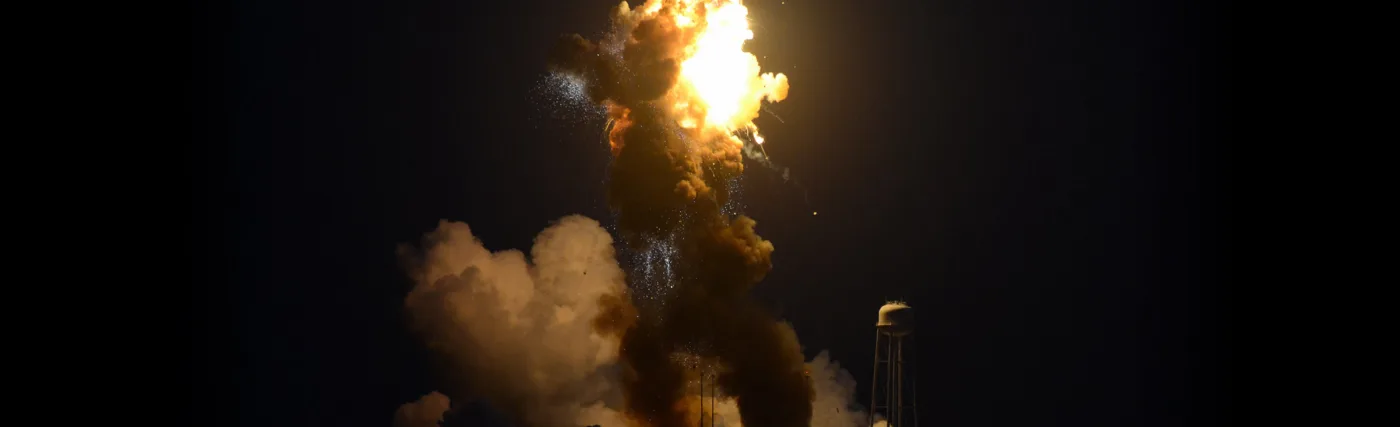
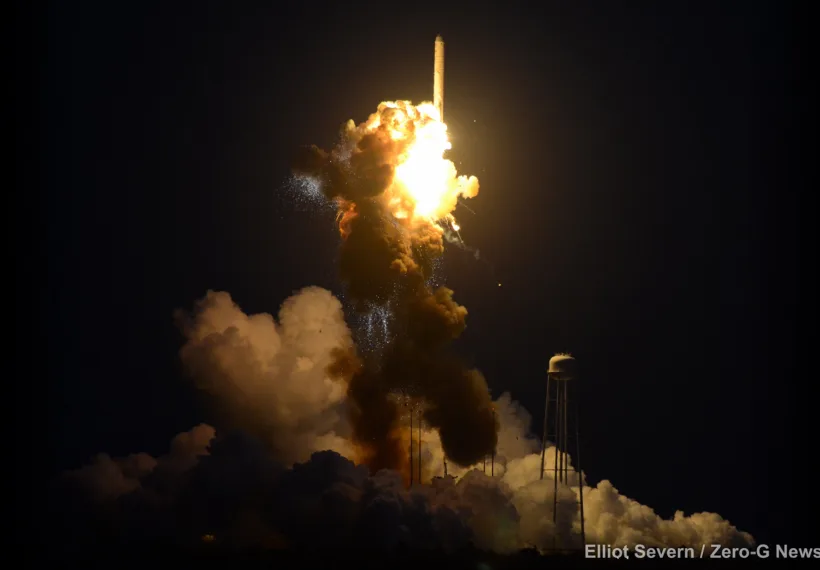
Yes, and the Antares blew up, which was a drag.
And that was what I like to call it.
Antares was Orbital Sciences' mission to resupply the space station.
But not manned, though, right?
Just full of money.
And it blew up.
And they quickly said, well, they quickly said, the officials quickly announced that the astronauts on the space shuttle, even though this was a supply ship to them, that they'll do just fine until the night.
I'm thinking then, why would you have to send this one in the first place?
Well, they've planned for something going wrong.
From time to time.
I bet you have stuff in your cabinet next time that there's a hurricane and you got to pull down your salmon in a can, your tuna fish.
It's called a car and you drive somewhere.
It took you three days though, didn't it?
Not to change the subject, but you didn't leave right away.
I was hit by Hurricane Sandy.
You had your fingers crossed for days.
Yeah, we lost electricity and so that was.
But that's not exactly rocket science.
No, it's not, it's not.
So we did learn some things.
The design of the space shuttle, anything else?
How serious you have to take it.
Take, ice is a big deal.
You got everybody on the crew saying, by the crew, I mean, people at the base, people who are working on it.
People on the ground.
People on the ground saying, well, it seems like about a one in 300 chance that it'll work and people are launching anyway.
It shows you, it could be a lot more reliable than that.
Right, okay.
Says after the fact, really before the fact.
Oh, we were all waving arms and pounding.
No, my old aeronautics professor said, don't ever, ever do this, I paraphrase.
But it was done anyway for financial reasons.
And it was really, and I know we're answering this question.
It was really during the Nixon administration when he decided that for the sake of votes, NASA jobs were more important really than NASA exploration.
And the evidence of this, if you look at Nixon's Oval Office, at one point he's got Earthrise, Apollo 8, on Isaac Newton's birthday eve, 1968.
And then six months later, after he's got the votes in California, he takes that picture down and puts up another one.
Wow.
He was not a believer.
He was just being a politician.
Just.
Politicians are hard jobs.
Politicians are hard jobs.
Sorry, ladies and gentlemen, you couldn't see the hands going up.
The hands going up.
Do it again, Chuck.
What do we need to get the space boat?
Wow.
So how about next question, Chuck?
Next question, Chuck.
Pages of them over here.
Yes, we do.
Okay.
So this is from at Fishmaman.
That's his name?
That's his name.
At Fishmaman from Twitter.
This is Cod.
His name is Cod.
Get it?
His handle is at Fishmaman.
How do we balance the burning desire of our genetic predisposition to explore with the need to insure safe passage?
I think he's kind of...
That's a great question.
He's kind of talking also about maybe commercial space flight.
Let me add some punctuation to this, and I'm going straight to you on this, Bill.
You're an engineer and you will tell the launch people, look, you shouldn't do that because it should be a little safer than that.
That could go wrong.
Don't do that.
At some point, somebody's got to push the button and launch the damn thing.
Oh yeah, you got to shoot all the engineers get on with production.
At some time, you have to stop listening to the engineers and get on.
I'm sorry, what?
What is that threshold?
Who decides it?
Well, that's what we call management.
Dive on it.
So the managers have to be literate enough to know what the acceptable level of risk is and act accordingly.
But the naive mind would say no risk is acceptable.
Oh no, no, that's not a true fact.
That's a false fact.
That's a false fact?
No, you've been in automobiles.
And there's a risk attached?
Especially when I'm driving.
Yeah, well, I'm sure you have a sense that something could go wrong.
And these guys, the people who fly in rockets, have a sense that something could go wrong.
And I'm very sorry about the Virgin Galactic crash the other day, a surprising result and one that they will straighten out.
And that I claim is not just part of the process, but it's part of the management process where you learn what is acceptable.
And I think what was going on, changing the subject to the Space Shuttle in the previous question, a lot of people knew the risk was a lot higher than was advertised and they pressed on anyway.
At Virgin Galactic, it looks like perhaps the risk was underestimated, that it's actually more dangerous than people were saying.
In other words, there wasn't deliberate ignoring of the facts, there was ignorance of the facts.
So we'll see what happens.
Two different reasons.
Yeah, why the feathering thing, it's a surprising result, why that would cause trouble and it could have to do, I'm shooting from the hip as an engineer, could have to do the materials involved.
So the brakes were put on too early, the air brake system.
Yeah, well, it's just too high, too many molecules in the atmosphere at that level.
If you'd waited a little longer where you got fewer molecules per cubic something, you might have been, just working with the data we have, stay tuned.
There are people who are experts at figuring this out.
Here we go.
This is from Carlos, and Carlos' CDS on Twitter wants to know this.
How easy is rocketry these days?
Been tough recently.
Do we pretty much have it figured out?
Or are we just kind of playing around?
Let me shape that question back to you, Bill.
We've been boldly going where hundreds have gone before into low Earth orbit.
I would think that low Earth orbit should be zero risk at this point, given how long we've been doing it and how many people have done it.
So that if we're going to put lives at risk, it should be by doing something we've never done before.
If I were to think of an acceptable risk, it'd be doing something that's never done before, not doing something hundreds have done before you.
So, we just saw it back in November, in October, we saw two disasters, two spaces, it was early November.
We saw two disasters, people not even going into orbit.
So here's what I'd say to you.
You may be mixing, the modern verb is conflating, air traffic, airplane, airliner travel with rocket travel.
A few hundred is not that many.
You think about how many airplanes people tried to build in the early 1900s and how many crashed.
How many failed?
Yeah.
And from the films, it looks like 100% of them.
Yeah.
I saw the film.
In other words, a hundred or a thousand isn't that big a sample size, really.
And the other constraint when it comes to the Antares rocket, the Orbital Sciences rocket, that was an old rocket being repurposed, being refurbished.
Okay.
So, are you saying that maybe we need to go up into low Earth orbit so much that it becomes like an airline?
Well, this is Neil's dream.
This is what he's saying.
This is what Bill is saying.
So, as many as a hundred sounds, as many as a hundred flights sounds like, it's not that many in the statistical scheme of things.
Yeah.
Do you know how many flights take off every day and land every day on Earth?
I can't say that I do.
I have a video.
I'll show you.
It is some countless scary number.
It's tens of thousands.
It's countless scary number of airplanes.
You're talking globally.
There are about a hundred thousand passengers in the air at any time.
At any given time.
If you said to the Wright brothers, in about a hundred years, we're going to have a hundred thousand people in the air at any given time.
So, that's what I say about space travel.
Compare the two accidents.
Antares is a very old rocket being refurbished and it had a leaky fuel line, it sounds like, or a leaky pump.
And then the Virgin Galactic rocket was a brand new rocket.
And so, it had the brand new problems.
The in-between ones is what we're all hoping to develop.
The in-between.
We want in-between.
We want in-between.
So, there you have...
So, Carlos, there's your answer.
Thank you.
Rocketry, not easy.
Hopefully, we'll get to a place where it is.
That place will be in-between.
In-between.
You got it?
Well, in-between old and...
In-between old and right...
Right out of the shop.
Right.
And it still smells new.
Anytime somebody says, this is a brand-new thing, try to...
That's where Letterman asks Sir Branson, are you gonna go on the first flight?
Oh, not on the first flight.
Yeah, sir.
Give him a few.
So there you have it.
If it has that new rocket smell, you don't want to get on it.
I feel bad about the fire.
Wait till you see a couple sandwich stains on the seat.
That's the rocket you want to take.
That's right.
That's true.
Let's go to Deepak Prem, Deepak Prem at AstroPrem.
He wants to know this.
He says, I can understand that it's justified to spend resources on space exploration, but why risk human life in the name of tourism?
He is quite emphatic about that.
So, Deepak, you have the option of not buying a ticket.
You'll be okay.
You don't have to buy a ticket.
You don't have to go.
No, but he's thinking in the abstract.
So stay here and so on.
The people who are willing to take the risk will throw down and go up.
Is there any benefit to the risk?
Well, apparently, everybody who flies in space, by all accounts, has this new appreciation for the earth.
When you see the earth from above, apparently, I've not done it except by the TV.
It changes your perspective.
You realize what a fragile small world we live on.
Yeah, but Bill, in the early days, there were joy-riding airplane flyers, right?
Yeah.
All right.
They must have known risks, and some of them would have died, and that was the touristic risk.
Clearly, people will do this.
People get on roller coasters and take risks.
No.
If you told someone there was 100% chance they would die by getting on a roller coaster, nobody would take the risk.
Yeah, that's right.
But if you say there's 100% chance you'll die climbing Mount Everest, people line up around the block to do it.
Why?
What's the difference?
I guess you're going someplace new.
You're going where no one has gone before.
And Mount Everest is just Mount Everest, where roller coasters are pretty much everywhere.
There's only one of those.
Yeah, there's only one Mount Everest, and there's only one space to go to.
No, but there's people who seek thrills for deep evolutionary reasons, apparently.
Ah, man, you can't just do that.
Can't just make these statements like that a full book.
No, the people who don't take risks get eliminated.
There's something about us, the people that go over the hill to look in the valley, they make discoveries.
People who take risks get eliminated too.
So, just excuse me.
Yeah, yeah, but it's deep within us, the drive.
But those who survive, survive longer than those who never took the risk in the first place.
Yeah, the tribes.
Got you.
That's how you got a word, that sentence.
Got you.
So, the inherent benefit of risk taking is long-term.
Or medium.
Right, so short-term disaster, long-term benefits.
It may accrue to your descendants, but only if you have descendants before you go on that risky venture.
Right.
Otherwise, you are wiped from the gene pool.
Or you pull it off.
You go over the hill, make the discovery, and come back.
Right.
Or do it and never come back and start your own colony.
And the people come with you.
Super cool, man.
This is Matt Kennan.
Matt Kennan, OA to Twitter.
He wants to know this.
Can we alter the popular notion in the media that a failure means nothing learned?
Go for it, Bill.
That's all you.
That was, I was charmed by the many, many news stories after the Antares rocket blew up, and then after the Virgin Galactic crash.
Does this mean the end of SpaceX?
Are you kidding?
Those people are going to redouble their efforts.
They're going to go back at it harder than ever.
They're going to work as hard as they possibly can to solve these problems because they see the great promise.
Are you joking me, Mr.
Question Person?
And how do you really feel, Bill, about that?
For crying out loud.
No, when something goes wrong, you just try even harder.
Otherwise, you get outcompeted by the other guy who does succeed, Lee, try harder.
And you know what?
That doesn't make...
It makes no difference what it is across the board.
That kind of...
It's a general...
It's an approach to life.
It's a general approach to life.
Now, you two guys have ancestry...
Yes...
.
where I imagine people told you couldn't do a lot of things.
This is true.
And look at you both.
Yep.
Ruling the airwaves.
Yeah.
I come from...
That is my lineage.
My great-grandfather invented the horse diaper.
And a lot of people don't realize.
They were like, that's a disgusting premise.
Why would you ever want to do that?
But if you're going to Central Park, that could be just the thing.
There you go.
So thank grandpop Nice for that.
Nicely done.
Is that true?
Is that true?
Now, Neil, you know better than I do.
I don't know.
I don't know.
No, but one of the perennial jokes about space exploration is how do you evacuate your bowels and empty your bladder?
And this is a very serious problem that has to be solved when you're going to fly in space.
At zero gravity.
When you're a horse, you're an owner of a horse and you have patrons.
And you have patrons riding in your handsome cab.
You're listening to StarTalk.
Stay tuned for another segment.
Welcome back to StarTalk.
Here's more of this week's episode.
Chuck, Bill and I have not seen these questions.
No, you have not.
I brought him along, because they're rocket questions I would not be able to answer.
That's why I brought him along for backup.
And so-
Give the engineering perspective.
Yes, exactly.
So what do you have for us?
All right, so here's, speaking of engineering wonders, let's talk about a little Rosetta Philae.
So this is from Andy Stens, who wants to know, what if another civilization see the comets and asteroids, et cetera, with organic material trying to propagate life around the universe, is that feasible?
Now, I mean, where he's talking about is the fact that we were able to land on a comet.
So he's in a longer version, he says, would we be able to actually do something like that?
Take who we are, and instead of sending a rocket, we put who we are on a comet and let who we are go out and leave our solar system and go forth.
There's a little problem with that.
The very act of landing on a comet means you have given your rocket the exact orbital trajectory of the comet itself.
To start with, and you light another engine and push it the rest of the way.
Yeah, well, you could do that.
No, so if you've matched the comet or the asteroid, then what does it mean to put on the asteroid?
You don't need the asteroid.
You don't need the asteroid is what you're saying.
That's exactly my point.
I got it now.
Oh no, no, the asteroid, Neil.
Yes.
From an engineering standpoint.
Yes.
These kids who want to mine asteroids, you've heard about them, Potentary Resources, for example.
To quote Bill, all the kids are trying to do it.
The big thing they want to mine is water.
Yeah, mortar.
And what they want to do is take solar panels to make electricity from the sun, electrolyze the water so that H2O becomes hydrogen and oxygen.
Break it apart.
Then put it back together as rocket fuel in a very fast fashion and get a jolt.
And get a jolt.
So this is not, I mean, it's extraordinary, but not completely unreasonable.
But, so you're saying you would go to the asteroid that is a source of water for future rocket fuel for you.
So it's a filling station.
It's a drive station.
That's all, I'm good with that.
The asteroid might be closer to comet, something icy.
I'm good with that.
And there are water-rich asteroids that are not comets, so.
Right.
So, no, that's cool.
These would be filling stations.
Yeah, and so.
The quickmarts.
Yeah, if you got time.
A lot of time at the quickmarts.
Furthermore.
Otherwise, you gotta look like a Saturn V rocket where every ounce of fuel that you're gonna use your entire journey, you're leaving with Earth to take.
And then you run into the rocket equation problem.
There you go.
To give us two minutes on the rocket equation.
Well, everybody, you know how heavy the thing you're gonna try to lift is.
Your payload, that which you pay for.
And think about this.
The moment you light the rocket engine, the rocket weighs less.
With every moment of time that passes, more fuel is burned and the rocket weighs less.
So the great deep calculus rocket equation question is, how much fuel do you start with?
Right.
And so there's, that's.
Because some of the fuel is to move other fuel you haven't burned yet.
That's it.
To burn it later in your trajectory.
It's related rates.
It's calculus.
It's like doing pull-ups.
You're.
Yeah.
You're lifting your own body weight.
So if you have long arms and you are heavy, it is very difficult to do pull-ups.
That's true.
And if you pooped while you were pulling up, every next pull-up would be easier.
I knew this was coming.
So this is the point of the rocket equation.
You can also, it could just be gas.
And the gas would have recoil effect and you can.
Ways to make the pull-ups easier for you.
Every day.
On route.
But those are third order effects.
All right, what else you got?
Well, there you have it, Andy.
The answer, well, one other question is, you really wouldn't need to do it unless it's a filling station.
That's the answer.
That's the answer.
All right, let's go to Jay Knickerbocker.
Right, not to be confused with the New York Knickerbockers.
Jay says, images of the comet show entumbling at a high rate of rotation.
If that is accurate, how did Rosetta match its rotation to the comet so Philae could make a stable landing regarding the failed harpoon?
How are they sure it didn't fire or is it possible any sensors indicating such simply failed and it is in fact tethered?
I don't know that it was rotating all that fast.
Well, the word fast, when you watch the animation on the electric internet, it looks fast, but it's a rotation rate was about once every 12 Earth hours.
Is that fast?
So that's not really all that fast.
Well, it's twice as fast as the Earth spins and it's a difficult deep space problem to get your Rosetta probe rotating at about the same speed.
But however, to the question's point, I would say, that if they show the rotation on the GIF, at the actual rate, that would be a really boring GIF.
Well, it'll take you a while.
It'll take to set there for 12 hours and watch the thing turn around.
Furthermore, it is tethered by gravity.
Even though it's a very low mass thing, it still has gravity.
It still has gravity, which is why it bounced, went up however many.
Almost over a kilometer apparently.
And then came back down.
You got it.
So there you have it, man.
There you have it.
Next question.
And the telemetry, as far as the sensor's not sensing it, the telemetry's pretty reliable.
And I got a question for Bill.
It's named Rosetta because the Rosetta Stone, which helped us decode ancient languages, in particular the Egyptian hieroglyphics.
And taught me Spanish.
Rosetta the...
The name for the same thing.
Okay, so but the Philae, I didn't do my homework on Philae.
What was Philae named after, Bill, do you know?
It's a nymph out there.
Really?
Yeah.
A sea nymph that, where if you go towards it, you crash into the rocks?
I should know that.
The water nymphs?
Yeah, I looked it up.
That doesn't sound like you'd want to name.
Let me encourage everybody who wants to know, check out planetary.org and read Emily Lochte Walla's blog.
It's in there.
A disclaimer?
Can't say that?
No, no, disclaimer.
Oh, disclaimer, I'm the CEO of the Planetary Society.
Neil deGrasse Tyson's on the board of the Planetary Society.
And Chuck Nice will be reading the blog.
So Chuck, here's what went wrong with that.
Dr.
Tyson used the word disclaimer when I think he meant disclosure.
Oh, you're right, he's right.
Totally called me out.
It's the schools.
It's the schools.
It's a rookie mistake.
There you go.
All right, let's move on.
This is Mark Parton.
Mark wants to know this.
He says, good day.
I heard that-
Is it G apostrophe D-A-Y?
No, it wasn't good-eye.
Good-eye.
It was good day.
Now there's the-
Chuck adopts the regional accent.
Well, he's got the DJ, the DJ voice, good day.
Good day.
I heard that Philae bounced off the comet before settling back to the surface several hours later.
The long bounce was due to extremely low gravity after seeing the pictures of the solid rock surface.
I wonder how something with such a low gravity formed rocks.
If this and other comets and asteroids were formed from leftover dust from the formation of a solar system, how did this dust compress into such solid materials without significant gravity?
This is awesome.
That was a great question, Mark.
These people are doing their homework.
Yes.
So the thing is.
That was great.
Good day, Mark.
That's who it is, it's Mark.
So when you're in deep space, there's nothing to slow you down if you're a particle of dust.
One of the strange insights that troubled me as a young man and I still stroke my chin from time to time.
And you're still a young man.
When you look at the dust on the bookshelf, it is a strange thing that not only is the earth pulling the dust down or toward the center of the earth, the dust is ever so slightly pulling the earth up.
So in deep space, when you have dust many, many kilometers apart and they're being attracted, they actually slam together at a pretty high speed.
And this was one of the ideas behind the Philae probe was to figure out what is the asteroid like?
Is it puffy, meringue-y or is it rocky, solid-y?
And is it a cream puff or a walnut?
Well, it's a comet.
We know it's a comet, so it'll be mostly evaporative ice.
Ice.
Right, right.
So here's the thing, Bill, which to me is quite cool.
It was not until recently that we had any clue what the structural integrity of comets or asteroids actually is.
And we've seen comets go around the sun and just the tidal force of the sun breaks it apart into 20 pieces.
We had a comet slam into Jupiter.
It was one piece at one time and then became 24 broken pieces afterwards.
And no one went to it with a sledgehammer.
It was just the gravitational stress of going by Jupiter that did that at all.
So we don't really know how tightly held together these things are.
And that was part of the mission.
That's part of the mission.
Now there's some asteroids that are the fragments of broken planetesimals.
Those would be chunks of rock and get out of their way.
But comets and some other asteroids, they might be rubble piles.
Just rocks that gather together.
There are rocks that we, there are asteroids that we know have the density, the material is made of rock, but you calculate the density, and it's the density of something almost as light as water.
Sounds like a marshmallow rock.
Exactly.
Sounds like a marshmallow rock.
Exactly, so it's got rock, but the rock isn't all the way through it.
It's got this, it's porous, or it's just a pile of rubble traveling together, pretending like it's one solid object.
Oh, like a bunch of little thugs.
Hey, you guys, I looked up Philae.
Mm-hmm.
The island of time.
Ooh.
Philae is the island of time.
Has he allowed to pull out his thing and look up the answer?
I mean, we're supposed to...
Well, anyway, it's just something I should know, and it has to do with the sun god Ra, and he had an island, and Philae was the island.
Okay, there you have it.
So this asteroid...
Philae sounds a little Latin rather than...
That's Greek, I think, when you got the pH going.
So 67 CP is Cherymanokov...
Buh-buh-buh-buh-buh.
Exactly that, yeah.
Russian words, excuse me.
Nobody named John Smith ever discovers a comet.
67 CP would be an island of time.
It's Cherymanonov.
Yeah, yeah, I did it for several days, and now under pressure, I'm blowing it.
Go take it.
What else you got?
All right, so that, by the way, was a great answer.
For Mark, there's your answer, Mark, this is how...
Oh, by the way, just while we're there, if there's an asteroid headed our way, and you want to deflect it, and you send something that's gonna push it, and you later learn that it's made of a rubble pile, you end up pushing some of the rocks and not the others.
So you wanna know what this thing is made of, and how it's held together before you do any of these rescue missions, or any kind of mission at all.
And like Bill said, that's part of the reason why we went there in the first place.
And this is a big push at the Planetary Society, is assessing the near-Earth objects.
Right.
Did I mention planetary.org that I'd disclose?
Disclosure.
That I'm the CEO and Neil's on the board?
What's the word I use?
I'm so embarrassed.
You went...
Disclaimer.
Disclaimer.
I wasn't disclaiming anything, I was disclosing.
I'm embarrassed.
We'll get through.
Okay, what else?
All right, let's move on.
Another great question.
All right, here we go, here we go, here we go, here we go.
You know what, this is a pretty, this is Chris Van Gundy.
A pretty simple, straightforward question.
All right.
How can we determine the difference between a brown dwarf and a large rogue planet?
Mm-hmm.
Ooh.
Well, brown dwarfs are still...
Do you use your, like, GPS?
Well, brown dwarfs...
Is that what you use?
Yeah, we showed a rogue planet.
We showed a planet in Cosmos and showed that with infrared filters, it's still sort of radiating the heat left over from its formation.
It is hotly debated still.
Get it?
Hotly debated.
What is the boundary between a brown dwarf and a planet?
Just, at what point do you say this is a planet, this is not a planet, and now you've got, like, the beginnings of a star, and then when do you have a star?
We have one like Jupiter that's a beginning.
Well, Jupiter is still a way, a little too light to have a, it's a star that never made it, but it's not like it was close.
Okay.
And so Jupiter is not massive enough to be, so we have people working on how to define brown dwarfs.
Is it chemically, what's going on in the atmosphere?
Is it temperature?
But then the temperature changes over the life of the thing.
Are the school kids going to have to relearn?
I know, and then as the temperature changes, the chemistry of the atmosphere changes, so what are you going to observe about it in order to say what kind of object it is and is the object changing?
So it's still a hotly discussed topic.
Look at that.
Albeit at about 3 Kelvin, 3 degrees above absolute zero.
It's hotter than that, yeah.
Is it 100 Kelvin?
Well, what, for the temperature of the stars?
A brown dwarf.
Oh, no, no, no, it's Kelvin.
No, no, no, sorry, sorry, a rogue planet.
No, a rogue planet would be, I mean, it could be as much as, I don't know, several hundred degrees Celsius.
I mean...
Several hundred degrees, several hundred Kelvins.
I'm sorry, let me think, hold on.
Several hundred Celsius degrees above absolute zero.
Let us agree on what scale we're using first.
Yes.
Okay, so how about Celsius?
Surface of the sun is between 5,000 and 6,000 degrees Celsius.
Okay, so a brown...
And a lot of sunsets.
Cooler red giant stars are around 3,000, 2,000 degrees.
You start getting brown dwarf land when you're 1,000 degrees, 800 degrees, and then hot planets would be 400 degrees.
A rogue planet would be 400.
Yeah, around there.
Based on my memory of how all this shakes out.
Note well, though the surface of the sun at 6,000 degrees Celsius sounds hot.
It is hot, but a bolt of lightning is a little hotter.
Ooh.
What?
Oh, snap.
That was pretty cool, because a bolt of lightning is hotter than the sun.
Excuse me, not the center of the sun, the surface of the sun.
Not that you feel better.
Now I feel better.
Hence the expression.
Now my mind isn't nearly as blown.
Hence the expression.
It was like I got stuck with the surface of the sun.
Yes.
No, see, that wouldn't be nothing.
That wouldn't be.
Yeah, it's a bolt of lightning.
Now you're talking.
Okay.
I don't know.
Do we have time for one more if it's quick?
Okay, here we go.
For this segment.
This is from Dan Zimny.
Excluding the size of this is from the sun, does Venus have more in common with the gas giants than terrestrial planets?
Venus is a rocky terrestrial planet.
People, that's fundamental.
You're listening to StarTalk Radio.
Stay tuned.
More up next.
Next.
Welcome back, here's more of StarTalk.
Alright, hey, let's jump right back into this.
This is Jose, I mean, sorry, Jose Javier Galvez.
I had to say it like that.
Chuck can do him some regional accents.
Yes, so this is, launching a space shuttle was originally estimated as very low cost, but in the end, it went up to a billion dollars per launch, which made it kind of unmanageable.
Do you think the same can happen now with private companies as they face the huge challenges and risks of space flight?
Time will tell.
And by the way, one billion was an estimate for a while.
Now, all in, people are throwing around the word, the number one and a half billion per shuttle flight.
So here's the thing.
The space shuttle was built by NASA, and there are 10 NASA centers, and this was a brilliant idea in 1958, that it made the space program, if I may, uncancelable.
Ten centers across the country.
Across the country.
In eight states.
Too big to fail.
Well, just too many congressional interests to get shut down.
Right.
And so now, everybody keep in mind, when we talk about space exploration technology, SpaceX, and we talk about Boeing, these companies are taking billions of dollars to produce rockets for the larger good, for the public good, to fly astronauts from many nations to space.
But when you visit SpaceX, the factory is a big horseshoe.
The train cars show up full of steel and aluminum.
They unload the stuff that goes into the factory.
They hammer it out to the right shape.
They stir weld it with the world's largest stir welder machine, which is a fabulous friction thing.
Then they put all the wires in and they pressure.
Then they make the pressure tanks and they install the pressure tanks.
It goes around the big horseshoe, the big letter U, and it goes back on a different train car and goes to Cape Canaveral or Vandenberg Air Force Base ready to fly.
That's the premise of the bit.
So it is believed that you'll be able to lower the cost of making rockets.
So we will see.
Are there subtleties?
Is there expertise that NASA had that these new companies, by new I mean more recently developed companies, do or do not have?
Time will tell.
When it comes to Boeing, they've been building all kinds of rockets for years.
Disclosure?
I worked at Boeing.
I have some loyalty to Boeing, but I'm not either way.
You worked on the jumbo jet.
Worked on 747.
Yeah, it was very cool.
Loyalty to that.
A lot of vertical tail.
Fabulous leading edge flap system.
Hey, listen, what can I say?
I can never hate on a man for getting a little vertical tail.
That's all I'm saying.
You had me a tail, Bill.
In the aerospace industry, we call that empinage.
Empinage.
I see in your hand you have a pen.
Yes, sir.
That's from the Latin word penna for feather.
We used to write with quills.
Correct.
Now, the shaft of an arrow is the fuselage.
Right?
The tail feathers are the empinage.
And airplanes have an empinage.
And my understanding in your experience, you have three children.
There's been quite successful empinage.
That's a lot of information.
I was going to let it taper off, but you're going to...
It's all good.
That's very cool.
Let's go to Facebook and James Fish.
I got to add something to this.
Go ahead.
So the shuttle would have been less per launch if we had 50 launches a year.
But the...
It turned out to be too dangerous and complicated.
Too complicated and the parts were being used.
And then when do you replace it?
Do you need a new part or one that's battle tested?
And so part of a business model is always, can you reuse the vessel?
And modern airplanes are used multiple times a day.
If you had...
People flying airplanes now are younger than the planes.
Right.
If you flew an airplane and each time you threw it away, that's a different business model.
We wouldn't be flying so much.
Right.
Well, there you go, Jose.
There's the real answer.
How do we do it?
Volume.
All right.
Our manager is out of town.
We must be crazy to offer these prices.
All right.
Let's go to Facebook and James Fish.
And then here's what James has to say.
There's a lot of talk about quantum computers and how they could change the face of predictive modeling.
What potential could it have to change artificial intelligence and lead to a robot uprising?
I thought he was going to and change the face of space travel, but he went with robot uprising.
So everybody, I'm all for the singularity when computers are as smart as people.
But computers and the quantum computing thing run on electricity.
And right now, someone literally has to shovel the coal to keep the robots going.
So I'm all for this robot uprising as long as there's an infinite supply of electricity.
What if they're controlling the nuclear power plants that they're going to...
Okay, knock yourselves out.
They're in control of the grid, Bill.
I think it's a long way off.
Well, they were designed by us.
If the computer has the quantum, they'll control the grid.
Right.
They're not going to wait for you to plug them in for them to take over your life.
Who's going to shovel the coal?
They will.
They'll invent a version of themselves that will shovel the coal.
Oh, they will.
So anyway, let's change the subject.
Plus, you speak like it's weird that the robots need some special source of energy.
So do we.
Yeah, because seriously?
We eat food three at least times a day.
And you're saying we create us by means of empanage interaction.
That's correct.
And so you're saying it's sort of six or one.
Okay, so by the way, change the subject back to me.
I have a little thing about the singularity in my book.
Just to be clear, there's an astrophysicist at the table.
If you use the word singularity, you have to clarify that you're not using it at the beginning of the universe.
We're not talking about the beginning of the universe or the center of a black hole or any other previous use of the word singularity.
Go.
I love this tension.
We're getting to where computers have enough computational power to be like a human brain.
And in my book...
Undeniable.
I'm on the New York Times bestseller list.
I have a little discussion about this.
You can go to places in the world where people have not made a phone call, not made a cell phone call, not made a phone call.
I'm not saying they won't change in the next little while, but it's going to be just...
It may be later than you think when there's a robot uprising taking over the world.
The robots show up in Western China and they go, there's no place to plug in, man.
I'm sorry, dude.
And they're not very productive, let alone take over the world of...
I take it you don't believe it.
There's a lot of other things to worry about.
I agree with Bill.
There's nothing about it that sounds impending to me, though it be impending to others, which is the perfect set up for a cult.
The world is going to come into it.
It'll change really soon, really fast.
Just join the bandwagon.
Send money now.
But that's not what...
He's not asking you to send money.
I want to get Ray Kurzweil on the show, the exponent of the Singularity.
We'll try to get him on StarTalk.
So that he can speak for himself, rather than me commenting on what others have said about him.
And he may be right.
All right.
Well, there you have it.
Don't worry about it is the answer to your question.
Don't worry about it.
Chill out.
Chillax, baby.
All right.
Okay, let's go to Robert Hartley, who is also coming to us from Facebook.
Hello, guys.
I'm from Auckland, New Zealand, just in case Neil asks, because sometimes you want to know where people are from.
In regards to the Antares failed launch, how much doubt would the team have to have that the mission would go unsuccessfully before making the decision to abort?
So what is the protocol for an aborted launch?
What has to happen where you go, God, forget that.
There's two different things.
There's canceling a launch, and then there's abort in flight.
So canceling, we're going to put it off, or postponing is probably a better verb, to place forward, to place ahead, to place later.
Postponing is where people ask themselves, is this going to work or not?
Abort generally means once the thing's flying, and it's going to cause trouble, should we blow it up?
In the case of the last Antares launch, it was self-uploading.
So it was a self-aborting flight.
That was a design feature.
Yeah, exactly.
What's that sound?
So anyway, I know what you mean, but this is why you have managers, and this is why you have managers you want to be literate with, technically, who want to know what's going on, can make decisions based on learned input from their subordinates.
Can you be a good manager going to managerial school, or did you have to be an engineer to manage engineers?
Well, let me ask you this.
So many of the Fortune 500 companies are run by engineers.
Well, many of them are tech companies.
Yeah.
So is there a connection?
In other words, could such a tech company be run by somebody who is not engineering savvy?
And the answer is, I don't know, man.
When it comes to rocket launches, you really want people in charge with experience.
And this is, just to talk about the Planetary Society yet again, on our board is Scott Hubbard, who became the Mars Czar.
And NASA.
Yeah.
So there was Mars.
Faster, better, cheaper was the way of thinking.
The modern word people throw is mantra.
This is what we're going to do.
Faster, better, cheaper.
And so there were some successful missions, but there was Mars Climate Orbiter, which went off into deep space because we interchanged English units with metric units.
Went off into deep space instead of arriving at Mars.
Yes.
And then Mars Polar Lander, which became Mars Polar Crasher because the landing gear deployed and the software thought that it had been on the surface.
But I mean, rather there was a little shake and the software thought it was on the surface, but it was still in space and it crashed.
So we brought in, NASA brought in Scott Hubbard, who was a manager.
He managed it.
He figured out who knew what he was doing and who didn't.
And he made some personnel changes.
And then we had the successful landings of Spirit of Opportunity and Curiosity.
You don't regret who you fire.
You regret who you don't fire.
So I didn't make that up.
That's ancient wisdom.
Chuck, we got time for one more question.
Oh, Bill Wanders.
It's management as well as technical problems.
All right.
So there you have it.
Last question.
All right.
Here we go.
This is from Matt Eli.
And Matt wants to know this.
If life were on a comet, would we know it?
Also, I heard mentioned that they are trying to see how much of Earth's water came from comets.
Furthermore, there are amino acids on these bodies.
These are acids with carbon and double bond, double bond, oxygen, oxygen.
Which are the building blocks of life?
And so exactly.
So where is the line drawn between an amino acid out there in space and you and me?
I thought you were going to chime in with some brilliant insight, astrophysical, astrobiological insight.
Well, there are ideas put forth back in the 1960s and 70s led by Fred Hoyle and his collaborator Wick Ramasinghe, who suggested that perhaps there were bugs in space and that if the solar system moved through a virus contaminated cloud, that the whole earth would be contaminated all at once.
And they put that forth as the reason for the 1918 flu epidemic.
So and bugs as in what?
As a disease.
As a disease.
As a disease.
The notion that you can have complex molecules in space, why can't you have complex organisms?
Organisms.
Right, right.
So that it's really great science fiction material, but it doesn't really hold up.
On analysis, because to make complex molecules, you need high rate of collision with particles and gas clouds are very low density.
And so you don't have the experimenting, the chemical experimenting that would go on on a planet's surface.
And so, if there were life on a comet and it was microbial, there's not any way we would not let you land on it and scoop it up and sniff around and find some goo.
So which means we got to go there.
We got two questions.
And we're there.
Where are we alone in the universe and where did we come from?
That's why we explore space.
I want to know where we're going.
Thanks for listening to StarTalk Radio.
I hope you enjoyed this episode.
Many thanks to our comedian, our guest, our experts.
And I've been your host, Neil deGrasse Tyson.
Until next time, I bid you to keep looking up.
See the full transcript



 Unlock with Patreon


 Become a Patron