


 Unlock with Patreon
About This Episode
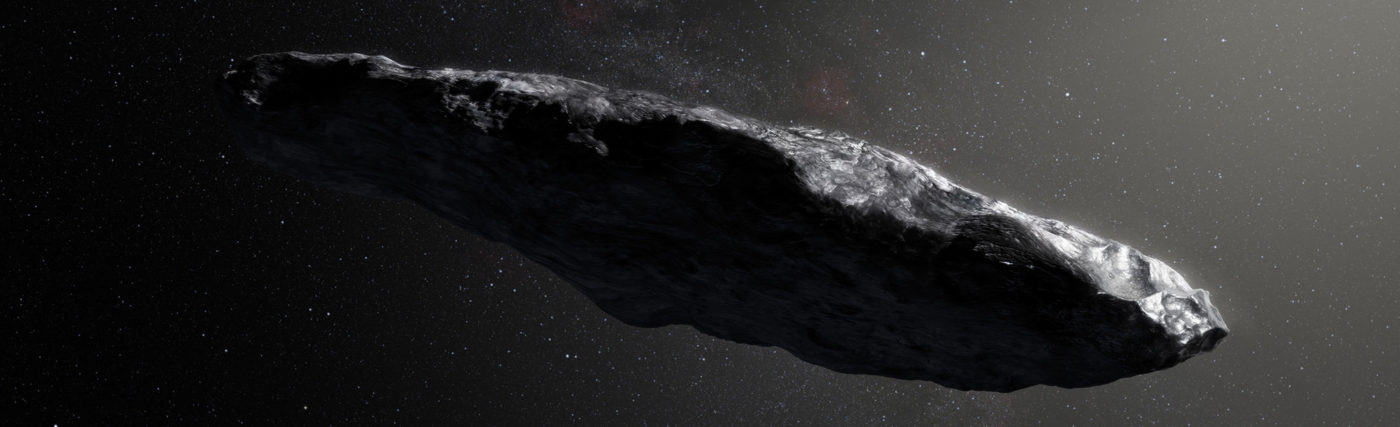
On this episode of StarTalk Radio, Neil deGrasse Tyson, comic co-host Chuck Nice, and cosmochemist and author Dr. Natalie Starkey answer fan-submitted Cosmic Queries about ‘Oumuamua, the first detected interstellar object that passed through the solar system.
To start, Chuck wonders why we even study space rocks if they’re all the “same.” Natalie tells us how studying space rocks helps us understand our solar system when studying Earth only tells us so much. You’ll learn why asteroids might be the leftover building blocks from planets. We ponder what might be hiding in the Oort Cloud and why ‘Oumuamua is basically an interstellar vagabond.
You’ll find out more about ‘Oumuamua’s discovery and how it got its name. We also talk about the only other interstellar object we’ve documented (so far). What is the likelihood we will see another interstellar object? Natalie explains the difficult task of looking in the right place at the right time since interstellar objects can, literally, come from anywhere.
How do we differentiate an interstellar comet from a comet that came from the Oort Cloud? We explore the idea of panspermia. Could life survive such a perilous journey similar to ‘Oumuamua’s? Lastly, Natalie helps us understand why ‘Oumuamua’s shape is so peculiar. All that, plus, we ask the obvious question: was it sent by aliens?
Thanks to our Patrons Christopher Sukhanenya, Dmitry Pugachevich, Eugenio Barrera, Colton Cichocki, Brad Sofka, Atle Beckmann, Alex Prieto, Dorothy Papadakos, Steven Bunevitch, and Johnathan Bynog for supporting us this week.
NOTE: StarTalk+ Patrons can watch or listen to this entire episode commercial-free.
About the prints that flank Neil in this video:
“Black Swan” & “White Swan” limited edition serigraph prints by Coast Salish artist Jane Kwatleematt Marston. For more information about this artist and her work, visit Inuit Gallery of Vancouver.
Transcript
DOWNLOAD SRTWelcome to StarTalk, your place in the universe where science and pop culture collide.
StarTalk begins right now.
This is StarTalk, Cosmic Queries edition, and I got my co-host, Chuck Nice, Chuck.
Hey, Neil, what’s happening?
Always good to have you, Chuck.
It’s nice to have you.
It’s always a pleasure to be here.
So today we’re gonna talk about Oumuamua.
Oumuamua, is that a new Disney film?
And I only know about it from just what I’ve read.
I don’t think much beyond that about it.
So we bring in one of our experts at large.
Of course, we’ve got Natalie Starkey.
Natalie, welcome back to StarTalk.
And you’re an expert on stuff that’s not planets in a solar system.
Yeah.
I know a fair amount about planets, but yeah, I like comets and asteroids.
I like the smaller bits and bobs of the solar system.
The stuff that could render us extinct one day.
Maybe, but hopefully not.
If we know enough about these things.
You hope?
So if there’s a comet Natalie headed towards Earth, that’s not good for you if that happens.
No, that wouldn’t be great.
But actually it would be, if we could divert it away from Earth and then get a sample of it and bring it back for all the scientists who want to study these things, then that would be great.
Wow, so you’re going beyond Bruce Willis.
You don’t just want to save the Earth.
You want to get some science done while you’re doing it.
There’s enough of us here doing this science that I think we could learn an awful lot if we could actually go and get some sample.
While you save humanity and civilization, can you bring back a sample for my lab?
It’s a bit of a different movie.
That’s a different movie.
So Natalie, you have the title of Cosmochemist.
I didn’t even know you could have that title.
And how many other people know that that’s even a title or something to aspire to who are in school?
And you know what I didn’t know?
It was something you could do when I was younger.
I had no idea.
And I actually went through my degrees, which were in geology and then ended up doing a PhD in again, in geochemistry, essentially, looking at volcanoes, old volcanoes in the Arctic.
And then it was doing, after that, when I became kind of what I would consider a proper scientist where I’m working for money and I’m getting paid to do science, that I became a cosmochemist because I just turned my geochemistry into studying rocks from space.
So I was looking at-
You could say you got bored with Earth.
Just say it, you got bored with Earth.
Well, you know, there’s only so much you can do with Earth.
No, no, I absolutely love Earth.
And volcanoes are like my absolute passion.
But yeah, when I saw this job advertiser that was working on samples from the Stardust mission, which was a NASA mission to collect samples from a comet, I was absolutely fascinated.
So it was a steep learning curve for me because I’d never studied asteroids or comets or anything like that before.
But essentially the rocks are all the same.
You look at Earth rocks, you look at space rocks, they all contain the same sort of minerals.
And the way that we analyze them in the lab is exactly the same.
We’re just kind of finding out different things about them.
So if they’re all the same, then what’s the point?
Like why?
Like, you know, we’re in space just like every other celestial body is in space.
And we’re all made of the same stuff.
Why are you studying?
Chuck, that reminds me of, it was Jon Stewart on his show back when he did The Daily Show.
He says, NASA has, no, was it?
Yeah, I think it was Jon Stewart.
He said, we went to Mars and we just discovered water on Mars for a billion dollars.
We discovered what comes out of my faucet.
I mean, one of the main reasons that we always argue is that we can’t find out a lot about the solar system that we’re within by studying our own planet.
So we can study our own planet to find about how, kind of how it formed and what happened over the last few billion years.
But we actually can’t go back in time that well because we’ve got plate tectonics.
So our surface is constantly changing, which means that we’ve sort of lost that really old history about our own planet.
Whereas if we go into space…
But just to be clear, when you say constantly changing, you mean on a geologic time scale.
There’s no plate tectonics dragging cities down into volcanic magma, right?
You’re talking about a slow process here.
I mean, listen, there’s always hope.
Sorry, I interrupted.
Keep going.
Absolutely fine.
No, exactly.
And that should be pointed out because I often think in kind of time scales of millions, if not billions of years.
And that becomes normal to geologists and people that work in space science.
But yeah, exactly.
It’s a very slow process.
Maybe the plates that we’re sitting on move maybe one to maybe 10 centimeters per year if they’re going very quickly.
So it’s a very small amount that they’re moving.
And it’s over a very long time scale.
But over that time, things change.
So continents move and they get, you know, taken down into the earth and melted essentially.
And then we get new volcanoes producing new land, which wouldn’t have been there before.
But it’s a problem because it means if we want to go back four and a half billion years to when our planet first was born and became a planet, it’s very hard to do that with the rocks that we have on earth, because they don’t really sample all of that history.
But if we go to asteroids, for example, they pretty much haven’t changed since they formed.
They’ve gone through a little bit of processing, but what we’ll say is that they’re essentially the same as when they formed four and a half billion years ago.
So by studying them, we can understand a lot more about all the planets and including earth, and we can find out things about even how life got to earth.
That’s one of the ways that we can find out those answers.
So studying space rocks is really, really valuable, and getting samples on earth is also really valuable.
Wait, so Chuck, that was a big F-U to you.
Just want to make that clear.
No, no, no.
I think there’s got to be some reason.
That makes sense.
Well, speaking of that though, when you look at this, since we are constantly having a makeover here on earth, and you’re getting these snapshots from these, kind of frozen in time pieces that are out there, when it comes to those pieces, this is for both of you, is most of that floating out there, asteroids, these fragments, are they kind of like space out, to use a word like Natalie, is that space rubbish?
Is that, does Triton-
Who’s British of you?
Is that like the waste of what’s leftover in formation, or is that the remnants of something cataclysmic?
Wait, wait, Natalie, he just accused you of studying rubbish, just wanted to make sure.
Well, yes, and some of it is, essentially.
It’s the leftover building blocks of the planets.
Many of the asteroids are the same as the planets, and they’re the same objects as when they formed, but the planets have then grown so large that they’ve undergone their own processing.
So you take any of the large rocky planets, they’ve all, what we say, differentiated into layers because they’ve got so big that they’ve melted their insides and actually the iron minerals have sunk to the middle of them, and the silicate, the lighter minerals, are all on the outside making a crust.
So they’re very complicated.
They’ve actually been processed a lot, whereas the asteroids are much smaller, so on the whole, they didn’t do that.
So they’re sort of the leftover building blocks.
But, Natalie, we think of rocks as being heavy, and you’re describing them as being light floating to the top.
So please explain that.
So it’s all relative.
Yeah, just for those of you listening, don’t try to go floating with rocks.
That’s right.
That’s how to make sure the body doesn’t float back up.
You put rocks to it.
But it’s one of the reasons we’re on the surface, in fact, because, you know, you go to the center of our planet, which you can’t do physically, but we know what’s down there by studying rocks from space and by using geophysics and earthquakes to figure out what’s down there.
We know the center of our planet is very dense.
It’s made of iron and nickel.
So it’s very dense and heavy.
And then as you move outwards, you get lighter and lighter elements as you go.
And then you eventually get to an atmosphere, which is obviously made of a very light elements like oxygen and nitrogen and things like that.
Now that happens on almost every planet that you find.
So there’s definitely this kind of relative gradation in terms of the density of the elements that you find.
But when you go to the asteroids, they tend to be, there are a few that have differentiated and made these layers, but on the whole, they’re smaller objects that didn’t do that.
So they’re the same all the way throughout.
So if we sample them, we can learn about basically what is the average composition of our planet if you were to mix it all back together again and take away those layers, which is really valuable because otherwise we don’t know what kind of our starting composition is.
It’s almost like taking the cake apart essentially.
If we’re making a cake and we’ve got all these different ingredients, we can start to see what was in the cake and we understand kind of what we started with, what were our constituent ingredients, which is really important.
Okay, so I got a question for you.
So we discovered, we, you know, the astronomical community, discovered an object named a muamua that apparently came from outside of our solar system and was passing through.
So everything you just said would give us no insight into that object, presumably, because it’s not from this solar system.
Yeah, so one of the great things about space is that we think, well, basically we have laws of physics and we think we understand some of those pretty well.
And so we expect that if we go to another star system outside of our solar system, we expect things to be pretty similar.
Now we know that stars can differ and therefore their temperatures and their sizes different, the things that are around them, the planets and the objects that orbit around them could be very different to what we have here.
But we expect on the whole things to be pretty similar wherever we go.
So when we go to the very edge of our solar system, what we find there is the comets, which we haven’t really spoken about yet.
We’ve spoken about the asteroids, the rocky parts, about kind of the leftover building blocks of the planets.
But when you go to the comets, they’re very light.
These are usually made of very light elements, but they do contain rock dust, and they also contain a lot of ice in them, which could be water ice.
It might be carbon dioxide ice, all sorts of different types of icers.
So carbon dioxide ice, we are familiar with that as dry ice, we’ll call it that, yeah.
All sorts of things out there.
So we’ve got lots of cold materials, because these objects are really, really far from the sun.
In fact, some of them are so far from the sun, we’ve never seen them.
They’re in the supposed Oort cloud, which is a hypothetical thing, because we’ve never seen it, but we think that there must be a lot of icy objects out there, which are probably quite small.
We don’t think there’s anything the size of a planet out there, because we haven’t seen it yet, and we probably should have if there was something very large out there.
But on the whole, these objects are quite small, quite cold, and they formed basically at the start of the solar system.
They formed as soon as the sun formed, and they’re basically a part of this cloud that the sun formed from, a little sample of an interstellar cloud, essentially.
Now these things are very loosely gravitationally bound to our sun because they’re so far away.
So what can happen with these objects is that sometimes they actually get ejected from the solar system.
And this is one option for what a muamua might be.
It might be a rogue comet from another planetary, exoplanetary system that’s been basically knocked out of its orbit, sitting far away from its sun, and it just kind of got thrown into the hinterlands of interstellar space and lost and not bound to any star gravitationally.
And so it just starts, you know, traveling through interstellar space forever and ever and ever until it maybe passes through another solar system without even realizing that solar system’s there.
So it’s basically a vagabond.
Yes.
That’s cool.
And so this is made possible because at the outer reaches of the solar system, the sun’s gravitational grip is only very slight on these objects.
So it wouldn’t take much to dislodge one from the grip of our solar system.
Because it can be dislodged by a passing planet.
So in our solar system, Uranus or Neptune can pass as they orbit around the sun.
They can pass these objects and literally just push them out gravitationally.
Or actually within the galaxy, a passing star coming, passing by our solar system can actually gravitationally pull these objects away.
They’re just so, so far from the sun that they really aren’t held on very well.
They’re really loosely within our solar system at all.
Now we’ve got to take a break in a couple of minutes before we get to the Cosmic Queries part of this.
But tell me how Abu Umur got named.
So it was spotted actually almost by chance by a telescope in Hawaii called PanStars.
It’s got a really complicated acronym.
I can’t remember what it stands for.
I never can.
It’s a really complicated one.
But just to be clear, PanStars is the acronym, not Umuamua.
No, exactly.
No, PanStars is the telescope acronym.
So because it was found by a Hawaiian telescope, they thought they would give it a Hawaiian name.
And I think O is the first part of it, which loosely means scout or messenger in Hawaiian.
And then the Muamua means kind of like a visitor from the distant past.
Oh, I get it.
They named it exactly what it’s supposed to be named, right?
This is nothing more than an alien reconnaissance mission checking us out.
Okay.
Built into the name, Muamua.
So very cool.
And does that have to be officially accepted by the nomenclature committees of the world?
Yes, that’s not its official name.
It’s a much friendlier name, but we tend to give any object in the solar system or anywhere, we tend to give it a kind of a code name, which would tend to be used in papers and scientific papers that are published.
So that’s actually quite an interesting story because it’s had its kind of proper name changed a few times because originally it was thought to be a comet.
So it had a C title and then it became an asteroid.
So it became an A title.
And then the scientists decided it came from interstellar space.
So it became an I title and then the year after it.
So basically, you know when it was discovered.
So it’s gone through some name changes, but it’s now currently got an I in its name.
Well, just to be clear, it would be the first I.
It is.
So it’s I1, in fact.
This is number one.
But there is a number two.
Wow!
There is no…
We will think about that after the break.
We’re going to take a break from StarTalk Cosmic Queries.
We’ve got Natalie Starkey, our solar system comet expert with us, who’s answering all our questions about the solar system.
It’s Vagabonds and especially Amuamua.
We’ll be right back.
Hey, I’m Roy Hill Percival, and I support StarTalk on Patreon.
Bringing the universe down to earth, this is StarTalk with Neil deGrasse Tyson.
Thanks for listening.
We’re back, StarTalk, Cosmic Queries, the Amuamua edition.
And I’ve got Natalie Starkey here, a friend of StarTalk’s.
She actually is the author of our current space show at the Hayden Planetarium.
The theater is closed, obviously during the COVID shutdown, but when we reopen, you’re all invited to come check it out.
And Natalie, you’ve also written a book, Catching Stardust, beautiful title, I love it.
It came out a year and a half ago or so, two years ago.
And did that book sort of capture your whole sort of research life, studying the comet dust from the Stardust mission, the NASA mission?
It did, yeah.
So my inspiration was the Stardust mission, because I’ve always been fascinated by it.
And it was the first mission to collect a comet sample, comet samples in space and bring them back to earth.
But then I also focused an awful lot on the Rosetta mission, which was a European mission, which didn’t collect samples, but what they did instead was put a laboratory onto the side of a comet instead.
So that was kind of the next best thing.
They would have liked to have brought back samples, but it’s really expensive to do that and technically quite challenging.
We’re starting to do it now with asteroids quite a few times with Osiris-Rex and the high-boost emissions.
But you know, this was a few years ago now.
So the best we could do was literally put a little landing laboratory on the side and do some experiments on the comet, which is just fascinating to me.
So you’re actually landing on these places.
Landing.
It reminds me, I saw this comic where there was some rover that went to Mars and there are these aliens standing on Mars, but they kind of all look like Native Americans, right?
And they say, there goes the neighborhood.
But anyhow, and Natalie, you have a title.
Let me get this correct.
The Officer for Outreach and Public Engagement at the Open University in the UK.
So that means, anytime we call you, you have to show up.
Because it’s in your title.
Outreach Public Engagement.
So I’m just going to hold you to that.
Yeah, that’s kind of, I would get them to change that because that means that it’s almost like being like, my name is Chuck Nice.
And so like, it’s very difficult to be like, you know, an ass because people are like, because the moment I have a bad day, people are like, I know he wasn’t nice.
I know, they just call you out.
So now like, you have to engage people.
You have to.
Yeah, you have to.
And I love doing it as well.
And so that’s why a few years ago, I did give up full-time science research because I found that actually I just love, it’s talking to people about this stuff.
And it’s always fascinated me.
And I’ve written down my second book on space science and it’s just what I love doing.
Wait, has that book come out yet?
No, it will be out in September 2021.
Okay, so we’ll get you back on.
We’ll talk about it.
Yeah, that would be great.
It’s about space volcanoes.
So yeah.
Oh, I love that.
And there’s no book on that.
Oh my gosh.
There are at the moment.
No, there’s-
Yeah, it’s gonna be-
And you have ice volcanoes in there as well?
Yeah, so it’s fire and ice it’s called.
So it’s on all the hot volcanoes and then all the cold volcanoes as well.
So now the volcano is actually on a planet.
It’s just not a volcano floating through space, right?
Vagabond volcanoes.
Because I thought it might have been like a moo-a-moo-a, just floating through the cosmos, spewing out stuff.
That would be so weird.
That would be a science fiction story’s embarrassing fact, because they think volcanoes just, they’re not actually connected to anything below.
This would be a profound ignorance of geophysics if it’s just a volcano spewing all of it.
Like a cosmic locomotive, just spewing out stuff from its opening.
So Chuck, we solicited questions about Oumuamua.
So from our fan base, are these all Patreons?
If not, definitely start with him.
Yes, we will always start with Patreon, and I think most of these questions are from our Patreon patrons.
And so let’s get right into it.
And let’s see here, this is Curtis Lee Zadlhak.
And he says, maybe that’s his name.
He says, he says, given the extreme rarity of objects zipping through our solar system, even when those objects are homegrown asteroids or comets, what is the likelihood of another object, like Oumuamua, passing through in the lifetime of anyone old enough to remember this recent event?
So what kind of frequency would we see?
Could we see more of this?
And is anybody looking for them so that one, if they…
What guarantee do we have that we would spot everyone that comes through as an interloper?
Yeah, maybe we’ve already missed like 10 of them.
Right, right.
I mean, for sure, we’ve missed probably quite a few.
It’s very unlikely that this is the first object to have gone through our solar system from another star.
So we don’t know for sure, because obviously we haven’t been looking for that long.
So the Pan-STARRS telescope that spotted this one, as I said in the last segment, it wasn’t actually looking for it.
It’s looking for near-Earth asteroids.
So it’s part of our kind of defense system of looking about what’s out there around our planet and one of the objects that are close to us in terms of asteroids and comets that might pose a risk to us in the future.
Now, it doesn’t look at all of the sky all the time.
It can’t do that.
It’s not designed to do that.
So it looks at portions of the sky at different times.
So there’s a really high chance that it could just miss one of these objects completely.
But over the course of time, the objects that were in our solar system, it should spot all of them because it kind of goes around and goes around again and looks at different portions of sky.
But obviously something just flying through randomly that we’re not expecting and isn’t on an orbit around our sun, it’s much easier to miss.
Plus Natalie, plus most of these objects you’re describing are in the plane of the solar system.
So if you’re going to design a search to get the most of them, you’re going to stick to the plane.
So if something coming from above or below, you don’t have as good as sky coverage there, do you?
That’s very true.
And actually we do, some of the comets within our own solar system don’t come along that what we call the ecliptic plane of the solar system, the one that basically all the planets are on.
So all the asteroids should do, but some of the, well, many of the comets, what we call the long period comets, which are these ones in the Oort cloud, which sit in basically a cloud around the solar system.
So you have the plane of the planets, and then you’ve got this kind of shell of comets, icy objects, which are comets basically.
And when those come into the inner solar system and go via the sun, they can come in from all very different random angles, and then can be going quite fast.
So we do spot those as well, but the objects that are coming from interstellar space can come from literally anywhere, and they’re traveling very, very quickly in relation to the objects that are within our solar system.
So that’s kind of the first thing, the first piece of evidence that we go, oh, hold on a minute, we don’t think this is from our solar system.
It’s going far too quickly.
It can’t have been sped up by interacting with a large planet like Jupiter.
It’s just going far too quickly for that.
In fact, Oumuamua was going so quickly that it didn’t even care our sun was there.
Our sun is massive, it has a huge amount of gravity.
But Oumuamua just passed straight by it, and it didn’t even get kind of pulled in towards it.
So, you know, it didn’t care.
It was going so quickly, and it was just chance that we spotted it.
So it did bend a little bit, just not so much at all, right?
It was like it took a look and then kept going.
So it was on basically a hyperbolic orbit, so it had excess hyperbolic velocity.
So it wasn’t going to get captured by our sun, as you know, our comets and asteroids are.
But spotting other ones, we just don’t know, because the problem is we don’t understand how many objects are lost from a solar system like ours, or from other star systems outside in the galaxy.
We don’t know how much material is thrown out into interstellar space.
We’ve started to make models that kind of guess at these numbers, or the volume of material, or the size of material.
For example, you might get comets pulled off and sent out into interstellar space.
You might get a planet being disrupted and broken apart by interaction with another planet or something, and they can get thrown out.
But we just don’t know how much is out there.
So how many eye objects do we know?
We’ve had two.
So we’ve got a mumumu, which is number one, and then there was one called two-eye Borisov, which was spotted, I think, in 2019 or 2018.
And that’s the second one.
So that is thought to be a comet.
But again, it’s an interstellar object.
So we’ve got two now that I know of.
Two in a couple of years.
Two in a couple of years.
Oh, wow, we are on a roll.
We’re totally on a roll.
So you said the second one was a comet.
Now, how do you differentiate between a comet from our cloud or just out there hanging around our solar system and an interstellar?
Is it from the way it comes in?
What are the determining categories?
Chuck, she just spent 10 minutes explaining that.
It’s on a hyperbolic orbit.
Oh, okay, yeah, well, I wasn’t.
It has a speed that is unlike anything that an orbit around the sun would give you.
Yeah.
Gotcha, so that’s it.
And here’s a question.
Let me help you out.
Chuck, I’ll help you out on this, okay?
Pretend Chuck asked this question, right?
If the object is at such distance from us, how do you know whether it’s a comet or an asteroid?
Okay, so one of the things the scientists look for when they first spotted this object was they got, as soon as they found out they’d seen it on Pan-Stars, they were like, we need to get some other telescopes looking at it to try and just find out a little bit more about it.
It was already at this point moving away from the sun, so it was getting further and further away from us, so we had to be really quick.
So, over a period of a few weeks, we missed it.
Because it’s getting dimmer faster, very quickly.
Exactly, and it’s already quite a small object.
We think it’s a maximum of maybe 1,000 meters long and maybe 100 or so meters wide.
So, at first it was quite a weird shape, but we can come back to that, but it is quite small.
So, trying to see these things is tricky and it’s not very bright.
So, trying to see anything dark in space is always tricky.
It needs to reflect the sun or produce its own light for us to see it.
Now, the way it can become brighter is if it starts to produce activity off its surface.
Now, we would expect that from a comet, because I explained earlier that we have the comets in the outer solar system.
They’re very icy.
They’re made up of lots of different types of ice.
Now, when you bring ice close to something hot, it’s either going to melt, or if you bring up something really, really hot, it’s going to sublimate.
So, it’s going to turn straight to gas.
So, the ice in a comet, when it gets close to the sun, starts to stream off the surface, producing a gaseous kind of envelope around the nucleus, the rocky part of the comet, and also brings off dust particles with it.
So, you can see this stuff really quite easily with telescopes.
Now, when they looked at…
So, the object basically gets bigger.
Its ability to reflect light improves.
Yes, it improves the light.
As this cloud around it grows.
Yeah, so it appears larger, and we see it because it’s kind of glowing for us.
So, we’ll see that activity.
Now, Amuramua didn’t produce any cometary-style activity that we could see anyway.
Now, the problem is that we wouldn’t necessarily see it because it was getting very far away.
I think Borisov, the other one, did produce cometary activity when it went close to the sun.
So, we could then tell that it was probably, it had some icers somewhere within its structure, and therefore, it was probably a rogue comet from another star system.
But yeah, for Amuramua, we didn’t see that activity, which doesn’t mean it isn’t there.
It just means we couldn’t see it.
Below the detection limits, as is typically reported in a scientific paper.
Yeah, it’s never, this isn’t or this is, is the evidence supports that it isn’t, or the evidence supports that it is.
All right, Chuck, give me another question.
All right, here we go.
This is Philip DeWint.
He says, is there any…
Philip who?
Philip, DeWint.
DeWint, okay.
He says, or Dewint, one or the other.
He says, is there any evidence that there’s more objects coming our way?
Or, I mean, you kind of just said that, you know, that we really don’t know, but is there any evidence right now?
Well, let’s ask it another way.
Did both of these come from the same place?
Yeah.
Oh, that’s a good question, because I don’t actually know the answer to that one.
I don’t know where the second one actually came from.
I know a lot more about Oumuamua.
Now, we only know that it came from a certain region of the galaxy, but we don’t know exactly where it came from, because when we try and backtrack that in time, we don’t know how long it’s been traveling, and the galaxy moves during that time.
It could have been up there for 50 million years traveling through space or even longer.
So we don’t know exactly where it’s come from.
We can’t pinpoint it to a particular star, for example.
Because the galaxy rotates, the farther back in time you want to trace it, the more you have to sort of unscramble what the galaxy had been doing to have any sense of where it was 50 million years ago or 100 million years ago.
Yeah, and then we don’t know when it was ejected.
If it came from another star system, we don’t know when it was ejected.
So trying to work back where it came from is, you know, almost impossible.
And it takes about 200 million years for the galaxy to make one full rotation.
So anything that you think has been in space that long, then it could not have possibly come from where you think it did, because the whole galaxy did a whole rotation on that.
So, yeah, it’s very likely that more of these style of objects are going to pass through our solar system.
They probably have been for eons, ever since, you know, the solar system formed.
Equally, some of the objects from our solar system will be out there doing the same thing.
When you think even about just the Voyager spacecraft now, they’re just going to go out into space now and continue on.
And if there’s any aliens out there on other planets and other star systems in the future, they may then see those spacecraft and go, oh, what is it?
Is it a kite or an asteroid?
Oh, it’s an alien spacecraft.
Oh, but so, Chuck, here’s the good story that we’re missing here, is maybe there was a destroyed solar system and all the debris came towards us.
And we can just get the pieces and reassemble their monuments and temples.
Oh, look at that, Cosmic Lego.
That would be great.
Yeah, with homeschooling, I’m mostly just doing exercise and Lego.
All right, Chuck, one more question before we take the next break.
All right, here it is.
Cameron Bishop says, I was wondering, could objects like a Muamua be great opportunities to study the idea of panspermia?
Good one.
How would panspermia unfold without destroying the genetic material on impact?
Not of a Muamua, because that’s not going to impact.
But if we were to have an object that would impact us, how would we be able to study it like that?
Well, just to put this in context, there are two levels of panspermia you can imagine.
One of them is life moving from planet to planet within a solar system, and then asking whether there’s enough sort of forces operating to get life from one star system to another in the galaxy.
So I think this question is going to the sort of the limiting case on that.
So Natalie, what do you have to say about that?
First of all, we didn’t get to study this particular object enough, for long enough to even have any idea what it’s made of.
We really don’t know if it’s metal or rock or really what it’s made of.
So in terms of seeing whether it contains carbon or any other kind of organic molecules on there, we have no idea.
In the future, if we had enough notice that one was coming and we could study it in more detail, we would definitely need to put a mission up there to sample some of it because we’re not going to get the answer just by looking at it with telescopes.
So it’s pie in the sky really.
It’s not a question we’re going to be answering anytime soon.
We’re trying to do that kind of science with asteroids and comets within our own solar system.
And that’s kind of the level that we’re at.
We’re trying to get up there and see what they contain.
Do they contain the building blocks for life, etc.
etc.
So it’s a long way off, but it is a good question because we have no idea.
Obviously, we have no idea if we’re alone in the solar system or in the galaxy or in the universe.
So yeah, it’s one way that we could start to think about that in the future.
Wait, wait, but there’s another half of that question, which is, and I’ll juice up the question just for the to get your answer.
If in fact, we do learn that one of these objects has not only organic molecules, but like the building blocks, you know, amino acids and maybe even some life form on it, panspermia requires that that has an encounter with a planet and then that planet gets seeded.
Will any of those molecules and early life forms possibly survive such an impact?
I mean, it’s unlikely, particularly for an object going through interstellar space.
First of all, it’s going to be subject to really high levels of radiation and the temperatures are just crazy.
But okay, so if something could survive for that long on a small object, which I think is very unlikely, then if it would collide with another object, that would probably be quite a devastating collision for both parties involved.
After billions of miles in interstellar space at absolute zero close to it, and then all the radiation you’re talking about.
Let me tell you something.
I’m not giving up from no fender bender.
When I crash into a planet, my response is, That’s all you got?
This is home.
So clearly the atoms survive the collision.
So if there were organic molecules, that carbon and nitrogen and silicon and all the rest of whatever we need, then those molecules could be broken apart.
But nonetheless, you can still think of these objects as feeding the chemical elements necessary for life.
Prometheus.
Yes.
That’s the movie.
I mean, we need all those basic elements to make the building blocks for carbon molecules and organic matter.
But it’s a big step and we have a lot of that matter everywhere, but it’s making that step.
Oh my God.
Now I want to ask.
Now I got to ask, but I know we got to end, so I’ll wait, but I got to take a quick break.
All right, put it on the table.
All right, here it is.
So, based on what you just said, and you talk about comets, is there a way like a comet could come in and just as it, instead of burning up in the atmosphere, it just deposits what it is across like, you know, our atmosphere, almost like, you know, seeding, but not necessarily so.
When we come back from our commercial, we will find out.
You got me.
Take a quick break.
StarTalk Cosmic Queries with Natalie Starkey.
It’s time to give a Patreon shout out to the following Patreon patrons.
Christopher Sukanenya, Dmitri Pugachevich, and Ingenio Barrera.
Thank you so much, guys, for your support.
Without you, you know we couldn’t do this show.
And for those of you listening who would like your very own Patreon shout out, please go to patreon.com/startalkradio and support us.
Thank you StarTalk, Cosmic Queries, Amuamua edition.
The interloper from outer space, interstellar space.
I got Cosmochemist Natalie Starkey.
Always good to have you, Natalie.
And Natalie, do you have a Twitter handle you can share with people?
I do, it’s at Starkey Stardust.
Starkey Stardust.
Oh, you get all the good, oh man.
Wow, not only are you a Cosmochemist, which sounds like the space version of Breaking Bad, but then you get Starkey Stardust on top of that.
Oh man.
Okay.
And Chuck’s handle is Chuck Nice Comic.
So inventive.
So we left off, we last left off, wondering, you asked the question, Chuck.
Yeah.
That if a Comet can come in and it has the ingredients for life, instead of colliding with Earth and burning up, can it just sort of break up in the atmosphere and then sprinkle down gently?
And the problem here, Chuck, is the matter of the kinetic energy it has.
That energy has to go somewhere.
Somebody’s gotta eat that kinetic energy.
And if it hits the atmosphere or the ground, all that kinetic energy goes back into the object and it destroys every fricking molecule.
However, Natalie’s Stardust mission managed to collect comet particles with a fast moving object.
So Natalie, what magic did you guys perform on this mission so that you didn’t destroy the very thing you tried to collect?
Yeah, I mean, I can’t take any credit for it.
I just got to analyze some of the particles that were collected.
But Natalie did an amazing amount of work and the scientists worked on some material called aerogel, which is basically a very light, not very dense material, which is mostly made of silica.
It’s all made of silica.
And it slows down the particles as they’re captured.
So it was made into blocks on this tennis racket style collector.
So it literally flew through the tail of the comet.
Particles from the comet hit this collector and they were rapidly decelerated.
But the important part when you do that is not to let the particles heat up.
So this material actually took the heat away from those particles as they impacted and preserved them really, really beautifully.
In fact, even the really volatile stuff, like the organic matter, which should have kind of gone, kind of evaporated away essentially.
Okay, so Natalie, what you’re suggesting is if we replace Earth’s atmosphere with aerogel, then we’ll be able to collect anything that fell in.
Okay, just checking on that.
Chuck, let’s see if we can do a lightning round, see how many of these questions we can get in.
All right, okay, this is Tony Hamm who says, could it have gotten this shape due to the possible gravitational pull of planets and stars?
So, you know, we didn’t talk about the shape, but it’s-
Well, she gave the dimensions.
It’s very, it’s like cigar shaped, right?
Cigar, yeah.
It’s basically-
Yeah, so we’re not exactly sure.
It’s hard to know the shape because we can’t see it directly.
So one of the, we think it’s probably quite long.
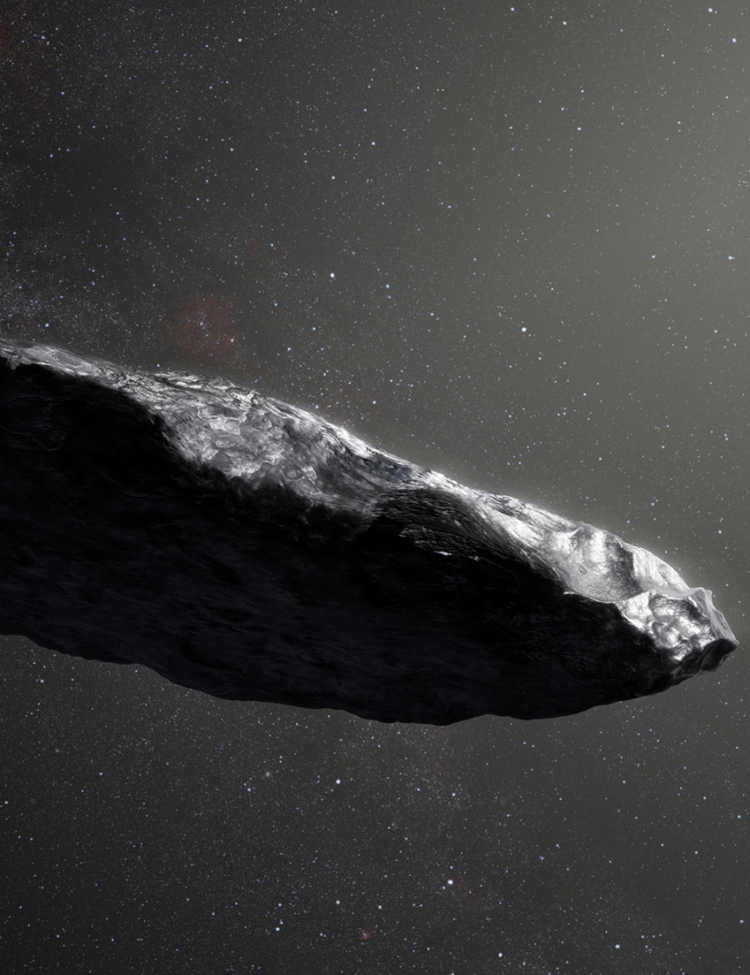
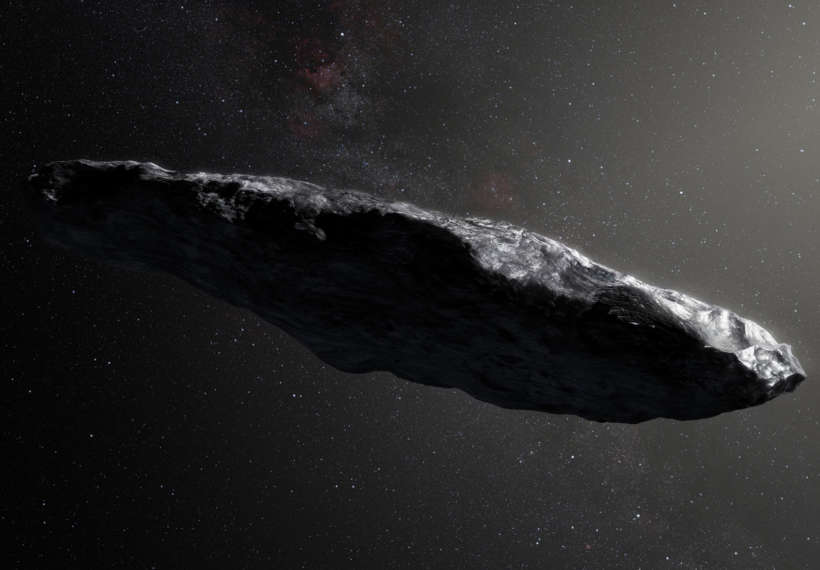
It’s possibly five to 10 times longer than it is wide, which is a really unusual shape.
We’ve seen nothing like that in our solar system.
And if it was over five times longer than its width, then it’s a really weird shape.
So it’s really hard to describe how that would have come from a comet or an asteroid or another planet.
It is extremely strange.
It might not be scar shaped.
Some people think it might be kind of flat, almost like a disc shape.
So it’s basically quite long in relation to how wide it is.
But why can’t it be like title forces have stretched it out?
Like, for example, in Comet Shoemaker-Levy back 25 years ago, that was one comet broken into many pieces.
If you couldn’t resolve the different pieces and you step back, you might think it’s just one long elongated comet, wouldn’t you?
Potentially, but they’re all basically rotating at the same time so that they would be bound in some way because we use light curve data, which is using astronomy all the time to look at objects outside of our earth and stars and planets and things.
The way we do this is we look at how it reflects the light, how an object reflects the sunlight or whatever it might be, the star near it.
And it’s got a very odd light curve shape.
So basically it looks like this object is essentially tumbling through space.
Normally an asteroid or a comet would just rotate almost very neatly and very predictably, but this is basically tumbling.
It’s really, really odd.
So I think it’s got to be one object because if it was a lot of objects, you probably wouldn’t expect to see that pattern in the light curve data.
It’s all happening coherently.
So there are a lot of people who think that this might be some type of alien technology or some kind of masked alien craft.
Philip N.
I says, is this from another civilization?
Yeah, no, it’s really exciting that when this was suggested, it is a really exciting prospect.
But we’ve got to remember, I love the old Carl Sagan saying, extraordinary claims require extraordinary evidence.
And we don’t have the evidence to really strongly support the idea that this is an alien spaceship or some alien spaceship junk or something like that.
What we have to do first is rule out all the more natural observations that we’ve made, all the more natural ideas about what this thing could be.
But just to be clear, your statement, we have to rule them out, is in a way a scientific bias against it being aliens, right?
To say we have to rule out these other explanations before we accept the aliens, that’s, let me not call it a bias, it’s the history of this exercise shows that that’s the right thing to do.
Is that a fair way to say it?
It is, and we have to apply Occam’s razor.
We have to go with the simplest explanation first, because it’s usually the correct one.
But once we’ve ruled out the more simple explanations that it’s a comet or an asteroid or a piece of a broken piece of a planet from another exoplanet, then we can start to look at the more obscure things like is it a piece of an alien spaceship or something.
But what was the most compelling evidence to even think this at all?
I think the fact its shape is probably one of the hardest things to describe, but having said that, we don’t really understand its shape very well.
As I said, we don’t know its exact dimensions and we don’t know what it’s made from.
I remember reading that its trajectory through the solar system was behaving in ways that sort of Newton’s law of gravity would not have predicted.
Is that still holding up, those observations?
So yeah, it basically was speeding up as it went by the sun, but it was not because of gravity from the sun.
Objects normally speed up as they go towards the sun because of its gravity, but this, it wasn’t happening because of gravity.
So we have to explain why it was speeding up, how it got this kind of more, basically more velocities that went by the sun that wasn’t due to gravity.
Duh, it’s aliens.
Yeah, you’re right.
So that is the hard one to explain.
Scientists are looking at that.
They turned on the impulse engine.
So this little engine, it could have inside.
It could be jets, basically of comet jets coming off it.
You just said it’s not a comet.
You said it’s not a comet, doesn’t have comets on it.
We can’t rule it out.
So I think that’s what, we’ve got to stick with simple explanations first, and we’ve got a lot more work to do.
We’re not going to do it on this comet or this object, sorry, because it’s gone now, and we’re never going to see it again.
Okay, so if I could recap what you just said, it’s you want to rule out every possible natural explanation, and even when you’ve ruled them all out, are you compelled to say that it’s alien, or might you say, I’m not clever enough to figure out what missing natural explanation I’ve yet to…
Yeah, I think the latter, because it’s even like, you know when we found, we thought we found life in the atmosphere of Venus, like the scientists had to work so hard to rule out all the natural things that could have been, and all the natural, other natural things.
And then they said it could be life, but they still weren’t sure.
And so they put that out there and said it could be, but I think we can never say for sure.
Of course, the press eats it up, the press loves it.
And that’s always the problem with making these claims, that you’ve got to be really careful because then they’re misconstrued by the media often.
Listen, Natalie, just need you to rule out 11,799 reasons so that we can get to alien.
That’s all I need.
I’m just saying, we’re all scientists here.
How do we get to alien?
That’s a famous number now, right?
11,799, whatever it is.
Another question.
All right, here we go.
Oh, by the way, to future people 20 years from now who are listening to this podcast, just go back and read the news from January to 2021.
There you go.
And you’ll know where that number comes from and who Chuck Nice was imitating.
This is to future people.
You won’t know from the imitation.
Who opened the time capsule.
The imitation’s so bad, you won’t know, but if you look up the op, you’ll be good.
Anyway, ee-capal, wait, wait, cap-yan-nudge, cap-yan-nudge.
That’s it.
I’m sure that’s it, Chuck.
I’m sure Jack.
Yeah, whatever, I’m making it, I’m, it is now, damn it.
It is now.
That’s your name now, ee-cap-yan-nudge.
All right, and this has gotta be the last question, because we’ve been too luxurious here.
I know we have.
All right, so here’s the deal, and I like this.
What is the shape of an asteroid?
Because we’re talking about it’s unusual shape.
He says, or she says, what is it usual for an asteroid to have a cylindrical shape?
What is the shape of an asteroid?
Basically, it depends on size.
And now we’ve gone out to the solar system and started looking at more of these objects.
We found they can be loads of different shapes and sizes.
So they tend to be sort of round.
They tend to approximate a round shape, but they’re not always.
The smaller ones can definitely be sort of any shape you like, but they’re gonna, they’re not, we’ve not seen anything like this before.
So it is really, really unusual, and it is hard to explain with natural processes, but we need to figure out some more stuff.
So what you’re saying is, asteroids have the greatest sort of variation in shape, and among the high variations in shapes that you have seen and measured, this falls outside of that high variation.
It’s definitely at the upper end.
Wow.
So I know what it is.
It was a vertical plug in the throat of a volcano, and it shot out, okay?
And it was actually a weapon coming through space.
And so the Volcanoes in Space movie now has a new way it can have attack ships.
Okay, I like that one.
Well, Natalie, we’ll look forward to your next book coming out in the fall of 2021.
And A Catching Stardust, it’s quite the story that I think everyone should know about.
And who publishes that?
Bloomsbury, I remember that.
That’s right.
I remember that correctly.
Excellent.
Natalie, always good to have you.
Thanks for dialing in from the UK.
No, thanks for having me.
And homeschooling your four-year-old.
I’ll continue.
Excellent.
Excellent.
All right, guys.
Thank you again, Natalie and Chuck.
This has been StarTalk Cosmic Queries.
I’m your host, Neil deGrasse Tyson, your personal astrophysicist, as always, bidding you.



 Become a Patron