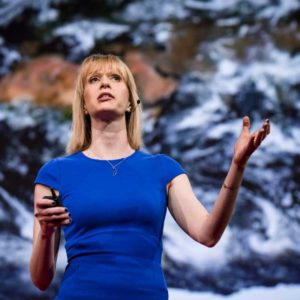
Bill Nye the Science Guy is back to delve into one of his favorite topics of discussion: climate change. Joined by comic co-host Chuck Nice and Kate Marvel, an Associate Research Scientist at NASA GISS and Columbia University, Bill and company answer fan-submitted Cosmic Queries about our changing climate. You’ll hear Kate talk about why the effects of climate change on the weather are similar to the effects of performance-enhancing drugs on athletes. Find out how climate change is affecting the severity of storms in major US cities like New York and Houston. Get tips on how to deal with climate deniers and maybe even ways to change their mind. Investigate the current state of nuclear energy: the benefits, the downfalls, and the dangers. Explore the role of volcanoes in the discovery of climate change and how they impact the climate today. Discover what methods, if any, we’re using to remove CO2 that’s already in the atmosphere. All that, plus you’ll hear why you must be climate-conscious when launching a rocket. And be sure to stick around for the Lightning Round as Bill, Chuck, and Kate tackle deep questions in under five minutes like, “How long do you give human existence?” and “Could we reset the Earth?” The answers are easier than you think!
Transcript
DOWNLOAD SRT
Welcome to StarTalk, your place in the universe where science and pop culture collide. StarTalk begins right now. Greetings, greetings, StarTalk fans. Bill Nye here. I'll be your host this week. Joined by none other, you're not gonna believe this....
Welcome to StarTalk, your place in the universe where science and pop culture collide.
StarTalk begins right now.
Greetings, greetings, StarTalk fans.
Bill Nye here.
I'll be your host this week.
Joined by none other, you're not gonna believe this.
You probably will.
Chuck Nice is here.
Unbelievable.
And our special guest this week is Kate Marvel from Columbia University and the NASA Goddard Institute for Space Studies here in Manhattan, in New York, New York.
The towns are nice.
They named it twice.
And so for this All-Star edition, we are gonna be talking about climate change.
Yes, we are.
And Chuck, you've got a stack of questions from the peoples.
Yeah, some queries from our fans that have been taken from all over the interwebs.
Well, stand by a moment.
So Kate, may I call you Kate?
Please do.
Dr.
Marvel.
I like Kate.
Dr.
Marvel sounds awesome though.
Pretty cool.
I can't live up to Dr.
Marvel.
I just see a superhero standing there going, you think you have me now, Dr.
Marvel?
But then she does because she's wearing her MODIS scarf, right?
I am, yeah.
This is the Aleutian Islands cloud cover taken by the MODIS instrument.
Our good friend, the moderate resolution imaging spectroradiometer spacecraft.
Am I gonna blow the lid off everything if I say we literally just Googled that?
Well, the lid off which you would blow is, since you're wearing the scarf, it is reasonable that you would know what it stood for.
It is true.
I'm terrible at off-the-rolls.
All that aside.
I blew off my own lid.
It shows you the value of acronyms.
They're easier than the full descriptions.
And they're not just a shorthand, they become a name.
And then we'll get back to work in a moment.
The word NASA itself has become a word.
National Aeronautics and Space Administration is a word.
And so it's appropriate that MODIS is a word.
Now with that said, what do you study?
Clouds?
I study a lot of things.
That's the cool thing about being a climate scientist is you never get bored.
So I do a little bit of work in the oceans.
I do a little bit of work with clouds.
I do a little bit of work with trying to understand what rainfall is going to do as the climate changes.
So I'm really all over the place, but kind of the unifying theme of my work is I'm a physicist.
That's my training.
And I use computer models and observations to try to understand what climate change actually means.
And listening to you, it sounds like water is a focus.
Yeah, I'm a big fan of water.
I like to drink it.
I'm full of it.
Right?
If you know what I'm saying.
So, the warmer it is, the more ocean evaporates, the more clouds you get, the more clouds you have, the more sun lights reflected back into space, which might cool the place.
And the most powerful greenhouse gas is water vapor.
Yeah, but clouds are so complicated, though, because not only do clouds reflect sunlight, but they also trap heat from the planet.
So they kind of play this dual role, which means it's really hard to understand what's going to happen to them as the planet heats up.
They're double agents.
You'd have to be like a scientist to figure that out.
So you write computer models?
I work with computer models, yeah.
Yeah, I do a little bit of writing them, but mostly using their output.
So I'm essentially a data scientist in a sense.
Because there are many data to crunch.
There are a lot of data, yeah.
And so what is your feeling?
The word I'm going for here, I think the phrase I'm going for here, is when do the curves cross?
This is to say the world's getting warmer.
Humankind seems focused on not doing anything about it.
When will we do something about it?
And when will we address climate change, no pun intended, globally?
Oh, that's a really good question.
I mean, I should say I am a physicist.
So it's my job to tell you what happens when you put carbon dioxide in the atmosphere.
So I don't really feel like I have that much special expertise in how we not do that or how we take it out.
But I am an optimist.
I mean, that's just kind of my personality.
I want to believe that we're going to do something about this.
And I think we have seen this year, weather has been in the news a lot.
We've had major hurricanes.
We've had major forest fires in California.
And I think this is really getting people talking about this.
Like, oh, hey, maybe there might be something to this climate change thing.
So along with something to this, I was always, what papers I've wrote and so on, it's very difficult to tie any one weather event to climate change.
But then there was, I guess it was two years ago, people said you can tie warm weather events, extreme heat events to climate change, right?
Now, are we able to tie for sure the fires to climate change?
No, because there are, there's so many complicated factors, you know, because it's not just about climate change.
It's about land management.
It's about our choices and, you know, when we let fires burn, it's about where we decide to live.
So it's really difficult to kind of tease that climate change signal out of that noise.
But the way I like to think about it is in terms of doping.
So Lance Armstrong is really good at riding his bike, right?
Like Lance Armstrong would win bike races normally.
But we know that Lance Armstrong was doping.
And it doesn't really make sense.
Or for me, it's not the right question to say, did doping cause Lance Armstrong to win that seventh Tour de France?
But we know what doping does.
So the answer is yes.
The answer is probably.
You know, the answer is probably.
And so it's not really the right question to say, this particular race, would he have won it without doping?
We say, we know what doping does.
And we know what was in your bloodstream.
And so we're going to take away those titles.
Right.
So this isn't StarTalk Sports, but this is quite relevant.
So what is the right question?
I think the question is, are we doping the weather?
And I think the answer is yes.
So in the case of hurricanes, it's really hard to tell, for example, is climate change going to lead to more frequent hurricanes?
I think the jury is still out on that.
And would there have been a hurricane Harvey without climate change?
You know, like hurricanes happen all the time, right?
We get them.
But what about the number of hurricanes and the intensity of these hurricanes?
Yeah, so that's where you start to get on really solid physical ground.
So warm water is hurricane food.
Hurricanes draw their energy from warming oceans, so warm ocean temperatures.
And we know that the oceans are getting warmer and will probably continue to get warmer in the future.
We also know that warm water holds more, or warm air holds more water vapor.
And so that means when hurricanes dump rainfall, on areas like Houston, there is a lot more water that they can dump.
And so that's kind of turbocharging.
That is how we're doping the weather.
And so, you know, would there have been hurricanes without climate change?
Yeah, hurricanes happen.
Would Hurricane Harvey in particular have happened without climate change?
It probably wouldn't have been as severe.
Because the ocean's warmer than normal, so it got more food.
It got more food, and then there's more water vapor in the atmosphere, so it can dump more rain.
So I read a paper, this is several years ago, where people were trying to parse, in the case of hurricanes, trying to decide whether there would be more stronger hurricanes, or would the jet stream move so far south it would essentially decapitate hurricanes, and this convection situation wouldn't be as strong.
So it's hard to figure out, is what you're saying.
But wouldn't that lead to its own little special spate of unbelievably disastrous ecological problems?
The whole problem, if I understand it, Doc, is the ocean's getting bigger, because it's getting warmer.
And so coastal cities are going to be affected.
And then for me, people as a citizen, if Houston gets a hurricane like this every couple years, every five years, if there's a Katrina every ten years, are people going to leave?
And apparently they did a study, or ask yourself, listener, viewer, ask yourself, your house is destroyed, you're standing there, where are we, in New Orleans or we're in Houston?
Your house is not destroyed, it's there, but all the walls have to be removed, it probably has to be mostly torn down, your car is ruined, everything you own is ruined, you got a couple pictures that are soggy and crinkled up.
And someone says to you, I'll give you $100,000 for your house, which you paid in Houston area $350,000.
Many people would go, yeah, I'm leaving.
I'm taking the deal.
And where are they going to go?
Hopefully not New York, that's all I'm saying.
Because I'm here and it's crowded enough.
You know, that's what amazes me about New York.
You and I, the three of us, we're busy, but who are these other people?
On the subway, there's just, there's thousands of people on every train.
Don't you people have homes?
Yes.
What are you doing out here?
Notice that in this weird way, this crowded city of New York is more efficient living than, for example, Houston and so on.
So, doctor, as you study this, you got to be thinking the situation is getting worse and worse, or more and more pronounced.
My situation, I mean, the climate is changing more and more rapidly.
Can that be shown scientifically, or is that just intuition on my part?
I mean, in terms of the rate is accelerating, it matters what variable you look at.
Like, are you looking at something like...
Oh, let's look at X.
How did that happen?
How did X become the variable?
There's some tradition.
Yeah.
No, I read a thing a long time ago about algebra, and the big question was, where did R come from?
That's where I started.
R for the ideal gas law constant.
Where did it come from?
Somebody writes a math paper and it sticks.
There are so few math papers.
Anyway, but I caused us to digress.
We pick a variable, take it, Dr.
Marvel.
I mean, it depends on what you're looking at, because I think a lot of people think, oh, climate change means the average temperature of the Earth is going to change.
And that's true.
But like nobody cares about the average temperature of the Earth, right?
Hang on a second, Chuck.
I'm going to agree.
Do you care about the average temperature of the Earth?
I've got to tell you, until this time right here, never really thought about the average temperature.
Always concerned about the temperature where I am.
Exactly, exactly.
And so, you know, nobody experiences the average temperature, right?
And, you know, like right now when it's cold outside in New York, I think 60 degrees Fahrenheit.
Like that seems like a pretty nice temperature.
I'd like to experience that.
But we experience climate change through all these other different factors, right?
So we experience changes in rainfall.
You know, like you pointed out, sea level rise.
We experience things like, you know, changes in the frequency and severity of extreme events.
And so not all of those things are sort of changing nicely and linearly.
We are expecting kind of step changes.
We're expecting really rapid changes in different variables.
What's a variable that's going to have a step change or dramatic change?
Because while you're sipping, I'd like to talk again briefly about...
Me!
Yes.
So I offered both Mark Moreno and Joe Bustardi, notorious climate contrarians that appear often on Fox News.
I offered them each two $10,000 bets that 2016 would be the hottest year on record so far, at that time.
And 2010, 2020 will be the hottest decade on record.
And neither one of them would take the bet.
I've got $40,000 on the table, neither one of them would take it.
No, no.
Even though they are dyed-in-the-wool climate deniers, they still wouldn't take the bet.
Joe Bustardi's problem, I mean, I'm sympathetic to him.
He's a Penn State guy, known Penn State, University of Pennsylvania, State University of Pennsylvania, known for its meteorology department.
He has confused the idea that carbon dioxide is a small fraction of the Earth's atmosphere with the idea that it has a small effect.
And so he's just gone down a dead end there.
Then the other guy is just how to describe.
A-hole?
Well, he's amoral.
Sorry, that was a joke.
I should not have said that.
No, no.
He just doesn't have morals the way other people do.
He's an interesting guy, I gotta say, in that regard.
So, Dr.
Kate, Dr.
Marvel, what variables should we be looking at?
I mean, for me, kind of the...
an extreme weather event is a good example because you're kind of going along, living your life, you know.
The way you do.
The way you do.
You know, beating up people on the subway when they walk slowly or whatever we do in New York.
It was people.
It was people, right?
Chuck can't even breathe.
It hit him with such profundity.
It hit him so close to the solar plexus.
As you walk on the right side, let people off the train before you get on.
I know you're all new here.
Okay, Dr.
But, you know, the thing is, like, we have all these modern conveniences, right?
We have a, you know, partially functional subway system.
We have roads.
We have electricity.
And then when there's a weather event, like a blizzard or Hurricane Sandy, kind of all that stuff goes out the window.
And we're so helpless, right?
Like, we're so helpless in the face of it.
All of our technology cannot prevent that storm from landing.
It can't prevent the blizzard.
It can't prevent the hurricane.
And that, for me personally, like, as a human, not just as a scientist, like, that really focuses my attention on, like, oh, that's what climate change means.
It means this thing that we can't control.
It means getting more of these things.
Until very recently, most of the science community would not make any correlation between extreme weather events and climate change.
Are you saying that that is now not the case?
Well, I think what Bill said is right, that any particular individual event, it's really hard to say this would have happened or not without climate change.
But we're talking about statistics here.
We're talking about things like 100-year floods, floods that used to come along every 100 years.
Now come along every five years.
Every five years, every three years, every one year.
And it's those things.
And those are really sort of viscerally terrifying, right?
To think about, you know, we live this comfortable life and it can all be destroyed by a weather event.
That really focuses my mind.
I like that.
I like it.
And I'm all about the scare tactics, okay?
That's what I say.
Scientists do not use enough scare tactics.
It's not a tactic.
Well, not a tactic, no.
And you're right, because here's what...
Climate deniers, they have one tool and one tool only.
Propaganda.
That's all they have.
Well, what they've done...
They're not telling the truth.
Yeah, well, what it is, they've been able to introduce the idea that doubt...
Right.
Doubt about climate change is the same as scientific uncertainty.
Exactly.
This is to say, Kate, you agree with this, that the climate contrarians have introduced the idea that plus or minus two or three percent in your computer model result is somehow equivalent to plus or minus 100 percent.
I mean, the way I like to put it is we don't know everything, but we don't know nothing.
And...
Ah, ah.
What about Chuck?
Chuck don't know nothing.
Pulling a double negative for comedic effect.
There you go.
Thank you, Bill.
But, you know, I do get a little bit annoyed when people use the continued existence of science to attack science.
You know, like, we're never going to know everything.
And we're, you know, there are still things to study.
I still go to work every day.
But that doesn't mean that carbon dioxide isn't a greenhouse gas.
Like, if we are wrong about carbon dioxide being a greenhouse gas, like, we are wrong about, like, all of physics and chemistry.
Like, gravity.
Everything is wrong.
Like, this is, like, a very basic thing.
And there's, you know, fascinating complexity on top of that.
And that's why I love my job.
And it's so fun.
But, like, there are certain things that are just so basic.
You say your job is fun.
Doesn't it get you down a little bit right now?
I feel like people are really disappointed that I'm not depressed.
You know, I'm going to say...
Are you disappointed in Kate?
I'm refreshed.
You know, because I'm depressed, so I'm glad that you're not depressed, okay?
Because I am absolutely crestfallen, you know?
Yeah, no, I mean, I think, like, everything you're saying is true.
Like, this is a big problem and it's really scary and it can feel really intractable.
But also, like, the Earth is this great, amazing planet.
I feel really grateful to live here.
And, you know, like, I...
I like that as an understatement of this.
So we are going to talk about this.
We are going to get to listener viewer questions in the next few moments.
You're listening to StarTalk All-Star edition today, talking with Dr.
Kate Marvel from Columbia University and NASA Goddard Institute for Space Studies and we will be right back.
Welcome back, welcome back to StarTalk.
I'm your guest host, Bill Nye.
And this week, we are talking about, I'm reluctant to call it my favorite topic, but something that I'm deeply concerned, but I hope you are too, climate change.
And for that, we not only have your beloved Chuck Nice.
That's right.
We have this week, Dr.
Kate Marvel from Columbia University and the NASA Institute, Goddard Institute for Space Studies right here in Manhattan.
And doctor, we were talking about your optimism, your, you love coming to work, you love talking about climate change, studying climate change, even though climate is changing.
Climate is changing, that's for sure.
But no, like this is, this is a fascinating planet and how, you know, we have oceans, we have an atmosphere, we have land, we have ice and all of those things interact with each other.
I love it here.
I mean, I'm from here.
I'm not objective.
Like I'm, I'm, I'm, yeah, hometown crap, right?
My friends are from here, yeah.
No, if it's earth versus Saturn, you know, in the solar system cup, I'm all about earth.
I mean, are you really gonna like go to Mars and it's just gonna be like you and Elon Musk and it's gonna be weird.
You guys, you're not gonna go too far afield with this, but I just wanna remind all you Mars buffs.
It's really cold.
I mean, it's really cold on Mars and it's really hard to get water.
And this third thing I talk about this, there's nothing to breathe.
You will notice that right away.
Sounds a lot like Minnesota.
No, Minnesota, you can breathe.
Just can't run and breathe.
So it's like a one-star Yelp review from Mars?
Yeah, yeah, well, if that.
And so this romantic notion of going to Mars and living under a dome, and then you go outside for a walk, you're gonna put on a spacesuit, which will be your own dome.
Right.
And if you've ever worn the same clothes for two or three years, they'll start to smell like that.
The whole thing will be an extraordinary camping trip that is not paradise.
All right, whereas the earth is paradise for us humans.
Now, Chuck.
Yes, sir.
We have questions from out there that Dr.
Marvel, Kate can interact with.
That's right.
Let's get to one.
And we always start off with a Patreon patron, because they...
Patreon patron.
That's right.
They support us financially and therefore they get precedent because...
So you're saying...
You can buy your way onto the show.
I did just say that.
Kinda.
I did not say that.
I'm a guest host.
I will not back down from that statement.
I'm a guest host.
I will not back down from that statement.
That's right.
You can, just like your Congress, we can be bought.
All right.
Chuck, he's exaggerating.
This message bought to you by...
Nevermind.
Here we go.
This is Jacob Casey from Buffalo, New York.
And he wants to know this.
He actually phrased it just like this.
Tell me, Dr.
Marvel.
No.
Human behaviors are contributing to climate change dramatically.
Was this inevitably going to happen at some time in the distant future anyway?
Which is, and to just put on some piggyback on what he's saying, kind of what climate deniers, that's their go-to.
Hey man, yeah, we recognize that the climate is changing, but what are you gonna do?
Climate changes.
So would that be the case at some point down the line if we didn't have our own contribution?
So I feel like climate deniers like to tell climate scientists that climate always changes.
And we're like, we know, we told you that.
So we are very aware of the fact that the climate of the planet has been really different in the far past and it will be really different in the future.
But we have ideas about what caused that.
Specifically, ice ages are caused by the planet sort of wobbling in its orbit closer to or farther from the sun.
They're called Milankovitch cycles.
And that's-
Discovered by Steve-
Buford.
No, I think his name was-
Steve Buford, who discovered the Milankovitch cycles.
So the earth goes around not in a perfect, it goes around in an ellipse, but there's perturbations and there's wobbles.
There's mutations.
And just to be clear, so those wobbles, they actually shift the earth just enough to create what effect?
Different climates.
We get ice ages, we come out of ice ages.
And so we know that there are natural factors that change the climate, those orbital wobbles.
When a giant volcano goes off and puts a bunch of gas and dust in the atmosphere, that blocks the sun and makes it colder.
But similarly, massive tectonic activity can put a lot of carbon dioxide in the atmosphere, which makes it warmer.
There's a lot of volcanoes.
A lot of volcanoes.
A way of example.
And so in the past, we have geological and all this corroborating evidence for those orbital wobbles or volcanic activity.
And all that stuff is not happening right now.
So that's actually how we know that it's us.
We can measure how close are we to the sun.
We can measure that solar irradiance.
We can measure, we would notice if a giant volcano was going off all the time.
And it's not.
Maybe it's a really quiet volcano, Dr.
Michael.
Well, people talk about seeps and methane getting in the atmosphere, but this can all be measured with extraordinary precision.
We can measure it.
And moreover, we know exactly what carbon dioxide does.
So getting back to the question, was this going to happen in the future?
Anyway, if you wait for millions of years, like yes, the climate will change and we know what makes the climate change.
But right now what's happening is we're so sure that we can attribute it to carbon dioxide in the atmosphere and we know who put the carbon dioxide there.
It's really getting back to the question of rate.
It's really that rate that's incredibly terrifying.
This has never happened before in the Earth's history.
Never has the climate changed this quickly.
So I think that answers the question.
Let's take another question.
It's like the answer is it would happen in whatever million years, but not for us, we're doing it.
All right, let's go to Facebook and this is Matt Eli.
Wants to know this.
So you've been able to convince a died hard, humans have nothing to do with climate change per person otherwise.
And if so, what has worked?
So in other words, have you been able to convince anybody and how did you do it if you have?
The answer is yes.
Oh, I'm surprised, I'm really shocked.
He's a media professional.
Unfortunately, the person in question is my dad, but my dad is a Republican, has always voted Republican and just thought this climate change thing, it's nonsense.
It's a liberal progressive.
It's a liberal progressive conspiracy.
And my dad knows that I love him and I didn't come in and say, you're an idiot and I hate you and you don't understand anything.
Oh, wow, have you been eavesdropping on my family conversation?
It's all over town, Chuck.
You wear your holiday dinner on your sleeve.
Anyway, you talked to your dad.
Yeah, I talked to my dad and the thing that I thought really convinced him is, you know who takes this really seriously is the US military and they're not a bunch of hippies.
I mean, maybe they are, but I don't think they are.
They have to cut their hair short if they are.
Cut their hair short.
So the military takes it incredibly seriously.
Insurance companies who are responsible for paying out policies, they take this incredibly seriously.
And so these institutions, like my dad doesn't listen to scientists who live in Brooklyn.
My dad listens to the military.
He listens to large corporations.
And there are a lot of those institutions that are actually taking this really seriously.
Which we hope will trickle up into voters' brains and we'll make decisions in the future to address this.
Like that trickle up.
So try another question, Chuck.
If we got to her dad, maybe we can get to our listeners.
We can get to our listeners.
The answer is everybody needs a physicist in their family who's studying the climate.
Well, we're here for you.
We are physicists here for you.
You're the StarTalk family out there.
Take it, Chuck.
Read us another question.
Oh, that was great.
Here we go.
Here you go.
This is Ave Valencia, who wants to know this, what is the link between plastic in our oceans and climate change?
Now, is there any link?
Well, there's a manufacturing link, for sure.
When you make plastic.
Doctor, were you going to say something?
No, I was just going to say we did both of them.
The link is us.
We extract oil and we make plastic, make these long polymers.
Oil will have a bunch of carbons linked together, often in single bonds, and then you take them out and you make them into polymers.
Very long change.
You know, we have this expression, high molecular weight, ultra high molecular weight, polyethylene and stuff where these things are really long, and then you make them into milk jugs and sweaters.
Right.
But then when you throw the milk jug away and people dump it off the back of a ship and it ends up in the ocean, in the Indian Ocean gyre, this giant spiral, or whirlpool out there.
Yeah, the thing ends up in the middle.
And so through secondary flow, our favorite.
So humans, when they make plastic, among which we are home, you're extracting oil and you're going to use fossil fuel burning to run the chemical process to make the plastic.
And then when you throw the plastic overboard, you're putting in the ocean.
And so the link, Kate, you hit the nail on the head, is us.
And plastic has improved the lives of a lot of people, let's face it.
Yeah, just the medical profession, let alone just having food that doesn't kill you is of great value.
And plastic helps us with that.
And then airplanes nowadays are made of plastic.
Your car is lousy with plastic.
And this microphone, this insulation, all this stuff is plastic.
But moderation, people.
And wouldn't it be great if we could recover the plastic and not throw it away?
And wouldn't it be great if we got our energy renewably instead of burning fossil fuels, instead of combining carbon with more carbon and fluorine to make plastics?
And instead of combining carbon with oxygen to make CO2?
Wouldn't it be great if we did something cool with it?
Take it, Chuck.
Bill, pull back.
Pull back, Bill.
I love it.
I love it.
I love it.
All right.
So speaking of what you just said there, Bill, Septura coming to us from Instagram says nuclear power or renewable energy.
So what are the advantages of both and which is preferable given, this is not all in the, but I know what you're saying.
You're embellishing.
I'm embellishing.
But given the current needs of the globe and the fact that you have emerging economies where there are people in two different continents.
Chuck, you are a nerd, man.
I know.
I can't help it.
I love it.
Where you have a billion people in one and a billion plus people in the other and they all need energy and we've given them a taste of this and they've got to produce.
So is it fair to say that nuclear power is something that we want or do we just go the renewable route?
Kate, do you have an opinion because I do.
I would love to hear your opinion because I will get yelled at on Twitter if I have an opinion on this.
Really?
By a whole different set of people.
So here is the problem with nuclear power.
It looked like a great idea.
You dig these rocks up, purify them, fish in them and put them back in the ground.
This would be great.
Fabulous.
But what has made nuclear power so expensive is the so-called low level or secondary waste.
All the rubber gloves and coveralls and everything that get radioactive.
Oh my God.
Really?
I have never heard of this.
Well, it is a big expense.
It is fantastic.
Well, I mean, well.
And then the biggest problem, everybody, is nobody wants it.
Right.
Let's say it is the greatest thing ever.
Nobody wants it in their neighborhood.
Not in my backyard.
And then here, so just consider the following.
Okay, bite my head off, Twitterians, but my fellow Tweetists.
Wait, I have to write both of those down.
Well.
That is perfect.
Note well.
There are about 432 commercial nuclear power plants around the world.
The US.
Navy, BT Dubs, is really good with its nuclear material, as long as you think really good is burying it literally in Idaho when you're done with it, in remote area, what we consider remote areas here in the US.
So that's good.
But commercial plants, 432 plants, there were 433, but Fukushima blew up, and so there's only 432.
All right.
So Three Mile Island, which is right at the end of the runway at Harrisburg, Pennsylvania, Pennsylvania, state capital, almost blew up.
And the evacuation plans had this side of town going that way and that side of town going this way.
And so it would never have worked.
Then Chernobyl blew up.
And then Fukushima got awash and a mess.
And then you can say as a proponent of nuclear power, I am hip, I'm a mechanical engineer.
Who doesn't love thermodynamics more than I?
No one.
All right.
You could say, well, these kooks just won't let us have nuclear power.
But everybody, you would not get in a car that had a catastrophic failure three out of 432 times.
It wouldn't even occur to you.
So you can say, well, the nuclear industry shouldn't have put that plant at the end of the runway.
But they did.
They shouldn't have put Fukushima on a geologic fault.
But they did.
They shouldn't have allowed it to get hit with a tsunami.
They did.
They shouldn't.
Those engineers in Chernobyl shouldn't have allowed the graphite to overheat.
But they did.
And so this is the problem is the perception of the nuclear industry makes it so nobody wants it.
So what I would prefer is for everyone, now look, it's Kate Marvel is our guest.
Chuck Nice is our commentator.
But I'm ranting.
I'm done momentarily.
This is a good rant.
I mean, I will be done momentarily.
There is enough sunlight, enough wind, enough geothermal energy and enough renewable energy to run the whole place right now enough renewable energy to run the whole place right now.
And I encourage you to check out the solutions project.org.
The problem is going to be the opportunities are going to be moving the electricity around, storing the electricity overnight.
But we can solve these problems if we just go after them.
And so let's not shut down existing nuclear power plants, but let's deal with the reality that it takes 10, 15 years to license one.
This is StarTalk All Stars.
I'm here with Dr.
Kate Marvel from Columbia University and NASA and Chuck Nice.
And we'll be back right after this.
Welcome back to StarTalk All-Star Edition.
I'm Bill Nye, your guest host this week, and I'm here once again with your beloved Chuck Nice.
Thank you, Bill.
And our guest this week is Dr.
Kate Marvel from Columbia University and NASA's Goddard Institute for Space Studies.
And she is an expert on climates, which we have here on Earth.
And so we, of course, as you might expect, are talking about climate change.
So we are in the segment of the show in which we take your questions.
Let's take one more, Chuck.
And then Kate, if you will, give us your amazing insights.
Sure thing.
This is Josephine.
Josephine.
Quiero from Facebook wants to know this.
Is there a volcanic event or system that could cool Venus to any extent?
I'm not sure exactly.
Could cool Venus.
Could cool Venus.
You know, the way it does.
Everybody, Venus is so hot.
How hot is it?
It's so hot that lead would melt.
And this is where, when I was in school, in engineering school back in the day, this is where climate change was really discovered, was exploring Venus.
James Hansen, Jim Hansen was looking at Venus.
So, the Muppet guy who was studying Venus?
That's a different Jim Hansen.
Oh, okay, I'm sorry.
Place is lousy with him.
So, Kate, can you talk about the role of volcanoes writ large, Venusian or terrestrial?
Yeah, can I go back to Earth?
Cause I feel like it's not fair.
I went with terrestrial.
Yeah, okay, great.
So, volcanoes, the volcanoes that we've experienced kind of over human history, mostly have a cooling effect on the climate.
So, in 1991, Mount Pinatubo in the Philippines exploded and just put so much gas and dust and dirt basically into the stratosphere that that blocked the sun and that made the planet a lot cooler.
But you say a lot.
Some fraction of a degree Celsius, yeah?
Yeah, but noticeably cooler.
Exactly, on a huge planet, it's a big deal.
So, over kind of recent history, if you take humans out of the equation, volcanoes have been by the...
There are a few I wouldn't mind taking.
Am I right?
There's people on the subway.
But so if you ignore humans, then volcanoes are generally the biggest external contributor to climate change.
But we can't ignore humans.
Right, the place is, talk about lousy, it's overrun.
But my understanding, if you're a volcano and you want to affect the climate, you have to be in the tropics.
Yeah, yeah, so not every volcano is going to be able to affect the climate.
You need to be in the tropics, you need to really get that plume really high up.
If you're a volcano.
If you're a volcano, which you know I-
So like Mount St.
Helens, my beloved Mount St.
Helens was not, didn't do much.
Didn't do anything really, right, for our climate?
It did its best, guys, but not for climate.
It was spectacular.
I was living in Washington State at that time.
So Chuck, we have another question.
Yes, let us move on.
This is from Cosmically Curious 97 on Instagram.
And Cosmically wants to know this.
We call him Cos or her.
I think I'm gonna call it Cos.
Yeah, yeah, that's a good one.
But not the Cos, because that would be, you know, a little...
That's troubling.
Right now, that's quite troubling.
Exactly.
We are currently working on ways to reduce our emissions of CO2.
But are we attempting to make any strides in the removal of CO2 that is already in the atmosphere?
And with that, it reminds me of a statement that I heard from Rex Tillerson, our now Secretary of State.
But at the time, he was the CEO of ExxonMobil.
And he said...
Chuck, he said...
We can engineer our way out of this problem.
Sure.
Sure.
CO2 may be, and he said, may be a contributing factor.
But if that is the case, we will be able to engineer our way out of the problem.
So are we making any strides?
And was Rex Tillerson right?
Oh, dear.
So I'm not sure the...
Is the first part of that question.
We are currently working on ways to reduce our emissions of CO2.
That was the first part of it.
Are we doing that?
Yeah, well, I've been to...
I've been north of Fort McMurray, Alberta, where Shell Oil Company is doing two things.
They are taking carbon dioxide out of their waste gases and liquefying it or getting it really cold and pumping it underground.
This would be carbon sequestration.
But is that taking it up before it gets to the atmosphere?
Yeah.
But the thing of it, it takes a tremendous amount of energy to do this.
And it's a demonstration project and they're getting a big tax credit for it.
And oil up there is coming from the tar sands.
And this is so by one reasonable estimate, a Canadian citizen is among the most environmentally responsible citizens, smallest footprint by one reckoning, smallest greenhouse footprint of any country in the developed world.
But if you take into account the tar sands, a Canadian citizen is the worst.
So the tar sands are just this extraordinary place everybody in Alberta where the ground right under the topsoil is made of sand full of tar.
And there's a trend to call it oil sand.
And I've been there.
It is tar, everybody.
That's what it is.
Get over it.
So it takes about 30% of the energy in the tar to melt it down and reform it into synthetic oil.
It's just everybody...
It sounds like an extremely inefficient way to get energy.
Well, it's...
Yeah, but it's just limitless.
That's the deal.
That's the deal.
1985 is when they started doing it.
Anyway, as the saying goes, the bad news is we'll never run out of tar, never run out of coal.
Yeah, but this aside, here's a question, Kate, writ large, is, in my opinion, which Chuck, as you know from all these years, is correct.
We are already engineering the planet.
This is to say, we have put the old analog Richard Alley would make is you get the roast, even if you're a vegetarian, you've heard of it, okay?
They put roasts in the oven.
Okay, let's not go down that road right now.
You take the roast out of the oven, the heat continues to move toward the inside of the roast.
It's baked in.
You're not going to let go of that.
Exactly.
So the carbon oxide that's already in the air is going to continue to cause the world to continue to warm, even if we stopped everything right now, right?
But you can turn off the oven, you know.
So even though the heat still, you know, in the case of the earth, the heat is still going to move into the ocean.
It takes that deep ocean a really long time, like centuries, to heat up.
And so we have kind of put a time bomb in the system for ourselves, like even if we, you know, stopped the increase in emissions, even if we froze them at the current levels, we would still see warming in the future.
But that doesn't, I don't think that's an excuse for despair.
I don't think that's, you know, we can just throw up our hands and say, oh, it doesn't matter.
Let's just keep increasing emissions because, you know, even though the roast is still cooking, you still can turn down the oven.
That's funny.
And as from a cooking standpoint, what you just said, sometimes when you turn off the oven, if you leave whatever is in the oven cooking, it gets overdone because the oven is still radiating heat.
It's an analogy.
Here's the thing.
I think every one of us, all of us should consider we are in charge of this planet.
There's 7.3, almost 7.4 billion people today by 2050, there'll be 20, there'll be 9 billion 2060, maybe 10 billion people.
We are in charge.
We are running the place like on a science fiction show where they go to a planet and the whole planet is ice.
The whole planet is tropical jungle, the whole planet is this and that.
We are running the whole show and we have to look at it that way.
So what we want to do is stop pumping carbon dioxide in the air, provide clean water, renewable electricity and access to the electronic information, internet to everybody in the world and dare I say it, change the world.
Now that little beep, Chuck, means it's time for the lightning round.
And Dr.
Marvel, Kate, we want you to jump in there.
This for correct, this for not so much.
Oh no.
All right, here we go.
This is Mark Eric Svensson from Facebook says, I've been told my whole life to recycle paper and other goods, but if landfills are so bad at decomposition, isn't it just tossing things into the ground and sequestering carbon underground?
So now landfills are not are still exposed.
So I'm not sure what he means.
I think he means when you when you cover it all over, isn't that just sequestering things underground?
Yeah, but that stuff is going to become carbon dioxide anyway, their bacteria are going to attack it.
But what you want to do with a landfill is capture the methane.
That's all the rage these days.
So the answer is the longest journey begins with a single step.
Some landfills are good, some of them not so good.
Wow, that's a good answer.
Great answer.
Okay, here we go.
Thanks, you guys.
JD, as in J-A-Y-D-E-E says, how long do you give the human race if nothing changes?
Humans are extinction proof.
They're just they're going to be here.
I mean, I care about specific humans, right?
And you know, I think climate change is going to really affect specific people and people we care about.
But as a race, we're going to be fine.
We're fine.
Right.
It's good news and bad news, as far as I'm concerned.
Take a chance.
Exactly.
I don't think that's a real name.
Could be.
It's unforgettable.
There you go.
About the hole in the ozone layer, how can there be a hole in a layer of gas?
Wouldn't it just be gas getting thinner?
Take it, Kate.
So the hole in the ozone layer mostly lives over Antarctica because of the way the circulation of the atmosphere transports ozone.
And the really good news, the thing that makes me so happy about the ozone hole is that it's getting smaller.
And why is it getting smaller?
Because we did something about it.
We got together as an international community in the face of massive corporate opposition and we did something about it.
So we had regulations for the common good.
That's crazy.
Take it, Chuck.
You communist.
At Cosmic Kid, 1598 from Twitter wants to know this.
Is climate change cyclical or is it entirely caused by humans?
Our current state, is it entirely caused by us?
The percentage of warming that's attributable to humans that we've observed in recent history is over 100%.
What?
Over 100%.
How do you get over 100%?
Without us, it would be cooling slightly.
Whoa.
Take it, Chuck.
Wow.
That is the coolest.
Kate.
That was Kate.
That was really a bomb drop.
That was a mic drop.
That was a bell ring horn squeak.
Yeah, man.
All right.
Here we go.
Mohammed Alenzi wants to know this.
Can we reset the earth?
Let's not try.
There you go.
That's a bing drop thing.
Mic drop.
Nicely done.
Let's not try.
It's just too big a problem.
All right.
The legendary pancakes.
Move forward.
Pancakes.
Oh, legendary pancakes.
Legendary pancakes.
That's the name.
That's the name.
Yes.
It says, does climate change cause any specific health concerns?
That's a very good question that nobody ever even talks about.
Well, we're each going to talk about it.
The number one thing that pops to mind is tropical diseases.
The tropics are expanding and the diseases are going with it.
Pests for crops in North America show up earlier and stick around later.
It makes more pesticide, more herbicide to deal with it and our crops, our farms are going to have to move north from central US into southern Canada.
So that's a big effect on a big thing.
I think we're getting down to the last question.
Here's the last one.
This is handmade Ina wants to know this.
Does the cosmic rockets that burn their fuel impact the ozone or climate change in any way?
Yeah, when you shoot a rocket, you have to fill out environmental impact statement.
You're burning kerosene like a crazy thing.
Oh, yeah, yeah.
It's your tax dollars at work.
This has been StarTalk All Star Edition with Dr.
Kate Marvel from Columbia University and NASA's Goddard Institute for Space Studies.
Chuck Nice has been here reading your happy questions.
This has been a fascinating show.
Thank you so much for joining us.
I'm Bill Nye, your host.
We'll see you next time on StarTalk.
See the full transcript



 Unlock with Patreon
 Become a Patron