From the early Gemini space missions to the future of Mars exploration, anytime humans venture beyond home they’ll need to have some snacks for the road. Dr. Charles Bourland developed food for astronauts for 30 years, since the days of the Apollo Moon landings, and he propounds on the preparation and packaging that goes into making food fit for space.
Chef Brian Ray, whose engineer father worked on the Apollo LEM and Saturn rocket, considers how cooking and restaurants would change in microGravity. Eugene Mirman reconsiders his desire to take a journey into space if instead of chips and BBQ ribs, he has to settle for irradiated beef and freeze-dried ice cream.
Transcript
DOWNLOAD SRT
Welcome to StarTalk, your place in the universe where science and pop culture collide. StarTalk begins right now. Welcome back to StarTalk Radio. I'm Neil deGrasse Tyson, your personal astrophysicist. And this week, our special topic is on space food....
Welcome to StarTalk, your place in the universe where science and pop culture collide.
StarTalk begins right now.
Welcome back to StarTalk Radio.
I'm Neil deGrasse Tyson, your personal astrophysicist.
And this week, our special topic is on space food.
What do they eat when NASA casts astronauts into orbit and beyond?
And to help me digest this topic, I've got with me a comedian, Eugene Mermin.
Eugene, this is not your first time on StarTalk Radio.
No, this is the second time.
If we're counting, if we're using the traditional numeric system that I've become used to.
Base 10.
Otherwise, it would be 1-0 if it were base 2.
In base 7, what's visit would this be of mine?
It would be 2.
Yeah, yeah, just testing you.
For the geeks out there.
You passed.
Really up until probably 4 or 3.
Anyway.
We're talking about space food.
How do you prepare it?
How do you package it?
How do you eat it?
I don't know if you knew, the earliest flights, like the Mercury flights, they just went up in orbit for an hour and a half, a couple of hours, and came back down.
No one was thinking space food.
They didn't bring anything?
No, no.
Well, they might have had some reserves in case they landed somewhere unpleasant on earth and they had to stay alive before GPS would ever find them.
This is way before any actual-
So they, so back then, they would have sort of the reserves for if they landed in an unseemly place.
But otherwise, in space, no.
In fact, they didn't even have really ways to go to the bathroom.
They would just, you go in orbit, a couple of orbits in orbit is an hour and a half.
You're up there for three hours, four and a half hours.
And so it's really just to see if you could survive the trip.
So technology has advanced so much that we can send bathrooms into space?
Is that what you're saying?
That's exactly what I'm saying, or means of excreting in space.
Yes.
And if what goes with that is, of course, the ingestion of food.
And so it required longer duration trips in space.
So the next program after Mercury was Gemini, where they went from one astronaut to two astronauts.
Gemini, the twins, isn't that clever?
It's very clever.
I wish I could send a congratulations back in time.
So Gemini, Apollo, follow Gemini, and that was the embodiment of the moon landings.
Apollo ended, but we still were going into space.
We had Skylab, which was our first sort of space station.
Mir, the Russian space station.
Mir is Russian for peace.
Yes, I know.
You knew that.
And world.
Because you are Russian, aren't you?
Yeah, that's the reason.
I even know the other meaning of the word.
It means world?
Yeah.
I didn't know that.
There you go.
I'm glad to come and ask the physicists to learn.
Why didn't they have a second word for it?
Well, it's the same way that I think it's a homonym.
I forgot what all those words mean.
I'll take it for it.
It's a homonym.
All right.
A samonym.
Yes, a soundalikesy.
And so then, of course, the International Space Station, where people are up there for not only days, at least days, but in some cases, weeks, months, and in a few cases where Russians who have the record, they're up there for more than a year.
And so I interviewed Dr.
Charles Borland, and he's a NASA consultant who's been developing food and food packages for space missions for 30 years.
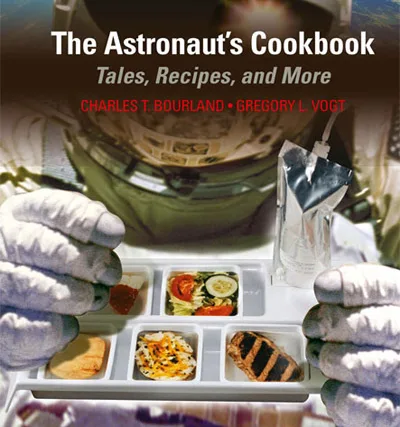
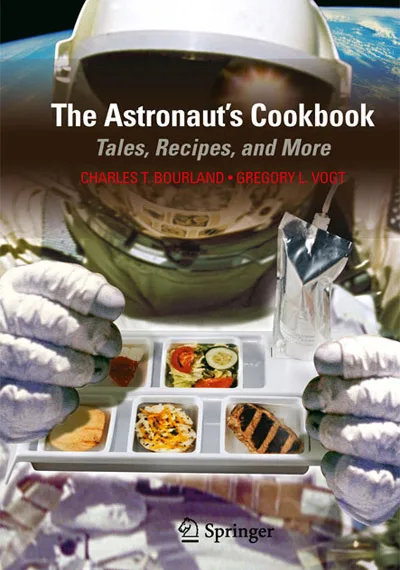
He goes way back, and he's co-authored the book The Astronaut's Cookbook, Tales, Recipes, and More, and he visited me in my office here in New York City, and I want to share some of that interview with you.
So let's check out what he has to say about space.
You've been feeding astronauts from the beginning.
Well, it was Apollo 12 when I first came to work.
Okay, so they'd already landed on the moon by then.
Okay, so you're a newcomer then.
So tell me how the food has changed.
Well, we found out in late Apollo that we could eat with open utensils in space, which was a major change.
Instead of sucking food out of packs.
Sucking in out of a package, and then we also found out that we needed to heat food, and we started heating it on Skylab.
So Skylab came after Apollo, so that would have been like early 70s.
Right.
So you didn't trust astronauts with a fork or a spoon in the early days?
What's the problem?
Well, I thought the problem was that it would interfere with the equipment if it had spills, but we found out that if it's wet, and surface tension will keep it on the utensil so you can eat most things.
Oh, so what you're saying is that if you're going to have open food, as opposed to food squeezed out of a pack, that food would have to be a little bit sticky.
Yeah, it has to be wet.
Wet, so that it stays on your utensil.
Right.
If you open a package of peanuts, it's all going to float away.
And then the peanuts in places you don't want it to be.
Right.
No loose food in zero G, period.
That's what that is, Eugene.
And you know, food is packaged in a variety of ways.
There's so much we take for granted on Earth that when you're eating it, you kind of expect gravity to bring it back to your plate.
Yes.
As you tell kids, eat over your plate, eat over your plate in space, there is no such commandment.
Because the food floats in front of your face if it falls out of your mouth.
Would people just keep it floating in front of them and pick at it?
Well, you can do that with M&M's and other things that-
Ribs?
Floaty ribs and floating soup?
Yeah, but you see, M&M's have clean, hard surfaces on them so that they can actually careen off of sensitive equipment.
Ribs would have a different relationship to-
Oh, I meant dry rub, sorry.
St.
Louis dry rub.
Exactly.
I thought that was assumed.
So it's packed in many ways and when they eat, they actually will strap the tray to their lap.
And they can be what we would think of as upside down, but it won't matter.
The food is attached to the plates and the plates are attached to the tray.
The tray is attached to them.
And it's surface tension that keeps the food on the tray?
Yeah, exactly.
Well, right, so they try to eat foods that are wet.
And we'll learn more from-
What's the driest wet food?
Could it be like chicken, would it be a curry?
The driest wet food-
Meaning is it all liquidy?
That's a crazy question.
Sorry.
So it just has to be able to want to attach to itself.
So it has to be full of desire.
This is the weird-
It just has to prefer to be attached.
It has to-
If it sees-
So haven't you seen two drops of water very close to each other on the table?
And if you connect them a little bit, what do they do?
It's my favorite thing, make a pile of water.
Two drops next to each other, you bring them close-
Are you writing a poem?
And they touch and they kiss each other, then both puddles merge into one.
It's a beautiful thing, try it at home one day.
I will, I can't wait.
And the same thing is true then about chicken tikka masala, you're saying?
I don't know that food.
Okay, yes.
So on the International Space Station, when they rehydrate food, they have special rehydrating machines.
They can rehydrate it with cold water or hot water to reconstitute the food in order to turn it into something that they would recognize or love.
And so Charles Borland, like I said, who was a food scientist in the service of NASA, I spoke with him about what it is to develop food for 0G.
What he has to do differently than what would otherwise happen on Earth's surface.
Let's see what he tells us.
Have you done the 0G plane?
Yes.
Have you done it while eating?
Yes.
Did you barf?
Yes.
Yes to all.
Yes to all of the above.
The first time I barfed, about the second parabola, then I took drugs from then on.
And I could last for about 30 parabolas without.
30 parabolas.
So the parabola is the trajectory of the plane.
It's a loop that goes up and as it falls back to earth, you're weightless, basically.
And they normally do about 40 of them.
40 in one trip.
Right.
Now, if you're weightless, so too would be your vomit.
So that would not be pleasant for other people, I wouldn't think.
It's not even pleasant for you.
I found out the first time you don't vomit in 0G, you hold it.
You hold it?
I don't even know what that means, to hold it.
I don't know if you're biophysically capable of holding vomit.
So you put your money where your mouth was.
You're designing food, you ate it in 0G, you're testing to see what effect it would have on you.
That's admirable.
Basically, we're testing the packages to see if you could open it and if you could eat from it with utensils.
Right.
So if you're trying to rip it open and it flies out of your hand and then it scatters everywhere.
For example, on Skylab, we had a big can and it's a pop-off lid, you pull the lid off, if you open that in 0G, half the contents come out with the lid.
That's bad.
The challenges of 0G eating, Eugene.
Wait, so the plane, it falls?
Yeah, so basically, that's correct.
So the plane goes up and it takes a trajectory that is effectively freefall towards Earth.
How long does that last?
How long do you have to eat your soup?
Yeah, so if you want to eat your soup in 0G, you've got about 20 seconds to do so.
In fact, for scenes in the movie Apollo 13, they want it to be authentic.
So they're all actual 0G.
So they have to staple together these 20-second filmed intervals to make it look like they were continuously in space.
So was he saying that he falls 30 times testing foods at 20 seconds?
Yes, in effect.
On drugs.
That's what he ate.
Drugs to prevent him from throwing up.
Oh, not like PCP to feel invincible.
I don't know what other drugs he might have taken, but he's just trying to not throw up.
I see.
What we really need in this conversation is an actual chef.
Who knows what it's like to fall from space eating food?
Or at least knows how to make food.
So we have with us, live in the studio, we have Brian Ray.
Brian Ray has competed in nearly 20 episodes of The Iron Chef.
If you know the show, you know how challenging that is.
Yeah.
And it's on the spot.
You don't know what you're gonna have to make beforehand, and they reveal it, and there you go.
And it tests your creativity, your panache.
I would be crushed by the stress of kitchen stadium.
And I didn't have to take drugs to do it.
There he is, welcome to StarTalk Radio, Brian Ray.
Brian, so right now, you're co-executive chef at Budokan, restaurant in New York City.
Yep.
Features, let me guess, Asian cuisine.
Yeah, modern Asian cuisine.
Budokan.
Chinese primarily.
This sounds like one of the evil enemies in Star Trek.
This is Budokan.
Budokan is, it does, it sounds like an angry monster.
Budokan is a theater in Japan.
It's like theatrical.
Is your food particularly theatrical or histrionic?
Should I say?
So one of the reasons why we love having you on the show cause you're not only an expert chef who's competed, but not only that, your father was an electrical engineer for NASA.
Yeah.
How often do I get a chef with genetic links to NASA engineer?
I know we're all thugs normally.
But at your age, you were probably like a little, little taught at the time he was doing this.
Yeah.
What do you remember that he did for NASA?
The stories that he told us, he worked for Grummond.
He did the test, he tested the LEM.
Oh, so the lunar excursion module.
So Grummond, right on Long Island here, this is where they built the module.
This is, so this is what landed on the moon.
Yep.
Yeah.
My brother Eric was born at the time.
Is that right?
And then he also-
He should be your older brother.
Correct, yes.
Much.
And then he also helped with the Saturn V booster rocket.
He helped with the stage one.
Stage one.
That's like the first one.
Sounds like it, right?
Sounds like you know about as much as me about the stage one rocket, Neil.
So that's great.
So you've also worked as a sous chef at Mesa Grill in Las Vegas and in New York.
I ate at Mesa Grill, beautiful place.
I don't know if you were there while I was there, but the food was really good.
Well, if it was really good, then I was there.
So I'm wondering if space tourism is on the horizon, then somebody is gonna wanna bring a chef with them one day.
Absolutely.
Because this astronaut food thing is not gonna fly, literally or figuratively.
So, if you're one of these chefs, what might you envision for a restaurant in orbit?
For space tourism, you'd be there for a long time.
Exactly.
It'd be a vacation.
Everybody's paying a fortune just to go into space, even for a few moments.
$20 million.
So I mean, what would you pay to go to a gourmet hot restaurant?
Great cocktails, great cocktail servers.
Probably $20 million in 2000.
NASA should be run by restaurateurs.
If it was, they'd probably already have a casino in space.
Oh, so you're saying it's got the wrong people with the visions.
Exactly.
You need hungry people with visions to take us into space.
Because in zero G, your cooking would be really different, I would think, right?
I mean, food preparation would be different.
And I'm thinking, what's the big challenge when you make a souffle?
Like if you peek at it by opening the oven, what happens?
Well, of course it's gonna deflate.
It's gonna deflate.
And when it deflates, it collapses.
It's ruined.
Under its own weight.
So if you cook a souffle in space, there is no collapsing under its own weight because it's weightless.
So it would be easy to make souffles in space.
So that's one food we got.
What else?
Go down the list.
Okay, how about the ribs?
Can we make ribs for this?
Yeah, absolutely.
Eugene has ribs on the brain.
Yeah, slow and low, so.
So one of the problems is, I don't know if you'd want to cook the ribs in space because if you do it right, you would smoke it for 36 hours.
And where does the smoke go?
That would look odd.
Do spaceships not have chimneys?
Yeah, you can't vent.
Isn't it venting?
No, what they do is they have filters and you refilter.
In fact, they filter all, it's quite efficient up there because you can't stop at the quick mart and swap out your food, plus your garbage, there's not a garbage disposal.
Yeah, can't crack a window.
Yeah, so this is what'll challenge us.
When we come back, what I wanna do is talk more about how you cook food in space, how you drink in space, and I'll get some culinary advice from Chef Ray.
All that after the break.
Bye This is StarTalk Radio, I'm Neil deGrasse Tyson, and we're talking about space food today.
Couple of things, I imagine a lot would be different.
Tell us what unique things you do in the kitchen, and let me react to what might have to happen to that in space.
We already settled the souffle thing.
Souffles don't fall, you can be an awful souffle maker, and it'll stay puffy.
What else you got going in the kitchen?
But I mean, how do you deal with open flame?
There's a lot of things where a quick blow torch, or you need to have that.
Yeah, open flame doesn't work well in a closed capsule.
Sure, and seasoning, too.
Seasoning, yeah.
Oh, so here's the thing.
Your seasoning would have to be liquid so that it can stick.
The food has to like itself.
If you start shaking a pepper shaker, it all goes into the air around you.
So if you had a nice crispy fried chicken, you're gonna have to spray it with?
Spray it with a liquid, salty, peppery thingy.
So you'd have to turn all of your spices into liquids.
That shouldn't be that hard, right?
Sure.
That's what else is a sauce, but spices liquidify.
You're describing sauce.
Yeah, basically.
You were like, but what is the word for these liquid spices?
It is too bad we don't have one on Earth.
They have one on Mars.
Yeah, so other things.
I'm told in Japan, there's some tradition where they eat food off of a naked woman that's laid down in a table.
Is this true?
I think we should make it a tradition here also.
I think you were literally confusing that tradition with something you saw on Cinemax.
On Cinemax, no, I don't, yeah, I get basic cable.
I don't get Cinemax.
So that would be odd behavior in space, for sure.
Absolutely, and then she could walk around too in space because it would stick to her, right?
It would stick to her, yeah.
So there is no horizontal.
In fact, you can put on all sides of her body because the food would stick to any parts of her body.
That's one of the disappointing things of eating food off a naked lady here is that she can't walk around.
It is such a bummer that she is table-like.
These are your persistent disappointments, I understand.
And so a few other things, moving liquids around would be a challenge, right?
And how would you sauté in space?
Sauté?
Everything would just float.
Sauté is French for to jump, you know?
You'd have to create a little basket.
I've been working on this, a space pan.
You have a patent ready for this.
Yes, a spherical walk.
A huge space pan.
So all you would need is weight to put down on your sauté.
And it wouldn't jump, it would just sort of stay there, but you would sort of jiggle it, I guess.
Sure, like, I mean, when you cook, you know, there's constant movement, especially like Budokan, it's a Chinese restaurant.
We have a lot in the wok.
There's a lot of walking.
Yes.
Could you use a wok in space or would everything fly away?
Everything, every time you flipped it, it would go up into the ceiling.
And there's no, are there?
So you know what you need?
Here, you know, a three dimensional spherical wok.
Yeah.
So every time you flick it, it'll hit the other surface and fry there as well.
That's the idea of my space pan.
I've taken your invention here, I'm sorry.
And here's a creepy one, carbonated beverages.
You don't want that in space.
Cause on earth, you drink some Coke or Pepsi, whatever, and it bubbles up in your stomach.
Where does the gas, where do the gases go?
They rise above the liquid, and then it comes up your esophagus, and then you burp.
In space, the gas does not know to go, quote, above the liquid.
It just emanates anywhere around the liquid, and it is not concentrated, ready for you to exhale.
No champagne in space?
So if you ever burped in space, the gas would come up with what the gas was mixed with, so all the food and liquid would come up in your burp.
And that's just nasty.
That's, the word is vomit, that's what vomit is.
You would vomit Coca-Cola.
So, I wanna get back to my interview with Charles Borland.
He's a food scientist for NASA.
He had visited me in my office a couple of months ago, and he's designed food his whole life.
And I asked him what his favorite food was that he designed for the space program.
Shrimp cocktails, probably been my favorite.
Favorite space food.
Was this freeze-dried shrimp that you had to reconstitute?
Right, freeze-dried and then you add water when you get ready to eat it.
I guess that's better than no shrimp at all, but it can't be like what you get on the fresh fish market.
It's really close, because it turns out the shrimp freeze-dry real good, and then they rehydrate so that they look like fresh shrimp.
So you had to test all the seafood to find out.
Right.
Did you have human guinea pigs, or did you actually eat the food that you were preparing to test it?
We had a taste panel in the laboratory.
Taste panel?
What's that code for?
Okay, shrimp cocktail.
So does that stay as one of your favorite foods?
Yeah, and also irradiated beef steak is one of my favorite foods.
Irradiated beef steak.
So this is you subject it to high doses of radiation, kills all the bacteria, so there's nothing to decompose the meat.
Right, you just open it up and you can warm it if you want, but it's shelf stable for several years.
Quantify several.
Of five to seven.
Five to seven, yeah, that's several.
Yeah, but no one's going into space for seven years, so why would you have to prepare food that long?
The Apollo missions were no more than 10 days.
Did anyone tell you the missions weren't really lasting that long?
No, well, in order to have something that lasts a long time, you have to have a lot longer shelf life than you expect to use it.
We didn't expect to keep it for seven years and use it.
But if you know, food starts decaying the day it's processed, and it's a matter of time.
It might be days, it might be years, before it's inedible.
Plus, when you prepare it, then it has to be packaged, and then there's all the lead time before the launch, so there's all this extra time, the overhead time.
That's sometimes close to a year.
No, no, almost any space mission.
So you're just being extra safe.
Right.
Okay, now all these people who are afraid of irradiated food, I think in France they call it franken food.
So what do you say to them?
I say it's absolutely safe.
We don't have any tests that's proven that it's harmful.
So you think they just fear the technology.
It's just new to them, and they don't know what it's doing, and so therefore they'd rather not take the risk.
Right, I call it anti-technology.
Anti-technology.
So we could roll you over to France and say, here's the man who'd been eating this for 40, 50 years, and he's looking healthy, right?
Right.
So what food would you take into space?
Well, first off, I don't want this guy writing my menus.
The irradiated beefsteak, he could really sell it to you.
Well, the astronauts have more than 200 items they can pick from to, it's not just, they're not just handed food, they actually have some selection.
I bet that's more than what's on your restaurant's menu.
All right.
Yeah, he doesn't have irradiated beefsteak, but I bet it's still pretty good.
I bet it would be a novelty item that some people would buy.
I would certainly order it.
Yes.
You know, aged steak, right?
This is aged beef.
Is it Colby beef aged?
No, it's just massage.
It's just massage.
It's just in fed beer.
And then exposed to harmful levels of radiation so that you can eat it whatever for seven years.
Just keep it in your pocket.
Just keep it there.
You know, so gourmet meals, that's not an unheard of concept.
In fact, did you know that Charles Simone, who's one of the Microsoft billionaires, paid $20 million, which is lunch money for him.
Chump change.
Chump change to go onto the International Space Station for 10 days, and he went through the tourist agency Space Adventures, okay.
And this was not through NASA.
This is not-
It's like a Disney ride.
Not NASA approved, right?
And his girlfriend at the time helped create a freeze dried meal of quail roasted in mandarin wine, duck confit with capers, chicken parmentier, apple fondant, rice pudding, and semolina cake with dried apricots.
Yeah, my girlfriend does too.
Eugene, guess who his girlfriend was?
Rachel Ray.
It was Martha Stewart at the time.
Yeah, so they were buddies.
That's a good girlfriend to have when you're going into space.
Yes, great pillows and tips for crafts.
Then he'd bring tons of popsicle sticks.
So another quick point is that in space, by the way, your body is designed to pump heavier up to your brain than down to your lower extremities because it knows it has to go against gravity.
If you don't have gravity, you have fluid buildup in your upper parts of your body.
Do you become super smart?
No, but you become bloated in your upper parts of your body and it interferes with your ability to sense taste, which is why astronauts generally prefer much spicier food than normal.
Let's find out.
I asked Charles Borland, again, food scientist with NASA.
The guy who does drugs in airplanes as they fall.
I have to find out what's going on with Tang.
Let's see what he says about that.
Once and for all, did Tang come from NASA?
No.
No?
That's like saying Pluto isn't a planet anymore, which we've been saying for 10 years.
That's one of these fundamental truths of the universe.
And now you're telling me no.
And I have to believe you, because you've been around from the early days.
So what gives?
Well, I've even heard congressmen say that NASA invented Tang, but Tang was on the grocery shelf before NASA was ever formed.
So Tang was selected by NASA, perhaps, and that's what gave it the notoriety, I guess.
Right.
Okay.
So it is astronaut food, but it wasn't invented for...
No.
And between you and me, I never really liked Tang.
And the choice between Tang and actual orange juice?
I'm taking the orange juice.
I'm sorry.
Well, the reason we do that, if you freeze dry or dehydrate orange juice in any way, and then vacuum pack it, because you have to vacuum pack beverages, then when you get ready to rehydrate, it'll be solidified and it won't rehydrate.
Oh, it becomes orange solids, non-dissolvable.
Non-dissolvable solids.
Solid.
So, the Tang is just a powder with the sugar in it, and there you go.
You can do anything with Tang and not hurt it.
There you have it.
You can do anything with Tang, Tang the ultimate freedom.
And not hurt it.
There you go.
I like that.
I like that Eugene Merman piping in.
Also, did you know Tang was invented by a guy named William Mitchell when he was working at General Foods, and it wasn't popular initially?
Because in America, we make our own orange juice.
So how could it possibly be popular?
But then you find out this same guy invented Cool Whip, Pop Rocks, and Quick Setting Jell-O.
This is a chemist, a brilliant food chemist.
I should have a shrine to him in my house.
Says the professional chef.
Because surely you use Cool Whip on all your gourmet dishes.
And Pop Rocks.
And Pop Rocks, absolutely.
Yeah, Pop Rocks in space.
That would be interesting.
Yeah, wherever that will take you.
When we come back after the break, we're going to talk about water.
So fundamental an ingredient in food as well as...
By the way, it's why food reheats so well in a microwave oven.
Because microwaves heat water, the water molecule, by vibrating it.
But they don't have the...
So in space, they heat them other ways as well.
But we'll get to that and find out if...
Do you need to take all the water there is with you?
Or can you find it elsewhere on your journey?
When we come back to StarTalk Radio.
Thank This is StarTalk Radio, I'm Neil deGrasse Tyson, and we're talking about space food today.
And I have joining me comedian Eugene Mermin and professional chef Brian Ray.
Brian.
Yes.
Where you cooking food these days?
I'm going.
Restaurant called Budokan.
Budokan.
In Chelsea Market, I'll be there.
If you're in New York, check it out, Budokan.
He's not there now, obviously, so somebody else is cooking for you, it's all right.
Sunday night, don't go Sunday night, so he's not there, I don't know.
So some of the things they serve, not only food, but beverages matter.
We talked about the fact that in zero G, burping is really bad, it's equivalent to basically throwing up.
Well, burping soda is really bad, is burping regular bad, too?
I don't know, the gas has to be in a different place from the food in order to come out of you, and the gas knows to go above solid things when you're in one G.
But if you're just drinking water, will you throw up if you burp?
I don't think so, yeah, I have to check on that, I don't know, because all I did was the research on the dissolved gases in the CO2 gases.
That's everybody's problem.
That would be, but one of the beverages what people like to drink is wine.
I ain't going to Mars unless I can bring some bottles of wine with me.
I'll just let you know that right now.
A Macallan 12 would make Mars wonderful.
And so, and one of the things they do is, if you want fresh food, you can bring fresh food up there immediately, and then you can eat it, but then if you want fresh food later, for fruits and vegetables, there's talk of bringing seeds on a long Mars journey, which would last at least nine months to get there and another couple of years before you come back.
And if you're gonna grow seeds, you might do it hydroponically, just in water, just in a water solution.
And so all the ways water matters to space, I brought up with Charles Worland, who is my running interview as he visited me in my office.
He's the author of a book all about sort of space recipes because he invented them.
They call themselves food scientists, not chefs.
I find that interesting.
Let's find out what he says about water and space.
If they're traveling up with the water anyway, then why not reconstitute the food before you go?
It's the same water.
Who cares whether it's in the food or in a cabinet?
We do that on International Space Station because we have to haul all the water up there, so it's better to haul it in the food.
But on shuttle, it generates a tremendous amount of water.
From the engines?
Fuel cells.
Oh, the fuel cells.
Oh, okay.
So fuel cells, you've got hydrogen and oxygen coming together, giving off energy, and the by-product is just plain old water.
Drinkable water.
Drinkable water.
You know, what does fuel cell water taste like?
Do you ever taste deionized water?
I don't know if I have.
I mean, you got stuff in Houston that the rest of us don't have.
I run on higher octane, or I don't know what.
Do you have four spigots in your bathroom?
Or it's sort of like distilled water, too.
Okay, so it's a little bland.
Very bland.
But it's okay.
I mean, you can quench your thirst with it.
Sure.
What I was worried about distilled water is they say that it's so low in minerals, it can suck the minerals out of your own body cells.
Is that true?
I sort of doubt that.
You've got a lot of minerals in your body cells and there's very little water.
Okay, so that's just an old tale, I guess.
So there you have it.
So water in space.
Do you know that on the space station, it's a very efficient machine for recycling water?
Water is essential to life as we know it, of course.
And well, first of all, just consider what it costs.
It costs anywhere between $10,000 and $15,000 a pound to launch water into space.
So if that's what it costs you to get the water there, you're not gonna waste a drop of it.
So the filtration system in the air takes out the evaporated sweat from your body.
It sounds delicious, go on.
As well as any moisture that you would exhale.
This is the same moisture that would fog a mirror if you breathed on it.
And any other liquids that emerge from your body from any orifice.
They take these liquids, they process them, filter them, and then it's given back to you as drinking water.
Basically, astronauts bleed each other dry and then plus their urine.
Everything, everything.
We do not do that at Budokan.
At Budokan, yeah, you would not get.
How much of the food has any rehydrated urine or filtered, would you say?
Well, the servers are still sparkling or recycled urine.
Gas without gas with gas.
They even recycle any urine from laboratory animals that have been brought up.
They bring animals to pee and drink it?
These people are monsters.
Well, wait, wait, wait.
This is insane.
Wait, excuse me, Mr.
Merman.
Go on.
The glass of water that's in front of you at this moment, how old do you think that water is?
That's as old as the earth.
That is passed through the kidneys of Abraham Lincoln.
That's fine.
Some molecules in there.
The idea of bringing cats into space to pee for you to turn it into drinking water is way more weird than this is somewhere from a pond.
A pond?
Where do you think it was before it was a pond?
It was inside a rat.
It was somewhere inside of some creature.
It evaporated into the clouds and rained back down.
So all water is recycled at some level.
In fact, the water on the space station is the purest water you would have ever consumed even if they did extract it from the laboratory rat.
Rat.
Delicious.
And you know, on Earth, you take typically 50 liters of water to take a shower.
On the space station, they'll do it in four liters.
Four liters.
Now, what I want to know about is if you're going to go into space, where are you going to get water if you're not going to bring it all with you because it's so expensive?
And Mars has frozen water on it.
And so that's a place to-
They get it from the moms.
The moms that are all there.
Moms on Mars.
Let's go to a clip again with me and Dr.
Borland to talk about a trip to Mars and what food would be like on such a long voyage.
So what do you imagine a trip to Mars, the food would be like on that?
It would be any better than what they're getting now in the space station and space shuttle?
I doubt it.
When you go on a mission like that, it's always a fight between the engineers and the food people.
We want to have good food and they want to have less weight.
And the way to have less weight is to take dehydrated food and try-
And get your water elsewhere.
Recycle water.
We think there might be water on Mars, so you're not taking as much water as take food to be rehydrated when you get to Mars.
One other option that we looked at years ago that can't convince anybody to do it is use frozen food and use that as a radiation shield of your vehicle.
Because once you leave the magnetic protection of Earth's field, you're susceptible to harmful rays from the sun, harmful particles.
Oh, and it stays frozen because it's touching the dark side of the ship or something in space?
Well, you'd have to have refrigerators probably to keep it.
And then you need energy.
Listen, there's an energy problem, right?
You might be able to work out by using the outside somehow.
Right, because the particles don't like moving through frozen concentrated orange juice.
It's probably a good shield.
But I don't know what you do when you come home.
I know, right?
You had all your good juices and then you just get irradiated like the meat.
Maybe it'll last longer.
So irradiated food kills all the bacteria.
It's the bacteria that decomposes the food.
So you take out all the bacteria, wrap it, put it on the shelf.
It's good for years and years and years.
It sounds delicious.
I think when kids, little kids are like, I wanna be an astronaut.
I don't think they're really thinking about the part where they're eating irradiated meat.
They're not thinking it through.
Drinking urine.
Very well distilled urine.
At your Budokan restaurant, do you irradiate any foods?
Well, some of our products come from Asia.
So by law, anything coming in from China and Vietnam has to be irradiated.
Is that right?
I didn't know that.
So what are they afraid of?
Like bird flu and this sort of thing?
I'm not sure, but like exotic fruits like rambutan and things like that, they're all irradiated.
I've never even heard of rambutan, so that's exotic to me.
On your menu, does it, when you serve it, does it say irradiated or rambutan?
It does not.
Or do you phrase it differently?
No, it does not.
And also, what might be the future of this is you genetically modify your foods to survive a long voyage to Mars.
By the way, getting there by our current technology takes about nine months.
To get back, you don't just get in your ship and come back because the alignment of Earth and Mars is not favorable for the trajectory.
So you have to wait until Earth and Mars reconfigure themselves to make the trip back.
And to do that, you gotta wait like a year and a half for that to happen.
That's really the reason I haven't gone.
So a full up round trip to Mars is like three years.
And then you pre-prepare the food and you want the food there the whole time.
And so that's why you need food that can survive that trip.
I can imagine a day where we genetically engineer food that will have, it's not only that will maintain its flavor, but also maintain something very important in the chef world is the food texture, isn't it?
Absolutely.
What good is if it has the right flavor, but it's pablo, right?
I mean, then it's just baby food at that level.
Yeah, absolutely.
So how much do you think about texture when you prepare foods?
All the time.
I mean, next to flavor, I think that's the most important thing.
Like it's gotta be fun and like on your palate, like everything plays, you know, spice, crunchy texture, everything.
I know someone who never liked shrimp because to them, it tastes, they thought of biting somebody's finger.
Really?
Yeah, because if you bite your finger, it's like shrimp, except you bite harder and then it sort of snaps.
So try it next time.
That's a person who doesn't know how delicious fingers are.
That's their main problem.
One big fear in genetically modified food is you get one of these scenes, I don't know if you remember the movie from, was it the early 70s?
Sleeper.
That's right.
Woody Allen wakes up in the future and there they are eating these genetically engineered vegetables and there's like a carrot the size of a tree log.
That's my greatest fear with science.
Incredibly big fruit and vegetables that seem unmanageable in New York City.
This is a childhood nightmare, huge vegetables invented by scientists.
And there's the slow food movement.
Which I guess.
Yeah, started in 1986.
Slow food, I always know that this stuff begins in France, right, because they're food, they're very food, they're food snobs, actually.
Am I saying it right?
Yeah, food snobs.
And I think if you need food to last for five years, the slow food movement might have something to say about that.
Yeah, if it's gonna last five years, I mean, you definitely wanna start with something good.
Because no telling where it would go after that.
And what I wonder is.
I don't believe slow food is slow decomposition of food.
I think it's the opposite.
It's food that you took a long time to prepare, yes.
Well, we're coming up on a break, and after the break, I wanna get to the bottom of what is this about?
Astronaut ice cream.
It's something that I never really understood.
More StarTalk when we return.
This is StarTalk Radio, welcome back.
A couple of months ago, Charles Borland visited me.
He's a NASA food scientist.
Is there a second NASA food scientist?
Because this radio program is making me think there's one food scientist, and it's this guy, Charlie.
He's a good one, because he's been around for many generations of spacecraft.
And we talked about the obvious most, the food that every kid wants to try, and it's astronaut ice cream.
Let's check it out.
I'd love me some ice cream, but I've never really bought the packet on the shelf.
We sell it here at the American Museum of Natural History at the Hayden Planetarium shop, but I was walked by those packs, because I say I am not, look, I'm 20 feet from a Haagen-Dazs Spencer.
I am so not buying astronaut ice cream.
So what is astronaut ice cream?
What do you do with it?
I hand you ice cream, and then what do you do with it?
We cut it up in little small chunks, put it in the freeze dryer.
That increases the surface area of the ice cream.
And then you freeze dry, it takes about a day and a half to do this.
So freeze drying, if I remembered my food science, you blow air across the food while it's frozen, and then you evaporate or subliminate the frozen water, leaving behind the flavor and everything else that is the ice cream.
And an interesting story about the astronaut ice cream is that it was only used on Apollo 8, and I don't think they ate any.
They denied eating it, but it went up there.
It was too scary, I guess.
You know, what's funny is, there they are.
Apollo 8, for listeners who don't remember, is the first mission to leave Earth orbit and go to the moon.
It didn't land on the moon, but it did a big ol loop orbit, figure eight, around the moon.
So you're telling me they were brave enough to leave Earth for the first time a human has ever done so, but were two chickens eat the astronaut ice cream that you prepared?
I don't know if they were two chicken or they didn't like it or, but later on when we tested it with other astronauts, they didn't like it because it sticks to your teeth.
Over the break, Leslie just brought in, Leslie's our researcher, some actual astronaut ice cream and I'm an astronaut virgin here.
Me too.
We each have a packet.
One is chocolate ice cream with chocolate chips.
Another one is an ice cream sandwich and another one simply says ice cream.
I'll try just the one that says ice cream.
Ice cream, okay.
How about you?
Chunky monkey was not an option.
Chunky, how about to get the chocolate chips and I'll do the ice cream sandwich.
I'm a little worried about this.
Oh, I see.
It's because I have three flavors.
Yeah, so you're gonna, oh, this looks like an ice cream sandwich.
It looks like what you can remember, get in the vending machine.
You get that?
And it smells like ice cream.
Eating this, I realized why they never bothered.
Mine is crunchy, but it's got flavor.
It tastes like the ice cream.
No one's saying scientists can't make this.
But actually, but I'd like the cold sensation on my mouth.
Everything about ice cream, except the cold, creamy sensation.
Kind of why you want ice cream in the first place.
It's the opposite.
Wow, no, but I'm no longer an ice cream virgin.
The astronaut ice cream virgin.
Thank you, Leslie.
Leslie brought this in for us.
Yeah, this is delicious.
Mm-hmm.
If you're listening, don't eat this.
If any kids are listening, please don't bother.
Don't try this at home is what you're doing.
I mean, try it, but be disappointed.
So Leslie, you picked that up at the museum shop.
I guess almost every science museum shop has got astronaut ice cream.
Astronaut ice cream.
You got it.
There are other foods that have worked out well in space and others that haven't.
So you don't want foods that'll crumble because then they just make crumbs everywhere like crackers and...
Like astronaut ice cream.
Yeah, all this is is dry.
Chips and crunchy food just does not work in space.
So I bet after a while, they start craving a crunch.
I wonder what that's like if you're three years without being on a crunchy potato chip.
And so instead of bread, which can get very crumbly, they use tortillas.
Tortilla worked out very, very well.
They had one of the first Hispanic astronauts request the tortillas, and they found out quite by accident that tortillas, like the gringos found out that tortillas work better than their bread.
Not only does it not crumble, you can wrap food in it, and that the food won't spill around.
The ultimate space bread.
And so, you know, there are other, there are a couple of things.
They tried pizza in space, but pizza always ended up soggy and chewy in micro-G.
But I never eat pizza if I leave New York, I'm just saying.
So you would then not do it on your way to Mars?
No, because I would so not, if I don't do it in Hackensack, I don't do it on my way to Mars.
We've got one more clip of my interview, and we learn about just some flyboys and what they wanted to take into space and what they were denied.
Let's find out how that went.
Let's go.
Sonny Carter was an astronaut, and he was also a flight surgeon, and he was also a pro soccer player, and he found this barbecue beef in Georgia, or barbecued pork, that he insisted we try.
Well, he sent us a sample, and it failed all the microbiology tests.
What does that mean, a fail in microbiology tests?
Had organisms in it that were not acceptable.
Wait, I thought nothing survives barbecue.
You're telling me he had barbecue pork and it still had organisms running around in it?
Right, so anyway, he wouldn't take no for an answer.
These are flyboys, they want what they want, yeah.
Sure as hell not going to listen to a food scientist, right, okay.
He went back and got another sample, brought it up and we tested it, failed again.
I told him, no, we can't take it.
So then he gave me the name of the person down there and I called the guy and had him cook it and then freeze it, the whole thing, because they were doing pulled pork.
Pulled pork, oh, that exposes the-
That's where they were contaminated.
And we did it and it passed.
Because you pull it, then it's exposed to any microorganisms floating in the air.
Right.
On their hands and gloves.
Yeah.
Did you alert him how many microorganisms he was eating in his pulled pork?
You think he might say, okay, I might be the right stuff, but I don't want these organisms.
Well, he didn't seem to be concerned about it.
He'd been eating it all of his life.
So, it'd be interesting if you did send astronauts up with these sort of organomysnically contaminated foods, and those microbes are exposed to high radiation from the sun, you might mutate them into something interesting.
That's a possibility.
Because if you're out there all by yourself, with, you know, it's you, the capsule, and your microorganisms, no telling what comes out at the end of the day.
You and your microorganisms, there it is.
There's no, it's whatever are the, is the portfolio of organisms you launch with, they're with you forever.
There are no others that will join your-
So is the moral no pulled pork sandwiches in space?
I think so.
You've been listening to StarTalk Radio.
I'm Neil deGrasse Tyson.
And as always, I bid you to keep looking up.
See the full transcript



 Unlock with Patreon

 Become a Patron