


 Unlock with Patreon
About This Episode
What does it take to communicate science effectively? Neil deGrasse Tyson has an idea, but he’s consulting another expert to unlock the secrets of bringing the universe down to Earth: legendary actor and award-winning science communicator Alan Alda. In studio, Neil is joined by co-host Matt Kirshen (who also hosts the comedy science podcast, Probably Science) and neuroscientist and StarTalk All-Stars host Heather Berlin to help dissect the science in science communication. You’ll hear how Alan developed his scientific curiosity as a child involving experiments with toothpaste, face powder, and watch faces. Find out how his interest in pseudoscience transitioned into a fascination with real science. You’ll also learn how his career in acting began, and how he chooses projects. Heather explains how M*A*S*H (the TV series Alda starred in in the 70s) helped give us a different look at the otherwise “serious” medical world. Find out how Heather started her journey as a neuroscientist and how her original interests have evolved over time. Discover how, as host of Scientific American Frontiers, Alan used a combination of ignorance and curiosity as an effective tactic to get scientists to communicate in a conversational way, making the science more easy to understand by the general public. Play along as Matt leads us in a game of Alan Alda trivia! Comedian (and primatologist!) Natalia Reagan stops by to discuss the art of improv, and Heather walks us through what’s happening in the brain during a creative state like improvisation or freestyle rapping. You’ll learn how good science communicators play to their audiences without coming off as condescending or detached. After Alan leads Neil in a basic improv game called the “mirror exercise,” Heather tells us about “mirror neurons” and the development of self-awareness during childhood. Investigate the concept Alan calls “dark empathy.” Ponder whether or not real listening involves vulnerability and openness to being changed. Explore why Alda thinks humor is a secret weapon for effective communication and find out more about the Alan Alda Center for Communicating Science. All that, plus, we check in with Bill Nye the Science Guy, who humbles us with the smallness of humanity and the vastness of the universe.
NOTE: All-Access subscribers can listen to this entire episode commercial-free here: Communicating the Science, with Alan Alda.
Transcript
DOWNLOAD SRTWelcome to Star Talk.
Your place in the universe where science and pop culture collide.
Star Talk begins right now.
Welcome to the Hall of the Universe.
I’m Neil deGrasse Tyson, your personal astrophysicist.
And tonight, we’re featuring my interview with actor and American treasure, Alan Alda.
And he’s probably best known for starring in the TV hit series, MASH, from the 1970s.
It went for 10 years.
And he’s appeared in more than three dozen movies since then.
What you might not know about him is that he’s also a vocal advocate for science communication and in sharing the wonder of science with the world.
So let’s do this.
Let’s do this.
So my co-host tonight is comedian Matt Kirshen.
Matt, welcome back to Star Talk.
You host a podcast called Most Likely Science.
It’s probably science is the name, Neil, and you always do this.
And I also have an old-time friend of Star Talk, Heather Berlin.
Heather Berlin, she’s a neuroscientist and professor of psychiatry at Mount Sinai Hospital here in New York.
You also hosted several educational programs over the years.
So you got street cred in what we’re doing here because we’re discussing in my recent interviews with Alan Alda.
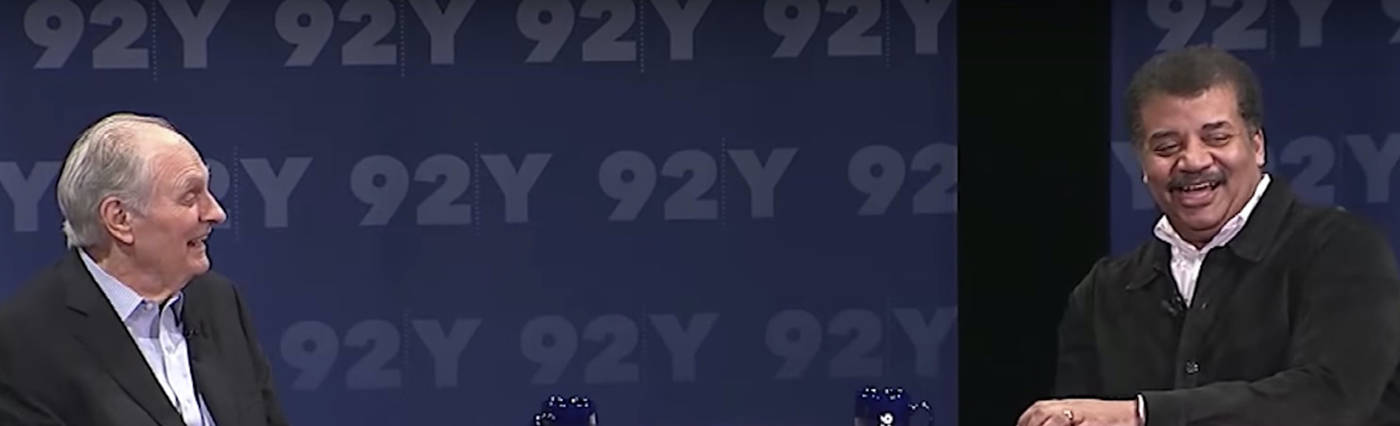
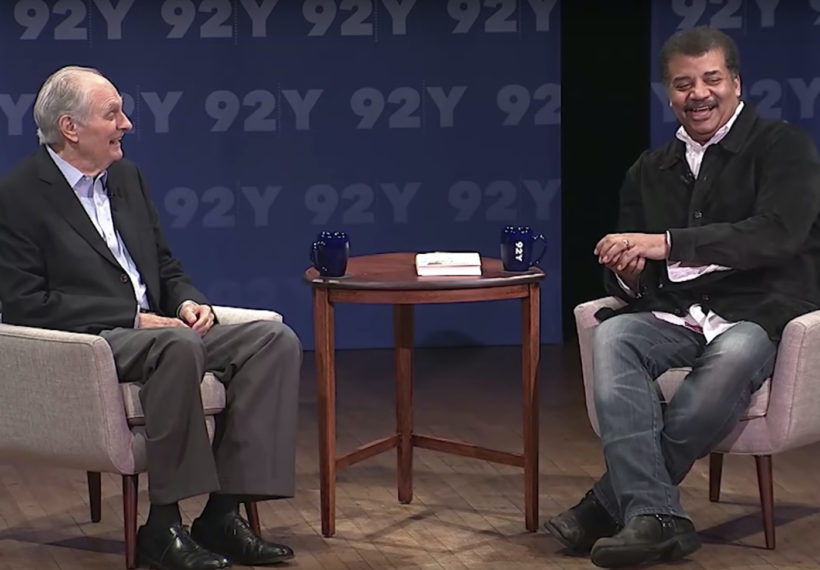
So Alan and I sat down together for a one-on-one chat at the 92nd Street Y, which is a community center in the Upper East Side of Manhattan.
And we had a lot of fun on stage talking about his new book and about science communication.
So let’s check it out.
Keep the applause when you get them.
Yeah, right.
Might as well stay and do something.
You got to run with that.
I just wanted to comment that this illustration of you has slightly more hair than you currently have.
I usually do my interviews on the radio where I still have my hair.
So Alan, it is an honor and a privilege to be on this stage with you.
You’re native to the area, right?
You’re a homegrown New Yorker.
I was born in Manhattan on 32nd Street and 3rd Avenue.
First time I ever got a hand for being born.
And so in K through 12, did you have any particular science influences, a good or bad experience with a math teacher or a science teacher?
Well, I got polio when I was seven.
And so after that, I had to have a tutor for a while and my parents kept me tutored until the seventh grade.
And I had a teacher I didn’t like too much.
This isn’t scientific except for the fact one day I was drawing a nude figure for the pleasure of the person next to me.
For the person next to him, yes.
And he wrestled it out of my hand and I was really pissed at that, you know.
So when April Fool came around, April Fool’s Day, I prepared him a sandwich to eat and luckily my goldfish had just died.
So I put the goldfish between two slices of Wonder Bread and gave him a snack.
I didn’t expect him to actually eat it.
I thought he’d lift it up and look at it and say, oh, April Fool.
But he put it in his mouth and bit on it.
And now I’m looking at him and he’s got this tail hanging out of his mouth.
And I thought, I got to tell him before he swallows that.
And then I remembered the picture and I thought, screw him.
So this is kind of like a science experiment.
It really was.
What to do with a dead goldfish.
But I did do experiments as a kid.
You know, when I was six years old, I had a card table where I would mix things, mix my mother’s face powder and toothpaste to see if I could get it to blow up.
What, did you then put it either back in the toothpaste tube or back in the powder tube?
No, no, but I once opened up her watch to see how it worked inside, what made the hands go around.
And I couldn’t get the case back on, so I bit it.
Oh, to try to squeeze it back together.
To squeeze it back together, and I left tooth marks so she knew who did it.
No, I was a good scientist, but not a good criminal.
Yeah, I think regardless of what the results of an experiment turn out to be, what matters is the curiosity that led to it.
Right, because whichever way it goes, isn’t this right, as a scientist, whether it goes the way you hoped it would or not, you’ve made some progress along some path, and you’ve kept your curiosity alive.
That was great.
I love the start of the clip, because you could see the struggle that I believe always goes on in your mind between genial host and scientist.
On the one hand, you’re like, welcome guest, and on the other hand, I observe that you are bald.
No.
No, it’s not the amount of hair he had, it’s just the comparison of the actual amount of hair.
Which is a more important scientific analysis.
It’s his hair over time.
Yes.
The variation.
Yes, yes.
But that’s a current book.
So I think the illustrator is just lying.
I wonder, Heather, is it in your experience or just in general, do you think it’s common that some people develop a kind of scientific curiosity by taking stuff apart that they can’t put back together?
Like watches?
Yeah, I mean, I think we’re all born with this innate curiosity, you know, to understand the world around us.
And as we develop, unfortunately, we tend to lose that curiosity.
Because, you know, our prefrontal cortex isn’t fully developed until we’re about 25.
And before it’s fully developed…
And for boys, it’s not until they’re 40.
Like about 80.
But that kind of is what puts the filter on, you know, and says, OK, that behavior isn’t, you know, conforming to social norms.
But when you’re a child, anything goes, and you’re very open to experiencing, curious.
So you deconstruct things and you ask lots of questions.
And I think the really important thing is how do we keep that curiosity alive when we’re adults?
And I think scientists are really good at that, is always asking questions, always wondering and asking.
And even when you get an answer, ask the question.
So we’re adults who never grew up from our childhood.
Pretty much.
That’s one of the things I love about that clip, is you and Alan both describing what’s essentially a prank as, no, this is science.
We were doing a science experiment.
So it’s just a matter of perspective, is what you’re saying.
It is.
It is.
It’s always saying, like, the man is a scientist.
What I wondered after that introduction with him, whether there might have been sort of some parallel universe where he might have become a scientist instead of an actor.
I just asked.
Let’s check it out.
So if you had this curiosity, was there some fork in the road where you said I could be an actor or I could be a scientist?
No, never.
No.
I was lucky enough to go, I followed my nose.
And what I seemed to be good at, I tried to do more of.
Although it’s a little crazy for an out of work actor.
I went nine or ten years and we were married and had three children and I still wasn’t making a living acting.
But I knew it was for me somehow.
Well, that’s how you know it’s love.
Yeah.
You know what I figured out early on?
That I wanted to act with people I respected in material I loved in front of an audience that got it.
And that’s all I wanted.
It didn’t matter to me where that would be or how much money I’d make doing it as long as I could earn a living.
Well, I really felt that way.
And then I wound up doing that for 11 years on MASH.
And it was a wonderful experience.
Thank you.
So, Heather, you saw MASH when it came out.
Were you a fan of the show?
Well, I mean, I was probably watching Sesame Street around that time.
How old do you think I am?
It reruns then.
I saw the reruns, yeah.
My father is a doctor, and so I kind of always grew up in that kind of medical world.
And then I remember when I first saw MASH, this realization that I always had envisioned doctors as being this very austere and serious, and they’re doing surgery and they’re very focused.
And they do that, they were just bantering and telling jokes and making light of it.
You know, that these doctors are people too.
And also how they use comedy in the face of tragedy as a coping strategy.
You know, I thought that was brilliantly done.
And this show, I mean, it was, it led the way for all these other shows like ER and the rest of it.
I mean, it was really ahead of its time.
So this show was on, I think, for 10 seasons.
It was nominated for more than 100 Emmys.
The show won 14.
He won five of them.
So it was a highly celebrated and decorated show.
Funny you mentioned his Emmys there, Neil, because it’s game show time.
It’s Alan Alda trivia time.
All that and a bag of chips.
All that, okay, all right.
We’ve got some Alan Alda facts or non-facts.
Okay, all right.
See if you can work out which ones are true.
He didn’t sign on to play Hawkeye until six hours before the pilot was shot.
You know, that’s so precise in its delivery of information.
I’d say it has to be true.
It was actually six and a half hours.
What?
No, you are correct.
That one is true.
Hey, apparently didn’t want war to be a backdrop for lighthearted hijinks.
He wanted to show that war was a bad place to be.
So that was his resistance.
That was his resistance.
Fact number two, is Alan Alda the step-cousin of Rick Moranis?
I’m gonna have to say false.
You’re saying false.
I am.
Neil, are you agreeing?
Again, that’s so precise.
I’m gonna have to say yes.
Neil, I’m afraid you are wrong.
You are correct.
No one is a relative of Rick Moranis.
He just came into existence.
They’re still studying his genome.
As a perfect being.
Okay, is Alan Alda the first person to win an Emmy for acting, writing and directing?
Heather.
Maybe true, maybe true.
It’s a very specific answer.
Heather again has taken it.
He did, and he once did a cartwheel down the aisle.
Possibly the most gymnastic guess we’ve had, right?
Younger days.
Are you going to do that when you win an Emmy now?
I don’t know.
No, no, no, I’m not.
No, no, no.
So let me ask you, Heather, is there a, he listed three ingredients that helped him find his compass point.
What was it?
People you respect, material you love, and an audience who gets it.
So do you think that that should, or is also the key ingredients for science communication?
You know.
An audience who gets it?
I’m going to have to say often it’s the opposite.
Oh, so you’re saying it’s not a prerequisite that they get it in advance.
It’s your duty to make them get it by the time you’re done.
Help them get it.
Yeah, and it’s not always material you love also because it’s, you know, trying to debunk pseudoscience isn’t the most interesting thing to do as a scientist, but I think it’s a duty.
Well, coming up next in my interview with Alan Alda, we actually learn how to learn when Star Talk returns.
Welcome back to Star Talk.
We’re talking about the art and science of science communication, featuring my interview with actor and science lover, Alan Alda.
I asked Alan about the origins of his lifelong interest in science.
Let’s check it out.
I was interested as a very young man in spiritualism and mental telepathy, and I read hundreds of books on the subject and did experiments.
And I was reading a book that was supposed to be, the story was that it had been dictated by a man who was dead 200 years already to a living person through a medium.
And he said, this is how matter is made.
It’s made of three constituent parts.
Ask any physicist.
I said, I don’t recognize this, but there’s a physicist who lives across the street.
I’ll ask him.
I said, does this make sense to you?
And he said, I don’t know.
I haven’t heard of anything like that.
So then I said, well, I’ll look in Scientific American.
That they ought to know.
And I started reading every article.
And then I was introduced to this whole new way of thinking.
A universe of inquiry.
Based on evidence, based on observation.
And I gave up what I thought was lacking in evidence.
And I got excited by this quest that science was on to understand how the universe works and how they could understand the deepest things with the tiniest bit of information they could extrapolate.
But not in a crazy way.
Not just making things up.
Not science fiction, but scientific evidence.
And it was just so exciting to me.
So Heather, he transformed in this moment.
Seeing that evidence mattered.
This is interesting, because I presume like just as real scientists, neither of you has ever had scientific theories that you’ve got from ghosts.
Yeah, none of mine have come from ghosts.
Just checking.
Yeah, yeah, yeah, just want to verify.
You don’t do ghost-based research.
So he chose the right path there, going from like ghost messages to real science.
Well, so let me not even say it’s the right path.
It’s just he discovered what the wrong path was, because it was not supported by objective evidence.
And he got excited about it.
So Heather, when you sort of discovered the scientific method, did you get excited?
Yeah, I mean, I thought, wow, it was a way to get away from this subjectivity and tap into something bigger and greater than myself, like trying to uncover these truths of the universe through this method.
That apply to us all?
Yeah.
So then why doesn’t everybody get that excited?
You know, I think a lot of people think of science as done for and by other people, like they’re not a part of it.
So my husband’s a science communicator, and he’s a rapper, but he raps about science.
And he’ll talk about findings in neuroscience and say, we discovered this, and we discovered that.
Your husband’s a rapper communicator?
Rapper, science communicator.
Yes.
Okay, is that the first time that sentence has ever been uttered in the history of the world?
Yeah, there’s absolutely no need for the word for A rather than V to be before that description.
He’s one of many rapper science communicators out there, but he’s one of the better ones.
But he’ll talk about neuroscience findings in my field and say, oh, you know, we discovered this, and I used to call him out, like, why are you saying we?
You know, you didn’t discover it.
And he said, no, I mean, we as like the collective, we as like humanity, you know, as mankind.
And then I kind of took a moment.
But, you know, I think if we all think about it as it’s this unifying, that it’s discoveries meant for all of us.
It’s not like these scientists over there doing this separate thing.
And it’s a way for us to uncover, you know, these realities.
Interesting you say that because the moonwalkers, when they toured the world, people would come up to them and say, we did it.
These are people from other countries.
So there was a collective we in the accomplishment of our species.
And there’s truth in that because none of those accomplishments could have happened without the collective accomplishments of all of humanity.
Like you couldn’t have put humans on the moon if it hadn’t been for the discoveries of mathematics by the Greeks and the, like everything leading up to that point combined to make it happen.
So do you know, did I ever tell you my summary of the scientific method?
It’s very simple.
Do whatever it takes to not fool you into thinking something is true that is not.
Or that something is not true that is.
That’s it.
Do whatever it takes.
Because we are susceptible to these delusions.
Yeah and also I mean our brain is just interpreting reality in different ways.
We have these visual illusions all the time, it’s just one example.
So what we’re perceiving in our minds eye does not necessarily correlate with reality.
We’re completely biased.
So the scientific method is amazing because it’s a way to get around that.
You know to be objective and get away from our own personal biases.
But here’s I think part of the problem is the way science and the scientific method is presented in pop culture isn’t how it really works.
Like you’re real scientists and the fact is science is generally is a painstaking and methodical and careful process.
I like that.
But Newton probably thought for years about what makes the universe move.
And then he went, ah, they’ll never get that.
I’ll just say it was an apple.
An apple hit my head and that’s how it just goes.
That’s how when you watch any movie in which a scientist is presented, that’s how it’s delivered.
Because it’s not as fun to watch years of careful measuring and testing and retesting.
So Heather, I wonder, because Alan mentioned pseudoscience as a first step towards him recognizing what is and is not true, is that a common, I mean, pseudoscience relates to what you think is true and how your brain is duped into thinking so.
And you study the brain.
So is this a common pathway that people take to find real science?
Often it starts out with a belief, a pseudoscience belief.
Even with studying the neural basis of consciousness, let’s say, I mean it started with dualism, right?
Descartes was, you know, I think, therefore I am.
And there was this separate mind.
And he thought that it came together in the pineal gland, that the soul came down and met the body through a gland in the brain.
But it was something separate.
And as we started to understand more about how the brain works, there’s less and less room for this sort of belief in it.
Okay, so you made a bigger story than I even thought.
Because he’s giving his personal story, going through pseudoscience, you’re giving the larger story where some of our deepest understandings of how the mind works had their origins in pseudoscientific thinking.
Yeah, I think most science starts out like that.
We have some vague idea or concept and then we start honing it and honing it and honing it.
And the more we discover the reality, the more we can separate out the pseudoscience from what’s real.
I mean, it’s both on a grand scale and also personally for me.
I mean, one of the reasons that I became a neuroscientist is because I had this fear of death.
And, you know, I thought if I…
So now you don’t have a fear of death?
Well, no.
I mean, I still don’t want to die.
But now she knows why she has that fear.
And that’s…
That’s crucial.
Well, I thought, you know, can I, even if I die, do I still have some sort of mind that I can still exist even if I’m like…
Right, does my soul persist?
And then, you know, where does your soul come from?
Oh, the brain.
How does the brain make our thoughts?
And as I started to get delving deeper and deeper, this idea that a soul that will go on, I started to lose that belief, but I became fascinated and in awe by how the human brain works and how it gives us this capacity to understand ourselves.
And his version of that experiment was reading Scientific American, which took him to a whole new place.
Well, speaking of Scientific American, Alan Alda’s next great TV project after MASH was as host of the PBS series Scientific American Frontiers.
And he hosted that for over a decade.
And what does he do?
He meets scientists and asks them questions, and he brings a sort of a childhood curiosity into the lab.
And so I asked him about the success of that series.
Let’s check it out.
We did something that’s not usually done on that kind of a show.
These weren’t conventional interviews.
I didn’t go in with a list of questions.
I went in just with curiosity and my own natural ignorance.
I had plenty of that to go around.
You know, curiosity plus ignorance, I think is a good combination.
Brilliant combination, yes.
And you got to know that you don’t know.
That’s really helpful.
But that led to just a conversational approach.
And if I didn’t understand them, I didn’t pretend I did.
I just kept after them until I got it.
And that changed them.
That made them look at me in a personal way.
The tone of voice became personal.
The language they used, the terms they were using were not technical terms anymore because they had to make me understand.
Sure, they weren’t thinking, how do I get this guy out of here as fast as I can?
Let me try hard to get him to understand.
They would sweat bullets.
They’d think, you don’t get it yet?
That’s not it?
Okay, because we had, you know, we shot a lot of stuff and then cut it down to where it looked like I got it an hour sooner.
But one scientist was wonderful.
She was really wonderful and conversational with me.
And then she remembered that this was just like a lecture she gave.
And she turned away from me and looked into the camera and started lecturing the camera.
And her tone of voice changed completely.
It wasn’t personal anymore.
The vocabulary changed.
I couldn’t understand what she was saying.
So I coaxed her back with questions.
She came back to me and then we got warm again and it was conversational.
That was a real lesson that if we don’t make this contact and really observe each other, let the other person in, it’s not going to lead to something lifelike happening.
It won’t be alive.
So Matt, ignorance is usually something people don’t like to admit to.
So on your podcast, is ignorance a part of how you run the show?
Well, we put probably in the title for a good reason.
And yeah, absolutely.
We’re lucky enough that we have this listenership that is half science people who like comedy and half comedy people who like science.
And what we encourage and what often happens is every episode we get emails and some of them are, hey, here’s something interesting that you should talk about on the next episode.
And then the other half are, here’s what you got wrong on the last episode.
And that’s wonderful.
It’s really exciting when we talk about earthquakes and then a seismologist writes in to go, well, here’s how it really is.
And we get to give their explanation of what we got wrong.
But what it means is you are honest enough and candid enough to actually celebrate the fact that your ignorance was corrected.
I think so.
And I think there’s a line to be drawn, though, isn’t there, as well?
Because I think you can be too proud of ignorance, too.
Like, I don’t know anything.
This stuff’s all mumbo jumbo to me.
But I think there’s sort of creative ignorance.
There’s sort of inquisitive ignorance.
Where we’re like, yeah, I don’t know this stuff, but please tell me.
And I think Alan puts it perfectly.
Just keep telling me until I tip over from ignorance to knowledge.
As opposed to brazen ignorance.
There we go, yes.
Where you don’t know what you’re talking about, but you think you do and you’re up in somebody’s face about it.
Are these science-y professors with their big words and ideas?
Yeah, no, we’re like, no, tell us because we don’t know.
And your field is full of equations, which again, that’s I think one of the things you do well is you are great at converting those equations into understandable ideas for the general popular.
So like for example, what does a scientist mean by equals mc squared?
We are describing the equivalence of mass and energy in the universe.
There are two sides of the same coin, even though in our lives we experience them as something different from one another.
And that’s great.
And for f equals ma, going back to a previous generation.
That’s Isaac Newton.
Yeah, yeah, yeah.
Force equals the mass of an object times the acceleration.
So this tells you how much force is required to accelerate an object of a given mass.
And so, okay, switch it up.
Isaac Newton.
What would a non-scientist mean by Netflix and chill?
I have it.
I’ve got it.
Because that’s an equation, Netflix and chill.
Exactly, but that’s a layperson’s equation.
Oh, a scientist would say care to copulate under recreational pretenses.
Wow, so what works at the bar?
That’s what I wanted to know.
It depends on the bar.
And Neil, I believe your tweets are amongst your most effective.
I think you’ve got an example for us.
Oh, do I?
Oh, yeah.
Oh, yeah.
I just had this thought.
In a mirror, you can only kiss yourself on the lips.
It’s just one of these fundamental truths of the world.
It is, no matter how much you try and turn at the last minute.
Yeah, yeah, you can’t fake the light beam, you know.
Profound, profound, Neil.
So up next, Alan Alda, American icon, will explain what it means to actually listen to one another for change on Star Talk.
Welcome back to Star Talk from the Hall of the Universe of the American Museum of Natural History.
We’re featuring my interview with actor Alan Alda.
And that interview was held live on stage at the 92nd Street Y right here at New York City.
And Alan showed me an exercise he does to help teach science communication.
Check it out.
The mirror exercise is a very basic improv exercise where I’m looking in the mirror and you’re my mirror.
And you have to be totally in sync with me.
Whatever, however I move, you can’t let there be a lag because there’s no lag with a mirror.
It’s exactly the same.
Except for the speed of light time delay.
If anybody notices that, we’re dead.
That’s a superhero person.
Yeah.
And what this is so good at implanting in people’s minds as they begin to study communication is it’s the leader’s responsibility to make sure that the follower is following.
You lead me now.
A little fast, I can’t follow.
I got Matt Kirshen here, my comedic co-host, Matt.
Hey.
And I got Heather Berlin, neuroscientist.
And joining the panel, I have Natalia Reagan.
Natalia, welcome.
This is not your first Star Talk Radio?
No, not my first Rodeo.
You’re an anthropologist and also a comedian and a writer and I’m just curious about something.
There’s, weren’t you part of an improv troupe before this?
Because improv, you gotta do some of this, right?
Yeah, oh God.
Yeah, yeah, yeah.
It’s like, you know, living minds.
It can be pretty painful sometimes.
That was your first time doing The Mirror?
You’ve done it plenty, right?
Oh God.
No, that was my first time doing it, yeah.
You missed the perfect opportunity to kiss Alan Alda on the lips.
I would have paid good money to see that.
But it is a way to connect with your audience.
And a big part of improv is getting your partner to say yes and.
It’s all about yes and, yes and.
And when you’re dealing with an audience, you want your audience, when you’re connecting with them, to say yes and, yes and, like what’s next?
You want them to keep up with you.
And a lot of academics and teachers, lecturers already do improv because they’re always having to adapt to what their audience is.
If you’re teaching a group at JPL about astrophysics.
Exactly, you can talk about, you can use them big words.
Where if you’re at a monster truck rally or a town hall meeting or a high school, you have to speak in their terms.
And that doesn’t necessarily mean talking down to them, it just means speaking their language.
So there’s a guy in Los Angeles, his name is Ori Amir, and he’s a neuroscientist and comedian.
And he put a bunch of comedians in an fMRI scanner and made us come up with funny captions to cartoons to work out what was firing when jokes created.
And I was one of those people.
So we have, I believe…
Oh, really?
This is my brain.
This is my brain trying to come up.
And the way the experiment works was we had to, it was basically a caption competition.
It was come up with a funny punchline to these captions.
And then as a control, both think of an unfunny caption and think of nothing.
Well, does that mean that if that part of your brain were damaged, you would stop being funny?
I think, I mean, some people on the internet would argue that it was damaged a long time ago.
But yes, I believe so.
Heather, do you, can you…
Yeah, so what they found, and they actually looked at professional comedians and amateurs as well, and found there were some differences there.
But in general, when comedians are spontaneously creating, they get increased activation of what’s called the temporal occipital junction or TOJ there, which has to do with cross-referencing information, right?
And also, so making these novel associations between ideas.
And that makes sense, because generally a punchline, I mean, the sort of logic of a joke is it’s often finding a logical connection between two…
Otherwise unassociated things.
And then you have activation of the medial prefrontal cortex, which is sort of the thinking about, trying to get at that connection.
And the amateur is actually needed more prefrontal cortex activation in order to come up with a funny punchline.
And finally, you have activation in what’s called the nucleus accumbens, the pleasure center of the brain.
And in comedians, they actually had that activation before they were about to say something funny, even before they even knew what it was going to be.
They’re getting a little bit of dopamine.
That definitely makes sense.
That makes so much sense.
My girlfriend calls me out on this sometimes.
Like, I’ll be sitting at dinner or whatever, and she’ll go like, you’ve got your, you just thought of a funny tweet face.
And that’s exactly what that is.
That’s like, I’m about to say a funny.
Well, Alan Alda, of course, had no access to fMRI.
So he didn’t otherwise have this kind of backdrop to think about how to communicate science.
He came to communicating science through his field of acting.
And so I asked him about his training as an actor and how that shaped his modes of communication in real life.
Let’s check it out.
You don’t say your line because it’s in the script.
Right, right.
It is in the script and you remember it.
But you say it because the other guy does something or says something that makes you say it.
Compells you for that to be the only thing that belongs in that moment.
Exactly.
And the energy that comes out of that, the way it just came out of you because you were finishing my sentence and you were reacting to what I just said.
That energy is real.
It’s not mechanical.
Whereas if I said to myself, now I’m gonna be very energized when I say this line and I get very energized.
And it sounds like somebody’s talking into a garbage can somewhere.
Whereas if I really let myself respond to you, my performance exists in your eyes.
It comes out of what’s coming from you.
If I let myself be changed by you.
And that got me interested in the idea which is a little radical.
Maybe not everybody can go for this.
That I don’t think we’re really listening unless we’re willing to be changed by the other person.
So some part of you has to be susceptible.
Yeah, that doesn’t mean you’re gonna change, but you’re willing to change.
If it really is something that strikes you, that really hits you.
But if you say, this person doesn’t know anything, this person doesn’t believe what I believe, I’m not even gonna, I’m gonna let them finish talking, and then I’m gonna tell them the real story.
That’s not communicating.
Not communicating, it’s not listening, it’s just waiting for your turn.
It’s dueling monologues.
So, Natalia, you create product.
What is your knowledge or evidence that people are listening?
That’s an excellent question.
For me, like Alan mentioned, for me I want to make sure we never insult the audience.
And I feel like your field and my field have something in common because humans are obsessed with two things, ourselves, anthropology, and our place in the universe.
And we are at a time when we have, scientists have an ethical responsibility to teach the world what we know.
You know, I can talk to people about how, if you look at the human genome, there’s not very much variation within our species, therefore we’re one big family.
And you can take a step back and look at the earth and say, look, it’s a beautiful blue, green, brown orb with no lines between countries.
So it’s an excellent time to really have that discourse, have that conversation, make the eye contact and not talk down to each other.
Cool.
So, Natalia, thank you for joining us on this segment of Star Talk.
Up next, actor Alan Alda explains his theory of the existence of dark empathy in the cosmos when Star Talk returns.
Welcome back to Star Talk from the Coleman Hall of the Universe.
We’re featuring my interview with award-winning actor and science communicator, Alan Alda.
And he explained a communication term that he coined called dark empathy.
Let’s check it out.
It’s a little like dark energy.
A little like dark energy, what is that?
Well, in the same way that dark energy is the opposite of gravity, and gravity’s pulling us in to some cozy connection and dark energy’s pushing us apart more distance.
It’s a little like that.
A lot of people consider empathy to be the same thing as sympathy or commiseration, to be on the side of the other person doing good.
Some people said the more empathy you have, the better a person you are.
I don’t think so.
I think it’s a tool and it can be used in a good way or a not-so-good way.
It’s an essential tool, I think, for communication because you’ve got to know what’s going on in the other person’s head to communicate with them.
However, it’s a tool for good communication, but it’s also a tool for working against people.
For instance, bullies know what you’re feeling and they can twist your feelings and make you hurt.
And they do it because they can read you pretty well.
They know just how far to go to-
Are you saying bullies would make good psychologists?
Is this what you’re saying?
Well, some may be, I don’t know.
So here’s an example that’s like in a marriage, right?
Guy is up late, it’s after midnight, his wife’s already in bed, and he notices there’s a huge pile of dishes in the sink.
And he thinks, I guess I ought to do something about that.
What are the odds that he’ll do something?
Not so great, but maybe if he uses a little empathy and he says, what’s my wife gonna feel like when she wakes up tomorrow and sees those dishes in the sink?
And he actually connects with her feeling of dismay.
Chances are he might wash the dishes, and chances are he might find out doing the dishes is floor play.
Is floor play.
That’s beautiful, isn’t it?
My husband does the dishes every night.
It’s true though.
No, but it’s true.
It’s true.
I do the dishes like half the time.
All right, that’s not bad.
But you commit to it.
So Heather, were you a bully?
No, no.
But you could have been, because you’re a psychologist.
Yeah, no.
We use our powers for good, not evil.
Well, I mean, you know, being able to have what we call theory of mind, you know, understand what another person is thinking and get sort of into their skin.
Can you learn that?
There’s some, yes, to an extent.
Some people are really good.
They’re genetic differences.
Some people are really good and others really not good.
Yeah, I mean, there are people, you know, on autism spectrum or with autism who have great difficulty understanding what other people are thinking.
So I think there’s a genetic predisposition.
So clearly then, they’re parts of the brain that serve this.
Absolutely, yeah.
I mean, we know that there’s certain neural circuits that are involved in theory of mind, and we can give people theory of mind tests and watch what parts of the brain light up.
So psychopaths aren’t able to empathize with people.
Psychopaths don’t care.
So they might know what you might be feeling and they might not, they just don’t care.
And what’s the difference between a psychopath and a sociopath?
They’re the same thing, they’re different names.
But wait, but in that vein, if a sociopath or psychopath, they’re really messing with you.
Doesn’t that mean they have empathy to know that what they’re doing fully messes with you?
Empathy shouldn’t mean they’re nice to you, it means they understand you on a level that they can exploit that knowledge.
Understanding how a person works or their motives or whatnot is different than feeling another’s pain.
So an empath would really be like, you know what, if I do something maniacal to you, it might make you feel bad.
And I know what that might feel like, I don’t wanna do that.
Well, actor Alan Alda actually founded a school and it’s called the Alan Alda School of Science Communication.
And you know what he does?
He uses acting and improv to improve the communication skills of actual scientists or graduate students.
And so we discussed the connection between learning and these other talents that he brings to the table.
Let’s check it out.
You have a particularly acute sense of comedic timing and comedic sensibilities.
And personally, I have found that when people smile, I think they’re more eager to learn.
And that must have been something very important.
That’s an interesting thing you said.
Would you go into that a little more?
What do you mean by that?
Who’s interviewing?
Can I, would you let me interview you?
What?
I’m curious.
Why do you say when they smile there?
What gives you that impression?
That’s an interesting thing to say.
I found that if something makes you smile, you come back for more of that because you enjoy the feeling of having smiles.
That’s good.
That’s great.
You seek more.
I have a similar feeling that when we’re laughing, we’re vulnerable.
We’re seldom more open and vulnerable than when we’re laughing.
And I think, and I’ve interviewed some science teachers, professors, especially one I talked to when I was writing the book who said he feels his secret weapon is humor.
When it gets them laughing, they’re more absorbent.
Absorbent?
You know, for the information.
No, no, I get that.
Interesting.
I mean, empirically, I agree with that.
Yeah, that’s your experience.
Yeah, oh, definitely, definitely.
And it happens that I find the universe to be a hilarious place.
That’s funny.
That’s funny, I’m really glad I’m stuck on Earth.
Because to me, stars and supernovas and all that stuff out there, they are fiery cauldrons of destruction as far as I’m concerned.
Indeed they are.
So I don’t want to go to Mars.
I don’t want to go no place.
I want to stay right here.
So you want to go to Mars if one of those asteroids is headed towards Earth?
No, I want you to get something to push it out of the world.
Well, coming up, Bill Nye the Science Guy, my good buddy, gives us his thoughts on sharing the wonders of science when Star Talk returns.
Tonight, we’ve been getting schooled in science communication in my interview with actor, comedian and educator, Alan Alda.
Let’s check it out.
You know what’s interesting about communicating science?
There was a study done, I think at the University of Pennsylvania, where they studied what were the most commonly emailed stories in the science section of the New York Times.
You might think they were about health, about medicine, fitness, things that affect their bodies every day.
The most emailed stories were about the wonder and awe found in confronting the universe.
That sense of wonder and awe, we all have, we go out at night, we look at the stars.
You’re telling me?
Forget who’s interviewing you?
And he said I had comic time.
Ladies and gentlemen, join me in thanking Alan Alda.
Thank you.
Alan Alda.
He’s amazing.
So Heather, what are your thoughts on the future of science education?
Despite what might be going on politically, I think that we are in a kind of renaissance of science.
But why isn’t it catching on in science policy?
I know that there’s a lot of anti-science sentiment in this country that gets a lot of play.
But if you look at the other side of the coin, I mean, look at the science march that we had.
I mean, all these people.
When have we ever had a science march before?
So, I mean, I am optimistic.
Because we never really needed it.
Right, yeah.
That’s true, too.
But I mean, the future is getting more people.
It’s grassroots.
Now we have the internet.
We have a place for nerds to go where, you know, when I was growing up, there was no place, right?
So I think that…
We had no community.
Exactly.
That was the woods.
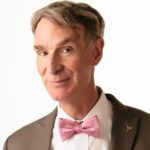
Well, before we wrap up this episode of Star Talk, let me catch up with Bill Nye the Science Guy, my buddy, and just to hear his thoughts on communicating science.
Greetings from the beach out here in Cali.
Science communication is what guys like Alan Alda and Neil and I do to get people like you excited about the world around us.
And when I stand on the beach, I can’t help but think about the cosmos and our place within it.
The ocean is vast, but the cosmos is somehow vaster.
Just how vast it is is hard to understand.
But I had quite a communicator for a third grade teacher.
Mrs.
Cochran told us there are more stars in the sky than there are grains of sand on a beach.
And I remember thinking that is incredible.
How could there be that many of anything?
But it turns out that was an underestimate.
Modern astronomers estimate there are about a hundred times as many stars as there are grains of sand on the Earth.
Beach and deserts combined.
When I think about that, I am humbled and empowered.
I am overwhelmed and relaxed both at the same time.
The key is communicating that.
Back to you, Neil.
Good luck.
Thanks, Bill.
So I’m old enough to remember where you would go all day, and no matter what channel on television you turn, there was no science there.
So it was easy at the time to think of science as this subject you were taught in school, and then when you’re done, you move on to other topics, and that science was something separate and distinct from anything you might care about.
I celebrate in modern times the fact that at any time of day or night, you can channel surf and land on science programming.
There are science podcasts.
There are entire movies based on actual science premises with marquee actors and marquee directors and marquee budgets.
For me, the greatest value is to see that science is not this silo that you can walk around.
Science is everywhere.
It is not simply part of life.
It is not simply part of the universe.
It is life, and it is the universe.
That is a Cosmic Perspective.
You’ve been watching Star Talk.
I’ve been your host, Neil deGrasse Tyson.
As always, I bid you to keep looking up.


 Become a Patron