Can Mars One succeed? Neil deGrasse Tyson gets a mission briefing from CEO Bas Lansdorp, from how Bas came up with the idea to fund the mission via reality TV, to a mission timeline detailing exploration, base construction and more. Neil also talks with Ryan MacDonald, an astrophysics grad student at Cambridge who is one of the 100 candidates hoping for a one-way ticket to the red planet. Meanwhile, former NASA astronaut Mike Massimino and co-host Eugene Mirman are more than a little skeptical about the project. Astro Mike, a veteran of two Space Shuttle flights, discusses the risks to the Mars One crew that include radiation on the flight, and the risks to the project’s financing if the viewing public gets as bored with watching Mars One as it did the Apollo and Shuttle programs. Mike and Bill Nye remind us that exploring space is dangerous: NASA figured the odds of the total loss of the Shuttle and crew for one of Mike’s flights at 1/75, and a recent MIT study concluded that the first Mars One astronaut will die within 68 days after landing. Is it, as Eugene says, “a pyramid scheme, or is it sort of reasonable?” Listen and decide for yourself.
Transcript
DOWNLOAD SRT
Welcome to StarTalk, your place in the universe where science and pop culture collide. StarTalk begins right now. Welcome to the hall of the universe. I'm Neil deGrasse Tyson, your personal astrophysicist. And tonight, we're featuring my interview with Bas...
Welcome to StarTalk, your place in the universe where science and pop culture collide.
StarTalk begins right now.
Welcome to the hall of the universe.
I'm Neil deGrasse Tyson, your personal astrophysicist.
And tonight, we're featuring my interview with Bas Lansdorp.
He's the guy who wants to take people to Mars and leave them there.
Is that even possible?
Should he be doing that?
We're gonna have the answer to that and more on StarTalk.
Let's do this.
Yes.
I need some help talking about that topic.
First, one of my favorite comedians here is Eugene Mirman.
Eugene, welcome.
Hello.
Yeah, Eugene is a professional comedian, and he's a regular on StarTalk, and among other things, he's like the voice of the kid in Bob's Burgers on Fox, but...
So can I hear some of that voice just for...
Sure, it sounds a lot like this, but a little yelly.
A little yelly.
It's accurate.
And Mike, you have a different talent set here?
I think so, yes.
My voice, I don't have a cartoon character voice.
I think my voice is a human voice, but go on.
I didn't mean it that way.
You play a cartoon character.
That's true, that's accurate.
Yeah, yeah, so Mike is a former astronaut, and he's not just any astronaut, he's one of the astronauts that repaired the Hubble Telescope, so he's a very special place in mind.
So, you know, I had Bas Lansdorp came through town.
He's the CEO of an organization called Mars One.
You know, I've seen a lot of criticism of his work.
I've seen him praised as an entrepreneur.
Is it because he's in a boy band?
I don't...
the praise part or the criticism?
Both.
So I just thought I can't let him pass through town unless I nab him, put him in my office, and just find out where he's coming from, where he's going, and what he's all about.
And he was okay with that?
Yeah, yeah, yeah.
Yeah.
He was okay with that.
This isn't one of those forced interviews.
Yeah, yeah, no, right, right.
Tell-all kind of thing.
No, he was very eager to share all that he wanted me to know about this project.
And he's the CEO of an organization called Mars One.
And people have signed up for this.
And he wants to go to Mars.
Who doesn't want to go to Mars, okay?
Well, he doesn't want to come back.
There's something different about his plan to send people to Mars.
Let's check it out.
The difference between Mars One and a lot of other ideas is that we are proposing a mission of permanent settlement, a one-way trip, which takes away the biggest complexity of the more standard mission, which is, in my opinion, the return trip.
I mean, it's hard to get back.
That's true.
It's hard to launch rockets from Earth with a hundred engineers checking the rocket at the last moment.
All the conditions are controlled, let alone launching a rocket from Earth to depart from Mars, flying through space, waiting on Mars for two or four years, and then launching without any supervision or checks.
And from my point of view, that's practically impossible.
And that's why I came up with the idea of permanent settlement.
Now, if you have such ideas, presumably you have a rocket or some way to get to Mars.
We're not an aerospace company, so we're not going to build the rocket.
We're actually not going to build any system.
We try to source them from established aerospace suppliers all around the world, mostly in the US.
So you don't have to invent something to do this?
No, because it is permanent settlement, there's no new inventions needed.
Of course, a lot of design, a lot of testing, a lot of building before we can actually do it, but no new inventions are needed to get humans to Mars and to keep them alive there.
So, Mike.
Yeah, why don't we start with this?
Why what?
He says no new inventions.
We've been to Mars.
Wait, let's back up.
Back up.
Okay, so it's not like we don't know how to get to Mars.
We know how to get to Mars.
Right, but he's right as far as coming back is where a lot of the cost is.
And that's where a lot of the dangers.
The guys that went to the moon, when they went there, they not only had to land, but they had to get back.
It was another launch that they had from the moon.
Mike Collins, I heard him speaking about it, said that on Apollo 11, he was pretty sure he would be able to come back alive because he didn't have the added complexity of landing and then having to launch and come back.
He was in the command module that never landed.
Right, he did not land.
Buzz Aldrin and Neil Lansdorp were on the moon.
It was a much different situation for them.
And they were worried about the abort light.
Did they have to abort before they landed and so on?
Because once you got there, you had to be able to come back.
And it is really risky.
He's right about all that.
But that's kind of the point, is to come back.
If you want to come back, that's what you have to do.
Yeah, but if you want to come back, you're not signing up for his mission.
All right, okay, fine.
Let's go to the next topic.
So it's all people who want to go and stay on Mars.
Yes, but he wants the people to arrive alive, correct?
He didn't say that.
No, he wants the people to die halfway and stay there.
Now, that I agree with he can do.
But if he wants them to arrive and be healthy, they're going to have to solve a lot of problems.
Yes, okay, but you're an engineer professionally.
You're a PhD in engineering.
Don't you love an unsolved problem?
Yes, but he's saying they don't need any new technology.
No, but they need some clever ideas from engineers.
He doesn't need new physics.
You know, we know how to go to Mars.
We do, but the technology you're going to need to protect these people, the radiation problem they're going to have, keeping people healthy on that long journey and then able to survive on the surface.
Okay, here's what he's got to plan to send supplies in advance to set up a base camp so that when they land, they're not just bare ass on the surface of Mars.
There's already snacks.
Can I say that?
Who wouldn't want to fly to a planet full of pretzels?
That's your incentive.
It's like the carrot on the end of the stick.
Literally.
Except the stick is on Mars.
Well, so the question is, all right, if given enough time, engineers, I think, can solve any problem.
I agree.
All right, so let's find out from Baz what kind of timetable he has thought up for this plan.
Check it out.
Our first unmanned mission is scheduled for departure in 2020.
This is possible because it's a copy of the NASA Phoenix mission that was sent to Mars in 2006.
We'll use that platform and install some instruments that will demonstrate important technology for Mars One, extraction of water from Martian soil, thin film solar panels, but perhaps most importantly...
Just for people to remember, the Phoenix mission was designed to land right at the melting, receding boundary of the polar ice caps so that there would be the highest chance of finding some kind of liquid something, presumably water.
Yeah, they found frozen water, of course.
The platform was not specifically designed for that purpose, so we can use it at the lower latitude where we want to use it.
But the most important demonstration of this mission is Mars One.
And we need to demonstrate to the world that we can actually send stuff to Mars.
And that's what this mission will demonstrate.
So that's 2020.
2022 we're going to send a rover to Mars, a rather big rover, more than two tons that will drive around to find the best location for the settlement.
So we know the area by then and it will pinpoint the exact location, determine the water content, make sure it's nice and flat for construction.
Again, two years later in 2024, we're sending all the hardware.
So two life support units, two living units, a second rover and all the supplies.
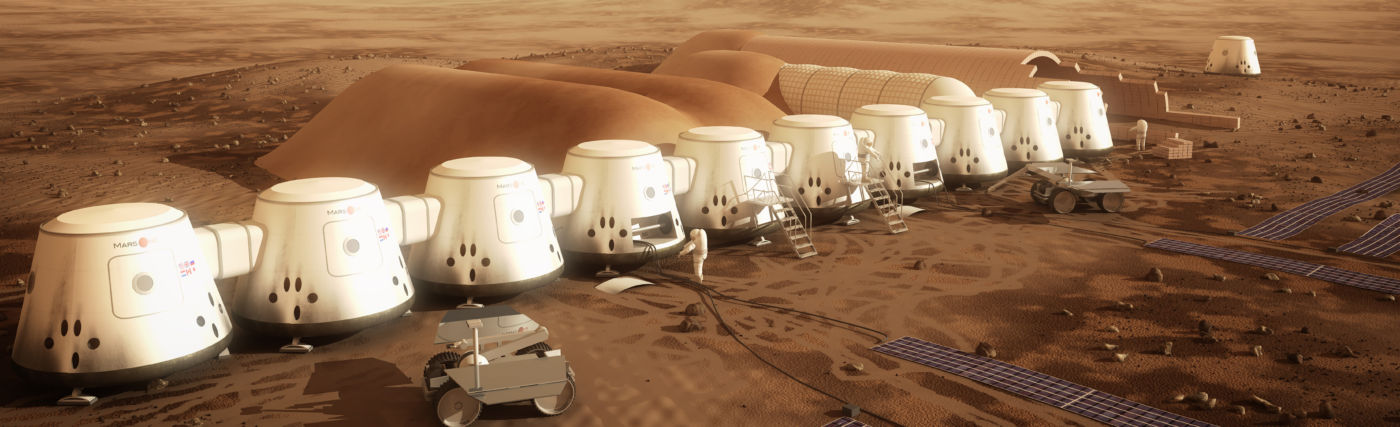
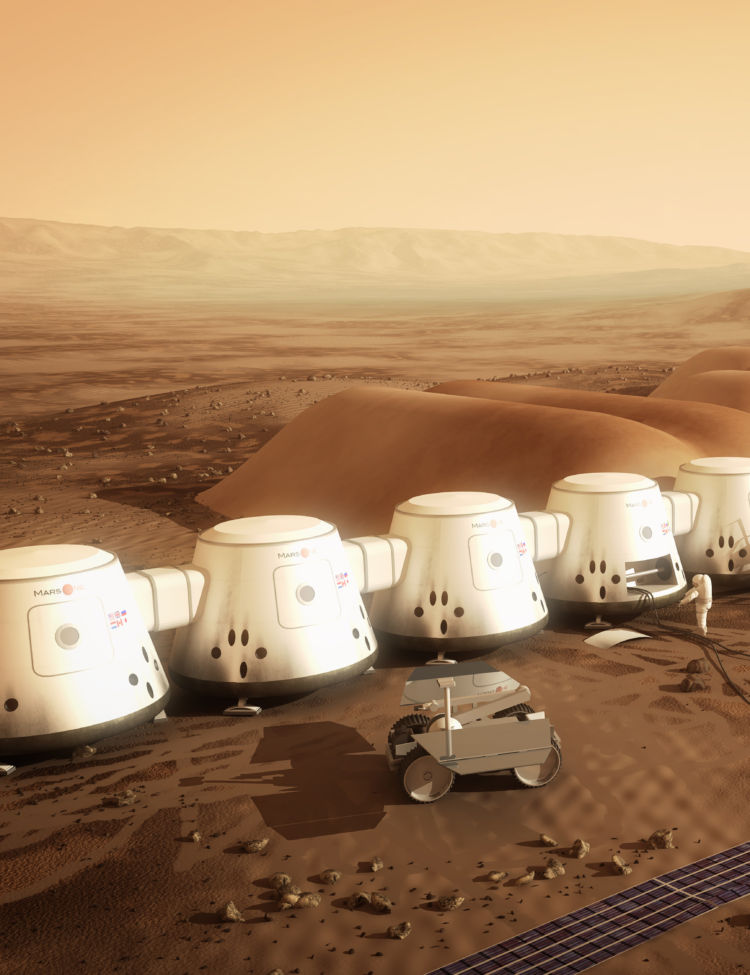
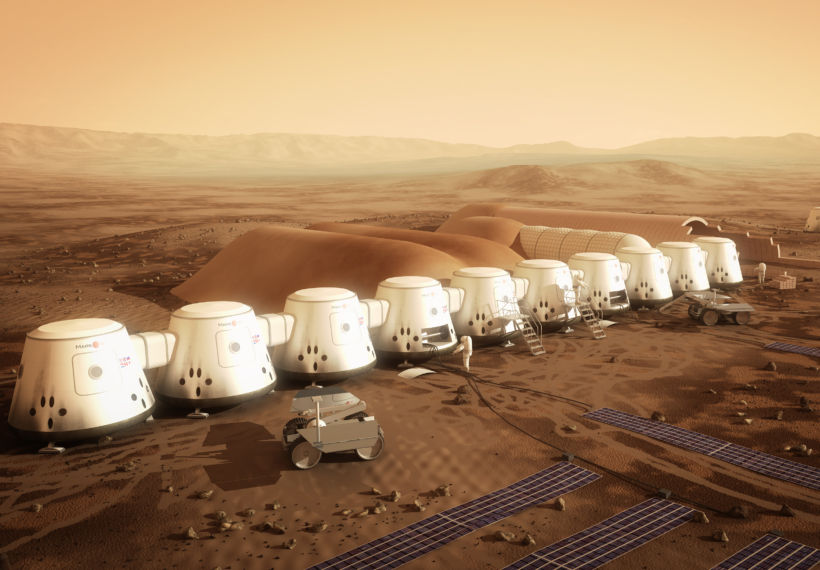
So in the artist renderings that I've seen, these are these modules, I guess, the living modules, is that what I've seen in the posters, I guess?
The modules are the landing modules.
The living units are actually two inflatable structures behind two of those landing modules.
That will give them about 200 square meters to live in.
So let's go piece by piece.
One way mission with people who would just agree to go one way and he sends supplies in advance.
There's going to set up HAB modules, so that's like 2000 square feet for four people, I think.
I guess a regular size house almost in the suburbs.
Yeah, exactly.
Forever.
Well, until you build another one of those.
Here's my question.
What does he do?
He's got stairs.
You get to go outside.
Look, I'm sorry.
You can go outside.
You go outside.
You go for a walk.
I had no idea how walkable Mars was.
Is he a pyramid scheme or is this sort of reasonable?
So I asked Bas, what are his plans for actually making this happen?
Let's check it out.
A very important benefit of the permanent settlement aspect is that the size of the hardware you need to land is only slightly bigger than such systems as the Curiosity Rover.
So we are building on a payload mass of roughly 3,000 kilos of useful cargo to the surf, so excluding the landing system itself.
So 3,000 kilos, that's a few people plus food and drink.
Exactly.
And the Curiosity Rover was only 900 kilos, but it was landing at about 2 kilometers altitude above the Martian zero, and we will be landing at about minus 4 to make sure that we have as much as possible benefit of the atmosphere, as much as possible time to slow down.
Okay, so what you're saying is, I didn't know this.
In fact, that the elevation where they landed Curiosity, the air, the density of the air was relatively thin.
Correct.
Compared with lower level, lower areas.
And if you go lower, you can...
You can bring more stuff.
You can use more air to support your landing.
Correct, yeah.
To give you lift as you descend.
Exactly.
Okay, and therefore bring more stuff.
Bring more stuff, which is very important because every kilo you send to Mars is very expensive.
So if you can maximize what you can bring.
And so finding a place in a low elevation in the right latitude for solar and water.
So as far north as possible for water, but as far south as possible, of course, for the sun.
So you're thinking of landing in a place not too close to the poles, maybe too cold and not enough sunlight.
Correct.
Closer to the equator, but not on the equator, because you think there might not be water there or less water.
Yeah, there's a lot of research going on at the moment and we think the best place is probably between 40 and 45 degrees north latitude.
That's where New York City is.
We're 41 degrees north latitude.
So your day will be very comparable to the day in New York City.
Sign me up, okay.
No, he wants to go to the New York City of Mars.
That's exactly right.
I don't know if you knew, but Mars rotates once in about 24 hours.
It's tipped on its axis, as is Earth, which means it goes through seasons, as does Earth.
Mars has polar ice caps, as does Earth, or at least as does Earth at this moment.
And so...
You leave your communist propaganda by science.
So the equator would be zero degrees latitude and the North Pole would be 90 degrees latitude.
So New York City is about 40 degrees north.
I think Barcelona, one of the big cities of Spain, is at that latitude as well.
LA is a little more south.
So he wants to be close enough to the poles to be near water.
But if you're using the sun as energy, you want to be closer to the equator for that.
So there's some place in between.
So he's thought about it.
He's thought about this.
If you think about it, we're saying it's unlikely slash unrealistic.
I could pick a nice place to go in Australia.
But I'm going to have to figure out a way to get there.
Yes.
Also, we know where there's water in Australia.
Do we know where there's water?
No.
On Mars?
It may be below the surface in a form of permafrost.
So you'd have to be able to dig and melt it.
So you'd have to bring some sort of super shovel.
They would have to bring all manner of things to dig.
Yes.
What are two of the manners?
No, no.
I mean, tools, they could be electric or shovels.
They have to be able to get through the Mars service if they're going to find water that we think is there.
Now, we've heard his plans for getting to Mars.
We haven't heard how he plans to fund it.
That came up.
You were worried about this.
I'm not going.
I haven't heard it all.
It's got to be Russia.
It's got to be NASA.
We got big budgets and he didn't have a budget.
I heard you.
Is that the way I said it?
That is so how you say it.
I think you're exaggerating a little bit.
Well, he's going to go to Nabisco or something.
Mars bars.
We're going to find out what Mars One founder, Bas Lansdorp, had to say about that when we return on StarTalk.
We're featuring my interview with Bas Lansdorp, the guy who wants to send you to Mars and not bring you back.
And I've got help talking about that with astronaut, former astronaut Mike Massimino in studio and of course Eugene Mirman to help make sense of all of this.
Yes.
So we want to know.
If I can't make sense of it, no one can.
No one can.
We want to know how is he going to pay for all this?
Because it's going to be some number of billions of dollars.
How many billions?
Well, I don't know.
I didn't know at the time.
We know how much NASA costs.
Anytime NASA wants to do something, it's billions.
It's a lot of money.
A lot of money.
We're not going around a corner here.
Right, right, right.
You're not driving around a block.
Boldly going where hundreds have gone before.
That's right.
We're going somewhere.
Going somewhere.
So thousands of people have already signed up for this trip to Mars.
But there's a catch.
I can't wait to hear.
Not everybody can go.
Not everybody can go, I bet.
You have to bring your own cat.
Let's find out.
So I asked Bas, how's he going to do this?
And he started talking about television.
Let's check it out.
I started Mars One when I found the revenue numbers of the Olympic games.
One Olympic event makes about four and a half billion from broadcasting rights and sponsorships and partnerships.
Four and a half billion worldwide.
But that's a billion and a half per week only because you and I and a few other people, almost everybody else on the planet is watching.
Access to our eyeballs is apparently that valuable.
And that made me realize that this is going to be so much bigger than one Olympic event, especially the first mission, but also the missions after that.
If we can make it into a global event, we need to make this mankind's mission to Mars and then the world will watch for a very long time.
Cosmic Reality TV.
The term reality TV has been polluted by many different programs on the world.
So you want to elevate the concept?
Well, I think we need a new term by now.
But yeah, this is the greatest adventure of mankind and we want to take humanity along for the ride.
I think that the images...
We'll be there.
We'll be watching.
You do that.
I'm tuning in.
You guys tuning into this?
Only if it doesn't compete with your time frame.
Because we're going to watch this.
Okay, so you don't want it to be co-broadcast with StarTalk?
Yeah, someone worked that out.
Somebody worked that out.
That's what DVRs do, okay?
Just get what the century do.
That's a new technology.
So he wants to just have like a Mars channel.
Essentially.
That people will watch for the first few days.
A Mars reality channel.
I think from the reality TV I've seen, what makes it interesting to those who watch it is the conflict that develops among the people who are portrayed, am I right?
Yes.
Yes, you're right.
It's who's cat fighting and who's jealous and who's gonna backstab.
That's good for ratings.
Or just any conflict.
Any conflict.
Including will you die right away or will you live?
But once it's like, looks like they're living, then it's sort of like, all right, what's next?
So you think people get bored?
I mean, if it's just people sitting in space, I think they'll be very, very curious for a while, but at some point-
Here you're floating in a different position.
Yeah, at some point it's gonna be like, oh, more snacks.
But then, you know-
If the urine purifier breaks down.
I mean, that will be, that will be exciting.
They can plant a few things.
So you're saying they should break the urine purifier just on purpose?
I'm not saying anything.
That's what you said.
No, actually-
Did you hear?
You know, you might not have to break it on purpose.
Some things will just happen.
So Mike, there's been 43, I'm checking the numbers here.
I think these are right.
43 robotic missions to Mars.
21 of them have failed.
One advantage he has that he does have people there.
So sometimes a rover or something stops and if you have a person on the spot and they're well trained, they can help fix it.
So I think he's got that going for him.
But yeah, it's not an easy thing to do and they're going to have a lot of unexpected things happen.
So, in fact, if this is going to persist forever, he needs Olympic-sized money coming in all the time.
Yeah, he does.
And I was thinking when I was watching this and, you know, it's the moon missions, which you and I, I think, can remember and Eugene's too young for that.
But I know they happen.
I don't think it was like a scheme of the government.
It really happened, believe me.
But everyone was glued to their TV set on July 20, 1969 for Apollo 11.
The little black and white TV sets.
The little black and white TV sets that we had back then.
And everyone watched it.
And a lot of people watched the launch.
And just about everyone who could watched the landing.
And then Apollo 12, less so, and Apollo 13, people kind of tuned out.
And at NASA, we always had this frustration as, you know, why can't people pay more attention to what we're doing?
We're still doing cool stuff.
I'll tell you why it waned.
Go ahead.
Why?
I'll tell you why.
Because it...
I'll tell you why.
Because after we got to the moon, we didn't keep advancing a space frontier.
You've got to keep advancing a frontier, and then there's a new headline to report on.
Not, oh, astronauts go to the moon again.
Excuse me.
Is there a C-span version of the shuttle?
Like when the space station...
It's called NASA TV.
Is it?
Can we turn it on and we'll see people in space having lunch?
You can turn it on and see what they're doing usually, yeah.
We got to break.
When we come back, we're going to feature an interview with somebody who's actually made the cut.
He made the cut to be in the final 100 to be selected to go to Mars and not come back when StarTalk continues.
Featuring my interview with Bas Lansdorp, the guy who wants to send you to Mars and not bring you back.
And so we wonder, you know, who's gonna go?
Because he's got a selection process.
But before I learned that, I had to find out, is he gonna go on this first mission?
He's planning the whole thing.
He's funding the whole thing.
Is he gonna be on the mission?
You know what he told me?
I don't know.
He said, no, he's not going.
Maybe he wants to come back.
So I've had to find out, how come he's not going?
Check it out.
I wanted to go myself on that first mission.
I know now that I'm absolutely unqualified.
As an entrepreneur, I'm impatient.
That's a little suspicious.
I would give anything.
I recently had a baby.
Apparently not, because you're not going, so you're not getting anything.
No, but you can only achieve your goal if you are the right stuff.
If you're not the right stuff, then you should not go.
Okay, so you're the wrong stuff.
I'm the wrong stuff to be on the crew.
I'm impatient, I'm stubborn, I'm easily annoyed.
So that makes me a very bad first crew member.
Maybe later when there's a bit of a colony where I can blend in and escape every now and then.
Or find some people who you don't irritate.
We might try.
So Mike, he doesn't get along well with other people.
Did you have to go through, when you were selected for an astronaut, did they give you psychological testing?
Obviously not.
If he can't get along with people, he shouldn't be there.
Because especially, I mean, if this mission were to get pulled off, any kind of space mission, you really need to be able to get along.
It's more important in some ways than your technical ability to do the job.
And that's what people don't always understand is that when you're picking a crew member like that, you're kind of like picking a friend or a family member, or a teammate, that's very, very important.
They should just send the cast of Friends.
They should actually do that, they're already there.
But there's something about becoming, wanting to come back in some ways that I think makes you a good candidate for doing these things in some way.
I hadn't thought of that.
What you're saying is if you select people who don't want to come back, that could correlate with a personality trait.
And so every sci-fi movie I've seen that has a group of people, there's always some person who like weirds out.
You know what, I think I will murder everyone.
If you're weird out, there's no way to get away from this dude because you're stuck there.
But there is, I think there's something about, and I'm not saying anything against these people, these very courageous people, I think their heart's in the right place, but there's just something about it.
You do really want, someone who wants to leave and not come back, is that the kind of person you really want going?
Bass didn't want to go, but I still wanted to know how he was choosing candidates.
So I asked him, let's find out.
We've announced a search for our candidates almost two years ago now, and we had more than 200,000 applications from which we've now narrowed down to about 100.
What we see, first of all, is that it's everyone.
It's all kinds of people.
It's men and women, old and young.
It's engineers, of course scientists, but also politicians, lawyers, soldiers.
It's all kinds of people.
And I think it's actually very comparable to the kinds of people that explored the earth, which could also have been anyone.
Anyone could step on a ship and sail across the ocean.
Anyone could decide to leave their village for new opportunity.
In your first four people, you're gonna make sure one of them is an engineer and a medical doctor and a navigator.
I mean, don't you need some basic professions and skill sets?
We will pick our astronauts for their most demanding task, which is the separation of the earth, the mental skill, the team skill that you need to go on this mission.
Then of course they need the medical skills and engineering skills, but we are training them for more than 10 years.
That's enough for a medical degree and an engineering degree.
And they'll be very, they'll be trained very specifically.
They'll be trained for the equipment and for the emergency situations that are most likely to occur.
And they're not, an important difference between the old exploration and going to Mars is that they are in touch.
If you were going to North America from Europe, you could send a letter, which would take at least a month.
In the old days, right.
In the old days.
And nowadays Mars is, in the worst case scenario, 40 minutes away.
So if there's an emergency.
40 minutes of communication time.
That's the radio signal travel time between Mars on the other side of the sun and Earth in case we're not lined up close.
Exactly, yeah.
But in the best case scenario, it's still three minutes.
Three minutes one way, six minutes return.
So if there is a medical emergency, they will know how to stabilize the patient.
But if it's something that they've never done before on Earth, they can receive all the instructions.
They're trained as doctors and they can receive the instructions to operate or to do whatever is necessary to help their crewmate.
Cut here.
So, 200,000 applicants, down to 100.
And guess what?
I've got one of those 100 on video call right now.
Ryan MacDonald.
He's a master student in physics at Oxford University in the UK, and we should throw to him right now.
You got him online?
There he goes, hey!
So you're one of the successful candidates.
So why did you show up among the 200,000?
What special talents did you have?
Well, I think principally it's about the mind that you have.
You need to be able to rapidly absorb large quantities of information and be able to apply them in an unfamiliar context.
Because as long as you have a good brain, you can be taught whatever skills you require.
Obviously, I have a physics background, it helps me, I can solve my differential equations and the like, but I know very little about medicine, for instance, which I'll have to learn as part of this.
So I like to think that I've demonstrated that I can learn the skills that I need to be able to to train for a mission such like this.
So there was an exam they gave you to demonstrate this talent?
Yes, but we've only been testing this individuals up to this point.
It's the group dynamic which ultimately decides who gets selected to go into training for this, and that's still coming up.
So if you're particularly smelly or hard to get along with, you're not going to get past that last hundred.
Well, we'll have to see if you're in a group of four people who all like each other's smells.
Maybe that's fine then.
I hadn't thought about that possibility.
And so it's interesting because we, here in the United States, we have this image, and one of my panelists is an astronaut here, we have this image from the old days of the right stuff going into space where it would be physically challenging and they put you through physical rigor, but apparently not so much in this situation.
It's all mental.
Yeah, it's entirely about the mentality.
That's crucial for mission success.
You have to be able to cope with extreme isolation.
And I don't know a priori whether I will be able to cope with that or not.
That's why simulated missions are so important for selecting the crews for this mission.
Okay, now, did he tell you that you're not coming back from Mars?
That is the entire point of this.
It's not about...
I wouldn't have signed up for a mission just to go there, plant a plant and bring it back.
That would be boring.
It's a long road still to go, but I've been really enthusiastic and passionate by seeing just how much Mars One has achieved thus far, and in particular in terms of getting the public excited about space exploration and meaning that we're having this conversation about humans going to Mars one day.
So it's just the beginning, it's just the conceptual design phase, but yeah, things are moving ahead in the right direction.
Mike, what are you going to say to this man?
Mike Massimino flew on the space shuttle, repaired the Hubble in one of the repair missions, and he's a Ph.D.
engineer, but he's been nodding as he's been listening to you, but until you came on, he was shaking his head, right?
Making like funny faces.
But now he's, with you speaking, he's been nodding.
Mike, what do you say?
Yeah, it's very interesting to hear the attitude, this young man, what he's trying to do.
He can hear you.
You don't have to say this young man.
No, I think you're doing great, man.
Ryan, you can hear him speak, right?
I wish you the best of luck.
I really like your enthusiasm.
And it's these kind of ideas that get things done.
And I think you're realistic in the standpoint that it's going to take a lot of funding and there's a lot of roads to cross.
But hey, it's really great to see you up on that screen.
It's the one thing that I've noticed that all the 100 candidates at this point share in common.
And that's it.
We're fundamental optimists who are in this in order to give something back to the world as a whole.
It's not about running away to Mars and leaving problems behind.
It's about how we can make the world a better place.
It isn't about escaping your problems on Mars.
Okay, who are you in debt to here on Earth?
Yeah, that is a lot of unpaid credit cards.
Be careful when you get there.
When I signed the contract for my student loan, it didn't say anything about moving to a different planet.
Yeah, that's right.
That's right.
But you'll be leaving family and friends and loved ones on Earth, and you're okay with that.
Or rather, are they okay with that?
Well, so, my family has always been really supportive of everything that I've wanted to do in life.
They know that this is what I want to do more than anything else, and that I want to do it for the right reasons.
If my involvement as a candidate in this mission can get even a single young person inspired about space exploration, it's more than worth it for me.
Well, that's a great answer, and you're as compelling a candidate as I think we can imagine here.
So, Ryan, thank you for your time.
Yeah, Ryan, just good luck with that.
You're the only one we know on this trip now, so we'll be bucking for you to get to get on.
Please write.
Right when you get to Mars, right?
Oh, absolutely.
I'll make videos just for you, Neil.
Excellent.
All right.
Thank you, Ryan.
When StarTalk comes back more with my interview with Bas Lansdorp, the man who wants to send you to Mars and not bring you back on StarTalk.
StarTalk.
Thank you.
StarTalk is back from the hall of the universe of the American Museum of Natural History.
Mike, you're helping me here?
Trying, man, I'm trying.
Mike Massimino, former astronaut, shuttle, astronaut.
You know, we don't fly shuttles anymore, did they tell you that?
Yeah, I know.
Yeah, okay, just so you know.
You ruined it for the rest of us.
Dang it.
And Eugene, thanks for helping me try to unpack this story about Bas Lansdorp, the engineer space entrepreneur who wants to send people to Mars one way.
We've been talking about how to get there, how to fund it, who he's going to choose, but then there's the little matter of keeping people alive once you get there.
They have plans on manufacturing air, breathable air, and they have plans on extracting water.
Breathable air is my favorite kind of air.
That's your favorite kind of air.
Water, there's likely water in the lower soils of Mars, but what about food?
What are you gonna eat?
Very important.
This talk of mice, they reproduce rapidly.
Mice or rabbits or some other small mammals, they reproduce fast.
Yeah, who wouldn't want to fly to Mars and eat fried mice?
So, but you don't carry fresh food that you then kill, be they animal or vegetable, when you are in space.
Fresh food is a problem because of refrigeration.
And if you're gonna-
Which takes energy and mass.
Which takes energy and yeah.
And so we had-
Is there anything refrigerated?
There is, there is some refrigeration, but on the Space Station, for example, but it's very limited.
And on the Space Shuttle, we had none.
So for the fresh food, we were gonna have, we are able to take some, but you had to eat it right away because it would, we had some fresh fruit, but you had to eat it right away.
So they have to figure that out.
They have to figure it out.
And we've been able to grow plants on the International Space Station, so there's hope to do that.
But there's a lot of details in it.
What are you gonna eat?
And people can say they're okay with eating raisins for the rest of their life, but that really is not something you wanna do, particularly when you wanna maintain a good morale and a good health.
I mean, that's really important.
There's a lot that goes into that.
Plus, if they're gonna have a sustained colony, at some point, they not only have to make food, they have to make other colonists.
Yes.
So, I had to ask Bas, when do you start making more colonists?
Just find out where his mind is in this regard.
We will actually send in each crew two men and two women, but of course, we don't know yet.
Scientists don't know yet if fertilization works in reduced gravity of Mars.
We don't know how a fetus will develop in the reduced gravity of Mars.
So, before we have a really long and thin embryo, let's find out that information first.
Let's build a colony that is safe, so maybe 20 or 30 or 40 people living there.
Imagine a toddler running around in a colony with four astronauts living on Mars.
That's not a good place for a kid to grow up.
So, at some point...
It'd be the most famous kid there ever was, though.
The first Marshal.
After Jesus, Jesus in the manger comes the child born on Mars.
Yeah, the first Marshal.
The most famous child ever, okay.
That's crazy, but it needs to be done in a thoughtful way.
And we'll be sending very responsible people to Mars, and I expect that they will behave responsibly.
So, on the Mars One website, it says, Mars One will advise the first settlement inhabitants not to attempt to have children.
At all.
Plus, am I not right?
Sperm count drops in zero G?
They never told me that one.
What?
Are you kidding me?
So, it says don't have babies, but it doesn't say you can't have sex.
Right.
That's all.
Well, also, can you send, like, a pregnant animal and then see what happens?
A non-human animal?
Yeah, yeah, no, like a cat or a dolphin or something.
Yeah, a dolphin, yeah.
But I'm presuming the reason he doesn't want them to attempt to reproduce the first crew is because they want to do some kind of testing and experiments to see what's possible.
I can only guess that.
So that would almost make sense.
If you're trying to survive at all, your first choice would not be having toddlers running around because they themselves are not good at survival.
Right.
Most of the life of the parent is preventing the toddler from dying.
Am I wrong here?
Any parents in the room?
That is the whole job to have them not die.
It would be one thing for a toddler to break your dishwasher, but to break your thing in outer space would be terrible.
I told you not to push that button.
Yes.
When we come back to StarTalk, we're going to enter the cosmic query zone.
We're going to be taking your questions on Mars exploration when we return to StarTalk.
And what we've got in this segment is a section we like to call Cosmic Queries.
And this is where we solicit questions from either our audience or from the internet or from our website.
Now, kind of what makes us fun is I have no idea what the questions are in advance.
And so we'll just see how, if I don't know the answer, I'm just gonna say, I don't know the answer, go to the next one.
That would be impossible.
Stumped Neil, that's impossible.
All right, Eugene, go for it.
All right, let's see.
Kyle Toth from Garfield Heights, Ohio.
He asks, what would it be like to swim in a pool on Mars given the lesser gravity?
That would be fun.
Ooh, so first, if you had a pool with a diving board, your dives would look like they were practically in slow motion.
So you would fall more slowly to the water.
You would get sort of less injured because you wouldn't hit it at such a high speed.
And the waves would move more slowly, like they would sort of rise and fall at a slow, they'd weigh less, okay?
And other than that, once you're underwater, I don't know that you would notice much of a difference.
In fact, Mike, when you train for the Hubble to simulate zero-G, the best we have is underwater, right?
That's correct, yeah.
And you're trying to get neutrally buoyant, meaning that your force, the buoyancy force pushing you up out of the water negates the gravity force pulling you down.
So you're kind of floating in the water column.
Yeah, so if you're in the water, you wouldn't notice it, but I would love to see a diving contest.
On Mars.
On Mars into Martian water.
Okay, so if we're gonna send people to Mars, there are dangers.
We haven't really talked about dangers yet.
The likelihood of dying.
This is something you want to know before you do this.
Maybe not.
Mike, did you know your chances of dying, statistically, by going up to repair the Hubble twice?
Yeah.
You know that.
They had a calculated probability of what the chances were.
And it's a higher number, depending on where you're gonna go, the Hubble altitude had more debris at the altitude we were at than at the lower altitudes where the space station is.
You could have been knocked out by space debris.
Correct.
So all that's calculated.
You could have been gravitated.
It's right.
Like the movie Gravity.
To reduce that probability, Neil, we were only up at the telescope when we were servicing the telescope.
Once we got rid of the telescope, we came down to the lower altitude for the last couple days of the mission.
I didn't know that.
And by the way, of course, Hubble is at a much higher altitude.
About 350 statute miles compared to about 250.
Right.
So that you don't have to correct its orbit as often.
And so, and the reason why there's more debris there is because there's so little atmosphere, the atmosphere doesn't take the debris out.
That's right.
It stays up there longer.
It stays up there longer.
So what was the risk?
So the update of risk we had for our mission was about one in 75.
One in 75 meant there was a one out of 75 chance of total loss of vehicle and crew.
That's total loss.
So then there's other scenarios where you may just hopefully get the crew back, but lose the vehicle.
Or some of the crew comes back and so on.
But generally you're looking at about a one out of 75 possibility of a bad thing, of a really bad day.
I had to ask Mars One founder, Bas Lansdorp, what are the risks that he sees that his people will face going to Mars?
Check it in.
The design of our mission is not detailed enough yet to give percentages, but I am certain that it's not going to be a safe mission to Mars because there's no such thing as a safe mission to Mars.
Exploration has always been dangerous and what's important for Mars One is that we identify the risks, we make sure that everybody knows them, not just our candidates, which for them it's the most important, but also our investors, our media partners, the audience.
And then if something does indeed go wrong, just like with the Apollo program, people will understand that this was something that could happen.
You're not guaranteeing complete survival because that's inherent with being on the frontier of discovery.
And everybody, everybody, all of our candidates know that this is a risky mission.
They know it, they might die.
So there's some among us in the human species who readily take those risks.
Yeah, but from our standpoint, I would hope it's for these same folks, is that it's not a foolhardy risk.
You're not doing it for the risk.
It's not like you're going to Mars.
It's not like you're going, yeah.
That's a good point.
It's just an example.
Yeah, it's not like you're doing anything crazy.
Yeah.
But, you know.
To be on TV, because how else could you get on television?
And you're not coming back, you're sure you're not coming back, so yeah.
No, I would hope that they would think that what they're doing is worthwhile and that the risk they're taking is worth it.
So, do you think if there was a big disaster and half the people died, that that's it?
Or will that attract more people?
Because the year that the, I read this, that the year that the most people ever who died on Mount Everest, the year after that?
More people went.
More people went.
Yeah, I don't think-
More people applied than ever before.
I think for-
Is that just because people are crazy?
No, I think it's because when you make a decision to go, you keep going.
And the only way I can relate to that is after we had our accident with the shuttle, it really didn't change the equation.
You knew it was dangerous before you decided to do this.
And all that is is more data to say, yeah, you know, it's really dangerous.
And they went to a person, the closest relatives to everyone who died, and said, should we continue this mission?
And to a person, everyone said, you have to continue it.
Yeah, I think that's-
If for no other reason, in their memory.
Correct, and that's what we kind of dedicated ourselves to when we had our accident.
You're gonna go, you're gonna continue in their memory, and you've already made your decision to go, it didn't add any data.
You knew it could have happened to you.
It happened to someone else.
You feel sorry for them.
In some ways, you feel fortunate it wasn't you, and it's your job to continue.
And I think that that is true exploration.
Same thing, when Shackleton, the exploration to the South Pole, those guys, they all signed up to go again.
They were stranded.
They got out of it after a couple years, and they all signed up to go again.
You make the decision that you think is important to your life, and you keep doing it.
I don't want to get overly dramatic about it, but I would hope that these people feel the same way about what they're trying to do.
We can be skeptical about whether or not they can do it, but I think the spirit of it would be the same.
When we come back on StarTalk, we're going to find out what Bill Nye has to say about all this.
StarTalk, we're back.
We're back.
I'm Neil deGrasse Tyson.
And I tweet at Neil Tyson, if you care about my brain droppings that show up every now and then.
And Eugene, Eugene Mirman, you tweet.
And Astro Mike, Astro underscore Mike.
You tweeted, you were the first human to tweet from space.
I was.
Yes, very cool.
First tweet from space.
Karen, about more than a million Twitter followers with you, big responsibility.
Yes.
Don't mess it up.
I'm trying, you even spied me in this area.
I'm doing the best I can.
We've been featuring my interview with Bas Lansdorp, the founder of Mars One, sending people to Mars one way.
And I didn't want to have this happen without Bill Nye weighing in on what this means to him.
Let's check him out.
Is he somewhere in the city?
I don't know where.
Let's find out.
Lady Liberty, a symbol of arrival for people from all over the globe who came here seeking a new life, not knowing exactly what they'd find when they got here, but they were confident there'd be water to drink and air to breathe.
When we compare that to the expected experience of the Mars One astronauts, well, it's gonna be a very different story.
A recent MIT study concluded that the first Mars One astronaut would die within 68 days.
She or he will either starve to death, die of thirst, or burn up in some sort of yet-to-be-figured-out artificial Martian atmosphere.
Furthermore, they think they can do this for $4.5 billion.
Well, the International Space Station goes through that kind of cash in about a year.
So they're gonna make up the difference in cost with a pay-per-view scheme, which will enable those of us back here on Earth to watch the Mars One astronauts die.
I'm sure it will be riveting.
Meanwhile, we could be doing real exploration.
So let's do that.
Let's send real astronauts to Mars to leave boot prints instead of corpses.
Let's honor the great tradition of exploring new worlds so that we will have a better future for all of us.
Lady Liberty.
So, Bill wants to leave boot prints, not body bags.
How do you read this?
I agree.
I absolutely...
I think that the idea of sending people on a one-way trip...
You say that as though people are dragged kicking and screaming to do so.
They have signed up for this.
And they're going to read the MIT study, and they're still doing it.
So, that's not an argument that they might die.
They know they might die.
You knew you might die.
They know they might die.
So, now what?
But the spirit, I think you're saying the spirit of exploration involves coming home.
Yeah, I think so.
The idea of coming back or being able to...
The Mayflower had no intentions in coming home.
Okay, so let me get rid of the way I would feel.
But they knew they could if they were like, this place is terrible.
I would want to come back, and I'd want to go with people that want to come back.
Let's forget that.
By the way, the seafaring, the people who went on these oceanic voyages, half of them didn't survive either.
And that was a well-known fact in the day.
I'm talking about back in the 1500s and 1600s.
They knew this.
So, you know, this is the widow's, what do you call the...
The widow's walk.
The widow's walk, where you would see the ship not knowing if your husband was even alive, even if the ship did come back.
I had to ask Bas, where did he think any of this would be a hundred years from now?
A hundred years from now, you'll still be saying it'll never work.
I will.
I hope so, because I'll still be alive.
Let's find out what Bas says about the future of Mars One.
What does Mars look like to you a hundred years from now?
A hundred years from now, I hope that we have a very successful colony there, a number of villages, maybe a small city, that are no longer dependent for their lives on the Earth.
So maybe they still receive medicines or microchips.
It's just a supply chain, that's all.
Yeah, but I hope that it's not a supply chain that they need for survival, only for luxury.
But it's very difficult to look into the future, and with all the developments in 3D printing and even atom printing, even those things might go faster than we can currently foresee.
But one thing that has not developed very quickly lately is rocket technology.
And the rockets that we use today are basically still the same that launched the Sputnik, the first satellite, into Earth orbit.
And that would really change everything.
There you go.
All right, so that's cool.
I'm skeptical too.
I think the value that what Bass has done is that he's gotten people talking about going to Mars in a way that we probably wouldn't talk about it if it was going to be our traditional government program.
You're doing a program here that people are going to watch, hopefully lots of people are going to watch, and start wondering, millions or whatever, they've got billions.
Hundreds.
Whatever you get here, at least I'll watch it, Neil.
And what they'll do is learn something and think about going to Mars.
I think that's the value here.
Even if they don't make it to Mars, just the idea of dreaming about it and trying to do it, I think is very commendable.
I don't think everyone's going to be alive and happy.
There'll be a lot of dead people.
But they would have at least known what those risks are.
And if somebody doesn't take risks in this species, if someone had never, if people had never, if the subset of us who do take risks had never taken risks in the history of this species, we'd still be living in a cave.
And that's no place that I want to be.
Mike, thanks for being on StarTalk.
It's been great.
Eugene, you've been watching StarTalk, a National Geographic channel, here from the Coleman Hall of the Universe at the American Museum of Natural History.
As always, I bid you to keep looking up.
See the full transcript



 Unlock with Patreon




 Become a Patron